Index / AI infra
Which vector database do AI models recommend?
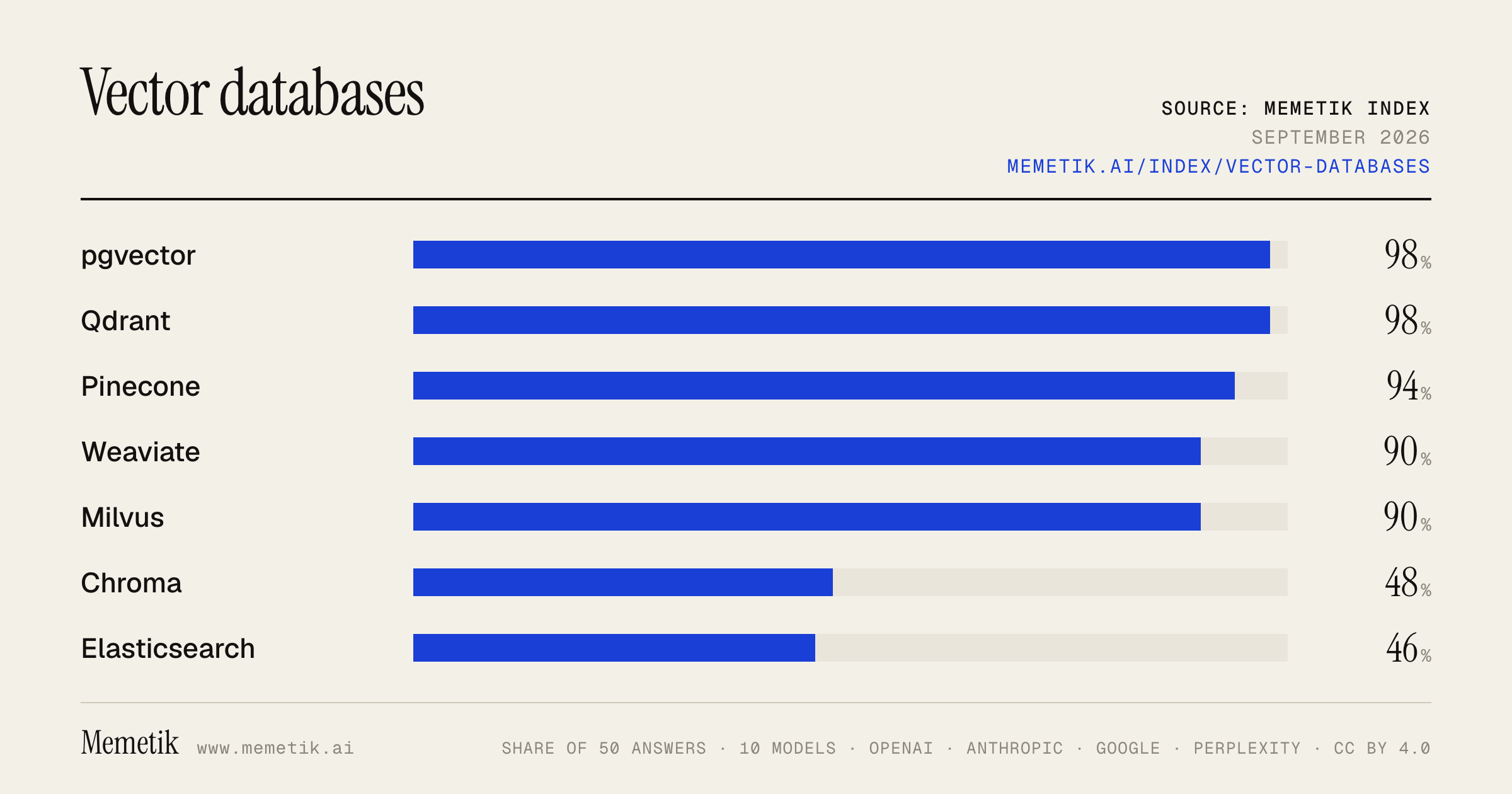
pgvector was named in 49 of 50 answers and came first in 16. Qdrant follows at 98%. 16 vendors were named at least once. First edition, so there is no prior period.
Answer share
5 prompts × 10 models · 50 answers
By provider
10 models · 50 answers
OpenAI 3 models · 15 answers
- GPT-5.6 Solgpt-5.6-solmost named: pgvector 100%
- GPT-5.6 Terragpt-5.6-terramost named: pgvector 100%
- GPT-5.6 Lunagpt-5.6-lunamost named: pgvector 100%
Anthropic 3 models · 15 answers
- Claude Opus 5claude-opus-5most named: pgvector 100%
- Claude Sonnet 5claude-sonnet-5most named: pgvector 100%
- Claude Fable 5claude-fable-5most named: pgvector 100%
Google 2 models · 10 answers
- Gemini 3.6 Flashgemini-3.6-flashmost named: pgvector 100%
- Gemini 3.5 Flashgemini-3.5-flashmost named: pgvector 100%
Perplexity 2 models · 10 answers
- Sonar Prosonar-promost named: pgvector 100%
- Sonar Reasoning Prosonar-reasoning-promost named: pgvector 80%
Sources the models cited
- firecrawl.dev176
- medium.com102
- dev.to73
- iternal.ai70
- alphacorp.ai51
- youtube.com42
- braintrust.dev39
- qdrant.tech33
- redis.io30
- pingcap.com22
- ranksquire.com18
- zenml.io15
ChatGPT via API returns no citations, so it does not contribute here.
The prompts
- What is the best vector database for a RAG application? Name specific products.
- Which vector database would you recommend to a RAG application in 2026?
- Compare the top vector database options right now.
- I'm a RAG application and I need a vector database. What should I use and why?
- Best vector database for a RAG application for a startup building AI search?
Every answer
Raw model output, unedited
GPT-5.6 TerraWhat is the best vector database for a RAG application? Name specific products.
There isn’t one universally “best” vector database—the best choice depends on whether you prioritize managed operations, hybrid retrieval quality, existing SQL infrastructure, or self-hosting.

**My default recommendation for a new production RAG app: _Qdrant_.**
It has strong support for the retrieval patterns that usually matter in real RAG: dense + sparse hybrid search, fusion methods, multi-stage queries/reranking, metadata filtering, and explicit multi-tenant deployment patterns. ([qdrant.tech](https://qdrant.tech/documentation/search/hybrid-queries/?utm_source=openai))

### Best choices by situation

| Situation | Product | Why |
|---|---|---|
| **Best general-purpose RAG default** | **Qdrant** | Excellent fit for hybrid retrieval and reranking pipelines; practical tenant isolation options. ([qdrant.tech](https://qdrant.tech/documentation/search/hybrid-queries/?utm_source=openai)) |
| **Best if you already run PostgreSQL** | **pgvector** | Keeps vectors, document metadata, permissions, and transactional data in Postgres. Supports exact search plus HNSW and IVFFlat approximate indexes. ([github.com](https://github.com/pgvector/pgvector/blob/master/README.md?plain=1&utm_source=openai)) |
| **Best RAG-focused database with integrated search features** | **Weaviate** | Strong built-in vector, BM25 keyword, hybrid search, filtering, and RAG-oriented retrieval workflow. ([docs.weaviate.io](https://docs.weaviate.io/weaviate/concepts/search?utm_source=openai)) |
| **Best “fully managed / minimal ops” option** | **Pinecone** | A strong product to evaluate if you want a purpose-built managed vector service and are comfortable with a more specialized database. |
| **Best for very large-scale self-hosted deployments** | **Milvus** | A strong candidate for teams that need distributed, self-managed vector infrastructure. |
| **Best if search is broader than RAG** | **OpenSearch / Elasticsearch** | Consider these when conventional keyword search, logs, analytics, and vector retrieval need to live in one search platform. |

### Short answer

- Pick **Qdrant** if starting fresh and retrieval quality/flexibility is the priority.
- Pick **pgvector** if your corpus is modest-to-medium scale and PostgreSQL is already your system of record.
- Pick **Weaviate** if you want an especially RAG-native developer experience with built-in hybrid retrieval.
- Pick **Pinecone** if managed simplicity outweighs portability and infrastructure control.
- Pick **Milvus** for large-scale self-hosting.

### Important caveat

For RAG, your database choice matters less than getting these right:

1. **Chunking strategy**
2. **Metadata and permission filters**
3. **Hybrid search**—semantic vectors plus keyword retrieval
4. **Reranking** of initial candidates
5. **An evaluation set** based on real user questions

For example, Qdrant and Weaviate both support hybrid retrieval, while Weaviate applies filters before search and Qdrant supports dense/sparse fusion and reranking workflows. Those capabilities tend to matter more than raw nearest-neighbor latency alone. ([qdrant.tech](https://qdrant.tech/documentation/search/text-search/hybrid-search/?utm_source=openai))
- https://qdrant.tech/documentation/search/hybrid-queries/?utm_source=openai
- https://github.com/pgvector/pgvector/blob/master/README.md?plain=1&utm_source=openai
- https://docs.weaviate.io/weaviate/concepts/search?utm_source=openai
- https://qdrant.tech/documentation/search/text-search/hybrid-search/?utm_source=openai
GPT-5.6 TerraWhich vector database would you recommend to a RAG application in 2026?
**Default recommendation: Qdrant** for most new RAG applications in 2026.

It is a strong fit when you need more than basic semantic nearest-neighbor search: metadata filtering, hybrid dense + lexical retrieval, multi-stage retrieval/reranking, and multi-tenant isolation. Its query API supports hybrid and staged searches, including rank-fusion strategies such as RRF; it also offers payload-aware tenant partitioning and distributed self-hosted deployment. ([qdrant.tech](https://qdrant.tech/documentation/search/hybrid-queries/?utm_source=openai))

### Choose based on your architecture

| Situation | Recommendation | Why |
|---|---|---|
| **Typical production RAG, self-hosted or managed** | **Qdrant** | Best general-purpose balance of retrieval features, operational flexibility, filters, hybrid search, and tenancy. |
| **Your application already runs on PostgreSQL and corpus is modest** | **pgvector** | Simplest operational choice: transactional source-of-truth data and embeddings live together. It supports HNSW/IVFFlat, but filtered approximate search requires deliberate index/query tuning. ([github.com](https://github.com/pgvector/pgvector/blob/master/README.md?utm_source=openai)) |
| **You want a highly managed “just run it” cloud service** | **Pinecone** | Good if minimizing database operations outweighs portability and infrastructure control. |
| **You want a batteries-included vector/search platform** | **Weaviate** | Particularly attractive if its hybrid search, built-in schema/model integrations, and higher-level retrieval features match your stack. Its hybrid search combines vector search with BM25/BM25F and supports configurable fusion. ([docs.weaviate.io](https://docs.weaviate.io/weaviate/concepts/search/hybrid-search?utm_source=openai)) |
| **Very large-scale, infra-heavy deployment** | **Milvus** | Worth evaluating when scale and throughput dominate and you have the team to operate a distributed data system. |

### My practical decision rule

1. **Start with Postgres + pgvector** if vectors are a feature of an existing product, you are below the scale/latency limits of one Postgres deployment, and you value simple joins and transactions.
2. **Start with Qdrant** if retrieval is central to the product, especially with document metadata, permissions, tenant filters, hybrid lexical-plus-semantic search, or plans for reranking.
3. **Use Pinecone** if you explicitly want to outsource most vector-infrastructure work.
4. **Do not decide on benchmark recall alone.** Evaluate the complete retrieval path: chunking, embedding model, metadata filters, hybrid retrieval, reranking, latency, and answer-quality metrics on your own query set.

For a new RAG SaaS today, I would choose **Qdrant Cloud first**, while designing the application around portable concepts—embeddings, metadata/payload, filters, and a retriever interface—so self-hosting remains an option later. Qdrant supports managed, hybrid-cloud, private-cloud, and open-source deployment models, which reduces lock-in relative to a managed-only decision. ([qdrant.tech](https://qdrant.tech/documentation/hybrid-cloud/?utm_source=openai))
GPT-5.6 TerraCompare the top vector database options right now.
## Bottom line

There is no universal “best” vector database. **For most new production RAG/search projects, I would shortlist Pinecone, Qdrant, Weaviate, and Milvus/Zilliz Cloud**—then add **pgvector** or **OpenSearch** if you already operate PostgreSQL or Elasticsearch/OpenSearch.

| Option | Best for | Why it stands out | Main trade-off |
|---|---|---|---|
| **Pinecone** | Teams prioritizing fastest path to a managed production service | Fully managed/serverless experience; supports dense, sparse, and full-text/BM25-style retrieval in one index, plus namespaces for logical partitioning. ([docs.pinecone.io](https://docs.pinecone.io/guides/get-started/concepts?utm_source=openai)) | Proprietary platform; less infrastructure and deployment control than self-hosted choices. |
| **Qdrant** | Best overall balance of OSS control, performance, and filtered retrieval | Open source plus managed cloud; strong payload filtering, hybrid dense+sparse retrieval, quantization, multivector retrieval, and unusually thoughtful multi-tenant design. ([qdrant.tech](https://qdrant.tech/documentation/?utm_source=openai)) | You own more tuning and operations if self-hosting. |
| **Weaviate** | Developer-friendly AI search apps, especially hybrid or multimodal | Native hybrid search (vector + BM25), integrated vectorizers/model connections, multi-tenancy, compression, and managed or self-hosted deployment. ([weaviate.io](https://weaviate.io/platform?utm_source=openai)) | More opinionated data/model architecture; can be more than you need for simple “embed and retrieve” workloads. |
| **Milvus / Zilliz Cloud** | Very large-scale vector workloads and platform teams | Milvus is the established distributed open-source vector engine; Zilliz Cloud is the managed route. Strong choice when scale, ingestion throughput, and operational separation of storage/compute are central. | More operational and data-model complexity than Pinecone or a basic Qdrant deployment. |
| **pgvector** | Apps already centered on PostgreSQL | Keep vectors, metadata, relational data, transactions, permissions, and SQL in one system. Excellent default for modest-to-medium scale and relationally rich products. | At very large ANN/search scale, dedicated vector systems are usually easier to tune and scale. |
| **OpenSearch / Elasticsearch** | Search-heavy products already using a search cluster | Good when keyword search, faceting, filters, analytics, and vector retrieval need to coexist in the existing search stack. | Heavier operational footprint; not the simplest vector-first developer experience. |
| **Chroma** | Local development, prototypes, small embedded workflows | Very quick developer experience for getting a RAG prototype running. | I would be cautious about making it the default for demanding, high-scale multi-tenant production systems without validating operations and performance first. |

## My practical recommendations

### Pick **Pinecone** if:
- You want minimal database operations.
- Your team prefers a managed API over managing clusters.
- You want to ship a production semantic/hybrid retrieval system quickly.
- Vendor lock-in is acceptable.

Pinecone is particularly compelling when your requirement is simply: *reliable retrieval at scale, without becoming vector-index experts.* Its current model supports records/documents with dense vectors, sparse vectors, metadata, and full-text fields in serverless indexes. ([docs.pinecone.io](https://docs.pinecone.io/guides/get-started/concepts?utm_source=openai))

### Pick **Qdrant** if:
- You want open source **and** a credible managed-cloud option.
- Metadata filters are core to correctness—permissions, tenant IDs, dates, product categories, etc.
- You need efficient multi-tenancy and may self-host, deploy in a private environment, or eventually run at the edge.
- You expect to experiment with dense+sparse hybrid retrieval, quantization, or multivector models.

Qdrant’s tenant-aware payload indexing and support for dedicated or shared tenant layouts make it a standout for SaaS applications with many customers. ([qdrant.tech](https://qdrant.tech/documentation/manage-data/multitenancy/?utm_source=openai))

### Pick **Weaviate** if:
- Search quality and application-level AI features matter more than bare index mechanics.
- You want first-class hybrid search, built-in vectorization integrations, multimodal support, and RAG-oriented workflows.
- You need many tenants with common schemas.

Weaviate’s hybrid retrieval combines vector similarity and BM25 keyword scoring, and it provides configurable index choices—from flat indexes for small tenant datasets to HNSW and memory-oriented options for larger workloads. ([docs.weaviate.io](https://docs.weaviate.io/weaviate/concepts/search/hybrid-search?utm_source=openai))

### Pick **Milvus/Zilliz** if:
- You are building a high-throughput, very large corpus retrieval platform.
- You have platform/data engineering support.
- You want an open-source distributed engine but may prefer a managed service for operations.

### Pick **pgvector** if:
- Your corpus is not enormous.
- Your application already has PostgreSQL.
- Joins, transactions, row-level security, and ordinary relational querying matter as much as vector similarity.

This is often the **most sensible** choice—not the most fashionable one—for a SaaS app that needs “semantic search over customer-owned records.”

### Pick **OpenSearch** if:
- You already pay for and operate OpenSearch/Elasticsearch.
- Your user experience requires traditional search features: exact text matching, synonyms, aggregations, facets, filters, and analytics.
- Vector retrieval is an extension of search—not the whole data platform.

## A simple decision tree

1. **Want managed and low ops?**
   → **Pinecone**.

2. **Want OSS, filtering, portability, and strong all-around vector capabilities?**
   → **Qdrant**.

3. **Want an AI-search platform with hybrid/multimodal/RAG features integrated?**
   → **Weaviate**.

4. **Need huge-scale distributed vector infrastructure?**
   → **Milvus** or **Zilliz Cloud**.

5. **Already use Postgres and scale is reasonable?**
   → **pgvector**.

6. **Already use a search engine and keyword search is equally important?**
   → **OpenSearch**.

## What matters more than benchmark charts

Before committing, run a proof of concept on **your own corpus** and measure:

- **Recall / answer quality:** Does retrieved context actually improve LLM answers?
- **Filtered-query latency:** Test ACLs, tenant IDs, date ranges, and category filters—not just unfiltered nearest-neighbor queries
- https://docs.pinecone.io/guides/get-started/concepts?utm_source=openai
- https://qdrant.tech/documentation/?utm_source=openai
- https://weaviate.io/platform?utm_source=openai
- https://qdrant.tech/documentation/manage-data/multitenancy/?utm_source=openai
- https://docs.weaviate.io/weaviate/concepts/search/hybrid-search?utm_source=openai
GPT-5.6 TerraI'm a RAG application and I need a vector database. What should I use and why?
**Default choice: Qdrant**—especially if vector retrieval is a core capability of your RAG system.

Why I’d choose it:
- It is purpose-built for vector search rather than bolted onto a general database.
- It supports **metadata/payload filtering**, including nested Boolean filters, which matters for document permissions, tenant IDs, document types, dates, and freshness. Create indexes for fields you filter on regularly. ([qdrant.tech](https://qdrant.tech/documentation/search/filtering/?utm_source=openai))
- It supports **hybrid retrieval**: dense semantic vectors plus sparse/lexical search, with fusion and multi-stage querying. That tends to beat embeddings-only retrieval for exact names, IDs, product codes, error messages, and uncommon terms. ([qdrant.tech](https://qdrant.tech/documentation/search/hybrid-queries/?utm_source=openai))
- You can self-host it, use managed cloud, or deploy it in your own infrastructure; it also has a distributed mode for horizontal scaling. ([qdrant.tech](https://qdrant.tech/documentation/scaling/distributed_deployment/?utm_source=openai))
- It has a clear path from straightforward dense retrieval to hybrid search and reranking as your quality requirements grow. ([qdrant.tech](https://qdrant.tech/documentation/production-checklist/?utm_source=openai))

## Choose based on your situation

| Situation | Use | Why |
|---|---|---|
| New RAG app; retrieval is central; need strong filtering/hybrid search | **Qdrant** | Best general-purpose default with flexible retrieval features and deployment choices. |
| You already run PostgreSQL and have a modest corpus / want transactional joins | **pgvector** | Keep embeddings, source records, ACLs, and application data together; use ordinary SQL, ACID transactions, backups, and joins. ([github.com](https://github.com/pgvector/pgvector/blob/master/README.md?utm_source=openai)) |
| You want the lowest operational burden and accept vendor dependence/cost | A managed vector DB/service | Good when your team does not want to run databases; assess pricing, residency, tenancy, and export/portability carefully. |
| You are doing an offline experiment, local RAG, or single-process prototype | **FAISS** or a local embedded index | Fast and simple, but you must build persistence, metadata filtering, access control, and operations around it. |

## My practical recommendation

1. **Start with Qdrant** if you are building a serious standalone RAG retrieval layer.
2. **Start with pgvector** instead if:
   - your documents and permissions already live in Postgres,
   - you want SQL joins and transactional consistency,
   - you are early-stage and want fewer moving parts.

pgvector supports exact nearest-neighbor search and approximate HNSW/IVFFlat indexes, but filtering with approximate indexes requires tuning—filters are applied after the approximate scan, so selective filters may need higher search settings, iterative scans, partial indexes, or partitioning. ([github.com](https://github.com/pgvector/pgvector/blob/master/README.md?utm_source=openai)) That is manageable, but it is a reason to prefer Qdrant when filtered vector retrieval is the primary workload.

## Important: database choice is not the main determinant of RAG quality

For most RAG systems, quality gains usually come in this order:

1. Good document parsing and chunking
2. Reliable metadata and ACL filters
3. Hybrid retrieval (semantic + keyword)
4. Retrieve a larger candidate set, then rerank
5. Evaluation with real user queries and known-good sources

In particular, use the vector DB to retrieve perhaps 20–100 candidates, then use a reranker to select the best few passages for the LLM. Qdrant’s own production guidance explicitly recommends evaluating hybrid retrieval and reranking rather than relying on vector similarity alone. ([qdrant.tech](https://qdrant.tech/documentation/production-checklist/?utm_source=openai))

**Short answer:** use **Qdrant** by default; use **pgvector** if Postgres is already your system of record and you value simplicity over a dedicated retrieval engine.
- https://qdrant.tech/documentation/search/filtering/?utm_source=openai
- https://qdrant.tech/documentation/search/hybrid-queries/?utm_source=openai
- https://qdrant.tech/documentation/scaling/distributed_deployment/?utm_source=openai
- https://qdrant.tech/documentation/production-checklist/?utm_source=openai
- https://github.com/pgvector/pgvector/blob/master/README.md?utm_source=openai
GPT-5.6 TerraBest vector database for a RAG application for a startup building AI search?
## Short answer

For a startup building **AI search**, I’d choose **Qdrant Cloud** as the default vector database, while keeping your canonical document/tenant/permission data in **Postgres**.

Why: AI search usually needs more than nearest-neighbor lookup—it needs **metadata/ACL filtering, hybrid lexical + semantic retrieval, reranking, and a path to scale**. Qdrant has first-class dense+sparse hybrid retrieval, multi-stage queries, filtering, multitenancy, quantization, and self-hosted or managed deployment options. ([qdrant.tech](https://qdrant.tech/documentation/search/hybrid-queries/?utm_source=openai))

## My decision guide

| Situation | Best starting choice |
|---|---|
| **General B2B AI-search startup** | **Qdrant Cloud** |
| Want the least infrastructure / fastest managed launch | **Pinecone** |
| Already all-in on Postgres; modest corpus and traffic | **pgvector** |
| Search is primarily keyword/document search with AI augmentation | Consider a full search engine alongside or instead of a pure vector DB |
| Strict VPC/on-prem/data-residency needs | **Self-hosted or hybrid Qdrant** |
| Large team willing to operate complex infra at massive scale | Evaluate Milvus / a search-engine architecture too |

## Why Qdrant is my default

A good AI-search retrieval path looks like:

1. **Dense retrieval** for semantic matches
2. **Sparse/BM25 retrieval** for product names, error codes, IDs, exact terminology
3. **Fusion** of results
4. **Rerank top candidates** with a cross-encoder or late-interaction model
5. Apply tenant, ACL, freshness, language, and document-type filters

Qdrant supports hybrid retrieval with dense and sparse vectors in the same collection, fusion approaches such as reciprocal-rank fusion, and multi-stage retrieval/reranking patterns. ([qdrant.tech](https://qdrant.tech/documentation/search/hybrid-queries/?utm_source=openai)) That makes it a strong fit when relevance—not merely vector-query latency—is the product.

It also leaves you options: start managed, self-host later, or use a hybrid-cloud model where the database runs in your own infrastructure while managed controls are used. ([qdrant.tech](https://qdrant.tech/documentation/hybrid-cloud/?utm_source=openai))

## When Pinecone is the better answer

Choose **Pinecone** if your overriding priority is: *“We need a managed vector service and do not want to think much about operating it.”*

Its documentation supports dense+sparse hybrid patterns, including a single-index approach and document-oriented patterns. One caution: its vector-API hybrid approach requires careful score normalization/weighting, so don’t assume the default hybrid blend will be optimal for your corpus. ([docs.pinecone.io](https://docs.pinecone.io/guides/search/hybrid-search?utm_source=openai))

**My take:** Pinecone is a sensible speed-to-market choice; Qdrant gives a search-focused team more retrieval flexibility and deployment leverage.

## When pgvector is the better answer

Choose **pgvector** if:

- you already run Postgres reliably,
- your corpus is relatively small or early-stage,
- retrieval is not yet your central differentiator,
- strong transactional joins and simple data ownership matter more than specialized search capability.

pgvector supports HNSW and IVFFlat indexing, but filtered approximate vector search needs deliberate tuning: filtering occurs after the approximate index scan, so you may need higher search settings, iterative scans, conventional indexes on filter columns, partial indexes, or partitioning to preserve recall. ([github.com](https://github.com/pgvector/pgvector/blob/master/README.md?utm_source=openai))

**My take:** pgvector is excellent for an MVP or internal RAG feature. For a company whose core product is search quality across many tenants and permissions, I would usually graduate to a dedicated retrieval system before it becomes painful.

## Recommended startup architecture

- **Postgres:** source of truth for users, tenants, permissions, document records, billing, jobs.
- **Object storage:** raw files and normalized document artifacts.
- **Qdrant:** chunk embeddings, sparse representations, retrieval metadata, and permission-aware filters.
- **Async ingestion pipeline:** parse → normalize → chunk → embed → index.
- **Query service:** hybrid retrieve top 50–100 → rerank top 20–50 → return top 5–10 with citations.
- **Evaluation dataset from day one:** real user queries, expected documents, click/answer-quality signals.

Do not make the database choice based solely on ANN latency benchmarks. For AI search, track:

- Recall@k / nDCG@k
- exact-match retrieval for IDs and domain terms
- filtered recall by tenant/ACL
- p50/p95 latency
- indexing lag
- cost per million indexed chunks and per thousand queries
- quality after reranking

## Bottom line

**Pick Qdrant Cloud** for the initial production system.
Use **Postgres alongside it**, not as a replacement for it.
Adopt **hybrid retrieval + reranking** early—this will matter more to user-perceived search quality than the fine differences between vector-database vendors.
Claude Sonnet 5What is the best vector database for a RAG application? Name specific products.
There's no single "best" vector database for RAG — the right choice depends on your scale, hosting preferences, and operational needs. Here's how the leading options break down, based on current comparisons:

## Top picks by use case

**Pinecone** — The go-to fully managed option.
If you want to build RAG applications without worrying about infrastructure headaches, Pinecone has become the go-to choice for teams who want to focus on building great AI experiences rather than managing servers and scaling databases.
 It's best if you want zero infrastructure management and are willing to pay for a managed service. One tradeoff:
cold start latency on serverless pods and higher cost per query at extreme volume.


**pgvector (Postgres extension)** — Increasingly recommended as the default starting point rather than a dedicated vector DB.
For most teams, pgvector on Postgres is considered the best vector database for RAG in 2026 — it handles up to 50 million vectors comfortably, integrates with existing Postgres infrastructure, and avoids the operational overhead of managing a separate database system.
 It's ideal if you already run Postgres and don't want another moving part in your stack.

**Weaviate** — A strong open-source, self-hostable option with a managed cloud tier. It's frequently recommended for multi-tenant SaaS RAG applications, since
for multi-tenant SaaS RAG, Weaviate leads.


**Qdrant** — Known for raw performance.
Qdrant is a high-performance vector database written in Rust, emphasizing speed and filtering capabilities, with efficient quantization and payload filtering that make it cost-effective for applications requiring both semantic search and structured filtering.
 It's the top pick when self-hosting for performance-critical workloads:
for performance-critical self-hosted RAG, Qdrant leads.


**Milvus** — Another proven open-source choice, especially at very large scale, often used alongside or via its managed version, Zilliz Cloud.

**Chroma** — Best for prototyping, not production at scale.
Chroma is the AI-native embedding database designed for developers — with a simple Python API and local-first architecture, it's the fastest way to prototype RAG applications.


**Turbopuffer** — A newer managed serverless alternative to Pinecone that's gaining traction, particularly for cost efficiency at scale.
Pinecone and Turbopuffer are managed serverless options for teams that want hosted infrastructure.


## Practical recommendation

- **Prototyping / small app:** Chroma or pgvector
- **Production, want zero ops:** Pinecone
- **Production, open-source/self-hosted, need speed + filtering:** Qdrant
- **Production, multi-tenant SaaS:** Weaviate
- **Already on Postgres, moderate scale (up to tens of millions of vectors):** pgvector —
it's production-ready for RAG systems with up to 50–100 million vectors.

- **Massive scale, enterprise:** Milvus/Zilliz or Pinecone

If you tell me more about your specific setup (expected data volume, whether you want managed vs. self-hosted, existing tech stack, budget), I can narrow this down to a single best-fit recommendation.
- https://azumo.com/artificial-intelligence/ai-insights/top-vector-database-solutions
- https://ranksquire.com/2026/02/26/best-vector-database-rag-applications-2026/
- https://medium.com/@pratik-rupareliya/top-15-vector-databases-in-2026-a-production-decision-guide-from-100-enterprise-deployments-dd58a04f51a5
- https://iternal.ai/insights/best-vector-databases-2026
- https://www.braintrust.dev/articles/best-vector-databases-for-rag-2026
Claude Sonnet 5Which vector database would you recommend to a RAG application in 2026?
There isn't a single universal answer—the right choice in 2026 depends heavily on your scale, existing stack, and operational preferences. Here's a practical breakdown based on current recommendations:

## Quick recommendation by scenario

**If you already use PostgreSQL:** Use **pgvector**. Multiple sources now consider it the default choice for most RAG workloads.
For most teams, pgvector on Postgres is the best vector database for RAG in 2026, handling up to 50 million vectors comfortably, integrating with existing Postgres infrastructure, and avoiding the operational overhead of managing a separate database system.
 It's
production-ready for RAG systems with up to 50–100 million vectors
, and keeps embeddings alongside your app data so you can use normal SQL joins.

**If you want a fully managed, zero-ops solution:** Go with **Pinecone**.
For workloads requiring sub-50ms p99 latency at scale or fully managed operations, Pinecone is the strongest alternative.
 It's built for serverless scaling with minimal setup.

**If you need self-hosted production at large scale:** Use **Qdrant** or **Milvus**.
Beyond pgvector's comfortable range, HNSW index rebuild times become a constraint, and dedicated vector databases like Qdrant or Milvus become a better choice.
 Milvus in particular is known for handling massive datasets —
Milvus has proven its ability to scale without compromising on speed or accuracy, with flexibility in deployment (on-premise or cloud) and support for multiple
 index types.

**If you need strong hybrid search (vector + keyword):** Consider **Weaviate** or **Qdrant**.
Weaviate offers vector + BM25 keyword search, while Qdrant offers advanced filtering
 — both are well-suited for RAG pipelines with strong LangChain/LlamaIndex integrations.

**If you're prototyping or building something small/local:** Use **Chroma**.
Chroma is the lightweight option for local development, prototypes, and smaller applications that need vector search without a separate database service.


## My overall recommendation

For a typical RAG application in 2026, I'd suggest this decision path:

1. **Already on Postgres, <50M vectors?** → **pgvector** (least operational overhead, one less system to maintain)
2. **Need managed/serverless with minimal ops and top-tier latency at scale?** → **Pinecone**
3. **Need to self-host at large scale (100M+ vectors) with full control?** → **Qdrant** (great filtering, Rust performance) or **Milvus** (proven at billion-vector scale)
4. **Just prototyping or building a small local app?** → **Chroma**

One important caveat worth flagging:
each vendor claims to be the fastest, most scalable, most developer-friendly solution, and the benchmarks contradict each other
. It's worth running your own retrieval-quality evaluation on your actual data rather than relying purely on vendor benchmarks —
retrieval quality still needs to be measured against answer quality
 regardless of which database you pick.

If you tell me more about your use case (expected vector count, whether you need hybrid search, self-hosted vs. managed preference, existing tech stack), I can give a more tailored recommendation.
- https://medium.com/@pratik-rupareliya/top-15-vector-databases-in-2026-a-production-decision-guide-from-100-enterprise-deployments-dd58a04f51a5
- https://azumo.com/artificial-intelligence/ai-insights/top-vector-database-solutions
- https://www.datacamp.com/blog/the-top-5-vector-databases
- https://www.braintrust.dev/articles/best-vector-databases-for-rag-2026
- https://www.firecrawl.dev/blog/best-vector-databases
Claude Sonnet 5Compare the top vector database options right now.
I'll research the current state of vector database options to give you an up-to-date comparison.
# Vector Database Landscape (2026)

Vector databases have moved from experimental tooling to core infrastructure —
vector databases have graduated from experimental tooling to mission-critical infrastructure, serving as the core retrieval layer for RAG pipelines, semantic search systems, and agentic AI workflows
. Here's how the top options stack up:

## 1. **Pinecone** — Best for fully-managed, zero-ops production

Pinecone is a fully managed, closed-source vector database designed for zero-ops — you don't run any infrastructure, just call the API.
 It
scales to billions of vectors with automatic sharding and supports metadata filtering and hybrid search via sparse-dense vectors
. It's widely recommended when
workloads require sub-50ms p99 latency at scale or fully managed operations
, and
for fully-managed production RAG, Pinecone offers the best combination of scale, performance, and enterprise security
.
- **Downside:** Closed-source, and pricing is worth checking directly since it has changed over time.

## 2. **Weaviate** — Best for hybrid search

Weaviate is the hybrid search champion in 2026, delivering native BM25 + dense vectors + metadata filtering in a single query.
 It's also praised for
native hybrid search and built-in vectorization
, making it strong when you need keyword + semantic search combined without bolting on a separate search engine.

## 3. **Milvus** — Best for open-source, billion-scale workloads

Milvus is the most widely adopted open-source vector database in 2026, with the largest community (42,000+ GitHub stars), billion-scale indexing, and Kubernetes-native deployment.
 For heavy write workloads,
above 10M vectors, Milvus's streaming indexing writes new vectors continuously while background compaction merges segments, keeping p95 query latency stable without index rebuild pauses.
 It's ideal if
you have Kubernetes expertise, or standalone mode for simpler deployments.


## 4. **Qdrant** — Best for performance + filtering on a budget
Built in Rust,
Qdrant offers Rust-based performance with efficient quantization for cost-sensitive workloads.

Qdrant offers strong filtering with competitive latency.
 It's also notably generous for smaller projects —
it's a budget-friendly vector database with the best free tier and excellent filtering for moderate-scale projects
, offering
1GB of vector storage forever, no credit card required
.

## 5. **pgvector** — Best for teams already on Postgres

For most teams, pgvector on Postgres is considered the best vector database for RAG in 2026 — it handles up to 50 million vectors comfortably, integrates with existing Postgres infrastructure, and avoids the operational overhead of managing a separate database system.
 More specifically,
pgvector is production-ready for RAG systems with up to 50–100 million vectors; beyond that, HNSW index rebuild times become a constraint, and dedicated vector databases like Qdrant or Milvus become a better choice.
 For continuous-write use cases,
for continuous-write agent memory under 10M vectors, pgvector with IVFFlat handles writes cheaply and inherits Postgres's WAL for durability.


## 6. **Chroma** — Best for prototyping

The 2025 Rust rewrite delivers 4x faster writes and queries compared to the original Python implementation, though it's not as fast as specialized databases like Qdrant or Pinecone — but for prototypes under 10 million vectors, that performance difference doesn't matter and getting your RAG system working quickly matters more.
 It also bundles extra functionality:
built-in metadata and full-text search mean you don't need to integrate separate tools — ChromaDB handles filtering and keyword search alongside vector similarity.
 However,
the limitation is scale — ChromaDB isn't designed for production workloads at 50 million or 100 million vectors; it's designed for development speed, not operational scale.
 Many
teams outgrow it and migrate to Qdrant, Pinecone, or Milvus when they go to production.


## 7. **Redis** — Best for unified data + vector platform
Rather than running vectors separately, Redis offers a consolidated approach:
many teams end up managing three systems — a vector database, a cache, and an operational store — but Redis combines all three in a single real-time data platform with a memory-first architecture.
 This appeals to teams who don't want
specialized tools that do one thing well but add operational complexity, since you'll run separate systems for caching, session management, and operational data.


---

### Quick Decision Guide

| Priority | Best Pick |
|---|---|
| Zero-ops, enterprise scale | **Pinecone** |
| Hybrid (keyword + semantic) search | **Weaviate** |
| Massive open-
- https://www.marktechpost.com/2026/05/10/best-vector-databases-in-2026-pricing-scale-limits-and-architecture-tradeoffs-across-nine-leading-systems/
- https://www.olostep.com/blog/best-vector-database
- https://medium.com/@pratik-rupareliya/top-15-vector-databases-in-2026-a-production-decision-guide-from-100-enterprise-deployments-dd58a04f51a5
- https://iternal.ai/insights/best-vector-databases-2026
- https://www.firecrawl.dev/blog/best-vector-databases
- https://redis.io/blog/best-open-source-vector-databases-comparison/
Claude Sonnet 5I'm a RAG application and I need a vector database. What should I use and why?
Choosing a vector database for a RAG (Retrieval-Augmented Generation) application depends heavily on your specific needs—scale, latency requirements, hosting preferences, budget, and existing tech stack. Let me give you a practical breakdown of the main options and how to think about the decision.

## Key Categories

**1. Dedicated Vector Databases**
These are purpose-built for vector search.

- **Pinecone** — Fully managed, serverless, very easy to set up. Great if you want zero infrastructure management and predictable scaling. Downside: cost can add up at scale, and it's proprietary/closed-source.
- **Weaviate** — Open-source, supports hybrid search (vector + keyword/BM25) out of the box, has modules for various embedding models. Good balance of features and flexibility. Can self-host or use their managed cloud.
- **Qdrant** — Open-source, written in Rust (fast), good filtering capabilities, simple API. Popular for its performance-to-simplicity ratio and generous free tier on their cloud offering.
- **Milvus / Zilliz** — Built for massive scale (billions of vectors), highly configurable, more complex to operate yourself. Zilliz is the managed cloud version.
- **Chroma** — Lightweight, developer-friendly, great for prototyping and smaller-scale RAG apps. Very popular in the LangChain/LlamaIndex ecosystem for getting started quickly.

**2. Vector Search Added to Existing Databases**
If you already use one of these, adding vector capabilities avoids introducing a new system.

- **pgvector (Postgres extension)** — If you're already on Postgres, this is often the easiest choice. You get transactional guarantees, joins with relational data, and one less system to manage. Performance is solid for small-to-medium scale (up to a few million vectors) though it lags dedicated vector DBs at very large scale.
- **Elasticsearch / OpenSearch** — If you already use these for text search, they now support dense vector fields and can do hybrid search well.
- **Redis (with RediSearch)** — Good if you need very low latency and already use Redis, though it's more memory-intensive/costly at scale.
- **MongoDB Atlas Vector Search** — Convenient if your app data already lives in MongoDB.

## How to Decide

Ask yourself:

1. **Scale**: Tens of thousands of docs? Chroma or pgvector is plenty. Tens of millions+? Look at Milvus, Qdrant, or Pinecone.
2. **Do you need hybrid search** (combining keyword + semantic)? Weaviate, Elasticsearch/OpenSearch, and Qdrant handle this well natively.
3. **Ops burden**: Want a fully managed, "don't think about it" service? Pinecone or a managed Qdrant/Weaviate cloud. Want full control and self-hosting? Qdrant, Milvus, or Weaviate open-source.
4. **Existing stack**: Already using Postgres, Mongo, or Elastic? Adding vector support to what you have is usually simpler than introducing a new database, especially early on.
5. **Budget**: Open-source self-hosted options (Qdrant, Weaviate, Milvus, pgvector) are cheaper if you have the ops capacity; managed services trade cost for convenience.

## A Reasonable Default

- **Prototyping / small-scale**: Chroma or pgvector (if you use Postgres).
- **Production, moderate scale, want managed simplicity**: Pinecone or Qdrant Cloud.
- **Production, need hybrid search, prefer open-source**: Weaviate or Qdrant self-hosted.
- **Massive scale (100M+ vectors)**: Milvus/Zilliz.

If you can tell me more about your scale (number of documents/chunks), whether you need hybrid search, your existing infrastructure (e.g., already on AWS/Postgres/etc.), and whether you prefer managed vs. self-hosted, I can give you a more specific recommendation.
Claude Sonnet 5Best vector database for a RAG application for a startup building AI search?
There's no single "best" — it really depends on your startup's stage, scale, and how much infra work you want to own. Here's a practical breakdown based on current comparisons:

## If you're early-stage / want to move fast
**Chroma or pgvector** are the go-to choices.
The best vector databases for RAG are Chroma and pgvector for small-scale projects, Qdrant and Milvus for self-hosted production, and Pinecone for fully managed deployments.


If you already run Postgres, pgvector is especially compelling:
pgvector on Postgres is the best vector database for RAG in 2026 for most teams — it handles up to 50 million vectors comfortably, integrates with existing Postgres infrastructure, and avoids the operational overhead of managing a separate database system.
 It's also production-viable further than people assume —
pgvector is production-ready for RAG systems with up to 50–100 million vectors; beyond that, HNSW index rebuild times become a constraint, and dedicated vector databases like Qdrant or Milvus become a better choice.


## If you want zero infrastructure ops (managed/serverless)
**Pinecone** or **Turbopuffer**.
Pinecone and Turbopuffer are managed serverless options for teams that want hosted infrastructure.
 Pinecone's edge is speed at scale:
for workloads requiring sub-50ms p99 latency at scale or fully managed operations, Pinecone is the strongest alternative.
 Worth noting though — some teams have found the tradeoff isn't always worth it:
some teams have migrated clients from Pinecone back to pgvector because the operational simplicity outweighed Pinecone's performance edge for their scale.


## If you want open-source with control over hosting (self-host now, scale later)
**Qdrant** or **Weaviate**.
Weaviate and Qdrant are open-source and self-hostable, with managed cloud options when teams want less operational work.
 These are frequently recommended specifically for RAG:
RAG applications benefit from Weaviate, Pinecone, or Qdrant thanks to sub-100ms queries, hybrid search, and excellent metadata filtering.
 Qdrant in particular stands out for filter-heavy retrieval, which matters a lot for AI search products with faceted or metadata-based filtering.

## If you're building "AI search" specifically (hybrid search matters)
This is important for a search product — you likely need **hybrid search** (combining vector + keyword/BM25), not just pure vector similarity. On this front:
Weaviate and Qdrant are open-source and self-hostable, with managed cloud options.
 Weaviate is often called out as the strongest on hybrid search specifically, while Qdrant is called out as best for filter-heavy retrieval — both very relevant for search UX (e.g., filtering by category, date, price, etc. alongside semantic relevance).

## If you expect massive scale (100M+ vectors, billions eventually)
**Milvus** (self-hosted) or its managed version **Zilliz Cloud**.
Milvus is open-source and best for billions of vectors, self-hosted deployments, with ops complexity as the tradeoff.


---

### My actual recommendation for your case
Given you're a **startup building an AI search product** (implying you care about hybrid search, filtering, and will need to scale reasonably but want to avoid excess ops burden early on):

1. **Start with Qdrant** (self-hosted via Docker, or their generous free managed tier) — it gives you strong hybrid/metadata filtering out of the box, an open-source escape hatch if you outgrow the managed tier, and doesn't lock you into a single vendor's pricing model.
2. **Alternative: pgvector** if you're already using Postgres and want to minimize the number of moving pieces early on — you can always migrate to Qdrant/Milvus later once you exceed ~50–100M vectors.
3. **Consider Pinecone** only if you want to completely offload ops and are fine with usage-based pricing scaling with your growth — it's the easiest "just works" option but costs more control and can get pricey at scale.

Since you're specifically doing *AI search* (not just internal RAG for docs), hybrid search quality (BM25 + vector fusion) and filtering performance should weigh more heavily than raw ANN speed — that favors Qdrant/Weaviate over pure vector stores.

If you can share more about your expected scale (thousands vs. millions of documents), query volume, and whether you want to self-host or stay fully managed, I can narrow this down further.
- https://deasadiqbal.medium.com/vector-databases-for-rag-1ec583ac75a8
- https://medium.com/@pratik-rupareliya/top-15-vector-databases-in-2026-a-production-decision-guide-from-100-enterprise-deployments-dd58a04f51a5
- https://www.braintrust.dev/articles/best-vector-databases-for-rag-2026
- https://www.firecrawl.dev/blog/best-vector-databases
Gemini 3.6 FlashWhat is the best vector database for a RAG application? Name specific products.
There is no single "best" vector database for Retrieval-Augmented Generation (RAG) applications; the right choice depends on your specific requirements such as scale, latency, cloud vs. self-hosted preference, budget, and existing tech stack.

Here are the top vector databases categorized by their best use cases:

---

### 1. **Best for Production Scale & High Performance (Dedicated Vector DBs)**

* **Pinecone**
  * **Best for:** Fully managed, serverless, hands-off cloud scaling.
  * **Pros:** Extremely easy to set up, highly scalable, zero infrastructure management, excellent developer experience, fast query speeds.
  * **Cons:** Proprietary/closed-source, can become expensive at massive scale.

* **Qdrant**
  * **Best for:** Advanced filtering, payload memory management, and hybrid search.
  * **Pros:** Open-source (with managed cloud option), written in Rust for high efficiency, excellent support for rich metadata filtering and geo-search.
  * **Cons:** Self-hosting requires DevOps familiarity at scale.

* **Milvus / Zilliz**
  * **Best for:** Enterprise, ultra-large-scale (billions of vectors) deployments.
  * **Pros:** Highly distributed architecture, handles massive vector scale, open-source (Zilliz is the fully managed cloud version).
  * **Cons:** Higher setup/operational complexity for the self-hosted version compared to lighter alternatives.

---

### 2. **Best for Open-Source & Self-Hosting**

* **Weaviate**
  * **Best for:** Multimodal data (text, images, audio) and GraphQL queries.
  * **Pros:** Built-in support for vectorization, hybrid search (keyword + semantic), module ecosystem, available as self-hosted or managed cloud.
  * **Cons:** Steeper learning curve if utilizing custom modules and GraphQL.

* **Chroma**
  * **Best for:** Prototyping, local development, Python-first projects.
  * **Pros:** Open-source, lightweight, runs locally in-memory or in a Docker container, zero-friction integration with LangChain and LlamaIndex.
  * **Cons:** Less battle-tested for massive enterprise production scale compared to Pinecone or Milvus.

---

### 3. **Best for Extending Existing Infrastructure**

* **pgvector (PostgreSQL Extension)**
  * **Best for:** Teams already using PostgreSQL who want to avoid adding a new database to their stack.
  * **Pros:** Keeps relational data, metadata, and vectors in one place; supports ACID compliance; widely supported (AWS RDS, Supabase, Neon).
  * **Cons:** Performance and indexing (HNSW, IVFFlat) can lag behind dedicated vector engines at massive vector scales (tens of millions+).

* **Elasticsearch / OpenSearch**
  * **Best for:** Hybrid search combining strong lexical (BM25) text search with dense vector embeddings.
  * **Pros:** Industry-standard for traditional keyword search, rich analytics, familiar to existing enterprise teams.
  * **Cons:** Can be resource-heavy and complex to tune purely for vector similarity compared to dedicated vector DBs.

* **Redis (RedisVL)**
  * **Best for:** Low-latency caching, fast real-time retrieval, and hybrid caching/vector search.
  * **Pros:** Ultra-fast in-memory performance, ideal for caching LLM prompts and responses.
  * **Cons:** Higher RAM costs for extremely large vector sets.

---

### **How to Choose?**

1. **Building a quick prototype / MVP?** → **Chroma** or **pgvector**
2. **Want zero infrastructure management?** → **Pinecone**
3. **Need open-source with advanced filtering and high performance?** → **Qdrant** or **Weaviate**
4. **Already using Postgres?** → **pgvector**
5. **Handling enterprise-scale data (100M+ vectors)?** → **Milvus** or **Qdrant**
Gemini 3.6 FlashWhich vector database would you recommend to a RAG application in 2026?
There is no single "best" vector database for Retrieval-Augmented Generation (RAG). The right choice depends on your **scale, deployment constraints, team expertise, and architectural priorities** (such as whether you need hybrid search, heavy metadata filtering, or multi-tenancy).

### 1. **PostgreSQL (`pgvector` + `pgvectorscale`)**
* **Best for:** Most startups, existing Postgres setups, and teams building under ~50–100M vectors.
* **Why recommend it:** The consensus among AI infrastructure engineers is to **start here** unless you hit a explicit bottleneck. Keeping your vector embeddings in the same ACID-compliant database as your core application relational data dramatically reduces system complexity, removes data sync issues, and simplifies transactional queries. With additions like `pgvectorscale`, query performance and disk storage management rival dedicated vector stores.
* **Drawbacks:** Can require index tuning as dataset sizes push into hundreds of millions of vectors.

---

### 2. **Qdrant**
* **Best for:** High performance, cost control, native sparse vector support, and self-hosted/cloud control.
* **Why recommend it:** Built in Rust, Qdrant is widely considered one of the fastest and most memory-efficient vector databases available. It excels at **payload metadata filtering** (crucial for multi-tenant RAG systems where users can only search their own documents) and natively supports sparse-dense hybrid search models (e.g., SPLADE, ColBERT).
* **Drawbacks:** Requires slightly more setup configuration compared to fully hands-off serverless options.

---

### 3. **Pinecone**
* **Best for:** Fully managed, zero-ops, enterprise-scale RAG.
* **Why recommend it:** If you want zero operational overhead, Pinecone's serverless architecture separates storage and compute automatically. It offers built-in inference (embeddings + reranking) and hybrid search out of the box, making setup extremely fast.
* **Drawbacks:** Closed-source and can become expensive at high sustained query volumes.

---

### 4. **Weaviate**
* **Best for:** Native hybrid search (BM25 + Vector) and complex object graph structures.
* **Why recommend it:** Excellent for RAG applications that rely heavily on hybrid keyword and semantic retrieval without needing extra middleware. It handles structured metadata well and offers strong modular integration with embedding models.
* **Drawbacks:** Higher memory usage when running native HNSW indexing at massive scale.

---

### 5. **Milvus / Zilliz Cloud**
* **Best for:** Very large enterprise workloads (hundreds of millions to billions of vectors).
* **Why recommend it:** Purpose-built for massive throughput and distributed cluster setups. If you have multi-billion vector scale and dedicated data engineering resources, Milvus (or its managed counterpart Zilliz) provides some of the lowest cost-per-vector metrics.
* **Drawbacks:** High operational complexity for self-hosted instances.

---

### 6. **ChromaDB / LanceDB**
* **Best for:** Early-stage prototyping, local/edge apps, or embedded Python stacks.
* **Why recommend it:** Zero friction for setting up a local RAG prototype. LanceDB is particularly strong for embedded applications or local-first AI agents due to its disk-backed, serverless columnar format.
* **Drawbacks:** Not designed to serve high-concurrency distributed web workloads out of the box without additional architecture.

---

### Summary Recommendation Framework

1. **If you already use PostgreSQL:** Stick with **`pgvector`** until you have a proven performance bottleneck.
2. **If you want maximum control and speed (Self-Hosted or Cloud):** Pick **Qdrant**.
3. **If you want a hassle-free, fully managed SaaS:** Pick **Pinecone**.
4. **If your RAG quality depends heavily on Hybrid BM25 + Vector Search:** Pick **Weaviate**.
5. **If you're operating at 100M+ vector scale:** Pick **Milvus / Zilliz**.
Gemini 3.6 FlashCompare the top vector database options right now.
The vector database ecosystem has matured into clearly defined tiers based on scale, architecture, operational overhead, and developer experience.

---

### 1. Purpose-Built Specialized Vector Databases

#### **Pinecone** *(Managed SaaS)*
* **Best For:** Teams that want zero operational overhead, fast deployment, and enterprise-grade reliability.
* **Key Strengths:** Fully managed serverless architecture, easy setup, built-in inference (embedding generation and reranking), and strong hybrid search (vector + BM25).
* **Trade-offs:** Proprietary / closed-source, can become expensive at scale compared to self-hosted alternatives.

#### **Qdrant** *(Open Source / Cloud)*
* **Best For:** Performance-sensitive applications, complex metadata filtering, and custom payload setups.
* **Key Strengths:** Written in Rust for speed and memory efficiency; features payload filtering (filtering before/during search), native sparse vectors (e.g., SPLADE), and ColBERT multi-vector support.
* **Trade-offs:** Requires infrastructure management if self-hosting; smaller plugin ecosystem than Weaviate.

#### **Weaviate** *(Open Source / Cloud)*
* **Best For:** AI applications requiring built-in model integrations, hybrid search, and rich object classification.
* **Key Strengths:** GraphQL and REST/gRPC API support, rich ecosystem of built-in modules for automatic embeddings and reranking, and native BM25 + vector hybrid search.
* **Trade-offs:** Can be memory-intensive under high scale; configuration has a learning curve.

#### **Milvus / Zilliz Cloud** *(Open Source / Managed)*
* **Best For:** Ultra-large workloads (100M+ to billions of vectors) and distributed enterprise architecture.
* **Key Strengths:** Built from the ground up for massive horizontal scaling, cloud-native architecture separating storage and compute, high throughput. Managed version via Zilliz Cloud.
* **Trade-offs:** High operational complexity for self-hosted cluster deployments; over-engineered for small-to-medium datasets.

---

### 2. Relational & Multi-Model Extensions

#### **pgvector + pgvectorscale (PostgreSQL)**
* **Best For:** Applications already using PostgreSQL with under ~50–100 million vectors.
* **Key Strengths:** Eliminates data synchronization and separate infrastructure; supports transactional integrity (ACID) and unified SQL queries. With `pgvectorscale` and HNSW/IVFFlat indexing, performance closely matches dedicated databases for small-to-mid scales.
* **Trade-offs:** At extreme scale (hundreds of millions+ vectors), dedicated databases scale and shard significantly better.

#### **Redis (Redis Query Engine / Redis Vector)**
* **Best For:** Low-latency RAG, caching embeddings, session memory, and real-time retrieval.
* **Key Strengths:** Blazing fast sub-millisecond lookups, memory-first design, lets you keep cache, session state, and vector indexes in a single platform.
* **Trade-offs:** In-memory footprint means higher cost for massive datasets unless using disk-backed tiering.

---

### 3. Embedded & Developer-Friendly Options

#### **ChromaDB**
* **Best For:** Prototypes, MVPs, local development, and small Python/TypeScript projects.
* **Key Strengths:** Lightweight, simple `pip install`, no complex cluster management required, great LangChain/LlamaIndex integration.
* **Trade-offs:** Not designed for massive multi-tenant distributed production deployments out of the box.

#### **LanceDB**
* **Best For:** Edge devices, local-first applications, or serverless setups querying directly against object storage (S3/GCS).
* **Key Strengths:** Open-source, columnar storage format (Lance), zero-server setup, cheap storage costs, fast disk-based vector search.
* **Trade-offs:** Requires managing your own compute layer when querying large static datasets over object storage.

---

### Summary: Which one should you pick?

| Use Case / Profile | Recommended Option | Why? |
| :--- | :--- | :--- |
| **Existing Postgres Stack** | **pgvector** | Avoids extra infrastructure; handles most workloads up to tens of millions of vectors. |
| **Turnkey / Fully Managed Cloud** | **Pinecone** | Fastest to deploy, serverless scaling, no infrastructure setup. |
| **Self-Hosted / High Efficiency** | **Qdrant** | Memory-efficient (Rust), fast filtering, native sparse vector support. |
| **Multi-Model / Integrated RAG** | **Weaviate** | Excellent hybrid search, native embedding/reranking modules. |
| **Billion-Scale Enterprise** | **Milvus / Zilliz** | Distributed infrastructure built specifically for massive dataset scaling. |
| **Local Dev / Prototyping** | **ChromaDB** | Easiest setup for Python/JS MVPs. |
Gemini 3.6 FlashI'm a RAG application and I need a vector database. What should I use and why?
To choose the right vector database for a Retrieval-Augmented Generation (RAG) application, the decision usually comes down to **architecture preference** (managed cloud vs. self-hosted vs. embedded) and **data scale**.

Here is a breakdown of the top options based on different use cases, followed by key criteria to help you choose:

---

### 1. Fully Managed / Cloud-Native Vector Databases
*Best for: Speed to market, scalability, zero infrastructure management.*

* **Pinecone**
  * **Why use it:** It is the industry standard for managed, serverless vector databases. Extremely easy to set up, scales automatically, and offers low latency.
  * **Best for:** Startups, production RAG apps with minimal DevOps overhead, and apps requiring hybrid search (dense + sparse vectors).
* **Qdrant (Cloud / Self-Hosted)**
  * **Why use it:** Written in Rust, Qdrant is fast, efficient, and offers powerful payload filtering (filtering metadata *before* or *during* vector search rather than after).
  * **Best for:** Applications where complex metadata filtering (e.g., user permissions, categories, dates) is as important as semantic similarity.

---

### 2. Embedded / Local Vector Databases
*Best for: Prototypes, local development, edge computing, or light production workloads.*

* **ChromaDB**
  * **Why use it:** Lightweight, open-source, and runs entirely in Python/JavaScript memory or locally via SQLite. Very minimal setup needed.
  * **Best for:** Early-stage prototyping, hackathons, and small-to-medium datasets (< 100k vectors).
* **LanceDB**
  * **Why use it:** Serverless/embedded architecture built on Apache Arrow. It allows you to query directly from disk without loading everything into memory, keeping costs very low for large datasets.
  * **Best for:** Multi-modal RAG (text + images/video) and cost-effective local or serverless deployment.

---

### 3. Open-Source / Self-Hosted Enterprise Databases
*Best for: Full data control, high volume, custom deployments, or hybrid search requirements.*

* **Weaviate**
  * **Why use it:** Graph-like vector database with built-in modules for vectorization, hybrid search (BM25 + vector), and object storage.
  * **Best for:** Enterprises needing hybrid search out-of-the-box and flexible deployment (Kubernetes, cloud, or Docker).
* **Milvus**
  * **Why use it:** Highly scalable, distributed architecture built for billions of vectors.
  * **Best for:** Large enterprise apps with massive datasets and dedicated infrastructure/Kubernetes engineering teams.

---

### 4. Extending Your Existing Database (Relational/NoSQL)
*Best for: Teams already running a primary database who want to keep all data in one place.*

* **pgvector (PostgreSQL extension)**
  * **Why use it:** If you already use Postgres, `pgvector` adds vector similarity search directly to your database. You avoid managing a separate service, keep ACID compliance, and can join relational data directly with vectors.
  * **Best for:** Most standard production applications up to a few million vectors, especially if Postgres is already in your stack.
* **Elasticsearch / OpenSearch**
  * **Why use it:** Excellent if you rely heavily on traditional keyword search alongside vector search.
  * **Best for:** Highly complex text search applications requiring state-of-the-art hybrid search.

---

### Quick Decision Framework

1. **"I just want to build a prototype as fast as possible."**
   👉 Use **ChromaDB** (local) or **Pinecone** (cloud free tier).
2. **"I already use Postgres in production."**
   👉 Use **pgvector**. Don't add infrastructure complexity until performance demands it.
3. **"I need complex metadata filtering (e.g., multitenancy, enterprise permissions)."**
   👉 Use **Qdrant** or **Weaviate**.
4. **"I am working with millions/billions of vectors at scale."**
   👉 Use **Pinecone** (managed) or **Milvus / Qdrant** (self-hosted).
5. **"I want lightweight, low-cost storage for multi-modal data."**
   👉 Use **LanceDB**.
Gemini 3.6 FlashBest vector database for a RAG application for a startup building AI search?
For an AI startup building a RAG application, there is no single "best" vector database for every team. The optimal choice depends heavily on your scale, deployment preferences, budget, and exact search capabilities (e.g., hybrid search or payload filtering).

Here is a breakdown of the top options and a decision matrix to help you choose the best fit for your stack.

---

### 1. The Top Candidates

#### **Qdrant** — *Best Overall Balance for AI Startups*
* **Why it’s great:** Written in Rust, Qdrant is extremely fast, highly memory-efficient, and supports complex payload filtering natively. It shines with native sparse/dense hybrid search (e.g., SPLADE, BM25, ColBERT).
* **Deployment:** Open-source (self-hosted), managed Cloud, or local/embedded mode (`Qdrant Client`).
* **Best for:** Teams that want low query latency, advanced metadata filtering, flexibility between cloud and self-hosting, and predictability over infrastructure costs.

#### **Pinecone** — *Best for Speed to Market & Zero Ops*
* **Why it’s great:** Fully managed, serverless, and effortless to set up. Pinecone offers integrated inference (embedding & reranking models directly in the pipeline) and strong developer tooling.
* **Deployment:** Managed SaaS only.
* **Best for:** Small teams or MVPs that want zero operations overhead and want to ship fast without managing database infrastructure.
* **Caveat:** Usage-based serverless billing can scale up quickly at high query volumes.

#### **pgvector (PostgreSQL)** — *Best for Existing Postgres Stacks & MVPs*
* **Why it’s great:** If your product already uses Postgres, `pgvector` (especially paired with `pgvectorscale`) lets you keep transactional data and vector search in one database without managing an extra system.
* **Deployment:** Self-hosted or any managed Postgres (AWS RDS, Supabase, Neon).
* **Best for:** Startups starting with under ~10M–50M vectors who want simplicity, ACID compliance, and zero added infra complexity.

#### **Weaviate** — *Best for Rich Schema & Hybrid Search*
* **Why it’s great:** Weaviate is built around modules that combine vector search, full-text search (BM25), and graph-like relational metadata natively. Excellent for structured + unstructured retrieval.
* **Deployment:** Open-source (Docker/K8s) or Cloud managed.
* **Best for:** Products requiring heavy hybrid search, multi-tenant workspace separation, or complex cross-referencing between metadata and vector objects.

#### **Turbopuffer / Vespa / Milvus** — *Best for Large-Scale (100M+ Vectors)*
* **Turbopuffer:** S3-backed serverless storage that drastically lowers vector storage costs (used heavily by AI tools like Cursor and Notion for massive scale).
* **Vespa / Milvus (Zilliz):** High-throughput, distributed vector platforms built for enterprise-grade billion-scale search pipelines.

---

### 2. Decision Matrix for Startups

| Your Startup's Main Constraint | Recommended Database | Why? |
| :--- | :--- | :--- |
| **"We want to launch an MVP in 2 days with 0 ops."** | **Pinecone** | Black-box SaaS, works out of the box with zero cluster setup. |
| **"We already use Postgres & want to keep infrastructure lean."** | **pgvector** | Avoids data duplication; seamless joins between application DB and vectors. |
| **"We need high performance, hybrid search, and low cost at scale."** | **Qdrant** | Best performance per dollar, native sparse-dense vectors, runs anywhere. |
| **"We need advanced search (dense + BM25 + multi-tenancy)."** | **Weaviate** | Best built-in hybrid search fusion and schema management out of the box. |
| **"We are indexing billions of code/doc embeddings on a budget."** | **Turbopuffer** | Cold-storage/S3-backed architecture makes storing huge vector collections significantly cheaper. |

---

### 3. Key Advice for AI Search Applications

1. **Prioritize Hybrid Search:** Pure vector similarity often struggles with exact keyword matching (e.g., product SKUs, proper nouns, error codes). Choose a database like **Qdrant**, **Weaviate**, or **Pinecone** that supports dense + sparse (BM25 or SPLADE) hybrid search natively.
2. **Abstract the Vector Store:** Wrap your database client behind a clean abstraction or repository layer in code. This allows you to start on **pgvector** or **Pinecone** for speed and migrate to **Qdrant** or **Turbopuffer** later if cost or scale requirements change.
3. **Decouple Data Optimization:** Retrieval accuracy depends as much on document chunking, metadata design, and reranking (e.g., Cohere/Jina rerankers) as it does on the underlying database engine.
Sonar ProWhat is the best vector database for a RAG application? Name specific products.
There is **no single best vector database** for every RAG application; the strongest choice depends on whether you want **managed simplicity**, **self-hosted control**, or **hybrid search**. Across recent comparisons, the most commonly recommended products are **Pinecone**, **Qdrant**, **Weaviate**, and **pgvector**.[2][3][5][8][12]

- **Pinecone** — best if you want a **fully managed, zero-ops** option for production RAG.[2][3][8][19]
- **Qdrant** — best if you want **self-hosted performance**, strong **filtering**, and good cost control.[3][5][11][17]
- **Weaviate** — best for **hybrid search** and **multi-tenant** RAG setups.[3][5][8][19]
- **pgvector** — best if your data already lives in **Postgres** and you want one operational footprint.[8][12][13]
- **Milvus / Zilliz Cloud** — best when you need **large-scale** deployments and open-source depth.[9][13][14][17]

If you want the most practical default recommendation:
- Choose **Pinecone** for the easiest managed production path.[3][8][19]
- Choose **Qdrant** for the best all-around self-hosted RAG foundation.[3][11][17][20]
- Choose **Weaviate** if **hybrid keyword + vector retrieval** is a core requirement.[3][5][8][19]

If you want, I can also give you a **short decision matrix** for RAG based on scale, budget, and deployment model.
- https://www.zenml.io/blog/vector-databases-for-rag
- https://www.braintrust.dev/articles/best-vector-databases-for-rag-2026
- https://alphacorp.ai/blog/best-vector-databases-for-rag-2026-top-7-picks
- https://www.pingcap.com/compare/best-vector-database/
- https://www.firecrawl.dev/blog/best-vector-databases
- https://www.reddit.com/r/LangChain/comments/1mqp585/best_vector_db_for_production_ready_rag/
- https://www.gigaspaces.com/blog/best-vector-database-solutions-for-rag-applications
- https://futureagi.com/blog/best-vector-databases-for-rag-2026/
- https://medium.com/@mutahar789/optimizing-rag-a-guide-to-choosing-the-right-vector-database-480f71a33139
- https://medium.com/data-science-collective/choosing-the-right-vector-database-for-enterprise-grade-rag-4a79c0a824e2
- https://aiintelreport.com/enterprise-ai/best-vector-databases-rag-2026
- https://selfhost.dev/blog/best-vector-database-for-rag-in-2026/
- https://www.bacancytechnology.com/insights/vector-db-for-rag
- https://digiscorp.com/best-vector-databases-for-rag-applications/
- https://www.reddit.com/r/Rag/comments/1mqp4qs/best_vector_db_for_production_ready_rag/
- https://latenode.com/blog/best-vector-databases-for-rag
- https://medium.com/@akhshyganesh/right-vector-database-for-your-rag-service-the-ultimate-guide-to-ultra-low-latency-and-scalability-f3c0bb279e3c
- https://community.openai.com/t/best-vector-database-to-use-with-rag/615350
- https://docs.cloud.google.com/gemini-enterprise-agent-platform/build/rag-engine/vector-db-choices
- https://www.reddit.com/r/Rag/comments/1qlftqz/which_vector_db_should_i_use_for_production/
Sonar ProWhich vector database would you recommend to a RAG application in 2026?
For **most RAG applications in 2026**, I would recommend **Pinecone** as the default choice if you want the safest *managed, zero-ops* option.[3][12][17] If you already run PostgreSQL, **pgvector** is often the simplest and cheapest choice; if you want open-source control with strong filtering, **Qdrant** is the strongest alternative.[2][11][18]

A practical recommendation by scenario is:

- **Pinecone** — best for teams that want the easiest production path, managed scaling, and minimal infrastructure work.[3][12][17]
- **Qdrant** — best for self-hosted or cost-conscious teams, especially for filtering-heavy RAG.[8][11][19]
- **Weaviate** — best when *hybrid search* matters most, combining vector and keyword retrieval.[3][5][13]
- **pgvector** — best when your data already lives in Postgres and you want one operational footprint.[2][10][11][18]

If you want a single answer without more context: **Pinecone** is the best general recommendation for most teams building RAG in 2026.[3][12][17] If you tell me your stack, scale, and whether you want managed or self-hosted, I can narrow it to one best pick.
- https://www.pingcap.com/compare/best-vector-database/
- https://www.braintrust.dev/articles/best-vector-databases-for-rag-2026
- https://www.firecrawl.dev/blog/best-vector-databases
- https://alphacorp.ai/blog/best-vector-databases-for-rag-2026-top-7-picks
- https://pecollective.com/tools/best-vector-databases/
- https://clawnewbie.com/reviews/best-rag-tools-vector-databases-2026
- https://iternal.ai/insights/best-vector-databases-2026
- https://aiintelreport.com/enterprise-ai/best-vector-databases-rag-2026
- https://futureagi.com/blog/best-vector-databases-for-rag-2026/
- https://techsy.io/en/blog/best-vector-databases-2026
- https://dupple.com/learn/best-vector-databases
- https://thesoftwarescout.com/best-vector-database-for-rag-2026-top-picks-for-retrieval/
- https://ranksquire.com/2026/02/26/best-vector-database-rag-applications-2026/
- https://www.marktechpost.com/2026/05/10/best-vector-databases-in-2026-pricing-scale-limits-and-architecture-tradeoffs-across-nine-leading-systems/
- https://www.zenml.io/blog/vector-databases-for-rag
- https://iternal.ai/blockify-vector-databases
- https://www.g2.com/articles/best-vector-databases
- https://encore.dev/articles/best-vector-databases
- https://www.instaclustr.com/education/vector-database/best-open-source-vector-database-solutions-top-5-in-2026/
- https://www.reddit.com/r/LangChain/comments/1mqp585/best_vector_db_for_production_ready_rag/
Sonar ProCompare the top vector database options right now.
The **top vector database options right now** cluster into a few clear categories: **Pinecone** for fully managed production at scale, **Qdrant** and **Weaviate** for strong open-source/self-hosted options, **Milvus** for very large-scale distributed workloads, and **pgvector** if you want vectors inside PostgreSQL.[1][3][10]

| Option | Best for | Deployment | Open source | Standout strength | Main tradeoff |
|---|---|---|---|---|---|
| **Pinecone** | Managed enterprise RAG, fastest path to production | Managed cloud only | No | Zero-ops serverless and strong scaling | Higher cost and vendor lock-in risk[1][3][15] |
| **Qdrant** | Filter-heavy retrieval, practical production RAG | Self-hosted or cloud | Yes | Rich payload filtering and strong performance | Smaller ecosystem than bigger platforms[1][11][17] |
| **Weaviate** | Hybrid search and teams wanting built-in features | Self-hosted or cloud | Yes | Native hybrid/vector search and built-in modules | More configuration choices; not the pure-speed leader[1][16][17] |
| **Milvus** | Massive-scale, distributed vector search | Self-hosted or managed cloud | Yes | Billions-scale architecture and strong throughput story | Operational complexity is higher[1][11][17] |
| **pgvector** | Teams already on PostgreSQL | Self-hosted or managed Postgres | Yes | Keeps vectors and app data in one database | Less specialized for very large vector workloads[1][11][17] |
| **Chroma** | Local development and prototyping | Embedded or self-hosted | Yes | Very easy developer experience | Not aimed at the largest production deployments[1][9] |

A few practical takeaways:

- **Choose Pinecone** if you want the simplest production rollout and are fine paying for managed convenience.[1][3][15]
- **Choose Qdrant** if your app depends on **metadata filtering** and you want a strong open-source production option.[1][11][17]
- **Choose Weaviate** if you want **hybrid search** and built-in vectorization-style features.[1][16][17]
- **Choose Milvus** if you expect **billions of vectors** or need a more distributed, scale-first system.[1][11][17]
- **Choose pgvector** if your workload is moderate and you want vectors to live alongside relational data in PostgreSQL.[1][11][17]
- **Choose Chroma** if you are still iterating locally and want the fastest developer setup.[1][9]

If you want, I can also turn this into a **“best choice by use case” shortlist** for RAG, agents, hybrid search, or startup vs enterprise.
- https://encore.dev/articles/best-vector-databases
- https://www.firecrawl.dev/blog/best-vector-databases
- https://iternal.ai/insights/best-vector-databases-2026
- https://www.pingcap.com/compare/best-vector-database/
- https://www.g2.com/articles/best-vector-databases
- https://fastcrw.com/blog/best-vector-databases
- https://techsy.io/en/blog/best-vector-databases-2026
- https://www.marktechpost.com/2026/05/10/best-vector-databases-in-2026-pricing-scale-limits-and-architecture-tradeoffs-across-nine-leading-systems/
- https://www.datacamp.com/blog/the-top-5-vector-databases
- https://www.olostep.com/blog/best-vector-database
- https://rahulkolekar.com/best-vector-databases-in-2026-what-s-free-what-s-paid-and-what-s-fast/
- https://dev.to/beehivestrategy/best-vector-databases-for-ai-applications-in-2026-536n
- https://www.instaclustr.com/education/vector-database/best-open-source-vector-database-solutions-top-5-in-2026/
- https://dev.to/pratikpathak/top-vector-databases-for-ai-agents-a-2026-developer-guide-436k
- https://www.cake.ai/blog/best-vector-databases
- https://redis.io/blog/best-open-source-vector-databases-comparison/
- https://alphacorp.ai/blog/best-vector-databases-for-rag-2026-top-7-picks
- https://www.braintrust.dev/articles/best-vector-databases-for-rag-2026
- https://iternal.ai/blockify-vector-databases
Sonar ProI'm a RAG application and I need a vector database. What should I use and why?
For **most RAG apps**, I’d start with **Qdrant** if you want a self-hostable, cost-efficient default, or **Pinecone** if you want the fastest path to a fully managed production setup.[2][6][11][16]

The reason is simple: RAG performance depends on **low-latency vector search**, **metadata filtering**, and often **hybrid retrieval**; the best database is usually the one that fits your ops model and retrieval pattern rather than a universally “best” product.[6][10][16][17]

| If you are… | Best fit | Why |
|---|---|---|
| Want **zero-ops managed** infrastructure | **Pinecone** | Easiest to ship, widely recommended for managed production RAG.[2][11][16] |
| Want **self-hosted** control and strong cost/performance | **Qdrant** | Frequently recommended for fast filtered search and good price-performance.[2][8][11][16] |
| Already run **PostgreSQL** | **pgvector** | Keeps embeddings beside your relational data with one operational footprint.[12][14][16] |
| Need **hybrid search** as a core requirement | **Weaviate** | Strong fit for combining vector and keyword search.[2][6][13][16] |
| Need **large-scale enterprise search** | **Milvus** or **Elasticsearch** | Better fit when scale, distributed architecture, or mature hybrid search matters most.[1][13][15] |

If you want a practical default:
- Choose **Qdrant** if you want the best balance of **performance, filtering, and self-hosting**.[2][8][11][16]
- Choose **Pinecone** if you value **managed reliability** over infrastructure control.[2][11][16]
- Choose **pgvector** if your RAG system already lives in **Postgres** and your scale is moderate.[12][14][16]

A good rule of thumb is:
- **Thousands to low millions of vectors**: pgvector can be enough.[12]
- **General production RAG**: Qdrant or Pinecone are the safest defaults.[2][6][11][16]
- **Hybrid search-first or enterprise search**: Weaviate or Elasticsearch.[1][6][15]

If you want, I can also recommend **one specific database** based on your stack, scale, budget, and whether you need managed or self-hosted deployment.
- https://www.zenml.io/blog/vector-databases-for-rag
- https://alphacorp.ai/blog/best-vector-databases-for-rag-2026-top-7-picks
- https://www.braintrust.dev/articles/best-vector-databases-for-rag-2026
- https://www.pingcap.com/compare/best-vector-database/
- https://www.reddit.com/r/LangChain/comments/1mqp585/best_vector_db_for_production_ready_rag/
- https://www.firecrawl.dev/blog/best-vector-databases
- https://www.gigaspaces.com/blog/best-vector-database-solutions-for-rag-applications
- https://aiintelreport.com/enterprise-ai/best-vector-databases-rag-2026
- https://medium.com/@mutahar789/optimizing-rag-a-guide-to-choosing-the-right-vector-database-480f71a33139
- https://medium.com/data-science-collective/choosing-the-right-vector-database-for-enterprise-grade-rag-4a79c0a824e2
- https://techsy.io/en/blog/best-vector-databases-2026
- https://gautamkhorana.com/blog/best-vector-database-for-rag-2026/
- https://futureagi.com/blog/best-vector-databases-for-rag-2026/
- https://subrupt.com/best/vector-database-for-rag
- https://www.bacancytechnology.com/insights/vector-db-for-rag
- https://www.lastingdynamics.com/blog/best-vector-database-for-rag/
- https://digiscorp.com/best-vector-databases-for-rag-applications/
- https://www.linkedin.com/posts/deasadiqbal_%3F%3F%3F%3F-%3F%3F%3F%3F%3F%3F-%3F%3F%3F%3F%3F%3F%3F%3F%3F-activity-7457792785367138304-SWcH
- https://www.reddit.com/r/Rag/comments/1mqp4qs/best_vector_db_for_production_ready_rag/
- https://community.openai.com/t/best-vector-database-to-use-with-rag/615350
Sonar ProBest vector database for a RAG application for a startup building AI search?
For a startup building **AI search** with RAG, the best default choice is usually **Qdrant** if you want strong retrieval performance, filtering, and control without locking into a fully managed vendor; **Pinecone** is the better pick if you want the fastest path to production with minimal ops. Multiple 2026 comparisons place Pinecone as the easiest managed option and Qdrant as the strongest self-hosted/open-source option for most teams.[2][5][7][12]

A practical decision rule is:

- **Choose Qdrant** if you want **open-source control**, strong payload filtering, and a good cost-performance balance for a startup that may want to self-host or keep cloud costs predictable.[2][4][12][16]
- **Choose Pinecone** if you want **zero-ops managed infrastructure** and are optimizing for speed of shipping over infrastructure control.[1][2][5][13]
- **Choose Weaviate** if **hybrid search** and **multi-tenant isolation** are core requirements for your product.[2][7][18]
- **Choose pgvector** if your team already runs **PostgreSQL** and wants the simplest operational footprint, especially at smaller-to-midsize scale.[5][12][16]
- **Choose Milvus** if you expect **very large-scale** open-source vector search and are comfortable with more operational complexity.[7][17][18]

If you want one recommendation for a startup specifically, I’d say:

- **Qdrant** for most AI search startups.
- **Pinecone** if you have budget and want the quickest production launch.

If you tell me your expected vector count, QPS, whether you need hybrid keyword+vector search, and whether you prefer managed vs self-hosted, I can narrow it to a single best fit.
- https://www.zenml.io/blog/vector-databases-for-rag
- https://alphacorp.ai/blog/best-vector-databases-for-rag-2026-top-7-picks
- https://www.braintrust.dev/articles/best-vector-databases-for-rag-2026
- https://aiintelreport.com/enterprise-ai/best-vector-databases-rag-2026
- https://techsy.io/en/blog/best-vector-databases-2026
- https://pulserevops.com/ai-infrastructure/ai338
- https://www.firecrawl.dev/blog/best-vector-databases
- https://www.reddit.com/r/LangChain/comments/1mqp585/best_vector_db_for_production_ready_rag/
- https://www.pingcap.com/compare/best-vector-database/
- https://futureagi.com/blog/best-vector-databases-for-rag-2026/
- https://www.bacancytechnology.com/insights/vector-db-for-rag
- https://dupple.com/learn/best-vector-databases
- https://iternal.ai/insights/best-vector-databases-2026
- https://www.reddit.com/r/Rag/comments/1mqp4qs/best_vector_db_for_production_ready_rag/
- https://medium.com/@mutahar789/optimizing-rag-a-guide-to-choosing-the-right-vector-database-480f71a33139
- https://gautamkhorana.com/blog/best-vector-database-for-rag-2026/
- https://www.gigaspaces.com/blog/best-vector-database-solutions-for-rag-applications
- https://clawnewbie.com/reviews/best-rag-tools-vector-databases-2026
- https://community.openai.com/t/best-vector-database-to-use-with-rag/615350
- https://www.reddit.com/r/Rag/comments/1qlftqz/which_vector_db_should_i_use_for_production/
GPT-5.6 SolWhat is the best vector database for a RAG application? Name specific products.
There isn’t one universally best vector database. **For most new RAG applications, my default recommendation is Qdrant.** The right product depends on whether you prioritize managed simplicity, open-source control, SQL integration, or massive scale.

### Best choices by scenario

| Product | Best for | Main trade-off |
|---|---|---|
| **Qdrant / Qdrant Cloud** | Best overall balance for most RAG systems | Smaller ecosystem than PostgreSQL or Elasticsearch |
| **Pinecone** | Easiest fully managed, low-operations deployment | Proprietary and potentially more expensive at scale |
| **Weaviate / Weaviate Cloud** | Feature-rich hybrid search and integrated AI workflows | More platform complexity than a focused vector store |
| **Milvus / Zilliz Cloud** | Very large-scale or high-throughput vector workloads | Self-hosted Milvus can be operationally complex |
| **pgvector on PostgreSQL** | Existing PostgreSQL applications and moderate data volumes | Less specialized for extreme vector-search scale |
| **Elasticsearch / OpenSearch** | RAG requiring strong keyword search, filtering, and existing search infrastructure | Heavier operational footprint |

## My practical recommendations

### 1. **Qdrant — best default**
Choose Qdrant if you want:

- Open-source self-hosting or managed cloud
- Strong metadata filtering
- Dense, sparse, and multi-vector retrieval
- Hybrid search and multi-stage reranking
- Good multi-tenant architecture

Its query API supports dense/sparse fusion, RRF, score-distribution fusion, nested retrieval stages, and ColBERT-style reranking. Its multitenancy options include payload partitioning and dedicated or tiered shards. ([qdrant.tech](https://qdrant.tech/documentation/search/hybrid-queries/?utm_source=openai))

**Best fit:** SaaS products, document assistants, agent memory, and production RAG where retrieval flexibility matters.

### 2. **Pinecone — best managed experience**
Choose Pinecone if you want to avoid operating database infrastructure. It supports metadata filters, dense and sparse vectors, BM25/full-text capabilities, hybrid retrieval, and hosted embedding workflows. ([docs.pinecone.io](https://docs.pinecone.io/guides/search/hybrid-search?utm_source=openai))

**Best fit:** Teams that value quick production deployment and predictable managed operations over portability.

### 3. **pgvector — best if you already use PostgreSQL**
Use pgvector when your chunks, permissions, users, and application records already live in Postgres. Keeping relational data and embeddings together usually makes authorization, joins, transactions, and backups simpler.

**Best fit:** Small-to-medium RAG systems, internal tools, and applications where filtered retrieval and relational consistency matter more than maximum vector-search throughput.

### 4. **Weaviate — best integrated retrieval platform**
Weaviate is attractive when you want semantic retrieval and BM25 keyword search in one system. Its hybrid search runs vector and keyword searches in parallel and combines the results using configurable fusion strategies. ([docs.weaviate.io](https://docs.weaviate.io/weaviate/concepts/search/hybrid-search?utm_source=openai))

**Best fit:** Content search, knowledge bases, and teams wanting integrated retrieval functionality rather than a minimal vector engine.

### 5. **Milvus or Zilliz Cloud — best for extreme scale**
Milvus supports filtered ANN search, BM25/full-text search, multiple vector fields, multimodal retrieval, hybrid ranking, and reranking. ([milvus.io](https://milvus.io/docs/filtered-search.md?utm_source=openai))

**Best fit:** Hundreds of millions or billions of vectors, multimodal search, and teams with serious infrastructure requirements. Zilliz Cloud is the managed alternative.

### 6. **Elasticsearch or OpenSearch — best for search-heavy RAG**
Choose these when lexical search, exact identifiers, complex filters, logs, and existing search indexes are as important as semantic similarity.

**Best fit:** Enterprise search, product catalogs, legal or technical corpora, and organizations already operating Elasticsearch/OpenSearch.

## Bottom line

- **Starting a new production RAG app:** **Qdrant**
- **Want fully managed with minimal operations:** **Pinecone**
- **Already use PostgreSQL:** **pgvector**
- **Need an integrated AI-search platform:** **Weaviate**
- **Need enormous scale:** **Milvus/Zilliz**
- **Keyword and enterprise search are central:** **Elasticsearch/OpenSearch**

Whichever product you choose, evaluate it using your own queries and documents. For RAG quality, **chunking, embeddings, hybrid retrieval, metadata filters, and reranking usually matter more than the database brand itself.**
GPT-5.6 SolWhich vector database would you recommend to a RAG application in 2026?
## Recommendation: **Qdrant**

As of **September 2, 2026**, Qdrant would be my default choice for a new production RAG application.

### Why Qdrant

- **Strong hybrid retrieval:** It natively combines dense semantic vectors with sparse lexical vectors and supports RRF, weighted RRF, DBSF, and multi-stage retrieval. That matters because production RAG usually performs better with hybrid search than vector similarity alone. ([qdrant.tech](https://qdrant.tech/documentation/search/hybrid-queries/?utm_source=openai))
- **Good metadata filtering and multitenancy:** It supports payload-based tenant partitioning, dedicated tenant shards, and tiered multitenancy—useful for SaaS RAG systems with many small customers and a few large ones. ([qdrant.tech](https://qdrant.tech/documentation/tutorials/multiple-partitions/?utm_source=openai))
- **Deployment flexibility:** You can run it open-source, use managed cloud, or deploy managed infrastructure inside your environment. ([qdrant.tech](https://qdrant.tech/documentation/overview/?utm_source=openai))
- **Designed specifically for retrieval:** Its query model supports nested prefetching, fusion, reranking, multiple named vectors, and multi-stage pipelines without forcing those operations entirely into application code. ([qdrant.tech](https://qdrant.tech/documentation/search/hybrid-queries/?utm_source=openai))
- **Scales beyond a single node:** Self-hosted distributed deployments support sharding and replication, although operating them correctly still requires planning and a load balancer. ([qdrant.tech](https://qdrant.tech/documentation/scaling/distributed_deployment/?utm_source=openai))

## When I would choose something else

### Choose **pgvector** when:

- You already use PostgreSQL.
- Your corpus is moderate rather than enormous.
- Transactional consistency and SQL joins matter more than specialized retrieval capabilities.
- You want the simplest architecture with one source of truth.

pgvector supports exact search, HNSW, IVFFlat, sparse vectors, filtering, half-precision vectors, and iterative scans. Its main attraction is avoiding a separate database—not necessarily being the strongest dedicated retrieval engine. ([github.com](https://github.com/pgvector/pgvector?utm_source=openai))

### Choose a fully managed service when:

- Your team does not want to operate search infrastructure.
- Predictable operational effort matters more than portability or infrastructure control.
- You are comfortable with vendor-specific pricing and APIs.

### Choose Elasticsearch/OpenSearch when:

- Your organization already operates it effectively.
- Traditional full-text search, aggregations, observability, and access-control filtering are central requirements.
- Vector retrieval is one component of a broader search platform.

## Practical decision rule

| Situation | My choice |
|---|---|
| New, serious production RAG system | **Qdrant** |
| Existing PostgreSQL app or MVP | **pgvector** |
| Enterprise search already built on Elastic/OpenSearch | **Keep that platform** |
| Tiny prototype | pgvector or an in-process vector index |
| Multitenant SaaS with hybrid retrieval | **Qdrant** |
| Zero infrastructure staff | Managed Qdrant or another managed vector service |

**Bottom line:** Start with **Qdrant** unless PostgreSQL is already central to your system and its expected retrieval scale comfortably fits pgvector. Before committing, benchmark both using your real documents, metadata filters, query distribution, and retrieval-quality evaluation set—not just raw vectors-per-second benchmarks.
- https://qdrant.tech/documentation/search/hybrid-queries/?utm_source=openai
- https://qdrant.tech/documentation/tutorials/multiple-partitions/?utm_source=openai
- https://qdrant.tech/documentation/overview/?utm_source=openai
- https://qdrant.tech/documentation/scaling/distributed_deployment/?utm_source=openai
- https://github.com/pgvector/pgvector?utm_source=openai
GPT-5.6 SolCompare the top vector database options right now.
## Short answer

As of **September 2026**, the strongest choices break down like this:

- **Pinecone:** best fully managed, low-operations option
- **Qdrant:** best open-source default for most new RAG applications
- **Weaviate:** best batteries-included semantic/hybrid search platform
- **Milvus / Zilliz Cloud:** best for very large-scale or infrastructure-heavy deployments
- **pgvector:** best when vectors belong inside an existing PostgreSQL application
- **Elasticsearch / OpenSearch:** best when traditional search is as important as vector similarity

There is no universal performance winner; filtering patterns, vector count, dimensions, update frequency, tenancy, and recall requirements strongly affect results.

## Comparison

| Option | Best for | Strengths | Main drawbacks |
|---|---|---|---|
| **Pinecone** | Teams wanting minimal infrastructure work | Fully managed; straightforward scaling; dense, sparse, metadata-filtered and hybrid retrieval; hosted embedding/reranking ecosystem | Proprietary; less infrastructure control; costs can become material at high sustained volume |
| **Qdrant** | New RAG systems, filter-heavy workloads, self-hosting | Excellent metadata filtering; clean API; Rust implementation; dense/sparse and multistage retrieval; strong multitenancy options | Smaller all-in-one ML ecosystem than Weaviate; operating distributed clusters still requires expertise |
| **Weaviate** | Teams wanting search plus integrated AI features | Native BM25/vector hybrid search; integrated vectorizers; named vectors; multimodal support; cloud and open-source deployment | Broader platform means more concepts and configuration; resource tuning can be more involved |
| **Milvus / Zilliz** | Huge collections and high-throughput distributed search | Highly scalable architecture; multiple deployment modes; multiple vector fields and hybrid/multimodal search; extensive index options | Self-hosted distributed Milvus is operationally complex; excessive for many ordinary RAG systems |
| **pgvector** | Existing PostgreSQL products | One database, transaction model and backup system; SQL joins and permissions; HNSW and IVFFlat indexing | Scaling and tuning vector workloads can affect transactional workloads; not as specialized operationally |
| **Elasticsearch / OpenSearch** | Enterprise search, ecommerce and document discovery | Mature keyword search, aggregations, filtering, permissions and vector retrieval in one search engine | Heavier operational footprint; vector-only workloads may be simpler or cheaper elsewhere |

## The key differences

### 1. Pinecone: easiest managed choice

Choose Pinecone when you want to send vectors to a service and avoid thinking much about cluster sizing, sharding, replication, or index maintenance. Its current search model supports multiple hybrid patterns involving dense vectors, sparse vectors and document-style full-text fields. Pinecone’s documentation notes that dense and sparse scores may require explicit normalization or weighting, so hybrid relevance still needs evaluation rather than relying blindly on defaults. ([docs.pinecone.io](https://docs.pinecone.io/guides/search/hybrid-search?utm_source=openai))

**Choose it if:**

- Your team has limited database/SRE capacity.
- Time to production matters more than infrastructure flexibility.
- You expect unpredictable demand.
- A proprietary managed service is acceptable.

**Avoid it if:**

- Self-hosting or infrastructure portability is mandatory.
- You need unusually deep control over indexes and physical placement.
- You already operate a database that comfortably handles the workload.

### 2. Qdrant: strongest general-purpose open-source default

Qdrant is particularly compelling for RAG applications with complex metadata filters. Its Query API supports dense/sparse hybrid retrieval, rank fusion, multistage queries and nested prefetch operations. ([qdrant.tech](https://qdrant.tech/documentation/search/hybrid-queries/?utm_source=openai))

Its multitenancy capabilities are also unusually thoughtful: small tenants can share storage, large tenants can receive dedicated shards, and tiered multitenancy can promote tenants as they grow. ([qdrant.tech](https://qdrant.tech/documentation/tutorials/multiple-partitions/?utm_source=openai))

**Choose it if:**

- You want open source without adopting a sprawling platform.
- Filtering is central to retrieval.
- You need cloud and self-hosted options.
- You are building a multitenant SaaS product.
- You want an approachable API and operational model.

**Potential concern:** For extremely large, heavily distributed installations, compare it directly with Milvus under your actual workload.

### 3. Weaviate: most batteries included

Weaviate is a good fit when you want more than a bare vector index. It provides native keyword-plus-vector hybrid retrieval, configurable score fusion, integrated vectorization and multiple named vectors. Its hybrid search executes BM25 and vector searches in parallel and combines their results. ([docs.weaviate.io](https://docs.weaviate.io/weaviate/concepts/search/hybrid-search?utm_source=openai))

It also offers HNSW, flat and dynamic indexes. The dynamic option can begin with a flat index for small tenants or collections and convert to HNSW after crossing a threshold, which is useful when tenant sizes differ dramatically. ([docs.weaviate.io](https://docs.weaviate.io/weaviate/tutorials/vector-indexing-deep-dive?utm_source=openai))

**Choose it if:**

- You want integrated embedding/model modules.
- Hybrid keyword-semantic search is a first-class requirement.
- You have multimodal or multiple-vector-per-object data.
- You want a semantic-search platform rather than only vector storage.

**Potential concern:** The broader feature set can introduce more configuration and platform coupling than a narrower database such as Qdrant.

### 4. Milvus / Zilliz: strongest large-scale architecture

Milvus spans three operational modes: embedded **Milvus Lite**, single-machine **Standalone**, and Kubernetes-oriented **Distributed**. Distributed Milvus separates ingestion and search responsibilities across components, providing significant scaling and resource-control flexibility. ([milvus.io](https://milvus.io/docs/install-overview.md?utm_source=openai))

It supports dense, sparse and binary vectors, metadata filtering and multiple consistency levels. Its multi-vector hybrid search can combine multiple text fields or modalities such as text and images. ([milvus.io](https://milvus.io/docs/install-overview.md?utm_source=openai))

**Choose it if:**

- You anticipate hundreds of millions or billions of vectors.
- You need independent control over ingestion and query resources.
- Your organization already runs Kubernetes and distributed data systems.
- Multimodal or multiple-vector-field retrieval is central.
- You prefer Milvus capabilities but not its operational burden—then consider managed Z
- https://docs.pinecone.io/guides/search/hybrid-search?utm_source=openai
- https://qdrant.tech/documentation/search/hybrid-queries/?utm_source=openai
- https://qdrant.tech/documentation/tutorials/multiple-partitions/?utm_source=openai
- https://docs.weaviate.io/weaviate/concepts/search/hybrid-search?utm_source=openai
- https://docs.weaviate.io/weaviate/tutorials/vector-indexing-deep-dive?utm_source=openai
- https://milvus.io/docs/install-overview.md?utm_source=openai
GPT-5.6 SolI'm a RAG application and I need a vector database. What should I use and why?
## Short answer

**My default recommendation is:**

- **Use `pgvector`** if your application already uses PostgreSQL and your corpus/query load is modest to medium.
- **Use Qdrant** if retrieval is a core workload and you want a purpose-built, open-source vector database.
- **Use Pinecone** if you want a fully managed service with minimal operational effort.
- **Use Weaviate** if built-in hybrid keyword/vector search and integrated retrieval features are especially important.

For most new production RAG systems, I’d choose **Qdrant Cloud** or **Postgres + pgvector**, depending on whether I want a separate retrieval system.

## Decision table

| Situation | Recommendation | Why |
|---|---|---|
| Already use PostgreSQL | **pgvector** | One database, SQL joins, transactions, backups, permissions, and metadata filters |
| Small prototype | **pgvector** or local **Qdrant** | Easy to start and inexpensive |
| Retrieval is mission-critical | **Qdrant** | Purpose-built indexing, filtering, quantization, hybrid retrieval, and multitenancy |
| Don’t want to operate infrastructure | **Pinecone** | Fully managed and simple to scale |
| Need strong out-of-the-box hybrid search | **Weaviate** | Native BM25F + vector fusion, filters, reranking integrations, and named vectors |
| Very large-scale specialized deployment | **Milvus/Zilliz** | Designed for distributed, large-scale vector workloads |
| Already standardized on Elasticsearch/OpenSearch | **OpenSearch/Elasticsearch** | Avoid another datastore and combine lexical, structured, and vector search |

## My practical recommendation

### Choose PostgreSQL + pgvector when:

- Your documents already live in PostgreSQL.
- You have fewer than roughly tens of millions of chunks.
- Query traffic is not extreme.
- Retrieval requires relational joins or complex permissions.
- Operational simplicity matters more than maximum vector-search performance.

pgvector supports exact search and approximate indexes such as HNSW. Its biggest benefit is architectural: chunks, documents, users, permissions, metadata, and vectors can remain transactionally consistent in one system. ([github.com](https://github.com/pgvector/pgvector?utm_source=openai))

A typical schema:

```sql
CREATE TABLE chunks (
    id          bigserial PRIMARY KEY,
    document_id bigint NOT NULL,
    tenant_id   bigint NOT NULL,
    content     text NOT NULL,
    metadata    jsonb,
    embedding   vector(1536)
);

CREATE INDEX chunks_embedding_hnsw
ON chunks USING hnsw (embedding vector_cosine_ops);

CREATE INDEX chunks_tenant_id
ON chunks (tenant_id);
```

**Main caution:** approximate nearest-neighbor search combined with highly selective metadata filters can require index tuning, partitioning, or iterative scans. Benchmark using your actual tenant and permission filters—not an unfiltered vector benchmark. ([github.com](https://github.com/pgvector/pgvector?utm_source=openai))

### Choose Qdrant when:

- You want open source and can self-host or use cloud.
- You expect vector search to become a major workload.
- You need good metadata filtering.
- You need dense, sparse, or multivector retrieval.
- You have many tenants or large collections.
- You want quantization and vector-specific operational controls.

Qdrant supports similarity search, payload filtering, hybrid queries, dense and sparse vectors, quantization, and multitenancy. Its documentation recommends shared collections with tenant payload filtering for many small tenants, with user-defined sharding available for stronger workload separation. ([qdrant.tech](https://qdrant.tech/documentation/?utm_source=openai))

**This is my general-purpose pick for a dedicated RAG database.**

### Choose Pinecone when:

- You want the least infrastructure work.
- Traffic may be bursty or unpredictable.
- You’re comfortable with a proprietary managed service.
- You want namespaces and metadata filtering without managing clusters.

Pinecone supports metadata filtering, dense/sparse hybrid retrieval, reranking workflows, and namespace-based partitioning. Its managed architecture is attractive when engineering time is more expensive than infrastructure. Be aware that updates are eventually consistent, so newly inserted or changed records may not immediately appear in queries. ([docs.pinecone.io](https://docs.pinecone.io/guides/search/search-overview?utm_source=openai))

### Choose Weaviate when:

- Hybrid lexical and semantic search is central.
- You want BM25F and vector retrieval in the same product.
- You need multiple named vectors or multimodal retrieval.
- You prefer more integrated RAG and reranking features.

Weaviate can run keyword and vector searches in parallel and combine their results using configurable fusion. It also supports filters, named vectors, multi-target vector search, and multiple index types. ([docs.weaviate.io](https://docs.weaviate.io/weaviate/search/hybrid?utm_source=openai))

## What matters more than the brand

For RAG, database selection usually matters less than these retrieval decisions:

1. **Hybrid search**
   Combine semantic vector search with keyword/BM25 retrieval. Vector-only retrieval often misses identifiers, product codes, names, error messages, and exact terminology.

2. **Reranking**
   Retrieve perhaps 20–100 candidates, then rerank them with a cross-encoder or reranking model before sending a smaller set to the LLM.

3. **Metadata and authorization filters**
   Tenant, user, document type, date, language, and access-control filters must be enforced during retrieval—not left to the prompt.

4. **Evaluation**
   Build a dataset of real questions and expected supporting chunks. Measure recall@k, ranking quality, latency, and answer faithfulness.

5. **Operational fit**
   Consider backups, data residency, deletion, replication, ingestion rate, monitoring, and cost—not merely ANN benchmark latency.

## Bottom line

If you haven’t provided any additional constraints:

> **Start with pgvector if you already run PostgreSQL. Otherwise, start with Qdrant.**

Use **Pinecone** instead when zero-ops management is the priority, and use **Weaviate** when sophisticated built-in hybrid search is the deciding feature.

Before committing, run the same evaluation corpus against two candidates. Measure **filtered recall, p95 latency, ingestion speed, and monthly cost** under realistic tenant and authorization filters.GPT-5.6 SolBest vector database for a RAG application for a startup building AI search?
## Short answer

**For a startup building AI search, I’d choose Qdrant Cloud by default.**

It offers a strong balance of:

- Dense and sparse/hybrid retrieval
- Powerful metadata filtering
- Good performance and operational simplicity
- Open-source portability
- Managed cloud now, with self-hosted or bring-your-own-cloud options later
- Less lock-in than a proprietary-only service

Qdrant Cloud pricing is based on provisioned CPU, memory, and storage, and it supports AWS, Azure, and GCP deployments. Its Hybrid Cloud option lets data remain in your infrastructure while Qdrant manages the database. ([qdrant.tech](https://qdrant.tech/documentation/cloud-pricing-payments/?utm_source=openai))

## My practical ranking

| Choice | Best for | Main drawback |
|---|---|---|
| **Qdrant** | Best overall startup choice; complex filtering and deployment flexibility | Some capacity planning and search tuning |
| **Pinecone** | Fastest path to a low-operations production system | Greater vendor lock-in; usage pricing can become difficult to predict |
| **Weaviate** | Search-first applications wanting built-in BM25/vector hybrid search | More platform complexity than many early startups need |
| **Postgres + pgvector** | Early-stage product already using Postgres | Lower performance ceiling and more manual hybrid-search engineering |
| **Milvus/Zilliz** | Very large-scale, high-throughput vector workloads | Operationally heavier; often overkill initially |

### 1. Qdrant: my default recommendation

Choose it if:

- Search is a core part of your product
- You need tenant, permissions, category, date or other metadata filters
- You want the option to self-host later
- You expect retrieval logic to become more sophisticated

It is particularly attractive because you can start managed without making your architecture permanently dependent on one vendor’s proprietary engine.

### 2. Pinecone: best for minimum operational effort

Choose Pinecone if your small team wants to concentrate almost entirely on product development. Its on-demand system uses pay-per-request pricing and is positioned for small-to-medium or bursty workloads; dedicated read nodes are available for sustained high-QPS workloads. Pinecone currently supports dense, sparse and full-text indexes. ([pinecone.io](https://www.pinecone.io/pricing/?utm_source=openai))

The trade-off is cost control and portability. It is easy to begin, but you should model storage, reads, writes, reranking and inference costs against realistic traffic before committing.

### 3. Weaviate: strongest built-in search feature set

Weaviate is worth choosing when hybrid search is central and you want keyword retrieval integrated directly with vector search. Its hybrid query combines vector results with BM25F keyword results, with configurable weighting and fusion. ([docs.weaviate.io](https://docs.weaviate.io/weaviate/search/hybrid?utm_source=openai))

It has a free managed tier, while its paid Flex plan currently starts at $45 per month and includes replication and RBAC. ([weaviate.io](https://weaviate.io/pricing?utm_source=openai))

### 4. pgvector: best “don’t add another database yet” option

Use pgvector if:

- You already run Postgres
- You have a modest corpus or traffic level
- Transactional metadata and vectors need to stay strongly consistent
- Your team is still validating product-market fit

Keeping documents, permissions, metadata and embeddings in one database can significantly simplify an early architecture. However, once vector retrieval becomes your primary workload—especially with very large indexes, high QPS or complicated filtered ANN search—a specialized vector database usually provides more headroom.

## Recommended startup architecture

I would begin with:

1. **Qdrant Cloud**
2. Object storage for original documents
3. Postgres for application and billing data
4. Both dense embeddings and keyword/sparse retrieval
5. Metadata filters for tenant and access control
6. Reranking of the top 20–100 results
7. An evaluation set measuring recall, nDCG/MRR and answer correctness

The important point is that **AI search quality usually depends more on hybrid retrieval, chunking, metadata, reranking and evaluation than on small benchmark differences between vector databases**.

### Final decision rule

- **Want my general recommendation?** Qdrant Cloud.
- **Want the least DevOps possible?** Pinecone.
- **Want deeply integrated BM25 + vector search?** Weaviate.
- **Still validating the business and already use Postgres?** pgvector.
- **Expect hundreds of millions or billions of vectors soon?** Benchmark Qdrant, Pinecone and Zilliz/Milvus with your actual data before deciding.
GPT-5.6 LunaWhat is the best vector database for a RAG application? Name specific products.
There is no single best vector database for every RAG application. **For most new production RAG systems, I’d shortlist `pgvector`, `Qdrant`, and `Pinecone`—with the choice driven more by operational needs than raw vector-search performance.**

## My practical recommendation

### 1. **pgvector — best default for most teams**
Use **PostgreSQL with the pgvector extension** if your application already uses Postgres or your dataset is modest to large but not enormous.

**Why choose it:**
- Keeps documents, metadata, permissions, and embeddings in one database
- Supports exact search plus approximate **HNSW** and **IVFFlat** indexes
- Excellent SQL filtering and transactional consistency
- Low operational complexity and often lower cost

pgvector supports HNSW and IVFFlat, with HNSW generally offering a better speed/recall tradeoff at the cost of more memory and slower index construction. ([github.com](https://github.com/pgvector/pgvector?utm_source=openai))

**Best for:** SaaS products, internal knowledge bases, prototypes that may become production systems, and teams already operating PostgreSQL.

**Products/options:**
- Self-hosted PostgreSQL + pgvector
- **Supabase Vector**
- **Neon + pgvector**
- **Amazon RDS/Aurora PostgreSQL + pgvector**

---

### 2. **Qdrant — best dedicated open-source vector database**
Choose **Qdrant** when you want a purpose-built vector store with strong metadata filtering, hybrid search, and self-hosting options.

**Why choose it:**
- Excellent payload/metadata filtering
- Supports dense, sparse, and hybrid retrieval
- Good APIs and developer experience
- Available self-hosted or as a managed cloud service
- Particularly attractive for privacy-sensitive or infrastructure-controlled deployments

Qdrant provides indexed payload filtering and a query API for combining dense and sparse retrieval or running multistage searches. ([qdrant.tech](https://qdrant.tech/documentation/search/hybrid-queries/?utm_source=openai))

**Best for:** Production RAG with complex filters, multi-tenant systems, hybrid search, and teams comfortable operating open-source infrastructure.

**Product:**
- **Qdrant Cloud** or self-hosted Qdrant

---

### 3. **Pinecone — best managed “just make it work” option**
Choose **Pinecone** if you want minimal database operations and are willing to pay for a managed service.

**Why choose it:**
- Fully managed and serverless-oriented
- Simple deployment and scaling
- Strong ecosystem integrations
- Good fit for teams that do not want to manage indexes, nodes, replication, or capacity planning

Pinecone’s current serverless indexing model supports JSON document fields and integrated embedding workflows. ([docs.pinecone.io](https://docs.pinecone.io/guides/index-data/indexing-overview?utm_source=openai))

**Best for:** Startups, rapid launches, variable workloads, and teams prioritizing engineering speed over infrastructure control.

**Product:**
- **Pinecone Serverless**

---

## Other strong choices

| Product | Best use case | Main trade-off |
|---|---|---|
| **Weaviate** | Hybrid search, built-in AI features, multimodal applications | More platform complexity than pgvector |
| **Milvus / Zilliz Cloud** | Very large-scale deployments and high-throughput search | Heavier operational footprint |
| **Elasticsearch / OpenSearch** | Existing keyword-search infrastructure, BM25 + vector search | More complex to tune as a pure vector store |
| **Redis Vector Search** | Low-latency applications already using Redis | Memory cost and less natural fit for large document corpora |
| **Chroma** | Local development and small prototypes | Usually not my first choice for serious production scale |
| **LanceDB** | Local, embedded, or data/ML-oriented applications | Less conventional as a large centralized serving database |

## Simple decision rule

- **Already use Postgres?** → **pgvector**
- **Want the best open-source dedicated vector DB?** → **Qdrant**
- **Want managed infrastructure with minimal operations?** → **Pinecone**
- **Need billion-scale vector workloads?** → **Milvus/Zilliz**
- **Need sophisticated keyword + semantic search?** → **Elasticsearch or OpenSearch**
- **Need local experimentation only?** → **Chroma or LanceDB**

## My overall ranking for typical RAG projects

1. **pgvector** — best overall default
2. **Qdrant** — best dedicated open-source option
3. **Pinecone** — best managed option
4. **Weaviate** — best feature-rich AI search platform
5. **Milvus/Zilliz** — best for very large-scale vector infrastructure

One important caveat: **retrieval quality usually depends more on chunking, embedding-model choice, metadata filters, hybrid search, reranking, and evaluation than on the database itself.** For a new application, I would start with **pgvector unless you have a clear reason to use a dedicated service**, then benchmark against Qdrant or Pinecone using your real documents and queries.
GPT-5.6 LunaWhich vector database would you recommend to a RAG application in 2026?
## Short answer

**My default recommendation for a new RAG application in 2026 is Qdrant.**

It offers a strong balance of:

- Excellent metadata filtering
- Dense, sparse, hybrid, and multivector retrieval
- Straightforward APIs and local development
- Self-hosting or managed cloud deployment
- Good support for reranking and multi-stage retrieval
- Less operational complexity than many distributed systems

Qdrant’s current Query API supports multi-stage searches combining dense and sparse vectors, including hybrid retrieval and reranking workflows. Its payload indexes are designed for efficient metadata filtering—important for tenant isolation, permissions, document types, dates, and product attributes. ([qdrant.tech](https://qdrant.tech/documentation/search/text-search/hybrid-search/?utm_source=openai))

## My decision rule

| Situation | Recommendation |
|---|---|
| Most new production RAG systems | **Qdrant** |
| You already use PostgreSQL and have moderate scale | **pgvector** |
| You want a fully managed service with minimal operations | **Pinecone** |
| You need billion-scale distributed vector search | **Milvus/Zilliz** |
| You already operate Elasticsearch/OpenSearch | **Elasticsearch/OpenSearch** |
| Simple prototype or local experiment | **Chroma** or **Qdrant** |

### Choose Qdrant when

Use Qdrant if retrieval quality and filtering matter more than minimizing the number of infrastructure components. It is particularly suitable for:

- Enterprise document RAG
- Multi-tenant applications
- Permission-aware retrieval
- Hybrid keyword-plus-semantic search
- Agentic retrieval with multiple query stages
- Self-hosted or private-cloud deployments

For RAG, I would generally use **dense retrieval + sparse/BM25 retrieval + a reranker**, rather than relying on dense embeddings alone. Qdrant supports these representations in one retrieval workflow. ([qdrant.tech](https://qdrant.tech/documentation/search/text-search/hybrid-search/?utm_source=openai))

### Choose pgvector instead if PostgreSQL is already central

If your application’s documents, users, ACLs, tenants, and transactional data already live in PostgreSQL, **pgvector is often the best engineering choice**. Avoiding synchronization between Postgres and a separate vector database can outweigh the advantages of a specialized system.

I would choose pgvector when:

- The corpus is small or moderate
- You need SQL joins and transactions
- Metadata and access-control queries are complex
- Your team already operates Postgres
- Retrieval traffic is not enormous

Do not choose a separate vector database merely because the application is called “RAG.” A well-indexed Postgres deployment can be simpler and more reliable.

### Choose Pinecone when operational simplicity dominates

Pinecone is a good choice when you want a managed, production-oriented vector service and do not want to operate storage, indexing, scaling, or failover yourself. Its current platform includes database APIs plus hosted embedding and reranking capabilities. ([docs.pinecone.io](https://docs.pinecone.io/reference/api/introduction?utm_source=openai))

I would favor Pinecone for:

- Small teams moving quickly
- Cloud-only deployments
- Variable or unpredictable traffic
- Teams without database-infrastructure expertise
- Applications where managed support is worth the cost

The tradeoff is greater vendor dependence and potentially less control over deployment, data locality, and cost structure than Qdrant or pgvector.

### Choose Milvus at genuinely large scale

Milvus is worth considering for very large collections, high ingestion rates, or distributed deployments. I would not start with it for an ordinary enterprise RAG system unless you already know you need that scale; its operational footprint is usually harder to justify for a few million or fewer chunks.

Recent comparative research still shows meaningful tradeoffs among systems: performance depends on corpus size, filtering selectivity, index type, recall target, hardware, and workload—not just the database brand. ([arxiv.org](https://arxiv.org/abs/2608.12812?utm_source=openai))

## My practical default architecture

For a typical 2026 production RAG application, I would start with:

1. **Qdrant**
2. Dense embeddings for semantic retrieval
3. Sparse/BM25 retrieval for exact terms, identifiers, and names
4. Metadata filters for tenant and permission boundaries
5. A cross-encoder or hosted reranker
6. An offline evaluation set measuring recall, citation accuracy, and answer faithfulness
7. PostgreSQL for users, document state, ACLs, and ingestion metadata

If your application already runs on Postgres, replace Qdrant with **pgvector** unless benchmarking demonstrates a real need for a separate system.

## Final recommendation

- **New application, dedicated retrieval layer:** Qdrant
- **Existing Postgres application:** pgvector
- **Managed service, minimal ops:** Pinecone
- **Huge distributed corpus:** Milvus

The most important qualification is that **chunking, metadata filtering, hybrid retrieval, reranking, and evaluation will usually affect RAG quality more than the choice between the top vector databases**. I would build a small benchmark with your real documents and queries before committing to a large deployment.
GPT-5.6 LunaCompare the top vector database options right now.
## Short answer

For most new AI applications:

- **Choose Pinecone** for the fastest path to a managed production service.
- **Choose Qdrant** for a strong balance of performance, filtering, cost control, and deployment flexibility.
- **Choose Weaviate** if built-in hybrid search and higher-level AI retrieval features matter.
- **Choose Milvus** for very large-scale, highly tunable, cloud-native deployments.
- **Choose PostgreSQL + pgvector** when your data already lives in Postgres and vector search does not need to be a separate platform.

There is no universally fastest vector database: indexing method, vector dimensionality, filters, update rate, recall target, and hardware usually matter more than product benchmarks.

## Comparison

| Option | Best for | Main strengths | Main drawbacks |
|---|---|---|---|
| **Pinecone** | Teams wanting managed infrastructure | Very easy to operate; serverless scaling; dense, sparse, and full-text indexes; managed backups and enterprise features | Vendor lock-in; less infrastructure control; costs need modeling at sustained scale |
| **Qdrant** | Production semantic search with rich metadata filtering | Strong payload filtering, quantization, multivectors, multitenancy, snapshots, and self-hosting/cloud options | You may need more operational involvement than with Pinecone; less of a general-purpose database |
| **Weaviate** | RAG and search applications needing hybrid retrieval | Native vector, BM25 keyword, hybrid search, reranking, filters, multimodal search, and multiple target vectors | Broader feature surface can add complexity; resource usage and managed-cloud cost should be benchmarked |
| **Milvus / Zilliz** | Massive datasets and high-throughput distributed search | Open source, cloud-native architecture, independent scaling of compute/storage, multiple indexing technologies, billion-scale orientation | More infrastructure complexity; typically a heavier choice for small applications |
| **Postgres + pgvector** | Existing relational applications | SQL, transactions, joins, familiar tooling, one source of truth, simpler application architecture | Vector workloads compete with transactional workloads; scaling and tuning may be less specialized than a dedicated vector system |
| **Elasticsearch / OpenSearch** | Organizations already using search infrastructure | Excellent lexical search, filtering, aggregations, logs, and hybrid search in one platform | Can be operationally heavy if all you need is nearest-neighbor retrieval; vector performance may require careful cluster design |
| **Chroma / LanceDB** | Prototypes, local applications, and developer workflows | Simple setup and good local-development ergonomics | Usually not the first choice for demanding, multi-tenant production workloads |

### Pinecone

Pinecone is the clearest “managed-first” option. Its current offering includes dense, sparse, and full-text indexes, serverless/on-demand operation, and managed production capabilities such as backups, RBAC/SSO, dedicated read nodes, and cloud/region selection on higher tiers. Its listed Builder plan is $20/month, while Standard has a $50/month minimum before usage-based charges. ([pinecone.io](https://www.pinecone.io/pricing/?utm_source=openai))

**Pick it when:** your team wants minimal database operations and predictable product integration.

**Avoid it when:** you need to run entirely inside your own infrastructure, require deep index-level tuning, or expect very large sustained workloads where vendor pricing dominates.

### Qdrant

Qdrant is particularly attractive for retrieval systems with complex metadata constraints. Its documentation emphasizes payload indexing, quantization, multitenancy, snapshots, hybrid queries, dense/sparse/multivector retrieval, and a lightweight embedded “Qdrant Edge” option for offline or in-process use. ([qdrant.tech](https://qdrant.tech/documentation/?utm_source=openai))

**Pick it when:** you want an open-source-oriented system with strong filtering and control over memory/performance tradeoffs.

**Avoid it when:** your organization strongly prefers a fully managed, minimal-operations experience.

### Weaviate

Weaviate provides a relatively complete retrieval layer: vector search, BM25F keyword search, hybrid search, filters, reranking, aggregations, multimodal search, and RAG-oriented functionality. Its hybrid search combines vector and keyword results with configurable fusion and weighting. ([docs.weaviate.io](https://docs.weaviate.io/weaviate/search/hybrid?utm_source=openai))

**Pick it when:** exact terms—such as product IDs, names, codes, or legal phrases—need to work alongside semantic similarity.

**Avoid it when:** you only need a narrowly focused vector index and want the smallest possible operational surface.

### Milvus

Milvus is designed for high-scale distributed workloads. Its architecture separates control and data planes and allows storage and compute to scale independently. It supports multiple indexing technologies, sharding, streaming ingestion, scalar filtering, hybrid and sparse search, and very large vector collections. ([milvus.io](https://milvus.io/docs/architecture_overview.md?utm_source=openai))

**Pick it when:** you have millions-to-billions of vectors, demanding throughput, or a platform team capable of operating Kubernetes/cloud infrastructure.

**Avoid it when:** you are building a small RAG application and do not need distributed-system complexity.

### PostgreSQL + pgvector

This is often the best architectural choice when the application already relies on Postgres. It keeps entities, permissions, metadata, and embeddings together and lets you use normal SQL joins and transactions.

**Pick it when:** your dataset is moderate, relational queries are important, and operational simplicity matters more than specialized vector infrastructure.

**Avoid it when:** vector retrieval is the dominant workload, you need very high QPS, or you expect massive independent scaling of search and transactional traffic.

## Recommendations by scenario

### Small-to-medium RAG application

1. **Postgres + pgvector** if you already use Postgres.
2. **Qdrant** if retrieval quality, filtering, or independent scaling is important.
3. **Pinecone** if you want the quickest managed deployment.

### Enterprise search with exact terms and semantic meaning

- **Weaviate** for an AI-native hybrid-search product.
- **Elasticsearch/OpenSearch** if your organization already operates that ecosystem.

### Tens or hundreds of millions—or more—of vectors

- **Milvus/Zilliz** for maximum scale and architectural control.
- **Pinecone** if you prefer managed scaling and accept its pricing model.
- **Qdrant** if filtering and operational simplicity are more important than extreme distributed scale.

### On-premises, private cloud, or regulated deployment

- **Qdrant**, **Milvus**, or **Weaviate**.
- **Postgres + pgvector** if consolidating into an existing database simplifies compliance.

### Local, offline, or edge retrieval

- **Qdrant Edge**, **LanceDB**, or a local embedded option.
- Qdrant specifically documents an in-process, no-background-service Edge deployment for offline-capable applications. ([qdrant.tech](https://qdrant.tech/documentation/?utm_source=openai))

## My practical default ranking

For a new project in 2026:

1. **Qdrant** — best general-purpose default for many engineering teams.
2. **Pinecone** — best managed-service default.
3. **Postgres + pgvector** — best if Postgres is already central to the application.
4. **Weaviate** — best for built-in hybrid and AI retrieval capabilities.
5. **Milvus** — best when scale and distributed tuning justify the operational complexity.

Before committing, benchmark at your expected scale using your own embeddings and queries. Measure:

- Recall@k and nDCG—not just latency
- p50/p95/p99 latency
- Metadata-filtered search performance
- Ingestion and update throughput
- Memory/storage cost
- Recovery and reindexing time
- Multi-tenant isolation
- Cost at both current and 10× projected traffic
GPT-5.6 LunaI'm a RAG application and I need a vector database. What should I use and why?
There isn’t one universally best vector database. For a RAG application, I’d choose based on **operational simplicity, filtering needs, hybrid search, scale, and whether you already use PostgreSQL**.

## My default recommendation

### Use **Postgres + pgvector** if you already use PostgreSQL

This is the best starting point for most RAG applications because it keeps:

- Documents and chunks
- Embeddings
- Tenant/user permissions
- Metadata
- Application data
- Search results and citations

in one system.

It is especially attractive when your retrieval requires SQL joins or strict authorization rules—for example, “retrieve chunks semantically similar to this query, but only from documents the current user is allowed to see.”

Use it when:

- You have an existing Postgres deployment
- Your corpus is small to medium-sized
- You need relational queries and transactions
- You want to minimize infrastructure
- Your workload is not an extremely high-throughput, globally distributed search service

For a new RAG MVP, I would usually start here rather than immediately adding a specialized database.

## Best standalone choices

| Situation | Recommendation | Why |
|---|---|---|
| Existing Postgres application | **pgvector** | Simplest architecture; SQL, joins, permissions, metadata, and vectors together |
| Managed service with minimal operations | **Pinecone** | Simple hosted workflow and metadata filtering |
| Open-source/self-hosted vector search | **Qdrant** | Strong filtering and flexible multi-stage/hybrid retrieval |
| Hybrid semantic + keyword search as a first-class feature | **Weaviate** | Built-in BM25/vector hybrid search and retrieval features |
| Very large, distributed collections | **Milvus** | Worth evaluating when specialized distributed vector infrastructure is the main requirement |

## My practical ranking

### 1. pgvector — best default

Choose this unless you have a clear reason not to.

A typical schema might contain:

```sql
documents (
  id,
  tenant_id,
  source_uri,
  title,
  created_at
)

chunks (
  id,
  document_id,
  tenant_id,
  content,
  embedding vector(...),
  chunk_index,
  metadata jsonb
)
```

This makes access control and filtering straightforward. You can combine vector similarity with normal SQL predicates, joins, and full-text search.

The main limitation is that PostgreSQL is still a general-purpose relational database. At very large scale or very high query volume, a specialized vector engine may provide better isolation and scaling characteristics.

### 2. Qdrant — best open-source standalone option

Qdrant is a strong choice if you want a dedicated vector database that you can run yourself or use as a managed service.

It supports payload metadata filtering, payload indexes for fields used in filters, and multi-stage queries. Its query API can combine multiple retrieval stages, which is useful for dense retrieval followed by sparse retrieval or reranking. ([qdrant.tech](https://qdrant.tech/documentation/search/filtering/?utm_source=openai))

Choose Qdrant when:

- You want an API-oriented vector service
- You prefer open source
- Filtering is important
- You expect to use dense + sparse retrieval
- You want more specialized vector-search behavior than Postgres provides

### 3. Pinecone — best managed “just make it work” option

Pinecone is a good choice when your priority is avoiding database operations and getting a hosted vector service running quickly.

Its records support vectors plus metadata, and its filtering language supports metadata operators for constrained retrieval. ([docs.pinecone.io](https://docs.pinecone.io/guides/search/filter-by-metadata?utm_source=openai))

Choose Pinecone when:

- You do not want to operate the database
- Your team values a focused managed service
- You want straightforward horizontal scaling
- You are comfortable keeping application data in a separate system

The tradeoff is architectural: your canonical document and business data will typically live elsewhere, so you need synchronization and a clear source-of-truth strategy.

### 4. Weaviate — best for built-in hybrid retrieval

Weaviate is appealing when keyword matching matters alongside semantic similarity. Its hybrid search combines vector search with BM25 keyword search, with configurable score fusion. ([docs.weaviate.io](https://docs.weaviate.io/weaviate/search/hybrid?utm_source=openai))

This is useful for RAG over content containing:

- Product names
- Error codes
- API names
- Legal clauses
- Part numbers
- Exact identifiers
- Technical terminology

Pure vector search can miss exact terms, while pure keyword search can miss paraphrases. Hybrid retrieval often gives you a better baseline for these workloads.

### 5. Milvus — consider for specialized large-scale deployments

Milvus is worth evaluating if vector search is a core infrastructure capability and you expect very large collections, distributed deployment, or substantial search throughput.

I would not choose it for a typical early-stage RAG application unless you already have the operational expertise or a clear scale requirement. Start with a simpler option and benchmark before introducing that complexity.

## Important: the vector database is not the main determinant of RAG quality

Retrieval quality usually depends more on:

1. Chunking strategy
2. Embedding model
3. Metadata design
4. Query rewriting
5. Hybrid search
6. Reranking
7. Access-control filtering
8. Evaluation data and retrieval metrics

A mediocre chunking and evaluation pipeline will perform poorly regardless of whether it uses Pinecone, Qdrant, Weaviate, or pgvector.

## Recommended architecture

For most applications:

1. Store the original documents in object storage or your primary database.
2. Split them into chunks.
3. Store each chunk with:
   - `document_id`
   - `tenant_id`
   - source URL or page
   - title/section
   - timestamps
   - permissions
   - embedding
4. Apply metadata filters **before or during retrieval**, not after sending results to the LLM.
5. Retrieve more candidates than you need—for example, 20–50.
6. Rerank them.
7. Send only the best few chunks to the model.
8. Return citations pointing back to the original document.

## Bottom line

My recommendation would be:

- **Already on Postgres:** use **pgvector**
- **Building a serious standalone open-source search service:** use **Qdrant**
- **Want the least operational work:** use **Pinecone**
- **Need strong built-in keyword + semantic search:** use **Weaviate**
- **Operating at very large specialized-search scale:** evaluate **Milvus**

If you have no additional constraints, start with **Postgres + pgvector**, design a clean retrieval interface, and keep the option to migrate later. Make the database replaceable behind an interface such as:

```python
results = retriever.search(
    query=query,
    tenant_id=tenant_id,
    filters=filters,
    top_k=30,
)
```

That lets you switch databases without rewriting your RAG pipeline.GPT-5.6 LunaBest vector database for a RAG application for a startup building AI search?
## Short answer

For a startup building **AI search**, I’d start with **Qdrant Cloud**—unless your top priority is the fastest possible prototype, in which case choose **Weaviate Cloud**.

### My default recommendation: **Qdrant Cloud**

Qdrant is a strong balance of:

- High-performance vector search
- Payload/metadata filtering
- Dense, sparse, and hybrid retrieval
- Quantization for reducing memory and cost
- Good multi-tenant patterns
- Open-source/self-hosting flexibility
- A relatively focused, simple API

Qdrant’s documentation includes filtering, full-text search, hybrid queries, quantization, and multitenancy as first-class capabilities. ([qdrant.tech](https://qdrant.tech/documentation/?utm_source=openai)) It also offers hybrid-cloud deployment, which can matter later for enterprise customers with data-residency or private-network requirements. ([qdrant.tech](https://qdrant.tech/documentation/hybrid-cloud/?utm_source=openai))

## Practical comparison

| Option | Best for | Main advantage | Main drawback |
|---|---|---|---|
| **Qdrant** | Startup building serious AI search | Control, retrieval quality, open-source path | Slightly more retrieval engineering than Weaviate |
| **Weaviate** | Fastest path to rich search features | Built-in BM25 + vector hybrid search, filters, reranking, RAG features | More opinionated platform; potentially more complexity/cost |
| **Pinecone** | Fully managed, minimal operations | Very easy serverless deployment and scaling | Vendor dependence and usage-based cost can become significant |
| **pgvector** | Product already centered on Postgres | One database for relational data, permissions, joins, and vectors | Less ideal as a dedicated high-scale search engine |
| **Milvus/Zilliz** | Very large-scale vector infrastructure | Strong scale and ecosystem | More operational and architectural complexity |

## When I’d choose each

### Choose **Qdrant** if:

- Search quality and control are strategic
- You expect complex metadata filters—tenant, permissions, document type, date, region, ACLs
- You may eventually self-host or support private deployments
- You want to avoid being locked into a proprietary managed service
- You’re comfortable owning some retrieval logic

For an AI-search startup, this is probably the best default.

### Choose **Weaviate** if:

- You want to ship a polished MVP quickly
- You need hybrid lexical + semantic search immediately
- You want built-in search abstractions, reranking, RAG-oriented features, and possibly multimodal search
- Your team prefers a higher-level “AI database” rather than a lower-level vector engine

Weaviate supports BM25F keyword search, vector search, hybrid fusion with configurable weighting, filters, reranking, and RAG workflows. ([docs.weaviate.io](https://docs.weaviate.io/weaviate/search/hybrid?utm_source=openai))

### Choose **Pinecone** if:

- You want almost no infrastructure work
- You need a managed service from day one
- Your team values operational simplicity over portability
- Your traffic is initially variable or modest

Pinecone’s serverless model charges based on storage and read/write operations, and supports dense/sparse hybrid retrieval, metadata filtering, and hosted reranking. ([docs.pinecone.io](https://docs.pinecone.io/guides/manage-cost/understanding-cost?utm_source=openai))

I would choose Pinecone for speed and convenience, but I’d model costs carefully before committing to it as the core of a high-volume search product.

### Choose **pgvector** if:

- You already run PostgreSQL
- Your corpus is relatively modest
- Search must join tightly with application data and authorization tables
- You want the simplest architecture and lowest operational overhead

It is often the right MVP choice. But if search becomes your company’s primary product, a dedicated engine may provide a better scaling and feature path.

## Recommended startup architecture

I would initially use:

```text
Postgres
  ├── users, accounts, billing, ACLs, document metadata
  └── ingestion/job state

Object storage
  └── original files and parsed documents

Qdrant
  └── chunk embeddings, sparse representations, searchable payloads

Search pipeline
  ├── lexical/BM25 retrieval
  ├── dense retrieval
  ├── reciprocal-rank fusion or weighted fusion
  ├── metadata/ACL filtering
  └── cross-encoder or API reranking
```

Do not treat the vector database as the whole search system. For high-quality AI search, the important pieces are usually:

1. Good document parsing and structure preservation
2. Chunking based on document structure
3. Hybrid lexical + semantic retrieval
4. Strict authorization filtering
5. Reranking
6. Query rewriting or decomposition
7. Evaluation against real user queries

## My final choice

- **Best overall for your described company:** Qdrant Cloud
- **Best fastest-to-market option:** Weaviate Cloud
- **Best zero-ops option:** Pinecone
- **Best simplest MVP if you already use Postgres:** pgvector

I’d run a two-week bakeoff using **Qdrant, Weaviate, and pgvector** on 500–2,000 real search queries. Measure recall@20, nDCG@10, p95 latency, filtered-query latency, ingestion throughput, and cost at your projected scale. Vector-database benchmarks are highly workload-dependent, so a benchmark on your own corpus is more valuable than a generic leaderboard.
Claude Opus 5What is the best vector database for a RAG application? Name specific products.
Great question — and the honest answer is that "best" depends heavily on your scale, budget, and infrastructure constraints. Let me search for current information, since this space moves fast.
I want to flag something before giving recommendations: there's no single "best" vector database, and the sources I found reflect that.
One notes that in 2026 there is no universal "winner"; the right choice depends on your workload and filtering needs.

Another observes that each vendor claims to be fastest and most scalable, and that the benchmarks contradict each other.
 So treat what follows as a decision framework rather than a verdict — and note that most of these sources are vendor blogs or SEO listicles, not independent benchmarks.

## The realistic default: pgvector

If you already run PostgreSQL, start here.
One practitioner guide argues pgvector on Postgres is the best choice for most teams, handling up to 50 million vectors comfortably while avoiding the operational overhead of a separate database.

The appeal is that embeddings, documents, and metadata sit in one database you can query with SQL joins.


The limit is real, though:
pgvector is generally considered production-ready up to roughly 50–100 million vectors, beyond which HNSW index rebuild times become a constraint and dedicated databases like Qdrant or Milvus become preferable.


## The others, by situation

**Zero-ops managed** — **Pinecone**.
It's cited as the strongest alternative for workloads needing sub-50ms p99 latency at scale or fully managed operations.
 Closed-source, usage-based pricing.

**Heavy metadata filtering** — **Qdrant**.
It's characterized as the open-source pick for filter-heavy retrieval
, with
payload indexes supporting its filtering
.

**Hybrid search (vector + keyword)** — **Weaviate**, or **OpenSearch/Elasticsearch** if you already run them.
Weaviate is recommended for combining vector and BM25 keyword search.
 This matters more than people expect — pure semantic search often fails on exact identifiers, product codes, and names.

**Billion-scale self-hosted** — **Milvus** (managed as Zilliz).
It's the option positioned for massive scale via distributed architecture.


**Prototyping** — **Chroma**.
Suited to local development, prototypes, and smaller applications that don't need a separate database service.


Also worth knowing: **Turbopuffer**, which
uses an object-storage architecture, unlike the others listed
 — potentially much cheaper for large, less latency-sensitive corpora.

## The part that actually matters

Where I'd push back on the framing of your question: for most RAG applications, the vector database is not the bottleneck. Chunking strategy, embedding model choice, retrieval evaluation, and reranking will affect answer quality far more than which of these you pick. One source makes this point directly —
whichever database you choose, retrieval quality still needs to be measured against answer quality.


My concrete suggestion: use pgvector if you have Postgres, or Qdrant if you don't. Build an eval set of real questions with known-good answers first. If retrieval quality is your problem, switching databases won't fix it; if latency or scale is your problem, you'll have the measurements to know which alternative you actually need.
- https://www.pingcap.com/compare/best-vector-database/
- https://www.firecrawl.dev/blog/best-vector-databases
- https://medium.com/@pratik-rupareliya/top-15-vector-databases-in-2026-a-production-decision-guide-from-100-enterprise-deployments-dd58a04f51a5
- https://encore.dev/articles/best-vector-databases
- https://www.braintrust.dev/articles/best-vector-databases-for-rag-2026
- https://www.datacamp.com/blog/the-top-5-vector-databases
- https://azumo.com/artificial-intelligence/ai-insights/top-vector-database-solutions
Claude Opus 5Which vector database would you recommend to a RAG application in 2026?
I'll look into the current state of vector databases to give you an up-to-date recommendation.
## Short answer

**Start with pgvector on Postgres.** If you have a specific reason not to, then: **Qdrant** for self-hosted performance/cost, **Pinecone** for zero-ops managed, **Weaviate** for multi-tenant SaaS, **Milvus** for billion-scale.

## Why pgvector as the default


For most teams, pgvector on Postgres is a strong default for RAG in 2026 — it handles up to roughly 50 million vectors comfortably, integrates with existing Postgres infrastructure, and avoids the operational overhead of a separate database. If you already run Postgres, adding pgvector is essentially a one-line installation.


The underrated benefit: your chunks, metadata, permissions, and business data live in the same place, so you can do transactional writes and SQL joins against live data instead of syncing two systems.
If your application needs freshness, consistency, or joins between vectors and live business data, keeping vectors next to SQL reduces moving parts.


## When to pick something else

| Situation | Pick | Rationale |
|---|---|---|
| Self-hosted, cost/latency-sensitive | **Qdrant** |
Rust-based performance with efficient quantization for cost-sensitive workloads
 |
| Tiny team, no ops capacity | **Pinecone** |
Fastest path from "we need RAG" to "it's in production" — no cluster provisioning, index tuning, or backup scripts
 |
| Multi-tenant SaaS | **Weaviate** |
Strongest for hybrid retrieval and multi-tenant isolation
 |
| Billion-scale / k8s-native | **Milvus** |
Most widely adopted open-source option, with billion-scale indexing and Kubernetes-native deployment
 |
| Local prototyping | **Chroma** |
Simplest for local development
 |

Two caveats on Pinecone:
it becomes hard to justify at enterprise scale where the same workload on self-hosted Qdrant or Milvus can cost 5–10x less, and for regulated industries needing data sovereignty it's a non-starter
.

## The thing that actually matters more than the DB

Your retrieval quality will hinge on **filtered hybrid search**, not raw ANN speed.
The database should perform hybrid search combining dense and sparse vectors and enforce strict, low-latency metadata filtering at the database layer — not after retrieval.
 This matters because
if the database retrieves the wrong tenant's documents or outdated policy chunks before your reranker sees them, the reranker is correcting a failure that should never have happened
.

So when you evaluate, benchmark **filtered** recall@k on your own data, not published ANN numbers.
Shortlist 2–3 candidates, then benchmark them on your real query patterns — especially the filters and tail-latency targets your app will live or die by.


## De-risking the decision

This is a less permanent choice than it feels.
You can usually switch without rebuilding the whole RAG app, as long as your source documents, chunks, embeddings, and evaluation set are stored outside the database — the main work is re-indexing, updating the client, and validating that retrieval quality didn't regress.


Practical advice: keep your chunks + embeddings in durable storage (S3 or Postgres) as the source of truth, treat the vector index as a rebuildable derived artifact, and maintain a golden eval set from day one. Then start with pgvector and only migrate when you hit a measured wall — usually >50M vectors, complex multi-tenancy, or filtered p99 latency you can't tune away.

One note on the sources: several of the "best vector DB" listicles are content marketing for adjacent products, so I'd weight the ones that actually report filtered-retrieval and tail-latency numbers over the ones ranking by feature checklists.
- https://medium.com/@pratik-rupareliya/top-15-vector-databases-in-2026-a-production-decision-guide-from-100-enterprise-deployments-dd58a04f51a5
- https://www.pingcap.com/compare/best-vector-database/
- https://iternal.ai/insights/best-vector-databases-2026
- https://alphacorp.ai/blog/best-vector-databases-for-rag-2026-top-7-picks
- https://ranksquire.com/2026/02/26/best-vector-database-rag-applications-2026/
- https://www.braintrust.dev/articles/best-vector-databases-for-rag-2026
Claude Opus 5Compare the top vector database options right now.
I'll look into the current state of vector databases for you.
Here's how the landscape looks in 2026:

## The main contenders

**pgvector (Postgres extension)** — The default answer for most teams now.
For most teams, pgvector on Postgres is considered the best vector database for RAG in 2026 — it handles up to 50 million vectors comfortably, integrates with existing Postgres infrastructure, and avoids the operational overhead of managing a separate database system.

You get transactional consistency and keep the SQL tooling you already know.
 The ceiling:
it's production-ready up to roughly 50–100 million vectors, beyond which HNSW index rebuild times become a constraint.


**Pinecone** — The managed/serverless default.
Founded 2019 by Edo Liberty, it's a fully-managed serverless SaaS on a proprietary Rust engine, and in 2026 it's serverless-first and optimizing for agentic AI workloads.

For workloads requiring sub-50ms p99 latency at scale or fully managed operations, it's the strongest alternative to pgvector.


**Qdrant** — Performance plus filtering.
Strong filtering with competitive latency
, and
Rust-based performance with efficient quantization for cost-sensitive workloads.
 Notable recent momentum:
a $50M Series B in March 2026 led by AVP, plus Qdrant Edge for lightweight embedded vector search.


**Weaviate** — The hybrid search specialist.
While Pinecone and Milvus focus on pure vector search, Weaviate does hybrid search better than anything else in the category.

It also has built-in vectorization.


**Milvus** — Billion-scale workhorse.
The most widely adopted open-source option in 2026, with 42,000+ GitHub stars, billion-scale indexing, and Kubernetes-native deployment.

It handles massive distributed workloads if you have Kubernetes expertise, with a standalone mode for simpler deployments.
 For write-heavy work,
above 10M vectors its streaming indexing writes continuously while background compaction merges segments, keeping p95 latency stable without index rebuild pauses.


**Chroma** — Prototyping.
A 2025 Rust rewrite delivered 4x faster writes and queries versus the original Python implementation — still not as fast as Qdrant or Pinecone, but under 10M vectors that gap doesn't matter.

It isn't designed for 50–100M vector production workloads, and teams typically migrate to Qdrant, Pinecone, or Milvus when they ship.


**LanceDB** —
Good for larger-than-memory datasets with disk-based indexing
, and
multi-modal use cases.


**Redis / Elasticsearch / Vespa** — The "already in your stack" options. Redis's pitch is consolidation:
many teams end up managing three systems — a vector database, a cache, and an operational store — and Redis combines all three in one memory-first platform.


## What's changed recently

- **Hybrid search is table stakes.**
Eight of the ten major options now support it out of the box
, which weakens Weaviate's historical differentiator.
- **Agent memory is reshaping requirements.**
Write-heavy patterns matter more in 2026 than a year ago because agent memory workloads look nothing like classic RAG.

Throughput varies from thousands to over 160K vectors/sec per node at billion-scale depending on configuration.


## Quick decision guide

| Situation | Pick |
|---|---|
| Existing Postgres backend, <50M vectors | pgvector |
| Want zero ops, strict latency SLAs | Pinecone |
| Cost-sensitive, heavy metadata filtering | Qdrant |
| Hybrid keyword + vector search is core | Weaviate |
| Billion-scale, have K8s expertise | Milvus |
| Prototype / local-first | Chroma or LanceDB |

One caveat worth flagging: several of these sources are vendor-published (the Redis and Encore comparisons, for instance) and unsurprisingly conclude in their own favor, so treat rankings accordingly. Also note
the argument that your choice of vector database matters less than your data quality
 — though that came from a company selling a data-preprocessing product.

If you tell me your scale, latency budget, and existing stack, I can narrow this considerably.
- https://medium.com/@pratik-rupareliya/top-15-vector-databases-in-2026-a-production-decision-guide-from-100-enterprise-deployments-dd58a04f51a5
- https://encore.dev/articles/best-vector-databases
- https://karthikeyanrathinam.medium.com/top-10-vector-databases-in-2026-ultimate-comparison-benchmarks-use-cases-6b0e878256b5
- https://redis.io/blog/best-open-source-vector-databases-comparison/
- https://iternal.ai/insights/best-vector-databases-2026
- https://www.firecrawl.dev/blog/best-vector-databases
- https://www.groovyweb.co/blog/top-10-ai-vector-databases-2026
Claude Opus 5I'm a RAG application and I need a vector database. What should I use and why?
Happy to help you pick — though I should flag that the vector DB landscape moves fast, so let me check what the current state of things looks like before giving you recommendations.

Also, one clarifying note on your phrasing: I'm reading "I'm a RAG application" as "I'm building a RAG application." Let me search for current options.
I got results, though I should be upfront about a limitation: nearly all of these are vendor blogs, SEO content marketing, or Medium listicles. Several make confident latency and scale claims with no visible methodology, and
one of them notes directly that every vendor claims to be fastest and most scalable, and that the benchmarks contradict each other
. So treat the specific numbers below as directional, not authoritative.

The bigger issue: **I can't actually answer "what should you use" yet**, because the answer depends entirely on facts about your situation that I don't have. Anyone who gives you a confident single recommendation without asking is selling you something.

## The honest default

If I have to guess with zero information: **use pgvector on Postgres, and only move if you hit a wall.**

The reasoning isn't performance — it's that it's the choice you're least likely to regret.
For RAG workloads under a few million vectors, embeddings, documents, and metadata sit in one database you can query with SQL joins
. That means no dual-write consistency problems, no second system to back up and monitor, and your metadata filters are just SQL `WHERE` clauses you already know how to write.

On the ceiling, sources disagree in a telling way.
One claims pgvector is production-ready up to 50–100 million vectors, with HNSW index rebuild times becoming the constraint beyond that
, while
another puts the limit at 100M
 and a third says a few million. That's a 30x spread, which mostly tells you the real answer depends on your dimensionality, filter patterns, and write rate. Don't plan around any of these numbers — measure.

## What would change my answer

**Go managed (Pinecone, or Turbopuffer) if** you have no ops capacity and would rather pay than run infrastructure.
Both are managed serverless options for teams that want hosted infrastructure
. The tradeoff is vendor lock-in and usage-based pricing that's hard to forecast early.

**Go Qdrant if** your retrieval is filter-heavy — per-tenant isolation, date ranges, document-type restrictions.
It's specifically positioned for filter-heavy retrieval, with payload indexes for metadata filtering
. This is the most common reason I'd move someone off pgvector at moderate scale.

**Go Weaviate or OpenSearch/Elasticsearch if** hybrid search matters. This is underrated for RAG — pure semantic search is genuinely bad at exact identifiers, error codes, product SKUs, and proper nouns.
Elasticsearch/OpenSearch and Weaviate are both called out as strongest for hybrid BM25 + vector work
. pgvector can do hybrid via Postgres full-text search, but it's more assembly required.

**Go Milvus if** you're genuinely at billion-scale.
It's built for billions self-hosted, at the cost of operational complexity
. Most teams who think they need this don't.

**Chroma** is fine for a prototype but I'd avoid building on it if you expect to go to production, since you'll likely migrate anyway.

## The part the listicles bury

Your vector DB choice is probably not what determines whether your RAG app works. Chunking strategy, embedding model, whether you rerank, and how you handle queries with no good answer will matter more.
One of the sources makes this point: whichever database you choose, retrieval quality still needs to be measured against answer quality.


Practically: build a small eval set of real queries with known-correct source documents before you commit. Migrating between vector DBs is mostly re-embedding and re-indexing — annoying but not architectural. Picking the wrong chunking strategy and discovering it six months in is worse.

## To give you a real recommendation

- Roughly how many vectors, and what's the growth curve?
- Already running Postgres?
- Do queries need heavy metadata filtering (multi-tenant, permissions, date ranges)?
- Do users search for exact terms — error codes, part numbers, names?
- Self-host or managed, and who's on call?

Answer those and I can narrow this to one or two options with actual reasoning rather than a decision table.
- https://www.firecrawl.dev/blog/best-vector-databases
- https://encore.dev/articles/best-vector-databases
- https://medium.com/@pratik-rupareliya/top-15-vector-databases-in-2026-a-production-decision-guide-from-100-enterprise-deployments-dd58a04f51a5
- https://www.braintrust.dev/articles/best-vector-databases-for-rag-2026
- https://www.pingcap.com/compare/best-vector-database/
Claude Opus 5Best vector database for a RAG application for a startup building AI search?
There's no single "best" — the right pick depends on scale, budget, and whether you want to run infrastructure yourself. Let me check the current state of the landscape before recommending.
## Short answer

For a startup building AI search, start with **pgvector on Postgres** if you already run Postgres, and move to **Qdrant** (self-hosted or Cloud) if filtering-heavy retrieval or scale becomes the bottleneck. Use **Pinecone** or **Turbopuffer** if you'd rather pay to avoid operating anything.

## Why that default

The strongest argument for pgvector is that it's not a new system to run.
Postgres with the pgvector extension avoids running a separate service, storing embeddings alongside your application data in the same tables and transactions, with support for HNSW and IVFFlat indexes.

For most RAG workloads under a few million vectors, pgvector is a strong choice because embeddings, documents, and metadata sit in one database you can query with SQL joins.


That matters more than benchmark latency at your stage — permission filtering, tenant isolation, and "show me the source document" all become joins instead of a two-system sync problem.

On the ceiling:
pgvector is generally considered production-ready up to roughly 50–100 million vectors; beyond that, HNSW index rebuild times become a constraint and dedicated databases like Qdrant or Milvus become a better fit.
 Note that this figure comes from a vendor-adjacent practitioner writeup rather than a neutral benchmark, so treat it as a rough order of magnitude, not a hard line. Other sources put the practical limit lower — one comparison lists pgvector as
not suited for more than 100M vectors
 while noting its latency is typically higher than dedicated engines.

## When to skip pgvector

**Heavy metadata filtering** — if most queries are "search within this customer's docs, this date range, this permission set," Qdrant is repeatedly singled out here.
It's characterized as the best fit for filter-heavy retrieval, with payload indexes for metadata.
 Its free tier is also generous for a startup:
1GB free, with paid plans starting around $25/month.


**Hybrid search as a core requirement** — if keyword matching matters as much as semantic similarity (product names, error codes, acronyms), Weaviate is the common recommendation, cited for
vector plus BM25 keyword search
. Elasticsearch/OpenSearch is the alternative if you also want a mature text-search stack.

**You want zero infrastructure work** —
Pinecone and Turbopuffer are the managed serverless options for teams that want hosted infrastructure
, with
Turbopuffer built on object storage, which suits large datasets at lower cost
. The tradeoff is usage-based pricing that's hard to forecast and vendor lock-in on a core component.

**Prototyping only** — Chroma is fine for a demo but
it's positioned for prototypes and smaller apps, with hybrid search limited outside Chroma Cloud
. Don't build your product on it expecting to stay.

## Two caveats worth flagging

Be skeptical of the comparison tables above, including the ones I just cited.
Every vendor claims to be fastest and most scalable, and the benchmarks contradict each other.
 Latency numbers in these roundups are measured on wildly different hardware, dataset sizes, and recall targets, so they aren't comparable across articles.

More importantly, the database is rarely what determines whether your AI search is good.
Whichever database you choose, retrieval quality still needs to be measured against answer quality.
 Chunking strategy, embedding model choice, and adding a reranker will move your relevance metrics far more than swapping Qdrant for Pinecone. Build an eval set of real queries with known-correct answers before you optimize infrastructure.

## Practical path

Keep the retrieval layer behind a thin interface in your code — a `search(query, filters) -> chunks` function. Migration between these systems is then a few days of work, which means you can pick pgvector now without much regret, and let real traffic tell you whether you actually hit its limits.

If it'd help, tell me your expected corpus size, whether you need per-user permission filtering, and what your team already runs in production — that narrows this considerably.
Claude Fable 5What is the best vector database for a RAG application? Name specific products.
There's no single "best" — it depends on your scale and hosting preferences. Here's how the current consensus breaks down:

**Quick recommendations by scenario:**

- **Small projects / prototyping:**
Chroma and pgvector are the best for small-scale projects
.
The best free vector DB for RAG is pgvector if you already run Postgres, and Chroma if you want the fastest local setup with a single pip install.

- **Already on PostgreSQL:**
For most teams, pgvector on Postgres is arguably the best choice — it handles up to 50 million vectors comfortably, integrates with existing Postgres infrastructure, and avoids the operational overhead of a separate database system.
 However,
beyond 50–100 million vectors, HNSW index rebuild times become a constraint, and dedicated vector databases like Qdrant or Milvus become a better choice.

- **Self-hosted production:**
Qdrant and Milvus for self-hosted production
. Qdrant is known for
Rust performance, hybrid search, and flexible deployment
; Milvus for
massive scale and distributed architecture
.
- **Fully managed / zero ops:**
Pinecone for fully managed deployments
. It's also
the strongest alternative for workloads requiring sub-50ms p99 latency at scale
.
- **Hybrid search (vector + keyword):**
Weaviate (vector + BM25 keyword search) or Qdrant (advanced filtering)
.

**Bottom line:** If you're starting out, use Chroma locally or pgvector if Postgres is already in your stack. For production, pick Qdrant or Weaviate (open-source, self-hostable with managed cloud options) or Pinecone if you want zero infrastructure work. All of these have
strong framework integrations with LangChain and LlamaIndex
, so switching later is relatively easy.
- https://deasadiqbal.medium.com/vector-databases-for-rag-1ec583ac75a8
- https://pub.towardsai.net/vector-database-for-rag-a7ddae9bf893
- https://medium.com/@pratik-rupareliya/top-15-vector-databases-in-2026-a-production-decision-guide-from-100-enterprise-deployments-dd58a04f51a5
- https://azumo.com/artificial-intelligence/ai-insights/top-vector-database-solutions
- https://www.datacamp.com/blog/the-top-5-vector-databases
Claude Fable 5Which vector database would you recommend to a RAG application in 2026?
There's no single winner — the right pick depends on your team's situation. Here's how the 2026 landscape breaks down:

## Default recommendation: pgvector (if you already use Postgres)


For most teams, pgvector on Postgres is considered the best vector database for RAG in 2026 — it handles up to 50 million vectors comfortably, integrates with existing Postgres infrastructure, and avoids the operational overhead of a separate database. It's the recommended default for new RAG projects unless there's a specific reason to choose otherwise.


## Other picks by scenario

- **Zero-ops / small team, fast to production:**
If your biggest bottleneck is operational capacity, Pinecone is the fastest path to production — no cluster provisioning or index tuning, with serverless scaling to billions of vectors at ~7 ms p99 latency
. But note:
at enterprise scale the same workload on self-hosted Qdrant or Milvus can cost 5–10x less, and Pinecone doesn't work for regulated industries needing data sovereignty
.
- **Performance-focused self-hosting:**
for performance-critical self-hosted RAG, Qdrant leads
, with
Rust-based performance and efficient quantization for cost-sensitive workloads
.
- **Multi-tenant SaaS / hybrid search:**
Weaviate leads for multi-tenant SaaS RAG
, and
takes the crown for hybrid retrieval and multi-tenant isolation
.
- **Massive scale, open source:**
Milvus is the most widely adopted open-source vector database in 2026, with billion-scale indexing and Kubernetes-native deployment
.
- **Prototyping:**
Chroma is the simplest for local development
.

## Two caveats worth remembering

1. **Filtering matters more than raw speed:**
pure semantic similarity fails in production; the database must pre-filter by tenant, date, and security context before similarity search begins
.
2. **Benchmark on your own data:**
shortlist 2–3 candidates, then benchmark them on your own data and real query patterns — especially the filters and tail-latency targets your app depends on
. Switching later isn't catastrophic either:
you can usually switch without rebuilding the whole RAG app if your documents, chunks, and embeddings are stored outside the database — the main work is re-indexing and validating retrieval quality
.

**TL;DR:** Start with pgvector if you're on Postgres and under ~50M vectors; Pinecone for zero-ops managed; Qdrant or Milvus for self-hosted scale; Weaviate for multi-tenant hybrid search.
- https://medium.com/@pratik-rupareliya/top-15-vector-databases-in-2026-a-production-decision-guide-from-100-enterprise-deployments-dd58a04f51a5
- https://alphacorp.ai/blog/best-vector-databases-for-rag-2026-top-7-picks
- https://ranksquire.com/2026/02/26/best-vector-database-rag-applications-2026/
- https://iternal.ai/insights/best-vector-databases-2026
- https://www.pingcap.com/compare/best-vector-database/
- https://www.braintrust.dev/articles/best-vector-databases-for-rag-2026
Claude Fable 5Compare the top vector database options right now.
# Top Vector Database Options (2026)

The main contenders right now are
pgvector, Pinecone, Qdrant, Weaviate, Milvus, Chroma, and LanceDB
, plus platforms like Redis, Elasticsearch, and Vespa. Here's how they stack up:

## The Options

**pgvector (Postgres extension)** —
For most teams, pgvector on Postgres is considered the best choice for RAG in 2026. It handles up to 50 million vectors comfortably, integrates with existing Postgres infrastructure, and avoids the operational overhead of a separate database
.
You avoid a separate service, get transactional consistency, and keep your existing SQL tooling
.
It's production-ready up to roughly 50–100 million vectors; beyond that, HNSW index rebuild times become a constraint
.

**Pinecone (managed/serverless)** —
For fully-managed production RAG, Pinecone offers the best combination of scale, performance, and enterprise security
.
It's the strongest option for sub-50ms p99 latency at scale or fully managed operations
, and
it's serverless-first and currently optimizing for agentic AI workloads
. Downside: proprietary and can get pricey.

**Qdrant** —
Offers strong filtering with competitive latency
, with
Rust-based performance and efficient quantization for cost-sensitive workloads
. It also recently shipped
Qdrant Edge, a lightweight embedded vector search, and raised a $50 million Series B in March 2026
.

**Weaviate** — The hybrid search leader:
while Pinecone and Milvus focus on pure vector search, Weaviate does hybrid search (vectors + keywords + filters) better than any other database, with exceptional documentation
.

**Milvus / Zilliz** — The billion-scale option:
the most widely adopted open-source vector database in 2026, with the largest community (42,000+ GitHub stars), billion-scale indexing, and Kubernetes-native deployment
.
It handles massive distributed workloads if you have Kubernetes expertise, or standalone mode for simpler deployments
.
Above 10M vectors, its streaming indexing keeps p95 latency stable without index rebuild pauses
.

**Chroma** — Best for prototyping:
the simplest API and fastest way to get started
.
Its 2025 Rust rewrite delivered 4x faster writes and queries
, but
it isn't designed for production at 50–100M vectors — teams typically outgrow it and migrate to Qdrant, Pinecone, or Milvus
.

**LanceDB** — Good embedded option
for larger-than-memory datasets with disk-based indexing
 and
multi-modal data
.

## Quick decision guide

- **Already on Postgres, <50M vectors** → pgvector
- **Want zero ops, enterprise SLAs** → Pinecone
- **Self-hosted, performance + filtering on a budget** → Qdrant
- **Hybrid (keyword + semantic) search** → Weaviate
- **Billion-scale, K8s expertise** → Milvus/Zilliz
- **Prototyping/local dev** → Chroma or LanceDB

A trend worth noting:
write-heavy patterns matter more in 2026 than a year ago because agent memory workloads look nothing like classic RAG
 — so if you're building agents with continuous memory writes, weigh write throughput heavily, not just query latency. Also,
eight of the top ten databases now support hybrid search out of the box
, so that's less of a differentiator than it used to be.

Want me to dig deeper into any specific pairing (e.g., pgvector vs. Pinecone) or your particular use case?
- https://encore.dev/articles/best-vector-databases
- https://medium.com/@pratik-rupareliya/top-15-vector-databases-in-2026-a-production-decision-guide-from-100-enterprise-deployments-dd58a04f51a5
- https://iternal.ai/insights/best-vector-databases-2026
- https://karthikeyanrathinam.medium.com/top-10-vector-databases-in-2026-ultimate-comparison-benchmarks-use-cases-6b0e878256b5
- https://redis.io/blog/best-open-source-vector-databases-comparison/
- https://www.firecrawl.dev/blog/best-vector-databases
- https://www.groovyweb.co/blog/top-10-ai-vector-databases-2026
Claude Fable 5I'm a RAG application and I need a vector database. What should I use and why?
There's no single "best" — it depends on your scale, ops capacity, and existing stack. Here's the practical breakdown:

## Default recommendation: pgvector (if you use Postgres)


For most teams, pgvector on Postgres is the top choice for RAG in 2026 — it handles up to ~50 million vectors comfortably, is a one-line install on existing Postgres infrastructure, and avoids the operational overhead of a separate database. It's the recommended default for new RAG projects unless there's a specific reason to choose otherwise.
 Also,
if your app needs freshness, consistency, or joins between vectors and live business data, keeping vectors next to SQL reduces moving parts
.

## By scenario

- **Zero-ops / small team, want managed:** Pinecone.
If your biggest bottleneck is operational capacity, Pinecone is the fastest path to production — no cluster provisioning, no index tuning, and a serverless store that scales to billions of vectors with ~7 ms p99 latency
. Caveats:
at enterprise scale the same workload on self-hosted Qdrant or Milvus costs 5–10x less, and it's a non-starter for regulated industries needing data sovereignty
.
- **Self-hosted, performance/cost-sensitive:**
For performance-critical self-hosted RAG, Qdrant leads
 —
it's Rust-based with efficient quantization for cost-sensitive workloads
.
- **Multi-tenant SaaS / hybrid search:**
Weaviate leads for multi-tenant SaaS RAG
, with
strong hybrid retrieval and multi-tenant isolation
.
- **Massive scale, open source:**
Milvus — the most widely adopted open-source option, with billion-scale indexing and Kubernetes-native deployment
.
- **Prototyping:**
Chroma or Faiss are ideal for prototyping
.

## Things that matter more than the brand name

1. **Metadata filtering + hybrid search.**
The database should combine dense and sparse vectors and enforce strict, low-latency metadata filtering at the database layer — not after retrieval
. This matters for tenant isolation and avoiding irrelevant-but-similar chunks.
2. **Evaluate on your own data.**
Shortlist 2–3 candidates, then benchmark them on your own data and real query patterns
, using
Recall@K for your task, since RAG quality is sensitive to missed "right chunks"
.
3. **You're not locked in.**
You can usually switch later without rebuilding the app, as long as documents, chunks, embeddings, and eval sets live outside the database — migration is mostly re-indexing and validating retrieval quality
.

**TL;DR:** If you already run Postgres and have <50M vectors, use pgvector. If you want zero ops, use Pinecone. If self-hosting at scale, use Qdrant (or Milvus for billion-scale). Prototyping? Chroma.
- https://medium.com/@pratik-rupareliya/top-15-vector-databases-in-2026-a-production-decision-guide-from-100-enterprise-deployments-dd58a04f51a5
- https://www.pingcap.com/compare/best-vector-database/
- https://alphacorp.ai/blog/best-vector-databases-for-rag-2026-top-7-picks
- https://ranksquire.com/2026/02/26/best-vector-database-rag-applications-2026/
- https://iternal.ai/insights/best-vector-databases-2026
- https://www.datacamp.com/blog/the-top-5-vector-databases
- https://www.braintrust.dev/articles/best-vector-databases-for-rag-2026
Claude Fable 5Best vector database for a RAG application for a startup building AI search?
For a startup building AI search, there's no single winner — it depends on your stage and constraints. Here's how the landscape breaks down in 2026:

## Quick recommendations by scenario

**If you want zero-ops speed to market: Pinecone.**
If your team's biggest bottleneck is operational capacity — not raw performance tuning — Pinecone is still the fastest path from "we need RAG" to "it's in production," with no cluster provisioning, index tuning, or backup scripts
. It's
a serverless vector store that scales to billions of vectors with p99 latency around 7 ms
, and
it's worth the cost when developer velocity outpaces infrastructure cost — typical for early-stage startups with small engineering teams
. Caveats:
at enterprise scale the same workload on self-hosted Qdrant or Milvus costs 5–10x less, and for regulated industries needing data sovereignty, Pinecone is a non-starter
.

**If you want open-source + cost control: Qdrant.**
For performance-critical self-hosted RAG, Qdrant leads
, offering
Rust-based performance with efficient quantization for cost-sensitive workloads
.

**If you're multi-tenant SaaS (likely for AI search): Weaviate.**
For multi-tenant SaaS RAG, Weaviate leads
, and it
takes the crown for hybrid retrieval and multi-tenant isolation
.

**If you already run Postgres: pgvector.**
For most teams, pgvector is arguably the best default — it handles up to 50 million vectors comfortably, is a one-line install on existing Postgres, and avoids operational overhead of a separate database; it's the recommended default for new RAG projects unless there's a specific reason to choose otherwise
.

## What actually matters for AI search

Since search quality is your product, prioritize hybrid search and filtering, not raw ANN benchmarks.
The best vector database for RAG performs high-concurrency hybrid search (dense + sparse vectors) and enforces strict, low-latency metadata filtering at the database layer — not after retrieval
.
Without precise metadata filtering and hybrid ranking, your LLM receives semantically similar but factually irrelevant noise — a failure mode called context poisoning
.

Also, don't over-index on this decision:
you can usually switch databases later without rebuilding the whole app, as long as documents, chunks, embeddings, and eval sets live outside the database — the main work is re-indexing and validating retrieval quality
.

**My bottom line:** Start with **Pinecone** (fastest to ship, tiny team) or **Qdrant** (if you want to self-host and control costs as query volume grows). Then
shortlist 2–3 candidates and benchmark them on your own data and real query patterns, especially the filters and tail-latency targets your app will live or die by
.
- https://alphacorp.ai/blog/best-vector-databases-for-rag-2026-top-7-picks
- https://medium.com/@pratik-rupareliya/top-15-vector-databases-in-2026-a-production-decision-guide-from-100-enterprise-deployments-dd58a04f51a5
- https://ranksquire.com/2026/02/26/best-vector-database-rag-applications-2026/
- https://iternal.ai/insights/best-vector-databases-2026
- https://www.braintrust.dev/articles/best-vector-databases-for-rag-2026
- https://www.pingcap.com/compare/best-vector-database/
Gemini 3.5 FlashWhat is the best vector database for a RAG application? Name specific products.
There is no single "best" vector database for Retrieval-Augmented Generation (RAG); rather, the right choice depends on your **existing tech stack, engineering bandwidth, and scale**.

When building a RAG application, you must balance operational complexity against retrieval features like hybrid search (combining keyword/BM25 and vector search), metadata filtering, and scale.

Here are the top-performing vector databases categorized by specific use cases:

---

### 1. Best for Teams Already Using PostgreSQL: **pgvector (with pgvectorscale)**
If your application data is already stored in PostgreSQL, **do not over-engineer by spinning up a new database**. Using the `pgvector` extension is widely considered the smartest starting point for most production RAG systems.
* **How it works:** It turns PostgreSQL into a highly capable vector database. By adding `pgvectorscale`, you get high-performance HNSW (Hierarchical Navigable Small World) indexing.
* **Why it’s great for RAG:** It allows you to perform SQL joins, relational queries, and vector searches in a single transaction. Metadata filtering is native and highly optimized.
* **Limits:** It is ideal for scales up to ~100 million vectors; beyond that, managing index memory inside Postgres can become costly compared to specialized engines.

### 2. Best for Turnkey, Fully-Managed SaaS: **Pinecone**
If you want a zero-ops, cloud-native vector database where you don't have to manage any infrastructure, Pinecone is the industry standard.
* **Why it’s great for RAG:** It is incredibly fast, offers native hybrid search (sparse and dense vector representations), and integrates out-of-the-box with tools like LangChain, LlamaIndex, and major LLM providers. Its newer serverless architecture is highly cost-effective because you only pay for storage and active read/write operations.
* **Limits:** It is strictly closed-source and managed-only, meaning you cannot run it locally or self-host it in your private VPC.

### 3. Best for Complex Data Relationships & Hybrid Search: **Weaviate**
If your RAG application relies on heavily structured, connected data with advanced filtering requirements, Weaviate is an exceptional choice.
* **Why it’s great for RAG:** Weaviate is built with a modular structure that allows you to easily plug in embedding models directly. Its hybrid search implementation is one of the best on the market, combining BM25 keyword matching and vector search out-of-the-box with customizable weights. It can be self-hosted (open-source) or run as a managed cloud service.
* **Limits:** Configuring schemas and maintaining the cluster can require a slight learning curve compared to simple key-value vector stores.

### 4. Best Self-Hosted Workhorse (Speed & Efficiency): **Qdrant**
Written in Rust, Qdrant is highly optimized for performance, CPU/memory efficiency, and rich filtering.
* **Why it’s great for RAG:** Qdrant has arguably the best JSON-based payload filtering capabilities, allowing you to easily narrow down your vector space before performing a search. It also natively supports multi-vector search (like ColBERT) and sparse vectors (like SPLADE), which are increasingly popular for hyper-accurate RAG.
* **Limits:** While its cloud offering is strong, managing large, distributed, self-hosted Qdrant clusters requires some DevOps familiarity.

### 5. Best for High-Volume, Billion-Scale Enterprise RAG: **Milvus (Zilliz)**
If you are working with billions of vectors and have dedicated infrastructure or engineering resources, Milvus (and its managed SaaS counterpart, Zilliz Cloud) is the premier enterprise engine.
* **Why it’s great for RAG:** Milvus was built from day one to be highly distributed and cloud-native. It is optimized for high-throughput queries, massive parallel processing, and GPU acceleration, making it incredibly fast at enormous scales.
* **Limits:** It is highly complex to deploy and maintain on-premise (often requiring Kubernetes), making it overkill for small-to-medium applications.

### 6. Best for Local Prototyping & MVPs: **ChromaDB / LanceDB**
If you are building a proof-of-concept, a local-first application, or working in a Jupyter notebook:
* **ChromaDB:** Extremely lightweight and developer-friendly. You can spin it up with a single line of Python code and use it locally.
* **LanceDB:** Serverless, local-first vector database optimized for multi-modal data (images, videos, and text). It runs embedded in your application (like SQLite), making it incredibly fast for local data science workflows.

---

### Summary: Which one should you choose?

| If your primary need is... | Choose... | Why? |
| :--- | :--- | :--- |
| **No new infrastructure / Simplicity** | **pgvector (Postgres)** | Leverage your existing database and SQL queries. |
| **No-ops, fast cloud deployment** | **Pinecone** | Industry standard, zero server maintenance, serverless pricing. |
| **Excellent hybrid search & modularity** | **Weaviate** | Best-in-class keyword + vector search and schemas. |
| **Low-cost self-hosting with great speed** | **Qdrant** | Written in Rust; highly optimized, amazing filtering. |
| **Massive enterprise scale (Billions of vectors)** | **Milvus / Zilliz** | Distributed architecture designed for ultra-large workloads. |
| **Quick hackathon / MVP / Local testing** | **Chroma or LanceDB** | In-memory, zero configuration, works instantly. |
Gemini 3.5 FlashWhich vector database would you recommend to a RAG application in 2026?
The vector database landscape has matured dramatically. The days of picking a vector database purely based on raw speed (ANN benchmarks) are over. Instead, the decision hinges on **operational complexity, existing infrastructure, budget, and scale**.

The primary recommendation is: **Do not over-engineer on day one. Pick the simplest architecture that fits your existing tech stack and operational capabilities.**

---

### 1. The Default Choice: `pgvector` (via PostgreSQL)
* **Best For:** 90% of new projects, teams with existing Postgres databases, and datasets under 50M–100M vectors.
* **Why it’s recommended:** The golden rule of data engineering is "keep your data in one place" if possible. Modern `pgvector` paired with `pgvectorscale` offers incredible performance (sub-10ms latency). It eliminates the need to manage a separate database, set up complex ETL pipelines, or worry about keeping metadata in sync.
* **Pros:** Standard SQL queries, transaction safety (ACID), flawless metadata filtering, zero additional infrastructure.
* **Cons:** Harder to scale horizontally past hundreds of millions of vectors compared to distributed, specialized databases.

### 2. The Fully-Managed SaaS Leader: Pinecone
* **Best For:** Teams that want zero operational overhead, fast prototyping to production transitions, and managed enterprise scale.
* **Why it’s recommended:** Pinecone is the developer favorite for out-of-the-box performance. It features serverless scaling (separating compute and storage), integrated inference (embeddings and reranking models directly in the database), and "Pinecone Assistant" capabilities optimized for multi-agentic workflows.
* **Pros:** Serverless architecture saves on idle costs, excellent metadata filtering, zero DevOps/infrastructure maintenance.
* **Cons:** Closed-source, vendor lock-in, and can become quite expensive at massive, continuous enterprise query scales.

### 3. The Open-Source & Hybrid Search Champions: Weaviate & Qdrant
If you need an open-source solution that you can either self-host (on Kubernetes/Docker) or run in their respective managed clouds, these two lead the pack.

* **Weaviate**
  * **Best For:** Complex RAG applications that rely heavily on hybrid search (combining keyword/BM25 and semantic vector search) and modular AI pipelines.
  * **Why it’s recommended:** Weaviate is schema-first and excels at combining unstructured data with structured metadata. It has native, modular integration for popular LLM APIs, embedding generators, and rerankers.
* **Qdrant**
  * **Best For:** Performance-first applications, heavy metadata filtering, budget-conscious teams, and edge deployments.
  * **Why it’s recommended:** Written in Rust, Qdrant is incredibly fast, memory-efficient, and boasts excellent quantization features (allowing you to compress vector sizes to cut cloud memory bills by up to 70%). They also feature "Qdrant Edge" for lightweight local-first deployments.

### 4. The Billion-Scale Heavyweight: Milvus / Zilliz Cloud
* **Best For:** Massive enterprises, high-volume multi-tenant systems, and datasets scaling past 100M+ to billions of vectors.
* **Why it’s recommended:** Milvus (and its fully-managed enterprise sibling, Zilliz Cloud) is built for highly distributed, cloud-native deployments. It separates query, data, and index nodes, allowing you to scale read-heavy or write-heavy workloads independently.
* **Pros:** Exceptional horizontal scalability, enterprise-grade security, and lowest cost-per-million vectors at extreme scales.
* **Cons:** Significant operational complexity to self-host and configure.

### 5. The Prototyping & Edge Option: Chroma / LanceDB
* **Best For:** Hackathons, local prototyping, or serverless/edge apps (running entirely in a browser or on a local device).
* **Why it’s recommended:** **Chroma** is incredibly lightweight and easy to spin up in Python. Meanwhile, **LanceDB** is an embedded, serverless, server-free vector database that stores data directly on object storage (like AWS S3), making it incredibly cheap and useful for local-first or edge-computing environments.

---

### Decision Matrix: Which one should you choose?

| If your scenario is... | ...then use: | Why? |
| :--- | :--- | :--- |
| **"We already use Postgres and have under 50M records."** | **`pgvector`** | Minimal complexity, unified database, instant setup. |
| **"We want a robust, fully managed SaaS and don't want to manage servers."** | **Pinecone** | Excellent serverless model, hosted inference, great DX. |
| **"We need state-of-the-art hybrid search (BM25 + Vectors) and prefer open-source."** | **Weaviate** | Native BM25 blending, schema-friendly, highly customizable. |
| **"We want blisteringly fast Rust performance and the lowest memory footprint."** | **Qdrant** | Extremely optimized, excellent quantization, highly cost-efficient. |
| **"We have 200M+ vectors and need a highly distributed, enterprise-grade engine."** | **Milvus / Zilliz** | Best-in-class horizontal scaling and isolation of workloads. |
| **"I'm building a quick MVP or local Python script this weekend."** | **Chroma** | Starts in two lines of Python code, zero-setup required. |
Gemini 3.5 FlashCompare the top vector database options right now.
The vector database landscape has matured dramatically. Instead of a frantic "hype-driven" land grab, the industry has settled into clear technical categories based on real-world constraints: cost, scalability, query patterns (like hybrid search), and operational complexity.

Choosing a vector database is no longer about finding "the absolute best," but about matching your specific architecture and budget constraints. Here is a comprehensive breakdown of the top options.

---

### Category 1: The Managed Serverless Specialists

These are built for teams that want a **zero-ops experience**. You don’t manage indexes, clusters, or memory; you pay purely for what you write, read, and store.

#### 1. Pinecone
Pinecone remains the gold standard for developer simplicity and fully-managed scaling.
*   **The Tech:** Its Serverless architecture decouples storage and compute, using blob storage (like S3) for the vectors and fetching them on-demand into hot caches. It has also integrated full-text hybrid search and built-in inference (embedding generation and reranking) directly into its platform.
*   **Pros:** Zero-infrastructure footprint. Exceptionally fast out-of-the-box performance and excellent integrations with LangChain, LlamaIndex, and other AI frameworks.
*   **Cons:** Closed-source; cannot be run locally; can become highly expensive at massive scale or under continuous high-throughput queries.

#### 2. Turbopuffer
Turbopuffer has emerged as a disruptive, ultra-low-cost serverless option designed specifically for teams with huge datasets and budget constraints.
*   **The Tech:** It is built from the ground up on object storage (like GCS or S3) to make storage incredibly cheap.
*   **Pros:** Phenomenal cost savings (companies like Cursor and Notion famously migrated workloads here to slash data retrieval bills by 80–95%).
*   **Cons:** Higher latency floor compared to fully RAM-cached vector DBs; limited features compared to mature systems like Pinecone or Weaviate.

---

### Category 2: Open-Source, Highly Customisable Engines

These databases can be **run locally, self-hosted on Kubernetes, or consumed as a managed cloud service**. They offer massive control over index tuning (like HNSW parameters), filtering, and quantization.

#### 3. Weaviate
Weaviate is the premier "schema-first" and **hybrid search** specialist.
*   **The Tech:** Written in Go, it features built-in vectorization pipelines (it can handle embedding and reranking automatically inside the DB) and natively integrates Model Context Protocol (MCP) servers so AI agents can query it directly.
*   **Pros:** The undisputed king of **hybrid search** (blending keyword BM25 search, vector similarity, and metadata filtering flawlessly). Outstanding for RAG and AI agent workflows.
*   **Cons:** High memory footprint if you keep all HNSW indexes in RAM; tuning schemas and scaling self-hosted clusters requires moderate operational expertise.

#### 4. Qdrant
Written in **Rust**, Qdrant is the efficiency and performance champion.
*   **The Tech:** Native support for advanced retrieval methods like sparse vectors (SPLADE/miniCOIL) and multi-vector models (ColBERT).
*   **Pros:** Blisteringly fast and incredibly resource-efficient. It offers some of the best filtering mechanisms (which avoids the latency degradation other databases suffer when applying strict metadata filters). It also has a highly generous free tier/community version.
*   **Cons:** Though it has a managed cloud option, self-hosting at massive scale requires understanding Rust-level memory configurations.

#### 5. Milvus
Milvus is the **enterprise heavyweight** built for massive, billion-vector datasets.
*   **The Tech:** A highly distributed, microservice-based architecture that utilizes GPU acceleration (via Nvidia rapids/raft) for indexing and querying.
*   **Pros:** Highly cost-efficient and performant once you cross the 100M+ vector threshold. Built for massive enterprise pipelines with high availability requirements.
*   **Cons:** Overkill for small to mid-sized projects. Extremely complex architecture that practically requires Kubernetes and dedicated DevOps engineers to run and maintain.

---

### Category 3: The Integrated Extensions (No New DB Required)

A massive trend is avoiding a dedicated vector database entirely, choosing instead to run vector extensions on existing relational or search infrastructure.

#### 6. pgvector (PostgreSQL)
For many developers, `pgvector` (along with `pgvectorscale`) on top of a standard PostgreSQL database is the best overall starting choice.
*   **Pros:** **Zero operational overhead** if you already use Postgres. It lets you perform vector searches using standard SQL, allowing you to easily join relational tables with vector queries in a single ACID-compliant database. It easily handles up to 50 million vectors.
*   **Cons:** Not optimized for highly complex multi-vector searches or ultra-low-latency retrievals at the billion-vector scale.

#### 7. Elasticsearch / Redis
*   **Elasticsearch:** Excellent if you already rely on Elastic for enterprise search and need to layer vector search on top of massive, pre-existing text corpuses.
*   **Redis:** Offers highly performant in-memory vector search, best for real-time applications and low-latency caching.

---

### Summary: The Quick-Decision Matrix

| Goal / Constraint | Best Option | Why? |
| :--- | :--- | :--- |
| **I want zero DevOps & easy setup** | **Pinecone** | Serverless, plug-and-play, extensive developer integrations. |
| **I already use Postgres / Small-to-mid dataset** | **pgvector** | Keeps your stack simple; avoids paying for and managing a separate database. |
| **I need the best Hybrid Search (Keyword + Vector)** | **Weaviate** | Best native integration of BM25 + Vector + Metadata filtering. |
| **I want blazing speed, local hosting, and low RAM costs** | **Qdrant** | Written in Rust, highly efficient, superb filtering, supports ColBERT. |
| **I have over 100 Million vectors** | **Milvus** | GPU-accelerated, highly distributed, built for massive enterprise scales. |
| **I want lowest possible cost at scale** | **Turbopuffer** | Serverless architecture backed entirely by cheap object storage. |
Gemini 3.5 FlashI'm a RAG application and I need a vector database. What should I use and why?
Choosing the right vector database for a Retrieval-Augmented Generation (RAG) application depends on your current tech stack, scale, budget, and performance needs. There is no "one-size-fits-all" answer, but the landscape is generally divided into four categories.

Here is a breakdown of what you should use and why, categorized by your specific situation.

---

### Category 1: "I want the most powerful, specialized vector database" (Dedicated Vector DBs)
If your RAG application needs to handle millions (or billions) of vectors, requires ultra-low latency, or needs advanced search capabilities (like hybrid search out-of-the-box), you should use a **purpose-built vector database**.

#### **1. Pinecone (Fully Managed / Serverless)**
*   **What it is:** A proprietary, fully managed cloud-native vector database.
*   **Why use it:** It is the "industry standard" for startups and enterprises who want zero-ops. It handles scaling, indexing, and infrastructure management for you. Its serverless tier is highly cost-effective for storing large amounts of data without paying for idle compute.
*   **Best for:** Rapid prototyping, production apps without dedicated DevOps, and developers who want a "just works" SaaS solution.

#### **2. Milvus or Qdrant (Open-Source / Self-Hosted)**
*   **What it is:** Highly performant, open-source dedicated vector databases.
*   **Why use it:**
    *   **Qdrant** is written in Rust, incredibly fast, resource-efficient, and has an excellent API. It is highly praised for its ease of deployment and great developer experience.
    *   **Milvus** is built for massive, distributed, enterprise-scale deployments (billions of vectors) and is highly customizable.
*   **Best for:** Companies that want to self-host (due to data privacy/compliance) but still need enterprise-grade performance and advanced features like filtering and hybrid search.

---

### Category 2: "I want to use what I already have" (Vector Extensions)
If you already have a database in your tech stack, you probably don’t need to spin up a new dedicated vector database. Adding more infrastructure introduces complexity.

#### **1. pgvector (PostgreSQL)**
*   **What it is:** An extension that turns PostgreSQL into a vector database.
*   **Why use it:** If you are already using Postgres, **use pgvector**. It allows you to store your application data, relational metadata, and vector embeddings in the exact same database. This makes ACID transactions, backups, and complex relational joins with your vector search incredibly simple. With HNSW indexing support, it is fast enough for the vast majority of RAG applications (up to millions of vectors).
*   **Best for:** Most standard RAG applications, teams already using Postgres, and developers who want to avoid "infrastructure bloat."

#### **2. Redis (RedisVL)**
*   **What it is:** Redis’s vector search capability.
*   **Why use it:** Redis is famous for being an ultra-fast in-memory database. If your RAG application requires real-time, ultra-low latency responses (e.g., chat history caching + vector search), Redis is exceptionally fast.
*   **Best for:** Low-latency caching + vector search in the same tool.

---

### Category 3: "I need highly advanced search (Hybrid Search)"
RAG applications perform significantly better when they combine **Vector Search** (semantic/conceptual similarity) with **Keyword Search** (exact keyword matching, BM25). This is called **Hybrid Search**.

#### **1. Elasticsearch / OpenSearch**
*   **What they are:** Enterprise search engines that have added powerful vector capabilities.
*   **Why use it:** Elasticsearch is the gold standard for text search. If your RAG application relies heavily on structured text filters, exact matches (like serial numbers, product codes, or specific names), and semantic search, Elasticsearch's hybrid search (reciprocal rank fusion) is best-in-class.
*   **Best for:** Complex enterprise RAG where keyword search is just as important as semantic search.

#### **2. Weaviate**
*   **What it is:** An open-source vector database designed specifically for AI and RAG workflows.
*   **Why use it:** Weaviate has built-in modules for hybrid search, generative search (integrations with OpenAI, Cohere, HuggingFace), and auto-vectorization. It essentially handles a lot of the RAG pipeline logic for you inside the database.
*   **Best for:** Developers who want a vector-first database that natively understands GraphQL, schemas, and AI integrations.

---

### Category 4: "I'm just testing / running locally"
#### **1. Chroma or LanceDB**
*   **What they are:** Lightweight, embeddable vector databases.
*   **Why use it:** They run locally inside your Python or JS code (like SQLite). There is no server to set up. LanceDB is particularly great because it is serverless, stores data in highly efficient Lance format, and integrates perfectly with Pandas/Polars.
*   **Best for:** Local prototyping, Jupyter notebooks, desktop applications, or small-scale serverless deployments.

---

### Summary Recommendation Matrix:

| If your primary goal is... | Use this: | Why? |
| :--- | :--- | :--- |
| **Simplicity & minimal infra** | **pgvector (Postgres)** | Keep all relational data and vectors in one reliable database. |
| **Fastest time to market (No-Ops)** | **Pinecone** | Fully managed, scales automatically, zero maintenance. |
| **Self-hosted & cost-efficient** | **Qdrant** | Extremely fast (Rust), great API, easy to deploy locally or on-prem. |
| **Best retrieval accuracy (Hybrid)** | **Elasticsearch** or **Weaviate** | Unbeatable combination of keyword search + semantic vector search. |
| **Just prototyping/Local dev** | **Chroma** or **LanceDB** | Runs entirely in-memory or locally with zero setup. |

### My Advice to Start:
If you already have a **PostgreSQL** database, start with **pgvector**. It will save you weeks of architectural headaches. If you don't have a database yet and want to get a prototype running in production quickly without managing servers, use **Pinecone** or **Qdrant Cloud**.
Gemini 3.5 FlashBest vector database for a RAG application for a startup building AI search?
For a startup building an **AI search application** powered by Retrieval-Augmented Generation (RAG), there is no single "absolute best" database. Instead, the right choice depends on your **scale, budget, team size, and existing tech stack**.

Because search engines require highly accurate, hybrid retrieval (combining vector search with keyword/BM25 search and metadata filtering), the leading options fall into distinct categories.

---

### 1. The Best "We Already Use Postgres" Option: `pgvector` (+ `pgvectorscale`)
**Best for:** Startups that want to launch fast, minimize infrastructure complexity, and keep costs extremely low.

If your application database is already PostgreSQL, **do not spin up a dedicated vector database yet**. Modern additions like `pgvector` combined with `pgvectorscale` allow Postgres to handle up to 100 million vectors with high performance.
*   **Why it's great for AI Search:** It allows you to perform SQL joins directly on your metadata and vector embeddings in a single query. There is no data synchronization lag between your transactional database and your vector store.
*   **The Catch:** While highly performant, it is not optimized out-of-the-box for highly complex, multi-lingual sparse/dense hybrid search algorithms compared to dedicated search engines.
*   **Verdict:** Start here to get your MVP shipped in days. Move to a dedicated vector DB only when you hit a concrete bottleneck.

---

### 2. The Best "Zero-Ops / Quickest to Market" Option: Pinecone (Serverless)
**Best for:** Lean startup teams (under 10 engineers) that want to focus 100% on their AI search product and 0% on managing database infrastructure.

Pinecone is the "default" choice for managed vector search. Its serverless architecture decouples storage and compute, keeping costs low for cold storage and scaling dynamically as search traffic spikes.
*   **Why it's great for AI Search:** It has excellent developer tooling, out-of-the-box hybrid search (dense + sparse vectors), and native integrated pipelines for embeddings and reranking (Pinecone Inference).
*   **The Catch:** It is closed-source and entirely managed. While its serverless pricing is affordable at low-to-medium volumes, sustained, high-QPS search traffic can lead to expensive monthly bills.
*   **Verdict:** If your startup’s biggest bottleneck is **engineering time** rather than infrastructure budget, use Pinecone.

---

### 3. The Best Open-Source Dedicated Option: Qdrant
**Best for:** Startups requiring blistering search speeds, cost efficiency, advanced filtering, and a path to self-hosting.

Written in Rust, Qdrant is highly optimized for performance and has become a massive favorite for production AI search. It offers an open-source self-hosted version, as well as a managed cloud service with a very generous free tier.
*   **Why it's great for AI Search:** It excels at complex payload/metadata filtering (e.g., "search only within PDF files created by User X in the last 30 days"). It also natively supports state-of-the-art search representations like **ColBERT** (multi-vector) and **SPLADE** (sparse vectors for precise keyword matching).
*   **The Catch:** While easier to self-host than enterprise-grade heavyweights like Milvus, it still requires your engineering team to manage and monitor cluster resources.
*   **Verdict:** The best technical choice if you need maximum search customization, high performance, and want to avoid closed-source vendor lock-in.

---

### 4. The Best for Rich Hybrid Search: Weaviate
**Best for:** Startups building complex, content-heavy search applications that require a tight integration of vector and keyword (BM25) search.

Weaviate is an open-source vector search engine that natively treats vectors, objects, and structured data as first-class citizens.
*   **Why it's great for AI Search:** It has arguably the most mature, configurable **hybrid search** algorithms (fusing dense vectors, BM25 keyword matching, and metadata filters effortlessly). It also has modular pipelines that can auto-vectorize your data using integrations with OpenAI, Cohere, HuggingFace, etc., straight from the database level.
*   **The Catch:** The learning curve can be steeper than Pinecone, and self-hosting Weaviate at massive scale requires solid Kubernetes/DevOps expertise.
*   **Verdict:** Choose Weaviate if your AI search engine relies heavily on merging semantic search with traditional, exact-match keyword search out of a single database.

---

### Summary: Which one should your startup choose today?

| If your startup's primary need is... | ...choose this database: | Why? |
| :--- | :--- | :--- |
| **Simplicity & MVP Speed** | **`pgvector` (Postgres)** | You likely already have Postgres. No new infrastructure to manage; fast enough for <100M vectors. |
| **No DevOps overhead & fast shipping** | **Pinecone (Serverless)** | Zero-ops. Just API calls. Lets your team focus entirely on your core product. |
| **High performance & advanced AI search (ColBERT/Sparse)** | **Qdrant** | Extremely fast, written in Rust, open-source, and has native support for modern search techniques. |
| **Best-in-class Hybrid Search (Dense + Keyword)** | **Weaviate** | Excellent out-of-the-box BM25 fusion and auto-vectorization capabilities. |

**Recommendation:** If you are building a *pure* AI search startup, start your proof-of-concept on **Postgres/pgvector**. If you already know you will need to scale to tens of millions of documents with complex metadata filtering and need a dedicated search database from Day 1, choose **Qdrant** (for speed and advanced features) or **Pinecone** (if you want to pay money to bypass infrastructure management completely).
Sonar Reasoning ProWhat is the best vector database for a RAG application? Name specific products.
There is no single “best” vector database for all RAG applications; the leading choices are **Pinecone**, **Qdrant**, **Weaviate**, and **Postgres with pgvector**, with **Milvus/Vespa/TiDB Vector Search** standing out at larger scale or special workloads.[4][7][9][11][12][13][14]
The right product depends mainly on whether you want **managed vs self-hosted**, your **existing database stack**, your **scale**, and whether you need strong **hybrid search** or **SQL**.

---

## Top picks by scenario (specific products)

### 1. Managed, “zero‑ops” production RAG

- **Pinecone**
  - Recommended as the default for **managed production RAG**: fully managed, serverless, auto-scaling to billions of vectors, with strong ecosystem and integrations.[4][7][9][11][14][19][20]
  - Frequently cited as “easiest to operate” and best when you want to avoid running infrastructure.[4][7][9][11][19][20]
  - Trade‑off: gets relatively expensive at high sustained query volume.[4][9]

- **Zilliz Cloud (managed Milvus)**
  - Cloud version of Milvus aimed at large-scale vector workloads, useful when you want managed operations but expect massive datasets.[9][14][18]

### 2. Self‑hosted / open‑source, vector‑first

- **Qdrant**
  - Often rated **best overall** vector DB for RAG for most teams: very fast filtered search, Rust-based efficiency, free self-hostable open core, and strong cost‑performance.[4][7][10][11][13][16][18]
  - Highlighted for ultra‑low latency, high throughput RAG services without high cost.[18]
  - Common recommendation for enterprise RAG and filter‑heavy workloads under tens of millions of vectors.[11][13]

- **Weaviate**
  - Strong open‑source option with excellent **hybrid search** (vector + keyword) and **multi‑tenant isolation**.[4][5][7][9][13][14][19]
  - Frequently recommended for RAG pipelines where hybrid retrieval and flexible schema are important.[4][5][7][9][13][14][19]

- **Milvus**
  - Open‑source, high‑performance vector database recommended for **massive datasets** and high throughput when you’re willing to manage infrastructure yourself.[8][9][13][14][18]

- **Vespa**
  - Large‑scale search engine that excels at **hybrid search at very large scale**, suitable for heavy production RAG with complex ranking and billions of documents.[8][9][12][13]

### 3. Use your existing SQL / document database

- **Postgres with pgvector**
  - Frequently argued to be the **best choice for most RAG apps** because it keeps embeddings in the same database as your structured data, avoids a second system, and handles semantic search into the millions of vectors.[9][11][12][13]
  - Highlighted as the **best free and open‑source vector database for RAG** and “best value” when you already run Postgres.[11][12][13]

- **MongoDB Atlas Vector Search**
  - Natural fit when your data already lives in MongoDB; lets you add vector search without introducing a new database.[9][12][17]

- **TiDB Vector Search**
  - Recommended as **best for RAG + SQL in one platform**, combining transactional/analytic SQL with vector search in the same distributed system.[3][13]

### 4. Hybrid search / search engine style RAG

- **Weaviate**
  - Consistently cited as the top choice for **native hybrid search** (combining dense vectors with keyword BM25 and other signals) and multi‑tenant isolation.[4][7][9][13][14][19]

- **Elasticsearch / OpenSearch (with vector search)**
  - Recommended when **hybrid search requirements** are primary and you already rely on Elasticsearch for text search.[13]

- **Vespa**
- https://www.zenml.io/blog/vector-databases-for-rag
- https://www.braintrust.dev/articles/best-vector-databases-for-rag-2026
- https://www.pingcap.com/compare/best-vector-database/
- https://alphacorp.ai/blog/best-vector-databases-for-rag-2026-top-7-picks
- https://pecollective.com/tools/best-vector-databases/
- https://www.gigaspaces.com/blog/best-vector-database-solutions-for-rag-applications
- https://www.firecrawl.dev/blog/best-vector-databases
- https://medium.com/@mutahar789/optimizing-rag-a-guide-to-choosing-the-right-vector-database-480f71a33139
- https://futureagi.com/blog/best-vector-databases-for-rag-2026/
- https://medium.com/data-science-collective/choosing-the-right-vector-database-for-enterprise-grade-rag-4a79c0a824e2
- https://aiintelreport.com/enterprise-ai/best-vector-databases-rag-2026
- https://selfhost.dev/blog/best-vector-database-for-rag-in-2026/
- https://www.bacancytechnology.com/insights/vector-db-for-rag
- https://digiscorp.com/best-vector-databases-for-rag-applications/
- https://www.reddit.com/r/LangChain/comments/1mqp585/best_vector_db_for_production_ready_rag/
- https://community.openai.com/t/best-vector-database-to-use-with-rag/615350
- https://latenode.com/blog/best-vector-databases-for-rag
- https://medium.com/@akhshyganesh/right-vector-database-for-your-rag-service-the-ultimate-guide-to-ultra-low-latency-and-scalability-f3c0bb279e3c
- https://docs.cloud.google.com/gemini-enterprise-agent-platform/build/rag-engine/vector-db-choices
- https://community.openai.com/t/what-is-the-best-database-for-retrieval-augmented-generation-rag/718536
Sonar Reasoning ProWhich vector database would you recommend to a RAG application in 2026?
I would not pick a single “best” vector database for all RAG systems in 2026; the right choice depends mainly on your **scale**, **ops model** (managed vs self‑hosted), and **existing
- https://www.pingcap.com/compare/best-vector-database/
- https://www.braintrust.dev/articles/best-vector-databases-for-rag-2026
- https://www.firecrawl.dev/blog/best-vector-databases
- https://alphacorp.ai/blog/best-vector-databases-for-rag-2026-top-7-picks
- https://pecollective.com/tools/best-vector-databases/
- https://ranksquire.com/2026/02/26/best-vector-database-rag-applications-2026/
- https://clawnewbie.com/reviews/best-rag-tools-vector-databases-2026
- https://iternal.ai/insights/best-vector-databases-2026
- https://aiintelreport.com/enterprise-ai/best-vector-databases-rag-2026
- https://futureagi.com/blog/best-vector-databases-for-rag-2026/
- https://techsy.io/en/blog/best-vector-databases-2026
- https://selfhost.dev/blog/best-vector-database-for-rag-in-2026/
- https://www.zenml.io/blog/vector-databases-for-rag
- https://iternal.ai/blockify-vector-databases
- https://www.g2.com/articles/best-vector-databases
- https://www.marktechpost.com/2026/05/10/best-vector-databases-in-2026-pricing-scale-limits-and-architecture-tradeoffs-across-nine-leading-systems/
- https://encore.dev/articles/best-vector-databases
- https://www.instaclustr.com/education/vector-database/best-open-source-vector-database-solutions-top-5-in-2026/
- https://www.reddit.com/r/LangChain/comments/1mqp585/best_vector_db_for_production_ready_rag/
- https://redis.io/blog/best-open-source-vector-databases-comparison/
Sonar Reasoning ProCompare the top vector database options right now.
The leading vector databases in 2026 are **Pinecone, Qdrant, Weaviate, Milvus/Zilliz, pgvector (often with pgvectorscale), Chroma**, plus ecosystem options like **Elasticsearch/OpenSearch** and **MongoDB Atlas Vector Search**, and the “best” choice depends mainly on your deployment model, scale, and how much ops you want to own.[3][8]

At a high level: **Pinecone** dominates fully managed enterprise RAG, **Milvus/Weaviate/Qdrant** lead in open‑source engines, **pgvector** is best when you’re already on PostgreSQL, and **Chroma** is ideal for local dev and rapid prototyping.[1][3][9][12][14]

---

### Quick recommendations by scenario

- **I want zero-ops, production RAG at scale (cloud only):**
  → **Pinecone**[1][3]

- **I want open source, self-hosted, high performance:**
  - **Qdrant** if you care about low-latency + strong filtering and want a Rust engine[1][12][15]
  - **Weaviate** if you want strong hybrid (BM25 + vector) search and multi-tenant/compliance features[4][12][14]
  - **Milvus** if you need billion-scale, heavy ingestion, or GPU acceleration[1][7][12]

- **My app already runs on PostgreSQL:**
  → **pgvector (+ pgvectorscale)** to keep vectors in the same DB as relational data, up to ~tens of millions of vectors per table.[1][12][14]

- **I’m prototyping / building local or small apps:**
  → **Chroma** for simplest UX and local-first workflows.[1][3][8][15]

- **I already use Elasticsearch / OpenSearch / MongoDB and want “good enough” vectors in the same system:**
  → Use **Elasticsearch/OpenSearch** for strong text + log + vector in one place, or **MongoDB Atlas Vector Search** for Mongo-native apps.[5][12]

---

### Side‑by‑side comparison of top options

*(“Scale” is based on published claims and common practice, not hard limits.)*

| Database | Open source? | Deployment | Sweet-spot scale | Hybrid search (keyword + vector) | Best for | Key limitations |
|---------
- https://encore.dev/articles/best-vector-databases
- https://www.firecrawl.dev/blog/best-vector-databases
- https://iternal.ai/insights/best-vector-databases-2026
- https://www.pingcap.com/compare/best-vector-database/
- https://www.g2.com/articles/best-vector-databases
- https://techsy.io/en/blog/best-vector-databases-2026
- https://www.marktechpost.com/2026/05/10/best-vector-databases-in-2026-pricing-scale-limits-and-architecture-tradeoffs-across-nine-leading-systems/
- https://www.datacamp.com/blog/the-top-5-vector-databases
- https://www.olostep.com/blog/best-vector-database
- https://dev.to/pratikpathak/top-vector-databases-for-ai-agents-a-2026-developer-guide-436k
- https://dev.to/beehivestrategy/best-vector-databases-for-ai-applications-in-2026-536n
- https://alphacorp.ai/blog/best-vector-databases-for-rag-2026-top-7-picks
- https://www.instaclustr.com/education/vector-database/best-open-source-vector-database-solutions-top-5-in-2026/
- https://atlan.com/know/top-vector-databases-enterprise-ai/
- https://redis.io/blog/best-open-source-vector-databases-comparison/
- https://karthikeyanrathinam.medium.com/top-10-vector-databases-in-2026-ultimate-comparison-benchmarks-use-cases-6b0e878256b5
- https://www.braintrust.dev/articles/best-vector-databases-for-rag-2026
- https://www.cake.ai/blog/best-vector-databases
- https://iternal.ai/blockify-vector-databases
Sonar Reasoning ProI'm a RAG application and I need a vector database. What should I use and why?
You should pick **Pinecone** if you want a fully managed, zero-ops setup, **Qdrant** if you want a fast, self-hosted open‑source store, **pgvector** if your data already lives in PostgreSQL, and **Weaviate** if you need strong hybrid search and multi‑tenant support.[2][8][12][13][14][18]

There is no single “best” vector database for RAG; the right choice depends mainly on your **ops capacity**, **existing stack**, **scale**, and whether you need **hybrid keyword+vector search**.[14][18][19]

---

### First: clarify what you need

Before picking a database, answer these questions (even roughly):

- **Do you want managed or self-hosted?**
  - If you have *low ops capacity*, a managed service is strongly recommended.[2][12][14][18]
- **Where does your data live today?**
  - If it’s already in **Postgres**, pgvector is often the simplest choice.[8][12][13][15][18]
- **What’s your scale?**
  - Thousands–low millions of vectors vs. hundreds of millions or more.[13][14][16][18]
- **Do you need hybrid search (text + vector) or complex filters?**
  - That pushes you toward Weaviate, Qdrant, or specialized engines.[2][7][14][16][18]

Several guides emphasize: *don’t start by picking a database; start by your retrieval strategy and requirements, then pick the DB that fits*.[10][18][19]

---

### Strong defaults for most RAG applications

For typical RAG workloads (sub‑billion scale, standard metadata filtering, HTTP-based microservices), these are the most common and well-supported choices:[2][7][8][12][14][16][18][19]

- **Pinecone – best managed “zero‑ops” default**
  - **Use if:** You want **fully managed**, serverless infrastructure and don’t want to run any stateful service yourself.[2][3][8][12][14][18]
  - **Why:**
    - Auto‑scaling to millions–billions of vectors with high QPS and low latency.[2][8][12]
    - Widely integrated with RAG tooling and frameworks; fast to get to production.[2][3][7][12][18]
  - **Trade‑offs:**
    - Closed source and can get **expensive at high sustained volume**, especially large indexes with heavy traffic.[2][8][12]

- **Qdrant – best self‑hosted general‑purpose RAG store**
  - **Use if:** You want **open‑source**, self-hosted control with fast filtered vector search and good price‑performance.[2][8][12][14][16][17][18]
  - **Why:**
    - Strong latency and throughput benchmarks for **filtered similarity search**; built in Rust with efficient memory usage.[2][8][16][18]
    - Free core you can self‑host, plus cloud options when you want managed later.[2][8][12][14]
  - **Trade‑offs:**
    - Ecosystem smaller than Pinecone’s and not usually the first pick for **billion-scale** right out of the gate.[2][16]

- **pgvector (PostgreSQL) – best if you’re already on Postgres**
  - **Use if:** Your app already uses **Postgres**, your scale is up to low millions of vectors, and you prefer **one database** to operate.[8][12][13][15][18]
  - **Why:**
    - It’s just a Postgres extension; you get vector search **next to your relational data** with no new system to run.[8][13][15][18]
    - Excellent **value** for small–medium RAG workloads.[8][12][15]
  - **Trade‑offs:**
    - Not ideal for **hundreds of millions of vectors** or very high QPS compared to purpose-built vector stores.[13][14][16][18]

- **Weaviate – best when hybrid search & multi‑tenant are requirements**
  - **Use if:** You need **first‑class hybrid search** (keyword + vector) and/or **multi‑tenant SaaS RAG** out of the box.[2][5][7][14][16][17][18]
  - **Why:**
    - Native hybrid search combining BM25-style keyword and semantic vector retrieval.[2][7][9][14][16]
    - Strong multi‑tenant isolation and schema support; popular in enterprise RAG and SaaS patterns.[2][5][14][17][18]
  - **Trade‑offs:**
    - More system complexity than a simple embedding store; best used when you truly need hybrid and tenancy features.[14][16][18]

Several comparative reviews explicitly state that for **most RAG pipelines**, **Pinecone or Qdrant** (plus often Weaviate) are the strongest defaults.[2][5][7][8][12][14][18]

---

### If your constraints are more specific

Use these scenarios to narrow further:[13][14][16][18][19]

- **You have almost no ops capacity and just want to ship a production RAG quickly**
  - Prefer **Pinecone (Serverless)** – lowest operational burden and fastest path to production.[2][3][7][12][14][18]

- **You want self-hosted, performance‑critical RAG with good filtering**
  - Prefer **Qdrant** – consensus “best overall” self-hosted choice for general RAG with strong filtered search.[2][8][12][16][17][18][20]

- **You already run PostgreSQL and don’t expect billion‑scale**
  - Start with **pgvector** – simplest operational story and excellent cost‑efficiency.[8][12][13][15][18]
  - You can always migrate to Pinecone/Qdrant/Milvus later if scale or latency demands it.[13][18]

- **You need advanced hybrid search / large‑scale search + ranking**
  - Consider **Weaviate** for native hybrid search and modules, or **Elasticsearch/Vespa** for mature keyword + vector + ranking at scale.[1][9][14][16][18]

- **You expect hundreds of millions to billions of vectors**
- Look at **Milvus** or **Vespa** for distributed, large‑scale vector search; Pinecone also targets this but as- https://www.zenml.io/blog/vector-databases-for-rag
- https://alphacorp.ai/blog/best-vector-databases-for-rag-2026-top-7-picks
- https://www.braintrust.dev/articles/best-vector-databases-for-rag-2026
- https://www.pingcap.com/compare/best-vector-database/
- https://pecollective.com/tools/best-vector-databases/
- https://www.gigaspaces.com/blog/best-vector-database-solutions-for-rag-applications
- https://www.firecrawl.dev/blog/best-vector-databases
- https://aiintelreport.com/enterprise-ai/best-vector-databases-rag-2026
- https://medium.com/@mutahar789/optimizing-rag-a-guide-to-choosing-the-right-vector-database-480f71a33139
- https://medium.com/data-science-collective/choosing-the-right-vector-database-for-enterprise-grade-rag-4a79c0a824e2
- https://www.reddit.com/r/LangChain/comments/1mqp585/best_vector_db_for_production_ready_rag/
- https://techsy.io/en/blog/best-vector-databases-2026
- https://gautamkhorana.com/blog/best-vector-database-for-rag-2026/
- https://futureagi.com/blog/best-vector-databases-for-rag-2026/
- https://subrupt.com/best/vector-database-for-rag
- https://www.bacancytechnology.com/insights/vector-db-for-rag
- https://ranksquire.com/2026/02/26/best-vector-database-rag-applications-2026/
- https://www.lastingdynamics.com/blog/best-vector-database-for-rag/
- https://digiscorp.com/best-vector-databases-for-rag-applications/
- https://community.openai.com/t/best-vector-database-to-use-with-rag/615350
Sonar Reasoning ProBest vector database for a RAG application for a startup building AI search?
There is no single “best” vector database, but for a startup building an AI search/RAG product the most practical defaults are **Pinecone** (managed, fastest to ship), **Qdrant** (best self-hosted price‑performance), or **pgvector** if you already use PostgreSQL.[2][3][5][11][13][17]

In practice, your choice should be driven by **ops overhead, budget, and your existing stack**, not just benchmarks.[2][11][17]

---

### Quick recommendation for a startup

Use this decision rule:

- **You want to ship quickly with minimal DevOps**
  → **Pinecone Serverless**
  *Why*: Fully managed, serverless, strong ecosystem, great default for production RAG with minimal tuning.[1][2][3][6][14][19]
  *Trade‑off*: Gets relatively expensive at high sustained volume.[3][6]

- **You’re cost‑sensitive and okay running infra (or want OSS control)**
  → **Qdrant**
  *Why*: Often rated **best self‑hosted overall** for RAG, with very fast filtered search, Rust core, free open‑source edition, and a generous cloud free tier.[3][5][11][12][13][18][20]

- **Your data already lives in Postgres and you prefer one database**
  → **pgvector**
  *Why*: Easiest operationally if you already run PostgreSQL; handles typical RAG workloads up to roughly **~10M vectors** with HNSW indexing without adding new infrastructure.[2][11][13][17]

- **Hybrid keyword + semantic search and multi‑tenant isolation are core to your product**
  → **Weaviate**
  *Why*: Frequently cited as the best for **hybrid retrieval** and strong multi‑tenant support, good fit for AI search products that must mix lexical and vector search per tenant.[3][7][9][11][12][16][19]

---

### Comparison: best fits for a startup RAG / AI search

| Option     | Best for                              | Pros                                          | Main trade‑off                          |
|-----------|----------------------------------------|-----------------------------------------------|-----------------------------------------|
| **Pinecone** | Managed production RAG with zero‑ops | Serverless, fast latency, mature ecosystem[1][2][3][6][14][19] | Cost at scale, fully proprietary[3][6] |
| **Qdrant**   | Self‑hosted or low‑cost cloud RAG   | Fast filtered search, OSS core, great free tier[3][5][11][12][18] | You own ops if self‑hosting            |
| **pgvector** | Teams already on PostgreSQL         | No new infra, good up to ~10M vectors[2][11][13][17] | Less feature‑rich than dedicated engines |
| **Weaviate** | Hybrid search & multi‑tenant SaaS   | Strong hybrid (BM25+vector), tenant isolation[3][7][9][11][19] | More moving parts than pgvector; ops if self‑hosted |

---

### Pragmatic guidance for your RAG stack

For a **typical early‑stage AI search startup**:

- If you have **no strong infra constraints** and time‑to‑market is critical, start with **Pinecone**; you can focus on retrieval quality and product, not cluster tuning.[1][2][3][6][14]
- If you’re **engineering‑heavy and budget‑sensitive**, or want to avoid lock‑in, start with **Qdrant** (self‑host or their cloud); it is widely recommended as the best all‑around OSS choice for RAG.[3][5][11][12][13][18][20]
- If you are already committed to **Postgres** (e.g., multi‑tenant SaaS with a shared DB), enable **pgvector** first; you can always migrate to Pinecone/Qdrant/Weaviate later once scale or features demand it.[2][11][13][17]

If you share a bit about your current stack (Postgres vs other DB, cloud provider, expected vector count/QPS), I can give a concrete pick plus a reference architecture for your AI search/RAG setup.
- https://www.zenml.io/blog/vector-databases-for-rag
- https://techsy.io/en/blog/best-vector-databases-2026
- https://alphacorp.ai/blog/best-vector-databases-for-rag-2026-top-7-picks
- https://www.braintrust.dev/articles/best-vector-databases-for-rag-2026
- https://aiintelreport.com/enterprise-ai/best-vector-databases-rag-2026
- https://pulserevops.com/ai-infrastructure/ai338
- https://pecollective.com/tools/best-vector-databases/
- https://www.reddit.com/r/LangChain/comments/1mqp585/best_vector_db_for_production_ready_rag/
- https://www.firecrawl.dev/blog/best-vector-databases
- https://www.pingcap.com/compare/best-vector-database/
- https://futureagi.com/blog/best-vector-databases-for-rag-2026/
- https://www.bacancytechnology.com/insights/vector-db-for-rag
- https://dupple.com/learn/best-vector-databases
- https://iternal.ai/insights/best-vector-databases-2026
- https://www.reddit.com/r/Rag/comments/1mqp4qs/best_vector_db_for_production_ready_rag/
- https://medium.com/@mutahar789/optimizing-rag-a-guide-to-choosing-the-right-vector-database-480f71a33139
- https://gautamkhorana.com/blog/best-vector-database-for-rag-2026/
- https://www.gigaspaces.com/blog/best-vector-database-solutions-for-rag-applications
- https://clawnewbie.com/reviews/best-rag-tools-vector-databases-2026
- https://community.openai.com/t/best-vector-database-to-use-with-rag/615350