Which subscription billing tool do AI models recommend?
Compare subscription billing names in recorded AI answers, model disagreements and citation sources. Memetik separates mentions from first position.
Figure 01 · Edition 2026-09
Subscription billing
How often each product was named, and how often it appeared first.
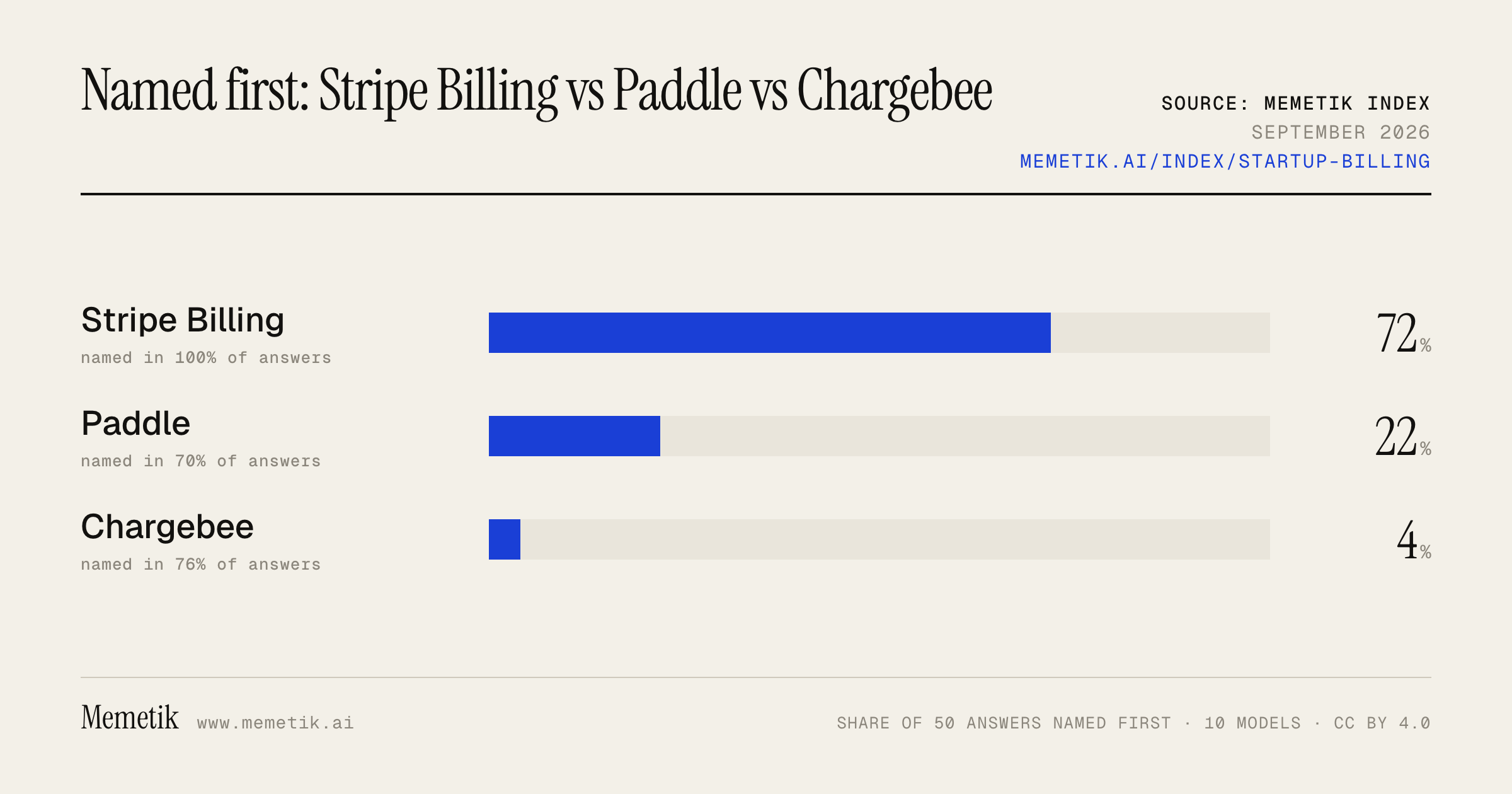
- Stripe BillingNamed: 100%Named first: 72%
- ChargebeeNamed: 76%Named first: 4%
- PaddleNamed: 70%Named first: 22%
- LagoNamed: 58%Named first: 0%
- MetronomeNamed: 48%Named first: 2%
- RecurlyNamed: 44%Named first: 0%
- OrbNamed: 38%Named first: 0%
- MaxioNamed: 38%Named first: 0%
Top 8 by answer share · 50 answers
10 models · 5 prompts · Memetik Index, 2026-09
Shares use all 50 answers as the denominator. Multiple products can appear in one answer. First position does not measure recommendation strength.
Key findings
Paddle overtakes Chargebee when the comparison shifts from being named to being named first.
The alternatives below the leader change with the model. An aggregate shortlist hides those differences.
An answer can name Stripe while recommending another billing tool. Read the recommendation around the name.
Vendor-authored guides recommend products for purchase. Memetik counts the names that recorded AI answers produce.
50 of 50 recorded answers name Stripe Billing; 36 name it first. Stripe Billing leads Memetik’s subscription billing panel on both measures. The scope is the September 2026 snapshot of names in AI answers.
Which billing tools did the models name?
Stripe Billing, Chargebee and Paddle lead the recorded subscription billing answers on mentions. The complete table separates presence from position so you can see which other names appear and where they sit.
| Vendor | Named answers | Answer share | Named first | Named-first share | Average position |
|---|---|---|---|---|---|
| Stripe Billing | 50/50 | 100% | 36/50 | 72% | 1.34 |
| Chargebee | 38/50 | 76% | 2/50 | 4% | 3.45 |
| Paddle | 35/50 | 70% | 11/50 | 22% | 2.63 |
| Lago | 29/50 | 58% | 0/50 | 0% | 4.66 |
| Metronome | 24/50 | 48% | 1/50 | 2% | 3.96 |
| Recurly | 22/50 | 44% | 0/50 | 0% | 5 |
| Orb | 19/50 | 38% | 0/50 | 0% | 4.79 |
| Maxio | 19/50 | 38% | 0/50 | 0% | 5.95 |
| Lemon Squeezy | 13/50 | 26% | 0/50 | 0% | 3.77 |
| Zuora | 9/50 | 18% | 0/50 | 0% | 5.67 |
| Zoho Billing | 7/50 | 14% | 0/50 | 0% | 4.14 |
| FastSpring | 6/50 | 12% | 0/50 | 0% | 6.17 |
| Polar | 3/50 | 6% | 0/50 | 0% | 3.67 |
| Braintree | 3/50 | 6% | 0/50 | 0% | 4.33 |
| Dodo Payments | 3/50 | 6% | 0/50 | 0% | 4.33 |
Stripe Billing leads, followed by Chargebee and Paddle on mentions. Below them, Lago has the widest presence without an opening position. A founder scanning only the start of an answer encounters a narrower set than a founder reading the complete comparison. The subscription billing index holds the category results; Stripe Billing’s vendor record gives the vendor view.
How big is the gap between being named and being named first?
Chargebee has the largest gap between being named and being named first. It is a frequent part of the conversation but rarely the opening tracked name.
| Vendor | Answer share | Named-first share | Gap, percentage points |
|---|---|---|---|
| Chargebee | 76% | 4% | 72 |
| Lago | 58% | 0% | 58 |
| Paddle | 70% | 22% | 48 |
| Metronome | 48% | 2% | 46 |
| Recurly | 44% | 0% | 44 |
| Orb | 38% | 0% | 38 |
| Maxio | 38% | 0% | 38 |
| Stripe Billing | 100% | 72% | 28 |
| Lemon Squeezy | 26% | 0% | 26 |
| Zuora | 18% | 0% | 18 |
| Zoho Billing | 14% | 0% | 14 |
| FastSpring | 12% | 0% | 12 |
| Polar | 6% | 0% | 6 |
| Braintree | 6% | 0% | 6 |
| Dodo Payments | 6% | 0% | 6 |
The gap is answer share minus named-first share. A small gap at the bottom is a small share meeting zero. Polar, Braintree and Dodo Payments have narrow gaps because they appear infrequently and never open an answer.
For a growth team comparing Chargebee’s recorded visibility with Paddle’s recorded visibility, the reporting question changes the conclusion. Use presence to assess inclusion in the discussion. Use opening position to assess which name the reader encounters before the other tracked products.
Do the models agree with each other?
Stripe Billing is at the top of every model’s mention count, sometimes tied with another vendor. Agreement on that name leaves substantial disagreement about the rest of the list.
Each cell records named answers out of the prompts given to that model.
| Vendor | GPT-5.6 Sol | ChatGPT | GPT-5.6 Luna | Claude Opus 5 | Claude | Claude Fable 5 | Gemini | Gemini 3.5 Flash | Perplexity | Sonar Reasoning Pro |
|---|---|---|---|---|---|---|---|---|---|---|
| Stripe Billing | 5/5 | 5/5 | 5/5 | 5/5 | 5/5 | 5/5 | 5/5 | 5/5 | 5/5 | 5/5 |
| Chargebee | 4/5 | 3/5 | 2/5 | 4/5 | 5/5 | 3/5 | 4/5 | 4/5 | 5/5 | 4/5 |
| Paddle | 3/5 | 4/5 | 4/5 | 4/5 | 4/5 | 3/5 | 4/5 | 4/5 | 2/5 | 3/5 |
| Lago | 3/5 | 2/5 | 3/5 | 4/5 | 4/5 | 4/5 | 3/5 | 3/5 | 1/5 | 2/5 |
| Metronome | 4/5 | 3/5 | 1/5 | 4/5 | 2/5 | 2/5 | 3/5 | 4/5 | 0/5 | 1/5 |
| Recurly | 2/5 | 1/5 | 2/5 | 4/5 | 3/5 | 2/5 | 1/5 | 2/5 | 2/5 | 3/5 |
| Orb | 2/5 | 1/5 | 3/5 | 1/5 | 3/5 | 2/5 | 4/5 | 1/5 | 0/5 | 2/5 |
| Maxio | 3/5 | 0/5 | 1/5 | 4/5 | 3/5 | 1/5 | 1/5 | 1/5 | 2/5 | 3/5 |
| Lemon Squeezy | 0/5 | 0/5 | 1/5 | 4/5 | 0/5 | 2/5 | 3/5 | 3/5 | 0/5 | 0/5 |
| Zuora | 1/5 | 0/5 | 0/5 | 2/5 | 3/5 | 2/5 | 0/5 | 0/5 | 1/5 | 0/5 |
| Zoho Billing | 0/5 | 0/5 | 0/5 | 0/5 | 2/5 | 0/5 | 0/5 | 0/5 | 2/5 | 3/5 |
| FastSpring | 0/5 | 1/5 | 0/5 | 1/5 | 1/5 | 1/5 | 0/5 | 0/5 | 0/5 | 2/5 |
| Polar | 0/5 | 0/5 | 0/5 | 0/5 | 0/5 | 1/5 | 1/5 | 1/5 | 0/5 | 0/5 |
| Braintree | 0/5 | 0/5 | 0/5 | 0/5 | 0/5 | 0/5 | 2/5 | 1/5 | 0/5 | 0/5 |
| Dodo Payments | 0/5 | 0/5 | 0/5 | 0/5 | 2/5 | 1/5 | 0/5 | 0/5 | 0/5 | 0/5 |
GPT-5.6 Sol names Metronome much more often than GPT-5.6 Luna does. Claude Opus 5 includes Maxio frequently; ChatGPT leaves it out. Gemini includes Orb frequently; Perplexity leaves it out. Braintree appears only in the Google models, while Dodo Payments appears only in Claude and Claude Fable 5.
The family totals also put Stripe Billing at the top. The order immediately below it differs:
| Provider family | Pattern below Stripe Billing |
|---|---|
| OpenAI | Paddle ahead of Chargebee |
| Anthropic | Chargebee and Lago tied ahead of Paddle |
| Chargebee and Paddle tied ahead of Metronome | |
| Perplexity | Chargebee ahead of the tied Paddle, Recurly and Maxio |
The Anthropic models name Lago more often than the Perplexity models do. For a team investigating Lago’s model split, the assistant used by its buyers changes which comparison deserves attention. Inspect the relevant model column before treating the combined order as the list a buyer sees.
Which sources do the answers cite?
solvimon.com is the most-cited host in the recorded subscription billing sample. The leading hosts include vendor publishers, discussion forums and video sites.
| Source host | Citation count |
|---|---|
| solvimon.com | 63 |
| hyperline.co | 47 |
| reddit.com | 46 |
| schematichq.com | 37 |
| youtube.com | 37 |
| outseta.com | 29 |
| baremetrics.com | 28 |
| flexprice.io | 27 |
The vendor-owned host subset includes the following sites. It is not a list of every vendor publisher in the source table.
| Vendor-owned host | Citation count |
|---|---|
| stripe.com | 18 |
| getlago.com | 15 |
| withorb.com | 12 |
| chargebee.com | 11 |
| docs.stripe.com | 9 |
Citation counts include the citations returned with the recorded answers. Coverage varies by model. Gemini citation redirects are resolved to real hosts before counting. These are host citation counts, not counts of unique answers or independent endorsements. A host can recur across the recorded citations.
For a buyer following an answer’s sources, the publisher’s role deserves inspection. Solvimon also sells billing software and puts its own product first in its comparison table. A citation to that guide leads to a vendor’s product-selection argument. The host totals alone do not show which page shaped a recommendation.
How was the sample built?
Memetik’s sample is 10 models x 5 fixed prompts = 50 recorded answers. The panel tracks 16 vendors; 15 were named. Kill Bill was tracked but never named.
The recorded questions were:
- What is the best subscription billing platform for a SaaS startup? Name specific products.
- Which billing tool should an early-stage SaaS use instead of building on raw Stripe?
- Compare the top recurring billing and invoicing platforms for startups.
- I need usage-based billing for my API startup. What do you recommend?
- Best billing system for a startup selling globally with tax handling?
| Provider family | Recorded model labels | Answers |
|---|---|---|
| OpenAI | GPT-5.6 Sol; ChatGPT; GPT-5.6 Luna | 15 |
| Anthropic | Claude Opus 5; Claude; Claude Fable 5 | 15 |
| Gemini; Gemini 3.5 Flash | 10 | |
| Perplexity | Perplexity; Sonar Reasoning Pro | 10 |
Each sampled model has equal weight. Families contribute according to their sampled models.
A named count records an answer containing a tracked vendor or approved alias. Answer share is the proportion of recorded answers containing that vendor. Named first records the earliest tracked vendor in the answer text; named-first share uses the same answer denominator. Average position is the vendor’s mean order among matched vendors in answers where it appears. The full counting method explains the measurement rules.
Can an answer name Stripe while recommending another tool?
Yes. The recorded answers can name Stripe as part of a recommendation for Autumn or Paddle. That context changes how a buyer should read the mention table.
Asked about an alternative to building on raw Stripe, GPT-5.6 Sol opened with this sentence:
For most early-stage SaaS companies, I’d use Autumn on top of Stripe rather than building directly against raw Stripe APIs.
GPT-5.6 Luna answered the same question with:
Short answer: use Paddle Billing for most early-stage SaaS teams that want to avoid building billing and tax infrastructure themselves.
In GPT-5.6 Sol’s complete answer, Autumn is the suggested layer above Stripe. In GPT-5.6 Luna’s answer, Stripe Billing appears later as an option for a different operating setup. The recommendations disagree even though Stripe appears in both answers.
The panel’s alias for Stripe Billing is stripe, so a general Stripe reference can count towards that row. Autumn is outside the tracked vendor list. A founder checking a billing shortlist should read which product the answer selects and which product it names as the underlying payments system. The recorded examples preserve that distinction where a row of totals cannot.
How does this sit against the subscription billing guides?
Stigg, Lago, Solvimon and Zone & Co publish buying guides organised around product fit. Their comparison orders reflect each publisher’s criteria. All are vendor-authored.
Stigg starts its list with Stripe Billing, followed by Metronome and Orb. It presents Stripe Billing as a starting option and distinguishes metering volume from pricing simulation and infrastructure ownership. The author reports sandbox work where available, with Metronome and Orb assessed through documentation and demos. The guide ends by promoting Stigg for entitlement enforcement before usage becomes an invoice.
Lago lists its own product first, then Stripe Billing, Zoho Subscriptions, QuickBooks Online and FreshBooks. Its comparison spans usage billing and accounting-led invoicing. The conclusion favours Lago for complex usage-based pricing and Stripe for integrated payments.
Solvimon’s AI shortlist favours Solvimon, Orb and Metronome. Its argument centres on hybrid pricing, event volume and longer-term cost. It positions Stripe Billing as a starting point and Lago as an option for teams seeking deployment control.
Zone & Co puts ZoneBilling first, followed by Zoho Billing and Recurly. Its guide favours billing inside NetSuite and says it draws on G2, Reddit and vendor websites. That finance-system emphasis produces a different buying order from the startup panel.
Use those guides to identify the requirements each publisher considers decisive. Use the recorded AI answers to see which vendor names enter the conversation under the fixed buyer questions. The guides rank products for purchase; the panel records answer text.
What can these counts not tell you?
The counts cannot establish product quality, purchase suitability or recommendation strength. They record names and their order.
This is a dated snapshot with a single response per prompt-and-model pair. It does not estimate repeatability or establish why an answer chose a vendor. Alias matching is string-based. API answers can differ from consumer chat products. The prompts are English and are not localised for other markets.
Frequently asked questions
Is there any AI billing software available?
Yes. Lago’s guide identifies Stripe Billing’s Smart Retries as a machine-learning feature for failed-payment recovery. AI inside a billing product is a different use of the term from asking an assistant which billing tool to use. Check which task a vendor means when it describes AI billing.
Which subscription billing software is the best?
The best fit depends on your billing requirements. Stigg bases its selection guidance on the existing stack, deployment preferences and who owns pricing changes. Write those requirements down before comparing vendor recommendations. Include whether the job is recurring subscriptions, usage billing or global selling with tax handling.
How can AI be used in billing?
Lago’s guide describes uses including predicting payment delays, flagging unusual transaction patterns and categorising transactions. It also describes automated invoicing and reminders. Ask vendors which operations use a learned model and which follow configured rules; those descriptions should be examined separately.
Where can I read the full recorded answers?
The recorded subscription billing answers include the model labels, prompts and answer text. Read the complete response when a vendor appears alongside a different recommended tool.
Behind the figures
Method and sources
Edition 2026-09: 5 fixed buyer prompts per category, sent to 10 models through their APIs. Each category contains 50 recorded answers. Answer share is the fraction of answers naming a vendor. Named first records the vendor's position before other tracked vendors, not the strength of a recommendation. This is one dated sample; small differences can reflect answer variation. API responses can differ from consumer chat products. Read the full method.
- Subscription billing: recorded answers 50 answers · Edition 2026-09
Cite this research
Memetik. Which subscription billing tool do AI models recommend?. Memetik, 24 September 2026. Data: edition 2026-09. https://www.memetik.ai/research/startup-billing-according-to-ai
Charts and figures: CC BY 4.0. Credit Memetik Index and link to the source.