Index / Startup stack
Which subscription billing tool do AI models recommend?
Stripe Billing was named in 50 of 50 answers and came first in 36. Chargebee follows at 76%. 15 vendors were named at least once. First edition, so there is no prior period.
Answer share
5 prompts × 10 models · 50 answers
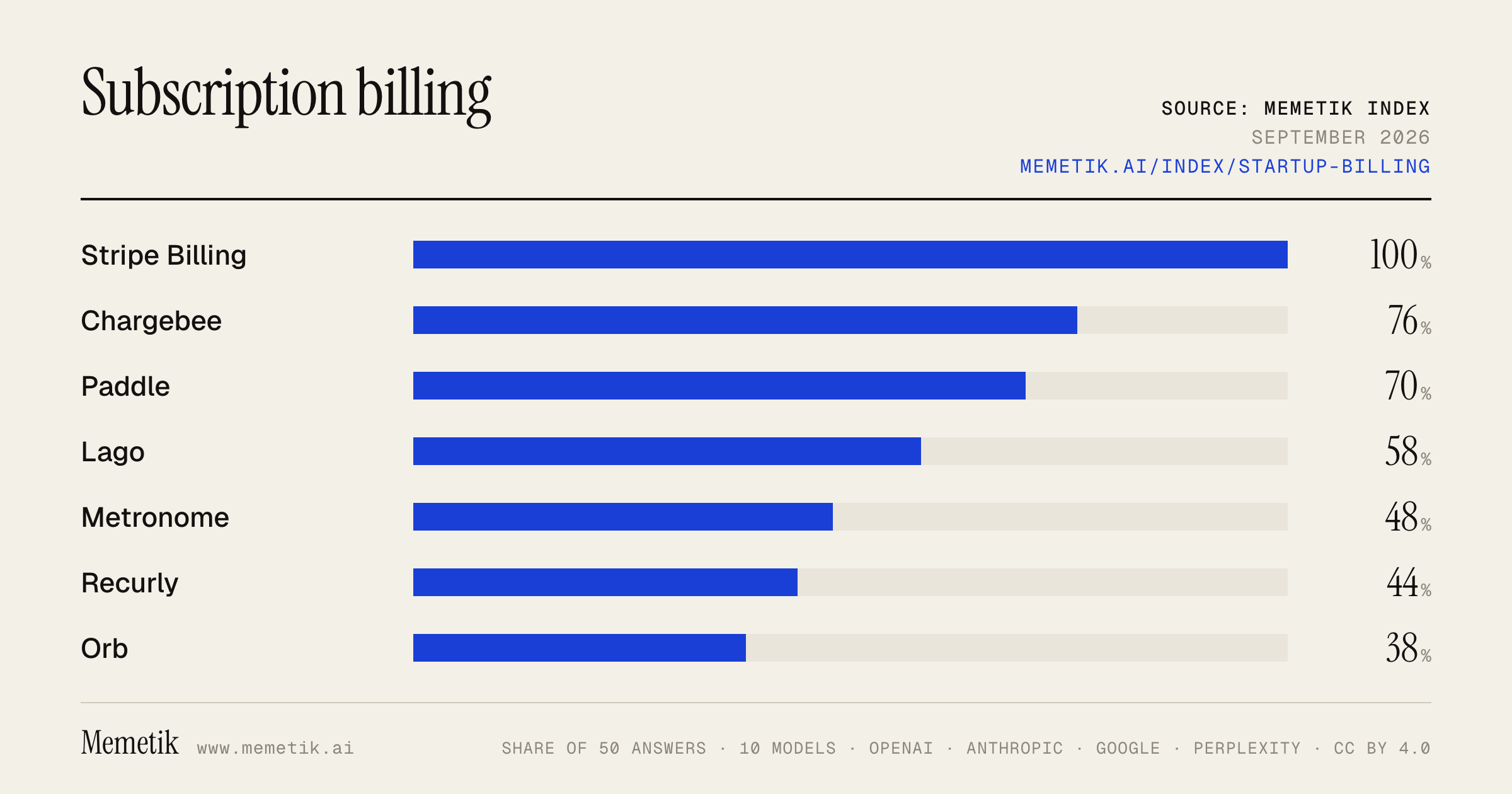
By provider
10 models · 50 answers
OpenAI 3 models · 15 answers
- GPT-5.6 Solgpt-5.6-solmost named: Stripe Billing 100%
- GPT-5.6 Terragpt-5.6-terramost named: Stripe Billing 100%
- GPT-5.6 Lunagpt-5.6-lunamost named: Stripe Billing 100%
Anthropic 3 models · 15 answers
- Claude Opus 5claude-opus-5most named: Stripe Billing 100%
- Claude Sonnet 5claude-sonnet-5most named: Stripe Billing 100%
- Claude Fable 5claude-fable-5most named: Stripe Billing 100%
Google 2 models · 10 answers
- Gemini 3.6 Flashgemini-3.6-flashmost named: Stripe Billing 100%
- Gemini 3.5 Flashgemini-3.5-flashmost named: Stripe Billing 100%
Perplexity 2 models · 10 answers
- Sonar Prosonar-promost named: Stripe Billing 100%
- Sonar Reasoning Prosonar-reasoning-promost named: Stripe Billing 100%
Sources the models cited
- solvimon.com63
- hyperline.co47
- reddit.com46
- schematichq.com37
- youtube.com37
- outseta.com29
- baremetrics.com28
- flexprice.io27
- connectpay.com24
- dealhub.io21
- resubly.com20
- solidgate.com19
ChatGPT via API returns no citations, so it does not contribute here.
The prompts
- What is the best subscription billing platform for a SaaS startup? Name specific products.
- Which billing tool should an early-stage SaaS use instead of building on raw Stripe?
- Compare the top recurring billing and invoicing platforms for startups.
- I need usage-based billing for my API startup. What do you recommend?
- Best billing system for a startup selling globally with tax handling?
Every answer
Raw model output, unedited
GPT-5.6 TerraWhat is the best subscription billing platform for a SaaS startup? Name specific products.
**Best default for most SaaS startups: Stripe Billing.**
Choose it if you want the fastest path from launch to scale with payments, subscriptions, invoices, dunning, a customer portal, and developer-friendly APIs in one stack. It supports flat-rate, tiered, and metered/usage-based subscriptions; its listed pay-as-you-go Billing price is **0.7% of Billing volume**. ([docs.stripe.com](https://docs.stripe.com/billing/subscriptions/usage-based/how-it-works?locale=en-GB&utm_source=openai))

**Choose Paddle Billing instead** if you sell internationally and want to offload sales-tax/VAT compliance. Paddle operates as the **merchant of record**—handling payments, tax/compliance, subscriptions, proration, dunning, and customer self-service across 200+ countries through one integration. That is often a major operational simplifier for a small SaaS team selling digital products globally. ([developer.paddle.com](https://developer.paddle.com/get-started/how-paddle-works/saas/?utm_source=openai))

### Practical shortlist

| Your situation | Best product |
|---|---|
| US-first SaaS, standard monthly/annual plans, want maximum flexibility | **Stripe Billing** |
| Global B2C or SMB SaaS; want tax/VAT and compliance handled for you | **Paddle Billing** |
| API/AI SaaS with serious usage-based pricing complexity | **Stripe Billing + Metronome** |

For the last case, Stripe’s basic meters can track usage events and invoice from them; Stripe positions **Metronome** for more advanced usage billing, such as multidimensional rates, negotiated contracts, and marketplace transactions. ([docs.stripe.com](https://docs.stripe.com/billing/subscriptions/usage-based/how-it-works?locale=en-GB&utm_source=openai))

### My recommendation
If you have not launched yet: **start with Stripe Billing**. It is the safest default because it minimizes integration surface area and preserves flexibility as your pricing changes.

Pick **Paddle** from day one instead if your core strategy is international self-serve SaaS and you do **not** want to own tax registration, remittance, and related compliance workflows.

One caution: don’t choose a platform solely because it claims advanced usage billing. For example, Stripe documents some advanced capabilities as private preview, so validate that any must-have feature—credits, complex rate cards, contract pricing, or self-serve plan migrations—is generally available before making it foundational. ([docs.stripe.com](https://docs.stripe.com/billing/subscriptions/usage-based/advanced/compare?locale=en-GB&utm_source=openai))
GPT-5.6 TerraWhich billing tool should an early-stage SaaS use instead of building on raw Stripe?
For most early-stage SaaS companies: **use Stripe Billing on top of Stripe Payments—not a separate billing platform, and not a hand-built “raw Stripe” subscription system.**

**Recommended stack**
- **Stripe Checkout** for signup/payment collection
- **Stripe Billing** for subscriptions, trials, coupons, invoices, prorations, and usage meters
- **Stripe Customer Portal** for self-serve plan/payment-management
- **Stripe Entitlements** *or your own small internal entitlement table* for feature access

This keeps payments, invoices, customer records, tax support, and subscription lifecycle events in one system. Stripe Billing supports flat-rate, tiered, and usage-based subscriptions, and its Entitlements product can notify your app when a customer’s feature access changes. ([docs.stripe.com](https://docs.stripe.com/payments/subscriptions?utm_source=openai))

**Do not build yourself:** invoice calculations, proration logic, dunning/retries, payment-method updates, tax handling, subscription state machines, and customer self-service. Those are long-tail operational problems that distract an early team.

**When to choose something else**
- Pick **Orb, Metronome, or Lago** only if usage-based/credit billing is genuinely your product’s core complexity—e.g., multiple billable dimensions, negotiated enterprise rate cards, prepaid credit burn-down, frequent pricing experiments, or finance needing audit-grade usage reconciliation.
- Pick a merchant-of-record such as **Paddle** if avoiding global sales-tax/VAT compliance and legal seller-of-record burden matters more than keeping Stripe as your payments stack.
- Consider **Chargebee/Recurly** later when you need multi-gateway, sophisticated enterprise invoicing, or a finance-led billing operation.

**Practical rule:**
If you have 1–3 plans, seats, a simple monthly/annual model, and perhaps one usage metric, start with **Stripe Billing**. Stripe now has native meters, billing credits, threshold alerts, and flexible billing behavior, so a separate billing layer is usually premature for an early-stage company. ([docs.stripe.com](https://docs.stripe.com/billing/subscriptions/usage-based/how-it-works?locale=en-GB&utm_source=openai))

One caveat: make your **product database—not Stripe—the source of truth for authorization**. Stripe should emit billing/entitlement events; your app should persist the resulting access state and enforce it. Stripe itself recommends persisting entitlements internally for faster resolution. ([docs.stripe.com](https://docs.stripe.com/billing/entitlements?dashboard-or-api=api&utm_source=openai))
GPT-5.6 TerraCompare the top recurring billing and invoicing platforms for startups.
## Short answer

For most startups, the practical shortlist is:

1. **Stripe Billing + Invoicing** — best default for developer-led startups that want one payments, subscriptions, and invoicing stack.
2. **Chargebee** — best when subscription operations become complex: multiple products, entities, currencies, contract terms, and hybrid pricing.
3. **Paddle** — best for SaaS companies that want to reduce the operational burden of global billing, tax, fraud, invoicing, and subscription management in one system.

### Comparison

| Platform | Best for | Strengths | Watch-outs | Pricing approach |
|---|---|---|---|---|
| **Stripe Billing** | Early-stage to growth-stage startups, especially API-first teams | Fast implementation; subscriptions, hosted checkout, payment links, customer portal, quotes, invoices, retries/dunning, and broad payment-method support in one platform | You are more responsible for configuring tax, compliance, revenue ops, and billing logic as complexity grows | Billing starts at **0.7% of recurring billing volume** on pay-as-you-go, plus payment-processing fees. One-time invoicing is separately priced at **0.4%–0.5% per paid invoice**. ([stripe.com](https://stripe.com/billing/pricing?utm_source=openai)) |
| **Chargebee** | B2B SaaS with complex pricing or an expanding RevOps/finance function | Stronger subscription-operations layer: price books, invoicing, hybrid revenue workflows, usage/pricing analytics, and support for complex multi-entity and multi-geography invoicing | Usually more process-heavy than Stripe for a very early startup; evaluate integration and implementation effort carefully | Vendor plans are oriented around billing automation and hybrid revenue workflows; obtain a quote based on your scale and requirements. ([chargebee.com](https://www.chargebee.com/billing/invoicing/?utm_source=openai)) |
| **Paddle** | Software/SaaS startups selling internationally that want a more managed commercial stack | Combines subscription management, billing, invoicing, payment support, tax compliance, fraud protection, churn prevention, and revenue analytics; supports flat-rate, per-seat, and usage-based models | Less ideal if you need maximum flexibility over your payment stack or have nonstandard payment-routing needs | Pricing is typically sales-led/usage-based rather than a simple published self-serve SaaS subscription. Confirm commercial terms, supported markets, and operational responsibilities during evaluation. ([paddle.com](https://www.paddle.com/billing?utm_source=openai)) |

## Which one should a startup choose?

### Choose **Stripe Billing** if:
- You are pre-seed through Series B and want to launch quickly.
- Your engineers prefer APIs and you already plan to use Stripe for payments.
- You need a mix of self-serve subscriptions, payment links, recurring invoices, trials, prorations, and basic usage billing.
- You want predictable low initial software overhead rather than a larger platform commitment.

Stripe is generally the strongest **default** because it can start simple—Dashboard, Payment Links, Checkout—and grow into a custom API integration. It includes invoice reminders, Smart Retries, a customer portal, quotes, subscription schedules, and recurring-invoice reconciliation. ([stripe.com](https://stripe.com/billing/pricing?utm_source=openai))

### Choose **Chargebee** if:
- You sell B2B contracts alongside self-serve plans.
- You expect frequent packaging experiments: subscriptions plus usage, annual commitments, negotiated terms, credits, multiple price books, or multiple legal entities.
- Finance and RevOps need more control than a payments-first platform provides.
- You need to integrate a billing layer with an existing payment processor rather than make the processor your billing system.

Chargebee is usually the better fit once billing becomes a **business-operations problem**, not merely a checkout and subscription-collection problem. Its invoicing positioning emphasizes multi-entity, multi-currency, and multi-geography workflows, as well as analytics-stack data availability. ([chargebee.com](https://www.chargebee.com/billing/invoicing/?utm_source=openai))

### Choose **Paddle** if:
- You sell digital software globally from day one.
- Your team wants to minimize tax, fraud, billing-support, and subscription-operations complexity.
- You value an all-in-one commercial platform over owning every part of payment infrastructure.
- You need per-seat, flat-rate, usage-based, and one-time-purchase support without assembling several vendors.

Paddle’s differentiated proposition is operational consolidation: payments and subscription management alongside invoicing, tax compliance, fraud protection, churn prevention, and subscription analytics. ([paddle.com](https://www.paddle.com/billing?utm_source=openai))

## Important cost distinction

Do not compare vendors on platform fees alone:

- With **Stripe**, recurring Billing fees are separate from card/payment-processing fees. For U.S. domestic cards, standard listed processing begins at **2.9% + 30¢**, while Billing pay-as-you-go starts at **0.7% of billing volume**. ([stripe.com](https://stripe.com/billing/pricing?utm_source=openai))
- **Stripe Invoicing** pricing applies to **one-time invoices**, not recurring subscription invoices; those fall under Billing. ([support.stripe.com](https://support.stripe.com/questions/stripe-invoicing-pricing?utm_source=openai))
- For **Chargebee** and **Paddle**, model the total cost including payment processing, tax/compliance services, implementation, international payments, chargebacks, and any required integrations—not just the subscription-billing platform price.

## My recommendation by startup stage

- **Pre-seed / MVP:** **Stripe Billing**
- **Product-led SaaS with global ambitions but a lean operations team:** **Paddle**
- **Scaling B2B SaaS with complex contracts and pricing:** **Chargebee**
- **Simple services business that mostly sends occasional invoices:** use **Stripe Invoicing** first; don’t buy an enterprise subscription-billing system before recurring revenue and pricing complexity justify it. ([support.stripe.com](https://support.stripe.com/questions/stripe-invoicing-pricing?utm_source=openai))
GPT-5.6 TerraI need usage-based billing for my API startup. What do you recommend?
For most early-stage API startups, I’d start with **Stripe Billing + Stripe Meters**—*provided you already use Stripe for payments*. It gives you metering, subscriptions/invoices, credit-burndown and hybrid plans, payment collection, tax, and revenue tooling in one stack. Stripe says its current usage-billing tooling supports real-time ingestion, spend alerts, multidimensional filters, and up to 100K events/second. ([stripe.com](https://stripe.com/en-mt/billing/usage-based-billing?__=&__scoop_post=4437f390-e6c9-11e4-ca89-90b11c3ead14&__scoop_topic=3137110&utm_source=openai))

### My shortlist

| If you need… | Recommend | Why |
|---|---|---|
| Fastest path from API event → invoice → payment | **Stripe Billing** | Lowest integration burden if Stripe is already your payment processor. Good for monthly base fee + included credits + overages. ([stripe.com](https://stripe.com/en-mt/billing/usage-based-billing?__=&__scoop_post=4437f390-e6c9-11e4-ca89-90b11c3ead14&__scoop_topic=3137110&utm_source=openai)) |
| Highly flexible pricing and frequent experiments | **Orb** | Strong choice if you expect to change plans often, need late-event corrections, simulations on historical use, custom SQL metrics, or complicated enterprise contracts. ([docs.withorb.com](https://docs.withorb.com/overview?utm_source=openai)) |
| Self-hosting, payment-processor independence, transparent source code | **Lago** | Open-source, supports usage/subscription/prepaid/hybrid pricing, and can be self-hosted; use it if control and avoiding billing-platform lock-in outweigh operating complexity. ([docs.getlago.com](https://docs.getlago.com/guide/introduction/welcome-to-lago?utm_source=openai)) |
| Mature, sales-led enterprise consumption business | **Metronome** | Best fit for complex rate cards, credits/commits, multidimensional pricing, and real-time customer spend visibility. Note that Stripe acquired Metronome in January 2026, so evaluate the current product/contract roadmap carefully. ([metronome.com](https://metronome.com/?utm_source=openai)) |

## What I’d implement

For an API company, I’d avoid pure pay-as-you-go at first. Use a **hybrid, prepaid-friendly** plan:

- **Platform minimum:** e.g. $29–$299/month
- **Included usage/credits:** enough to make the plan feel useful
- **Metered overages:** charge per request, token, GB, compute-second, document processed, etc.
- **Prepaid credits for larger customers:** improves cash flow and limits non-payment risk.
- **Hard limits plus alerts:** stop a runaway customer bill before it becomes a support issue.

Example:

```text
Pro: $99/month
Includes: 1 million API calls
Overage: $0.20 per additional 1,000 calls
Optional: automatic top-up of $100 in prepaid credits
```

For an AI API, consider billing on the thing that maps most directly to customer value—often **successful task completion, documents processed, generated minutes/images, or agent runs**—rather than merely raw requests. If input costs vary substantially, use separate dimensions such as model, region, input/output tokens, or compute tier. Both Stripe and Orb support multidimensional-style usage models, though Orb is generally the more flexible option for complex custom metrics. ([stripe.com](https://stripe.com/en-mt/billing/usage-based-billing?__=&__scoop_post=4437f390-e6c9-11e4-ca89-90b11c3ead14&__scoop_topic=3137110&utm_source=openai))

## Non-negotiable engineering rules

Whichever vendor you choose:

1. **Maintain your own immutable usage ledger.** Your billing vendor should not be your sole record of consumption.
2. **Give every usage event a deterministic idempotency key**—retries must never double-charge.
3. **Separate authorization from billing.** Enforce quotas/credits in your API gateway or service; invoice calculation is not a reliable real-time access-control mechanism.
4. **Store the pricing version with each account and event.** Pricing changes should never silently rewrite historical bills.
5. **Build a customer-facing usage page** with near-real-time consumption, projected spend, limits, and downloadable detail.
6. **Reconcile daily:** your internal ledger ↔ vendor meter ↔ invoice totals ↔ payment status.
7. **Plan for late/corrected events:** define an adjustment policy rather than mutating closed invoices invisibly.

## Bottom line

- **Default recommendation:** **Stripe Billing** if you are a typical seed-to-Series-A API startup and use Stripe Payments.
- **Choose Orb** if flexible pricing is a core competitive advantage or you are already selling complex enterprise agreements.
- **Choose Lago** if self-hosting, source visibility, or payment-provider flexibility is strategically important.
- **Don’t build the billing engine yourself** unless billing mechanics themselves are central IP or your requirements are unusually specialized. Even then, keep a vendor or open-source system for invoicing, tax, collections, and auditability.
- https://stripe.com/en-mt/billing/usage-based-billing?__=&__scoop_post=4437f390-e6c9-11e4-ca89-90b11c3ead14&__scoop_topic=3137110&utm_source=openai
- https://docs.withorb.com/overview?utm_source=openai
- https://docs.getlago.com/guide/introduction/welcome-to-lago?utm_source=openai
- https://metronome.com/?utm_source=openai
GPT-5.6 TerraBest billing system for a startup selling globally with tax handling?
## Best default choice: **Paddle** — if you sell SaaS or other digital products globally

For an early-stage startup selling subscriptions, software licenses, downloads, or digital services internationally, I’d generally choose **Paddle** because it operates as **Merchant of Record (MoR)**. That means Paddle—not your startup—is the legal seller to the customer and takes responsibility for calculating, collecting, filing, and remitting applicable VAT, GST, and sales tax on its transactions. It also covers the related compliance, payment processing, and chargeback workflow. ([developer.paddle.com](https://developer.paddle.com/get-started/how-paddle-works/digital-products/?utm_source=openai))

This is usually worth the higher effective payment cost versus assembling Stripe + tax software + registrations, because it avoids creating a global tax-operation project before you have product-market fit.

### Choose **Paddle** if:
- You sell **B2C or self-serve SaaS**, digital goods, plugins, apps, courses, or subscriptions.
- You want to enter international markets quickly.
- Your team does **not** want to register for and file sales tax/VAT/GST across jurisdictions.
- You value localized checkout, currencies, invoices, tax-ID handling, and subscription billing in one product. Paddle says it supports selling in 200+ countries and territories and applies reverse charge for eligible B2B purchases with valid VAT IDs. ([paddle.com](https://www.paddle.com/solutions/enterprise?utm_source=openai))

## Choose **Stripe Billing + Stripe Tax** if you need flexibility and control

Stripe is my default alternative when you need a highly customizable billing architecture: complicated usage/metered pricing, bespoke invoicing, marketplaces, payment routing, or a product-led checkout that needs total control.

Stripe Tax can calculate tax across 100+ countries and all U.S. states, monitor obligations, validate tax IDs, and support filing through Stripe or filing partners. But with the usual Stripe Tax setup, **you remain the seller and generally retain the responsibility to register, file, and remit taxes**. ([stripe.com](https://stripe.com/tax?utm_source=openai))

Stripe also offers **Managed Payments**, its MoR-style option, which assumes indirect-tax liability in supported jurisdictions. It may be compelling if you already want Stripe’s stack, but check its country/product eligibility carefully: Stripe’s own materials describe coverage differently across pages, including 75 countries/35 product categories and “more than 80 countries.” ([stripe.com](https://stripe.com/tax?utm_source=openai))

### Choose **Stripe** if:
- You have engineering resources and want maximum API/control.
- You sell enterprise B2B and need custom contracts, invoicing, payment flows, or a nonstandard pricing model.
- You are prepared to own tax registrations and filings—or Stripe Managed Payments is clearly available for your business and markets.

## Other credible option: **FastSpring**

FastSpring is another Merchant of Record built for digital commerce. It becomes the legal seller and states that it calculates, collects, and remits global sales tax and VAT, while also handling compliance and localized payment methods. It is especially worth evaluating alongside Paddle for desktop software, games, B2C digital products, or if its checkout/payment-method coverage better matches your buyers. ([developer.fastspring.com](https://developer.fastspring.com/docs/welcome-to-fastspring?utm_source=openai))

## What I would *not* choose first

- **Chargebee** is excellent when billing operations become complex—multiple entities, enterprise workflows, CRM/CPQ integrations, revenue operations, and sophisticated subscription management. But its tax approach is primarily calculation/automation and integrations; it is not the simplest “make global tax liability go away” default for a tiny startup. ([chargebee.com](https://www.chargebee.com/features/?utm_source=openai))
- If you sell **physical goods**, do not select Paddle purely for tax simplicity: its MoR positioning is focused on digital products. Use a commerce stack appropriate to your fulfillment model, typically with a tax specialist such as Avalara/TaxJar or a marketplace that handles tax collection where applicable.

## Practical recommendation

| Your startup | Best starting point |
|---|---|
| Global SaaS / digital subscriptions, lean team | **Paddle** |
| Highly custom billing, usage-based pricing, marketplaces, strong engineering team | **Stripe Billing + Stripe Tax** |
| Want Stripe but want MoR-style offloading | **Evaluate Stripe Managed Payments** |
| Digital commerce with a strong desktop/software/gaming orientation | **Compare FastSpring and Paddle** |
| Physical products | A commerce platform + dedicated tax engine; not Paddle by default |
| Larger enterprise revenue operations | **Chargebee** plus payment/tax providers |

**Bottom line:** For a typical U.S.-based startup selling digital SaaS globally, start with **Paddle** to offload tax liability. Move toward **Stripe** when custom billing/control is strategically more valuable than the compliance simplicity of a Merchant of Record. Before signing, have each vendor confirm—in writing—coverage for your product category, home entity, target countries, refunds/credits, B2B tax-ID treatment, and who files/remits tax in each market.
- https://developer.paddle.com/get-started/how-paddle-works/digital-products/?utm_source=openai
- https://www.paddle.com/solutions/enterprise?utm_source=openai
- https://stripe.com/tax?utm_source=openai
- https://developer.fastspring.com/docs/welcome-to-fastspring?utm_source=openai
- https://www.chargebee.com/features/?utm_source=openai
Claude Sonnet 5What is the best subscription billing platform for a SaaS startup? Name specific products.
There's no single "best" platform—it depends on your stage, pricing model, and engineering resources. Here's how the top contenders break down:

## Best overall picks by scenario

**Stripe Billing** — The default choice if you're already using Stripe for payments and have engineering capacity.
Stripe Billing is the default choice for engineering-led SaaS companies, with an API-first design meaning any pricing model is theoretically possible—but "theoretically" is the operative word.

Complex usage-based pricing or multi-party billing requires significant custom development, making it best fit for seed to Series B SaaS with strong engineering teams and relatively simple pricing models.
 Cost-wise,
Stripe Billing has no monthly fee but charges 0.70% of billing volume on top of Stripe Payments processing.


**Chargebee** — The most popular all-around choice for early-to-mid-stage SaaS.
Chargebee is a billing-first platform with strong pricing flexibility that fits SaaS businesses testing pricing models and needing extensive integrations.
 It's also budget-friendly early on since
Chargebee is free up to $1M cumulative billing on its startup plan.


**Recurly** — Best if failed payments/churn are your biggest pain point.
Recurly is subscription billing focused on revenue recovery, fitting businesses where reducing involuntary churn from failed payments is the priority.


**Maxio** — Best if finance/CFO needs are driving the decision.
Maxio combines subscription billing with financial planning and SaaS metrics, fitting B2B SaaS where finance needs direct visibility.


**Paddle** — Best for global, self-serve SaaS that wants to offload tax compliance (it acts as a merchant of record).

**Zuora** — Best for large enterprises.
Zuora offers enterprise billing with advanced revenue recognition, fitting large businesses with complex subscription products and strict compliance requirements.
 It comes at a cost, though —
subscription billing software costs range from $0 to $50,000+ annually for enterprise platforms like Zuora.


## If you have usage-based or AI/hybrid pricing

Modern SaaS increasingly mixes seats, usage, and credits, so a newer set of tools has emerged for that specifically: **Metronome** (pure usage-based billing at scale), **Orb** (now acquired by Adyen but still operating), **Lago** (open-source, event-based usage billing), and **Solvimon** (built for hybrid seat+usage+credit pricing, especially for AI companies).
Most modern SaaS sells hybrid pricing: seats for the dashboard, usage for the API, credits for AI features, sometimes outcomes for agent runs — companies are pricing on whichever model fits the surface, not picking one.


Worth noting:
the "outgrown your first system" buyer typically sits at $5M–$15M ARR, which is where Stripe Billing's limits and Chargebee's hybrid-pricing limits tend to show up most often.


## Bottom line recommendation
- **Just starting out, simple monthly/annual plans, already on Stripe:** Stripe Billing
- **Want a dedicated billing tool with flexibility and free tier:** Chargebee
- **Struggling with failed payments/churn:** Recurly
- **Finance-led B2B SaaS:** Maxio
- **Selling globally without a tax/compliance team:** Paddle
- **Usage-based, API, or AI/token pricing:** Metronome, Lago, or Solvimon
- **Enterprise scale with complex revenue recognition:** Zuora

For most early-stage SaaS startups, **Stripe Billing or Chargebee** are the two most commonly recommended starting points, with a likely migration to something like Maxio, Metronome, or Solvimon once pricing complexity or ARR grows significantly.
- https://ustechautomations.com/resources/blog/best-subscription-billing-software-for-saas-2026
- https://www.solvimon.com/blog/best-subscription-billing-in-2026-decision-guide
- https://solidgate.com/blog/best-subscription-billing-software/
- https://www.solvimon.com/guides/best-subscription-billing-software-saas-reddit-2026/
Claude Sonnet 5Which billing tool should an early-stage SaaS use instead of building on raw Stripe?
For an early-stage SaaS, the general consensus is to avoid building custom billing logic directly on raw Stripe APIs and instead use a subscription-management layer on top of (or instead of) it. A few good options depending on your situation:

**Most commonly recommended for early-stage teams:**
- **Chargebee** –
Chargebee is fully tailored to SaaS businesses, offering a full subscription management platform as well as a billing tool that helps with all stages of the customer lifecycle.
 Its Starter plan is
free to $250K in cumulative billing
, making it accessible pre-revenue/pre-Series A.
- **Zoho Billing** –
covers the full subscription lifecycle at a price point accessible to early-stage SaaS teams, handling recurring billing, usage-based pricing, trials, coupons, proration, and dunning, plus a customer self-service portal.

It connects with Stripe, PayPal, and other payment gateways, with revenue recognition included.

It's considered the most affordable full-featured subscription billing option, and its Standard plan covers most of what a pre-Series A SaaS team actually needs.


**Why avoid raw Stripe integration early on:**
As one analysis puts it,
the common trigger for switching is that your engineering team ends up maintaining billing logic instead of building product.
 Stripe itself is best suited for teams with strong engineering bandwidth —
Stripe Billing serves as the industry standard for API-first billing, but it delivers unmatched flexibility mainly for teams with strong developer resources.


**If you expect usage-based/AI-style pricing early:**
- **Orb** or **Lago** —
Orb is designed specifically for usage-based billing with strong transformation and growth capabilities, while Lago gives teams the ability to collaborate on complex billing and develop usage-based pricing models.

- **Flexprice** (open-source) —
an open-source, developer-first billing and metering platform built for AI, API, and SaaS products, supporting real-time event tracking, hybrid pricing, credit wallets, and feature entitlements.


**If you need global tax/compliance handled for you (Merchant of Record):**
- **Paddle** —
rather than merely processing payments, Paddle handles compliance, taxation, and billing on behalf of SaaS businesses.

- **Dodo Payments** —
built specifically for the next generation of SaaS and AI startups, combining a powerful billing engine with a full Merchant of Record service for modern billing infrastructure and global tax compliance.


**Bottom line recommendation:** For most early-stage B2B SaaS with straightforward subscriptions, **Chargebee** or **Zoho Billing** are the safest choices — cheap/free at low volume, fast to set up, and they save you from reinventing dunning, proration, invoicing, and metrics logic yourself. If your pricing is usage-based from day one (e.g., AI/API product), lean toward **Orb**, **Lago**, or **Flexprice** instead. If you're selling globally and want tax/compliance off your plate entirely, **Paddle** or **Dodo Payments** (Merchant of Record models) are worth considering.
- https://upflow.io/blog/saas-finance/saas-best-billing-software
- https://www.solvimon.com/blog/best-billing-systems-in-2026
- https://www.outseta.com/posts/best-saas-billing-platforms
- https://mercury.com/blog/saas-founders-stripe-billing
- https://flexprice.io/blog/open-source-stripe-billing-alternatives
- https://www.webfactoryltd.com/blog/6-tools-like-stripe-for-payment-processing-in-saas-businesses/
Claude Sonnet 5Compare the top recurring billing and invoicing platforms for startups.
## Recurring Billing & Invoicing Platforms for Startups: Comparison

Here's how the leading platforms stack up based on current market analysis:

### 1. **Stripe Billing**

Stripe Billing is a strong choice for SaaS startups
, largely due to its developer-friendly APIs and tight integration with Stripe's broader payments ecosystem. It's a go-to for startups that want to build custom billing logic without heavy implementation overhead.

### 2. **Chargebee**

Chargebee works well for startups that need to connect billing, invoicing, and finance workflows.
 Its strengths include:
-
Flexible billing supporting usage-based billing, recurring fees, and one-time charges, plus custom usage metering and aggregation to track and aggregate usage data into billable units

-
Automated revenue recognition that helps stay compliant with accounting standards like ASC 606/IFRS 15

-
Support for both usage-based monetization and recurring billing, with flexible metering for calls, tokens, workflows, and outcomes without code rewrites


### 3. **Recurly**

Recurly supports a variety of billing models and integrates with multiple payment gateways, making it flexible enough for evolving subscription structures.
 However,
it's clearly built with larger businesses in mind — pricing and implementation can be more suited to mid-sized and enterprise companies rather than early-stage startups.


### 4. **Zuora**
Best reserved for later-stage companies.
It's best for companies above $10M ARR with complex billing requirements, multiple entities, and dedicated billing operations teams — implementation typically takes three months or longer and costs tens of thousands of dollars in professional services fees, making it poorly matched for sub-$10M ARR startups who need billing working this quarter, not next year.


### 5. **Zoho Billing (formerly Zoho Subscriptions)**

Zoho Billing expanded beyond recurring subscriptions to become a unified platform handling one-time invoices, project billing, and expense tracking, with its biggest strength coming from Zoho ecosystem integration — if you already use Zoho CRM or Zoho Books, it plugs in instantly.
 Best fit:
budget-conscious startups looking for affordable feature-rich billing software, consultancies/agencies mixing retainer and project work, and businesses already in the Zoho ecosystem.


### 6. **Maxio**

Maxio emerged from the merger between Chargify (billing execution) and SaaSOptics (financial reporting)
 — a solid pick for startups that need both billing execution and SaaS financial reporting/metrics in one place.

### 7. **Lago (open-source alternative)**

The open-source, self-hosted version suits scaling startups that want full control over their billing system
, offering:
-
Metered billing that translates raw usage data to accurate invoices in real time, with hybrid and usage-based pricing models that integrate with subscriptions, self-serve, and enterprise sales-led motions

-
Open-source code that can be deployed on-premises or in managed hosting environments


### 8. **Orb**

Orb is a usage billing solution designed for startups needing fast, flexible, customer-centric billing — it tracks usage metrics at scale, turning raw events into billable quantities, then lets you define pricing based on that data.
 Good for usage-based/metered SaaS models specifically.

### 9. **FreshBooks / Wave / QuickBooks Online (simpler invoicing needs)**
For startups with simpler needs (freelancers, small service businesses), lighter tools shine:
Helcim and Stripe Billing are stronger options for flexible payment or subscription workflows, while FreshBooks and Wave are better suited to simpler service billing and smaller budgets.
 Notably,
QuickBooks Online scored highest in one evaluation because it combines accounting and recurring payments in one system.


### 10. **Merchant-of-Record options (Outseta, FastSpring, Paddle-style platforms)**
For startups selling globally without an in-house tax/compliance team, MoR platforms are worth a look —
a Merchant of Record manages global tax compliance, invoicing, fraud protection, chargebacks, and tax remittance across 220+ countries, while supporting subscription, usage-based, seat-based, credit-based, one-time, and hybrid billing models.

FastSpring serves as the veteran heavyweight Merchant of Record for established software companies.


---

## Quick Decision Guide

| Startup Type | Best Fit |
|---|---|
| Early-stage SaaS, developer-led | **Stripe Billing** |
| Usage/metered pricing (AI, API products) | **Orb, Lago, or Chargebee** |
| Need finance + billing ops in one | **Maxio** |
| Already on Zoho / need affordability | **Zoho Billing** |
| Global sales, want to skip tax complexity | **Outseta, FastSpring, or other MoR
- https://connectpay.com/blog/recurring-payment-software/
- https://schematichq.com/blog/best-usage-based-billing-software-for-startups
- https://turnstile.ai/blog/recurring-billing-software
- https://www.outseta.com/posts/best-saas-billing-platforms
- https://technologyadvice.com/blog/sales/best-recurring-billing-software/
Claude Sonnet 5I need usage-based billing for my API startup. What do you recommend?
# Usage-Based Billing for API Startups

There are several strong options depending on your priorities (build vs. buy, engineering resources, and how complex your pricing needs to be). Here's a breakdown:

## Build vs. Buy Decision First

**Build your own** if:
- Your billing logic is simple (e.g., flat per-call pricing)
- You have engineering bandwidth to maintain it
- You want full control over metering granularity

**Buy a solution** if:
- You need to move fast and avoid billing infrastructure work
- You expect complex pricing (tiered, credits, hybrid subscription+usage)
- You want built-in invoicing, dunning, tax handling, etc.

## Top Third-Party Tools for API/Usage-Based Billing

**1. Stripe Billing (with Metered Billing)**
- Most popular choice for startups already using Stripe for payments
- Supports usage records, metered prices, and tiered/graduated pricing
- Good if you want tight integration with a payment processor you likely already use

**2. Orb**
- Purpose-built for usage-based billing, popular with API/infra startups
- Strong support for complex pricing models (tiered, minimums, credits, hybrid plans)
- Good invoicing and revenue recognition features

**3. Metronome**
- Similar positioning to Orb — built specifically for usage-based B2B SaaS/API companies
- Strong at handling high-volume metering events and complex contract terms
- Popular with infrastructure and dev-tool companies

**4. Lago**
- Open-source alternative — good if you want control/self-hosting without building from scratch
- Has a hosted version too if you don't want to self-manage

**5. Chargebee / Recurly**
- More traditional subscription billing platforms that have added usage-based components
- Better if you also need robust subscription management alongside usage billing

## Architecture Considerations Regardless of Tool

1. **Event ingestion**: You need a reliable pipeline to capture usage events (API calls, tokens, compute time, etc.) — often via a queue (Kafka, SQS) to handle bursts without dropping events.
2. **Idempotency**: Make sure usage events are deduplicated so retries don't double-bill customers.
3. **Real-time vs. batch aggregation**: Decide if customers need live usage dashboards or if end-of-period aggregation is fine.
4. **Rating engine**: The logic that converts raw usage into cost (per-unit, tiered, volume discounts) — this is often the hardest part to get right and change later.
5. **Proration and plan changes**: Usage-based billing gets complicated fast when customers switch plans mid-cycle.

## My Recommendation

For most early-stage API startups:
- **Start with Stripe Billing** if your pricing is straightforward (per-request, per-token, tiered) and you want to launch fast with minimal vendor sprawl.
- **Move to Orb or Metronome** once your pricing gets complex (multiple metrics, credits, enterprise contracts, usage minimums) or once billing edge cases start eating significant engineering time.

Want me to go deeper on any specific option — e.g., how Stripe's metered billing works technically, or a comparison of Orb vs. Metronome pricing/features?
Claude Sonnet 5Best billing system for a startup selling globally with tax handling?
Based on current options, the "best" choice really depends on your business model and how much tax burden you want to own yourself. Here's a practical breakdown:

## If you want tax compliance completely off your plate (Merchant of Record model)
**Paddle** and similar Merchant of Record (MoR) platforms are the top pick for lean startups selling globally.
Paddle acts as a Merchant of Record, technically selling your product to the customer, not you—a legal distinction that means Paddle takes 100% liability for global taxes, fraud, and compliance off your shoulders.
 This is ideal because
it suits global SaaS startups with small teams but worldwide customer bases, digital product sellers, and bootstrappers who want to avoid the complexity of international tax compliance.


In practice,
Paddle handles VAT and sales tax in 100+ jurisdictions as the Merchant of Record
, and
accepts payments in 20+ currencies with localized checkout for higher conversions
. Pricing is straightforward:
pay-as-you-go is 5% + $0.50 per transaction covering payments, invoicing, tax compliance, and fraud protection, or a Starter plan at $249/month after a promo period—ideal for startups launching subscriptions quickly.


**Dodo Payments** is a newer alternative worth considering:
it's built specifically for next-gen SaaS and AI startups, combining a powerful billing engine with a full Merchant of Record service for modern billing infrastructure and global tax compliance.


## If you want more control (billing engine + separate tax tool)
If you'd rather own the customer relationship and payment processing yourself (e.g., via Stripe) and bolt on tax compliance separately, this combo is popular:

- **Billing layer**: Chargebee, Zuora, or Maxio —
Chargebee offers powerful billing without locking you into one payment gateway
, giving more flexibility than an MoR.
- **Tax layer**: **Anrok** is the standout for SaaS specifically —
it's purpose-built for SaaS businesses, integrating with billing systems like Stripe, NetSuite, QuickBooks, and Chargebee, and automating the entire lifecycle from exposure monitoring, registration, calculation, filing, and remittance.

Its strength is handling SaaS subscription invoicing and global VAT/GST obligations, though it's priced for funded startups and mid-market SaaS companies rather than small ecommerce sellers.


For broader indirect tax coverage across many countries, **Commenda** or **Numeral** are also strong:
for an e-commerce or SaaS company selling into 80+ countries, Numeral covers US sales tax and global VAT/GST with a pay-per-filing model and on-time filing guarantee.


## If you're US-focused but scaling internationally
- **TaxJar/TaxCloud**: good for straightforward US sales tax, but
if you need to file VAT in 50+ countries, look at Quaderno, Lovat, or Avalara instead.

- **Avalara**: the enterprise-grade option —
Avalara's US sales tax product is the strongest in the category, covering nexus determination, registration, calculation, filing, and remittance across all US states
, but
this makes Avalara better suited for large companies with IT teams than fast-moving startups.


## My recommendation
For a **startup selling globally right out of the gate** (especially SaaS/digital products), start with **Paddle** (or Dodo Payments) as an MoR — it eliminates the need to register for VAT/GST in dozens of countries yourself, which is a massive time and legal burden for an early-stage team. Once you scale past a certain revenue threshold and want more control over payment routing, margins, and customer data, you can transition to a **Stripe/Chargebee + Anrok** setup for more flexibility at a lower per-transaction cost.

If you tell me more about your product (SaaS subscriptions vs. physical goods vs. digital downloads) and rough transaction volume, I can narrow this down further.
- https://www.outseta.com/posts/best-saas-billing-platforms
- https://www.ratiotech.com/blog/saas-subscription-billing-solutions
- https://www.ratiotech.com/blog/saas-subscription-billing-software
- https://taxcloud.com/blog/sales-tax-compliance-software/
- https://www.commenda.io/blog/best-sales-tax-software-for-startups
- https://www.deel.com/blog/best-sales-tax-compliance-software-for-global-businesses/
Gemini 3.6 FlashWhat is the best subscription billing platform for a SaaS startup? Name specific products.
When choosing a subscription billing and revenue management platform for a SaaS startup, the "best" option depends on your business model, customer type (B2B vs. B2C), billing complexity, and tech stack.

Here are the top subscription billing platforms specifically suited for SaaS startups, categorized by their primary strengths:

---

### 1. **Stripe Billing** (Best All-in-One for Developer-Led Startups)
Stripe is the industry standard for early-stage and high-growth SaaS startups. **Stripe Billing** sits directly on top of Stripe’s payment processing engine.

* **Best For:** Startups with developer talent who want a flexible, highly customizable setup that grows with them.
* **Key Features:**
  * Handles standard recurring billing, usage-based/metered billing, and tiered plans.
  * Native customer portal, automated receipts, hosted checkout pages, and failed payment recovery (dunning).
  * Smooth transition into global payments, multi-currency support, and sales tax compliance (via Stripe Tax).
* **Pros:** Highly scalable, world-class developer documentation, transparent pay-as-you-go pricing.
* **Cons:** Requires engineering resources to set up complex enterprise workflows compared to out-of-the-box merchant platforms.

---

### 2. **Paddle** (Best "Merchant of Record" for Global B2C/B2B SaaS)
Paddle operates as a **Merchant of Record (MoR)**, meaning Paddle acts as the reseller of your software. They handle billing, checkout, currency conversion, refund requests, and—most importantly—global tax compliance (VAT, GST, sales tax) on your behalf.

* **Best For:** Bootstrapped or small SaaS teams selling globally that want to avoid international tax compliance headaches.
* **Key Features:**
  * Complete tax remittance worldwide (no need to register for tax in dozens of countries).
  * Built-in checkout, subscription management, and localized payment methods.
  * Invoicing and wire transfer support for B2B deals.
* **Pros:** Eliminates massive tax, legal, and compliance overhead; simple pricing percentage per transaction.
* **Cons:** Slightly higher percentage fee per transaction; less flexibility if you want direct ownership of the merchant processor account.

---

### 3. **Chargebee** (Best for Scaled B2B SaaS & Complex Billing)
Chargebee is a dedicated recurring billing and revenue management platform that integrates with major payment gateways (Stripe, Braintree, PayPal, Adyen).

* **Best For:** Growing B2B SaaS startups with complex pricing models, sales-led contract workflows, or plans to scale past $1M+ ARR.
* **Key Features:**
  * Deep CRM integrations (Salesforce, HubSpot) for sales-driven deals and custom quote-to-cash workflows.
  * Advanced revenue recognition (ASC 606 / IFRS 15 compliance) and financial reporting.
  * Strong subscription analytics, retention tools, and customizable billing logic.
* **Pros:** Free tier available for early-stage startups (up to your first $100k in revenue); extremely powerful subscription lifecycle management.
* **Cons:** Steep learning curve; pricing scales up quickly once past the free threshold.

---

### 4. **Lemon Squeezy** (Best No-Code / Fast-Launch MoR for Solopreneurs & Micro-SaaS)
Lemon Squeezy (acquired by Stripe) is designed as an all-in-one platform for digital products, software, and SaaS businesses. Like Paddle, it acts as a Merchant of Record.

* **Best For:** Solopreneurs, micro-SaaS builders, and indie hackers looking to launch quickly without writing extensive billing code.
* **Key Features:**
  * Merchant of Record model (handles sales tax and compliance globally).
  * Built-in checkout pages, email marketing, affiliate management, and customer portal.
  * Easy integrations with Framer, Webflow, Next.js, and WordPress.
* **Pros:** Extremely fast setup, clean UI/UX, low technical barrier to entry.
* **Cons:** Higher transaction fees; less suited for complex enterprise B2B sales workflows.

---

### 5. **Lago** or **Orb** (Best for Usage-Based / Metered Billing)
If your SaaS pricing model relies heavily on usage metrics (e.g., API calls, compute power, active seats, data ingested) rather than flat monthly fees, standard subscription tools can be limiting.

* **Orb:** A modern product-led revenue platform built specifically for complex usage-based pricing, hybrid plans, and enterprise contracts (used by companies like Replit and Vercel).
* **Lago:** An open-source metering and usage-based billing platform designed as a developer-first alternative to legacy systems.
* **Best For:** AI startups, developer tooling, infrastructure, and API-first SaaS.

---

### Summary Recommendation Matrix

| Startup Goal / Need | Top Recommendation |
| :--- | :--- |
| **Developer-friendly, maximum flexibility, global scale** | **Stripe Billing** |
| **Worry-free global tax compliance (Merchant of Record)** | **Paddle** |
| **Fastest launch with no-code/low-code tools** | **Lemon Squeezy** |
| **Sales-led B2B SaaS with custom contracts & CRM integration** | **Chargebee** |
| **Pure usage-based / metered pricing (AI, API, Infrastructure)** | **Orb** or **Lago** |
Gemini 3.6 FlashWhich billing tool should an early-stage SaaS use instead of building on raw Stripe?
Building directly on raw Stripe (or standard Stripe APIs) often forces early-stage SaaS teams to spend valuable engineering weeks building subscription lifecycle logic, custom entitlement systems, metered usage pipelines, customer portals, and international tax compliance.

The best alternative depends on your **pricing model** and **how much admin/tax overhead you want to offload**:

---

### 1. The "Merchant of Record" (MoR) Tools
*Best for: Speed to market, global sales without tax headaches, lean teams.*

If you don’t want to worry about global tax compliance (sales tax, VAT, GST), chargebacks, or local business registration, a Merchant of Record acts as the legal reseller of your software.

*   **Lemon Squeezy** (Acquired by Stripe): Purpose-built for digital products and SaaS. It acts as an MoR (handles global VAT/tax automatically), provides hosted checkouts, manages subscriptions, and offers built-in customer portals—letting you launch in hours.
*   **Paddle**: The standard MoR for growing SaaS. It handles all worldwide taxes, invoicing, compliance, and currency localization out of the box so you never have to register for taxes in different jurisdictions.
*   **Polar.sh**: An open-source, developer-friendly MoR alternative designed specifically for digital products, SaaS, and developer tools.

---

### 2. Usage-Based & AI Metering Engines
*Best for: AI tools, API platforms, consumption/token-based pricing.*

If your SaaS charges based on compute time, API calls, tokens, or active seats, building aggregation logic on raw Stripe is notoriously difficult.

*   **Lago**: An open-source metering and usage-billing engine. You can self-host or use their cloud version. It plugs into Stripe (or other PSPs) for payment processing, while handling complex usage aggregations, credit balances, and tiers natively.
*   **Orb** / **Metronome**: Enterprise-grade usage billing engines used by AI and API companies. They ingest real-time events, convert them to billing metrics, and sync seamlessly with Stripe for processing. *(Orb and Metronome skew slightly more expensive, but excel at heavy usage volume).*

---

### 3. Full-Stack All-in-One SaaS Launchpads
*Best for: Early-stage solo founders or small teams wanting Auth + Billing + User Management bundled.*

*   **Outseta**: A complete tech stack for SaaS. Instead of just billing, Outseta handles payments (via Stripe), authentication, email marketing, CRM, and helpdesk in a single tool. It lets you launch a SaaS without piecing together 5 separate services.
*   **Clerk / Stytch + Stripe integrations**: If you are using pre-built auth providers, many offer high-level Stripe integrations that handle tier switching, gated access (entitlements), and user session billing without manual webhook plumbing.

---

### 4. Subscription & Pricing Abstraction Layers
*Best for: Traditional B2B SaaS with seat-based or tier-based models that need fast pricing iteration.*

*   **Stigg**: An entitlement and pricing management platform. It decouples your application logic from Stripe, allowing you to launch new tiers, add feature gates, or experiment with freemium models without rewriting back-end code.
*   **Chargebee (Launch Tier)**: Offers a free tier for early-stage startups (up to your first $100k in ARR). It abstracts subscription management, dunning, invoicing, and proration, using Stripe strictly as the underlying payment gateway.

---

### Quick Recommendation Summary

| Scenario / SaaS Type | Recommended Billing Tool | Primary Advantage |
| :--- | :--- | :--- |
| **Global B2B/B2C SaaS** *(Don't want to handle global taxes)* | **Lemon Squeezy** or **Paddle** | Merchant of Record; handles global VAT, sales tax, & chargebacks. |
| **AI / Consumption / API SaaS** | **Lago** (OSS) or **Orb** | High-precision event-metering, credit wallets, and usage calculation. |
| **Solo Founders & Lean Teams** | **Outseta** | Combines Billing, Auth, CRM, and Email out-of-the-box. |
| **Fast Pricing Iteration / Entitlements** | **Stigg** | Change feature gates and pricing tiers without touching code. |
Gemini 3.6 FlashCompare the top recurring billing and invoicing platforms for startups.
When choosing a recurring billing and invoicing platform for a startup, the right fit depends heavily on your **business model** (e.g., standard SaaS subscription, usage-based billing, global self-serve, or enterprise B2B contracts), your **tech stack**, and your **budget**.

---

### 1. Stripe Billing
**Best For:** Early-stage startups, developer-led teams, and simple-to-moderate SaaS subscription models.

* **Strengths:**
  * **Seamless Integration:** If you already use Stripe for payment processing, adding Stripe Billing requires minimal effort.
  * **Developer-Friendly:** Outstanding documentation, webhooks, and modern APIs.
  * **Built-in Features:** Native customer portal, tax automation (Stripe Tax), invoicing, and AI-driven dunning (recovering failed payments).
* **Weaknesses:**
  * **Pay-as-you-go Pricing:** Typically adds around **0.5%–0.7%** on top of standard payment processing fees. As revenue scales into millions, this variable cost becomes expensive.
  * **Limited Complex Logic:** Struggles out of the box with highly complex B2B contract ramps or custom enterprise billing rules.

---

### 2. Chargebee
**Best For:** Fast-growing B2B/B2C SaaS startups that need flexible pricing experiments, multi-gateway support, and non-developer management.

* **Strengths:**
  * **Gateway Independence:** Unlike Stripe Billing, Chargebee sits on top of multiple payment gateways (Stripe, Adyen, Braintree, PayPal, etc.).
  * **Pricing Experimentation:** Non-technical sales/marketing teams can launch discounts, coupons, add-ons, and new tiers without writing code.
  * **Startup-Friendly Tiers:** Free/freemium starter options available up to initial revenue thresholds.
* **Weaknesses:**
  * Pricing jumps significantly once you outgrow the starter tiers (often scaling up to baseline platform fees plus usage).

---

### 3. Recurly
**Best For:** High-volume B2C subscription platforms or scaling SaaS requiring sophisticated churn prevention.

* **Strengths:**
  * **Industry-Leading Dunning:** Excellent machine learning-based card decline retries, which drastically reduces involuntary churn.
  * **Analytics & Subscriber Lifecycles:** Deep reporting on lifetime value (LTV), retention, and cohort churn.
* **Weaknesses:**
  * High entry cost; generally geared toward companies with established transaction volume rather than pre-revenue startups.

---

### 4. Paddle
**Best For:** Global SaaS startups that want to offload tax compliance, chargebacks, and international invoice regulations.

* **Strengths:**
  * **Merchant of Record (MoR) Model:** Paddle acts as the seller of record for your transactions. They calculate, collect, and remit global sales tax/VAT, handle chargebacks, and ensure local law compliance automatically.
  * **Instant Global Scale:** Accept local payment methods in 100+ countries with zero additional tax setup.
* **Weaknesses:**
  * Higher flat take rate (around 5% + $0.50 per transaction).
  * Reduced control over branding and localized customer checkout flows compared to owning your own payment gateway.

---

### 5. Orb / Metronome / Solvimon
**Best For:** Modern AI startups, infrastructure companies, and consumption/usage-based pricing models.

* **Strengths:**
  * **Purpose-Built for Metered Usage:** Designed specifically for complex billing logic, such as pay-per-token (e.g., LLM APIs), compute hours, credit systems, prepaid drawdown wallets, and multi-variable usage.
  * **Developer First:** Built to process huge streams of real-time usage data.
* **Weaknesses:**
  * Overkill for traditional flat monthly/yearly subscription businesses.

---

### 6. Maxio (formerly Chargify & SaaSOptics)
**Best For:** Mid-market to growth-stage B2B SaaS startups needing unified accounting and revenue recognition.

* **Strengths:**
  * Handles complex sales-led B2B contracts, custom line items, mid-cycle upgrades, and compliance-heavy revenue recognition (ASC 606 / IFRS 15).
  * Combines billing with rich financial metrics for venture capital reporting.
* **Weaknesses:**
  * Expensive and rigid for early self-serve B2C or early seed-stage products.

---

### Quick Comparison Matrix

| Platform | Best Business Model | Primary Advantage | Main Drawback |
| :--- | :--- | :--- | :--- |
| **Stripe Billing** | Standard SaaS, early-stage | Native to Stripe ecosystem, developer-friendly | %-fee scales up cost as volume grows |
| **Chargebee** | B2B / B2C SaaS testing pricing | Works across multiple gateways, flexible pricing setups | Can get expensive past initial tier |
| **Paddle** | Cross-border B2C/B2B SaaS | Takes over global sales tax, VAT, and chargebacks (MoR) | Higher per-transaction fee |
| **Orb / Metronome** | AI, APIs, Infrastructure | Native support for usage/metered billing & credits | Complex setup for basic flat-fee plans |
| **Recurly** | High-volume B2C subscriptions | Superior churn recovery & ML decline handling | Priced higher for early-stage teams |

---

### How to Choose for Your Startup

1. **If you have developer resources and want simple setup:** Go with **Stripe Billing**.
2. **If global tax, VAT, and compliance are major headaches:** Go with **Paddle**.
3. **If you have complex pricing plans (freemium, tiered, add-ons) and want non-technical control:** Go with **Chargebee**.
4. **If your core billing relies on API tokens, compute metrics, or credit wallets:** Go with **Orb** or **Metronome**.
Gemini 3.6 FlashI need usage-based billing for my API startup. What do you recommend?
Choosing the right usage-based billing platform for an API startup depends heavily on your **stage**, **event volume**, **pricing model complexity** (e.g., pure consumption vs. credits vs. tiered seats), and **budget**.

A breakdown of the top recommended options:

---

### 1. Simple, Low-Volume, or Pre-Revenue Startups
**Best choice: Stripe Billing / Stripe Meters**
* **Why it works:** If you already use Stripe for payments, Stripe’s built-in metered billing allows you to quickly charge customers per API call or unit without introducing new infrastructure.
* **Pros:** Fast setup, no added base subscription costs, unified dashboard for payments and invoices.
* **Cons:** Pushes complex aggregation logic back onto your engineering team. It struggles with high-throughput event streaming (often capping around ~100 API events/sec) and complex hybrid models.

---

### 2. Fast-Growing, Engineering-Led, or AI Startups
**Best choice: Lago or Flexprice**
* **Why it works:** These are developer-first, open-source usage billing engines. You can self-host for complete data control or use their managed cloud platforms.
* **Pros:**
  * **Lago:** Excellent for startups that want control over their billing stack without vendor lock-in. Native support for wallets, prepaid credits, and custom event aggregations.
  * **Flexprice:** Handles high throughput (tens of thousands of events/sec) out of the box with built-in wallet/credit logic.
* **Cons:** Requires slight developer bandwidth to integrate and manage event streaming compared to plug-and-play SaaS platforms.

---

### 3. Scaling Startups with Complex Pricing Models
**Best choice: Orb**
* **Why it works:** Orb specializes in multi-dimensional pricing. If your API pricing involves dynamic tiers, custom enterprise commitments, overages, or minimum spend thresholds, Orb handles the math out of the box.
* **Pros:** Allows you to simulate pricing changes before rolling them out. Exceptional developer experience and clear financial reporting.
* **Cons:** Pricier base costs (often $500–$700+/mo), making it better for funded startups rather than bootstrapped side projects.

---

### 4. Enterprise-Grade / Massive Event Volumes
**Best choice: Metronome**
* **Why it works:** Purpose-built for massive throughput and complex enterprise sales motions (powering major companies like OpenAI and Anthropic).
* **Pros:** Built on real-time streaming infrastructure capable of ingesting billions of events daily. Handles complex enterprise contracts, committed spend, and ramp schedules seamlessly.
* **Cons:** High minimum contracts and longer sales cycles. Overkill for early-stage startups.

---

### Recommendation Checklist

1. **If you want to launch in 24 hours with minimal code:** Start with **Stripe Billing**.
2. **If you want open-source, full data control, or low upfront costs:** Go with **Lago**.
3. **If you charge via credits/wallets or have complex usage metrics:** Choose **Orb**.
4. **If you are already closing $50k+ ARR enterprise API deals with usage commitments:** Choose **Metronome**.

**Key Architectural Advice:** Decouple your API metering (event collection) from your billing engine. Send usage events to a high-throughput queue/database (like Kafka, Redpanda, or ClickHouse) first, then forward aggregated metrics to your billing tool. This prevents losing usage data if your billing platform experiences downtime.
Gemini 3.6 FlashBest billing system for a startup selling globally with tax handling?
When selling globally as a startup, tax compliance (EU VAT, US sales tax/economic nexus, GST in India/Australia, etc.) is usually the biggest operational hurdle.

The best solution depends on whether you want a **Merchant of Record (MoR)**—where the platform takes on 100% of the tax liability and handles filings for you—or a **Traditional Billing Platform**, where the tool calculates taxes, but you are responsible for registering and remitting taxes yourself.

---

### Option A: Merchant of Record (MoR) Platforms
*Best if you want **zero tax management headache**. An MoR acts as the legal seller of your product, meaning they collect, report, and remit taxes in over 100+ countries on your behalf.*

#### 1. **Paddle** (Best Overall for Global SaaS & Software Startups)
* **How it works:** Handles global billing, subscriptions, localized payment methods, tax collection, and remittance.
* **Tax handling:** 100% automated. You don’t need to register for VAT/GST in individual countries or track local tax thresholds. Paddle takes the legal liability.
* **Best for:** Early to mid-stage SaaS, mobile apps, and digital product startups.
* **Pricing:** ~5% + $0.50 per transaction (higher transaction fee, but saves thousands on international tax accountants and filing fees).

#### 2. **Lemon Squeezy** (Best for Micro-SaaS & Solopreneurs)
* **How it works:** Similar to Paddle, acting as a Merchant of Record, but with an extremely modern developer experience and quick setup.
* **Tax handling:** Fully managed global tax compliance and remittance.
* **Best for:** Developers launching digital downloads, micro-SaaS, or simple subscription products fast.
* **Pricing:** ~5% + $0.50 per transaction.

---

### Option B: Payment Gateway + Automated Tax Suite
*Best if you want lower transaction fees, direct control over customer relationships, and plan to register/file taxes as you hit local volume thresholds.*

#### 3. **Stripe (Stripe Billing + Stripe Tax)** (Most Flexible & Developer-Friendly)
* **How it works:** Best-in-class payment infrastructure and subscription management engine.
* **Tax handling:** **Stripe Tax** automatically calculates the correct sales tax, VAT, and GST at checkout based on customer location. It alerts you when your revenue crosses local tax threshold limits (nexus), but **you are responsible for registering with local tax authorities and remitting the funds**.
* **Best for:** Startups with strong engineering resources that want flexibility to scale and plan to use services like Numeral or Anrok to file tax returns.
* **Pricing:** Standard payment processing (~2.9% + $0.30) + Stripe Billing (~0.5%) + Stripe Tax (~0.4%–0.5% per taxable transaction).

#### 4. **Chargebee** (Best for B2B SaaS & Complex/Sales-Led Pricing)
* **How it works:** Advanced billing platform supporting hybrid models (usage-based, custom enterprise contracts, tier-based billing).
* **Tax handling:** Native integrations with major tax compliance software like **Anrok**, **Avalara**, and **TaxJar**. It handles multi-currency tax logic effortlessly at the invoice level.
* **Best for:** Scale-ups and B2B startups selling to enterprise clients via both self-serve and high-touch sales teams.
* **Pricing:** Free tier up to $250k in lifetime revenue, then paid monthly tiers.

---

### Summary Recommendation Matrix

| Startup Profile | Recommended Platform | Tax Handling Model |
| :--- | :--- | :--- |
| **Early-stage / Solo Dev / Small Team** selling digital goods or SaaS globally | **Paddle** or **Lemon Squeezy** | **MoR:** Platform files & remits all taxes for you. |
| **Tech-heavy startup** wanting brand control, custom UI, and low processing fees | **Stripe Billing + Stripe Tax** | **Automated Calculation:** You file taxes (or use an automated tax partner). |
| **B2B SaaS with custom contracts** & hybrid pricing (usage + fixed) | **Chargebee** + (Anrok / Avalara) | **Integration:** Integrated with enterprise tax engines. |

### Final Advice
If your team is small and you do not have a dedicated finance or tax legal team, start with a **Merchant of Record (Paddle)**. Crossing tax thresholds in dozens of countries requires registering, filing, and remitting monthly/quarterly in each jurisdiction—which can cost tens of thousands in accounting overhead early on.
Sonar ProWhat is the best subscription billing platform for a SaaS startup? Name specific products.
For most **SaaS startups**, the strongest default choice is **Stripe Billing** if you want the fastest setup, strong developer APIs, and you already use Stripe for payments.[3][16][17] If you want a more complete subscription-management layer with more built-in billing operations, **Chargebee** is the most common next choice.[1][3][8]

A practical startup shortlist is:

- **Stripe Billing** — best for developer-led startups, simple-to-moderate subscription models, and teams already on Stripe.[3][16][18]
- **Chargebee** — best for growing SaaS companies that need dunning, plan changes, coupons, invoicing, and more billing workflow depth.[1][3][8][12]
- **Paddle** — best if you want a merchant-of-record model that simplifies global tax and payment compliance.[1][6][18]
- **Recurly** — best for recurring billing with strong retention and payment-recovery features.[3][4][8]
- **Maxio** — best for SaaS with more complex finance, usage, and revenue-recognition needs, but often heavier than an early-stage startup needs.[1][3][10]

If you want the simplest recommendation: **Stripe Billing** for early-stage startups, **Chargebee** for startups that are already feeling billing complexity, and **Paddle** if tax/compliance simplicity matters most.[3][1][18]
- https://ventureharbour.com/subscription-billing-platforms/
- https://www.ledgerup.ai/resources/best-subscription-billing-software-2026
- https://saas-expert.com/articles/best-subscription-billing-software-b2b-saas-startups/
- https://upflow.io/blog/saas-finance/saas-best-billing-software
- https://www.withorb.com/blog/best-subscription-billing-software
- https://www.paddle.com/billing
- https://www.apps365.com/blog/subscription-billing-software/
- https://solidgate.com/blog/best-subscription-billing-software/
- https://www.zoneandco.com/articles/20-best-subscription-billing-platforms-for-different-use-cases
- https://schematichq.com/blog/saas-billing-solutions
- https://www.outseta.com/posts/best-saas-billing-platforms
- https://turnstile.ai/blog/subscription-management-software
- https://www.reddit.com/r/SaaS/comments/1iztpiv/what_is_the_best_payment_platform_today_to/
- https://www.g2.com/discussions/best-billing-platforms-for-subscription-based-companies
- https://www.reddit.com/r/devops/comments/1q4thrg/researching_the_best_subscription_management/
- https://sotion.so/blog/best-subscription-billing-software
- https://gitnux.org/best/subscription-billing-software/
- https://viasocket.com/discovery/blog/87q2qy/7-best-payment-gateways-for-saas-billing
- https://schematichq.com/blog/best-subscription-management-software
- https://viasocket.com/discovery/blog/w9ex9c/billing-subscription-management/7-top-usage-based-billing-tools-for-saas-teams
Sonar ProWhich billing tool should an early-stage SaaS use instead of building on raw Stripe?
For an **early-stage SaaS**, the most common “instead of raw Stripe” choice is **Chargebee Starter** if you want a dedicated billing layer, or **Zoho Billing** if you want something simpler and lighter-weight.[1]

If your pricing is still very simple, some sources say **Stripe Billing itself** is enough through roughly pre-seed to about **$500K ARR**, because it is cheap, fast to set up, and works well for basic subscriptions.[2][7] But if you specifically want a billing tool *beyond* Stripe’s raw API, **Chargebee Starter** is the clearest early-stage recommendation in the results, and it is described as free up to **$250K cumulative billing**.[1][3]

A practical way to choose:

- **Choose Chargebee Starter** if you want stronger subscription management and expect to outgrow basic billing soon.[1][3]
- **Choose Zoho Billing** if you want early-stage simplicity and a lighter operational footprint.[1]
- **Choose Stripe Billing** if you are already Stripe-native and want the fastest, simplest path for basic recurring billing.[2][7]

If you want, I can also give you a **short decision tree** for early-stage SaaS billing based on whether you need **usage-based billing, invoicing, dunning, or revenue recognition**.
- https://upflow.io/blog/saas-finance/saas-best-billing-software
- https://billed.app/hub/invoicing/best-invoicing-software-for-saas/
- https://turnstile.ai/blog/invoicing-software
- https://dev.to/credyt/6-best-usage-based-billing-platformsdeveloper-guide-25f4
- https://www.hyperline.co/geo/top-usage-based-billing-platforms-startups-2026
- https://www.younium.com/blog/saas-billing-platforms
- https://www.ledgerup.ai/resources/best-subscription-billing-software-2026
- https://schematichq.com/blog/saas-billing-solutions
- https://www.outseta.com/posts/best-saas-billing-platforms
- https://unibee.dev/blog/best-billing-invoicing-software/
- https://billingmanager.net/best-billing-software-for-saas-companies/
- https://www.zenskar.com/buyers-guide/saas-billing-software
- https://www.ledgerup.ai/resources/best-b2b-saas-billing-automation-platforms-for-2026-a-complete-guide
- https://wise.com/us/blog/saas-billing-software
- https://www.reddit.com/r/SaaS/comments/1tzvjvh/whats_the_best_billing_automation_platforms_for/
- https://www.onebillsoftware.com/best-saas-ai-billing-platforms-2026/
- https://mercury.com/blog/best-invoicing-software-for-startups-small-businesses
- https://www.zoneandco.com/articles/20-best-subscription-billing-platforms-for-different-use-cases
- https://whop.com/blog/subscription-billing-software/
- https://www.reddit.com/r/SaaS/comments/1j1mhig/what_payment_and_billing_service_to_use/
Sonar ProCompare the top recurring billing and invoicing platforms for startups.
For most startups, the main contenders are **Stripe Billing**, **Chargebee**, **Recurly**, **Maxio**, and **Zoho Billing/Subscriptions**. If you want the shortest answer: **Stripe Billing** is usually best for developer-led startups already on Stripe, while **Chargebee** is stronger when you need flexible subscription management, and **Maxio** is more finance/reporting-heavy.[1][4][5][19]

| Platform | Best for | Strengths | Trade-offs |
|---|---|---|---|
| **Stripe Billing** | Teams already on Stripe, developer-led SaaS | Tight payments + billing integration, flexible pricing models, developer-friendly APIs, usage/proration support | Less of a full back-office billing suite than some specialists[1][8][9][19] |
| **Chargebee** | Startups needing broader subscription management | Flexible packaging/pricing, strong integrations, lifecycle tools, dunning/recovery | Typically higher cost as you scale[4][5][19] |
| **Recurly** | Retention and revenue recovery | Strong dunning, churn reduction, subscription lifecycle tooling | Can be less compelling if you only need simple invoicing[2][5][19] |
| **Maxio** | B2B SaaS needing finance-grade billing and reporting | Revenue recognition, SaaS metrics, audit-ready reporting, finance-led workflows | More suited to established SaaS than very lean early startups[1][5][12] |
| **Zoho Billing / Zoho Subscriptions** | Cost-conscious teams in the Zoho ecosystem | Integrates well with other Zoho products, straightforward recurring billing | Less specialized than Stripe/Chargebee/Recurly for complex SaaS monetization[4][13] |
| **FreshBooks** | Simple service invoicing and smaller budgets | User-friendly invoicing, easier setup | Basic subscription features compared with dedicated billing platforms[4][6] |
| **Billsby** | Lean teams launching quickly | Lightweight recurring billing, low-friction start | Fewer enterprise/advanced monetization features[5] |

The biggest pattern across the sources is that **startup fit depends on billing complexity**: Stripe Billing is consistently positioned as best for developer-friendly SaaS and teams already in the Stripe ecosystem, Chargebee for pricing flexibility and integrations, Recurly for dunning/retention, and Maxio for SaaS finance and reporting.[1][5][9][19]

If you’re choosing for a startup, a practical rule of thumb is:

- **Choose Stripe Billing** if you want the fastest path for subscription billing inside a modern product stack and already use Stripe.[1][8][9][20]
- **Choose Chargebee** if you expect to experiment with pricing, bundles, add-ons, or multi-stage subscription lifecycle workflows.[4][5][19]
- **Choose Recurly** if failed payments, churn reduction, and recovery workflows are a major priority.[2][5][19]
- **Choose Maxio** if investor-grade reporting, revenue recognition, and SaaS finance operations matter early.[1][5][12]
- **Choose Zoho/FreshBooks/Billsby** if cost and simplicity matter more than advanced monetization depth.[4][5][6]

A few pricing signals from the results: Stripe Billing is listed around **0.5–0.8% of recurring payments plus processing fees** in one comparison, Recurly starts around **$249/month plus 0.9% of billing volume**, Chargebee has a free tier with higher-paid plans, and Maxio starts around **$599/month** in one source.[5][9]

If you want, I can turn this into a **startup-specific shortlist** by stage:
- **pre-seed / MVP**
- **seed to Series A**
- **usage-based SaaS**
- **B2B invoicing + subscriptions**
- **non-technical / no-code team**
- https://www.greatstartuptools.com/best-recurring-billing-software
- https://www.gartner.com/reviews/market/recurring-billing-applications
- https://turnstile.ai/blog/recurring-billing-software
- https://venturz.co/comparisons/recurring-billing-software
- https://www.guideflow.com/blog/recurring-billing-software
- https://technologyadvice.com/blog/sales/best-recurring-billing-software/
- https://sourceforge.net/software/recurring-billing/for-startup/
- https://wifitalents.com/best/recurring-payment-software/
- https://www.younium.com/blog/subscription-billing-platforms
- https://www.zoneandco.com/articles/20-best-subscription-billing-platforms-for-different-use-cases
- https://www.salesforce.com/sales/revenue-lifecycle-management/recurring-billing-software/
- https://www.agencyhandy.com/recurring-billing-software/
- https://connectpay.com/blog/recurring-payment-software/
- https://www.withorb.com/blog/recurring-billing-software
- https://schematichq.com/blog/recurring-billing-software
- https://www.reddit.com/r/SaaS/comments/1cma9p1/whats_the_best_recurring_payment_processing/
- https://thrivecart.com/blog/top-8-recurring-payment-software-tools/
- https://recurly.com/
- https://solidgate.com/blog/best-subscription-billing-software/
- https://www.reddit.com/r/devops/comments/1q4thrg/researching_the_best_subscription_management/
Sonar ProI need usage-based billing for my API startup. What do you recommend?
For an API startup, I’d recommend **starting with usage-based billing built on Stripe if you want speed**, and choosing a dedicated usage-billing platform like **Lago, Chargebee, or Moesif** if you need more metering, invoicing, or self-serve complexity out of the box.[1][2][10][16]

A practical way to choose:

- **Fastest MVP:** track API calls yourself, aggregate usage daily/hourly, and sync to Stripe for invoicing; this is a common lightweight approach for startups.[4][17]
- **Best open-source/self-hosted option:** **Lago**; it’s positioned for usage-based, subscription-based, and hybrid billing, and is explicitly designed to meter usage, manage entitlements, calculate charges, generate invoices, and handle prepaid credits.[2][1]
- **Best general-purpose commercial option:** **Chargebee**; sources describe it as strong for subscription-first teams adding usage, with ingestion, rating, and billing at scale.[1][16]
- **Best for API-metering focus:** **Moesif**; it specializes in metering API usage and can integrate with billing providers like Stripe.[7][10]
- **Best for enterprise complexity:** **Zuora** or other enterprise billing suites if you expect heavier order-to-revenue, finance, and revenue-recognition needs.[1]

What matters most for API billing is not just the platform, but the billing design itself: you need **metering**, **rating**, and **invoicing** working together.[13] The best billable metric is usually one that correlates with customer value, such as **API requests, tokens, data volume, or compute time**.[8][14][15]

My recommendation by stage:

- **Pre-seed / MVP:** Stripe + your own usage tracking
- **Seed / growing usage:** Lago or Moesif + Stripe
- **Mid-market / subscription-led:** Chargebee
- **Enterprise / complex finance workflows:** Zuora or BillingPlatform

If you want, I can also give you a **specific stack recommendation** based on your setup—e.g. **Node/Python backend, API gateway, expected monthly requests, and whether you want prepaid credits, free tiers, or volume discounts**.
- https://flexprice.io/blog/best-platform-for-usage-based-pricing-for-api-products
- https://getlago.com/
- https://apio.sh/use-cases/usage-based-billing-apis
- https://rately.dev/blog/saas-apis-usage-based-billing-rately/
- https://www.stigg.io/blog-posts/usage-based-billing
- https://help.chargeover.com/docs/for-developers/usage-based-billing/
- https://www.moesif.com/solutions/metered-api-billing
- https://www.tabs.com/blog/usage-based-api-billing-finance
- https://blog.stoplight.io/should-i-utilize-usage-based-billing-or-subscription-based-for-my-apis
- https://www.moesif.com/blog/developer-platforms/self-service/Best-Practices-For-Usage-Based-Billing-to-Generate-Revenue-from-APIs/
- https://colorwhistle.com/api-credits-billing-tech-startups/
- https://schematichq.com/blog/best-usage-based-billing-software-for-startups
- https://www.tabs.com/blog/usage-based-api-billing
- https://www.moesif.com/blog/api-monetization/api-strategy/Usage-Based-vs-Outcome-Based-Pricing-For-APIs/
- https://metronome.com/blog/usage-based-billing
- https://www.chargebee.com/billing/usage-based/
- https://www.reddit.com/r/SaaS/comments/18h6un9/simple_usagebased_billing_provider/
- https://billingplatform.com/blog/ubb-vs-subscription-billing
- https://stripe.com/resources/more/pay-as-you-go-and-usage-based-pricing-examples
- https://billingplatform.com/usage-based-billing
Sonar ProBest billing system for a startup selling globally with tax handling?
For a startup selling globally with tax handling, **Paddle** is the strongest default choice if you want the platform to handle **global tax compliance** for you as a merchant of record (MoR). It is repeatedly described as the option that offloads VAT/GST and sales tax collection and remittance, which reduces compliance burden for small teams selling internationally.[10][11][1]

If you want more control and an API-first stack, **Stripe Billing + Stripe Tax** is the best alternative. Stripe Billing provides subscription management, and Stripe Tax automates tax calculation, but you remain responsible for more of the tax/compliance workflow than with a MoR platform.[2][6][11]

A practical shortlist:

- **Paddle** — best for **global tax compliance** and simplest operational setup for an early-stage SaaS selling internationally.[10][11][1]
- **Stripe Billing + Stripe Tax** — best for **developer-first startups** that want flexibility and strong payments infrastructure.[2][6][11]
- **Chargebee** — best when you need more advanced **billing complexity** and scaling features, but not necessarily full tax outsourcing.[6][11]
- **Commenda** — strong if you need **one system for US sales tax plus VAT/GST** across countries.[18]
- **Avalara** — strong for **automated tax compliance**, especially if tax is the main pain point rather than billing orchestration.[3]

If your top priority is “sell globally and avoid building tax operations,” choose **Paddle**. If your top priority is “best engineering flexibility with good tax automation,” choose **Stripe Billing + Stripe Tax**.[10][11][2]

If you want, I can also give you a **2-minute decision matrix** comparing Paddle vs Stripe vs Chargebee for your exact startup model.
- https://www.outseta.com/posts/best-saas-billing-platforms
- https://checkthat.ai/ai-answers/5a72b395-d8fc-49a2-b203-990a50654c81
- https://www.g2.com/discussions/top-tools-for-billing-compliance-and-tax-calculation
- https://www.reddit.com/r/SaaS/comments/1ovxkxq/best_subscriptionpayment_platform_for_an_app_with/
- https://wifitalents.com/best/tax-billing-software/
- https://fungies.io/best-saas-billing-software/
- https://wise.com/us/blog/saas-billing-software
- https://us.fitgap.com/search/billing-software/tax
- https://myfundbox.com/post/7-best-german-tax-compliant-subscription-billing-services-for-saas-2026-guide
- https://ventureharbour.com/subscription-billing-platforms/
- https://ustechautomations.com/resources/blog/best-subscription-billing-software-for-saas-2026
- https://www.apps365.com/blog/saas-subscription-billing-solutions/
- https://www.airwallex.com/en-us/blog/best-billing-and-software-solutions
- https://thefinancechiefs.com/best-tax-automation-tools-saas-global/
- https://getrenn.com/blog/billing-software-small-businesses
- https://fueler.io/blog/best-tax-invoice-software-for-european-businesses
- https://mercury.com/blog/best-accounting-software-startups-2025
- https://www.commenda.io/sales-tax/best-sales-tax-software-for-saas
- https://learn.g2.com/best-billing-software
- https://wise.com/gb/blog/international-accounting-software-uk
GPT-5.6 SolWhat is the best subscription billing platform for a SaaS startup? Name specific products.
## Best overall: **Stripe Billing**

For most early-stage SaaS startups, **Stripe Billing** is the safest default because it combines payments, subscriptions, invoicing, hosted checkout, customer self-service, retries, coupons, trials, tax integrations, and APIs in one ecosystem. It supports flat-rate, per-seat, tiered, and basic usage-based pricing. As of September 2, 2026, its US pay-as-you-go billing fee is **0.7% of billing volume**, separate from payment-processing fees. ([stripe.com](https://stripe.com/billing/pricing?utm_source=openai))

### Choose something else when:

| Situation | Recommended product | Why |
|---|---|---|
| Typical self-service SaaS startup | **Stripe Billing** | Best balance of speed, APIs, payments, and ecosystem |
| You want global sales tax/VAT handled for you | **Paddle** | Merchant-of-record model reduces international tax and compliance work |
| Complex subscription operations without building everything internally | **Chargebee** | Strong plan management, invoicing, revenue operations, and integrations |
| AI/API product with sophisticated usage pricing | **Orb** or **Metronome** | Better suited to high-volume metering, credits, custom contracts, and complex rate cards |
| Established company with mature recurring-revenue operations | **Recurly** | Enterprise-oriented subscription lifecycle and retention tooling |
| B2B SaaS with contracts, invoicing, and revenue recognition | **Maxio** | Designed around SaaS finance workflows and sales-led billing |
| You require open source or self-hosting | **Lago** | Greater infrastructure control and reduced platform lock-in |
| Selling primarily through app stores | **RevenueCat** | Best for Apple/Google subscription infrastructure rather than web-first SaaS |

## My practical recommendation

1. **Start with Stripe Billing** if you have straightforward monthly, annual, or per-seat plans.
2. Pick **Paddle** if avoiding global indirect-tax administration is more important than maximum payment-stack control.
3. Pick **Orb or Metronome** if usage billing is fundamental to the product—not merely an occasional overage charge.
4. Consider **Chargebee, Recurly, or Maxio** when finance and sales operations have become too complex for a developer-centric billing system.
5. Choose **Lago** only if self-hosting, customization, or avoiding proprietary billing infrastructure is a genuine requirement.

Before signing, model the **total cost**, including billing fees, payment processing, tax calculation, revenue recognition, support, implementation and migration—not just the advertised subscription price. Billing systems become difficult to replace once customer subscriptions, pricing versions and accounting processes depend on them.
GPT-5.6 SolWhich billing tool should an early-stage SaaS use instead of building on raw Stripe?
**For most early-stage SaaS companies, I’d use Autumn on top of Stripe rather than building directly against raw Stripe APIs.**

Why Autumn:

- Keeps **Stripe as the payment processor**
- Adds a cleaner abstraction for **plans, features, entitlements, usage limits, upgrades, and credits**
- Makes pricing changes less likely to require billing-code rewrites
- Better suited to a small engineering team than enterprise-oriented platforms such as Orb or Metronome

Autumn’s model is specifically product-facing: it owns billing state and entitlements while Stripe continues handling payments and invoices. ([useautumn.com](https://useautumn.com/alog/autumn-vs-metronome?utm_source=openai))

### Choose differently when:

| Situation | Recommendation |
|---|---|
| Simple monthly plans with 2–3 tiers | **Stripe Billing**—not raw Stripe |
| Product-led SaaS with plans, feature gates, quotas, or credits | **Autumn** |
| Complex usage-based or AI billing | **Orb** or **Metronome** |
| Want open source or payment-provider flexibility | **Lago** |
| Finance-heavy B2B contracts and revenue operations | **Maxio, Chargebee, or Sequence** |

Stripe Billing now supports subscriptions, usage meters, entitlements, hybrid pricing and more advanced rate-card structures, so it is a reasonable default when your model is straightforward. ([docs.stripe.com](https://docs.stripe.com/billing/subscriptions/usage-based/advanced/compare?utm_source=openai))

**Bottom line:** start with **Autumn + Stripe** if billing touches product access or usage. Use **Stripe Billing alone** if you only need conventional subscriptions. Don’t adopt Orb, Metronome, Chargebee, or Maxio until your pricing or finance complexity genuinely justifies the additional platform.
GPT-5.6 SolCompare the top recurring billing and invoicing platforms for startups.
## Best recurring billing and invoicing platforms for startups

**Bottom line:**
- **Stripe Billing** — best default for developer-led startups.
- **Paddle** — best for SaaS startups wanting taxes and compliance outsourced.
- **Chargebee** — best when billing operations are becoming complex.
- **Recurly** — best for subscription retention and multi-gateway flexibility.
- **Maxio** — best for B2B SaaS finance operations and revenue reporting.
- **Zuora** — best for enterprise-grade complexity, usually excessive for an early startup.
- **QuickBooks Online** — best for simple service-business invoicing, not product-led SaaS billing.

> Pricing and packaging change frequently. The Stripe figures below were verified against its current public US pricing; confirm a tailored quote before selecting any platform.

### Comparison

| Platform | Best for | Billing capabilities | Payments and tax model | Pricing posture | Main drawback |
|---|---|---|---|---|---|
| **Stripe Billing** | Developer-led SaaS, marketplaces, usage-based products | Subscriptions, seats, tiers, usage, credits, invoicing, dunning, customer portal | Integrated with Stripe Payments; tax and revenue recognition are add-ons | Billing starts at **0.7% of billing volume** pay-as-you-go; US card processing is generally **2.9% + 30¢**; invoicing starts at **0.4% per paid invoice** | Costs accumulate across payments, billing, tax and other modules |
| **Paddle** | Global SaaS and software sellers | Subscriptions, trials, upgrades, usage billing, invoicing and recovery | **Merchant of record:** Paddle handles payment processing, indirect-tax collection/remittance and much of the compliance burden | Typically bundled as a percentage plus fixed transaction fee; custom terms at scale | Higher headline transaction cost and less control over the merchant relationship |
| **Chargebee** | Growing SaaS with complex pricing and finance workflows | Strong subscription lifecycle, catalogs, entitlements, usage billing, quotes and dunning | Connects to third-party gateways; tax, accounting and revenue tools available through products/integrations | Entry and growth packages, followed by custom/enterprise pricing | More configuration, operational overhead and cost than Stripe for a simple product |
| **Recurly** | Consumer subscriptions and companies optimizing retention | Plans, usage, gift subscriptions, account updater, retries, churn analytics | Gateway-agnostic; supports multiple processors and tax integrations | Usually sales-led as needs grow | Less attractive when you want a single, tightly integrated payments stack |
| **Maxio** | B2B SaaS with contracts, invoices and finance reporting | Recurring, usage and milestone billing; SaaS metrics; collections; revenue recognition | Works with external processors and accounting systems | Generally platform/subscription pricing rather than startup-friendly transaction-only pricing | Often too finance-heavy for a pre-revenue or self-serve startup |
| **Zuora** | Large or rapidly globalizing enterprises | Highly configurable product catalogs, subscriptions, usage, invoicing, collections and revenue | Multi-gateway, multi-entity and global finance support | Custom enterprise contracts plus implementation costs | Long implementation and substantial administrative complexity |
| **QuickBooks Online** | Agencies, consultants and simple recurring invoices | Recurring invoice templates, payment links, reminders and bookkeeping | Integrated accounting and payment collection | Monthly accounting subscription plus payment fees | Not a true SaaS subscription-management system |

Stripe currently supports subscriptions, one-off and recurring invoicing, multiple pricing models, usage metering, customer portals and automated revenue recovery. Its public pricing lists Billing at 0.7% of billing volume, Invoicing Starter at 0.4% per paid invoice and standard US domestic card processing at 2.9% plus 30¢. ([stripe.com](https://stripe.com/billing?utm_source=openai))

## How to choose

### Choose **Stripe Billing** if:

- Your developers already use—or are comfortable using—Stripe.
- You sell primarily through self-service checkout.
- You need seat-based, tiered or moderately complex usage billing.
- Fast launch and API quality matter more than eliminating every vendor fee.
- You want payments, subscriptions and invoices under one roof.

Stripe is the safest general recommendation for most software startups. Its weakness is that the apparently simple pricing can become a stack of separate charges for processing, Billing, Tax, invoicing, revenue recognition and advanced usage metering. Stripe’s more advanced usage product, Metronome, is priced separately. ([stripe.com](https://stripe.com/billing?utm_source=openai))

### Choose **Paddle** if:

- You sell downloadable software or SaaS internationally.
- You do not want to register, calculate, file and remit sales tax or VAT yourself.
- You can accept paying more per transaction for a merchant-of-record service.
- Your business model fits Paddle’s underwriting and supported-product policies.

Paddle is especially compelling for a small team selling globally. The key distinction is that it becomes the merchant of record rather than merely supplying billing software. That reduces compliance work but also gives you less control and can complicate migration later.

### Choose **Chargebee** if:

- You need to use multiple payment gateways.
- Finance or sales teams need substantial no-code control.
- You have negotiated contracts, add-ons, entitlements and frequent plan changes.
- You expect billing operations to become a dedicated business function.

Chargebee often makes sense after a startup has outgrown a payment processor’s native subscription features. For an early product with two or three plans, it may add unnecessary cost and configuration.

### Choose **Recurly** if:

- Failed-payment recovery and churn reduction are major priorities.
- You run a higher-volume consumer subscription business.
- You need gateway redundancy or want to avoid dependence on one processor.
- Gift subscriptions, promotions and account-lifecycle management matter.

### Choose **Maxio** if:

- You are a B2B SaaS company with both self-service and sales-led contracts.
- Customers pay by invoice, ACH or annual contract.
- Finance needs MRR, ARR, cohort, collections and revenue-recognition workflows.
- Billing must integrate closely with the general ledger and CRM.

Maxio is often a better fit for the CFO/controller than for a two-person engineering team.

### Choose **Zuora** if:

- You have multiple legal entities, countries, product catalogs and payment gateways.
- Your contracts require highly customized billing and revenue treatment.
- You can fund a substantial implementation.
- You already operate at enterprise scale.

For most startups, Zuora should be considered only when simpler platforms demonstrably cannot handle the requirements.

## Recommended shortlist by startup stage

| Startup profile | First choice | Alternative |
|---|---|---|
| Pre-seed or seed SaaS with simple monthly plans | **Stripe Billing** | Paddle |
| Global SaaS with no internal tax/compliance team | **Paddle** | Stripe with Stripe Tax |
| Usage-based API or AI startup | **Stripe Billing/Metronome** | Chargebee |
| B2B SaaS with annual contracts and invoicing | **Maxio** | Chargebee |
| Consumer subscription app with high churn | **Recurly** | Stripe Billing |
| Agency or
GPT-5.6 SolI need usage-based billing for my API startup. What do you recommend?
## My recommendation

For most early-stage API startups, start with **Stripe Billing’s usage-based billing**.

It gives you metering, rating, invoicing, payments, customer portal, discounts, tax integrations, and revenue tooling in one ecosystem. It supports pay-as-you-go, base fee plus overage, prepaid credits, rate cards, and hybrid contracts. Stripe currently advertises ingestion of up to 100,000 events per second, including API, S3, and dashboard ingestion. ([stripe.com](https://stripe.com/en-mt/billing/usage-based-billing?__=&__scoop_post=4437f390-e6c9-11e4-ca89-90b11c3ead14&__scoop_topic=3137110&utm_source=openai))

### Consider alternatives when:

- **Metronome:** Best if pricing is central to your product and you expect complex enterprise contracts, multidimensional rates, negotiated commitments, credit burndowns, or frequent pricing experiments. It is now presented as a Stripe product, focused specifically on sophisticated usage-based monetization. ([stripe.com](https://stripe.com/billing/usage-based-billing?__=&__previewld=&utm_source=openai))
- **Lago:** Best if open source, self-hosting, white labeling, or payment-processor independence matters. It supports usage events, billable metrics, tiers, aggregation, and hybrid subscription/usage plans. ([docs.getlago.com](https://docs.getlago.com/guide/plans/charges/usage-based-charges?utm_source=openai))
- **Custom billing:** Avoid initially. Keep your own authoritative usage ledger, but outsource rating, invoicing, tax, and payment collection. Billing systems become surprisingly difficult once you add corrections, late events, contract versions, credits, disputes, and audits.

## Suggested pricing structure

I’d normally launch an API with a **hybrid model**, rather than pure pay-as-you-go:

1. **Free developer allowance**
2. **Monthly platform fee** with included usage
3. **Metered overage**
4. **Volume discounts**
5. **Prepaid credits or minimum commitments** for enterprise customers

Choose a metric customers understand and can predict—such as successful API calls, tokens, minutes processed, records enriched, or GB transferred. Avoid exposing an arbitrary internal “compute unit” unless it directly represents customer value. ([stripe.com](https://stripe.com/resources/more/usage-based-pricing-strategy-for-saas?utm_source=openai))

Example:

| Plan | Monthly fee | Included | Overage |
|---|---:|---:|---:|
| Developer | $0 | 10,000 calls | Hard limit |
| Startup | $49 | 100,000 calls | $0.40/1,000 |
| Growth | $299 | 1 million calls | $0.25/1,000 |
| Enterprise | Commitment | Negotiated | Volume rate |

## Implementation pattern

Even when using a billing provider:

- Record every billable event in **your own append-only usage ledger**.
- Give each event an idempotency key.
- Store customer, metric, quantity, timestamp, and relevant dimensions.
- Send events asynchronously to the billing provider.
- Reconcile your totals against the provider daily.
- Support corrections without silently deleting original events.
- Show customers current usage, estimated spend, limits, and alerts.
- Version prices so existing contracts don’t change accidentally.
- Decide explicitly how retries, failed requests, cached responses, and refunds affect billable usage.

Treat usage records as financial data, not ordinary analytics events.

**Bottom line:** use **Stripe Billing** if you want the quickest, lowest-complexity launch. Choose **Metronome** if complex enterprise pricing is already a major requirement, or **Lago** if open-source control and processor independence are priorities.
- https://stripe.com/en-mt/billing/usage-based-billing?__=&__scoop_post=4437f390-e6c9-11e4-ca89-90b11c3ead14&__scoop_topic=3137110&utm_source=openai
- https://stripe.com/billing/usage-based-billing?__=&__previewld=&utm_source=openai
- https://docs.getlago.com/guide/plans/charges/usage-based-charges?utm_source=openai
- https://stripe.com/resources/more/usage-based-pricing-strategy-for-saas?utm_source=openai
GPT-5.6 SolBest billing system for a startup selling globally with tax handling?
## Best default: **Paddle**

For a startup selling **SaaS, subscriptions, apps, or digital products globally**, I’d generally choose **Paddle Billing**.

Paddle operates as the **Merchant of Record (MoR)**, meaning it—not your startup—is generally responsible for registering, calculating, collecting, filing, and remitting sales tax, VAT, and GST in supported jurisdictions. It also bundles subscription billing, payments, fraud handling, chargebacks, and customer invoicing. ([paddle.com](https://www.paddle.com/solutions/enterprise?utm_source=openai))

### When to choose something else

| Situation | Recommended system |
|---|---|
| Early-stage global SaaS/digital product; minimal tax administration | **Paddle** |
| Maximum checkout/API flexibility and you’ll manage compliance | **Stripe Billing + Stripe Tax** |
| Complex enterprise contracts, multiple gateways/entities, heavy RevOps | **Chargebee + tax provider** |
| Physical products or complicated mixed catalogs | **Stripe or commerce platform + Avalara/Stripe Tax** |

### Paddle vs. Stripe

**Choose Paddle if:**

- You want tax liability and filings largely off your plate.
- You sell digital products.
- You can accept the MoR appearing as the seller on transactions/invoices.
- Operational simplicity matters more than minimizing transaction fees.

Paddle states that it handles tax registration, collection, remittance and associated liability across supported markets. ([developer.paddle.com](https://developer.paddle.com/migrate/learn/feature-comparison/?utm_source=openai))

**Choose Stripe Billing + Stripe Tax if:**

- You need deeper payment and checkout customization.
- You want a direct relationship with customers and processors.
- You have finance/legal resources to manage registrations and compliance.
- You expect sophisticated usage-based billing or marketplace flows.

Stripe Tax can monitor obligations and calculate taxes in more than 100 countries, but standard Stripe Tax does **not automatically make Stripe the seller**—your company usually remains responsible for registrations and compliance. Stripe also offers separate filing services and a Merchant-of-Record product called Managed Payments, subject to availability and eligibility. ([stripe.com](https://stripe.com/tax?utm_source=openai))

### Bottom line

**For most new global SaaS startups: start with Paddle.**
Use **Stripe Billing + Stripe Tax** when product flexibility, payment control, or lower costs at scale outweigh the additional tax and compliance workload.

Before committing, verify that your product category, incorporation country, target markets, refund policy, and invoicing requirements are supported—especially if you sell physical goods, services, or both B2B and B2C.
GPT-5.6 LunaWhat is the best subscription billing platform for a SaaS startup? Name specific products.
## Short answer

For most early-stage SaaS startups, **Stripe Billing** is the best default.

It offers the strongest combination of developer experience, payment acceptance, subscription management, invoices, customer portals, failed-payment recovery, and flexibility. Stripe Billing supports flat-rate, per-seat, tiered, hybrid, and usage-based pricing. Its standard Billing fee is currently **0.7% of billing volume**, in addition to payment-processing fees. ([stripe.com](https://stripe.com/pricing?utm_source=openai))

However, the “best” platform depends mainly on whether you want **control** or **outsourced tax/compliance**.

| Platform | Best for | Main advantage | Main drawback |
|---|---|---|---|
| **Stripe Billing** | Most startups | Flexible APIs and broad payments ecosystem | You generally own tax registration, filing, and remittance |
| **Paddle** | Global B2B/B2C SaaS with a small finance team | Merchant of Record handles payments, sales tax, VAT, GST, and much of compliance | Higher fees and less control over the payments relationship |
| **Chargebee** | Growing B2B SaaS with complex subscription operations | Strong subscription lifecycle, invoicing, analytics, CPQ, and revenue workflows | More expensive and operationally heavier |
| **Orb** | Usage-based or consumption-based SaaS | Purpose-built metering, pricing, credits, and usage billing | Usually paired with a separate payment processor |
| **Recurly** | Mature recurring-revenue businesses | Strong subscription management and churn/recovery tooling | Less of an all-in-one developer platform than Stripe |
| **Maxio** | B2B SaaS needing finance and revenue operations | Billing plus SaaS metrics, invoicing, and revenue-management workflows | Often too much for a very early startup |
| **Lago** | Teams wanting open-source or payment-agnostic billing | Flexible usage-based billing and more infrastructure control | Requires more engineering and operational ownership |

### My practical recommendations

**Choose Stripe Billing if:**

- You are pre-revenue or early revenue.
- Your pricing is straightforward: monthly/annual plans, seats, or simple usage.
- You want maximum control over checkout, payments, data, and customer experience.
- You already use Stripe Connect, Checkout, Tax, Sigma, or other Stripe products.

**Choose Paddle if:**

- You sell internationally, especially to many smaller customers.
- You do not want to manage VAT, GST, and sales-tax registrations and filings.
- You are willing to pay a higher all-in transaction fee in exchange for simpler compliance.
- You want a Merchant of Record rather than being responsible for the payment transaction yourself. Paddle says it handles payment processing and global tax obligations across more than 100 jurisdictions. ([paddle.com](https://www.paddle.com/billing?utm_source=openai))

**Choose Chargebee if:**

- You need complex plan migrations, add-ons, coupons, proration, invoicing, multiple gateways, or enterprise contract billing.
- Finance needs subscription metrics, revenue recognition, or CPQ workflows.
- Your billing requirements are already exceeding what you want to build around Stripe. Chargebee currently positions its product as a billing-integrated quote-to-cash and revenue-management suite, with usage billing and multiple payment-gateway integrations. ([chargebee.com](https://www.chargebee.com/pricing/?utm_source=openai))

**Choose Orb if:**

- Your product is billed by API calls, tokens, compute, storage, seats-with-usage, or other measurable consumption.
- Pricing changes frequently and you need sophisticated metering, credits, minimums, tiers, or hybrid pricing.
- You want a dedicated billing engine rather than putting all pricing logic directly into your application.

## Bottom line

My default shortlist would be:

1. **Stripe Billing** — best overall default for an early SaaS startup.
2. **Paddle** — best if global tax compliance and operational simplicity matter more than fees and control.
3. **Chargebee** — best once billing becomes a serious finance and operations function.
4. **Orb** — best for sophisticated usage-based pricing.
5. **Lago** — best for engineering-heavy teams wanting open-source or payment-provider flexibility.

A good rule is: **start with Stripe Billing unless you specifically need Paddle’s Merchant of Record model or already know you need Chargebee/Orb-level complexity.** Avoid selecting an enterprise billing platform before your pricing and customer segments have stabilized.
GPT-5.6 LunaWhich billing tool should an early-stage SaaS use instead of building on raw Stripe?
**Short answer: use Paddle Billing** for most early-stage SaaS teams that want to avoid building billing and tax infrastructure themselves.

Paddle is a **merchant of record**, so it handles recurring billing, plan changes, proration, dunning, customer self-service, and global sales-tax/VAT compliance in one integration. ([developer.paddle.com](https://developer.paddle.com/get-started/how-paddle-works/saas/?utm_source=openai))

### Choose based on your situation

| Situation | Best fit |
|---|---|
| Simple subscriptions, mostly U.S. customers, need maximum control | **Stripe Billing** |
| Global self-serve SaaS and you don’t want to handle tax/compliance | **Paddle** |
| Very small/indie SaaS with simple plans and hosted checkout | **Lemon Squeezy** |
| Usage-based, credits, hybrid pricing, or enterprise contracts | **Orb** |
| Want open-source/self-hosted metering and invoicing | **Lago** |

My practical recommendation:

- **Start with Paddle** if your main goal is to ship quickly and minimize finance/legal work.
- **Start with Stripe Billing** if you expect unusual payment flows, marketplace features, heavy customization, or primarily U.S. B2B customers.
- **Start with Orb** only if usage-based billing is central to the product—not merely something you might add someday. Orb is specifically designed around usage events, hybrid subscriptions, credits, and enterprise contracts. ([docs.withorb.com](https://docs.withorb.com/introduction?utm_source=openai))

One important architectural rule: **keep entitlements in your own database**. Treat Paddle/Stripe/Orb as the system of record for payment and invoice status, then use webhooks to update whether an account is active, what plan it has, and what limits it receives. Don’t scatter provider-specific subscription checks throughout your application.

If I had to pick without more context: **Paddle for a global, self-serve early-stage SaaS; Stripe Billing for a U.S.-focused B2B SaaS.**
GPT-5.6 LunaCompare the top recurring billing and invoicing platforms for startups.
## Best recurring billing and invoicing platforms for startups

The right choice depends mainly on whether you prioritize **developer flexibility, finance automation, global tax compliance, or subscription-growth tools**.

| Platform | Best for | Pricing model* | Strengths | Main drawbacks |
|---|---|---:|---|---|
| **Stripe Billing + Invoicing** | Technical startups and early-stage SaaS | Billing from **0.7% of recurring billing volume**; one-time Invoicing from **0.4% per paid invoice**, plus payment processing | Excellent APIs, Checkout, global payment methods, usage/metered billing, strong ecosystem, quick launch | You may need to assemble tax, revenue recognition, reporting, and customer-service workflows |
| **Chargebee** | Growing SaaS with complex plans and invoicing | Current “Flow” pricing shows options such as **$99/month + 0.65%** or **$0 + 0.80%**, with higher tiers and add-ons | Strong subscription lifecycle management, usage and hybrid billing, proration, consolidated invoices, customer portal, many gateways | More expensive and complex than Stripe; some advanced capabilities are paid add-ons |
| **Recurly** | Subscription businesses focused on retention | Starter: **$249/month + 0.9% of billing volume**, with the first $40,000 of monthly billings included at no charge; larger plans are custom | Mature subscription management, churn reduction, dunning, promotions, subscriber analytics, multi-gateway support | Monthly minimum makes it less attractive for very small startups; pricing and enterprise features can be less transparent |
| **Paddle** | SaaS selling internationally without wanting to manage tax operations | All-in-one per-transaction merchant-of-record fee; exact rates depend on the commercial arrangement | Paddle handles payment collection, subscription management, tax handling, fraud, chargebacks, and billing support | Higher effective transaction cost; less control over payment infrastructure and merchant relationship |

\*Pricing changes frequently and can vary by country, payment method, contract, and volume. Payment-processing fees are generally additional unless explicitly included.

### 1. Stripe: best default for most startups

Choose Stripe if you:

- Have a strong engineering team.
- Want to launch quickly with a flexible API.
- Need both one-time payments and subscriptions.
- Expect to build a customized product, checkout, or billing workflow.
- Already use Stripe Payments, Connect, Tax, or Revenue Recognition.

Stripe Billing supports recurring invoices and flexible billing logic, while Stripe Invoicing handles one-time invoices separately. Stripe’s current pay-as-you-go Billing price is listed as 0.7% of Billing volume, and its Invoicing Starter tier is 0.4% per paid invoice; standard card processing starts at 2.9% + $0.30 in the United States. ([support.stripe.com](https://support.stripe.com/questions/stripe-invoicing-pricing?utm_source=openai))

**Verdict:** Usually the best starting point for a developer-led startup. It offers the lowest operational friction, though not necessarily the lowest total cost once you add tax, revenue recognition, and finance tooling.

### 2. Chargebee: best for complex SaaS monetization

Chargebee becomes attractive when your pricing includes combinations such as:

- Per-seat subscriptions.
- Usage or overage charges.
- Annual commitments with monthly invoicing.
- Add-ons, coupons, and prorations.
- Multiple payment gateways.
- B2B invoices and net payment terms.
- Consolidated or multi-entity billing.

Its current Flow plan includes usage-based and hybrid billing, invoicing, customer portals, credit notes, payment methods, revenue analytics, and integrations. Enterprise capabilities include account hierarchies, multi-entity management, and more advanced commercial controls. ([chargebee.com](https://www.chargebee.com/pricing/?utm_source=openai))

**Verdict:** Better than Stripe when finance and operations need sophisticated billing controls without building them internally. It is often overkill for a simple monthly subscription.

### 3. Recurly: best for subscription retention and consumer businesses

Recurly is particularly compelling for businesses where subscription metrics and involuntary churn matter, such as:

- Media and membership products.
- Consumer subscriptions.
- Digital content.
- Subscription boxes.
- High-volume recurring commerce.

Its higher tiers emphasize churn-prevention tools, multiple dunning campaigns, pricing and promotion flexibility, payment orchestration, analytics, multicurrency, and additional payment methods. Recurly also supports usage-based add-ons and bills customers for measured consumption at the end of a billing cycle. ([recurly.com](https://recurly.com/pricing/?utm_source=openai))

**Verdict:** Strong for a subscription-first company with meaningful volume and a dedicated growth or retention function. The $249 monthly starting price makes it difficult to justify at the earliest stage.

### 4. Paddle: best for global SaaS and “merchant of record” simplicity

Paddle is different from the others: it acts as a **merchant of record** rather than simply providing payment and billing infrastructure. Its all-in-one transaction model covers payment management, tax handling, fraud, chargebacks, billing support, and subscription management. ([paddle.com](https://www.paddle.com/paddle-101?utm_source=openai))

This can substantially reduce the work involved in:

- VAT/GST/sales-tax collection.
- International invoicing.
- Tax-compliant receipts.
- Chargeback and payment-risk operations.
- Selling into many countries early.

**Verdict:** A good choice when international compliance and operational simplicity are more important than minimizing transaction fees or controlling the payments stack.

## Practical recommendations by startup stage

### Pre-revenue or early MVP

**Start with Stripe Billing** unless you have a specific reason to use Paddle.

Why:

- No substantial platform commitment.
- Excellent developer tools.
- Easy experimentation with plans and checkout.
- Broad integrations and payment support.

### $1M–$10M ARR SaaS

Shortlist **Stripe Billing and Chargebee**.

- Choose **Stripe** if your product and engineering teams want control.
- Choose **Chargebee** if finance, sales operations, and customer success need self-service billing administration.

### International SaaS with a small finance team

Shortlist **Paddle**.

The higher transaction cost may be worthwhile if it avoids building global tax, invoicing, and payment-compliance processes.

### High-volume subscription or consumer business

Shortlist **Recurly and Stripe**.

- Choose **Recurly** for subscription-growth, dunning, and retention tooling.
- Choose **Stripe** if payment flexibility and engineering control are more important.

## Cost example

For **$100,000 in monthly recurring billing**, excluding payment processing:

- Stripe Billing at 0.7%: approximately **$700/month**.
- Recurly Starter at 0.9%: approximately **$900/month**, plus its $249 monthly fee, though its pricing page indicates the first $40,000 of monthly billings is included at no charge.
- Chargebee Flow: potentially around **$749/month** using the displayed $99 + 0.65% structure, subject to plan terms and applicable limits.
- Paddle: requires a quote or applicable transaction-rate calculation; compare the total rate against the value of outsourced tax and merchant-of-record responsibilities.

These are directional comparisons—not a final quote—and payment-processing, tax, currency-conversion, and add-on costs can materially change the result. ([recurly.com](https://recurly.com/pricing/?utm_source=openai))

## Bottom line

- **Best overall default:** Stripe Billing
- **Best for complex B2B SaaS billing:** Chargebee
- **Best for subscription retention and consumer subscriptions:** Recurly
- **Best for global compliance with minimal operational overhead:** Paddle

For most startups, I would begin with **Stripe** and move to **Chargebee** only when billing complexity—not merely transaction volume—becomes a real operational problem.
GPT-5.6 LunaI need usage-based billing for my API startup. What do you recommend?
For most API startups, I’d recommend:

## My default recommendation

**Stripe Billing for payments + a small, durable usage-metering service you own.**

Use Stripe for:

- Customer and payment-method management
- Checkout
- Subscriptions
- Invoices and tax integrations
- Failed-payment recovery
- Metered subscription charges for straightforward usage models

Stripe supports metered subscriptions, but I would avoid making Stripe your only usage ledger. Keep your own append-only usage records so you can audit, replay, correct, and explain every invoice. ([github.com](https://github.com/stripe-samples/subscription-use-cases?utm_source=openai))

### Suggested architecture

```text
API request
   ↓
Authorize against quota / balance
   ↓
Process request
   ↓
Write usage event ──→ durable event store
   ↓
Aggregate usage
   ↓
Billing engine / Stripe meter
   ↓
Invoice + dashboard + alerts
```

A usage event should include at least:

```json
{
  "event_id": "uuid",
  "customer_id": "cus_123",
  "api_key_id": "key_456",
  "metric": "successful_api_requests",
  "quantity": 1,
  "timestamp": "2026-09-02T12:00:00Z",
  "request_id": "req_789",
  "metadata": {
    "model": "standard",
    "region": "us-east"
  }
}
```

Make events **idempotent**, immutable, replayable, and separate from the payment system.

## When to choose something else

### Choose **Orb** if pricing will become sophisticated

Orb is a strong fit if you need:

- Tiered or volume pricing
- Multiple meters
- Credits and drawdowns
- Prepaid commitments
- Customer-specific enterprise contracts
- Pricing experiments
- Usage aggregation by dimensions
- More advanced invoice previews

Orb separates billable metrics from prices and supports usage-based discounts, making it better suited than a basic Stripe-only implementation once pricing becomes complex. ([docs.withorb.com](https://docs.withorb.com/product-catalog/build-catalog?utm_source=openai))

### Choose **Metronome** for enterprise or high-scale monetization

Metronome is appropriate when billing is strategically important and you expect complex combinations of:

- Pay-as-you-go pricing
- Prepaid credits
- Subscriptions with overages
- Enterprise commitments
- Contract-specific rate cards
- Real-time usage visibility

Its model explicitly separates raw usage events, billable metrics, rate cards, contracts, and invoices. ([docs.metronome.com](https://docs.metronome.com/guides/get-started/how-metronome-works?utm_source=openai))

### Choose **Lago** if self-hosting or avoiding vendor lock-in matters

Lago is worth considering if you want:

- An open-source billing engine
- Self-hosting
- Hybrid subscription and usage pricing
- Prepaid credits
- Flexible payment-provider integrations
- Usage data kept in your infrastructure

Its self-hosted version is positioned as free and composable, while its cloud product is offered as SaaS. ([github.com](https://github.com/getlago/lago?utm_source=openai))

## Practical pricing model I’d start with

For an API startup, I’d usually launch with:

1. **Free trial credit** — e.g. $5 or 1,000 requests
2. **Monthly minimum or base subscription** — optional, depending on support/infrastructure costs
3. **Usage charge** — per successful request, token, second, GB, or other value metric
4. **Hard spending limit** — prevents surprise bills
5. **Soft alerts** — 50%, 80%, and 100% of expected budget
6. **Prepaid credits for self-serve customers**
7. **Monthly invoicing or invoiced commitments for larger customers**

Avoid charging for failed requests unless the failed request genuinely consumes meaningful infrastructure. Customers generally expect predictable and explainable billing.

## Important implementation details

- **Decide what counts as billable**: attempted request, successful request, bytes processed, tokens, compute time, etc.
- **Record usage after authorization but before losing request context.**
- **Use request IDs for deduplication.**
- **Support late-arriving events and corrections.**
- **Create invoice previews before charging.**
- **Show usage and projected spend in the dashboard.**
- **Keep quota enforcement separate from invoice calculation.**
- **Test pricing changes against historical usage before deploying them.**
- **Never rely solely on frontend limits for spend protection.**
- **Keep a full audit trail for disputes.**

## Bottom line

- **Early-stage, simple pricing:** Stripe Billing + your own usage ledger
- **Complex pricing or rapid iteration:** Orb
- **Enterprise-grade monetization:** Metronome
- **Self-hosted/open-source preference:** Lago

I would **not build the entire billing system from scratch**, but I would build or retain ownership of the usage-event ledger and quota-enforcement layer. That gives you flexibility without taking on payment, invoicing, and collections infrastructure.GPT-5.6 LunaBest billing system for a startup selling globally with tax handling?
## Short answer

For most startups selling **digital products or SaaS globally**, I’d choose:

### **1. Paddle — best for minimizing tax and compliance work**
Paddle acts as the **Merchant of Record**. It generally handles the customer transaction, sales tax/VAT/GST registration, calculation, collection, filing, and remittance across supported markets. It also handles certain refunds, chargebacks, and billing compliance. ([paddle.com](https://www.paddle.com/solutions/enterprise?utm_source=openai))

**Choose Paddle if:**
- You are selling SaaS, apps, software, downloads, or digital subscriptions.
- You want to avoid registering for VAT/GST/sales tax in numerous jurisdictions.
- You have a small finance/legal team.
- You’re willing to accept higher, less-transparent per-transaction costs and less control over payments.

**Main tradeoff:** Paddle is more expensive than using Stripe directly, and the Merchant of Record model can create constraints around pricing, invoicing, refunds, payment flows, and enterprise procurement.

---

### **2. Stripe Billing + Stripe Tax — best for control and long-term flexibility**
Stripe gives you more control over checkout, subscriptions, invoices, pricing, payment methods, customer records, and integrations. Stripe Tax calculates sales tax, VAT, and GST using your product tax code, customer location, business location, registrations, and customer tax status. It can also monitor thresholds and connect you with filing partners. ([docs.stripe.com](https://docs.stripe.com/invoicing/taxes?locale=en-GB&utm_source=openai))

**Choose Stripe if:**
- You expect significant B2B or enterprise sales.
- You need custom billing, usage-based pricing, metered billing, credits, contracts, or complex invoices.
- You want maximum control over your customer relationship and payment experience.
- You have—or plan to hire—an accountant or tax compliance provider.
- You may eventually use a separate tax engine or ERP.

**Important limitation:** Stripe Tax is not automatically a complete “we handle every tax obligation” solution. You generally still need to identify where you must register, register there, and file/remit taxes. Stripe can assist with registrations and offers filing partners, but your business remains responsible for its compliance setup. ([docs.stripe.com](https://docs.stripe.com/tax/registering?locale=en-GB&utm_source=openai))

---

## My practical recommendation

| Startup situation | Best choice |
|---|---|
| Small SaaS startup, selling globally, wants minimal tax administration | **Paddle** |
| Technical startup with custom subscriptions or usage billing | **Stripe Billing + Stripe Tax** |
| Mostly US customers initially, but international expansion planned | **Stripe Billing + Stripe Tax** |
| Digital product with many low-value international transactions | **Paddle** |
| Enterprise B2B SaaS with purchase orders and negotiated contracts | **Stripe**, possibly with a dedicated tax/compliance partner |
| Physical goods | **Stripe, Shopify, or an ecommerce-specific stack**—Paddle is usually not the default choice |

## Suggested starting stack

### Simplest global SaaS setup
- **Paddle**
- Your application
- Accounting software such as QuickBooks or Xero
- A tax adviser for income-tax and company-level matters

### More flexible setup
- **Stripe Billing**
- **Stripe Tax**
- Stripe Checkout or Payment Element
- Accounting integration
- Tax filing provider once you have registrations in multiple jurisdictions

## Bottom line

If your priority is **“sell globally without becoming a tax-compliance company,” choose Paddle**.

If your priority is **“build a sophisticated billing system and retain maximum control,” choose Stripe Billing + Stripe Tax**.

For a typical early-stage SaaS startup, I’d start with **Paddle unless you already know you need Stripe’s deeper billing, payment, or enterprise capabilities**. Tax handling depends heavily on whether you sell software, services, physical goods, or marketplace access, so have a tax professional confirm your setup before launch.
Claude Opus 5What is the best subscription billing platform for a SaaS startup? Name specific products.
Here's a rundown of the main options, organized by what kind of startup they fit best.

## The Default Choice: Stripe Billing

For most SaaS startups, Stripe Billing is the right starting point. You get payment processing and subscription management in one system, the developer experience is excellent, and there's no separate platform fee beyond payment processing costs. If you're pre-revenue or early-revenue and want to ship fast, this is the path of least resistance.

The tradeoff: Stripe's native tools get thin around complex usage-based pricing, revenue recognition, and multi-entity setups. Many companies eventually layer something on top.

## Merchant of Record: Paddle and Lemon Squeezy

These handle sales tax and VAT compliance globally because they're legally the seller, not you. If you're selling internationally — especially B2C or prosumer SaaS with customers scattered across dozens of tax jurisdictions — this eliminates an enormous compliance burden.

You pay for it, typically around 5% of revenue versus roughly 3% for Stripe. Lemon Squeezy (now owned by Stripe) skews toward smaller indie products; Paddle handles larger B2B operations.

## Usage-Based and Metered Billing: Metronome, Orb, Lago

If your pricing is consumption-based — API calls, compute, tokens, seats that fluctuate — dedicated metering platforms matter. Metronome and Orb are the serious contenders here, both built for high-volume event ingestion and complex rating logic. Lago is the open-source option if you want to self-host or avoid vendor lock-in.

This category has gotten a lot of attention because AI companies almost universally need usage-based billing. If that's you, don't try to force it into Stripe's subscription primitives.

## Enterprise / Revenue Ops: Chargebee, Recurly, Maxio, Zuora

These add subscription lifecycle management, dunning, revenue recognition, and analytics on top of a payment gateway. Chargebee is the most common choice for growth-stage B2B SaaS. Maxio (formerly Chargify + SaaSOptics) leans into financial reporting and ASC 606 compliance. Zuora is the heavyweight for large enterprises and is generally overkill for a startup.

## My actual recommendation

Start with Stripe Billing unless you have a specific reason not to. The specific reasons that would change my answer:

- **Selling globally to consumers or small businesses** → Paddle, for the tax compliance alone
- **Consumption-based pricing model** → Orb or Metronome
- **Approaching a Series B with real finance/audit requirements** → Chargebee or Maxio on top of Stripe

The most common mistake I see is over-engineering this early. Billing infrastructure is genuinely painful to migrate later, but it's also easy to spend two months evaluating platforms when you have eleven customers. At that stage, the cost of picking wrong is much lower than the cost of the delay.

One caveat worth flagging: pricing and feature sets in this space shift constantly, and several of these companies have been acquired or repositioned recently. Verify current pricing directly before committing — I'd treat the percentages above as approximate.
Claude Opus 5Which billing tool should an early-stage SaaS use instead of building on raw Stripe?
Short answer: it depends on your pricing model and how far along you are — and for a lot of early-stage SaaS companies, the honest answer is "raw Stripe is fine for now." But let me give you the real decision framework, and then I'll check what the current landscape looks like since this space moves fast.

**First, the case for NOT adding a billing tool yet**

If you have 1–3 flat-rate plans, monthly/annual, no usage component, and under ~$1M ARR, Stripe Billing plus Checkout genuinely handles it. Adding a billing layer at that stage means paying 0.5–1% of revenue (on top of Stripe's ~2.9%) to solve problems you don't have yet. The "build vs. buy" tipping point is usually triggered by a specific pain, not by revenue.

**The signals that mean you should buy something**

1. **Usage-based or hybrid pricing.** This is the big one. Metering, aggregation, rating, prepaid credits, overages, and mid-cycle plan changes are genuinely hard to build correctly, and getting it wrong means invoicing customers incorrectly — which is both an accounting problem and a trust problem.
2. **Sales-led motion with custom contracts.** Negotiated discounts, ramp deals, minimum commitments, non-standard terms. Stripe's data model resists this.
3. **Revenue recognition / audit needs.** Once you're pursuing SOC 2, a real audit, or ASC 606 compliance, spreadsheet rev rec stops being viable.
4. **Pricing experimentation velocity.** If you're changing packaging every quarter and each change is an engineering ticket, that's the tell.
5. **Multi-gateway or multi-entity.** Needing Stripe plus something else, or billing across multiple legal entities.

**The categories, roughly**

- *Usage-based / metering-first*: Metronome, Orb, Lago (open source), Amberflo. These are built around events and rating engines. Orb and Lago tend to be more accessible for early-stage; Metronome has historically skewed toward larger infra companies.
- *Pricing-as-config / packaging layer*: Schematic, Stigg, Salable. These sit on top of Stripe and handle entitlements and feature gating rather than replacing payments. Often the lightest-touch option and a good first step.
- *Merchant of Record*: Paddle, Lemon Squeezy (now Stripe-owned), Polar. These take on global sales tax and VAT liability entirely. If you're a small team selling internationally and dread tax compliance, this trades a higher percentage fee for making a whole problem category disappear.
- *Full revenue platform*: Maxio, Chargebee, Recurly. Heavier, more expensive, more suited once you have finance headcount.

**My actual recommendation for most early-stage SaaS**

- Flat-rate, self-serve, domestic → stay on Stripe Billing.
- Flat-rate, self-serve, international, small team → merchant of record (Paddle or Polar) to offload tax.
- Any real usage component → Orb or Lago. Lago if you want open source and control; Orb if you want to move fast and not operate it.
- Complex entitlements but simple payments → an entitlements layer like Schematic or Stigg on top of Stripe.

**One important caveat:** whatever you pick, keep Stripe as the payment processor underneath where possible, and own your event/usage data in your own database. The billing tool should be replaceable. The failure mode I'd most want you to avoid is a migration where your customer and subscription state lives entirely in a vendor you've outgrown.

Two things I should flag about the above: this space changes quickly — pricing, funding, and acquisitions shift the picture every few months, and some of what I've said about specific vendors' positioning may be stale. And I don't know your pricing model, stage, or whether you sell internationally, which are the variables that actually determine the answer. If you tell me those, I can narrow it considerably. I can also search for current comparisons and pricing if that'd be useful.
Claude Opus 5Compare the top recurring billing and invoicing platforms for startups.
I'll research current options for you.
# Recurring Billing & Invoicing Platforms for Startups

Here's a comparison of the leading options, organized by the stage and business model they fit best.

---

## Quick Verdict by Startup Type

| Your situation | Best fit |
|---|---|
| Early-stage SaaS, simple subscriptions | **Stripe Billing** |
| Selling software globally, want tax handled | **Paddle** (merchant of record) |
| Usage/metered pricing (AI, API, infra) | **Orb**, **Lago**, or **Metronome** |
| Growing past simple plans, need ops tooling | **Chargebee** or **Maxio** |
| Freelance / services invoicing | **Invoice Ninja**, **FreshBooks** |
| $10M+ ARR, multi-entity complexity | **Zuora**, **Recurly** |

---

## The Main Contenders

### Stripe Billing
The default starting point.
Stripe Billing is a strong choice for SaaS startups, while Zuora leads in enterprise subscription billing.


- **Pricing:** ~0.5–0.8% on recurring revenue *on top of* standard payment processing (~2.9% + 30¢)
- **Pros:** Fast to implement, excellent docs/API, huge ecosystem, Stripe Tax add-on
- **Cons:** Percentage-of-revenue fees get expensive at scale; weaker at complex usage metering and invoice-based B2B (net terms, POs, dunning workflows)
- **Note:** Many startups pair Stripe with a layer on top —
Schematic + Stripe ranks among the best usage-based billing setups for startups


### Chargebee
The classic "graduate from Stripe" choice.
Chargebee is designed for both usage-based monetization and recurring billing, offering flexible metering for calls, tokens, workflows, and outcomes without code rewrites, and helping you set limits, thresholds, and entitlements.


Its feature set covers
usage-based billing, recurring fees and one-time charges; custom usage metering and aggregation; revenue recognition compliant with ASC 606/IFRS 15; subscription management for plans, add-ons, upgrades and billing cycles; plus analytics on usage, trends, revenue, and add-ons.


- **Pricing:** Free tier up to ~$250K cumulative billing, then ~$599/mo + overage %
- **Pros:** Deep subscription lifecycle tooling, dunning, revenue recognition
- **Cons:** Overage fees stack up; more config overhead than Stripe

### Paddle
A **merchant of record** — Paddle is legally the seller, so it absorbs global sales tax/VAT registration, remittance, and fraud liability.

- **Pricing:** ~5% + 50¢ per transaction (all-in — no separate processor fee)
- **Pros:** Zero tax compliance burden, huge for solo founders and small teams selling internationally
- **Cons:** Highest headline rate; less control over checkout and payout timing; not ideal for enterprise/invoiced deals
- **Competitors in this category:** Lemon Squeezy (now Stripe-owned), FastSpring, Polar

---

## Usage-Based / Metered Specialists

If you're an AI or infrastructure company billing on tokens, API calls, or compute, general-purpose tools struggle.

**Lago** — open source.
The open-source, self-hosted version suits scaling startups that want full control over their billing system.
 Key capabilities include
real-time metered billing and invoicing, hybrid usage-based plus subscription pricing across self-serve and sales-led motions, on-premises or managed deployment, customizable pricing overrides and discounts for enterprise customers, and real-time revenue analytics with anomaly detection.


**Orb** —
designed for startups needing fast, flexible, customer-centric billing; it tracks usage metrics at scale, turning raw events into billable quantities, then lets you define usage-based, tiered, seat-based, or volume pricing and package prices into plans.


**Also worth evaluating:** Metronome (popular with AI infra companies), Zenskar, Maxio (strong for B2B SaaS with contracts + rev rec).

---

## Enterprise Tier — Usually a Mistake Early

**Zuora:**
When subscription billing requires dedicated cross-team programs — multiple entities, global operations, complex usage scenarios — Zuora provides the enterprise infrastructure to support it, handling sophisticated recurring and usage billing for companies where billing operations have become a function unto themselves.

It's best for companies above $10M ARR with complex billing requirements, multiple entities, and dedicated billing operations teams.


The catch:
implementation typically takes three months or longer and costs tens of thousands in professional services fees before you send your first invoice, making it poorly matched for sub-$10M ARR startups who need billing working this quarter.


**Recurly:**
supports a variety of billing models and integrates with multiple payment gateways, making it flexible for evolving subscription structures — but it's clearly built with larger businesses in mind, with pricing and implementation better suited to mid-sized and enterprise companies than early-stage startups.


---

## Simple Invoicing (Not Subscription-Heavy)

If
Claude Opus 5I need usage-based billing for my API startup. What do you recommend?
Usage-based billing has a lot of moving parts, and the right answer depends heavily on your specifics. Let me give you a framework, then some concrete options.

## The core architectural decision

There are three layers you need, and you can buy or build each independently:

1. **Metering/event ingestion** — capturing raw usage events (API calls, tokens, compute-seconds) reliably and at volume
2. **Rating/aggregation** — turning events into billable quantities against a pricing model (tiers, volume discounts, credits, prepaid balances, free tiers)
3. **Invoicing and payments** — generating invoices, charging cards, handling dunning, taxes, revenue recognition

The classic mistake is buying a payments tool and assuming it solves metering. Metering is the hard part: it's a high-throughput data problem with idempotency, late-arriving events, and reconciliation requirements. Your customers will dispute bills, and you need to be able to show them a line-item audit trail.

## Common paths

**Stripe Billing (meters + usage-based pricing).** Best default if you're already on Stripe and your pricing is relatively simple. Lowest integration cost. Limitations show up when you need complex rating logic, real-time balance enforcement, or non-Stripe payment rails.

**Dedicated usage-based billing platforms** — Metronome, Orb, Lago (open-source), Amberflo, m3ter. These specialize in the metering + rating layer and typically hand off to Stripe for payment collection. Worth it if pricing is complex, you sell to enterprises with custom contracts, or you need real-time usage visibility for customers.

**Build metering, buy invoicing.** Emit events to a stream, aggregate in your warehouse or a time-series store, push aggregate quantities to Stripe. Reasonable if your pricing is simple and stable, and you have data engineering capacity. Gets painful when sales starts negotiating custom deals.

## Things that will bite you

- **Idempotency keys on every event.** Retries are inevitable; double-billing destroys trust.
- **Real-time balance enforcement vs. billing accuracy** are different systems with different latency requirements. Don't conflate them. Rate limiting and spend caps need sub-second decisions; invoicing needs correctness.
- **Prepaid credits and commitments.** Enterprise buyers want to prepay and draw down. This is surprisingly hard to bolt on later.
- **Customer-facing usage dashboards.** Not optional. Bill shock is the top driver of churn in usage-based models.
- **Grandfathering.** You will change pricing. Plan for multiple concurrent price versions from day one.
- **Tax.** Usage-based revenue has genuinely messy sales tax/VAT treatment by jurisdiction. Stripe Tax or Anrok handles most of it.

## What I'd need to know to narrow this down

- What's your billable unit, and what's your event volume per month?
- Self-serve, sales-led, or both? (This is the biggest fork — sales-led means custom contracts, which strongly favors a dedicated platform)
- Pure usage, or hybrid subscription + overage?
- Do you need to hard-enforce spend limits in real time?
- Current stack and team size?

## My default recommendation

If you're pre-revenue or early and pricing is simple: **start with Stripe Billing meters.** Instrument your usage events with clean idempotency and store the raw events yourself in your own system, even if Stripe is doing the aggregation. That raw event log is your escape hatch — it lets you migrate to Metronome or Orb later without a painful backfill, and it's what you'll need when a customer disputes an invoice.

If you're already selling to enterprises with negotiated terms, skip ahead to **Orb or Metronome** now. Retrofitting commitment contracts and custom rate cards onto a homegrown system is a well-known trap.

Tell me more about your situation and I can get more specific — particularly the self-serve vs. sales-led question and your expected event volume.
Claude Opus 5Best billing system for a startup selling globally with tax handling?
Great question — "best" depends a lot on your specifics, so let me give you the landscape and then some criteria for narrowing it down.

## The main contenders

**Stripe Billing + Stripe Tax** — The default choice for most software startups. Subscriptions, usage-based billing, invoicing, and automatic tax calculation/collection across ~100+ countries, all in one stack. Stripe Tax also monitors your thresholds and tells you where you've triggered registration obligations. Downsides: it doesn't file returns for you (you'll need a partner or accountant), and fees stack on top of payment processing.

**Paddle / Lemon Squeezy** — Merchant of Record (MoR) model. They legally become the seller, so *they* handle VAT/GST/sales tax registration, collection, and remittance globally. This is the single biggest headache-remover for a small team selling digital products worldwide. You pay a higher blended rate (~5% + fixed fee vs. ~3%), but you avoid dozens of tax registrations. Lemon Squeezy is now owned by Stripe and skews toward smaller/simpler businesses; Paddle handles more complex B2B SaaS.

**Chargebee / Recurly / Maxio** — Billing-logic layers that sit on top of your payment processor. Worth it when your pricing is genuinely complex (tiered + usage + seats + custom enterprise contracts, multi-entity, revenue recognition needs). Overkill for most early-stage startups.

**Avalara / Vertex / Anrok** — Tax engines specifically. Anrok is the newer, SaaS-focused one that handles calculation *and* filing. Pair these with Stripe Billing if you outgrow Stripe Tax.

## How I'd decide

The real fork in the road is **MoR vs. doing it yourself**:

Go **MoR (Paddle/Lemon Squeezy)** if you're a small team, selling digital goods/SaaS, don't have finance headcount, and want tax to simply not be your problem. The extra percentage points are cheap compared to a compliance mess or a part-time accountant.

Go **Stripe Billing + Stripe Tax** if you want lower fees, direct control of the customer relationship, cleaner data, and you're okay registering for VAT/GST as you cross thresholds. Also the better path if you might eventually need enterprise invoicing, custom contracts, or if investors will scrutinize your revenue stack during diligence.

Go **Chargebee/Recurly + Avalara/Anrok** only when your billing complexity is the actual bottleneck — usually post-Series A.

## Practical advice

- **Don't over-engineer at the start.** Migrating billing systems is painful but very survivable at low volume. Picking the "wrong" one at $10k MRR is a much smaller problem than not shipping.
- **Watch the MoR exit cost.** Moving off Paddle later means re-onboarding every subscriber's payment method, which has real churn. Ask about card-data portability before you commit.
- **Physical goods change the answer.** Most MoRs are digital-only. If you ship anything, you're looking at Stripe + Avalara/TaxJar territory.
- **Selling into the EU?** Note the OSS/IOSS schemes and the B2B reverse charge — MoRs handle VAT ID validation for you, which is genuinely fiddly to build.

If you tell me your product type (SaaS vs. physical vs. marketplace), rough stage/revenue, and whether you have anyone doing finance, I can give you a much more specific recommendation.

One caveat worth flagging: pricing, feature sets, and country coverage in this space change often, and Stripe's acquisition of Lemon Squeezy has been shifting how those products are positioned. Please verify current rates and tax coverage directly with the vendors before committing — I'd treat the numbers above as approximate.
Claude Fable 5What is the best subscription billing platform for a SaaS startup? Name specific products.
There's no single winner — it depends on your pricing model and stage.
Chargebee wins established mid-market subscription SaaS, Stripe Billing wins simple product-led growth already on Stripe, and Zuora wins large enterprise multi-product setups.
 For most startups, here are the top specific picks:

**1. Stripe Billing — the default starting point**

Stripe Billing is the default choice for engineering-led SaaS companies
, and it's
best fit for seed to Series B SaaS with strong engineering teams and relatively simple pricing models
.
It has no monthly fee but charges 0.70% of billing volume on top of Stripe Payments processing.
 Caveat:
complex usage-based pricing or multi-party billing requires significant custom development
.

**2. Chargebee — as pricing gets more complex**

Best for established mid-market subscription SaaS
, and startup-friendly on cost:
it's free up to $1M cumulative billing on its startup plan
. It's also kept pace with modern models —
Chargebee ships usage-based billing, prepaid credits, outcome pricing and agent billing
.

**3. Paddle — if you sell globally and want simplicity**

Best for global self-serve SaaS that wants a merchant of record
 — meaning Paddle handles sales tax/VAT compliance worldwide for you.

**Other strong niche options:**
- **Metronome or Lago** — for usage-based/API-first products.
Metronome is best for pure usage-based / API-first companies
, while
Lago is a usage-based billing platform designed for SaaS and AI startups, letting you combine usage-based billing with subscriptions, pay-as-you-go, prepaid credits, and custom pricing rules
.
- **Recurly** —
best for subscription businesses with high involuntary churn
;
it focuses on preventing involuntary churn from expired cards and bank declines
.
- **Maxio** —
best for finance-led B2B SaaS with strict revenue recognition
.

**Bottom line:** For a typical early-stage SaaS startup, start with **Stripe Billing** if you have engineers and simple pricing, choose **Paddle** if you're selling internationally and want tax handled for you, and move to **Chargebee** (free until $1M billed) when pricing and plan complexity grow.
- https://www.solvimon.com/blog/best-subscription-billing-in-2026-decision-guide
- https://ustechautomations.com/resources/blog/best-subscription-billing-software-for-saas-2026
- https://www.solvimon.com/guides/best-subscription-billing-software-saas-reddit-2026/
- https://schematichq.com/blog/best-usage-based-billing-software-for-startups
- https://www.outseta.com/posts/best-saas-billing-platforms
Claude Fable 5Which billing tool should an early-stage SaaS use instead of building on raw Stripe?
There's no single winner — the right pick depends on your pricing model and how much operational burden you want to offload.
Early-stage SaaS companies need a lightweight, modular, and low-cost option
, and the main choices fall into a few camps:

**1. Merchant of Record platforms (offload tax/compliance entirely)**
Best if you're selling globally and don't want to handle VAT/sales tax yourself:
- **Paddle** —
a straightforward MoR with a track record and minimal setup, good if you're not yet at a scale where the ~5% rate creates meaningful pressure
. It's
one of the most established Stripe competitors in the MoR category, common in global SaaS stacks where tax liability transfer is a core requirement
.
- **Polar** —
good for developer tools or open-source products; an MoR with a clean API at a lower rate than Paddle
, at
4% + $0.40 per transaction, with a clean API and support for modern billing models out of the box
.
- **Creem** —
at 3.9% + $0.40, aimed at pre-revenue and early-stage SaaS, undercutting most competitors by a full percentage point
.
If you're bootstrapped and every basis point matters, its pricing is hard to beat
.
- One caution:
avoid Lemon Squeezy if Stripe independence matters to you — the acquisition makes it a lateral move, not an alternative
.

**2. Billing layers on top of Stripe (keep Stripe for payments)**
If your frustration is billing logic (usage metering, plans, proration) rather than payments:
- **Orb** —
purpose-built for usage-based billing, with strong traction among AI companies and infrastructure SaaS needing real-time metering at high event volume
.
- **Lago** —
the open-source path
; similarly, Flexprice
handles the billing logic and metering layer while Stripe handles payment collection, so you keep Stripe's payment reliability while replacing the pricing/metering infrastructure
.

**3. All-in-one for very small teams**
- **Outseta** —
bundles subscription billing, user authentication, customer management, email marketing, and a help desk
, aimed at
startups wanting to launch fast without a complex tech stack, and bootstrapped founders needing an all-in-one solution
.

**My practical take:** if your pricing is simple subscriptions and you sell internationally, an MoR like Paddle or Polar removes the most work (tax, invoicing, chargebacks). If your pricing is usage-based, use a billing layer (Orb, Lago) on top of Stripe. And note that raw Stripe Billing isn't crazy either —
Stripe Billing remains the early-stage default
, with the caveat that
real complex usage-based pricing requires engineering work on top of the API
.
- https://www.airwallex.com/uk/blog/stripe-alternatives-for-saas
- https://tiun.io/blog/stripe-billing-alternatives-saas-2026
- https://dodopayments.com/blogs/stripe-alternatives-for-saas
- https://fungies.io/best-stripe-alternatives-saas-2026/
- https://www.hyperline.co/geo/top-10-usage-based-billing-platforms-saas-2026
- https://flexprice.io/blog/open-source-stripe-billing-alternatives
- https://www.outseta.com/posts/best-saas-billing-platforms
Claude Fable 5Compare the top recurring billing and invoicing platforms for startups.
Here's a comparison of the leading recurring billing and invoicing platforms, with a focus on which ones actually fit startup-stage companies.

## Best fits for startups

**Stripe Billing** —
Stripe Billing is a strong choice for SaaS startups
. It's easy to set up on top of Stripe's payment processing, is developer-friendly, and charges a percentage of billing volume, so costs scale with revenue. Great default if you're self-serve SaaS and already using Stripe.

**Chargebee** — A step up when subscription logic gets complex.
Chargebee is designed for both usage-based monetization and recurring billing, offering flexible metering for calls, tokens, workflows, and outcomes without code rewrites, plus limits, thresholds, and entitlements.
 It also covers
revenue recognition with compliance for ASC 606/IFRS 15, subscription management for plans, add-ons, upgrades, and billing cycles from a central dashboard, and advanced analytics on product usage, trends, and revenue
.

**Lago** (open source) —
The open-source, self-hosted version suits scaling startups that want full control over their billing system
, with
metered billing that translates raw usage data into invoices in real time, hybrid pricing combining usage-based and subscription models, and deployment on-premises or in managed hosting
. Good for engineering-heavy teams avoiding percentage-of-revenue fees.

**Orb** — Built for usage-based pricing.
Orb is designed for startups that need fast, flexible billing; it tracks usage metrics at scale, turning raw events into billable quantities, and supports usage-based, tiered, seat-based, or volume pricing models
.

## Mid-market and up (usually overkill early on)

**Recurly** —
Recurly supports a variety of billing models and integrates with multiple payment gateways, but it's clearly built with larger businesses in mind — pricing and implementation suit mid-sized and enterprise companies rather than early-stage startups.


**Zuora** — The enterprise standard, but a poor startup fit.
It's best for companies above $10M ARR with complex billing needs; implementation typically takes three months or longer and costs tens of thousands in professional services, making it poorly matched for sub-$10M ARR startups who need billing working this quarter.


## Lightweight invoicing (non-SaaS / service startups)

- **FreshBooks** —
a cloud-based accounting and invoicing platform combining recurring billing, expense tracking, and time tracking
.
- **Invoice Ninja** —
tailored to freelancers who need straightforward invoicing and recurring billing, with automated invoice sending and reminders
.
- **Patriot Accounting** —
recurring billing software for startups and small businesses providing essential billing, payroll, and accounting functions
.

## How to choose

- **Pricing model matters**:
some platforms charge a percentage of your billing volume (e.g., 0.75% of revenue), while others charge a flat monthly fee that may scale with usage tiers
 — a big deal depending on your revenue stage.
- **Integrations**:
your billing software should integrate with your CRMs, ERPs, analytics platforms, and AR systems; open APIs and pre-built integrations ensure smoother operations
.

**Quick recommendation**: Start with Stripe Billing for simple subscriptions; choose Chargebee or Orb if you have hybrid/usage-based pricing; consider Lago if you want open-source control; and only look at Recurly/Zuora once you're well past product-market fit.
- https://connectpay.com/blog/recurring-payment-software/
- https://schematichq.com/blog/best-usage-based-billing-software-for-startups
- https://turnstile.ai/blog/recurring-billing-software
- https://thecfoclub.com/tools/best-recurring-billing-software/
- https://upflow.io/blog/saas-finance/saas-best-billing-software
Claude Fable 5I need usage-based billing for my API startup. What do you recommend?
Here's what I'd recommend depending on your situation:

## Quick picks

**Start with Stripe Billing if you're already on Stripe.**
Stripe Billing is the simplest start for light usage
, and it's
best for API-first startups that want to launch usage billing quickly on a global payments backbone
. Pricing is roughly
0.5 to 0.8% of recurring revenue
. It runs out of room, though —
in practice there are areas where this falls short, like handling per-customer adjustments
.

**Orb or Metronome if usage billing is core to your business.**
Orb and Metronome go deep on billing accuracy at scale
.
Orb is a developer-first usage-based billing platform that handles complex pricing models with an elegant API design, built by engineers who previously worked on billing infrastructure at companies like Stripe and Asana
. Both have custom pricing, so budget accordingly.

**Lago or OpenMeter if you want open source / self-hosting.**
Lago markets itself as a modern OSS alternative to Stripe or Chargebee, with strong APIs, dashboards, and a growing community. It covers subscriptions, usage metering, coupons, and invoicing, but still lacks some advanced workflows AI startups often need.
 Lago is
free OSS or $400+/mo cloud, while OpenMeter suits bootstrapped teams with very lean metering needs
. Flexprice is another OSS option —
the open-source core is free to self-host with no cap, and cloud plans are flat with no revenue share: free up to 100K events/month, $500/month up to 1M events
.

## How to decide

Key evaluation criteria:
pricing flexibility (per-unit to tiered structures with volume discounts), integration capabilities (payment processors, data warehouses, accounting), and scalability (millions of usage events without performance degradation)
. Also plan for hybrid pricing —
as of 2026, most SaaS and AI companies run a base subscription with usage components layered on top; pure pay-as-you-go is less common than it was in 2024
.

**My practical advice:** if you're pre-revenue or early, start with Stripe metered billing to validate pricing fast, and instrument your usage events cleanly from day one so you can migrate to Orb, Metronome, or Lago later without re-architecting. Want me to dig into any of these in more detail?
- https://flexprice.io/blog/best-platform-for-usage-based-pricing-for-api-products
- https://www.hyperline.co/geo/top-usage-based-billing-platforms-startups-2026
- https://knock.app/blog/the-top-usage-based-billing-solutions-for-developers
- https://flexprice.io/blog/best-open-source-usage-based-billing-platform-for-an-ai-startup-(2025-guide)
- https://www.solvimon.com/blog/best-usage-based-billing-2026
Claude Fable 5Best billing system for a startup selling globally with tax handling?
It depends mainly on one decision: do you want a **Merchant of Record (MoR)** that takes on tax liability for you, or a payment processor (like Stripe) where you handle tax compliance yourself? For most early-stage startups selling globally, an MoR is the pragmatic choice —
the wrong choice means registering for sales tax and VAT in dozens of countries yourself, while the right one means a single platform collects and remits tax on your behalf, and you just receive a clean payout
.

**Top options:**

- **Paddle** — the safest "default" pick for SaaS.
Paddle was one of the first platforms to popularize the Merchant of Record model for SaaS and is a popular choice for B2B companies that want to outsource their tax and payment stack
, with
global tax/compliance handling, built-in churn reduction via Paddle Retain (formerly ProfitWell), and good support for B2B wire transfers and manual invoicing
. Pricing is
pay-as-you-go (5% + $0.50 per transaction) with custom pricing also available
. Caveats:
not ideal for complex B2B invoicing and quoting, and limited support for affiliate-heavy or reseller-led sales models
.

- **Lemon Squeezy** —
popular for subscriptions and digital products
 and simple indie launches; now owned by Stripe.

- **Newer, cheaper MoRs** —
Creem and Dodo Payments offer the lowest fees for indie SaaS, and Polar is best for developers and open source
. Dodo, for example,
handles global tax (VAT, GST, sales tax) across 220+ countries and offers credit-based and usage-based billing suited to AI companies
. These are attractive but younger platforms.

- **FastSpring** —
best for mixed B2B + B2C software with quoting needs
.

- **Stripe (Billing + Tax)** — best if you want maximum flexibility, lower fees (~3% total vs ~5%), and control. But Stripe Tax calculates and collects tax; *you* remain liable for registering and filing in each jurisdiction, which is real operational overhead for a small team.

**Practical recommendation:** if you're a small team selling SaaS/digital products globally, start with **Paddle** (established, B2B-friendly) or **Lemon Squeezy/Creem** (simpler/cheaper for self-serve products). When choosing,
ensure the MoR covers taxes in your key markets — US state sales tax, EU VAT, and emerging markets like South Korea and Brazil are where compliance gets complex — and make sure it supports your billing model natively
. Switch to Stripe + a tax service (Anrok, Avalara) later if you need custom billing logic or enterprise invoicing and can absorb the compliance work.
- https://www.launchvault.dev/blog/merchant-of-record-for-saas
- https://dodopayments.com/blogs/best-subscription-billing-software
- https://grow.cleverbridge.com/blog/top-merchant-of-record-providers-2026
- https://freemius.com/blog/best-merchant-of-record-software-developers/
- https://www.creem.io/blog/best-merchant-of-record-saas-2026
Gemini 3.5 FlashWhat is the best subscription billing platform for a SaaS startup? Name specific products.
There is no single “best” subscription billing platform for a SaaS startup because the right choice depends heavily on your **pricing model**, **target geography**, **go-to-market motion**, and **engineering resources**.

Modern SaaS billing platforms generally fall into distinct categories, each excelling at different operational setups. The specific, top-tier products are broken down below by use case:

---

### 1. For Fast Global Growth (No Tax Hassles): **Paddle**
If you are a lean startup with a Product-Led Growth (PLG) motion looking to sell internationally from day one, sales tax compliance (VAT, GST, sales tax across various US states) can become an administrative nightmare.
* **The Platform:** **Paddle** operates as a **Merchant of Record (MoR)**. This means Paddle legally sells the software to your customer, handles all global sales tax calculation, collection, and remittance, and then pays you.
* **Why it’s great for startups:** It removes massive legal and accounting overhead. You write one integration, and you instantly have global compliance.
* **The catch:** They charge a slightly higher transaction fee (typically around 5% + $0.50) to absorb that liability, and they own the payment gateway.

### 2. For Developer-First & Standard Subscriptions: **Stripe Billing**
If you already have developers on your team and are building standard subscription tiers (e.g., flat rate, seat-based, or simple tiered pricing), Stripe is the industry standard.
* **The Platform:** **Stripe Billing** is a powerful subscription management layer built directly on top of Stripe's industry-leading payment gateway.
* **Why it’s great for startups:** The documentation is unparalleled, developer APIs are top-tier, and you can get a basic checkout portal up and running in hours. If your pricing is simple and you want to launch fast, Stripe is incredibly reliable.
* **The catch:** If you need to scale to complex usage-based pricing or handle complex enterprise contracts with customized negotiated terms, Stripe can become difficult to manage without heavy custom engineering.

### 3. For Mid-Market Scaling & Pricing Flexibility: **Chargebee** or **Recurly**
If your startup is already generating revenue, looking to aggressively test new pricing models (like packaging trials, add-ons, or hybrid pricing), and you want to use gateways other than just Stripe, you need a dedicated subscription management platform.
* **The Platforms:** **Chargebee** and **Recurly** sit as an abstraction layer *above* your payment processor.
* **Why they are great for startups:**
  * **Chargebee** is incredibly strong for catalog management, allowing your non-technical growth/marketing team to spin up new coupons, discounts, and plan tiers without asking engineers to write code.
  * **Recurly** is famous for its elite "dunning" (failed payment recovery) capabilities and machine learning-backed retry logic, which drastically reduces involuntary churn.
* **The catch:** They can get expensive as your transaction volume grows, and setting them up is more complex than a basic Stripe integration.

### 4. For AI, API, and Usage-Based Models: **Metronome** or **Lago**
If your SaaS charges based on consumption—such as API calls, data stored, compute hours, or AI tokens used—legacy billing tools will struggle to handle the high-volume data ingestion.
* **The Platforms:**
  * **Metronome** is the gold standard for high-growth, modern infrastructure and AI companies. It handles high-throughput usage events and translates them into real-time bills and dashboards for your customers.
  * **Lago** is an excellent open-source alternative to Metronome, offering incredible flexibility for startups that want control over their billing architecture without being locked into proprietary SaaS pricing.
* **The catch:** These platforms do not process payments directly. They act as the billing logic and metering engine, meaning you will still need to pair them with a payment gateway like Stripe.

### 5. For B2B Sales-Led & Custom Contracts: **Maxio** (formerly Chargify & SaaSOptics)
If your startup is sales-led, meaning your sales team negotiates custom, bespoke contracts with larger mid-market or enterprise clients, self-serve checkout tools won't work.
* **The Platform:** **Maxio** specializes in bridging the gap between subscription billing and complex finance/accounting.
* **Why it’s great for startups:** It excels at managing customized, negotiated contracts and has built-in, automated revenue recognition compliance (ASC 606), which is critical when you prepare for VC audits or fundraising.
* **The catch:** The implementation timeline is longer, and the platform is too heavy and complex for a standard, self-serve PLG startup.

---

### Summary Checklist: Which should you choose?

1. **"I am a solo founder/small team, and I don't want to deal with international sales tax compliance."**
   👉 **Choose Paddle**.
2. **"We have standard SaaS plans (Bronze, Silver, Gold), we have developers, and we want to go live ASAP."**
   👉 **Choose Stripe Billing**.
3. **"We are scaling, we want to run frequent pricing experiments without bothering developers, and we need deep hub integrations."**
   👉 **Choose Chargebee**.
4. **"Our pricing is tied to AI tokens, API calls, or server compute time."**
   👉 **Choose Metronome or Lago**.
5. **"We sell custom contracts to enterprises with different terms for every customer."**
   👉 **Choose Maxio**.
Gemini 3.5 FlashWhich billing tool should an early-stage SaaS use instead of building on raw Stripe?
Building your billing on "raw" Stripe (handling raw payment intents, creating your own webhook listeners, managing subscription state in your database, and writing custom code for prorations) is notoriously a **startup trap**. It feels like it will take a weekend, but quickly morphs into a massive maintenance burden as you add plans, trial periods, seat-based metrics, and tax compliance.

To avoid this, you should look for tools that abstract away the complexity. The right tool depends on your **go-to-market motion** and **pricing model**.

---

### 1. If you are selling globally and want ZERO tax headaches: *Merchants of Record (MoR)*
As soon as you sell to your first customer in Europe, Canada, or various US states, you technically owe local sales tax (VAT/GST). A Merchant of Record handles all of this by technically "reselling" your software. They handle the sales tax, compliance, and localized payment methods globally.

*   **Paddle**: The gold standard for SaaS MoRs. Paddle sits on top of its own payment rails (and Stripe). It handles all subscription logic, upgrades/downgrades, and completely offloads global tax compliance. It is highly reliable for B2B and B2C startups.
*   **Lemon Squeezy**: Acquired by Stripe, Lemon Squeezy is a highly developer-friendly MoR wrapper. It has an incredibly clean API, gorgeous checkout overlays, and built-in support for discount codes and affiliate programs. It’s perfect for solo founders and early-stage indie hackers.
*   **Polar.sh**: A rapidly growing developer-first, open-source MoR. It is specifically built for SaaS and open-source creators, offering an excellent alternative to Lemon Squeezy with superior modern developer ergonomics (e.g., great SDKs and Next.js integrations).

### 2. If you are building AI or developer tools: *Usage-Based & Metering Engines*
If you are charging per API call, per AI token, or using a "pay-as-you-go" credit system, Stripe's basic subscription model is incredibly difficult to bend to your needs. You need a metering engine that can ingest millions of events, aggregate them, and calculate the bill in real-time.

*   **Lago**: An open-source, developer-first metering and billing engine. It acts as a middleware: you send your usage events to Lago, it calculates the bills based on your pricing strategy (even complex hybrid or credit-wallet structures), and then it automatically triggers Stripe just to collect the cash. Because it’s open-source, you avoid vendor lock-in.
*   **Flexprice**: A modern, open-source billing and metering platform built specifically for AI and API-driven SaaS. It natively handles credit wallets, real-time event tracking, and complex hybrid pricing with minimal configuration.
*   **Orb / Metronome**: These are the enterprise-grade giants of usage-based billing. While incredibly powerful, they are generally too expensive and complex for a pre-revenue or seed-stage startup, but they are great targets to migrate to once you scale.

### 3. If you want a traditional SaaS Billing wrapper: *The Subscription Managers*
If you want to use Stripe for payment processing but want a powerful, UI-driven dashboard to manage your plans, customer portals, dunning (failed payment recovery), and subscription lifecycles.

*   **Chargebee**: The classic choice for venture-backed startups. It sits on top of Stripe and allows your product or growth teams to run pricing experiments, change tiers, and issue coupons without needing a developer to write code. It has a very generous free tier for early-stage startups.
*   **Outseta**: A fantastic, all-in-one "startup-in-a-box" platform. Beyond subscription billing, it gives you authentication, email marketing, and help desk tools. If you want to launch a SaaS next week and don't want to stitch together 5 different tools, Outseta is highly recommended.

---

### Summary Recommendation Matrix

| If your primary need is... | The Best Tool to Choose | Why? |
| :--- | :--- | :--- |
| **"I don't want to deal with global sales taxes."** | **Paddle** or **Polar.sh** | They handle all global tax compliance and local payment methods out of the box. |
| **"We charge per-token, per-API-call, or use credits."** | **Lago** or **Flexprice** | Open-source, developer-friendly, and built specifically to meter high-volume events. |
| **"We need standard SaaS plans but want non-technical founders/marketers to manage them."** | **Chargebee** or **Lemon Squeezy** | Excellent, no-code billing portals, checkout overlays, and pricing management tools. |
| **"I want billing, auth, and CRM in one single tool."** | **Outseta** | Drastically reduces your time-to-market by bundling all early-stage SaaS utilities. |
Gemini 3.5 FlashCompare the top recurring billing and invoicing platforms for startups.
Choosing the right recurring billing and invoicing platform is one of the most critical infrastructure decisions a startup can make. Choosing the wrong system can lead to severe revenue leakage from failed payments, a massive tax-compliance headache, or high migration costs as your pricing model scales.

The "best" platform depends heavily on your startup’s product delivery model (SaaS, physical, services), your target audience (PLG self-serve vs. enterprise sales), and your engineering resources.

A comparison of the top recurring billing and invoicing platforms for startups highlights where they excel, what they cost, and when to use them.

---

### 1. Stripe Billing
**Best for:** Developer-led, product-led growth (PLG) SaaS startups with relatively straightforward pricing models who are already using Stripe for payment processing.

*   **How it works:** Stripe Billing is an overlay layer that sits directly on top of Stripe’s payment processing rails. Because of Stripe’s acquisition of Metronome, the platform has heavily optimized its usage-based and hybrid billing mechanics (like combining seats + API consumption).
*   **Pros:**
    *   **Low Friction:** Extremely easy to set up if you are already using Stripe Checkout.
    *   **Developer-First:** Industry-standard APIs and world-class documentation.
    *   **All-in-One Ecosystem:** Integrates seamlessly with Stripe Tax, Stripe Revenue Recognition, and Stripe Sigma (analytics).
*   **Cons:**
    *   **Vendor Lock-in:** You are restricted to using Stripe as your payment processor.
    *   **Tax Compliance Costs Extra:** While Stripe Tax is highly effective, it costs an additional fee per transaction to calculate taxes. You are still responsible for registering, filing, and remitting those taxes to global authorities.
*   **Pricing:** Typically **0.5% to 0.7% of recurring volume** on top of standard payment processing fees (2.9% + $0.30).

### 2. Paddle (or Lemon Squeezy)
**Best for:** Global, self-serve SaaS startups that want to offload 100% of global tax compliance, local entity management, and international currency conversions.

*   **How it works:** Unlike Stripe, Paddle acts as a **Merchant of Record (MoR)**. When a customer buys from you, they technically buy from Paddle, which then licenses the product to them. Paddle assumes all liability for collecting and remitting global taxes (VAT, sales tax, etc.).
*   **Pros:**
    *   **Zero Tax Headache:** They handle global tax registration, calculation, filing, and audit liabilities.
    *   **Global Local Methods out-of-the-box:** No need to set up separate international entities to support regional payment methods.
    *   **One Consolidated Payout:** You get paid once a month in your preferred currency, drastically simplifying bookkeeping.
*   **Cons:**
    *   **Higher Standard Fees:** Because they assume legal tax risk, their baseline transaction fee is higher.
    *   **Less Customization:** Because they sit between you and the customer, checkout flows and custom dunning emails can feel slightly less customizable compared to custom-coded Stripe solutions.
*   **Pricing:** Standard flat fee around **5% + $0.50 per transaction** (no hidden payment processing or gateway fees).

### 3. Chargebee
**Best for:** Rapidly growing, mid-market SaaS startups that need deep subscription management, multi-gateway support, and non-technical price testing.

*   **How it works:** Chargebee is a pure **subscription management layer**. It sits on top of your existing payment gateway (whether that is Stripe, Adyen, Braintree, or PayPal) to manage the entire subscription lifecycle, upgrades, and customer portals.
*   **Pros:**
    *   **Ultimate Flexibility:** Change pricing tiers, set up grandfathered plans, or offer promotional coupons instantly without writing code.
    *   **Multi-Gateway Support:** Allows you to swap out or route traffic between payment processors to negotiate better processing rates.
    *   **No-Code Customer Portals:** Gives your customers a plug-and-play portal to pause, upgrade, or cancel subscriptions on their own.
*   **Cons:**
    *   **Expensive at Scale:** Once you outgrow their initial tiers, their pricing switches to an annual contract or charges a percentage of billing volume on top of your payment processor's fees (resulting in double-dipping on transaction costs).
    *   **Setup Complexity:** Takes longer to configure compared to Stripe Billing.
*   **Pricing:** Offers a "Launch" tier (often free up to $100k-$250k in cumulative revenue), transitioning to subscription tiers starting at **$599/month** plus revenue overage fees.

### 4. Recurly
**Best for:** Startups focused on maximizing subscriber retention, especially consumer-facing (B2C) subscriptions or high-volume B2B setups.

*   **How it works:** Similar to Chargebee, Recurly is a subscription management platform. It is widely recognized as the industry leader in **involuntary churn recovery** (dunning management).
*   **Pros:**
    *   **Superior Dunning:** Uses machine learning models to dynamically determine the absolute best days and times to retry declined credit cards, recovering a significantly higher percentage of failed transactions than competitors.
    *   **Processor Agnostic:** Integrates with dozens of payment gateways.
    *   **Highly Reliable:** Great dashboard analytics for tracking Lifetime Value (LTV), Churn, and Monthly Recurring Revenue (MRR).
*   **Cons:**
    *   High cost of entry makes it less attractive for very early pre-revenue startups.
    *   Like Chargebee, you have to manage your own global tax compliance (though it integrates with tax platforms like Avalara).
*   **Pricing:** Starter plans begin around **$149 - $249/month** plus a percentage of transaction volume.

---

### Comparison Matrix: At-a-Glance

| Feature / Criteria | Stripe Billing | Paddle (MoR) | Chargebee | Recurly |
| :--- | :--- | :--- | :--- | :--- |
| **Primary Focus** | Fast developer setup, unified processing | Hands-off global tax & compliance | Non-tech pricing agility, multiple gateways | Churn recovery, high-volume transactions |
| **Tax Handling** | Calculates only (using Stripe Tax); you must file | **Full filing and remittance** globally | Integrates with third parties (Avalara, etc.) | Integrates with third parties |
| **Pricing Models** | Subscriptions, usage, seat-based | Simple flat, tiered, or recurring | Extremely complex/hybrid plans, coupons | Strong custom/tier pricing |
| **Payment Gateway** | Stripe Only | Managed by Paddle | Bring Your Own (Stripe, Braintree, Adyen) | Bring Your Own |
| **Ideal Stage** | Early to Growth (under $5M ARR) | Early to Mid-Market (Global self-serve) | Seed to Growth (Multi-gateway scaling) | Growth to Scale (Focus on churn reduction) |

---

### Which one should your startup choose?

*   **Choose Stripe Billing if:** You have active developers on your founding team, you want to launch quickly, and you want to keep all of your financial infrastructure in a single, robust dashboard
 [1.
Gemini 3.5 FlashI need usage-based billing for my API startup. What do you recommend?
For an API startup, implementing usage-based billing (UBB) is one of the most critical infrastructure choices you will make. Because your costs are tightly coupled with server resources, compute time, and external APIs (such as LLM tokens), flat-rate pricing can quickly kill your margins.

Selecting the right platform depends on your **funding stage**, **engineering bandwidth**, and **transaction volume**.

---

### 1. The Heavyweights (High Volume, VC-backed, Modern AI/Dev-Tools)
If you have raised funding, have high event volumes, and need a platform that can handle complex multi-dimensional pricing (e.g., charging differently for basic API calls vs. deep learning endpoints), you should look at the industry standards:

*   **Metronome (now a Stripe product):**
    *   **The Vibe:** The premium developer-first choice for high-growth API startups.
    *   **Why it's great:** It has incredibly powerful real-time metering and can scale past 100,000 events per second. It handles complex credit systems, drawdowns, prepaid commitments, and hybrid models (e.g., base fee + overages) beautifully.
    *   **Downside:** It usually requires custom enterprise pricing and has a high minimum cost.
*   **Orb (now an Adyen company):**
    *   **The Vibe:** A massive-scale, usage-native engine geared towards infrastructure, API, and modern AI tools.
    *   **Why it's great:** Engineered to withstand extreme scale (stress-tested at over 250,000 events/second). It bridges the gap between raw backend telemetry and real-time invoicing without lagging.
    *   **Downside:** Like Metronome, it’s an enterprise tool. It is typically too expensive and has too high of an onboarding hurdle for an early bootstrapped team.

### 2. The Open-Source Favorites (Great for Self-Hosting & Privacy)
If you are pre-seed, bootstrapped, want to keep your data on-premise, or just hate vendor lock-in, open-source is an incredible path:

*   **Lago:**
    *   **The Vibe:** The leading open-source alternative to proprietary billing platforms.
    *   **Why it's great:** You can self-host the open-source version for free, allowing you to scale your API telemetry without worrying about paying a percentage of your revenue to a third party. It supports hybrid plans, prepaid credits, and token-based billing. They also offer a hosted cloud version when you are ready to offload maintenance.
*   **OpenMeter:**
    *   **The Vibe:** A highly focused, ultra-fast metering layer designed specifically for developer platforms and AI APIs.
    *   **Why it's great:** Unlike general billing tools, OpenMeter focuses strictly on *metering* at high speeds and low latency, which it can then feed into downstream billing systems (like Stripe or Lago).

### 3. The Fast-to-Launch Bootstrapping Options (Lowest Friction)
If your engineering team is tiny, you are building your MVP, and you need to launch a billing portal in a matter of days:

*   **Hyperline:**
    *   **The Vibe:** Specifically built to give early-stage SaaS and API startups unified "Quote-to-Cash" from day one.
    *   **Why it's great:** Highly accessible pricing starting around $299/month. It provides out-of-the-box real-time metering and customer portals, meaning you can launch a PLG (Product-Led Growth) self-serve checkout very quickly without spending weeks building billing logic.
*   **Stripe Billing:**
    *   **The Vibe:** The default choice if your entire payments stack is already on Stripe.
    *   **Why it's great:** It has no platform fees, instead taking a tiny percentage (0.5% to 0.8%) of recurring revenue. It’s easy to get started with basic UBB.
    *   **Downside:** It was originally built for subscriptions, not real-time event streams. While it has improved its high-volume metering capabilities, if you have multi-dimensional pricing, complex credit matrices, or incredibly high API volume, Stripe alone will require you to write a massive amount of custom wrapper code.

---

### Summary Recommendation: How to Choose

1.  **If you are Bootstrapped / Pre-revenue:** Go with **Stripe Billing** (simplest, zero-upfront cost) OR self-host **Lago** (to avoid paying vendor fees on your usage telemetry).
2.  **If you have a Seed/Series A round and want to move fast:** Choose **Hyperline** for its incredibly low friction, transparent pricing, and fast implementation.
3.  **If you are scale-first, VC-backed, or an AI-native API processing massive event volumes:** Go straight to **Metronome** or **Orb**. They are built to handle the complex unit economics (tokens, GPU seconds, and heavy infrastructure overages) that standard subscription tools cannot.
Gemini 3.5 FlashBest billing system for a startup selling globally with tax handling?
For a startup selling globally, tax handling (sales tax, VAT, and GST) is the single biggest operational bottleneck. Choosing the wrong system early on can result in major audit liabilities or hundreds of hours spent registering for tax in foreign jurisdictions.

When looking for a global billing system, the market is split into two fundamentally different approaches: **Merchants of Record (MoR)** and **Payment Processors with Tax Add-ons**.

---

### Option 1: The Merchant of Record (MoR) Route
*Best for: Small teams, solo founders, and startups who want to **outsource** 100% of tax compliance.*

With an MoR, the billing provider is the legal seller of your product. When a customer in Germany, Australia, or Texas buys your software, **the MoR calculates, collects, and remits the taxes under their own tax ID**. You receive one consolidated payout, and you don’t have to register for taxes or file tax returns in multiple countries.

#### 1. Paddle (Highly Recommended for SaaS)
Paddle is the gold standard MoR specifically built for B2B and B2C SaaS startups.
*   **Tax Handling:** Completely hands-off. They handle global VAT, sales tax, and GST compliance across 100+ countries. They also deal with invoicing and localization.
*   **Features:** Strong subscription management, robust developer API, enterprise-ready billing features (like seat-based or tiered pricing), and direct handling of billing disputes.
*   **Fees:** Typically 5% + $0.50 per transaction.
*   **Best for:** Startups aiming for $100k to $10M+ ARR that sell B2B SaaS and don't want to hire a full finance team to handle international tax filings.

#### 2. Lemon Squeezy (Best for Indie Founders & Digital Goods)
Acquired by Stripe, Lemon Squeezy is another highly popular MoR.
*   **Tax Handling:** Identical to Paddle (acts as the MoR, meaning no tax filing for you).
*   **Features:** It features a very friendly, developer-centric interface, fast 24–48 hour onboarding, built-in email marketing, and affiliate management.
*   **Fees:** 5% + $0.50 per transaction.
*   **Best for:** Early-stage startups, solo founders, and digital product creators who need to launch fast and appreciate a modern, clean dashboard.
*   *Note: For scaling B2B SaaS (approaching $1M+ ARR), its enterprise invoicing and complex subscription logic may start to feel limited compared to Paddle.*

---

### Option 2: Payment Processor + Global Tax Software
*Best for: Startups with high transaction volumes, dedicated finance/ops teams, or those who require full control over their branding and merchant relationships.*

Under this model, you are the Merchant of Record. You handle payments via a processor (like Stripe) and use software to automate the tax calculation, but **your startup is legally responsible for registering, filing, and remitting the taxes** to local governments.

#### 1. Stripe Billing + Stripe Tax (The Developer Default)
Stripe has a massive ecosystem and is the default for almost every tech startup.
*   **Tax Handling:** You must enable **Stripe Tax**. It will monitor your sales volume, notify you when you reach "tax nexus" (tax liability thresholds) in different countries/states, and automatically calculate correct tax at checkout.
*   *The Catch:* Stripe Tax only *calculates* the tax. **You** (or your accountant) must still register in each state/country and manually file the tax returns.
*   **Fees:** ~2.9% + $0.30 for payment processing, plus an extra ~0.5% per transaction for Stripe Tax.
*   **Best for:** Teams with engineering bandwidth who want maximum flexibility and are willing to pay for an external tax filing service.

#### 2. Stripe / Chargebee + Anrok (The Enterprise/Scaling SaaS Stack)
If you grow past a few million dollars in ARR, using basic tools might not be enough to handle complex corporate sales tax. Many scaling startups pair their billing engine with **Anrok**.
*   **Tax Handling:** Anrok is the premier sales tax automation platform for digital services. It connects directly to Stripe, Chargebee, or your ERP to automatically calculate tax and—critically—**auto-file and remit taxes in 80+ countries and states**.
*   **Best for:** High-growth B2B SaaS startups that have outgrown simple setups but want a highly automated tax engine to handle filings on their behalf.

---

### The Decision Tree: How to Choose

1. **How much time/money do you want to spend on tax paperwork?**
   * **Zero time:** Go with a Merchant of Record. Choose **Lemon Squeezy** if you are launching quickly and are under $100k ARR. Choose **Paddle** if you are B2B-focused and need advanced billing logic.
   * **Some time (or have a finance hire):** Go with **Stripe Billing + Stripe Tax**. You will save money on transaction fees (roughly 3% vs 5%) but will need to pay an accountant or external service to file taxes once you trigger nexus thresholds.

2. **What is your target audience?**
   * **Mainly B2C / Prosumers globally:** Use an MoR like **Paddle** or **Lemon Squeezy**. Selling to thousands of individuals worldwide means triggering hundreds of micro-tax jurisdictions very quickly, which is a nightmare to manage manually.
   * **High-ticket B2B / Sales-led Contracts:** Use **Stripe** or **Chargebee** paired with **Anrok**. B2B sales often involve customized contracts, wire transfers, and corporate VAT exemptions that Stripe/Anrok handle with superior flexibility.
Sonar Reasoning ProWhat is the best subscription billing platform for a SaaS startup? Name specific products.
For a typical SaaS startup, **Stripe Billing** is usually the best all‑around choice, with **Paddle** (merchant‑of‑record) and **Chargebee** (scaling B2B SaaS) as the most common alternatives depending on your complexity and global tax needs.[3][17][18][16]

Below are the leading options and when each is “best” for a startup, plus key watch‑outs.

---

### 1. Default choice for most SaaS startups

**Stripe Billing**
Best if: you already use Stripe or want a developer‑friendly, flexible billing stack for subscriptions, trials, coupons, and basic usage.[3][4][16]

- **Why it’s often the best default**
  - Frequently ranked #1 overall for subscription billing (features, ease of use, value).[17]
  - Strong APIs, great developer experience, global payment methods, hosted checkout, and customer portal.[16][18]
  - Ideal for startups with simple to moderate pricing (subscriptions, add‑ons, light usage).[3][8]

- **Watch‑outs**
  - Complex B2B contracts, advanced tax, revenue recognition, and intricate usage models may require extra tools (e.g., Maxio, Chargebee, or custom).[3][10]
  - You remain merchant‑of‑record, so you handle compliance/tax setup yourself (or via add‑ons).

---

### 2. If you want to offload tax & merchant‑of‑record work

**Paddle**
Best if: you sell globally (especially to consumers or SMBs), want to **offload VAT/sales tax, compliance, and some risk** via a merchant‑of‑record model.[3][1][6]

- **Strengths**
  - Merchant‑of‑record: Paddle handles tax, compliance, and many regional payment details.[3][18]
  - Strong for international SaaS with card + local payment methods.[6][18]
  - Often recommended when startups want to reduce tax and compliance headaches versus Stripe.[1][18]

- **Watch‑outs**
  - MoR model affects control, accounting, pricing flexibility, and sometimes customer experience.[3]
  - Revenue‑share / transaction‑based pricing can be more expensive at scale.[18]

---

### 3. If you’re building a more complex, sales‑led B2B SaaS

**Chargebee**
Best if: you anticipate **complex subscription lifecycles** (upgrades/downgrades, discounts, trials), multiple pricing experiments, and finance workflows as you scale from seed to Series B and beyond.[3][8][12]

- **Strengths**
  - Designed for B2B SaaS subscription management and pricing experiments.[3][8]
  - Strong dunning, lifecycle changes, integrations (CRMs, accounting), and revenue recognition support.[3][8][16]
  - Often recommended for sales‑led SaaS from pre‑seed to ~$50M ARR without needing to migrate.[12]

- **Watch‑outs**
  - More implementation and operational overhead than Stripe for a very simple early‑stage product.[3][8]
  - Pricing and setup effort can be heavy for very small teams.

---

### 4. If you need strong recurring billing but not a full finance stack

**Recurly**
Best if: you’re a subscription business that wants **reliable recurring billing, flexible plans, and strong payment recovery**, but not necessarily deep ERP‑level finance features.[3][4][10]

- **Strengths**
  - Widely used for subscription billing with good retention workflows and dunning.[4][10]
  - Integrates with common gateways (Stripe, PayPal) and accounting tools.[4][7]

- **Watch‑outs**
  - Make sure your B2B invoicing and accounting flows fit their model; some teams pair it with other finance tools.[3]

---

### 5. If you want an all‑in‑one “startup stack” (bootstrapped / lean teams)

**Outseta**
Best if: you’re a **bootstrapped SaaS** and want billing plus CRM, help desk, and authentication in one tool.[11]

- Strengths: all‑in‑one simplicity—designed for early SaaS with minimal tooling; often recommended for bootstrapped startups needing simplicity over best‑of‑breed.[11]
- Watch‑outs: less specialized than Stripe/Chargebee for very complex pricing or enterprise finance.

**Zoho Billing / Zoho Subscriptions**
Best if: you want **simple recurring billing and invoicing** with low cost and you like the Zoho ecosystem.[4][7][14]

- Strengths: easy‑to‑use invoicing and recurring billing; good fit for small businesses and startups, especially if you already use Zoho CRM/Books.[7][14]
- Watch‑outs: may be limited for advanced SaaS metrics, usage‑based pricing, or complex B2B workflows compared to Stripe/Chargebee.[4][7]

---

### 6. If you’re usage‑heavy or PLG with complex metering

For startups with **complex usage‑based or hybrid pricing**, specialized tools can be “best” even early on:

**Orb**
Best if: you want a dedicated usage‑based billing engine with strong metering and pricing flexibility.[4][10][20]

**Metronome**
Best if: you need **complex usage billing scenarios** and high‑scale metering.[10][20]

**Lago**
Best if: you want **open‑source, developer‑friendly billing** for product‑led SaaS, with custom usage logic.[3][5][10][19]

- Strengths (Orb/Metronome
- https://ventureharbour.com/subscription-billing-platforms/
- https://www.ledgerup.ai/resources/best-subscription-billing-software-2026
- https://saas-expert.com/articles/best-subscription-billing-software-b2b-saas-startups/
- https://upflow.io/blog/saas-finance/saas-best-billing-software
- https://www.withorb.com/blog/best-subscription-billing-software
- https://www.paddle.com/billing
- https://www.apps365.com/blog/subscription-billing-software/
- https://solidgate.com/blog/best-subscription-billing-software/
- https://www.zoneandco.com/articles/20-best-subscription-billing-platforms-for-different-use-cases
- https://schematichq.com/blog/saas-billing-solutions
- https://www.outseta.com/posts/best-saas-billing-platforms
- https://turnstile.ai/blog/subscription-management-software
- https://www.reddit.com/r/SaaS/comments/1iztpiv/what_is_the_best_payment_platform_today_to/
- https://www.g2.com/discussions/best-billing-platforms-for-subscription-based-companies
- https://www.reddit.com/r/devops/comments/1q4thrg/researching_the_best_subscription_management/
- https://sotion.so/blog/best-subscription-billing-software
- https://gitnux.org/best/subscription-billing-software/
- https://viasocket.com/discovery/blog/87q2qy/7-best-payment-gateways-for-saas-billing
- https://schematichq.com/blog/best-subscription-management-software
- https://viasocket.com/discovery/blog/w9ex9c/billing-subscription-management/7-top-usage-based-billing-tools-for-saas-teams
Sonar Reasoning ProWhich billing tool should an early-stage SaaS use instead of building on raw Stripe?
For most early-stage SaaS that are already using Stripe for payments, the most pragmatic alternative to “raw Stripe” is **Stripe Billing** itself; it gives you subscriptions, invoicing, and basic dunning without having to build those layers by hand.[2][5][6][11]
If you want a more finance‑friendly, all‑in‑one billing system from day one, **Chargebee Starter** or **Zoho Billing** are strong early‑stage options with free or low‑cost tiers.[1][9]

### 1. Default recommendation: Stripe Billing instead of raw Stripe

If your stack is already Stripe‑native and engineering owns most of billing, start with **Stripe Billing** rather than building directly on Stripe Payments APIs.[5][6][7][11]

Key reasons:

- **Purpose‑built for developer‑led startups**: Several guides note Stripe Billing as the “natural starting point” for developer‑led tech startups and Stripe‑native teams.[6][11][15]
- **Fast to ship**: You get hosted invoices, subscription management, metered usage, and webhooks with minimal custom code.[5][7][18]
- **Low cost at early stage**: Typical surcharge ~0.5% on recurring, which is cited as cheap and suitable for pre‑seed to roughly $500K ARR with simple subscriptions.[2][12]
- **Clear upgrade path**: Common advice is “start with Stripe Billing; move to Chargebee, Recurly, Maxio etc. when pricing and reporting complexity grow around $500K–$1M ARR.”[2][7]

For a simple subscription model (monthly/annual plans, maybe a bit of usage), **Stripe Billing + an accounting tool** like QuickBooks Online or Xero is widely recommended for early SaaS.[2][10]

### 2. When to prefer something *other* than Stripe Billing

If your concern is not just avoiding raw Stripe code, but also:

- letting non‑engineers run billing
- handling global tax/VAT from day one
- or needing an all‑in‑one “SaaS back office”

then these tools fit early‑stage better than building in Stripe:

#### Chargebee Starter

- **Positioning**: Recommended explicitly for *early‑stage* SaaS; Starter plan is free up to a defined billing threshold (often around $250K cumulative billing).[1][3]
- **Why choose it**: Rich subscription lifecycle, proration, dunning, and tax workflows “enterprise‑grade” but with an early‑stage entry point
- https://upflow.io/blog/saas-finance/saas-best-billing-software
- https://billed.app/hub/invoicing/best-invoicing-software-for-saas/
- https://turnstile.ai/blog/invoicing-software
- https://dev.to/credyt/6-best-usage-based-billing-platformsdeveloper-guide-25f4
- https://wifitalents.com/best/saas-billing-software/
- https://www.younium.com/blog/saas-billing-platforms
- https://www.ledgerup.ai/resources/best-subscription-billing-software-2026
- https://schematichq.com/blog/saas-billing-solutions
- https://www.outseta.com/posts/best-saas-billing-platforms
- https://unibee.dev/blog/best-billing-invoicing-software/
- https://billingmanager.net/best-billing-software-for-saas-companies/
- https://dodopayments.com/blogs/best-subscription-billing-software
- https://www.zenskar.com/buyers-guide/saas-billing-software
- https://wise.com/us/blog/saas-billing-software
- https://www.ledgerup.ai/resources/best-b2b-saas-billing-automation-platforms-for-2026-a-complete-guide
- https://www.reddit.com/r/SaaS/comments/1j1mhig/what_payment_and_billing_service_to_use/
- https://www.onebillsoftware.com/best-saas-ai-billing-platforms-2026/
- https://www.salesforce.com/sales/revenue-lifecycle-management/billing-software/
- https://mercury.com/blog/best-invoicing-software-for-startups-small-businesses
- https://www.zoneandco.com/articles/20-best-subscription-billing-platforms-for-different-use-cases
Sonar Reasoning ProCompare the top recurring billing and invoicing platforms for startups.
For most early-stage SaaS/tech startups, **Stripe Billing** is the default choice thanks to its tight payment integration, flexible pricing models, and strong APIs, with **Chargebee** and **Recurly** better once you need deeper subscription ops, and **QuickBooks Online** or **FreshBooks** better if you’re a non-technical services startup that just needs recurring invoices plus accounting.[1][4][5][6][8][9][13][16]

Below is a concise, startup-focused comparison and then quick recommendations by scenario.

---

## Key decision factors for startups

When comparing tools, most startups should optimize for:

- **How technical your team is**
  - Developer-heavy → API-first tools (Stripe Billing, Chargebee, Recurly).[1][5][8][9][16][17]
  - Non-technical → Accounting/invoicing tools (QuickBooks, FreshBooks).[4][6][20]

- **Billing complexity**
  - Simple plans/retainers → QuickBooks, FreshBooks, Zoho Billing.[4][6][12]
  - Complex tiers, usage-based, add-ons, proration → Stripe Billing, Chargebee, Recurly, Paddle/FastSpring.[1][5][13][16][19]

- **Global reach & compliance**
  - Need EU/UK/ROW, VAT/GST, stronger tax/compliance → Stripe, Chargebee, Recurly, Paddle, FastSpring.[9][13][16][19]

- **Accounting integration**
  - Want all-in-one or tight sync → QuickBooks Online, Zoho, Maxio, Chargebee.[4][5][6][12][16]

- **Stage & budget**
  - Pre-revenue / very early →
- https://www.greatstartuptools.com/best-recurring-billing-software
- https://www.gartner.com/reviews/market/recurring-billing-applications
- https://turnstile.ai/blog/recurring-billing-software
- https://venturz.co/comparisons/recurring-billing-software
- https://www.guideflow.com/blog/recurring-billing-software
- https://technologyadvice.com/blog/sales/best-recurring-billing-software/
- https://sourceforge.net/software/recurring-billing/for-startup/
- https://wifitalents.com/best/recurring-payment-software/
- https://www.younium.com/blog/subscription-billing-platforms
- https://www.zoneandco.com/articles/20-best-subscription-billing-platforms-for-different-use-cases
- https://www.salesforce.com/sales/revenue-lifecycle-management/recurring-billing-software/
- https://www.agencyhandy.com/recurring-billing-software/
- https://connectpay.com/blog/recurring-payment-software/
- https://www.withorb.com/blog/recurring-billing-software
- https://www.reddit.com/r/SaaS/comments/1cma9p1/whats_the_best_recurring_payment_processing/
- https://solidgate.com/blog/best-subscription-billing-software/
- https://schematichq.com/blog/recurring-billing-software
- https://recurly.com/
- https://thrivecart.com/blog/top-8-recurring-payment-software-tools/
- https://whop.com/blog/subscription-billing-software/
Sonar Reasoning ProI need usage-based billing for my API startup. What do you recommend?
For an API startup, the most practical choices are **a managed usage-based billing SaaS (e.g., Chargebee, Schematic+Stripe, Orb)** or an **open‑source/self‑hosted stack like Lago**, with **Moesif or Rately + Stripe** if you mainly need metering plus invoicing rather than a full billing suite.[1][2][3][6][9][11][12][16]

Below is a concise comparison and then a short implementation checklist so you can move quickly.

---

### 1. Recommended platforms for usage‑based API billing

| Platform | Type | Best suited for | Key strengths | Main trade‑offs |
|---------|------|-----------------|--------------|-----------------|
| **Lago** | Open‑source, self‑hosted or cloud | Startups that want control over billing infra, especially AI/API products | Purpose‑built for **usage-based, subscription, and hybrid pricing**; meters tokens, compute, API calls, and other usage; open‑source so you can self‑host and customize.[1][2][11] | You manage hosting, scaling, and compliance if self‑hosted; more setup effort than pure SaaS. |
| **Chargebee** | SaaS billing platform | Startups wanting a mature, hosted billing system with strong usage support | Handles **ingestion, rating, and billing** once you feed it usage data; supports complex usage tiers and hybrid models.[3][16] | Less “developer‑first” than some API‑native tools; data model and workflows are more opinionated. |
| **Schematic + Stripe Billing** | SaaS + payments | Early‑stage startups optimizing for speed on Stripe | Highlighted as a top usage‑based billing stack for startups; combines Schematic’s usage logic with Stripe’s invoices/payments.[12] | Best if you’re already on Stripe; requires wiring your metering to Schematic. |
| **Orb** | Usage‑based billing SaaS | Scaling SaaS/API companies with complex usage pricing | Listed among top **usage-based billing systems for startups**; oriented to metering, rating, and pricing experimentation.[12] | Generally more suitable when you already have
- https://flexprice.io/blog/best-platform-for-usage-based-pricing-for-api-products
- https://getlago.com/
- https://apio.sh/use-cases/usage-based-billing-apis
- https://rately.dev/blog/saas-apis-usage-based-billing-rately/
- https://www.stigg.io/blog-posts/usage-based-billing
- https://www.moesif.com/solutions/metered-api-billing
- https://www.tabs.com/blog/usage-based-api-billing-finance
- https://blog.stoplight.io/should-i-utilize-usage-based-billing-or-subscription-based-for-my-apis
- https://www.moesif.com/blog/developer-platforms/self-service/Best-Practices-For-Usage-Based-Billing-to-Generate-Revenue-from-APIs/
- https://colorwhistle.com/api-credits-billing-tech-startups/
- https://github.com/getlago/lago
- https://schematichq.com/blog/best-usage-based-billing-software-for-startups
- https://www.tabs.com/blog/usage-based-api-billing
- https://www.moesif.com/blog/api-monetization/api-strategy/Usage-Based-vs-Outcome-Based-Pricing-For-APIs/
- https://metronome.com/blog/usage-based-billing
- https://www.chargebee.com/billing/usage-based/
- https://billingplatform.com/blog/ubb-vs-subscription-billing
- https://stripe.com/resources/more/pay-as-you-go-and-usage-based-pricing-examples
- https://www.reddit.com/r/startups/comments/1tu29jf/how_to_tell_if_your_startup_actually_needs/
- https://billingplatform.com/usage-based-billing
Sonar Reasoning ProBest billing system for a startup selling globally with tax handling?
For a startup selling software or digital products globally and wanting built‑in tax handling, the most robust “single system” is **Paddle** (merchant‑of‑record) if you want to offload tax and compliance, or **Stripe Billing + Stripe Tax** if you prefer more control and have developer capacity.[4][9][1][10]

The right choice depends mainly on whether you want a **merchant‑of‑record (MoR)** model (Paddle/FastSpring) or to remain the merchant yourself and bolt on tax automation (Stripe + tax tools like Commenda/Anrok).[10][17][14]

---

## 1. Core options for a global startup

### A. Paddle – offload tax and compliance (Merchant of Record)

- **What it is:** A subscription billing and payments platform that acts as the **merchant of record** for your transactions.
- **Tax handling:**
  - Paddle **collects and remits VAT, GST, and US sales tax globally**, and assumes the legal responsibility for tax compliance in your place.[9][10]
  - It is described as “the only platform that offers a complete tax compliance service that assumes legal responsibility in your place.”[9]
- **Why it fits your use case:**
  - Multiple guides position Paddle as **best for SaaS selling globally who want merchant‑of‑record tax compliance**.[10]
  - Also recommended as a standout when global tax compliance is the priority, alongside Fungies.[4]
- **Trade‑offs:**
  - You give up some pricing and settlement flexibility because Paddle is the seller of record.
  - Fees are typically higher than pure payment processors, but you avoid separate tax software, registrations, and filings.

If your main goal is “sell worldwide, don’t build a tax stack, don’t deal with registrations and filings,” **Paddle is usually the most founder‑friendly choice.**[9][10][11]

---

### B. Stripe Billing + Stripe Tax – developer‑friendly, you stay merchant of record

- **What it is:**
  - **Stripe Billing** handles subscriptions, invoicing, proration, trials, and dunning.
  - **Stripe Tax** automates tax rate calculation at checkout and on invoices.[1]
- **Tax handling:**
  - Stripe provides **automatic tax calculation** based on customer location and product type (VAT/GST/sales tax) directly in Billing.[1]
- **Why it fits startups:**
  - One guide calls Stripe Billing **“the best balance of features, price, and developer experience” for most startups.**[4]
  - Stripe Billing is frequently described as **winning on developer experience**.[4][10]
- **What you still own:**
  - You remain the merchant of record, so you must manage **tax registrations, filings, and remittances**, or pair Stripe with a dedicated tax platform (e.g., Commenda, Anrok, Fonoa).[17][14]

If you have engineering resources and want tight control over pricing and integrations, **Stripe Billing + Stripe Tax** is the typical default for global SaaS startups.[1][4][10]

---

### C. FastSpring – full billing back office including tax (MoR)

- **What it is:** A billing platform that handles the **entire billing back office** for digital products and SaaS.
- **Tax handling:**
  - FastSpring manages **global tax collection, fraud prevention, and remittance**, similar to Paddle.[5]
- **Best for:**
  - Startups that want **MoR‑style global tax handling** but prefer FastSpring’s product or ecosystem over Paddle.[5]

---

### D. Billing + separate tax platform (for more complex or US‑heavy footprints)

If you expect significant US and EU revenue and want best‑in‑class tax coverage while keeping your billing flexible:

- **Commenda** – global indirect tax (US sales tax + VAT/GST in 70+ countries)
  - Handles **nexus monitoring, registration, filing, and remittance** for US sales tax and global VAT/GST in one managed platform.[17]
  - Recommended as **best for SaaS companies with US and international revenue that want one vendor for sales tax compliance.**[17]

- **Anrok / Fonoa / Avalara / Vertex** – tax automation tools
  - A tax‑tools comparison recommends starting with **Anrok or Fonoa** for SaaS‑native, modern architectures, and then considering **Avalara or Vertex** as complexity grows.[
- https://checkthat.ai/ai-answers/5a72b395-d8fc-49a2-b203-990a50654c81
- https://www.reddit.com/r/SaaS/comments/1ovxkxq/best_subscriptionpayment_platform_for_an_app_with/
- https://wifitalents.com/best/tax-billing-software/
- https://fungies.io/best-saas-billing-software/
- https://www.outseta.com/posts/best-saas-billing-platforms
- https://wise.com/us/blog/saas-billing-software
- https://us.fitgap.com/search/billing-software/tax
- https://myfundbox.com/post/7-best-german-tax-compliant-subscription-billing-services-for-saas-2026-guide
- https://ventureharbour.com/subscription-billing-platforms/
- https://ustechautomations.com/resources/blog/best-subscription-billing-software-for-saas-2026
- https://www.apps365.com/blog/saas-subscription-billing-solutions/
- https://mercury.com/blog/best-accounting-software-startups-2025
- https://www.airwallex.com/en-us/blog/best-billing-and-software-solutions
- https://thefinancechiefs.com/best-tax-automation-tools-saas-global/
- https://getrenn.com/blog/billing-software-small-businesses
- https://fueler.io/blog/best-tax-invoice-software-for-european-businesses
- https://www.commenda.io/sales-tax/best-sales-tax-software-for-saas
- https://upflow.io/blog/saas-finance/saas-best-billing-software
- https://learn.g2.com/best-billing-software
- https://wise.com/gb/blog/international-accounting-software-uk