Index / Startup stack
Which auth platform do AI models recommend to developers?
Clerk was named in 49 of 50 answers and came first in 29. Auth0 follows at 94%. 17 vendors were named at least once. First edition, so there is no prior period.
Answer share
5 prompts × 10 models · 50 answers
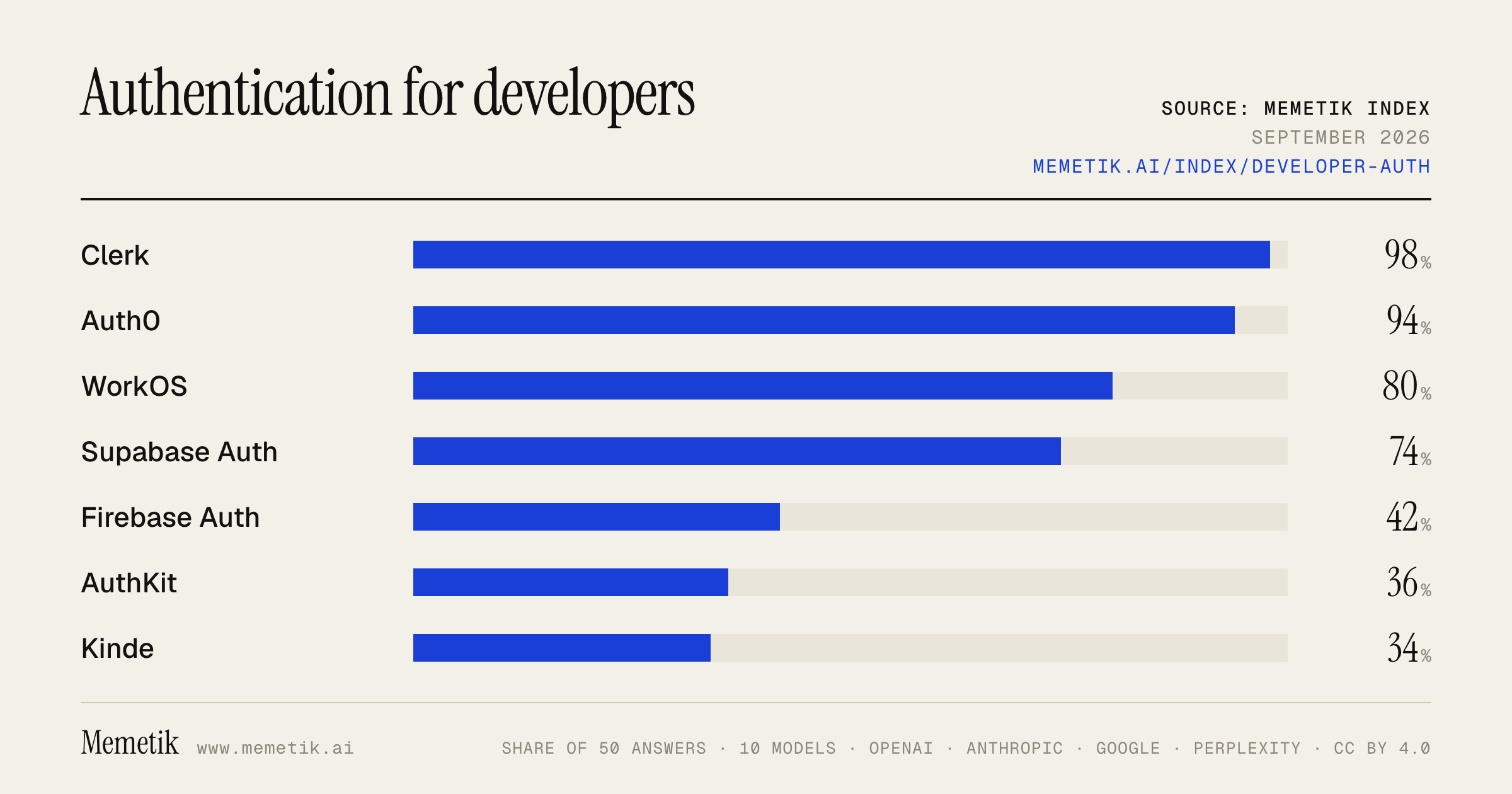
By provider
10 models · 50 answers
OpenAI 3 models · 15 answers
- GPT-5.6 Solgpt-5.6-solmost named: Clerk 100%
- GPT-5.6 Terragpt-5.6-terramost named: Clerk 100%
- GPT-5.6 Lunagpt-5.6-lunamost named: Clerk 100%
Anthropic 3 models · 15 answers
- Claude Opus 5claude-opus-5most named: Clerk 100%
- Claude Sonnet 5claude-sonnet-5most named: Clerk 100%
- Claude Fable 5claude-fable-5most named: Clerk 100%
Google 2 models · 10 answers
- Gemini 3.6 Flashgemini-3.6-flashmost named: Clerk 100%
- Gemini 3.5 Flashgemini-3.5-flashmost named: Clerk 100%
Perplexity 2 models · 10 answers
- Sonar Prosonar-promost named: Clerk 100%
- Sonar Reasoning Prosonar-reasoning-promost named: Clerk 80%
Sources the models cited
- kinde.com99
- propelauth.com88
- workos.com83
- merginit.com80
- ssojet.com47
- designkey.studio47
- spiderhunts.com40
- reddit.com34
- clerk.com31
- boilerplatehub.com31
- pkgpulse.com27
- dev.to26
ChatGPT via API returns no citations, so it does not contribute here.
The prompts
- What is the best authentication provider for a new SaaS app? Name specific products.
- Which auth service should I use for a Next.js startup?
- Compare the top user authentication platforms for startups.
- I'm building a B2B app and need SSO and user management. What do you recommend?
- Best managed auth for a startup that wants to avoid building login itself?
Every answer
Raw model output, unedited
GPT-5.6 TerraWhat is the best authentication provider for a new SaaS app? Name specific products.
For most **new B2B SaaS apps**, I’d choose **Clerk** as the default—especially if you’re building with **React/Next.js** and want to ship quickly.

### My practical shortlist

| If your app is… | Best pick | Why |
|---|---|---|
| A typical early-stage B2B SaaS | **Clerk** | Fastest developer experience, polished prebuilt UI, organizations/workspaces, and a low-ops path to enterprise SSO. Clerk’s current plans include 50,000 monthly retained users free per app. ([clerk.com](https://clerk.com/changelog/2026-02-05-new-plans-more-value?utm_source=openai)) |
| B2B SaaS where enterprise SSO/SCIM is a near-term sales requirement | **Stytch** | Strong B2B-first model: organizations, RBAC, SSO, SCIM, machine-to-machine tokens, and organization-specific authentication policies. Its published free tier includes 10,000 MAUs, unlimited organizations, and five SSO or SCIM connections. ([stytch.com](https://stytch.com/pricing?utm_source=openai)) |
| A complex, multi-platform product needing maximum customization | **Auth0** | Broad, mature CIAM platform with flexible identity integrations, organizations, enterprise federation, MFA, and extensive customization. The tradeoff is more implementation/configuration complexity. Auth0’s current B2B offering includes a free tier with up to 25,000 MAUs, five organizations, one enterprise connection, self-service SSO, and SCIM. ([auth0.com](https://auth0.com/pricing?pm=true&utm_source=openai)) |
| You already built login and only need enterprise SSO/provisioning | **WorkOS** | Best as an enterprise-identity layer added to your existing user system—particularly for SAML SSO, directory sync, and a customer-facing SSO setup portal. Its AuthKit user-management product is described as free up to 1 million MAUs, while enterprise SSO is priced per connection. ([clerk.com](https://clerk.com/articles/how-to-add-sso-and-saml-to-my-saas-product-2?utm_source=openai)) |
| An API-first or security-sensitive B2B product | **Stytch** | More composable than Clerk while still avoiding much of Auth0’s operational overhead; particularly compelling if passwordless, custom auth flows, fraud controls, or B2B machine identities matter. ([stytch.com](https://stytch.com/pricing?utm_source=openai)) |

## Recommendation by default

**Pick Clerk if:**
- You use Next.js, React, or a modern TypeScript stack.
- You want signup/login, social login, organizations, invitations, and user management working this week.
- Your early product needs good UX more than deeply custom identity workflows.

**Pick Stytch instead if:**
- You are clearly building **B2B from day one**.
- You expect SAML SSO and SCIM to come up in early enterprise deals.
- You need granular organization-level policies or machine-to-machine credentials.

**Pick Auth0 instead if:**
- You have unusual identity requirements: many external IdPs, legacy databases, complex federation, highly customized login rules, regulated-industry needs, or several app stacks/languages.
- You have enough engineering capacity to own the additional configuration and maintenance.

**Use WorkOS alongside another provider if:**
- Authentication is already built, but a customer says, “We need Okta/Azure AD SSO and SCIM before we sign.”
- You prefer an enterprise-SSO specialist rather than migrating all authentication.

## What I would avoid for a new SaaS

- **Building auth yourself** beyond basic authorization tables. Password resets, MFA, account recovery, session rotation, breach protections, SAML, SCIM, and enterprise IdP debugging become a major product area.
- Picking purely on today’s free tier. Model costs for your likely 12–24 month future: active users, organizations, SSO connections, SCIM connections, SMS/email verification, and support needs.
- Treating authentication and authorization as identical. Regardless of provider, keep your app’s business permissions—e.g. `workspace`, `role`, `plan`, resource-level permissions—in your own database/domain model.

### Bottom line

- **Fastest, safest default:** **Clerk**
- **Best B2B/enterprise-ready default:** **Stytch**
- **Best for complicated enterprise identity:** **Auth0**
- **Best enterprise SSO add-on to existing auth:** **WorkOS**
GPT-5.6 TerraWhich auth service should I use for a Next.js startup?
**Default choice: use Clerk** for a typical Next.js startup—especially if you want to ship quickly with polished sign-up/sign-in, social login, session management, route protection, and eventual B2B/multi-tenant organization support. Its Next.js SDK directly supports the App Router, Server Components, Server Actions, Route Handlers, and `proxy.ts`, with prebuilt UI and server-side authorization helpers. ([clerk.com](https://clerk.com/nextjs-authentication?utm_source=openai))

### Pick based on your situation

| Situation | Best fit | Why |
|---|---|---|
| You’re building a SaaS MVP and want the fastest reliable path | **Clerk** | Managed auth plus user-management UI; less auth plumbing to write and maintain. |
| You already use Supabase for Postgres/storage/realtime | **Supabase Auth** | Auth is naturally integrated with the rest of your Supabase project, and its official Next.js template includes cookie-based auth. ([supabase.com](https://supabase.com/docs/guides/auth/quickstarts/nextjs?utm_source=openai)) |
| You need maximum ownership/customization and can maintain auth yourself | **Better Auth** | It runs through your Next.js API routes and offers a broad feature set—including passkeys, 2FA, social sign-in, sessions, and organizations—in its example. ([better-auth.com](https://better-auth.com/docs/installation?utm_source=openai)) |
| You’re selling to enterprises with SAML/SCIM/compliance procurement from day one | **Consider Auth0 or a higher-tier Clerk setup** | Don’t optimize for this prematurely unless enterprise identity is already a sales blocker. |

### My practical recommendation

- **Use Clerk** if auth is not your product differentiator.
- **Use Supabase Auth** if you have already committed to Supabase as your backend.
- **Use Better Auth** only when avoiding a managed auth vendor or deeply controlling the data model is a real requirement—not merely an abstract preference.

For a new App Router app, I’d start with Clerk and keep your own application authorization data in your database:

```ts
// Your DB remains the source of truth for app-specific authorization.
users: {
  clerkUserId: string
  plan: "free" | "pro"
  role: "member" | "admin"
}
```

That way, Clerk handles **identity and sessions**, while your app owns **billing state, permissions, and business rules**. Clerk’s server-side `auth()` helper can protect routes and check authentication/authorization close to where resources are used. ([clerk.com](https://clerk.com/docs/reference/nextjs/app-router/auth?utm_source=openai))GPT-5.6 TerraCompare the top user authentication platforms for startups.
## Bottom line

For most startups, the best choice depends less on “who has login” and more on whether you need **consumer-scale UX**, **fast frontend integration**, **enterprise SSO/SCIM**, or **a database/cloud-native stack**.

| Platform | Best for | Main advantage | Main trade-off |
|---|---|---|---|
| **Clerk** | Product-led SaaS, especially React/Next.js teams | Fastest polished implementation; excellent prebuilt UI and developer experience | Costs grow with retained users; enterprise features/add-ons can matter for B2B |
| **WorkOS** | B2B SaaS selling to enterprise customers | Best enterprise-readiness: orgs, SSO, SCIM, admin tooling | Enterprise SSO and directory sync are charged per connection |
| **Auth0** | Complex identity requirements, large/mature companies | Broadest, mature identity feature set and extensibility | Can become expensive and pricing can be less startup-friendly at scale |
| **Stytch** | API-first B2B or security-conscious consumer auth | Strong authentication + authorization + risk controls; generous B2B bundle | More implementation work than drop-in UI-first tools |
| **Supabase Auth** | Startups already building on Supabase/Postgres | Tight integration with database, RLS, storage, and edge functions | Less turnkey for sophisticated enterprise identity workflows |
| **Firebase Auth / Identity Platform** | Mobile-first, Google Cloud/Firebase apps | Very straightforward mobile and social login integration | Enterprise B2B modeling, SSO, and provisioning are not its core strength |
| **Amazon Cognito** | AWS-native teams optimizing cloud consolidation | Fits AWS IAM, Lambda, API Gateway, and AWS procurement | Developer experience and customization are often more labor-intensive |

### My default recommendations

- **New B2C or prosumer web app using Next.js/React:** **Clerk**
- **B2B SaaS that expects SAML SSO and SCIM requests from customers:** **WorkOS**
- **Startup with unusual login, authorization, fraud, or API-level identity needs:** **Stytch**
- **App already committed to Supabase:** **Supabase Auth**
- **Mobile app built around Firebase:** **Firebase Auth**
- **AWS-heavy company with platform engineering capacity:** **Cognito**
- **Regulated or unusually complex identity program with budget:** **Auth0**

---

## Platform-by-platform comparison

### 1. Clerk — best for speed and polished product UX

**Choose Clerk if:** authentication should feel like a product feature rather than infrastructure work.

- Strong fit for React, Next.js, and modern JavaScript stacks.
- Provides ready-made sign-in, sign-up, profile, organization, session, and user-management components, while still allowing customization.
- Clerk’s current pricing includes a free Hobby tier with up to **50,000 monthly retained users (MRUs)** per app. Pro is listed at **$20/month when billed annually**, includes 50,000 MRUs, and then charges usage over that threshold; it also includes one enterprise connection. ([clerk.com](https://clerk.com/pricing?ck_subscriber_id=2020659820&utm_source=openai))
- MFA, satellite domains, and simultaneous sessions are now bundled more broadly into its paid offering than in its older pricing structure. ([clerk.com](https://clerk.com/changelog/2026-02-05-new-plans-more-value?utm_source=openai))

**Watch-outs**
- Its metric is **MRU**, not MAU. That can be favorable for high sign-up/low-return funnels, but make sure you understand your retention behavior.
- For B2B, model the cost of extra enterprise connections and administration features before committing.
- If authentication is deeply custom or needs to be fully backend/API-driven, Clerk may feel more opinionated than Stytch or Auth0.

**Verdict:** Best default for a small product team that wants a high-quality auth experience quickly.

---

### 2. WorkOS — best for enterprise B2B SaaS

**Choose WorkOS if:** your roadmap includes “We need SAML SSO for Acme” and “We need SCIM provisioning” early.

- Designed around organizations, enterprise connections, directory sync, auditability, and admin workflows.
- Its User Management/AuthKit product includes email/password, Google and Microsoft OAuth, magic links, MFA, bot protection, organization-aware policy configuration, and user/session management. ([workos.com](https://workos.com/user-management?utm_source=openai))
- WorkOS lists user management as free through **1 million users**, then **$2,500/month per additional million**. ([workos.com](https://workos.com/user-management?utm_source=openai))
- The key cost driver is enterprise functionality: SSO and Directory Sync are priced per connection; publicly listed pricing is **$125 per connection** before volume discounts. ([workos.com](https://workos.com/compare/clerk?utm_source=openai))

**Watch-outs**
- A customer needing both SSO and SCIM can represent two billable connections.
- WorkOS is strongest for B2B; it is not necessarily the best fit if your only need is a slick consumer login screen.
- Its hosted AuthKit is fast, but teams that require a completely bespoke embedded authentication interface should validate the headless API fit.

**Verdict:** The clearest choice for enterprise-bound B2B SaaS. It prevents a painful auth-platform migration when larger customers arrive.

---

### 3. Auth0 — best for breadth and complex identity programs

**Choose Auth0 if:** you need mature identity infrastructure, many connection types, advanced security controls, or extensive customization.

- Broad support for passwordless login, social identity providers, enterprise connections, RBAC, attack protection, MFA, logs, machine-to-machine tokens, and more.
- Its published free tier currently covers up to **25,000 MAUs** and includes items such as social connections, passwordless authentication, a custom domain, and one enterprise connection. Paid Essentials is listed from **$35/month** for a 500-MAU tier, while Professional starts at **$240/month** for that tier. ([auth0.com](https://auth0.com/pricing?pm=true&utm_source=openai))
- Auth0 also advertises a startup program that includes up to **100,000 monthly external active users** plus select enterprise/security capabilities free for a year, subject to eligibility. ([auth0.com](https://auth0.com/pricing?pm=true&utm_source=openai))

**Watch-outs**
- Pricing tiers and add-ons require careful forecasting—particularly for B2B functionality, MFA, security controls, and larger MAU volumes.
- It is powerful, but can be more platform-like and operationally heavy than Clerk.
- Avoid selecting it merely because it is familiar; select it because its specific identity depth solves a real requirement.

**Verdict:** Excellent technically, but usually best when complexity, compliance, integrations, or enterprise requirements justify its cost and operational weight.

---

### 4. Stytch — best API-first modern auth and fraud controls

**Choose Stytch if:** your team wants fine-grained API control, modern passwordless/passkey flows, multi-tenant B2B architecture, or integrated risk prevention.

- Stytch positions its B2B offering around authentication and authorization, organizations, SSO, SCIM, RBAC, machine-to-machine tokens, and configurable organization-level policies.
- Its public B2B plan lists **10,000 MAUs**, unlimited organizations, **five SSO or SCIM connections**, and a broad auth/authz feature set on the free allowance. �
- https://clerk.com/pricing?ck_subscriber_id=2020659820&utm_source=openai
- https://clerk.com/changelog/2026-02-05-new-plans-more-value?utm_source=openai
- https://workos.com/user-management?utm_source=openai
- https://workos.com/compare/clerk?utm_source=openai
- https://auth0.com/pricing?pm=true&utm_source=openai
GPT-5.6 TerraI'm building a B2B app and need SSO and user management. What do you recommend?
For most new **B2B SaaS apps**, I’d recommend:

## Default recommendation: **WorkOS for enterprise features**
Use WorkOS if you already have (or want freedom to choose) your normal authentication stack, but need enterprise requirements such as:

- SAML/OIDC SSO for customer identity providers
- SCIM / directory sync for automated provisioning and deprovisioning
- Group sync
- A self-serve IT-admin setup portal
- Audit-log and authorization-related enterprise add-ons

Its main advantage is that it handles the annoying per-IdP enterprise integration and onboarding work, while you retain control of your own application’s users, tenants, roles, and data model. Its Admin Portal is designed for customer IT admins to configure SSO and directory connections themselves; Directory Sync sends user/group lifecycle changes to your app through APIs and events/webhooks. ([workos.com](https://workos.com/docs/directory-sync?utm_source=openai))

**A pragmatic stack:**
- **Auth:** your existing auth system, or WorkOS AuthKit
- **Enterprise SSO + SCIM:** WorkOS
- **App authorization:** your own tenant-scoped RBAC in the database; optionally use an authorization product later if requirements become complex
- **Billing/entitlements:** separate from identity and authorization

## When I’d choose something else

| Situation | Better fit |
|---|---|
| You need a full, highly customizable consumer + enterprise identity platform in one vendor | **Auth0** |
| You’re building quickly with a modern web app and want polished prebuilt auth UI plus organizations | **Clerk** |
| You want an API-first auth vendor designed around B2B organizations and memberships | **Stytch** |
| You have strong IAM expertise, need on-prem/self-hosting, or cannot use a SaaS identity vendor | **Keycloak** |
| You are deeply AWS-native, cost-sensitive, and can tolerate more integration work | **Amazon Cognito** |

My bias: don’t build direct SAML and SCIM integrations yourself unless identity infrastructure is part of your product strategy. The long tail of IdP-specific behavior, certificate rotation, provisioning edge cases, retry handling, and support burden is substantial. WorkOS explicitly positions Directory Sync as a normalized layer across directory providers and recommends consuming events to keep your app synchronized. ([workos.com](https://workos.com/docs/directory-sync?utm_source=openai))

## Data model I’d implement regardless of vendor

Keep these concepts in **your** database:

```text
organizations
users
memberships              # user_id, organization_id, role
roles
permissions
sso_connections          # external connection ID + organization ID
directory_connections    # external directory ID + organization ID
```

Important rules:

1. **Tenant membership is not the same thing as authentication.**
   A person may authenticate successfully but still have no access to a given customer organization.

2. **Treat the customer directory as authoritative only where agreed.**
   For SCIM-managed organizations, deactivate/revoke membership promptly on deprovisioning events. For manually invited users, retain your own lifecycle rules.

3. **Make every authorization check organization-scoped.**
   Never infer tenant access just from email domain or from an SSO login.

4. **Separate roles from entitlements.**
   `admin`, `member`, and `viewer` are permissions; “Enterprise plan can use SSO” is an account-level entitlement.

5. **Use webhooks as an eventually consistent input.**
   Verify signatures, persist event IDs for idempotency, enqueue processing, and make updates safe to replay.

## Rollout plan

**Phase 1 — MVP**
- Email/password or social login
- Organizations, invitations, memberships
- Simple RBAC: owner/admin/member/viewer

**Phase 2 — Enterprise-ready**
- Per-organization SAML/OIDC SSO
- Domain verification
- JIT provisioning at SSO login
- Self-serve setup for IT admins

**Phase 3 — Enterprise procurement**
- SCIM/directory sync
- Group-to-role mapping
- Audit logs
- Session controls, support/admin impersonation with audit trails
- Custom roles or fine-grained authorization if truly needed

## Bottom line

If you want a crisp decision without more context: **use WorkOS for SSO + SCIM, retain a simple internal organization/membership/RBAC model, and avoid coupling your business authorization model to your identity provider.**

If you’re starting from zero and want one vendor to own nearly all login and user-management UX, evaluate **Clerk, Stytch, and Auth0** alongside WorkOS—but for a B2B app expecting enterprise customers, I would prioritize a strong SSO + lifecycle-management path over merely having attractive login screens.
GPT-5.6 TerraBest managed auth for a startup that wants to avoid building login itself?
**Default pick: Clerk** — especially for a typical web/SaaS startup using React/Next.js. It is optimized for shipping a polished login experience quickly: hosted/customizable UI, social sign-in, passwordless options, sessions, organizations, MFA/passkeys, webhooks, and user management without your team owning the security-sensitive plumbing. Clerk’s current free allowance is 50,000 monthly retained users; production Pro starts around $20/month on annual billing. ([clerk.com](https://clerk.com/changelog/2026-02-05-new-plans-more-value?utm_source=openai))

Choose based on your startup shape:

| If you are building… | Pick | Why |
|---|---|---|
| B2C or small B2B SaaS, want fastest launch | **Clerk** | Best developer/UI ergonomics and sensible out-of-box product features. |
| B2B SaaS that expects enterprise SSO/SCIM early | **WorkOS** | Its AuthKit/User Management plus enterprise identity stack is unusually startup-friendly; core user management is free through 1M users, but enterprise SSO is separately priced. ([workos.com](https://workos.com/user-management?utm_source=openai)) |
| Complex, highly customized identity flows / regulated enterprise buyers | **Auth0** | Mature and flexible, with deep extensibility, but pricing can become harder to predict as you grow. Its free plan lists up to 25,000 MAU, while paid tiers and enterprise features can escalate quickly. ([auth0.com](https://auth0.com/pricing?pm=true&utm_source=openai)) |
| You already use Supabase for database/backend | **Supabase Auth** | Lowest-friction integrated option; Pro includes 100,000 MAU and then charges per MAU. Less polished as a dedicated auth/product layer than Clerk. ([supabase.com](https://supabase.com/docs/guides/platform/manage-your-usage/monthly-active-users?utm_source=openai)) |

**My practical recommendation:**
- Start with **Clerk** for a consumer-facing app or ordinary SaaS.
- Start with **WorkOS AuthKit** if selling to companies where Google Workspace, Okta, Entra ID, SAML SSO, and SCIM are likely sales requirements in the first year.
- Avoid starting with Auth0 unless you already know you need unusually deep identity customization.

Whichever you choose, preserve an exit path: keep your own internal `users` table keyed to the provider’s immutable user ID, use webhooks to sync lifecycle changes, put app roles/permissions in your database rather than only in the auth vendor, and confirm user-data export/migration terms before committing.
Claude Sonnet 5What is the best authentication provider for a new SaaS app? Name specific products.
Choosing an authentication provider depends on your budget, growth stage, tech stack, and how much control you want over the auth flow. Here's a practical breakdown of the leading options for a new SaaS app:

## Top Options

**Clerk**
Popular right now for modern SaaS/startup apps, especially those built with React, Next.js, or similar frameworks. It offers pre-built UI components (sign-in, sign-up, user profile, organization management), multi-tenancy support out of the box, and a generous free tier. Great developer experience and fast to integrate.

**Auth0 (by Okta)**
One of the most established players. Extremely feature-rich — supports SSO, MFA, social logins, enterprise connections (SAML/OIDC), and has strong compliance certifications (SOC2, HIPAA, etc.). Pricing scales up quickly and can get expensive as you grow, but it's battle-tested for enterprise SaaS.

**Firebase Authentication (Google)**
Good if you're already in the Firebase/Google Cloud ecosystem or want something free and simple for smaller apps. Supports email/password, phone auth, and social providers. Less suited for complex B2B/enterprise SSO needs.

**AWS Cognito**
Solid choice if you're already deep in AWS infrastructure. Cheaper at scale than Auth0 in many cases, but the developer experience and documentation are notoriously clunky compared to newer providers.

**Supabase Auth**
Part of the Supabase open-source Firebase alternative. Good if you're using Supabase for your database too — gives you Postgres row-level security integrated with auth, which is powerful for SaaS permission models.

**WorkOS**
Specifically built for B2B SaaS that needs to sell to enterprise customers — handles SSO (SAML/OIDC), SCIM provisioning, and directory sync in a much simpler/cheaper way than Auth0's enterprise tier. Many companies use WorkOS *specifically* for enterprise SSO while using something else (like Clerk or their own auth) for regular user login.

**NextAuth.js / Auth.js**
Free, open-source, self-hosted option if you want full control and don't want to pay a third-party vendor. More setup work, but no per-user pricing.

## My Recommendation

- **Early-stage B2C or small B2B SaaS, fast shipping:** Clerk
- **Need enterprise SSO/SAML for B2B customers:** WorkOS (paired with Clerk or your own auth for regular logins)
- **Already on AWS:** Cognito
- **Already on Supabase/Postgres:** Supabase Auth
- **Enterprise-grade, willing to pay more, need maximum feature depth:** Auth0

If you tell me more about your stack (framework, hosting, B2B vs. B2C, expected scale) I can narrow this down further.
Claude Sonnet 5Which auth service should I use for a Next.js startup?
For a Next.js startup, the right choice depends on your priorities (speed of setup, cost, ownership of data, scalability). Here's a breakdown of the most popular options:

## Top Choices

**NextAuth.js / Auth.js**
- Free, open-source, built specifically with Next.js in mind
- Full control over your data and auth flow (self-hosted)
- Supports OAuth providers (Google, GitHub, etc.), email/magic links, credentials, and database sessions
- Great if you want to avoid vendor lock-in and don't mind a bit more setup
- Best for: teams comfortable managing their own database/session logic

**Clerk**
- Extremely popular in the Next.js/React ecosystem right now, purpose-built for modern frontend frameworks
- Drop-in UI components (sign-in, sign-up, user profile, org management) that just work
- Handles MFA, social logins, session management, and has a generous free tier
- Great DX (developer experience), fastest to ship with
- Best for: startups who want to move fast and not worry about building auth UI from scratch

**Supabase Auth**
- Good if you're already using Supabase as your backend/database (Postgres-based)
- Built-in row-level security integration, social logins, magic links
- Generous free tier, open-source
- Best for: startups using Supabase as their full backend

**Auth0 (by Okta)**
- Enterprise-grade, very mature, tons of features (SSO, MFA, compliance certifications)
- Can get pricey as you scale users
- Best for: startups anticipating enterprise customers needing SSO/SAML compliance early

**Firebase Auth**
- Simple, well-documented, free tier is solid
- Ties you into the Firebase/Google ecosystem
- Best for: startups already using Firebase for other services

**Better-Auth** (newer, worth mentioning)
- Fully open-source, TypeScript-first, framework-agnostic but works great with Next.js
- Growing fast in popularity as a "own your data" alternative to Clerk
- Best for: teams that want Clerk-like DX but self-hosted and free

## My Recommendation

- **If you want the fastest path to shipping and don't mind a paid service as you scale:** go with **Clerk**. It's currently the go-to for Next.js startups because of its polish and speed.
- **If you want full ownership, no vendor lock-in, and don't mind writing more code:** go with **Auth.js (NextAuth)** or **Better-Auth**.
- **If you're already using Supabase for your database:** just use **Supabase Auth** — it's tightly integrated and saves you from juggling extra services.

Want me to help you pick based on your specific stack (database, hosting, expected user scale) or walk through a quick setup for one of these?
Claude Sonnet 5Compare the top user authentication platforms for startups.
## Top User Authentication Platforms for Startups: A Comparison

Choosing an authentication provider is a decision that's hard to unwind later, so it's worth understanding how the major players differ. Here's how the leading platforms stack up:

### Clerk

Clerk is ideal for startups and frontend-heavy teams building React or Next.js applications that want a polished authentication experience with minimal setup, best suited for teams that value prebuilt UI and fast implementation over deep identity orchestration.
 It's also praised for security defaults —
best practices include short-lived tokens (like Clerk's 60-second expiration with background refresh), device tracking, and remote session revocation capabilities.


**Best for:** Early-stage teams on React/Next.js who want speed and great UX out of the box.

### Firebase Authentication (Google)

Firebase Authentication is Google's authentication service for web and mobile apps, supporting email/password login, phone authentication, anonymous auth, social providers, and integration with the broader Firebase ecosystem.
 It's a strong fit for
early-stage startups using Firebase as a full backend (Firestore, Functions, Hosting), mobile-first or single-page apps that benefit from client-side SDKs, and teams comfortable with the Google Cloud ecosystem and not needing complex enterprise SSO.
 On pricing, it offers a
generous free tier with a large number of monthly active users including phone auth quotas, with pay-as-you-go beyond free limits (charges differ by auth method), billed under the broader Firebase/Google Cloud project.


**Best for:** Mobile/SPA startups already in the Google Cloud ecosystem.

### Supabase Auth

It supports email and password login, magic links, OTP, social login, SDKs, APIs, and integration with Supabase's Postgres-based backend services, making it popular among startups and product teams building custom applications.
 A key advantage is that
authentication works seamlessly with Supabase databases, storage, and backend services.

Supabase is ideal for startups, SaaS teams, and developers who want to build custom authentication experiences without being constrained by hosted login pages, and works especially well for organizations already using Supabase as their application backend.


**Best for:** Teams already using Postgres/Supabase as their backend.

### Auth0 (by Okta)

Auth0 is a popular Identity-as-a-Service (IDaaS) platform that lets developers quickly add authentication and authorization to their applications, supporting social logins, enterprise identity providers, multi-factor authentication, and role-based access control, all wrapped in hosted login pages and APIs.
 It's built for scale —
Auth0 takes a modern approach to identity, providing secure access to any application, for any user, and safeguards billions of login transactions each month.

It lets you integrate authentication and authorization for web, mobile, and legacy applications, supporting passwords, biometrics, MFA, token-based auth, and SSO.


However,
many startups eventually look for Auth0 alternatives — common reasons include costs growing quickly as MAUs or advanced features increase, vendor lock-in concerns with hosted proprietary platforms, and complexity in customizing login flows, UI, or policies.


**Best for:** Startups anticipating enterprise SSO/compliance needs and willing to trade some cost/flexibility for maturity.

### Frontegg

Frontegg is a Customer Identity and Access Management (CIAM) platform that simplifies authentication, authorization, and user management for SaaS companies, supporting SSO, MFA, role-based access control, entitlements, multi-tenancy, and audit logs.

Its low-code platform integrates in days and provides a user-friendly admin portal that bridges technical and non-technical teams, increasing operational efficiency and improving security posture.


**Best for:** B2B SaaS startups needing multi-tenancy and self-serve admin features quickly.

### Descope, Stytch & Others
These are newer entrants also aimed at developer experience. One industry comparison sums up the decision matrix well:
if you're a React/Next.js startup, Clerk or Descope probably make the most sense; if you need enterprise SSO and multi-tenancy in addition to user auth, consider Descope or Auth0; if you're on Postgres, Supabase is probably best, but Descope can also work.


---

## Quick Decision Framework

| Priority | Best Choice |
|---|---|
| Fastest UX for React/Next.js | **Clerk** |
| Already on Google Cloud / mobile-first | **Firebase Auth** |
| Already using Postgres/Supabase backend | **Supabase Auth** |
| Need enterprise SSO/compliance at scale | **Auth0** or **Descope** |
| B2B SaaS needing multi-tenancy & admin UI | **Frontegg** |
| Adding enterprise SSO without ripping out existing auth | **Identity broker (e.g., SSOJet)** |

A few important caveats to weigh:

1. **Migration cost is real.**
Migration complexity is a major factor when picking an auth
- https://www.descope.com/blog/post/developer-friendly-auth-platforms
- https://clerk.com/articles/essential-user-management-features-startups
- https://startupik.com/auth0-alternatives-best-authentication-platforms-for-developers/
- https://www.descope.com/blog/post/best-ux-auth-platforms
- https://sourceforge.net/software/authentication/for-startup/
Claude Sonnet 5I'm building a B2B app and need SSO and user management. What do you recommend?
For a B2B app needing SSO and user management, this is a well-trodden space with several solid options depending on your priorities. Here's a breakdown:

## Managed Identity Platforms (fastest to ship)

**Auth0 / Okta** — The most established option. Handles SSO (SAML, OIDC), user management, MFA, organizations/multi-tenancy, and has extensive documentation. Auth0's B2B/enterprise features (Organizations) are specifically built for multi-tenant SaaS. Downside: pricing scales aggressively once you need enterprise SSO connections per customer.

**WorkOS** — Built specifically for B2B SaaS SSO. Popular because it abstracts away the pain of supporting different customers' SAML/OIDC identity providers (Okta, Azure AD, Google Workspace, etc.) behind one API. Also offers Directory Sync (SCIM), audit logs, and admin portals. Many devs like it because it's cheaper and more focused than Auth0 for pure B2B SSO needs.

**Clerk** — Great developer experience, strong for modern React/Next.js stacks. Has organizations, roles, and SSO support, though its enterprise SSO story is newer/less mature than WorkOS.

**FusionAuth** — Self-hostable or cloud, generous free tier, full-featured (SSO, MFA, user management), good if you want more control without building from scratch.

**Frontegg / SuperTokens** — Frontegg is also B2B-focused with self-serve admin portals for your customers. SuperTokens is open-source if you want to self-host and avoid vendor lock-in.

## Key things to consider when choosing:

1. **Multi-tenancy model** — B2B apps usually need "organizations" as a first-class concept (users belong to companies, companies configure their own SSO). Not all providers make this equally easy.
2. **Who configures SSO** — If your enterprise customers' IT admins need to self-service configure SAML/OIDC, look for a built-in admin portal (WorkOS and Frontegg both offer this).
3. **SCIM/Directory Sync** — Larger enterprise customers will eventually ask for this (auto-provisioning/deprovisioning users). Worth checking early if you expect enterprise deals.
4. **Cost model** — Some charge per SSO connection (can get expensive with many enterprise customers), others per MAU.
5. **Build vs. buy** — Rolling your own with something like NextAuth/Auth.js + a SAML library is possible but SSO edge cases (especially SAML) are notoriously painful to get right. Most teams don't recommend building this from scratch unless identity is core to your product.

## My general recommendation

If you're a smaller team wanting to move fast and expect enterprise customers to ask for SSO: **WorkOS** or **Clerk** tend to be the most commonly recommended starting points right now for B2B SaaS. If you want a single mature all-in-one platform with a longer track record: **Auth0**.

Want me to narrow this down based on your stack (e.g., Next.js, Rails, etc.) or expected scale/budget?
Claude Sonnet 5Best managed auth for a startup that wants to avoid building login itself?
For most startups, I'd point you toward **Clerk**, **Auth0**, or **Supabase Auth** depending on your stack — here's how to think about it:

## Quick recommendation
- **Clerk** — best if you're building a modern React/Next.js app fast and want great pre-built UI components (login, signup, user profile, orgs) with minimal code.
- **Auth0** (by Okta) — best if you want the most mature, battle-tested, enterprise-ready option with broad framework/language support and you anticipate needing SSO/enterprise features later.
- **Supabase Auth** — best if you're already using Supabase for your database/backend and want auth bundled in for free/cheap.
- **Firebase Auth** — best if you're in the Google/Firebase ecosystem, want a generous free tier, and don't need advanced enterprise features.
- **WorkOS** — best if you're B2B SaaS and know you'll need SSO/SCIM for enterprise customers early on.

## Why "managed auth" over building it yourself
Building auth in-house means owning password hashing, session/token management, MFA, email verification, social logins, breach-credential checks, and compliance — all high-risk, low-differentiation work. A managed provider like Auth0 offers
consumer-grade and enterprise-grade identity capabilities
, and this category overall is mature — the
CIAM market is over $5.8 billion in annual revenue, growing at a 17% CAGR
, meaning these tools are well-funded and actively developed, so you're not betting on something niche.

## How to choose

**1. If you want speed + great DX (small team, modern stack):**
Clerk is popular right now for its drop-in UI components and generous free tier for early-stage apps. Similarly, other providers in this space tout
a generous free tier (25,000 MAUs) that makes it ideal for startups and growing businesses, with a scalable subscription model based on Monthly Active Users and developer-friendly documentation, SDKs, and code examples
.

**2. If you want the "safe enterprise choice":**
Auth0 remains a default recommendation because of its maturity, huge integration ecosystem, and flexibility across languages/frameworks — similar in philosophy to Okta, which is
well-suited for enterprises needing comprehensive identity management and adaptive MFA, with over 8,000 app integrations and rich customization
, though Auth0 is more startup-friendly at entry pricing tiers than Okta itself.

**3. If you're B2B SaaS and need SSO/RBAC/orgs early:**
Look at **Frontegg** or **WorkOS**. Frontegg is
a modern Customer Identity and Access Management platform purpose-built for SaaS applications, giving developers a low-code toolkit for MFA, SSO, passwordless login, and role-based access control without spending weeks wiring up custom flows
. It also
includes built-in support for OpenID Connect, SAML, OAuth2, and webhooks, with pre-configured components for login, signup, user management, and organization hierarchies
 — useful if enterprise buyers will demand SAML SSO.

**4. If you're already using a backend-as-a-service:**
Supabase Auth or Firebase Auth make sense — you get auth "for free" alongside your database, cutting integration work further.

## Bottom line
- **Next.js/React app, want it done in an afternoon:** Clerk
- **Need maximum flexibility/enterprise trust signal:** Auth0
- **Already on Supabase/Firebase:** use their built-in auth
- **B2B SaaS selling to enterprises:** WorkOS or Frontegg for easy SSO/SCIM

Whichever you pick, the core startup logic holds: authentication is undifferentiated heavy lifting — security-critical, compliance-sensitive, and easy to get subtly wrong — so offloading it to a managed provider is almost always the right call unless auth itself is your product.
Gemini 3.6 FlashWhat is the best authentication provider for a new SaaS app? Name specific products.
There is no single "best" authentication provider for a SaaS application, as the right choice depends heavily on your application's architecture (B2B vs. B2C), target market (SMB vs. Enterprise), and stack. However, the modern ecosystem has clear category leaders:

---

### 1. Best for B2B SaaS (Organizations & Enterprise SSO)
If your product sells to companies rather than individual consumers, you need multi-tenancy (workspace/organization management) and support for enterprise single sign-on (SAML/OIDC via Okta, Entra ID, Google Workspace) from day one.

*   **WorkOS**
    *   **Why choose it:** WorkOS is purpose-built for selling to enterprises. It offers modular APIs for Enterprise SSO, SCIM user provisioning, multi-tenant RBAC, and audit logs.
    *   **Best for:** B2B startups that want to start with standard auth (or another provider) and incrementally add enterprise features to close big deals.
*   **PropelAuth**
    *   **Why choose it:** Designed entirely around multi-tenant B2B apps. It automatically handles organization switching, role delegation within orgs, self-serve admin portals for your business customers, and SAML SSO.
    *   **Best for:** Founders building a B2B SaaS who want a turnkey, organization-aware login and user-management system out of the box.
*   **Kinde**
    *   **Why choose it:** High developer-experience platform built specifically for B2B. Includes multi-tenancy, custom permissions, feature flags, and built-in monetization/billing controls alongside standard auth.

---

### 2. Best for Frontend/Product Experience & Rapid Prototyping
*   **Clerk**
    *   **Why choose it:** Outstanding developer experience with pre-built React, Next.js, Vue, and Remix components. It provides polished UI elements for sign-in, user profiles, organization switchers, and session management in minutes.
    *   **Best for:** Modern web applications prioritizing user interface quality and ultra-fast speed to market.

---

### 3. Best for Infrastructure-Integrated & Open Source Apps
*   **Supabase Auth**
    *   **Why choose it:** Built natively on top of PostgreSQL using Row Level Security (RLS). It handles password, magic link, and social authentication for free or low cost alongside a full database backend.
    *   **Best for:** Full-stack apps built on Supabase or projects needing basic, reliable auth tied directly to a database schema.
*   **Better Auth / NextAuth.js (Self-Hosted Frameworks)**
    *   **Why choose it:** Open-source, framework-native options (especially popular in the React/Next.js/Node ecosystem) that keep user data inside your own database, eliminating per-user vendor lock-in.
    *   **Best for:** Teams with tight privacy requirements, low budget, or a desire for full ownership of auth tables.

---

### 4. Best for Scale & Complex Enterprise Customization
*   **Auth0 (by Okta)**
    *   **Why choose it:** The industry standard for complex CIAM (Customer Identity Access Management). Highly extensible via custom pipeline scripts (Actions), supporting virtually every identity protocol, MFA strategy, and security rule.
    *   **Caveat:** Can get expensive fast, especially when enabling enterprise B2B features like SAML connections or custom domains.
    *   **Best for:** Larger teams or startups backed by enterprise capital that require total customizability and advanced compliance controls.

---

### Summary Recommendation
*   **Building a B2B app with enterprise growth in mind?** Go with **WorkOS** or **PropelAuth**.
*   **Building a Next.js / React Web App?** Go with **Clerk**.
*   **Building on a budget or needing full data control?** Go with **Supabase Auth** or open-source solutions like **Better Auth**.
Gemini 3.6 FlashWhich auth service should I use for a Next.js startup?
Choosing the right authentication service for a Next.js startup depends on your project’s target audience (B2C vs. B2B SaaS), budget, timeline, and how much control you want over user data.

Below is a breakdown of the **top options** to help you pick the best fit.

---

### 1. **Clerk** — *Best overall for B2C & fast shipping*
* **Type:** Fully Managed Service (SaaS)
* **Why startups choose it:** Clerk offers the absolute best developer experience for Next.js. It provides drop-in React components (`<SignIn />`, `<UserProfile />`, `<OrganizationSwitcher />`) that work seamlessly with modern Next.js features like Server Components, Server Actions, and App Router Middleware.
* **Best for:**
  * Startups that want to launch MVP-fast without spending time designing auth UIs.
  * Apps needing pre-built UI components and simple user management out of the box.
* **Drawbacks:** Vendor lock-in and potential per-user costs as you scale (though it offers a generous free tier).

---

### 2. **Better Auth** — *Best self-hosted / open-source option*
* **Type:** Open-source TypeScript Auth Library
* **Why startups choose it:** Designed specifically with modern Next.js and TypeScript in mind. It gives you complete ownership of your database (using ORMs like Drizzle or Prisma) with zero vendor lock-in. It also includes powerful features like multi-tenancy, passkeys, 2FA, and RBAC via plugins.
* **Best for:**
  * Teams that want total control over their user data and schema in Postgres/MySQL.
  * Cost-conscious startups wanting enterprise features (2FA, passkeys, orgs) for free.
* **Drawbacks:** Requires self-hosting, database configuration, and building or styling your own login forms/UI.

---

### 3. **WorkOS** or **PropelAuth** — *Best for B2B SaaS (Enterprise-ready)*
* **Type:** Managed Auth for B2B
* **Why startups choose it:** If you are selling to businesses, you will eventually need enterprise features like **SAML SSO**, **SCIM directory syncing**, multi-tenant organizations, and role-based permissions.
  * **WorkOS:** Offers native Next.js SDKs and a massive free tier for user management (up to 1M MAUs).
  * **PropelAuth:** Designed ground-up for B2B SaaS with zero-friction organization and role/permission helpers built directly into React hooks/components.
* **Best for:** B2B startups targeting business/enterprise customers who need SSO (Okta, Azure AD) or organization management.

---

### 4. **Supabase Auth** — *Best if you're already using Supabase*
* **Type:** Managed Auth tied to a Postgres Backend
* **Why startups choose it:** If you use Supabase as your primary database, its auth system connects directly with PostgreSQL Row-Level Security (RLS).
* **Best for:** Indie hackers or startups using Supabase for their full backend (Database + Auth + Storage).
* **Drawbacks:** Slightly more manual setup if you are not using Supabase's full ecosystem or RLS.

---

### 5. **Auth.js (formerly NextAuth.js v5)** — *The Open-Source Legacy Standard*
* **Type:** Open-source auth framework
* **Why startups choose it:** It's free, highly flexible, and has a massive community. Auth.js v5 is fully adapted for Next.js App Router and Server Actions.
* **Best for:** OAuth-heavy logins (e.g., "Sign in with Google/GitHub") where you want a simple, free library.
* **Drawbacks:** Adding complex email/password flows, 2FA, or custom session logic can feel tedious compared to Better Auth or Clerk.

---

### 💡 Recommendation Matrix

| Your Startup's Goal | Recommended Choice |
| :--- | :--- |
| **"I want to launch as fast as humanly possible."** | **Clerk** |
| **"I want full control over my database & zero vendor lock-in."** | **Better Auth** |
| **"I am building B2B SaaS and need Orgs, SSO, and Permissions."** | **WorkOS** or **PropelAuth** |
| **"I am already using Supabase as my main backend."** | **Supabase Auth** |
Gemini 3.6 FlashCompare the top user authentication platforms for startups.
Choosing the right authentication provider for a startup depends heavily on your **target audience (B2C vs. B2B SaaS)**, your **tech stack**, and your **budget constraints**.

Here is a comparison of the top authentication platforms for startups, followed by key decision factors to help you pick the best one.

---

### Comparison of Top Auth Platforms

| Platform | Best For | Standout Strengths | Weaknesses / Gotchas | Generous Free Tier? |
| :--- | :--- | :--- | :--- | :--- |
| **Clerk** | B2C or B2B web apps (Next.js / React) | Unmatched UI components (drop-in user profiles, org switchers); fastest time-to-market. | Expensive at scale; tightly coupled to front-end frameworks. | **10,000** Monthly Active Users (MAUs) |
| **WorkOS** | B2B SaaS aiming for Enterprise clients | Enterprise SSO (SAML/OIDC), SCIM directory sync, Admin Portal for B2B; massive MAU limit via AuthKit. | SAML / SCIM connections get expensive as enterprise deals scale. | **1,000,000** MAUs (AuthKit free tier) |
| **Supabase Auth** | Full-stack apps / Postgres users | Integrates with PostgreSQL Row-Level Security (RLS); open-source; cheap scaling. | Pre-built UI is basic compared to Clerk; requires managing a broader database setup. | **50,000** MAUs |
| **Kinde / PropelAuth** | Early-stage B2B SaaS | First-class organization management, RBAC, feature flags, and multi-tenant logic out of the box. | Smaller community footprint than Auth0 or Firebase. | **10,000+** MAUs |
| **Auth0 (by Okta)** | Enterprise-grade requirements / Legacy apps | Industry standard; extensive marketplace integrations; deeply customizable via Actions/Rules. | Aggressive pricing jumps; UI feels dated; overkill for early-stage MVPs. | **25,000** MAUs |
| **Firebase Auth** | Mobile apps (Flutter/iOS/Android) & Web | Battle-tested scale; seamless Google ecosystem integration; extremely cheap. | Poor B2B support (SSO/multi-tenancy is clunky); weak modern UI components. | **50,000** MAUs |
| **Stytch** | Fraud prevention & Passwordless | Passkey-first approach; built-in bot detection and device fingerprinting. | Higher learning curve for traditional email/password setups; higher baseline pricing. | **10,000** MAUs |

---

### Detailed Breakdown of the Top Contenders

#### 1. Clerk (Best Developer Experience & Rapid MVP)
* **Why startups pick it:** If you're building a modern React, Next.js, or Remix app, Clerk gives you drop-in authentication components that look completely native. You can set up complete user flows (login, sign-up, user profiles, MFA, org management) in under 30 minutes.
* **Best use case:** Web apps prioritizing design and rapid shipping.
* **Watch out for:** Clerk charges per Monthly Read Active User (MRU). As your traffic spikes, costs can increase faster than on raw infrastructure platforms like Supabase.

#### 2. WorkOS (Best for B2B SaaS & Upmarket Expansion)
* **Why startups pick it:** B2B startups eventually face "The Enterprise Readiness Wall"—when a potential client requires Enterprise Single Sign-On (SAML with Okta, Microsoft Entra, etc.) and Directory Sync (SCIM). WorkOS lets you add enterprise SSO in days rather than months. With its **AuthKit** service offering up to 1M free active users, it’s a dominant choice for B2B SaaS.
* **Best use case:** SaaS startups selling to mid-market and enterprise buyers.
* **Watch out for:** Flat monthly or per-connection pricing for SAML/SCIM can become a significant line item once you cross into dozens of enterprise clients.

#### 3. Supabase Auth (Best Value & Open Source)
* **Why startups pick it:** If you are already using or considering Supabase for your database, its built-in authentication is hard to beat. It passes JWTs directly to PostgreSQL, allowing you to secure data using database Row-Level Security (RLS) policies. It is open-source (built on GoTrue) so there is no vendor lock-in.
* **Best use case:** Indie hackers, budget-conscious startups, and developers who want full control over their data.
* **Watch out for:** You’ll need to build more custom front-end logic compared to Clerk's polished drop-in components.

#### 4. Kinde / PropelAuth (Best B2B Native Alternatives)
* **Why startups pick it:** Both of these platforms were designed specifically to solve the "multi-tenant B2B" problem without requiring complex configuration. Instead of treating users as individual accounts, they natively support **Organizations, Roles, and Permissions (RBAC)** right out of the box.
* **Best use case:** Multi-tenant B2B apps that need multi-organization support from Day 1.

#### 5. Auth0 (The Enterprise Standard)
* **Why startups pick it:** Auth0 is the most mature platform on the market. If your team has complex compliance requirements, legacy systems, or custom authorization workflows, Auth0's Extensibility (Actions) can handle virtually any edge case.
* **Best use case:** High-compliance industries (Fintech, Healthtech) or teams with complex, non-standard auth needs.
* **Watch out for:** Auth0's pricing escalates quickly when moving beyond free tiers into advanced feature tiers (like custom domains, enterprise connections, or advanced MFA).

---

### Decision Matrix: Which one should you pick?

1. **Building a B2B SaaS app and want to sell to enterprise customers?**
   * 👉 Go with **WorkOS** (for enterprise SSO/SCIM scale) or **PropelAuth / Kinde** (for native multi-tenant organization handling).
2. **Building a React/Next.js web app and want to launch fast with great UI?**
   * 👉 Go with **Clerk**.
3. **Building on PostgreSQL or need low, predictable infrastructure costs?**
   * 👉 Go with **Supabase Auth**.
4. **Building a cross-platform mobile app (Flutter, iOS, Android)?**
   * 👉 Go with **Firebase Auth**.
5. **Prioritizing passkeys, biometrics, and anti-fraud technology?**
   * 👉 Go with **Stytch**.
Gemini 3.6 FlashI'm building a B2B app and need SSO and user management. What do you recommend?
When building a B2B SaaS application, authentication needs to go beyond standard user logins. You need support for **multi-tenancy (organizations)**, **role-based access control (RBAC)**, and eventually **Enterprise Single Sign-On (SAML / OIDC)** and **Directory Sync (SCIM)** as you sell to larger customers.

The recommended options depend on your architecture, target audience, and business model:

---

### 1. **WorkOS** – *Best for Enterprise-Ready B2B SaaS*
* **Why it’s great:** WorkOS was built explicitly for B2B SaaS. They offer **AuthKit** (hosted auth / basic logins) for standard users and make adding SAML/SSO and SCIM provision simple.
* **Key B2B Features:** Self-serve Admin Portal (allows customer IT teams to set up their own SAML SSO), Directory Sync (Okta, Azure AD), fine-grained authorization (FGA).
* **Pricing Model:** Standard user auth has generous free headroom, and Enterprise SSO is billed **per active connection** (~$125/connection/mo). This maps cleanly to B2B unit economics—you only pay when an enterprise customer pays you.

### 2. **PropelAuth or Kinde** – *Best "All-in-One" Out-of-the-Box B2B Auth*
* **Why it’s great:** If you want non-friction multi-tenancy without spending weeks mapping database tables, these platforms treat **Organizations** as a first-class citizen.
* **Key B2B Features:** Turnkey org management, user invitations, role/permission switching per tenant, and native support for self-serve SAML.
* **Who it’s for:** Bootstrapped or small engineering teams that want to ship fast without managing complex multi-tenant backend logic.

### 3. **Clerk** – *Best Developer Experience (Mid-Market Focus)*
* **Why it’s great:** Clerk provides pre-built, highly customizable React / Next.js / full-stack UI components for user profiles, organization switchers, and team invites.
* **Key B2B Features:** First-class Organization support, multi-tenant session management, easy UI integration.
* **Trade-offs:** Great for self-serve B2B/PLG (Product-Led Growth). However, advanced enterprise SAML/SSO features typically require higher-tier plans or negotiations compared to WorkOS.

### 4. **Auth0 (by Okta)** – *Best for Complex Legacy / Heavy Enterprise Requirements*
* **Why it’s great:** Auth0 is the industry incumbent and handles almost any complex identity architecture, custom logic (via Auth0 Actions), and strict compliance standard.
* **Key B2B Features:** Multi-tenant support through Auth0 Organizations, deep enterprise identity mapping.
* **Trade-offs:** Can be overly complex for early-stage startups. Pricing scales by Monthly Active Users (MAUs), which can lead to expensive price jumps when entering enterprise tiers.

---

### **How to Choose?**

1. **If building with modern full-stack web frameworks (Next.js, Remix, React) and targeting SMBs / Mid-market:** Go with **Clerk** or **PropelAuth** for the fastest speed to launch.
2. **If selling to mid-market / enterprise customers requiring SAML/Okta from Day 1:** Go with **WorkOS**.
3. **If you want a low-cost or open-source stack:** Look into **Supabase Auth** (if using PostgreSQL) or **FusionAuth / Keycloak** for self-hosted compliance requirements.

### **Key Features to Ensure You Support Early**
* **Organization Architecture:** Ensure the database schema maps users to an `Organization` with a specific `Role` (e.g., Owner, Admin, Member).
* **Self-Serve Invites:** Allow admins within a customer's organization to invite teammates without involving your support team.
* **Domain Routing / IdP Discovery:** Route users automatically to SAML SSO based on their email domain (`@acme-corp.com`).
Gemini 3.6 FlashBest managed auth for a startup that wants to avoid building login itself?
Choosing the right managed auth platform depends heavily on **whether you are building B2C or B2B**, your **frontend/backend stack**, and **how much long-term flexibility** you need.

Here are the top managed auth recommendations tailored to specific startup needs:

---

### 1. **Clerk** — Best overall for React/Next.js and fast MVPs
* **Best for:** Fast-moving Web / Mobile startups, indie hackers, and Next.js/React applications.
* **Why pick it:** Unbeatable Developer Experience (DX). You can drop in drop-in UI components (`<SignIn />`, `<UserButton />`) and have complete, polished auth (passwords, social logins, MFA, organization switching) in under 30 minutes.
* **Key Features:** Built-in multi-tenancy/organizations, pre-built user management modals, session management out of the box.
* **Watch out for:** It relies on pre-built UI components, which can feel restrictive if you want 100% custom non-React flows.
* **Pricing:** Generous free tier (up to 10,000 Monthly Active Users).

---

### 2. **WorkOS** (or AuthKit) — Best for B2B SaaS aiming for Enterprise clients
* **Best for:** B2B startups that need to sell to enterprise customers (SAML SSO, SCIM provision, tenant isolation).
* **Why pick it:** Known as "Stripe for enterprise features." WorkOS handles complex B2B needs like Enterprise SSO (Okta, Azure AD), Directory Sync (SCIM), and RBAC with modern APIs. Its user auth framework, **AuthKit**, offers a free base tier.
* **Key Features:** First 1,000,000 active users are free on AuthKit. Seamless migration when your customers start demanding SAML SSO.
* **Watch out for:** Enterprise connections (SAML SSO / Directory Sync) cost money ($125/connection/month), though that is easily billed back to enterprise clients.

---

### 3. **Supabase Auth** — Best if using Postgres or wanting zero vendor lock-in
* **Best for:** Full-stack startups using PostgreSQL / Supabase, or teams seeking an open-source fallback.
* **Why pick it:** Auth is deeply integrated with PostgreSQL Row Level Security (RLS). Because it is built on open-source `GoTrue`, you can self-host if you ever want to leave.
* **Key Features:** Fast social logins, magic links, integrated backend DB.
* **Watch out for:** Multi-tenant / B2B organization logic requires custom DB schemas compared to WorkOS or PropelAuth.
* **Pricing:** Free tier up to 50k MAUs, then very cheap usage rates ($0.00325/MAU).

---

### 4. **Stytch** or **PropelAuth** — Best for Passwordless & Modern B2B
* **Best for:** Apps targeting passwordless/passkeys (Stytch) or teams wanting B2B multi-tenancy out-of-the-box (PropelAuth).
* **Why pick it:**
  * **Stytch:** Focuses heavily on passkeys, magic links, OTPs, and API-first composability. Great if you want total design control on the backend without using pre-packaged UI.
  * **PropelAuth:** Designed ground-up for B2B startups. Handles end-user team management, role-based access control (RBAC), and customer support impersonation out of the box.

---

### 5. **Auth0 (by Okta)** — The "Safe Enterprise Classic" (With Tradeoffs)
* **Best for:** Enterprise compliance-heavy industries or complex legacy integrations.
* **Why pick it:** The most established and widely recognized name in identity. Supports virtually every legacy/modern identity protocol imaginable.
* **Watch out for:** Known for steep pricing curves and enterprise-heavy complexity as you scale (e.g., locking basic B2B / SSO features behind higher plans). Most early-stage startups choose Clerk, WorkOS, or Kinde over Auth0.

---

### Summary Recommendation: How to Choose

1. **Building a modern B2C or B2S SaaS in React / Next.js?** Go with **Clerk**.
2. **Building B2B SaaS expecting to sell to mid-market/enterprise?** Go with **WorkOS / AuthKit** or **PropelAuth**.
3. **Using PostgreSQL / Supabase for backend?** Stick to **Supabase Auth**.
4. **Need custom passwordless/passkey flows via raw APIs?** Go with **Stytch**.
Sonar ProWhat is the best authentication provider for a new SaaS app? Name specific products.
There is no single **best** authentication provider for every new SaaS app; the best choice depends on whether you want the fastest product UX, the strongest B2B/enterprise features, or the most control. For most *new* SaaS startups, **Clerk** and **Kinde** are the strongest default picks, while **WorkOS** is the best fit if enterprise SSO is your immediate priority.[1][3][5][6][10][12][17][19]

- **Best overall for a new SaaS startup:** **Clerk** — repeatedly recommended for React/Next.js teams because of its developer experience, modern UI components, and generous free tier.[1][5][12]
- **Best all-in-one B2B SaaS auth:** **Kinde** — positioned as the “best overall” for B2B SaaS in multiple comparisons, with orgs, RBAC, MFA, SSO, and SCIM out of the box.[6][8][10][12]
- **Best for enterprise SSO fast:** **WorkOS** — specifically recommended for SaaS companies that need SAML/SCIM and enterprise onboarding without building it all themselves.[3][14][17][19]
- **Best for complex enterprise identity:** **Auth0 / Okta CIC** — the most established choice when you need deep customization, broad protocol support, and enterprise-grade identity workflows.[4][5][12][18]
- **Best if you want open-source/self-hosted control:** **Keycloak** or **FusionAuth** — better when you need full ownership of the auth stack and deployment model.[4][5][11][12][19]

If you want a simple recommendation:
- **B2C or product-led SaaS:** **Clerk**
- **B2B SaaS with orgs and roles:** **Kinde**
- **Selling to enterprise on day 1:** **WorkOS**
- **Need maximum flexibility/compliance:** **Auth0 / Okta CIC**

One important caveat: several vendor pages rank their own product as “best,” so the most credible pattern across sources is not a universal winner but a use-case split: **Clerk for developer speed**, **Kinde for B2B completeness**, and **WorkOS for enterprise SSO**.[1][3][5][6][10][17][19]
- https://ogblocks.dev/blog/5-best-authentication-provider-for-saas
- https://blog.logto.io/top-7-auth-providers-2026
- https://www.propelauth.com/post/6-best-auth-platforms-b2b-saas
- https://ssojet.com/blog/b2b-authentication-provider-comparison-features-pricing-sso-support
- https://ssojet.com/ciam-101/7-best-b2b-saas-authentication-platforms-with-transparent-pricing-and-easy-sso-integration
- https://www.kinde.com/comparisons/what-are-the-top-10-enterprise-authentication-providers-in-2025/
- https://www.reddit.com/r/SaaS/comments/1gf7swu/what_tools_do_you_use_for_authentication_in_your/
- https://www.kinde.com/blog/compare/what-are-the-top-10-enterprise-authentication-providers-in-2025/
- https://www.reddit.com/r/SaaS/comments/1r4ga77/recommend_auth_providers/
- https://www.kinde.com/comparisons/top-10-authentication-providers-for-b2b-software-2026/
- https://www.descope.com/blog/post/auth-multi-tenant-b2b-saas
- https://www.kinde.com/comparisons/top-10-authentication-providers-for-b2b-software-2025/
- https://www.xano.com/blog/top-10-authentication-providers/
- https://www.scalekit.com/saas-authentication
- https://stytch.com/blog/best-authentication-services/
- https://ssojet.com/blog/top-sso-providers
- https://workos.com/blog/enterprise-sso-providers-b2b-saas
- https://mojoauth.com/blog/authentication-services-2026-providers-compared
- https://workos.com/blog/the-best-5-sso-providers-to-power-your-saas-app-in-2024
- https://www.reddit.com/r/SaaS/comments/1eeqgz7/which_auth_provider_do_you_use_for_your_saas/
Sonar ProWhich auth service should I use for a Next.js startup?
For a **Next.js startup**, the best default choice is usually **Clerk** if you want to ship fast with minimal auth maintenance, and **Better Auth** if you want more ownership and a code-first, self-hosted setup.[2][4][14]

A practical way to choose:

- **Clerk**: best when you want **fast setup**, hosted user management, prebuilt UI, organizations, social login, and less engineering time spent on auth.[2][4][14]
- **Better Auth**: best when you want **full control**, your own database/infra, and a more startup-friendly self-hosted model for a new greenfield app.[3][14]
- **Auth.js / NextAuth v5**: best when you want an **open-source library** and are comfortable assembling more of the auth stack yourself; it’s widely used, but several 2026 comparisons frame it more as a flexible DIY option than the default greenfield recommendation.[2][4][14][16][17]
- **WorkOS**: best if **enterprise SSO/SCIM/audit logs** are on the roadmap or are already required.[1][2][14]
- **Supabase Auth**: best if you are **already using Supabase** and want auth tightly integrated with your backend and Row Level Security.[3][7]

If you want the shortest answer:
- **Pick Clerk** for speed and lowest operational burden.[2][4]
- **Pick Better Auth** if ownership and flexibility matter more than polish.[3][14]
- **Pick WorkOS** only if enterprise identity is a core requirement.[1][14]

Next.js itself recommends using an authentication library for security and simplicity, and its docs list **Auth.js, Better Auth, Clerk, WorkOS, and others** as supported options.[20]
- https://workos.com/blog/top-authentication-solutions-nextjs-2026
- https://www.pkgpulse.com/guides/best-nextjs-auth-solutions-2026
- https://makerkit.dev/blog/tutorials/better-auth-vs-clerk
- https://clerk.com/nextjs-authentication
- https://www.reddit.com/r/nextjs/comments/1h5g09i/recommendations_for_authentication_in_nextjs/
- https://indie-starter.dev/blog/next-js-auth-top-5-authentication-solutions-for-secure-apps-in-2025
- https://dev.to/joodi/best-authentication-libraries-for-nextjs-in-2025-5eca
- https://boilerplatehub.com/best/auth-for-nextjs
- https://dev.to/ethanleetech/4-best-authentication-methods-for-nextjs-2705
- https://www.reddit.com/r/nextjs/comments/x3lflg/recommended_auth_provider/
- https://ilyagru.com/blog/12-great-auth-libraries-to-use-with-next-js
- https://medium.com/@annasaaddev/authentication-in-next-js-the-ultimate-2024-guide-nextauth-vs-clerk-vs-supabase-415ff7d841c5
- https://www.reddit.com/r/nextjs/comments/1rv1q0e/learning_nextjs_whats_the_best_authentication/
- https://blog.logrocket.com/best-auth-library-nextjs-2026/
- https://dev.to/vyan/exploring-authentication-providers-in-nextjs-4nh7
- https://authjs.dev/
- https://next-auth.js.org/
- https://www.propelauth.com/post/5-best-auth-platforms-for-react-developers
- https://strapi.io/blog/nextauth-js-secure-authentication-next-js-guide
- https://nextjs.org/docs/app/guides/authentication
Sonar ProCompare the top user authentication platforms for startups.
For most startups, the top user authentication platforms are **Clerk**, **Auth0 / Okta CIC**, **Stytch**, **Firebase Authentication**, **Supabase Auth**, and **Amazon Cognito**. The best choice depends on whether you want the fastest developer experience, the cheapest early-stage scaling, or the most enterprise-ready security and SSO support.[3][4][7][11]

| Platform | Best for | Strengths | Tradeoffs |
|---|---|---|---|
| **Clerk** | Frontend-heavy startups, especially React/Next.js | Polished UX, fast setup, strong MFA options including TOTP, SMS, backup codes, and WebAuthn; startup-friendly positioning | Can become expensive at scale compared with infrastructure-style options[2][7][11] |
| **Auth0 / Okta CIC** | Startups that want enterprise-grade identity early | Mature ecosystem, broad feature set, MFA, SSO, passkeys, strong brand recognition | Pricing can rise quickly as MAUs grow; more “platform” than lightweight starter tool[3][4][6][7] |
| **Stytch** | Passwordless-first consumer apps and modern APIs | Native passkey support, modern auth flows, strong fit for B2C startups | Less commonly chosen for broad enterprise IAM needs than Auth0/Okta-style platforms[3][17] |
| **Firebase Authentication** | Mobile-first and consumer apps already using Google Cloud/Firebase | Very easy to start, low-cost/free for many early-stage use cases, fast implementation | More limited MFA/SSO depth; not ideal if you expect complex enterprise identity needs later[4][7][12] |
| **Supabase Auth** | Startups wanting open-source-backed auth and custom UX | Strong fit for custom authentication experiences, good for dev teams that want flexibility | You manage more of the surrounding product/infra compared with fully managed UX-first tools[13][15] |
| **Amazon Cognito** | AWS-native startups with engineering capacity | Low per-MAU pricing and fits AWS stacks well | Commonly described as more engineering-heavy and less polished than Clerk/Auth0 for startup UX[3] |

The simplest way to choose is:

- **Choose Clerk** if you want the quickest polished login experience with strong modern auth features and minimal frontend friction.[2][11]
- **Choose Auth0 / Okta CIC** if you expect enterprise customers, need SSO, and want the broadest identity platform even if it costs more later.[3][4][6][19]
- **Choose Stytch** if your startup is **passwordless-first** or passkeys are central to the product.[3][17]
- **Choose Firebase Auth** if speed and simplicity matter most and your app is mobile-first or already inside the Google ecosystem.[4][12]
- **Choose Supabase Auth** if you want more control, custom UX, and an auth layer that fits a broader open-source backend stack.[13][15]
- **Choose Cognito** if you are already committed to AWS and want lower raw auth costs, accepting more setup complexity.[3][7]

For early-stage startups, the main tradeoff is usually **developer experience vs. long-term cost and control**: Clerk and Auth0 optimize for speed and features, Firebase and Supabase optimize for lightweight adoption, and Cognito optimizes for AWS integration and price at scale.[3][4][7][11][13]
- https://sourceforge.net/software/authentication/for-startup/
- https://clerk.com/articles/essential-user-management-features-startups
- https://securityboulevard.com/2026/05/authentication-services-in-2026-how-they-work-top-providers-compared-and-how-to-choose/
- https://www.authgear.com/post/authentication-solutions-guide/
- https://www.g2.com/discussions/what-are-the-best-auth-providers-for-startups-that-need-to-ship-fast-with-minimal-setup
- https://perkbook.co/startup-programs/authentication-identity/
- https://www.nucamp.co/blog/top-10-authentication-services-and-libraries-in-2026-from-free-to-enterprise
- https://geekflare.com/cybersecurity/user-authentication-platforms/
- https://mojoauth.com/blog/how-to-pick-the-right-authentication-solution-for-your-growing-startup
- https://latestintech.com/the-5-best-auth-platforms-for-early-stage-startups/
- https://www.descope.com/blog/post/developer-friendly-auth-platforms
- https://www.producthunt.com/categories/authentication-identity
- https://www.descope.com/blog/post/best-ux-auth-platforms
- https://www.gartner.com/reviews/market/user-authentication
- https://www.cerbos.dev/blog/best-open-source-auth-tools-and-software-for-enterprises-2026
- https://www.osohq.com/learn/best-authorization-tools-and-software
- https://stytch.com/blog/best-authentication-services/
- https://www.loginradius.com/blog/identity/top-ciam-for-startups
- https://auth0.com/
- https://www.reddit.com/r/softwarearchitecture/comments/1heh3m4/simplest_user_login_services_for_startups/
Sonar ProI'm building a B2B app and need SSO and user management. What do you recommend?
If you’re building a **B2B app** and need both **SSO** and **user management**, I’d usually recommend one of two paths: **WorkOS** if you already have auth/user storage and mainly need enterprise SSO + SCIM fast, or **Clerk** if you want a more unified “all-in-one” auth stack with organizations, MFA, and user management in one SDK.[3][4][8]

A practical way to choose:

| Your situation | Best fit | Why |
|---|---|---|
| You already have login/user management and need enterprise SAML/OIDC quickly | **WorkOS** | Built for adding enterprise SSO and provisioning without replacing your core auth system.[2][3][15] |
| You want auth, orgs, SSO, MFA, and user management together in one product | **Clerk** | Positioned as a unified B2B auth platform with pre-built UI and SCIM support.[4] |
| You need maximum identity flexibility and have a team to operate it | **Auth0** | Broadest feature surface, but with more implementation overhead.[3][4] |
| You want a developer-first, B2B-focused option for enterprise deals | **PropelAuth** | Described as a strong starting point for B2B customers from the start.[9] |
| You need to preserve your existing auth while layering on customer-specific SSO | **Datawiza** | Designed as an access proxy/federation layer for existing B2B SaaS apps.[2] |
| You want multi-tenant SSO with self-service onboarding and predictable pricing | **SSOJet** or **Descope** | Both are positioned for tenant-aware B2B SaaS use cases.[5][6][11][19] |

My default recommendation:

- **Start with WorkOS** if your app already has a solid authentication system and you need to unblock enterprise customers quickly.[2][3][8][15]
- **Start with Clerk** if you’re still early, especially on **React/Next.js**, and want to outsource most of auth and user-management plumbing to one vendor.[4]
- **Consider Auth0** only if you know you need deeper customization and can absorb the added complexity.[3][4]

What to prioritize when evaluating any vendor:

- **SAML and OIDC support** for enterprise SSO.[3][4][7]
- **SCIM provisioning** for automated user lifecycle management.[4][7][8]
- **Self-service onboarding** for customer admins.[6]
- **Multi-tenant/org support** so each customer can manage their own IdP settings.[4][6]
- **Pricing model** that won’t become painful as enterprise usage grows.[6][19]

If you tell me:
- your stack,
- whether you already have auth in place,
- your target customer size,
- and whether you need SCIM on day one,

I can narrow this to a single recommendation.
- https://www.scalekit.com/top-sso-tools
- https://www.datawiza.com/blog/enterprise-sso-for-b2b-saas
- https://workos.com/blog/enterprise-sso-providers-b2b-saas
- https://clerk.com/articles/best-sso-and-mfa-providers-for-b2b-saas
- https://securityboulevard.com/2026/01/10-best-b2b-fintech-sso-solutions-in-2026/
- https://www.descope.com/blog/post/customer-sso-solutions
- https://ssojet.com/blog/comprehensive-analysis-of-sso-solutions-for-b2b-saas-applications-in-2025
- https://startwithidentity.com/rankings/best-sso-scim-platforms-b2b-saas/
- https://www.propelauth.com/post/6-auth-platforms-enterprise-sso-support
- https://securityboulevard.com/2026/02/best-sso-scim-providers-for-b2b-saas-selling-to-enterprise-2026-ranked-guide/
- https://ssojet.com/ciam-101/7-best-b2b-saas-authentication-platforms-with-transparent-pricing-and-easy-sso-integration
- https://frontegg.com/blog/top-sso-providers
- https://medium.com/@ssojet/popular-sso-solution-for-b2b-saas-ac1fa125fa51
- https://www.scalekit.com/blog/exploring-open-source-sso-b2b-saas
- https://workos.com/blog/the-best-saml-providers-for-b2b-saas-in-2025
- https://ssojet.com/blog/top-10-enterprise-sso-providers-2026
- https://wifitalents.com/best/sso-software/
- https://www.reddit.com/r/devops/comments/1kw0uvh/whats_the_best_sso_solution_for_a_50_midsized/
- https://ssojet.com/blog/authentication-platforms-for-b2b-saas
- https://www.miniorange.com/blog/sso-platforms/
Sonar ProBest managed auth for a startup that wants to avoid building login itself?
If your startup wants to **avoid building login yourself**, the strongest default choice is usually **Clerk** for product-led apps and **WorkOS** for B2B SaaS that needs enterprise login features like SSO/SCIM.[5][6] If you want a broader, more established managed auth platform with lots of flexibility, **Auth0** is the classic all-around option, while **Firebase Authentication** is a good speed-first choice for apps already built on Firebase/Google Cloud.[1][3][17]

A practical way to choose:

- **Clerk**: best if you want polished prebuilt auth UI, fast implementation, and a modern developer experience for B2C or B2B SaaS.[5][6]
- **WorkOS**: best if you sell to enterprises and need SAML SSO, SCIM, directory sync, and audit logs without building that infrastructure yourself.[5]
- **Stytch**: best if you want passwordless-first auth and modern onboarding flows like magic links or social login.[1][10]
- **Firebase Authentication**: best if you want a simple managed option and are already in the Firebase/Google ecosystem.[1][3][17]
- **Auth0**: best if you want a mature, feature-rich managed identity platform with broad integrations and room to grow.[3][19]
- **Keycloak**: best if you want open-source, self-hosted control and can support the operational overhead.[2][3]

For most startups, the decision comes down to this:

- Choose **Clerk** if you want the fastest path to a good-looking login and user-management experience.[5][6]
- Choose **WorkOS** if enterprise customers are a priority.[5]
- Choose **Firebase Auth** if you value simplicity and already use Firebase.[1][3]
- Choose **Auth0** if you want the safest “general-purpose” enterprise-grade managed auth bet.[3][19]

If you tell me your stack and whether you’re **B2C, B2B, or enterprise**, I can recommend one option more specifically.
- https://www.better-stack.ai/p/blog/managed-authentication-for-web-apps-2025
- https://aboutauth.com/best-identity-and-access-management-for-startups/
- https://startupik.com/auth0-alternatives-best-authentication-platforms-for-developers/
- https://mojoauth.com/blog/how-to-pick-the-right-authentication-solution-for-your-growing-startup
- https://idsync.com/compare/best-iam-tools-for-startups
- https://clerk.com/articles/essential-user-management-features-startups
- https://www.reddit.com/r/SaaS/comments/1r4ga77/recommend_auth_providers/
- https://sourceforge.net/software/identity-management/for-startup/
- https://kinde.com/comparisons/what-are-the-top-10-enterprise-authentication-providers-in-2026/
- https://mojoauth.com/blog/authentication-services-2026-providers-compared
- https://www.loginradius.com/blog/identity/top-ciam-for-startups
- https://launchtry.com/tools/identity-access
- https://www.rippling.com/blog/mfa-providers
- https://www.reddit.com/r/startups/comments/o3du6b/successful_saas_founders_how_do_you_handle_auth/
- https://www.g2.com/discussions/looking-for-the-top-identity-management-service-for-startups-let-s-discuss
- https://sourceforge.net/software/authentication/for-startup/
- https://www.sheownssuccess.com/business/top-authentication-solutions-for-startups/
- https://solutionsreview.com/identity-management/best-identity-and-access-management-providers/
- https://learn.g2.com/best-identity-and-access-management-software
- https://www.g2.com/discussions/what-are-the-best-auth-providers-for-startups-that-need-to-ship-fast-with-minimal-setup
GPT-5.6 SolWhat is the best authentication provider for a new SaaS app? Name specific products.
## Short answer

**For most new SaaS apps, I’d choose Clerk.**

It offers excellent developer experience, hosted and embedded UI components, organizations, invitations, roles, MFA, passkeys, session management, and enterprise SSO without requiring you to assemble everything yourself. It is especially compelling for **React or Next.js B2B SaaS**. As of September 2, 2026, Clerk’s free tier includes up to 50,000 monthly retained users; Pro starts at $20/month billed annually. ([clerk.com](https://clerk.com/pricing?utm_source=openai))

## Best products by use case

| Use case | Recommended product |
|---|---|
| Typical React/Next.js SaaS | **Clerk** |
| B2B SaaS with SSO, SCIM and enterprise customers | **Stytch B2B** or **WorkOS AuthKit** |
| Complex enterprise identity requirements | **Auth0** |
| Existing Supabase application | **Supabase Auth** |
| AWS-native architecture and cost optimization | **Amazon Cognito** |
| Maximum ownership/self-hosting | **Better Auth**, **Keycloak**, or **Zitadel** |
| Consumer app needing fraud controls | **Stytch Consumer** |

### 1. Clerk — best default for a new SaaS

Choose **Clerk** when:

- You use Next.js, React or another supported modern web stack.
- You want polished sign-in and account-management components.
- Your app needs organizations, memberships, invitations and roles.
- Speed to market matters more than maximum infrastructure control.

Potential drawbacks:

- Your application becomes coupled to Clerk’s user, organization and session models.
- Advanced B2B functionality and additional enterprise connections can increase costs.
- It may be less suitable for unusual identity workflows or heavily backend-oriented, non-JavaScript stacks.

**Verdict:** My default recommendation for an early-stage SaaS team.

### 2. Stytch B2B — best B2B-focused alternative

Choose **Stytch B2B** if enterprise authentication is central to your product. It has first-class multi-tenancy, organization-specific authentication policies, SSO, SCIM, RBAC and machine-to-machine authentication. Its current entry tier includes 10,000 monthly active users, unlimited organizations and five SSO or SCIM connections. ([stytch.com](https://stytch.com/pricing?utm_source=openai))

**Verdict:** Potentially better than Clerk when SSO, directory synchronization and enterprise onboarding are core requirements rather than future additions.

### 3. WorkOS AuthKit — best for enterprise features or augmenting existing auth

Choose **WorkOS AuthKit** when:

- You expect enterprise customers to demand SAML SSO and SCIM.
- You want an enterprise-ready onboarding/admin portal.
- You already have basic authentication and primarily need enterprise identity capabilities.

**Verdict:** Strong B2B option, particularly if “enterprise readiness” is more important than highly customizable consumer login flows.

### 4. Auth0 — best for mature, complex identity requirements

Choose **Auth0** when:

- You need broad framework and identity-provider compatibility.
- You have complicated federation, migration or extensibility requirements.
- Your organization has dedicated security or identity engineers.
- Enterprise compliance and support options outweigh cost and simplicity.

Auth0 currently offers a free tier up to 25,000 monthly active users. Paid plans add capabilities such as advanced MFA, enhanced attack protection, log streaming and regulated-industry options, but pricing can rise considerably as requirements become more sophisticated. ([auth0.com](https://auth0.com/pricing?utm_source=openai))

**Verdict:** Powerful and mature, but often more platform—and expense—than a new SaaS startup needs.

### 5. Supabase Auth — best when already using Supabase

Choose **Supabase Auth** if your database, storage and backend already run on Supabase. Keeping authentication close to Postgres and Row Level Security can make application authorization straightforward.

**Verdict:** A sensible integrated choice, but I would not adopt the entire Supabase platform solely to get its authentication.

### 6. Amazon Cognito — best for AWS-native teams

Choose **Amazon Cognito** when:

- Most of your infrastructure is already on AWS.
- You have engineers comfortable with IAM, infrastructure-as-code and AWS operational complexity.
- Cost at large scale matters more than polished developer experience.

**Verdict:** Capable and potentially economical, but rarely the fastest or most pleasant option for a small team launching an MVP.

### 7. Better Auth, Keycloak or Zitadel — best for ownership

Choose a self-hosted or application-owned option when:

- You cannot send identity data to a managed authentication vendor.
- Data residency or deployment control is mandatory.
- You want to avoid long-term vendor dependence.
- Your team can securely operate identity infrastructure.

**Better Auth** is attractive for TypeScript applications. **Keycloak** is established and feature-rich but operationally heavier. **Zitadel** offers a more modern identity-platform approach.

**Verdict:** Only choose this path because you have a concrete ownership or compliance requirement—not merely to avoid an authentication bill.

## My practical recommendation

For a new SaaS application:

1. **Choose Clerk** for a conventional React/Next.js SaaS.
2. **Choose Stytch B2B or WorkOS AuthKit** if enterprise SSO and SCIM are immediate sales requirements.
3. **Choose Auth0** if identity is unusually complicated or your company already has Auth0 expertise.
4. **Choose Supabase Auth** if you are committed to Supabase.
5. Avoid building authentication yourself. Keep your **application authorization and entitlement model** in your own database, even when a provider handles authentication.

Before committing, prototype these four workflows: normal sign-in, account recovery, organization invitations and deleting/exporting a user. Also verify how easily you can export password hashes or migrate users—the exit path is an important part of the decision.
GPT-5.6 SolWhich auth service should I use for a Next.js startup?
## Short answer

**Use Clerk** for most early-stage Next.js startups.

It’s the fastest route to production because it provides polished sign-in/sign-up UI, session management, social login, MFA, route protection, user management, and organization support. Its Next.js SDK directly supports the App Router, Server Components, Server Actions, Route Handlers, and middleware. ([clerk.com](https://clerk.com/nextjs-authentication?utm_source=openai))

### Choose something else when:

- **Supabase Auth** — best if you already use Supabase/Postgres and want authentication tightly integrated with Row Level Security. For Next.js cookie-based sessions, Supabase currently recommends `@supabase/ssr`. ([supabase.com](https://supabase.com/docs/guides/auth/quickstarts/nextjs?utm_source=openai))
- **Auth.js** — best if minimizing vendor dependence and owning your user/session infrastructure matter more than development speed. Expect to build more UI, account-management, and authorization functionality yourself.
- **WorkOS AuthKit** — consider it when enterprise SSO, directory synchronization, and B2B requirements are central from day one.
- **Custom auth** — avoid it unless authentication is part of your product or you have unusual regulatory/security requirements.

## My practical decision rule

| Situation | Recommendation |
|---|---|
| Typical SaaS MVP | **Clerk** |
| Supabase is already your backend | **Supabase Auth** |
| B2B app with teams | **Clerk** initially |
| Enterprise SSO is the core requirement | **WorkOS** |
| Strong preference for self-hosting/control | **Auth.js** |
| Consumer app needing the quickest polished onboarding | **Clerk** |

**Bottom line:** Start with **Clerk** unless you are already committed to Supabase. Don’t optimize for avoiding modest authentication costs before you have users; optimize for shipping securely and quickly. Keep your own application-level `users` table keyed by the provider’s user ID so migrating later remains manageable.
GPT-5.6 SolCompare the top user authentication platforms for startups.
## Best authentication platforms for startups

| Platform | Best for | Free tier / entry pricing | Main strengths | Main drawbacks |
|---|---|---|---|---|
| **Clerk** | Product-led startups using React/Next.js | Free up to **50,000 monthly retained users**; Pro starts around **$20/month** | Excellent prebuilt UI, fast integration, organizations, MFA and strong developer experience | Less infrastructure flexibility; advanced B2B/admin capabilities can require add-ons or higher plans |
| **Auth0** | Complex identity requirements and long-term enterprise scale | Free up to **25,000 MAU**; Essentials starts at **$35/month for 500 MAU** | Mature platform, extensive integrations, customizable authentication flows, broad protocol support | More complicated configuration and potentially steep pricing as usage grows |
| **WorkOS AuthKit** | B2B SaaS, especially enterprise customers | User management free for the first **1 million users** | Organizations, enterprise SSO, directory provisioning and per-organization authentication policies | Enterprise features beyond basic user management drive the real cost; more B2B-oriented than consumer-oriented |
| **Supabase Auth** | Startups already using Supabase | Bundled with the Supabase platform | Auth integrates naturally with Postgres, Row Level Security and backend services; open-source foundation | Authentication tooling and polished UI are less extensive than Clerk’s |
| **Firebase Authentication** | Mobile apps and Firebase-centric products | Generous basic tier; costs depend on authentication method and Identity Platform usage | Strong mobile SDKs, easy social sign-in and tight Google/Firebase integration | Vendor coupling, database authorization can become complicated, and some phone/enterprise features cost extra |
| **AWS Cognito** | AWS-native teams optimizing infrastructure cost | Usage-based pricing with a free allowance | Integrates with AWS, supports large user pools and offers substantial configuration | Frequently considered harder to configure, debug and customize; hosted UI is less polished |
| **Stytch** | API-first teams emphasizing passwordless and fraud resistance | Usage-based/free startup allowance depending on product | Strong passwordless flows, device intelligence, session APIs and B2B support | Smaller ecosystem than Auth0 and fewer drop-in UI components than Clerk |

*Pricing changes frequently and the platforms use different billing definitions—MAU, retained users, connections and message charges—so headline free-tier numbers are not directly comparable.*

### 1. Clerk: best default for fast-moving web startups

Clerk is usually the strongest choice when you want authentication to feel like a product component rather than infrastructure. It provides polished sign-in, sign-up, profile and organization components, especially for React and Next.js.

In February 2026, Clerk expanded its free allowance to 50,000 monthly retained users and moved MFA and simultaneous sessions into its Pro plan. Unlike traditional MAU billing, its retained-user metric generally excludes users who sign up but never return after their initial day. ([clerk.com](https://clerk.com/changelog/2026-02-05-new-plans-more-value?utm_source=openai))

**Choose Clerk when:**

- You use Next.js, React or another well-supported web framework.
- Speed to market and polished UI matter most.
- You need consumer authentication plus lightweight organizations.
- You do not want to construct account-management screens yourself.

**Avoid it when:**

- You require unusual identity protocols or deeply customized authentication pipelines.
- You want authentication tightly integrated with your own open-source backend.
- Enterprise SSO connections will represent a large percentage of your customers.

### 2. Auth0: best for flexibility and mature identity infrastructure

Auth0 has the broadest identity-platform feel: hosted login, social and passwordless authentication, organizations, enterprise connections, extensibility and established support for standard identity protocols.

Its current free plan supports up to 25,000 MAU and includes five organizations and one enterprise connection. B2C Essentials begins at $35 per month for 500 MAU. Auth0 counts a user when that user authenticates or refreshes a token during the calendar month, rather than charging per login. ([auth0.com](https://auth0.com/pricing?pm=true&utm_source=openai))

**Choose Auth0 when:**

- Authentication requirements are likely to become complicated.
- You need mature OAuth, OIDC, SAML or enterprise integrations.
- You expect larger-company security and compliance reviews.
- Your team is willing to trade simplicity for configurability.

**Avoid it when:**

- You want the lowest-friction integration and best out-of-the-box UI components.
- Your consumer MAU could grow rapidly on a limited budget.
- Your requirements are straightforward enough that Auth0’s depth becomes overhead.

### 3. WorkOS AuthKit: best for B2B SaaS

WorkOS is particularly compelling for startups selling to businesses. Its model centers users around organizations and connects authentication with enterprise SSO, directory provisioning and organization-specific security policies.

AuthKit’s user-management layer is currently free for up to one million users, with $2,500 per month for each additional million. However, evaluate the total quote using the enterprise capabilities you need—not just the user-management headline. ([workos.com](https://workos.com/user-management?utm_source=openai))

**Choose WorkOS when:**

- Your customers are companies rather than individual consumers.
- Enterprise SSO and SCIM provisioning are on your roadmap.
- Authentication policies need to vary by customer organization.
- You want a straightforward path from startup login to enterprise readiness.

**Avoid it when:**

- You are building a high-volume consumer application.
- You want deeply embedded, highly customizable React components.
- You do not anticipate selling enterprise identity features.

## Practical recommendations

### For a typical Next.js SaaS startup

**Start with Clerk.** It generally offers the fastest implementation, best prebuilt experience and enough organization support for early B2B requirements.

### For enterprise-first B2B SaaS

**Start with WorkOS.** Enterprise SSO, directory provisioning and organization-level policies are central to its architecture rather than secondary additions.

### For complex or regulated identity requirements

**Shortlist Auth0.** Its maturity and flexibility usually justify the added configuration and cost when identity is genuinely complicated.

### For a Supabase-based product

**Use Supabase Auth initially**, unless authentication itself is a major product surface. Keeping auth, Postgres and authorization policies together reduces early architectural complexity.

### For a mobile-first Firebase application

**Use Firebase Authentication**, particularly if the rest of the application already relies on Firebase SDKs, Analytics, Firestore or Cloud Functions.

### For an AWS-heavy backend

**Consider Cognito when cost and AWS integration outweigh developer experience.** Do a prototype first: migration costs can erase any infrastructure savings if the team finds customization difficult.

## What to evaluate before committing

1. **Billing unit:** Determine whether users are counted as MAU, retained users, stored users or enterprise connections.
2. **B2B requirements:** Price SAML, OIDC, SCIM and organizations separately.
3. **Authorization:** Authentication answers who the user is; confirm how roles, permissions, tenants and resource access will
GPT-5.6 SolI'm building a B2B app and need SSO and user management. What do you recommend?
## My default recommendation

For a new B2B SaaS app, I’d shortlist **WorkOS AuthKit** and **Clerk**:

- **Choose WorkOS AuthKit** if enterprise readiness is central to your roadmap: SAML/OIDC SSO, SCIM/directory provisioning, organizations, RBAC, and customer-facing setup flows. WorkOS also lets you add SSO or Directory Sync to an existing authentication system instead of replacing it. ([workos.com](https://workos.com/docs/directory-sync?utm_source=openai))
- **Choose Clerk** if you prioritize excellent prebuilt UI, fast implementation, and straightforward organization/member management. It supports organization-scoped SAML/OIDC connections, JIT provisioning, custom roles, verified domains, and self-service SSO configuration. ([clerk.com](https://clerk.com/docs/guides/organizations/add-members/sso?utm_source=openai))

### Other option

- **Auth0** is a solid choice when you have complex IAM requirements, an existing Auth0 footprint, or a team already experienced with it. It supports enterprise identity providers and B2B/multitenant architectures, but plan-dependent capabilities and configuration can make it heavier for a startup. ([auth0.com](https://auth0.com/docs/authenticate/enterprise-connections?utm_source=openai))

## Quick decision table

| Situation | Recommendation |
|---|---|
| New B2B app selling to enterprises | **WorkOS AuthKit** |
| Existing login system; just need enterprise SSO/SCIM | **WorkOS SSO + Directory Sync** |
| Want polished React/Next.js components and fastest launch | **Clerk** |
| Complex identity rules or existing enterprise IAM infrastructure | **Auth0** |
| Only basic email/password and Google login for now | Clerk or your framework’s managed auth—but design organizations from day one |

## Features you should require

Regardless of vendor, verify these before committing:

1. **Organizations/tenants are first-class objects**
2. Users can belong to **multiple organizations**
3. **SAML and OIDC** enterprise connections
4. **SCIM provisioning and deprovisioning**
5. **JIT provisioning**
6. Organization-level **roles and permissions**
7. Domain verification and SSO enforcement
8. Customer-facing admin portal for configuring SSO
9. Audit logs and webhook/event delivery
10. Session revocation, MFA, passkeys, and impersonation controls
11. Machine-to-machine/API authentication if your product needs it
12. Data export and migration options to reduce lock-in

Treat authentication, organization membership, and authorization as separate concepts. Keep your product permissions and entitlement rules in your own database even if the identity provider helps administer them.

## Cost consideration

As of **September 2, 2026**, pricing models differ significantly:

- WorkOS Directory Sync publicly lists connection-based pricing, starting at **$125 per directory connection per month** with volume discounts. ([workos.com](https://workos.com/directory-sync?utm_source=openai))
- Clerk bundles basic B2B organization functionality into its plans, while advanced B2B features and organization-linked enterprise connections use its enhanced B2B add-on. ([clerk.com](https://clerk.com/pricing?utm_source=openai))
- Auth0 enterprise connection availability varies by plan or custom agreement. ([auth0.com](https://auth0.com/docs/authenticate/enterprise-connections?utm_source=openai))

Model costs by **enterprise connections and directories**, not merely monthly active users. Ten customers requesting SSO plus SCIM can cost more than thousands of ordinary users.

**Bottom line:** Start with **WorkOS AuthKit** if enterprise SSO and lifecycle management are core sales requirements. Pick **Clerk** if developer experience and prebuilt account-management UI matter most. Avoid implementing SAML or SCIM yourself.
- https://workos.com/docs/directory-sync?utm_source=openai
- https://clerk.com/docs/guides/organizations/add-members/sso?utm_source=openai
- https://auth0.com/docs/authenticate/enterprise-connections?utm_source=openai
- https://workos.com/directory-sync?utm_source=openai
- https://clerk.com/pricing?utm_source=openai
GPT-5.6 SolBest managed auth for a startup that wants to avoid building login itself?
## Best default: **WorkOS AuthKit**

For a startup that wants authentication fully managed, I’d choose **WorkOS AuthKit**, especially for B2B SaaS.

**Why:**

- Hosted login, social auth, passwords, magic codes, MFA and passkeys
- Built-in organizations, RBBAC and organization-specific policies
- Straightforward path to enterprise SSO, SCIM/directory sync and audit logs
- Currently free for up to **1 million monthly active users**; enterprise SSO is priced per connection. ([workos.com](https://workos.com/pricing?utm_source=openai))

### Alternatives

- **Clerk:** Best polished developer experience and prebuilt UI, particularly for consumer or prosumer apps. Evaluate its pricing at your projected MAU and organization count.
- **Auth0:** Best when you need extensive customization, unusual identity flows or established enterprise IAM capabilities. It has a generous free tier, but paid B2B features can become comparatively expensive or complex. ([auth0.com](https://auth0.com/pricing?utm_source=openai))
- **Supabase Auth:** Best if you already use Supabase and want auth tightly integrated with Postgres and row-level security. Pro currently starts at $25/month with 100,000 MAUs included, but it is less turnkey for enterprise identity requirements. ([supabase.com](https://supabase.com/pricing?utm_source=openai))
- **AWS Cognito:** Consider only if deep AWS integration and infrastructure cost matter more than developer experience.

### My practical decision rule

- **B2B SaaS:** WorkOS
- **Consumer app needing polished UI quickly:** Clerk
- **Already all-in on Supabase:** Supabase Auth
- **Complex/custom enterprise identity:** Auth0

Whichever you choose, keep your own internal `users` and `organizations` tables keyed to the provider IDs. Don’t spread provider-specific objects throughout your application; that makes migration much less painful.
GPT-5.6 LunaWhat is the best authentication provider for a new SaaS app? Name specific products.
There’s no universal “best,” but for most new SaaS apps I’d choose **Clerk** as the default.

## My recommendations

| Use case | Best pick | Why |
|---|---|---|
| Modern web SaaS, especially Next.js/React | **Clerk** | Fastest implementation, polished hosted UI, social/passwordless login, organizations, invitations, roles, user management |
| Enterprise B2B SaaS | **WorkOS AuthKit** | Strong SAML SSO, SCIM provisioning, directory sync, enterprise onboarding |
| Complex identity requirements or maximum maturity | **Auth0** | Broad protocols, extensibility, enterprise identity features, compliance and security tooling |
| Already using Postgres/Supabase | **Supabase Auth** | Auth integrates directly with Postgres, Row Level Security, storage, and database-backed application logic |
| Mobile-first app or Google Cloud backend | **Firebase Authentication** | Excellent mobile SDKs, social login, phone auth, and tight Firebase integration |
| AWS-native product | **Amazon Cognito** | Fits AWS IAM/API Gateway/Lambda architectures and can be cost-effective at scale |
| Auth-focused startup wanting flexible APIs | **Stytch** or **Descope** | Strong passwordless, MFA, B2B, and workflow-oriented authentication capabilities |

## My default choice: Clerk

Choose **Clerk** if:

- You want to launch quickly.
- Your app has individual users and team/workspace accounts.
- You want prebuilt sign-in, sign-up, profile, organization-switching, and invitation UI.
- You are using Next.js, React, or a similar modern web stack.
- You don’t want to build basic account-management screens yourself.

Clerk currently offers hosted components, organizations, roles and permissions, invitations, machine authentication, and billing-related features. Its current public pricing includes a free tier up to 50,000 monthly retained users, with paid features such as MFA and enterprise connections on higher tiers. ([clerk.com](https://clerk.com/pricing?utm_source=openai))

**Caveat:** Don’t let Clerk’s organization model become your entire authorization system. Store your application’s users, workspaces, memberships, roles, and resource permissions in your own database as well.

## Best for serious B2B: WorkOS AuthKit

Pick **WorkOS AuthKit** when enterprise sales are central to the product. It is particularly attractive if customers will ask for:

- SAML or OIDC SSO
- SCIM user provisioning
- Directory Sync
- Just-in-time provisioning
- Enterprise audit and administrative workflows

WorkOS provides user management alongside enterprise identity features such as JIT provisioning and Directory Sync. ([workos.com](https://workos.com/user-management?utm_source=openai))

A common architecture is:

- **WorkOS AuthKit** for login and enterprise connections
- **WorkOS Organizations/Directory Sync** for customer identity administration
- Your own database for product authorization and tenancy

## Best established general-purpose option: Auth0

Choose **Auth0** if you need a broad, highly configurable identity platform and expect unusual requirements. It is a good fit for:

- Multiple application types—web, mobile, APIs, and machine-to-machine clients
- Complex OAuth/OIDC flows
- Many social and enterprise identity providers
- Advanced customization and extensibility
- Larger security or compliance teams

Auth0 supports B2C and B2B plans, organizations, role-based access control, enterprise connections, audit-log integrations, and advanced security features. Its B2B offering has also recently added self-service SSO and SCIM capabilities. ([auth0.com](https://auth0.com/pricing?pm=true&utm_source=openai))

**Caveat:** Carefully model pricing before committing. Auth0’s pricing can become significantly more complicated as MAU, enterprise connections, MFA, and B2B requirements grow. ([auth0.com](https://auth0.com/pricing?pm=true&utm_source=openai))

## Best if you are already building on Supabase

Use **Supabase Auth** if Supabase is already your backend. It supports common login methods and integrates especially well with Postgres and Row Level Security. ([supabase.com](https://supabase.com/auth?utm_source=openai))

It’s a strong choice for:

- Small teams
- Postgres-centric applications
- Internal tools and lightweight SaaS
- Apps where database authorization is central
- Teams wanting fewer infrastructure vendors

I would not select Supabase solely for authentication if you otherwise prefer a separate database and backend stack.

## What I would avoid for a new SaaS

I generally would not start with:

- **Rolling your own authentication**
- Storing passwords yourself
- Building custom OAuth flows without a strong reason
- Using Firebase just because it is familiar, if your app is not otherwise Firebase-based
- Using Cognito unless your architecture is already AWS-centric

Authentication has many edge cases: account recovery, email verification, MFA, session rotation, OAuth security, suspicious-login handling, account linking, and tenant switching. Outsourcing those is usually worth it.

## Practical decision

My shortlist would be:

1. **Clerk** — best default for a new web SaaS.
2. **WorkOS AuthKit** — best if enterprise SSO/SCIM is important.
3. **Auth0** — best for maximum flexibility and broad identity requirements.
4. **Supabase Auth** — best if Supabase/Postgres is already your platform.
5. **Cognito** — best for an AWS-native architecture.

**If I were starting a typical B2B SaaS today:** I’d use **Clerk initially**, keep authorization and tenant data in my own Postgres database, and verify early whether enterprise SSO/SCIM requirements justify moving to or adding **WorkOS**.
GPT-5.6 LunaWhich auth service should I use for a Next.js startup?
For most Next.js startups, I’d choose **Clerk**—unless you already use Supabase or strongly prefer owning the auth layer.

### My recommendation

| Situation | Best choice |
|---|---|
| Fastest launch, polished sign-in UI, teams/organizations | **Clerk** |
| You’re already using Supabase/Postgres/RLS | **Supabase Auth** |
| You need enterprise SSO, compliance, or complex identity federation | **Auth0** |
| You want self-hosted/open-source auth and control over user data | **Better Auth** |
| You want minimal vendor lock-in and are comfortable building UI/ops | **Auth.js** |

### Why Clerk is the default pick

Clerk has particularly strong Next.js App Router integration: prebuilt sign-in/sign-up components, server-side helpers, route protection, session management, social login, MFA, and organizations for multi-tenant SaaS. ([clerk.com](https://clerk.com/nextjs-authentication?utm_source=openai))

It’s usually the best tradeoff when your priorities are:

- Ship authentication in hours, not weeks
- Avoid maintaining password reset, email verification, MFA, and account-management flows
- Support B2B organizations and roles later
- Keep your product team focused on the actual product

**Caveat:** You’re accepting a hosted dependency and usage-based pricing. Check the current pricing against your expected monthly active users before committing.

### Choose Supabase Auth if your stack is already Supabase

Supabase Auth is compelling when your app’s data already lives in Supabase Postgres. Auth users are stored in the database, and authenticated requests can work naturally with Row Level Security policies. Its Next.js setup supports cookie-based SSR sessions through `@supabase/ssr`. ([supabase.com](https://supabase.com/docs/guides/auth/quickstarts/nextjs?utm_source=openai))

Choose it if:

- Supabase is already your database/backend
- You want auth and authorization close to your data
- You’re comfortable building or customizing more of the user experience
- You want to avoid syncing Clerk users into your database

### Choose Better Auth if ownership and flexibility matter most

Better Auth is a good option if you want an application-owned auth system rather than a hosted identity vendor. It supports Next.js integration, social sign-in, passkeys, 2FA, sessions, organizations, members, and roles. ([better-auth.com](https://better-auth.com/docs/examples/next-js?utm_source=openai))

The tradeoff is operational responsibility: you’ll own database migrations, email delivery, abuse protection, security updates, account recovery, and production debugging.

### I would generally avoid Auth0 for an early consumer startup

Auth0 is excellent for enterprise identity, SSO, MFA, and external identity providers. But it can be more expensive and more configuration-heavy for a typical early-stage product; its current pricing page positions higher-tier features around professional and enterprise use cases. ([auth0.com](https://auth0.com/pricing?utm_source=openai))

### Practical decision

Use:

```text
Clerk + your own users table
```

if you want the fastest, lowest-maintenance launch.

Use:

```text
Supabase Auth + Supabase Postgres + RLS
```

if Supabase is already your backend.

Use:

```text
Better Auth + your own database
```

if long-term control and avoiding a hosted auth vendor outweigh implementation speed.

One important design choice: **keep your application’s user/profile record separate from the auth provider’s user ID**. Store the provider user ID as an external identifier, so migrating providers later is manageable.
GPT-5.6 LunaCompare the top user authentication platforms for startups.
## Startup authentication platforms compared

For most startups, the strongest shortlist is **Clerk, Supabase Auth, Auth0, and Firebase Authentication**. The best choice depends less on basic login methods—which all support—and more on your stack, B2B requirements, pricing model, and how much identity infrastructure you want to own.

| Platform | Best for | Pricing snapshot | Main strengths | Main drawbacks |
|---|---|---|---|---|
| **Clerk** | Modern web/SaaS apps, especially Next.js | Free up to **50,000 monthly retained users per app**; Pro starts at **$20/month billed annually**, with additional retained users charged incrementally. ([clerk.com](https://clerk.com/pricing?utm_source=openai)) | Excellent prebuilt React/Next.js UI, polished developer experience, user profiles, organizations, impersonation, MFA, and relatively transparent pricing | More opinionated; costs can rise with retained users and enterprise connections; less attractive if you only need a minimal auth API |
| **Supabase Auth** | Startups already using Supabase/Postgres | Free plan includes **50,000 MAUs**; Pro starts at **$25/month**, with 100,000 MAUs included before usage charges. ([supabase.com](https://supabase.com/pricing?utm_source=openai)) | Tight Postgres integration, Row Level Security, user-data ownership, email/social/passwordless auth, and strong value when using the broader Supabase platform | UI and identity-management experience is less turnkey than Clerk; production cost may include database, compute, egress, and storage charges |
| **Auth0** | Complex B2C/B2B identity, enterprise integrations, and compliance-sensitive products | Free up to **25,000 MAUs**; Essentials lists at **$35/month** and Professional at **$240/month**, with enterprise and some B2B features requiring higher tiers or custom pricing. ([auth0.com](https://auth0.com/pricing?utm_source=openai)) | Broadest identity feature set, mature enterprise SSO, organizations, MFA, attack protection, audit-log integrations, and extensive ecosystem | Can become expensive and complex; pricing and feature boundaries are harder to model, especially for B2B SSO and advanced security |
| **Firebase Authentication** | Mobile apps, consumer products, and teams already using Firebase/Google Cloud | Firebase lists a **50,000-MAU no-cost tier** on pay-as-you-go projects for most authentication methods; phone authentication is billed per SMS, and SAML/OIDC has a separate allowance and pricing. ([firebase.google.com](https://firebase.google.com/pricing?utm_source=openai)) | Excellent mobile SDKs, anonymous auth, social providers, Google ecosystem integration, and easy coupling with Firebase services | Less ideal as a standalone web identity platform; billing depends on Firebase/Google Cloud usage; advanced enterprise identity can require Identity Platform |

## Quick recommendations

### Choose **Clerk** if:
- You are building a **Next.js, React, or modern SaaS application**.
- You want polished sign-in, sign-up, profile, organization, and account-management screens quickly.
- Your team values speed over maximum architectural flexibility.
- You want a relatively clear path from hobby project to production.

Clerk is usually the easiest option for a startup that wants authentication to feel finished without building much UI or account-management infrastructure.

### Choose **Supabase Auth** if:
- Your application already uses **Supabase or PostgreSQL**.
- Authorization is closely tied to database rows and policies.
- You want direct ownership and access to user data.
- You are optimizing for low initial infrastructure cost.

Its strongest differentiator is that authentication integrates naturally with Postgres and Row Level Security, rather than existing as a separate identity silo. ([supabase.com](https://supabase.com/docs/guides/auth?utm_source=openai))

### Choose **Auth0** if:
- You expect **enterprise customers**.
- You need SAML, OIDC, B2B organizations, advanced MFA, audit logs, or sophisticated identity flows.
- You want a mature, dedicated identity provider rather than an auth feature bundled with your application platform.

Auth0 is the safest strategic choice when identity requirements are likely to become a sales, compliance, or enterprise procurement issue—but it is often more platform than an early-stage startup needs. ([auth0.com](https://auth0.com/pricing?utm_source=openai))

### Choose **Firebase Authentication** if:
- You are building primarily for **iOS, Android, or Firebase**.
- You need anonymous users, phone auth, or tight integration with Firebase Analytics, App Check, Cloud Functions, or Firestore.
- Your team is already comfortable with Google Cloud billing and operations.

Be particularly careful with phone authentication: Firebase documents that phone auth is billed per SMS, unlike many other authentication methods. ([firebase.google.com](https://firebase.google.com/pricing?utm_source=openai))

## Feature-oriented comparison

| Requirement | Best fit |
|---|---|
| Fastest polished web implementation | **Clerk** |
| Lowest-cost auth alongside Postgres | **Supabase Auth** |
| Enterprise SSO and B2B identity | **Auth0** |
| Mobile-first authentication | **Firebase** |
| Database-native authorization | **Supabase Auth** |
| Prebuilt account and organization UI | **Clerk** |
| Broadest mature identity ecosystem | **Auth0** |
| Anonymous and phone-based consumer auth | **Firebase** |

## Important pricing differences

Do not compare only the headline “free MAU” number:

- **Clerk** bills by monthly retained users, which counts users who return after the initial signup period—not exactly the same as conventional MAU billing. ([clerk.com](https://clerk.com/pricing?utm_source=openai))
- **Supabase** pricing is bundled with broader platform resources, so database compute, storage, bandwidth, and additional projects may matter more than the auth line item. ([supabase.com](https://supabase.com/pricing?utm_source=openai))
- **Auth0** has a generous free tier, but advanced MFA, organizations, SSO, support, and production features can move you into paid tiers quickly. ([auth0.com](https://auth0.com/pricing?utm_source=openai))
- **Firebase** is inexpensive for many standard auth methods, but SMS and enterprise federation have distinct pricing considerations. ([firebase.google.com](https://firebase.google.com/pricing?utm_source=openai))

## My default startup ranking

1. **Clerk** — best default for a polished web SaaS product
2. **Supabase Auth** — best value if you use Supabase/Postgres
3. **Firebase Authentication** — best for mobile/Firebase-centric products
4. **Auth0** — best when enterprise identity is a core requirement

### Bottom line

For an early-stage web startup, I would generally choose **Clerk** for maximum speed or **Supabase Auth** for maximum value and database control. Choose **Auth0** early only if B2B SSO, enterprise customers, or compliance requirements are central to the business. Choose **Firebase** when the product is fundamentally mobile- or Google Cloud-oriented.
GPT-5.6 LunaI'm building a B2B app and need SSO and user management. What do you recommend?
For a B2B app, I’d avoid building SAML, SCIM, organization membership, invitations, and domain discovery yourself. My recommendation depends on whether you already have authentication.

## My default recommendation

### **Use WorkOS if you already have auth**
Choose WorkOS when your app already uses an auth system—such as your own users table, NextAuth/Auth.js, Firebase Auth, or another provider—and you mainly need enterprise features:

- SAML and OIDC SSO
- SCIM provisioning and deprovisioning
- Organization/domain management
- Admin Portal for customer IT teams
- Directory Sync and audit-oriented enterprise features

WorkOS is designed to plug into an existing authentication stack rather than requiring you to replace it. Its SSO profile includes an `organization_id`, which is useful for associating identities with your tenant model. ([workos.com](https://workos.com/docs/sso/domains?utm_source=openai))

**Best fit:** SaaS apps that already have login working and need to become enterprise-ready.

---

### **Use Stytch B2B for a greenfield B2B app**
Choose Stytch if you want the provider to handle the complete B2B identity layer:

- Users and organizations
- Invitations and membership
- SAML/OIDC SSO
- SCIM
- JIT provisioning
- RBAC
- Organization-specific authentication policies
- Embedded admin configuration UI

Stytch’s B2B model treats organizations and members as first-class objects, and it supports settings such as SSO-only authentication, required MFA, allowed email domains, and organization-level provisioning rules. ([stytch.com](https://stytch.com/docs/get-started/guides/enterprise-ready?utm_source=openai))

**Best fit:** A new product where you do not want to assemble auth, tenant membership, and enterprise SSO from separate systems.

---

## Other reasonable choices

### **Clerk**
Good if you are building with Next.js/React and want a polished developer experience around users, organizations, invitations, organization switching, roles, and permissions. Clerk makes organizations and memberships first-class and supports enterprise connections through SAML or OIDC. ([clerk.com](https://clerk.com/docs/guides/organizations/overview?utm_source=openai))

**Caveat:** Verify that its enterprise SSO/SCIM capabilities and pricing model fit your expected number of customer organizations before committing.

### **Auth0**
A mature option if you need a broad authentication platform, many connection types, or already use Auth0. Its B2B features include organizations, enterprise connections, self-service SSO setup, and SCIM configuration. ([auth0.com](https://auth0.com/docs/authenticate/enterprise-connections/self-service-enterprise-configuration?utm_source=openai))

**Caveat:** It can be more complex to model and operate than newer B2B-focused products, and enterprise features may require careful plan/pricing validation.

## Practical decision table

| Situation | Recommendation |
|---|---|
| Existing auth; need SSO/SCIM | **WorkOS** |
| Greenfield B2B app; want all-in-one | **Stytch B2B** |
| Next.js/React app; polished user/org UI is important | **Clerk** |
| Already standardized on Auth0 or need a broad IAM platform | **Auth0** |
| Strict self-hosting/data-control requirement | Evaluate **Keycloak** or another self-hosted IdP, accepting higher operational cost |

## Architecture I’d use

Regardless of provider, keep your application’s authorization model separate from the identity provider:

```text
User
 ├── id
 ├── identity_provider_user_id
 └── profile data

Organization
 ├── id
 ├── name
 └── billing/account data

Membership
 ├── user_id
 ├── organization_id
 ├── role
 └── status
```

Then process:

1. **SSO login** → identify the user and organization.
2. **JIT provisioning** → optionally create the user/membership on first login.
3. **SCIM events** → create, update, suspend, or remove users and groups.
4. **Your authorization layer** → decide what the member can access.
5. **Webhook reconciliation** → treat provider events as synchronization signals, not as your only source of truth.

Important requirements to verify in a proof of concept:

- SAML and OIDC support
- SCIM create/update/deactivate/delete behavior
- Group-to-role mapping
- Multiple organizations per user
- Domain verification and account discovery
- IdP-initiated login
- Invite and guest-user behavior
- MFA enforcement per organization
- Audit logs and webhook retry semantics
- Admin self-service setup

**Bottom line:** I’d pick **WorkOS** if you already have login, and **Stytch B2B** if you’re starting from scratch and want B2B organizations to be native to the auth model.
- https://workos.com/docs/sso/domains?utm_source=openai
- https://stytch.com/docs/get-started/guides/enterprise-ready?utm_source=openai
- https://clerk.com/docs/guides/organizations/overview?utm_source=openai
- https://auth0.com/docs/authenticate/enterprise-connections/self-service-enterprise-configuration?utm_source=openai
GPT-5.6 LunaBest managed auth for a startup that wants to avoid building login itself?
## Short answer: **Clerk** for most startups

If you want to avoid building login, account recovery, email verification, social login, sessions, MFA, and user management, I’d start with **Clerk**.

### Why Clerk is the best default

- Very polished hosted login and signup UI
- Excellent React/Next.js integration
- Social login, passwordless, MFA, organizations, roles, and user management
- Fast to integrate without designing your own auth flows
- Currently lists a free tier up to **50,000 monthly retained users**, with paid plans starting around **$25/month**. ([clerk.com](https://clerk.com/articles/clerk-pricing-explained?utm_source=openai))

**Choose Clerk if:** you’re building a web SaaS, especially with Next.js, and developer speed matters more than minimizing every dollar.

---

## Good alternatives

| Provider | Best for | Main tradeoff |
|---|---|---|
| **Clerk** | Best overall startup developer experience | Can become expensive at larger scale; its billing metric is monthly retained users |
| **Supabase Auth** | You already use Supabase/Postgres | Auth is tightly coupled to the Supabase platform |
| **WorkOS AuthKit** | B2B SaaS with enterprise SSO | Enterprise SSO connections are separately priced |
| **Auth0** | Complex enterprise identity requirements | Powerful, but often more expensive and operationally complex |
| **Firebase Authentication** | Mobile apps and Google/Firebase ecosystems | Less polished for some SaaS-specific organization/admin workflows |

### Supabase Auth

Pick **Supabase Auth** if Supabase is already your database/backend. The free plan includes up to **50,000 monthly active users**, social OAuth, custom SMTP, and basic MFA; the Pro plan starts at **$25/month** and includes 100,000 MAUs. ([supabase.com](https://supabase.com/pricing?utm_source=openai))

It’s particularly attractive if you want users, database rows, Row Level Security, and authorization policies to live in one ecosystem.

### WorkOS AuthKit

Pick **WorkOS** if your product is primarily **B2B** and you expect customer SSO, directory sync, SCIM, RBAC, or enterprise onboarding. AuthKit includes social auth, MFA, RBAC, and user management; WorkOS currently lists AuthKit as free up to **1 million users**, while SSO connections are priced separately starting at **$125 per connection/month**. ([workos.com](https://workos.com/pricing?utm_source=openai))

### Auth0

Pick **Auth0** when you need unusually deep identity customization, complex protocols, regulated-enterprise features, or a broad enterprise identity ecosystem. Auth0 supports features such as Actions, Forms, marketplace integrations, enterprise SSO, and regulated identity options, but pricing should be modeled carefully before committing. ([auth0.com](https://auth0.com/pricing?source=post_page---------------------------&utm_source=openai))

---

## My practical recommendation

- **Next.js/web SaaS:** Clerk
- **Supabase backend:** Supabase Auth
- **B2B SaaS with enterprise customers:** WorkOS AuthKit
- **Highly regulated or identity-heavy product:** Auth0
- **Mobile-first Firebase app:** Firebase Authentication

For a typical early-stage startup, I’d use **Clerk**, but make sure your application stores its own internal user/account IDs and treats Clerk as the identity provider. That makes a future migration much less painful.

Also, before launch, verify:

1. Whether you own/export user data
2. How migration works if you leave
3. MFA and passkey availability
4. Custom email/domain support
5. Organization and role modeling
6. Pricing at your expected MAU/MRU count
7. Support and uptime commitments

**Bottom line:** choose **Clerk** unless you are already deeply invested in Supabase or know that enterprise SSO is central to your product.
Claude Opus 5What is the best authentication provider for a new SaaS app? Name specific products.
For a new SaaS app, the "best" choice depends heavily on your stack, budget, and whether you need B2B features. Let me get current pricing and positioning before recommending.
Before the recommendations, a caveat about the sources: most of the "top authentication providers 2026" articles you'll find are published by vendors ranking themselves first.
Kinde's comparison concludes that the best provider for most teams is Kinde
,
PropelAuth's guide names PropelAuth the most complete B2B-native option
, and MojoAuth's roundup at least discloses this —
it notes that MojoAuth publishes the guide and is included in the comparison
.
A "Security Boulevard" comparison that appears independent is actually syndicated content authored by SSOJet, a vendor in the comparison.
 Treat all of these as marketing, not evaluation. So below I'm leaning on the factual details (pricing, feature scope) rather than the rankings.

**There isn't one best product — the answer splits on B2C vs B2B:**

**If you're building B2C or are a small team on React/Next.js: Clerk.**
It's known for developer experience in the React and Next.js ecosystem, with prebuilt UI components for sign-in, sign-up, user profiles, and organization management.

Its Pro plan starts at $25/month, most features previously requiring add-ons are now included, and passkeys are built in.
 Fastest path to a working login screen.

**If you're B2B and will face enterprise procurement: WorkOS.** Its model is selling exactly the things that unblock enterprise deals — SAML SSO, SCIM directory sync, audit logs — priced per connection rather than per user, which matters because
enterprise buyers now expect SSO and SCIM by default and security teams will reject products lacking them
. You can pair it with a cheaper auth layer for self-serve users.

**Serious alternatives worth a look:** Auth0, whose free tier improved notably —
it now supports 25,000 MAUs with Self-Service SSO, SCIM, and unlimited Okta Enterprise Connections included
, though
because it's built to serve every authentication model rather than B2B specifically, fitting it to a multi-tenant product can require more configuration
. Also Supabase Auth if you're already using Supabase as your database (the integration is the whole argument), and Descope if auth flows are a product surface you'll iterate on —
its differentiator is a visual drag-and-drop flow builder that lets PMs and security teams adjust login sequences without engineering tickets
.

**What I'd actually skip:** Firebase Auth for anything B2B —
limited B2B features, no built-in organizations, basic RBAC, and passkeys require custom work
. And self-hosted Keycloak or Ory unless you have someone who wants to own identity infrastructure;
Ory is the leading open-source option for teams wanting full control
, but that control is a staffing commitment, not a cost saving.

**The decision that actually matters more than the vendor:** whether organizations/tenants are a first-class concept in your data model.
The key question is whether organizations are first-class or something you bolt onto a user table.
 Migrating auth providers later is painful but survivable; retrofitting multi-tenancy is much worse. If there's any chance you'll sell to companies rather than individuals, pick a provider with native org support now, even if you launch B2C.

If you tell me your stack and whether you're selling to consumers or companies, I can narrow this to one.
- https://www.kinde.com/comparisons/top-authentication-providers-2026/
- https://www.propelauth.com/post/6-best-auth-platforms-b2b-saas
- https://mojoauth.com/blog/authentication-services-2026-providers-compared
- https://securityboulevard.com/2026/04/b2b-authentication-provider-comparison-features-pricing-sso-support-2026/
- https://www.kinde.com/comparisons/what-are-the-top-10-enterprise-authentication-providers-in-2026/
- https://futurepicker.com/en/saas-authentication-tool-comparison-2026/
- https://workos.com/blog/best-identity-access-management-providers-2026
Claude Opus 5Which auth service should I use for a Next.js startup?
Good question — and the answer depends a lot on your specifics. Let me search for current information, since this space moves fast and pricing/positioning changes frequently.
One important caveat before the recommendation: I only got results from my first search — the pricing-comparison query didn't go through, so the cost figures below come from secondary sources (blog comparison tables) rather than the providers' own pricing pages. Verify them directly before you commit.

**The single biggest thing to know:** the default answer changed.
Auth.js/NextAuth is in maintenance mode under Better Auth's stewardship — it receives security patches but no new features, and the main contributor left in January 2025 after v5 had been stuck in beta since October 2023. New projects are pointed to Better Auth instead.

Reportedly the Auth.js maintainers themselves now recommend Better Auth for new projects.
 So if you were leaning NextAuth because it's what everyone used to say, that advice is stale.

That leaves two real candidates for a startup:

**Clerk — if speed to market is the constraint.**
One comparison puts Clerk's setup time at ~15 minutes versus 2–4 hours for Better Auth, with first-class org/team support and built-in email/password UI.

Setup is the fastest of the major options and edge middleware works without configuration overhead — the tradeoff being you don't own the session store, user records, or signing keys.


**Better Auth — if you want ownership or expect scale.**
It treats your database as the authoritative session store; the session token is a plain string in your DB, so revocation is immediate by deleting the row.

It ships 2FA, passkeys, organization management, RBAC, and multi-tenancy — things Auth.js never implemented.

The pitch is self-hosted, feature-dense, zero marginal cost at scale.


**How I'd decide:**

- **Pre-PMF, small team, need to ship this week** → Clerk.
The free tier is generous, the DX is strong, and the pre-built components save days of frontend work.
 Migrating later is real work, but it's a problem worth having.
- **Regulated data (health, fintech) or EU residency requirements** → Better Auth.
User data stays in your database on your infrastructure with no external service storing credentials — which matters where HIPAA, SOC 2, or GDPR residency mandates apply.

- **Selling to enterprise from day one** → look harder at Auth0, which
remains the go-to for enterprise requirements: SOC 2/HIPAA/ISO 27001 compliance certs, advanced threat detection, and SAML/OIDC SSO out of the box
. Though
it's often described as powerful but heavy.

- **Already on Supabase for your database** → just use Supabase Auth.
It's strong in a Supabase-centric stack, at the cost of coupling and migration overhead later.


Two things worth weighing that the search results gloss over. First, Better Auth's maturity is a genuine open question —
its community is described as "small but growing"
, and for an auth layer, a thin community means fewer people finding edge-case vulnerabilities before you do. The momentum is real, but "recommended by everyone in 2026" isn't the same as "battle-tested for a decade." Second, the migration-cost argument cuts both ways: people underestimate the pain of moving off Clerk (you can't export password hashes trivially), but they also overestimate how often startups actually hit the scale where Clerk's per-MAU pricing hurts.

**My default for an unspecified Next.js startup: Clerk to get to PMF, unless you're in a regulated vertical or already on Supabase.** The ownership arguments for Better Auth are correct but mostly describe problems you earn by succeeding.

If you tell me your stack (Supabase? own Postgres?), whether you're B2B or B2C, and whether enterprise SSO is on the near-term roadmap, I can narrow this considerably — those three answers basically determine it.
- https://www.buildmvpfast.com/blog/better-auth-vs-clerk-vs-authjs-nextjs-decision-tree-2026
- https://kostra.io/blog/best-authjs-nextjs-starter-kits-2026
- https://blog.codercops.com/blog/nextjs-auth-comparison-clerk-better-auth-2026
- https://blog.logrocket.com/best-auth-library-nextjs-2026/
- https://getnextjstemplates.com/blogs/best-nextjs-user-authentication-resources
- https://workos.com/blog/top-authentication-solutions-nextjs-2026
Claude Opus 5Compare the top user authentication platforms for startups.
I'll research the current authentication platform landscape for you.
I got results from one search (my second query hit a rate limit), so here's a comparison combining those findings with general knowledge of the space. Note that pricing specifics change often — verify current tiers directly before committing.

## The main contenders

**Clerk** — Best developer experience for modern JS stacks.
Clerk is known for its developer experience, particularly in the React and Next.js ecosystem, providing prebuilt UI components for sign-in, sign-up, user profiles, and organization management, along with SDKs aimed at quick integration.

It supports organizations, roles, and permissions, along with an organization switcher and member management components, so multi-tenant basics are covered.
 Trade-off: you're deeply coupled to their hosted components, and per-MAU costs climb as you scale.

**Auth0 (Okta)** — The mature, do-everything option.
Auth0 supports organizations, roles, and permissions, has added B2B features and embeddable UI components, spans passkeys to attack protection, has expanded into AI agent and MCP authentication, and supports SAML, OIDC, and SCIM with a mature enterprise connection model.
 The catch for startups:
because Auth0 is built to serve every authentication model rather than B2B specifically, fitting it to a multi-tenant product can mean more configuration than a B2B-first platform requires.
 It's also the platform most notorious for painful pricing jumps between tiers.

**Supabase Auth** — Cheapest path if you're already using Postgres. Auth rows live in your own database, generous free tier, open source. Weakest on enterprise SSO/SCIM and org management.

**WorkOS** — Purpose-built for the "we just landed an enterprise deal and need SAML by Friday" moment. Often layered on top of existing auth rather than replacing it.

**PropelAuth / Frontegg / Kinde / Descope** — B2B-focused middle ground.
Frontegg is a CIAM platform purpose-built for SaaS, giving developers a low-code toolkit for MFA, SSO, passwordless login, and RBAC without weeks of wiring custom flows.

PropelAuth is positioned as the most complete B2B-native option, with organizations, roles, and enterprise SSO built in from the ground up
 — though that assessment comes from PropelAuth's own comparison, so weigh it accordingly.

## How to actually choose

The decisive question isn't features, it's **who you sell to**:

- **B2C / prosumer** → Clerk or Supabase Auth. Optimize for speed and cost per MAU.
- **B2B SaaS from day one** → PropelAuth, Kinde, or Frontegg. Organizations and RBAC as first-class primitives save real months.
- **Existing auth + one enterprise customer demanding SAML** → WorkOS or a broker.
Identity broker platforms are typically the most architecture-aligned choice for adding enterprise SAML and SCIM without replacing existing authentication, whereas enterprise IAM platforms suit organizations replacing their entire identity layer.

- **Regulated industry / complex compliance** → Auth0 or Okta, despite the cost.

## Two things people underweight

**Migration cost is the real lock-in.** Password hashes, session tokens, and user IDs propagate through your entire schema. Ask upfront whether a vendor lets you export bcrypt hashes — some don't, which means forcing every user through a password reset when you leave.

**Per-MAU pricing punishes certain business models.** If you have many low-value or dormant accounts (freemium, marketplaces, seat-heavy B2B), per-MAU billing can become one of your largest line items. Model it at 10x your current users before signing.

For most early-stage startups, my default recommendation is Clerk for B2C and PropelAuth or Kinde for B2B — with the caveat that if you're pre-product-market-fit and cost-sensitive, Supabase Auth or a self-hosted option buys you time cheaply.

Want me to dig into pricing specifics for a particular two or three?
Claude Opus 5I'm building a B2B app and need SSO and user management. What do you recommend?
For a B2B app, SSO and user management is one of those areas where "build vs. buy" almost always lands on "buy" — enterprise SSO in particular is a deep rabbit hole (SAML edge cases, per-IdP quirks, SCIM provisioning, directory sync) that eats months of engineering time and delivers zero product differentiation.

Let me check what the current landscape looks like, since pricing and feature sets in this space shift constantly.
Before I get into specifics, an important caveat about what came back: nearly every source in this space is a vendor comparing itself to competitors.
Kinde's page concludes that Kinde is the best
,
Clerk's page concludes Clerk is the top pick
, and PropelAuth and WorkOS each publish their own rankings. Treat all of it as marketing, not analysis. There's also a direct factual conflict in the results:
Clerk says its SCIM directory sync reached full GA in 2026
, while
PropelAuth's page claims SCIM is not yet available from Clerk and remains on the roadmap
. Both are self-interested; verify SCIM status directly with any vendor before it factors into your decision.

With that said, here's what I'd actually tell you.

**Start by answering one question: how far upmarket are you selling, and when?**

This drives everything. The genuinely useful framing in the results is vendor-neutral:
you need SAML 2.0 and OIDC both, coverage of Okta/Entra ID/Google Workspace/OneLogin/PingFederate/JumpCloud, self-serve configuration so your customer's IT admin can set up their own connection without your engineers, and SCIM so users get deprovisioned when they leave
. Score vendors against that list yourself rather than trusting anyone's ranking.

**My rough guidance by situation:**

- **Pre-enterprise, moving fast, React/Next.js stack** — Clerk. Best-in-class DX and pre-built components get you shipping quickly.
It's reasonable for your first SMB and mid-market customers, but worth re-evaluating before a large enterprise deal
.
- **Enterprise SSO is the immediate blocker on deals** — WorkOS.
It leads on identity-provider breadth
, and it's designed to bolt onto existing auth rather than replace it, which matters if you already have login working.
- **Complex, unusual identity requirements and a team to maintain them** — Auth0.
Broadest feature surface in the market, but budget for the implementation overhead
.
- **You want organizations, RBAC, and billing bundled** — Kinde or PropelAuth, both of which are explicitly organization-first.

**The architectural point that matters more than vendor choice:**
B2B auth is a fundamentally different problem from consumer login — you're modeling organizations, scoping every request to a tenant, handling roles that vary per organization, and letting enterprise customers self-serve their SSO setup
. If organizations aren't a first-class primitive in the platform, you'll write tenancy middleware yourself forever. That's the single biggest differentiator between these products.

Two things worth watching on cost and lock-in:
the wrong pick tends to surface later as custom multi-tenancy middleware, deals stalled on a missing SCIM checkbox, or a painful migration when per-user pricing catches up with growth
. Ask every vendor what enterprise SSO connections cost specifically — several price per-connection, which gets expensive fast — and confirm there's a real user-export path before you commit.

If you tell me your stack, current auth setup (greenfield or existing?), and the size of customer you're chasing next, I can narrow this to one or two concrete recommendations.
- https://www.kinde.com/comparisons/top-10-authentication-providers-for-b2b-software-2026/
- https://clerk.com/articles/best-sso-and-mfa-providers-for-b2b-saas
- https://www.propelauth.com/post/6-auth-platforms-enterprise-sso-support
- https://workos.com/blog/enterprise-sso-providers-b2b-saas
- https://www.propelauth.com/post/6-best-auth-platforms-b2b-saas
Claude Opus 5Best managed auth for a startup that wants to avoid building login itself?
Short answer: for most startups in 2026, the shortlist is **Clerk**, **WorkOS (AuthKit)**, **Auth0**, **Supabase Auth**, and **Better Auth + a host** — and which one wins depends heavily on whether you're B2C or B2B.

Let me pull current pricing and positioning, since this space changes fast.
# The short answer

**If you're B2B SaaS: WorkOS AuthKit.** **If you're B2C/consumer and React-first: Clerk.** **If you're already on Supabase: just use Supabase Auth.** Everything else is a special case.

Here's the reasoning.

---

## The B2B pick: WorkOS AuthKit

This is the clearest recommendation on the board right now, and it's almost entirely because of the pricing model.
AuthKit is free up to 1 million monthly active users — including email/password, social login, MFA, and user management. You only pay when enterprise customers need SSO or SCIM, at $125/connection/month with volume discounts. The model is well-suited to B2B: auth is free until you land enterprise deals, and then you charge those customers enough to cover the cost.


The strategic argument is about avoiding a migration later.
WorkOS shipped AuthKit as a hosted login flow plus user management that competes with Clerk head-on for greenfield projects, and if you know you'll need SSO within 18 months, starting on AuthKit means one vendor instead of two.


The thing you genuinely can't build yourself is the self-serve admin portal.
The Admin Portal that lets your customer's IT admin configure SAML themselves is the feature you cannot build in-house in a quarter.
 Without it,
your engineering team gets pulled into every customer onboarding
 — which is exactly the "avoid building login" tax you're trying to dodge.

One caveat on that source: the sharpest WorkOS-vs-Clerk comparisons I found are published by WorkOS themselves, so discount the framing accordingly.

## The B2C pick: Clerk

Clerk's pitch is developer experience and shipping speed.
If you're React/Next.js-first and want the fastest polished integration, Clerk has the best day-one DX.

Premium DX, pre-built UI components, organization support out of the box — the default for indie SaaS founders shipping fast.


**Verify the pricing yourself before budgeting** — sources actively contradict each other here. One source says
free to 10K MAU, Pro $25/month + $0.02/MAU
, while Clerk's own page says
free to 50,000 retained users, $25/mo on Pro, with published overage rates up to 1,000,000+ users
 and explicitly calls the older figure stale:
the "10,000 free + flat $0.02/user" formula yielding ~$1,825/mo at 100,000 users is now wrong on both inputs; current math yields $1,025/mo at 100,000.
 Clerk also
bills on MRU (monthly retained users), not MAU
, which makes cross-vendor comparison genuinely hard.

## The cheapest sane option: Supabase Auth

If you're already using Supabase — or willing to — this is hard to beat.
One reviewer's pick for a typical indie SaaS is Supabase Auth, not for the largest free tier but for balance: 50,000 MAU free, $0.00325 per MAU after that on paid plans, native social login, selectable project regions, a public DPA, and an exit path through open-source GoTrue.


The catch is coupling:
if the full platform fits, auth is free and well-integrated — but if not, extracting auth from Supabase later means migrating away from their entire backend.


## Worth knowing about

- **Auth0** — the procurement-friendly choice.
The most battle-tested managed option if you need classic enterprise IAM depth.
 But
it charges multiples more at the same MAU
, and
it bills MAU in discrete tier buckets, with between-tier usage billed at the next tier up
 — nasty surprises if you're near a boundary. Pick it if you have
complex requirements across consumer and enterprise and the engineering bandwidth to configure and maintain it
.
- **Kinde** — the underrated cost play.
Its Plus plan ($75/month) includes unlimited enterprise SSO connections, making it the cheapest SSO option by a wide margin versus WorkOS ($125/connection) or Auth0 ($100/connection).
 Tradeoff:
each individual feature is less deep, and community awareness is lower
.
- **Better Auth** — not managed, but the cost delta is real:
roughly $25–50/month for hosting
. Only if you actually want to own the control plane.

---

## Two things worth internalizing

**Don't buy SSO before you need it.**
SSO becomes table-stakes around the time you start selling to companies with 200+ employees, which usually correlates with $5k+ MRR per customer. Before that, password + social login + magic link is enough.


**Auth is critical-path infrastructure — check status pages, not just feature lists.**
Clerk had a 2h32m outage in February 2026 from a DNS provider failure, and its postmortem noted DNS failover "had been planned for 2026, but sits behind other infrastructure improvements we believed were higher risk."
 When auth goes down, your entire product
Claude Fable 5What is the best authentication provider for a new SaaS app? Name specific products.
There's no single "best" — it depends on your stack and market. Quick note: most comparison articles are written by the vendors themselves (Kinde, WorkOS, PropelAuth all rank themselves #1), so take rankings with a grain of salt. Here's a neutral breakdown:

**Top picks by scenario**

- **Clerk** — best for React/Next.js apps that want a fast launch with polished pre-built UI.
A February 2026 pricing restructure made it significantly more accessible — the Pro plan now starts at $25/month, most previous add-ons are included, and passkeys are built in. It's best for React-based SaaS applications prioritizing quick launch.


- **Auth0 (Okta)** — the safe, mature default, especially good value now.
A February 2026 upgrade means the free tier supports 25,000 MAUs, with Self-Service SSO, SCIM, and unlimited Okta Enterprise Connections included on the free plan — making it a much more compelling option for early-stage B2B teams than in 2025.

Best for enterprises with complex compliance requirements.


- **WorkOS** — best if you're B2B and need to close enterprise deals (SAML SSO, SCIM directory sync, audit logs).
One guide suggests that for most SaaS teams building customer-facing applications and looking to sell to enterprises, WorkOS is the starting point
 — though note that's WorkOS's own blog.

- **Kinde or PropelAuth** — B2B-focused alternatives with
organization management, RBAC, and SSO out of the box
, good for multi-tenant SaaS without heavy customization.

- **Supabase Auth or Firebase Auth** — cheapest for B2C/consumer apps, especially if you're already on those platforms. Firebase has
a generous free tier and excellent mobile SDKs, but limited B2B features, no built-in organizations, and Google lock-in
.

- **Keycloak or Ory** — open-source, self-hosted options if you want no vendor lock-in and have ops capacity.
Ory is the leading open-source identity platform for teams wanting full control over auth infrastructure.


**My concrete recommendation:**
- B2C / consumer SaaS → **Clerk** (or Supabase Auth if already using Supabase)
- B2B SaaS selling to enterprises → **WorkOS** or **Auth0** (its new free tier is hard to beat)
- Avoid lock-in / self-host → **Keycloak**

If you tell me your stack (Next.js? mobile?) and whether you're B2B or B2C, I can narrow it to one.
- https://www.kinde.com/comparisons/what-are-the-top-10-enterprise-authentication-providers-in-2026/
- https://www.kinde.com/comparisons/top-authentication-providers-2026/
- https://workos.com/blog/best-identity-access-management-providers-2026
- https://www.kinde.com/comparisons/top-10-authentication-providers-for-b2b-software-2026/
Claude Fable 5Which auth service should I use for a Next.js startup?
For a Next.js startup in 2026, it mostly comes down to two strong options depending on how much you want to manage yourself:

## Clerk — if you want auth fully managed


Clerk is the fastest path from zero to working authentication in Next.js. Its `<SignIn />` and `<SignUp />` components handle email verification, social OAuth, MFA, and error states without any custom UI — removing 1–2 weeks of auth UI work for startups
. It's also strong for B2B:
its standout features are organization management for multi-tenant apps, impersonation, and webhooks — if your app needs team workspaces, Clerk handles the user-to-organization mapping with a few lines of config
.

The catch is cost at scale:
it's $0 up to 10,000 monthly active users, then $0.02 per MAU — a 50,000 MAU app pays ~$800/month just for auth
.

## Better Auth — if you want open-source and self-hosted


Better Auth is an open-source, MIT-licensed, TypeScript-first framework that's fully self-hosted, so user data stays in your own database. It supports email/password, OAuth, magic links, passkeys, 2FA, organizations, and RBAC via plugins
. It has serious momentum:
in early 2026 it became the successor to Auth.js (formerly NextAuth) and is where active development continues
. Cost-wise,
at ~100,000 MAU it can save roughly $24,000/year vs. Clerk, and you avoid vendor lock-in — the trade-off being that you're responsible for running and maintaining your own auth
.

Note that
Auth.js/NextAuth itself is no longer being developed — it still receives security updates but no new features
, so I wouldn't start a new project on it.

## Other options worth knowing

- **Supabase Auth** —
if you're using Supabase as your database, getting auth from the same provider is compelling, with native App Router support via @supabase/ssr
.
- **Auth0** —
the go-to for enterprise-grade compliance (SOC 2, HIPAA, ISO 27001) and enterprise SSO, but overkill and expensive for most Next.js projects
.

## My recommendation

- **Pre-product-market-fit, small team, want to ship fast** → Clerk (free up to 10K MAU, near-zero maintenance)
- **TypeScript-heavy team, expect scale, want data ownership and low costs** → Better Auth
- **Already on Supabase** → just use Supabase Auth

Which are you closer to — speed of shipping, or control and cost?
Claude Fable 5Compare the top user authentication platforms for startups.
Here's a comparison of the leading user authentication platforms most relevant to startups:

## Quick Overview

The main developer-focused options startups typically evaluate are
Auth0, Clerk, Supabase, Firebase, and Cognito
, and for B2B-focused products,
PropelAuth, WorkOS, Auth0, Clerk, Kinde, and Descope
.

## Platform-by-Platform

**Auth0 (Okta)**
-
Targeted towards developers who need flexibility in consumer-facing applications, with extensive API support and customizable identity flows

-
Provides the most comprehensive CIAM platform with native passkey support and the largest integration ecosystem

- Has a free tier, with
paid plans starting around $23/mo
. Costs can climb steeply with MAU growth — a common startup complaint.

**Firebase Auth (Google)**
-
Fast to start with for pure consumer apps, but has limited MFA and no self-hosting
. Great for MVPs on Google's stack; weaker for B2B/enterprise needs.

**Clerk**
- Popular with modern React/Next.js startups for its pre-built UI components and fast integration; it appears in both consumer and B2B comparison lists, and treats organizations and roles as first-class concepts for multi-tenant apps.

**Supabase Auth**
- Bundled free with Supabase's Postgres backend — very cost-effective if you're already using it, though less feature-rich than dedicated auth platforms.

**FusionAuth / Keycloak (self-hosted options)**
- FusionAuth is
self-hosted and API-first — free to self-host, or $125/mo for cloud

- Keycloak is
open-source IAM where you pay only infrastructure cost, best for self-hosted identity control, though it requires deep integration


**WorkOS / SSOJet (enterprise-readiness add-ons)**
-
For startups that want to add enterprise SAML and SCIM without replacing their existing authentication system, identity broker platforms are typically the most architecture-aligned choice
. WorkOS is the best-known here (free SSO up to 1M MAU for standard auth).

**Frontegg (B2B SaaS all-in-one)**
-
Supports SSO, MFA, role-based access control, entitlements, multi-tenancy, and audit logs, with a low-code platform that integrates in days


## How to Choose

- **Consumer app, move fast:** Firebase or Supabase (cheapest), Clerk (best DX)
- **B2B SaaS selling to enterprises:**
If your product is multi-tenant and sold to businesses, how platforms treat organizations, roles, and enterprise readiness matters
 — look at WorkOS, PropelAuth, or Frontegg
- **Maximum flexibility/ecosystem:** Auth0, but budget carefully —
developer-first platforms get you live fast, but watch the cost curve as your user count grows

- **Avoiding vendor lock-in:** FusionAuth or Keycloak self-hosted

One general note: buying beats building for most startups, since
dedicated authentication platforms invest heavily in security research, undergo regular penetration testing, and maintain compliance certifications — the risk of a misconfigured in-house implementation typically outweighs the risk of depending
 on a vendor. Also,
for developer-focused or B2B products where you will eventually need SSO and stronger security, starting with a more complete platform avoids a painful migration later
.

Want me to dig deeper into pricing or a specific pair (e.g., Clerk vs. Auth0)?
- https://www.xano.com/blog/top-10-authentication-providers/
- https://www.propelauth.com/post/6-best-auth-platforms-b2b-saas
- https://mojoauth.com/blog/best-multi-factor-authentication-solutions
- https://guptadeepak.com/top-5-passwordless-authentication-solutions-in-2026-enterprise-and-saas-comparison/
- https://mojoauth.com/blog/best-passwordless-authentication-solutions
- https://www.authgear.com/post/authentication-solutions-guide/
- https://securityboulevard.com/2026/02/best-enterprise-sso-platforms-for-startups-in-2026-technical-guide-comparison/
- https://sourceforge.net/software/authentication/for-startup/
Claude Fable 5I'm building a B2B app and need SSO and user management. What do you recommend?
For a B2B app that needs SSO and user management, the strongest options today are WorkOS, Auth0, Clerk, and a few B2B-focused platforms like PropelAuth. Here's how to think about it:

## Top recommendations

**WorkOS** — best if enterprise SSO is your main driver.
WorkOS is focused on the enterprise SSO and directory sync side, and gives you building blocks rather than a full end-to-end B2B platform — depending on your stack, you may build more of the surrounding user management and UI yourself.
 Its pricing is also B2B-friendly:
it charges per SSO connection per month with automatic volume discounts, so cost scales with your enterprise customer count, not your total user base.


**Auth0** — best for breadth.
It's the category incumbent, acquired by Okta in 2021, with the deepest feature set and largest ecosystem — social connections, enterprise SSO, machine-to-machine auth, custom rules, hundreds of integrations — plus SOC 2, ISO 27001, HIPAA, and PCI DSS certifications. If your requirements span consumer and enterprise identity, its breadth is hard to match.
 The caveat:
Auth0 wasn't designed for B2B multi-tenancy — the Organizations feature was retrofitted onto a platform built around single-tenant applications.


**Clerk** — best DX if you're on React/Next.js.
Clerk is known for its pre-built UI components, particularly in React and Next.js environments, and a February 2026 pricing restructure consolidated most previously separate add-ons into the Pro plan.


**PropelAuth** — a B2B-first alternative.
It's built specifically for B2B and multi-tenant applications, treating organizations as a first-class concept rather than a feature layered onto a consumer auth model.


**Keycloak** (open source) is also worth mentioning:
it's the leading open-source IAM solution, best for teams that want full control and have the engineering resources to maintain it.


## What to evaluate

Whichever you pick, check these boxes:
-
Enterprise SSO (SAML and OIDC) — can enterprise customers connect their IdP self-serve, without IdP-specific code?
 This matters because
enterprise IT teams often require SSO as a condition of procurement — without it you may not pass security review.

-
SCIM provisioning — automatic provisioning/deprovisioning from a customer's directory.

When an employee joins, their account is provisioned automatically; when they leave, access is cut off at the IdP level.

-
Self-serve organization management — customers can invite teammates, manage members, and configure settings without your support team.


## Quick guidance

- **Early-stage, want to ship fast on Next.js** → Clerk
- **Enterprise sales motion, SSO/SCIM front and center** → WorkOS (its free tier for basic auth is generous)
- **Complex mixed B2B/B2C needs, bigger budget** → Auth0
- **Want orgs/multi-tenancy as the core model** → PropelAuth
- **Self-hosting / cost control** → Keycloak

If you tell me your stack and whether you expect enterprise customers demanding SAML soon, I can narrow it down further.
Claude Fable 5Best managed auth for a startup that wants to avoid building login itself?
For most startups, the shortlist comes down to a few managed options, and the right pick depends on your stack and whether you're B2C or B2B SaaS. Worth noting up front:
there's no universally "best" auth provider—only the one that fits your architecture and stage; it's a question of where authentication should live in your stack
.

**Top picks by scenario:**

- **Clerk** — great if you're building a React/Next.js app. It's a
modern authentication platform with pre-built React components, and after a February 2026 pricing restructure the Pro plan starts at $25/month with most features included and passkeys built in
.
Best for React-based SaaS applications prioritizing quick launch
.

- **Kinde** — strong for B2B SaaS. It offers
comprehensive B2B capabilities including native multi-tenancy, flexible RBAC, passkeys, and feature flags built into the auth layer
, and generally faster setup than the enterprise incumbents.

- **Firebase Auth** — good for consumer/mobile MVPs. Its
generous free tier makes it popular with indie developers and startups; best for consumer mobile apps and MVPs, with social providers, phone auth, and excellent mobile SDKs
. Downsides:
limited B2B features, no built-in organizations, basic RBAC, and Google lock-in
.

- **Auth0 / Okta** — the enterprise-grade default.
Established players like Okta and Auth0 remain strong for large enterprises with complex requirements
, but pricing scales up fast, so many startups defer them until they need heavy enterprise SSO/compliance.

- **Frontegg** — if you want non-engineers self-serving identity admin. It
supports SSO, MFA, RBAC, entitlements, multi-tenancy, and audit logs, with a low-code platform that integrates in days
.

**My recommendation:** If you're a typical early-stage web startup, start with **Clerk** (fastest to ship, great DX) or **Kinde** if you're B2B and need orgs/multi-tenancy from day one. Use **Firebase** for a consumer mobile MVP. Reach for **Auth0** only when enterprise customers demand it — it's more expensive and heavier to integrate than you need pre-product-market-fit.
Gemini 3.5 FlashWhat is the best authentication provider for a new SaaS app? Name specific products.
There is no single "absolute best" authentication provider because SaaS applications have wildly different requirements depending on whether they are **B2C (consumer-facing)**, **B2B (selling to other businesses)**, or built on a specific database stack.

To make the right choice for your new SaaS app, look at the top-performing products categorized by their ideal use case:

---

### 1. Best for B2B SaaS (Enterprise Readiness): **WorkOS** or **PropelAuth**
If you are building a B2B SaaS app, your ultimate goal is to sell to enterprise customers. These customers will eventually demand Single Sign-On (SSO) via SAML/OIDC (Okta, Azure AD, etc.) and automatic user provisioning via SCIM.

*   **WorkOS:** Known as the gold standard for "SAML-first" and B2B SaaS. It is an incredibly powerful identity broker.
    *   **Why it’s great:** Their hosted login box, **AuthKit**, offers a massive free tier (free for your first 1 million Monthly Active Users). You can launch your SaaS for free, and only pay when you land enterprise clients who need custom SAML SSO connections (priced per connection).
    *   **Best for:** High-growth B2B SaaS targeting enterprise customers from day one.
*   **PropelAuth:** A native B2B authentication platform built specifically for multi-tenant applications.
    *   **Why it’s great:** Instead of just managing "users," PropelAuth has "Organizations" and "Roles" baked into its core. It allows your business customers to self-invite team members, manage their own internal roles, and set up their own SAML SSO connections without you needing to build custom administration dashboards.
    *   **Best for:** B2B SaaS where self-serve team and organization management is a core feature.

---

### 2. Best Developer Experience & Pre-Built UI: **Clerk** or **Kinde**
If you want to get to market as fast as possible without designing login boxes, forgot-password screens, profile management, or multi-factor authentication (MFA) flows, these are the top contenders.

*   **Clerk:** A massive favorite for modern web stacks (especially Next.js, React, and Remix).
    *   **Why it’s great:** It provides beautiful, pre-built UI components (`<SignIn />`, `<SignUp />`, `<UserProfile />`) that you can drop into your app in minutes. It also includes excellent multi-tenancy (organizations) on its paid tiers.
    *   **The Catch:** Clerk is a fully managed, proprietary SaaS. If you scale to tens of thousands of users, the pricing can become quite steep compared to database-native or open-source alternatives.
*   **Kinde:** A rapidly growing competitor to Clerk that positions itself as the complete "all-in-one" platform for SaaS.
    *   **Why it’s great:** Beyond just authentication, Kinde bundles in feature flags, user profiles, and basic billing integrations on its platform. It has a generous free tier (up to 10,000 monthly active users) and offers great multi-tenancy capabilities.

---

### 3. Best for Tech Stack Integration (PostgreSQL): **Supabase Auth**
If you are already using PostgreSQL (or planning to use Supabase as your backend), choosing their built-in auth is a no-brainer.

*   **Supabase Auth:** An open-source, highly scalable authentication service built on top of GoTrue.
    *   **Why it’s great:** It integrates flawlessly with PostgreSQL **Row Level Security (RLS)**. This means you can write security rules directly in your database (e.g., *"Users can only read rows where `user_id` matches their auth ID"*), completely securing your database without complex backend middleware.
    *   **Pricing:** Extremely generous (50,000 monthly active users free, and dirt-cheap scaling thereafter).
    *   **Best for:** Developers looking to minimize monthly SaaS bills who are comfortable using PostgreSQL as their primary data layer.

---

### 4. Best Self-Hosted / Open-Source: **Better Auth**
If you refuse to let an external third-party vendor "own" your user data and want to avoid vendor lock-in, open-source is the way to go.

*   **Better Auth:** A modern, TypeScript-first framework that runs directly inside your own application and writes to your own database.
    *   **Why it’s great:** It has exploded in popularity as a highly developer-friendly library with a rich plugin ecosystem (including native plugins for Stripe, API keys, Passkeys, and 2FA). Because it is a library and not a hosted SaaS, you pay absolutely $0 for your user volume; your only cost is your own database.
    *   **Best for:** Solopreneurs and teams looking to maximize margins, control their own database schema, and maintain 100% data ownership from day one.

---

### 5. Best Legacy / Complex Enterprise: **Auth0 (by Okta)**
*   **Auth0:** The long-standing giant of the CIAM (Customer Identity and Access Management) space.
    *   **Why it’s great:** It can handle literally any edge-case authentication flow, machine-to-machine (M2M) authorization, or custom security compliance requirement you throw at it.
    *   **The Catch:** It is complex to configure, has an aging developer experience compared to newer tools like Clerk, and its pricing scales aggressively, making it less startup-friendly than newer B2B alternatives like WorkOS.
    *   **Best for:** Large, established startups or enterprise spin-offs with complex legacy systems.

---

### Summary: Which one should you choose?

1.  **"I want to sell to businesses and need SSO later:"** Choose **WorkOS** (huge free tier, scales with enterprise contracts) or **PropelAuth** (unmatched out-of-the-box organization UI).
2.  **"I want to build a React/Next.js app as fast as possible:"** Choose **Clerk** (best pre-built UI components) or **Kinde** (all-in-one with feature flags).
3.  **"I want to save money and keep full control of my database:"** Choose **Supabase Auth** (if using Postgres) or **Better Auth** (self-hosted TS framework).
Gemini 3.5 FlashWhich auth service should I use for a Next.js startup?
Picking the right authentication service for a Next.js startup is one of those foundational decisions where the wrong choice can stall your product velocity now, or hit you with a massive bill and migration project later.

With the maturation of Next.js 15/16 and the App Router, the auth landscape has stabilized into clear categories. To choose the right one, you should evaluate based on your startup’s **business model (B2C vs. B2B)**, **runway/budget**, and **desired control over user data**.

---

### 1. Better Auth (The Modern Default for Self-Hosted / Full Control)
If you want to own your data, avoid per-user monthly bills, and have a highly type-safe experience, **Better Auth** has rapidly become the community favorite for Next.js. It is a framework-agnostic, TypeScript-first auth library designed specifically with modern App Router mechanics in mind.

*   **How it works:** It runs entirely in your Next.js application. Users and session tables live directly in your own SQL database (via Prisma, Drizzle, etc.), making user joins incredibly easy.
*   **Best for:** Developers who want to "own their stack," B2C startups trying to avoid MAU-based pricing traps, and teams who love clean, type-safe code.
*   **Pros:**
    *   Zero usage fees (completely open-source).
    *   Unbelievable plugin ecosystem (has built-in plugins for Passkeys, 2FA, Organization/Multi-tenancy, and Admin panels out of the box).
    *   Your user table is a local database table, meaning no complex webhook syncing is required.
*   **Cons:** You have to manage the database connection and UI styling yourself (though tools like `better-auth-ui` help).

### 2. Clerk (The Absolute Fastest Path to Launch)
If your primary bottleneck is time-to-market and you have some budget, **Clerk** is the gold standard for developer experience (DX). It provides highly polished, pre-built UI components (`<SignIn />`, `<UserButton />`) that drop right into Next.js.

*   **How it works:** It is a fully managed Auth-as-a-Service. User accounts and sessions live on Clerk’s servers.
*   **Best for:** Early-stage SaaS MVPs, solo founders, or fast-moving teams who want login, user profiles, and organization management completed in an afternoon.
*   **Pros:**
    *   Incredibly generous free tier (typically free up to 10,000 monthly active users).
    *   Includes drop-in UIs for sign-in, user profiles, and organization switching.
    *   Excellent first-party support for Next.js App Router and middleware.
*   **Cons:**
    *   Can get very expensive quickly once you cross the free tier threshold.
    *   Customizing their pre-built UI components to perfectly match highly bespoke brand designs can sometimes be frustrating.
    *   Your users are stored in their system, requiring webhooks to keep your local database in sync.

### 3. WorkOS (The Go-To for B2B / Enterprise SaaS)
If you are building a B2B product targeting enterprise customers, **WorkOS** is arguably the strongest contender on the market.

*   **How it works:** Managed auth service built specifically with enterprise features—like Single Sign-On (SAML/OIDC) and Directory Sync (SCIM)—integrated into the core product.
*   **Best for:** B2B startups targeting corporate clients who will inevitably ask for SSO (Okta, Azure AD).
*   **Pros:**
    *   Free user management for up to **1 million** monthly active users (MAUs), which is unmatched for a managed provider.
    *   The transition from standard email/social sign-in to enterprise SSO is seamless.
    *   Superb Next.js App Router support.
*   **Cons:** Enterprise features like SAML SSO are paid add-ons, but they only bill you once you start landing paying corporate clients who require them.

### 4. Supabase Auth (Best if using Supabase)
If you are already planning on using Supabase as your backend database, using **Supabase Auth** is a no-brainer.

*   **How it works:** Built-in auth layer on top of your Supabase PostgreSQL database.
*   **Best for:** Startups building on the Supabase/Postgres ecosystem.
*   **Pros:**
    *   Since user records are stored directly in your Postgres database (`auth.users`), you can easily write foreign keys and trigger relational database logic.
    *   Deep integration with Row-Level Security (RLS) in Postgres, meaning you can secure your database directly.
    *   Highly cost-effective.
*   **Cons:** If you decide to move away from Supabase’s hosted database model later, migrating the auth layer can be complex.

### 5. Auth.js / NextAuth.js (The Traditional Standard)
Formerly known as NextAuth.js, **Auth.js** (v5) is the most widely downloaded open-source library for Next.js.

*   **Best for:** Free, self-hosted applications relying primarily on social OAuth (Google, GitHub, etc.).
*   **Pros:** Zero-cost open-source library with an enormous community and thousands of pre-configured social login providers.
*   **Cons:** The library underwent a massive rewrite from v4 to v5 (Auth.js). Historically, configuring credentials (email/password) or managing complex session persistence with your database has been notoriously finicky compared to newer tools like Better Auth.

---

### Summary: Which one should you pick?

| If your startup is... | Your best option is... | Why? |
| :--- | :--- | :--- |
| **B2C, cash-conscious, and wants full control** | **Better Auth** | You own the database, there are zero active-user fees, and the TS-first developer experience is incredible. |
| **Under tight deadlines, needs to ship an MVP yesterday** | **Clerk** | No UI to build, no session management to write. It lets you focus purely on your core product. |
| **B2B / SaaS targeting businesses/enterprises** | **WorkOS** | Free up to 1M users, and the enterprise SSO upgrade path is built directly into the service. |
| **Built entirely on PostgreSQL/Supabase** | **Supabase Auth** | Perfect, natural integration with Postgres schemas and Row-Level Security. |
Gemini 3.5 FlashCompare the top user authentication platforms for startups.
Choosing the right user authentication platform is one of the most critical early-stage decisions for a startup. Making the wrong choice can lead to complex migrations later, high maintenance costs, or missed enterprise deals due to missing compliance or SSO features.

The four industry leaders dominating startup tech stacks—**Clerk, Supabase Auth, WorkOS, and Auth0**—along with newer challengers represent distinct options to consider.

---

### Quick Verdict: Which should you choose?
* **Choose Clerk** if you are building a modern React/Next.js/TypeScript SaaS and want the fastest, most beautiful out-of-the-box UI/UX with minimal setup.
* **Choose Supabase Auth** if you are already using (or plan to use) the Supabase Postgres database and want a highly scalable, extremely affordable solution.
* **Choose WorkOS** if you are building a B2B SaaS aiming to sell to enterprise customers who demand Single Sign-On (SAML/OIDC), SCIM directory sync, and fine-grained RBAC on day one.
* **Choose Auth0** if you have highly complex legacy requirements, strict enterprise-grade compliance needs, and the budget to support its steep pricing tiers.

---

### In-Depth Platform Comparison

#### 1. Clerk: Best for Developer Experience (DX) and Rapid Launches
Clerk has become the default choice for React, Next.js, and modern JavaScript startups. Its core philosophy is that developers shouldn't have to build *any* login UI.

* **The Good:** Beautiful, customizable pre-built UI components (sign-in, user profile, organization switcher) that drop into your frontend in minutes. First-class support for passkeys, magic links, social logins, and multi-tenant organizations.
* **The Bad:** Heavily coupled with frontend-first JavaScript frameworks. If you are building a pure backend API (e.g., in Python, Go, or Rust), the integration feels less native.
* **Pricing:** **Extremely startup-friendly.** Free tier covers up to **10,000 Monthly Active Users (MAUs)**. Beyond the free tier, it scales at roughly $0.02 per MAU plus flat-rate fees for B2B organization add-ons.

#### 2. Supabase Auth: Best for Budget and Postgres-native Stacks
If your startup's backend is built on Supabase (PostgreSQL), rolling with Supabase Auth is a no-brainer.

* **The Good:** Unbeatable pricing and scalability. Because it is built directly on PostgreSQL, it natively integrates with **Row-Level Security (RLS)**, making database queries secure and incredibly fast to write. It also offers a clean escape hatch—since Supabase is open-source (using the GoTrue auth engine), you are not locked into a proprietary SaaS vendor.
* **The Bad:** It is "headless." Unlike Clerk, you have to build and design your own login forms and UI flows. Advanced B2B enterprise features like SAML SSO and SCIM require significantly more manual configuration.
* **Pricing:** **The industry standard for budget.** Free tier covers **50,000 MAUs**. Paid tiers scale at a highly economical $0.00325 per MAU, meaning 100k active users will only cost you around $25/month.

#### 3. WorkOS: Best for B2B SaaS & Enterprise Readiness
Startups selling to corporate clients quickly run into security reviews requiring Single Sign-On (SSO) and Directory Sync (SCIM). WorkOS is engineered specifically to help startups clear these enterprise hurdles effortlessly.

* **The Good:** A modern, developer-first replacement for legacy identity providers. It provides an embeddable, white-labeled **Admin Portal** where your enterprise customers can configure their own SAML SSO (Okta, Entra ID, Google Workspace) without contacting your support team. Its user management platform (AuthKit) handles basic login out of the box.
* **The Bad:** It is hyper-focused on B2B SaaS. If you are building a consumer app (B2C) where users sign up with social accounts or phone numbers, WorkOS is over-engineered and less suitable.
* **Pricing:** **Incredibly generous for basic users, but scales with B2B success.** The first **1 million MAUs are free** via AuthKit (including social login and MFA). However, enterprise features are billed on a utility model (e.g., $125 per enterprise SSO connection/month), which you typically pass on to your high-paying B2B customers.

#### 4. Auth0 (by Okta): The Legacy Enterprise Powerhouse
Auth0 is the most mature, battle-tested customer identity access management (CIAM) platform on the market.

* **The Good:** Extremely powerful, highly flexible, and heavily compliant. Using Auth0 "Actions" (JavaScript hooks run during the auth lifecycle), you can customize almost any aspect of the login flow, integrate complex MFA, or run custom database lookups.
* **The Bad:** It suffers from complex UI, a steep learning curve, and notoriously punitive pricing cliffs. Many startups have faced massive, unexpected bill increases as they scale past the free tier.
* **Pricing:** Free tier covers up to **7,500 MAUs** with strict feature limitations. Moving to paid tiers escalates quickly—B2C Essentials starts at $35/month but B2B plans with enterprise connections can immediately jump to hundreds or thousands of dollars a month.

---

### Side-by-Side Comparison Matrix

| Feature | Clerk | Supabase Auth | WorkOS | Auth0 |
| :--- | :--- | :--- | :--- | :--- |
| **Best For** | React/Next.js Dev Experience | Postgres-based tech stacks | Enterprise-ready B2B SaaS | Highly complex/legacy apps |
| **Free Tier Limit** | 10,000 MAUs | 50,000 MAUs | 1,000,000 MAUs (AuthKit) | 7,500 MAUs |
| **UI Components** | Yes (Beautiful, drop-in) | No (Build your own UI) | Yes (AuthKit) | Yes (Hosted Login Page) |
| **B2B / Multi-Tenancy**| Good (Org Switcher, roles) | Basic (Requires custom schemas) | Best (Native orgs, white-label) | Excellent (Complex setups) |
| **Enterprise SSO / SCIM**| Available as an add-on | Harder (Custom setup) | Industry Leader (Built-in)
 [
Gemini 3.5 FlashI'm building a B2B app and need SSO and user management. What do you recommend?
Choosing the right SSO and user management (Identity and Access Management - IAM) provider for a **B2B app** is critical. B2B has very different requirements than B2C. You aren’t just managing individual users; you are managing **organizations (tenants)**, each wanting their own custom configurations (like mapping their own SAML/OIDC identity providers, custom domain branding, and custom roles).

Here is a breakdown of the best recommendations for B2B SSO and user management in 2026, categorized by your team's size, budget, and development philosophy.

---

### 1. The Best All-Rounders (Modern B2B-Focused IAM)
These platforms were built specifically with multi-tenant B2B SaaS in mind. They offer "out-of-the-box" organization management, enterprise SSO (SAML/OIDC), and directory sync (SCIM).

#### **WorkOS**
*   **Best for:** Rapidly shipping enterprise-grade B2B features (SSO, Directory Sync, Admin Portals).
*   **Why choose it:** WorkOS is designed explicitly for B2B SaaS. Instead of just giving you APIs to build an admin portal, they provide pre-built, embeddable "Admin Portals" that your customers can use to self-configure their own SAML SSO (Okta, Azure AD, Ping Identity, etc.) and Directory Sync (SCIM).
*   **Pros:** Outstanding developer experience (DX); incredibly fast to integrate; completely abstracts the headache of enterprise SSO mapping.
*   **Cons:** Pricing can scale quickly as you land more enterprise customers.

#### **Clerk**
*   **Best for:** Modern web stacks (React, Next.js, Remix, Node) looking for a beautiful, drop-in UI with B2B "Organizations" support.
*   **Why choose it:** Clerk has evolved from a B2C auth provider into a powerful B2B tool. Their **Organizations** feature allows you to easily handle multi-tenancy, member invitations, and domain-matching (e.g., anyone with `@acme.com` is auto-routed to the Acme tenant).
*   **Pros:** The absolute best pre-built UI components (sign-in, user profile, organization switcher); extremely fast setup; great pricing for early-stage startups.
*   **Cons:** Customizing the UI beyond their design system can sometimes feel restrictive; traditionally weaker on heavy enterprise features like SCIM (though they are rapidly improving this).

---

### 2. The Open-Source & Self-Hosted Favorites
If you want to avoid vendor lock-in, have strict data compliance requirements (like HIPAA/GDPR where user data cannot leave your servers), or want a highly customizable free tier.

#### **Kinde**
*   **Best for:** Startups looking for a modern, cost-effective alternative to Auth0 with strong B2B multi-tenancy built-in.
*   **Why choose it:** Kinde has gained massive popularity because of its developer-friendly approach to B2B SaaS. It supports multi-tenancy, custom enterprise connection setups, and has a very generous free tier (up to 10,000 monthly active users).
*   **Pros:** Great multi-tenant architecture out of the box; clean dashboard; highly competitive pricing.
*   **Cons:** Newer ecosystem compared to Auth0 or WorkOS, meaning fewer legacy integrations.

#### **Supabase Auth / GoTrue**
*   **Best for:** Teams already building on Supabase (PostgreSQL) who want to keep auth close to their database.
*   **Why choose it:** Supabase is an open-source Firebase alternative. It supports SAML/OIDC SSO and multi-tenancy (via Row Level Security in Postgres).
*   **Pros:** Fully open-source; cheap/self-hostable; incredibly powerful when combined with Postgres schemas.
*   **Cons:** You have to write more of the "B2B glue" yourself (e.g., building the UI for managing organizations, mapping SAML assertions, and handling enterprise invites).

---

### 3. The Enterprise Giants
If you are selling to Fortune 500 companies, government entities, or highly regulated industries, you might need the "nobody ever got fired for buying" options.

#### **Auth0 (by Okta)**
*   **Best for:** Highly complex, highly customized enterprise requirements.
*   **Why choose it:** Auth0 is the industry standard for identity. Their "Organizations" feature supports B2B multi-tenancy, allowing you to configure custom branding, connections, and security policies per tenant.
*   **Pros:** Unmatched flexibility via Auth0 Actions (serverless JS functions that run during the auth pipeline); virtually infinite integrations.
*   **Cons:** Infamously expensive and complex pricing tiers; the developer dashboard and documentation can feel bloated and dated.

---

### Feature Checklist: What B2B Apps Actually Need
Whichever vendor you choose, ensure they support these core B2B pillars:

1.  **Multi-Tenancy (Organizations):** The ability to group users under an "Organization" bucket, where an admin can invite members, assign roles, and configure security policies just for that group.
2.  **Self-Serve SAML/OIDC (Enterprise SSO):** Enterprise clients don't want you configuring their SSO. They want a screen in your app where their IT admin can copy/paste their Okta or Azure AD metadata.
3.  **Directory Sync (SCIM):** This allows your enterprise customer's IT department to automatically provision or de-provision users in your app when they hire or fire employees.
4.  **Role-Based Access Control (RBAC):** B2B requires distinct permissions (e.g., `Viewer`, `Editor`, `Admin`, `Billing Admin`).

### Our Recommendation:
*   **Choose WorkOS** if your product is already built, you have enterprise clients waiting for SSO/SCIM, and you want to implement it in a weekend without building configuration UIs.
*   **Choose Clerk** if you are starting a new project, want beautiful ready-made UI components, and need B2B multi-tenancy right out of the gate.
*   **Choose Kinde** if you want a great balance of modern B2B features, ease of use, and highly competitive pricing.
*   **Choose Supabase** if you are committed to open-source and want to control your entire database and auth layer.
Gemini 3.5 FlashBest managed auth for a startup that wants to avoid building login itself?
If your primary goal as a startup is to **avoid building login yourself** and launch as quickly as possible, you want a **CIAM (Customer Identity and Access Management)** provider.

The "best" managed auth provider depends entirely on your tech stack, your target market (B2C vs. B2B), and your budget.

---

### 1. Clerk (Best overall for B2C & B2B Web Apps — Next.js / React / Remix)
If you are building a modern web application (especially using Next.js, React, or Remix) and want a gorgeous, fully functioning sign-in/sign-up flow running in under 15 minutes, **Clerk is the gold standard.**
* **Why it’s great:** You don’t just get an SDK; you get **drop-in UI components** (`<SignIn />`, `<UserProfile />`, `<UserButton />`) that handle everything—OAuth, multi-factor authentication (MFA), passwordless passkeys, and profile management.
* **B2B Native:** It has built-in Organization switching, meaning you don't have to write custom database middleware for multi-tenancy.
* **Pricing:** Free tier is very generous, supporting up to **50,000 Monthly Active/Returning Users (MRUs)**. However, scaling beyond that gets expensive quickly (around $0.02 per MRU + add-on costs).
* **Best for:** Startups using React/Next.js that want to outsource 100% of the UI and backend logic.

### 2. Supabase Auth (Best Value & if using PostgreSQL)
Supabase is an open-source Firebase alternative. If you are already planning to use PostgreSQL as your database, Supabase Auth is an incredibly strong contender.
* **Why it’s great:** It integrates natively with PostgreSQL Row Level Security (RLS). This means your database can automatically check if a user is allowed to read or write a row based on their auth state. It's fast, lightweight, and uses standard JWTs.
* **Exit Strategy:** Unlike almost every other provider, Supabase is built on open-source technology (GoTrue). If you ever want to leave, you can self-host it yourself without rewriting your entire auth schema.
* **Pricing:** Exceptionally cheap. It offers **50,000 free MAUs**, and only **$0.00325 per MAU** after that.
* **Drawback:** Unlike Clerk, it does not provide pre-built, highly polished frontend UI components (you will need to style your own login pages using their API or standard UI library).
* **Best for:** Cost-conscious startups, or those already using Supabase/Postgres.

### 3. PropelAuth or Kinde (Best for B2B SaaS / Selling to Enterprises)
If you are building a product that you plan to sell to other businesses, your auth needs are completely different. You don't just need "login"; you need **organizations, member invite flows, custom roles (RBAC), and Enterprise Single Sign-On (SAML/OIDC)**.
* **Why they are great:** Both platforms are specifically designed for B2B. They allow your business customers to self-serve their own SSO configuration (e.g., letting them connect their Okta or Microsoft Entra ID without you writing a line of custom SAML code).
* **PropelAuth:** Uniquely handles multi-tenant UI out of the box (e.g., providing an organization management portal that your users can use to invite teammates and assign roles).
* **Kinde:** Very clean UI, easy to set up, and includes helpful developer features like feature flags and environment splitting out of the box.
* **Best for:** B2B SaaS startups that need to be "Enterprise-ready" on Day 1.

### 4. Auth0 by Okta (Best for Complex, Multi-Platform, or Legacy Systems)
Auth0 is the mature heavyweight of the identity world.
* **Why it’s great:** It can handle absolutely anything. If you have a web app, a mobile app, and a desktop app, and you need highly customized "Auth0 Actions" (javascript code that runs during the login pipeline to enrich user data or block suspicious logins), Auth0 is incredibly powerful.
* **Pricing Trap:** It has a free tier of 25,000 MAUs, but the moment you need advanced features (like MFA, custom domains, or SAML), you are forced onto their Enterprise tiers, which quickly scale to thousands of dollars per month.
* **Best for:** Startups with highly complex compliance needs (e.g., HIPAA) or those with complex cross-platform identity requirements.

### 5. WorkOS (Best "SSO-first" broker)
If you want to use a simple social auth tool for your normal users, but need a seamless way to sell SAML SSO to enterprise clients, WorkOS is a developer favorite.
* **Why it’s great:** WorkOS provides **AuthKit** (which is 100% free for up to 1 million active users for basic logins). It then charges a flat monthly fee (usually around $125/month) *per enterprise connection*.
* **Best for:** Startups targeting mid-market and enterprise clients who want to charge a premium for SSO anyway (you can easily pass the connection cost onto your customers).

---

### Summary: Which one should you pick today?

1. **"I am using Next.js/React and want to ship in 15 minutes without writing CSS."**
   👉 Go with **Clerk**.
2. **"I am using PostgreSQL and want a highly scalable, incredibly cheap solution."**
   👉 Go with **Supabase Auth**.
3. **"I am building a B2B SaaS product and my customers will demand SAML SSO, Team Invites, and RBAC."**
   👉 Go with **PropelAuth** or **Kinde**.
4. **"I have complex, custom enterprise requirements, mobile apps, and HIPAA/SOC 2 needs."**
   👉 Go with **Auth0**.
Sonar Reasoning ProWhat is the best authentication provider for a new SaaS app? Name specific products.
There is no single “best” auth provider for all new SaaS apps; for most modern SaaS products, a practical shortlist is **Kinde**, **Clerk**, **Auth0 / Okta CIC**, **Supabase Auth**, **Firebase Auth**, **FusionAuth**, and **WorkOS/SSOJet** for enterprise SSO.[1][5][10][12][16][19]

Below is a concise, use‑case‑driven guide with specific products.

---

## Quick recommendations by common SaaS scenario

- **New B2B SaaS that will need orgs + SSO + RBAC**
  - **Kinde** – strong out‑of‑the‑box B2B features: organizations, RBAC, SSO, MFA, SCIM, good SDKs, and transparent usage‑based pricing.[6][10][12]
  - **Auth0 / Okta CIC** – full CIAM platform for complex enterprise requirements; very feature‑rich and widely adopted.[4][12][18]
  - **Frontegg / PropelAuth / WorkOS** – good options if you want dedicated B2B/enterprise readiness and user-management UI.[3][5][14][19]

- **Early‑stage SaaS / product‑led growth, mostly self‑service users**
  - **Clerk** – excellent developer experience for React/Next.js, modern UI components, and a very generous free tier (up to ~50k MAUs).[1][5][12]
  - **Kinde** – also works well here, combining simple auth with orgs and feature flags as you grow.[6][8][10][12]

- **Developer‑heavy team wanting integrated backend + auth**
  - **Supabase Auth** – PostgreSQL‑based, tightly integrated with Supabase; popular free option among indie SaaS builders.[9][12]
  - **Firebase Authentication** – great for mobile/web apps in the Google ecosystem; tight integration with Firebase services.[11][12][18]

- **Need on‑prem / self‑hosted / maximum control**
  - **FusionAuth** – self‑hosted CIAM with enterprise SSO and SCIM; designed for teams that need full control.[4][5][16]
  - **Keycloak** – open‑source IAM, self‑hosted, widely used in regulated and government environments.[4][11][16][19]

- **Selling to enterprises and primarily adding SSO to an existing stack**
  - **WorkOS** – focused SAML/OIDC, SCIM, “enterprise‑ready” features and Admin Portal; recommended when you need to close enterprise SSO deals quickly.[4][14][17][19]
  - **SSOJet** – positioned as best for SaaS startups needing fast enterprise SSO, flat pricing and unlimited MAUs.[4][5][16]

---

## Shortlist and when each is “best”

| Provider       | Best for                                                | Why it’s strong for new SaaS apps |
|----------------|---------------------------------------------------------|------------------------------------|
| **Kinde**      | **B2B SaaS** needing orgs, RBAC, SSO, MFA, SCIM        | Built specifically for B2B SaaS; org management, roles, SSO and SCIM out of the box; good DX and usage‑based pricing.[6][10][12] |
| **Clerk**      | **React/Next.js‑based SaaS** with modern UX            | React‑first SDKs, prebuilt auth UI, social login, and a very generous free tier ideal for early‑stage startups.[1][5][12] |
| **Auth0 / Okta CIC** | **Enterprise‑grade** SaaS with complex auth flows | Mature CIAM platform with rules/actions, SSO, MFA, SCIM, and broad compliance; good when you expect complex enterprise needs.[4][12][18] |
| **Supabase Auth** | Full‑stack apps built on Supabase/Postgres          | Auth directly integrated with the database and backend; praised as a “cost‑free” and fast solution for small SaaS.[9][12] |
| **Firebase Auth** | Consumer/mobile SaaS in the Google/Firebase stack   | Mobile/web SDKs, social providers, and seamless integration with Firebase services; suited to prototype‑to‑scale consumer apps.[11][12][18] |
| **FusionAuth** | Teams needing self‑hosting and deep customization      | Self‑hosted CIAM with enterprise SSO, SCIM, and fine‑grained control over tenancy and user data.[4][5][16] |
| **Keycloak**   | Open‑source, regulated, or gov‑style deployments       | Free, self‑hosted IAM supporting SAML/OIDC, RBAC and SSO; common in on‑
- https://ogblocks.dev/blog/5-best-authentication-provider-for-saas
- https://blog.logto.io/top-7-auth-providers-2026
- https://www.propelauth.com/post/6-best-auth-platforms-b2b-saas
- https://ssojet.com/blog/b2b-authentication-provider-comparison-features-pricing-sso-support
- https://ssojet.com/ciam-101/7-best-b2b-saas-authentication-platforms-with-transparent-pricing-and-easy-sso-integration
- https://www.kinde.com/comparisons/what-are-the-top-10-enterprise-authentication-providers-in-2025/
- https://www.reddit.com/r/SaaS/comments/1gf7swu/what_tools_do_you_use_for_authentication_in_your/
- https://www.kinde.com/blog/compare/what-are-the-top-10-enterprise-authentication-providers-in-2025/
- https://www.reddit.com/r/SaaS/comments/1r4ga77/recommend_auth_providers/
- https://www.kinde.com/comparisons/top-10-authentication-providers-for-b2b-software-2026/
- https://www.descope.com/blog/post/auth-multi-tenant-b2b-saas
- https://www.kinde.com/comparisons/top-10-authentication-providers-for-b2b-software-2025/
- https://www.xano.com/blog/top-10-authentication-providers/
- https://www.scalekit.com/saas-authentication
- https://stytch.com/blog/best-authentication-services/
- https://ssojet.com/blog/top-sso-providers
- https://workos.com/blog/enterprise-sso-providers-b2b-saas
- https://mojoauth.com/blog/authentication-services-2026-providers-compared
- https://workos.com/blog/the-best-5-sso-providers-to-power-your-saas-app-in-2024
- https://www.reddit.com/r/SaaS/comments/1eeqgz7/which_auth_provider_do_you_use_for_your_saas/
Sonar Reasoning ProWhich auth service should I use for a Next.js startup?
For a typical new Next.js startup, the strongest defaults in 2026 are **Clerk** if you want managed auth with prebuilt UI and minimal setup, or **Better Auth** if you want self-hosted, TypeScript-native auth where all user data lives in your own database.[2][3][14]
If enterprise SSO is on your 6–12 month roadmap, add **WorkOS** to your stack or shortlist.[1][2][14]

---

### Step 1: Decide between **managed** vs **self-hosted** auth

**Managed (hosted) auth – fastest for SaaS startups**

- **Clerk**
  - Managed authentication with **prebuilt sign-in/sign-up UI, session management, organizations, social login, MFA**, and App Router helpers.[2][4]
  - Very quick to ship: “managed auth as a service with beautiful pre-built UI — $0 for 10K monthly users.”[2]
  - Great fit when you want to spend *almost no time* on auth and focus on product and onboarding.[2][4][8]
  - Strong choice for indie SaaS or early-stage teams optimizing time-to-market.[2][14]

- **WorkOS**
  - Focused on **enterprise SSO, SAML, SCIM, audit logs, B2B readiness**.[1][2][14]
  - Recommended when “enterprise SSO is a current or six-month requirement.”[14]
  - Often used alongside another layer (like Clerk or Better Auth) that handles basic sessions for non-enterprise users.[2][14]

**Self-hosted auth – more control and ownership**

- **Better Auth**
  - TypeScript-first, **self-hosted**, plugin-based auth library; user data lives in your own Postgres.[3][14]
  - Newer but widely recommended for **new self-hosted Next.js projects in 2026**.[3][14]
  - Gives full ownership, immediate session revocation, and code-first integration that fits how infra-heavy teams work.[14]
  - Listed in the official Next.js docs as a recommended library.[20]

- **Auth.js / NextAuth.js (v5)**
  - The long-time **standard open-source auth library** for Next.js; handles OAuth and many providers and works with App Router and edge.[2][16][19][20]
  - Still very flexible, but recent evaluations suggest it’s best when **migrating existing codebases**, while new projects should consider Better Auth instead.[14]
  - Requires you to manage adapters, database, and more of the user-management layer.[2][4][19]

---

### Quick recommendation by startup scenario

**Assume you’re starting a new Next.js SaaS today:**

- **You want to ship fast, with minimal auth work and good UX**
  - Pick **Clerk**.
  - Reason: prebuilt UI, free tier up to 10k users, organizations, social login; fastest path for most indie SaaS teams.[2][4][8][14]

- **You care about owning all user data and infra (self-hosted, Postgres)**
  - Pick **Better Auth**.
  - Reason: Type-safe, self-hosted, multi-tenancy-friendly; recommended as the default for new self-hosted Next.js projects in 2026.[3][14][20]

- **You expect enterprise customers needing SAML/SSO within ~6–12 months**
  - Add **WorkOS** to your shortlist (possibly alongside Clerk or Better Auth).[1][2][14]
  - Reason: built specifically for enterprise SSO, SCIM, and audit logs with generous free tier.[1][14]

- **You already use Supabase for your backend**
  - Consider **Supabase Auth**.
  - Reason: tight integration with Supabase and Row Level Security doing much of the authorization work.[3][7][12]

- **You’re migrating an older Next.js app that already uses NextAuth**
  - Stay on **Auth.js / NextAuth.js v5** or migrate within that ecosystem.
  - Reason: still a solid, widely used option; especially logical as a migration path.[2][14][19]

---

### Simple comparison table

| Scenario / Priority                           | Recommended auth service |
|-----------------------------------------------|--------------------------|
| Ship MVP fast, polished hosted auth           | **Clerk**[2][4][8]       |
| Self-hosted, type-safe, data stays in Postgres| **Better Auth**[3][14]   |
| Enterprise SSO (SAML, SCIM, B2B)              | **WorkOS** (plus another)[1][2][14] |
| Existing NextAuth codebase / migration        | **Auth.js v5 (NextAuth)**[2][14][19] |
| Already all-in on Supabase                    | **Supabase Auth**[3][7][12] |

---

If you share a bit about your startup (B2B vs B2C, expected user scale, hosting stack, and how much auth complexity you’re willing to own), I can give a more specific “pick X and ignore Y/Z” recommendation.
- https://workos.com/blog/top-authentication-solutions-nextjs-2026
- https://www.pkgpulse.com/guides/best-nextjs-auth-solutions-2026
- https://makerkit.dev/blog/tutorials/better-auth-vs-clerk
- https://clerk.com/nextjs-authentication
- https://www.reddit.com/r/nextjs/comments/1h5g09i/recommendations_for_authentication_in_nextjs/
- https://indie-starter.dev/blog/next-js-auth-top-5-authentication-solutions-for-secure-apps-in-2025
- https://dev.to/joodi/best-authentication-libraries-for-nextjs-in-2025-5eca
- https://boilerplatehub.com/best/auth-for-nextjs
- https://dev.to/ethanleetech/4-best-authentication-methods-for-nextjs-2705
- https://www.reddit.com/r/nextjs/comments/x3lflg/recommended_auth_provider/
- https://ilyagru.com/blog/12-great-auth-libraries-to-use-with-next-js
- https://medium.com/@annasaaddev/authentication-in-next-js-the-ultimate-2024-guide-nextauth-vs-clerk-vs-supabase-415ff7d841c5
- https://www.reddit.com/r/nextjs/comments/1rv1q0e/learning_nextjs_whats_the_best_authentication/
- https://blog.logrocket.com/best-auth-library-nextjs-2026/
- https://dev.to/vyan/exploring-authentication-providers-in-nextjs-4nh7
- https://authjs.dev/
- https://next-auth.js.org/
- https://www.propelauth.com/post/5-best-auth-platforms-for-react-developers
- https://strapi.io/blog/nextauth-js-secure-authentication-next-js-guide
- https://nextjs.org/docs/app/guides/authentication
Sonar Reasoning ProCompare the top user authentication platforms for startups.
The top user authentication platforms for startups today are **Firebase Authentication**, **Supabase Auth**, **Clerk**, **Auth0 / Okta Customer Identity**, **AWS Cognito**, **Stytch**, and a few *developer-first / self-hosted* options like **Authgear**, **NextAuth.js**, and **Keycloak**.[2][5][7][11][13]
The right choice depends mainly on your **stack (web/mobile/cloud)**, **B2B vs B2C**, **budget**, and how soon you will need **SSO, MFA, and passkeys**.[2][5][13]

---

### 1. Quick comparison: leading options for startups

| Platform | Best for | Free tier (indicative) | Key strengths | Main tradeoffs |
| --- | --- | --- | --- | --- |
| **Firebase Auth** | Consumer/mobile apps, AI apps, early prototypes | Free for most use cases; per-SMS pricing (e.g., ~$0.06/SMS) and free up to ~50K MAU in common tiers[2][5][7] | Tight integration with Google ecosystem (Firestore, Hosting, FCM), fast to set up, strong SDKs for mobile and web.[2][5][14] | Limited MFA options, no native passkey support in SDKs, no self-hosting; can be constraining for advanced security or B2B SSO.[2][5] |
| **Supabase Auth** | Full‑stack JS/TypeScript, Postgres‑backed products, budget‑sensitive teams | Very generous: free up to ~50K MAU; ~\$25/month includes ~100K MAU in Pro tier.[7][15] | Open-source, ships with Postgres and Row Level Security, good for custom UX and self-hosting; popular with startups and SaaS teams.[7][15][16] | Less “batteries-included” enterprise features than Auth0/Okta; you own more of the security and policy design.[7][15] |
| **Clerk** | Frontend-heavy React/Next.js apps that want polished UX and fast time-to-market | Free up to ~10K MAU; paid from about \$25/month + per-MAU fee.[7][13] | Very strong developer experience; drop-in hosted components, modern UI, support for MFA and passkeys; widely used by startups.[11][13] | Hosted only; costs grow with MAU; less suited if you want self-hosting or very low-level control.[7][11][13] |
| **Auth0 / Okta CIC** | Startups expecting enterprise needs (SSO, compliance) or selling to mid-market/enterprise | Has a free tier; reports vary from ~7.5K to ~25K MAU on free plans, depending on edition and time.[2][7] | Mature CIAM platform with rich rules engine, SSO (OIDC/SAML), MFA, and broad ecosystem; considered “brand-name” with strong compliance posture.[2][5][6] | Can get expensive at scale; configuration can be complex; fully managed (no self-hosting).[5][7][13] |
| **AWS Cognito** | Teams already all
- https://clerk.com/articles/essential-user-management-features-startups
- https://securityboulevard.com/2026/05/authentication-services-in-2026-how-they-work-top-providers-compared-and-how-to-choose/
- https://sourceforge.net/software/authentication/for-startup/
- https://mojoauth.com/blog/how-to-pick-the-right-authentication-solution-for-your-growing-startup
- https://www.authgear.com/post/authentication-solutions-guide/
- https://perkbook.co/startup-programs/authentication-identity/
- https://www.nucamp.co/blog/top-10-authentication-services-and-libraries-in-2026-from-free-to-enterprise
- https://geekflare.com/cybersecurity/user-authentication-platforms/
- https://latestintech.com/the-5-best-auth-platforms-for-early-stage-startups/
- https://www.reddit.com/r/softwarearchitecture/comments/1heh3m4/simplest_user_login_services_for_startups/
- https://www.descope.com/blog/post/developer-friendly-auth-platforms
- https://www.g2.com/discussions/what-are-the-best-auth-providers-for-startups-that-need-to-ship-fast-with-minimal-setup
- https://dev.to/syedsakhiakram66/7-best-authentication-frameworks-for-2025-free-paid-compared-159g
- https://www.producthunt.com/categories/authentication-identity
- https://www.descope.com/blog/post/best-ux-auth-platforms
- https://www.cerbos.dev/blog/best-open-source-auth-tools-and-software-for-enterprises-2026
- https://www.osohq.com/learn/best-authorization-tools-and-software
- https://www.gartner.com/reviews/market/user-authentication
- https://stytch.com/blog/best-authentication-services/
- https://www.loginradius.com/blog/identity/top-ciam-for-startups
Sonar Reasoning ProI'm building a B2B app and need SSO and user management. What do you recommend?
Use a **managed B2B identity/SSO platform** rather than rolling your own. For most B2B SaaS apps, I would:

- Use **Auth0** or **Descope** if you want a *full* identity layer (auth, SSO, user management, SCIM, roles) built in.[6][10][2][5]
- Use **WorkOS** if you already have basic auth and mainly need **enterprise SSO + user / org management** on top.[4][9]
- Consider **Ory** (or Keycloak) if you specifically want a more **open-source / self-hosted** stack.[1][10]

Below is how to think about it and how these options differ.

---

### 1. Core capabilities you’ll need for a B2B app

For a typical B2B / multi-tenant SaaS, prioritize:

- **Enterprise SSO protocols**: SAML 2.0 and OIDC so you can integrate with Okta, Entra ID, Ping, etc.[2][5][8]
- **Organization / tenant model**: ability to model “organizations,” assign users to orgs, and route SSO by domain or slug (e.g. `/sso/:org_slug`, domain matching).[4]
- **User lifecycle & provisioning**:
  - Just-in-time (JIT) user creation on first SSO login.[4]
  - **SCIM** provisioning for automatic create/update/deactivate from customer IdPs.[5][6][11]
- **Admin self-service**: customer admins can configure their IdP, manage users and groups, and see sync / SSO status.[5][14][11]
- **Roles & permissions (RBAC)** stored in your database, not hardcoded.[1][11]
- **Auditability**: logs on who did what, including impersonation with provenance for support workflows.[11]

WorkOS’s guide, for example, calls out the need for metadata exchange (SSO URLs, certs), an ACS endpoint, token validation, JIT provisioning, and org-aware routing as table stakes for B2B user management.[4]

---

### 2. Recommended providers (pragmatic choices)

| Provider | Best for | Key strengths | Common tradeoffs |
| --- | --- | --- | --- |
| **Auth0** | Teams that want a **full identity platform** (auth, SSO, SCIM, multi-tenancy) and don’t mind a larger vendor | Enterprise-grade B2B features: pre-built multi-tenancy, enterprise SSO, and SCIM directory sync out of the box.[6] Acts as a “universal adapter” for SAML, OIDC, WS-Fed, AD/LDAP, etc.[8] Offers self-service org management via My Organization API and embeddable UIs.[14] | More complex and potentially costly at scale; “big” platform feel and configuration surface area.[7][10] |
| **Descope** | SaaS teams that want **B2B-focused CIAM** with modern DX and prebuilt flows | B2B CIAM aimed at SaaS apps; supports SAML & OIDC SSO, multi-tenancy with per-tenant IdP configs, self-service setup for customer admins, and SCIM provisioning.[2][5] Evaluations position it as a full-stack managed identity platform for multi-tenant SaaS.[10] | Newer platform; ecosystem and mindshare smaller than Auth0; fewer legacy integrations, but often simpler for greenfield. |
| **WorkOS** | Teams that already have login and need **enterprise SSO + user management** | Unified API for SAML/OIDC SSO across dozens of IdPs, plus an Admin Portal and audit-log infra tailored to B2B SaaS.[4][9] Designed specifically around enterprise deals and SSO add-on flows.[9] Strong docs for org routing, JIT, etc.[4] | Not a full auth stack
- https://www.ory.com/business-to-business-identity-and-access-management-iam
- https://www.descope.com/use-cases/b2b-apps
- https://www.scalekit.com/top-sso-tools
- https://workos.com/blog/user-management-for-b2b-saas
- https://www.descope.com/use-cases/sso
- https://auth0.com/b2b-saas
- https://ssojet.com/ciam-101/auth0-for-b2b-enterprise-customer-identity-and-sso-management
- https://auth0.com/blog/b2b-saas-identity-challenges-enterprise-integration-and-security/
- https://workos.com/blog/enterprise-sso-providers-b2b-saas
- https://www.descope.com/blog/post/auth-multi-tenant-b2b-saas
- https://nhimg.org/articles/enterprise-user-management-for-b2b-saas-is-an-identity-design-problem/
- https://www.scalekit.com/blog/saml-sso-in-b2b-saas-the-complete-guide-for-developers-and-enterprise-buyers
- https://www.datawiza.com/blog/enterprise-sso-for-b2b-saas
- https://auth0.com/blog/how-to-enable-self-service-identity-management-b2b-saas/
- https://medium.com/@hoffmann.webdev/b2b-software-sso-for-streamlined-business-app-access-a-devs-guide-30c45d5e4d50
- https://ssojet.com/blog/the-ultimate-guide-to-b2b-saas-sso/
- https://ssojet.com/blog/implementing-enterprise-sso-login-for-b2b-saas-platforms-architecture-and-integration-strategies
- https://ssojet.com/blog/enterprise-sso-implementation-for-b2b-saas-best-practices-and-case-studies
- https://ssojet.com/sso-for-b2b-saas/
- https://www.reddit.com/r/AZURE/comments/1cu8w1j/setting_up_b2b_crosstenant_sso_for_third_party/
Sonar Reasoning ProBest managed auth for a startup that wants to avoid building login itself?
For a typical early-stage startup that wants to **avoid building login UI and flows**, the most practical default is **Clerk** (especially if you use React/Next.js) or **Auth0**, since both provide fully managed, drop‑in UIs, social login, passwordless options, and user management with minimal setup.[12][13][14]
If you are **B2C and passwordless‑first**, **MojoAuth** or **Stytch** are strong choices; for **B2B SaaS with SSO/orgs from day one**, **Kinde** or **WorkOS** fit better.[6][7][8][14]

### Quick recommendation by scenario

| Scenario | Recommended managed auth | Why it fits “no-login-building” goal |
| --- | --- | --- |
| **React / Next.js app, want drop‑in components** |
- https://www.better-stack.ai/p/blog/managed-authentication-for-web-apps-2025
- https://mojoauth.com/blog/how-to-pick-the-right-authentication-solution-for-your-growing-startup
- https://www.xano.com/blog/top-10-authentication-providers/
- https://www.reddit.com/r/SaaS/comments/1r4ga77/recommend_auth_providers/
- https://www.reddit.com/r/startups/comments/o3du6b/successful_saas_founders_how_do_you_handle_auth/
- https://kinde.com/comparisons/top-10-authentication-providers-for-b2b-software-2025/
- https://mojoauth.com/blog/authentication-services-2026-providers-compared
- https://workos.com/blog/best-identity-access-management-providers-2026
- https://aboutauth.com/best-identity-and-access-management-for-startups/
- https://www.misar.io/blogs/identity-provider-early-stage-startup
- https://www.loginradius.com/blog/identity/top-ciam-for-startups
- https://ssojet.com/ciam-qna/best-fast-auth-services-small-businesses
- https://clerk.com/articles/essential-user-management-features-startups
- https://ssojet.com/ciam-qna/best-oauth-providers-secure-api-access
- https://stytch.com/blog/best-authentication-services/
- https://www.g2.com/discussions/looking-for-the-top-identity-management-service-for-startups-let-s-discuss
- https://www.g2.com/discussions/what-are-the-best-auth-providers-for-startups-that-need-to-ship-fast-with-minimal-setup
- https://github.com/hbmartin/comparison-web-app-authentication-providers
- https://sourceforge.net/software/identity-management/for-startup/
- https://www.osohq.com/learn/best-authorization-tools-and-software