Index / AI media
Which AI voice generator do AI models recommend?
ElevenLabs was named in 50 of 50 answers and came first in 47. Murf follows at 74%. 17 vendors were named at least once. First edition, so there is no prior period.
Answer share
5 prompts × 10 models · 50 answers
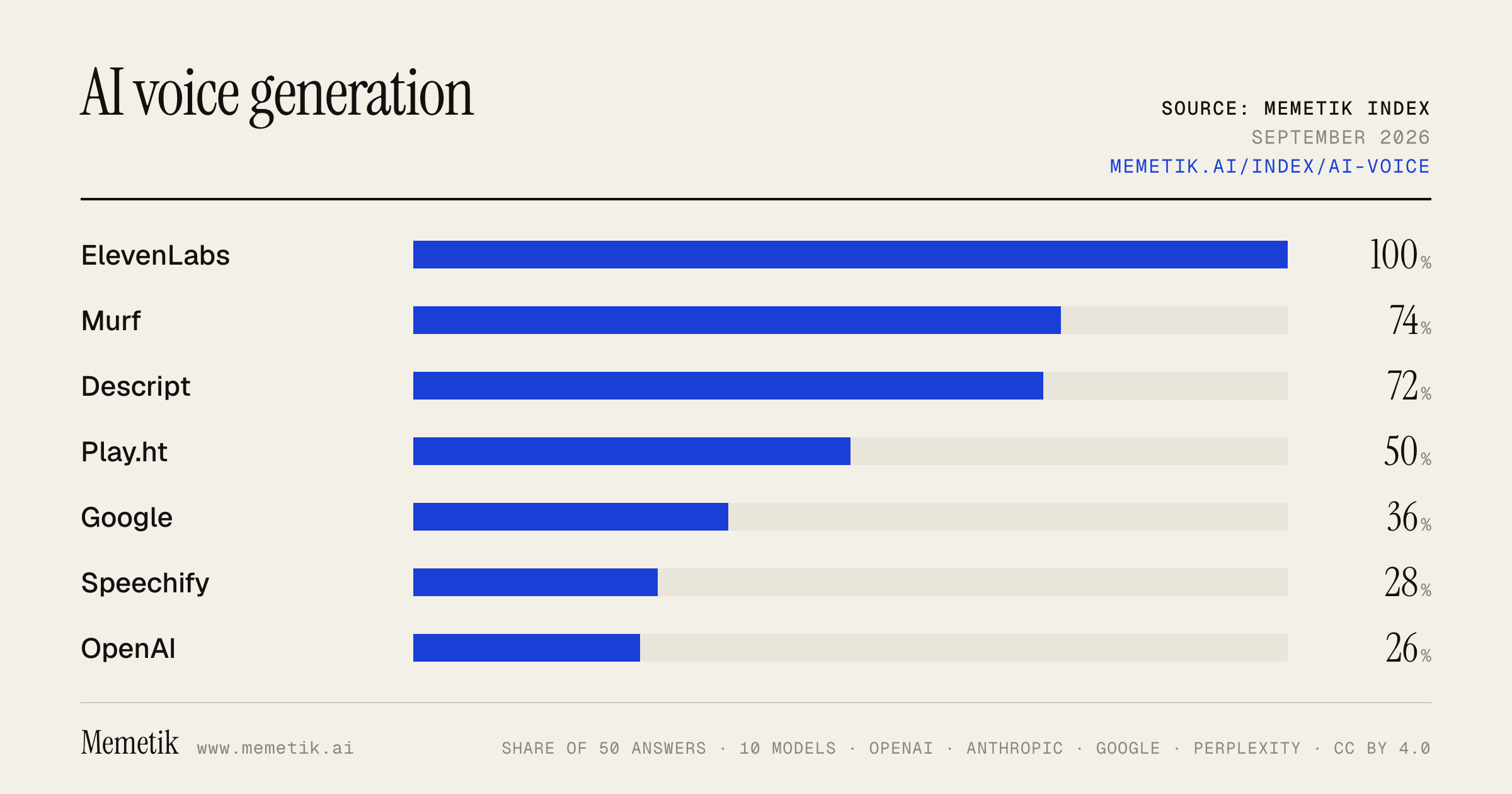
By provider
10 models · 50 answers
OpenAI 3 models · 15 answers
- GPT-5.6 Solgpt-5.6-solmost named: ElevenLabs 100%
- GPT-5.6 Terragpt-5.6-terramost named: ElevenLabs 100%
- GPT-5.6 Lunagpt-5.6-lunamost named: ElevenLabs 100%
Anthropic 3 models · 15 answers
- Claude Opus 5claude-opus-5most named: ElevenLabs 100%
- Claude Sonnet 5claude-sonnet-5most named: ElevenLabs 100%
- Claude Fable 5claude-fable-5most named: ElevenLabs 100%
Google 2 models · 10 answers
- Gemini 3.6 Flashgemini-3.6-flashmost named: ElevenLabs 100%
- Gemini 3.5 Flashgemini-3.5-flashmost named: ElevenLabs 100%
Perplexity 2 models · 10 answers
- Sonar Prosonar-promost named: ElevenLabs 100%
- Sonar Reasoning Prosonar-reasoning-promost named: ElevenLabs 100%
Sources the models cited
- youtube.com71
- inworld.ai58
- therundown.ai39
- oakgen.ai32
- zapier.com29
- elevenlabs.io28
- noiz.ai28
- podcastify.io27
- toolradar.com26
- moonb.io25
- freetts.org24
- hinoter.com21
ChatGPT via API returns no citations, so it does not contribute here.
The prompts
- What is the best AI voice generation or text-to-speech tool for a podcaster? Name specific products.
- Which AI voice generation or text-to-speech tool would you recommend to a podcaster in 2026?
- Compare the top AI voice generation or text-to-speech tool options right now.
- I'm a podcaster and I need an AI voice generation or text-to-speech tool. What should I use and why?
- Best AI voice generation or text-to-speech tool for a realistic voiceover?
Every answer
Raw model output, unedited
GPT-5.6 TerraWhat is the best AI voice generation or text-to-speech tool for a podcaster? Name specific products.
For most podcasters, **ElevenLabs** is the best standalone AI voice-generation / text-to-speech tool.

It is especially strong for **natural narration, expressive delivery, custom voice cloning, multilingual episodes, and character/guest-style voices**. Its current platform supports long-form and expressive speech models, multi-speaker dialogue, voice design/cloning, and commercially usable output on paid plans. ([elevenlabs.io](https://elevenlabs.io/docs/overview/capabilities/text-to-speech?utm_source=openai))

### Best choices by use case

1. **ElevenLabs — best overall voice quality**
   - Best for: polished intros/outros, narrated segments, ads, fiction podcasts, multilingual editions, or a synthetic host.
   - Why: very natural prosody and emotion; broad voice library; custom and cloned voices; good production/API capabilities. ([elevenlabs.io](https://elevenlabs.io/api?utm_source=openai))
   - Choose it if: voice realism is your top priority.

2. **Descript Overdub — best for fixing your own podcast recordings**
   - Best for: correcting a misread word, updating dates/names, or inserting a short sentence after the session—without re-recording.
   - Why: it combines a podcast editor with a voice-cloning feature designed to let you replace or add spoken lines by typing. Descript limits cloning to your own voice, which is a useful consent safeguard. ([descript.com](https://www.descript.com/overdub-2?utm_source=openai))
   - Choose it if: you record yourself and want AI mainly as an **editing repair tool**, rather than to replace the host.

3. **ElevenLabs Dubbing — best for translating an existing podcast**
   - Best for: creating Spanish, French, Japanese, etc. versions of your show while retaining aspects of the original speaker’s delivery.
   - Why: its dubbing workflow combines transcription, translation, voice cloning, and timing synchronization, with support for many languages. ([elevenlabs.io](https://elevenlabs.io/dubbing-api?utm_source=openai))
   - Choose it if: international audience growth matters.

### My practical recommendation

- **If you need one product:** start with **ElevenLabs**.
- **If you already edit in Descript:** use **Descript + Overdub** for correction pickups, and add ElevenLabs only when you need premium narration or translation.
- **If authenticity is central to the show:** keep the actual host voice for full episodes; use AI voice sparingly for corrections, accessibility versions, trailers, disclaimers, or clearly labeled dramatized segments.

Before publishing, get explicit written permission from anyone whose voice is cloned, and disclose synthetic narration when an audience could reasonably mistake it for a real recording.
GPT-5.6 TerraWhich AI voice generation or text-to-speech tool would you recommend to a podcaster in 2026?
For most podcasters in **2026**, I’d recommend **ElevenLabs** as the best overall AI voice/TTS tool.

**Why it’s my top pick**
- Its voices are particularly natural and expressive—important for long-form listening, where robotic cadence becomes tiring.
- It supports **voice cloning**, so you can record normally when possible but use your own approved clone for corrections, intros, translated editions, or scripted segments.
- Its **Studio** product is aimed at long-form audio workflows: multi-speaker casting, timeline editing, captions, music/SFX, and podcast-oriented production.
- It supports multilingual generation and dubbing, which makes it a strong choice if you may localize your show later. ([elevenlabs.io](https://elevenlabs.io/use-cases/podcasts?utm_source=openai))

**The plan I’d start with:**
Use the free tier to audition voices and test a real script. If it fits your show, the **Starter** plan has commercial rights and instant voice cloning; the **Creator** plan adds professional voice cloning and substantially more usage. The pricing page currently lists Starter at **$6/month** and Creator at **$22/month** (with a first-month promotion shown on the site). ([elevenlabs.io](https://elevenlabs.io/pricing?gspk=ZTQyMzQwYjhkZmIz&gsxid=1TBRJKY5o4aiMr&ps_partner_key=ZTQyMzQwYjhkZmIz&ps_xid=1TBRJKY5o4aiMr&pscd=try.elevenlabs.io&utm_source=openai))

### Best way to use it in a podcast
I would *not* usually make an entire personality-led podcast fully synthetic. Instead, use AI voice for:
- cold opens, trailers, recaps, and sponsor-read drafts;
- fixing a misread word without re-recording a whole segment;
- narrated research or documentary sections;
- temporary host tracks while editing;
- translations/dubbed versions;
- accessibility editions.

That approach preserves the human rapport listeners expect while delivering the biggest production-time savings.

### Important caveat
Only clone **your own voice** or a voice for which you have clear, written permission. Also disclose meaningful synthetic narration—especially if it could cause listeners to think a real person spoke words they did not record.

**Bottom line:** If you want one tool that combines excellent TTS quality, legitimate voice-cloning options, and a podcaster-friendly production workflow, choose **ElevenLabs**.
GPT-5.6 TerraCompare the top AI voice generation or text-to-speech tool options right now.
## Bottom line

For most buyers, the best shortlist is:

1. **ElevenLabs** — best overall for highly natural narration, character/performance, voice cloning, dubbing, and creator workflows.
2. **OpenAI Text-to-Speech** — best for developers already building AI assistants who want an easy, capable API with instruction-driven delivery.
3. **Cartesia** — best for extremely low-latency, real-time conversational voice applications.
4. **Azure AI Speech** — best for enterprise deployment, broad language coverage, compliance, and custom voices.
5. **Google Cloud Text-to-Speech** — best for global-scale cloud deployments and broad language/voice catalog needs.
6. **Amazon Polly** — best for straightforward, cost-conscious AWS-native production TTS.
7. **Murf / WellSaid / Speechify Studio** — best for nontechnical marketing, L&D, corporate-video, and presentation teams.
8. **Resemble AI / PlayAI** — worth evaluating when custom voices, conversational agents, or voice-security controls are central.

## Comparison

| Tool | Best for | Main strengths | Watch-outs |
|---|---|---|---|
| **ElevenLabs** | Creators, media, games, premium narration | Usually a leading choice for expressive, human-sounding output; strong voice-cloning, dubbing, and studio tooling | Premium quality can become expensive at scale; establish explicit voice-consent procedures |
| **OpenAI TTS** | AI products and assistants | Simple API integration; multiple built-in voices; supports delivery instructions with `gpt-4o-mini-tts`; streaming and common output formats | Smaller “voice marketplace” and production-studio ecosystem than specialist voice vendors |
| **Cartesia** | Live voice agents, games, interactive apps | Designed around low latency and real-time responsiveness | Less oriented toward creator-facing editing/dubbing workflows |
| **Azure AI Speech** | Large organizations | Enterprise controls, custom neural voice options, integrations, languages, and Azure ecosystem | Setup and pricing can feel more enterprise/cloud-complex |
| **Google Cloud TTS** | Global apps on GCP | Broad language support and cloud-scale operations | Less creator-friendly than dedicated voice studios |
| **Amazon Polly** | AWS teams, utility narration | Operational simplicity for AWS users; reliable standard TTS use cases | Typically not the first pick for the most emotionally expressive narration |
| **Murf / WellSaid** | Business content teams | Polished browser studios, collaboration, easy video/voiceover production | Usually less flexible for deeply custom developer or conversational-agent work |
| **Resemble AI / PlayAI** | Branded voices and agents | Custom voice and conversational-voice capabilities | Evaluate governance, latency, language quality, and licensing carefully in a proof of concept |

## My recommendations by scenario

- **YouTube, audiobooks, ads, character dialogue, localization:** **ElevenLabs**
- **An AI assistant inside your web/mobile product:** **OpenAI** for a unified AI stack; **Cartesia** if response latency is the overriding requirement
- **Call center or real-time customer-support agent:** **Cartesia**, **OpenAI Realtime**, **Azure**, or **PlayAI**—test with actual phone audio before committing
- **Enterprise training, accessibility, IVR, regulated deployment:** **Azure AI Speech**
- **A global app already running on Google Cloud:** **Google Cloud TTS**
- **A global app already running on AWS and needing dependable standard speech:** **Amazon Polly**
- **Marketing team needs voiceovers without developers:** **Murf** or **WellSaid**
- **A consistent branded spokesperson voice:** **ElevenLabs** or **Resemble**, but only with documented speaker authorization

## Current pricing signals worth knowing

ElevenLabs’ current API pricing lists TTS v3 at roughly **$0.10 per 1,000 characters** on its displayed plans, with lower-latency options advertised from roughly **$0.05/minute** in some configurations. Its Creator tier is listed at **$22/month** (with a promotional first month shown as $11), including 220k TTS characters for v3. ([elevenlabs.io](https://elevenlabs.io/pricing/api?utm_source=openai))

For OpenAI, the legacy `tts-1` model is listed at **$15 per 1 million characters** and is optimized for speed. The Audio API also lists `gpt-4o-mini-tts`, which supports textual delivery instructions, streaming, and several output formats. ([developers.openai.com](https://developers.openai.com/api/docs/models/tts-1?utm_source=openai))

## What to test before buying

Do not select solely from demos. Run the same script through 3–4 vendors and score:

1. **Naturalness** — especially pauses, emphasis, names, numbers, and acronyms
2. **Control** — pace, emotion, pronunciation dictionary, SSML, and direction-following
3. **Latency** — time to first audio and interruption/barge-in handling for agents
4. **Voice consistency** — across long scripts and separate sessions
5. **Languages and accents** — using your actual customer content
6. **Commercial rights and consent** — particularly for cloned or branded voices
7. **Unit economics** — calculate cost per finished minute, not just cost per character
8. **Data handling** — retention, training use, regional hosting, SOC 2/HIPAA needs, and auditability

### Practical default choices

- **Best single tool for premium voice content:** ElevenLabs
- **Best developer default for AI applications:** OpenAI
- **Best real-time-performance specialist:** Cartesia
- **Best enterprise-cloud default:** Azure AI Speech

If you tell me your use case—e.g., audiobook, TikTok/YouTube, phone agent, SaaS feature, e-learning, or IVR—and expected monthly minutes/languages, I can narrow this to a ranked 2–3 vendor recommendation with a cost model.
GPT-5.6 TerraI'm a podcaster and I need an AI voice generation or text-to-speech tool. What should I use and why?
## Short answer

**Use ElevenLabs as your primary AI voice tool** if you want polished, natural-sounding narration, a clone of *your own* voice, multiple character voices, or the ability to localize episodes. Its Studio is specifically designed around long-form production such as podcasts, with timeline editing, multi-speaker projects, voice cloning, music/SFX, and support for multilingual workflows. ([elevenlabs.io](https://elevenlabs.io/studio?utm_source=openai))

**Use Descript alongside it—or instead—if your bigger problem is editing rather than generating full narration.** Its strength for podcasters is text-based multitrack editing and “Overdub”-style corrections: you can repair a misread line by typing the replacement in your own cloned voice. ([descript.com](https://www.descript.com/blog/article/introducing-descript-podcast-studio-overdub?utm_source=openai))

## My recommendation by use case

| Your need | Best choice | Why |
|---|---|---|
| A host-quality AI narrator or a clone of your voice | **ElevenLabs** | Best-fit production environment for polished long-form spoken audio, cloning, multi-voice casting, and localization. ([elevenlabs.io](https://elevenlabs.io/studio?utm_source=openai)) |
| Fixing small mistakes in episodes you actually recorded | **Descript** | Text-first podcast editor; particularly useful for replacing a sentence rather than re-recording an entire segment. ([descript.com](https://www.descript.com/blog/article/introducing-descript-podcast-studio-overdub?utm_source=openai)) |
| Automatically producing many short segments from a CMS, spreadsheet, or custom workflow | **OpenAI TTS API** | A developer-oriented option: generate MP3/WAV/FLAC and other formats programmatically, select a voice, adjust speed, and—in supported models—give delivery instructions. ([platform.openai.com](https://platform.openai.com/docs/api-reference/audio/voice-consent-list?lang=curl&utm_source=openai)) |
| A fully synthetic show with frequent speaker changes | **ElevenLabs** | Its Studio supports multi-cast character assignment and long-form project organization, which is much more convenient than stitching individual TTS exports together. ([elevenlabs.io](https://elevenlabs.io/studio?utm_source=openai)) |
| International editions of an existing show | **ElevenLabs** | Its podcast workflow promotes multilingual TTS and dubbed/localized episodes while retaining voice character. ([elevenlabs.io](https://elevenlabs.io/use-cases/podcasts?utm_source=openai)) |

## What I’d do in your position

1. **Start with ElevenLabs.** Create either:
   - a licensed library voice for intros, ads, disclaimers, recaps, and pickups; or
   - a clone of **your own** voice for continuity between recorded and AI-generated segments.

2. **Keep your real voice for the core show.** AI tends to work best when it augments the production: corrections, cold opens, sponsor reads you approve, translations, trailer variants, and accessibility versions. For a personality-led interview or opinion show, completely replacing the host can make the program feel less spontaneous.

3. **Use Descript if editing time is the bottleneck.** If you routinely have verbal stumbles, changed facts, or last-minute copy revisions, repairing isolated lines through a text editor can save more time than choosing the most realistic standalone TTS engine. ([descript.com](https://www.descript.com/blog/article/introducing-descript-podcast-studio-overdub?utm_source=openai))

4. **Only choose OpenAI’s API route if you—or a producer—can work with software automation.** It is not the simplest no-code podcast studio, but it is strong for repeatable generation pipelines: e.g., turn daily sports briefs, newsletters, show notes, or personalized feed inserts into audio automatically. The API supports several audio formats, voice selection, speed controls, and expressive instructions on applicable TTS models. ([platform.openai.com](https://platform.openai.com/docs/api-reference/audio/voice-consent-list?lang=curl&utm_source=openai))

## Before subscribing: run this practical audition

Render the same 60–90 second script in two or three candidate voices. Include:

- names, dates, numbers, URLs, and acronyms;
- a shift from a serious statement to a joke;
- a sponsor-read paragraph;
- your usual pacing and sentence length;
- one emotionally important passage.

Then listen **on phone speakers, earbuds, and car audio**—not only studio monitors. Pick the tool that needs the fewest manual fixes for pronunciation, emphasis, and pacing.

## One important rule

Clone **only your own voice or a voice for which you have explicit written permission**, and clearly disclose synthetic narration when that would matter to listeners or commercial partners. Avoid cloning guests, public figures, or actors simply because a sample is available.

**Bottom line:**
- **One tool:** choose **ElevenLabs**.
- **Best editing companion:** add **Descript**.
- **Best for automated/custom technical workflows:** use the **OpenAI TTS API**.
- https://elevenlabs.io/studio?utm_source=openai
- https://www.descript.com/blog/article/introducing-descript-podcast-studio-overdub?utm_source=openai
- https://platform.openai.com/docs/api-reference/audio/voice-consent-list?lang=curl&utm_source=openai
- https://elevenlabs.io/use-cases/podcasts?utm_source=openai
GPT-5.6 TerraBest AI voice generation or text-to-speech tool for a realistic voiceover?
**Best overall for a realistic, polished voiceover: ElevenLabs.**
It’s usually the strongest choice for natural narration, character, pacing, and emotional delivery—especially for YouTube videos, ads, explainers, audiobooks, and cinematic reads.

**Pick by use case:**

- **ElevenLabs — best overall realism:** Choose this if the voice itself is the priority and you want convincing, expressive narration.
- **Descript Overdub — best for podcast/video editing:** Ideal when you also need to edit the recording, replace a sentence by typing it, or create/use a clone of *your own* voice within an editing workflow. ([descript.com](https://www.descript.com/overdub-2?utm_source=openai))
- **OpenAI TTS / audio API — best for developers and dynamic apps:** Good if you need generated narration inside a product, want programmatic control over delivery instructions, or need scalable API generation. Its TTS API supports steerable delivery and several audio export formats; for realtime applications, OpenAI recommends its newer realtime voice models. ([platform.openai.com](https://platform.openai.com/docs/api-reference/audio/voice-consent-list?lang=curl&utm_source=openai))
- **Murf or WellSaid — best for business/corporate reads:** Worth auditioning if you want a clean, brand-safe training, presentation, or commercial voice.

**My practical recommendation:**
1. Start with **ElevenLabs** for final voiceovers.
2. Use **Descript** if you’re producing podcasts or videos and need fast revisions.
3. Use **OpenAI** if you’re building this into software rather than manually producing files.

Before committing, render the same 30–60 second script in 3–5 voices. Include names, numbers, acronyms, emotional shifts, and pauses—the “best” provider often depends more on the *specific voice* than the platform.

Only clone or imitate a real person’s voice with their clear permission.
Claude Sonnet 5What is the best AI voice generation or text-to-speech tool for a podcaster? Name specific products.
Based on current reviews and comparisons, here's a breakdown of the top AI voice/TTS tools for podcasters, depending on what you need:

## Top Picks by Use Case

**ElevenLabs** — The consensus favorite for raw voice quality.
It's considered the premium solo narration option at the top of the market, with Multilingual v3 for single-voice sustained quality.
 It's also strong for scaling internationally, since
Multilingual v3 handles 32+ languages in the same voice, making it the choice for podcasters expanding internationally, with best-in-class voice cloning fidelity.
 For shows with multiple characters or narrators,
ElevenLabs Voice Library offers character variety for multi-voice narrative podcasts.
 Multiple independent guides confirm it wins on pure voice quality in head-to-head tests.

**Descript** — Best if you want voice generation bundled with editing.
Descript is an all-in-one content creation tool that combines AI voice generation with powerful audio and video editing features, and is especially popular among podcasters because it allows you to edit audio by editing text.
 Its Overdub feature is specifically noted as a
transcript-based editing workflow with integrated editing plus voice cloning.


**Murf AI** — Good for teams and quick, easy production. It's frequently cited for
promising "Make studio-quality voice overs in minutes" with a vast library of voices — over 110 voices in 15+ languages.


**MiniMax Speech HD** — A newer, budget-friendly alternative praised for
consolidated pricing in a multi-modal workflow, producing industry-leading sustained narration comparable to ElevenLabs.


**NotebookLM (Google)** — Notable for its "Audio Overview" feature that auto-generates a conversational podcast-style discussion from source documents, combining
impressively realistic voices plus smart script generation.


**PlayHT and Resemble AI** — Mentioned as strong options for more technical production pipelines, with Resemble AI in particular
built for production teams doing deeper custom-voice and localization pipelines.


## Quick Recommendation

- **Best overall voice quality:** ElevenLabs
- **Best if you want editing + voice cloning in one app:** Descript
- **Best for teams/simple workflow:** Murf AI
- **Best budget-conscious multi-modal option:** MiniMax Speech HD (via platforms like Oakgen)
- **Best for auto-generating a full podcast from notes/articles:** Google NotebookLM

One important caveat worth citing:
listeners who learn about AI voice later feel deceived, while listeners who know upfront accept it as a production tool — transparency protects trust, the most valuable asset a podcaster has.
 If you plan to use synthetic voices for your show, disclosing that to your audience is generally recommended.

If you tell me more about your specific use case (solo narration, interview-style show, multilingual content, or fully automated production), I can narrow this down further.
- https://oakgen.ai/blog/best-ai-voice-generator-podcasters-2026
- https://toolstack.net/best-ai-voice-generator/
- https://www.goodreads.com/author_blog_posts/21990362-5-best-ai-text-to-speech-voice-generator-tools-reviewed-2022?tab=author
- https://noiz.ai/use-cases/en/The-Best-AI-Podcast-Voice-Generator
- https://www.therankmasters.com/insights/ai-voice/best-ai-voice-generators-for-podcasting
Claude Sonnet 5Which AI voice generation or text-to-speech tool would you recommend to a podcaster in 2026?
Based on current reviews and comparisons from 2026, here's a breakdown depending on what a podcaster actually needs:

## Top Overall Recommendation: **ElevenLabs**
Across nearly every comparison, ElevenLabs comes out on top for raw voice quality.
For solo narrated content like history, true crime, or deep dives, ElevenLabs and MiniMax Speech HD produce industry-leading sustained narration.
 It's especially strong if you plan to expand internationally, since
Multilingual v3 handles 32+ languages in the same voice, making it the choice for podcasters expanding internationally
, and
voice cloning fidelity is best-in-class.


It also offers variety for narrative-style shows —
Multi-voice narrative podcasts benefit from ElevenLabs Voice Library for character variety.


## Best for Editing Workflow: **Descript**
If your priority is ease of production rather than just voice quality, Descript is frequently recommended.
Descript is an all-in-one content creation tool that combines AI voice generation with powerful audio and video editing features, and it's especially popular among podcasters because it allows you to edit audio by editing text.
 One review even noted
Descript follows closely with its incredible editing suite that makes podcasting feel like editing a Word document.


## Best Budget/Free Option: **Google Text-to-Speech**
If you're just starting out and don't need advanced emotional nuance,
Google's offering is the most accessible tool on the list, providing a solid foundation for those just starting out — while it lacks some of the high-end emotional features of competitors, its reliability and integration make it a practical choice for basic podcast needs.


## Other Notable Mentions
- **MiniMax Speech HD** – a strong budget-efficient alternative to ElevenLabs for sustained narration quality, often bundled into multi-modal AI platforms.
- **Murf AI** – good for
team-friendly production
 and collaborative workflows.
- **Fish Audio / Resemble AI** – better suited for developers:
if you need realtime/streaming or programmatic delivery, Fish Audio is the best fit, while for deeper custom-voice and localization pipelines, Resemble AI is built for production teams.


## My Recommendation
For most podcasters in 2026, **ElevenLabs** is the best starting point if voice realism and cloning quality matter most (e.g., you want a consistent "host" voice or need multilingual versions of your show). If your bigger pain point is *editing* rather than voice generation, **Descript** is the better fit since it merges TTS with a full editing suite.

One important consideration across all these tools:
listeners who learn about AI voice later feel deceived, while listeners who know upfront accept it as a production tool — transparency protects trust, the most valuable asset a podcaster has.
 Whichever tool you choose, disclosing AI voice usage to your audience is worth keeping in mind.
Claude Sonnet 5Compare the top AI voice generation or text-to-speech tool options right now.
I'll research the current landscape of AI voice generation and text-to-speech tools to give you an accurate comparison.
Based on current research, here's how the top AI voice generation and text-to-speech tools stack up right now:

## Top Contenders

**ElevenLabs** remains a dominant force in the space.
ElevenLabs is still the king of voice cloning and creator tools, with Turbo v2.5 delivering 3x faster generation in 32 languages while keeping that signature emotional depth. Multilingual v2 shines on long-form content with rock-solid consistency.
 It's also praised for practical features —
its Sound Effects feature is a massive win that most competitors haven't mastered yet.


**Inworld** has emerged as a serious challenger, and by some benchmarks has overtaken ElevenLabs.
Inworld didn't just catch up, they took the crown in 2026 — their TTS-1.5 Max currently sits at the top of the Artificial Analysis Speech Arena with an ELO of ~1236, consistently winning blind tests for naturalness, emotional range, and conversational flow.
 Its technical edge is speed:
it offers sub-250ms P90 latency on Max, instant voice cloning from 5-15 seconds of audio, and WebSocket streaming that feels like talking to a real person, with prosody that's context-aware enough to understand sarcasm, excitement, or hesitation without SSML hacks.


**MiniMax** (backed by Alibaba/Tencent) is another strong performer on leaderboards.
MiniMax has several models in the top 10 on Artificial Analysis, one of the highest concentrations from any single provider, with Speech-02-HD ranking just outside the top 5 at ~1,156 ELO. Backed by a $2B+ valuation, the company is strongest in Asian markets, and its long-text mode processes up to 200,000 characters per request — useful for audiobook-length generation.
 It's best suited for
teams needing consistent quality across multiple model variants, strong Asian language support (particularly Cantonese and Mandarin), or bulk long-form audio generation
, though
pricing runs significantly higher than Inworld
.

## Other Notable Options

- **Hume** —
offers voice design, voice cloning and a developer-friendly API for integration, and is less about volume and more about expressiveness — one of the most promising tools if you want voices that feel alive and full of personality.


- **LOVO** —
stands out for its focus on expressive voices and its creator-first platform called Genny, combining text-to-speech with video editing, packed with 500+ voices in 100+ languages for ads, education, audiobooks, and podcasts.


- **Deepgram** — a good pick if you need both directions of voice AI, since it
bundles TTS with its speech-to-text engine, letting teams run both directions of a voice conversation through one vendor, with its Aura-2 model focusing on domain-specific pronunciation accuracy in regulated industries.


- **Respeecher** — a niche, high-end option for performance-based voice conversion rather than pure TTS.
It's the tech behind some of the biggest moments in modern cinema (like Luke Skywalker in The Mandalorian) — this isn't about simple text-to-speech; it's about "skinning" a real human performance with a different voice.
 The tradeoff:
there's a serious "VIP-only" bar to entry, and it's not very accessible for the average indie creator.


- **Qwen3-TTS** (Alibaba) — a strong budget/open option.
It's a modular voice system giving you Voice Design, Text-to-Speech, and zero-shot Voice Cloning, with both 0.6B (lighter, faster) and 1.7B (heavier, higher quality) parameter variants available.


## How to Choose

The right pick depends heavily on your use case, since
AI voice generators vary widely in what they optimize for — some focus on cinematic realism and long-form narration, others prioritize speed and scale for social content, and a few aim to be all-in-one solutions covering generation, cloning, and transformation.


**Quick recommendations:**
- **Best overall quality/versatility:** ElevenLabs — still the safest all-rounder for creators
- **Best for real-time/conversational agents:** Inworld — lowest latency, top naturalness scores
- **Best for scale/Asian languages:** MiniMax
- **Best for emotional nuance:** Hume
- **Best for film/high-end dubbing:** Respeecher (if budget allows)
- **Best budget/open-source-friendly:** Qwen3-TTS

Note that this space is moving extremely fast —
the market moved so fast that last year's "best" models already feel dated
, so it's worth checking current leaderboards (like Artificial Analysis) before committing to a long-term plan.
- https://aimlapi.com/blog/best-text-to-speech-ai
- https://curiousrefuge.com/blog/best-ai-voice-generator-for-2026
- https://inworld.ai/resources/best-ai-voice-generators
- https://visme.co/blog/best-ai-voice-generator/
- https://fal.ai/learn/tools/ai-voice-generators
- https://www.barchart.com/story/news/37214648/best-ai-voice-generator-for-2026-how-to-choose-the-right-tool
Claude Sonnet 5I'm a podcaster and I need an AI voice generation or text-to-speech tool. What should I use and why?
Based on current comparisons, here's a breakdown of the top options for podcasters and which one fits which use case:

## Top Picks by Use Case

**1. ElevenLabs — Best overall voice quality**
This is the go-to if raw voice realism is your top priority.
For premium solo narration, ElevenLabs Multilingual v3 leads the market for single-voice sustained quality.
 It's also the strongest choice if you're growing internationally:
ElevenLabs' Multilingual v3 handles 32+ languages in the same voice, making it the choice for podcasters expanding internationally.
 And if you ever want to clone your own voice (for intros, ad reads, or backup when you're sick),
ElevenLabs Professional Voice Cloning offers the highest fidelity for host voice cloning.


**2. Descript — Best if you want editing + voice generation combined**

Descript is an all-in-one content creation tool that combines AI voice generation with powerful audio and video editing features, and is especially popular among podcasters because it allows you to edit audio by editing text.
 This is huge for podcast workflows — you literally delete a typo in the transcript and the audio updates.

**3. Murf.ai — Best for teams/beginners who want simplicity**
Murf is praised for
easy, team-friendly production
 and has
a vast library of voices—with the option to choose from over 110 voices in 15+ languages.


**4. NotebookLM (Google) — Best free/simple option to start**
If you're just testing the waters,
Google's offering is the most accessible tool on the list, providing a solid foundation for those just starting out — while it lacks some high-end emotional features of competitors, its reliability and integration make it a practical choice for basic podcast needs.


**5. PlayHT / Resemble AI — Best for advanced/production pipelines**

If you need realtime/streaming or programmatic delivery, Fish Audio is the best fit, while for deeper custom-voice and localization pipelines, Resemble AI is built for production teams.


## How to Choose

Ask yourself these questions:

- **Do you need to sound like *you*, consistently, every episode?** → ElevenLabs (best cloning fidelity) or Descript Overdub.
- **Do you want to edit audio like a Word doc, not a waveform?** → Descript —
its incredible editing suite makes podcasting feel like editing a Word document.

- **Multi-character fiction/narrative podcast?** →
ElevenLabs Voice Library is best for multi-voice narrative podcasts needing character variety.

- **On a tight budget or just starting?** → Google TTS (free) or Murf's free tier, since
Murf's pricing is generally fair, with a generous free tier for testing.

- **Going international?** → ElevenLabs Multilingual v3.

## Practical tips regardless of tool
A few production tips that apply across platforms:
write conversationally with contractions and shorter sentences, use SSML to add pauses and emphasis, break long text into natural paragraphs, match the voice to your content's tone, layer with subtle background music, and post-process with slight EQ and compression like any audio.


## One honesty note
Whichever tool you pick, disclose it to your audience.
Listeners who learn about AI voice later feel deceived, while listeners who know upfront accept it as a production tool — transparency protects trust, the most valuable asset a podcaster has.


**My recommendation:** Start with **ElevenLabs** for voice quality (they have a free tier to test), and if you want an all-in-one editing+voice workflow, pair it with or switch to **Descript**. Both have free tiers, so you can trial them on a real episode before committing.
- https://oakgen.ai/blog/best-ai-voice-generator-podcasters-2026
- https://toolstack.net/best-ai-voice-generator/
- https://noiz.ai/use-cases/en/The-Best-AI-Podcast-Voice-Generator
- https://www.goodreads.com/author_blog_posts/21990362-5-best-ai-text-to-speech-voice-generator-tools-reviewed-2022?tab=author
- https://noiz.ai/use-cases/en/The-Best-AI-Voice-Podcasts-Generator
- https://www.therankmasters.com/insights/ai-voice/best-ai-voice-generators-for-podcasting
- https://toolradar.com/guides/best-ai-text-to-speech
Claude Sonnet 5Best AI voice generation or text-to-speech tool for a realistic voiceover?
Based on current reviews and testing, **ElevenLabs** is the most consistently recommended tool for realistic AI voiceovers in 2026, but the "best" choice depends on your specific use case:

## Top Pick: ElevenLabs

ElevenLabs set the new standard for AI voice quality, with a proprietary voice model that produces the most expressive, emotionally aware speech tested — including micro-expressions, breathing, and natural pacing.
 Reviewers also note
ElevenLabs stands out for emotional range — the same voice can shift from instructional to conversational without sounding like two different speakers, which matters a lot for YouTube voiceover work.


On pricing:
the free tier is limited but enough to evaluate quality, with professional plans starting at $22/month for 100,000 characters, covering roughly 2-3 hours of finished audio.


## Other Strong Options by Use Case

- **Murf.ai** –
the professional's choice for voiceover work, built around a studio workflow where you can record a rough voiceover and have it cleaned up, or go straight to text-to-speech with precise control over pitch, speed, and emphasis.
 Pricing starts around $19/month.

- **Play.ht** –
built for audiobook production and long-form narration, with an Unlimited plan that removes character limits entirely, making it ideal for authors and journalists converting books or long articles to audio.


- **WellSaid Labs** – Best for enterprise/business use.
Licensed voice data, enterprise security controls, reliable workflows, and governance frameworks shape long-term value, and WellSaid sets the standard here — Fortune 500 companies adopt it because it delivers natural, consistent voice output within a private, compliant environment.


- **Lovo** – Great if you need variety:
it specializes in advertising and marketing voiceovers, with the most voice customization options seen — including 500+ voices with granular control over age, accent, emotion, and style.


- **Fish Audio** –
has emerged as a serious contender, particularly for content that needs
 high realism (worth checking out as a newer alternative).

## My Recommendation
- **For general/creator voiceovers with the most human-like emotion**: ElevenLabs
- **For structured business/marketing videos**: Murf.ai
- **For audiobooks or very long content**: Play.ht
- **For enterprise compliance needs**: WellSaid Labs

Most of these offer free trials, so it's worth testing 2-3 with your actual script since voice quality can vary depending on language, tone, and content type.
Gemini 3.6 FlashWhat is the best AI voice generation or text-to-speech tool for a podcaster? Name specific products.
The best AI voice generation tool for a podcaster depends on your specific use case—whether you need ultra-realistic narration, full episode editing, voice cloning to fix mistakes, or an automated tool that builds entire shows from source material.

The top tools currently available for podcasters include:

---

### 1. ElevenLabs — **Best Overall for Realism & Voice Cloning**
* **Best For:** Solo creators, narrative audio, intro/outro narration, and high-fidelity voice cloning.
* **Why it stands out:** ElevenLabs is widely considered the gold standard for natural inflection, micro-pauses, and emotional nuance. It sounds far less robotic than standard text-to-speech tools.
* **Key Features for Podcasters:**
  * **Voice Cloning:** Train an AI clone on your voice with a short audio sample so you can record fixes, insert forgotten details, or run entire episodes in your synthetic voice.
  * **GenFM / Podcast Generator:** Automatically converts documents, articles, or scripts into dynamic, multi-speaker conversational podcasts.
  * **Projects:** Long-form audio publishing tool to manage text-to-speech chapter by chapter.
* **Pricing:** Free plan available; paid tiers start around $5–$11/month.

---

### 2. Descript — **Best All-in-One Podcast Editing Tool**
* **Best For:** Traditional podcasters who record their own voice but want AI editing, transcript-based editing, and script correction.
* **Why it stands out:** Descript is an end-to-end podcast DAW (Digital Audio Workstation) where you edit audio by editing text.
* **Key Features for Podcasters:**
  * **Overdub:** Clone your own voice to fix typos or missed lines directly inside the transcript without re-recording.
  * **Text-to-Speech Stock Voices:** Standard AI voices you can assign to placeholders or script drafts.
  * **Studio Sound:** AI-powered noise removal that turns cheap mic audio into studio quality with one click.
* **Pricing:** Free plan available; creator/pro plans start around $12–$24/month.

---

### 3. Wondercraft AI — **Best for Turning Written Content into Podcasts**
* **Best For:** Bloggers, journalists, and newsletter writers looking to easily convert text into full-length podcasts.
* **Why it stands out:** Built specifically as an "AI studio for podcasters," Wondercraft functions like Canva for audio production.
* **Key Features for Podcasters:**
  * Built-in script writing assistant (powered by LLMs).
  * Multi-host support (assigning different AI voices to play host/guest).
  * Automatically generates royalty-free background music beds, intro/outros, and episode show notes.
  * One-click distribution directly to Spotify and Apple Podcasts.
* **Pricing:** Tiers range from $29/month to higher-volume plans.

---

### 4. Podcastle — **Best Web-Based Recording & Production Studio**
* **Best For:** Podcasters who want a lightweight, beginner-friendly web platform to record, generate AI voices, and edit.
* **Why it stands out:** Very intuitive interface with a solid library of hyper-realistic AI voices.
* **Key Features for Podcasters:**
  * **Revoice / AI Text-to-Speech:** Convert text scripts into natural narration using built-in voices or a digital clone of your own voice.
  * Audio editing, noise cancellation, transcription, and remote multi-track recording all in one web browser.
* **Pricing:** Free tier; Storyteller/Pro plans start around $12–$24/month.

---

### 5. Murf.ai — **Best for Structured, Scripted Audio & Co-Hosts**
* **Best For:** Educational podcasts, corporate shows, and multi-speaker scripted formats.
* **Why it stands out:** Murf excels at fine-grained control over pitch, speed, and emphasis on a word-by-word basis.
* **Key Features for Podcasters:**
  * Timeline-based script editor where you can mix multiple AI voices into a single dialogue.
  * Pitch and cadence adjustments to prevent long monologues from sounding monotone.
* **Pricing:** Free trial available; paid plans start around $19–$29/month.

---

### Summary Recommendation

* Go with **ElevenLabs** if your primary goal is the **most human-like voice quality** or high-fidelity voice cloning.
* Go with **Descript** if you **already record your own podcast** and want an AI editor to easily modify text, fix mistpoken words, and enhance audio.
* Go with **Wondercraft AI** if you want a **hands-off production studio** to convert articles or written scripts into fully-mixed podcast episodes with music and hosts.
Gemini 3.6 FlashWhich AI voice generation or text-to-speech tool would you recommend to a podcaster in 2026?
For podcasters looking for AI voice generation or text-to-speech tools, the best choice depends on **how** you plan to use AI in your workflow.

The top recommendations for podcasters are grouped by use case below:

---

### 1. **Best for Ultimate Realism & Voice Cloning: ElevenLabs**
If your primary goal is to generate synthetic co-hosts, create realistic narrations, or clone your own voice to read scripts seamlessly, **ElevenLabs** remains the industry leader.
* **Why it’s great for podcasters:** Its voice models excel at emotional nuance, inflections, and pacing, making speech sound remarkably natural rather than robotic. You can generate audio from written text, design unique custom voices, or clone your own voice. It also supports deep dubbing in multiple languages while retaining the original speaker's tone.
* **Best for:** Audiobooks, solo scripted podcasts, generating host banter, or translating episodes into other languages.

### 2. **Best for Text-Based Editing & Fixing Audio: Descript**
If you record human hosts or guests and want AI voice features integrated directly into your podcast editing software, **Descript** is the standard.
* **Why it’s great for podcasters:** Descript edits audio like a Word document—deleting text automatically removes the corresponding audio. Its AI feature (**Overdub**) lets you clone your voice so that if you mispronounce a word or forget a line, you can simply type the correction into the transcript, and the AI will fix it using your voice. It also includes powerful studio-sound processing to clean up bad mic quality.
* **Best for:** Traditional multi-speaker podcasts, audio cleanup, and fixing script mistakes post-recording without re-recording.

### 3. **Best All-in-One Podcast Creation Platform: Podcastle**
If you want an accessible browser-based studio that combines recording, editing, and AI voice generation, **Podcastle** is built specifically for creators.
* **Why it’s great for podcasters:** It allows you to record remote interviews, edit audio tracks, clean up background noise, and convert text to speech using a library of natural AI voices—all in one place.
* **Best for:** Beginners or solo creators who want a streamlined, all-in-one platform without juggling multiple apps.

### 4. **Best for Full AI Host Shows & News Repurposing: Wondercraft AI**
If you run a daily news podcast, newsletter roundup, or want to create fully AI-generated episodes from written content, **Wondercraft AI** is tailored for audio repurposing.
* **Why it’s great for podcasters:** It combines LLM scriptwriting with TTS voices (often powered by ElevenLabs) and auto-adds intro/outro music, sound effects, and mastering. You can paste a newsletter or article URL, and it will draft and synthesize a multi-host show.
* **Best for:** Converting blogs, newsletters, or daily reports into daily short-form podcasts automatically.

---

### **Which one should you pick?**
* **Choose ElevenLabs** if you want the highest-quality audio synthesis or voice cloning available.
* **Choose Descript** if you record human voice/interviews and want an AI editor that lets you type to fix mistakes.
* **Choose Podcastle** if you need a simple end-to-end studio for recording and light AI editing.
Gemini 3.6 FlashCompare the top AI voice generation or text-to-speech tool options right now.
The landscape of AI voice generation and text-to-speech (TTS) tools has advanced rapidly, with tools offering human-like emotion, real-time latency for conversational AI, multi-lingual voice cloning, and direct video integration.

Here is a breakdown and comparison of the top AI voice tools based on their strengths, ideal use cases, and key features.

---

### 1. **ElevenLabs** — *Best Overall for Realism, Emotion, and Voice Cloning*
ElevenLabs is widely considered the industry benchmark for audio quality, nuance, and emotional fidelity.

* **Key Strengths:** Unmatched speech naturalness, dynamic pacing, hesitation handling, and realistic emotional range (whispering, excitement, sadness). Excellent multilingual voice cloning and AI dubbing (translating speech while maintaining the original speaker's voice tone).
* **Best For:** Audiobooks, storytelling, video game voice acting, dubbing, and high-end video production.
* **Standout Features:** Sound effects generation, Voice Design (creating new voices from prompt parameters), and Conversational AI agent building.
* **Pricing:** Generous free tier; paid plans start at $5/month.

---

### 2. **Murf.ai** — *Best for Corporate, E-Learning, and Presentations*
Murf is built as an all-in-one studio for teams and professionals who need high-quality voiceovers combined with media assets.

* **Key Strengths:** Polished, professional-sounding voices tailored for corporate presentations, training videos, and explainer content. Offers a built-in media editor to sync voiceovers directly with background music and slide visuals.
* **Best For:** Educators, HR teams, marketers, and corporate video creators.
* **Standout Features:** Pitch, speed, and emphasis adjustment per word/sentence; Google Slides integration; Canva integration.
* **Pricing:** Free plan with limited exports; paid plans start around $19–$26/month.

---

### 3. **Play.ht (PlayHT)** — *Best for Developers and Low-Latency Conversational Apps*
PlayHT offers a vast library of voices and focuses heavily on high-speed API performance and developer integration.

* **Key Strengths:** Ultra-low latency voice streaming, making it ideal for interactive conversational agents and live bots. Very good voice cloning capabilities (PlayHT 2.0 / 3.0 models).
* **Best For:** Developers building voice bots, podcasters, blog readers, and scalable apps.
* **Standout Features:** Real-time TTS streaming API, high customization via SSML and voice prompt engineering, massive library of multi-lingual voices.
* **Pricing:** Free tier available; creator and developer plans start around $29/month.

---

### 4. **Speechify** — *Best for Personal Productivity and Accessibility*
Speechify originally gained fame as a screen reader and long-form reading assistant, but it has expanded into creative voiceover tools.

* **Key Strengths:** Mobile and browser-first integration designed to read web pages, PDFs, and books aloud smoothly. Includes recognizable celebrity voices (e.g., Snoop Dogg, Gwyneth Paltrow).
* **Best For:** Students, professionals with dyslexia/ADHD, audio learners, and fast-paced article listening.
* **Standout Features:** Cross-device sync, high-speed playback (up to 4.5x without pitch warping), OCR document scanning.
* **Pricing:** Basic free reading plan; Premium starts around $139/year ($11.58/mo billed annually).

---

### 5. **LOVO.ai (Genny)** — *Best for Social Media Content Creators*
Genny by LOVO.ai combines text-to-speech with a timeline-based video editor, AI image generation, and scriptwriting tools.

* **Key Strengths:** Rich voice library with diverse accents, expressions, and tones explicitly cataloged by video genre (e.g., "gaming," "news broadcast," "advertisement").
* **Best For:** YouTube creators, TikTok/Reels editors, video marketers, and ad agencies.
* **Standout Features:** All-in-one workspace featuring ChatGPT-powered script generation, mid-journey style AI image creation, and multi-track audio editing.
* **Pricing:** Free trial available; basic plans start around $24–$29/month.

---

### 6. **OpenAI Voice / Audio API** — *Best for Native AI Integration & Interactive Voice*
OpenAI's underlying voice models powers live voice interactions in ChatGPT and developer workflows via API.

* **Key Strengths:** Exceptional context awareness and natural conversational flow. It supports real-time multi-turn dialogue with natural interruptions and pitch dynamics.
* **Best For:** Building interactive AI agents, live customer service bots, and integrating speech directly into OpenAI-powered applications.
* **Pricing:** Pay-per-character/token API pricing model.

---

### Quick Comparison Matrix

| Tool | Primary Focus | Realism | Ease of Use | Developer / API Focus |
| :--- | :--- | :--- | :--- | :--- |
| **ElevenLabs** | Cinematic & Creative Realism | ⭐⭐⭐⭐⭐ | High | Excellent API |
| **Murf.ai** | E-Learning & Presentations | ⭐⭐⭐⭐☆ | Very High | Moderate |
| **Play.ht** | Scalable Real-time TTS | ⭐⭐⭐⭐☆ | High | Outstanding API |
| **Speechify** | Productivity & Document Reading | ⭐⭐⭐⭐☆ | Very High | Limited |
| **LOVO.ai** | Video Content Creation | ⭐⭐⭐⭐☆ | Very High | Moderate |
| **OpenAI Audio** | Conversational Agents | ⭐⭐⭐⭐⭐ | Medium (Developer) | Native API |

---

### How to Choose the Right Tool

1. **For Storytelling, Audiobooks, & Gaming:** Go with **ElevenLabs** for emotion, performance nuances, and realism.
2. **For Corporate Videos & Presentations:** Choose **Murf.ai** for simplicity, timeline editing, and corporate tones.
3. **For Personal Reading & Speed Listening:** Choose **Speechify**.
4. **For Web/App Development or Live AI Voice Agents:** Use **Play.ht** or **OpenAI's Audio/TTS API**.
5. **For YouTube/TikTok Video Production:** Choose **LOVO.ai** for quick end-to-end multimedia editing.
Gemini 3.6 FlashI'm a podcaster and I need an AI voice generation or text-to-speech tool. What should I use and why?
The right AI voice generation tool for your podcast depends entirely on **how you plan to use it**.

### 1. The Best for Overall Realism & Voice Cloning: **ElevenLabs**
* **Best for:** Intro/outro narrations, solo shows, cloning your own voice for quick edits, and translation/dubbing.
* **Why use it:** ElevenLabs is widely considered the gold standard for pure voice quality. It captures emotional nuance, natural pauses, inflections, and pacing far better than older text-to-speech tools.
* **Key Features:**
  * **Professional Voice Cloning:** You can train a highly accurate clone of your own voice using a short recording sample.
  * **Multilingual Dubbing:** Automatically translate your podcast into other languages using your same cloned voice.
  * **Speech-to-Speech:** Deliver lines into a microphone with your own emotion, and let the AI swap the voice profile while keeping your exact performance.

---

### 2. The Best All-in-One Podcast Editor: **Descript**
* **Best for:** Editing existing podcast recordings, removing filler words, and patching audio mistakes using AI.
* **Why use it:** Descript is not just a text-to-speech generator; it is a full podcast recording and text-based audio editor. It generates a transcript of your audio, allowing you to edit the audio timeline simply by editing the written transcript text.
* **Key Features:**
  * **Overdub:** Clone your voice so that if you mispronounce a word during a recording, you can simply retype the word in the script, and Descript’s AI will insert it seamlessly.
  * **Studio Sound:** One-click AI audio restoration to remove background noise and make cheap microphones sound professional.
  * **Filler Word Removal:** Automatically detects and deletes "ums," "ahs," and awkward gaps.

---

### 3. The Best for Co-Hosts & Dynamic Scripts: **Podcastle / PlayHT**
* **Best for:** Creating multi-character scripted audio, audiobooks, or co-hosted segments entirely from scratch.
* **Why use it:**
  * **Podcastle:** Offers an intuitive studio environment designed specifically for podcasters. You can assign different text blocks to different AI voices or cloned hosts effortlessly.
  * **PlayHT (Play.ai):** Features a massive library of 900+ natural-sounding voices and dynamic multi-voice conversational setups.

---

### 4. The Best Free Concept Generator: **Google NotebookLM**
* **Best for:** Creating full "Audio Overview" deep-dive discussions automatically from source documents.
* **Why use it:** If you upload notes, PDFs, or articles to NotebookLM, it can instantly generate a shockingly realistic, two-person conversational podcast discussing your materials. While it gives you less control over specific scripts, it is ideal for generating casual host banter, show ideas, or full overview segments.

---

### Summary Recommendation

* **If you want to edit your real podcast faster, fix typos, and enhance audio:** Go with **Descript**.
* **If you want the most lifelike AI host narration or voice clone:** Go with **ElevenLabs**.
* **If you want an easy platform to build multi-voice scripts from scratch:** Go with **Podcastle** or **PlayHT**.
Gemini 3.6 FlashBest AI voice generation or text-to-speech tool for a realistic voiceover?
When it comes to generating realistic, natural-sounding voiceovers, several text-to-speech (TTS) and AI voice generation tools lead the market depending on your specific use case.

---

### **1. Best Overall for Realism & Emotion: ElevenLabs**
* **Best for:** Video narration, podcasts, audiobooks, character reads, and social content.
* **Why it leads:** ElevenLabs is widely considered the gold standard for voice realism. It excels at capturing natural human pacing, subtle pauses, breathing, and emotional inflection.
* **Standout features:**
  * **Granular Emotional Control:** Fine-tune stability, emotion, and clarity using inline voice direction tags.
  * **Voice Cloning:** High-quality instant and professional voice cloning with minimal source audio.
  * **Multilingual support:** Generates expressive natural speech in over 70 languages.

---

### **2. Best for Corporate, E-Learning & Professional Content: WellSaid Labs**
* **Best for:** Internal training videos, corporate presentations, product explainers, and commercial work.
* **Why it leads:** WellSaid offers clean, articulate, studio-quality voices that sound authoritative and professional without sounding overly dramatic or robotic.
* **Standout features:**
  * **Pronunciation & Word-Level Control:** Allows replacement of phonemes and exact control over individual word pronunciations.
  * **Team Collaboration:** Easy workflow management for teams working on corporate projects.

---

### **3. Best All-in-One Studio for Video Creators: Murf AI**
* **Best for:** Marketers, educators, and YouTube creators who want an integrated media studio.
* **Why it leads:** Murf provides an easy-to-use timeline-based workspace where you can sync text-to-speech directly with slides, images, or video tracks.
* **Standout features:**
  * **Built-in Audio Editing:** Control pitch, emphasis, speed, and pause durations visually.
  * **Integrations:** Direct integrations into platforms like Canva and Adobe Premiere.

---

### **4. Best Budget / High-Value Alternative: MiniMax Audio & Fish Audio**
* **Best for:** Creators needing high output volume on a budget.
* **Why they lead:** Open-source and emerging platforms like MiniMax and Fish Audio offer hyper-realistic speech synthesis at a fraction of the price (or via generous free credits), rivaling top-tier tools.
* **Standout features:** Excellent zero-shot voice cloning and strong performance across short-form audio.

---

### **5. Best for Long-Form Audio & Reading: Speechify**
* **Best for:** Converting long documents, e-books, and articles into natural spoken audio.
* **Why it leads:** Speechify focuses on smooth cadence over long durations, making it comfortable to listen to for extended periods.

---

### **Summary Recommendation**
* **Go with ElevenLabs** if your primary goal is raw realism, human-like emotion, and expressive storytelling.
* **Go with WellSaid Labs** if you need corporate, studio-polished narration with precise pronunciation controls.
* **Go with Murf AI** if you want an easy visual studio to build voiceovers on top of videos.
Sonar ProWhat is the best AI voice generation or text-to-speech tool for a podcaster? Name specific products.
For a podcaster who wants the **best AI voice quality**, **ElevenLabs** is the strongest pick overall: multiple 2026 podcast-tool guides call it the market leader for realistic voices, voice cloning, and natural emotional range, and they specifically recommend it for narration and host-voice cloning.[1][4][5]

If you want the best option by workflow, these are the main products to consider:

- **ElevenLabs** — best for **realistic voice generation** and **voice cloning**; good if you want your own voice or a highly natural host voice.[1][5][10]
- **Descript Overdub** — best if you want **voice generation inside a podcast editing workflow**; it is frequently paired with transcription and text-based editing.[2][6][17]
- **Podcastle AI Voice** — best for an **all-in-one podcast studio**; useful if you want recording, editing, and AI voice tools in one place.[1][6][7]
- **Speechify** — best for **speed and simplicity** with a large preset voice library, though it is usually framed as less customizable than ElevenLabs.[1][14]
- **Murf AI** — a solid choice for **clean, professional narration**, especially for educational or corporate-style podcasts.[9][17]
- **PlayHT** — another serious contender for **high-volume voice generation** and automation workflows.[2][16]
- **Resemble AI** — worth considering if you care about **voice cloning** and multilingual or production-oriented use cases.[2][16]
- **Wondercraft** — better if you want a more **podcast-production-oriented** tool that can find or clone voices as part of a broader generation workflow.[7][15]

If you want a single recommendation: **ElevenLabs** for the best voices, or **Podcastle/Descript** if you want voice generation bundled with editing and production.
- https://www.podigee.com/en/blog/podcast-ai-tools/
- https://oakgen.ai/blog/best-ai-voice-generator-podcasters-2026
- https://teachaitools.blog/blog/best-ai-voice-podcast-tools-2026
- https://superlore.ai/blog/ai-voice-generator-for-podcasts
- https://ttscompared.com/best-tts-for-podcasts/
- https://aitoolranked.com/blog/best-ai-podcast-generators-ultimate-review-top-tools-automated-audio-voiceovers
- https://aijourn.com/7-best-ai-podcast-generators-in-2026-for-creators-and-learners/
- https://podgorilla.co/blog/best-ai-podcast-tools-2026
- https://aisoftpick.com/best-ai-voice-generator-tools-for-podcasters/
- https://rinzara.com/articles/best-ai-voice-for-podcasts
- https://fixthephoto.com/best-ai-podcast-generator.html
- https://noiz.ai/use-cases/en/The-Best-AI-Podcast-Voice-Generator
- https://elevenlabs.io/use-cases/podcasts
- https://fueler.io/blog/best-ai-voice-generator-tools-for-youtube-and-podcasts
- https://www.wondercraft.ai/tools/ai-podcast-generator
- https://fueler.io/blog/ai-voice-generator-tools-podcasters-and-creators-use
- https://visme.co/blog/best-ai-voice-generator/
- https://podcastify.io/blog/best-ai-podcast-generator
- https://sparkpod.ai/blog/best-ai-podcast-generators-2026
- https://podcast-generator.ai/blog/best-ai-podcast-generator
Sonar ProWhich AI voice generation or text-to-speech tool would you recommend to a podcaster in 2026?
For a **podcaster in 2026**, I’d recommend **ElevenLabs** as the default choice, especially if you care most about **natural-sounding narration**, **voice cloning**, and **multilingual output**. Multiple 2026 roundups place ElevenLabs at or near the top for podcasts and long-form audio, and one specifically lists it among the best tools for podcasts and audiobooks.[1][4][5][7][14]

If your priority is different, the best alternative depends on the workflow:

- **Descript Overdub** if you want to **edit audio by editing text** and keep voice work inside a podcast editing workflow.[8][13][15]
- **PlayHT** if you need **podcast-scale output** and strong **multilingual publishing**.[8][15]
- **Murf AI** if you want a more **all-in-one production studio** with a polished voiceover workflow.[3][4][13]
- **Listnr** if you care about **podcast creation plus distribution** in one place.[3]

For most independent podcasters, **ElevenLabs** is the safest recommendation because it is repeatedly cited for **voice realism** and **podcast suitability**.[4][5][7][12][14] If you’re already editing episodes in a transcript-based workflow, **Descript** may be the better practical fit even if ElevenLabs wins on raw voice quality.[8][13][15]

If you want, I can also give you a **podcaster-specific shortlist by budget**: free, under $20/month, or pro studio.
- https://inworld.ai/resources/best-ai-voice-generators
- https://fal.ai/learn/tools/ai-voice-generators
- https://www.thinkdom.co/post/top-ai-voiceover-tools
- https://visme.co/blog/best-ai-voice-generator/
- https://notevibes.com/best-ai-voice-generator
- https://resources.rework.com/tools/ai-tools/best-ai-voice-generators-2026
- https://www.jotform.com/ai/best-ai-voice-generator/
- https://www.techraisal.com/blog/best-ai-tools-for-voice-generation-in-2026/
- https://www.sonarworks.com/blog/learn/best-ai-vocal-tools-2025
- https://curiousrefuge.com/blog/best-ai-voice-generator-for-2026
- https://www.aitoolssme.com/blogs/free-ai-voice-generators-vs-paid-tools
- https://sites.google.com/view/aitoolfree/best-ai-voice-generators
- https://www.wellsaid.io/resources/blog/best-ai-voice-generator
- https://zapier.com/blog/best-ai-voice-generator/
- https://fish.audio/blog/best-ai-voice-cloning-tools/
- https://www.reddit.com/r/audioengineering/comments/1rmyz8j/what_is_the_best_ai_audio_tool_in_2026/
- https://anyspeech.io/blog/best-text-to-speech-tools
Sonar ProCompare the top AI voice generation or text-to-speech tool options right now.
The strongest **all-around AI voice generator** right now is **ElevenLabs**, while **Murf**, **WellSaid**, **Speechify**, and **PlayHT/PlayAI** are the main alternatives depending on whether you care most about studio workflow, enterprise use, reading text aloud, or API-driven voice automation.[1][2][3][13]

| Tool | Best for | Main strengths | Typical tradeoff | Starting price / plan notes |
|---|---|---|---|---|
| **ElevenLabs** | General-purpose high-quality voice generation | Most sources rank it as the most realistic; strong emotional range, cloning, multilingual support, and broad use cases like narration and audiobooks | Can be overkill if you just need simple narration or enterprise governance | Free plan available; paid plans start around **$5–$6/mo**[1][2][3][8] |
| **Murf AI** | Beginners and teams making polished voiceovers | Strong editor, pauses/pronunciation/emphasis controls, good for corporate and creator workflows | Less famous for ultra-realism than ElevenLabs | Free plan available; paid plans start around **$19/mo**[1][3][8][13] |
| **WellSaid Labs** | Enterprise/corporate voiceovers | Studio-quality licensed voices, strong enterprise readiness, compliance-friendly positioning | Less flexible for creative cloning-style workflows | Paid plans start around **$50/mo**[3][13] |
| **Speechify** | Reading text aloud / accessibility | Best fit for converting documents to natural speech and everyday listening | Not the first choice for advanced voice design or production editing | Free plan available; paid plans start around **$29/mo** in one source, higher in another consumer-oriented listing[3][8] |
| **PlayHT / PlayAI** | API-first production workflows | Good for automation, developer workflows, and scalable voice generation | Less emphasized for beginner-friendly studio editing | Pricing varies by plan and source; generally positioned as a premium/API option[13][1] |
| **Descript** | Podcast and video editing workflows | Strong when voice generation is part of a broader editing pipeline, especially if you need to clean up filler words | Not a pure TTS-first tool | Often bundled into editing subscriptions rather than sold as a standalone voice product[1][5] |

The practical shortlist is:

- **Best overall quality:** **ElevenLabs**.[1][2][8]
- **Best for polished editing control:** **Murf AI**.[1][3][13]
- **Best for enterprise/compliance:** **WellSaid Labs**.[13]
- **Best for accessibility and long-form reading:** **Speechify**.[3][8]
- **Best for developers / APIs:** **PlayHT / PlayAI**, and also **fal** if you want access to multiple TTS models through one API.[4][6][13]

A few other options are worth noting if your use case is more specific:

- **Synthesia** is a better fit when you want **video plus voice** in one workflow.[1]
- **Resemble** is strong for **voice cloning** and tone/emotion tuning.[1]
- **LOVO** is frequently recommended for **expressive storytelling** and character-style voices.[5][8]
- **Hume** is highlighted for **designing a voice from a prompt**.[3]
- **Canva** offers a convenient built-in voice generator, but it is generally more of a **lightweight creator feature** than a top-tier specialist TTS tool.[16]

If you want the simplest decision rule:
- Choose **ElevenLabs** if you want the **best-sounding voice**.
- Choose **Murf** if you want **easy editing controls**.
- Choose **WellSaid** if you need **business-grade consistency and compliance**.
- Choose **Speechify** if you want **text read aloud** with minimal setup.
- Choose **PlayHT/PlayAI or fal** if you are building **apps or automation**.[1][3][4][6][13]

If you want, I can turn this into a tighter comparison by **use case** like “best for YouTube,” “best for podcasts,” “best for enterprise,” or “best free options.”
- https://www.jotform.com/ai/best-ai-voice-generator/
- https://nerdynav.com/best-ai-voice-generators/
- https://zapier.com/blog/best-ai-voice-generator/
- https://inworld.ai/resources/best-ai-voice-generators
- https://visme.co/blog/best-ai-voice-generator/
- https://fal.ai/learn/tools/ai-voice-generators
- https://sites.google.com/view/aitoolfree/best-ai-voice-generators
- https://www.layer3labs.io/guides/best-ai-voice-generators
- https://www.toolworthy.ai/blog/best-ai-voice-generator
- https://www.audiocipher.com/post/ai-voice-generators
- https://www.reddit.com/r/artificial/comments/1t3l8pa/whats_the_best_ai_voice_generator/
- https://mastra.ai/articles/best-ai-voice-tools
- https://www.wellsaid.io/resources/blog/best-ai-voice-generator
- https://dev.to/nitinfab/i-tried-25-ai-voice-generators-these-7-are-the-best-for-realistic-voices-2025-4h07
- https://elevenlabs.io/
- https://www.canva.com/features/ai-voice-generator/
Sonar ProI'm a podcaster and I need an AI voice generation or text-to-speech tool. What should I use and why?
For most podcasters, **ElevenLabs** is the best single choice because it combines the most realistic-sounding voices, strong **voice cloning**, and multilingual support, which matters if you want narration that feels natural rather than robotic.[1][2][5][10] If you want an all-in-one podcast production workflow instead of just voice generation, **Descript** or **Podcastle** are better fits because they bundle editing and voice tools into one place.[1][7][9]

What to use depends on your workflow:

- **Choose ElevenLabs** if you want the best voice quality, host cloning, or multilingual episodes.[1][2][5][10]
- **Choose Descript** if you record/edit podcasts in a transcript-based workflow and want editing plus voice cloning together.[2][7][9]
- **Choose Podcastle** if you want a browser-based all-in-one studio that is beginner-friendly.[1][7][11]
- **Choose Murf** if you mainly need structured narration, sponsor reads, or clearer studio-style delivery.[5][9][15]
- **Choose Speechify** if speed and a large preset voice library matter more than deep customization.[1][15]
- **Choose Wondercraft** if you want an AI-assisted podcast generator that can help with production end-to-end.[7][14]

Why ElevenLabs is usually the default recommendation:
- It is repeatedly identified as the **market leader** for realism and emotional range.[1][5][10]
- It supports **voice cloning**, which is valuable if you want your own podcast voice for intros, ads, or backup narration.[1][2][13]
- It supports **multiple languages**, which helps if you plan to localize or expand internationally.[1][2][13]

A practical rule:
- If your priority is **the best-sounding voice**, pick **ElevenLabs**.[1][5][10]
- If your priority is **editing + voice in one workflow**, pick **Descript** or **Podcastle**.[1][7][9]
- If your priority is **fast, low-friction narration**, pick **Speechify** or **Murf**.[1][15]

If you want, I can also give you a **shortlist by budget** or by use case, like **solo host narration, ad reads, character voices, or multilingual podcasting**.
- https://www.podigee.com/en/blog/podcast-ai-tools/
- https://oakgen.ai/blog/best-ai-voice-generator-podcasters-2026
- https://teachaitools.blog/blog/best-ai-voice-podcast-tools-2026
- https://superlore.ai/blog/ai-voice-generator-for-podcasts
- https://ttscompared.com/best-tts-for-podcasts/
- https://aitoolranked.com/blog/best-ai-podcast-generators-ultimate-review-top-tools-automated-audio-voiceovers
- https://aijourn.com/7-best-ai-podcast-generators-in-2026-for-creators-and-learners/
- https://podgorilla.co/blog/best-ai-podcast-tools-2026
- https://aisoftpick.com/best-ai-voice-generator-tools-for-podcasters/
- https://rinzara.com/articles/best-ai-voice-for-podcasts
- https://fixthephoto.com/best-ai-podcast-generator.html
- https://noiz.ai/use-cases/en/The-Best-AI-Podcast-Voice-Generator
- https://elevenlabs.io/use-cases/podcasts
- https://www.wondercraft.ai/tools/ai-podcast-generator
- https://fueler.io/blog/best-ai-voice-generator-tools-for-youtube-and-podcasts
- https://fueler.io/blog/ai-voice-generator-tools-podcasters-and-creators-use
- https://visme.co/blog/best-ai-voice-generator/
- https://podcastify.io/blog/best-ai-podcast-generator
- https://sparkpod.ai/blog/best-ai-podcast-generators-2026
- https://podcast-generator.ai/blog/best-ai-podcast-generator
Sonar ProBest AI voice generation or text-to-speech tool for a realistic voiceover?
For a **realistic voiceover**, **ElevenLabs** is the strongest overall choice in the sources you provided, with multiple reviews calling it the most human-like and best for voice realism.[1][2][3][4][6][8]

If your priority is slightly different, these are the best fits:

- **ElevenLabs** — best for **maximum realism**, emotional delivery, and voice cloning.[1][2][3][4][5][6][8]
- **Murf AI** — best if you want a more **finished voiceover production workflow** with editing and video-sync tools.[1][2][13]
- **WellSaid Labs** — strong for **professional English narration** and enterprise-style use cases.[8][12][18]
- **LOVO** — good if you want **voiceover plus built-in editing/video tools** in one place.[13][17]
- **Inworld** — best if you need **real-time voice generation** rather than standard prerecorded voiceover.[15]

If you want the shortest recommendation: **pick ElevenLabs for the most realistic-sounding voiceover**.[1][3][4][6][8][16]
- https://www.layer3labs.io/guides/best-ai-voice-generators
- https://www.wireflow.ai/blog/most-realistic-ai-voice-generators-in-2026
- https://notegpt.io/blog/best-ai-voice-generator-2026
- https://nerdynav.com/best-ai-voice-generators/
- https://chad-wyatt.com/ai/best-ai-voice-generators/
- https://memeburn.com/best-ai-voice-generator/
- https://medium.com/freelancers-hub/best-ai-voice-generator-2025-review-0c2b45070273
- https://www.thinkdom.co/post/top-ai-voiceover-tools
- https://dev.to/nitinfab/i-tried-25-ai-voice-generators-these-7-are-the-best-for-realistic-voices-2025-4h07
- https://www.jotform.com/ai/best-ai-voice-generator/
- https://zapier.com/blog/best-ai-voice-generator/
- https://www.wellsaid.io/
- https://visme.co/blog/best-ai-voice-generator/
- https://www.reddit.com/r/artificial/comments/1t3l8pa/whats_the_best_ai_voice_generator/
- https://inworld.ai/resources/best-ai-voice-generators
- https://idearocketanimation.com/28238-best-ai-voiceover-generator/
- https://lovo.ai/
- https://www.wellsaid.io/resources/blog/best-ai-voice-generator
- https://www.reddit.com/r/instructionaldesign/comments/1etsur8/recommendations_for_ai_voiceover_generator/
- https://www.canva.com/features/ai-voice-generator/
GPT-5.6 SolWhat is the best AI voice generation or text-to-speech tool for a podcaster? Name specific products.
## Best AI voice tools for podcasters

### 1. **ElevenLabs — best overall voice quality**
My top recommendation if you want realistic narration, expressive delivery, voice cloning, or multilingual versions of a podcast. It supports podcast production, professional voice cloning, transcription, and localization across numerous languages. ([elevenlabs.io](https://elevenlabs.io/use-cases/podcasts?utm_source=openai))

**Best for:**
- Narrated and scripted podcasts
- Cloning your own voice
- Intros, ads, corrections, and translated episodes
- Producers who prioritize natural-sounding speech

**Downside:** Usage costs can become significant for long or frequent episodes.

### 2. **Descript — best all-in-one podcast workflow**
Descript is the better choice when you also need recording, transcript-based editing, audio cleanup, clips, and publishing tools. Its AI Speech feature can generate audio with stock voices or a custom clone, making it particularly useful for correcting a sentence without rerecording an entire segment. ([descript.com](https://www.descript.com/podcasting?utm_source=openai))

**Best for:**
- Conventional podcasts with human hosts
- Editing audio by editing text
- Fixing mistakes in your own cloned voice
- Combining recording, cleanup, editing, and AI speech in one app

**Downside:** Its synthetic-voice controls may not be as flexible or expressive as ElevenLabs.

### 3. **Wondercraft — best for completely AI-generated podcasts**
Wondercraft is purpose-built for turning scripts, documents, URLs, or ideas into conversational podcasts. It includes multiple AI voices, voice cloning, music, sound effects, collaboration, and multilingual production in one workspace. ([wondercraft.ai](https://www.wondercraft.ai/podcast?utm_source=openai))

**Best for:**
- Producing a podcast without recording
- Multi-host or conversational AI shows
- Branded audio and company podcasts
- Teams producing localized versions

**Downside:** Less appropriate if you mainly want to edit authentic host-and-guest recordings.

### Other products worth auditioning
- **Murf AI:** A good alternative for straightforward, polished narration and business-oriented content.
- **Speechify Studio:** Worth considering for voiceovers and voice cloning.
- **Resemble AI:** Better suited to customized voices, integrations, and production teams.
- **Podcastle:** A convenient option for creators wanting recording, editing, and AI voices in a simpler podcast-focused platform.

## Bottom line

- **Best AI voice itself:** **ElevenLabs**
- **Best for a working podcaster who also records and edits:** **Descript**
- **Best for generating an entire synthetic podcast:** **Wondercraft**

For most podcasters, I would choose **Descript for the main production workflow and ElevenLabs for premium narration or translated segments**. Before committing, generate the same two-minute script in several tools—voice quality varies considerably by voice, speaking style, and subject matter. Also obtain explicit permission before cloning anyone’s voice.
GPT-5.6 SolWhich AI voice generation or text-to-speech tool would you recommend to a podcaster in 2026?
## Recommendation for 2026: **Descript for most podcasters**

Descript is the best practical choice because it integrates AI speech into the complete podcast workflow: recording, transcription-based editing, noise cleanup, filler-word removal, clips, publishing, and custom voice cloning. You can correct a sentence simply by changing its transcript and generating the replacement in your cloned voice. ([descript.com](https://www.descript.com/podcasting?utm_source=openai))

### Choose **ElevenLabs** instead when…

Pick ElevenLabs if **voice quality and performance are the priority**—for example:

- Fully narrated or scripted shows
- Fiction and character voices
- Multilingual editions
- Highly expressive intros, advertisements, or voiceovers
- Dubbing episodes while preserving a speaker’s vocal identity

Its dubbing system handles translation, voice cloning, and synchronization across more than 90 languages and accents. Independent 2026 comparisons generally place ElevenLabs ahead for natural synthetic narration, while positioning Descript as the stronger podcast-production environment. ([elevenlabs.io](https://elevenlabs.io/dubbing-studio?utm_source=openai))

### Quick decision table

| Your main need | Best choice |
|---|---|
| Edit your own recorded podcast and repair lines | **Descript** |
| Most natural fully synthetic narration | **ElevenLabs** |
| Fiction, characters, emotional delivery | **ElevenLabs** |
| Recording, cleanup, clips and voice generation in one app | **Descript** |
| Programmatic generation at scale | **OpenAI Audio API** |
| Multilingual dubbing | **ElevenLabs** |

OpenAI’s API is a good developer-oriented alternative, offering built-in and custom voices with instruction-controlled speech, but it is less of a ready-made podcast production suite. ([developers.openai.com](https://developers.openai.com/api/docs/models/tts-1?utm_source=openai))

**Bottom line:** Start with **Descript** if you are a conventional podcaster. Use **ElevenLabs alongside it** when you need premium narration or multilingual versions. Before committing, generate the same two-minute script in both—the preferred voice is ultimately subjective. Only clone voices with explicit permission, and disclose synthetic narration when listeners could reasonably mistake it for a real person.
GPT-5.6 SolCompare the top AI voice generation or text-to-speech tool options right now.
## Best AI voice and text-to-speech tools — September 2026

There isn’t one universal winner. The best option depends on whether you need **studio-quality narration, voice cloning, real-time agents, multilingual scale, or a no-code production workflow**.

| Tool | Best for | Strengths | Main drawbacks |
|---|---|---|---|
| **ElevenLabs** | Best overall for creators and realistic narration | Highly natural voices, strong emotion, excellent cloning, dubbing, audiobooks and localization | Can become expensive at scale; usage and cloning permissions need careful management |
| **OpenAI Audio API** | Best for developers already building with OpenAI | Prompt-controlled delivery, straightforward API, custom voices and easy integration with conversational systems | Smaller creator-oriented editing ecosystem than ElevenLabs; not primarily a full production studio |
| **Google Gemini-TTS / Cloud TTS** | Best for multilingual and enterprise deployments | Large language/voice catalog, expressive prompting, multi-speaker generation, streaming, SSML and strong Google Cloud integration | Product/model selection and token-versus-character pricing can be confusing |
| **Microsoft Azure AI Speech** | Best for Microsoft-centric enterprises | Broad language coverage, SSML, custom/brand voices, security and Azure integration | More infrastructure-oriented; less immediately accessible for individual creators |
| **Cartesia** | Best for low-latency conversational agents | Very fast streaming, responsive conversational delivery and developer-focused APIs | Smaller end-to-end content-production ecosystem |
| **PlayAI / PlayHT** | Best ElevenLabs alternative | Voice cloning, multilingual voices, API access and conversational-agent tooling | Quality can vary by voice and language; product packaging changes frequently |
| **Amazon Polly** | Best for predictable, scalable conventional TTS | Mature AWS integration, SSML, reliability and straightforward volume deployment | Voices generally feel less expressive than leading generative-voice platforms |
| **Murf** | Best no-code business voiceovers | Easy editor, presentation/video workflow, collaboration and commercially oriented voice library | Less flexible for deeply customized developer applications |
| **Descript** | Best for podcast and video editing | Voice generation integrated with transcript-based audio/video editing and overdubbing | TTS is part of a broader editor rather than a dedicated voice API platform |

## My practical recommendations

### 1. Best voice quality for narration: **ElevenLabs**

Choose it for:

- Audiobooks and storytelling
- YouTube narration
- Character voices
- High-quality voice cloning
- Multilingual dubbing
- Advertising and cinematic content

Its biggest advantage is that it combines realistic speech with a polished creator workflow. For content production, it remains the safest first platform to test.

### 2. Best developer option: **OpenAI**

Choose OpenAI when voice generation is one component of a broader AI application—especially a tutor, assistant, game character or support agent.

The speech endpoint supports built-in and custom voices, while OpenAI’s wider audio stack can cover transcription and real-time conversations. The conventional `tts-1` model is listed at **$15 per million input characters**, with `tts-1-hd` at **$30 per million characters**. Newer real-time models use audio-token pricing instead. ([developers.openai.com](https://developers.openai.com/api/docs/models/tts-1?utm_source=openai))

**Best reason to choose it:** fewer vendors and APIs when your application already uses OpenAI models.

### 3. Best multilingual enterprise platform: **Google Cloud**

Google is especially compelling when you need many languages, deployment regions, output formats and enterprise cloud controls. Google advertises **380+ voices across 75+ languages and variants**. Gemini-TTS supports natural-language control over accent, pace, tone and emotional expression, including single- and multi-speaker synthesis. ([cloud.google.com](https://cloud.google.com/text-to-speech?authuser=2&utm_source=openai))

Current representative pricing includes:

- **Gemini 2.5 Flash TTS:** $0.50 per million text tokens plus $10 per million audio tokens
- **Gemini 3.1 Flash TTS Preview:** $1 per million text tokens plus $20 per million audio tokens
- **Chirp 3 HD:** $30 per million characters, with the first million characters free
- **Neural2:** $16 per million characters, after its free allowance
- **Standard/WaveNet:** $4 per million characters, after applicable free allowances ([cloud.google.com](https://cloud.google.com/text-to-speech/pricing?authuser=4&utm_source=openai))

**Best reason to choose it:** breadth, multilingual support and flexible enterprise deployment.

### 4. Best for real-time voice agents: **Cartesia or OpenAI Realtime**

For phone agents, in-game characters and conversational assistants, latency matters almost as much as realism.

- Pick **Cartesia** when minimizing response delay and streaming speech are the central requirements.
- Pick **OpenAI Realtime** when you want reasoning, listening and speaking integrated through one model/API stack.
- Also test **Google Gemini-TTS Flash** if multi-speaker control and Google Cloud deployment matter; Google positions its Flash TTS models for low-latency synthesis. ([docs.cloud.google.com](https://docs.cloud.google.com/text-to-speech/docs/gemini-tts?authuser=19&utm_source=openai))

Run your own latency tests from the regions where your users are located. Vendor demo latency often differs from full production latency.

### 5. Best no-code workflow: **Murf or Descript**

Choose **Murf** for business presentations, training videos and marketing narration.

Choose **Descript** when you also need to:

- Record a podcast
- Remove mistakes through transcript editing
- Edit video
- Replace spoken phrases
- Produce an entire episode in one application

Neither would be my first choice for a developer building a high-volume API product.

## Quick decision guide

- **Audiobook, YouTube or cinematic narration:** ElevenLabs
- **AI application already using OpenAI:** OpenAI Audio API
- **Global, multilingual enterprise application:** Google Cloud TTS
- **Microsoft/Azure organization:** Azure AI Speech
- **Lowest possible conversational latency:** Cartesia
- **AWS-native application with conventional TTS needs:** Amazon Polly
- **No-code corporate videos:** Murf
- **Podcast/video editing plus generated voice:** Descript
- **Need an ElevenLabs competitor:** PlayAI/PlayHT

## What to test before committing

Use the same 10–20 scripts across your finalists and evaluate:

1. **Pronunciation:** names, acronyms, addresses and technical terms
2. **Emotional control:** whether prompts consistently affect delivery
3. **Long-form stability:** voice consistency over 10–30 minutes
4. **Latency:** time to first audio byte, not merely total generation time
5. **Language quality:** test native speakers rather than relying on language-count claims
6. **Cloning rights:** consent verification and permitted commercial uses
7. **Pricing unit:** characters, credits, tokens or generated minutes
8. **Production controls:** SSML, pronunciation dictionaries, timestamps and audio formats
9. **Reliability:** rate limits, concurrency, regional availability and SLAs
10. **Disclosure rules:** whether generated audio must be identified as synthetic

### Bottom line

For most buyers, I would shortlist **ElevenLabs, OpenAI and Google**:

- **ElevenLabs** for the strongest creator-focused voice experience
- **OpenAI** for integrated AI applications and conversational systems
- **Google** for multilingual breadth and enterprise deployment

Add **Cartesia** if latency is mission-critical, or **Azure** if your organization is
- https://developers.openai.com/api/docs/models/tts-1?utm_source=openai
- https://cloud.google.com/text-to-speech?authuser=2&utm_source=openai
- https://cloud.google.com/text-to-speech/pricing?authuser=4&utm_source=openai
- https://docs.cloud.google.com/text-to-speech/docs/gemini-tts?authuser=19&utm_source=openai
GPT-5.6 SolI'm a podcaster and I need an AI voice generation or text-to-speech tool. What should I use and why?
## My recommendation

**For most podcasters, start with ElevenLabs.** It’s the strongest all-around choice when your priority is natural-sounding narration, character voices, multilingual speech, or cloning your own voice. Its plans include text-to-speech and instant voice cloning, although usage is credit-based, so long episodes can become expensive. ([elevenlabs.io](https://elevenlabs.io/pricing?gspk=ZTQyMzQwYjhkZmIz&gsxid=ApxydOBZjlk7Fw&ps_partner_key=ZTQyMzQwYjhkZmIz&ps_xid=ApxydOBZjlk7Fw&pscd=try.elevenlabs.io&utm_source=openai))

However, the right choice depends on your workflow:

| Your main need | Best starting point | Why |
|---|---|---|
| Best overall voice quality | **ElevenLabs** | Expressive voices and strong voice-cloning options |
| Fixing your own recordings | **Descript** | Editing audio through the transcript is generally more useful than standalone TTS |
| Automated production at scale | **OpenAI TTS API** | Programmable, steerable delivery and multiple output formats |
| Corporate narration/e-learning | **Murf** | Structured voice-over production workflow |
| Simple article/script narration | **Speechify Studio** | Easy, nontechnical interface |

### 1. ElevenLabs: best overall for finished narration

Use it for:

- Narrated solo episodes
- Intros, outros and advertisements
- Fictional characters
- Translated versions of your podcast
- Creating a controlled clone of your own voice

**Why I’d choose it:** It’s oriented toward generating polished speech rather than merely reading text aloud. The main drawback is that you’ll need to watch credit consumption if you generate full-length weekly episodes. ([elevenlabs.io](https://elevenlabs.io/pricing?gspk=ZTQyMzQwYjhkZmIz&gsxid=ApxydOBZjlk7Fw&ps_partner_key=ZTQyMzQwYjhkZmIz&ps_xid=ApxydOBZjlk7Fw&pscd=try.elevenlabs.io&utm_source=openai))

### 2. Descript: best if you normally record yourself

If you already speak into a microphone and mainly need to:

- Replace a misspoken sentence
- Remove filler and bad takes
- Rearrange sections
- Edit without using a traditional audio timeline

…then an audio editor with AI speech features is probably more valuable than pure TTS.

**My practical advice:** Use Descript for editing and ElevenLabs only for sections that genuinely need synthetic narration. This hybrid workflow often sounds more authentic and reduces generation costs.

### 3. OpenAI TTS: best for developers and automation

Choose an API when you want to generate recurring intros, personalized segments, news summaries or multiple podcast feeds automatically.

OpenAI’s speech endpoint supports several built-in voices, delivery instructions, speed control, and formats including MP3, WAV, AAC, FLAC, Opus and PCM. Custom voices require a consent recording and are limited to eligible customers. ([platform.openai.com](https://platform.openai.com/docs/api-reference/audio/voice-consent-list?lang=curl&utm_source=openai))

The legacy `tts-1` model is listed at **$15 per million characters**, with `tts-1-hd` at **$30 per million characters**. ([developers.openai.com](https://developers.openai.com/api/docs/models/tts-1?utm_source=openai))

The disadvantage is that it’s an API rather than a complete podcast-production application—you may need code or an automation service.

## What I would do

1. **Generate the same two-minute script in ElevenLabs and one competing tool.**
2. Include names, acronyms, emotional lines, questions and numbers.
3. Listen through headphones—not laptop speakers.
4. Judge:
   - Pronunciation
   - Emotional range
   - Unnatural pauses
   - Consistency across separate generations
   - Time required to correct mistakes
5. Estimate cost using your **actual monthly script length**, not the advertised entry price.

**Bottom line:**
- **Fully AI-narrated podcast:** ElevenLabs
- **Your voice, repaired and edited with AI:** Descript
- **Automated or high-volume system:** OpenAI TTS API
- **My default podcast stack:** Descript for production plus ElevenLabs for generated segments

Only clone your own voice—or a performer who has given explicit, documented permission—and disclose synthetic hosts or guests when listeners could reasonably believe they are real people.
- https://elevenlabs.io/pricing?gspk=ZTQyMzQwYjhkZmIz&gsxid=ApxydOBZjlk7Fw&ps_partner_key=ZTQyMzQwYjhkZmIz&ps_xid=ApxydOBZjlk7Fw&pscd=try.elevenlabs.io&utm_source=openai
- https://platform.openai.com/docs/api-reference/audio/voice-consent-list?lang=curl&utm_source=openai
- https://developers.openai.com/api/docs/models/tts-1?utm_source=openai
GPT-5.6 SolBest AI voice generation or text-to-speech tool for a realistic voiceover?
## Best overall: **ElevenLabs**

For the most realistic, emotionally expressive voiceovers, **ElevenLabs would be my first choice**. It offers:

- Natural pacing and intonation
- Strong emotional delivery
- Voice cloning
- Multilingual voices
- Controls for stability, style, and delivery
- Plans ranging from free to professional; voice cloning starts on a paid tier ([elevenlabs.io](https://elevenlabs.io/pricing?gspk=ZTQyMzQwYjhkZmIz&gsxid=iVbelGnCMp8oLL&ps_partner_key=ZTQyMzQwYjhkZmIz&ps_xid=iVbelGnCMp8oLL&pscd=try.elevenlabs.io&utm_source=openai))

The **Creator plan** is likely the sweet spot for regular YouTube videos, ads, podcasts, courses, and narration. Be aware that usage is credit/character-based, so lengthy audiobooks can become relatively expensive. ([elevenlabs.io](https://elevenlabs.io/pricing?gspk=ZTQyMzQwYjhkZmIz&gsxid=iVbelGnCMp8oLL&ps_partner_key=ZTQyMzQwYjhkZmIz&ps_xid=iVbelGnCMp8oLL&pscd=try.elevenlabs.io&utm_source=openai))

### Other good choices

| Tool | Best for | Main advantage |
|---|---|---|
| **ElevenLabs** | Best overall realism | Expressive voices and excellent cloning |
| **WellSaid** | Corporate training and professional narration | Consistent, polished delivery and clear commercial rights |
| **OpenAI TTS/API** | Apps and automated workflows | Developer-friendly, low-latency speech generation |
| **Descript** | Editing podcasts and videos | Voice generation integrated with transcript-based editing |
| **Murf** | Presentations and business content | Accessible visual editor and team workflow |

**WellSaid** is particularly attractive for business content: paid plans include commercial rights, unlimited generation with limits based on downloaded minutes, pronunciation tools, and exports up to 48 kHz on Pro. Its listed annual pricing starts at $10/month for Starter and $33/month for Pro. ([wellsaid.io](https://www.wellsaid.io/ai-voice-pricing?utm_source=openai))

**OpenAI TTS** is better suited to developers building voice generation into a product; its TTS model is optimized for real-time speech through the Audio API. ([developers.openai.com](https://developers.openai.com/api/docs/models/tts-1?utm_source=openai))

### Quick recommendation

- **YouTube, ads, storytelling:** ElevenLabs
- **Clone your own voice:** ElevenLabs
- **Corporate/e-learning:** WellSaid
- **Podcast editing plus voice correction:** Descript
- **Building an app:** OpenAI TTS
- **Long-form on a tight budget:** Compare usage limits carefully before committing

Before subscribing, generate the **same 30-second script** in two or three tools. Include a question, numbers, an emotional sentence, and unusual names—these expose differences in realism quickly. Only clone a voice when you have the speaker’s explicit permission.
GPT-5.6 LunaWhat is the best AI voice generation or text-to-speech tool for a podcaster? Name specific products.
## Best overall: **ElevenLabs**

For most podcasters, **ElevenLabs** is the strongest standalone AI voice-generation tool. Its voices are highly natural, expressive, and suitable for narration, intros, ads, fictional characters, and multilingual versions of a show. It offers voice cloning, voice controls, podcast-oriented voices, and support for 32 languages. ([elevenlabs.io](https://elevenlabs.io/use-cases/podcasts?utm_source=openai))

**Choose ElevenLabs if you want:**

- The most realistic-sounding AI narration
- A cloned version of your own voice
- Multiple narrator or character voices
- Podcast localization into other languages
- A dedicated voice-generation platform rather than a full editor

**Main drawback:** It is primarily a voice-production tool, so you may still want separate software for recording, multitrack editing, mixing, and publishing.

## Best for editing a real podcast: **Descript**

**Descript** is probably the best choice if you record yourself or conduct interviews and want AI voice generation mainly for corrections. You edit the transcript like a document, remove words or phrases, and generate replacement speech using your own voice model. It also includes transcription, filler-word removal, podcast editing, and voiceover tools. ([descript.com](https://www.descript.com/overdub-2?utm_source=openai))

**Choose Descript if you want to:**

- Fix a mistake without rerecording
- Remove “um,” “uh,” and awkward pauses
- Edit audio by editing text
- Produce video and audio versions of the same podcast
- Keep your authentic voice while using AI sparingly

**Main drawback:** Its voice generation is most useful for edits and short segments, rather than producing an entire highly expressive show from scratch.

## Best all-in-one AI podcast creator: **Wondercraft**

**Wondercraft** is designed for creating podcasts without traditional recording. You can provide a script, article, URL, or idea; assign AI voices; adjust delivery; add music and sound effects; collaborate; and export or publish the result. Its library includes hundreds of voices, including custom and cloned voices. ([wondercraft.ai](https://www.wondercraft.ai/podcast?utm_source=openai))

**Choose Wondercraft if you want to:**

- Create a fully synthetic podcast
- Make a two-host or conversational show
- Turn articles or research into narrated episodes
- Produce episodes quickly with minimal audio experience
- Add music and sound effects in the same workflow

**Main drawback:** The result can sound less distinctive or emotionally authentic than a human-hosted podcast unless you carefully edit the script and delivery.

## Other good options

### **Murf AI**
Good for polished narration, branded intros, advertisements, and educational or business podcasts. It is generally easier for beginners than a developer-oriented TTS platform, though I would usually audition ElevenLabs first for naturalness.

### **PlayAI / PlayHT**
Useful if you need a broad voice catalog, voice cloning, or API access for larger-scale production. It is worth testing with your actual script because pronunciation and emotional delivery can vary by voice.

### **Adobe Podcast**
Best used as a companion tool for improving recorded speech rather than as your primary AI voice generator. It is particularly useful when your podcast needs cleanup and enhancement after recording.

## My practical recommendation

- **Narrated or faceless podcast:** ElevenLabs
- **Interview or host-led podcast:** Descript
- **Entirely AI-generated podcast:** Wondercraft
- **Commercials, intros, and sponsor reads:** ElevenLabs or Murf AI
- **Multilingual podcast versions:** ElevenLabs
- **Replacing mistakes in your own recording:** Descript

If choosing only one, I’d start with **ElevenLabs** for voice quality, or **Descript** if editing and correcting recorded podcast episodes is the main priority. For a credible host-led show, I’d use AI as a supplement—intros, corrections, ads, translations, and accessibility versions—rather than replacing the host entirely.
GPT-5.6 LunaWhich AI voice generation or text-to-speech tool would you recommend to a podcaster in 2026?
## My recommendation for most podcasters in 2026: **Descript**

Choose **Descript** if you want one practical podcast workflow rather than a standalone voice generator. It combines transcription-based editing, filler-word removal, recording, mixing, publishing, and AI voice generation. Its Overdub/AI Speaker tools can clone **your own voice** and insert corrections by editing the transcript—useful for fixing a mispronunciation, updating a sponsor mention, or replacing a missed sentence without rerecording. ([descript.com](https://www.descript.com/blog/article/introducing-descript-podcast-studio-overdub?utm_source=openai))

### Pick something else if…

- **Best-sounding synthetic narration or character voices:** **ElevenLabs**
  I’d choose it for narrative podcasts, documentary-style narration, intros, ads, fictional characters, and multilingual versions. It offers detailed voice controls, voice cloning, a podcast-oriented voice library, and support for 32 languages on its podcast offering. ([elevenlabs.io](https://elevenlabs.io/use-cases/podcasts?utm_source=openai))

- **You mainly need to clean up real recordings:** **Adobe Podcast**
  Its strength is recording and post-production—especially Enhance Speech for reducing noise and echo—not replacing the host with an AI voice. ([podcast.adobe.com](https://podcast.adobe.com/en?utm_source=openai))

- **You need an API or large-scale automated production:** **PlayHT**
  Consider it for programmatically generating episodes, localized versions, or high-volume voice content. Its developer platform supports text-to-speech, voice cloning, dubbing, and API access. ([playht.co](https://playht.co/docs?utm_source=openai))

## Quick decision

| Your use case | Recommendation |
|---|---|
| Edit a podcast by editing its transcript | **Descript** |
| Correct your own recorded lines | **Descript Overdub** |
| Generate the most polished narration/voiceover | **ElevenLabs** |
| Produce fictional multi-voice audio | **ElevenLabs** |
| Improve imperfect microphone recordings | **Adobe Podcast** |
| Automate voice production through code | **PlayHT** |

**Bottom line:** Start with **Descript** if you are a normal host producing recurring episodes. Add **ElevenLabs** when voice quality, narration, character voices, or multilingual output becomes more important than editing convenience.

One caution: disclose AI-generated or AI-cloned speech when it could reasonably mislead listeners, and only clone voices with explicit permission. For a personal podcast, I’d generally use AI to repair small sections, create promos, or narrate supporting material—not to replace the human host entirely.
GPT-5.6 LunaCompare the top AI voice generation or text-to-speech tool options right now.
## Best AI voice-generation / TTS tools right now

The “best” option depends mainly on whether you prioritize **naturalness**, **voice cloning**, **real-time latency**, **API scale**, or **low cost**.

| Tool | Best for | Main strengths | Main drawbacks |
|---|---|---|---|
| **ElevenLabs** | Highest-quality creator voiceovers and cloning | Very natural voices, expressive delivery, voice design/cloning, dubbing, strong web editor and API | Relatively expensive; credit-based pricing can be difficult to forecast |
| **OpenAI Audio / TTS** | Developers building conversational AI | Simple API, good fit with LLM applications, real-time speech experiences, convenient developer ecosystem | Less of a full voice-production studio; voice selection and cloning are more limited than ElevenLabs |
| **Google Cloud Text-to-Speech / Gemini TTS** | Enterprise apps needing controllable, multilingual speech | Cloud-scale infrastructure, SSML, broad Google Cloud integration, prompt-based Gemini TTS control | Pricing and model choices are more complex; some newer TTS models are preview offerings |
| **Amazon Polly** | Cost-sensitive production APIs and AWS applications | Mature, reliable, inexpensive standard/neural voices, streaming, speech marks, AWS integration | Traditional voices are generally less expressive than the best creator-focused tools; generative voices have narrower regional availability |

### 1. ElevenLabs — best overall for human-sounding voiceovers

**Choose it for:** YouTube narration, audiobooks, marketing videos, games, character voices, dubbing, and custom voice identities.

ElevenLabs is the strongest default choice when the output needs to sound convincingly human. Its advantages are expressive prosody, voice consistency, multilingual speech, voice cloning, voice design, and creator-oriented editing tools. Its current plans range from a free tier to paid plans such as **$6/month Starter, $22/month Creator, $99/month Pro, and $299/month Scale**; the company lists roughly 10 to 1,800 minutes across those tiers depending on the plan and model. ([elevenlabs.io](https://elevenlabs.io/pricing?gspk=ZTQyMzQwYjhkZmIz&gsxid=iVbelGnCMp8oLL&ps_partner_key=ZTQyMzQwYjhkZmIz&ps_xid=iVbelGnCMp8oLL&pscd=try.elevenlabs.io&utm_source=openai))

**Watch out for:** Pricing is based primarily on credits/characters. Standard TTS is approximately one credit per character, while some newer models use discounted character rates. ([elevenlabs.io](https://elevenlabs.io/pricing?gspk=ZTQyMzQwYjhkZmIz&gsxid=iVbelGnCMp8oLL&ps_partner_key=ZTQyMzQwYjhkZmIz&ps_xid=iVbelGnCMp8oLL&pscd=try.elevenlabs.io&utm_source=openai))

**Verdict:** Best pick if audio quality and expressiveness matter more than minimum cost.

---

### 2. OpenAI TTS — best for AI products and voice agents

**Choose it for:** Chatbots, tutoring apps, accessibility tools, interactive assistants, and applications that already use OpenAI models.

OpenAI’s `tts-1` is specifically optimized for real-time text-to-speech use cases and is accessed through the Audio API. ([developers.openai.com](https://developers.openai.com/api/docs/models/tts-1?utm_source=openai)) Its biggest advantage is not necessarily being a standalone voice studio, but fitting naturally into an application where an LLM generates the text, decides what to say, and then speaks it.

**Strengths:**

- Straightforward developer integration
- Good fit for streaming and conversational responses
- Convenient when your application already uses OpenAI
- Less infrastructure to manage than assembling separate LLM, orchestration, and TTS vendors

**Limitations:**

- Fewer voice-production features than ElevenLabs
- Usually not the first choice for elaborate narration, character casting, or professional voice cloning
- You should benchmark latency and pronunciation on your specific content

**Verdict:** Best for building an intelligent voice experience, rather than producing a large library of polished voiceovers.

---

### 3. Google Cloud TTS / Gemini TTS — best for enterprise control and multilingual deployments

**Choose it for:** Large applications, Google Cloud workloads, multilingual products, accessibility, and speech that needs technical control.

Google Cloud’s conventional TTS is billed by characters, and its newer Gemini TTS models support text-based prompting for more granular control over generated audio. Google currently lists Gemini 2.5 Flash TTS at **$0.50 per million input text tokens plus $10 per million output audio tokens**, with Gemini 2.5 Flash-Lite Preview TTS listed at higher rates. ([cloud.google.com](https://cloud.google.com/text-to-speech/pricing?authuser=4&utm_source=openai))

**Strengths:**

- Strong cloud infrastructure and regional deployment options
- SSML and programmatic pronunciation control
- Good fit with Google Cloud data, security, and monitoring
- Gemini TTS can provide direction such as tone, style, and delivery through prompts

**Limitations:**

- More complicated pricing and product selection
- Newer Gemini voice models may have preview-status constraints
- Voice quality can vary considerably by voice, language, and model

**Verdict:** A strong enterprise choice, especially when control, cloud integration, and language coverage outweigh having the most natural default voice.

---

### 4. Amazon Polly — best value for high-volume, conventional TTS

**Choose it for:** AWS-backed applications, notifications, e-learning systems, IVR, accessibility, and large amounts of generated speech.

Amazon Polly’s current published prices are **$4 per million characters for Standard voices, $16 for Neural voices, $100 for Long-Form voices, and $30 for Generative voices**. ([aws.amazon.com](https://aws.amazon.com/polly/pricing/?loc=4&nc=sn&utm_source=openai)) It also supports speech marks, which are useful for synchronized highlighting, animation, and word-level timing.

AWS now offers generative voices designed to be more emotionally engaged and conversational, though availability is limited to selected regions. ([docs.aws.amazon.com](https://docs.aws.amazon.com/polly/latest/dg/generative-voices.html?utm_source=openai))

**Strengths:**

- Very competitive cost, especially at scale
- Mature API and dependable AWS integration
- Speech marks and streaming support
- Straightforward pay-as-you-go model
- Useful free-tier allowances for eligible customers

**Limitations:**

- Standard and neural voices can sound more synthetic than ElevenLabs or the newest generative models
- Generative voices cost more than neural voices
- Fewer creator-oriented editing and cloning features

**Verdict:** Best value for production systems where reliability and price are more important than maximum emotional realism.

---

## Quick recommendations by use case

- **Best voiceover quality:** ElevenLabs
- **Best voice cloning and character work:** ElevenLabs
- **Best conversational AI integration:** OpenAI
- **Best enterprise Google Cloud deployment:** Google Cloud TTS / Gemini TTS
- **Lowest-cost scalable API:** Amazon Polly Standard or Neural
- **Best for synchronized captions or word highlighting:** Amazon Polly, because of speech marks
- **Best for a polished nontechnical workflow:** ElevenLabs
- **Best if you already operate heavily in AWS or Google Cloud:** Use the matching cloud provider first, then compare samples against ElevenLabs

## What I would choose

For most projects:

1. **Start with ElevenLabs** if the audience will judge the voice quality directly.
2. **Start with OpenAI** if the product is an interactive AI assistant or voice agent.
3. **Start with Amazon Polly** if you need very low cost and predictable infrastructure.
4. **Start with Google Cloud** if multilingual enterprise deployment, SSML, or Google Cloud integration is central.

Before committing, test the same 1–2 minutes of text in each service. Include names, numbers, abbreviations, emotional changes, long pauses, and difficult pronunciations—those reveal bigger differences than generic demos. Also verify commercial-use rights, voice-cloning consent requirements, data retention, and whether your selected voice/model is available in your deployment region.
- https://elevenlabs.io/pricing?gspk=ZTQyMzQwYjhkZmIz&gsxid=iVbelGnCMp8oLL&ps_partner_key=ZTQyMzQwYjhkZmIz&ps_xid=iVbelGnCMp8oLL&pscd=try.elevenlabs.io&utm_source=openai
- https://developers.openai.com/api/docs/models/tts-1?utm_source=openai
- https://cloud.google.com/text-to-speech/pricing?authuser=4&utm_source=openai
- https://aws.amazon.com/polly/pricing/?loc=4&nc=sn&utm_source=openai
- https://docs.aws.amazon.com/polly/latest/dg/generative-voices.html?utm_source=openai
GPT-5.6 LunaI'm a podcaster and I need an AI voice generation or text-to-speech tool. What should I use and why?
For most podcasters, **I’d start with ElevenLabs**—unless your main need is editing recorded episodes rather than generating narration.

## My recommendations

| Tool | Best for | Why choose it |
|---|---|---|
| **ElevenLabs** | Best overall AI narration and voice cloning | Very natural voices, strong emotion and pacing, voice library, cloning, multilingual support, and a Studio workflow for longer productions. Plans currently start with a free tier; paid plans include commercial licensing and voice cloning. ([elevenlabs.io](https://elevenlabs.io/pricing?gspk=ZTQyMzQwYjhkZmIz&gsxid=ApxydOBZjlk7Fw&ps_partner_key=ZTQyMzQwYjhkZmIz&ps_xid=ApxydOBZjlk7Fw&pscd=try.elevenlabs.io&utm_source=openai)) |
| **Descript** | Editing a podcast by editing its transcript | Excellent if you record yourself and want to remove mistakes, rearrange sections, generate captions, clean up audio, and type corrections in your own cloned voice. Overdub is deliberately limited to cloning your own voice. ([descript.com](https://www.descript.com/blog/article/overdub-on-all-plans?utm_source=openai)) |
| **Murf** | Polished narrated shows, explainers, and branded content | Good studio-style workflow, professional-sounding voices, and useful controls for business narration. I’d choose it when consistency and presentation matter more than maximum emotional realism. |
| **PlayAI / PlayHT** | High-volume or multilingual production | Worth testing if you need lots of generated audio or many languages and want an alternative to ElevenLabs. Compare actual samples in your target accent before committing. |
| **OpenAI TTS** | Developers or automated podcast pipelines | A strong choice if you’re building a workflow that automatically turns scripts, summaries, or news feeds into audio through an API. It’s less suitable if you want a turnkey podcast editor. |

## What I’d use in your situation

### 1. You want a fully AI-narrated podcast
Choose **ElevenLabs**.

It is the strongest starting point for:

- Narrated documentaries
- Fiction podcasts
- Solo educational shows
- Intro/outro generation
- Sponsor-read variations
- Multilingual versions
- Character voices
- Replacing or supplementing a host

Its current creator plans include commercial licensing and voice-cloning features, which are important if you plan to monetize the show. ([elevenlabs.io](https://elevenlabs.io/pricing?gspk=ZTQyMzQwYjhkZmIz&gsxid=ApxydOBZjlk7Fw&ps_partner_key=ZTQyMzQwYjhkZmIz&ps_xid=ApxydOBZjlk7Fw&pscd=try.elevenlabs.io&utm_source=openai))

### 2. You are the host and only need to fix mistakes
Choose **Descript**.

This is probably the best workflow if you already record your episodes. You can edit the transcript and have the AI generate a replacement sentence in your voice, rather than rerecording an entire section. Descript says its Overdub system only clones your own voice, which is a useful consent and rights safeguard. ([descript.com](https://www.descript.com/blog/article/overdub-on-all-plans?utm_source=openai))

### 3. You want to automate production
Choose **OpenAI TTS** or **ElevenLabs’ API**.

Use this if you want a script-to-podcast pipeline that can:

1. Generate or edit a script
2. Assign different voices to speakers
3. Produce the audio automatically
4. Add music and transitions
5. Publish through your hosting workflow

For nontechnical creators, ElevenLabs Studio is easier. For a custom application or automated workflow, an API is more flexible.

## My practical buying advice

Before paying for a year, test the same 500–1,000-word script in three tools. Include:

- Names and unusual proper nouns
- Numbers, dates, and abbreviations
- Emotional lines
- Long paragraphs
- Dialogue between two speakers
- Your actual podcast topic and tone

Then judge:

- Does it sound natural after several minutes?
- Can you control pauses and pronunciation?
- Is the voice consistent across a full episode?
- Can you legally use it commercially?
- Does the plan produce enough minutes or characters?
- Can you export WAV or high-quality MP3?

## Important caution

Do not clone a guest, actor, or co-host without explicit permission and clear usage rights. Also, disclose AI-generated or AI-cloned speech when it could reasonably mislead listeners—especially for news, politics, endorsements, or impersonation.

**Bottom line:**
- **Best overall:** ElevenLabs
- **Best for fixing your own recordings:** Descript
- **Best for a custom automated pipeline:** OpenAI TTS or ElevenLabs API
- **Best for a polished business-style narration workflow:** Murf

If you tell me your format—solo narration, interviews, fiction, or AI-generated hosts—plus your episode length and budget, I can narrow this to one specific plan.
GPT-5.6 LunaBest AI voice generation or text-to-speech tool for a realistic voiceover?
## Best overall: **ElevenLabs**

For the most realistic, expressive voiceover—especially for YouTube videos, documentaries, ads, podcasts, and storytelling—I’d start with **ElevenLabs**. It’s particularly strong at natural pacing, emotion, emphasis, voice variety, and voice cloning. Independent comparisons also commonly place it among the strongest options for lifelike narration. ([techradar.com](https://www.techradar.com/best/best-ai-tools?utm_source=openai))

### Best alternatives by use case

| Tool | Best for | Why choose it |
|---|---|---|
| **ElevenLabs** | Most realistic narration | Expressive delivery, strong voice cloning, natural-sounding voices |
| **Murf AI** | Business videos and e-learning | Easy editor, 300+ voices, pronunciation/emphasis controls, video workflow, multilingual support ([help.murf.ai](https://help.murf.ai/what-is-murf?utm_source=openai)) |
| **OpenAI TTS** | Developers and conversational apps | Simple API, controllable delivery via instructions, built-in and custom voice support ([platform.openai.com](https://platform.openai.com/docs/api-reference/audio/voice-consent-list?lang=curl&utm_source=openai)) |
| **Descript** | Editing voiceovers alongside video | Convenient script-based audio/video editing and voice replacement |
| **PlayAI/PlayHT** | Broad voice and language selection | Useful for multilingual or high-volume TTS workflows |

### My recommendation

- **For maximum realism:** ElevenLabs
- **For the easiest professional workflow:** Murf AI
- **For an app, chatbot, or automated system:** OpenAI TTS or ElevenLabs API
- **For your own cloned voice:** ElevenLabs or Murf, assuming you have clear permission to clone the voice

**Tip:** Even the best AI voice sounds more natural when the script includes short sentences, punctuation, intentional pauses, and pronunciation guidance. Always check commercial-use and voice-cloning rights before publishing.
Claude Opus 5What is the best AI voice generation or text-to-speech tool for a podcaster? Name specific products.
I'll look into the current landscape of AI voice tools for podcasting.
Short answer: **ElevenLabs** is the default recommendation for most podcasters, with **Descript Overdub** as the better pick if you want voice generation baked into your editing workflow.

## The main contenders

**ElevenLabs — best overall voice quality and cloning**
ElevenLabs v3 still sets the quality ceiling — emotionally nuanced, 29 languages, voice cloning from about a minute of audio.

For multi-voice narrative shows (fiction, re-enactments, character-driven stories), its Voice Library offers hundreds of distinct voices
, and it's the standard pick
if your show needs AI narration, voice cloning, dubbing, or translated clips
. Pricing starts around
$5/mo with a 10-min/mo free tier
;
the $22/mo Creator tier clones from 30 seconds of audio and includes commercial rights
.

**Descript (Overdub) — best if editing is your bottleneck**
Descript combines transcript-based editing, audio cleanup, clips, and show notes in one workflow
, and
Overdub adds voice cloning inside that editor
.
It needs ~30 minutes of training audio rather than 30 seconds, but it's the stronger workflow choice at $24/mo with 10 hours of voice generation.
 Great for patching a mispronounced word or fixing a line without re-recording.

**Play.ht / PlayAI — long-form focus**
Play.ht is often cited as the top option for podcast long-form content
, though
it leans developer-oriented as a TTS API — verify current pricing before committing
.

**Murf.ai — scripted, team-based production**
Pick Murf if you need consistent AI voiceovers for explainers, training content, or scripted podcast segments
.

**NotebookLM — script-to-conversation, free**
Google's NotebookLM pairs impressively realistic voices with automatic script generation
 — useful for turning research documents into a two-host discussion, though you give up control over the output.

## Practical notes

- **Ad reads in your own voice** are the highest-ROI use case:
native-read podcast ads convert far better than generic pre-recorded ones, and cloning the host voice lets sponsors get custom copy without booking studio time
.
- **Always post-process.**
Adobe Podcast's Enhance Speech is free, browser-based, and unlimited
 — running TTS output through it helps. Target
-16 LUFS for the voice track and -22 LUFS for music beds
.
- **Distribution is fine.**
Neither Spotify nor Apple Podcasts explicitly bans or penalizes AI-narrated audio
, and
as of mid-2026 there's no disclosure requirement — though disclosing is good practice
.

**My pick:** Start with ElevenLabs' free tier to test whether the voice quality clears your bar. If you're also fighting your editor, Descript's combined workflow may be worth more to you than ElevenLabs' marginal quality edge.
- https://toolradar.com/guides/best-ai-text-to-speech
- https://oakgen.ai/blog/best-ai-voice-generator-podcasters-2026
- https://www.theneuron.ai/guides/best-ai-tools-for-podcasters/
- https://bigbangindex.com/blog/best-ai-tools-podcasters-2026
- https://freetts.org/best-text-to-speech-for-podcasts-2026
- https://noiz.ai/use-cases/en/The-Best-AI-Podcast-Voice-Generator
Claude Opus 5Which AI voice generation or text-to-speech tool would you recommend to a podcaster in 2026?
I'll look into the current state of AI voice tools for podcasting.
Here's my read on the landscape, though a big caveat first: most "best of 2026" listicles are affiliate-driven, and several of the sources above conveniently rank their own product first. Treat rankings skeptically and trust your own ears.

## The short answer

**ElevenLabs** is still the default recommendation.
For polished English podcasts, ElevenLabs still leads on voice realism
, and
it's widely considered the best for voice realism and cloning
. If you want your own voice cloned so you can fix flubs or write ad reads without re-recording, this is the one to try first.

## But it depends on your format

**Solo narration** — ElevenLabs or a cheaper TTS is fine. Practical tip worth heeding:
pick a narrator-style voice rather than a chatty conversational one, since the conversational voices get tiring over long-form
.

**Two-host / dialogue** —
Gemini's conversational voices reportedly feel the most natural for two-host dialogue
, and Google's NotebookLM is notable for
realistic voices plus script generation
. Wondercraft is the purpose-built option:
built for multi-voice podcast generation, best for two-host or fiction formats, around $39/mo for 10 episodes, though newer and less mature than Descript
.

**Interview shows with heavy editing** — Descript, mainly for the workflow rather than the voice:
edit-by-transcript can save a couple of hours per episode
.

## Two things that will actually bite you

**Character math.**
A 10-minute script uses roughly 8,000 characters, so a weekly 30-minute show needs about 100K characters/month
 — budget for a mid-tier plan, not the free one.

**Commercial licensing.**
ElevenLabs free and Starter output can't be used commercially; check before publishing.
 This is the most common expensive mistake.

## My honest advice

Don't pick from a list — including this one.
Platforms showcase their best voices in demos, so test with your actual content including brand names, technical terms, and numbers to find the real problems.
 Run the same 500-word chunk of your own script through the free tiers of ElevenLabs, Gemini, and one budget option, then listen on earbuds. The differences on a 30-second demo are subtle; over 30 minutes they're glaring.

One more:
running output through Adobe Podcast Enhance Speech afterward to add room tone
 is a cheap trick that makes AI audio feel less sterile.

Two things I'd flag as uncertain rather than settled: one source claims
Spotify and Apple Podcasts both allowed AI-narrated audio as of May 2026 with no disclosure requirement
 — platform policies shift, so verify directly before you build a show on it. And while sources claim
the gap between top AI voices and human narration has effectively closed for most listeners
, that's a vendor-friendly claim. Engaged podcast listeners are a tougher audience than casual ones, and many still find fully synthetic hosts hard to bond with over time.
Claude Opus 5Compare the top AI voice generation or text-to-speech tool options right now.
I'll research the current state of AI voice generation tools for you.
Here's a comparison of the leading AI voice/TTS tools right now:

## The Overall Leader

**ElevenLabs** —
widely regarded as the gold standard for realistic AI voice generation, and the starting point if you want the most human-sounding output
.
Its Multilingual V2 model produces very natural speech with human-like prosody, breath patterns, and emotional inflection.

The company reached an $11 billion valuation in early 2026
. Pricing:
the Creator tier runs about $22/month for roughly 50 minutes of audio
.

## Best for Real-Time Voice Agents

**Cartesia Sonic** — the latency king.
When building voice agents, latency is everything, and Cartesia Sonic 3 delivers the lowest time-to-first-audio at around 90ms, making conversations feel natural and responsive.


## Best for Emotional Nuance

- **Inworld** —
currently leads in overall realism and subtle emotional nuance, while ElevenLabs excels at consistent character voices and studio-grade narration
.
- **Hume AI Octave 2** —
wins when voices need to genuinely convey empathy or excitement
.

## Best for Developers / Enterprise Scale


Google and Azure TTS offer more scalability and infrastructure support for developers
.
Azure supports 140+ languages and 400+ voices, one of the broadest options for multilingual projects.
 Amazon Polly is also
frequently ranked as a top developer-oriented pick
.

## Best for Creators & Video

- **Murf** —
generates realistic voiceovers for e-learning and corporate presentations, with an easy-to-use tool suite including a Voice Changer that transforms your recording into an AI voice
.
Murf Creator is $29/mo for about 24 minutes of audio
 — notably less generous per dollar than ElevenLabs.
- **Play.ht** and **LOVO** — strong for breadth:
Play.ht supports 142 languages and LOVO 100+
.

## Free Options
Most tools offer a free tier or trial — ElevenLabs, Murf, Google TTS, and Azure all have free options with usage limits.

TTSMaker is often cited as the best completely free option.


## Quick Decision Guide

| Need | Pick |
|---|---|
| Audiobooks/narration | ElevenLabs, Inworld |
| Live voice agents | Cartesia Sonic |
| Emotional performance | Hume AI, Inworld |
| Max languages | Azure, Play.ht |
| Dev infrastructure | Google, Azure, Polly |
| Budget/free | TTSMaker, free tiers |

## Practical Tips Before You Commit
Test with a 500-word sample of your actual script rather than demos — real content reveals pronunciation issues with brand names, technical terms, and numbers. Also compare the same text across 3+ voices per platform, since quality varies significantly between individual voices, not just between platforms.
 For cloning,
ElevenLabs' Instant Clone (1 min of audio) is fine for testing, but a Professional Clone (30+ min) is worth it for production
.

One caveat: several of these "best of" lists are affiliate-driven, so rankings vary by source. The consensus across them is that ElevenLabs leads on quality, Cartesia on speed, and Azure/Google on scale.
- https://www.needsomefun.net/10-best-ai-text-to-speech-tools-in-2026/
- https://oakgen.ai/blog/best-ai-text-to-speech-2026
- https://toolradar.com/guides/best-ai-text-to-speech
- https://aimlapi.com/blog/best-text-to-speech-ai
- https://anyspeech.io/blog/best-text-to-speech-tools
- https://www.techradar.com/best/best-text-to-speech-software&
Claude Opus 5I'm a podcaster and I need an AI voice generation or text-to-speech tool. What should I use and why?
For podcasting, the AI voice space moves fast, so let me check what's currently leading before giving you recommendations.
Before the tool list, one thing worth flagging: "AI voice tool for a podcaster" covers several very different jobs, and the right pick depends on which one you actually have.

**Which problem are you solving?**

1. **Fixing flubs in your own recorded voice** — you misspoke, or need to change a sponsor name after the fact
2. **Fully synthetic narration** — you don't want to record at all, or you're producing at a volume that makes recording impractical
3. **Character/multi-voice work** — fiction, re-enactments, dramatized segments
4. **Translation/dubbing** — same show, other languages

These have different best answers, and #1 in particular is often better solved by just re-recording the line.

**The consensus picks**

ElevenLabs is the near-unanimous top recommendation across current roundups.
It's described as leading on realism and cross-lingual performance, converting scripts into expressive speech across dozens of languages, with context-aware pacing that's made it a standard for long-form narration
.
Its Multilingual v3 model handles 32+ languages in the same voice, which matters if you're expanding internationally
.

The podcast-specific caveat is worth understanding:
most AI voice tools are optimized for 30-second clips, while podcast production needs voice consistency across long sessions, natural breathing, conversational pacing, and the ability to resume the same voice weeks later without drift
. That last point — drift between episodes — is the failure mode that bites podcasters specifically and won't show up in a five-minute demo.

Other options by job:

- **Editing fixes:**
Descript Overdub is the fastest path if your priority is fixing lines while editing
 — it lives inside a full editor, so you're not exporting audio between tools.
- **Sustained solo narration:**
ElevenLabs and MiniMax Speech HD are both cited as industry-leading for sustained narration, with the choice coming down to budget and workflow
.
- **Custom voice pipelines:**
Resemble AI is built for production teams doing custom-voice and localization work
.

**A note on the sources**

I'd treat these roundups with some skepticism. One openly states it
updates monthly and invites tools to contact them to be featured
 — that's a paid-placement signal. Another names a tool I'd never heard of as "best all-in-one," which reads like content marketing. ElevenLabs's dominance is credible precisely because it recurs across sources with different apparent incentives, but the specific rankings below the top slot are noisy.

**Two things to handle before you publish**


Disclosure norms are tightening — platforms including Spotify are increasingly requiring it — and cloned voices should only be used with explicit consent.
 If you're cloning a co-host or guest, get that in writing.
Cloning typically needs a clean one-to-three-minute sample plus a voice verification consent step
, which is a guardrail, not a formality.

Also consider your audience. If your show's value is your voice and presence, synthetic narration can read as a downgrade even when it's technically excellent. AI voice tends to work best for things listeners don't experience as "you" — ad reads, intros, translated versions, character work.

**Suggestion:** start with the ElevenLabs free tier —
roughly 10 minutes per month
. Don't test it on a script snippet. Generate a full 20+ minute segment, then generate more of the same voice a week later and check whether it still matches. That's the test that actually predicts podcast use.

If you tell me which of the four jobs above you're solving, and whether you're cloning your own voice or using a stock one, I can narrow this down considerably.
Claude Opus 5Best AI voice generation or text-to-speech tool for a realistic voiceover?
I'll look into the current landscape of TTS tools to give you up-to-date recommendations.
## Short answer: ElevenLabs

For pure realism in a voiceover, ElevenLabs is still the default recommendation and the benchmark everyone else gets compared to.
It has grown from a simple text-to-speech tool into a full audio workstation covering TTS, voice cloning, dubbing, AI music, sound effects, and a conversational AI agents platform, with its Eleven v3 model as the current flagship.
 Its emotional range and handling of pacing/inflection are what make it sound convincing over a long script rather than just a demo sentence.

Pricing is approachable to test:
a free plan with 10,000 credits/month, Starter at $6/month (30,000 credits), Creator at $11/month (121,000 credits), and Pro at $99/month (600,000 credits)
. Note the free/cheap tiers usually come with attribution requirements, so check the license before commercial use.

## Better picks depending on your use case

| Need | Tool | Why |
|---|---|---|
| Maximum emotional expressiveness | Hume AI Octave 2 |
Wins when voices need to genuinely feel empathy or excitement
 |
| Real-time / conversational agents | Cartesia Sonic 2 |
Near-human quality with ~90ms time-to-first-byte
 |
| Video voiceover in one workspace | Murf.ai |
Best integrated studio for video voiceovers
;
good when the audio needs to sound polished and presentation-ready rather than experimental
 |
| Long-form podcasts/audiobooks | Play.ht |
Remains a top choice for podcast long-form
 |
| High volume at low cost via API | Google Cloud TTS Chirp 3 HD |
Has closed the gap with ElevenLabs, offering 30 styles at a fraction of the price
 |
| Free + already editing video | CapCut |
Voiceovers generate directly on your timeline, synced with visuals and captions
 |

## The context worth knowing


The naturalness problem is largely solved — the 2026 frontier has moved to emotion (Hume, ElevenLabs v3) and latency (Cartesia, Chirp 3 HD), the properties that matter for real-time agents and live dubbing.

For classic workflows like YouTube narration, e-learning, and podcasts, even older-generation tools hold up fine.
 So if you're doing a standard voiceover, don't overthink it.

## One tip before you commit


Test with a 500-word sample of your actual script — demo voices sound great, but real content reveals pronunciation problems with brand names, technical terms, and numbers.
 Then
compare the same text across three or more voices on each platform
, since voice quality varies far more within a platform than between platforms.

If you tell me what the voiceover is for — YouTube, an ad, an audiobook, an app — I can narrow this to one pick.
Claude Fable 5What is the best AI voice generation or text-to-speech tool for a podcaster? Name specific products.
Here are the top AI voice tools for podcasters, based on what consistently rises to the top across recent comparisons:

**Top picks:**

1. **ElevenLabs** — The consensus leader for raw voice quality.
For pure voice quality and voice cloning, ElevenLabs is the industry benchmark.
 It's especially strong for long-form narration and international reach —
Multilingual v3 handles 32+ languages in the same voice, making it the choice for podcasters expanding internationally, and voice cloning fidelity is best-in-class.


2. **Descript** — Best if you record yourself and want an all-in-one workflow.
For creators who record themselves and need powerful audio editing and automated transcription, Descript is unmatched.

Its editing suite makes podcasting feel like editing a Word document.
 Its Overdub feature lets you fix flubs by typing corrections —
one podcast production team used Descript Overdub to streamline episode editing, reducing production time by 45%
.

3. **Murf AI** —
Easy, team-friendly production
, good for collaborative teams.

4. **Play.ht (PlayHT)** —
Plans start at ~$32/month; perfect for podcasters, eLearning content creators, and digital marketers who need reliable, high-quality voiceovers.


5. **NotebookLM (Google)** — Best free/entry option for turning documents into podcast-style audio, with
impressively realistic voices plus smart script generation
.

Also worth noting: **Resemble AI** and **MiniMax Speech HD** appear in some 2026 rankings —
five voice platforms dominating podcast AI workflows in 2026 include ElevenLabs, MiniMax Speech HD, Descript Overdub, PlayHT, and Resemble AI
.

**My recommendation:** For most podcasters, start with **ElevenLabs** for voice generation/cloning quality, or **Descript** if you want editing, transcription, and voice AI in one tool. Keep in mind that podcast use differs from generic TTS —
podcast production needs voice consistency across long sessions, natural breathing patterns, conversational pacing, and the ability to resume the same voice days or weeks later without drift
 — so test each tool with a long script before committing.
Claude Fable 5Which AI voice generation or text-to-speech tool would you recommend to a podcaster in 2026?
For most podcasters in 2026, my top recommendation is **ElevenLabs** — it's the most consistently praised option across reviews.
ElevenLabs v3 still sets the quality ceiling, with emotionally nuanced output, 29 languages, and voice cloning from one minute of audio
. It's the pick
if your show needs AI narration, voice cloning, dubbing, or translated clips
, and
the Creator plan ($22/mo) can clone a voice from just 30 seconds of audio
.

Depending on your workflow, though, a different tool might fit better:

- **Descript (Overdub)** —
best if you want a transcript-based editing workflow with integrated voice cloning
;
it's ideal for creators who record themselves and want fast editing
.
- **Murf** —
a good choice if you need consistent AI voiceovers for explainers, training content, or scripted podcast segments
.
- **Play.ht** —
remains a top option for podcast long-form content
.
- **Google NotebookLM / Wondercraft** — better if you want to turn documents into full AI-generated podcast episodes rather than just generate voice.
Wondercraft is often cited as the easiest end-to-end podcast generator
.
- **Adobe Podcast Enhance** —
free, browser-based, and great for polishing audio before upload
.

Good news on the policy front:
as of mid-2026, neither Spotify nor Apple Podcasts bans or penalizes AI-narrated audio, and there's no disclosure requirement — though disclosing is good practice
.

**Bottom line:** Start with ElevenLabs' free tier to test voice quality; pair it with Descript if editing is your bottleneck.
- https://toolradar.com/guides/best-ai-text-to-speech
- https://www.theneuron.ai/guides/best-ai-tools-for-podcasters/
- https://freetts.org/best-text-to-speech-for-podcasts-2026
- https://oakgen.ai/blog/best-ai-voice-generator-podcasters-2026
- https://podcastify.io/blog/best-ai-podcast-generator
- https://cybernews.com/ai-tools/best-ai-podcast-generator/
Claude Fable 5Compare the top AI voice generation or text-to-speech tool options right now.
Here's a comparison of the top AI voice generation / text-to-speech tools right now:

## Overall Leader: ElevenLabs

ElevenLabs has become the industry standard for high-quality AI audio, blowing up because it sounds scarily human right out of the box—it's the go-to for creators and filmmakers who want a premium "narrator" sound without hiring a voice actor.
 Strengths include
voices that breathe, pause, and intonate like real people; instant cloning from about a minute of audio; and a v3 model that allows performance notes in text-to-speech for more creative control
. One tested ranking scored it
best overall AI audio tool with a score of 8.9/10
.

## Best Alternatives by Use Case

- **Character/emotional speech:**
Fish Audio is the strongest alternative for character-led and emotionally varied speech
.
Hume is also less about volume and more about expressiveness—one of the most promising options if you want voices with personality
.
- **Multilingual:**
Play.ht is better suited to multilingual production
.
LOVO's Genny platform combines text-to-speech with video editing and offers 500+ voices in 100+ languages, good for ads, education, audiobooks, and podcasts
, though
its realism narrows the gap to ElevenLabs without closing it—the best all-in-one option at its price, but realism still trails the top tier
.
- **Editing existing recordings:**
Descript is the best choice for editing existing recordings
—
it clones a voice from ~10 minutes of audio and lets you fix lines by retyping the transcript instead of rerecording, though dedicated tools still win for pure generation quality
.
- **Real-time/developer APIs:**
Inworld is a top realtime option (<100ms TTFB with a full voice pipeline), while Cartesia Sonic 3.5 Turbo has the lowest latency (~40ms TTFB)
.
These are well-suited for voice agents, language learning apps, AI companions, and customer service bots at scale
.
- **Live voice changing:**
Voice.ai is a real-time powerhouse for gaming and streaming—you talk and the modified voice comes out instantly
, but
it runs locally and needs a beefy graphics card
.
- **Enterprise/regulated environments:**
Consider platforms with licensed voice data, transparent sourcing, SOC 2 controls, and GDPR compliance
 — WellSaid Labs positions itself here.
Healthcare, finance, aviation, and government programs depend on documented provenance for every asset.

- **Simple voiceovers:** Murf.ai is
designed for marketers, teachers, and YouTubers who need a solid voiceover without technical headaches
.

## How to Choose

Professional voiceovers need emotion control and cloning, quick content benefits from speed-optimized tools, and multilingual projects require broad language support—check pronunciation in your target languages before committing.
 Most importantly,
use free credits to test multiple tools with your actual content, since voice quality preferences are subjective
.

**Bottom line:** ElevenLabs is the default pick for realism and cloning; go with Cartesia/Inworld for low-latency apps, Descript for podcast/video editing workflows, LOVO or Murf for all-in-one budget-friendly content creation, and WellSaid for compliance-heavy enterprise use.
- https://curiousrefuge.com/blog/best-ai-voice-generator-for-2026
- https://diyai.io/ai-tools/audio-generation/best-ai-audio-tools/
- https://visme.co/blog/best-ai-voice-generator/
- https://www.timtis.com/blog/best-ai-voice-generators-in-2026-the-tools-that-actually-sound-human/
- https://inworld.ai/resources/best-ai-voice-generators
- https://www.wellsaid.io/resources/blog/best-ai-voice-generator
- https://www.jaiportal.com/best/ai-voice-generators-2026
Claude Fable 5I'm a podcaster and I need an AI voice generation or text-to-speech tool. What should I use and why?
For most podcasters, the top recommendation is **ElevenLabs**, with **Descript** as a strong alternative depending on your workflow.

**ElevenLabs — best voice quality.**
Choose ElevenLabs if your podcast workflow includes narration, translated clips, ads, intros, or AI generated voiceovers
. It's widely rated as the leader for realism —
in one head-to-head test of five AI podcast tools, ElevenLabs won on voice quality
, and it's the pick for
host voice cloning for ads and backup, with its Professional Voice Cloning offering the highest fidelity
. It also excels internationally:
its Multilingual v3 model handles 32+ languages in the same voice, making it the choice for podcasters expanding internationally
.

**Descript — best if you want TTS inside a full editing suite.**
Choose Descript if you want transcript-based editing, cleaner audio, clips, and show notes in one workflow
.
It combines AI voice generation with powerful audio/video editing and is especially popular among podcasters because you can edit audio by editing text
. As one reviewer put it:
"If voice authenticity is your competitive advantage, build on ElevenLabs. If you record but hate editing, Descript will change your life."


**Other options worth knowing:**
- **Play.ht** —
strong for podcast long-form, with 800+ voices and podcast RSS integration

- **Hume AI** —
best when content demands emotional delivery you can steer with plain-English instructions

- **Murf** —
good for consistent AI voiceovers for explainers, training content, or scripted podcast segments


**Practical tips before you commit:**
1.
Don't choose based on demo clips alone — test with your actual content, including brand names, technical terms, and numbers
.
2. Check licensing:
ElevenLabs free/Starter output can't be used commercially, while Murf includes commercial use from its Creator plan (~$29/mo). Also budget for usage — a weekly 30-minute podcast needs roughly 100K characters/month, requiring ElevenLabs Creator or higher
.
3. Be transparent with listeners:
listeners who learn about AI voice later feel deceived, while those who know upfront accept it as a production tool — transparency protects trust
.

**Bottom line:** If you mainly need high-quality voice generation (intros, ads, narration, cloning your own voice), go with ElevenLabs. If you record yourself and want AI voice as part of an all-in-one edit/publish workflow, go with Descript — or use both together.
Claude Fable 5Best AI voice generation or text-to-speech tool for a realistic voiceover?
For realistic voiceovers, the most consistent recommendation across recent comparisons is **ElevenLabs**:

## Top Pick: ElevenLabs

ElevenLabs makes the most realistic text to speech in 2026. Its voices carry natural emotion, pauses, and breath. Many listeners cannot tell the audio is AI-generated.
 It also
remains the name most people reach for when realism is the priority — its Turbo model delivers near-instant generation that routinely passes blind listening tests, and voice cloning from under 30 seconds of clean audio produces usable results
. What sets it apart is
emotional range: the same voice can shift from instructional to conversational without sounding like two different speakers
.
The free tier is limited but enough to evaluate quality, and professional plans start at $22/month for 100,000 characters (roughly 2–3 hours of finished audio)
.

## Strong Alternatives

- **Murf AI** —
best when you need a finished voiceover, not just an audio clip; it pairs 200+ voices across 30+ languages with a built-in video and timeline editor so you can sync narration to footage in one place
.
Paid plans start at $19/month on annual billing and include commercial rights.

- **Speechify** —
provides 200+ realistic voices across 60+ languages
, great for narration and reading text aloud.
- **WellSaid Labs** —
best if you need professional-grade voiceovers for training, onboarding or enterprise communications
, with a focus on licensed voice data and compliance.

## Quick advice
- Start with ElevenLabs' free tier to test quality on your actual script.
-
Most free tiers block commercial use, so upgrade before you publish.

- If your voiceover is part of a video workflow, Murf's built-in editor may save you time; if it's pure narration quality you're after, ElevenLabs wins.
Gemini 3.5 FlashWhat is the best AI voice generation or text-to-speech tool for a podcaster? Name specific products.
For podcasters, the "best" AI voice generator depends entirely on your specific workflow. Whether you want to generate highly expressive narrator voices, fix errors in your recorded audio, clone your own voice to read script updates, or automatically turn documents into a conversational show, there are outstanding, specialized products available.

The top AI voice generation and text-to-speech (TTS) tools for podcasters are categorized below by their primary strengths.

---

### 1. ElevenLabs (Best for Expressive Realism & Voice Cloning)
**ElevenLabs** is widely considered the industry gold standard for raw voice quality, natural inflection (prosody), and emotional range. It sounds less like a computer reading text and more like a human who understands the context of the sentence.

* **Best For:** Creating highly realistic solo narration, intro/outro voiceovers, translating/dubbing your show into other languages, and creating top-tier voice clones.
* **Key Features:**
  * **Projects Tool:** A studio-style interface designed specifically for long-form content like audiobooks and podcast scripts.
  * **Voice Design & Library:** Thousands of pre-made and community-shared AI voices (like the highly popular "Rachel" and "Adam" voices).
  * **Instant Voice Cloning:** You can upload a 30-second clip of your own voice to create a remarkably accurate clone for reading ads or intro segments.
* **Pricing:** Free tier available; paid plans start at $5/month (Starter) and $22/month (Creator).

### 2. Descript (Best for Edit-by-Text & Fixes)
**Descript** is a video and audio editing platform built around transcripts. It operates on a "text-to-speech-to-edit" workflow: when you upload your recorded podcast, Descript transcribes it, and you can edit your audio simply by deleting or modifying the written words.

* **Best For:** Podcasters who record their own voices but want to seamlessly fix mistakes or generate script updates without re-recording.
* **Key Features:**
  * **Overdub:** Allows you to create an AI clone of your own voice. If you misspoke during a recording (e.g., said "Tuesday" instead of "Thursday"), you can simply type the correct word in the transcript, and Descript will generate it in your voice.
  * **Studio Sound:** AI-powered noise removal that makes a cheap microphone in a bedroom sound like a professional studio.
* **Pricing:** Free tier available; paid creator plans start around $12 to $24/month.

### 3. Google NotebookLM (Best for Auto-Generating Conversational Podcasts)
**NotebookLM** is a unique tool that uses Google’s Gemini model to convert static text documents into an interactive audio experience.

* **Best For:** Instantly turning blogs, research papers, or show notes into a highly engaging, banter-filled discussion.
* **Key Features:**
  * **Audio Overview:** With a single click, it generates a fully-produced, two-host conversational podcast discussing your uploaded material.
  * **Uncanny Realism:** The AI hosts use incredibly natural speech patterns, including "ums," "ahs," laughing, interrupting each other, and changing pitch based on excitement—making it the best tool for simulated host chemistry.
* **Pricing:** Free to use (requires a Google account).

### 4. Murf.ai (Best for Team Collaboration & Structured Scripts)
**Murf.ai** is an intuitive, studio-style AI voice platform designed heavily for content creators and production teams who need to manage structured scripts.

* **Best For:** Podcasts with highly structured script blocks, multi-voice scripts, or corporate/educational podcast productions.
* **Key Features:**
  * **Timeline Editor:** Lets you sync your generated voice precisely with background music, video tracks, or other audio elements in a visual timeline.
  * **Pitch and Speed Controls:** You can adjust the emphasis, speed, and pitch of specific words or sentences to get the exact delivery you need.
  * **Collaborative Workspaces:** Great for teams editing scripts and sharing audio assets.
* **Pricing:** Free limited tier; Creator plans start at around $26/month.

### 5. Resemble AI (Best for Secure, Enterprise-Grade Cloning)
If security, deep voice editing, and high-fidelity cloning are your primary concerns, **Resemble AI** is a highly professional alternative.

* **Best For:** Professional creators, brands, and networks that want strict security protocols around their cloned voices.
* **Key Features:**
  * **Speech-to-Speech:** Instead of just typing text, you can record yourself speaking with a certain emotion or cadence, and Resemble will convert that exact performance into your cloned AI voice or a target voice.
  * **Watermarking & Security:** Advanced safeguards to ensure your cloned voice cannot be stolen or used maliciously by others.
* **Pricing:** Pay-as-you-go basic plans, with customized enterprise tiers.

---

### Which one should you choose?
* Choose **ElevenLabs** if you want the **most realistic narrator voices** or need to translate your podcast into multiple languages while keeping your voice's original tone.
* Choose **Descript** if you are a traditional podcaster who wants to **edit your audio like a Google Doc** and occasionally generate your own voice to fix script mistakes.
* Choose **NotebookLM** if you want to experiment with **fully AI-generated host banter** to summarize notes or documents.
Gemini 3.5 FlashWhich AI voice generation or text-to-speech tool would you recommend to a podcaster in 2026?
In 2026, the landscape of AI voice generation and text-to-speech (TTS) is highly specialized. Instead of a one-size-fits-all tool, the best recommendation depends entirely on **how** you plan to use AI in your podcasting workflow.

The top AI voice generation and TTS tools for podcasters in 2026 are broken down by their strengths:

---

### 1. ElevenLabs — Best Overall for Voice Quality & Cloning
If your primary concern is **realism, emotional range, and believable delivery**, ElevenLabs remains the gold standard.
* **Why it’s great for podcasters:** Most TTS models sound great for 30 seconds but begin to sound robotic or lose pacing over a 20-minute episode. ElevenLabs' advanced models (like Eleven v3) excel at long-form content. It captures micro-inflections, natural breathing, and pauses that make synthetic voices sound truly human.
* **Voice Cloning:** Its voice cloning (especially the "Creator" tier) is incredibly accurate and requires very little training data. You can easily clone your own voice to read ads, fix mistakes in your recorded audio, or generate intro/outro segments.
* **Best for:** Solo narrators, high-end audiobooks, and creators who want their AI-generated voices to be virtually indistinguishable from real humans.

### 2. Descript — Best for Video/Audio Editors (Text-Based Editing)
If you already record your own podcast and want a tool to **edit and patch your audio seamlessly**, Descript is the industry leader.
* **Why it’s great for podcasters:** Descript transcribed your audio and lets you edit your podcast by editing the text transcript (e.g., deleting a word in the text automatically deletes it from the audio).
* **Overdub Feature:** If you misspoke during a recording, you don't need to set up your microphone to re-record. Descript’s *Overdub* uses a cloned version of your voice so you can simply type in the correct word, and the AI will generate it in your exact voice and tone, fitting it perfectly into the edit.
* **Best for:** Traditional podcasters who host, interview guests, and edit their own audio.

### 3. Speechify (or NotebookLM) — Best for Instantly Converting Documents into Shows
If you want to **turn written research, essays, or articles into fully produced conversational podcasts** without stepping in front of a microphone, Speechify is highly recommended.
* **Why it’s great for podcasters:** Powered by advanced models like SIMBA 3.0, Speechify can take a document and automatically write a podcast script and output it as a multi-host, conversational show. You can set the style to "two-host banter," "lecture," or "debate".
* **Alternative (Free Option):** **Google NotebookLM** is a phenomenal, free tool that does something similar. You can upload sources, and its "Audio Overview" feature generates highly realistic, banter-filled dialogue between two AI hosts summarizing your material.
* **Best for:** Marketers, newsletter writers, and researchers looking to automatically repurpose written content into highly engaging audio formats.

### 4. Wondercraft — Best for End-to-End AI Podcast Production
Wondercraft is built specifically as an "AI Podcast Studio" from the ground up.
* **Why it’s great for podcasters:** It handles the entire pipeline in one interface: script generation, choosing host voices, adding intro/outro music beds, and generating the final master track. It features highly polished templates for various podcast formats (news roundups, storytelling, etc.) and even offers translation tools to clone your voice into multiple languages for global reach.
* **Best for:** Brands, businesses, and content teams who want a streamlined, hands-off workflow to produce episodes on a consistent schedule.

### 5. Murf.ai — Best for Collaborative Teams
If you are working with a production team and need a structured, presentation-like timeline editor, Murf.ai is a top-tier choice.
* **Why it’s great for podcasters:** Murf provides an excellent, block-based editor where you can align voiceovers, adjust timing down to the millisecond, change pitch/emphasis word-by-word, and sync background music. It is highly collaborative and perfect for team projects.
* **Best for:** Corporate podcasts, educational shows, and teams who need precise control over the timeline.

---

### Summary Recommendation:
* Choose **ElevenLabs** if you want the absolute highest-quality, most human-sounding voiceovers and voice clones.
* Choose **Descript** if you are already recording a traditional show and want the ultimate AI-powered editing assistant.
* Choose **Speechify** or **NotebookLM** if you want to turn written notes/articles into a two-person, conversational podcast with zero effort.
Gemini 3.5 FlashCompare the top AI voice generation or text-to-speech tool options right now.
The landscape of AI voice generation and text-to-speech (TTS) has undergone a massive shift, dividing the market into two distinct categories: **high-fidelity content creation** (for audiobooks, video narrations, and character acting) and **ultra-low-latency real-time agents** (for conversational AI, phone agents, and interactive tutors).

An analysis of the top-performing AI voice generation tools reveals how they stack up against each other across performance, latency, features, and pricing.

---

### 1. ElevenLabs (Eleven v3)
*The Gold Standard for Expressive Narrations & Audiobooks*

ElevenLabs remains the dominant name in TTS, especially for projects requiring rich, emotionally nuanced delivery. With its latest **v3 model**, ElevenLabs has expanded its capabilities in multilingual speech and intuitive performance control.

*   **Best For:** Video narration, podcasts, audiobooks, character reads, and highly realistic voice cloning.
*   **Key Features:**
    *   **Emotional Controls:** You can insert inline tags to dynamically shift a voice from calm to excited, somber, or panicked.
    *   **Extensive Language Library:** Supports over 70 languages with native accents.
    *   **Voice Design & Cloning:** Industry-leading instant (from a few seconds) and professional-grade (from hours of studio data) voice cloning.
*   **Pros:** The most convincing, human-like cadence and tone for long-form content.
*   **Cons:** Higher latency compared to real-time tools (~300–500ms); its high-quality models consume credits quickly, making it a more expensive option for high-volume needs.

---

### 2. Cartesia (Sonic-3.6)
*The Speed Demon of Real-Time AI Agents*

Cartesia is built specifically for speed, utilizing a unique **State Space Model (SSM) architecture** instead of traditional transformer models. This allows its flagship **Sonic-3.6** model to start streaming audio in under 90 milliseconds, earning it the top spot on multiple TTS evaluation leaderboards.

*   **Best For:** Real-time conversational AI, phone support agents, interactive gaming, and instant-response apps.
*   **Key Features:**
    *   **Non-Verbal Expressions:** Supports inline tags for dynamic actions like `[laughter]` or `[sighs]`.
    *   **Alphanumeric Accuracy:** Flawlessly reads out serial codes, credit cards, and phone numbers natively without breaking flow.
    *   **Custom Pronunciation:** Developers can override spelling using the International Phonetic Alphabet (IPA).
*   **Pros:** Blazing-fast Time-To-First-Byte (TTFB) (~40–90ms depending on conditions) and excellent pricing.
*   **Cons:** Tailored primarily for real-time streaming, meaning it is less optimized for complex, highly produced audio storytelling compared to ElevenLabs.

---

### 3. Inworld AI (Realtime TTS-2)
*The Champion of Long-Form Conversational Context*

While known for gaming and virtual characters, Inworld’s **Realtime TTS-2** (and TTS-2 Flash) has emerged as a powerhouse alternative. Rather than treating every sentence as a brand-new generation, Inworld's model has "conversational awareness," ensuring the voice retains its character consistency, memory, and emotional trajectory across an ongoing 60-minute chat.

*   **Best For:** Virtual companions, AI tutors, in-game NPCs, and coaching platforms.
*   **Key Features:**
    *   **8-Dimensional Natural Steering:** You can prompt the voice with plain text (e.g., *"sound slightly exhausted but reassuring"*) to steer volume, pitch, speed, and emotional range dynamically.
    *   **Extensive Multilingual Support:** Supports cross-lingual voice identity across over 200 languages.
*   **Pros:** Incredible emotional stability over long sessions; extremely competitive pricing ($12.50 per 1M characters on standard plans, significantly cheaper than ElevenLabs' $100/1M rate).
*   **Cons:** Geared heavily toward developers integrating real-time chat via APIs and WebSockets, making it less accessible for a casual creator looking for a simple web-editor interface.

---

### 4. Speechify (Simba 3.0)
*The King of Everyday Reading & Accessibility*

For users looking to consume written text—such as articles, PDFs, and books—Speechify remains the absolute favorite. Powered by its **Simba 3.0** engine, it focuses heavily on high-speed reading cadence, preventing the monotonous "robotic drone" of traditional screen readers.

*   **Best For:** Students, professionals with heavy reading loads, and auditory learners looking to convert PDFs, ePUBs, and web pages into speech.
*   **Key Features:**
    *   **Celebrity and Professional Voices:** Offers officially licensed voice profiles (such as Snoop Dogg or Gwyneth Paltrow) to read your documents.
    *   **Platform Integration:** Exceptional mobile apps and browser extensions that scan pages in real time.
*   **Pros:** Superior pacing control for fast listening (up to 4x speeds with clear comprehension); extremely intuitive consumer interface.
*   **Cons:** Not meant for developers building real-time interactive apps, nor is it highly suited for dramatic voiceover editing for video.

---

### 5. WellSaid Labs
*The Corporate & Enterprise Specialist*

WellSaid Labs caters to a specific, professional niche: corporate training videos, product explainer animations, and e-learning courses. It skips flashy creative tools to focus on immaculate, pristine audio that is entirely safe for commercial use.

*   **Best For:** HR training, standard operating procedures, educational courses, and corporate presentations.
*   **Key Features:**
    *   **Word-by-Word Control:** Allows creators to adjust the exact pronunciation, emphasis, and spelling phonetically to ensure brand names are said perfectly every time.
    *   **Enterprise-Grade Compliance:** Secure hosting, clear licensing rights, and ethical data sourcing.
*   **Pros:** Exceptionally clean, corporate-standard narration; reliable pronunciation editors.
*   **Cons:** Lacks the deep emotional ranges (whispering, crying, shouting) found in creative-focused tools; pricing is locked behind premium, enterprise-focused monthly tiers.

---

### Summary Recommendation: Which should you choose?

*   Choose **ElevenLabs** if you are a **content creator** producing YouTube videos, audiobooks, or marketing material where performance, drama, and custom voice-cloning quality are paramount.
*   Choose **Cartesia** if you are a **developer** building high-speed conversational agents or phone bots where speed is the number one priority.
*   Choose **Inworld** if you are building an **interactive companion, game character, or AI coach** that needs to maintain its personality and mood over hours of chatting.
*   Choose **Speechify** if you want to **listen to documents, PDFs, and books** on the go.
*   Choose **WellSaid Labs** if you need clean, reliable, commercially-compliant voices for **e-learning and corporate videos**
 [1.
Gemini 3.5 FlashI'm a podcaster and I need an AI voice generation or text-to-speech tool. What should I use and why?
As a podcaster, using AI voice generation and text-to-speech (TTS) tools can be a game-changer. Whether you need to create a highly realistic voiceover for intro/outro segments, fix a misspoken word in post-production without re-recording, or generate entire episodes from a script, there is a tool tailored to your workflow.

Here are the best AI voice generation tools for podcasters, categorized by what they do best, followed by a guide on how to choose.

---

### 1. ElevenLabs (Best Overall for Ultra-Realistic Voices & Cloning)
ElevenLabs is widely considered the industry leader in natural-sounding AI voices. Their proprietary models capture the subtle nuances of human speech—including breathing, pauses, and emotional inflections—making it incredibly difficult to tell their AI voices apart from real humans.

*   **Why it’s great for podcasters:**
    *   **Unmatched Voice Cloning:** You can upload a few minutes of your own voice, and ElevenLabs will create an incredibly accurate digital clone. This is perfect for generating intros, outros, ads, or quick corrections without setting up your mic.
    *   **Emotional Range:** You can adjust stability, clarity, and style exaggeration to make the voice sound excited, serious, conversational, or dramatic.
    *   **Multilingual Support:** It can translate and generate your voice in dozens of different languages while keeping your unique vocal tone.
*   **Best for:** Podcasters who want the highest-quality voiceovers, professional voice clones, or localized content.

### 2. Descript (Best for Podcast Editing & "Overdub")
Descript is an all-in-one audio and video editing platform that treats your audio like a Google Doc. You edit the podcast by editing the text transcript.

*   **Why it’s great for podcasters:**
    *   **The "Overdub" Feature:** If you mispronounce a word or want to change a sentence in your recorded podcast, you can simply type the correction. Descript’s AI will generate the correction in your own voice and seamlessly stitch it into the existing audio.
    *   **Studio Sound:** Aside from TTS, its one-click AI "Studio Sound" removes background noise and makes cheap mics sound like they were recorded in a professional studio.
    *   **Filler Word Removal:** It automatically finds and deletes "ums," "uhs," and repetitive filler words.
*   **Best for:** Podcasters who want an integrated workflow where editing, transcriptions, and voice generation happen in one place.

### 3. Murf.ai (Best for Studio-Quality Voiceovers & Slides)
Murf.ai is a highly professional, web-based AI voice generator with a massive library of over 120+ high-quality, pre-trained voices in various languages and accents.

*   **Why it’s great for podcasters:**
    *   **Role-Based Voices:** Murf categorizes voices by use case (e.g., "Promo," "Podcast Host," "Narrator"), making it easy to find a voice that fits the exact vibe of your show.
    *   **Timing Control:** You can easily align your AI voiceover with video clips, intro music, or sound effects directly in the Murf timeline.
    *   **Pronunciation Customization:** If the AI struggles with a specific brand name or guest name, you can spell it phonetically or use custom spelling to force the correct pronunciation.
*   **Best for:** Podcasters who need highly polished, professional voice actors for intros, sponsor ads, or narrative storytelling.

### 4. PlayHT (Best for Long-Form Content & Conversational Style)
PlayHT (specifically their PlayHT 2.0 / PlayHT Turbo models) is built for instant, real-time voice generation. It excels at long-form narrative text.

*   **Why it’s great for podcasters:**
    *   **Conversational Nuance:** It is excellent at generating conversational-style speech, avoiding the "robotic" cadence that some TTS tools fall into over long paragraphs.
    *   **Podcast Distribution Integration:** PlayHT allows you to turn your written blog posts directly into podcast feeds and publish them to platforms like Spotify and Apple Podcasts automatically.
*   **Best for:** Creators who write blogs or newsletters and want to automatically turn them into fully-formed audio podcasts.

---

### Summary: Which one should you use?

*   If you want to **clone your own voice to fix mistakes in your episodes or quickly edit audio by typing**, use **Descript**.
*   If you want the **most realistic-sounding voice possible** for custom ads, intros, or entirely AI-hosted segments, use **ElevenLabs**.
*   If you want a **huge library of professional, ready-to-use voice actors** with an easy timeline editor to sync with music, use **Murf.ai**.
*   If you want to **convert written blogs/articles into podcast episodes** effortlessly, use **PlayHT**.

**A Quick Tip for Podcasters:** Most of these platforms offer free trials. If you are looking to clone your own voice, start with **ElevenLabs** (for pure quality) or **Descript** (for overall editing convenience) to see which workflow fits your routine best!
Gemini 3.5 FlashBest AI voice generation or text-to-speech tool for a realistic voiceover?
The text-to-speech (TTS) landscape features AI voices that are virtually indistinguishable from real humans. Modern tools have largely moved past the robotic cadences of the past, capturing realistic pacing, emotional nuances, and natural-sounding breaths.

The best tool for your voiceover depends entirely on your specific workflow.

---

### 1. ElevenLabs — **Best Overall for Hyper-Realism & Cloning**
ElevenLabs is the industry gold standard for expressive, cinematic voice generation. It excels at capturing the subtle emotional undertones of speech (excitement, sadness, whispering, anger) and includes built-in pacing adjustments and breath generation.
* **Key Features:** **Eleven v3** (highly expressive), instant voice cloning with just a 1-minute audio sample, voice design (generating a voice from a text prompt), and automated dubbing in 70+ languages.
* **Best For:** Content creators (YouTube, TikTok), audiobook narrators, video game developers, and podcasters.
* **Pricing:** Free tier (10k characters/month); Paid plans start around $5/month.

### 2. Murf.ai — **Best for Professional Video & Corporate Voiceovers**
While ElevenLabs is built for storytelling, Murf is designed like a complete production studio. It lets you easily sync your AI voiceover with presentation slides or video clips on a built-in timeline.
* **Key Features:** High-quality, polished "announcer" and "educator" voices, depth of control over pronunciation, pitch, and emphasis, and collaborative team workspaces.
* **Best For:** E-learning modules, product demos, explainer videos, and corporate presentations.
* **Pricing:** Free trial (no downloads); Paid plans start around $23–$29/month.

### 3. Speechify — **Best for Long-Form Reading & Narrations**
If you need to turn thousands of words of written text, articles, or PDFs into a natural-sounding, easy-to-listen-to podcast style, Speechify is highly optimized for human-like cadence and listening comfort.
* **Key Features:** Incredible high-quality celebrity voice options (such as Snoop Dogg and Gwyneth Paltrow), great text-to-speech document reader apps, and a studio tier for content creators.
* **Best For:** Audiobooks, academic reading, and creators who need high-volume, long-form reading capabilities.
* **Pricing:** Free tier available; Premium plans start around $139/year.

### 4. WellSaid Labs — **Best for Brand Consistency & Enterprise**
For businesses that need a highly specific voice for their brand and want to ensure that voice never changes, WellSaid Labs offers heavily regulated, professionally designed "avatars".
* **Key Features:** Deep control over pronunciation on a syllable-by-syllable level. Unlike open libraries where anyone can clone a voice, WellSaid uses fully licensed, exclusive actors so your corporate brand audio is legally secure and ethically sourced.
* **Best For:** Corporate training, brand marketing, and large enterprises requiring strict commercial rights.
* **Pricing:** Paid plans start around $49/month (focused on B2B).

### 5. Resemble AI — **Best for Real-Time & Interactive Gaming Voices**
Resemble AI is highly focused on dynamic voice generation, localization, and programmatic integration.
* **Key Features:** Advanced speech-to-speech (using your own voice delivery to control the cadence of the AI voice), deepfake detection to protect cloned voices, and low-latency APIs.
* **Best For:** Video game development, interactive conversational bots, and highly customized localization projects.

### 6. Low-Latency API Options (For Developers)
If you are a developer looking to integrate realistic voices directly into an application or product at a lower cost:
* **Cartesia (Sonic 3.5 Turbo):** Leads the market in speed with an incredibly low Time-to-First-Byte latency of ~40ms, making it ideal for real-time conversational agents.
* **Inworld AI:** Offers ultra-fast latency (<100ms) paired with full real-time conversational pipelines, popular for interactive NPC characters.
* **OpenAI & Gemini 3.1 Flash TTS:** Provide robust developer APIs that are highly affordable (fractions of a cent per thousand characters) and extremely easy to scale.

---

### Which should you choose?
* If you want the **absolute most realistic, human-sounding** emotional performance: Choose **ElevenLabs**.
* If you need to **make a presentation or edit a video** directly side-by-side with your audio: Choose **Murf.ai**.
* If you are looking to **listen to documents, PDFs, or books**: Choose **Speechify**.
Sonar Reasoning ProWhat is the best AI voice generation or text-to-speech tool for a podcaster? Name specific products.
For most podcasters, **ElevenLabs** is the best overall AI voice / text‑to‑speech tool because of its natural sound, strong voice cloning, and multilingual support.[1][5][10] However, the “best” option depends on whether you prioritize realism, an all‑in‑one podcast workflow, or simplicity, so it is worth knowing a few leading alternatives.

**Best overall AI voice for podcasters**

- **ElevenLabs** – Industry‑leading realism and cloning
  - Frequently ranked the *best TTS for podcasts* for realistic narration, host voice cloning, and multilingual dubbing.[1][5][10][20]
  - Noted for exceptional emotional range and highly natural voices, with instant cloning of your own voice and commercial rights on paid plans.[3][9][10]
  - Works as a **voice engine** (via web app or API), so you pair it with a separate DAW/editor if you need full production tools.[10][20]

**Best if you want TTS built into your editing / production workflow**

- **Descript (Overdub / Regenerate)** – Text‑based editing plus AI voice
  - Lets you edit your podcast like a document and regenerate audio via its Overdub/Regenerate TTS, with built‑in transcription and multitrack editing.[2][6][9][17]
  - Ideal if you want one tool for recording, editing, and occasional AI voice fixes rather than a standalone TTS engine.[6][9]

- **Podcastle (AI Voice)** – Browser‑based all‑in‑one studio
  - Provides AI voices and cloning integrated into a full podcast studio (recording, editing, remote interviews) in the browser.[1][6][7][8]
  - Good for beginners or teams that want an end‑to‑end workflow with AI narration built in.[1][8]

- **PodGorilla** – All‑in‑one AI podcast generator with built‑in voices
  - Combines AI script generation, 300+ voices, video export, and publishing to multiple platforms in one system.[8]
  - Rated “best all‑in‑one AI podcast generator” for creators who want to generate and distribute episodes quickly without juggling multiple tools.[8]

- **Wondercraft** – Studio‑style AI podcast production
  - An AI podcast generator that lets you choose or clone voices and outputs fully produced, studio‑style shows, aimed at creators who want minimal manual production.[7][12][15]

**Best for simple, fast TTS without complex setup**

- **Speechify / Speechify Studio** – Quick TTS with many presets
  - Known for a large preset voice library and ease of use; popular with creators who value speed over deep voice customization.[1][3][9][14]

**Other notable AI voice tools podcasters use**

- **Murf.ai** – Often recommended for **educational and corporate** audio, with clear, professional voices and built‑in editing tools.[9][16]
- **PlayHT** – Favored for **high‑volume content** and automation, with an API suitable for programmatic podcast/audio generation.[2][16]
- **Resemble AI** – Strong in **custom voice cloning** and more advanced voice design, used when brand‑specific or character voices are needed.[2][16]
- **LOVO** – Highlighted for **multi‑language podcasts** and a broad international voice library.[9][17]
- **Noiz.ai** – Positioned as a podcast‑focused TTS/cloning platform emphasizing expressive, emotional voices and multilingual dubbing.[11]

If you are a typical podcaster who wants the most natural‑sounding AI narration or a clone of your own voice, **start with ElevenLabs**, then add a production tool like **Descript**, **Podcastle**, or your preferred DAW to handle recording, editing, and mixing.[5][10][20]
- https://www.podigee.com/en/blog/podcast-ai-tools/
- https://oakgen.ai/blog/best-ai-voice-generator-podcasters-2026
- https://teachaitools.blog/blog/best-ai-voice-podcast-tools-2026
- https://superlore.ai/blog/ai-voice-generator-for-podcasts
- https://ttscompared.com/best-tts-for-podcasts/
- https://aitoolranked.com/blog/best-ai-podcast-generators-ultimate-review-top-tools-automated-audio-voiceovers
- https://aijourn.com/7-best-ai-podcast-generators-in-2026-for-creators-and-learners/
- https://podgorilla.co/blog/best-ai-podcast-tools-2026
- https://aisoftpick.com/best-ai-voice-generator-tools-for-podcasters/
- https://rinzara.com/articles/best-ai-voice-for-podcasts
- https://noiz.ai/use-cases/en/The-Best-AI-Podcast-Voice-Generator
- https://fixthephoto.com/best-ai-podcast-generator.html
- https://elevenlabs.io/use-cases/podcasts
- https://fueler.io/blog/best-ai-voice-generator-tools-for-youtube-and-podcasts
- https://www.wondercraft.ai/tools/ai-podcast-generator
- https://fueler.io/blog/ai-voice-generator-tools-podcasters-and-creators-use
- https://visme.co/blog/best-ai-voice-generator/
- https://podcastify.io/blog/best-ai-podcast-generator
- https://sparkpod.ai/blog/best-ai-podcast-generators-2026
- https://podcast-generator.ai/blog/best-ai-podcast-generator
Sonar Reasoning ProWhich AI voice generation or text-to-speech tool would you recommend to a podcaster in 2026?
For a podcaster using AI voices in 2026, the strongest single recommendation is **PlayHT** for AI‑hosted or heavily AI‑narrated podcasts, with **Descript Overdub** for human‑hosted shows needing tight editing and **ElevenLabs** if you prioritize the most natural, expressive cloned voice.

### 1. Primary pick if you want an AI‑voiced podcast: **PlayHT**

Multiple 2026 roundups name **PlayHT** as the top choice specifically for podcast and long‑form audio rather than short ads or simple narration.[8]
According to Techraisal’s cross‑referenced benchmarks, PlayHT is the **editorial pick for “best for podcast and long‑form audio,”** with ElevenLabs as the closest alternative.[8]
The same source highlights PlayHT as best for **multilingual podcast publishing**, supporting over **140 languages** and offering *unlimited characters on paid tiers*, which matters if you publish a lot or run multiple feeds.[8]
Their comparison table also calls PlayHT best for *volume output, podcasts* with high voice quality, and notes an entry price around **$31/month**, positioning it as a pro‑tier tool rather than a hobbyist toy.[8]

**Why I’d recommend it to a podcaster (inference based on these features):**
- It is optimized for **long‑form, multi‑episode output**, not just small clips.[8]
- Multilingual support and character limits fit podcasters who release weekly or daily episodes.[8]
- Benchmarks explicitly single it out for podcast workflows, which is closer to your use case than tools aimed at slide narration or corporate training.[8][5]

### 2. If you record your own voice and want AI to fix & extend it: **Descript Overdub**

If your show is primarily *you* on mic and you want AI mainly for editing, pickups, or occasional synthetic lines in your own voice, **Descript Overdub** is usually the better fit.

- Techraisal lists **Descript Overdub** as the best option for a **“solo podcaster editing recorded audio,”** emphasizing transcript‑based editing, personal voice cloning, and an integrated workflow.[8]
- A 2026 voice‑tool roundup from Rework says that for *podcast and video post‑production*, tools with strong **editing integration** are key and specifically points to **Descript and LOVO
- https://inworld.ai/resources/best-ai-voice-generators
- https://www.thinkdom.co/post/top-ai-voiceover-tools
- https://visme.co/blog/best-ai-voice-generator/
- https://notevibes.com/best-ai-voice-generator
- https://resources.rework.com/tools/ai-tools/best-ai-voice-generators-2026
- https://nerdynav.com/best-ai-voice-generators/
- https://www.jotform.com/ai/best-ai-voice-generator/
- https://www.techraisal.com/blog/best-ai-tools-for-voice-generation-in-2026/
- https://www.sonarworks.com/blog/learn/best-ai-vocal-tools-2025
- https://curiousrefuge.com/blog/best-ai-voice-generator-for-2026
- https://fal.ai/learn/tools/ai-voice-generators
- https://www.aitoolssme.com/blogs/free-ai-voice-generators-vs-paid-tools
- https://www.wellsaid.io/resources/blog/best-ai-voice-generator
- https://zapier.com/blog/best-ai-voice-generator/
- https://fish.audio/blog/best-ai-voice-cloning-tools/
- https://www.reddit.com/r/audioengineering/comments/1rmyz8j/what_is_the_best_ai_audio_tool_in_2026/
- https://anyspeech.io/blog/best-text-to-speech-tools
Sonar Reasoning ProCompare the top AI voice generation or text-to-speech tool options right now.
For most people, ElevenLabs is the best all‑around AI voice generator right now, with the most natural and expressive voices plus strong cloning and a generous free tier.[6][7][9] For full production studios and corporate voiceover, tools like Murf AI and WellSaid Labs remain top choices, while Cartesia, PlayHT, and cloud platforms (Google, Azure, Amazon Polly, OpenAI TTS) lead for real‑time and large‑scale API use.[7][9][10][14]

## Quick recommendations by use case

1. **Best overall / creators and general use – ElevenLabs**
   - Repeatedly ranked #1 or “best overall” for realism and emotional range.[6][7][9][13][15]
   - Noted for a huge voice library, strong voice cloning, and wide language support.[6][7][9][10][14]
   - Has a free tier and low starting paid plans (around \$5–\$6/month).[6][10][13][14]
   - Good fit if you want natural narration, character voices, or cloning your own voice.

2. **Best for video, e‑learning, and team workflow – Murf AI**
   - Often recommended as the best “voiceover studio” for video creators and teams.[5][7][13][14]
   - Includes timeline editing, sync to video/presentations, and collaboration tools.[5][7][13][14]
   - Pricing starts in the mid‑tier range (roughly \$19–\$23/month).[10][13][14]
   - Ideal if you care as much about workflow (scripts, timing, revisions) as voice quality.

3. **Best for brand‑safe corporate narration – WellSaid Labs**
   - Frequently highlighted for consistent, “brand‑safe” corporate voices at scale.[4][5][9][13]
   - Used for training, corporate presentations, and standardized narration.[5][9][13]
   - Pricing tends to be higher, aimed at business/enterprise (around \$50/month and up).[4][10][13]
   - Choose this if you’re standardizing voices across a company or LMS.

4. **Best for document/website reading – Speechify**
   - Positioned as the best for reading documents, web pages, and books aloud across devices.[7][13]
   - Focuses on consumer reading experience more than studio‑grade production.[7][10][13]
   - Premium plans are subscription‑based (around annual pricing for full features).[10][13]
   - Ideal if your main need is “listen to what I’m reading” rather than producing polished voiceovers.

5. **Best for low‑latency real‑time agents – Cartesia, PlayHT, Inworld**
   - Cartesia’s Sonic models are noted for extremely low latency (around ~40–90 ms) designed for real‑time agents.[2][6][7][9]
   - Often recommended when you need streaming voices for interactive assistants or games.[2][6][7][9]
   - PlayHT and Inworld also appear as top picks for live conversational and streaming use cases.[2][9][14]
   - Choose these if you’re building voice chatbots, interactive characters, or live support.

6. **Best budget APIs / large‑scale TTS – Google, Azure, Amazon Polly, Unreal Speech**
   - Google Cloud Text‑to‑Speech, Microsoft Azure TTS, and Amazon Polly are all highlighted for cost‑effective, scalable cloud TTS with many voices and languages.[9][10][14]
   - They typically offer generous free tiers and relatively low per‑million‑character pricing.[9][10]
   - Unreal Speech is specifically called out as one of the cheapest APIs, with very low cost per million characters.[7]
   - Best fit if you’re a developer or company needing millions of characters per month at low cost.

7. **Best for expressive characters / dubbing – LOVO, Hume, Listnr and others**
   - Tools like LOVO/Genny and Hume are recommended for emotional, character‑driven voices and storytelling.[3][5][13]
   - Some tools specialize in AI dubbing and multilingual content (e.g., Listnr and LOVO).[3][5]
   - These shine in audiobooks, games, animated content, and multilingual voice localization.

## Side‑by‑side snapshot of top tools

| Tool | Best for | Key strengths | Notable tradeoffs | Typical entry price* |
|------|----------|---------------|-------------------|----------------------|
| ElevenLabs | General creators, high realism | Widely cited as most realistic and expressive; strong cloning; many languages; big voice library[6][7][9][10][13][14][15] | Web‑based studio is simpler than full NLE; usage‑based limits[6][7][14] | ~\$5–\$6/month starter, with free tier[6][10][13][14] |
| Murf AI | Video and e‑learning production | Full voiceover studio with editing, timing, team collaboration; good for presentations and training[5][7][13][14] | Slightly less “ultra‑real” than top cloning tools; more expensive than basic TTS[5][7][14] | ~\$19–\$23/month starting[10][13][14] |
| WellSaid Labs | Corporate brand voice | Enterprise focus, consistent narration, brand‑safe voice library[4][5][9][13] | Higher pricing; less oriented toward casual creators[4][10][13] | ~\$50/month and up[4][10][13] |
| Speechify | Reading content aloud | Optimized for reading documents, web pages, books across devices[7][13] | Less advanced production workflow vs studio tools[7][10] | Subscription, around mid‑tier annual pricing[10][13] |
| Cartesia | Real‑time voice agents | Very low latency models (~40–90 ms); API‑first for live agents[2][6][7][9] | More technical setup; focused on developer use cases[2
- https://www.jotform.com/ai/best-ai-voice-generator/
- https://inworld.ai/resources/best-ai-voice-generators
- https://nerdynav.com/best-ai-voice-generators/
- https://zapier.com/blog/best-ai-voice-generator/
- https://visme.co/blog/best-ai-voice-generator/
- https://dupple.com/learn/best-ai-text-to-speech
- https://toolchase.com/blog/best-ai-text-to-speech-tools-2026/
- https://www.wireflow.ai/blog/best-ai-text-to-speech-tools-compared-2026
- https://resources.rework.com/tools/ai-tools/best-ai-voice-generators-2026
- https://soloa.ai/blog/best-ai-text-to-speech-tools-ranked-2026
- https://sites.google.com/view/aitoolfree/best-ai-voice-generators
- https://www.toolworthy.ai/blog/best-ai-voice-generator
- https://www.layer3labs.io/guides/best-ai-voice-generators
- https://toolradar.com/guides/best-ai-text-to-speech
- https://speechgeneration.ai/best-text-to-speech
Sonar Reasoning ProI'm a podcaster and I need an AI voice generation or text-to-speech tool. What should I use and why?
For most podcasters, **start with ElevenLabs** as your main AI voice / text‑to‑speech tool, then layer it into whatever editor you already use (or into an editing platform like Descript).[5][8][11]

Here’s why ElevenLabs is usually the best fit:

- **Most natural, “human” narration**
  Multiple independent comparisons rank ElevenLabs as the **best overall AI voice for podcasts** because its voices sound more realistic and emotionally expressive than competitors.[1][5][11]
- **Host voice cloning (so your podcast still sounds like you)**
  ElevenLabs offers high‑fidelity **professional voice cloning**, letting you build a clone of your own voice and use it for narration, ads, or backup recordings.[1][2][11]
- **Great for narrative and long‑form episodes**
  Reviews consistently recommend ElevenLabs’ **Multilingual v3** and related models for sustained solo narration and narrative podcasts.[2][10][11]
- **Multilingual expansion**
  It can keep your voice’s character while speaking in 30+ languages, making it a strong option if you plan translations or international audiences.[1][2][5]
- **Creator‑friendly pricing with a useful free tier**
  It has a free tier to test real episodes, and paid plans starting around $5/month, with a “Creator” tier positioned as the sweet spot for serious solo creators.[1][5][8][11]

If your workflow needs more than “just a voice,” these are the main alternatives to consider:

| Tool | Best for | Why you’d pick it |
| --- | --- | --- |
| **ElevenLabs** | **Realistic narration, host cloning, multilingual dubbing** | Top‑rated voice realism, strong cloning, great for narrative podcasts and language expansion.[2][5][10][11] |
| **Descript (Overdub)** | **Editing‑first workflows** | Text‑based podcast editing plus voice cloning in one app; ideal if you edit by editing the transcript.[2][7][10] |
| **Murf** | **Sponsor reads, structured or corporate narration** | Browser‑based, clear “studio” voices and built‑in production features; often recommended for educational or corporate‑style content.[5][10][19] |
| **Podcastle / Wondercraft / Podcastify** | **All‑in‑one AI podcast production** | Handle scripting, AI voices, editing, and often hosting or distribution, so you can go from idea or text to finished podcast in one tool.[6][7][18][19] |

**How to decide quickly**

- If you mainly **record yourself and just need voice backup / AI help** → Use **ElevenLabs** for cloning + your usual DAW/editor.[2][5][11]
- If you want to **edit by editing text** (cutting and rearranging the transcript) → Use **Descript**; optionally plug ElevenLabs in for higher‑quality voices.[2][7][10]
- If you want to **go from articles or notes to a finished AI podcast with minimal manual work** → Use **Wondercraft** or **Podcastify** and select ElevenLabs‑quality voices where available.[6][7][18]
- If you only need **simple TTS narration without a full production stack** → Consider **Murf** or similar TTS‑only tools, but know that most podcast‑focused comparisons still rank ElevenLabs ahead on realism.[5][10][19]

If you share your current setup (e.g., DAW or host, whether you want to clone your own voice, and budget), I can map out a concrete workflow using one of these tools step‑by‑step.
- https://www.podigee.com/en/blog/podcast-ai-tools/
- https://oakgen.ai/blog/best-ai-voice-generator-podcasters-2026
- https://teachaitools.blog/blog/best-ai-voice-podcast-tools-2026
- https://superlore.ai/blog/ai-voice-generator-for-podcasts
- https://ttscompared.com/best-tts-for-podcasts/
- https://aitoolranked.com/blog/best-ai-podcast-generators-ultimate-review-top-tools-automated-audio-voiceovers
- https://aijourn.com/7-best-ai-podcast-generators-in-2026-for-creators-and-learners/
- https://listicler.com/best/best-ai-voice-generators-youtube-podcast-narration
- https://podgorilla.co/blog/best-ai-podcast-tools-2026
- https://aisoftpick.com/best-ai-voice-generator-tools-for-podcasters/
- https://rinzara.com/articles/best-ai-voice-for-podcasts
- https://noiz.ai/use-cases/en/The-Best-AI-Podcast-Voice-Generator
- https://fixthephoto.com/best-ai-podcast-generator.html
- https://elevenlabs.io/use-cases/podcasts
- https://www.wondercraft.ai/tools/ai-podcast-generator
- https://fueler.io/blog/ai-voice-generator-tools-podcasters-and-creators-use
- https://visme.co/blog/best-ai-voice-generator/
- https://podcastify.io/blog/best-ai-podcast-generator
- https://sparkpod.ai/blog/best-ai-podcast-generators-2026
- https://podcast-generator.ai/blog/best-ai-podcast-generator
Sonar Reasoning ProBest AI voice generation or text-to-speech tool for a realistic voiceover?
The **most realistic AI voice generator for voiceovers right now is *ElevenLabs***; it is consistently ranked the top choice for human‑like text‑to‑speech in independent tests and reviews.[1][2][4][7][8][9][11][17]

According to multiple 2025–2026 comparisons, ElevenLabs’ speech is often indistinguishable from human voices in short clips, and it leads on realism, emotional range, and voice cloning.[2][4][7][8][9]

---

### Best options by realism and use case

**1. ElevenLabs – best overall realism / most human‑sounding**

- Frequently rated the **most realistic AI voice generator** and “gold standard for voice quality.”[2][4][7][8][9][14][17]
- Blind tests show many listeners can’t tell it from real speech in short clips.[2]
- Strong **voice cloning** and **custom voice design**, with 10,000+ voices and 70+ languages in its v3 models.[4][7]
- Free tier for testing realistic voices; paid plans start at a low monthly price.[1][4][8]
- Well suited for **YouTube narration, audiobooks, ads, podcasts, and general voiceover**.[4][7][8]

**Use it if:** you want the **most realistic, expressive voiceover** and can work in a typical web/app workflow.

---

**2. Murf AI – best for full voiceover *production* (slides, explainers, marketing)**

- Positioned as the best for **polished voiceover production**, not just raw audio.[1][7][14]
- Includes a **studio editor**, timing and script tools, and video syncing for explainers and training content.[1][7]
- Frequently recommended for **corporate videos, marketing, and e‑learning**.[1][7][14]

**Use it if:** you want an integrated **“PowerPoint + voiceover”** type workflow with editing and sync built in, and are okay with slightly less realism than ElevenLabs.

---

**3. WellSaid Labs – best for corporate / e‑learning narration**

- Focuses on **realistic, neutral professional voices** derived from licensed voice actors.[13][19]
- Designed for **enterprise** teams needing consistent voice, governance, and pronunciation control for training, onboarding, and internal comms.[19]
- Often cited as a close second to ElevenLabs for high‑quality English narration, especially in professional contexts.[9][19]

**Use it if:** you’re in **L&D, HR, or corporate communications** and need stable, compliant, “brand‑safe” narration.

---

**4. Other strong realistic options depending on needs**

- **Fish Audio** – standout for **expressive, character‑driven and emotionally varied speech**; recommended as the best expressive alternative to ElevenLabs.[7]
- **LOVO & Hume** – highlighted as strong for **podcasts, audiobooks, and emotional delivery**.[14][18]
- **Play.ht** – recommended for **multilingual production** (many languages, good TTS quality).[7][14]
- **Murf, WellSaid, Visme, Descript** – good when you need **voice + video editors** and branded content workflows.[1][7][14][19]

---

### How to choose for *your* use case

When picking a tool, focus on:

1. **Realism vs. workflow**
   - **Maximum realism:** ElevenLabs.[1][2][4][7][8][9][14][17]
   - **Realism + production tools (timelines, slides, video):** Murf AI, Visme, Descript.[1][7][14]

2. **Content type**
   - **YouTube, podcasts, audiobooks, ads:** ElevenLabs, LOVO, Hume.[4][7][14][18]
   - **Corporate training / e‑learning:** WellSaid Labs, Murf.[1][9][13][14][19]
   - **Character voices / emotion‑heavy content:** Fish Audio, LOVO, Hume.[7][14][18]

3. **Languages and dubbing**
   - For **multilingual** content and dubbing, tools like **ElevenLabs** and **Play.ht** are often recommended.[4][7][14]

4. **Voice cloning & licensing**
   - ElevenLabs, Fish Audio, Resemble, and others offer **voice cloning** for custom or brand voices.[4][7][9]
   - Check each platform’s **usage rights and licensing**, especially for commercial work.

---

### Practical recommendation

- If you just want **the most realistic AI voice for a voiceover**, start with **ElevenLabs** and try its free tier for a few scripts.[1][2][4][7][8][9][17]
- If your priority is an **end‑to‑end production tool** (scripts + slides/video + voice), combine or compare **Murf AI** (or similar) with ElevenLabs.[1][7][14]

If you tell me your specific use case (e.g., YouTube videos, e‑learning, ads, or dubbing, plus budget), I can recommend a concrete “do this, use this model, use these settings” setup.
- https://www.layer3labs.io/guides/best-ai-voice-generators
- https://notegpt.io/blog/best-ai-voice-generator-2026
- https://www.wireflow.ai/blog/most-realistic-ai-voice-generators-in-2026
- https://nerdynav.com/best-ai-voice-generators/
- https://chad-wyatt.com/ai/best-ai-voice-generators/
- https://medium.com/freelancers-hub/best-ai-voice-generator-2025-review-0c2b45070273
- https://diyai.io/ai-tools/audio-generation/best-ai-audio-tools/
- https://memeburn.com/best-ai-voice-generator/
- https://www.thinkdom.co/post/top-ai-voiceover-tools
- https://dev.to/nitinfab/i-tried-25-ai-voice-generators-these-7-are-the-best-for-realistic-voices-2025-4h07
- https://www.jotform.com/ai/best-ai-voice-generator/
- https://zapier.com/blog/best-ai-voice-generator/
- https://www.wellsaid.io/
- https://visme.co/blog/best-ai-voice-generator/
- https://www.reddit.com/r/artificial/comments/1t3l8pa/whats_the_best_ai_voice_generator/
- https://inworld.ai/resources/best-ai-voice-generators
- https://idearocketanimation.com/28238-best-ai-voiceover-generator/
- https://lovo.ai/
- https://www.wellsaid.io/resources/blog/best-ai-voice-generator
- https://www.reddit.com/r/instructionaldesign/comments/1etsur8/recommendations_for_ai_voiceover_generator/