Index / Startup stack
Which transactional email service do AI models recommend?
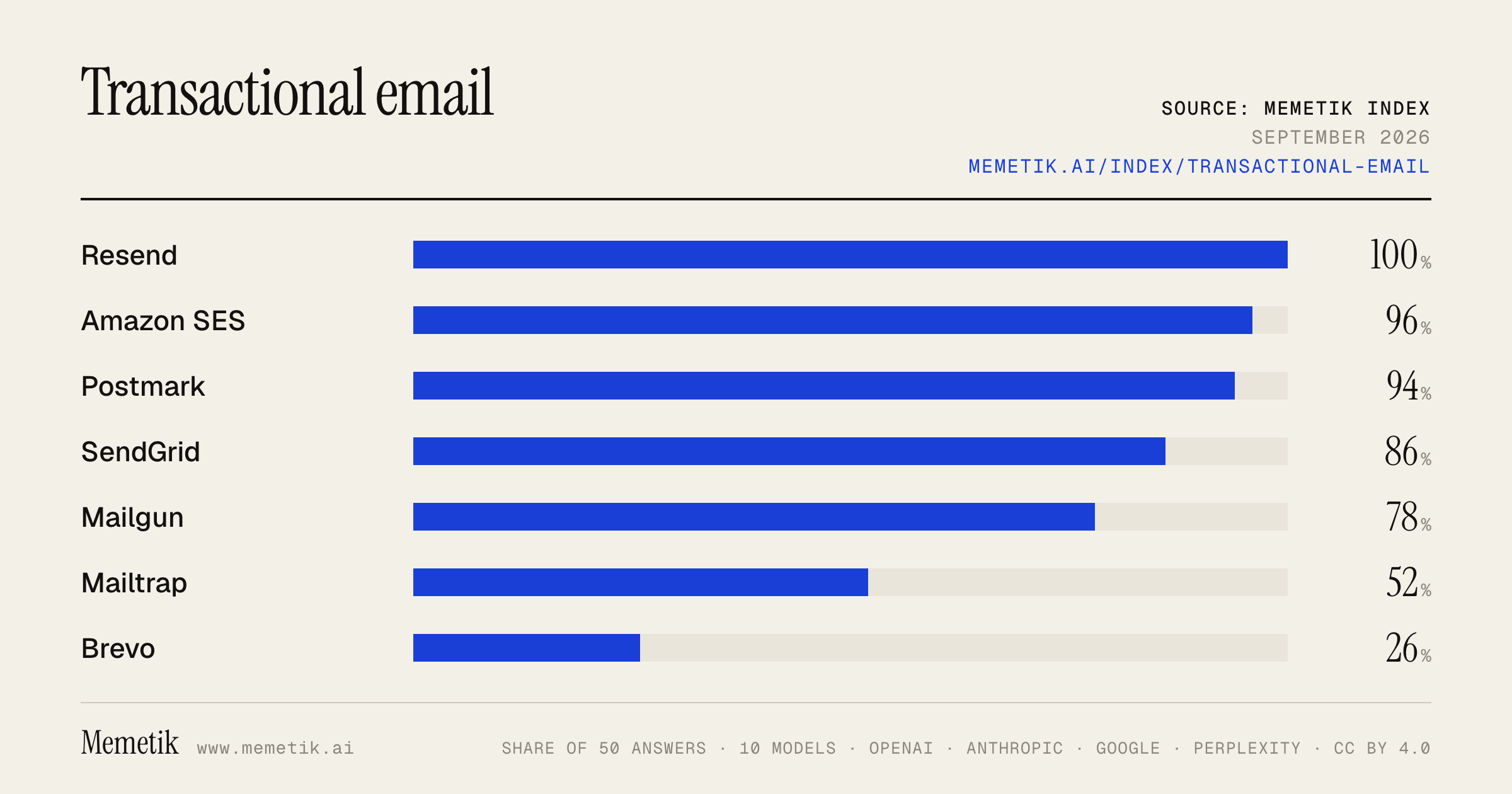
Resend was named in 50 of 50 answers and came first in 28. Amazon SES follows at 96%. 12 vendors were named at least once. First edition, so there is no prior period.
Answer share
5 prompts × 10 models · 50 answers
By provider
10 models · 50 answers
OpenAI 3 models · 15 answers
- GPT-5.6 Solgpt-5.6-solmost named: Resend 100%
- GPT-5.6 Terragpt-5.6-terramost named: Resend 100%
- GPT-5.6 Lunagpt-5.6-lunamost named: Resend 100%
Anthropic 3 models · 15 answers
- Claude Opus 5claude-opus-5most named: Resend 100%
- Claude Sonnet 5claude-sonnet-5most named: Resend 100%
- Claude Fable 5claude-fable-5most named: Resend 100%
Google 2 models · 10 answers
- Gemini 3.6 Flashgemini-3.6-flashmost named: Resend 100%
- Gemini 3.5 Flashgemini-3.5-flashmost named: Resend 100%
Perplexity 2 models · 10 answers
- Sonar Prosonar-promost named: Resend 100%
- Sonar Reasoning Prosonar-reasoning-promost named: Resend 100%
Sources the models cited
- mailtrap.io193
- nitrosend.com112
- agentmail.to112
- smtp2go.com104
- sequenzy.com85
- reddit.com58
- maestra.io37
- ventureharbour.com37
- mailtoolscout.com26
- emailvendorselection.com24
- postmarkapp.com22
- sendlayer.com21
ChatGPT via API returns no citations, so it does not contribute here.
The prompts
- What is the best transactional email API for a developer? Name specific products.
- Which transactional email API would you recommend to a developer in 2026?
- Compare the top transactional email API options right now.
- I'm a developer and I need a transactional email API. What should I use and why?
- Best transactional email API for a SaaS sending signup and receipt emails?
Every answer
Raw model output, unedited
GPT-5.6 TerraWhat is the best transactional email API for a developer? Name specific products.
**Best default for most developers: Resend.**
It has a notably clean developer experience, straightforward API, good TypeScript/React Email workflow, and is especially pleasant for modern web apps.

Other excellent choices, depending on your priority:

| Product | Best for | Why choose it |
|---|---|---|
| **Resend** | Most modern app developers | Best overall DX; strong TypeScript, React Email, and simple API integration. |
| **Postmark** | Critical transactional mail | Great choice for password resets, receipts, alerts, and other high-importance email where transactional focus and support matter most. |
| **Amazon SES** | Lowest cost at substantial scale / AWS shops | Powerful and inexpensive, but requires more AWS and deliverability operational work. AWS’s current pricing and plan structure changed in July 2026, so model the plan versus à-la-carte pricing before committing. ([aws.amazon.com](https://aws.amazon.com/ses/pricing//?utm_source=openai)) |
| **Mailgun** | Mature, flexible email platform | A practical option if you need sending plus inbound email routing, validations, analytics, SMTP, and configurable domain management. Its listed plans include REST APIs, SMTP relay, webhooks, analytics, and inbound routes. ([mailgun.com](https://www.mailgun.com/pricing/?gspk=YW1pcnJlaXRlcg&gsxid=BzK4ToCSioYq&utm_source=openai)) |
| **SendGrid** | Established enterprise ecosystem | Widely supported, familiar to many teams, and useful if you also expect marketing-email needs—but its developer experience is less elegant than Resend’s or Postmark’s. |
| **MailerSend** | Simple product teams needing transactional + light marketing | Good UI and API balance, with templates and collaboration features. |

### My practical recommendation

- **Starting a new TypeScript/Next.js/SaaS app:** **Resend**
- **Sending account/security/financial emails where reliability is your overriding concern:** **Postmark**
- **Sending millions of emails and already running on AWS:** **Amazon SES**
- **Need inbound parsing/routing or a fuller email platform:** **Mailgun**

Avoid optimizing purely for per-email cost at the beginning. For transactional email, reliable delivery, sane webhooks, easy domain authentication, suppression handling, and good logs are usually worth more than saving a fraction of a cent per message.
GPT-5.6 TerraWhich transactional email API would you recommend to a developer in 2026?
**My default recommendation for a new application in 2026: Resend.**

It is the choice I’d make when the priority is a clean developer experience for product email—password resets, receipts, account notifications, invitations, and similar transactional traffic. I’d still put it behind a thin internal `EmailProvider` interface so switching providers later is manageable.

**Choose something else when:**

- **You are already deeply on AWS or are extremely price-sensitive:** choose **Amazon SES**. Its current Essentials pricing starts at **$0.16 per 1,000 messages** for up to 10M/month (with different pricing/models available), but it asks more of you operationally around configuration, reputation, observability, and deliverability. New SES accounts began defaulting to the Essentials plan on **July 21, 2026**. ([aws.amazon.com](https://aws.amazon.com/ses/pricing//?utm_source=openai))
- **You already use Twilio for SMS/voice or want one communications vendor:** choose **Twilio Email**. It is usage-priced at **$0.0013 per email** with no monthly base fee, and is designed to sit in the Twilio Console alongside other channels. ([twilio.com](https://www.twilio.com/en-us/products/email-api/twilio-pricing?utm_source=openai))
- **You need a long-established, high-volume platform with broad enterprise controls:** consider **Twilio SendGrid**. Its Email API plans begin at **$19.95/month**, and it remains a sensible fit for teams that need its scale, established ecosystem, and deliverability tooling. ([twilio.com](https://www.twilio.com/en-us/products/email-api/pricing?utm_source=openai))

### What I would actually do
1. Start with **Resend** for a typical SaaS/product team.
2. Use a provider-neutral wrapper around send, template, and webhook events.
3. Configure a dedicated sending subdomain such as `mail.example.com`.
4. Treat **SPF, DKIM, DMARC, bounce handling, complaint handling, and idempotent sends** as requirements—not provider-specific extras.
5. Re-evaluate at meaningful scale; moving to SES can make financial sense, but it should not be the first optimization for most small teams.

So: **Resend for the best default developer experience; SES for AWS-native cost optimization; Twilio/SendGrid for an existing Twilio stack or established enterprise-scale needs.**
GPT-5.6 TerraCompare the top transactional email API options right now.
## Short answer

For most new product teams in **September 2026**, I’d narrow the shortlist to:

1. **Resend** — best default for developer experience and predictable startup pricing
2. **Postmark** — best when transactional deliverability, speed, and message isolation matter most
3. **Mailgun** — best for mature email infrastructure: inbound email, routing, validations, regions, and enterprise controls
4. **Amazon SES** — best for teams optimizing relentlessly for raw sending cost and willing to own more operations
5. **Twilio SendGrid** — viable established all-rounder, especially if you already use Twilio or need its broader ecosystem

## Comparison

| Provider | Best for | Main strengths | Main trade-offs | Published entry pricing* |
|---|---|---|---|---|
| **Resend** | Modern SaaS, startups, product-led engineering teams | Clean developer-first API, generous free tier, pay-as-you-go overages rather than forced plan jumps | Less oriented toward complex inbound-email and enterprise routing workflows than Mailgun | Free: 3,000/month, 100/day. Pro: **$20/month for 50,000**, then **$0.90/1,000** extra. ([resend.com](https://resend.com/pricing?volume=50000&utm_source=openai)) |
| **Postmark** | Password resets, receipts, login links, alerts, and other high-value transactional mail | Strong transactional focus, separate transactional/bulk streams, inbound processing options, detailed message history | Typically not the cheapest choice at very large volume; less of a “do everything email platform” | Free Developer tier: **100/month**. Its published 10k tiers start at **$15/month**, with inbound/team features from **$16.50/month** in its announced structure. ([postmarkapp.com](https://postmarkapp.com/pricing/?utm_source=openai)) |
| **Mailgun** | Larger SaaS platforms, multi-domain sending, inbound-email applications | Mature REST API + SMTP, webhooks, inbound routing, EU/US data-region option, validation, dedicated IP/pool features, long-lived operational tooling | Pricing and feature gates can become more complex; lower tiers have short log retention | Free: **100/day**. Basic: **$15/month for 10,000**. Foundation: **$35/month for 50,000**. Scale: **$90/month for 100,000**. ([mailgun.com](https://www.mailgun.com/pricing/?gspk=YW1pcnJlaXRlcg&gsxid=BzK4ToCSioYq&utm_source=openai)) |
| **Amazon SES** | Very high-volume, cost-sensitive AWS-native systems | Usually the cost leader; integrates naturally with AWS identity, event, queue, and observability tooling | More DIY: reputation management, templates, analytics, routing, and support experience require more engineering ownership | Usage-based rather than a polished bundled SaaS-plan model; get an exact current estimate from AWS for your region and architecture. |
| **Twilio SendGrid** | Existing Twilio customers; teams wanting a long-established API plus broader email tooling | Established API/SMTP provider, ecosystem familiarity, marketing + transactional capabilities | Plan structure and product experience may be less appealing than newer developer-first alternatives; validate current feature/pricing details directly before standardizing | Pricing varies by plan and volume; confirm the current plan page during procurement. |

\*Pricing is a starting-point comparison, not a quote—overages, dedicated IPs, validation, retention, support, and regional/compliance requirements can materially change cost.

## How I’d choose

### Pick **Resend** if:
- You are building a new web app or SaaS product.
- Your team prioritizes a fast, pleasant integration and straightforward pricing.
- You expect anywhere from a few thousand to a few hundred thousand transactional messages monthly.
- You do not need sophisticated inbound-email workflows.

At 50,000 emails/month, Resend’s published **$20/month** plan is unusually attractive, especially because its stated overage model stays at $0.90 per additional thousand rather than requiring an immediate tier jump. ([resend.com](https://resend.com/pricing?volume=50000&utm_source=openai))

### Pick **Postmark** if:
- Your emails are mission-critical: authentication, password reset, payment, booking, compliance, or operational notifications.
- You want strict separation between transactional and bulk/marketing traffic.
- Supportability matters: Postmark states it retains full message content history for 45 days by default, configurable from 7 to 365 days. ([postmarkapp.com](https://postmarkapp.com/pricing/?utm_source=openai))

My default for a company where a missed password-reset email is a major customer-support incident: **Postmark**.

### Pick **Mailgun** if:
- Email itself is part of the product: inbound parsing, reply handling, forwarding, routing, multiple sending domains, or multi-tenant sending.
- You need US/EU regional deployment options, validation, dedicated IPs/pools, and deeper deliverability operations.
- You expect complex needs rather than merely “send a receipt.”

Mailgun is especially compelling when the system must both **send and receive/process email**. Its plans include REST and SMTP sending, tracking/webhooks, and inbound routing; larger plans add high domain limits, longer retention, and dedicated IP capabilities. ([mailgun.com](https://www.mailgun.com/pricing/?gspk=YW1pcnJlaXRlcg&gsxid=BzK4ToCSioYq&utm_source=openai))

### Pick **Amazon SES** if:
- Cost at scale is the overriding concern.
- You already run on AWS and have engineers comfortable building the missing operational layers.
- You can manage deliverability, bounce/complaint processing, templates, dashboards, alerting, and support workflows yourself.

SES is rarely the easiest starting experience, but it can be the rational choice once volume is huge and engineering capacity is plentiful.

### Pick **SendGrid** if:
- You already have a successful SendGrid/Twilio integration.
- Its existing features, vendor relationship, or organizational familiarity outweigh switching benefits.
- You need to consolidate vendors under Twilio.

For a greenfield build, I would evaluate Resend, Postmark, and Mailgun first before choosing SendGrid.

## Practical recommendations by scenario

- **Indie app / early startup:** **Resend**
- **B2B SaaS with high-stakes auth and receipts:** **Postmark
GPT-5.6 TerraI'm a developer and I need a transactional email API. What should I use and why?
## Recommendation

**Use Resend for a new developer-focused app unless you already run deeply on AWS or expect very high volume.**

Why: it has a notably simple REST API and SDK experience, supports an idempotency key to avoid accidental duplicate sends, and its paid transactional tier is straightforward: **$20/month for 50,000 emails**, then usage-based overages. ([resend.com](https://resend.com/docs/api-reference/emails/send-email?utm_source=openai))

### Choose by situation

| Your situation | Best fit | Why |
|---|---|---|
| New SaaS/app; small team; value implementation speed | **Resend** | Clean developer experience, simple API, sensible default for product emails. |
| Millions of emails/month; AWS-heavy infrastructure; cost is paramount | **Amazon SES** | Base outbound pricing is **$0.10 per 1,000 emails**—dramatically cheaper at scale—but you take on more AWS configuration and operational ownership. ([aws.amazon.com](https://aws.amazon.com/ses/pricing/?nc1=h_ls&utm_source=openai)) |
| You already use Twilio for SMS/voice and want consolidated billing/workflows | **Twilio Email** | Flat usage pricing of **$0.0013/email**, transactional logs/deliverability tooling, and integration into Twilio’s console. ([twilio.com](https://www.twilio.com/en-us/products/email-api/twilio-pricing?utm_source=openai)) |
| You need a mature, broad platform that also supports substantial marketing-email requirements | **Twilio SendGrid** | Mature API, dynamic templates, attachments, personalization, high API rate limits, and both transactional and marketing sending. ([twilio.com](https://www.twilio.com/docs/sendgrid/api-reference/mail-send?utm_source=openai)) |

## The practical trade-off

At modest volume, optimize for engineering time:

- **Resend:** roughly $20/mo at 50k sends. ([resend.com](https://resend.com/pricing?volume=50000&utm_source=openai))
- **SES:** roughly $5 in base outbound-send fees at 50k sends, excluding add-ons/data and other AWS services. ([aws.amazon.com](https://aws.amazon.com/ses/pricing/?nc1=h_ls&utm_source=openai))

That $15/month difference rarely justifies additional integration and deliverability operations for an early-stage product. At 1M+ emails/month, however, SES’s cost advantage becomes material; that is when I’d seriously consider it.

## What I’d implement

Use a provider abstraction—even if it initially has only one implementation:

```ts
interface TransactionalEmailProvider {
  send(input: {
    idempotencyKey: string;
    to: string;
    template: "verify-email" | "password-reset" | "receipt";
    data: Record<string, unknown>;
  }): Promise<{ providerMessageId: string }>;
}
```

Then:

1. **Queue emails through an outbox/job queue** rather than sending inline in the HTTP request.
2. **Persist an idempotency key** per business event—e.g. `password-reset:<userId>:<tokenId>`—so retries never produce duplicate mail.
3. **Use provider webhooks** for delivered, bounced, complained, and deferred events.
4. **Separate transactional and marketing traffic**, ideally by subdomain, such as `notify.example.com` vs. `news.example.com`.
5. Configure **SPF, DKIM, and DMARC** before production, and monitor bounces/complaints. API choice helps, but deliverability ultimately depends heavily on authentication, list hygiene, content, and sending reputation.
6. Treat a provider’s accepted response as **“queued/accepted,” not “delivered.”**

Resend explicitly supports request idempotency keys that expire after 24 hours, which is useful—but I would still maintain application-level deduplication because your retry windows and business semantics may be longer. ([resend.com](https://resend.com/docs/api-reference/emails/send-email?utm_source=openai))

## Bottom line

- **Most developers building a new transactional-email integration:** **Resend**
- **High-volume, cost-sensitive, AWS-native teams:** **Amazon SES**
- **Existing Twilio customers or teams needing cross-channel communications:** **Twilio Email**
- **Teams that need a broad legacy/mature email suite including marketing:** **SendGrid**

If you tell me your language/runtime, monthly send volume, compliance/data-region needs, and whether you need inbound email or marketing campaigns, I can narrow this to one provider and sketch the integration.- https://resend.com/docs/api-reference/emails/send-email?utm_source=openai
- https://aws.amazon.com/ses/pricing/?nc1=h_ls&utm_source=openai
- https://www.twilio.com/en-us/products/email-api/twilio-pricing?utm_source=openai
- https://www.twilio.com/docs/sendgrid/api-reference/mail-send?utm_source=openai
- https://resend.com/pricing?volume=50000&utm_source=openai
GPT-5.6 TerraBest transactional email API for a SaaS sending signup and receipt emails?
**Best default for a SaaS:** **Postmark**.

For signup confirmations, password resets, invoices, and receipt emails, I’d choose Postmark when **deliverability and operational simplicity** matter more than shaving every dollar off the bill. Keep transactional email on its own sending domain/subdomain (for example, `notify.example.com`) and use provider webhooks to record delivery, bounces, and complaints.

**Choose by priority:**

| If you value… | Pick | Why |
|---|---|---|
| Best no-drama transactional default | **Postmark** | Purpose-built fit for critical product email; straightforward API and templates. |
| Modern developer experience / React email workflow | **Resend** | Strong choice if your team builds emails in code and wants a very simple API. |
| Lowest cost at meaningful volume and you already run on AWS | **Amazon SES** | Very economical but more operational work: AWS setup, IAM, reputation/deliverability configuration, and building more of the surrounding tooling yourself. AWS’s current pricing has changed recently, so check the plan vs. à-la-carte option for your exact volume. ([aws.amazon.com](https://aws.amazon.com/ses/pricing//?utm_source=openai)) |
| Large enterprise / broad email platform needs | **Twilio SendGrid** or **Mailgun** | Consider these if you need their particular ecosystem, analytics, routing, or established enterprise procurement path. |

**My concrete recommendation:**
1. Start with **Postmark** for transactional-only mail.
2. Use a distinct transactional subdomain and configure **SPF, DKIM, and DMARC** before launch.
3. Build sends through a small internal `sendEmail()` service with:
   - idempotency keys for receipts,
   - a durable job queue/retries,
   - provider event webhooks,
   - separate streams/tags for `signup`, `receipt`, `password-reset`, etc.
4. Do **not** mix product-critical transactional mail with marketing campaigns on the same sending identity.

If you expect hundreds of thousands to millions of emails per month and have AWS expertise, SES can be the financially better choice; its current Essentials rate is listed at **$0.16 per 1,000 emails for 0–10M/month**, while its à-la-carte outbound rate is **$0.10 per 1,000** before optional deliverability features. ([aws.amazon.com](https://aws.amazon.com/ses/pricing//?utm_source=openai))

**Bottom line:** Pick **Postmark** unless you have a strong reason to optimize for developer-email components (**Resend**) or lowest infrastructure cost at scale (**SES**).
Claude Sonnet 5What is the best transactional email API for a developer? Name specific products.
For a developer, the "best" transactional email API depends on your priorities (pure simplicity vs. features vs. scale), but a few products consistently stand out:

## Top picks

**Resend** — Widely regarded as the most modern, developer-friendly option right now, especially for React/Next.js stacks.
It's known for developer-first transactional and marketing email with native React Email integration for React and Next.js teams.

Reviewers note it has the cleanest API and docs, with best-in-class React Email integration.
 It also carries strong user ratings —
Resend carries the highest review rating (4.8/5) among 13 providers compared in one recent survey.


**Postmark** — The classic pick for teams that just want transactional email done extremely well, with minimal extra fluff.
Postmark is best for teams looking to send transactional emails and don't need any extra features.
 It's also praised for
developer-focused transactional email with a deliverability focus, a strong API, mature webhooks, and flexible routing rules, though its marketing features are limited.


**Mailgun** — A solid choice if you need more advanced control.
Mailgun is best for developers with in-depth email sending expertise who need detailed logs and an email validation API on top of an email API.


**SendGrid (Twilio)** — Good for enterprise-scale needs.
SendGrid is best for enterprise users who need granular control over their user permissions.
 Note that
it's a Twilio-owned, enterprise-scale transactional API, but has two separate products for transactional and marketing, so integration can feel awkward.


**Amazon SES** — The cheapest at scale if you're already on AWS.
Amazon SES is best for current AWS users who have extensive experience with setting up, configuring, and supporting email infrastructures.


**Mailtrap** — A newer contender that's gotten strong reviews for developer experience.
Setup takes about five minutes from account creation to first send, official SDKs cover seven languages including Node.js, PHP, Ruby, Python, .NET, Elixir, and Java, and it offers 25+ framework snippets for Laravel, Symfony, Django, Rails, and Next.js.
 It also has a nice testing feature:
an email sandbox for testing and debugging.


**Brevo** — Best if you want transactional email plus marketing/SMS/WhatsApp in one platform.
Brevo is a comprehensive customer platform designed for businesses that need a reliable, high-performance transactional email API alongside a broader set of relationship-building tools, providing the reliable infrastructure needed for mission-critical emails while offering native tools to scale into SMS, WhatsApp, and marketing automation without needing to switch platforms.


## Quick recommendation

- **Just want the cleanest DX for a modern app (especially React/Next.js)?** → **Resend**
- **Want pure transactional email, rock-solid deliverability, no bloat?** → **Postmark**
- **Need heavy-duty logs/validation or already deep into email infra?** → **Mailgun**
- **Already on AWS and cost-sensitive at high volume?** → **Amazon SES**
- **Want transactional + marketing + SMS in one API?** → **Brevo**

If you're unsure, Resend or Postmark are the two most commonly recommended starting points for developers today due to their API simplicity and documentation quality.
Claude Sonnet 5Which transactional email API would you recommend to a developer in 2026?
Based on current comparisons, there's no single universal answer — it depends on your priorities — but here's how I'd break it down for a developer in 2026:

## If you want the cleanest developer experience
**Resend** is frequently praised for being the most modern, minimal option. It has
the cleanest API and docs, with best-in-class React Email integration, plus broadcasts and automations for lighter marketing needs
. It's
best for modern web apps where transactional is the main job and marketing needs are light, with a free tier of 3K/month and paid plans starting at $20/mo for 50K
.

## If deliverability analytics and dev tooling matter most
**Mailtrap** stands out repeatedly across sources.
It's a transactional email platform for development and product teams, focusing on high email deliverability, a modern dev experience, and detailed analytics, providing SMTP relay, an email API, and an MCP server for AI agent workflows.
 On integration speed,
setup takes about five minutes from account creation to first send, official SDKs cover seven languages including Node.js, PHP, Ruby, Python, .NET, Elixir, and Java, and it offers 25+ framework snippets for Laravel, Symfony, Django, Rails, and Next.js.


## If you want deep API control and advanced features
**Mailgun** remains a strong developer-first pick.
It's known for its developer-friendly approach and powerful API, designed to handle high volumes of email with reliability and speed, and the flexible, well-documented API allows deep integration for advanced email functionality and automation.
 It also offers
advanced email validation to reduce bounces, plus unique email parsing functionality allowing you to receive and process incoming emails programmatically.


## If raw speed/deliverability is the priority
**Postmark** is the go-to for pure transactional speed.
EmailTooltester's 2026 test gave them a 93.8% average deliverability, and Knock's benchmarks show p50 API response of 23ms and p99 of 228ms — among the fastest on the market.
 Trade-off:
it explicitly separates transactional and marketing streams (you pay transactional prices even for that), and pricing is considerably pricier than competitors.


## If cost at scale is the deciding factor
**Amazon SES** is consistently cited as the cost leader for AWS-heavy teams — rock-bottom per-email pricing, though with a less polished DX than the others.

## If you want transactional + marketing unified
Consider **Brevo** or **Sequenzy** — both combine transactional sending with marketing automation on one platform. Brevo notably
shipped a full MCP server in 2026 covering campaigns, contacts, CRM, SMS/WhatsApp, templates, and analytics — one of two providers with a complete AI agent integration.


---

### My actual recommendation
For most developers starting a new project in 2026, I'd lean toward **Resend** if you're transactional-first and want a beautiful, minimal API — or **Mailtrap** if you want strong analytics and debugging tools baked in. If you're already deep in AWS infrastructure, **Amazon SES** is hard to beat on price. If email deliverability at scale is business-critical, budget for **Postmark**.

If you tell me your stack (e.g., Node/Next.js, Django, AWS-based, etc.) and expected volume, I can narrow this down further.
Claude Sonnet 5Compare the top transactional email API options right now.
## Top Transactional Email APIs — 2026 Comparison

The field has consolidated around a handful of clear leaders, each optimized for different priorities. Here's how they stack up:

### The Main Contenders

**Amazon SES** — Best for rock-bottom cost at massive scale.
Amazon SES has the highest ceiling, with production-access requests able to get you to thousands of emails per second, but it has the rawest API, meaning you'll write your own retry and batch logic.
 It's the pick when engineering time is cheaper than per-email cost.

**SendGrid (Twilio)** — Best for enterprise teams already in the Twilio ecosystem.
SendGrid has the broadest language support and the best enterprise-scale rate limits out of the box.
 It also has an edge in raw SDK coverage —
SendGrid and AWS SES have the broadest SDK language coverage
 among the major providers.

**Postmark** — Best for reliability and clean architecture.
Postmark's API is simple and extremely well documented, with message streams that cleanly separate transactional from broadcast sending.

For mission-critical legacy systems, Postmark's track record still wins.


**Resend** — Best developer experience, especially for React/Next.js teams.
It offers developer-first transactional and marketing email with native React Email integration for React and Next.js teams.
 It also scores well on user sentiment —
Resend carries the highest review rating (4.8/5) among providers compared.
 Broadly,
Resend and Postmark have the cleanest, most idiomatic SDKs, so if your team cares about DX, start there.


**Mailgun** — Best for granular infrastructure control.
For teams that want fine-tuned configuration and are comfortable working at the infrastructure level, Mailgun offers RESTful API and SMTP relay with ready-made code snippets, ML-based send time optimization, email validation, and US/EU region selection for data residency.
 It also does well on transparency —
Mailgun delivers high deliverability rates and supports subdomain sending, letting teams route different email types through separate domains.


**Mailtrap** — A newer full-stack entrant, strong on testing/debugging and analytics.
Mailtrap started in 2019 as an email testing sandbox and has expanded into a full email delivery platform, with outbound running through separated transactional and bulk sending streams on independent IP pools.
 It also stands out for onboarding speed:
setup takes about five minutes from account creation to first send, with official SDKs covering seven languages and 25+ framework snippets for Laravel, Symfony, Django, Rails, and Next.js.


**Brevo (formerly Sendinblue)** — Best if you want transactional + marketing on one bill.
It's rated well for teams who want marketing email and transactional API on one bill — the only platform that genuinely combines marketing and transactional well.
 One caveat worth knowing:
Brevo allows sending without verifying a domain, which is technically possible but will hurt deliverability long-term, especially with Gmail and Yahoo — it's best used only for testing, then a proper authenticated domain with DKIM, SPF, and DMARC should be added before production.


### Head-to-Head Cheat Sheet

On the axes that matter most day-to-day:
SDK language coverage favors SendGrid and AWS SES; default rate limits are highest for SendGrid and SES (Resend and Mailgun default lower but raise on request); batch endpoints are cleanest with Postmark and Resend (SES offers SendBulkTemplatedEmail); and webhook/event quality is richest with Postmark and Mailgun.
 Summed up:
for developer experience, Resend and Postmark lead; for raw scale, SendGrid and SES lead.


### Bottom Line by Use Case

- **Lowest cost at huge volume:** Amazon SES
- **Best out-of-the-box DX / React-Next.js stack:** Resend
- **Most battle-tested reliability:** Postmark
- **Already on Twilio / need enterprise rate limits:** SendGrid
- **Want infrastructure-level control and region options:** Mailgun
- **Want transactional + marketing unified:** Brevo (or Maestra/Sequenzy, newer unified entrants)
- **Need built-in testing sandbox + deliverability analytics:** Mailtrap

As one comparison summed it up:
Maestra is best for brands that want transactional and marketing email on one customer profile; Mailtrap for deliverability analytics; Mailgun for granular API control; Amazon SES for rock-bottom unit cost; SendGrid for teams already on Twilio; and Postmark for raw delivery speed.


If you tell me your priorities (volume, budget, tech stack, whether you need marketing email too), I can narrow this down to a specific recommendation.
- https://mailtoolscout.com/blog/best-transactional-email-services
- https://www.sequenzy.com/blog/best-transactional-email-services
- https://www.courier.com/integrations/list/transactional-email
- https://maestra.io/blog/comparisons/best-transactional-email-platforms
- https://www.agentmail.to/blog/5-best-email-api-for-developers-compared-2026
- https://mailtrap.io/blog/transactional-email-services/
Claude Sonnet 5I'm a developer and I need a transactional email API. What should I use and why?
Choosing a transactional email API depends on your priorities—deliverability, pricing, developer experience, features, and scale. Here's a breakdown of the main options developers commonly consider:

## Top Choices

**Resend**
A newer, developer-first API built specifically with modern stacks in mind (React Email support, great DX, simple API). Popular in the indie hacker/startup community for its clean API and generous free tier. Great if you're using React/Next.js and want beautiful, component-based email templates.

**SendGrid (Twilio SendGrid)**
One of the most established players. Pros: mature API, good documentation, strong deliverability infrastructure, marketing + transactional in one platform. Cons: pricing can get expensive at scale, and their reputation for deliverability has had ups and downs.

**Postmark**
Known for being *the* deliverability-focused option—specifically optimized for transactional email (not marketing), with excellent inbox placement rates. Great analytics, clean API, but no free tier and pricier per email than some competitors. Ideal if deliverability is your #1 concern (e.g., password resets, receipts, critical notifications).

**Amazon SES (Simple Email Service)**
Cheapest at scale by far (fractions of a cent per email), integrates well if you're already on AWS. Downside: bare-bones API, you need to build more yourself (templates, tracking, etc.), and deliverability requires more manual reputation management.

**Mailgun**
Solid middle ground—flexible API, good for both transactional and some marketing use cases, reasonable pricing, decent deliverability. Popular with developers who want more control (e.g., routing/parsing inbound email).

**Brevo (formerly Sendinblue), Mailjet, Sparkpost**
Also viable, often chosen for pricing or EU data residency (Brevo/Mailjet are France-based, useful for GDPR compliance).

## How to Decide

1. **If you want simplicity + great DX + modern tooling** → **Resend**
2. **If deliverability is mission-critical** (e.g., fintech, auth emails) → **Postmark**
3. **If you're already deep in AWS and want lowest cost at scale** → **Amazon SES**
4. **If you want an all-in-one with marketing + transactional** → **SendGrid** or **Brevo**
5. **If you need flexibility (inbound parsing, custom routing)** → **Mailgun**

## Practical Recommendation
For most developers building a typical SaaS product today, **Resend** or **Postmark** tend to be the most loved choices for pure transactional email (password resets, receipts, notifications)—Resend for DX and modern stack fit, Postmark for deliverability guarantees. If cost at high volume is the main driver, **Amazon SES** wins, especially paired with a templating layer you build yourself.

Want me to compare pricing specifics or help you integrate one of these into your stack (e.g., Node.js, Python)?
Claude Sonnet 5Best transactional email API for a SaaS sending signup and receipt emails?
For signup and receipt emails specifically (transactional, developer-triggered), a few providers stand out depending on what you value most:

## Top picks

**Postmark** – Best if speed and reliability for critical auth/receipt emails is your top concern.
Postmark is a strong choice when magic-link logins, OTPs, and trial activation emails need to arrive in seconds rather than minutes.
 It's a long-time favorite for its dedicated transactional-only infrastructure (no marketing email mixed in, which protects deliverability).

**Resend** – Best developer experience if you're on Node.js/React.
For most new Node.js SaaS apps in 2026, the practical shortlist is Resend, Postmark, and MailerSend, with Resend being a strong developer-experience default.
 It's popular for its clean API, React Email templating, and generous free tier for early-stage SaaS.

**Mailtrap** – Best if you want strong deliverability plus built-in analytics without much setup work.
Mailtrap is an email delivery platform built for developers and product teams, covering outbound sending via Email API and SMTP relay, with deliverability analytics across the full sending lifecycle. Its core deliverability mechanism is stream separation: transactional and bulk traffic run on isolated infrastructure by default.
 It also
automatically configures SPF, DKIM, and DMARC after DNS records are added, and rotates DKIM keys every month so stale key decay doesn't silently degrade inbox placement.


**Amazon SES** – Best if you're cost-sensitive and already on AWS.
Choose Amazon SES when your infrastructure already lives on AWS and you have the engineering capacity to manage deliverability, bounce handling, and log retention yourself.

AWS lists outbound SES email at $0.10 per 1,000 emails, plus additional data and feature-specific charges,
 making it by far the cheapest at scale — but
it typically requires more operational work around setup, reputation, bounce handling, dashboards, alerts, and developer workflow.


**SendGrid (Twilio)** – Best if you need enterprise SLAs or already use Twilio for SMS.
SendGrid is the market leader for transactional email, maintaining a 99.99% uptime SLA and offering the most comprehensive documentation and SDK support of any provider.

Choose Twilio SendGrid when your team already runs on Twilio and you want email, SMS, and voice billed from a single account.


**Mailgun** – Worth a look if you need granular sending control.
Mailgun is a good choice when pre-send address validation and per-domain routing control are core to how your product handles email infrastructure.


## My recommendation

For a typical SaaS sending signup confirmations and receipts:
- **Small/early-stage, cost-conscious:** Resend or Postmark — both are cited as offering
generous free or low-cost entry tiers with excellent developer experience
 for pure transactional use cases like password resets and receipts.
- **Scaling with mixed transactional + marketing needs:** Mailtrap, since it isolates transactional traffic from bulk sends so a marketing campaign can't hurt your signup/receipt deliverability.
- **Already deep in AWS and want lowest cost:** Amazon SES, if you have engineering bandwidth to manage deliverability yourself.

One practical tip echoed across sources:
use a queue or background job layer so signup and billing flows remain fast and resilient when the email provider is slow or needs retries, with the request handler simply recording the event and enqueuing the email job
 — this matters regardless of which provider you pick.
Gemini 3.6 FlashWhat is the best transactional email API for a developer? Name specific products.
The answer depends on whether you prioritize **developer experience (DX)**, **ultra-high deliverability**, **massive enterprise scale**, or **cost efficiency**.

Specific transactional email APIs for developers stand out in key categories:

---

### 1. **Resend** — *Best Developer Experience (Best Overall for Modern Stacks)*
* **Why developers love it:** Resend is purpose-built for modern web stacks (Next.js, Node.js, React). Its standout feature is integration with **React Email**, allowing you to write, preview, and componentize email templates using JSX/TSX instead of raw HTML tables.
* **Key Features:** Clean REST APIs, top-tier SDKs, zero bloat dashboard, linear pricing, webhooks.
* **Best for:** Startups, indie developers, and modern web application engineers (TypeScript/JavaScript/React stack).
* **Pricing:** Generous free tier (up to 3,000 emails/month); paid plans start around $20/month for 50k emails.

---

### 2. **Postmark** (by ActiveCampaign) — *Best for Unmatched Deliverability & Logs*
* **Why developers love it:** Postmark strictly isolates transactional emails from marketing/bulk emails to protect IP reputations. It boasts faster delivery speeds and higher inbox placement rates than almost anyone else in the industry.
* **Key Features:** Detailed 45-day activity logs (making debugging failed sends effortless), sub-second delivery latency, robust Webhooks, and incredible customer support.
* **Best for:** Mission-critical emails (password resets, 2FA codes, order confirmations) where zero-delay and guaranteed inbox placement are essential.
* **Pricing:** Starts around $15/month for 10,000 emails (slightly higher cost per email, but worth it for critical delivery).

---

### 3. **Amazon SES (Simple Email Service)** — *Best for Raw Low Cost at Scale*
* **Why developers love it:** Nothing beats AWS SES on price. It provides raw infrastructure that gives you full control over sending limits, IP addresses, and custom DKIM/SPF configurations.
* **Key Features:** Extremely cheap, global infrastructure, deep AWS ecosystem integrations (IAM, SQS, Lambda).
* **Best for:** High-volume senders, developers on AWS, or engineers who don't mind extra configuration overhead to save thousands of dollars at scale.
* **Pricing:** $0.10 per 1,000 emails (effectively free or fractions of a penny for low volume).

---

### 4. **Mailtrap** — *Best for Full Lifecycle (Testing + Production)*
* **Why developers love it:** Mailtrap historically made its name as an email sandbox tool for safe testing in staging/dev environments. They offer a production-ready transactional sending API paired directly with their testing environment.
* **Key Features:** Built-in email sandbox to catch bugs before hitting real users, actionable deliverability analytics, and modern API/SDKs.
* **Best for:** Teams who want to test emails in staging safely without accidentally sending test emails to real customers, then use the same provider to send production API emails.
* **Pricing:** Free tier up to 4,000 emails/month; paid plans starting around $15/month.

---

### 5. **Twilio SendGrid** — *Best for Enterprise & Mass Scale*
* **Why developers love it:** As an industry incumbent, SendGrid handles massive enterprise throughput with ease. It features extensive documentation, SDKs for virtually every programming language, and extensive sub-account controls for agency models.
* **Key Features:** High-throughput processing, visual template builders (for non-devs on your team to edit API templates), and deep analytics.
* **Best for:** Established enterprises, large SaaS platforms, and teams needing both transactional and marketing automation under one vendor roof.
* **Pricing:** Free tier (100 emails/day), with paid plans starting around $20/month.

---

### Summary Recommendation:
* **Go with Resend** if you are building a modern React/Node app and value developer experience.
* **Go with Postmark** if zero-latency password resets and maximum deliverability matter most.
* **Go with Amazon SES** if you send massive volume and want the lowest cost possible.
Gemini 3.6 FlashWhich transactional email API would you recommend to a developer in 2026?
There is no single "best" transactional email API, as the right choice depends heavily on your tech stack, volume, and developer workflow. However, the top recommendations fall into distinct categories based on standard developer use cases:

---

### 1. **Resend** — Best overall for modern web developers & DX
* **Best for:** Developers building modern React/Next.js stacks who prioritize developer experience.
* **Why pick it:**
  * Integrates seamlessly with **React Email**, allowing you to write email templates using React/TypeScript instead of painful, outdated HTML/table layouts.
  * Modern, clean API design with SDKs across major languages (Node, Python, Go, PHP, etc.).
  * Fast setup, slick dashboard, and great webhook integrations.
* **Pricing:** Generous free tier (up to ~3,000 emails/month), then starting at around $20/month.

---

### 2. **Postmark** — Best for absolute deliverability & speed
* **Best for:** High-stakes transactional emails (password resets, security codes, purchase receipts) where delivery speed and inbox placement are non-negotiable.
* **Why pick it:**
  * Strict separation of transactional and promotional email streams to protect your sender reputation.
  * Industry-leading, fast delivery times and top-tier inbox placement rates.
  * Excellent, detailed log retention and real-time delivery analytics.
* **Pricing:** Starts at around $15/month for 10k emails.

---

### 3. **Amazon SES (Simple Email Service)** — Best for raw scale & lowest cost
* **Best for:** High-volume senders (hundreds of thousands or millions of emails/month) or teams already heavily invested in AWS infrastructure.
* **Why pick it:**
  * Unbeatable cost ($0.10 per 1,000 emails).
  * Handles practically infinite scale without breaking the bank.
* **The Trade-off:** Poor developer experience, primitive UI, and no built-in email template design tools. You are responsible for handling IP warming, deliverability setup, and domain reputation yourself.

---

### 4. **Mailtrap / Mailgun** — Best for deliverability tooling & testing
* **Mailtrap:** Ideal if you want built-in email testing/sandboxing environments, inbound receiving via webhooks, and strong deliverability analytics out-of-the-box.
* **Mailgun:** Best for teams that require granular routing, built-in email address validation APIs, and explicit EU/US data residency options.

---

### 5. **SendGrid (Twilio)** — Best for traditional enterprise scale
* **Best for:** Larger companies already inside the Twilio ecosystem or needing high-volume enterprise SLAs.
* **Considerations:** Note that recent pricing restructuring has made SendGrid less friendly to early-stage developers compared to newer alternatives like Resend.

---

### Summary Recommendation

* Go with **Resend** if you are building a modern web app (especially React/TypeScript) and want the best developer experience.
* Go with **Postmark** if deliverability and speed for critical transactional messages are your top priorities.
* Go with **Amazon SES** if you are sending massive volume and need to minimize infrastructure costs.
Gemini 3.6 FlashCompare the top transactional email API options right now.
When evaluating transactional email APIs (used for password resets, OTPs, receipts, and event triggers), modern teams generally weigh **developer experience (DX)**, **deliverability/speed**, **cost at scale**, and **infrastructure control**.

Here is how the top transactional email API providers compare across key categories:

---

### 1. Resend
* **Best for:** Modern web developers, Next.js / React teams, and early-to-mid stage startups.
* **Key Strengths:**
  * Exceptional developer experience with modern SDKs (Node, Python, Go, etc.).
  * Native integration with **React Email**, allowing you to build and preview templates in TypeScript/React rather than messy HTML tables.
  * Extremely clean UI, simple webhooks, and low end-to-end API latency.
* **Drawbacks:** Free tier is limited to ~100 emails/day. Lacks deeply granular enterprise permissions or legacy protocol support compared to older incumbents.
* **Pricing:** Free tier available (~3,000 emails/mo); starts around **$20/mo for 50k emails**.

---

### 2. Postmark (ActiveCampaign)
* **Best for:** Mission-critical emails where speed, strict inbox placement, and low latency are non-negotiable.
* **Key Strengths:**
  * **Top-tier deliverability and speed:** Postmark strictly separates transactional email from marketing traffic, yielding industry-leading time-to-inbox.
  * Detailed 45-day activity logs and fast support.
  * Minimal downtime and reliable webhooks for event tracking.
* **Drawbacks:** Gets expensive fast as volume scales into hundreds of thousands per month. Strict vetting process during setup.
* **Pricing:** Starts at **$15/mo for 10,000 emails**. Scale pricing is steeper than competitors.

---

### 3. Amazon SES (Simple Email Service)
* **Best for:** High-volume senders, AWS-native architectures, and budget-conscious teams.
* **Key Strengths:**
  * Unbeatable cost economics (**$0.10 per 1,000 emails**).
  * Deeply integrated into the AWS ecosystem (IAM roles, CloudWatch, Lambda triggers, SQS).
  * Unlimited scalability once out of the initial sandbox.
* **Drawbacks:** High setup overhead. Deliverability management is entirely on you (IP warming, bounce processing setup, suppression lists). Raw, basic UI compared to dedicated platforms.
* **Pricing:** **$0.10 per 1,000 emails** (+ AWS data transfer fees).

---

### 4. SendGrid (Twilio)
* **Best for:** Enterprise companies, high-volume senders needing robust APIs, and teams tied into the Twilio ecosystem.
* **Key Strengths:**
  * High throughput capabilities and massive scale.
  * Comprehensive feature set including subaccounts, granular access control, IP pools, and inbound parse APIs.
  * Strong compliance standards for enterprise requirements.
* **Drawbacks:** Mixed customer support experiences. Platform UI feels heavy and dated. Deliverability on shared IPs requires careful management.
* **Pricing:** Limited trial/free options; Essentials tier starts around **$19.95/mo for 50k–100k emails**.

---

### 5. Mailgun (Sinch)
* **Best for:** Complex routing, deep API flexibility, built-in email validation, and strict EU/US data residency requirements.
* **Key Strengths:**
  * Advanced email validation API built directly into the workflow.
  * Flexible route handling and inbound email parsing.
  * Clear regional isolation options (US vs EU data processing).
* **Drawbacks:** Pricing tier changes over time have alienated some small developers; cost increases sharply at mid-to-high volumes.
* **Pricing:** Starts at **$15/mo for 10,000 emails**.

---

### 6. Mailtrap
* **Best for:** Development teams needing built-in testing (email sandbox) alongside production delivery.
* **Key Strengths:**
  * Combines production transactional sending with a staging/dev email sandbox so you can test templates safely without sending live emails.
  * Clear deliverability analytics and separate sub-infrastructure for transactional vs. bulk emails.
* **Drawbacks:** Less name recognition for pure enterprise scale compared to SendGrid or SES.
* **Pricing:** Generous free plan (~4,000 emails/mo); paid plans start around **$15/mo**.

---

### Summary Recommendation

| Goal / Priority | Best Choice |
| :--- | :--- |
| **Fastest DX & Modern Stack (React/Next.js)** | **Resend** |
| **Highest Speed & Immediate Inbox Placement** | **Postmark** |
| **Lowest Cost at High Scale (>500k/mo)** | **Amazon SES** |
| **Enterprise / Multi-Team Governance** | **SendGrid** |
| **EU Data Residency & Native Email Validation** | **Mailgun** |
Gemini 3.6 FlashI'm a developer and I need a transactional email API. What should I use and why?
There is no single "best" transactional email API, as the ideal choice depends on your **tech stack**, **sending volume**, and **deliverability requirements**.

The current top choices for developers break down into specific use cases:

---

### 1. **Resend** (Best for Modern DX & React/Next.js)
* **Why pick it:** If developer experience is your top priority, Resend is the current favorite. It pairs natively with **React Email**, allowing you to write email templates directly in JSX/TSX with type safety and hot-reloading instead of fighting inline HTML tables.
* **Great for:** Modern web apps, Next.js/Node/TypeScript stacks, and early-stage SaaS.
* **Pricing:** Free tier up to 3,000 emails/month (100/day limit). Paid plans start around $20/month for 50,000 emails.

### 2. **Postmark** (Best for Pure Deliverability & High-Stakes Emails)
* **Why pick it:** Postmark is the gold standard for transactional delivery speed and inbox placement. They strictly separate transactional email streams from bulk marketing, protecting your domain's reputation.
* **Great for:** Password resets, MFA tokens, payment receipts, and security alerts where delay or going to spam is unacceptable.
* **Pricing:** Starts at around $15/month for 10,000 emails.

### 3. **Amazon SES** (Best for High Volume & Ultra-Low Cost)
* **Why pick it:** It is by far the cheapest option on the market. You pay only for what you send, with no forced tier upgrades.
* **Great for:** Apps sending **100k+ emails/month**, teams already on AWS infrastructure, or bootstrapped projects on a tight budget.
* **The Catch:** Low-level developer experience. There are no slick template editors or out-of-the-box dashboards; you are responsible for monitoring domain reputation, suppression lists, and IP warming.
* **Pricing:** $0.10 per 1,000 emails.

### 4. **Mailtrap / Mailgun** (Best for Advanced Infrastructure & Inbound Handling)
* **Why pick Mailgun:** Strong API flex, EU/US data residency controls, and built-in email verification.
* **Why pick Mailtrap:** Excellent sandbox testing environment and built-in deliverability analytics to debug deliverability issues before hitting production.
* **Pricing:** Both start around $15/month.

### 5. **SendGrid (Twilio)** (Best for Enterprise & Legacy Scales)
* **Why pick it:** High API throughput capacity for massive scale.
* **The Catch:** The DX has aged, and support can be slow unless you are on high enterprise tiers. Free tiers are now heavily limited or short trials.

---

### Quick Decision Matrix

| If your priority is... | Choose... |
| :--- | :--- |
| **Fast setup & React/TS stack** | **Resend** |
| **Instant delivery & 99% inbox placement** | **Postmark** |
| **Lowest cost at huge scale (100k+/mo)** | **Amazon SES** |
| **Deep deliverability analysis & sandbox testing** | **Mailtrap** or **Mailgun** |

### Recommendation
* If you are building a **React / Node / Web app** today, start with **Resend**.
* If email is **mission-critical** (e.g., healthcare, financial alerts, auth codes), use **Postmark**.
* If you anticipate **massive volume** very quickly, use **Amazon SES** (or wrap SES with a modern SDK layer).
Gemini 3.6 FlashBest transactional email API for a SaaS sending signup and receipt emails?
For a SaaS product sending **critical transactional emails** like signup verifications, password resets, and purchase receipts, speed and inbox placement (deliverability) are everything.

The four best transactional email APIs depend on your priorities:

---

### 1. **Resend** — *Best Developer Experience & Modern Stack*
If you built your SaaS using Next.js, React, Node.js, or modern web frameworks, Resend is usually the top recommendation.

* **Why it’s great for SaaS:**
  * **React Email integration:** Allows you to code beautiful responsive emails (like receipts and welcome flows) directly in React rather than fighting inline HTML/CSS templates.
  * **Ultra-clean API & SDKs:** Dead-simple setup and exceptional documentation.
  * **Good free tier:** Generous free tier (~3,000 emails/mo) to get your SaaS off the ground.
* **Best for:** Early-stage to growth SaaS teams who want modern DX and fast deployment.

---

### 2. **Postmark** — *Best Deliverability & Latency (The Gold Standard)*
Postmark is famous in the SaaS industry for its strict deliverability standards and lightning-fast time-to-inbox.

* **Why it’s great for SaaS:**
  * **Strict IP separation:** Postmark does not allow marketing/bulk email on its primary servers, keeping its transactional IP reputation pristine.
  * **Ultra-low latency:** Magic links and signups arrive almost instantaneously (often sub-second end-to-end delivery).
  * **Great template management:** Built-in SaaS email templates out of the box (welcome, receipts, password resets).
* **Best for:** Applications where a delayed email (like a OTP/signup link) directly results in customer churn or support tickets.

---

### 3. **Amazon SES (Simple Email Service)** — *Best for Low Cost at Scale*
If cost efficiency is your main driver and you expect to send hundreds of thousands of emails per month, AWS SES is virtually unbeatable on price.

* **Why it’s great for SaaS:**
  * **Dirt cheap:** $0.10 per 1,000 emails.
  * **Infrastructure reliability:** Scales effortlessly alongside the rest of your AWS infrastructure.
* **Drawbacks:** Requires manual domain verification, IP reputation management, and deliverability tuning. The initial UI/UX setup is very basic compared to developer-first alternatives.
* **Best for:** Tech-heavy teams scaling to high volumes who are willing to manage deliverability configurations themselves.

---

### 4. **Loops** or **Brevo** — *Best if You Want Transactional + Marketing Together*
Pure transactional platforms (like Postmark) penalize or restrict bulk marketing newsletters. If you want your welcome sequence, receipts, **and** lifecycle marketing (like newsletter updates or churn re-engagement) in one place:

* **Loops:** Built specifically for SaaS; lets you trigger transactional emails via API while managing drip campaigns, user properties, and marketing in a clean dashboard.
* **Brevo (formerly Sendinblue):** Great all-in-one option with a generous free tier (300 emails/day) and built-in marketing automation.

---

### Recommended Winner for Most SaaS Apps
* Go with **Resend** if you're building with TypeScript/React and value speed of implementation.
* Go with **Postmark** if deliverability and sub-second email arrival are your absolute highest priorities.
Sonar ProWhat is the best transactional email API for a developer? Name specific products.
For most developers, **Postmark** is the best transactional email API when the priority is fast delivery, a clean API, and support focused on transactional mail.[1][19] If you want a more modern developer experience and native templates, **Resend** is also a top choice; if you need broad email functionality beyond transactional sends, **Twilio SendGrid** is the stronger all-in-one option.[3][17]

A practical shortlist:

- **Postmark** — best overall for transactional-only email, with strong deliverability and engineer-friendly support.[1][13][19]
- **Resend** — best modern DX, especially if you want a developer-first workflow and React Email-style templating.[3][12]
- **Twilio SendGrid** — best when you need transactional plus marketing email in one platform, with broad APIs and analytics.[1][17]
- **Mailgun** — best for API flexibility, inbound routing, validation, and teams that want more control.[16][20]
- **Amazon SES** — best for AWS-native teams optimizing for cost and infrastructure fit.[11][14]

If you want one direct recommendation: choose **Postmark** unless you specifically need **Resend**’s modern templating/DX or **SendGrid**’s broader platform features.[1][3][17]
- https://hackceleration.com/labs/best/transactional-email-developers
- https://coldletter.com/blog/transactional-email-api/
- https://subrupt.com/best/transactional-email
- https://nitrosend.com/best-transactional-email-apis-2026
- https://www.reddit.com/r/webdev/comments/1qj0m6r/who_offers_the_best_transactional_email_api_out/
- https://sendlayer.com/blog/best-email-api-providers/
- https://photonconsole.com/blog/best-transactional-email-api-in-2026-9-providers-evaluated-for-engineering-teams/
- https://www.agentmail.to/blog/5-best-email-api-for-developers-compared-2026
- https://www.mailerlite.com/blog/email-apis
- https://www.rajeshkumar.xyz/blog/transactional-email-apis/
- https://mailtrap.io/blog/transactional-email-services/
- https://www.sequenzy.com/blog/best-transactional-email-apis-for-ai-agents
- https://bentonow.com/posts/best-email-api-for-developers
- https://mailtrap.io/blog/best-email-api-for-nodejs-developers/
- https://www.emailvendorselection.com/email-api-for-fintech/
- https://www.sender.net/blog/transactional-email-services/
- https://www.twilio.com/en-us/blog/insights/best-email-api
- https://www.sequenzy.com/blog/best-transactional-email-services
- https://postmarkapp.com/blog/best-email-api
- https://www.mailgun.com/solutions/transactional-email-platform/
Sonar ProWhich transactional email API would you recommend to a developer in 2026?
For most developers in 2026, I would recommend **Postmark** if the priority is *reliable transactional delivery* and a clean, developer-friendly API; if the priority is *modern DX and template-as-code*, I would recommend **Resend** instead.[6][19][1]

The reason I’d split the recommendation is that the 2026 comparisons consistently place **Postmark** at or near the top for delivery speed, inbox placement, and engineering-quality support, while **Resend** is repeatedly highlighted as the easiest “modern” API to integrate for teams building with React Email and current web stacks.[6][13][1][4]

If you want a single default pick:
- **Postmark** for production apps where password resets, receipts, and alerts must arrive fast and reliably.[6][19][7]
- **Resend** for startups and product teams that value the smoothest developer experience and component-based email templates.[1][3][4]

A practical rule of thumb:
- Choose **Postmark** if email is mission-critical and you care most about deliverability and support.[6][13][19]
- Choose **Resend** if you want the fastest path from code to sent email in a modern app.[1][3][4]
- Choose **Twilio SendGrid** if you want transactional plus marketing in one platform and strong event/webhook analytics.[5][11][16]
- Choose **Mailtrap** if observability, analytics, and deliverability tooling matter more than minimalist API design.[8][13][18]

If you want, I can also give you a **“best by use case” shortlist** for Node.js, Python, startups, or high-volume SaaS.
- https://subrupt.com/best/transactional-email
- https://coldletter.com/blog/transactional-email-api/
- https://nitrosend.com/best-transactional-email-apis-2026
- https://www.sequenzy.com/blog/best-transactional-email-apis-for-ai-agents
- https://www.twilio.com/en-us/blog/insights/best-email-api
- https://hackceleration.com/labs/best/transactional-email-developers
- https://www.brevo.com/blog/best-email-api/
- https://www.techloy.com/best-transactional-email-api-for-node-js-projects-in-2026-reviewed/
- https://www.authencio.com/blog/12-best-transactional-email-apis-for-e-commerce-picks
- https://maestra.io/blog/comparisons/best-transactional-email-platforms
- https://instantly.ai/blog/top-email-sending-apis-in-2026-complete-comparison-guide/
- https://www.agentmail.to/blog/5-best-email-api-for-developers-compared-2026
- https://mailtrap.io/blog/transactional-email-services/
- https://www.emailtooltester.com/en/blog/best-transactional-email-service/
- https://www.reddit.com/r/webdev/comments/1qj0m6r/who_offers_the_best_transactional_email_api_out/
- https://www.sequenzy.com/blog/best-api-first-email-platforms
- https://www.smtp2go.com/blog/best-transactional-email-services/
- https://www.sequenzy.com/blog/best-transactional-email-services
- https://postmarkapp.com/blog/best-email-api
- https://www.emailvendorselection.com/transactional-email-services/
Sonar ProCompare the top transactional email API options right now.
The **top transactional email API choices right now** are typically **Resend, Postmark, Amazon SES, SendGrid, Mailgun, Mailtrap, MailerSend, and Brevo/Sendinblue**, with the “best” pick depending on whether you care most about **developer experience, deliverability, or cost**.[1][2][5][10][15]

| Provider | Best for | Strengths | Trade-offs |
|---|---|---|---|
| **Resend** | Modern developer experience | Often ranked **best overall** in 2026 roundups; strong DX and simple API[1][2][4] | Smaller/younger ecosystem than the long-established incumbents[1][2] |
| **Postmark** | **Critical transactional deliverability** | Frequently described as best for inbox placement and transactional-only workflows; clean UX and debugging workflow[1][3][5][10] | Less broad platform scope than all-in-one suites[3][10] |
| **Amazon SES** | **Lowest cost at scale** | Commonly cited as the cheapest option; AWS-native and pay-as-you-go[1][10][15] | More operationally hands-on than higher-level APIs[1][15] |
| **SendGrid** | Enterprise and high-volume teams | Mature ecosystem, broad adoption, strong scale; often positioned as the incumbent choice[1][3][17] | Not usually the simplest or cheapest option[1][15][17] |
| **Mailgun** | Developer-centric apps with inbound routing needs | API-first, strong routing/parsing/inbound features[1][3][20] | Pricing tends to be higher than SES and can be less streamlined than newer tools[1][15] |
| **Mailtrap** | Deliverability visibility + testing + analytics | Strong developer tooling, inbox placement focus, analytics, and sandbox/testing capabilities[5][18] | Usually chosen for workflow/tooling advantages, not lowest price[5][18] |
| **MailerSend** | Teams wanting templates + transactional API | Often highlighted for template tooling and straightforward transactional sending[4] | Less established than SendGrid/Postmark/Mailgun in many comparisons[4] |
| **Brevo** | Teams wanting marketing + transactional in one stack | Good if you want an all-in-one communications platform[3][8][15] | Less specialized than transactional-first providers[3][15] |

**Best by category:**
- **Best overall developer pick:** **Resend**.[1][2][4]
- **Best deliverability / transactional purity:** **Postmark**.[1][3][5][10]
- **Best cheapest pricing:** **Amazon SES**.[1][10][15]
- **Best enterprise incumbent:** **SendGrid**.[1][17]
- **Best for inbound parsing / routing control:** **Mailgun**.[3][20]
- **Best for testing + analytics:** **Mailtrap**.[5][18]

A practical way to choose:
- Choose **Resend** if you want the cleanest modern API and fastest integration.[1][2][4]
- Choose **Postmark** if your emails are mission-critical and you want a transactional-first product.[1][3][10]
- Choose **Amazon SES** if price is the main constraint and you’re comfortable with AWS tooling.[1][10][15]
- Choose **SendGrid** if you need a proven enterprise platform with broad adoption.[1][17]
- Choose **Mailgun** if you need advanced inbound email workflows.[3][20]

If you want, I can also turn this into a **shortlist by use case**:
- **best for startups**
- **best for SaaS**
- **best for high-volume**
- **best for low cost**
- **best for best deliverability**
- https://subrupt.com/best/transactional-email
- https://nitrosend.com/best-transactional-email-apis-2026
- https://www.rajeshkumar.xyz/blog/transactional-email-apis/
- https://www.sequenzy.com/blog/best-transactional-email-apis-for-ai-agents
- https://mailtrap.io/blog/transactional-email-services/
- https://www.courier.com/integrations/list/transactional-email
- https://www.scmgalaxy.com/tutorials/top-10-transactional-email-apis-features-pros-cons-comparison/
- https://sendlayer.com/blog/best-email-api-providers/
- https://www.reddit.com/r/webdev/comments/1qj0m6r/who_offers_the_best_transactional_email_api_out/
- https://www.infobip.com/blog/best-email-api
- https://www.reddit.com/r/webdev/comments/1afp6nw/best_transactional_email_api_providers/
- https://www.softwaretestinghelp.com/transactional-email-service/
- https://www.agentmail.to/blog/5-best-email-api-for-developers-compared-2026
- https://www.reddit.com/r/SaaS/comments/1cvhffl/which_transactional_email_is_easy_to_use/
- https://www.sender.net/blog/transactional-email-services/
- https://www.emailtooltester.com/en/blog/best-transactional-email-service/
- https://www.twilio.com/en-us/blog/insights/best-email-api
- https://mailtrap.io/blog/email-api-flexibility/
- https://www.emailvendorselection.com/best-email-api/
- https://www.mailgun.com/solutions/transactional-email-platform/
Sonar ProI'm a developer and I need a transactional email API. What should I use and why?
If you want the **best default choice for a developer-focused transactional email API**, pick **Postmark** for pure transactional sending or **Resend** if you want the most modern developer experience and React/Next-friendly workflows.[1][4][14][16]

A practical decision rule is:

- **Postmark**: best when **deliverability and fast transactional delivery** are the top priorities, especially for password resets, receipts, and account notifications.[1][7][14][16]
- **Resend**: best when you want a **modern API and DX-first workflow**, especially if your stack uses React or Next.js.[4][11][15]
- **Mailgun**: best when you want **API flexibility**, inbound routing, and email validation, especially for teams that need more control.[13][15][18]
- **SendGrid**: best when you need **one platform for transactional + marketing** and strong analytics at scale.[1][11][17]
- **Amazon SES**: best when **lowest cost** matters and you are already on AWS, but it usually requires more setup and email ops knowledge.[4][7][11][15]

Why these are the common recommendations:

- Transactional email APIs are mainly judged by **deliverability, API simplicity, SDK quality, webhooks, and speed to integrate**.[2][3][19]
- For pure transactional use, multiple sources consistently rank **Postmark** highly because of its focus on reliable, fast delivery and engineer-friendly tooling.[1][7][14][16]
- For developer experience, several 2026 comparisons call **Resend** the modern “developer-first” pick, especially for React-based apps.[4][11]
- For scale and ecosystem breadth, **SendGrid** and **Amazon SES** remain common choices, but they are usually better when you need broader platform capabilities or lower cost rather than the cleanest developer experience.[1][11][17]

If you want the shortest recommendation: **use Postmark unless you specifically want a modern React/Next-oriented workflow, in which case choose Resend**.[1][4][14][16]
- https://hackceleration.com/labs/best/transactional-email-developers
- https://nitrosend.com/best-transactional-email-apis-2026
- https://coldletter.com/blog/transactional-email-api/
- https://subrupt.com/best/transactional-email
- https://www.reddit.com/r/webdev/comments/1qj0m6r/who_offers_the_best_transactional_email_api_out/
- https://photonconsole.com/blog/best-transactional-email-api-in-2026-9-providers-evaluated-for-engineering-teams/
- https://mailtrap.io/blog/transactional-email-services/
- https://sendlayer.com/blog/best-email-api-providers/
- https://www.mailerlite.com/blog/email-apis
- https://www.myhospitalnow.com/blog/top-10-transactional-email-apis-features-pros-cons-comparison/
- https://www.agentmail.to/blog/5-best-email-api-for-developers-compared-2026
- https://bentonow.com/posts/best-email-api-for-developers
- https://www.sender.net/blog/transactional-email-services/
- https://mailtrap.io/blog/best-email-api-for-nodejs-developers/
- https://knock.app/blog/the-top-transactional-email-services-for-developers
- https://postmarkapp.com/blog/best-email-api
- https://www.twilio.com/en-us/blog/insights/best-email-api
- https://www.mailgun.com/solutions/transactional-email-platform/
- https://www.sequenzy.com/blog/best-transactional-email-services
- https://userpilot.com/blog/transactional-email-software/
Sonar ProBest transactional email API for a SaaS sending signup and receipt emails?
For a SaaS sending **signup confirmations** and **receipt emails**, the best default choice is usually **Postmark** if your top priority is *reliable deliverability and simple transactional setup*, while **Mailtrap** is a strong all-around recommendation for SaaS teams that want inbox placement, fast setup, analytics, and compliance in one place.[4][6]

A few source-backed ways to choose:

- **Postmark**: Best fit when transactional email is the main job and you want dependable delivery for password resets, receipts, and account notifications.[4][14]
- **Mailtrap**: Recommended by multiple 2026 comparisons for SaaS teams sending order confirmations, password resets, and account notifications, especially when analytics and inbox placement matter.[1][6]
- **AWS SES**: Best if you are highly cost-sensitive and have engineering capacity to manage a more technical setup; one comparison cites it as the lowest-cost option at about $0.10 per 1,000 emails.[4]
- **SendGrid**: Better if you also need marketing newsletters alongside transactional email, but it is not the most focused choice for pure SaaS transactional sending.[4]
- **Resend**: Often described as the modern-developer “best overall” pick in some 2026 roundups, especially for teams that want a clean API and straightforward integration.[7]

If you want a single practical recommendation for a SaaS app today: **choose Postmark for the cleanest transactional-first experience, or Mailtrap if you want the broader SaaS-friendly package with analytics and compliance**.[4][6][1]

If you want, I can also give you a **ranked shortlist by priority**:
- **lowest cost**
- **best deliverability**
- **fastest developer experience**
- **best for startup SaaS**
- https://www.sendx.io/blog/best-transactional-email-api-for-saas
- https://www.sequenzy.com/blog/best-transactional-email-apis-for-ai-agents
- https://nitrosend.com/best-transactional-email-apis-2026
- https://instantly.ai/blog/email-api-for-saas-building-scalable-transactional-and-growth-infrastructure/
- https://sendlayer.com/blog/best-email-api-providers/
- https://mailtrap.io/blog/transactional-email-services/
- https://subrupt.com/best/transactional-email
- https://www.devopsschool.com/blog/top-10-transactional-email-apis-features-pros-cons-comparison/
- https://www.reddit.com/r/webdev/comments/1qj0m6r/who_offers_the_best_transactional_email_api_out/
- https://viasocket.com/discovery/blog/htfisn/Email%20Marketing%20/%20Transactional%20Email/9-best-transactional-email-platforms-for-api-driven-saas
- https://www.sequenzy.com/blog/best-transactional-email-services
- https://www.reddit.com/r/SaaS/comments/1cvhffl/which_transactional_email_is_easy_to_use/
- https://www.smtp2go.com/blog/best-transactional-email-services/
- https://www.mailgun.com/blog/email/best-email-apis-guide/
- https://www.sequenzy.com/blog/best-api-first-email-platforms
- https://www.emailvendorselection.com/email-api-for-fintech/
- https://userpilot.com/blog/transactional-email-software/
- https://learn.g2.com/best-transactional-email-software
- https://www.emailtooltester.com/en/blog/best-transactional-email-service/
- https://www.emailvendorselection.com/transactional-email-services/
GPT-5.6 SolWhat is the best transactional email API for a developer? Name specific products.
## Best overall: **Postmark**

For most developers building SaaS products, I’d choose **Postmark**. It is strongly focused on transactional messages—password resets, receipts, verification emails and notifications—and offers a clean API, straightforward templates, useful message logs and a relatively uncomplicated developer experience.

### Best options by use case

| Product | Best for | Main trade-off |
|---|---|---|
| **Postmark** | Best overall for transactional SaaS email | Usually not the cheapest at high volume |
| **Resend** | Best developer experience, especially with React/Next.js | Newer platform with less operating history |
| **Amazon SES** | Lowest-cost option at substantial scale | More AWS configuration and operational work |
| **Mailgun** | Flexible email infrastructure and advanced routing | Pricing and product structure can feel complex |
| **Twilio SendGrid** | Large organizations needing transactional and marketing email | Developer experience and support can be inconsistent |
| **MailerSend** | Good balance of API, visual templates and team collaboration | Smaller ecosystem than SendGrid or SES |
| **SparkPost** | High-volume, data-heavy email operations | Often more platform than a small application needs |

### My decision rule

- **Choose Postmark** if reliable transactional delivery and easy troubleshooting matter most.
- **Choose Resend** if you want the most pleasant modern integration—particularly with TypeScript, Next.js or React Email.
- **Choose Amazon SES** if cost and scale dominate and you are comfortable managing AWS infrastructure, reputation signals, event processing and templates yourself. SES supports transactional email through its API and AWS SDKs. Its current pricing includes plans as well as à-la-carte pricing; the latter lists outbound email at **$0.10 per 1,000 recipients**, excluding data and optional features. ([aws.amazon.com](https://aws.amazon.com/ses/pricing//?utm_source=openai))
- **Choose Mailgun** if inbound email parsing, routing or infrastructure flexibility is important.
- **Choose SendGrid** if your company already uses Twilio or wants one established platform for both marketing and transactional traffic.

## Bottom line

**Postmark is my default recommendation.**
**Resend** is the strongest developer-experience alternative.
**Amazon SES** is the cost-focused choice for high volume.

Whichever provider you select, configure **SPF, DKIM and DMARC**, separate transactional traffic from marketing traffic, and process bounce and complaint webhooks. Those decisions can matter more than small differences between APIs.
GPT-5.6 SolWhich transactional email API would you recommend to a developer in 2026?
## Recommendation for 2026: **Resend**

For most developers building a new application, I’d choose **Resend**. It offers a straightforward REST API, SMTP support, SDKs for major languages, and a notably simple onboarding experience. ([resend.com](https://resend.com/docs/api-reference/emails/send-email?utm_source=openai))

Its current transactional pricing is also reasonable:

- **Free:** 3,000 emails/month, limited to 100/day
- **Pro:** $20/month for 50,000 emails
- **100,000 emails:** $35/month
- Paid plans support metered overages, starting at $0.90 per additional 1,000 emails on Pro. ([resend.com](https://resend.com/docs/knowledge-base/what-is-resend-pricing?utm_source=openai))

### When I’d choose something else

**Choose Amazon SES** if you:

- Already run heavily on AWS
- Send millions of emails
- Prioritize cost over developer experience
- Need sophisticated infrastructure controls, regional integrations, or multi-region resilience

SES à-la-carte outbound sending remains approximately **$0.10 per 1,000 emails**, before data and optional deliverability features. However, AWS introduced Essentials, Pro, and Enterprise pricing plans on **July 21, 2026**; new SES accounts now start on Essentials, currently $0.16 per 1,000 messages, although they can switch to à-la-carte pricing. ([aws.amazon.com](https://aws.amazon.com/ses/pricing/?nc1=h_ls&utm_source=openai))

### Bottom line

| Situation | Pick |
|---|---|
| Typical startup, SaaS, or side project | **Resend** |
| Best API and onboarding simplicity | **Resend** |
| Very high volume or lowest unit cost | **Amazon SES** |
| Deep AWS integration and infrastructure control | **Amazon SES** |

**My default stack:** Resend behind a small internal email abstraction, with event webhooks stored in the application database. That keeps the initial implementation pleasant while making a future move to SES or another provider manageable.
GPT-5.6 SolCompare the top transactional email API options right now.
## Best transactional email APIs as of September 2, 2026

### Quick verdict

- **Best overall for critical transactional email:** **Postmark**
- **Best developer experience:** **Resend**
- **Best for complex routing and email infrastructure:** **Mailgun**
- **Best for lowest cost at high volume:** **Amazon SES**
- **Best broad, established platform:** **Twilio SendGrid**

| Provider | Best for | Entry pricing* | Main strengths | Main drawbacks |
|---|---|---:|---|---|
| **Postmark** | SaaS apps and mission-critical email | Free: 100/month; paid from **$15/month for 10K** | Strong transactional focus, excellent logs, message streams, inbound processing | Small free tier; not the cheapest at scale |
| **Resend** | Modern development teams | Free: **3K/month**; **$20/month for 50K** | Clean API, excellent SDKs, React Email integration, generous pricing | Younger platform; some enterprise features are add-ons |
| **Mailgun** | Advanced routing, inbound email, multi-domain systems | Free: 100/day; **$15/month for 10K** | Powerful API, inbound routing, validation and deliverability tooling | Plans and add-ons can become complicated |
| **Amazon SES** | Very high volume and AWS-native systems | Usage-based | Extremely inexpensive, scalable, tight AWS integration | More setup, weaker dashboard/debugging experience, support through AWS |
| **SendGrid** | Organizations wanting a mature, all-purpose ecosystem | Tiered; enterprise pricing available | Established infrastructure, broad integrations, marketing and transactional tools | Developer experience and troubleshooting are less streamlined than newer specialists |

\*Public pricing can vary by volume, region and add-ons.

---

## 1. Postmark — best for reliability and operational visibility

**Choose it when:** Password resets, login links, receipts and alerts absolutely must arrive, and your team values straightforward troubleshooting.

Postmark deliberately separates transactional and broadcast traffic through message streams. Its current paid tiers begin at $15 per month for 10,000 emails, while Pro and Platform tiers at the same volume cost $16.50 and $18. It includes 45-day detailed activity retention, templates, webhooks, official SDKs and authentication support. Inbound processing becomes available on Pro and Platform. ([postmarkapp.com](https://postmarkapp.com/pricing?utm_source=openai))

**Advantages**

- Particularly clean logs and message-level diagnostics
- Separate infrastructure for transactional and broadcast email
- Simple account organization using servers and streams
- Responsive support and uncomplicated product design
- Inbound email processing on higher feature tiers
- Managed dedicated IPs for customers sending at least 300,000 emails monthly

**Limitations**

- Free tier is only 100 emails per month
- No paid tier between 100 and 10,000 emails
- Less attractive if minimizing per-message cost is your overriding priority
- Marketing automation is not its core purpose

**Bottom line:** My default recommendation for a conventional SaaS product whose email volume is moderate and whose transactional messages are important.

---

## 2. Resend — best developer experience and value

**Choose it when:** You are starting a new application, especially in TypeScript, JavaScript, Next.js or React.

Resend currently offers 3,000 emails per month free, subject to a 100-email daily limit. Its $20 Pro plan includes 50,000 monthly emails, with additional messages priced at $0.90 per 1,000. The $90 Scale plan includes 100,000 messages, up to 1,000 domains and additional support capabilities. ([resend.com](https://resend.com/pricing?volume=50000&utm_source=openai))

**Advantages**

- Excellent API ergonomics and documentation
- First-class React Email workflow
- Strong free tier for development and small applications
- Very competitive 50K pricing
- Straightforward SDKs, webhooks and domain setup
- Pay-as-you-go overages instead of forcing an immediate plan upgrade ([resend.com](https://resend.com/handbook/company/how-we-make-money?utm_source=openai))

**Limitations**

- Shorter operating history than Postmark, SES, Mailgun or SendGrid
- Dedicated IP and some enterprise capabilities require higher tiers or add-ons
- Free plan's daily cap can be restrictive for bursty applications
- Teams with complex inbound-routing requirements may prefer Mailgun

**Bottom line:** The strongest starting point for most new developer-led products. If you want to integrate email quickly with minimal friction, start here.

---

## 3. Mailgun — best for advanced email infrastructure

**Choose it when:** You need inbound routing, many sending domains, address validation, regional hosting or sophisticated deliverability controls.

Mailgun's current free plan provides 100 emails per day. Basic starts at $15 per month for 10,000 messages; Foundation is $35 for 50,000; and Scale is $90 for 100,000. Foundation supports up to 1,000 custom sending domains and fuller inbound routing, while Scale adds longer logs, validation credits, dedicated-IP capabilities and expanded support. ([mailgun.com](https://www.mailgun.com/pricing/?gspk=YW1pcnJlaXRlcg&gsxid=BzK4ToCSioYq&utm_source=openai))

**Advantages**

- Mature REST API and SMTP relay
- Strong inbound-email routing
- Large numbers of sending domains on appropriate plans
- Address validation and deliverability products
- US and EU hosting options
- Detailed enterprise capabilities, including dedicated IP pools and SAML SSO

**Limitations**

- Only one day of log retention on Free and Basic
- Pricing becomes harder to compare after validations, dedicated IPs and other add-ons
- The dashboard and account structure can feel more infrastructure-oriented
- Basic is substantially less feature-rich than Foundation and Scale

**Bottom line:** Better than Resend or Postmark when email itself is a complex subsystem rather than simply an application notification channel.

---

## 4. Amazon SES — best for lowest cost at scale

**Choose it when:** You already operate in AWS, send large volumes and are comfortable building more of the operational layer yourself.

**Advantages**

- Usually the lowest raw sending cost among major providers
- Handles very large volumes
- Integrates with IAM, SNS, CloudWatch, Lambda and other AWS services
- Supports dedicated IP options and configuration sets
- Useful when infrastructure-as-code and granular access control matter

**Limitations**

- Initial sandbox, production-access and identity setup creates friction
- You may need to build or configure your own event processing, dashboards and alerting
- Message-level troubleshooting is less friendly than Postmark
- AWS support and deliverability assistance may add cost
- Easy to underestimate engineering and operational overhead

**Bottom line:** SES wins on infrastructure economics, but not necessarily on total cost. If engineers spend significant time recreating Postmark-style logs and workflows, the nominal savings can disappear.

---

## 5. Twilio SendGrid — best established general-purpose choice

**Choose it when:** Your organization prefers a long-established vendor, needs broad integrations, or wants transactional and marketing capabilities under one vendor.

SendGrid supports API and SMTP delivery, suppression management, dedicated-IP options, client libraries and an extensive integration ecosystem.
GPT-5.6 SolI'm a developer and I need a transactional email API. What should I use and why?
## Short answer

**Use Resend by default** for a new application.

It offers a developer-focused API, straightforward transactional-email pricing, and SDK-friendly integration without requiring you to manage much email infrastructure. Its plans support usage-based overages, while larger-volume enterprise plans add capabilities such as SLAs, SSO, dedicated IP options, and priority support. ([resend.com](https://resend.com/handbook/company/how-we-make-money?utm_source=openai))

### Choose something else when:

| Situation | Recommended provider | Why |
|---|---|---|
| Typical SaaS or startup | **Resend** | Best balance of developer experience and operational simplicity |
| Email is extremely business-critical | **Postmark** | Strong transactional-email focus; good separation of message streams and troubleshooting |
| High volume and cost matters most | **Amazon SES** | Very inexpensive and highly scalable, but requires more configuration and operational work |
| Already standardized on Twilio | **SendGrid** | Broad platform, mature API, and marketing-email capabilities |
| Need advanced inbound email routing | **Mailgun** | Flexible inbound parsing and routing workflows |

## My practical recommendation

Start with **Resend**, but place it behind a small internal abstraction:

```ts
interface TransactionalEmail {
  send(input: {
    to: string;
    template: string;
    variables: Record<string, unknown>;
    idempotencyKey?: string;
  }): Promise<{ messageId: string }>;
}
```

That gives you an easy migration path to SES or Postmark if pricing, deliverability, or compliance requirements change.

## When I would choose Amazon SES

Choose SES immediately if you:

- Expect millions of emails per month.
- Already run primarily on AWS.
- Can implement bounce, complaint, suppression, retry, and event-processing workflows.
- Care more about unit cost than dashboard and API polish.

SES integrates with IAM and can publish delivery events into AWS services such as CloudWatch and Data Firehose. It also supports DKIM and regional deployment. ([docs.aws.amazon.com](https://docs.aws.amazon.com/pdfs/ses/latest/dg/ses-dg.pdf?utm_source=openai))

As of **September 2, 2026**, SES offers both bundled pricing plans and à-la-carte pricing. Its current Essentials plan starts at **$0.16 per 1,000 emails**, while à-la-carte outbound sending is listed at **$0.10 per 1,000**, excluding add-ons and data charges. ([aws.amazon.com](https://aws.amazon.com/about-aws/whats-new/2026/07/amazon-ses-pricing-plans/?utm_source=openai))

## Don’t select on API design alone

Before production, verify that your provider supports:

- SPF, DKIM, and DMARC
- Bounce and complaint webhooks
- Automatic suppression lists
- Idempotent sending or your own deduplication
- Separate transactional and marketing streams
- Regional data-processing requirements
- Log-retention requirements
- Template versioning
- Dedicated IPs at your expected volume
- A documented retry and failover strategy

**Bottom line:** pick **Resend** for speed and simplicity, **Postmark** when transactional-email operations are the primary concern, and **SES** when scale and cost justify additional engineering.GPT-5.6 SolBest transactional email API for a SaaS sending signup and receipt emails?
## Best default: **Postmark**

For a SaaS sending **email verification, password resets, signup confirmations, and receipts**, I’d choose **Postmark**. It focuses heavily on transactional email and provides useful delivery logs, templates, webhooks, suppression handling, and separate message streams. Plans currently start at **$15/month for 10,000 emails**, with a small 100-email/month developer tier. ([postmarkapp.com](https://postmarkapp.com/pricing?utm_source=openai))

### Alternatives

| Provider | Best for | Main trade-off |
|---|---|---|
| **Postmark** | Reliability and straightforward operations | More expensive than SES |
| **Resend** | Best developer experience, especially React/Next.js | Newer provider; shorter operational track record |
| **Amazon SES** | High volume and lowest cost | More setup, monitoring, and deliverability work |
| **SendGrid** | Companies needing a broad email platform | More complexity than necessary for basic transactional mail |

**Resend** is my second choice if developer experience is the priority. It has clean SDKs, React Email integration, webhooks, SMTP, and automatic suppression management. Its free tier includes 3,000 emails/month with a 100/day cap; Pro starts at **$20/month for 50,000 emails**. ([resend.com](https://resend.com/docs/knowledge-base/what-is-resend-pricing?utm_source=openai))

**Amazon SES** costs roughly **$0.10 per 1,000 outbound emails**, excluding data and optional features. Choose it when email volume is high enough that infrastructure effort is justified. ([aws.amazon.com](https://aws.amazon.com/ses/pricing/?nc1=h_ls&utm_source=openai))

### My practical recommendation

- **Typical SaaS:** Postmark
- **Next.js/React startup optimizing for DX:** Resend
- **Hundreds of thousands or millions of emails/month with AWS expertise:** SES
- **Already deeply invested in Twilio/SendGrid:** SendGrid

Regardless of provider:

1. Send from a dedicated subdomain such as `notify.example.com`.
2. Configure SPF, DKIM, and DMARC.
3. Keep transactional and marketing email separate.
4. Process bounce, complaint, and delivery webhooks.
5. Add an idempotency mechanism so retries don’t produce duplicate receipts.

For this exact use case, **I’d start with Postmark unless React Email integration or Resend’s larger free tier is especially valuable to you**.
GPT-5.6 LunaWhat is the best transactional email API for a developer? Name specific products.
## Best overall for most developers: **Resend**

**Resend** is my default recommendation for a new application, especially if you use **TypeScript, Next.js, React, or React Email**.

Why:

- Very clean REST API and SDKs
- Excellent developer experience
- React Email integration
- Straightforward domain verification, templates, webhooks, and logs
- Good fit for password resets, receipts, invitations, alerts, and other app-generated email

Its main tradeoff is that it is newer and may offer fewer mature enterprise and inbound-email features than older providers. ([apiscout.dev](https://apiscout.dev/guides/best-email-apis-for-developers-2026?utm_source=openai))

## Strong alternatives

| Product | Best for | Main tradeoff |
|---|---|---|
| **Postmark** | Maximum focus on transactional deliverability | More expensive at higher volume |
| **Amazon SES** | Lowest sending cost and very high volume | More AWS configuration and operational work |
| **Twilio SendGrid** | Large organizations, broad ecosystem, transactional + marketing email | Heavier product and less streamlined developer experience |
| **Mailgun** | API/SMTP flexibility, inbound email, routing, and webhooks | Pricing and product structure can be less simple |
| **MailerSend** | Smaller applications wanting a simpler low-cost option | Less ecosystem depth than the largest providers |

### Postmark

Choose **Postmark** if email delivery is business-critical—for example, account activation, login links, invoices, or support notifications. It is designed specifically around transactional email rather than combining transactional and marketing infrastructure. ([apiscout.dev](https://apiscout.dev/guides/best-email-apis-for-developers-2026?utm_source=openai))

**My pick:** Postmark over Resend when a missed email would create significant customer-support or revenue problems.

### Amazon SES

Choose **Amazon SES** when cost and scale matter most, particularly if you already use AWS. AWS lists outbound email at **$0.10 per 1,000 emails** under its standard à-la-carte pricing, though current SES plans and add-ons can affect the total cost. ([aws.amazon.com](https://aws.amazon.com/ses/pricing/?c=ses&p=pdp&s=3&utm_source=openai))

**My pick:** SES for high-volume systems with engineers willing to manage more of the infrastructure—reputation monitoring, event processing, templates, and operational tooling.

### Twilio SendGrid

Choose **SendGrid** if you need both:

- Transactional email
- Marketing campaigns
- Visual templates
- Established integrations and enterprise support

It is often a good organizational choice, but for a small developer-led product, Resend or Postmark usually feels simpler. ([apiscout.dev](https://apiscout.dev/guides/best-email-apis-for-developers-2026?utm_source=openai))

### Mailgun

Choose **Mailgun** if you need more than outbound email—especially **inbound email processing, routing, SMTP, webhooks, and email logs**. It is a practical choice for applications that receive and process email as part of their workflow. ([clirank.dev](https://clirank.dev/compare/email-apis?utm_source=openai))

## My practical recommendation

- **New SaaS or web app:** Resend
- **Most important requirement is inbox reliability:** Postmark
- **100,000+ emails/month or strict cost control:** Amazon SES
- **Transactional plus marketing platform:** SendGrid
- **Inbound email and routing:** Mailgun
- **Need the easiest modern TypeScript setup:** Resend

One important caveat: the provider is only part of deliverability. Configure **SPF, DKIM, DMARC**, use a verified sending domain, process bounces and complaints, and keep marketing email separate from critical transactional traffic.
GPT-5.6 LunaWhich transactional email API would you recommend to a developer in 2026?
## My default recommendation for 2026: **Postmark**

For a developer sending **password resets, login codes, receipts, invoices, alerts, and other strictly transactional email**, I’d choose **Postmark** first.

Why:

- It is focused on transactional mail rather than trying to be an all-in-one marketing platform.
- It has a relatively simple API and useful delivery/bounce diagnostics.
- Its main value is reducing the operational burden around important emails where delayed or missing messages create support tickets.
- It supports templates, webhooks, message streams, and delivery activity tracking.

The tradeoff is cost: Postmark is usually more expensive than Amazon SES at high volume, so you’re paying for a more polished operational experience. Independent 2026 comparisons generally place Postmark among the strongest options for pure transactional deliverability, though third-party deliverability figures should be treated cautiously because providers and test methodologies differ. ([sendx.io](https://www.sendx.io/blog/transactional-email-api-comparison-for-developers-2026?utm_source=openai))

### My shortlist

| Provider | Best choice when… |
|---|---|
| **Postmark** | Deliverability and debugging matter more than minimizing cost |
| **Resend** | You want the nicest modern developer experience, especially with TypeScript, Next.js, or React Email |
| **Amazon SES** | You send large volumes, already use AWS, or want the lowest infrastructure cost |
| **SendGrid** | You need transactional email plus broader marketing, template, and ecosystem features |
| **Mailgun** | You need inbound email processing, routing, or more email infrastructure flexibility |

**Resend** would be my alternative for a new startup or TypeScript-heavy app. It emphasizes a modern API and React-oriented workflow, and 2026 comparisons commonly identify it as one of the easiest services to integrate. I would choose it over Postmark when developer velocity and email-template ergonomics are the priority. ([sendx.io](https://www.sendx.io/blog/transactional-email-api-comparison-for-developers-2026?utm_source=openai))

**Amazon SES** is the cost winner at scale. Its à-la-carte pricing is listed at **$0.10 per 1,000 outbound emails**, excluding applicable data and optional feature charges. However, you’ll own more of the setup and operations: AWS configuration, production access, domain authentication, bounce/complaint handling, monitoring, and deliverability work. ([aws.amazon.com](https://aws.amazon.com/ses/pricing//?utm_source=openai))

### Practical recommendation

- **Small SaaS / normal web app:** Resend or Postmark
- **Mission-critical transactional email:** Postmark
- **100k+ emails per month or AWS-native infrastructure:** SES
- **Transactional plus newsletters/campaigns:** SendGrid or another platform designed for both
- **Inbound email or email routing:** Mailgun

If I were starting a typical SaaS in September 2026, I would use **Postmark for reliability-critical mail**, with a small provider abstraction in my code so I could switch to **SES** later if volume made the economics compelling. Make sure you configure SPF, DKIM, and DMARC regardless of provider; the API alone cannot compensate for poor domain reputation or low-quality sending practices.
GPT-5.6 LunaCompare the top transactional email API options right now.
## Best transactional email APIs right now

| Provider | Best for | Pricing posture | Main strengths | Main drawbacks |
|---|---|---:|---|---|
| **Amazon SES** | Lowest cost at high volume | Usually the cheapest pay-as-you-go option | Extremely low cost, AWS integration, scalable sending | More setup and deliverability work; weaker developer experience |
| **Postmark** | Password resets, receipts, alerts, and other critical mail | Premium, volume-based | Excellent focus on transactional delivery, clear message streams, strong logs and debugging | Less suited to bulk marketing; can cost more at scale |
| **Resend** | Modern startups and developer-first teams | Simple usage-based plans | Clean API, excellent DX, React/email-template workflow, fast onboarding | Younger ecosystem; fewer enterprise/legacy features than SendGrid |
| **Mailgun** | Developers needing API + SMTP + inbound routing | Starts around **$15/month for 10,000 emails**; higher tiers add analytics and deliverability features | Strong API, SMTP relay, webhooks, inbound routing, logs, validation add-ons | Pricing and feature tiers become complex; premium capabilities require higher plans |
| **Twilio SendGrid** | Broad platform coverage and enterprise scale | Starts around **$19.95/month for 50,000 emails** on the listed Email API plan | Mature ecosystem, templates, analytics, validation, SMTP/API, enterprise support | More UI and product complexity; lower tiers use shared IP pools |
| **SparkPost** | High-volume senders and detailed deliverability analytics | Generally sales-led or volume-oriented | Strong analytics, reputation tooling, and high-volume infrastructure | Less attractive for small projects; pricing can be less transparent |
| **Brevo** | Transactional email plus marketing in one platform | Often attractive for combined email programs | Marketing automation, contacts, campaigns, and transactional sending together | API/product experience is less focused than Resend, Postmark, or SES |

### My practical ranking

1. **Best overall for most new SaaS products: Resend**
   Choose it if you value a modern API, quick setup, and developer experience.

2. **Best for mission-critical transactional mail: Postmark**
   A strong choice for login codes, account verification, billing notices, and password resets where reliable delivery and troubleshooting matter more than the lowest price.

3. **Best price at scale: Amazon SES**
   Ideal if you already use AWS and have the engineering ability to manage domain authentication, suppression handling, monitoring, and deliverability.

4. **Best established all-rounder: SendGrid**
   Useful when you need mature templates, analytics, API/SMTP support, validation, and enterprise features. SendGrid advertises REST APIs, SMTP, dynamic templates, event webhooks, authentication tools, and deliverability analytics. ([sendgrid.com](https://sendgrid.com/solutions/email-api/?utm_source=openai))

5. **Best for API plus inbound email: Mailgun**
   Mailgun is particularly compelling if your application needs inbound routing as well as outbound email. Its current listed tiers include REST APIs, SMTP relay, webhooks, analytics, custom sending domains, inbound routes, and optional validation. ([mailgun.com](https://www.mailgun.com/pricing/?gspk=YW1pcnJlaXRlcg&gsxid=BzK4ToCSioYq&utm_source=openai))

## Provider-by-provider guidance

### Amazon SES

**Pick SES when:** cost and AWS-native infrastructure are the priority.

- Best raw economics, especially at hundreds of thousands or millions of emails per month.
- Works well with queues, Lambda, CloudWatch, SNS, and other AWS services.
- Requires more ownership of implementation details: bounce/complaint processing, suppression lists, reputation monitoring, templates, and operational tooling.

**Avoid it when:** your team wants a polished email product rather than a low-level delivery service.

### Postmark

**Pick Postmark when:** dependable transactional delivery is more important than marketing functionality.

- Excellent separation between transactional message streams.
- Strong visibility into delivery events and bounces.
- Straightforward mental model and generally good documentation.

**Avoid it when:** you need sophisticated marketing campaigns, large contact databases, or one provider for both marketing and transactional mail.

### Resend

**Pick Resend when:** you are building a modern web product and want minimal integration friction.

- Particularly attractive for teams using React/TypeScript or component-based email templates.
- Clean API and developer-oriented workflow.
- Good fit for verification emails, notifications, receipts, and product messaging.

**Avoid it when:** you need extensive legacy integrations, complex account hierarchies, or highly mature enterprise deliverability consulting.

### Mailgun

**Pick Mailgun when:** you need flexibility across outbound API, SMTP, logs, webhooks, and inbound email.

- The Basic tier currently lists 10,000 included emails per month at $15/month; Foundation lists 50,000 at $35/month, and Scale lists 100,000 at $90/month. ([mailgun.com](https://www.mailgun.com/pricing/?gspk=YW1pcnJlaXRlcg&gsxid=BzK4ToCSioYq&utm_source=openai))
- Higher tiers add longer log retention, dedicated IP pools, SSO, support, and sending optimization. ([mailgun.com](https://www.mailgun.com/pricing/?gspk=YW1pcnJlaXRlcg&gsxid=BzK4ToCSioYq&utm_source=openai))

**Avoid it when:** you want the simplest possible billing and product surface.

### SendGrid

**Pick SendGrid when:** you need a mature, widely integrated platform that can support both developers and marketers.

- Current listed Email API pricing includes an Essentials plan at $19.95/month for 50,000 emails and higher volume tiers. ([sendgrid.com](https://sendgrid.com/content/dam/sendgrid/global/en/other/sendgrid-pricing/twi121--sendgrid-pricing-pdf-st1.pdf?utm_source=openai))
- Its lower-cost tiers use shared IP pools; dedicated IPs, subuser management, and SSO are associated with higher plans. ([sendgrid.com](https://sendgrid.com/en-us/marketing/sendgrid-services-cro?utm_source=openai))
- New accounts created from March 25, 2025 receive a 60-day trial with a 100-email-per-day sending limit. ([support.sendgrid.com](https://support.sendgrid.com/hc/en-us/articles/35270136965403-Twilio-SendGrid-Trial-Account-Plan?utm_source=openai))

**Avoid it when:** you want a narrowly focused transactional provider with minimal product complexity.

## Important selection criteria

Prioritize these over small differences in per-email price:

- **Deliverability controls:** SPF, DKIM, DMARC, dedicated or shared IPs, suppression management.
- **Event webhooks:** delivered, deferred, bounced, complained, opened, and clicked.
- **Template workflow:** hosted templates, versioning, previewing, localization, and variables.
- **Isolation:** separate transactional and marketing streams.
- **Logs and debugging:** searchable message events and retention period.
- **Compliance:** data residency, DPA, SOC 2, GDPR, HIPAA requirements if relevant.
- **Inbound email:** important for support tickets, replies, parsing, or email-based workflows.
- **Migration risk:** SMTP compatibility, API quality, exportability, and suppression-list portability.

## Bottom line

- **Choose Resend** for a new developer-first SaaS.
- **Choose Postmark** for the most focused transactional experience.
- **Choose SES** when minimizing cost at scale.
- **Choose Mailgun** when inbound routing and operational flexibility matter.
- **Choose SendGrid** when you need a mature, broad, enterprise-capable platform.
- **Choose Brevo** if transactional email and marketing automation should live together.

For most teams, I would start with **Postmark vs. Resend**, then evaluate **SES** once volume makes infrastructure cost significant.
- https://sendgrid.com/solutions/email-api/?utm_source=openai
- https://www.mailgun.com/pricing/?gspk=YW1pcnJlaXRlcg&gsxid=BzK4ToCSioYq&utm_source=openai
- https://sendgrid.com/content/dam/sendgrid/global/en/other/sendgrid-pricing/twi121--sendgrid-pricing-pdf-st1.pdf?utm_source=openai
- https://sendgrid.com/en-us/marketing/sendgrid-services-cro?utm_source=openai
- https://support.sendgrid.com/hc/en-us/articles/35270136965403-Twilio-SendGrid-Trial-Account-Plan?utm_source=openai
GPT-5.6 LunaI'm a developer and I need a transactional email API. What should I use and why?
## Short answer

**Use Resend by default** for a new developer-built product—especially if you use React/Next.js, TypeScript, or want a clean API and modern email templates.

Choose **Postmark** instead if delivery of password resets, receipts, and account notifications is your top priority. Choose **Amazon SES** if you send large volumes and are comfortable operating more of the email infrastructure yourself.

## My recommendation by situation

| Best choice | Use it when | Why |
|---|---|---|
| **Resend** | New SaaS, startup, TypeScript/React stack | Excellent developer experience, REST API, official SDKs, React Email integration, straightforward pricing |
| **Postmark** | Mission-critical transactional mail | Strong transactional focus, separate message streams for transactional and broadcast mail, good delivery diagnostics |
| **Amazon SES** | High volume or AWS-native infrastructure | Extremely low sending cost and pay-as-you-go pricing, but more setup and operational responsibility |
| **Twilio SendGrid** | You need a mature, broad email platform | Large ecosystem, API + SMTP, templates, analytics, dedicated IP options; generally more platform complexity |
| **Mailgun** | You need inbound email, routing, or flexible email operations | Useful when receiving and processing email is as important as sending |

### 1. Resend — best default for most developers

I’d start here for a new application. Its API is REST-based, it provides official SDKs, and it integrates with React Email for component-based templates. The current free tier includes 3,000 emails/month with a 100-email/day limit; paid plans start at $20/month for 50,000 emails, according to its current pricing information. ([resend.com](https://resend.com/docs/knowledge-base/what-is-resend-pricing?utm_source=openai))

**Good fit for:**

- Verification emails
- Password resets
- Receipts and invoices
- Magic links
- Product notifications
- Small-to-medium SaaS products

**Why I’d choose it:** low integration friction. You can define templates in code, send with a simple API, and handle delivery events through webhooks.

**Potential downside:** if you have unusual compliance, routing, or very high-volume requirements, a more established enterprise-oriented provider may offer more controls.

### 2. Postmark — best when transactional delivery matters most

Postmark is purpose-built around transactional email. It supports REST and SMTP, and separates transactional traffic from broadcast traffic using distinct message streams. Its free Developer tier includes 100 emails/month, while paid plans currently start at $15/month. ([postmarkapp.com](https://postmarkapp.com/pricing?utm_source=openai))

**Good fit for:**

- Authentication and security emails
- Billing notifications
- Notifications where delays are unacceptable
- Applications where you want clear message-level delivery history

**Why choose it:** it keeps transactional email focused and avoids mixing critical messages with marketing traffic.

**Potential downside:** it is usually not the cheapest option at large volume, and it is less appealing if you want one platform for both transactional and sophisticated marketing programs.

### 3. Amazon SES — best price at scale

SES is the cost choice. AWS currently lists outbound email at roughly **$0.10 per 1,000 emails** under its standard pricing, with separate charges for data and certain features. It provides both API and SDK access. ([aws.amazon.com](https://aws.amazon.com/ses/pricing/?nc1=h_ls&utm_source=openai))

**Good fit for:**

- Hundreds of thousands or millions of emails per month
- AWS-based systems
- Teams that already operate queues, monitoring, DNS, IAM, and infrastructure
- Cost-sensitive internal or high-volume applications

**Why choose it:** the raw delivery cost is dramatically lower than most developer-friendly email platforms.

**The tradeoff:** SES is more of a delivery primitive than a polished transactional-email product. You may need to build or integrate:

- Template management
- Suppression handling
- Bounce and complaint workflows
- Analytics and dashboards
- Retry/queue logic
- Reputation monitoring
- Operational alerts

If your team is small, the engineering time can outweigh the savings.

### 4. SendGrid — best broad platform/ecosystem

SendGrid remains a reasonable choice if you need API and SMTP support, client libraries, templates, analytics, validation, and dedicated-IP options in one established platform. Its current Email API Essentials plans start at $19.95/month, with pricing varying by volume and features. ([twilio.com](https://www.twilio.com/en-us/products/email-api/pricing?utm_source=openai))

**Good fit for:**

- Existing SendGrid deployments
- Companies needing both transactional and marketing capabilities
- Teams that want a mature enterprise feature set
- Organizations already using Twilio products

**Why I wouldn’t make it my default for a new small app:** it tends to feel more expansive and operationally complex than Resend or Postmark.

## What I would actually deploy

For a typical SaaS:

1. **Resend API**, not SMTP.
2. A dedicated subdomain such as `mail.example.com`.
3. SPF, DKIM, and DMARC configured before production.
4. Separate transactional and marketing sending domains or streams.
5. Webhook processing for delivered, bounced, complained, and suppressed messages.
6. An internal email service abstraction so the provider can be replaced later.
7. Queue-based sending for retries and traffic spikes.
8. Rate limits and spending alerts to protect against a leaked API key.

A simple abstraction might look like:

```ts
type TransactionalEmail =
  | { type: "verify_email"; to: string; token: string }
  | { type: "password_reset"; to: string; token: string }
  | { type: "receipt"; to: string; orderId: string };

interface EmailProvider {
  send(email: TransactionalEmail): Promise<{ id: string }>;
}
```

## Bottom line

- **Starting a new product:** Resend
- **Highest confidence in transactional workflows:** Postmark
- **Lowest cost at serious volume:** Amazon SES
- **Broad enterprise/email-marketing platform:** SendGrid

If I had to pick one without more context, I’d choose **Resend for developer experience**, while designing the code behind an interface so moving to **SES or Postmark** later is manageable.GPT-5.6 LunaBest transactional email API for a SaaS sending signup and receipt emails?
## Short answer

**For a typical SaaS, I’d choose _Resend_ by default.** It has a particularly good developer experience, straightforward API/SDKs, React-email support, webhooks, and reasonable pricing: free up to **3,000 emails/month** and **$20/month for 50,000 emails** on its current plans. ([resend.com](https://resend.com/docs/knowledge-base/what-is-resend-pricing?utm_source=openai))

Choose **Postmark** instead if your priority is maximum focus on reliable, fast transactional delivery—especially for receipts, password resets, login codes, and account verification. Its plans start at **$15/month for 10,000 emails**, with delivery analytics and unlimited daily sending. ([postmarkapp.com](https://postmarkapp.com/pricing/?utm_source=openai))

### My ranking for your use case

| Provider | Best for | Main drawback |
|---|---|---|
| **Resend** | Best overall developer experience for a new SaaS | Less inexpensive than SES at high volume |
| **Postmark** | Transactional deliverability and operational visibility | More expensive per email |
| **Amazon SES** | Lowest cost at scale | More AWS setup and less polished product experience |
| **Mailgun** | Flexible email infrastructure and routing | Pricing/product complexity |
| **SendGrid** | Larger organizations needing a broad email platform | Often feels heavier than necessary for basic SaaS mail |

## Recommendation by situation

### Pick **Resend** if:
- You’re building a new product with Node, Next.js, Laravel, Rails, etc.
- You want clean API ergonomics and easy template development.
- You send signup confirmations, team invites, receipts, billing alerts, and password resets.
- You want to get running quickly without operating email infrastructure.

### Pick **Postmark** if:
- Email delivery is business-critical.
- You want excellent transactional-specific logs and troubleshooting.
- You care about fast delivery of receipts and authentication emails.
- You’re willing to pay somewhat more for a focused transactional service.

### Pick **Amazon SES** if:
- You send hundreds of thousands or millions of messages.
- You already use AWS heavily.
- Cost is more important than setup simplicity. SES charges about **$0.10 per 1,000 outbound emails**, excluding applicable data and optional feature charges. ([aws.amazon.com](https://aws.amazon.com/ses/pricing/?nc1=h_ls&utm_source=openai))

## What I’d use

For most startups:

> **Resend + a dedicated sending subdomain such as `mail.yourapp.com`**

Use separate streams or domains for:
- **Transactional:** signup, verification, password reset, receipts
- **Marketing:** newsletters and promotional campaigns

Configure **SPF, DKIM, and DMARC**, process bounce/complaint webhooks, and make receipts idempotent so a retry cannot send duplicate invoices.

One important note: no provider can guarantee inbox placement. Your domain reputation, authentication, sending patterns, content, list quality, and bounce handling matter at least as much as the API vendor.

**Bottom line:**
- **Best default:** Resend
- **Best pure transactional option:** Postmark
- **Best price at scale:** Amazon SES
Claude Opus 5What is the best transactional email API for a developer? Name specific products.
For developer-focused transactional email, here are the main players and where each one fits:

**Resend** — The newest and most developer-loved option. Clean API, great docs, and React Email integration for building templates as React components. Best pick if you're building a modern JS/TS app and want the least friction. Weakness: younger company, less mature deliverability tooling for high-volume senders.

**Postmark** (part of ActiveCampaign) — Widely considered the deliverability king for transactional mail. They keep transactional and bulk streams strictly separated, which is a big reason inbox placement and speed are so good. Excellent API, great support, detailed logs. Costs more per email than most, and it's a poor fit if you also want marketing/bulk sending.

**Amazon SES** — By far the cheapest at scale (fractions of a cent per email). Choose this if volume is high and you have the engineering appetite. Downside: bare-bones API, no built-in templating UI worth much, weak analytics, and you own your reputation management entirely. Many teams put a layer on top of it.

**SendGrid** (Twilio) — The default incumbent. Huge feature set, mature SDKs, handles both transactional and marketing. But support quality is a common complaint, and shared IP pools have a mixed deliverability reputation.

**Mailgun** (Sinch) — Strong API, good for developers who need inbound email parsing and routing, plus solid EU data residency options. Deliverability is decent but generally rated below Postmark.

**Loops** and **Plunk** — Smaller, newer options worth knowing if you want transactional plus lightweight lifecycle email in one tool without SendGrid's complexity.

**A quick recommendation:**

- Startup / new project, <100k emails/month: **Resend**
- Deliverability is critical (password resets, receipts, invoices): **Postmark**
- Millions of emails/month, cost-sensitive: **Amazon SES**
- Need transactional + marketing in one platform: **SendGrid**
- Need inbound email parsing: **Mailgun**

One thing worth flagging regardless of choice: none of these fix a bad sending domain setup. Get SPF, DKIM, and DMARC configured properly and use a subdomain (like `mail.yourdomain.com`) dedicated to sending — that matters more for deliverability than which vendor you pick.

I should mention that my knowledge has a cutoff, and this space moves fast — pricing tiers and free-plan limits in particular change often, and there may be newer entrants I'm not aware of. Worth checking current pricing pages before committing. Happy to search for the latest if useful.
Claude Opus 5Which transactional email API would you recommend to a developer in 2026?
I'll look into the current state of transactional email APIs to give you an up-to-date recommendation.
Here's my take, based on current comparisons and benchmarks.

## Short answer

**Resend** if you're building a modern web app (especially TypeScript/React), **Postmark** if deliverability and reliability are paramount, and **Amazon SES** if you're cost-sensitive at high volume and already on AWS.

## Why these three

**Resend** — the current developer-experience favorite.
It's noted for the cleanest API and docs, best-in-class React Email integration, and Broadcasts/Automations for lighter marketing needs — free 3K/mo, then from $20/mo for 50K
.
It's best suited to modern web apps where transactional is the main job and marketing needs are light.
 If you're on Next.js and want to write emails as React components, nothing else comes close in ergonomics.

**Postmark** — the reliability pick.
EmailTooltester's 2026 test gave Postmark a 93.8% average inbox placement, with three of four rounds at 95–97%, and Knock's benchmarks show a p50 API response of 23ms and p99 of 228ms — among the fastest on the market.
 The tradeoffs:
$15 for 10k, $55 for 50k, $115 for 100k — considerably pricier than competitors, and they're upfront about it
. Also worth knowing:
data is US-only hosted, which is a problem if you have strict EU data residency requirements
, and
they explicitly separate transactional and marketing streams, so you'd pay transactional prices for marketing sends
.

**Amazon SES** —
the choice for rock-bottom unit cost
. You trade DX and support for price; expect to build your own template management, dashboards, and bounce handling.

## A few 2026-specific considerations

- **MCP / AI agent support** is becoming a real differentiator.
Several comparisons now weight first-party MCP support explicitly, noting it "matters more each quarter."

Resend's MCP is send-focused
, while
Brevo shipped a full MCP server covering campaigns, contacts, CRM, SMS/WhatsApp, templates, and analytics
.
- **Unified transactional + marketing.** If you don't want two vendors and two sets of API keys, consider Brevo or Mailgun instead.
Mailgun in particular is known for a developer-friendly, well-documented API, broad language support, email validation, and inbound email parsing — best suited to technical teams who can exploit those features.

- **Sanity check on vendor comparisons.** Many "best of 2026" roundups are published *by* one of the vendors being ranked —
Mailtrap's comparison, for example, openly discloses that it ranks its own product
. Weigh independent data (GlockApps seed tests, Knock's latency benchmarks) more heavily than the rankings themselves.

## My recommendation

Start with **Resend** unless you have a specific reason not to. It's the fastest path from zero to sending, the docs are excellent, and the free tier is generous enough to validate in production. Keep your sending logic behind a thin abstraction layer so switching providers later is a few hours of work, not a migration project.

Then let your own data decide:
start on a free plan, test with real traffic, and let deliverability data make the final call
. And regardless of provider,
authenticate your sending domain with SPF, DKIM, and DMARC before you go to production
 — provider choice matters far less than domain reputation and authentication hygiene.
- https://nitrosend.com/best-transactional-email-apis-2026
- https://www.smtp2go.com/blog/best-transactional-email-services/
- https://maestra.io/blog/comparisons/best-transactional-email-platforms
- https://sendlayer.com/blog/best-transactional-email-services/
- https://mailtrap.io/blog/transactional-email-services/
Claude Opus 5Compare the top transactional email API options right now.
I'll look into the current state of transactional email APIs for you.
Here's a comparison of the leading transactional email APIs as of now. One caveat up front: many "best of" roundups are published by vendors who rank themselves in the list, so I've flagged that where relevant.

## The main contenders

**Postmark** — the speed and deliverability specialist
Knock's benchmarks show p50 API response of 23ms and p99 of 228ms, which is among the fastest on the market
, and
EmailTooltester's 2026 test gave them a 93.8% average, with three of four rounds at 95-97%
. Pricing runs
$15 for 10k, $55 for 50k, and $115 for 100k
 —
considerably pricier than most alternatives
. Downsides:
a tiny free tier of 100 emails/month, and US-only data hosting, which is a problem for EU senders with strict data residency rules
.

**Resend** — the modern developer-experience pick
Known for
clean API and docs, plus best-in-class React Email integration
.
Free tier is 3K/month, paid from $20/month for 50K
.
Best fit for modern web apps where transactional is the main job and marketing needs are light
 —
its Broadcasts and Automations features exist but sit at the simpler end of marketing
.

**Amazon SES** — cheapest at scale
The go-to for
rock-bottom unit cost
, especially for teams already on AWS. Tradeoff is that you build the tooling, analytics, and templating yourself.

**SendGrid** — enterprise scale
Best if you're
already on Twilio
 or need
enterprise-scale operations
.

**Mailgun** — granular control

Developer-friendly with a powerful, well-documented API designed for high volumes, allowing deep integration into applications
. Differentiators include
advanced email validation and inbound email parsing, letting you receive and process incoming mail programmatically
.

**Mailtrap** — testing plus production

A platform for development and product teams focused on deliverability, dev experience, and detailed analytics, providing SMTP relay, an email API, and an MCP server
. Its sandbox environment for testing before production is the standout feature. (Note: the most detailed comparison I found ranking it first is published by Mailtrap itself.)

## A newer differentiator: MCP support

If you're building AI agent workflows, first-party MCP servers are becoming a real selection criterion.
One 2026 evaluation weights MCP support at 15% of its scoring, noting it matters more each quarter.
 Resend offers a
send-focused MCP with OAuth
, while
Brevo shipped a full MCP server covering campaigns, contacts, CRM, SMS/WhatsApp, templates, and analytics
.

## How to choose

| Your situation | Best pick |
|---|---|
| Shipping a modern web/SaaS app, light marketing needs | Resend |
| Deliverability and latency are critical, budget is not | Postmark |
| Massive volume, cost-sensitive, AWS-native | Amazon SES |
| Need inbound parsing or validation | Mailgun |
| Want transactional + marketing in one account | Brevo |
| Need a testing sandbox in the workflow | Mailtrap |

The practical advice most sources converge on:
start with a free plan, test with real traffic, and let deliverability data make the final call
. Deliverability varies by your domain reputation and recipient mix, so benchmark numbers are a starting point rather than a guarantee. Also verify current pricing directly — several of these sources note their figures were accurate only as of publication.
- https://www.smtp2go.com/blog/best-transactional-email-services/
- https://nitrosend.com/best-transactional-email-apis-2026
- https://maestra.io/blog/comparisons/best-transactional-email-platforms
- https://sendlayer.com/blog/best-transactional-email-services/
- https://mailtrap.io/blog/transactional-email-services/
Claude Opus 5I'm a developer and I need a transactional email API. What should I use and why?
Good question — though the honest answer depends on details you haven't mentioned yet. Let me search for current information, then flag what I'd need to know to give you a real recommendation.
# Transactional Email API: What to Use

I'll give you a recommendation, but first a caveat about my sources: **most of what's written on this topic is marketing content, not neutral analysis.** Nearly every comparison article I found is published by a vendor that ranks itself in the top three. Some are transparent about this —
Mailtrap discloses that it "publishes this comparison and ranks its own product"
, and
Nitrosend states its list includes its own product while claiming not to rank itself first
 — but the disclosure doesn't make the ranking neutral. I'd weight these accordingly, and I've tried to lean on the underlying third-party data rather than the vendors' conclusions.

## My actual recommendation

**For most developers building a web app: start with Resend or Postmark.**

**Resend** if you're on a modern JS stack.
It has the cleanest API and docs, best-in-class React Email integration, and is aimed at modern web apps where transactional is the main job — free up to 3K/month, then from $20/month for 50K
.

**Postmark** if deliverability and latency are your top concerns and you'll pay for them. The independent data here is the most useful signal I found:
EmailTooltester's 2026 inbox-placement test gave Postmark a 93.8% average across four rounds, and Knock's benchmarks show a p50 API response of 23ms and p99 of 228ms, among the fastest available
.
Pricing runs $15 for 10k, $55 for 50k, $115 for 100k — considerably pricier than competitors, which they're upfront about
.

Note that these two benchmarks —
EmailTooltester's four-round GlockApps seeding test across Gmail, Outlook, Yahoo, AOL, GoDaddy, and Zoho measuring real inbox placement rather than opens
, and
Knock's Feb–May 2026 benchmarks across hundreds of millions of production sends and ten providers
 — are the only genuinely independent measurements I came across. Everything else is vendor self-assessment.

## Where I'd point you instead

- **Very high volume, cost-sensitive, already on AWS:** Amazon SES.
It's the standard pick for rock-bottom unit cost
. The tradeoff is real: you build your own tooling, dashboards, and bounce handling.
- **Already using Twilio:** SendGrid, mostly for the consolidated billing and account surface rather than product superiority.
- **You also need marketing email:** don't pick a pure transactional provider.
Postmark explicitly separates the streams, so you'd pay transactional prices for marketing volume
.
- **EU data residency requirements:** rules out Postmark —
their data hosting is US-only
.

## What I'd need to know to be more confident

My recommendation above is a reasonable default, not a tailored answer. It would change based on:

1. **Volume** — 10K/month and 10M/month are completely different problems. Cost differences that are noise at low volume dominate at scale.
2. **Marketing email too?** This is the single biggest fork in the decision.
3. **Stack** — the React Email argument for Resend is irrelevant if you're on Rails or Django.
4. **Data residency / compliance** — eliminates options outright.
5. **Do you need inbound email parsing?** Fewer providers do this well;
Mailgun's inbound parsing lets you receive and process email programmatically
.

## Two things that matter more than provider choice

Whichever you pick, **authenticate your domain properly** —
SPF, DKIM, and DMARC on your sending domain before you go to production
. Deliverability problems are more often domain reputation and authentication issues than provider issues.

And **abstract your send call behind a thin internal interface.** These providers are close enough in capability that switching should be a day of work, not a migration project. That also means the decision is lower-stakes than it feels — the sensible move is to
start on a free tier, test with real traffic, and let your own deliverability data decide
.

If you tell me your volume, stack, and whether marketing email is in scope, I can narrow this considerably.
Claude Opus 5Best transactional email API for a SaaS sending signup and receipt emails?
For a SaaS sending signup confirmations and receipts, here's how the main options stack up:

**Resend** — Currently the most popular pick for new SaaS projects. Built by developers who came from the modern web tooling world, it has an excellent DX, React Email integration (write templates as React components), and a clean API. Free tier is generous enough for early-stage products. Downside: it's the youngest of the bunch, so less battle-tested at very high volume.

**Postmark** — The best reputation for transactional deliverability, full stop. They enforce a strict separation between transactional and bulk streams, which is exactly why their inbox placement is so good. Signup and receipt emails are precisely their sweet spot. Pricing is per-email and slightly higher than competitors, but you're paying for reliability. Great analytics on opens/bounces and a genuinely good support team.

**SendGrid (Twilio)** — The incumbent. Massive scale, mature API, works everywhere. But support quality has slipped over the years, the dashboard is clunky, and shared IP reputation can be hit-or-miss since anyone can sign up. Fine if you're already in the Twilio ecosystem.

**Amazon SES** — By far the cheapest (~$0.10 per 1,000 emails). But it's raw infrastructure: no templating to speak of, you build your own analytics, and you handle warmup and reputation yourself. Best if you have volume and infra expertise.

**Loops / Mailgun** — Loops is nice if you want marketing and transactional in one place with a friendly UI. Mailgun is solid, EU-region friendly, good for developers who want more routing control.

**My recommendation:** If deliverability is the top concern and volume is modest, go **Postmark**. If you want the best developer experience and are building something new, go **Resend**. If you're cost-sensitive at scale and have engineering capacity, **SES**.

A few things worth doing regardless of provider: set up SPF, DKIM, and DMARC on a dedicated subdomain (e.g. `mail.yourdomain.com`) so your transactional reputation stays isolated from marketing sends, and keep receipts on a separate stream or subdomain from anything promotional.

One caveat: I answered this from general knowledge rather than checking current sources, so pricing tiers and free-plan limits in particular may have shifted — those change frequently. Worth verifying the current numbers on each provider's pricing page before you commit. If you tell me your expected monthly volume and stack, I can narrow this down further.
Claude Fable 5What is the best transactional email API for a developer? Name specific products.
There's no single winner—it depends on your stack and needs—but here are the standout picks:

**Top choices for pure developer experience:**

- **Resend** —
carries the highest review rating (4.8/5) among 13 providers compared
, and is known as a
developer-first transactional and marketing email service with native React Email integration for React and Next.js teams
.
Resend and Postmark both offer generous free or low-cost entry tiers with excellent developer experience
.
- **Postmark** —
best for teams looking to send transactional emails who don't need any extra features
; famous for fast, reliable delivery with sending streams that separate transactional from broadcast traffic.
- **Mailtrap** —
setup takes about five minutes from account creation to first send, official SDKs cover seven languages including Node.js, PHP, Ruby, Python, .NET, Elixir, and Java, and it offers 25+ framework snippets for Laravel, Symfony, Django, Rails, and Next.js
. It also includes an email sandbox for testing.

**Other strong options by use case:**

- **Amazon SES** —
best for current AWS users who have extensive experience with setting up, configuring, and supporting email infrastructures
; cheapest at high volume.
- **Mailgun** —
best for developers with in-depth email sending expertise who need detailed logs and an email validation API
.
- **SendGrid** —
best for enterprise users who need granular control over their user permissions
.
- **Brevo** —
best for scaling businesses that need a transactional email API and want native marketing and multi-channel tools built in
 (SMS, WhatsApp, automation).

**My recommendation:** For most solo developers or small teams shipping a modern web app, start with **Resend** (great DX, React Email support) or **Postmark** (best-in-class deliverability for transactional mail). Choose **Amazon SES** if you're already on AWS and cost at scale matters most.
Claude Fable 5Which transactional email API would you recommend to a developer in 2026?
It depends on your stack and priorities, but here's how the 2026 landscape breaks down:

**Top pick for most developers: Resend**
For modern web apps, Resend stands out. It offers
first-class React Email integration (write templates as React components), a clean modern dashboard, full event API, batch sending, and outstanding documentation
, and reviewers call it the
best developer experience, with React Email integration eliminating the worst part of email templating
. One reviewer's verdict:
if you are starting a project in 2026 with a modern stack, Resend is the default pick
. Caveat: it's a
younger company with a shorter deliverability track record than Postmark
.

**Best for reliability: Postmark**

Postmark's API is simple and extremely well documented, with message streams that cleanly separate transactional from broadcast sending
, and
for mission-critical legacy systems, Postmark's track record still wins
.

**Other solid options:**
- **SendGrid** — best for
teams already inside the Twilio ecosystem (SMS, voice, WhatsApp) who want one vendor
, though
its two separate products for transactional and marketing make integration awkward
.
- **Mailgun** —
developer-focused with a strong API, mature webhooks, and flexible routing rules; best where routing and inbound email handling matter as much as sending
.
- **Mailtrap** — praised for quick onboarding:
setup takes about five minutes, official SDKs cover seven languages, and it offers 25+ framework snippets for Laravel, Django, Rails, and Next.js
.
- **Amazon SES** — the cheapest at high volume; it's grouped among the
infrastructure giants
, but expect more DIY setup.

**Key decision criteria:** deliverability is non-negotiable —
pure transactional services like Postmark and Resend separate marketing and transactional traffic at the IP level so a bad marketing campaign cannot poison your password reset deliverability
. Also note that
per-email math gets very different above 1M sends/month, so model your real volume before committing annually
.

**TL;DR:** Resend for a new project with a modern (especially React/Next.js) stack, Postmark if deliverability track record is paramount, SES if cost at scale matters most.
Claude Fable 5Compare the top transactional email API options right now.
Here's a comparison of the leading transactional email APIs as of 2026:

## Quick overview

The top names across recent comparisons are consistent:
Mailtrap, Maestra, Mailgun, Amazon SES, SendGrid, and Postmark
, with Resend, Brevo, and SMTP2GO also appearing frequently. The market has segmented —
pure transactional specialists (Postmark, Resend's original scope), infrastructure giants (SES, SendGrid), and full-stack products that include a transactional API plus AI workflow tools
.

## By strength

- **Postmark – speed & deliverability.**
EmailTooltester's 2026 test gave them a 93.8% average, with three of four rounds at 95–97%, and Knock's benchmarks show p50 API response of 23ms and p99 of 228ms, among the fastest on the market.
 Tradeoffs:
a free plan of just 100 emails/month, $15 for 10k, $55 for 50k, $115 for 100k — considerably pricier than competitors
, and
US-only data hosting
.

- **Mailgun – developer control.**
Known for its developer-friendly approach and powerful API, designed to handle high volumes with reliability and speed; the flexible, well-documented API allows deep integration into applications
, plus
email validation to reduce bounces and email parsing to process incoming mail programmatically
.

- **Amazon SES – lowest cost.** Best for
rock-bottom unit cost
 and
cost-driven AWS teams
, though it's the most bare-bones option requiring you to build your own tooling.

- **SendGrid – enterprise scale.** Best suited for
enterprise-scale operations
 and
teams already on Twilio
.

- **Resend – modern DX.** Praised for the
cleanest API and docs, with best-in-class React Email integration
;
best for modern web apps where transactional is the main job, with a free 3K/mo tier and paid plans from $20/mo for 50K
.

- **Mailtrap – testing + analytics.**
Offers a sandbox environment plus production delivery with detailed analytics
, and it's noted that
setup takes about five minutes, with official SDKs in seven languages and 25+ framework snippets for Laravel, Django, Rails, Next.js, etc.


- **Brevo – transactional + marketing combined.**
A full-featured transactional email tool that also offers email marketing software
, and it
shipped a full MCP server in 2026 as part of Brevo AI Lab
 for AI agent integration.

## How to choose

Key evaluation criteria used across these comparisons:
API quality/DX (can you ship in 15 minutes?), deliverability (inbox placement, stream separation, bounce handling, dedicated IPs), price at scale, and webhook/event surface (signed, retried, idempotent)
. Notably, MCP/AI-agent support is now a real differentiator in 2026 rankings.

**Bottom line:** Postmark if delivery speed matters most, Resend for modern DX, SES for cost at scale, Mailgun for API flexibility, SendGrid for enterprise, Brevo if you also need marketing email. As one guide advises:
start with a free plan, test with real traffic, and let deliverability data make the final call
.
- https://maestra.io/blog/comparisons/best-transactional-email-platforms
- https://nitrosend.com/best-transactional-email-apis-2026
- https://www.smtp2go.com/blog/best-transactional-email-services/
- https://sendlayer.com/blog/best-transactional-email-services/
- https://www.sequenzy.com/blog/best-transactional-email-services
- https://www.emailvendorselection.com/transactional-email-services/
- https://mailtrap.io/blog/transactional-email-services/
Claude Fable 5I'm a developer and I need a transactional email API. What should I use and why?
Here's a breakdown of the top options, based on what matters most to developers in 2026:

## Top Picks

**Resend** — Best if you're building a modern web app. It offers
first-class React Email integration (write templates as React components), a clean modern dashboard, full event API, batch sending, and outstanding documentation
. One review calls it the
best developer experience on the list, with React Email integration eliminating the worst part of email templating
. Pricing is
free for 3K emails/month, paid from $20/mo for 50K
. The main caveat: it's a
younger company with a shorter deliverability track record than Postmark
.

**Postmark** — Best for reliability-critical email.
Postmark's API is simple and extremely well documented, with message streams that cleanly separate transactional from broadcast sending
.
For mission-critical legacy systems, Postmark's track record still wins
.

**Amazon SES** — Best for high volume on a budget (cheapest per-email cost), though you'll do more setup work yourself.

**SendGrid** —
Twilio-owned, enterprise-scale transactional API, best for teams already inside the Twilio ecosystem who want one vendor
, though its separate transactional/marketing products make integration awkward.

**Mailgun** —
Developer-focused with a strong API, mature webhooks, and flexible routing rules — best for workloads where routing and inbound email handling matter as much as sending
.

## What to evaluate

1. **Deliverability first** —
if emails don't reach the inbox, nothing else matters; a 98%+ deliverability rate is the standard benchmark, and SPF, DKIM, and DMARC authentication are a minimum
.
2. **Stream separation** —
pure transactional services (Postmark, Resend) separate marketing and transactional traffic at the IP level so a bad marketing campaign cannot poison your password reset deliverability
.
3. **SDKs & docs** — make sure there's an official library for your language and good framework examples.
4. **Pricing at your volume** —
per-email math gets very different above 1M sends/month, so model your real volume before committing annually
.

## My recommendation

For most new projects: **Resend** (great DX, free tier to start). If you're sending truly critical emails (password resets, receipts) and want the most proven deliverability: **Postmark**. If cost at scale is the priority: **SES**. Want me to dig deeper into pricing or a specific stack integration?
Claude Fable 5Best transactional email API for a SaaS sending signup and receipt emails?
For a SaaS sending signup emails and receipts, the short answer is: **Postmark** or **Resend** for most teams, **Amazon SES** if cost at scale is your priority.

**Top picks:**

1. **Postmark** – The reliability choice.
Postmark is better when deliverability track record and transactional-only discipline are non-negotiable—auth, payments, and regulated industries. For a product where a lost password reset is a business risk, Postmark is worth the extra cost.
 A notable trend:
a common migration in 2026 is SendGrid → Postmark, deliverability-driven, usually after a spam-folder incident
.

2. **Resend** – The developer-experience choice.
Resend is better when you're starting a modern web project and value developer experience, React Email templating, and predictable pricing—for a startup building a new SaaS in 2026, it's the default.

Its DX is especially appealing if you're a Next.js / React Email shop.


3. **Amazon SES** – Cheapest at scale, but more hands-on.
A common pattern is moving from SES to Postmark for the auth-only stream when a bootstrapped product hits product-market fit and stops wanting to babysit reputation.


**Also worth a look:**
MailerSend is designed for modern SaaS apps and fast-moving startups that need developer-friendly APIs and business-user-accessible tools
, and
Resend and Postmark both offer generous free or low-cost entry tiers if you're purely sending transactional email and want low cost while small
.

**One caveat on SendGrid:**
its 2026 deliverability tests were middling (82%), the free plan is only 100/day for 60 days, and email activity history is a paid add-on
 — I'd skip it unless you're at enterprise scale.

**My recommendation:** Since signup emails (password resets, verification links) are business-critical, start with **Postmark** if you want maximum inbox reliability, or **Resend** if you're on a modern JS stack and want the best DX. Both let you keep transactional traffic isolated from any future marketing sends, which protects your deliverability.
Gemini 3.5 FlashWhat is the best transactional email API for a developer? Name specific products.
The "best" transactional email API for a developer depends heavily on what you prioritize: **developer experience (DX), raw cost, extreme deliverability, or advanced testing tools**.

The top transactional email APIs for developers are categorized below by their primary strengths:

---

### 1. Resend
**Best for:** Modern web developers and clean developer experience (DX).
* **The Pitch:** Resend has quickly become a developer favorite due to its obsession with clean APIs, modern documentation, and first-class integration with **React Email**. Instead of dealing with clunky drag-and-drop template builders or raw HTML strings in your code, you can build your emails using React components and send them seamlessly.
* **Why developers love it:**
  * Outstanding SDKs (Node, Python, Go, Ruby, etc.) and a clean, modern dashboard.
  * Native integration with React Email makes template development, testing, and rendering incredibly easy.
  * Lightning-fast setup (you can send your first email in minutes).
* **Downside:** It is a newer player compared to legacy giants, and its advanced features (like complex marketing automation) are relatively light.

### 2. Postmark (by ActiveCampaign)
**Best for:** Bulletproof deliverability and critical alerts (password resets, 2FA, receipts).
* **The Pitch:** Postmark is the industry standard for transactional-only email. They strictly protect their IP reputation by separating bulk/marketing traffic from transactional traffic into entirely different "servers" and IP pools. This ensures that your critical password reset emails are never delayed by someone else’s (or your own) marketing campaigns.
* **Why developers love it:**
  * Out-of-the-box stellar deliverability with exceptionally fast delivery speeds.
  * Detailed, searchable 45-day activity logs (invaluable for debugging "did the user get the email?" tickets).
  * Incredibly robust inbound email processing (converting incoming emails into structured JSON webhooks).
* **Downside:** It is more expensive than other options, and they charge strictly by volume with no cheap "unlimited" plans.

### 3. Amazon SES (Simple Email Service)
**Best for:** Raw cost-efficiency at high volumes.
* **The Pitch:** If you are sending millions of emails a month and want the lowest possible bill, Amazon SES is the undisputed king. At roughly $0.10 per 1,000 emails, it is a fraction of the cost of any other service.
* **Why developers love it:**
  * Unbeatable pricing.
  * Deep integration with the rest of the AWS ecosystem (IAM roles, Lambda, S3, CloudWatch).
  * Highly reliable and scalable infrastructure.
* **Downside:** Virtually non-existent developer experience (DX). It is a raw infrastructure tool; you have to build your own templating systems, handle your own suppression lists, manage IP warmups, and dig through complex AWS consoles.
*(Tip: Many developers pair SES with a wrapper like **Loops.so** or **Nitrosend** to get a pretty UI while keeping SES's low costs.)*

### 4. Mailtrap
**Best for:** Built-in sandbox testing and deliverability monitoring.
* **The Pitch:** Mailtrap started as a beloved "Email Sandbox" tool where developers could safely test emails in staging environments without accidentally sending real emails to real clients. They have since expanded into a full, high-deliverability sending API.
* **Why developers love it:**
  * Having your testing environment (Sandbox) and your production API under one roof makes QA workflows incredibly smooth.
  * Strong analytics, spam score checking, and deliverability monitoring are built right in.
  * Automatically separates marketing and transactional streams to protect IP health.
* **Downside:** Their sending API is highly capable, but their library ecosystem and documentation—while good—are slightly less "modern-feeling" than Resend.

### 5. Mailgun
**Best for:** Complex email routing, parsing, and EU/US data residency.
* **The Pitch:** Mailgun is an API-first classic designed for developers who need to do more than just *send* email. If your application relies heavily on receiving emails, parsing complex MIME data, or needs strict EU-only data residency for compliance (GDPR), Mailgun is a powerhouse.
* **Why developers love it:**
  * Industry-leading inbound email routing and parsing engine.
  * Highly robust email validation API (checking if an email address actually exists before you attempt to send to it).
  * Strong support for sending at massive, enterprise-level volumes.
* **Downside:** Over the years, the UI has become quite complex, and the pricing structure has gotten steeper for smaller developers.

---

### Summary Recommendation

* If you are a **React/Next.js/Node developer** who wants the absolute best developer experience, go with **Resend**.
* If you are building a **SaaS application** where a delayed email (like a 2FA code) costs you money, go with **Postmark**.
* If you are on **AWS** and sending **massive volumes** on a budget, go with **Amazon SES**.
* If you want a seamless loop of **safe staging tests and production sends**, go with **Mailtrap**.
Gemini 3.5 FlashWhich transactional email API would you recommend to a developer in 2026?
The landscape of transactional email APIs has shifted significantly. Legacy giants have introduced drastic pricing changes—such as SendGrid eliminating its permanent free tier and Mailgun doubling its pay-as-you-go rates—while modern, developer-first platforms have matured.

Additionally, the rise of AI-driven development and coding agents has placed a higher premium on clean, predictable REST APIs, robust SDKs, and native support for templating libraries.

The best transactional email API depends on your specific stack, budget, and use case:

---

### 1. Resend: Best Overall Developer Experience (DX)
* **Best for:** Modern web apps, React developers, and coding agents.
* **Why it’s recommended:** Resend has quickly become the developer favorite due to its beautifully clean API, modern documentation, and first-party integration with **React Email**. It treats email templates as code (React components) rather than clunky HTML strings or legacy visual editors. It also features robust webhook management, easy-to-configure regional sending (US and EU data centers), and inbound email handling.
* **Pricing:** Free tier up to 3,000 emails/month; paid tiers start at $20/month for up to 50,000 emails.

### 2. Postmark (by ActiveCampaign): Best for Crucial Deliverability
* **Best for:** High-stakes emails where failure is not an option (e.g., password resets, MFA codes, purchase receipts).
* **Why it’s recommended:** Postmark maintains an elite reputation for fast queue times and industry-leading deliverability. Unlike other platforms, Postmark enforces a strict separation between transactional and marketing streams to protect the IP reputation of transactional sends. It also boasts incredibly fast customer support and an excellent 45-day retention period for activity logs, making debugging a breeze.
* **Pricing:** After dropping its entry-level pricing to be highly competitive, plans start at $15/month for 10,000 emails.

### 3. Amazon SES (Simple Email Service): Best for Raw Cost at Scale
* **Best for:** High-volume senders (500K+ emails/month) with dedicated backend engineering resources.
* **Why it’s recommended:** If your only metric is price-per-thousand emails, nothing beats Amazon SES. However, SES is "raw infrastructure." It lacks out-of-the-box template builders, a pretty UI, or robust built-in logging. You will have to handle your own deliverability monitoring, suppression list management, and bounce/complaint webhooks via other AWS services (like SNS or SQS).
* **Pricing:** $0.10 per 1,000 emails.

### 4. Mailgun: Best for Global Compliance & Heavy Inbound Routing
* **Best for:** Apps requiring strict EU/US data residency and advanced email validation/routing.
* **Why it’s recommended:** Mailgun is highly mature and excels at handling complex inbound email routing (converting incoming emails into parsed JSON payloads) and built-in email address validation. It is also one of the easiest platforms to configure for strict EU-only data processing.
* **Pricing:** Flex pay-as-you-go pricing has been scaled back, meaning plans now start at $15/month.

### 5. SendGrid: Best for Enterprise Ecosystems
* **Best for:** Large enterprise teams already locked into the Twilio ecosystem.
* **Why it’s recommended:** Despite dropping its permanent free tier in 2025 and receiving criticism from developers for aging UI and documentation, SendGrid remains the industry titan. It offers massive scalability, unmatched API throughput limits, and seamless integration with Twilio's SMS and Voice products.
* **Pricing:** 60-day free trial (100 emails/day), with paid plans starting at $19.95/month.

---

### Summary Recommendation

* If you are launching a **modern SaaS app or Next.js project**, choose **Resend** for its unmatched developer experience and React Email integration.
* If your application sends **mission-critical security alerts, login OTPs, or financial transactions**, choose **Postmark**.
* If you are **sending millions of emails** and have the engineering bandwidth to build your own email management dashboard, choose **Amazon SES**.
Gemini 3.5 FlashCompare the top transactional email API options right now.
Choosing the right transactional email API is less about finding a single "best" provider and more about finding the right fit for your **developer workflow, volume scale, budget, and deliverability needs**.

In 2026, the landscape is clearly split into three categories: **Modern & DX-First** (perfect for startups and modern JS frameworks), **Enterprise Workhorses** (high-volume, feature-rich), and **Raw Infrastructure** (low cost, bare metal).

---

### Category 1: The Modern & DX-First Contenders
*Best for: Startups, SaaS, and developers who value an exceptional developer experience (DX) and modern tech stacks.*

#### 1. Resend
Resend has become the developer favorite for modern SaaS builds. It was built with a code-first mindset and is highly integrated with the React ecosystem.
* **The Killer Feature:** **React Email** integration. Instead of wrestling with clunky HTML drag-and-drop editors or raw table tags, you build your email templates directly in your codebase using Tailwind and React.
* **API Latency & Performance:** Excellent. Because it utilizes highly optimized routing, it consistently sits near the top of the pack for time-to-inbox.
* **Pros:** Beautiful UI/UX, incredibly clean API documentation, great SDKs, and excellent team access controls.
* **Cons:** Fewer legacy integrations (like complex SMTP legacy configurations) than older players.

#### 2. Postmark (by ActiveCampaign)
Postmark is widely regarded as the "gold standard" for reliability and lightning-fast speed. Unlike other platforms, Postmark strictly segregates marketing traffic from transactional traffic, keeping their sending IPs exceptionally clean.
* **The Killer Feature:** **Sub-second time-to-inbox.** If your users are waiting on a password reset or one-time passcode (OTP), Postmark consistently delivers it faster than almost anyone else.
* **Pros:** Deep, detailed 45-day searchable log retention, fantastic customer support, and elite deliverability.
* **Cons:** Price scales up quickly. They do not allow bulk marketing emails on transactional servers to protect their IP reputations, meaning you must separate your promotional traffic.

---

### Category 2: The Enterprise Workhorses
*Best for: High-volume enterprise sending, robust compliance, and globally distributed development teams.*

#### 3. Mailgun (by Sinch)
Mailgun is the Swiss Army knife for API-first developers. It is highly customizable and heavily optimized for programmatic routing and validation.
* **The Killer Feature:** **Email Validation API.** Built-in validation allows you to verify emails at the point of sign-up, keeping bounce rates low.
* **Pros:** Extremely robust routing engines (great for inbound processing via webhooks), excellent log retention, and native support for localized EU/US data residency to meet strict compliance guidelines (GDPR).
* **Cons:** Can feel bloated for smaller projects, and support quality can vary significantly based on your tier.

#### 4. Twilio SendGrid
SendGrid remains the undisputed giant of the email API space, sending billions of emails daily. It is heavily integrated into the Twilio ecosystem.
* **The Killer Feature:** High-volume throughput infrastructure.
* **Pros:** Best-in-class scalability. If you are sending tens of millions of emails a month, SendGrid's APIs and custom IP infrastructure can easily absorb that volume.
* **Cons:** Over the years, developer sentiment has drifted due to aging documentation, occasionally sluggish dashboard performance, and complex pricing tiers.

---

### Category 3: Raw Infrastructure & Deliverability Specialists
*Best for: Bare-metal cost savings at massive scale, or specialized setups that need a high out-of-the-box deliverability safety net.*

#### 5. Amazon SES (Simple Email Service)
If you have a dedicated engineer to configure it and you want to pay as little as possible, Amazon SES is the only realistic choice.
* **The Killer Feature:** **Dirt-cheap pricing.** At roughly $0.10 per 1,000 emails, it is exponentially cheaper than every other API on this list.
* **Pros:** Rock-bottom unit cost, and native integration within the AWS ecosystem (IAM, CloudWatch, etc.).
* **Cons:** Zero "hand-holding." You must handle your own deliverability reputation, set up your own suppression lists, build your own logging/analytics layers, and configure DKIM/SPF from scratch.

#### 6. SMTP2GO & Mailtrap
If you do not want to manage your own deliverability and want a provider that prioritizes getting emails out of the spam folder and into the inbox automatically, these are highly rated.
* **SMTP2GO:** Consistently scores near the top of third-party deliverability tests (such as EmailTooltester). Excellent for businesses that have a mix of legacy systems, smart-device alerts, and standard app APIs.
* **Mailtrap:** Built as a "developer playground" that evolved into a powerful sending API. It is fantastic for sandboxing and testing emails safely in staging before routing them to live production.

---

### Comparison Matrix: Which one should you pick?

| Provider | Best For | DX / API Setup | Key Strength | Starting Price / 10k emails |
| :--- | :--- | :--- | :--- | :--- |
| **Resend** | Startups & modern JS stacks | **Elite** (React-first) | Clean code integration, modern dashboard | ~$20/mo (Free tier: 3,000/mo) |
| **Postmark** | Time-critical emails (OTPs, password resets) | **Excellent** | Industry-leading delivery speed & log detail | ~$15/mo |
| **Mailgun** | Complex routing & global compliance | **Good** | Strict EU data residency & deep routing APIs | ~$15/mo |
| **SendGrid** | Massive enterprise scale & Twilio users | **Average** | Bulletproof API throughput | ~$19.95/mo |
| **Amazon SES** | Large companies seeking lowest raw cost | **Poor** (Complex AWS setup) | Price ($0.10 per 1k) | $1/mo + AWS data costs |
| **SMTP2GO** | Bulletproof deliverability, mixed setups | **Good** | Top-tier out-of-the-box deliverability rates | ~$15/mo |

### The Verdict:
1. **If you are building a modern SaaS app today:** Go with **Resend** (for the developer workflow and React components)
 [1.1.1
Gemini 3.5 FlashI'm a developer and I need a transactional email API. What should I use and why?
The "best" transactional email API for you depends entirely on **what you value most for your current project**: developer experience, bulletproof deliverability, raw cost-savings at scale, or specialized requirements like AI integration.

To help you make the quick decision, here are the top options and exactly why you should (or shouldn’t) use them:

---

### 1. Resend
**Best for:** Modern web developers (especially those using React/Next.js) who prioritize exceptional developer experience (DX).

*   **Why use it:** Resend is the gold standard for developer experience. They are the creators of **React Email**, allowing you to write your email templates in React rather than battling clunky, outdated drag-and-drop builders or messy inline HTML. Their API and documentation are clean, fast, and modern, and their UI is incredibly slick.
*   **Pricing:** Free tier up to 3,000 emails/month, then starts around $20/month for 50,000 emails.
*   **Skip if:** You need highly complex marketing automation integrated natively into the same transactional service, or you have massive enterprise sending volumes where raw infrastructure costs are a major concern.

---

### 2. Postmark (by ActiveCampaign)
**Best for:** Mission-critical transactional emails (password resets, OTPs, 2FA, receipts) where delivery speed and reliability are absolutely non-negotiable.

*   **Why use it:** Postmark is famous for its strict, rigid separation of transactional and promotional email streams. Because they do not allow bulk marketing campaigns on their transactional servers, their IP addresses maintain stellar reputations. They have incredibly fast delivery speeds, excellent search/debug logs, and top-tier customer support.
*   **Pricing:** Starts at $15/month for 10,000 emails. It becomes relatively expensive if you scale beyond 50k–100k emails per month.
*   **Skip if:** You are on a tight budget or want to send bulk promotional newsletters from the same API.

---

### 3. Amazon SES (Simple Email Service)
**Best for:** High-volume sending where cost is the absolute bottom-line metric.

*   **Why use it:** It is incredibly cheap. At **$0.10 per 1,000 emails**, no other major provider comes close on price. If you are sending 1 million emails a month, Amazon SES will cost you about $100, while other platforms could cost you $500 to $1,000+.
*   **Pricing:** $0.10 per 1,000 emails.
*   **Skip if:** You don’t want to deal with setup headaches. SES has practically no product UI; it is raw AWS infrastructure. You have to manually request to be taken out of the "sandbox" mode, build your own bounce-handling/suppression list systems, and configure your own analytical dashboards. *If you spend a week of developer time configuring and maintaining it, you’ve likely wiped out your cost savings.*

---

### 4. Mailgun (by Sinch)
**Best for:** Mid-to-enterprise developer teams that need robust routing, email validation, and strict data residency.

*   **Why use it:** Mailgun is highly flexible and a staple of the developer community. It excels at parsing inbound emails, has excellent APIs for automated email validation (verifying if an address exists before sending to reduce bounces), and offers strict EU-only data residency regions, which is crucial for GDPR compliance.
*   **Pricing:** Starts around $15/month for 10,000 emails.
*   **Skip if:** You want a simple setup. Mailgun’s dashboard and features are dense, which can feel overwhelming and represent a steeper learning curve than modern options like Resend.

---

### 5. Mailtrap
**Best for:** Developers who want a seamless testing environment built directly into their production sending pipeline.

*   **Why use it:** Before Mailtrap was an email sending API, it was the industry standard for **email testing** (a fake SMTP server that intercepts emails during staging/dev so you don't accidentally email real users). Now, they offer an integrated platform where you can test in your staging environment and then push to their highly-reliable production API with the same service.
*   **Pricing:** Free tier for 4,000 emails/month, then starts at $15/month.

---

### Summary Recommendation: Which should you choose?

1.  **"I am building a SaaS app, using React/Next.js/Node, and want to write code-first email templates today."**
    👉 **Use Resend.**
2.  **"I am sending high-stakes emails (like password resets) and absolutely cannot afford for them to go to spam or arrive late."**
    👉 **Use Postmark.**
3.  **"We are scaling rapidly and sending over 200k+ emails a month, and our email bills are getting too high."**
    👉 **Use Amazon SES** (but make sure your team has the bandwidth to configure it).
4.  **"I need complex routing (receiving and parsing incoming emails) or have strict European GDPR data residency needs."**
    👉 **Use Mailgun.**
Gemini 3.5 FlashBest transactional email API for a SaaS sending signup and receipt emails?
For a SaaS sending critical user-triggered emails like **signups (OTPs, verification links)** and **receipts (invoices, subscription confirmations)**, you have two primary operational goals:

1. **Sub-second Latency & Flawless Deliverability:** If a signup email takes longer than 10 seconds to arrive, you lose the user and generate a support ticket.
2. **Excellent Developer Experience (DX):** Your engineering team needs to set it up fast, use modern API libraries (or React templates), and easily debug delivery failures.

Here is a breakdown of the best transactional email APIs for SaaS, categorized by what your team values most.

---

### 1. Resend (The Developer Favorite)
If your engineering team is building with modern frameworks (like React, Next.js, or Node.js) and wants the absolute best developer experience, **Resend** is the top choice.

* **Why it’s great:** It integrates flawlessly with **React Email**, meaning you can design, preview, and build your receipts and signup emails in React component code rather than fighting archaic inline HTML table styling.
* **Key Features:** Beautiful, modern dashboard; intuitive SDKs; native React Email integration; excellent API playground.
* **Pricing:**
  * **Free tier:** Generous 3,000 emails/month (up to 100/day).
  * **Pro plan:** Starts at $20/month for up to 50,000 emails.

### 2. Postmark (The Gold Standard for Speed & Deliverability)
If you want to ensure your signup verification codes land in the inbox in under a second, **Postmark** (acquired by ActiveCampaign) is the industry benchmark.

* **Why it’s great:** Postmark enforces a strict rule: **they do not allow bulk marketing emails on their transactional servers.** Because their IPs are never "polluted" by spammy promotional campaigns, their delivery speeds are incredibly fast (often under 1 second to reach Gmail/Outlook).
* **Key Features:** Industry-leading latency; 45-day searchable message history (incredibly helpful for checking if a user actually received their receipt); beautiful template editor with built-in version control.
* **Pricing:**
  * **Free tier:** Very small (100 emails/month).
  * **Paid plans:** Start at $15/month for 10,000 emails. *Note: It gets pricier than competitors as you scale.*

### 3. Amazon SES (The Lowest Cost at Scale)
If your SaaS is already hosted on AWS, or if you expect to scale rapidly to hundreds of thousands of emails per month and want to minimize overhead, **Amazon SES (Simple Email Service)** is the default utility choice.

* **Why it’s great:** It is by far the cheapest option on the market. It operates purely as infrastructure, giving you raw, rock-bottom pricing.
* **The Catch:** The developer experience is notoriously complex. You have to handle domain authentication manually, build your own logging/dashboarding systems, and request to be moved out of the "sandbox" environment before you can send to external users.
* **Pricing:**
  * **Free tier:** 3,000 free emails/month for the first 12 months.
  * **Standard Price:** A dirt-cheap **$0.10 per 1,000 emails**.

### 4. Loops (The All-in-One for SaaS)
If you are building a modern B2B or B2C SaaS and want a unified tool where you can send transactional signups/receipts *and* also design marketing/onboarding loops, **Loops.so** is highly recommended.

* **Why it’s great:** Usually, mixing transactional and marketing email is a bad idea because a spammy marketing campaign can tank your transactional deliverability. Loops solves this by letting you design all your emails in a gorgeous, Notion-style UI, but routes your transactional emails (like signups) through isolated, high-deliverability transactional infrastructure.
* **Key Features:** Extremely fast to set up; no-code flow builder for onboarding sequences; excellent developer API.
* **Pricing:** Starts with a free tier, then scales based on contact count rather than strictly per-email volume.

### 5. Mailtrap (The Best for Deliverability Analytics)
If you want deep, granular analytics and an built-in environment to safely test your emails before they go live, **Mailtrap** is a standout choice.

* **Why it’s great:** Mailtrap includes an **Email Sandbox** where developers can send fake signup emails and receipts from their dev environment to view exactly how they look in different email clients, check spam scores, and test HTML validity—without any risk of accidentally emailing real customers.
* **Pricing:**
  * **Free tier:** 4,000 emails/month.
  * **Paid plans:** Start at $15/month.

---

### Summary Recommendation: Which should you choose?

* **Choose Resend** if you want to write your signup and receipt templates in **React/HTML**, value modern developer tooling, and want to get set up in 5 minutes.
* **Choose Postmark** if your app is highly interactive and **delivery speed is critical** (e.g., you rely on magic-link logins or immediate OTPs).
* **Choose Loops** if you want a **clean, unified platform** to handle your receipts, signups, and automated onboarding sequence emails in one UI.
* **Choose Amazon SES** if you have dedicated backend resources to configure it and you expect **massive scale** where every fraction of a cent matters.
Sonar Reasoning ProWhat is the best transactional email API for a developer? Name specific products.
There is no single “best” transactional email API for every developer, but **Postmark**, **Mailgun**, and **Resend** consistently surface as top choices, with **Twilio SendGrid**, **Amazon SES**, and **Mailtrap** as strong contenders depending on your stack, budget, and whether you also need marketing features.[1][3][9][16][18][17]

Below is a concise, developer-focused rundown of the leading options and when each tends to be the best choice.

---

### 1. Postmark – best for pure transactional reliability & speed

- Multiple independent comparisons call **Postmark** the best overall transactional email service for developers, especially when emails must arrive in seconds and you want minimal configuration.[1][13][19]
- It focuses on **transactional-only** sending with separate streams for transactional vs broadcast, which helps maintain high deliverability and predictable behavior.[3][11]
- In structured inbox-placement tests on shared IPs, Postmark achieved about **83.3% inbox placement**, the highest among tested providers, highlighting its strength for mission-critical app emails.[11]

**Choose Postmark if:** your app’s login emails, receipts, and alerts must be fast and reliable, and you don’t need a complex marketing suite.

---

### 2. Mailgun – best for flexible, feature‑rich API and developer control

- Several reviews explicitly call **Mailgun** the **best transactional email API for developers** who need flexibility, scalability, and control.[16][18][15]
- Its **REST API** covers sending, validation, event tracking, inbound routing, webhooks, and suppression lists, with data centers in US/EU and SDKs for major languages.[16][9][20]
- It’s often recommended as *“best for developers and SaaS applications”* thanks to its powerful API and developer tooling.[16][15]

**Choose Mailgun if:** you want a broad, well‑established email API with inbound routing, validation, granular logs, and regional data control.

---

### 3. Resend – best modern developer experience (DX)

- Multiple 2026 comparisons highlight **Resend** as the **modern‑developer-first pick** and “best overall transactional email API” in terms of developer experience.[3][4][12]
- It’s especially noted for native support for **React Email templates** and a very streamlined integration flow, which appeals to modern JavaScript/TypeScript stacks.[3][12]
- Guides for engineering teams often recommend Resend for early-stage startups that prioritize integration speed and simplicity.[8][12]

**Choose Resend if:** you care most about a clean, modern DX, especially in React/Node ecosystems, and are building new SaaS products.

---

### 4. Twilio SendGrid – best for high-volume, multi-channel & enterprise

- Twilio’s own guidance and independent reviews frequently list **Twilio SendGrid** as the **top overall email API** for high-throughput transactional sending with detailed per-message analytics.[18][3][11]
- It integrates email with SMS and WhatsApp, making it attractive to enterprise teams wanting one API for multiple channels.[11][18]
- Recommended for organizations needing combined **transactional + marketing** features and integration into broader Twilio workflows.[11][18]

**Choose SendGrid if:** you’re in an enterprise or high-volume environment where you need both transactional and marketing email at scale, plus cross-channel capabilities.

---

### 5. Amazon SES – best for AWS-native and lowest cost

- Reviews consistently position **Amazon SES** as the **best option for AWS-native apps** that need rock-bottom pricing and tight integration with other AWS services.[3][9][14]
- Pricing is extremely low (on the order of \$0.10 per 1,000 emails), making it ideal for cost-sensitive systems, provided you’re comfortable with AWS configuration and deliverability tuning.[14][9]
- It’s frequently mentioned alongside Mailgun and SendGrid as a core “classic” developer API, especially when infrastructure is already on AWS.[3][9][14]

**Choose Amazon SES if:** cost is critical and your app already runs on AWS, and you’re willing to manage more of the deliverability and configuration complexity.

---

### 6. Mailtrap – best for developer-centric deliverability & analytics

- **Mailtrap** is described as “best for developer and product teams focused on high deliverability, in-depth analytics, and modern dev experience,” with separate transactional and bulk streams.[11][17]
- In deliverability tests, Mailtrap achieved strong inbox placement (around **78.8%**), close behind Postmark and ahead of some incumbents like SES.[11]
- It’s particularly recommended for teams that want fast setup (about five minutes from signup to first email) and multi-language SDK coverage.[17][14]

**Choose Mailtrap if:** you want a developer-friendly API with strong deliverability and analytics, but don’t necessarily need the largest ecosystem or lowest price.

---

### 7. SendLayer
- https://hackceleration.com/labs/best/transactional-email-developers
- https://coldletter.com/blog/transactional-email-api/
- https://subrupt.com/best/transactional-email
- https://nitrosend.com/best-transactional-email-apis-2026
- https://sendlayer.com/blog/best-email-api-providers/
- https://www.agentmail.to/blog/5-best-email-api-for-developers-compared-2026
- https://www.reddit.com/r/webdev/comments/1qj0m6r/who_offers_the_best_transactional_email_api_out/
- https://photonconsole.com/blog/best-transactional-email-api-in-2026-9-providers-evaluated-for-engineering-teams/
- https://www.rajeshkumar.xyz/blog/transactional-email-apis/
- https://www.mailerlite.com/blog/email-apis
- https://mailtrap.io/blog/transactional-email-services/
- https://www.sequenzy.com/blog/best-transactional-email-apis-for-ai-agents
- https://bentonow.com/posts/best-email-api-for-developers
- https://mailtrap.io/blog/best-email-api-for-nodejs-developers/
- https://www.emailvendorselection.com/email-api-for-fintech/
- https://www.sender.net/blog/transactional-email-services/
- https://www.sequenzy.com/blog/best-transactional-email-services
- https://www.twilio.com/en-us/blog/insights/best-email-api
- https://postmarkapp.com/blog/best-email-api
- https://www.mailgun.com/solutions/transactional-email-platform/
Sonar Reasoning ProWhich transactional email API would you recommend to a developer in 2026?
For a typical developer building a modern app in 2026, the **safest default recommendation is Mailtrap**, with **Postmark** and **Resend** as top alternatives depending on whether you prioritize *fastest delivery* or *developer ergonomics*.

Mailtrap is a strong default because:

- **Developer-focused API & SDKs**
  Mailtrap is called out as the **clearest standout for developers** in 2026, with a clean API, official SDKs for seven major languages (Node.js, PHP, Ruby, Python, .NET, Elixir, Java) and 25+ framework snippets for stacks like Laravel, Django, Rails, and Next.js.[18]
- **High deliverability + analytics**
  Independent comparisons describe Mailtrap as best for teams where **inbox placement and analytics matter**, with tested inbox placement around 78.8% on shared IPs and strong deliverability tooling.[13][7]
- **Great fit for most SaaS/product apps**
  For common transactional workloads (password resets, order confirmations, account notifications), reviewers explicitly recommend Mailtrap as the default choice for most SaaS and product teams.[13]
- **Good Node.js & TypeScript story**
  For Node.js projects specifically, Mailtrap is rated the best transactional email API for most teams, citing a TypeScript-friendly SDK, clear docs, and a 99.99% uptime SLA.[8]

That said, the **“best”** pick depends on what you care about most:

- **If you care about fastest, rock-solid delivery:**
  - **Postmark** is repeatedly rated **best overall for developers** and **fastest transactional delivery**, with very low time-to-inbox and a clean, mature API.[6][7][17]
  - It’s recommended when “email must arrive in seconds,” and is often the go-to for mission‑critical transactional mail.[6][17][4]

- **If you care about modern DX and React-based templates:**
  - **Resend** is frequently named the **best overall transactional email API for modern developers**, with a very clean API, modern SDKs, understandable errors, and **first-class React Email support** so you can write templates as code instead of raw HTML.[1][3][4]

- **If you want transactional + marketing in one platform:**
  - **Twilio SendGrid** is a market leader and is recommended when you need **high-throughput transactional email plus detailed per-message analytics** and campaigns.[5][11]
  - Tools like **Sequenzy** and SendGrid are recommended when you explicitly want transactional triggers to feed into campaigns and automations.[4][16]

If you tell me your stack (e.g., Node/Go/Rails), volume, and whether you also need marketing campaigns, I can give a more pointed “pick X” answer.
- https://subrupt.com/best/transactional-email
- https://coldletter.com/blog/transactional-email-api/
- https://nitrosend.com/best-transactional-email-apis-2026
- https://www.sequenzy.com/blog/best-transactional-email-apis-for-ai-agents
- https://www.twilio.com/en-us/blog/insights/best-email-api
- https://hackceleration.com/labs/best/transactional-email-developers
- https://www.brevo.com/blog/best-email-api/
- https://www.techloy.com/best-transactional-email-api-for-node-js-projects-in-2026-reviewed/
- https://www.authencio.com/blog/12-best-transactional-email-apis-for-e-commerce-picks
- https://maestra.io/blog/comparisons/best-transactional-email-platforms
- https://instantly.ai/blog/top-email-sending-apis-in-2026-complete-comparison-guide/
- https://www.agentmail.to/blog/5-best-email-api-for-developers-compared-2026
- https://mailtrap.io/blog/transactional-email-services/
- https://www.emailtooltester.com/en/blog/best-transactional-email-service/
- https://www.reddit.com/r/webdev/comments/1qj0m6r/who_offers_the_best_transactional_email_api_out/
- https://www.sequenzy.com/blog/best-api-first-email-platforms
- https://www.smtp2go.com/blog/best-transactional-email-services/
- https://www.sequenzy.com/blog/best-transactional-email-services
- https://postmarkapp.com/blog/best-email-api
- https://www.emailvendorselection.com/transactional-email-services/
Sonar Reasoning ProCompare the top transactional email API options right now.
The leading **transactional email APIs** in 2026 are generally considered to be **Resend, Amazon SES, Postmark, Twilio SendGrid, Mailgun, Mailtrap, and Brevo**, with each excelling in a different “best for” category such as lowest cost, deliverability, developer experience, or enterprise scale.[1][2][6][8][9][10][16]

Below is a concise comparison of the options most frequently recommended across recent evaluations.

### At‑a‑glance: top transactional email APIs

| Provider | Best for | Free tier (approx.) | Pricing / cost profile | Key strengths | Main tradeoffs |
| --- | --- | --- | --- | --- | --- |
| **Resend** | **Modern DX & “pure” transactional APIs**[1][2] | ~**100/day, 3,000/mo** in recent tests[5] | Plans from **$20/mo**[1] | Built as a **developer‑first** API; simple HTTP interface, modern tooling, and a strong focus on transactional use cases.[1][2][5] | Newer vendor; smaller ecosystem and reputation footprint vs. incumbents like SendGrid/Mailgun.[1][2] |
| **Amazon SES** | **Lowest cost & AWS‑native workloads**[1][6][9][10] | Up to **62,000 emails/mo free** when sending from EC2; separate 12‑month free tier ~3,000/mo for new AWS accounts.[9][10] | **$0.10 per 1,000 emails**, among the cheapest at scale.[1][6][9] | Extremely **cheap**, massively scalable, and deeply integrated with AWS; strong compliance (SOC 2, ISO 27001, HIPAA eligible).[6][10] | Console and API are less friendly; more AWS setup (IAM, DKIM, SES config) and less “out‑of‑the‑box” UX than SaaS‑style competitors.[2][3][6] |
| **Postmark** | **Critical, time‑sensitive transactional email & deliverability**[1][6][9][10][14] | ~**100 emails/mo** free in current offers[10][14] | From **$15/mo** plans in most comparisons.[1][9] | Consistently highlighted for **speed and inbox placement**, with stream separation for transactional vs. broadcast, strong debugging tools, and SOC 2 compliance.[1][6][10][14] | Not designed for large marketing campaigns; more expensive than SES if you only care about raw price.[1][6][9] |
| **Twilio SendGrid** | **High‑volume & enterprise (marketing + transactional)**[1][6][10][15][19] | ~**100 emails/day** trial free tier.[6][9][10] | Entry around **$19–20/mo**.[1][9][19] | Very mature platform sending **tens of billions of emails/month**, strong template tooling, robust subaccount and enterprise controls; seen as “top overall” among email APIs by Twilio’s own insights.[6][10][15][19] | More complex UI and configuration; deliverability and support quality can vary by plan and shared IP pool.[6][18] |
| **Mailgun** | **Developer‑centric SaaS apps & custom routing**[3][6][9][17] | ~**100 emails/day** free in many plans.[9] | From about **$15/mo**, scaling by usage.[9] | Long‑time **developer favorite** with powerful inbound parsing, routing rules, and flexible APIs; good for complex SaaS and multi‑tenant apps.[3][6][17] | Interface and pricing can be confusing for smaller teams; not as cheap as SES and not as “polished product” for non‑developers.[3][6][9] |
| **Mailtrap** | **Product/SaaS teams needing deliverability + analytics**[8][10][14] | **4,000 emails/mo** free tier.[8][10] | From **$15/mo** in many comparisons.[8][9] | Strong focus on **deliverability infrastructure** (separate transactional/bulk streams, auto throttling), analytics, and SOC 2 Type II / ISO 27001; offers built‑in testing sandbox.[8][10][14] | Smaller brand than SendGrid/Mailgun; if you only need basic sending at the lowest price, SES/Postmark may be simpler.[8][14] |
| **Brevo (Transactional)** | **All‑in‑one marketing + transactional suite on a budget**[3][5][9][16] | ~**300 emails/day** free transactional tier.[5][9] | Paid plans from around **$8/mo**.[9][16] | Combines **marketing campaigns, automation, SMS, and transactional email** in one tool, attractive pricing for SMBs.[3][5][9][16] | API and developer tooling are less “pure DX” than Resend/Mailgun; not as specialized in
- https://subrupt.com/best/transactional-email
- https://nitrosend.com/best-transactional-email-apis-2026
- https://www.rajeshkumar.xyz/blog/transactional-email-apis/
- https://www.reddit.com/r/webdev/comments/1qj0m6r/who_offers_the_best_transactional_email_api_out/
- https://www.sequenzy.com/blog/best-transactional-email-apis-for-ai-agents
- https://www.scmgalaxy.com/tutorials/top-10-transactional-email-apis-features-pros-cons-comparison/
- https://www.courier.com/integrations/list/transactional-email
- https://mailtrap.io/blog/transactional-email-services/
- https://www.sender.net/blog/transactional-email-services/
- https://www.infobip.com/blog/best-email-api
- https://sendlayer.com/blog/best-email-api-providers/
- https://www.reddit.com/r/webdev/comments/1afp6nw/best_transactional_email_api_providers/
- https://www.softwaretestinghelp.com/transactional-email-service/
- https://mailtrap.io/blog/email-api-flexibility/
- https://www.twilio.com/en-us/blog/insights/best-email-api
- https://www.emailvendorselection.com/best-email-api/
- https://www.mailgun.com/solutions/transactional-email-platform/
- https://www.emailtooltester.com/en/blog/best-transactional-email-service/
- https://www.sequenzy.com/blog/best-transactional-email-services
- https://www.emailvendorselection.com/transactional-email-services/
Sonar Reasoning ProI'm a developer and I need a transactional email API. What should I use and why?
For most developers who “just need it to work” for password resets, receipts, and notifications, **Postmark** is the safest default pick: it has a clean API, very fast delivery, and excellent developer-focused support.[1][6][10]
If you have specific constraints (AWS-native, EU data residency, React-based templates, or heavy marketing needs), **Mailtrap, Mailgun, Resend, Amazon SES, or SendGrid** may be a better fit for your stack.[4][6][7][13][14][15]

---

### How to choose (in 30 seconds)

Before picking a provider, answer four questions:[12]

- **How many emails/month?** (low <50k, medium 50k–500k, high >500k)[6][12]
- **Transactional only, or transactional + marketing?**[6][10][12]
- **Any infra constraints?** (already on AWS, need EU data residency, etc.)[4][6][13][15]
- **How much time can you spend on integration & ops?** (turnkey vs highly configurable)[12][15]

Below are practical recommendations by scenario, then a comparison table.

---

### Opinionated picks by developer scenario

#### 1. “I’m building a SaaS and just need reliable transactional email”

Use **Postmark**.

- Multiple independent reviews rank Postmark as *best overall for developers* or a top pick for fast, reliable transactional email.[1][4][6][15][19]
- It is optimized specifically for **transactional speed and deliverability**, not bulk marketing.[1][6][8][10]
- Good docs, straightforward REST API/SMTP, and sensible defaults mean low integration and ops overhead.[1][6][16]

**When Postmark is ideal:**
- Password resets, sign-up confirmation, invoices, and notifications where latency and reliability matter.[6][10][18]
- Volume under ~50k emails/month (beyond that, cost ramps relative to cheaper providers).[6]

#### 2. “Deliverability + analytics matter, and I want strong dev experience”

Use **Mailtrap**.

- Mailtrap is recommended specifically for **SaaS and product teams** focused on high inbox placement, analytics, and a modern dev experience.[6][19]
- It provides **separate transactional vs bulk streams**, detailed analytics, and a 99.99% uptime SLA.[6][14][19]
- Multiple guides call Mailtrap the best email API for most use cases and for Node.js developers due to documentation and tooling.[6][14][19]

**Best when:**
- You want to watch and debug deliverability carefully (open rates, bounces, spam) and keep transactional separate from marketing.[6][19]
- You value a polished dashboard and sandbox/test flows as much as the raw API.[6][14][19]

#### 3. “I need flexibility, EU/US regions, and features like email validation”

Use **Mailgun**.

- Several comparisons call Mailgun **“best for developers”** and *best overall transactional email API for developers who need flexibility and control*.[6][13][18]
- Strong **REST API**, EU/US regional data centers, inbound routing, and built-in email validation.[6][13][18]
- Good choice if you expect custom routing logic, multiple domains, or complex infrastructure.[6][13]

**Best when:**
- You need **EU data residency** or multi-region delivery, plus validation to keep lists clean.[6][13]
- You’re comfortable configuring DNS, IP warming, and more advanced deliverability settings yourself.[6][13]

#### 4. “I’m in a modern JS stack (Next.js, React) and want React-based emails”

Use **Resend**.

- Resend is described as the **“modern-developer-first pick”** and *best overall transactional email* in some rankings.[4][15]
- It integrates naturally with **React Email**, making templates feel like part of your frontend codebase.[4][15]
- Good developer experience and simple API surface, geared at modern web app workflows.[4][15]

**Best when:**
- Your team builds UI in React/Next and wants to keep email templates in the same ecosystem.[4][15]
- You’re willing to trade some maturity and ecosystem size for fast iteration and DX.[4][15]

#### 5. “I’m already deep in AWS and care most about cost”

Use **Amazon SES** (optionally via a simplifying wrapper).

- SES is consistently cited as **the cheapest option**, with pricing around $0.10 per 1,000 emails.[4][6][10][14][15]
- It’s highly scalable and reliable but expects you to understand SMTP, IAM, DNS, and deliverability tuning.[6][14][15][18]
- Some devs use a third-party interface/product to simplify SES configuration and handling.[9][15]

**Best when:**
- You are already in AWS (Lambda, EC2, RDS
- https://hackceleration.com/labs/best/transactional-email-developers
- https://nitrosend.com/best-transactional-email-apis-2026
- https://coldletter.com/blog/transactional-email-api/
- https://subrupt.com/best/transactional-email
- https://photonconsole.com/blog/best-transactional-email-api-in-2026-9-providers-evaluated-for-engineering-teams/
- https://mailtrap.io/blog/transactional-email-services/
- https://sendlayer.com/blog/best-email-api-providers/
- https://www.mailerlite.com/blog/email-apis
- https://www.reddit.com/r/webdev/comments/1qj0m6r/who_offers_the_best_transactional_email_api_out/
- https://www.myhospitalnow.com/blog/top-10-transactional-email-apis-features-pros-cons-comparison/
- https://www.agentmail.to/blog/5-best-email-api-for-developers-compared-2026
- https://bentonow.com/posts/best-email-api-for-developers
- https://www.sender.net/blog/transactional-email-services/
- https://mailtrap.io/blog/best-email-api-for-nodejs-developers/
- https://knock.app/blog/the-top-transactional-email-services-for-developers
- https://postmarkapp.com/blog/best-email-api
- https://www.twilio.com/en-us/blog/insights/best-email-api
- https://www.mailgun.com/solutions/transactional-email-platform/
- https://www.sequenzy.com/blog/best-transactional-email-services
- https://userpilot.com/blog/transactional-email-software/
Sonar Reasoning ProBest transactional email API for a SaaS sending signup and receipt emails?
For a typical SaaS that needs **reliable signup and receipt emails**, the most balanced choices are **Mailtrap** for ease-of-use and analytics, or **Postmark** for top-tier deliverability and speed.[1][6][14][13]

Both are purpose-built for SaaS transactional traffic (signups, password resets, receipts) and avoid the complexity of raw cloud email like AWS SES, while still scaling well as you grow.[6][14][4]

### Short recommendation

- **Pick Mailtrap** if you want:
  - Very fast, low-friction setup for SaaS apps
  - Built-in inbox placement monitoring and analytics
  - Good defaults for password resets, order confirmations, and account notifications without much configuration[6][1]

- **Pick Postmark** if you care most about:
  - **Maximum deliverability and time-to-inbox** for mission‑critical emails (signups, receipts, 2FA)
  - A service explicitly specialized in transactional email for e‑commerce and SaaS notifications[14][13]

### Where other popular options fit

- **AWS SES** – Best if you are deeply on AWS and extremely cost‑sensitive (around $0.10 per 1,000 emails), but requires more engineering effort to get templates, tracking, and deliverability practices right.[4][8]
- **Resend** – Common “modern developer” pick and rated “best overall transactional email API” in some 2026 comparisons; good if you want a very clean API and primarily transactional sending.[7][15]
- **SendLayer, Mailgun, Twilio SendGrid, Brevo** – Solid general email APIs that handle both transactional and marketing; good if you expect to expand from pure transactional into newsletters and campaigns later.[5][8]

### If transactional is part of a broader lifecycle system

If your SaaS emails need to double as **lifecycle events** (e.g., trials, activation nudges, dunning, usage‑based triggers) managed in one place, platforms like **Sequenzy** are recommended specifically for “SaaS lifecycle email,” combining transactional sending with subscriber records and automations.[2][11][18]

**Bottom line:**
- For *straightforward* signup and receipt emails with minimal fuss, choose **Mailtrap**.
- For *deliverability‑critical* SaaS where every signup and receipt must land instantly, choose **Postmark**.
- https://www.sendx.io/blog/best-transactional-email-api-for-saas
- https://www.sequenzy.com/blog/best-transactional-email-apis-for-ai-agents
- https://nitrosend.com/best-transactional-email-apis-2026
- https://instantly.ai/blog/email-api-for-saas-building-scalable-transactional-and-growth-infrastructure/
- https://sendlayer.com/blog/best-email-api-providers/
- https://mailtrap.io/blog/transactional-email-services/
- https://subrupt.com/best/transactional-email
- https://www.devopsschool.com/blog/top-10-transactional-email-apis-features-pros-cons-comparison/
- https://www.reddit.com/r/webdev/comments/1qj0m6r/who_offers_the_best_transactional_email_api_out/
- https://viasocket.com/discovery/blog/htfisn/Email%20Marketing%20/%20Transactional%20Email/9-best-transactional-email-platforms-for-api-driven-saas
- https://www.sequenzy.com/blog/best-transactional-email-services
- https://www.reddit.com/r/SaaS/comments/1cvhffl/which_transactional_email_is_easy_to_use/
- https://www.smtp2go.com/blog/best-transactional-email-services/
- https://www.mailgun.com/blog/email/best-email-apis-guide/
- https://www.sequenzy.com/blog/best-api-first-email-platforms
- https://www.emailvendorselection.com/email-api-for-fintech/
- https://userpilot.com/blog/transactional-email-software/
- https://learn.g2.com/best-transactional-email-software
- https://www.emailvendorselection.com/transactional-email-services/
- https://www.emailtooltester.com/en/blog/best-transactional-email-service/