Index / Startup stack
Which CRM do AI models recommend for startups?
HubSpot was named in 50 of 50 answers and came first in 32. Pipedrive follows at 100%. 13 vendors were named at least once. First edition, so there is no prior period.
Answer share
5 prompts × 10 models · 50 answers
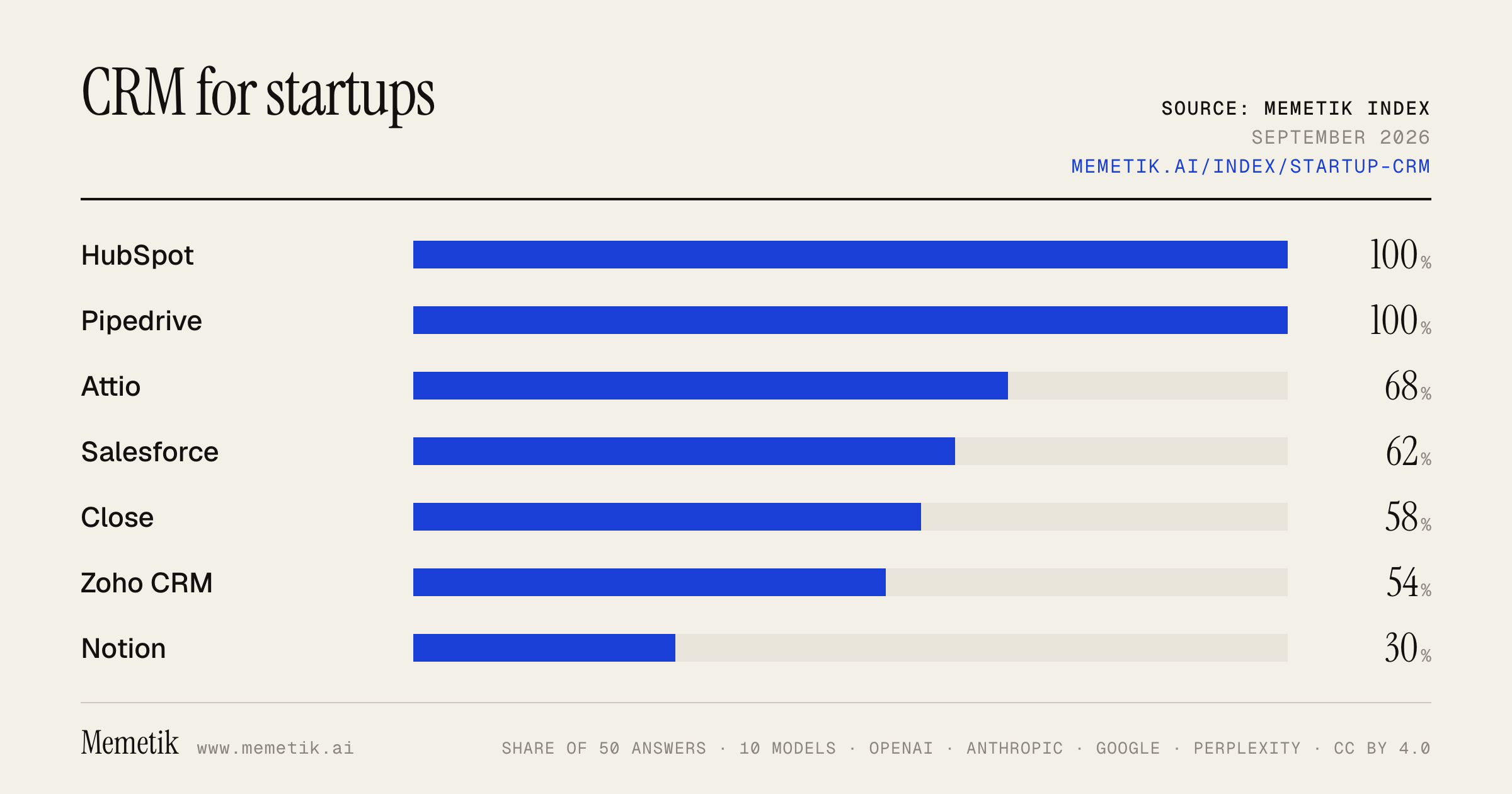
By provider
10 models · 50 answers
OpenAI 3 models · 15 answers
- GPT-5.6 Solgpt-5.6-solmost named: HubSpot 100%
- GPT-5.6 Terragpt-5.6-terramost named: HubSpot 100%
- GPT-5.6 Lunagpt-5.6-lunamost named: HubSpot 100%
Anthropic 3 models · 15 answers
- Claude Opus 5claude-opus-5most named: HubSpot 100%
- Claude Sonnet 5claude-sonnet-5most named: HubSpot 100%
- Claude Fable 5claude-fable-5most named: HubSpot 100%
Google 2 models · 10 answers
- Gemini 3.6 Flashgemini-3.6-flashmost named: HubSpot 100%
- Gemini 3.5 Flashgemini-3.5-flashmost named: HubSpot 100%
Perplexity 2 models · 10 answers
- Sonar Prosonar-promost named: HubSpot 100%
- Sonar Reasoning Prosonar-reasoning-promost named: HubSpot 100%
Sources the models cited
- youtube.com71
- attio.com39
- withallo.com38
- spotsaas.com35
- reddit.com30
- hubspot.com25
- lightfield.app23
- saasmaste.com20
- techradar.com18
- startupik.com16
- smashsend.com16
- zoflowx.com15
ChatGPT via API returns no citations, so it does not contribute here.
The prompts
- What is the best CRM for an early-stage startup? Name specific products.
- Which CRM should a 5-person B2B SaaS sales team use?
- Compare the top CRMs for startups in 2026.
- I'm a founder doing my own sales. Which CRM do you recommend?
- Best affordable CRM for a startup that will scale to 50 reps?
Every answer
Raw model output, unedited
GPT-5.6 TerraWhat is the best CRM for an early-stage startup? Name specific products.
There isn’t one universal “best,” but for most early-stage startups I’d choose **Attio** or **HubSpot**, depending on your motion.

### My picks

1. **Attio — best overall for a modern B2B startup**
   - Best when you want a flexible CRM that can evolve with your sales process, partnerships, fundraising, recruiting, and customer data—not just a standard contacts/deals pipeline.
   - Strong email/calendar sync, enrichment, customizable data model, and workflow automation.
   - Its free plan supports up to 3 seats; Plus is listed at **$35/user/month annually**, while more advanced sequencing, call intelligence, and reporting are on Pro. ([attio.com](https://attio.com/pricing?authuser=0&utm_source=openai))
   - **Choose Attio if:** you are a 2–10 person B2B SaaS startup and expect your process/data model to change frequently.

2. **HubSpot CRM / Sales Hub — best for a startup combining sales and marketing**
   - The safest low-friction option: free contact management, deal pipelines, scheduling, live chat, quotes, and reporting; you can add marketing, service, content, and automation later in the same platform. ([hubspot.com](https://www.hubspot.com/products/sales?lang=en&utm_source=openai))
   - HubSpot’s current Sales Hub pricing page lists a free tier and Starter from **$7/user/month annually** (or $20 monthly, before applicable taxes/promotions). ([hubspot.com](https://www.hubspot.com/pricing/sales?u=undefined&utm_source=openai))
   - **Choose HubSpot if:** inbound leads, content marketing, website forms, lifecycle emails, and customer support will be central to your go-to-market.
   - **Watch-out:** it can become comparatively expensive and complex as you add Hubs, contacts, seats, and advanced automation.

3. **Pipedrive — best for a simple founder-led sales pipeline**
   - A strong choice if all you need is a clear, visual pipeline and disciplined follow-up. It has less platform overhead than HubSpot or Salesforce.
   - **Choose Pipedrive if:** your immediate goal is simply to move opportunities from lead → meeting → proposal → closed-won, and you do not need marketing automation or a highly custom CRM yet.

4. **Close — best for outbound / call-heavy sales**
   - Built around calling, email, SMS, and workflows, rather than treating phone outreach as an add-on. Close currently lists a **Solo plan at $9/user** and offers native business-phone capabilities as an add-on. ([close.com](https://close.com/pricing?utm_source=openai))
   - **Choose Close if:** your startup’s early sales motion is SDR-like—high-volume outbound, demos, phone calls, and rapid follow-up.

5. **Folk — best lightweight relationship CRM**
   - Good for founder networks, partnerships, early fundraising, agencies, and small teams that need more structure than a spreadsheet but less process than a conventional sales CRM.
   - **Choose Folk if:** relationship management matters more than forecasting, sales operations, or complex automation.

### Straight answer

- **Default choice for a modern B2B startup:** **Attio**
- **Default choice if marketing + sales need one shared system:** **HubSpot**
- **Simplest pure sales-pipeline choice:** **Pipedrive**
- **Best for aggressive outbound calling:** **Close**
- **Best for founder/relationship tracking:** **Folk**

For an early-stage company, avoid Salesforce unless you already have a real sales-ops requirement, a larger sales team, or unusually complex enterprise processes. The best CRM is the one founders will update after every customer conversation—not the one with the longest enterprise feature list.
GPT-5.6 TerraWhich CRM should a 5-person B2B SaaS sales team use?
**Default choice: Pipedrive** for a 5-person B2B SaaS sales team.

It is usually the best balance of fast adoption, a clear opportunity pipeline, enough automation, and low admin overhead. At your size, the biggest CRM risk is not missing enterprise functionality—it is buying a system reps won’t keep updated.

### Choose based on your motion

| If your sales motion is… | Choose | Why |
|---|---|---|
| Founder-led or rep-led outbound, demos, relatively straightforward pipeline | **Pipedrive** | Best default: deal-centric, simple, quick to implement. |
| Heavy cold calling/emailing; reps live in a dialer and sequences | **Close** | Stronger all-in-one outbound workflow. |
| Inbound/content-led, or you expect marketing, sales, and customer success to share one customer database | **HubSpot** | Strong cross-functional system of record; good long-term platform. |
| Highly customized data model, product-led sales, or you have someone comfortable configuring systems | **Attio** | Flexible and modern, but requires more design discipline. |

### Why I would not default to HubSpot
HubSpot is excellent, but it can become expensive before a five-person team genuinely needs its advanced layer. Its current Sales Hub Professional pricing is listed at **$90 per seat/month when billed annually**, plus a **$1,500 one-time onboarding fee**—roughly **$6,900 in year one for five sales seats**, before any add-ons. Its Starter tier is much cheaper, but the advanced workflow, forecasting, and sequence capabilities are in Professional. ([hubspot.com](https://www.hubspot.com/pricing/sales?u=undefined&utm_source=openai))

So:

- **Use HubSpot now** if your website forms, marketing automation, lifecycle reporting, customer success, and sales need to operate in one shared CRM from day one.
- **Otherwise, use Pipedrive** and spend the savings on better lead data, call recording, prospecting tools, or an additional SDR.

### Recommended setup for Pipedrive
Keep version 1 deliberately boring:

1. **One new-business pipeline**
   Stages: Qualified → Discovery booked → Discovery complete → Demo → Evaluation/security → Proposal → Closed won/lost.

2. **Mandatory fields only**
   Account, primary contact, ICP segment, source, estimated annual contract value, close date, next step, next-step date, loss reason.

3. **Two non-negotiable rules**
   - Every open deal has a dated next activity.
   - Every pipeline stage has an exit criterion.

4. **Three weekly reports**
   - Pipeline by stage and rep
   - Opportunities with no next activity
   - Conversion rate and days-in-stage by stage

5. **Integrate only essentials initially**
   Email/calendar, meeting scheduler, product/demo or call-recording tool, and your lead source. Avoid building elaborate automations in the first month.

### Bottom line
- **Pick Pipedrive** unless you have a clear reason not to.
- Pick **Close** if outbound calling/sequences are central to every rep’s day.
- Pick **HubSpot** if your company is committing to an inbound-led, all-in-one go-to-market platform and can justify the higher cost as you scale.
- Do **not** start with Salesforce for a five-person SaaS sales team unless a large enterprise sales process, unusual compliance needs, or an existing Salesforce ecosystem forces it.
GPT-5.6 TerraCompare the top CRMs for startups in 2026.
## Top CRMs for startups in 2026

There is no single “best” CRM: the right choice depends mainly on whether you are **founder-led and budget-constrained**, doing **high-volume outbound**, building a **modern B2B sales motion**, or need an **all-in-one marketing + sales + support platform**.

### Shortlist comparison

| CRM | Best for | Strengths | Watch-outs | Pricing signal* |
|---|---|---|---|---|
| **HubSpot** | Startups that want sales, marketing, customer support, and website/customer data in one system | Excellent free starting point; strong ecosystem; easy handoff from marketing to sales and service; scales into more sophisticated automation and reporting | Costs and implementation complexity can jump sharply at Professional/Enterprise; avoid buying advanced hubs before the process is mature | Free plan supports up to two users; Sales Hub Starter is advertised from **$7/user/month annually** (or $20 monthly), while Professional is **$90/user/month annually** plus a **$1,500 onboarding fee**. ([hubspot.com](https://www.hubspot.com/pricing/sales?u=undefined&utm_source=openai)) |
| **Attio** | Modern B2B startups, especially flexible/relationship-led GTM teams | Highly customizable data model and workspace; a strong fit if your team wants CRM to adapt to its process rather than conform to traditional objects and fields | Less of an out-of-the-box “full customer platform” than HubSpot; assess the reporting, integrations, and permissions you will need before standardizing on it | Consider it when flexibility and a newer, AI/agent-oriented CRM approach matter more than an established all-in-one suite. ([attio.com](https://attio.com/f/best-crm-for-small-business?utm_source=openai)) |
| **Pipedrive** | Small sales teams that need reps to adopt a CRM quickly | Clean, visual, drag-and-drop pipeline; focused sales workflow; usually easier to administer than enterprise CRM suites | Marketing, service, and sophisticated automation may require integrations or add-ons; check the true cost of extras | Its current packaging includes tiered CRM plans and optional products such as a Projects add-on. ([pipedrive.com](https://www.pipedrive.com/en/pricing/professional-crm?utm_source=openai)) |
| **Close** | Outbound-heavy B2B startups—especially phone, email, and SMS sales | Sales-first workflow with calling, email, SMS, sequences/automation, reporting, and high-velocity rep workflows in one place | No permanent free tier; less suitable as the central platform for content marketing, customer service, or complex field-sales operations | Annual-billing plans listed as **$9 Solo, $35 Essentials, $99 Growth, and $139 Scale per user/month**; monthly rates are higher. ([close.com](https://close.com/blog/crms-for-startups?utm_source=openai)) |
| **Zoho CRM** | Cost-sensitive startups already using Zoho apps | Broad suite, low entry pricing, and useful value when CRM, finance, support, and operations are in the Zoho ecosystem | Product experience can feel less polished; add-ons and suite decisions can complicate the price and setup | Zoho offers a free tier, with paid CRM plans listed in the market from roughly **$14 to $52/user/month annually** before relevant add-ons. ([close.com](https://close.com/blog/crms-for-startups?utm_source=openai)) |
| **Salesforce** | Funded startups with complex requirements, a capable ops owner, or a clear enterprise-sales trajectory | Deep customization, ecosystem, governance, integrations, and long-run extensibility | Overkill for most seed-stage teams; administration, consulting, and configuration debt can outweigh the benefits early | Choose it because you have real complexity—not merely because it is the best-known CRM brand. ([close.com](https://close.com/blog/crms-for-startups?utm_source=openai)) |

\*Pricing is vendor-listed/market-listed information available as of **September 2, 2026**, generally shown per user and often contingent on annual billing, region, or promotion. Confirm your exact quote before committing.

## My practical recommendations

### 1. Best default for most startups: **HubSpot**
Choose HubSpot if you want one source of truth across lead capture, email, deals, marketing attribution, and eventually customer support. Its free entry point makes it particularly attractive before product-market fit. The main discipline is to **stay on the free/Starter tiers until advanced automation, forecasting, or governance clearly pays for itself**—Professional pricing and required onboarding can change the economics quickly. ([hubspot.com](https://www.hubspot.com/pricing/sales?u=undefined&utm_source=openai))

### 2. Best for founder-led or small-team pipeline discipline: **Pipedrive**
Pick Pipedrive when the immediate problem is simple: “We need every lead, next step, and deal stage visible—and people must actually use it.” It is often the lowest-friction choice for a 2–15-person sales team that does not need an integrated marketing platform on day one. ([close.com](https://close.com/blog/crms-for-startups?utm_source=openai))

### 3. Best for high-velocity outbound: **Close**
Choose Close when calls, personalized email, SMS, and follow-up cadence are central to customer acquisition. It is less a universal customer platform and more a purpose-built sales execution system—an advantage for lean outbound teams. ([close.com](https://close.com/blog/crms-for-startups?utm_source=openai))

### 4. Best modern/flexible choice: **Attio**
Choose Attio if conventional CRM structures feel constraining—for example, you track investors, partners, target accounts, product users, champions, or nonstandard relationship data alongside ordinary deals. It is especially worth piloting for technical B2B teams that want more control over how data and workflows are modeled. ([attio.com](https://attio.com/f/best-crm-for-small-business?utm_source=openai))

### 5. Best low-cost suite bet: **Zoho CRM**
Use Zoho if cost control is paramount and you expect to use other Zoho applications. It can offer a lot of functional breadth per dollar, but run a hands-on trial with real users: rep adoption matters more than feature count. ([close.com](https://close.com/blog/crms-for-startups?utm_source=openai))

### 6. Best only
GPT-5.6 TerraI'm a founder doing my own sales. Which CRM do you recommend?
**My default recommendation: start with HubSpot Free.**

For a founder doing their own sales, it covers the essentials without forcing a big process: contacts, deals, tasks, email tracking/templates, meeting scheduling, quotes, and a pipeline. It is free with no expiration, so you can build the habit of logging every prospect and next step before paying for automation you may not yet need. ([hubspot.com](https://www.hubspot.com/products/crm?gh_jid=6554134&utm_source=openai))

Choose a different one only if your motion clearly fits:

- **Close** — pick this if you do heavy outbound and want calling, email, SMS, and workflows tightly integrated. Its Solo plan is listed at **$9/user/month**, with calling/SMS usage charged separately. ([close.com](https://close.com/pricing?utm_source=openai))
- **Pipedrive** — pick this if you want the most focused, visual “move deals across stages” experience and do not need marketing/support in the same system. It’s deliberately pipeline-centric. ([attio.com](https://attio.com/f/best-crm-for-startups?utm_source=openai))
- **Attio** — pick this if your sales process needs a nonstandard data model—for example, selling into networks of people, funds, portfolios, partners, or multiple stakeholders per account—and you want deep customization early. ([attio.com](https://attio.com/f/best-crm-for-startups?utm_source=openai))

**What I’d do in your shoes:**
1. Create HubSpot Free.
2. Use one pipeline: `New lead → Qualified → Discovery booked → Proposal → Negotiation → Closed won/Lost`.
3. Make **“next activity date”** mandatory for every open deal.
4. Add no more than five fields initially: source, ICP fit, deal amount, close date, and reason lost.
5. Reassess after 30–50 active opportunities—not before.

Avoid enterprise CRMs and elaborate automations right now. The biggest founder-sales win is not CRM sophistication; it’s ensuring no promising conversation lacks a clear next step. HubSpot can later add paid sales automation and broader connected marketing/service tools if those become genuinely necessary. ([hubspot.com](https://www.hubspot.com/pricing/sales?u=undefined&utm_source=openai))
GPT-5.6 TerraBest affordable CRM for a startup that will scale to 50 reps?
## Best pick: **Freshsales Pro**

For a startup expecting to grow to ~50 sales reps, **Freshsales Pro** is the best affordability-to-scale choice.

- **Price:** **$39/user/month billed annually** → about **$1,950/month** for 50 reps (**$23,400/year**).
- Includes the sales-team features you will likely need before reaching 50 reps: **sales sequences, contact scoring, deal insights, custom sales activities, and territory management**. ([freshworks.com](https://www.freshworks.com/crm/pricing/?device=c&tactic_id=3389380&utm_source=openai))
- If your organization later needs strict field permissions, audit logs, custom modules, or a sandbox, you can move to **Enterprise at $59/user/month**—about **$2,950/month for 50 reps**—without changing platforms. ([freshworks.com](https://www.freshworks.com/crm/pricing/?device=c&tactic_id=3389380&utm_source=openai))

### Why I’d choose it over the common alternatives

| CRM | Sensible 50-rep tier | Approx. annual-billed cost at 50 reps | Verdict |
|---|---:|---:|---|
| **Freshsales Pro** | Pro | **$1,950/mo** | **Best value for a scaling sales team** |
| Pipedrive | Growth / Premium | $1,950 / $2,950 mo | Excellent usability; Premium is needed sooner for routing/scoring and deeper customization |
| HubSpot Sales Hub | Professional | $4,500/mo + $1,500 onboarding | Great platform, but expensive for a cost-conscious startup |

Pipedrive is a very credible runner-up: Growth is **$39/seat/month** annually and adds email sync, automations, nurturing sequences, forecasting, and scheduling; Premium is **$59/seat/month** and adds lead routing, scoring, enrichment, contracts/e-signatures, and stronger customization. ([pipedrive.com](https://www.pipedrive.com/en/pricing/professional-crm?utm_source=openai))

HubSpot is the better choice only if you already rely heavily on HubSpot for marketing/service and truly need a unified customer platform. But Sales Hub Professional is **$90 per seat per month** on annual billing—about **$4,500/month for 50 reps**—and has a required **$1,500 one-time onboarding fee**. ([hubspot.com](https://www.hubspot.com/pricing/sales?iframe=yes&utm_source=openai))

### Recommended rollout

1. Start on **Freshsales Pro** for quota-carrying reps and managers.
2. Define your pipeline stages, required fields, lead-routing rules, and activity standards **before** importing data.
3. Keep enrichment, dialer, and AI add-ons optional until rep adoption is high; add-ons are where CRM costs tend to creep up.
4. Upgrade to Freshsales Enterprise only if you hit a real governance/compliance need—not just because you reach 50 users.

**Bottom line:** Pick **Freshsales Pro** if you want capable sales automation and management at roughly half the price of HubSpot Professional. Pick **Pipedrive Premium** instead if your team prioritizes an especially simple rep experience and you value its pipeline-first workflow more than territory management.
Claude Sonnet 5What is the best CRM for an early-stage startup? Name specific products.
There's no single "best" CRM — it depends on your sales motion, team size, and budget — but a few tools consistently come out on top for early-stage startups:

## Top picks

**1. HubSpot CRM** — The most common default choice for startups.

HubSpot CRM offers a forever-free plan with up to 1 million contacts, a visual deal pipeline, email tracking, live chat, and a meeting scheduler all at $0/month with no credit card required.
 It's
the best default choice for most early-stage startups that want fast setup, strong integrations, and marketing plus sales in one system.
 The tradeoff:
costs scale quickly as you add features and users; can become expensive at growth stage.


**2. Pipedrive** — Best for founder-led sales teams.

Pipedrive was built by salespeople for salespeople — deals move through stages with a simple drag and drop, and activity reminders keep reps on track. It lacks a free plan, but the Essential tier is affordable and covers everything an early-stage team needs.
 It's especially good for
founder-led sales teams that need a simple pipeline, fast adoption, and minimal admin overhead.


**3. Attio** — Modern, flexible option.

Attio is best for modern startups that want flexible data models, collaboration, and a relationship-driven CRM workflow.


**4. Zoho CRM** — Best budget/value pick.

Zoho CRM is the best all-round pick thanks to a free tier, low-cost paid plans, and room to scale.


**5. Close** — For outbound-heavy teams.

Close works well for outbound-heavy startups that need calling, email sequences, and sales execution in one place.


**6. Folk** — Lightweight, relationship-first.

Folk is the fastest way to get a relationship-first CRM off the ground. It won't scale into a complex sales operation, but for early-stage teams juggling many relationship types at once, it's a smart starting point.


**Other notable mentions:** Freshsales and Capsule for simplicity; Monday CRM for teams that want it tied into project management; Salesflare for B2B startups doing active outbound; Copper for small teams already in Google Workspace.

## How to pick

- **Solo founder / very early:**
Solo founders should start with Streak or HubSpot free.

- **Small team (2–5 people):**
Teams of 2–5 can justify Pipedrive or Copper.

- **Growing team (5+) with defined roles:**
Teams of 5+ with defined roles should evaluate Freshsales, Monday CRM, or Zoho CRM for more robust permission and reporting features.

- **Avoid Salesforce for now** —
Salesforce is usually too heavy for true early-stage teams unless the startup has a complex enterprise sales process from day one.


**Bottom line:** If you want one safe, no-cost starting point, go with **HubSpot CRM's free tier**. If you want the fastest, simplest daily-use pipeline tool for a founder-led sales process, go with **Pipedrive**. As the guidance notes,
most early-stage startups overbuy — the right CRM should support your current stage plus one level of growth, not the hypothetical structure of a Series C company.
Claude Sonnet 5Which CRM should a 5-person B2B SaaS sales team use?
For a lean, 5-person B2B SaaS sales team, you generally want something fast to set up, cheap per seat, and focused on pipeline/activity management rather than heavy enterprise complexity. Here's how the main contenders stack up:

## Top picks

**Pipedrive** – Frequently recommended for small teams because it nails simplicity and rep adoption.
Pipedrive figured out that if sales reps don't use it, nothing else matters, offering a clean visual pipeline and activity-based model with no pretense of being everything — though it's not the best for marketing automation, so you'd pair it with something like ActiveCampaign for that.
 It's a great fit if pipeline clarity and quick adoption matter more than bells and whistles.

**HubSpot (Free/Starter CRM)** – A strong choice if you want room to grow into marketing/service tools later.
It's built for PLG and B2B SaaS teams wanting an integrated platform that scales from pre-seed to enterprise, with a generous free tier, excellent UX, and a massive integration ecosystem — though paid tiers can get expensive as you add users and advanced features, and professional onboarding costs extra.


**Pipeline CRM** – Worth a look specifically because it's sized for teams your scale.
It offers visual pipeline tracking, deal management, and account-based reporting for small and mid-size B2B sales teams of 5 to 50 reps, with native QuickBooks, Gmail, and Outlook integration, focusing on a clean visual pipeline and responsive support without feature bloat.
 It also
wins for small and mid-sized teams wanting pipeline-first simplicity with the highest G2-rated support (9.2/10), starting at $25/user/month billed annually.


**Zoho CRM** – A budget-friendly, capable alternative described as
underrated, mostly because Zoho doesn't market aggressively.
 It's often positioned as best for cost-effective small business management.

**Capsule** – If you're moving off spreadsheets and want zero complexity,
Capsule or Pipedrive offers immediate clarity with zero bloat for teams replacing messy spreadsheets without a technical admin on staff.


## What to avoid at your size
**Salesforce** and **Microsoft Dynamics 365** are usually overkill for a 5-person team.
Salesforce is complex and expensive, requiring real investment to configure — the fully loaded cost surprises finance teams, though the ROI holds with the right resources and pipeline complexity.
 That complexity is best suited to
enterprise B2B SaaS with dedicated sales operations and complex, multi-stage pipelines
 — not a lean 5-person team.

## Bottom line
For a 5-person B2B SaaS sales team, **Pipedrive** or **HubSpot's free/starter CRM** are the safest starting points — cheap, fast to deploy, and low-friction for reps. If you want something purpose-built for exactly your team size with strong support, **Pipeline CRM** is worth a trial. If budget is the biggest constraint, **Zoho CRM** is a solid value pick. Avoid Salesforce/Dynamics until you scale up and actually need RevOps-level complexity.

If you tell me a bit more — your sales motion (inbound vs. outbound), whether you need marketing automation built in, and your budget — I can narrow this down to one clear recommendation.
Claude Sonnet 5Compare the top CRMs for startups in 2026.
Based on current reviews and buyer guides, here's how the top CRMs for startups stack up in 2026:

## Quick Comparison

**HubSpot CRM** — Still the default starting point for most startups.
The free tier is genuinely useful, not a crippled demo, offering unlimited contacts, a visual pipeline, deal tracking, email logging, and a live chat widget.
 On the paid side,
HubSpot Sales Hub is a full-funnel CRM that combines contacts, deals, tasks, sequences, and reporting, fitting startups that need a single system for pipeline execution plus marketing and service expansion later.
 Pricing scales from
free for up to 2 users, to $7/seat/month for Starter (adds calling and automation), up to $90/seat/month for Professional.


**Zoho CRM** — The best value pick for budget-conscious teams.
Zoho CRM offers one of the best value-for-money propositions in the market, free for up to 3 users with Standard plans starting around $14/user/month, giving unmatched feature depth at this price point
 — though it can have
a cluttered interface and higher learning curve than competitors.
 It's also praised for
striking a balance between affordability and robust functionality, with AI-powered sales insights, workflow automation, and multi-channel communication.


**Pipedrive** — Best for outbound, pipeline-focused sales teams. It's
best for outbound sales teams that prioritize pipeline management, with pricing from $14/user/month, the most intuitive pipeline UI in this category, though it has no free plan and limited marketing/support features.
 Reviewers also note
Pipedrive is the go-to for teams that want a visual, stage-based pipeline with disciplined follow-ups.


**Salesforce** — Best for startups planning to scale into enterprise complexity.
Priced from $25/user/month with no free plan, it offers a balance between easy customization and built-in functionality and works well with other Salesforce products. As the world's most popular CRM, salespeople typically have the most experience with it, easing onboarding as you hire more reps
 — though it comes with tradeoffs since it's
fairly expensive with limited customer service contact options.
 It's generally recommended for
enterprise-style motions... toward Salesforce (customization + governance).


**Folk** — Best for small, relationship-driven teams. Recommended when
relationship-led startups lean toward folk (partnerships, social prospecting).
 More broadly,
folk works well for small agile teams who need a collaborative CRM.


**Freshsales & Capsule** — Simplicity-first budget picks.
Freshsales speeds up lead-to-deal with integrated comms, and Capsule keeps things minimal for early-stage teams that don't want heavy configuration.


**Close** — Best for outbound-heavy sales. It suits
outbound teams toward Close (built-in calling/email).


**Monday Sales CRM** — Best if sales overlaps with product/ops work, since it's
built on the Monday.com work management platform, which makes it uniquely suited for startups where sales, product, and operations overlap.


## How to Choose

The consensus across guides is to match the CRM to your specific sales motion and stage rather than picking the "best" one universally. Key deciding factors for 2026 startups:

- **Budget first**:
You shouldn't be paying enterprise prices before you have repeatable revenue — a generous free tier or a sub-$20/month plan lets you get value before you commit.

- **Setup speed**:
A CRM you spend two weeks configuring is a CRM you won't use.

- **Core features to prioritize**:
Sales pipeline management (visual stages), contact and lead tracking, email/calendar integration, and lead scoring to surface hottest prospects first.


**Bottom line**:
Pick a CRM for what your startup needs this quarter, not for a feature list you might use in two years.
 For most early-stage founders, HubSpot's free tier or Zoho's low-cost plans are the safest starting points, while Pipedrive suits pipeline-obsessed sales teams and Salesforce makes sense once you're scaling toward more complex, enterprise-style sales operations.
Claude Sonnet 5I'm a founder doing my own sales. Which CRM do you recommend?
For a founder doing your own sales, the right CRM really depends on how complex your sales process is, your budget, and how much time you want to spend on setup vs. selling. Here's my honest take:

## Top picks for solo-founder sales

**HubSpot CRM (free tier)**
- Genuinely free for the core CRM, contact management, deal pipeline, email tracking
- Very easy to set up in a day, minimal learning curve
- Good if you eventually want marketing/email tools bolted on
- Downside: free tier gets limiting fast, and paid tiers jump in price quickly

**Pipedrive**
- Built specifically around visual pipeline/deal management, which suits founder-led sales well
- Simple, fast to learn, great mobile app
- Affordable at low tiers (~$14-25/user/month depending on plan)
- Less bloat than HubSpot or Salesforce

**Close.com**
- Built for founders/small teams doing outbound sales — has built-in calling, email sequencing, SMS
- No need to bolt on separate outreach tools
- Slightly pricier but saves you from stitching together 3 tools

**Attio or Folk**
- Newer, very lightweight, great UI, good for relationship-based/network-driven selling
- Attio has strong data enrichment; Folk is popular with founders doing warm intros and investor/customer outreach
- Less "sales process" structure than Pipedrive, more flexible

**Notion or Airtable (DIY route)**
- If you have <50 active deals and just want something dead simple, a Notion/Airtable pipeline table works fine
- Zero cost, total flexibility, but no automation, email sync, or reminders unless you build it

## My actual recommendation

If you're doing **outbound-heavy sales** (cold emails, calls, sequences): go with **Close.com**.

If you're doing **relationship/inbound-driven sales** (warm intros, demos, following up with leads who came to you): go with **Pipedrive** or **HubSpot Free**.

If you're pre-PMF and just want to track 10-30 conversations without overhead: **Notion/Airtable** is genuinely enough — don't over-invest in a CRM before you have real sales volume.

A good rule of thumb: as a solo founder, optimize for *speed of logging activity* over feature completeness. The best CRM is the one you'll actually update after every call.

Want me to narrow it down based on your sales motion (outbound, inbound, high-touch enterprise, etc.) or your budget?
Claude Sonnet 5Best affordable CRM for a startup that will scale to 50 reps?
Based on current pricing and scalability comparisons, here's my take for a startup planning to grow to 50 reps:

## Top recommendation: **HubSpot**

It's ideal for any startup that wants to start free, get productive immediately, and have a clear upgrade path, and it's particularly strong for startups running both inbound and outbound motions because the marketing and sales tools share one database.
 It also has the richest ecosystem —
it connects to over 1,500 apps through its marketplace, covering tools like Slack, Stripe, and Zapier, and the breadth of its ecosystem is one of the strongest arguments for choosing it as a long-term platform.


**Pricing to plan for:**
HubSpot offers a permanent free plan with no credit card required, and paid tiers start at $15/user/month and scale to several hundred dollars per user at the Professional and Enterprise levels.
 Worth noting:
advanced features like custom reporting, workflow automation, and predictive lead scoring sit behind Professional or Enterprise pricing, which may catch fast-growing teams off guard.
 If you're a young company,
HubSpot for Startups offers up to 90% off in year one for pre-seed to Series A companies, with 50% off year 2 and 25% off year 3
 — but budget for standard pricing afterward since
accounts move to standard pricing once the discount period ends.


## Best budget-first alternative: **Zoho CRM**
If cost is the primary constraint early on, Zoho is hard to beat:
Zoho CRM is free for up to 3 users with paid plans starting around $14 per user per month on annual billing.
 It also holds up well as you scale —
scaling tech startups need strong automation, an open API, and clean reporting, and Zoho CRM and Salesforce Starter both keep up as headcount and deal volume rise.
 Many comparisons conclude
for most startups in 2026, Zoho CRM is the best all-round pick thanks to a free tier, low-cost paid plans, and room to scale.


## Best for pure pipeline simplicity: **Pipedrive**

Pipedrive is a sales-focused CRM built specifically around pipeline management, making it a strong contender for startups that need clean deal tracking without unnecessary complexity.
 Pricing runs from
Solo at $15/user/month for basic CRM with mail merge, up to Pro at $49/user/month for shared pipelines and team collaboration, and Pro+ at $69/user/month for advanced reporting, automations, integrations, and AI Co-Pilot.


## When Salesforce makes sense
Salesforce is overkill for early-stage teams but worth planning for if you're VC-backed and expect complexity: it's
best for venture-backed startups with complex sales processes that need enterprise-grade customisation and plan to scale past 50 sales reps, though it is also the most complex and expensive to implement properly, and most likely to be underutilised by a startup without a dedicated admin.


---

### My recommendation for your situation
Given you're explicitly planning to scale to **50 reps**, I'd lean toward **HubSpot or Zoho CRM** as the best combination of affordability now and scalability later — both avoid painful migrations while keeping early costs low. Pipedrive is great if your team is purely sales-execution focused and doesn't need marketing/service tools bundled in. Reserve Salesforce for when you have a dedicated RevOps/admin resource, since
pricing and complexity should be modelled across growth trajectories — 2 users, 10 users, 25 users, and 50 users
 — to avoid a costly re-platform later.

A practical path many startups take: **start on Zoho or HubSpot's free/low tier now, and re-evaluate at ~15-20 reps** to decide whether to upgrade tiers or migrate to Salesforce, based on how complex your sales process has become by then.
Gemini 3.6 FlashWhat is the best CRM for an early-stage startup? Name specific products.
Choosing the best CRM for an early-stage startup depends on your budget, sales model (B2B vs. B2C), and primary goals (e.g., pipeline management vs. marketing automation). However, a few specific products consistently stand out as top choices for early-stage companies:

---

### **1. HubSpot CRM (Best Overall & Best Free Option)**
* **Why it’s great for startups:** HubSpot offers a surprisingly robust **100% free tier** with no time limits and unlimited users. It includes basic deal tracking, contact management, email tracking, and live chat.
* **Best for:** Founders who want to get started immediately without spending money, or teams that plan to scale marketing and sales together.
* **Startup Perk:** The **HubSpot for Startups** program offers eligible early-stage startups up to 50–75% off their premium tiers.

---

### **2. Pipedrive (Best for Pure Sales Pipeline Management)**
* **Why it’s great for startups:** Built specifically by sales reps for sales reps, Pipedrive focuses on visual pipeline management. It is lightweight, intuitive, and requires almost no onboarding time.
* **Best for:** Early-stage B2B startups with a straightforward sales funnel that need reps to focus purely on closing deals.
* **Pricing:** Starts around $14–$24/user/month.

---

### **3. Attio (Best for Modern Data Model & Tech-Forward Teams)**
* **Why it’s great for startups:** Attio is a next-generation, highly customizable CRM built specifically for modern tech companies and startups. It lets you create custom data objects, syncs seamlessly with product usage data, and connects directly with your email/calendar.
* **Best for:** Product-led growth (PLG) startups or teams with non-traditional sales workflows who find standard CRMs too rigid.
* **Pricing:** Free tier available; paid plans start at ~$29/user/month.

---

### **4. Folk (Best for Relationship Management & Founders)**
* **Why it’s great for startups:** Folk feels like a cross between Notion and a traditional CRM. It uses a clean, table-based view to organize contacts, send personalized email sequences, and track outreach across email, LinkedIn, and Twitter.
* **Best for:** Pre-seed or seed-stage founders doing investor updates, recruiting, or early outbound sales.
* **Pricing:** Free tier available; paid plans start around $18/user/month.

---

### **5. Close (Best for High-Volume Outbound Sales)**
* **Why it’s great for startups:** Close is an all-in-one CRM that integrates calling, SMS, email sequences, and pipeline tracking into a single interface. It eliminates the need for third-party calling/outreach tools.
* **Best for:** Fast-moving sales teams doing heavy outbound cold calling and email sequences.
* **Pricing:** Starts around $49/month (includes built-in communication tools).

---

### **6. Zoho CRM (Best for Budget-Conscious Teams Wanting Full Features)**
* **Why it’s great for startups:** Zoho offers a comprehensive suite of features (automation, analytics, lead scoring) at a fraction of Salesforce’s price.
* **Best for:** Startups looking for deep feature sets and integrations on a tight budget.
* **Pricing:** Free tier for up to 3 users; paid plans start around $14/user/month.

---

### **Summary Recommendation**
* **Choose HubSpot** if you want a reliable free tier that grows with your marketing and sales.
* **Choose Pipedrive** if you just need an easy, visual sales pipeline.
* **Choose Attio or Folk** if you want a modern, highly flexible tool for relationship management and non-standard workflows.
* **Choose Close** if outbound emailing and calling are your primary go-to-market channels.
Gemini 3.6 FlashWhich CRM should a 5-person B2B SaaS sales team use?
For a 5-person B2B SaaS sales team, **there is no single best CRM, but rather a top choice based on your primary sales motion.**

At 5 reps, you are likely balancing speed, cost, and the need to build a predictable, repeatable process without getting bogged down in administrative clutter or massive software overhead.

Recommended options broken down by sales strategy include:

---

### 1. Close – *Best for Outbound-Heavy / High-Velocity Sales*
If your 5 reps are primarily making cold calls, running multi-touch email sequences, and doing aggressive outbound prospecting, **Close** is purpose-built for this environment.

* **Why it wins:** It includes a native built-in power dialer, call recording, SMS, and automated email sequences directly inside the platform—no need for extra tools like Outreach or Aircall.
* **Pros:** Extremely fast UI, high rep adoption, eliminates tool sprawl.
* **Cons:** Weak marketing automation features and higher entry price per seat.
* **Pricing:** ~$49–$99 / seat / month.

### 2. HubSpot (Sales Hub) – *Best for Inbound & Product-Led Growth (PLG)*
If your leads are generated via marketing (e.g., content, paid ads, free trials, product sign-ups) and passed to sales reps, **HubSpot** is the industry standard.

* **Why it wins:** Flawlessly connects marketing touchpoints, trial usage data, and sales activity into a single timeline so reps know exactly how leads have interacted with your software.
* **Pros:** Unmatched contact/account tracking, smooth onboarding, scales easily as you add Marketing and Customer Success hubs.
* **Cons:** Can get very expensive as you move to Professional tiers, and advanced reporting requires paid add-ons or upgrades.
* **Pricing:** Free starter tiers exist, but SaaS teams usually need *Sales Hub Professional* (~$90 / seat / month).

### 3. Pipedrive – *Best Value for Deal-Focused / Mid-Market Sales*
If you have a mid-market or enterprise deal motion (longer sales cycles, multiple buying committee members) and just need a clean, highly visual pipeline tool at an affordable price, **Pipedrive** is a top choice.

* **Why it wins:** It’s strictly designed around moving deals forward through clear stages without unnecessary fluff. Reps almost universally find it easy to use.
* **Pros:** Very affordable, extremely customizable pipelines, strong native integrations.
* **Cons:** Lacks a native power dialer or advanced native email sequencing out-of-the-box (requires third-party integrations).
* **Pricing:** ~$34–$49 / seat / month for mid-level tiers.

### 4. Attio – *Best Modern Choice for Custom Data & Product Usage*
If your SaaS product relies heavily on custom data models (e.g., tracking "Active Workspaces," "API Usage," or complex parent-child company relationships), **Attio** is a strong modern alternative.

* **Why it wins:** Built specifically for modern tech startups, it behaves more like a flexible database (similar to Notion or Airtable) while acting as a fully featured CRM with strong automation.

---

### ❌ What to Avoid for Now: Salesforce
Unless your 5-person team sells exclusively to Fortune 500 companies with complex multi-layered procurement rules, **avoid Salesforce**. For a small team, it typically requires expensive dedicated admins or consultants to set up, slows down rep workflows, and adds unnecessary friction.

---

### Quick Decision Framework

1. **Pure Outbound SDR/AE setup?** Go with **Close**.
2. **Inbound-driven with trial signups or heavy marketing?** Go with **HubSpot**.
3. **Budget-conscious with standard B2B deal stages?** Go with **Pipedrive**.
4. **Data-heavy SaaS product with custom metrics?** Go with **Attio**.
Gemini 3.6 FlashCompare the top CRMs for startups in 2026.
Choosing the right CRM depends heavily on your startup’s growth model (e.g., product-led growth, outbound B2B sales, or marketing-driven) and your budget.

Below is a comparative breakdown of the top CRMs for startups, categorized by their primary strengths.

---

### 1. HubSpot (Smart CRM / Sales Hub)
* **Best For:** All-in-one marketing + sales alignment, fast scaling.
* **Key Features:** Unified contact record across marketing, sales, and support; drag-and-drop landing pages/email marketing; robust pipeline tracking.
* **Startup Tier:** **HubSpot for Startups** offers up to 75%–90% off for eligible seed/funded startups.
* **Pros:** Extremely easy to adopt; best-in-class free tier; seamlessly connects marketing and sales.
* **Cons:** Costs escalate quickly as contact lists and user counts scale beyond startup tiers.

### 2. Pipedrive
* **Best For:** Sales-led B2B startups focused on pipeline management.
* **Key Features:** Visual Kanban-style sales pipelines, activity-based selling workflows, automated email tracking, AI deal-closing tips.
* **Pros:** Very clean, user-friendly interface; rapid onboarding for sales reps; cost-effective.
* **Cons:** Lacks deep built-in marketing or customer support automation without third-party integrations.

### 3. Attio or Folk (Next-Gen & PLG CRMs)
* **Best For:** Product-Led Growth (PLG) startups, technical founders, and relationship-heavy teams.
* **Key Features:** Flexible database structures (similar to Notion or Airtable), automatic contact enrichment, deep API/product usage tracking integrations.
* **Pros:** Ultra-modern design; adaptable schemas fit complex data models; great for tracking network relationships and product events.
* **Cons:** Requires more custom setup; fewer out-of-the-box legacy sales automation features.

### 4. Zoho CRM (or Zoho Bigin)
* **Best For:** Budget-conscious startups needing high customizability.
* **Key Features:** Deep customization, AI assistant (Zia), seamless connectivity with the broader Zoho ecosystem (finance, HR, support).
* **Pros:** Highly affordable; "Zoho Bigin" offers a lightweight pipeline CRM built specifically for micro-startups.
* **Cons:** Steeper learning curve; UI can feel bloated compared to streamlined alternatives.

### 5. Salesforce Starter Suite
* **Best For:** Venture-backed startups aiming for rapid enterprise scale.
* **Key Features:** Combined sales, service, and email outreach tools tailored for small teams, built on Salesforce's core platform with access to Einstein AI features.
* **Pros:** Unmatched scalability and customization; seamless transition as you grow into an enterprise.
* **Cons:** Higher baseline cost per user; requires administration effort to set up correctly.

### 6. Freshsales (by Freshworks)
* **Best For:** Early-stage startups needing built-in phone, email, and chat capabilities.
* **Key Features:** Freddy AI lead scoring, built-in cloud telephony, multi-channel customer communications.
* **Pros:** All-in-one communication channel setup straight out of the box; competitive pricing.
* **Cons:** Advanced analytics and customized reporting are gated behind higher-tier plans.

---

### Quick Selection Matrix

| Startup Type / Need | Recommended CRM | Primary Benefit |
| :--- | :--- | :--- |
| **Bootstrapped / Low Budget** | **Zoho CRM / Bigin** | High functionality at low costs. |
| **Pure Outbound B2B Sales** | **Pipedrive** | Clean visual pipelines focused on closing deals. |
| **Inbound / Marketing-Driven** | **HubSpot** | Strongest marketing-to-sales lead routing. |
| **Technical / SaaS / PLG** | **Attio** | Dynamic data modeling and API flexibility. |
| **GSuite/Google Workspace Native** | **Streak / NetHunt** | Runs directly inside Gmail inbox. |
| **Scale-up / Enterprise Ambition**| **Salesforce Starter** | Industry standard with infinite headroom. |
Gemini 3.6 FlashI'm a founder doing my own sales. Which CRM do you recommend?
As a founder doing your own sales, your CRM needs to meet three main criteria: **low friction** (minimal manual data entry), **quick setup**, and **scalability** as you hire your first sales rep.

Here are the top CRMs recommended for founder-led sales, depending on your primary go-to-market (GTM) style:

---

### 1. Attio (Best Overall for Modern B2B & Tech Startups)
* **Best for:** Early-stage SaaS, tech startups, and founders who want a modern, highly customizable tool (like Notion for CRM).
* **Why founders love it:**
  * **Automatic enrichment:** Automatically pulls in company info, social profiles, and employee counts.
  * **Flexible data structure:** Easily customize pipelines, custom objects, and workflows without code.
  * **Email & Calendar Sync:** Seamlessly tracks all communications without requiring manual entry.
* **Pricing:** Free tier available; paid plans start around $29/user/month.

### 2. Close (Best for High-Volume Outbound & Call-Heavy Sales)
* **Best for:** Founders doing heavy cold outreach, cold calling, and multi-channel prospecting.
* **Why founders love it:**
  * **Built-in Calling & SMS:** Make calls, log recordings, and send texts directly inside the CRM.
  * **Email Sequences:** Automated email cadences built right into the platform (no need for third-party tools like Apollo or Lemlist initially).
  * **Speed:** Extremely fast UI designed to maximize sales activity per hour.
* **Pricing:** Starts at around $49/user/month (includes built-in calling features).

### 3. Folk (Best for Relationship-Driven / Network-Based Selling)
* **Best for:** Founders selling high-ticket B2B, agency services, or relying on warm introductions and personal networks.
* **Why founders love it:**
  * **Chrome Extension:** Instantly import contacts from LinkedIn, Twitter/X, and Gmail with one click.
  * **Simple UI:** Extremely easy to organize contacts, send personalized mail merges, and track warm intros.
  * **Low Overhead:** Zero steep learning curve—you can be up and running in 10 minutes.
* **Pricing:** Starts at around $18/user/month.

### 4. HubSpot CRM (Best for Inbound Marketing & Long-Term Scalability)
* **Best for:** Founders with strong inbound lead generation (content, ads, sign-ups) who want a single ecosystem for marketing + sales.
* **Why founders love it:**
  * **Generous Free Tier:** Excellent core CRM functionality for free.
  * **Startup Program:** Offers massive discounts (up to 75-90% off) for eligible funded startups.
  * **Ecosystem:** Seamlessly scales as you grow into larger sales and marketing teams.
* **Downside:** Can get very expensive once you scale past the startup discount.

### 5. Pipedrive (Best for Visual Pipeline Management & Simplicity)
* **Best for:** Founders who want a simple, visual, deal-centric sales pipeline with zero fluff.
* **Why founders love it:**
  * **Intuitive Kanban Board:** Very clear visual representation of where every deal stands.
  * **Activity-Based Selling:** Keeps you focused on the *next action* needed to move a deal forward.
  * **Affordability:** Budget-friendly and straightforward.
* **Pricing:** Starts at around $14/user/month.

---

### Summary Recommendation: Which should you choose?

1. **If you are a modern B2B SaaS startup:** Go with **Attio**.
2. **If you are doing heavy outbound dialing/emailing:** Go with **Close**.
3. **If your leads come mainly from LinkedIn & personal network:** Go with **Folk**.
4. **If you qualify for startup discounts / rely on inbound marketing:** Go with **HubSpot**.

***

**Would you like to narrow this down?** Tell me a bit about:
1. What you are selling (B2B SaaS, services, physical product, etc.)
2. How you get leads (cold outbound, inbound/website, LinkedIn networking)
3. Your current tech stack (e.g., Gmail vs. Outlook, existing outbound tools)
Gemini 3.6 FlashBest affordable CRM for a startup that will scale to 50 reps?
When scaling a startup to **50 sales reps**, the total cost of ownership changes dramatically. A CRM that is cheap or free for 2–3 founders can easily become a financial bottleneck or an operational headache at 50 seats.

The primary trap to avoid is **HubSpot**. While its free tier is popular, scaling 50 reps on HubSpot Sales Hub (Professional tier) will run upwards of **$4,000–$5,000/month** plus thousands in mandatory onboarding fees.

The most cost-effective CRMs that scale smoothly to 50 reps fall into three main categories:

---

### 1. Pipedrive — *Best Overall for Pure Sales Teams*
If your sales motion is deal-focused (outbound, inside sales, demo-to-close), Pipedrive is often considered the gold standard for usability and pipeline management.
* **Why it scales to 50 reps:** Highly visual, intuitive, and reps actually use it (high adoption rate). It keeps administrative overhead low.
* **Pricing at 50 seats:**
  * *Advanced Plan* (~$29/user/month billed annually) = **~$1,450/month total**.
  * *Professional Plan* (~$49–$59/user/month) = **~$2,450–$2,950/month total**.
* **Pros:** Fast implementation, excellent custom reporting, zero hidden admin costs.
* **Cons:** Weak built-in marketing features (requires external tools like Mailchimp or ActiveCampaign for marketing automation).

---

### 2. Zoho CRM — *Best for Maximum Budget Savings & Full Ecosystem*
Zoho CRM offers the best feature-to-price ratio on the market if you need deeply customizable features, lead scoring, and built-in workflows without paying enterprise tier prices.
* **Why it scales to 50 reps:** Offers granular user permissions, team management hierarchy, and strong automation engines.
* **Pricing at 50 seats:**
  * *Standard Plan* (~$14/user/month) = **~$700/month total**.
  * *Professional Plan* (~$23/user/month) = **~$1,150/month total**.
  * *Zoho One (All-in-one suite)* = ~$37–$45/user/month for every application in their suite (finance, support, HR, CRM).
* **Pros:** Extremely affordable, scales without price cliffs, built-in AI (Zia) for lead scoring.
* **Cons:** UI is less polished than Pipedrive; setup takes longer and requires clear administrative planning.

---

### 3. Freshsales (Freshworks CRM) — *Best Value with Built-In Phone & AI*
Freshsales is designed for high-velocity inside sales teams that make lots of outbound calls, send sequence emails, and need built-in telemetry.
* **Why it scales to 50 reps:** Includes built-in phone/dialer capabilities, lead scoring, and automated sales sequences right out of the box.
* **Pricing at 50 seats:**
  * *Growth Plan* (~$9–$15/user/month) = **~$450–$750/month total**.
  * *Pro Plan* (~$39/user/month) = **~$1,950/month total**.
* **Pros:** Lowest entry barrier; eliminates the need for third-party dialer tools (saves additional seat costs).
* **Cons:** Native integrations ecosystem is smaller than Pipedrive or HubSpot.

---

### 4. Close CRM — *Best for Outbound High-Velocity Inside Sales*
If your sales model relies heavily on high-volume calling, SMS, and cold email sequences, Close is built specifically for that motion.
* **Pricing at 50 seats:**
  * *Growth Tier* (~$49–$59/user/month) = **~$2,450–$2,950/month total**.
* **Pros:** Built-in power dialer, call recording, SMS, automated email workflows, and extreme speed for sales reps.
* **Cons:** Pricier than Zoho or Freshsales; not meant for complex multi-stage account-based enterprise sales.

---

### Summary Cost Comparison at 50 Seats (Annual Billing)

| CRM Platform | Tier Needed for 50 Reps | Est. Cost / User / Mo | Est. Total Monthly Cost |
| :--- | :--- | :--- | :--- |
| **Freshsales** | Growth / Pro | $9 – $39 | **$450 – $1,950** |
| **Zoho CRM** | Standard / Professional | $14 – $23 | **$700 – $1,150** |
| **Pipedrive** | Advanced | $29 | **$1,450** |
| **Close CRM** | Growth | $49 | **$2,450** |
| **HubSpot** | Sales Hub Pro | $90 – $100+ | **$4,500 – $5,000+** |

### Recommendation
1. **Choose Pipedrive** if your primary concern is ease of adoption, strong pipeline tracking, and keeping sales reps focused without CRM bloat.
2. **Choose Zoho CRM** if cost is your top metric, or if you plan to tie sales directly into back-office tools (invoicing, support tickets, project management).
3. **Choose Freshsales or Close** if your reps live on the phone and rely heavily on multichannel sales sequences.
Sonar ProWhat is the best CRM for an early-stage startup? Name specific products.
For most early-stage startups, the best default CRM is **HubSpot CRM**. If your team is sales-led and wants the simplest pipeline workflow, **Pipedrive** is the strongest alternative; if you want a more flexible, modern data model, **Attio** is another top pick.[1][3][12]

A practical shortlist by startup style is:

- **HubSpot CRM** — best overall default for early-stage startups because it is easy to adopt, has a strong free tier, and can grow into sales + marketing workflows.[1][3][4][12][18]
- **Pipedrive** — best for founder-led or sales-heavy teams that want a clean, visual pipeline with minimal admin overhead.[1][9][12]
- **Attio** — best for startups that want flexible, relationship-driven CRM workflows and a more modern, customizable structure.[1][7][12]
- **Close** — a solid option for sales-focused teams, especially if you want calling and outbound sales features in one place.[10][14]
- **Salesforce Starter** — better when you already expect more complex sales processes and long-term enterprise-scale needs, but it is usually more than an early-stage startup needs.[3][15][17]

If you want the simplest recommendation: **start with HubSpot CRM** unless your workflow is very clearly sales-pipeline-only, in which case **Pipedrive** is usually the easier fit.[1][3][4][12]
- https://startupik.com/best-crm-for-early-stage-startups/
- https://www.reddit.com/r/CRM/comments/1ncf59q/whats_the_best_crm_for_an_early_stage/
- https://www.techradar.com/best/the-best-crm-for-startups
- https://cactusmarketing.io/questions/what-is-the-best-crm-for-early-stage-startups
- https://getcoherence.io/blog/best-crm-early-stage-startups-2026
- https://saascrmreview.com/best-crm-for-startups/
- https://crmsreviewed.com/top-crms-for-early-stage-startups/
- https://getcoherence.io/blog/best-crm-for-early-stage-startups
- https://cadence.withremote.ai/blog/best-crm-early-stage-startup
- https://startupik.com/best-crm-platforms-for-small-startups/
- https://www.upliftgtm.com/blog/best-crm-for-startups
- https://waveup.com/blog/5-best-crms-for-startups-in-2025/
- https://slack.com/blog/crm/best-crms-for-startups
- https://www.g2.com/discussions/crm-best-crm-for-a-growing-tech-startup
- https://www.salesforce.com/crm/startup-crm/
- https://www.reddit.com/r/ycombinator/comments/1ai0t0g/best_crm_at_preseed/
- https://baserow.io/blog/best-crm-tools-for-startups
- https://www.zendesk.com/sell/crm/startups/
- https://www.hubspot.com/products/crm/startups
- https://www.podium.com/article/best-crm-for-startups
Sonar ProWhich CRM should a 5-person B2B SaaS sales team use?
For a **5-person B2B SaaS sales team**, the best default choice is usually **Pipedrive** if the team is **sales-led and pipeline-focused**; choose **HubSpot** if you also need **marketing automation and a broader growth suite**.[2][4][6]

- **Pipedrive** is the strongest fit for a small team that wants a **simple, visual pipeline**, quick setup, and low overhead.[2][5][8]
- **HubSpot** is better if the team needs **CRM plus marketing tools** in one place, especially for inbound or hybrid motions.[1][5][6]
- **Close** is a better pick if the team runs **high-volume outbound sales** and needs calling/sequencing built in.[2][5]
- **Attio** is the best fit if your SaaS is **product-led** and you want CRM records tied to **product usage data**.[2][3][7]

For a 5-person team specifically, several sources point to the “simple pipeline, fast setup, low cost” category as the right starting point, which aligns most closely with **Pipedrive** or similar lightweight CRMs.[8][15] One guide specifically says that for lean, sales-led startups, **Pipedrive or Close** keeps things simple and cheap, while another recommends **HubSpot Free** as a good starting point before upgrading as needs grow.[2][3]

If you want a single recommendation without more context: **pick Pipedrive**. If you tell me your motion—**outbound vs inbound**, **product-led vs sales-led**, and whether you need **marketing automation**—I can narrow it to the best exact plan tier.
- https://aimers.io/blog/best-crm-platforms-for-b2b-saas
- https://onesuite.io/blog/crm-for-saas-companies/
- https://stackmadesimple.com/best/best-crm-small-teams
- https://grouglobal.com/blog/best-crm-for-b2b-saas
- https://allaboutinsights.com/software/best-crm-for-b2b-saas-companies
- https://www.authencio.com/blog/best-crm-for-b2b-saas-companies-the-definitive-guide
- https://hackceleration.com/labs/best/crm-saas
- https://resources.rework.com/tools/crm/best-crm-software-2026
- https://designrevision.com/blog/best-crm-for-saas
- https://www.folk.app/articles/best-crm-b2b-saas
- https://www.larksuite.com/en_us/blog/crm-for-saas
- https://blog.hubspot.com/sales/saas-crm-software
- https://clickup.com/blog/crm-saas/
- https://www.poweredbysearch.com/learn/crm-tools-b2b-saas-marketing/
- https://ultratalent.com/blog/best-crm-for-saas-startups/
- https://www.reddit.com/r/marketing/comments/1dp0g0l/best_crm_for_saas_startup_b2b/
- https://smashsend.com/blog/best-crm-for-saas-startups
- https://www.insightly.com/blog/top-crms-for-small-teams/
- https://www.reddit.com/r/SaaS/comments/1pqnoxm/what_do_people_actually_think_is_the_best_crm_for/
Sonar ProCompare the top CRMs for startups in 2026.
For most startups in 2026, **HubSpot**, **Attio**, **Pipedrive**, **Freshsales**, and **Salesforce** are the most commonly recommended CRMs, but they fit different startup stages and operating styles.[1][4][5][6][10][11]

| CRM | Best for | Strengths | Trade-offs | Typical startup fit |
|---|---|---|---|---|
| **HubSpot Sales Hub** | All-around growth teams | Free plan, easy UI, strong marketing/sales ecosystem, broad integrations | Can get expensive as you add seats/features | Early-stage to growth-stage startups that want one platform for sales + marketing + support[4][5][7][8][10][11] |
| **Attio** | Modern, data-driven startups | Flexible data model, AI-native approach, clean UX, strong for custom workflows | Less established than HubSpot/Salesforce | Seed to Series A teams that want a highly adaptable CRM[5][6][11] |
| **Pipedrive** | Pipeline-first sales teams | Very visual pipeline, simple onboarding, strong follow-up discipline | Less comprehensive for marketing/service use cases | Founder-led sales or small teams focused on deal execution[1][2][4][5][6][8] |
| **Freshsales** | Budget-conscious teams | Easy to use, good value, often noted as startup-friendly, free tier available in some rankings | Not as deep as enterprise CRMs | Startups that want a lower-cost, practical sales CRM[4][5][10] |
| **Salesforce** | Scaling startups | Deep customization, enterprise-grade scalability, strong ecosystem | More complex and heavier to administer | Startups expecting rapid scale or enterprise requirements[1][4][5][8][9] |

The rankings are broadly consistent across sources: **HubSpot** is most often the “best all-around” choice, **Attio** is emerging as the strongest modern startup CRM, and **Pipedrive** is repeatedly recommended for simple pipeline management.[2][5][6][8][10][11]

A useful way to choose is by startup stage:

- **Pre-seed / very small team:** **HubSpot Free** or **Attio** if you want flexibility and modern workflows.[4][5][6][11]
- **Founder-led sales:** **Pipedrive** for straightforward pipeline management and follow-up discipline.[1][2][4][5][6]
- **Seed to Series A:** **HubSpot** if you want the broadest all-in-one stack; **Attio** if you want a more customizable, lightweight CRM.[2][5][6][7][11]
- **Growth / scaling toward enterprise:** **Salesforce** if you need advanced customization, governance, and room to scale.[1][4][5][8][9]

The main disagreement among reviews is *which CRM deserves the top spot*. Some rate **Salesflare** or **Attio** highest for startup-specific use, while others place **HubSpot** first because of its free tier, usability, and ecosystem.[1][5][6][8] That difference usually comes down to whether the reviewer prioritizes *startup simplicity* or *long-term platform breadth*.

If you want the shortest recommendation:
- **Best overall:** **HubSpot**
- **Best modern startup CRM:** **Attio**
- **Best for simple sales pipelines:** **Pipedrive**
- **Best for scaling complexity:** **Salesforce**
- **Best budget-friendly option:** **Freshsales**
- https://blog.salesflare.com/best-crm-for-startups
- https://www.withallo.com/blog/best-crms-for-startups
- https://www.techradar.com/best/the-best-crm-for-startups
- https://www.upliftgtm.com/blog/best-crm-for-startups
- https://saascrmreview.com/best-crm-for-startups/
- https://hackceleration.com/labs/best/crm-startups
- https://www.hubspot.com/comparisons/best-crm
- https://saasmentic.com/2026/03/15/top-10-best-crm-software-for-startups-in-2026-tested-compared/
- https://startupsavant.com/service-reviews/best-crm-for-startups
- https://www.pcmag.com/picks/the-best-crm-software
- https://zapier.com/blog/best-crm-app/
- https://baserow.io/blog/best-crm-tools-for-startups
- https://www.bigcontacts.com/blog/crm-for-startups/
- https://www.forbes.com/advisor/business/software/best-crm-software/
- https://smashsend.com/blog/best-crm-for-saas-startups
- https://www.linkedin.com/pulse/7-best-crm-saas-startups-boost-growth-2026-akash-upadhyay-407ae
- https://solutionsreview.com/crm/2026/01/05/best-crm-companies-to-know-about/
Sonar ProI'm a founder doing my own sales. Which CRM do you recommend?
If you’re a founder doing your own sales, I’d recommend **HubSpot CRM** as the default starting point, because it has the strongest free tier for solo operators and covers contact management, pipelines, email integration, and meeting scheduling without cost.[3][9]

If your sales motion is more specific, the best choice changes:

- **Pipedrive** if you sell through a clear pipeline and want the cleanest deal-management workflow.[2][3][5]
- **Folk** if your sales are relationship-heavy and you want a contact-first interface.[2][3][5]
- **Bigin by Zoho** if you want a simple, low-cost CRM and care most about keeping things lightweight.[4][19]
- **Less Annoying CRM** if you want maximum simplicity and strong support.[2]
- **Close** if you do a lot of outbound calling and email follow-up.[3]

A practical rule from the sources is:
- **Pre-revenue or very early:** start with **HubSpot Free**.[2][3][5]
- **If you already have a repeatable sales pipeline:** choose **Pipedrive**.[2][3][5]
- **If relationships matter more than stages:** choose **Folk**.[2][3][5]

If you want one single recommendation without more context: **HubSpot CRM** is the safest pick for most solo founders.[3][9]
- https://delveant.com/blog/best-crm-for-one-person-business/
- https://goal-group.com/articles/lead-generation/7-best-crms-for-solopreneurs-in-2026-ranked/
- https://monolit.sh/blog/best-crm-tools-solo-founders-compared-2026
- https://hustpilot.com/9-best-crms-for-solopreneurs-in-2026/
- https://www.fastlancer.org/en/fastlancer-blog/best-crm-solopreneurs/
- https://getcoherence.io/blog/solo-founder-crm-comparison-guide-2026
- https://www.reddit.com/r/smallbusiness/comments/1ienywn/best_crm_for_a_solopreneur_thats_actually/
- https://fluidcrm.io/blog/crm-for-solo-founders/
- https://serviceagent.ai/blogs/best-crm-for-one-man-business/
- https://www.bigcontacts.com/blog/best-crm-for-solopreneur/
- https://waveup.com/blog/6-best-crm-for-solopreneurs/
- https://www.breakcold.com/blog/crm-for-solopreneurs
- https://www.zoye.io/blog/best-crm-for-one-person-business
- https://www.reddit.com/r/CRMSoftware/comments/1ugrxdy/best_crm_for_startups_and_solo_business_owners/
- https://wperp.com/168546/crm-for-solopreneurs/
- https://www.reddit.com/r/CRM/comments/1opy6ok/whats_the_best_crm_for_single_entrepreneurs/
- https://www.flowlu.com/blog/crm/what-is-the-best-crm-for-solopreneurs/
- https://medium.com/@nikolaosdemetriou/best-crm-for-solopreneurs-in-2025-9d7bd32dc9cc
- https://www.bigin.com/crm-for-solopreneurs.html
- https://www.onepagecrm.com/crm-solution/personal-crm/
Sonar ProBest affordable CRM for a startup that will scale to 50 reps?
For a startup that wants to stay **affordable now** but still scale to **50 reps**, the safest default choice is **HubSpot CRM** because it has a strong free tier, is repeatedly recommended as the best overall startup CRM, and is described as scaling from very small teams to 50–500+ reps.[1][2][3][6][15][18]

If your team is **sales-led and budget-sensitive**, **Pipedrive** is often the best practical alternative because it is positioned as a low-cost sales CRM that handles growing teams well, including 100+ reps.[1][2]
If you need the **lowest-cost “real CRM” with a free tier**, **Zoho CRM** is also a strong option, but some sources note that its interface can feel more complex as teams grow.[2][9][14][20]

A simple recommendation by scenario:

| Scenario | Best pick | Why |
|---|---|---|
| Best overall balance of cost + scalability | **HubSpot CRM** | Free to start, broad feature set, and good scaling path.[1][3][6][15][18] |
| Sales-focused startup watching spend | **Pipedrive** | Low-cost, simple pipeline management, good for growing sales teams.[1][2] |
| Absolute cheapest functional CRM | **Zoho CRM** | Free/low-cost entry and enough room to grow, but can be more complex.[2][9][14][20] |
| Need heavy outbound calling/sequences | **Close** | Better for outbound-heavy teams, though not the cheapest path.[6] |

If you expect to reach **50 reps** and want to avoid a painful migration later, **HubSpot** is the best default unless your process is strongly sales-outbound, in which case **Close** or **Pipedrive** may fit better.[5][6][8][15]

If you want, I can also give you a **shortlist by budget per user/month** or compare **HubSpot vs Pipedrive vs Zoho** for your exact sales motion.
- https://optif.ai/media/articles/best-crm-small-teams/
- https://optif.ai/media/articles/best-crm-small-teams-2025
- https://vibegrowthstack.io/blog/best-crm-for-startups
- https://www.bigcontacts.com/blog/crm-for-startups/
- https://designrevision.com/blog/best-crm-for-saas
- https://bestcrmreviews.com/best-crm-for-startups
- https://saascrmreview.com/best-crm-for-startups/
- https://www.sybill.ai/blogs/best-crm-software-for-small-business
- https://www.uschamber.com/co/start/strategy/low-cost-crm-tools
- https://www.reddit.com/r/CRMSoftware/comments/1uyrghz/best_inexpensive_crm_for_small_business/
- https://zapier.com/blog/best-crms-for-small-business/
- https://www.reddit.com/r/CRM/comments/1tvlwhb/best_startup_crm_for_2050_person_teams_were/
- https://www.onepagecrm.com/blog/best-affordable-crms/
- https://crm.org/crmland/best-crm-for-startups
- https://www.techradar.com/best/the-best-crm-for-startups
- https://www.forbes.com/advisor/business/software/best-crm-small-business/
- https://monday.com/blog/crm-and-sales/affordable-crm-options-for-small-businesses/
- https://bestcrmforstartups.com/crm-software
- https://www.quickbase.com/blog/best-crm-for-startups-small-business
- https://www.salesforce.com/crm/free-crm/best-free-crms/
GPT-5.6 SolWhat is the best CRM for an early-stage startup? Name specific products.
## Best overall: **HubSpot CRM**

For most early-stage startups, I’d choose **HubSpot**. Its free tier supports two users and includes contact management, deal tracking, meeting scheduling, and live chat. It can later expand into marketing, customer service, billing, and more. Eligible startups may also receive substantial first-year discounts. ([hubspot.com](https://www.hubspot.com/products/crm/startups?utm_source=openai))

The main drawback is that advanced automation, reporting, and sales sequences can become expensive as your team grows.

## Strong alternatives

| Product | Best for | Why choose it | Main drawback |
|---|---|---|---|
| **Attio** | Product-led or technically sophisticated startups | Modern interface, flexible data model, good for designing a CRM around your unique workflow | Requires more setup decisions than a conventional CRM |
| **Pipedrive** | Small teams wanting straightforward pipeline management | Excellent visual pipeline, quick implementation, little administrative overhead | Marketing and customer-service capabilities are less comprehensive than HubSpot’s |
| **Close** | Outbound-heavy B2B sales | Calling, email, SMS, sequences, and pipeline management in one sales-focused system | No permanent free plan; less suitable for integrated marketing or customer support. Its entry-level Solo plan is listed at $9 per month when billed annually. ([close.com](https://close.com/blog/crms-for-startups?utm_source=openai)) |
| **folk** | Founder-led sales, partnerships, investors, and community relationships | Lightweight relationship management with contact enrichment and LinkedIn-oriented workflows | Less powerful for formal forecasting and larger sales organizations |
| **Zoho CRM** | Budget-conscious teams requiring customization | Broad feature set, automation, customization, and a free-plan option | Interface and setup can feel more complex than Pipedrive or Attio |
| **Copper** | Companies operating almost entirely in Google Workspace | Tight Gmail and Google Workspace workflow | Less compelling outside the Google ecosystem |

Pipedrive, folk, Zoho, and Copper are all positioned as relatively affordable startup options, although exact pricing and packaging can change. ([blog.hubspot.com](https://blog.hubspot.com/sales/startup-crm?utm_source=openai))

## My decision rule

- **Unsure what you need:** HubSpot
- **Want the cleanest, most flexible modern CRM:** Attio
- **Want a simple visual sales pipeline:** Pipedrive
- **Doing lots of outbound calls and emails:** Close
- **Tracking warm relationships rather than conventional deals:** folk
- **Need maximum functionality on a tight budget:** Zoho CRM

I would generally **avoid Salesforce at the earliest stage** unless you already have complex enterprise sales processes, dedicated operations staff, or customers requiring Salesforce-specific integrations. Otherwise, its implementation and administration burden usually outweigh its benefits.

**Bottom line:** Start with **HubSpot Free** if you want the safest general-purpose choice. Pick **Attio** instead if flexibility and product design matter more than having marketing and support tools built in.
GPT-5.6 SolWhich CRM should a 5-person B2B SaaS sales team use?
## Best default: **Pipedrive Growth**

For a typical five-person B2B SaaS sales team, I’d choose **Pipedrive Growth**. It provides:

- Straightforward deal and pipeline management
- Full email synchronization and tracking
- Follow-up automations and nurturing sequences
- Meeting scheduling and forecasting
- Fast implementation without needing a CRM administrator

The current listed annual price is **$39 per user/month**, or approximately **$195/month for five users**. ([pipedrive.com](https://www.pipedrive.com/en/pricing/professional-crm?utm_source=openai))

### Choose something else when:

- **HubSpot Sales Hub:** Best if marketing, sales, and customer service need one platform. Starter is inexpensive, but meaningful sales automation and forecasting can require Professional, currently listed from **$90 per seat/month plus onboarding**. ([hubspot.com](https://www.hubspot.com/pricing/sales?list_view=true&utm_source=openai))
- **Close:** Best for outbound-heavy teams making lots of calls, emails, and texts. Essentials is listed at **$35 per user/month annually**, with communications built directly into the CRM. Calling and SMS usage cost extra. ([close.com](https://close.com/pricing?eco_budget=none&utm_source=openai))
- **Attio:** Best for technical teams wanting a modern, highly customizable data model and interface. Plus supports up to ten seats and is listed at **$35 per user/month annually**. ([attio.com](https://attio.com/pricing?authuser=0&utm_source=openai))

### Simple decision rule

| Your sales motion | Recommended CRM |
|---|---|
| Conventional demo-driven B2B SaaS | **Pipedrive Growth** |
| Strong inbound/content marketing | **HubSpot** |
| High-volume outbound calling/email | **Close** |
| Product-led or highly customized workflow | **Attio** |

Avoid Salesforce at this size unless enterprise customers, compliance requirements, or an experienced RevOps person make its complexity necessary. Start with a trial and test one real workflow: lead creation → qualification → demo → follow-up → closed-won.
GPT-5.6 SolCompare the top CRMs for startups in 2026.
## Best CRMs for startups in 2026

**Quick verdict**

- **Best overall for most startups:** HubSpot
- **Best modern, customizable CRM:** Attio
- **Best for a focused sales team:** Pipedrive
- **Best value:** Zoho CRM
- **Best for eventual enterprise complexity:** Salesforce
- **Best for outbound-heavy selling:** Close

Pricing below is approximate US list pricing as of **September 2, 2026**, generally assuming annual billing. Vendors frequently change packaging, seat rules, usage limits, and AI add-ons.

| CRM | Approx. entry price | Best for | Main strengths | Main drawback |
|---|---:|---|---|---|
| **HubSpot** | Free; paid around **$20/user/month** | Startups combining sales, marketing and support | Excellent free CRM, broad ecosystem, strong marketing and service products | Costs can rise sharply when you need automation, reporting and multiple hubs |
| **Attio** | Free for up to 3 seats; paid plans available | SaaS, venture-backed and product-led startups | Modern interface, flexible data model, custom objects, automatic relationship data | Smaller integration and consulting ecosystem |
| **Pipedrive** | Around **$14/user/month** | Small, sales-led teams | Very easy visual pipeline, quick setup, strong activity and deal management | Less complete for marketing, service and highly customized operations |
| **Zoho CRM** | Free for up to 3 users; paid from roughly **$14/user/month** | Bootstrapped and cost-conscious startups | Excellent price-to-feature ratio, automation, customization, broad Zoho suite | Interface and configuration can feel less polished |
| **Salesforce Starter** | Around **$25/user/month** | Startups expecting enterprise-scale requirements | Deep customization, massive ecosystem, mature reporting and governance | Administration and total cost increase considerably beyond Starter |
| **Close** | Typically higher than basic pipeline CRMs | Outbound sales teams | Calling, email, SMS, sequences and pipeline management in one sales workspace | Less suitable as an all-company marketing or customer-success platform |

These products consistently appear among the leading startup CRM choices in current 2026 comparisons. ([choosemystack.com](https://choosemystack.com/guides/best-crm-for-startups?utm_source=openai))

### 1. HubSpot: best all-around platform

Choose **HubSpot** if you expect your CRM to become the center of sales, inbound marketing, customer service and website lead generation.

**Advantages**
- Useful free edition for contacts, deals, email tracking and basic customer communication.
- Easy for nontechnical teams to adopt.
- Large integration and implementation ecosystem.
- Natural expansion path into marketing, service, content and operations tools.

**Watch out for**
- Advanced sequences, workflows, permissions and reporting can require materially more expensive tiers.
- Marketing-contact charges and combining several “Hubs” can make the effective cost much higher than the initial seat price.

HubSpot is strongest when consolidating multiple go-to-market functions matters more than achieving the lowest possible long-term price. Its free entry point remains a major advantage, but 2026 assessments continue to flag pricing complexity as teams grow. ([ir.hubspot.com](https://ir.hubspot.com/static-files/d326b283-bbe4-4556-83fe-6b33ad329a73?utm_source=openai))

### 2. Attio: best for flexible startup workflows

Choose **Attio** if you want a CRM that resembles a modern collaborative database rather than a traditional enterprise sales system.

**Advantages**
- Flexible objects, attributes, lists and workflows.
- Particularly suitable for SaaS, partnerships, fundraising and other relationship models that do not fit a standard lead-to-deal pipeline.
- Automatic email and calendar relationship data.
- Clean interface and comparatively low administrative burden.

**Watch out for**
- Younger ecosystem than HubSpot or Salesforce.
- Some mature enterprise capabilities and specialist integrations may be less extensive.
- Flexibility means you still need to design your data model carefully.

Attio is increasingly positioned as a strong choice for scaling startups with nonstandard processes, especially when traditional CRM structures feel restrictive. ([techradar.com](https://www.techradar.com/pro/software-services/attio-crm-review?utm_source=openai))

### 3. Pipedrive: best pure sales CRM

Choose **Pipedrive** when your immediate requirement is straightforward: keep representatives organized and move opportunities through a pipeline.

**Advantages**
- Probably the easiest option here to learn.
- Excellent pipeline visualization and activity tracking.
- Faster implementation than heavily customizable platforms.
- Sensible fit for founder-led sales and small account-executive teams.

**Watch out for**
- Marketing, lead generation and customer support may require add-ons or separate products.
- Costs rise when you add automation, advanced reporting and prospecting functionality.
- Less appropriate for complex custom data relationships.

Pipedrive remains particularly attractive when usability and sales-team adoption are more important than building an all-in-one customer platform. ([techradar.com](https://www.techradar.com/reviews/pipedrive-crm-review?utm_source=openai))

### 4. Zoho CRM: best value

Choose **Zoho CRM** if you need substantial functionality at a relatively low per-user price.

**Advantages**
- Competitive entry pricing.
- Broad workflow automation and customization.
- Access to the larger Zoho business-software ecosystem.
- Good option for startups that may also need support, finance, projects or marketing applications.

**Watch out for**
- Setup and navigation can be less intuitive than Pipedrive or Attio.
- The large number of Zoho products and editions can make purchasing confusing.
- Teams may need more configuration discipline to provide a clean user experience.

Zoho’s paid CRM tiers begin at approximately $14 per user monthly, and its breadth makes it one of the strongest cost-conscious alternatives to HubSpot and Salesforce. ([choosemystack.com](https://choosemystack.com/guides/best-crm-for-startups?utm_source=openai))

### 5. Salesforce: best for enterprise readiness

Choose **Salesforce** when you already know that complex territories, permissions, integrations, objects and governance are coming.

**Advantages**
- Exceptional customization and extensibility.
- Large marketplace and talent ecosystem.
- Strong fit for sophisticated revenue operations.
- Easier to support unusual enterprise requirements over the long term.

**Watch out for**
- Starter pricing does not represent the eventual cost of a sophisticated Salesforce deployment.
- Usually requires more administration, implementation work and user training.
- Often excessive for a five-person team validating its sales process.

Salesforce Starter can be reasonably priced, but the platform’s real advantage—and expense—appears at higher levels of organizational complexity. ([choosemystack.com](https://choosemystack.com/guides/best-crm-for-startups?utm_source=openai))

### 6. Close: best for outbound teams

Choose **Close** if representatives spend most of their day prospecting through email, telephone and SMS.

**Advantages**
- Communication tools are built directly into the selling workflow.
- Strong sequences and representative-productivity features.
- Less tool switching for outbound teams.
- Generally faster to deploy than an enterprise CRM plus a separate sales-engagement platform.

**Watch out for**
- Not as broad as HubSpot for inbound marketing and customer service.
- Can be more expensive than basic pipeline tools.
- Its advantages are less compelling if your business is primarily self-serve or inbound.

## Recommendations by startup stage

### Pre-seed or founder-led sales
Pick **HubSpot Free**, **Attio Free** or **Zoho Free**. Avoid designing an
- https://choosemystack.com/guides/best-crm-for-startups?utm_source=openai
- https://ir.hubspot.com/static-files/d326b283-bbe4-4556-83fe-6b33ad329a73?utm_source=openai
- https://www.techradar.com/pro/software-services/attio-crm-review?utm_source=openai
- https://www.techradar.com/reviews/pipedrive-crm-review?utm_source=openai
GPT-5.6 SolI'm a founder doing my own sales. Which CRM do you recommend?
## My default recommendation: **HubSpot Free**

For a founder doing their own sales, it offers the best balance of:

- Quick setup
- Contact and deal tracking
- Email logging
- Meeting scheduling
- A usable mobile app
- Plenty of integrations
- Room to grow without migrating immediately

The free plan currently supports up to two users. Upgrade to Starter only when you need automation, more customization, or branding removed; current promotional pricing starts around $7 per seat monthly when billed annually. ([hubspot.com](https://www.hubspot.com/pricing/sales?u=undefined&utm_source=openai))

### Choose something else if:

- **Attio:** You want a modern, flexible CRM and enjoy designing your own workflows.
- **Close:** Most of your selling involves heavy outbound email and calling.
- **folk:** Your sales are relationship-driven—investors, partnerships, agencies, consulting, or warm introductions.
- **Pipedrive:** You primarily want a simple, visual pipeline with minimal complexity.

### My practical advice

Start with **HubSpot Free**, create one pipeline, and use only these fields:

1. Company/contact
2. Deal value
3. Pipeline stage
4. Next action
5. Next-action date
6. Source
7. Loss reason

Use no more than six stages:

**Lead → Contacted → Discovery → Proposal/Trial → Verbal Commit → Won/Lost**

The best founder CRM is not the most sophisticated one—it’s the one that makes it impossible to forget the next follow-up. Avoid spending days customizing it before you have a repeatable sales process.
GPT-5.6 SolBest affordable CRM for a startup that will scale to 50 reps?
## Best overall: **Zoho CRM Professional**

For a startup expecting to reach **50 sales reps**, Zoho offers the best balance of affordability, customization, and room to scale.

- **Professional:** $23/user/month billed annually
- **At 50 reps:** approximately **$1,150/month or $13,800/year**
- **Enterprise:** $40/user/month, or **$24,000/year for 50 reps**, if you later need stronger automation, permissions, and administration. ([zoho.com](https://www.zoho.com/crm/zohocrm-pricing-calculator.html?utm_source=openai))

### Alternatives

| CRM | Suitable tier | Cost at 50 reps* | Best for |
|---|---:|---:|---|
| **Zoho CRM** | Professional, $23/user | **$1,150/mo** | Best price-to-capability ratio |
| **Pipedrive** | Growth, $39/user | **$1,950/mo** | Easiest rep adoption and pipeline UX |
| **Freshsales** | Pro, $39/user | **$1,950/mo** | Built-in email, phone, sequences and scoring |
| **HubSpot** | Professional, $90/user | **$4,500/mo** plus $1,500 onboarding | Marketing-led companies wanting one unified platform |

\*Annual billing, before taxes and optional add-ons.

Pipedrive Growth includes email synchronization, tracking, automations, sequences, forecasting, and meeting scheduling; its Premium tier rises to $59/user/month. ([pipedrive.com](https://www.pipedrive.com/en/pricing?utm_source=openai)) Freshsales Pro adds scoring, deal insights, territory management and sales sequences. ([freshworks.com](https://www.freshworks.com/crm/pricing/?device=c&tactic_id=3389380&utm_source=openai)) HubSpot is attractive early, with Starter currently listed from $7/user/month, but the major jump to Professional makes it considerably more expensive once advanced sales automation is required. ([hubspot.com](https://www.hubspot.com/pricing/sales?list_view=true&utm_source=openai))

### My decision rule

- **Choose Zoho CRM Professional** if budget and long-term flexibility matter most.
- **Choose Pipedrive Growth** if getting reps to consistently use the CRM is your biggest concern.
- **Choose Freshsales Pro** if calling, email outreach and sequences should be native.
- **Choose HubSpot** only if CRM, marketing automation, service and content need to share one platform—and you can tolerate the later price jump.

**Bottom line:** I’d start with **Zoho CRM Professional**, configure it carefully before hiring rapidly, and consider Enterprise once territories, complex permissions or advanced governance become necessary. Before signing, run a pilot with 5–8 reps using your actual lead-routing, reporting and email workflows.
GPT-5.6 LunaWhat is the best CRM for an early-stage startup? Name specific products.
For most early-stage startups, **HubSpot CRM** is the safest default. It has a genuinely useful free tier, is easy to adopt, and can expand into marketing, sales, and customer support as the company grows. The downside is that paid HubSpot can become expensive and complex once you need advanced automation. ([attio.com](https://attio.com/f/best-crm-for-startups?utm_source=openai))

## Specific recommendations

| Product | Best for | Why choose it | Main drawback |
|---|---|---|---|
| **HubSpot CRM** | Most startups, especially inbound-led | Strong free plan, email tracking, forms, marketing integrations, broad ecosystem | Paid features can become expensive; the system may feel oversized later |
| **Attio** | SaaS startups, technical teams, or unusual sales processes | Flexible data model, modern interface, strong relationship and company views; adapts better when your workflow changes | Less mature all-in-one marketing/support ecosystem than HubSpot |
| **Pipedrive** | Founder-led sales and straightforward B2B pipelines | Excellent visual pipeline, quick setup, minimal administration | Primarily sales-focused; costs rise as you add automation and other capabilities |
| **Close** | Outbound sales teams | Native calling, SMS, email sequences, call workflows, and sales activity tracking | Overkill if you are not doing significant outbound calling |
| **folk** | Very small, relationship-driven teams | Lightweight, good for networking, partnerships, investors, and warm introductions | Not ideal for a highly structured, multi-rep sales organization |
| **Zoho CRM** | Bootstrapped startups prioritizing price and breadth | Broad feature set and generally cost-conscious positioning | Interface and setup can require more configuration |
| **Salesforce** | Startups already targeting enterprise complexity | Deep customization, ecosystem, reporting, and enterprise credibility | Usually too much administration and cost for an early team |

## My practical shortlist

### Choose **HubSpot** if:
- You have inbound leads, content, demos, or a marketing funnel.
- You want to start free.
- You expect marketing and support to live in the same platform.
- You want the lowest-risk default.

### Choose **Attio** if:
- You are building a SaaS or product-led company.
- Your sales process is still changing.
- You care about a flexible, modern data model.
- You want something less heavyweight than HubSpot or Salesforce.

Attio is particularly compelling for startups whose customer, account, product, investor, or partnership data does not fit neatly into a traditional contact–company–deal structure. Current startup-focused comparisons commonly position it as the best option for flexible or changing data models. ([attio.com](https://attio.com/f/best-crm-for-startups?utm_source=openai))

### Choose **Pipedrive** if:
- You simply need to see every opportunity and its next step.
- Your team sells through a conventional pipeline.
- You want to be operational in one afternoon rather than configure a platform for weeks.

Pipedrive is commonly recommended for founder-led outbound and teams that want a focused, visual sales pipeline without a broader marketing suite. ([attio.com](https://attio.com/f/best-crm-for-startups?utm_source=openai))

### Choose **Close** if:
- Your sales motion involves high-volume cold calls or outbound sequences.
- Reps need calling, SMS, email, and activity logging in one place.
- You want a sales engagement tool that also functions as the CRM.

## Bottom line

My default ranking for an early-stage startup would be:

1. **HubSpot CRM** — best general-purpose starting point
2. **Attio** — best modern/flexible choice
3. **Pipedrive** — best simple sales pipeline
4. **Close** — best outbound-sales CRM
5. **folk** — best relationship-focused lightweight CRM
6. **Zoho CRM** — best budget-oriented broader suite
7. **Salesforce** — only if enterprise requirements already justify it

If I were choosing for a typical **2–10 person startup today**, I would test **HubSpot, Attio, and Pipedrive** with the same sample leads and ask: *Which one can the team keep updated every day without a CRM administrator?* Adoption matters more than feature count.
GPT-5.6 LunaWhich CRM should a 5-person B2B SaaS sales team use?
## Recommendation: **Pipedrive Growth**

For a typical **5-person B2B SaaS sales team**, I’d choose **Pipedrive Growth** unless your main acquisition engine is inbound marketing or high-volume outbound calling.

### Why Pipedrive Growth fits

- Clear, visual deal pipeline
- Email synchronization and tracking
- Automated follow-up sequences
- Meeting scheduling
- Forecasting and subscription/installment tracking
- Enough automation for a small team without enterprise-level complexity
- Public pricing of **$39/user/month when billed annually**, or about **$195/month for five users**. ([pipedrive.com](https://www.pipedrive.com/en/pricing?utm_source=openai))

It is generally the best balance of **adoption, sales functionality, simplicity, and cost** for a small sales team.

## Shortlist by sales motion

| Your situation | Best choice | Why |
|---|---|---|
| General B2B sales team | **Pipedrive Growth** | Best overall sales CRM for a small team |
| Strong inbound, content, trials, or marketing automation | **HubSpot Sales Hub Starter** | CRM, marketing, forms, website tracking, and service can live together |
| High-volume outbound with lots of calls/SMS | **Close Essentials** | Calling, email, SMS, and CRM are integrated; $35/user/month annually |
| Need a highly flexible, modern data model | **Attio Plus** | Flexible CRM structure and enrichment; $35/user/month annually |
| Very low budget / just getting started | **HubSpot Free** or **Pipedrive Lite** | Good for basic contact and pipeline management |

HubSpot is attractive if you want a broader go-to-market platform, but its more advanced sales automation starts at roughly **$90–$100 per seat/month**, with required onboarding for Professional, making it potentially expensive for a five-person team. ([hubspot.com](https://www.hubspot.com/pricing/sales?iframe=yes&utm_source=openai)) Close is compelling for sales teams that need an all-in-one communications system; its Essentials plan is listed at **$35/user/month annually**. ([close.com](https://close.com/pricing?eco_budget=none&utm_source=openai)) Attio offers a flexible alternative, with Plus at **$35/user/month annually** and Pro at **$79/user/month annually**. ([attio.com](https://attio.com/pricing?authuser=0&utm_source=openai))

### My practical setup

Start with **Pipedrive Growth**, and configure:

1. One pipeline with 5–7 stages
2. Required fields for deal size, close date, lead source, next step, and loss reason
3. Automatic tasks after every stage change
4. Email/calendar sync
5. Weekly pipeline and forecast review
6. One dashboard showing conversion rate, pipeline value, sales velocity, and rep activity

**Exception:** If you already depend heavily on HubSpot marketing forms, email campaigns, website analytics, or lead scoring, use **HubSpot** instead to avoid splitting your customer data across systems.
GPT-5.6 LunaCompare the top CRMs for startups in 2026.
## Best CRMs for startups in 2026

There is no single best startup CRM. The right choice depends mainly on whether you prioritize **free software, inbound marketing, outbound sales, flexibility, or long-term scalability**.

| CRM | Best for | Startup strengths | Main drawbacks | Indicative pricing |
|---|---|---|---|---|
| **HubSpot** | Most early-stage startups | Excellent free CRM, marketing forms/email, sales pipeline, support tools, broad integrations | Costs can rise quickly as you add automation, marketing contacts, and paid hubs | Free CRM; eligible startups may receive **30–90% off** net-new Professional or Enterprise products, usually with an annual commitment. ([hubspot.com](https://www.hubspot.com/startups?utm_source=openai)) |
| **Attio** | Modern, flexible, data-driven startups | Highly adaptable data model, relationship intelligence, enrichment, clean interface, startup-friendly free tier | Less mature ecosystem than HubSpot or Salesforce; advanced capabilities become expensive | Free for up to 3 seats; Plus is listed at **$35/user/month annually** and Pro at **$79/user/month annually**. ([attio.com](https://attio.com/pricing?authuser=0&utm_source=openai)) |
| **Pipedrive** | Founder-led or small outbound sales teams | Very easy to learn, excellent visual pipeline, strong activity and deal management | Primarily sales-focused; marketing, support, and complex data modeling are weaker | Generally affordable entry-level plans; verify current quote and feature limits before purchasing. |
| **Zoho CRM** | Budget-conscious startups needing broad functionality | Low cost, substantial customization, automation, reporting, and access to a broad business-app ecosystem | Interface and setup can feel less polished; administration may require more effort | Often among the lowest-cost full CRMs, but pricing and feature availability vary by edition and region. |
| **Salesforce Starter Suite** | Startups expecting complex processes or enterprise customers | Strong customization, lead routing, sales/service/marketing capabilities, large integration ecosystem | More implementation overhead; can become costly and administratively heavy | **$25/user/month**, billed monthly or annually, according to Salesforce’s current pricing page. Pro Suite is listed at **$100/user/month billed annually**. ([salesforce.com](https://www.salesforce.com/sales/pricing/?bc=OTH&d=cta-body-promo-8&utm_source=openai)) |
| **Close** | High-velocity outbound sales | Built-in calling, email, SMS, sequences, and sales activity tracking | Less suitable as a broad marketing, service, or customer-data platform | Usually best evaluated against the cost of separate dialer and sequencing tools. |

## Quick recommendations

### Choose **HubSpot** if you want the safest default

HubSpot is usually the strongest choice for a startup that expects to combine:

- Website lead capture
- Email marketing
- Sales pipelines
- Customer support
- Reporting
- Product and marketing integrations

Its free CRM makes it easy to start, and the startup program can substantially reduce the initial cost for eligible companies. The main risk is the **post-discount and multi-hub cost**. Model your expected cost after the discount expires—HubSpot says the initial discount period is typically two years. ([hubspot.com](https://www.hubspot.com/startups?utm_source=openai))

**Best fit:** B2B SaaS, inbound-led companies, startups with marketing and sales working together.

---

### Choose **Attio** if your business model or data structure is still evolving

Attio is particularly attractive when a conventional “contacts → companies → deals” structure is too restrictive. Its flexible objects and relationship-oriented design can suit startups managing:

- Investors and fundraising relationships
- Partnerships
- Communities
- Marketplaces
- Multi-sided networks
- Complex account hierarchies

The free plan supports up to three seats, while paid plans add private lists, enhanced email capabilities, call intelligence, sequences, permissions, and advanced reporting. ([attio.com](https://attio.com/pricing?authuser=0&utm_source=openai))

**Best fit:** Product-led startups, marketplaces, venture-backed teams, and teams that want a modern, flexible CRM.

---

### Choose **Pipedrive** if sales execution matters more than marketing

Pipedrive is often the easiest CRM for a small sales team to adopt quickly. It works well when your process is essentially:

1. Add a prospect
2. Qualify the opportunity
3. Move it through defined stages
4. Schedule activities
5. Close and forecast

It is less compelling if you need sophisticated marketing automation, customer support, custom objects, or a unified customer platform.

**Best fit:** Agencies, consultancies, founder-led sales, and small outbound teams.

---

### Choose **Zoho CRM** if keeping software costs low is critical

Zoho is worth considering when you want more than a basic pipeline without paying HubSpot or Salesforce prices. It can provide a broad feature set, but the tradeoff is often more setup and a less intuitive user experience.

**Best fit:** Bootstrapped startups, price-sensitive teams, and companies already using Zoho Books, Zoho Campaigns, or other Zoho products.

---

### Choose **Salesforce** if you already need enterprise-grade complexity

Salesforce is not usually my first recommendation for a two- or three-person startup. However, it can make sense from the beginning when you have:

- Complex sales processes
- Multiple business units
- Strict permissions or compliance requirements
- Enterprise procurement requirements
- A dedicated operations or RevOps resource
- A strong expectation of scaling into larger accounts

Salesforce’s Starter Suite includes lead, account, contact, and opportunity management, lead routing, email/event syncing, email marketing, and analytics at the listed $25-per-user monthly price. ([salesforce.com](https://www.salesforce.com/sales/pricing/?bc=OTH&d=cta-body-promo-8&utm_source=openai))

**Best fit:** Enterprise-focused B2B startups, regulated industries, and teams that already have CRM expertise.

## Rankings by startup scenario

- **Best overall for most startups:** HubSpot
- **Best free starting point:** HubSpot
- **Best modern CRM:** Attio
- **Best for flexible/custom data:** Attio
- **Best for simple sales pipelines:** Pipedrive
- **Best low-cost full CRM:** Zoho CRM
- **Best for outbound calling and sequences:** Close
- **Best for enterprise scalability:** Salesforce
- **Best startup discount:** HubSpot for Startups
- **Best for avoiding overengineering:** Pipedrive or Attio

## Total-cost considerations

Do not compare only the advertised per-user price. For a realistic 2026 comparison, calculate:

1. **Users now and in 12 months**
2. **Marketing contacts or database size**
3. **Required automation tier**
4. **Email, calling, SMS, and sequencing add-ons**
5. **Onboarding or implementation fees**
6. **Data migration and integration costs**
7. **Price after any startup discount ends**
8. **Cost of replacing separate tools**

For example, a low-cost CRM may become more expensive once you add a dialer, email sequencer, forms, marketing automation, and reporting. Conversely, HubSpot may cost more than a basic sales CRM but replace several separate tools.

## My practical shortlist

For most startups, I would narrow the decision to:

- **HubSpot** — if inbound marketing and an all-in-one platform matter.
- **Attio** — if flexibility, relationship data, and a modern interface matter.
- **Pipedrive** — if the immediate goal is simply to manage sales opportunities.
- **Zoho CRM** — if budget is the dominant constraint.
- **Salesforce** — only if your complexity or enterprise requirements justify it.

**Bottom line:** Start with **HubSpot** for the broadest startup platform, **Attio** for flexibility and modern data management, or **Pipedrive** for the fastest sales-team adoption. Avoid Salesforce until you have a clear operational reason to need it—or a team capable of administering it.
GPT-5.6 LunaI'm a founder doing my own sales. Which CRM do you recommend?
For most founders doing their own sales, I’d recommend **HubSpot CRM Free** to start.

It gives you the essentials—contacts, companies, deal pipelines, tasks, email tracking, templates, meeting scheduling, and reporting—without adding another meaningful expense. The current free tier supports up to **2 users and 1,000 contacts**, with no expiration date. ([hubspot.com](https://www.hubspot.com/pricing/crm?tier=starter&utm_source=openai))

### My shortlist

| CRM | Best for | Main tradeoff |
|---|---|---|
| **HubSpot Free** | Most founders; inbound + outbound sales | Can become expensive/complex as you add paid marketing or automation |
| **Pipedrive** | A simple, sales-focused pipeline | Paid from the start; email sync and automation require higher tiers |
| **Attio** | Modern, flexible, startup-native CRM | More configurable; may require more setup and discipline |
| **Folk** | Relationship-heavy selling and networking | Less conventional as a structured sales pipeline |

### My recommendation by situation

- **You’re pre-revenue or very early:** **HubSpot Free**
- **You mainly need to manage a straightforward sales pipeline:** **Pipedrive Lite**—currently listed at $14/user/month when billed annually, with a 14-day trial. ([pipedrive.com](https://www.pipedrive.com/en/pricing?utm_source=openai))
- **You sell through networks, investors, communities, or partnerships:** **Attio**
- **You expect inbound content, forms, email marketing, and support to become important:** **HubSpot**, because its CRM connects to those broader tools.

### How I’d set it up

Keep it extremely simple:

1. **Stages:** New lead → Contacted → Discovery booked → Qualified → Proposal/trial → Won/Lost
2. **Required fields:** Next step, next-step date, lead source, estimated value, close date
3. **One rule:** Every open deal must have a specific next action
4. **Weekly review:** Clear stale deals and follow up on overdue tasks
5. **Avoid customization** until you have at least 20–30 active opportunities

The biggest CRM mistake founders make is choosing software designed for a future sales organization instead of adopting a lightweight system they’ll actually update. I’d start with **HubSpot Free**, and only move to Pipedrive or Attio if HubSpot feels too broad or cumbersome.
GPT-5.6 LunaBest affordable CRM for a startup that will scale to 50 reps?
## Best affordable choice: **Zoho CRM Professional**

For a startup that may grow to **50 sales reps**, I’d shortlist:

| CRM | Best for | Approx. listed price* | 50-rep cost |
|---|---|---:|---:|
| **Zoho CRM Professional** | Best overall value and flexibility | **$23/user/month** | **~$1,150/month** |
| **Pipedrive Growth** | Easiest adoption for a sales-only team | **$39/user/month** | **~$1,950/month** |
| **HubSpot Sales Hub Starter** | Best free ecosystem and marketing integration | Starts around **$7–20/user/month** | **~$350–$1,000/month** |
| **HubSpot Professional** | Advanced automation and reporting | **$90–100/user/month** | **~$4,500–$5,000/month**, plus onboarding |
| **Zoho Enterprise** | Complex processes, advanced customization | **$40/user/month** | **~$2,000/month** |

\*Pricing varies by billing term, region, add-ons, and promotions. Verify the final quote before purchasing. ([zoho.com](https://www.zoho.com/crm/zohocrm-pricing-calculator.html?utm_source=openai))

### Why I’d choose Zoho

**Zoho CRM Professional** gives you a better long-term cost structure than HubSpot or Pipedrive while still supporting:

- Multiple sales pipelines
- Workflow automation
- Lead assignment and routing
- Custom fields and sales stages
- Forecasting and reporting
- Email and telephony integrations
- Role-based permissions
- A path to Enterprise features later

It is less polished and intuitive than Pipedrive, but the savings at 50 seats can be substantial.

### When to choose something else

- **Choose Pipedrive Growth** if your priority is rapid implementation, simple pipeline management, and strong rep adoption. It is probably the easiest CRM for a sales team to use, but costs more per user. ([pipedrive.com](https://www.pipedrive.com/en/pricing?utm_source=openai))
- **Choose HubSpot** if inbound marketing, website tracking, email marketing, and customer support need to live in one ecosystem. It is attractive at the beginning, but the cost can rise sharply when you need Professional automation and reporting. HubSpot lists Professional at $90–100 per seat/month and requires a one-time $1,500 onboarding fee. ([hubspot.com](https://www.hubspot.com/pricing/sales?list_view=true&utm_source=openai))
- **Choose Salesforce** only if you already have a dedicated CRM administrator or unusually complex enterprise requirements. It is rarely the most affordable choice for an early-stage startup.

## My practical recommendation

Start with **Zoho CRM Professional**, but configure it carefully:

1. Define your sales stages before importing data.
2. Build only the essential automations initially.
3. Create manager dashboards and rep activity reports.
4. Integrate email, calendar, calling, and your billing system.
5. Pilot with 5–10 reps before rolling it out company-wide.
6. Negotiate an annual quote once you approach 25–50 seats.

**Bottom line:**
- **Best value:** Zoho CRM Professional
- **Best usability:** Pipedrive Growth
- **Best broader growth platform:** HubSpot, if your budget supports it
Claude Opus 5What is the best CRM for an early-stage startup? Name specific products.
Let me look into the current CRM landscape so I can give you up-to-date recommendations.
There's no single "best" — the right answer depends on your sales motion. Here are the specific products worth shortlisting:

**Start here (most early-stage teams)**

- **HubSpot** — the default first CRM for good reason.
The free tier is genuinely useful rather than a crippled demo: unlimited contacts, a visual pipeline, deal tracking, email logging, and a live chat widget.

Starter runs about $7/seat/month annually, adding calling, sales automation, and removing HubSpot branding
, though
Professional jumps to roughly $90/seat/month
 — a real cliff to plan for.
It fits startups that want one system for pipeline plus marketing and service later.


- **Pipedrive** — best if you're running outbound and want pipeline discipline above all.
Essential starts around $14/user/month billed annually, with arguably the most intuitive pipeline UI in the category; the tradeoff is no free plan and thin marketing/support features.


- **Attio** — worth adding to your list even though it didn't surface above. It's become the popular pick among technical/product-led seed-stage teams who want a flexible, Notion-like data model rather than a rigid sales pipeline. Note this one is from my general knowledge rather than the sources I checked, so verify current pricing directly.

**Situational picks**

- **Zoho CRM** — the value play.
Free for up to 3 users, Standard from $14/user/month, with unmatched feature depth at that price — but a cluttered interface and steeper learning curve.

- **Close** —
good for outbound teams because of built-in calling and email.

- **folk** —
suits relationship-led motions like partnerships and social prospecting, and works well for small agile teams needing something collaborative.

- **Capsule** —
keeps things minimal for early-stage teams that don't want heavy configuration.

- **Salesforce** —
only if you're running an enterprise-style motion needing deep customization and governance.
 For most pre-Series A startups this is overkill.

**My actual recommendation:** if you're pre-product-market-fit with fewer than ~50 accounts in play, a spreadsheet is fine — don't over-engineer. Once you have a repeatable motion, start on HubSpot's free tier (zero cost, easy exit) or Attio if your team is technical and wants custom data structures. Switch to Pipedrive or Close only if you're doing high-volume outbound.

Two things to weigh when choosing:
a CRM you spend two weeks configuring is one you won't use
, and
pick for what you need this quarter, not a feature list you might use in two years.


What's your sales motion — founder-led enterprise deals, self-serve, or volume outbound? That would narrow this considerably.
Claude Opus 5Which CRM should a 5-person B2B SaaS sales team use?
For a 5-person B2B SaaS sales team, here's how I'd break it down — starting with the short answer, then the reasoning.

## The short answer

**HubSpot Sales Hub** is the default best fit for most teams your size. **Pipedrive** if you want cheap and simple. **Attio** or **Folk** if you're a modern startup that wants something flexible. **Salesforce** only if you have a specific reason (investor mandate, complex compensation structures, or you're hiring an ops person soon).

## Why HubSpot usually wins at 5 people

- **Free tier that actually works** — you can run a real pipeline on it before paying anything, then upgrade seats as you hire
- **Marketing and sales in one place** — critical for B2B SaaS where inbound leads, email sequences, and pipeline all need to talk to each other
- **Low admin burden** — you probably don't have a RevOps person, and HubSpot doesn't require one
- **Great integration ecosystem** — Slack, Gong, Apollo, Outreach, your product analytics, etc.

The main watch-out: HubSpot pricing escalates sharply once you need Professional-tier features (sequences, custom reporting, workflows). Budget for that jump around the time you hit 8–10 reps.

## When to pick something else

| Situation | Better choice |
|---|---|
| Tight budget, simple deal flow, no marketing automation needed | **Pipedrive** — cheapest per-seat, fastest to set up |
| Founder-led sales, relationship/network-driven, want flexible data model | **Attio** — feels like Notion for CRM, popular with newer startups |
| Very early, mostly tracking warm intros and light pipeline | **Folk** or even a well-built Airtable base |
| PLG motion with heavy product-usage signals | **HubSpot + a signals tool**, or **Attio** which handles custom objects well |
| Complex quotas, territories, multi-product CPQ, or investor requirement | **Salesforce** — but expect to pay for a consultant |

## What I'd skip

**Salesforce** at 5 reps is usually a mistake. It's genuinely more powerful, but the configuration cost, per-seat price, and need for dedicated admin time mean you'll spend more energy on the CRM than on selling. Migrating from HubSpot to Salesforce at 30+ reps is a well-worn path — don't pre-optimize for it.

## The decision that actually matters more than the CRM

At 5 people, your CRM choice is less important than:

1. **Defining your stages** with clear exit criteria (not "Negotiation" but "champion confirmed, pricing sent, legal engaged")
2. **Deciding what data is mandatory** — pick 5 required fields, not 25. Reps will sandbag anything more.
3. **Logging activity automatically** — connect email and calendar from day one so you're not relying on manual entry
4. **One source of truth for "why we lost"** — this is the single most valuable dataset you'll build in year one

Pick HubSpot free, spend a week getting stages and required fields right, and revisit in 12 months. Most teams your size over-research this and under-invest in the hygiene.

## A few questions that would sharpen this

- What's your average deal size and sales cycle length? (Sub-$5K/short cycle pushes toward simpler tools; $50K+/6-month cycles justify more structure)
- Is your lead flow mostly inbound, outbound, or founder network?
- Do you already use a marketing automation tool you like?
- Any existing data in a spreadsheet or another CRM you'd need to migrate?
Claude Opus 5Compare the top CRMs for startups in 2026.
I'll look into the current CRM landscape for startups.
Here's a comparison of the CRMs most commonly recommended for startups right now. One note upfront: my search returned mostly vendor-adjacent and affiliate-driven "best of" listicles, so treat the rankings as directional and verify pricing directly with vendors — tiers change often.

## The main contenders

**HubSpot** — the default first CRM
HubSpot CRM is described as the default starting point for most startups, with a free tier that's genuinely useful rather than a crippled demo — unlimited contacts, a visual pipeline, deal tracking, email logging, and a live chat widget
.
Sales Hub combines contacts, deals, tasks, sequences, and reporting, fitting startups that want a single system for pipeline plus later marketing and service expansion, with reporting that supports forecasting as the team scales
.

Pricing runs
Free ($0, basic features for up to 2 users), Starter at $7/seat/month annually (adds calling, sales automation, removes HubSpot branding), and Professional at $90/seat/month
. That Free→Starter→Pro jump is the well-known trap: the cliff to Professional is steep.

**Pipedrive** — best pure pipeline tool
Best for outbound teams prioritizing pipeline management, from $14/user/month billed annually; the key advantage is the most intuitive pipeline UI in the category, with no free plan and limited marketing/support features
.
It's the go-to for teams wanting a visual, stage-based pipeline with disciplined follow-ups
.

**Zoho CRM** — best value
Zoho offers one of the best value-for-money propositions in the market — free for up to 3 users, Standard from $14/user/month, with unmatched feature depth at that price, though the interface can feel cluttered and the learning curve is steeper
.
Includes AI sales insights, workflow automation, and multi-channel communication
.

**Salesforce** — scale and governance
From $25/user/month with no free plan and a 14-day trial; strengths are the balance of customization and built-in functionality plus integration with other Salesforce products, offset by cost and limited support options. Its ubiquity also means new reps usually already know it
.
Reserve it for enterprise-style sales motions needing customization and governance
.

**Others worth knowing:**
folk for relationship-led startups doing partnerships and social prospecting; Close for outbound teams wanting built-in calling and email
.
Freshsales speeds up lead-to-deal with integrated comms, and Capsule stays minimal for early-stage teams avoiding heavy configuration
.
Monday Sales CRM suits startups where sales, product, and operations overlap
.

## How to choose
The most useful framing I found: match the CRM to your sales motion, not just your headcount.
 Beyond that, two criteria matter disproportionately early on:
a free plan or sub-$20/month entry point so you get value before committing, and setup in under a day — a CRM you spend two weeks configuring is one you won't use
.

Rough guidance: **inbound/marketing-led** → HubSpot; **outbound with heavy calling** → Close or Pipedrive; **budget-constrained, feature-hungry** → Zoho; **enterprise deals or complex approvals** → Salesforce; **founder-led networking** → folk or Capsule.
Pick for what you need this quarter, not a feature list you might use in two years — simple and actually used beats the alternative.


Want me to go deeper on any two head-to-head, or factor in a specific team size and sales motion?
Claude Opus 5I'm a founder doing my own sales. Which CRM do you recommend?
For a founder doing your own sales, my honest recommendation depends on one question: how much do you actually need a CRM versus a lightweight pipeline tracker?

**If you have fewer than ~50 active deals and no sales team yet:** Start with a spreadsheet or something like Notion/Airtable. Seriously. The failure mode I see most often is founders spending a weekend configuring HubSpot, then abandoning it because logging activity feels like busywork when you already remember every conversation. A CRM's value compounds when you're handing off context — to a future rep, to a co-founder, to yourself six months later.

**If you're ready for a real CRM, the two I'd shortlist:**

**Pipedrive** — Built around the pipeline view, which is how founders actually think ("what's moving, what's stuck"). Fast to set up, minimal configuration, roughly $15–30/user/month. The tradeoff: weaker marketing automation and reporting than heavier tools. That's usually fine at your stage.

**HubSpot (free tier)** — The free CRM is genuinely usable and the obvious pick if you want email marketing, forms, and sales in one place. The catch is pricing cliffs: the free tier is generous, then paid tiers escalate fast, and by then your data and workflows are entrenched. Go in knowing that.

**Two worth knowing about:**
- **Attio** — Newer, feels like Notion-meets-CRM, popular with technical founders who want to model their own data. More setup effort, more flexibility.
- **Folk** — Very lightweight, strong for relationship-driven sales (fundraising, partnerships, agency work) rather than high-volume transactional pipelines.

**Who I'd skip:** Salesforce. It's excellent at scale and overkill for one person — you'll pay in configuration time and likely need a consultant.

**My default answer** if you forced me to pick one for a solo founder: Pipedrive if you're doing outbound sales with a real pipeline, HubSpot free if you want room to grow into marketing tools.

One caveat worth flagging: CRM tooling changes fast — pricing tiers shift, and Attio and Folk in particular are young enough that their positioning may have moved since my training data. If pricing is a deciding factor, verify current numbers directly. And the single biggest predictor of whether a CRM works isn't the tool, it's whether you'll actually log calls the same day you make them. Pick the one with the least friction for that habit.

What are you selling, and what's your average deal size? That changes the answer more than anything else.
Claude Opus 5Best affordable CRM for a startup that will scale to 50 reps?
I'll look into current CRM options and pricing for you.
Here's how I'd think about this. Your constraint isn't really "cheap today" — it's "cheap today *and* not a nightmare at 50 reps." Those pull in different directions, and most of the advice out there optimizes for the first one only.

**The short answer: Pipedrive or HubSpot Sales Hub.**

**Pipedrive** is the safest bet if you're running a straightforward outbound or inbound sales motion.
It was built by salespeople for salespeople, and the pipeline-first interface makes it genuinely easy to use daily — deals move through stages with drag and drop
. That matters more than it sounds.
CRM failure usually comes from poor user adoption, unclear goals, over-complicated workflows, or a platform that doesn't match team needs
 — and rep adoption is the thing that actually kills CRM rollouts at 20-50 people. Pricing stays predictable as you add seats.

**HubSpot** wins if you expect marketing and sales to be tightly coupled.
Sales Hub starts around $15/user/month with a free-forever tier that has no contact limits, though costs scale quickly as you add features and users and can get expensive at growth stage
. Two things worth knowing:
the HubSpot for Startups program offers startup-friendly onboarding plus discounts of up to 90% for eligible companies in the first year
 — great for year one, but budget for the cliff when it expires. That discount is a real trap for teams that don't plan for renewal pricing.

**On Zoho** — a lot of roundups will tell you it's the best value pick, and on pure price-per-feature
it's one of the best value-for-money options, with paid plans significantly cheaper than HubSpot or Salesforce at comparable feature levels
. I'd push back on it for your case anyway. The savings are real but modest at 50 seats, and you'll pay them back in admin overhead and clunkier UX. Cheap CRM is a false economy once reps are your main cost.

**What I'd skip:** the free-tier-first advice.
Common guidance is to start on a free tier and upgrade only when you need more users, automation, or reporting
 — reasonable if you're pre-product-market-fit, but you've told me where you're going. Migrating a CRM at 25 reps mid-quarter is genuinely painful, and you'd be doing it to save maybe a few thousand dollars.

**How I'd decide:** Are you inbound/marketing-led, or outbound/rep-led? Inbound → HubSpot. Outbound → Pipedrive. If you're truly unsure, Pipedrive is the lower-regret choice; it's easier to bolt marketing tools onto Pipedrive than to escape HubSpot's pricing once you're deep in it.

One thing I'd flag: the number that will actually determine your CRM spend isn't the per-seat price, it's how much custom process you build into it. Fifty reps with a clean, standard pipeline is cheap on either platform. Fifty reps with heavy custom objects, territory routing, and CPQ needs pushes you toward Salesforce whether you like it or not. If you know your sales process is going to be unusual, that's worth telling me — it changes the recommendation.
Claude Fable 5What is the best CRM for an early-stage startup? Name specific products.
For most early-stage startups, the consensus top picks are **HubSpot, Pipedrive, and Attio**, with a few niche alternatives depending on your sales motion. Here's the breakdown:

## Top recommendations

**HubSpot CRM — best default choice.**
HubSpot CRM is the best default choice for most early-stage startups that want fast setup, strong integrations, and marketing plus sales in one system.

It offers a forever-free plan with up to 1 million contacts, a visual deal pipeline, email tracking, live chat, and a meeting scheduler at $0/month
, and
the HubSpot for Startups program provides up to 90% off in year one for eligible early-stage companies
. One caveat:
costs scale quickly as you add features and users, and it can become expensive at growth stage
.

**Pipedrive — best for founder-led, sales-focused teams.**
Pipedrive is best for founder-led sales teams that need a simple pipeline, fast adoption, and minimal admin overhead.

Its pipeline-first interface makes it the easiest CRM to use daily — deals move through stages with drag and drop. It lacks a free plan, but the Essential tier is affordable, and it's particularly strong for outbound-heavy, prospecting-led startups.


**Attio — best modern/flexible option.**
Attio is best for modern startups that want flexible data models, collaboration, and a relationship-driven CRM workflow.


## Other options worth knowing

- **Close** —
works well for outbound-heavy startups that need calling, email sequences, and sales execution in one place

- **Zoho CRM** —
offers broad functionality with cost control and optional suite expansion
;
its free plan covers 3 users at no cost

- **Streak** —
transforms Gmail into a fully functional CRM, letting founders manage pipelines, track emails, and log deals without leaving their inbox

- **Freshsales** —
Growth plan at $15/user/mo adds AI lead scoring


One to skip for now:
Salesforce is usually too heavy for true early-stage teams unless the startup has a complex enterprise sales process from day one
.

## Bottom line

If you're unsure, **start with HubSpot's free tier** — it's zero-risk and the most widely adopted among early-stage startups. Choose **Pipedrive** if you're purely sales-driven, or **Attio** if you want something more modern and flexible (e.g., for tracking both customers and investors). Keep in mind that
if founders and first reps won't use the system daily, the CRM is wrong — usability matters more than feature depth in the early stage
.
Claude Fable 5Which CRM should a 5-person B2B SaaS sales team use?
For a 5-person B2B SaaS sales team, the two picks that come up most consistently are **Pipedrive** and **HubSpot** —
HubSpot's free version and Pipedrive are the two most commonly recommended for small B2B SaaS teams just getting started, since both set up fast, need no dedicated admin, and scale clearly
.

**Top recommendation: Pipedrive (~$14/user/mo)**
-
Best if you need visual pipeline clarity and fast onboarding — clean, intuitive, low learning curve, and ideal for deal-focused teams who just want to know what needs to happen next
.
-
It handles typical 2–5 stakeholder deals well
, which matches most SMB/mid-market SaaS sales motions.
- Caveat:
it has no native marketing or service tools
.

**Choose HubSpot instead if:**
- You want sales + marketing in one place.
HubSpot fits teams that need sales and marketing unified
, and it has
a genuinely functional free plan, with paid Starter seats around $20/month
 — great for testing before committing. Watch out, though:
costs scale quickly across multiple Hubs
.

**Other situational picks:**
- **Close (~$35/user/mo)** if you're doing
phone-heavy inside sales
 with lots of outbound calling.
- **Copper** if
your team works primarily inside Google Workspace
.
- **Attio** if you're product-led — it's suited to
technically sophisticated teams running product-led growth
 and
ingesting product usage signals alongside sales data is native to the platform
, though
its integration ecosystem is thinner than established CRMs
.
- **Zoho CRM (~$14/user/mo)** if budget is tight and your process needs heavy customization —
it's the most flexible at the lowest price point, but has a steeper learning curve
.

**Bottom line:** Start a free HubSpot account and a Pipedrive trial in parallel for a week. If you're purely sales-focused and want simplicity, go Pipedrive. If you'll add marketing/inbound soon, go HubSpot. Whatever you pick,
look for visual pipelines, basic automation, reliable email/calendar sync, and clear upgrade paths as you grow
.
- https://aimers.io/blog/best-crm-platforms-for-b2b-saas
- https://www.sybill.ai/blogs/best-crm-software-for-small-business
- https://www.spotsaas.com/blog/best-crm-for-sales-teams-2026
- https://www.digitallitmus.com/blog/best-crm-for-small-business
- https://pipelinecrm.com/blog/best-sales-crm-software/
- https://monday.com/blog/crm-and-sales/crm-for-saas/
- https://www.salesgenie.com/blog/best-crms-for-b2b-sales-teams/
Claude Fable 5Compare the top CRMs for startups in 2026.
Here's a comparison of the leading CRMs for startups in 2026:

## Top Picks at a Glance


The best CRM tools for B2B startups in 2026 are Zoho CRM, HubSpot, Salesforce Starter, Pipedrive, and Freshsales — each fits a slightly different team
. Other lists also highlight folk, Close, Capsule, and Monday Sales CRM.

### HubSpot — Best free entry point

HubSpot CRM is the default starting point for most startups — the free tier is genuinely useful, not a crippled demo, with unlimited contacts, a visual pipeline, deal tracking, email logging, and a live chat widget
.
It combines contacts, deals, tasks, sequences, and reporting, fitting startups that need a single system for pipeline execution plus marketing and service expansion later
. Pricing scales from
free for up to 2 users, to Starter at $7/seat/month (annual), to Professional at $90/seat/month
. The main risk: costs climb steeply as you upgrade tiers.

### Pipedrive — Best for pipeline-focused sales teams

Best for outbound sales teams that prioritize pipeline management, with the Essential plan from $14/user/month (billed annually); its key advantage is the most intuitive pipeline UI in this category, but there's no free plan and limited marketing/support features
.
It's the go-to for teams that want a visual, stage-based pipeline with disciplined follow-ups
.

### Zoho CRM — Best value for money

Zoho offers one of the best value-for-money propositions: free for up to 3 users, Standard from $14/user/month, with unmatched feature depth at that price — though the interface can feel cluttered with a higher learning curve
.
It offers AI-powered sales insights, workflow automation, and multi-channel communication including social media integration
.

### Salesforce — Best for scaling into enterprise

Priced from $25/user/month with a 14-day trial (no free plan), Salesforce balances easy customization with built-in functionality, though it's fairly expensive with limited customer service options
.
Since it's so widely adopted, salespeople typically have the most experience with it, easing onboarding as you hire more reps
.

### Others worth a look
- **Close**: suited to
outbound teams thanks to built-in calling/email

- **folk**: good for
relationship-led startups (partnerships, social prospecting) and small agile teams needing a collaborative CRM

- **Freshsales & Capsule**:
Freshsales speeds up lead-to-deal with integrated comms, and Capsule keeps things minimal for early-stage teams that don't want heavy configuration

- **Monday Sales CRM**:
built on Monday.com, uniquely suited for startups where sales, product, and operations overlap


## How to Choose


Match the CRM to your sales motion, not just size
. Key startup-specific criteria:
a free plan or sub-$20/month entry point so you get value before committing, and quick setup — a CRM you spend two weeks configuring is a CRM you won't use
. And as one guide puts it:
pick a CRM for what your startup needs this quarter, not for a feature list you might use in two years
.

**Bottom line:** Start with HubSpot's free tier if unsure; choose Pipedrive for pure sales pipeline discipline, Zoho for budget-conscious feature depth, and Salesforce only if you anticipate enterprise-style complexity soon.
Claude Fable 5I'm a founder doing my own sales. Which CRM do you recommend?
For a founder doing your own sales, two options come up as the clear front-runners:

**1. HubSpot Free — best if you're pre-revenue or budget-conscious**
-
For pre-revenue / solo founders, HubSpot CRM free is a common starting recommendation — unlimited contacts, $0/month, no credit card required
. It includes
contact management, deal tracking, email logging, meeting scheduling, and live chat — all free with no time limit
.
- It's also
a good pick if you want one tool that grows with you as you start hiring
.
- One caveat: some reviewers note
HubSpot's free tier is designed as a funnel — when you need one more feature, prices can jump significantly
.

**2. Pipedrive — best if you're actively working a deal pipeline**
-
At $14/month for the Essential plan, you get email integration, a solid mobile app, and activity reminders that keep deals from going cold — for a solo founder running 10–50 deals at a time, it's often called the obvious choice
.

**Worth considering depending on your workflow:**
- **Close** —
strong for outbound-heavy founders
, with built-in calling and SMS.
- **Streak or Copper** — if you live in Gmail; Streak gives you
a native Gmail experience with minimal context switching
.
- **Less Annoying CRM or Bigin** — ultra-simple, cheap options, though
they're great solo but limited once you grow past 2–3 people
.

**My recommendation:** Start with **HubSpot Free** if you want zero cost and a scaling path, or **Pipedrive** if you're doing structured, deal-focused selling and want the best pipeline UX for ~$14/month. Since
it's smart to pick a tool that scales without forcing a re-migration — Pipedrive and HubSpot both handle the solo-to-small-team transition cleanly
 — either choice won't box you in when you hire your first salesperson.

What kind of sales are you doing (outbound-heavy, inbound leads, long relationship-driven deals)? That'd help me narrow it further.
Claude Fable 5Best affordable CRM for a startup that will scale to 50 reps?
For a startup planning to scale to ~50 reps, the strongest affordable picks are Zoho CRM, HubSpot, and Pipedrive. Here's how they compare:

## Top recommendation: Zoho CRM

For most startups in 2026, Zoho CRM is the best all-round pick thanks to a free tier, low-cost paid plans, and room to scale
. It's frequently described as offering
the strongest balance of free entry, low-cost paid plans, and room to scale from 2 users to 200
 — which covers your 50-rep trajectory comfortably. It's also praised for
broad functionality with cost control and optional suite expansion
.

## Strong alternative: HubSpot

HubSpot Sales Hub combines contacts, deals, tasks, sequences, and reporting, and fits startups that need a single system for pipeline execution plus marketing and service expansion later
. Pricing starts low —
free for up to 2 users, Starter at $7/seat/month (annual), and Professional at $90/seat/month with analytics, forecasting, and lead scoring
. The caveat at your target size:
costs scale quickly as you add features and users, and it can become expensive at growth stage
.

## If you're outbound-heavy: Pipedrive or Close
- **Pipedrive:**
Built by salespeople for salespeople, its pipeline-first interface makes it the easiest CRM to use daily; the Essential tier is affordable, and it's particularly strong for outbound-heavy startups running prospecting-led sales motions
.
- **Close:**
A sales-focused CRM that puts calling, email, SMS, and sequences directly into the CRM, with a built-in power dialer and rep activity reporting
.

## Practical advice
-
Start on a free tier and upgrade only when you need more users, automation, or reporting
.
- Choose carefully upfront:
choosing the wrong CRM early can cost a startup months of wasted effort — migrating data, retraining your team, and rebuilding broken workflows
.
- Adoption matters most:
CRM failure often stems from poor user adoption, lack of clear goals, over-complicated workflows, or choosing a platform that doesn't match team needs
.

**Bottom line:** Zoho CRM is likely your best cost-per-seat value at 50 reps. HubSpot is worth the premium if you want marketing/inbound alignment as you grow; Pipedrive or Close if your motion is pure outbound sales. Run 2 of these on free trials with real deals before committing.
Gemini 3.5 FlashWhat is the best CRM for an early-stage startup? Name specific products.
For an early-stage startup, there is no single "perfect" CRM, because your ideal choice depends entirely on your **go-to-market (GTM) motion** and **how much time you have to maintain it**.

Early-stage startups usually fail at CRM adoption not because of a lack of features, but because of manual data-entry fatigue. Founders need a system that fills itself in or is incredibly simple to navigate.

Specific, top-tier CRMs are broken down below by what they do best for early-stage startups:

---

### 1. HubSpot: Best for Scale and All-In-One Marketing/Sales
If your startup is highly marketing-driven (using content, inbound leads, or email newsletters) and you want a platform you won't have to migrate away from as you grow, **HubSpot** is the gold standard.
*   **Why it’s great:** It offers a robust free tier and a **HubSpot for Startups** program that gives eligible early-stage startups up to a 90% discount in their first year. It seamlessly bridges marketing, sales, and customer service.
*   **The Catch:** While the Starter tiers are highly affordable, HubSpot's pricing scales up sharply (often into thousands of dollars a year) once you need advanced automation, custom reporting, or outgrow the startup discounts.

### 2. Attio: Best for Tech-Forward & Product-Led Growth (PLG) Startups
If you are a technical founder or running a PLG (Product-Led Growth) startup where customer data lives across different product databases, **Attio** is a powerful modern option.
*   **Why it’s great:** Attio is built to feel like Notion or Airtable. It is highly customizable, has beautiful, developer-friendly APIs, and auto-enriches contact profiles using data from across your web apps. It is built to stream in-app product usage data so you can target users who are ready to convert.
*   **The Catch:** It requires some initial setup and design. If you want a traditional "plug-and-play" sales pipeline out of the box with zero configuration, Attio might feel like too much of a blank canvas.

### 3. Pipedrive: Best for Outbound & Pure Sales Pipelines
If your startup relies on outbound sales—cold calling, cold emailing, and manual demo bookings—**Pipedrive** is one of the most streamlined tools available.
*   **Why it’s great:** It is highly visual and incredibly intuitive. It forces you to focus on *actions* (scheduling calls, sending emails, moving cards along a Kanban board). Setup takes minutes, and there is almost no learning curve.
*   **The Catch:** It is strictly a sales CRM. It does not handle marketing automation, newsletter blasts, or customer support ticket workflows well.

### 4. folk or Salesflare: Best for Founder-Led, High-Relationship Sales
At the early stage, founders are usually the ones doing the selling, but they have very little time for manual CRM admin.
*   **folk:** Extremely lightweight, looking like a collaborative, supercharged spreadsheet. It has a brilliant Chrome extension that lets you pull contact details directly from LinkedIn, Twitter, or Gmail with one click, making it ideal for founders running lightweight, relationship-driven outreach.
*   **Salesflare:** A B2B-focused CRM that excels at "zero admin." It integrates deeply with your inbox and calendar to automatically log emails, track links, log meetings, and build contact profiles without you having to manually input data.

### 5. NetHunt CRM or Copper: Best for Google Workspace Power Users
If your startup runs entirely on Google Workspace (Gmail, Google Docs, Calendar) and you don’t want to keep switching browser tabs to update a CRM, look at **NetHunt** or **Copper**.
*   **Why they’re great:** Both tools live directly *inside* Gmail. When you open an email from a lead, their CRM profile, deal status, and notes appear in a sidebar on the right. NetHunt also offers an aggressive startup program (typically offering the first few months free and steep discounts thereafter).

---

### Which one should you choose?

*   Choose **HubSpot** if you qualify for their startup discount and plan to do heavy inbound email marketing.
*   Choose **Pipedrive** if you just need a clean, visual pipeline to track sales deals and outbound efforts.
*   Choose **Attio** if you are building a SaaS/software product and want your product usage data to dictate your sales pipeline.
*   Choose **folk** or **Salesflare** if you are a busy founder who wants a lightweight tool that integrates with LinkedIn/Gmail and requires minimal manual data entry.
Gemini 3.5 FlashWhich CRM should a 5-person B2B SaaS sales team use?
For a 5-person B2B SaaS sales team, **the best CRM is the one your reps will actually use.**

At this stage, your biggest enemy is "admin bloat"—the time spent manually entering data rather than selling. Avoid **Salesforce** (which requires a full-time administrator to be useful) and standard **HubSpot** (which quickly becomes incredibly expensive and complex to scale for a tiny sales team).

Instead, your choice should be based on your specific B2B SaaS sales motion:

---

### Option 1: Attio (The Best Overall for Modern B2B SaaS)
* **Best for:** Product-Led Growth (PLG) or hybrid sales motions where product data matters.
* **The Pitch:** Often described as the "Notion of CRMs," Attio is a modern, data-driven CRM designed specifically for SaaS startups.
* **Why it fits a 5-person team:**
  * **Auto-enrichment:** It automatically pulls in social data, emails, and interactions, drastically reducing manual data entry for a small team.
  * **SaaS Native Data Model:** Standard CRMs treat "deals" like one-time purchases. Attio lets you link product data (e.g., *active workspace users*, *trial sign-ups*) directly to accounts, allowing your reps to see exactly who to reach out to based on real-time usage.
  * **No-code flexibility:** It’s fast to set up, highly customizable, and includes robust AI features (Ask Attio) to summarize deals and draft outreach.
* **Price:** Highly affordable for early-stage teams (starts around $35–$79/user/month).

### Option 2: Close CRM (The Best for Aggressive Outbound Sales)
* **Best for:** Teams doing heavy cold outreach, cold calling, and email sequencing.
* **The Pitch:** Close is built strictly for high-velocity, sales-led B2B teams who want to live inside one unified communication dashboard.
* **Why it fits a 5-person team:**
  * **Built-in Power Dialer:** Unlike other CRMs where you have to integrate a third-party calling tool, Close has a native calling, texting, and email sequence engine built right in.
  * **Zero Friction UI:** Reps can make calls, send SMS, sequence emails, and update deal pipelines without ever leaving the single lead view.
  * **"Smart Views":** This feature tells reps exactly who to call and when (e.g., *"Leads who haven't been contacted in 5 days"*), taking the guesswork out of daily workflows.
* **Price:** Starting around $49–$99/user/month, replacing the need for separate email sequencing and calling software.

### Option 3: Pipedrive (The Best for Pure Pipeline Management)
* **Best for:** Traditional sales-led B2B SaaS with a straightforward, high-ticket sales cycle.
* **The Pitch:** A classic, visual kanban-board style CRM focused strictly on deal velocity and simplicity.
* **Why it fits a 5-person team:**
  * **Minimal Learning Curve:** If your team has zero CRM experience, they can master Pipedrive in 30 minutes.
  * **Deal Visibility:** Its visual pipeline is highly intuitive for tracking multi-stakeholder B2B sales cycles and spotting stalled deals.
  * **Cheap and Reliable:** It is lightweight, stable, and integrates easily with Slack, Calendly, and standard prospecting tools.
* **Price:** Highly cost-effective (starting around $15–$29/user/month).

### Option 4: folk (The Best for Founder-Led / LinkedIn Prospecting)
* **Best for:** Teams who generate a majority of their B2B leads from LinkedIn, referrals, and networking.
* **The Pitch:** A lightweight, "intelligent spreadsheet" CRM that sits natively alongside your browser and inbox.
* **Why it fits a 5-person team:**
  * **LinkedIn Extension:** Their "folkX" Chrome extension lets you import entire lists of contacts, profiles, and interactions directly from LinkedIn into your CRM in one click.
  * **Clean Contact Merging:** It is phenomenal at consolidating messy contact data across team members' separate Google/Outlook accounts.
  * **Ultra-Fast Outreach:** You can easily send highly personalized, tracked bulk emails directly from the contact dashboard.
* **Price:** Around $20–$40/user/month.

---

### Summary: Which one should you pick?

1. If you are a **modern SaaS** that wants to connect your product usage data (who is using the app) to your sales pipeline, go with **[Attio](https://attio.com/)**.
2. If your reps are doing **heavy cold outreach** (calling and emailing dozens of leads a day), go with **[Close](https://www.close.com/)**.
3. If you want a **classic, no-nonsense sales pipeline** that requires zero training to use, go with **[Pipedrive](https://www.pipedrive.com/)**.
4. If your team is primarily sourcing deals through **LinkedIn and warm networking**, go with **[folk](https://www.folk.app/)**.
Gemini 3.5 FlashCompare the top CRMs for startups in 2026.
The landscape of Customer Relationship Management (CRM) for startups in 2026 has undergone a massive paradigm shift. Traditional systems with static databases and bolt-on AI chat boxes are being aggressively challenged by **AI-native, auto-updating platforms** and **flexible relational models**.

To choose the right CRM for your startup in 2026, you must align the tool with your startup’s stage, your go-to-market (GTM) motion, and who is actually inputting the data. Below is a structured comparison of the top CRMs for startups, categorized by what they do best.

---

### 1. The Best "Self-Updating" & AI-Native CRMs
*If you want a CRM that updates itself automatically so your team doesn't have to manually log every call, email, and meeting.*

#### **Lightfield**
* **Best for:** Founder-led sales and early-stage teams (0–50 employees) who hate data entry.
* **How it works:** Lightfield is an AI-native CRM built around "customer memory". Instead of relying on manual entry, it connects to your email, calendar, and Zoom, automatically capturing customer interactions, updating pipelines, and tracking action items in real time.
* **Key Strengths:** It features a "one-hour migration agent" to easily import messy CSVs or old HubSpot data; its AI auto-fills deals, updates pipeline stages, and drafts context-aware follow-up emails.
* **Cons:** Still a younger tool compared to giants like HubSpot, meaning deep enterprise-level custom integrations might require API development.
* **Pricing:** Standard startup tiers begin around $99/user/month with unlimited AI usage and no hidden data-enrichment credit gates.

#### **Aurasell**
* **Best for:** Rapidly growing, well-funded B2B startups (Series A+) looking to consolidate their entire sales tech stack.
* **How it works:** Backed by massive venture funding, Aurasell is an enterprise-grade, AI-native CRM designed to completely replace up to 15 fragmented point solutions (e.g., your CRM, ZoomInfo, Apollo, Outreach, Clari, and CPQ tools).
* **Key Strengths:** Comes with a massive built-in database of 850M+ contacts; features agentic workflows that automatically calculate ICP-fit, fill MEDDPICC qualification frameworks, and handle dynamic territory management.
* **Cons:** Extremely expensive for early-stage startups; pricing reportedly hovers around $14,000/year, making it overkill for pre-revenue teams.

---

### 2. The Best "Flexible & Relational" CRMs
*If your startup has a non-standard sales process (e.g., Product-Led Growth, complex billing accounts, or multi-party deal structures).*

#### **Attio**
* **Best for:** Product-Led Growth (PLG) startups, SaaS platforms, and technical founders.
* **How it works:** Most traditional CRMs force you into a rigid "Contacts > Accounts > Deals" box. Attio behaves more like Notion combined with a powerful relational database. It lets you define custom objects and attributes dynamically.
* **Key Strengths:** Beautiful, fast, and keyboard-friendly UI. Features deep product-usage data integration, letting you track active workspaces, API calls, or free-trial metrics alongside customer records.
* **Cons:** Its blank-canvas nature requires you to design your data model from scratch. "Ask Attio" AI features are helpful but act more as assistants than self-driving GTM agents.
* **Pricing:** Free plan for up to 3 users. Offers a generous **Startup Program** giving qualified startups 80% off the Pro tier for the first year.

---

### 3. The Best Lightweight & Relationship-First CRMs
*If you are in the pre-seed/seed stage and are managing relationships rather than structured sales pipelines.*

#### **folk CRM**
* **Best for:** Founders managing investors, recruiting, and early-stage partner relations (0–15 employees).
* **How it works:** folk is an incredibly lightweight, spreadsheet-style CRM designed for speed and relationship building.
* **Key Strengths:** Features the highly-rated "folkX" Chrome extension, allowing you to scrape and import contacts directly from LinkedIn or Sales Navigator in one click. "Magic Fields" use AI to write personalized outreach icebreakers.
* **Cons:** Lacks advanced forecasting, automated workflow rules, and complex reporting as your sales team scales to multiple reps.
* **Pricing:** Starts at around $20/user/month, making it highly cost-effective.

---

### 4. The Industry Giants
*If you need a highly stable ecosystem with thousands of third-party integrations.*

#### **HubSpot (Smart CRM)**
* **Best for:** Startups wanting an all-in-one platform for Sales, Marketing, and Customer Support under one roof.
* **Key Strengths:** Its "Starter" tier is exceptionally generous and cheap for early teams. The app ecosystem is unmatched—almost every tool integrates with HubSpot natively.
* **Cons:** **The "HubSpot Trap."** While the entry point is low, once your startup scales and you need advanced automated sequences, custom reports, or multiple pipelines, you must upgrade to the Professional tiers, where pricing rapidly skyrockets to thousands of dollars per month.

#### **Pipedrive**
* **Best for:** Startups running a traditional, outbound B2B sales model with no marketing complexity.
* **Key Strengths:** The undisputed king of the simple Kanban pipeline. It is fast, intuitive, highly visual, and focuses purely on moving a lead to a closed deal.
* **Cons:** It is strictly a sales CRM; it does not handle robust marketing email automation, complex custom databases, or post-sales customer success well.

---

### Summary Checklist: Which one should you choose?

* **Choose Lightfield** if you want the cutting-edge in **AI automation** and want to completely eliminate manual CRM logging and data entry.
* **Choose Attio** if you are a **SaaS/PLG founder** who needs custom data modeling to track how customers use your app before they buy.
* **Choose folk** if you are in the **pre-seed/fundraising stage** and need a clean, lightweight way to track LinkedIn conversations, warm intros, and investors.
* **Choose HubSpot** if you want an **all-in-one suite** (Marketing + Sales + Support) and have the budget to handle scaling price tiers later on.
* **Choose Pipedrive** if you just want a **no-nonsense, visual sales pipeline** that your reps can use starting on day one.
Gemini 3.5 FlashI'm a founder doing my own sales. Which CRM do you recommend?
Since you are a founder doing your own sales, your priorities are likely very different from a massive sales team. You need a CRM that is **quick to set up, highly automated** (so you aren't spending hours on manual data entry instead of building your product or talking to customers), and **cost-effective**.

The "best" CRM for you depends heavily on how your business operates. Here is a breakdown of the best CRMs for founder-led sales, categorized by your specific needs:

---

### 1. The Best All-Rounders (For Most B2B Founders)

#### **HubSpot (Free / Starter Plan)**
HubSpot is the industry standard for a reason. Its free tier is incredibly generous, and it grows with you as your startup scales.
*   **Why it’s great for founders:** It is highly intuitive and integrates with almost every tool you already use. It has great email tracking, meeting schedulers, and basic pipeline management out of the box.
*   **The Catch:** HubSpot is famously a "gateway drug." While the Free and Starter ($15–$20/month) plans are highly affordable, once you need professional-grade automation or custom reporting, the price jumps drastically to hundreds of dollars a month.
*   **Best for:** Founders who want a reliable, recognizable tool that can scale from Day 1 to a Series A sales team.

#### **Attio**
Attio is a modern, next-generation CRM designed specifically for tech startups. It acts like a highly customizable, beautiful database (similar to Notion or Airtable) but built specifically for sales.
*   **Why it’s great for founders:** It is incredibly fast, clean, and highly customizable. It automatically enlists data from your emails and calendar, meaning you don't have to manually create contacts. It also has a generous free tier.
*   **The Catch:** Because it is highly customizable, you have to build your own pipelines and views. If you want something that works right out of the box with zero configuration, there is a slight learning curve.
*   **Best for:** Tech founders who love modern, fast, Notion-like UI and want to build a highly customized sales engine.

---

### 2. Best for Maximum Automation (To Save Time)

#### **Folk**
Folk is often described as the "lightweight CRM for the modern era." It bridges the gap between a messy spreadsheet and a heavy CRM.
*   **Why it’s great for founders:** Folk has incredible integrations with Gmail/Outlook and LinkedIn. You can use their Chrome extension to import leads directly from LinkedIn profiles or Twitter in one click. It also allows you to send personalized, mail-merged bulk emails directly from the tool.
*   **The Catch:** It lacks deep, complex reporting or heavy enterprise features.
*   **Best for:** Founders doing heavy outbound prospecting, leveraging LinkedIn, and wanting to save hours on manual data entry.

#### **Streak**
Streak is a CRM that lives entirely inside your Gmail inbox.
*   **Why it’s great for founders:** If you spend 90% of your day in Gmail, Streak is perfect. There is no external app to log into. It turns your inbox into a visual pipeline, tracks when emails are opened, and lets you send mail merges.
*   **The Catch:** It only works with Google Workspace. If you use Outlook, or if you eventually want to move your sales tracking out of your personal email inbox, it won't work.
*   **Best for:** Solo founders who run their entire business out of Google Workspace and want zero friction.

---

### 3. Best for Cold Outbound & High-Volume Sales

#### **Close**
Close is a CRM built specifically for inside sales and outbound calling/emailing.
*   **Why it’s great for founders:** It has built-in calling, SMS, and email sequences. You don’t need to buy a separate tool (like Outreach or Lemlist) to run outbound campaigns; you can do it all directly inside the CRM.
*   **The Catch:** It is pricier than other starter CRMs (starting around $49/user/month) and is overkill if you are mostly doing warm, inbound, or relationship-driven sales.
*   **Best for:** Founders whose primary sales strategy is cold emailing, cold calling, and high-volume outbound prospecting.

---

### 4. Best for the "Spreadsheet Lovers"

#### **Pipedrive**
Pipedrive is a classic, highly visual pipeline-centric CRM.
*   **Why it’s great for founders:** It is incredibly easy to understand. It forces you to focus on the "actions" (calls, emails, meetings) required to move a deal forward. It is highly affordable, very stable, and has great mobile apps.
*   **The Catch:** It can feel a bit traditional compared to modern tools like Attio or Folk, and the automation features require higher-tier plans.
*   **Best for:** Founders who want a simple, visual drag-and-drop board to track deals without any fluff.

---

### Decision Matrix: How to Choose?

1.  **"I just want something free, easy, and standard:"** Go with **HubSpot**.
2.  **"I live in my Gmail inbox and hate switching tabs:"** Go with **Streak**.
3.  **"I want a modern, beautiful, highly customizable tool (like Notion for Sales):"** Go with **Attio**.
4.  **"I am doing a lot of LinkedIn prospecting and want to automate data entry:"** Go with **Folk**.
5.  **"I am doing heavy cold outreach (calling & emailing sequences):"** Go with **Close**.

**My Recommendation:** If you aren't sure, start with **Attio** or **HubSpot's free tier**. Both will give you immediate structure without costing a dime, allowing you to figure out your sales process before you start paying for software.
Gemini 3.5 FlashBest affordable CRM for a startup that will scale to 50 reps?
When evaluating CRMs for a startup scaling to 50 reps, the primary trap to avoid is the **"upgrade tax."** Many popular CRMs (like HubSpot) offer highly affordable or free entry tiers but lock basic features like automated workflows, multiple pipelines, or advanced reporting behind steep "Enterprise" or "Professional" paywalls.

For a 50-rep team, paying $100+ per user per month means spending upwards of **$60,000/year** on software. To keep your costs manageable while supporting a robust sales team, the best affordable CRMs are structured around low per-seat pricing or flat-rate options.

---

### 1. Zoho CRM (Best Overall for Value & Scalability)
If you want a traditional, feature-rich CRM that will comfortably support 50 reps without a massive bill, Zoho CRM is the industry standard for affordable scaling.

* **The Pricing Model:**
  * **Professional:** ~$23/user/month (billed annually)
  * **Enterprise:** ~$40/user/month (billed annually)
* **Cost for 50 Reps:** **$13,800 to $24,000/year** (compared to $60,000+ on Salesforce or HubSpot).
* **Why it works for scaling:** Zoho is highly customizable and scales incredibly well. You won’t outgrow its feature set. At the Enterprise tier, you unlock their AI assistant (Zia), advanced custom modules, assignment rules, and territory management.
* **The Catch:** The interface is not as modern or "slick" as HubSpot or Attio, and the setup is notoriously fiddly. You will need someone to dedicate time to configuring it properly.

### 2. Attio (Best for Modern Tech Startups & Data Flexibility)
Attio is a fast-growing, AI-native CRM built for modern startups that want to model their own data without rigid, outdated CRM schemas. It functions like a superpower database (similar to Notion or Airtable but built explicitly for sales pipelines).

* **The Pricing Model:**
  * **Plus Plan:** $35/user/month (billed annually)
  * **Pro Plan:** $79/user/month (billed annually)
  * *Note:* Venture-backed startups can apply for their **Startup Program**, which offers **80% off** in Year 1 and 30% off in Year 2.
* **Cost for 50 Reps (without Startup Discount):** **$21,000/year** (Plus) to **$47,400/year** (Pro).
* **Why it works for scaling:** Attio automatically pulls in all customer interactions, emails, and calendar events without requiring reps to manually log them. This eliminates "CRM friction," ensuring your 50 reps actually use the tool. It has an incredible API, allowing you to sync it directly with your product database.
* **The Catch:** It requires a slightly technical team member to build out the workflows and custom attributes initially.

### 3. Close CRM (Best for Outbound-Heavy Teams with Cold Calling)
If your 50 reps are mostly SDRs/BDRs making high-volume cold calls, sending SMS, and running email sequences, buying a CRM *and* a separate telephony tool (like Dialpad or Aircall) gets extremely expensive. Close CRM bundles the CRM and the dialer into one seat price.

* **The Pricing Model:**
  * **Essentials:** $35/user/month (billed annually)
  * **Growth:** $99/user/month (includes Power Dialer and multi-channel automation)
* **Cost for 50 Reps:** **$21,000/year** (Essentials) to **$59,400/year** (Growth).
* **Why it works for scaling:** Close eliminates "tool sprawl". If you have 50 reps making outbound calls, paying $99/seat for CRM + built-in Power Dialer is actually a massive discount compared to paying $40/seat for a CRM and another $50/seat for an outbound dialer.
* **The Catch:** If your team does inbound sales, relationship-based enterprise sales, or relies heavily on marketing integrations, Close’s laser-focus on outbound calling might feel too narrow.

### 4. Pipedrive (Best for Pure Sales Adoption & Simplicity)
If your primary concern is that reps won't use a complicated CRM, Pipedrive is the easiest tool for sales teams to adopt.

* **The Pricing Model:**
  * **Advanced:** ~$27/user/month (billed annually)
  * **Professional:** ~$49/user/month (billed annually)
* **Cost for 50 Reps:** **$16,200/year** (Advanced) to **$29,400/year** (Professional).
* **Why it works for scaling:** Pipedrive is designed around visual, drag-and-drop pipelines. Its "Advanced" tier includes email syncing, template sequences, and workflow automations, which is generally all a growing team needs.
* **The Catch:** Pipedrive is purely a *sales* CRM. It has very limited capabilities for marketing automation, post-sale customer success, or complex ticketing.

---

### Summary Recommendation: How to Choose

1. **Choose Zoho CRM** if you want the absolute **lowest total cost** with the deepest custom capabilities, and you have the bandwidth to configure the system.
2. **Choose Attio** if you are a **fast-growing tech startup** that wants automated data entry, seamless product syncs, and can utilize their 80% startup discount.
3. **Choose Close CRM** if your sales motion is **heavy outbound/cold calling** and you want to avoid paying for both a CRM and separate calling software.
4. **Choose Pipedrive** if you want a clean, simple, and **sales-led tool** that 50 reps will adopt instantly without requiring extensive training.
Sonar Reasoning ProWhat is the best CRM for an early-stage startup? Name specific products.
For most early-stage startups, the **best default CRM is HubSpot CRM (free tier)** because it combines fast setup, strong integrations, and room to grow without upfront cost.[1][4][6] Other strong options include **Pipedrive**, **Attio**, **Coherence**, **Folk**, **Zoho CRM**, **Close**, and **Salesforce Starter**, depending on how sales-heavy, technical, or cost‑sensitive you are.[1][5][10][11]

Below are specific products and when each is likely “best” for an early-stage startup:

- **HubSpot CRM** – *Best overall default for early-stage startups*
  - Repeatedly ranked as the **best overall CRM for startups** thanks to its generous free plan, integrated marketing/sales tools, and startup discounts.[1][3][6][12][18]
  - Many advisors explicitly recommend **HubSpot free** as the starting point for early-stage or seed-stage B2B startups, upgrading to paid tiers only when automation needs grow.[1][4][11]

- **Pipedrive** – *Best for simple, founder-led, sales-heavy teams*
  - Frequently recommended for **sales-led teams that want a clean visual pipeline and minimal admin**.[1][5][10][11]
  - Community and review sites highlight Pipedrive as a streamlined tool that early-stage teams can deploy quickly and scale as they grow.[2][14]

- **Attio** – *Best for product/tech-heavy teams that want flexible data models*
  - Often ranked among the **top CRMs for early-stage startups**, with strengths in flexible, Notion-like data modeling and collaboration.[1][7][11]
  - Especially recommended for tech-heavy or PLG (product-led growth) startups that need custom objects and workflows early on.[7][11]

- **Coherence** – *Best for “CRM + operations” in one AI-native workspace*
  - Positioned as the **best balance of AI-native CRM plus projects/tasks/docs** for early-stage teams at a transparent entry price.[5][8]
  - Designed for founders who want CRM, tasks, documents, and prospect research tightly connected rather than using many separate tools.[8]

- **Folk** – *Best for fundraising and relationship-driven pipelines*
  - Recommended specifically for **founders running investor pipelines** and doing light customer outreach, with a free tier tuned to fundraising workflows.[9][11]

- **Zoho CRM** – *Best for maximum customization per dollar*
  - Highlighted as a **cost-effective, highly customizable CRM** for startups that care more about flexibility and price than UI polish.[11][17]
  - Good fit if you expect complex custom fields and workflows but want to keep subscription costs low.[11][17]

- **Close** – *Best for outbound, call/email-heavy sales teams*
  - Frequently listed among top startup CRMs alongside HubSpot and Pipedrive, especially for teams doing heavy calling and email sequences.[10][14]

- **Salesforce Starter / Salesforce CRM** – *Best if you’re planning for enterprise-scale complexity*
  - Some guides rank Salesforce (particularly the **Starter Suite**) as the top option for startups that are explicitly optimizing for long-term scalability and enterprise features.[3][15][17]
  - Other advisors caution that **Salesforce’s cost and complexity are often overkill at very early stage**, recommending HubSpot or similar tools until sales complexity justifies a move.[4][10]

- **Spreadsheets or lightweight tools (e.g., Notion-style CRMs)** – *Best when you’re pre-CRM*
  - Several startup-focused guides argue that **the best CRM at very early stage is the cheapest one your team will actually use daily**, often a spreadsheet under ~50 contacts or a very simple tool like Folk or HubSpot Free.[9][11]

If you want a simple decision rule for an early-stage startup:

- Choose **HubSpot CRM Free** if you want a safe default that covers contacts, deals, email, basic automation, and can later expand into marketing and support.[1][4][6][12]
- Choose **Pipedrive** if your main priority is a straightforward sales pipeline for a founder-led or small sales team.[1][5][11]
- Choose **Attio or Coherence** if you want a more modern, flexible, “workspace-style” CRM with strong customization and collaboration.[5][7][8][11]
- Choose **Folk** if fundraising and relationship tracking (investors/partners) is your primary use case.[9][11]
- Choose **Zoho CRM** if your top constraint is cost but you still want significant customization.[11][17]
- https://startupik.com/best-crm-for-early-stage-startups/
- https://www.reddit.com/r/CRM/comments/1ncf59q/whats_the_best_crm_for_an_early_stage/
- https://www.techradar.com/best/the-best-crm-for-startups
- https://cactusmarketing.io/questions/what-is-the-best-crm-for-early-stage-startups
- https://getcoherence.io/blog/best-crm-early-stage-startups-2026
- https://saascrmreview.com/best-crm-for-startups/
- https://crmsreviewed.com/top-crms-for-early-stage-startups/
- https://getcoherence.io/blog/best-crm-for-early-stage-startups
- https://cadence.withremote.ai/blog/best-crm-early-stage-startup
- https://startupik.com/best-crm-platforms-for-small-startups/
- https://waveup.com/blog/5-best-crms-for-startups-in-2025/
- https://www.upliftgtm.com/blog/best-crm-for-startups
- https://slack.com/blog/crm/best-crms-for-startups
- https://www.g2.com/discussions/crm-best-crm-for-a-growing-tech-startup
- https://www.salesforce.com/crm/startup-crm/
- https://www.reddit.com/r/ycombinator/comments/1ai0t0g/best_crm_at_preseed/
- https://baserow.io/blog/best-crm-tools-for-startups
- https://www.zendesk.com/sell/crm/startups/
- https://www.hubspot.com/products/crm/startups
- https://www.podium.com/article/best-crm-for-startups
Sonar Reasoning ProWhich CRM should a 5-person B2B SaaS sales team use?
For a typical **5‑person B2B SaaS sales team**, the safest default is **Pipedrive (Essential or Advanced)**: it gives a simple, visual pipeline, fast setup, and good value for small teams without the complexity of enterprise CRMs.[4][5][9]
If you are very **marketing/inbound- or product-led**, lean instead toward **HubSpot** or **Attio**.[2][3][5][6][7][13]

---

### 1. Default recommendation: Pipedrive

Why Pipedrive is a strong default for your size and motion:

- **Designed for small sales teams** wanting a straightforward, visual pipeline and easy adoption.[4][5][8]
- Frequently recommended as the “right CRM” for **2–15 reps**, especially in B2B SaaS, with **Pipedrive Advanced** called out as the sweet spot.[4]
- Highlighted as the **best CRM for B2B SaaS sales teams** with high‑velocity pipelines (shorter cycles, many deals).[5][6]
- Fits **seed/early-stage SaaS** teams of 2–5 people on a budget, with plans like Pipedrive Lite/Essential providing “cheapest real pipelines.”[9][16]

**What to choose inside Pipedrive:**

- **Essential/Lite** if:
  - You mainly need contact + deal tracking and basic email sync.
- **Advanced** if:
  - You want more automation, better reporting, and email features while still staying simple.[4][5]

For most 5‑person SaaS sales teams, **Pipedrive Advanced** will be the best balance of power vs. complexity.[4][5]

---

### 2. When you should *not* pick Pipedrive

Use this quick decision guide based on your go‑to‑market:

| If your motion is… | Better fit than Pipedrive | Why |
|--------------------|---------------------------|-----|
| **Sales-led, high-volume outbound** | **Close** | Purpose-built for high-velocity outbound SaaS teams under 20 people; strong calling & email for SDR/BDR teams.[2][5][9][13] |
| **Product-led (PLG) / self-serve with usage data** | **Attio** or **HubSpot** | Attio is purpose-built to tie product usage (MRR, feature adoption, NPS) to your CRM; HubSpot connects marketing + product signals.[2][3][5][7][13] |
| **Inbound / marketing-heavy + sales** | **HubSpot** | Frequently ranked “top overall” for B2B SaaS due to integrated marketing, CRM, and automation in one platform.[5][6][12][13] |

#### Close (if you’re outbound-heavy)

- Recommended as the winner for **high-velocity outbound SaaS teams under 20 people**.[13]
- Suits small teams running **high-volume outbound sales motions** (lots of calls/emails).[2][5][9]

#### Attio (if you’re PLG and technical)

- Built as a **modern CRM for SaaS teams**, with a flexible data model and strong product-usage tracking.[3][5][7][13]
- Lets you sync **
- https://aimers.io/blog/best-crm-platforms-for-b2b-saas
- https://onesuite.io/blog/crm-for-saas-companies/
- https://stackmadesimple.com/best/best-crm-small-teams
- https://grouglobal.com/blog/best-crm-for-b2b-saas
- https://allaboutinsights.com/software/best-crm-for-b2b-saas-companies
- https://www.authencio.com/blog/best-crm-for-b2b-saas-companies-the-definitive-guide
- https://hackceleration.com/labs/best/crm-saas
- https://resources.rework.com/tools/crm/best-crm-software-2026
- https://designrevision.com/blog/best-crm-for-saas
- https://www.folk.app/articles/best-crm-b2b-saas
- https://www.larksuite.com/en_us/blog/crm-for-saas
- https://blog.hubspot.com/sales/saas-crm-software
- https://designrevision.com/blog/crm-for-saas-companies
- https://clickup.com/blog/crm-saas/
- https://www.poweredbysearch.com/learn/crm-tools-b2b-saas-marketing/
- https://ultratalent.com/blog/best-crm-for-saas-startups/
- https://www.reddit.com/r/marketing/comments/1dp0g0l/best_crm_for_saas_startup_b2b/
- https://smashsend.com/blog/best-crm-for-saas-startups
- https://www.insightly.com/blog/top-crms-for-small-teams/
Sonar Reasoning ProCompare the top CRMs for startups in 2026.
The **top CRMs for startups in 2026** most consistently recommended across independent rankings are **HubSpot**, **Attio**, **Pipedrive**, **Salesforce Starter**, **Freshsales (Freshworks CRM)**, **Zoho CRM**, **Close**, **Folk**, and **Salesflare**, but the “best” choice depends heavily on your stage, sales motion, and budget.[1][2][3][4][5][6][7][9]

Below is a comparison focused on how they fit *startups specifically*.

---

### 1. How the leading startup CRMs rank in 2026

**HubSpot CRM / Sales Hub**

- Frequently rated the *overall best CRM for startups* and ranked #1 in several “best CRM for startups 2026” lists.[4][5][7]
- Highlighted for a **strong free tier** and an all‑in‑one GTM stack (CRM, marketing, support, automation) that scales as teams grow.[4][5][6][7][12]
- Positioned as best free CRM for startups and “all-around, scalable startups.”[4][5][7][8]

**Attio**

- Named **“best overall for startups”** that want a modern, data‑model–driven CRM instead of rigid templates.[1][3]
- Regularly ranked in the top 2–3 tools for startups
- https://attio.com/f/best-crm-for-startups
- https://blog.salesflare.com/best-crm-for-startups
- https://hackceleration.com/labs/best/crm-startups
- https://www.upliftgtm.com/blog/best-crm-for-startups
- https://saascrmreview.com/best-crm-for-startups/
- https://www.folk.app/articles/best-crms-software-for-startups
- https://saasmentic.com/2026/03/15/top-10-best-crm-software-for-startups-in-2026-tested-compared/
- https://startupsavant.com/service-reviews/best-crm-for-startups
- https://www.pcmag.com/picks/the-best-crm-software
- https://www.startupnetworks.co.uk/topic/684-best-crm-for-startups-in-2026-5-killer-tools-to-ditch-spreadsheets-forever-updated-2026/
- https://baserow.io/blog/best-crm-tools-for-startups
- https://www.hubspot.com/comparisons/best-crm
- https://www.bigcontacts.com/blog/crm-for-startups/
- https://www.techradar.com/best/the-best-crm-for-startups
- https://myquoteiq.com/top-10-crms-for-home-service-startups-in-2026/
- https://www.linkedin.com/pulse/7-best-crm-saas-startups-boost-growth-2026-akash-upadhyay-407ae
- https://www.salesforce.com/crm/free-crm/best-free-crms/
- https://www.failory.com/startups/crm
- https://solutionsreview.com/crm/2026/01/05/best-crm-companies-to-know-about/
- https://smashsend.com/blog/best-crm-for-saas-startups
Sonar Reasoning ProI'm a founder doing my own sales. Which CRM do you recommend?
For a solo founder doing your own sales, **start with HubSpot CRM (Free)**; it covers contacts, deals, email, and meeting scheduling at no cost, and is consistently rated the strongest free option for solo operators and solopreneurs.[3][5][9][10][16]
If your sales are very **pipeline- and call-driven**, **Pipedrive** is the best alternative thanks to its clean pipeline-focused UX.[2][3][5]

To make that choice more precise:

- **If you’re pre-revenue / <~$10k MRR and just building a sales habit**
  - Use **HubSpot Free**; multiple independent reviews call it the best overall *free* CRM for solo founders, with an easy upgrade path as you grow.[3][5][9][10]
  - Several guides explicitly recommend HubSpot Free (or a simple Notion setup) at this stage because the priority is forming the habit, not optimizing the tool.[2][5][6]

- **If your motion is traditional pipeline sales (cold outbound, demos, proposals)**
  - Use **Pipedrive**: it is repeatedly ranked as the best for a visual sales pipeline and outbound-heavy workflows.[2][3][5]

- **If your sales are relationship-heavy (warm intros, investors, partners, referrals)**
  - Consider **Folk**: it is positioned specifically for contact-first, relationship-driven outreach for solo founders.[2][3][5]

- **If you want the simplest possible tool, not a “platform”**
  - Options like **Bigin** or **Less Annoying CRM** are recommended for solopreneurs who want a very simple, low-cost CRM over feature depth.[2][5][11][19]

If you tell me:
- what you sell (product vs service),
- how you currently get leads (outbound vs inbound vs referrals), and
- roughly how much time per week you spend on sales,

I can narrow this down to a single best pick and suggest a minimal setup.
- https://delveant.com/blog/best-crm-for-one-person-business/
- https://goal-group.com/articles/lead-generation/7-best-crms-for-solopreneurs-in-2026-ranked/
- https://monolit.sh/blog/best-crm-tools-solo-founders-compared-2026
- https://hustpilot.com/9-best-crms-for-solopreneurs-in-2026/
- https://www.fastlancer.org/en/fastlancer-blog/best-crm-solopreneurs/
- https://getcoherence.io/blog/solo-founder-crm-comparison-guide-2026
- https://www.reddit.com/r/smallbusiness/comments/1ienywn/best_crm_for_a_solopreneur_thats_actually/
- https://fluidcrm.io/blog/crm-for-solo-founders/
- https://serviceagent.ai/blogs/best-crm-for-one-man-business/
- https://www.bigcontacts.com/blog/best-crm-for-solopreneur/
- https://waveup.com/blog/6-best-crm-for-solopreneurs/
- https://www.breakcold.com/blog/crm-for-solopreneurs
- https://www.zoye.io/blog/best-crm-for-one-person-business
- https://www.reddit.com/r/CRMSoftware/comments/1ugrxdy/best_crm_for_startups_and_solo_business_owners/
- https://wperp.com/168546/crm-for-solopreneurs/
- https://www.reddit.com/r/CRM/comments/1opy6ok/whats_the_best_crm_for_single_entrepreneurs/
- https://www.flowlu.com/blog/crm/what-is-the-best-crm-for-solopreneurs/
- https://medium.com/@nikolaosdemetriou/best-crm-for-solopreneurs-in-2025-9d7bd32dc9cc
- https://www.bigin.com/crm-for-solopreneurs.html
- https://www.onepagecrm.com/crm-solution/personal-crm/
Sonar Reasoning ProBest affordable CRM for a startup that will scale to 50 reps?
**For most startups planning to grow to ~50 reps, the best “affordable + scalable” default is *HubSpot CRM* (start on the free tier, then move to Starter), with *Pipedrive* and *Zoho CRM* as the main low-cost alternatives depending on whether you’re more sales-led or budget-driven.**[1][2][6][18]

Below is a focused breakdown so you can pick quickly.

---

## 1. Recommended default: HubSpot CRM

**Why it fits your use case**

- **Very affordable to start:** HubSpot offers a **generous free CRM** with core contact, deal, and pipeline management and **unlimited users**, making it ideal when you’re small but planning to hire many reps.[1][2][3][18]
- **Scales to 50+ reps:** Multiple reviews note HubSpot as the **overall best CRM for startups**, explicitly saying it can scale from a couple of founders to **100–200+ reps without a migration**.[1][2][6][18]
- **Tooling as you grow:** You can add paid hubs (Sales, Marketing, Service) gradually—Starter is relatively low cost per user and gives better automation, reporting, and permissions.[6][7]
- **Startup discounts:** Many startup programs highlight **HubSpot’s startup discounts**, making mid-tier plans significantly cheaper for funded or accelerator-backed companies.[6][16][18]

**Best if:**
- You want one system for **sales + marketing**.
- You care about **low friction now** but still want **no-pain scale to ~50 reps**.

---

## 2. Strong alternative for sales-led teams: Pipedrive

**Why consider Pipedrive**

- **Designed for sales teams:** Pipedrive is repeatedly recommended as a **sales-focused CRM** that keeps reps in their pipelines, with simple UI and strong deal management.[1][2][5][13]
- **Affordable per-user pricing:** It’s highlighted as a top pick around **$14/user/month** for small teams, making it cost-effective if most of your users are sales reps.[2][5]
- **Scales into mid-sized teams:** Guides list Pipedrive among tools that **handle 100+ rep teams**, so growing from a few reps to 50 is within its comfort zone.[1][2]

**Tradeoffs:**
- Less of an all-in-one platform vs. HubSpot (marketing, content, etc.), so you may bolt on other tools.
- Reporting and complex automation are more limited than in enterprise-focused CRMs.

**Best if:**
- You’re **sales-led**, focused on outbound and pipeline, and want reps ramped quickly.
- You want predictable, low per-seat costs without a big suite.

---

## 3. Budget-first choice: Zoho CRM

**Why Zoho CRM is attractive**

- **Very budget-friendly:** Zoho is frequently named the **best value** or **best for fast-growing startups on a budget**, with **low per-user pricing** and a **free tier for up to 3 users**.[2][7][9][13][15]
- **Scales up:** Zoho’s higher tiers support **larger teams and more advanced features**, and reviews list it among CRMs that **scale well to 50–500+ reps**.[1][2]
- **Broad suite:** Zoho offers a whole ecosystem (email, helpdesk, finance tools) that can be tied into the CRM at relatively low cost.[13]

**Tradeoffs:**
- UI and UX can feel less polished; adoption may need more training than HubSpot or Pipedrive.
- Admin setup can be more involved.

**Best if:**
- **Cost per seat is your top constraint**.
- You’re comfortable trading some polish for breadth and price.

---

## 4. When to consider Salesforce Starter instead

Even though you asked for “affordable,” if you are **sure** you’ll grow well beyond 50 and run complex processes, **Salesforce Starter (or Salesforce Essentials/Starter Suite)** is worth considering:

- Several reviews say: *“If you’re planning to scale fast and never want to switch CRMs, choose Salesforce Essentials / Starter”*.[5][8][13][16]
- It’s described as the **best for scale to enterprise**; you’ll never hit a ceiling as you add more reps, products, territories, and integrations.[5][6][13][16]

**Downsides for your scenario:**
- **Higher setup and admin overhead**, often needing an implementer.[8][13]
- Even the “Starter” plans are typically **more expensive and complex** than HubSpot/Pipedrive at small-team stages.

**Best if:**
- You expect to **outgrow 50 reps quickly** and run complex, multi-team workflows.
- You’re willing to invest more upfront to avoid future migration.

---

## 5. Quick comparison for a 50-rep target

| CRM          | Why pick it for 50 reps                           | Cost profile (high level)            | Best fit |
|--------------|----------------------------------------------------|--------------------------------------|---------|
| **HubSpot**  | Free to start, strong automation & reporting, scales to 100–200 reps without migration.[1][2][6][18] | Free core CRM, then low–mid per-user Starter tiers.[6][7] | Most startups; mixed sales + marketing |
| **Pipedrive**| Simple, sales-focused pipeline CRM; proven up to 100+ reps.[1][2][5] | Low per-user (~$14/user/month tiers).[2][5] | Sales-led teams, outbound-heavy, pipeline-centric |
| **Zoho CRM** | Cheapest broad suite; strong value for budget-conscious growth.[2][9][13][15] | Very low per-user pricing; free for first 3 users.[2][7][9] | Cost-sensitive teams needing breadth |
- https://optif.ai/media/articles/best-crm-small-teams/
- https://optif.ai/media/articles/best-crm-small-teams-2025
- https://vibegrowthstack.io/blog/best-crm-for-startups
- https://www.bigcontacts.com/blog/crm-for-startups/
- https://designrevision.com/blog/best-crm-for-saas
- https://bestcrmreviews.com/best-crm-for-startups
- https://saascrmreview.com/best-crm-for-startups/
- https://www.sybill.ai/blogs/best-crm-software-for-small-business
- https://www.uschamber.com/co/start/strategy/low-cost-crm-tools
- https://www.reddit.com/r/CRMSoftware/comments/1uyrghz/best_inexpensive_crm_for_small_business/
- https://zapier.com/blog/best-crms-for-small-business/
- https://www.onepagecrm.com/blog/best-affordable-crms/
- https://micropyramid.com/blog/which-crm-is-best-for-startups-and-small-businesses/
- https://www.reddit.com/r/CRM/comments/1tvlwhb/best_startup_crm_for_2050_person_teams_were/
- https://crm.org/crmland/best-crm-for-startups
- https://www.techradar.com/best/the-best-crm-for-startups
- https://www.forbes.com/advisor/business/software/best-crm-small-business/
- https://bestcrmforstartups.com/crm-software
- https://monday.com/blog/crm-and-sales/affordable-crm-options-for-small-businesses/
- https://www.quickbase.com/blog/best-crm-for-startups-small-business