Index / Startup stack
Which product analytics tool do AI models recommend?
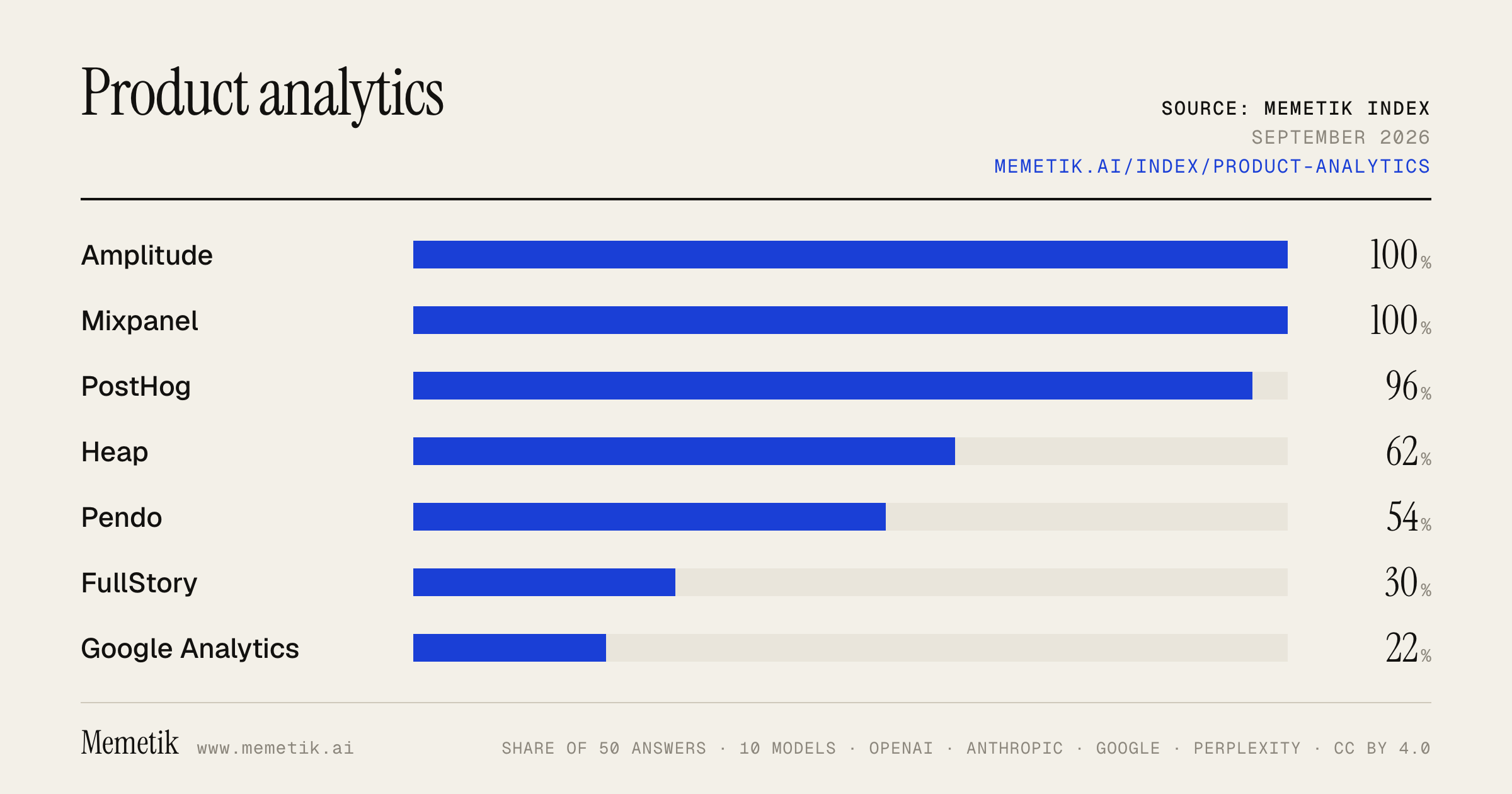
Amplitude was named in 50 of 50 answers and came first in 15. Mixpanel follows at 100%. 13 vendors were named at least once. First edition, so there is no prior period.
Answer share
5 prompts × 10 models · 50 answers
By provider
10 models · 50 answers
OpenAI 3 models · 15 answers
- GPT-5.6 Solgpt-5.6-solmost named: Amplitude 100%
- GPT-5.6 Terragpt-5.6-terramost named: Amplitude 100%
- GPT-5.6 Lunagpt-5.6-lunamost named: Amplitude 100%
Anthropic 3 models · 15 answers
- Claude Opus 5claude-opus-5most named: Amplitude 100%
- Claude Sonnet 5claude-sonnet-5most named: Amplitude 100%
- Claude Fable 5claude-fable-5most named: Amplitude 100%
Google 2 models · 10 answers
- Gemini 3.6 Flashgemini-3.6-flashmost named: Amplitude 100%
- Gemini 3.5 Flashgemini-3.5-flashmost named: Amplitude 100%
Perplexity 2 models · 10 answers
- Sonar Prosonar-promost named: Amplitude 100%
- Sonar Reasoning Prosonar-reasoning-promost named: Amplitude 100%
Sources the models cited
- amplitude.com82
- valueaddvc.com78
- learn.g2.com78
- gainsight.com55
- reddit.com47
- visionlabs.com38
- youtube.com33
- pendo.io32
- posthog.com27
- launchtry.com27
- mixpanel.com20
- cleverx.com18
ChatGPT via API returns no citations, so it does not contribute here.
The prompts
- What is the best product analytics tool for a startup? Name specific products.
- Which product analytics tool would you recommend to a startup in 2026?
- Compare the top product analytics tool options right now.
- I'm a startup and I need a product analytics tool. What should I use and why?
- Best product analytics tool for a B2B SaaS with 10k users?
Every answer
Raw model output, unedited
GPT-5.6 TerraWhat is the best product analytics tool for a startup? Name specific products.
**Best default choice for most startups: Amplitude.**
Choose **Amplitude** if your founders, PMs, and growth team need strong funnels, retention, cohorts, paths, session replay, and experimentation in one relatively approachable product. Its free tier includes up to 2M events/month, and qualifying very early startups (under 20 employees and under $10M raised) can receive a year of its Growth plan free. ([amplitude.com](https://amplitude.com/pricing?siteLocation=nav&utm_source=openai))

But the best choice depends on how your startup operates:

| If you are… | Pick | Why |
|---|---|---|
| A typical B2B SaaS or consumer app startup | **Amplitude** | Best all-around product analytics and a strong non-technical UI for PMs. |
| Engineering-led, privacy-conscious, or wanting one stack for analytics + flags + replay | **PostHog** | Open-source option, can self-host, and bundles product analytics, feature flags, experiments, and session replay. |
| A growth/product team that wants exceptionally focused event analytics | **Mixpanel** | Excellent for funnels, retention, segmentation, and self-serve analysis. |
| Short on engineering resources and need data captured with minimal upfront instrumentation | **Heap** | Autocapture lets you define useful events after data is already collected. |
| Primarily trying to improve onboarding and in-app education for B2B users | **Pendo** | Better fit when guides, walkthroughs, and feature adoption are at least as important as deep analytics. |
| Primarily diagnosing UX friction | **FullStory** | Strong choice when session replay and qualitative experience debugging are the core need, rather than analytics alone. |

### My practical recommendation

1. **Start with Amplitude** if you want the safest all-purpose answer.
2. **Start with PostHog** instead if engineers will own analytics and you value open-source/self-hosting or feature flags.
3. **Choose Mixpanel** if you want a narrower, highly polished analytics-first tool and will use separate tools for replay and experimentation.

Avoid choosing based on a massive feature checklist. For an early startup, make sure the product can answer these five questions within the first week:

- Where do users drop out of onboarding?
- Which activation actions predict retention?
- Which features are actually adopted?
- What differs between retained and churned users?
- Did a shipped change improve the target metric?

Also, don’t use **Google Analytics 4** as your primary product analytics system: it is useful for acquisition and web traffic, but it is not designed around in-product behavioral analysis, cohorts, and feature adoption. ([amplitude.com](https://amplitude.com/compare/best-product-analytics-tools?utm_source=openai))
GPT-5.6 TerraWhich product analytics tool would you recommend to a startup in 2026?
**Default recommendation: PostHog.**

For most early-stage startups in 2026, I’d choose **PostHog Cloud** and instrument a small, disciplined set of product events. It combines product analytics with session replay, feature flags, and experimentation; it also offers open-source/self-hosted deployment if data ownership or compliance later becomes important. That lets a small engineering-led team avoid integrating several separate tools while still keeping an exit path. ([amplitude.com](https://amplitude.com/compare/best-product-analytics-tools?utm_source=openai))

**Why it’s my default**
- **Broad enough for the first 1–3 years:** funnels, retention, cohorts, replay, flags, and experiments in one stack.
- **Startup-friendly operating model:** usage-based pricing and a free/self-hosted option reduce the risk of an early enterprise commitment. ([amplitude.com](https://amplitude.com/compare/best-product-analytics-tools?utm_source=openai))
- **Engineering fit:** it rewards a clean event taxonomy and gives developers useful adjacent tooling, rather than being just a dashboard for PMs.

**Choose something else if:**
- **Your PM/growth team needs the most polished self-serve behavioral analysis with minimal engineering involvement:** evaluate **Amplitude** or **Mixpanel**. Mixpanel remains particularly strong for focused event analytics, cohorts, and funnels; Amplitude emphasizes a more unified analytics/experimentation/replay platform. ([amplitude.com](https://amplitude.com/compare/best-product-analytics-tools?utm_source=openai))
- **You need immediate answers but cannot instrument events well yet:** consider **Heap**, whose autocapture model supports defining events after data is collected. The trade-off is eventual governance and data-quality complexity. ([amplitude.com](https://amplitude.com/compare/best-product-analytics-tools?utm_source=openai))
- **You qualify for a startup program and want to minimize year-one spend:** compare PostHog against **Amplitude for Startups**; Amplitude advertises a one-year program that includes analytics, experimentation, replay, and activation tooling, though eligibility matters. ([amplitude.com](https://www.amplitude.com/startups?utm_source=openai))

**Implementation advice:** Don’t track every click. Start with ~10–20 canonical events tied to:
1. signup and activation,
2. the product’s “value moment,”
3. key feature adoption,
4. paid conversion, and
5. retention.

Then make one decision metric explicit—e.g., “a workspace reaches value when it completes _X_ meaningful actions within seven days.” Product analytics is most useful when it supports funnels, retention, and cohorts around that value definition, not when it becomes an ungoverned event firehose. ([mixpanel.com](https://mixpanel.com/blog/what-is-product-management-analytics/?utm_source=openai))
GPT-5.6 TerraCompare the top product analytics tool options right now.
## Product analytics tools to shortlist — as of September 2, 2026

The best choice depends less on which tool has the longest feature list and more on your **data model, engineering capacity, budget predictability, and whether you want analytics alone or an all-in-one product stack**.

| Tool | Best for | Standout strengths | Trade-offs | Pricing signal |
|---|---|---|---|---|
| **Amplitude** | Product-led teams wanting an integrated platform | Strong behavioral analytics plus session replay, feature flags, experimentation, guides/surveys, and activation in one platform; generous free tier | Can be more platform than a small team needs; advanced governance/enterprise needs are custom-priced | Free includes 2M events/month; Plus begins at $0 and grows with volume; Growth and Enterprise are custom. ([amplitude.com](https://www.amplitude.com/pricing?utm_source=openai)) |
| **Mixpanel** | Teams prioritizing fast, self-serve behavioral analysis | Excellent funnels, retention, segmentation, flows, dashboards, replay/heatmaps, and increasingly experiments/flags and warehouse connectivity | You will still need a separate tool if you require a broad customer-guidance or CDP-style workflow platform | Free tier includes 1M monthly events; qualifying startups can receive a year with 1B events and 1M session replays. ([mixpanel.com](https://mixpanel.com/smb?utm_source=openai)) |
| **PostHog** | Developer-led SaaS teams and startups | Transparent usage pricing, broad engineering-adjacent suite: analytics, replay, feature flags, warehouse, and more; technical support posture | Consumption costs can require close monitoring at high scale; its product can feel more engineering-centric than analyst-centric | Free: 1M analytics events/month, 5,000 recordings/month, and 1M flag requests/month; paid analytics starts at $0.00005/event. ([posthog.com](https://posthog.com/?from=explinks.com&utm_source=openai)) |
| **Pendo** | B2B SaaS companies that need product analytics *and* in-app adoption/governance | Especially compelling for in-app guides, product adoption, feedback, and enterprise-style product operations | Typically sales-led/custom priced; replay, NPS/sentiment, orchestration, and data-sync capabilities may be separate add-ons or higher-tier capabilities | Public pricing is limited; expect a sales process and evaluate total package price rather than just analytics. ([amplitude.com](https://amplitude.com/pricing/platform-consolidation?utm_source=openai)) |
| **Contentsquare + Heap** | Digital-experience / UX teams that need behavioral analytics alongside experience insights | A broader digital-experience analytics orientation; Heap is now part of Contentsquare | Often better suited to larger organizations and UX/DX programs than a lean product-led startup | Generally sales-led; validate package scope and data-volume terms in a quote. ([amplitude.com](https://amplitude.com/pricing/platform-consolidation?utm_source=openai)) |
| **FullStory** | Session replay and qualitative UX investigation first | Strong “watch the problem happen” workflow, valuable for diagnosing friction, bugs, and confusing UX | Less of a direct replacement for a dedicated event-analytics system if deep funnels, retention, cohorts, and experimentation are central | Business has a public starting point, but real cost rises with session volume. ([amplitude.com](https://amplitude.com/pricing/platform-consolidation?utm_source=openai)) |

## My practical picks

### 1. Best overall platform: **Amplitude**
Choose Amplitude when you want to consolidate **analytics + replay + flags + experimentation + engagement** under one event model. It is especially attractive if product, growth, and marketing will all work from the same behavioral data, rather than buying separate point tools. Its current free offering is unusually broad for initial evaluation. ([amplitude.com](https://www.amplitude.com/pricing?utm_source=openai))

### 2. Best pure product-analytics experience: **Mixpanel**
Choose Mixpanel if the central question is: *“Can PMs, growth, and analysts answer behavior questions quickly without SQL?”* It remains a strong option for funnels, cohorts, retention, flows, and self-serve exploration, now paired with replay, heatmaps, experimentation, and warehouse connectors. ([mixpanel.com](https://mixpanel.com/platform/product-analytics/?utm_source=openai))

### 3. Best for engineering-led startups: **PostHog**
Choose PostHog if your team values product breadth, developer friendliness, transparent pay-as-you-go economics, and the ability to add flags, replay, and warehouse capabilities without entering a traditional enterprise sales cycle. Its included volume makes it easy to pilot. ([posthog.com](https://posthog.com/?from=explinks.com&utm_source=openai))

### 4. Best for B2B adoption programs: **Pendo**
Choose Pendo if product analytics is inseparable from **driving adoption inside the application**—guided onboarding, feature discovery, feedback collection, and structured product operations. Treat it as a broader product-adoption platform rather than a simple analytics purchase. ([amplitude.com](https://amplitude.com/pricing/platform-consolidation?utm_source=openai))

### 5. Best replay-first complement: **FullStory**
Choose FullStory when your biggest gap is qualitative understanding: why a checkout, onboarding, or workflow is failing in real sessions. It can complement an analytics-first platform, though that means managing separate tools and data definitions. ([amplitude.com](https://amplitude.com/pricing/platform-consolidation?utm_source=openai))

## Decision guide

- **Want one vendor for analytics, replay, flags, experimentation, and engagement?** → **Amplitude**
- **Want the easiest, strongest self-serve behavioral analytics workflow?** → **Mixpanel**
- **Want a technical, modular, transparent-usage stack?** → **PostHog**
- **Sell B2B software and need guides/adoption tooling as much as analytics?** → **Pendo**
- **Need UX/replay diagnostics more than event analytics?** → **FullStory**
- **Run a larger web/digital-experience program?** → **Contentsquare + Heap**

## What to test in a 2-week evaluation

Do not decide from a demo. Instrument—or import—a representative slice of data and ask every finalist to support these same tasks:

1. Build an onboarding funnel with account-level and user-level segmentation.
2. Measure week-1 and month-1 retention for a meaningful activation behavior.
3. Investigate one conversion drop using both quantitative analysis and session replay.
4. Define a governed “active account” metric and verify it agrees with your warehouse.
5. Create a reusable cohort and send it to a downstream tool.
6. Estimate cost at **current volume, 3× volume, and 10× volume**—including replay, data retention, identities, seats, and add-ons.
7. Check privacy controls: masking, consent, deletion, regional hosting, SSO/RBAC, and warehouse integration.

**Bottom line:** start with **Amplitude, Mixpanel, and PostHog** for most software products. Add **Pendo** if in-app adoption is a primary outcome; add or consider **FullStory/Contentsquare** when digital experience and replay are the center of gravity.
GPT-5.6 TerraI'm a startup and I need a product analytics tool. What should I use and why?
## My default pick: **PostHog**

For most **engineering-led startups**, use **PostHog Cloud** to start. It combines the things startups otherwise buy separately: product analytics, session replay, feature flags, experiments, surveys, and a warehouse. Its pricing is transparent and usage-based; the current free allowances include **1M analytics events/month**, **5,000 session recordings/month**, and **1M feature-flag requests/month**. ([posthog.com](https://posthog.com/?from=explinks.com&utm_source=openai))

**Why it’s the best default**
- **One implementation, many jobs:** measure activation/retention funnels, inspect replays when conversion drops, and roll out or test fixes using flags.
- **Good fit for builders:** it is open source and can be self-hosted if data control becomes a real requirement.
- **Less early stack sprawl:** you avoid immediately stitching together an analytics tool, replay tool, feature-flag vendor, and experiment platform.
- **Costs are legible:** better for preserving runway than tools that require a sales conversation before you can forecast spend. ([posthog.com](https://posthog.com/?from=explinks.com&utm_source=openai))

**Choose Amplitude instead** if the startup is **product-manager/growth-led rather than engineering-led**, or you expect nontechnical teammates to spend much of their day exploring funnels, retention, cohorts, and experiments. Amplitude’s current free plan includes **2M events/month**, session replay, feature flags, web experimentation, guides/surveys, and unlimited seats, and it offers a startup scholarship for eligible companies with fewer than 20 employees and under $10M in funding. ([amplitude.com](https://amplitude.com/pricing?siteLocation=nav&utm_source=openai))

**Choose Mixpanel instead** only if you want a **focused, dedicated product-analytics experience** and are comfortable using separate tools for experimentation, flags, and other adjacent needs. It remains a solid option for event-based funnels, cohorts, and mobile/web product analysis. ([mixpanel.com](https://mixpanel.com/platform/product-analytics/?utm_source=openai))

### Simple decision rule

| Your situation | Pick |
|---|---|
| Technical founders; want analytics + flags + replay in one place | **PostHog** |
| Strong PM/growth team; analytics UX and broad business adoption matter most | **Amplitude** |
| You only need classic product analytics and already have the rest of the stack | **Mixpanel** |

## What I would do in your shoes

1. Start on **PostHog Cloud**.
2. Instrument only **10–20 high-value events**, not every button click:
   - signed up
   - completed onboarding
   - created the core object in your product
   - invited a teammate
   - reached the “aha” action
   - upgraded / started checkout
3. Create four reports immediately:
   - acquisition → activation funnel
   - onboarding completion funnel
   - weekly retention by signup cohort
   - feature adoption among activated users
4. Use session replay selectively for failed funnels, and ensure you mask sensitive inputs and respect consent/privacy requirements.
5. Re-evaluate after you have real usage—typically when product questions become more sophisticated than your team can answer comfortably in the tool, not just because you have more events.

The important part is not the vendor: it is agreeing on a crisp definition of **activation** and instrumenting it reliably. A mediocre tool with a disciplined event taxonomy beats a sophisticated tool full of noisy, ambiguous events.
GPT-5.6 TerraBest product analytics tool for a B2B SaaS with 10k users?
**Best overall: Amplitude — especially if account-level adoption and expansion are core B2B metrics.**

For a B2B SaaS with ~10k users, you usually need to analyze **both people and companies/workspaces**: which accounts activate, which roles use key features, whether usage predicts renewal/expansion, and which accounts are at risk. Amplitude’s **Accounts** capability is explicitly designed for account-level analysis and can enrich usage data with Salesforce information—making it a strong fit for product-led or hybrid-sales B2B SaaS. ([amplitude.com](https://amplitude.com/accounts?utm_source=openai))

### My short list

| If your priority is… | Pick | Why |
|---|---|---|
| **Account-level product adoption, retention, and expansion** | **Amplitude** | Strong B2B account analysis plus a broader platform for analytics, experimentation, replay, and governance. ([amplitude.com](https://amplitude.com/accounts?utm_source=openai)) |
| **Best focused, self-serve event analytics UX** | **Mixpanel** | Excellent funnels, cohorts, segmentation, and real-time analysis; a great choice if you do not need a deeply integrated account-health workflow. ([mixpanel.com](https://mixpanel.com/mejor-analisis-producto/?utm_source=openai)) |
| **In-app onboarding, guides, and feature adoption interventions** | **Pendo** | Choose it when guides, walkthroughs, surveys, and adoption programs matter as much as analytics. Its plans include analytics, guides, and session replay. ([pendo.io](https://www.pendo.io/pricing/?utm_source=openai)) |

### Recommendation by situation

- **Default choice:** **Amplitude**
  - Best if your product, CS, sales, and leadership teams all need a shared view of account health.
  - Particularly good for metrics such as: activated accounts, weekly active seats per account, champion engagement, multi-user adoption, feature penetration, and usage-based churn risk.

- **Pick Mixpanel instead if:** you have a lean product/growth team, want the fastest path to excellent behavioral analytics, and plan to handle account-health scoring primarily in your warehouse/CRM. Its Growth tier includes 1M monthly events free, then charges per event—so pricing is relatively straightforward to model from your instrumentation volume. ([mixpanel.com](https://mixpanel.com/pricing/?org=1932919&utm_source=openai))

- **Pick Pendo instead if:** your immediate problem is poor onboarding or feature discoverability, and you want to launch in-app guidance without stitching together a separate adoption tool. ([pendo.io](https://www.pendo.io/pricing/?utm_source=openai))

### Important caveat: 10k users is not the pricing input

Get pricing estimates using:
1. **Monthly tracked users / MAUs**
2. **Monthly event volume**
3. **Number of session replays**
4. Whether you need **SSO, RBAC, HIPAA/SOC 2 requirements, data residency, warehouse sync, or Salesforce integration**
5. Whether “account” means a simple workspace ID or a complex parent/child enterprise hierarchy

For example, 10k users generating 20 meaningful events per active day can easily become millions of events per month. Avoid auto-capturing every UI interaction unless you have a clear governance and cost plan.

### Implementation advice

Whichever tool you choose, make these first-class properties from day one:

- `user_id`
- `account_id` / `workspace_id`
- `account_plan`
- `account_segment`
- `user_role`
- `seat_status`
- `feature_area`
- `subscription_status`
- CRM identifiers where appropriate

Then define one shared **activation event** at both levels:
- **User activation:** a user reaches meaningful first value.
- **Account activation:** enough eligible users at an account reach meaningful value within a set window.

That distinction is often the difference between “nice dashboards” and analytics that actually predicts B2B retention.

**Bottom line:** Start with **Amplitude** if you want the strongest all-around B2B SaaS setup; choose **Mixpanel** for a simpler, analytics-first product/growth stack; choose **Pendo** when in-app adoption programs are the main job.
Claude Sonnet 5What is the best product analytics tool for a startup? Name specific products.
Great question — the "best" choice really depends on your startup's stage, budget, and technical setup. Here's a breakdown of the most commonly recommended product analytics tools for startups:

## Top Picks

**1. Mixpanel**
- Popular for event-based tracking (funnels, retention, cohort analysis)
- Generous free tier, making it a favorite for early-stage startups
- Strong at answering "what are users doing in my product" questions

**2. Amplitude**
- Similar to Mixpanel — deep behavioral analytics, retention curves, and cohort analysis
- Also has a solid free tier for startups
- Known for powerful segmentation and North Star metric tracking frameworks

**3. PostHog**
- Increasingly popular with technical/dev-heavy startups because it's **open-source** and self-hostable
- Combines product analytics with session recording, feature flags, A/B testing, and surveys in one tool
- Generous free tier (based on usage volume), appealing to cost-conscious startups

**4. Heap**
- Automatically captures all user interactions (autocapture) without needing to manually define events upfront
- Good if you want retroactive analysis without re-instrumenting tracking code

**5. Google Analytics 4 (GA4)**
- Free and ubiquitous — good baseline for web traffic and basic behavioral data
- Less suited to deep product/funnel analytics compared to the above, but fine as a starting point or complement

## Quick Recommendation Framework

- **Very early stage / limited budget / want an all-in-one tool:** PostHog (free tier is generous, and you get session replay + feature flags bundled)
- **Want the most polished UX and are willing to pay as you scale:** Mixpanel or Amplitude
- **Don't want to define events manually / want retroactive tracking:** Heap
- **Already using GA4 for marketing and want zero additional cost:** Stick with GA4 initially, layer on a dedicated tool later

If you let me know your tech stack (e.g., mobile app vs. web, engineering resources available) and budget, I can narrow this down further.
Claude Sonnet 5Which product analytics tool would you recommend to a startup in 2026?
For a startup in 2026, the best choice really depends on your team's technical profile and budget, but here's how the leading options stack up:

## Top Recommendation: PostHog (for most startups)
PostHog has become a favorite for startups because it bundles multiple tools into one platform.
It's the leading open-source product analytics option, with experimentation and session replay built in, and it offers a transparent per-event pricing model and a self-host option, which makes it popular with engineering-heavy teams that care about data ownership.

It's the best choice for engineering-led teams that want open-source, self-hosted analytics with feature flags, session recording, and A/B testing in one platform (free to 1M events/month).


**Trade-off:**
The limitation is that self-hosting requires technical lift, and the UI and polish still trail the cloud-first leaders, particularly on cohort flexibility and AI features.


## Amplitude (for teams wanting a polished, all-in-one platform)

Amplitude's free Starter plan covers up to 50K monthly tracked users with funnels, cohorts, retention analysis, and user path exploration
, and many consider it
the best product analytics platform for most startups in 2026
.
Amplitude provides a foundation for startups from early validation through enterprise scale, combining behavioral analytics, integrated experimentation, session replay, and customer data activation, enabling you to identify user behavior patterns and act on insights without connecting multiple tools.


## Mixpanel (for non-technical teams)
If your team isn't engineering-heavy, Mixpanel is a strong pick —
it offers the simplest event-based analytics with a generous free tier (20M events/month)
. More broadly,
Mixpanel suits non-technical users with its intuitive UI, while PostHog fits technical teams due to its complex setup and lower cost
.

## My practical suggestion:
- **Technical/engineering-led startup, cost-conscious, want flexibility** → **PostHog**. Best value if you have engineers who can handle setup, and you get analytics + session replay + feature flags + A/B testing in one place.
- **Non-technical or fast-moving team that wants something polished out of the box** → **Amplitude** or **Mixpanel**.
Non-technical product teams generally do best with Mixpanel or Amplitude, since they're built for your workflow and won't require engineering to answer basic questions.

- **Pre-PMF, just want qualitative insight (session recordings, heatmaps)** → Start even simpler with something like Hotjar, since
early-stage startups often use Hotjar before graduating to more sophisticated tools
.

**Bottom line for 2026:** If you had to pick just one, I'd lean toward **PostHog** if you have any engineering resources (best bang-for-buck, all-in-one, generous free tier), or **Amplitude** if you want the most mature, polished product-analytics experience with minimal setup friction and room to scale into enterprise features later.
- https://amplitude.com/compare/best-product-analytics-tools
- https://valueaddvc.com/blog/best-product-analytics-for-startups-2026-amplitude-mixpanel-posthog-heap-compared
- https://amplitude.com/compare/best-product-analytics-tools-early-stage-startups
- https://cleverx.com/blog/product-analytics-tools-12-best-options-compared
- https://visionlabs.com/blog/best-product-analytics-tools/
Claude Sonnet 5Compare the top product analytics tool options right now.
## Top Product Analytics Tools: Comparison (2026)

Product analytics has consolidated around a handful of strong platforms, each with a distinct strength. Here's how the leading options stack up:

### 1. **Amplitude**

This category is evaluated on three criteria that separate tools in 2026: behavioral depth, experimentation integration, and AI capabilities.
 Amplitude is considered a top performer here, with
strong behavioral cohort analysis
 capabilities. It relies on
a core event-based data model where every meaningful action a user takes gets recorded as a structured event with properties attached, making it possible to slice behavior by user, cohort, time, or feature flag
.
- **Best for:** Teams needing deep behavioral analysis, cohorting, and experimentation integration at scale.

### 2. **Mixpanel**

Mixpanel leads for funnel and retention tracking
, making it a favorite for teams focused on conversion and lifecycle metrics. It's also frequently recommended as an accessible entry point —
non-technical marketers can start with Google Analytics and move to Mixpanel or Amplitude when they outgrow it, while non-technical product teams often go straight to Mixpanel or Amplitude
.
- **Best for:** Product/growth teams prioritizing funnels, retention curves, and ease of use.

### 3. **Heap**

Heap offers auto-capture without manual tagging
, meaning
it excels in autonomous event capture
 — a big advantage for teams that don't want to build a rigid tracking plan up front, since it retroactively captures data on user interactions.
- **Best for:** Teams that want to skip manual instrumentation and analyze historical interactions after the fact.

### 4. **Pendo**
Pendo takes a broader "software experience management" approach.
It's positioned as the leader in Software Experience Management (SXM), offering an end-to-end solution that integrates analytics, in-app guidance, user feedback tools, and user journey mapping — giving teams a unified toolkit for understanding and acting on user behavior without extensive code changes.
 It also
combines analytics with in-app guides
.
- **Best for:** Teams wanting analytics tightly paired with in-app messaging, onboarding flows, and feedback collection in one platform.

### 5. **FullStory / Session Replay Tools**

FullStory is a strong choice for session replay
, and more broadly,
session replay tools reveal the experiential context behind aggregate metrics, helping teams diagnose issues that numbers alone would miss
.
- **Best for:** Debugging UX issues and understanding the "why" behind quantitative drop-offs.

### 6. **PostHog**
Increasingly popular as an open-source, all-in-one alternative that bundles product analytics with session replay, feature flags, and experimentation — appealing to engineering-led teams wanting more control and self-hosting options (noted across multiple comparison guides as a top contender alongside Amplitude, Mixpanel, and Heap).

### 7. **Google Analytics (GA4)**
Still relevant for many teams despite not being a true product analytics tool.
Google Analytics gets dismissed by product teams, but that's shortsighted — at 5 million events per month, you're still on their free plan, for zero dollars.
 However,
GA4 is best suited for web attribution
 rather than in-product behavioral analysis.

---

### Key Trends Shaping the Choice in 2026
- **Consolidation over point solutions:**
The market's shifting towards holistic platforms that combine data insights with actionable in-app experiences, reducing tool sprawl.

- **AI is now a baseline expectation:**
AI and machine learning are increasingly central for automating analysis, predicting behavior, and guiding users directly within the product.

- **Compliance matters more:**
Real-time data access is crucial for agile decision-making, but robust compliance features (SOC2, GDPR, CCPA, HIPAA) are required for enterprise adoption and user trust.

- **Category confusion is costly:**
Picking the wrong category can cost six to twelve months of re-platforming
, so it's worth clarifying upfront whether you need product analytics, web analytics, session replay, or BI reporting —
since digital experience analytics is optimized for session replay and visual heatmaps, business intelligence is optimized for aggregated reporting, while product analytics is optimized for behavioral analysis at scale — a different engineering problem and buyer persona.


### Quick Recommendation Framework
- **Enterprise, need guidance + analytics unified:** Pendo
- **Deep behavioral/cohort analysis, experimentation-heavy:** Amplitude
- **Funnels, retention, ease of use:** Mixpanel
- **Don't want to manually instrument events:** Heap
- **Need to see *why* users struggle (qualitative):** FullStory
- **Engineering-led team wanting open-source/self-hosted flexibility:** PostHog
- **Budget-constrained, marketing-adjacent needs:** Google Analytics (GA4), graduating later

If you t
- https://amplitude.com/compare/best-product-analytics-tools
- https://www.guideflow.com/blog/product-analytics-software-tools
- https://visionlabs.com/blog/best-product-analytics-tools/
- https://webeyez.com/insights/guides/best-product-analytics-tools-guide-2026
- https://www.pendo.io/pendo-blog/top-10-product-analytics-tools/
- https://www.unwrap.ai/post/top-ten-best-product-analytics-software-for-2026
Claude Sonnet 5I'm a startup and I need a product analytics tool. What should I use and why?
# Choosing a Product Analytics Tool

There's no single "best" answer here—it really depends on your stage, budget, and technical resources. Let me walk you through the main options and how to think about the decision.

## Top Options for Startups

**1. Mixpanel**
- Great for event-based tracking (understanding user actions, funnels, retention)
- Strong self-serve UI that non-technical folks can use
- Generous free tier for early-stage startups
- Best if you care deeply about user behavior flows and conversion funnels

**2. Amplitude**
- Similar to Mixpanel but often praised for more powerful segmentation and cohort analysis
- Good free tier (up to a decent volume of events/month)
- Popular with product-led growth companies
- Slightly steeper learning curve but more robust for complex product analytics

**3. PostHog**
- Open-source, can self-host (great if data privacy/ownership matters)
- Combines analytics + session replay + feature flags + A/B testing in one tool
- Generous free tier even on the cloud version
- Good choice if you want an all-in-one product tool without stitching multiple SaaS products together

**4. Heap**
- Auto-captures all user interactions retroactively (no need to define events upfront)
- Useful if you don't want to spend engineering time instrumenting events early on
- Can get expensive as you scale

**5. Google Analytics 4 (GA4)**
- Free and fine for basic web traffic/marketing analytics
- Not ideal for deep product analytics (funnels, retention, user-level behavior) compared to the above
- Good as a "starter" if budget is $0 and you mainly care about marketing/acquisition metrics

## How to Decide

Ask yourself:

1. **Do you need session replay/feature flags too?** → PostHog bundles these.
2. **Do you have engineering time to instrument events properly?** → If not, Heap's auto-capture helps.
3. **Is data ownership/self-hosting important?** → PostHog is open-source and self-hostable.
4. **Do you want the most mature, polished analytics UX?** → Mixpanel or Amplitude.
5. **Is budget the main constraint?** → PostHog's free tier is very generous; GA4 is free but limited.

## My Practical Recommendation

For most early-stage startups, I'd suggest starting with **PostHog** or **Mixpanel**:
- **PostHog** if you want one tool that grows with you (analytics + replay + flags + experiments) and appreciate open-source flexibility.
- **Mixpanel** if you want the cleanest, most intuitive analytics-only experience and don't need the extra bells and whistles yet.

Would you like me to look up current pricing/free-tier limits for any of these (they change fairly often), or help you think through what specific metrics/events you should be tracking for your product?
Claude Sonnet 5Best product analytics tool for a B2B SaaS with 10k users?
For a B2B SaaS with around 10k users, you're in a sweet spot where several tools work well, but the right choice depends on what you're optimizing for:

## Top Recommendations

**Mixpanel — Best overall balance**

Mixpanel offers the best balance of power and usability, and its event-based model fits well with SaaS products.
 At 10k users, you get robust funnel, cohort, and retention analysis without the complexity overhead of enterprise tools.
Mixpanel is a product analytics platform for tracking user behavior within your SaaS application, ideal for understanding trial conversion and feature adoption, and excels at answering questions about what users actually do inside your product.


**Amplitude — Best if you need deeper analytics**

Amplitude provides deeper analytics capabilities and better handles large data volumes
 — worth considering if you anticipate scaling well past 10k or need more sophisticated behavioral cohorting and predictive analytics.

**Pendo or Gainsight PX — Best for tying analytics to customer success**
If your priority is connecting usage data to retention, expansion, and churn prevention (common at 10k-user B2B scale), these are strong picks.
For B2B SaaS product and CS leaders, Gainsight PX or Pendo connect analytics to in-app guidance and CS health scores, letting your team act on usage data.
 Specifically,
GainsightPX combines product analytics (funnel, path, segmentation) with customer feedback and engagement, offering native in-app engagements plus self-service support — ideal for B2B SaaS teams focused on customer lifecycle health and integrating with customer success workflows.
 The tradeoff:
pricing is custom and generally high, and some users note a lack of native session replay/heatmaps.


**PostHog — Best if budget/data ownership matters**

PostHog combines events, funnels, cohorts, feature flags, and session replay in one platform with a generous free tier, and self-hosting removes third-party data transfer concerns.
 The tradeoff is that
Mixpanel and Amplitude ship with richer out-of-the-box B2B account grouping and enterprise SSO, while PostHog demands more engineering effort to configure account-level tracking but returns full data ownership and avoids per-event pricing at scale.


**Heap — Best with limited engineering resources**

Heap's auto-capture means you can analyze data you did not explicitly track
 — useful if your team doesn't want to spend time instrumenting every event manually.

## My practical suggestion

At 10k users specifically, most B2B SaaS teams land on **Mixpanel or Amplitude for pure behavioral/product analytics**, paired with **Pendo or Gainsight PX** if customer success/expansion tracking is a priority. If you're an early-stage or budget-conscious team with engineering capacity, **PostHog** is increasingly popular since
companies at the $500k–$10M ARR stage primarily rely on Amplitude, Mixpanel, and PostHog
.

A few questions that would help me narrow it down further: Do you need account-level (not just user-level) analytics since this is B2B? Do you already have engineering resources for instrumentation, or do you need auto-capture? And is churn/expansion tracking a core need, or is this purely for product/UX decisions?
- https://www.b2bsaastools.com/category/product-analytics
- https://www.cometly.com/post/marketing-analytics-for-b2b-saas
- https://www.gainsight.com/essential-guide/product-management-metrics/product-analytics-tools/
- https://www.pendo.io/pendo-blog/top-10-product-analytics-tools/
- https://www.saashero.net/strategy/best-b2b-saas-analytics-tools/
Gemini 3.6 FlashWhat is the best product analytics tool for a startup? Name specific products.
There is no single "best" product analytics tool for every startup—the right choice depends on your team's technical capabilities, stage, and specific budget constraints. However, a few industry standards consistently top the list for early-stage companies.

---

### 1. PostHog (Best Overall All-in-One for Startups)
PostHog has quickly become a developer and startup favorite. It goes beyond traditional product analytics by combining multiple tools into a single platform.
* **Key Features:** Event tracking, session replay, heatmaps, feature flags, A/B testing, and survey tools.
* **Why Startups Love It:** It replaces 3–4 separate tools (like Mixpanel + Hotjar + LaunchDarkly). It offers a generous free tier (up to 1M events/month), transparent pay-as-you-go pricing, and the startup program grants up to $50,000 in credits.
* **Best For:** Technical founders, SaaS startups, and engineering-led product teams.

### 2. Mixpanel (Best for Funnels, Cohorts, and Ease of Use)
Mixpanel is the most user-friendly, classic product analytics platform on the market.
* **Key Features:** Granular funnel visualization, user retention charts, cohort segmentation, and self-serve interactive dashboards.
* **Why Startups Love It:** It requires minimal training for non-technical team members (like product managers and marketers) to build actionable reports. Their **Mixpanel for Startups** program provides $50,000 in credits for the first year.
* **Best For:** Non-technical founders, PMs, and startups that prioritize user behavior, conversion funnels, and retention analysis.

### 3. Amplitude (Best for Scaling & Deep Retention Analysis)
Amplitude is the industry heavyweight for enterprise product analytics, but it also caters well to growing startups.
* **Key Features:** Advanced behavioral cohorts, algorithmic user pathing, predictive analytics, and experimentation.
* **Why Startups Love It:** The free plan offers generous monthly active user (MAU) limits. The **Amplitude Amplify** startup program offers free access to Growth tier features for eligible early-stage startups.
* **Best For:** Data-mature startups, mobile-first apps, and teams looking for deep retention and behavioral insights that can scale as the business grows.

### 4. Heap / Heap by Contentsquare (Best Low-Code / Auto-Capture)
Traditional analytics require engineers to manually code ("instrument") custom tracking for every button click. Heap solves this by capturing all user actions automatically in the background.
* **Key Features:** Autocapture event tracking, virtual event creation, retro-active analysis, and built-in session replay.
* **Why Startups Love It:** You can track user behavior without constantly asking engineers to deploy new analytics code every time you build or tweak a feature.
* **Best For:** Very early-stage startups that lack dedicated engineering resources for tracking setups.

### 5. LogRocket or FullStory (Best for Qualitative + Engineering Debugging)
If your primary concern is discovering *why* users get stuck or where bugs occur rather than looking at high-level aggregated charts, session recording tools are ideal.
* **Key Features:** Session replays, frontend error logging, performance monitoring, and friction points identification.
* **Best For:** Early product validation, bug fixes, UX troubleshooting, and early customer feedback loops.

---

### Summary Recommendation:
* Choose **PostHog** if you want the best value, open-source flexibility, and multiple features (flags, replay, metrics) wrapped in one platform.
* Choose **Mixpanel** if you want the cleanest UI, easiest learning curve, and best funnel analysis for your PMs and marketers.
* Choose **Heap** if your dev resources are constrained and you want auto-tracking out of the box.
Gemini 3.6 FlashWhich product analytics tool would you recommend to a startup in 2026?
Choosing the right product analytics tool for a startup depends heavily on **team structure, budget, and tech stack setup**. The market is primarily led by three main contenders:

---

### 1. **PostHog** *(Best Overall Recommendation for Most Early-Stage Startups)*
* **Why it’s great:** It eliminates the need for a fragmented growth stack by combining **product analytics, session replays, feature flags, A/B testing, and user surveys** into a single SDK.
* **Best for:** Technical founders, developer-led startups, or lean teams that want to avoid paying for multiple tools (e.g., Amplitude + LogRocket + LaunchDarkly).
* **Pricing/Free Tier:** Exceptionally founder-friendly. Extremely generous free monthly volume (1 million free events + session replays) with no per-seat pricing tax.

---

### 2. **Mixpanel** *(Best for Non-Technical Product Managers & UX Speed)*
* **Why it’s great:** Mixpanel has the cleanest, fastest UI for non-technical team members. It makes creating funnels, retention charts, and cohort comparisons effortless without needing SQL or engineering support.
* **Best for:** Product-led startups with dedicated PMs or growth marketers who need rapid answers on drop-off rates and user flows.
* **Pricing/Free Tier:** Free tier offers up to 20 million events/month, plus an aggressive startup program giving early-stage companies up to 1 year free.

---

### 3. **Amplitude** *(Best for Complex Data Science & High-Scale Analytics)*
* **Why it’s great:** Offers deep analytical capabilities like predictive cohorts, detailed behavioral pathing, and machine-learning insights. It also integrates seamlessly if you are running a warehouse-native setup (Snowflake, BigQuery, Databricks).
* **Best for:** Later-stage startups (Seed to Series A) that have dedicated data analysts, or startups dealing with complex, multi-touch behavioral journeys.
* **Pricing/Free Tier:** Free Starter plan covers up to 50K Monthly Tracked Users (MTUs) with fundamental cohort and retention tools.

---

### **Honorable Mention: Heap (by Contentsquare)**
* **Best for:** Small teams that don't have engineering bandwidth to manually tag every single event. Heap’s **autocapture** tracks all clicks and form fills automatically, so you can define events retroactively.

---

### **Summary Advice:**
1. **If you have software engineers building the product:** Choose **PostHog**. You get full context (analytics + session recordings + feature flags) out of the box with virtually zero cost early on.
2. **If your primary driver is a Product Manager or Marketer:** Choose **Mixpanel**. It has the lowest learning curve for slicing data and building executive dashboards.
3. **If you have a dedicated data analyst or complex ML data models:** Choose **Amplitude**.
Gemini 3.6 FlashCompare the top product analytics tool options right now.
The product analytics landscape is shaped by consolidation, warehouse-native architectures, and all-in-one developer platforms. Rather than picking a single "best" tool, the choice depends heavily on your team’s technical maturity, business model, and existing data stack.

Here is a breakdown of the top product analytics tools:

---

### 1. **PostHog**
**Best For:** Engineering-led startups, technical PMs, and teams wanting an all-in-one suite.
* **Core Strengths:** Combines traditional product analytics with feature flags, session replay, A/B testing, and user surveys in a single tool. It offers an open-source option for self-hosting (data privacy compliance) or a cloud-hosted version.
* **Downsides:** UI can feel cluttered or overly complex for non-technical marketers and business analysts.
* **Pricing Model:** Highly transparent usage-based pricing with generous free tiers (1M free events/month).

### 2. **Mixpanel**
**Best For:** Fast-moving product teams looking for an intuitive UI, fast self-serve analysis, and modern warehouse integrations.
* **Core Strengths:** Excellent self-serve experience for PMs and designers to slice-and-dice funnels, retention, and cohorts without writing code. Extremely strong "Warehouse Connector" capabilities that query data natively from Snowflake, BigQuery, or Databricks without duplicating storage.
* **Downsides:** Lacks native in-app guidance/onboarding overlays (requires third-party integrations like Appcues).
* **Pricing Model:** Event-based pricing; generous free plan (up to 20M events/month).

### 3. **Amplitude**
**Best For:** Enterprise product teams, complex multi-platform apps, and deep behavioral science workflows.
* **Core Strengths:** Industry benchmark for deep behavioral analytics, custom event modeling, predictive cohorts, and identity resolution. Strong ecosystem with integrated experimentation (Amplitude Experiment) and customer data platform (CDP) capabilities.
* **Downsides:** Steeper learning curve; high pricing scale once you breach the free/starter tiers.
* **Pricing Model:** Free starter plan (up to 50K MTUs), then scales exponentially on paid tiers.

### 4. **Pendo**
**Best For:** B2B SaaS, product-led growth (PLG) teams, and digital adoption management.
* **Core Strengths:** Uniquely combines product analytics with **in-app messaging, guides, and NPS surveys** natively. Excellent for guiding users through onboarding tours and measuring feature adoption simultaneously.
* **Downsides:** Analytics depth for complex user journeys/funnels isn't as granular as Amplitude or Mixpanel. Premium pricing.
* **Pricing Model:** Custom enterprise pricing based on Monthly Active Users (MAUs).

### 5. **Heap (acquired by Contentsquare)**
**Best For:** Teams looking for "autocapture" to analyze user data retroactively without heavy manual engineering.
* **Core Strengths:** Auto-captures every click, form submit, and scroll out-of-the-box. Allows teams to define events retroactively on historical data without waiting for developers to instrument code.
* **Downsides:** Can create data clutter ("event chaos") if not governed tightly; less depth on complex behavioral cohorts.
* **Pricing Model:** Session- or volume-based pricing tiers.

---

### Quick Comparison Summary

| Tool | Primary Philosophy | Key Differentiator | Ideal User Profile |
| :--- | :--- | :--- | :--- |
| **PostHog** | All-in-one Dev Platform | Built-in replay + feature flags + A/B testing | Technical Product Managers & Developers |
| **Mixpanel** | Self-serve & Warehouse Native | Easiest UI for ad-hoc querying & warehouse sync | Product Managers, Growth, & Product Designers |
| **Amplitude** | Enterprise Behavioral Depth | Best-in-class identity mapping & advanced cohorts | Enterprise Product & Data Teams |
| **Pendo** | Product Analytics + Guidance | Native in-app onboarding tours and NPS | B2B SaaS & Customer Success / PM teams |
| **Heap** | Autocapture First | No manual tracking specs needed retroactively | Non-technical PMs & Growth teams with low dev resources |

### How to Choose:
1. **If you want developer control + session replay/feature flags under one roof:** Go with **PostHog**.
2. **If your priority is quick answer-seeking for PMs without SQL:** Go with **Mixpanel**.
3. **If you are a large organization with complex multi-platform identity resolution:** Go with **Amplitude**.
4. **If you need to show in-app tooltips/popups directly tied to analytics:** Go with **Pendo**.
Gemini 3.6 FlashI'm a startup and I need a product analytics tool. What should I use and why?
To choose the right product analytics tool for your startup, the decision usually comes down to **what stage you are at**, **your budget**, and **your technical setup**.

Here are the top recommendations categorized by their primary strengths, along with a guide on how to choose:

---

### 1. The Best All-Rounder for Startups: **PostHog**
* **Why it’s great:** PostHog is an open-source product analytics platform built specifically with startups in mind. Instead of *just* giving you product analytics (funnels, retention, cohorts), it integrates session recordings, feature flags, A/B testing, and user surveys into one tool.
* **Pricing:** Very startup-friendly. Generous free tier (up to 1M events/month), and pay-as-you-go after that.
* **Best for:** Early-to-growth startups that want an all-in-one stack without managing 4 different SaaS subscriptions.

### 2. The Gold Standard for Self-Serve Analytics: **Mixpanel**
* **Why it’s great:** Mixpanel is arguably the most polished, intuitive, and powerful pure-play product analytics platform. It makes it extremely easy for non-technical team members (product managers, founders, marketers) to build dashboards, track user journeys, and analyze retention.
* **Pricing:** Free tier up to 20B events/month (with limitations), then predictable event-based pricing. They also offer a **Startup Program** giving up to $50,000 in credits for eligible early-stage companies.
* **Best for:** Fast-growing teams that want top-tier dashboarding, strong self-serve capabilities, and deep funnel/cohort analysis.

### 3. Best for Visual Insights & UX Debugging: **UXCam** or **LogRocket** / **PostHog**
* **Why it’s great:** If you are building a **Mobile App**, **UXCam** is the market leader for mobile session replay, heatmaps, and funnel analytics tailored specifically for iOS/Android. If you are building a **Web App**, tools like **LogRocket** combine frontend performance monitoring with session replays and basic product analytics.
* **Best for:** Early startups still finding Product-Market Fit (PMF) who need to *see* how users interact with the UI rather than just looking at graphs.

### 4. The Enterprise-Grade Leader: **Amplitude**
* **Why it’s great:** Amplitude is the industry giant. It offers deep behavioral analytics, predictive analytics, and enterprise-grade data management features.
* **Pricing:** Free plan includes 50k Monthly Active Users (MAUs). Like Mixpanel, they have a **Startup Program** (up to 1 year free on their Plus plan for early-stage companies).
* **Best for:** Later-stage startups with complex user journeys or dedicated data analyst teams.

---

### Quick Recommendation Summary

1. **If you want the best all-in-one toolkit (analytics + session replay + feature flags):** Go with **PostHog**.
2. **If you want clean, easy-to-use event analytics with strong team adoption:** Go with **Mixpanel** (apply for their startup program).
3. **If you are building a Native Mobile App:** Go with **UXCam** or **Mixpanel**.
4. **If you are on a tight budget:** Start with **PostHog** or **Mixpanel**'s free tiers.

---

### Key Questions to Ask Before Picking One

* **What is your engineering bandwidth?**
  * Auto-capture tools (like PostHog or Heap) require less upfront setup because they capture every click/event automatically.
  * Explicit event-tracking tools (like Mixpanel or Amplitude) require manual instrumentation from your engineers, but give much cleaner, more reliable data long-term.
* **Web vs. Mobile?**
  * Web works great on almost all platforms, but native iOS/Android can require specialized SDKs (e.g., UXCam).
* **Data Privacy/Compliance?**
  * If you handle sensitive data (healthcare, fintech, or strict GDPR compliance) and need to self-host, **PostHog** offers open-source/self-hosted options, whereas Mixpanel and Amplitude are fully managed cloud solutions.
Gemini 3.6 FlashBest product analytics tool for a B2B SaaS with 10k users?
At **10,000 users**, your B2B SaaS is in a sweet spot: you have enough active data to get meaningful retention, cohort, and account-level insights, but you aren't yet locked into enterprise custom contracts or massive data-volume bills.

For B2B SaaS specifically, **Group Analytics** (the ability to track and analyze metrics by **Company/Account level**, not just individual user profiles) is mandatory.

Here is a breakdown of the top product analytics options and how to choose the right one for your setup:

---

### 1. PostHog (Best All-in-One for Tech-Forward Teams)
* **Why it fits B2B SaaS:** PostHog goes beyond event-tracking by offering product analytics, session recordings, feature flags, A/B testing, and user feedback under a single platform. For B2B, it has native **Group Analytics** to easily track account-level usage.
* **Best for:** Early-to-mid stage startups, technical product managers, and engineering-led teams who prefer an open-source or self-hosted approach (or developer-friendly cloud).
* **Pricing:** Generous free tier (1 million events/month + 5,000 session recordings free), with transparent pay-as-you-go pricing after that.
* **Drawback:** UI can feel slightly more developer/engineering-centric compared to purely business-focused dashboarding tools.

### 2. Mixpanel (Best for Product Managers & Fast Insights)
* **Why it fits B2B SaaS:** Mixpanel offers one of the most intuitive user interfaces for funnel, retention, and cohort analysis. It is exceptionally easy for non-technical teams (PMs, marketers, CS reps) to ask questions without needing SQL. It supports Group Analytics to analyze account adoption and expansion.
* **Best for:** PM-heavy teams, non-technical stakeholders, and companies looking for deep behavioral analytics that are simple to set up and query.
* **Pricing:** Free plan includes up to 20 million events/month (with standard features); paid plans scale based on monthly tracked users/events. Very cost-effective at 10k users.
* **Drawback:** Purely an analytics/funnel engine; requires pairing with other tools if you want built-in session replays or feature flags.

### 3. Amplitude (Best for Complex Data & Deep Behavioral Cohorts)
* **Why it fits B2B SaaS:** Amplitude is the enterprise benchmark for behavioral analytics. It handles advanced cross-platform tracking, predictive analytics, and deep governance capabilities (managing event taxonomies so data stays clean).
* **Best for:** Teams with a dedicated data analyst or complex multi-tiered user journeys who need deep behavioral segmentation.
* **Pricing:** Free tier offers up to 50,000 Monthly Tracked Users (MTUs) or 10–20M events. Paid plans get expensive as usage scales.
* **Drawback:** Higher learning curve compared to Mixpanel, and Group Analytics features are locked behind higher tier paid plans.

### 4. Pendo (Best for Product-Led Growth & In-App Engagement)
* **Why it fits B2B SaaS:** Pendo combines analytics with **in-app guidance** (pop-up tours, banners, release notes) and **NPS surveys**. If you need to immediately act on analytics by guiding B2B users through onboarding, Pendo is built for it.
* **Best for:** Product Operations, CS, and Growth teams focusing heavily on user onboarding and in-app messaging.
* **Pricing:** Custom, enterprise-tier pricing. Free tier exists for up to 500 MAUs, but for 10k users, it will be significantly more expensive than Mixpanel or PostHog.
* **Drawback:** Price tag can be steep, and pure analytics capabilities are less granular than Mixpanel or Amplitude.

---

### Which Should You Choose?

1. **Choose PostHog if:** You want the best value, run an engineering/dev-friendly team, and want session replays + feature flags in addition to event analytics in one place.
2. **Choose Mixpanel if:** Your Product Managers and Customer Success team need to quickly drag-and-drop funnels, analyze user retention, and track B2B company accounts without relying on developers.
3. **Choose Amplitude if:** You expect rapid growth, have data governance/schema requirements, or have a data analyst on the team.
4. **Choose Pendo if:** In-app walkthroughs, user onboarding guides, and feedback widgets are just as important as the analytics data.

**Recommendation for 10k users:** Start by testing **PostHog** or **Mixpanel**. Both offer exceptional B2B group tracking capabilities, generous free/low-cost tiers for 10k users, and minimal friction to get up and running quickly.
Sonar ProWhat is the best product analytics tool for a startup? Name specific products.
For most startups, **Mixpanel** is the best all-around product analytics tool, with **PostHog** the best choice if you want an all-in-one, more technical/open-source stack, and **Amplitude** the best fit when you need deeper analytics and stronger platform breadth.[3][4][16]

A practical startup shortlist is:

- **Mixpanel** — strongest general-purpose pick for event-based analytics, funnels, and retention; several sources call it the top overall startup choice or the strongest all-around free option.[3][9][11]
- **PostHog** — best if you want product analytics plus session replay, feature flags, heatmaps, and surveys in one platform, especially for engineering-led startups.[2][4][8]
- **Amplitude** — best for teams that want advanced behavioral analytics, segmentation, and more robust journey analysis; one source explicitly recommends it as the best for early-stage startups.[1][16]
- **Heap** — good if you want retroactive autocapture and don’t yet know exactly what to track, though it is less often the top startup pick.[4][15]
- **Pendo** — better when analytics needs to be combined with in-app guidance and product experience tooling, rather than pure analytics.[15][16]

If you want a single recommendation without more context, choose **Mixpanel** for most startups, **PostHog** for technical founders who want an all-in-one product stack, and **Amplitude** for teams that prioritize advanced analysis over simplicity.[3][4][16]
- https://amplitude.com/compare/best-product-analytics-tools-early-stage-startups
- https://launchtry.com/tools/product-analytics-for-startups
- https://hackceleration.com/labs/best/product-analytics-startups
- https://posthog.com/blog/best-product-analytics-tools-for-startups
- https://mercury.com/raise/software-stack/categories/product-analytics
- https://learn.g2.com/best-product-analytics-software
- https://visionlabs.com/blog/best-product-analytics-tools/
- https://www.trulycritic.com/blog/best-product-analytics-tool-2026
- https://learn.g2.com/best-free-product-analytics-software
- https://www.statsig.com/comparison/best-product-analytics-tools
- https://productschool.com/blog/analytics/product-analytics-tools
- https://www.reddit.com/r/ProductManagement/comments/10m81mu/best_product_analytics_tool_for_start_ups/
- https://userpilot.com/blog/product-analytics-tools/
- https://www.dansiepen.io/saas-stack/product-analytics-platforms
- https://www.pendo.io/pendo-blog/top-10-product-analytics-tools/
- https://amplitude.com/compare/best-product-analytics-tools
- https://www.reddit.com/r/ProductManagement/comments/1aji74p/what_are_your_favourite_product_analytics_tools/
- https://news.ycombinator.com/item?id=25375148
- https://www.gartner.com/reviews/market/product-analytics-for-technology-and-service-providers
- https://www.quadratichq.com/blog/best-product-analytics-tools-for-startups-quick-growth-insights
Sonar ProWhich product analytics tool would you recommend to a startup in 2026?
For most startups in **2026**, I’d recommend **PostHog** as the default choice, especially if your team is engineering-led or you want analytics plus session replay, feature flags, and experiments in one tool.[5][14][9]

A practical way to choose:

- **PostHog**: best all-around for startups that want an **all-in-one** product analytics stack and a strong free tier.[5][14]
- **Mixpanel**: best if you want **fast, no-code funnel and cohort analysis** and a very generous free tier.[3][14][6]
- **Amplitude**: best if you expect to grow into **deeper behavioral analysis** and more advanced analytics workflows.[7][13][9]

If you want a simple rule:
- **Technical startup** → **PostHog**.[1][5][9]
- **Non-technical team** → **Mixpanel** or **Amplitude**.[1][3][7]
- **Need session replay too** → **PostHog** or add a separate replay tool like Clarity/FullStory.[1][5][14]

If you tell me your stage, event volume, and whether your team is technical, I can give you a sharper recommendation between PostHog, Mixpanel, and Amplitude.
- https://visionlabs.com/blog/best-product-analytics-tools/
- https://learn.g2.com/best-product-analytics-software
- https://hackceleration.com/labs/best/product-analytics-startups
- https://www.gainsight.com/essential-guide/product-management-metrics/product-analytics-tools/
- https://dupple.com/learn/best-product-analytics-tools
- https://www.trulycritic.com/blog/best-product-analytics-tool-2026
- https://amplitude.com/compare/best-product-analytics-tools-early-stage-startups
- https://cleverx.com/blog/product-analytics-tools-12-best-options-compared/
- https://www.adasight.com/blog/best-product-analytics-tools-in-2026-compared-for-product-and-growth-teams
- https://learn.g2.com/best-free-product-analytics-software
- https://www.unwrap.ai/post/top-ten-best-product-analytics-software-for-2026
- https://www.pendo.io/pendo-blog/top-10-product-analytics-tools/
- https://amplitude.com/compare/best-product-analytics-tools
- https://posthog.com/blog/best-product-analytics-tools-for-startups
- https://www.reddit.com/r/ProductOwner/comments/1q5im3x/whats_on_your_evaluation_list_for_the_best/
- https://www.convertmate.io/best/best-analytics-tools-for-startups
- https://userpilot.com/blog/product-analytics-tools/
- https://ajelix.com/data/best-analytics-platform-for-startup-data-needs/
- https://www.quadratichq.com/blog/best-product-analytics-tools-for-startups-quick-growth-insights
Sonar ProCompare the top product analytics tool options right now.
The **top product analytics tools right now** are generally **Amplitude**, **Mixpanel**, **PostHog**, **Heap**, and **Pendo**, with **FullStory**, **LogRocket**, and **Google Analytics 4** filling important adjacent niches depending on whether you want deeper behavior analysis, session replay, or free web analytics.[2][3][6][8][10][13]

Here’s the practical comparison:

| Tool | Best for | Strengths | Trade-offs |
|---|---|---|---|
| **Amplitude** | Product teams doing cohort, funnel, and journey analysis at scale | Strong behavioral analytics, experimentation, and enterprise readiness | Can get expensive as usage grows; more setup/analytics maturity needed[3][8][10][17] |
| **Mixpanel** | Teams that want focused event analytics and retention analysis | Very strong funnels, retention, and segmentation; widely recommended as a top pick | No session replay in the core product analytics comparison; pricing can be high[1][3][6][7][15][17] |
| **PostHog** | Engineering-led teams that want analytics plus feature flags/session replay in one stack | Open-source, self-host option, built-in experimentation and recordings | More technical to implement; less polished for non-technical teams[1][6][8][10][17] |
| **Heap** | Teams that want autocapture and retroactive analysis | Minimal manual tagging; good for fast setup | Session replay is often add-on or limited; pricing is typically custom/growth-tier oriented[3][6][7][8] |
| **Pendo** | SaaS teams that want analytics plus in-app guidance and feedback | Combines product analytics, guides, surveys, and roadmapping | Usually mid-market to enterprise pricing; less pure-play analytics than Amplitude/Mixpanel[3][10][13] |
| **FullStory** | UX and friction analysis | Excellent session replay and digital experience intelligence | Less centered on classic product analytics workflows; usually custom pricing[6][7][17] |
| **LogRocket** | Debugging product issues and frontend behavior | Session replay plus error/performance monitoring | More dev/QA-oriented than product-led analytics platforms[6][13][15] |
| **Google Analytics 4** | Acquisition and top-of-funnel web analytics | Free, easy to adopt, strong for marketing traffic and conversion tracking | Much weaker for deep product behavior analysis and retention workflows[1][7][15][17] |

A few clear takeaways:

- If you want the **best all-around product analytics platform**, **Amplitude** and **Mixpanel** are the most consistently recommended options across current roundups.[3][8][10][13]
- If you want **open-source control and built-in replay/flags**, **PostHog** is the standout.[1][6][8][10]
- If you want **zero/low instrumentation overhead**, **Heap** is usually the best fit because of autocapture.[3][8]
- If you need **analytics plus onboarding/guidance**, **Pendo** is stronger than most pure analytics tools.[3][10]
- If your main need is **session replay and UX debugging**, **FullStory** or **LogRocket** are better fits than classic analytics suites.[6][7][17]

If you want, I can also narrow this down into **best tool by use case** for:
- startup / PLG
- B2B SaaS
- mobile apps
- enterprise
- low-code / no-code teams
- privacy/self-hosted needs
- https://visionlabs.com/blog/best-product-analytics-tools/
- https://learn.g2.com/best-product-analytics-software
- https://www.pendo.io/pendo-blog/top-10-product-analytics-tools/
- https://www.unwrap.ai/post/top-ten-best-product-analytics-software-for-2026
- https://www.trulycritic.com/blog/best-product-analytics-tool-2026
- https://www.guideflow.com/blog/product-analytics-software-tools
- https://www.gainsight.com/essential-guide/product-management-metrics/product-analytics-tools/
- https://amplitude.com/compare/best-product-analytics-tools
- https://vwo.com/blog/product-analytics-tools/
- https://whatfix.com/blog/best-product-analytics-tools/
- https://blog.uxtweak.com/product-analytics-tools/
- https://cleverx.com/blog/product-analytics-tools-12-best-options-compared/
- https://www.g2.com/categories/product-analytics
- https://www.reddit.com/r/ProductOwner/comments/1q5im3x/whats_on_your_evaluation_list_for_the_best/
- https://www.guideflow.com/blog/best-product-analytics-software-tools
- https://userpilot.com/blog/product-analytics-tools/
- https://www.fullstory.com/blog/digital-analytics-tools/
- https://www.gartner.com/reviews/market/product-analytics-for-technology-and-service-providers
Sonar ProI'm a startup and I need a product analytics tool. What should I use and why?
For most startups, **Mixpanel** is the safest default choice: it’s built for product analytics, has a generous free tier, and is widely recommended for early-stage teams that need funnels, cohorts, and retention analysis without heavy setup.[3][4][5]

If you want a more specific recommendation, the best choice depends on your stage and team:

- **Mixpanel** — best overall for startups that want fast, core product analytics with a strong free tier and easy self-serve usage.[3][4][5]
- **PostHog** — best if you want an **all-in-one** platform with analytics, session replay, feature flags, surveys, and error tracking bundled together.[3][9]
- **Amplitude** — best if you’re a bit later-stage, want deeper behavioral analytics, and care about broader platform breadth and AI features.[1][16]
- **Heap** — best if you do not yet know what you need to track and want retroactive analysis without a detailed tracking plan.[3]

Why this is the usual ranking for startups:
- Product analytics is about **in-product behavior**, not just website traffic, so tools like Mixpanel, Amplitude, and PostHog are more appropriate than general web analytics.[1][3][19]
- Startups usually want **activation, funnel drop-off, and retention** insight first, and Mixpanel and PostHog are repeatedly called out for those use cases.[3][5][20]
- If you have limited engineering time, **PostHog** is attractive because it combines multiple product tools in one install.[3][9]
- If you want the broadest “product + growth” platform and expect to scale into more advanced analysis, **Amplitude** is frequently positioned as the stronger choice.[1][16]

A practical rule:
- **Pre-PMF / lean team:** choose **Mixpanel** or **PostHog**.[3][4]
- **Need all-in-one tooling:** choose **PostHog**.[3][9]
- **Need advanced analytics and broader platform depth:** choose **Amplitude**.[1][16]

If you tell me your **stage, team size, whether you have engineers to instrument events, and whether you need session replay or feature flags**, I can recommend one tool more precisely.
- https://amplitude.com/compare/best-product-analytics-tools-early-stage-startups
- https://launchtry.com/tools/product-analytics-for-startups
- https://posthog.com/blog/best-product-analytics-tools-for-startups
- https://hackceleration.com/labs/best/product-analytics-startups
- https://mercury.com/raise/software-stack/categories/product-analytics
- https://learn.g2.com/best-product-analytics-software
- https://visionlabs.com/blog/best-product-analytics-tools/
- https://www.statsig.com/comparison/best-product-analytics-tools
- https://www.trulycritic.com/blog/best-product-analytics-tool-2026
- https://learn.g2.com/best-free-product-analytics-software
- https://productschool.com/blog/analytics/product-analytics-tools
- https://www.reddit.com/r/ProductManagement/comments/10m81mu/best_product_analytics_tool_for_start_ups/
- https://userpilot.com/blog/product-analytics-tools/
- https://www.dansiepen.io/saas-stack/product-analytics-platforms
- https://www.pendo.io/pendo-blog/top-10-product-analytics-tools/
- https://amplitude.com/compare/best-product-analytics-tools
- https://www.reddit.com/r/ProductManagement/comments/1aji74p/what_are_your_favourite_product_analytics_tools/
- https://news.ycombinator.com/item?id=25375148
- https://www.gartner.com/reviews/market/product-analytics-for-technology-and-service-providers
- https://www.quadratichq.com/blog/best-product-analytics-tools-for-startups-quick-growth-insights
Sonar ProBest product analytics tool for a B2B SaaS with 10k users?
For a **B2B SaaS with 10k users**, the best default pick is usually **Amplitude** if you want the strongest behavioral analytics and room to grow into deeper cohort, retention, and enterprise-style analysis.[2][6][9] If your team wants faster setup with less engineering work, **Heap** is the best no-code alternative because it auto-captures behavior and has a usable free tier up to 10K sessions/month.[1][8]

A practical way to choose:

| Tool | Best fit | Why it stands out |
|---|---|---|
| **Amplitude** | B2B SaaS teams that want advanced analytics | Strong for behavioral analysis, cohorts, retention, and broader enterprise governance.[2][6][7] |
| **Heap** | Teams that want minimal instrumentation | Auto-capture makes it fast to start, with a generous free tier and low engineering overhead.[1][8] |
| **Mixpanel** | Mid-market teams focused on funnels and conversion | Frequently recommended for usable event analytics and funnel tracking in SaaS.[1][2][7] |
| **Pendo** | Product + onboarding + CS workflows | Best when you want analytics plus in-app guidance and account-level segmentation.[1][10] |
| **PostHog** | Technical teams wanting flexibility/open source | Strong if you want product analytics with session replay and more control over the stack.[9][15] |

If you want a single recommendation:
- **Choose Amplitude** if your priority is *best-in-class product analytics* and you expect the tool to support more complex B2B usage analysis over time.[2][6]
- **Choose Heap** if you care most about *speed to value* and want to avoid heavy event instrumentation.[1][8]
- **Choose Pendo** if you also need *in-app onboarding and customer success* features alongside analytics.[1][10]

For a 10k-user B2B SaaS, the main question is usually not scale but *workflow*: if you need insight only, go **Amplitude** or **Mixpanel**; if you need insight plus action, go **Pendo**; if you need the fastest setup, go **Heap**.[1][2][10]
- https://www.gainsight.com/essential-guide/product-management-metrics/product-analytics-tools/
- https://weframetech.com/blog/best-product-analytics-b2b-saas
- https://www.poweredbysearch.com/learn/b2b-saas-product-analytics-tools/
- https://www.b2bsaastools.com/category/product-analytics
- https://checkthat.ai/answers/which-product-analytics-tools-are-best-for-saas-companies
- https://www.openaiclaude.com/7-best-product-analytics-software-for-b2b-saas-to-improve-retention-and-revenue/
- https://learn.g2.com/best-product-analytics-software
- https://listicler.com/best/best-product-analytics-tools-b2b-saas-no-data-engineer
- https://cite.solutions/prompts/best-product-analytics-tool-2026
- https://www.pendo.io/pendo-blog/top-10-product-analytics-tools/
- https://www.growthbook.io/insights/free-product-analytics-tools
- https://userpilot.com/blog/product-analytics-tools/
- https://trackraptor.com/blog/best-product-analytics-tools-2026
- https://www.reddit.com/r/ycombinator/comments/1jhr5tk/do_you_build_product_analytics_in_b2b_saas/
- https://www.saashero.net/strategy/best-b2b-saas-analytics-tools/
- https://www.g2.com/categories/product-analytics
- https://visionlabs.com/blog/best-product-analytics-tools/
- https://userpilot.com/blog/saas-analytics-software/
- https://www.hockeystack.com/blog-posts/ultimate-guide-to-b2b-saas-data-analytics
GPT-5.6 SolWhat is the best product analytics tool for a startup? Name specific products.
## Best overall for most startups: **PostHog**

I’d choose **PostHog** for a technical, early-stage startup because it combines:

- Product and web analytics
- Session replay
- Feature flags and experiments
- Surveys
- Data warehouse capabilities
- Transparent usage-based pricing

Its current free allowances include **1 million analytics events, 5,000 session recordings, and 1 million feature-flag requests per month**. That makes it possible to consolidate several tools into one platform and postpone paying until usage grows. ([posthog.com](https://posthog.com/?from=explinks.com&utm_source=openai))

**Best for:** Engineering-led SaaS companies that want one integrated stack.
**Potential drawback:** Its breadth can make it feel more technical and less polished for nontechnical product teams.

## Strong alternatives

| Product | Best for | Why choose it |
|---|---|---|
| **Amplitude** | Serious product-led growth | Excellent funnels, retention, behavioral cohorts, journey analysis, experimentation and session replay. Its free offering currently includes **2 million events per month**, and qualifying startups can receive the Growth plan free for one year. ([amplitude.com](https://amplitude.com/startups?utm_source=openai)) |
| **Mixpanel** | Easiest pure product analytics | Strong, approachable funnel, retention, segmentation and cohort reporting. Its current free tier covers **1 million monthly events**, while eligible startups can receive substantial first-year credits. ([mixpanel.com](https://mixpanel.com/pricing/?source=post_page---------------------------&utm_source=openai)) |
| **Heap** | Minimal upfront instrumentation | Automatically captures user interactions, which helps when you don't yet know which events matter. Its free plan currently supports up to **10,000 monthly sessions** with six months of history. ([heap.io](https://www.heap.io/pricing?utm_source=openai)) |
| **June** | Very small B2B SaaS teams | Simpler dashboards and ready-made SaaS reporting; attractive if you want answers quickly rather than a highly configurable analytics system. |
| **Pendo** | Analytics plus onboarding | Useful when in-app guides, onboarding and feature adoption are as important as analytics. Usually more appropriate after the earliest startup stage. |

## My recommendation by startup type

- **Technical startup wanting an all-in-one platform:** **PostHog**
- **Product-led company requiring sophisticated analysis:** **Amplitude**
- **Nontechnical team wanting fast, intuitive reporting:** **Mixpanel**
- **Team unable to define an event-tracking plan yet:** **Heap**
- **Tiny B2B SaaS team wanting simple dashboards:** **June**
- **Larger startup needing in-app guides and analytics:** **Pendo**

### Bottom line

Start with **PostHog** unless you already know that deep behavioral analytics is your priority—in that case, choose **Amplitude**. If ease of use for product managers matters more than having an integrated engineering platform, choose **Mixpanel**.

Whichever product you select, the quality of your event taxonomy—such as `signed_up`, `created_project`, `invited_teammate`, and `upgraded`—will matter more than small differences between the tools.
GPT-5.6 SolWhich product analytics tool would you recommend to a startup in 2026?
## Recommendation: **Amplitude**

For most startups in **2026**, I’d choose **Amplitude** as the default product analytics platform.

**Why:**

- Its free plan includes **2 million events per month**, unlimited seats, product analytics, session replay, basic experimentation, feature flags, surveys, and AI-assisted analysis.
- It provides funnels, retention, cohorts, user journeys, and behavioral analysis without requiring a mature data team.
- Pricing remains self-serve as usage grows, while advanced governance and analytics are available later.
- Eligible startups with **fewer than 20 employees and under $10 million in funding** can receive one year of the Growth plan free. ([amplitude.com](https://www.amplitude.com/pricing?utm_source=openai))

### When I’d choose something else

- **PostHog:** Best for an engineering-led team that prioritizes developer tooling, self-hosting, and combining analytics with flags, experiments, replay, and observability.
- **Mixpanel:** Strong choice if you want particularly straightforward event-based analytics. Its current free allowance is 1 million monthly events, with usage-based pricing afterward. ([mixpanel.com](https://mixpanel.com/pricing/?source=post_page---------------------------&utm_source=openai))
- **Heap:** Consider it when automatic capture is the main requirement and your team cannot define a clean event taxonomy upfront. ([heap.io](https://www.heap.io/pricing?utm_source=openai))

### Practical decision

Choose **Amplitude** unless your startup is strongly engineering-led and specifically wants PostHog’s developer-centric approach. Whichever tool you select, start with only 10–20 decision-relevant events—such as signup completed, activation reached, core action performed, invite sent, upgrade started, and subscription purchased. A disciplined tracking plan matters more than marginal feature differences between platforms.
GPT-5.6 SolCompare the top product analytics tool options right now.
## Product analytics tools: the 2026 shortlist

**As of September 2, 2026**, the strongest general-purpose options are **Amplitude, Mixpanel, PostHog, Heap/Contentsquare, and Pendo**. **FullStory** and **GA4** are important adjacent choices, but neither is usually the best standalone product analytics system.

| Tool | Best for | Key strengths | Main trade-offs | Pricing posture |
|---|---|---|---|---|
| **Amplitude** | Mid-market/enterprise teams wanting one integrated platform | Deep funnels, retention and cohorts; experimentation; replay; guides; AI-assisted analysis; strong governance | Broader and potentially more complex than a small team needs | Free tier includes 2M events/month; paid usage-based plans |
| **Mixpanel** | Teams wanting focused, approachable product analytics | Excellent self-serve funnels, segmentation, retention and cohort analysis; strong mobile support | Less of an all-in-one product stack; scaling costs need evaluation | Free tier, then event-based pricing |
| **PostHog** | Engineering-led startups and teams prioritizing control | Product analytics, replay, feature flags and experiments; transparent usage pricing; open-source/self-hosting options | Less polished for nontechnical stakeholders; self-hosting creates operational work | Generous free allowances, usage-based cloud pricing |
| **Heap / Contentsquare** | Teams wanting autocapture or enterprise digital-experience analysis | Captures interactions before events are formally defined; replay, heatmaps and journey analysis | Autocaptured data can become noisy; governance and enterprise pricing deserve scrutiny | Free/entry options may exist; serious deployments generally require quotes |
| **Pendo** | B2B SaaS onboarding and feature adoption | Analytics plus in-app guides, walkthroughs, announcements and feedback | Pure behavioral analytics is generally less flexible than Amplitude or Mixpanel | Mostly sales-led/custom pricing |
| **FullStory** | UX research, conversion friction and debugging | Excellent session replay and visual diagnosis of user frustration | Weaker as the primary system for retention, cohorts and product KPIs | Limited entry options; larger deployments are quote-driven |
| **GA4** | Marketing acquisition and web attribution | Free; Google Ads and BigQuery integration; widespread adoption | Awkward for sophisticated product journeys, account-level SaaS behavior and retention | Free; Analytics 360 for enterprises |

Amplitude’s current packaging combines analytics with replay, experimentation, guides and AI capabilities; its published free plan includes two million events per month and unlimited seats. ([amplitude.com](https://amplitude.com/pricing?siteLocation=nav&utm_source=openai))

Mixpanel remains especially strong as a dedicated, self-service analytics product: its emphasis is real-time segmentation, KPI trends and behavioral analysis rather than becoming a complete product-management suite. ([mixpanel.com](https://mixpanel.com/best-product-analytics/?utm_source=openai))

PostHog’s differentiator is less “best charts” and more **engineering control plus breadth**: open-source roots, self-hosting, replay, flags and experimentation in one stack. Heap’s differentiator is **autocapture**, while Pendo’s is **in-product guidance**. FullStory and Contentsquare lean more toward visual digital-experience analytics. These category distinctions are also reflected in Amplitude’s current competitive overview, although its vendor-authored rankings should not be treated as neutral. ([amplitude.com](https://amplitude.com/compare/best-product-analytics-tools?utm_source=openai))

## My practical recommendations

### Choose **Amplitude** if:
- Product analytics will be used across product, growth, data and experimentation teams.
- You want to consolidate analytics, replay and experimentation.
- Governance, cross-platform identity and sophisticated cohorts matter.
- You expect the implementation to become an enterprise-wide system.

**Best overall for a mature product organization.**

### Choose **Mixpanel** if:
- Your priority is answering behavioral questions quickly.
- PMs and growth managers need intuitive funnels, retention and segmentation.
- You already have separate tools for experimentation, flags or replay.
- You prefer a focused analytics product over a broad suite.

**Best pure product-analytics experience.**

### Choose **PostHog** if:
- Your organization is engineering-led.
- You want transparent, granular usage pricing.
- Self-hosting or tighter data control matters.
- You would otherwise buy separate analytics, replay, flags and experimentation tools.

**Best for technical startups and data-control requirements.**

### Choose **Heap/Contentsquare** if:
- You need insights before establishing a perfect tracking plan.
- Autocapture and retroactive event definition are valuable.
- Ecommerce journeys, heatmaps and visual experience analysis are central.

**Best for autocapture and enterprise digital experience.**

### Choose **Pendo** if:
- Your biggest problem is onboarding or driving adoption of underused features.
- You want no-code in-app guides and announcements tied to usage data.
- Analytics supports a product-adoption program rather than being the sole priority.

**Best for B2B SaaS product adoption.**

## Bottom line

- **Best overall platform:** Amplitude
- **Best focused analytics tool:** Mixpanel
- **Best engineering-led/value option:** PostHog
- **Best autocapture option:** Heap/Contentsquare
- **Best onboarding and in-app guidance:** Pendo
- **Best session replay:** FullStory
- **Best marketing analytics companion:** GA4

Before purchasing, run the same instrumented prototype through your final two candidates and compare: **identity resolution, funnel flexibility, historical event changes, warehouse integration, governance, and projected cost at 2× and 5× current event volume**. Pricing models can diverge dramatically as event and replay volumes grow. ([amplitude.com](https://amplitude.com/compare/best-product-analytics-tools?utm_source=openai))
GPT-5.6 SolI'm a startup and I need a product analytics tool. What should I use and why?
## My default recommendation: **Mixpanel**

For most early-stage startups, I’d start with **Mixpanel** because it offers a good balance of:

- **Fast implementation:** straightforward event-based tracking
- **Useful startup analyses:** funnels, retention, cohorts, user journeys, and feature adoption
- **Accessibility:** product and growth teams can answer questions without SQL
- **Integrated context:** product analytics, web analytics, session replay, heatmaps, experiments, and feature flags are available in the platform
- **Startup-friendly economics:** its current free offering includes up to 1 million monthly events, and qualifying startups can receive their first year free with advanced features. ([mixpanel.com](https://mixpanel.com/smb?utm_source=openai))

It should quickly answer questions such as:

- Where do users abandon onboarding?
- Which actions predict conversion or retention?
- Which features are adopted—or ignored?
- How do retained users differ from churned users?
- Did the latest release improve activation?

## When I’d choose something else

### Choose **Amplitude** if analytics will be central to your organization

Amplitude is a better candidate when you expect several product, growth, marketing, and data teams to work from the same analytics system. Its free plan currently includes **2 million events per month**, unlimited seats, product and web analytics, session replay, limited experimentation, and guides/surveys. It also provides prebuilt product-health views covering onboarding, engagement, and retention. ([amplitude.com](https://amplitude.com/pricing?siteLocation=nav&utm_source=openai))

**Pick Amplitude when:**

- You want deeper behavioral exploration and governance
- Several nontechnical teams will use it
- You anticipate sophisticated experimentation
- You want a broader customer-behavior platform rather than just basic event analytics

The tradeoff is that it can become more platform—and potentially more expense—than a very small startup needs.

### Evaluate **PostHog** if your company is strongly engineering-led

PostHog is often worth shortlisting when developers want analytics, session replay, feature flags, experimentation, and related developer tooling in one system—particularly when control over infrastructure or deployment matters.

### Consider warehouse-first analytics later

If your product data already flows into a mature warehouse and your company has analytics engineering capacity, a warehouse-native approach may eventually make sense. For an early startup, however, it usually introduces unnecessary setup and slows down basic product questions.

## The implementation matters more than the vendor

Don’t instrument hundreds of clicks immediately. Begin with approximately **10–20 decision-relevant events**:

```text
account_created
onboarding_started
onboarding_completed
core_action_completed
feature_used
teammate_invited
subscription_started
subscription_cancelled
```

Attach consistent properties such as:

```text
user_id
account_id
plan
acquisition_channel
device_type
user_role
experiment_variant
```

Then establish:

1. **Activation definition:** the behavior showing that a new user received value
2. **Primary funnel:** signup → onboarding → activation → payment
3. **Retention metric:** users or accounts repeating the core action
4. **Feature-adoption dashboard**
5. **Weekly review process** tied to actual product decisions

Avoid relying on automatic click tracking alone. Explicitly named business events produce cleaner, more durable analytics.

## Bottom line

- **Typical early-stage startup:** start with **Mixpanel**
- **Analytics-heavy or larger cross-functional team:** choose **Amplitude**
- **Highly technical, developer-led startup:** evaluate **PostHog**
- **Existing warehouse and data team:** consider warehouse-native analytics

Run a two-week proof of concept using your actual onboarding and activation funnel. Choose the tool in which your team—not the vendor’s solutions engineer—can answer a new question fastest.
GPT-5.6 SolBest product analytics tool for a B2B SaaS with 10k users?
## Best overall: **PostHog**

For a B2B SaaS with roughly 10,000 users, I’d generally choose **PostHog**—especially if your team is engineering-led.

**Why:**
- Combines product analytics, session replay, feature flags, experiments, and surveys.
- Supports account/group-level analysis, important when customers are companies rather than individual users.
- Transparent usage-based pricing and a generous free tier.
- Offers more control over data and instrumentation than many no-code alternatives.

### Choose something else when:

| Your priority | Best choice |
|---|---|
| Most polished, powerful analytics experience | **Amplitude** |
| Straightforward funnels, cohorts, and retention | **Mixpanel** |
| In-app onboarding, guides, and NPS | **Pendo** |
| Fast autocapture with minimal planning | **Heap** |
| Data ownership and an engineering-friendly all-in-one stack | **PostHog** |

**Runner-up: Amplitude.** It’s the better choice if you have dedicated product/data people who will regularly conduct sophisticated cohort, retention, and journey analysis. Its current free plan includes 2 million events per month, unlimited seats, 10,000 monthly replays, and limited experimentation and guides. ([amplitude.com](https://amplitude.com/pricing?siteLocation=nav&utm_source=openai))

**Budget-focused alternative: Mixpanel.** Its free plan currently includes up to 1 million monthly events and 10,000 monthly session replays; paid pricing scales primarily with event volume. ([mixpanel.com](https://mixpanel.com/pricing/?utm_source=openai))

### My practical recommendation

1. **Start with PostHog** if engineers will own implementation and you want to consolidate tools.
2. **Pick Amplitude** if analytics depth and ease of use for PMs outweigh cost and technical control.
3. Track B2B-specific properties from day one:
   - `account_id`
   - account plan and size
   - user role
   - lifecycle stage
   - subscription status
   - key activation and retention events

One caveat: **10,000 users doesn’t determine price nearly as much as monthly event volume.** Ten thousand users generating 20 events each is very different from ten thousand generating 2,000 each. Estimate your monthly events—and ask vendors for pricing at current, 2×, and 5× usage—before committing.
GPT-5.6 LunaWhat is the best product analytics tool for a startup? Name specific products.
## Short answer

For most early-stage startups, **PostHog** is the best default.

It combines product analytics, session replay, feature flags, A/B testing, surveys, and experiments in one platform, with usage-based pricing and a free tier. That breadth can help a small team avoid buying several separate tools. It is especially attractive for engineering-led or technical startups. ([foundra.ai](https://www.foundra.ai/tools-directory/analytics-for-startups?utm_source=openai))

That said, **Mixpanel** is often the best choice if you want the simplest, most polished product-analytics experience, while **Amplitude** is stronger for sophisticated product teams that expect to scale their analytics practice.

## Specific recommendations

| Product | Best for | Main strengths | Main drawback |
|---|---|---|---|
| **PostHog** | Seed-stage, technical, or cost-conscious startups | Analytics, session replay, feature flags, A/B tests, surveys, and optional self-hosting in one platform | Broader platform can feel less focused than dedicated analytics tools |
| **Mixpanel** | Most startups wanting straightforward analytics | Excellent funnels, retention, cohorts, segmentation, and fast report creation | Costs can rise with event volume; you may need separate tools for experimentation or feature flags |
| **Amplitude** | Series A+ teams and product-led growth companies | Deep behavioral cohorts, retention analysis, governance, experimentation, and mature product workflows | More complexity than many very early startups need |
| **Heap / Contentsquare** | Teams that want automatic capture and retrospective analysis | Captures user behavior with less upfront event planning; useful for discovering unexpected journeys | Can create noisy or expensive datasets; pricing is generally less transparent |
| **Pendo** | B2B SaaS companies focused on adoption and onboarding | Product usage analytics plus in-app guidance, surveys, and customer-success workflows | Usually heavier and more expensive for a small startup |
| **FullStory** | UX debugging and qualitative behavior analysis | Strong session replay and friction analysis | Better as a complement to product analytics than as the only analytics system |
| **June** | B2B SaaS teams wanting opinionated, prebuilt reports | Simple reporting around SaaS activation, adoption, and retention | Narrower than PostHog, Mixpanel, or Amplitude |

These tools occupy different positions: PostHog emphasizes an all-in-one developer toolkit, Mixpanel emphasizes fast event-based analysis, Amplitude emphasizes depth and governance, and Pendo/FullStory emphasize adoption or UX workflows. ([learn.g2.com](https://learn.g2.com/best-product-analytics-software?utm_source=openai))

## My practical decision rule

- **Pre-product-market fit:** Choose **PostHog** or **Mixpanel**.
- **Technical founding team:** Choose **PostHog**.
- **Nontechnical product or growth team:** Choose **Mixpanel**.
- **Growing product organization with analysts or data engineers:** Choose **Amplitude**.
- **B2B SaaS with heavy onboarding and in-app education needs:** Consider **Pendo**.
- **You primarily need to watch user sessions and diagnose UX problems:** Consider **FullStory**, often alongside Mixpanel or Amplitude.
- **You want automatic capture without designing a detailed tracking plan first:** Consider **Heap**.

## My ranking for a typical startup

1. **PostHog** — best overall value and breadth
2. **Mixpanel** — best focused product analytics experience
3. **Amplitude** — best for deeper analysis at scale
4. **Heap** — best for automatic data capture
5. **Pendo** — best when onboarding and in-app guidance are central

I would not choose based only on the free tier. The important questions are:

1. Can your team instrument events correctly?
2. Is pricing based on events, users, sessions, or another metric?
3. Do you need session replay, experiments, or feature flags?
4. Can you export the data to your warehouse later?
5. Will the tool remain affordable when usage increases?

For a new startup, start with a small tracking plan—typically signup, activation, core-value action, conversion, and return usage—rather than instrumenting every click. That keeps the analytics useful and reduces unnecessary cost and noise. ([foundra.ai](https://www.foundra.ai/tools-directory/analytics-for-startups?utm_source=openai))
GPT-5.6 LunaWhich product analytics tool would you recommend to a startup in 2026?
## My default recommendation: **PostHog**

For most early-stage startups in 2026, I’d start with **PostHog** because it combines:

- Product analytics
- Session replay
- Feature flags
- Experiments
- Surveys
- A developer-friendly implementation
- Transparent, usage-based pricing

Its current free tier includes **1 million product-analytics events per month** and **5,000 session recordings**, with published usage rates rather than requiring a sales process. ([posthog.com](https://posthog.com/?from=explinks.com&utm_source=openai))

That makes it a strong fit when engineering resources and budget are limited—and when you want to avoid assembling several separate tools.

### Choose something else if…

| Situation | Recommendation |
|---|---|
| You want the broadest all-in-one startup stack | **PostHog** |
| You have a product-led growth team focused on polished funnels, cohorts, and retention analysis | **Amplitude** |
| You want the simplest dedicated event-analytics experience for PMs and marketers | **Mixpanel** |
| You have strict data-control or self-hosting requirements | **PostHog**, subject to validating the current deployment options |
| You’re building a highly regulated or enterprise-oriented product | **Amplitude** |

Amplitude is now particularly compelling for startups because its free plan includes **2 million events per month**, unlimited seats, session replay, feature flags, experimentation, and AI-related capabilities, though advanced functionality is concentrated in higher tiers. ([amplitude.com](https://www.amplitude.com/pricing?utm_source=openai))

## My practical decision rule

- **Technical founding team, pre-PMF, limited budget:** PostHog
- **Nontechnical PM/growth team, analytics is central to weekly decisions:** Amplitude
- **Already familiar with Mixpanel or need straightforward behavioral reports:** Mixpanel
- **Very small product with only basic conversion tracking:** Start with a lightweight tool, then adopt one of the above once you need retention, cohorts, or feature-level analysis.

### Bottom line

**Pick PostHog unless you already know you need Amplitude’s deeper product-analytics workflows.** Instrument the core events from day one, but avoid tracking everything indiscriminately. Your initial schema should cover activation, key feature usage, conversion, retention, and cancellation.
GPT-5.6 LunaCompare the top product analytics tool options right now.
## Short answer

For most teams evaluating product analytics in **September 2026**:

- **Choose Amplitude** for the deepest, most mature product-analytics platform.
- **Choose Mixpanel** for focused, approachable funnels, cohorts, and retention analysis.
- **Choose PostHog** for the best developer-oriented value and an all-in-one analytics stack.
- **Choose Heap** when you need autocapture and want to investigate behavior retroactively.
- **Choose Pendo** when analytics must be tightly connected to onboarding, adoption, and in-app guidance.

There is no universal winner. The biggest decision is whether you want **deep analysis**, **low implementation effort**, or **a broad integrated platform**.

## Comparison

| Tool | Best for | Main strength | Main drawback | Pricing shape |
|---|---|---|---|---|
| **Amplitude** | Scaling product organizations | Advanced behavioral analytics, cohorts, retention, experimentation, replay, and activation in one platform | Can be more platform than smaller teams need; enterprise features generally require sales involvement | Free tier with 2M events/month; usage-based paid plans |
| **Mixpanel** | Product and growth teams | Excellent funnels, retention, cohorts, segmentation, and relatively direct UX | Less broad than an all-in-one platform; costs need modeling as event volume grows | Free tier plus event-volume-based paid plans |
| **PostHog** | Engineering-led startups and SaaS companies | Analytics, session replay, feature flags, experiments, surveys, and more in one developer-friendly stack | Broader UI can feel heavier; self-hosting requires operational ownership | Transparent usage pricing; generous free allowances; self-hosting option |
| **Heap** | Teams with limited instrumentation resources | Automatically captures user interactions so events can be defined later | Autocapture can produce noisy or poorly governed data; pricing is less transparent at larger scale | Free tier; paid plans generally quote- or volume-based |
| **Pendo** | B2B SaaS adoption and customer-success programs | Product analytics combined with in-app guides, onboarding, and adoption workflows | Less compelling if you only need analytics; pricing is typically sales-led | Generally custom pricing |
| **FullStory / LogRocket** | UX investigation and debugging | Strong session replay, frustration signals, errors, and performance context | Not usually the best primary product-analytics system | Usually usage- or quote-based |

Amplitude itself positions its platform around analytics, experimentation, session replay, guides and surveys, activation, and AI capabilities, with unlimited seats and a free plan that includes 2 million events per month. ([amplitude.com](https://amplitude.com/pricing?siteLocation=nav&utm_source=openai))

## Tool-by-tool assessment

### 1. Amplitude — best for analytical depth and scale

Amplitude is the strongest default for a mature product organization that wants product managers, analysts, and data teams working from a common behavioral-data foundation. Its advantage is not just event charts; it connects analysis with experimentation, replay, guides, surveys, and activation. ([amplitude.com](https://amplitude.com/compare/best-product-analytics-tools?utm_source=openai))

**Pick it if you need:**

- Sophisticated retention and behavioral cohort analysis
- Cross-platform web and mobile analytics
- Strong governance, permissions, and enterprise controls
- Analytics connected to experimentation and engagement workflows
- A product analytics platform that can serve many teams

**Watch out for:**

- More setup and conceptual overhead than a lightweight tool
- Potentially higher cost once usage and enterprise requirements grow
- Paying for a broad platform when you only need funnels and retention

**Best fit:** mid-market and enterprise product teams, or startups expecting complex analytics needs.

---

### 2. Mixpanel — best focused product-analytics experience

Mixpanel remains one of the clearest choices when your central questions are:

- Where do users drop out?
- Which behaviors correlate with conversion?
- Which cohorts retain?
- How do segments use the product differently?

It is especially attractive to product and growth teams that want powerful event analysis without adopting a larger digital-experience suite. Current comparisons generally characterize Mixpanel as a focused, polished product-analytics tool rather than an all-in-one experimentation and engagement platform. ([amplitude.com](https://amplitude.com/compare/best-product-analytics-tools?utm_source=openai))

**Pick it if you need:**

- Fast funnel, cohort, and retention analysis
- Strong self-service workflows for PMs and growth teams
- A relatively focused product rather than a broad platform
- Good support for mobile and web event analytics

**Watch out for:**

- Modeling event volume carefully before committing
- Potentially needing separate tools for feature flags, experimentation, or in-app messaging
- Maintaining a clean event taxonomy; it is not primarily an autocapture product

**Best fit:** SaaS and consumer product teams whose primary requirement is high-quality behavioral analytics.

---

### 3. PostHog — best value and developer-oriented breadth

PostHog is particularly compelling for startups and engineering-heavy teams because it combines product analytics with session replay, feature flags, experimentation, surveys, error tracking, and related tooling. It also offers transparent usage-based pricing and a self-hosting option, which makes data ownership a more realistic choice than with most competitors. ([amplitude.com](https://amplitude.com/compare/best-product-analytics-tools?utm_source=openai))

**Pick it if you need:**

- Analytics and feature flags in the same system
- Session replay and experiments without assembling multiple vendors
- Transparent pricing
- A strong developer workflow
- Self-hosting or greater control over data location

**Watch out for:**

- More technical implementation and administration
- A broader product surface that can feel less focused
- More responsibility if you self-host
- Validating report quality against your most important analytical questions before migrating

**Best fit:** early-stage SaaS, developer tools, technical founders, and teams that want to consolidate their stack.

---

### 4. Heap — best for retroactive analysis

Heap’s defining approach is autocapture: it records user interactions broadly, allowing teams to define or refine events after the data has already been collected. That is valuable when the product’s event taxonomy is immature or when teams frequently discover new questions. ([amplitude.com](https://amplitude.com/compare/best-product-analytics-tools?utm_source=openai))

**Pick it if you need:**

- Minimal upfront instrumentation
- The ability to investigate previously unplanned user behavior
- Fast initial deployment
- Web journey and interaction analysis

**Watch out for:**

- Noise and inconsistent naming from broad autocapture
- Governance challenges as the organization grows
- Ensuring mobile support and depth match your product
- Confirming pricing against your traffic and session volume

**Best fit:** teams with limited engineering bandwidth or products where exploratory UX questions are common.

---

### 5. Pendo — best for adoption and in-app engagement

Pendo is a better choice when “analytics” is only one part of the job. Its value is strongest when you also need onboarding, in-app announcements, guides, feature adoption programs, and customer-success workflows. Product-analytics comparisons commonly place Pendo in the analytics-plus-in-app-guidance category rather than as a pure analytics competitor. ([amplitude.com](https://amplitude.com/compare/best-product-analytics-tools?utm_source=openai))

**Pick it if you need:**

- Feature adoption programs
- In-app onboarding and education
- Product-led customer-success workflows
- Analytics connected to guides and user communication

**Watch out for:**

- It may be excessive if you only need event analysis
- Licensing and packaging can be harder to compare publicly
- Validate analytics depth against Amplitude or Mixpanel for complex behavioral analysis

**Best fit:** B2B SaaS companies with dedicated product adoption, customer-success, or product-operations teams.

## My practical recommendations

### Choose Amplitude when…

You have a serious product analytics practice, multiple product lines or platforms, and need deep cohorts, governance, experimentation, and enterprise controls.

### Choose Mixpanel when…

You want the cleanest dedicated product-analytics workflow and your main use cases are funnels, retention, cohorts, and feature usage.

### Choose PostHog when…

You are technical, cost-conscious, comfortable with a broader tool, and want analytics, replay, flags, and experiments together.

### Choose Heap when…

You do not yet trust your instrumentation plan or need to answer questions about behavior you did not anticipate tracking.

### Choose Pendo when…

Your primary business goal is product adoption and guided user behavior—not merely understanding what happened
GPT-5.6 LunaI'm a startup and I need a product analytics tool. What should I use and why?
For most early-stage startups, I’d start with **PostHog**.

### My recommendation

| Tool | Best for | Why choose it |
|---|---|---|
| **PostHog** | Technical, cost-conscious startups | Product analytics, session replay, feature flags, experiments, and more in one self-serve platform |
| **Amplitude** | Product-led teams with dedicated PMs/analysts | Excellent funnel, retention, cohort, behavioral analysis, and strong collaboration features |
| **Mixpanel** | Teams wanting focused, polished event analytics | Very good for funnels, flows, retention, cohorts, and fast ad hoc analysis |

## Choose PostHog if…

- You have a small engineering/product team.
- You want to avoid sales calls and annual contracts.
- You want analytics plus **session replay, feature flags, experiments, surveys, and data tooling** in one place.
- You care about transparent, usage-based pricing.
- You may eventually want self-hosting or greater control over data.

PostHog currently includes **1 million product events per month free**, plus free quotas for session replay and feature-flag requests, with usage-based pricing beyond those limits. ([posthog.com](https://posthog.com/?from=explinks.com&utm_source=openai))

**Main downside:** its interface and data model can feel more technical than Amplitude or Mixpanel. You may need to spend more time establishing a clean tracking taxonomy.

## Choose Amplitude if…

- Product managers—not engineers—will be the primary users.
- You expect to need sophisticated behavioral analysis, experimentation, governance, or cross-product analytics.
- You qualify for its startup program.

Amplitude’s free tier currently includes **2 million events per month**, unlimited seats, product analytics, session replay, feature flags, and limited experimentation. It also advertises a startup scholarship providing one free year of Growth for qualifying companies with fewer than 20 employees and less than $10 million in funding. ([amplitude.com](https://amplitude.com/pricing?siteLocation=nav&utm_source=openai))

**Main downside:** advanced capabilities and higher-volume usage can move you toward custom pricing and a more sales-led buying process.

## Choose Mixpanel if…

- Your main need is high-quality product analytics rather than an all-in-one platform.
- You want a relatively approachable UI for funnels, retention, cohorts, and user flows.
- You already have separate tools for replay, experimentation, and feature flags.

Mixpanel offers a free tier and a Growth plan with usage-based pricing; its current pricing page includes an estimator for event volume and plan cost. ([mixpanel.com](https://mixpanel.com/pricing/?org=2145463&utm_source=openai))

**Main downside:** you may eventually assemble and pay for several adjacent tools.

## What I would do in your position

1. **Install PostHog first** unless you already know your team prefers Amplitude.
2. Define 15–30 important events before instrumenting everything:
   - `account_created`
   - `project_created`
   - `invite_sent`
   - `integration_connected`
   - `核心_action_completed`
   - `subscription_started`
   - `subscription_cancelled`
3. Track the key properties: plan, user role, acquisition source, device, company size, and experiment variant.
4. Build only four initial reports:
   - Activation funnel
   - Weekly/monthly retention
   - Conversion by acquisition source
   - Feature adoption by customer segment
5. Reevaluate after 30 days based on whether your team is actually using the reports.

### Bottom line

- **Best default:** PostHog
- **Best for a PM-led organization:** Amplitude
- **Best focused analytics experience:** Mixpanel

The biggest risk is not choosing the “wrong” tool—it’s collecting inconsistent events that nobody trusts. A simple, well-maintained tracking plan will matter more than the vendor.
GPT-5.6 LunaBest product analytics tool for a B2B SaaS with 10k users?
## Short answer: **Mixpanel** for most B2B SaaS teams with ~10,000 users

It’s usually the best balance of:

- Easy-to-build funnels, retention, cohorts, and feature adoption reports
- Strong **group/account analytics** for B2B—analyzing users within companies
- Good self-serve usability for product, marketing, and customer-success teams
- A free tier up to **1 million monthly events**; its Growth plan currently includes the first 1 million events free and scales up to 20 million events. ([mixpanel.com](https://mixpanel.com/pricing/?org=2145463&utm_source=openai))

### My recommendation by situation

| Situation | Best choice |
|---|---|
| General B2B SaaS product analytics | **Mixpanel** |
| Large product/data team needing sophisticated governance and behavioral analysis | **Amplitude** |
| Engineering-led startup wanting analytics, session replay, feature flags, and experimentation in one tool | **PostHog** |
| Customer onboarding, in-app education, and adoption are the primary needs | **Pendo** or **Appcues**, paired with analytics |

### When I’d choose Amplitude instead

Choose **Amplitude** if you have multiple product managers, complex retention/cohort analysis, strict permissions/SSO requirements, or expect your analytics program to become a major company-wide system. Its current plans include product analytics across tiers, with more advanced behavioral analysis, permissions, and governance on higher plans. ([amplitude.com](https://amplitude.com/pricing?siteLocation=nav&utm_source=openai))

### When I’d choose PostHog instead

Choose **PostHog** if you want transparent usage-based pricing and a broader engineering toolset. It currently offers product analytics, session replay, feature flags, and other tools, with product analytics priced by events after a 1-million-event monthly free tier. ([posthog.com](https://posthog.com/?from=explinks.com&utm_source=openai))

## Important: 10k users is not enough to estimate cost

Pricing is generally driven by **monthly events, sessions, or tracked users**, not simply total registered users. For example:

- 10k users × 20 events/month = **200k events/month**
- 10k users × 200 events/month = **2M events/month**
- A detailed B2B app may generate much more through autocapture and server-side events

For a typical 10k-user B2B SaaS, I’d shortlist **Mixpanel and PostHog**, then choose:

- **Mixpanel** if nontechnical teams need to answer questions independently.
- **PostHog** if engineering owns instrumentation and you also want replay, flags, and experimentation.
- **Amplitude** if you already have a mature product analytics function.

**Default pick: Mixpanel.** Make sure you model event volume, identify companies/accounts as groups, and track a small set of business-critical events rather than every possible UI interaction.
Claude Opus 5What is the best product analytics tool for a startup? Name specific products.
Here are the leading options, grouped by what kind of startup you are:

**PostHog** — the default recommendation for most technical startups today. It bundles product analytics, session replay, feature flags, A/B testing, and surveys in one tool, has a genuinely usable free tier (typically ~1M events/month), and can be self-hosted. If your team is engineering-led and you want one tool instead of five, start here.

**Amplitude** — the strongest pure product analytics tool. Best-in-class funnel, retention, and cohort analysis, and a free tier that's generous enough for early stage. Choose this if analytics is central to your business (consumer apps, growth teams) and you want depth over breadth.

**Mixpanel** — very similar niche to Amplitude, often cheaper at smaller scale, and quicker for non-technical teammates to build reports in. Free tier is respectable. Amplitude vs. Mixpanel is largely a taste call; both are safe.

**June** (built on Segment) — worth a look for B2B SaaS specifically, since it's oriented around company-level rather than user-level metrics out of the box.

**Heap** — auto-captures every interaction, so you don't need to define events upfront. Good if you don't yet know what to track, though it gets expensive and messy at scale.

Two practical notes that matter more than the choice itself:

1. **Instrument through Segment, RudderStack, or PostHog's own pipeline** rather than wiring SDKs directly into each vendor. That way switching tools later is a config change, not a re-instrumentation project.
2. **At the earliest stage, don't over-invest.** If you have under a few hundred users, talking to them plus a simple SQL dashboard (Metabase on your Postgres) will teach you more than any analytics tool.

**My pick:** PostHog for most startups, Amplitude if you're consumer-scale and analytics-obsessed.

One caveat worth flagging: pricing tiers, free-tier limits, and feature sets in this category change often, so verify the current numbers on each vendor's pricing page before committing. I'd also suggest sanity-checking whether any newer entrants have gained traction since I last had reliable information — I haven't searched for current data here, so treat the specific free-tier figures above as approximate rather than authoritative.
Claude Opus 5Which product analytics tool would you recommend to a startup in 2026?
Let me look into the current state of product analytics tools to give you an up-to-date recommendation.
## Short answer

For most startups in 2026, I'd recommend **PostHog** if you have engineers, and **Mixpanel** or **Amplitude** if your product team is more non-technical.

Here's the reasoning:

**PostHog** — best default for engineering-led startups
It's the leading open-source option, with experimentation and session replay built in, transparent per-event pricing, and a self-host option, which makes it popular with engineering-heavy teams that care about data ownership.

It bundles feature flags, session recording, and A/B testing in one platform, free up to 1M events/month.
 The consolidation is the real win: instead of paying separately for analytics + a feature-flag service + session replay, it's one bill and one SDK. The tradeoff:
self-hosting requires technical lift, and the UI polish still trails cloud-first competitors, particularly on cohort flexibility and AI features.
 (Note: you can use PostHog Cloud and skip the self-hosting burden entirely — most startups should.)

**Mixpanel** — best if you want the least friction
It's the simplest event-based analytics with a generous free tier (20M events/month).

It suits non-technical users with its intuitive UI, while PostHog fits technical teams given its more complex setup and lower cost.


**Amplitude** — best if you expect to scale into an enterprise motion
Its free Starter plan covers up to 50K monthly tracked users with funnels, cohorts, retention analysis, and user path exploration.

The learning curve can be steep for non-technical users and advanced features require paid plans; it's best suited for startups with dedicated product teams focused on user engagement optimization.


## One caveat on the sources

Worth flagging: several of the "best product analytics tools 2026" articles that rank highly are published by Amplitude itself, so
the recommendation of Amplitude as the best tool for early-stage startups
 comes from an interested party. Independent practitioner takes converge on a capability-based split instead —
Mixpanel or Amplitude for non-technical product teams since they're built for that workflow, and PostHog for technical product teams, where you save money and gain features but should expect to invest setup time.
 Some of these comparison sites also run affiliate links, with
one disclosing that links may earn commission.


## The thing that actually matters more than the vendor

Honestly, the tool choice is less important than your instrumentation discipline.
The most underestimated factor is how the tool handles identity stitching across anonymous and authenticated sessions, and whether engineers can enforce schema rules at the collection layer — weak identity resolution produces inflated user counts, broken retention curves, and unreliable attribution.
 A clean event taxonomy in a mediocre tool beats a sloppy one in the best tool.

## My concrete recommendation

Start with **PostHog Cloud** on the free tier. Rationale: the free tier is generous enough that you likely won't pay for a year, you get analytics + feature flags + session replay + experiments in one place (which is 3–4 fewer vendors at seed stage), and if you later dislike it you'll have exported clean events you can replay into Amplitude or Mixpanel. If nobody on your team writes code, go Mixpanel instead.

Two things that would change my answer: if you're B2B SaaS and want in-app onboarding guides and NPS bundled in,
Pendo bundles analytics with in-app guides and NPS surveys
. And if you already have a data warehouse as your source of truth, look at warehouse-native options —
platforms like Kubit and Mitzu now rival legacy SaaS analytics tools for teams prioritizing data ownership.


What's your stack and team composition? That'd let me narrow this down further.
Claude Opus 5Compare the top product analytics tool options right now.
I'll look into the current landscape of product analytics tools for you.
Here's how the leading product analytics tools stack up right now. One caveat up front: most "best of" lists are published by vendors themselves, so I'd treat rankings with some skepticism — the details below are more useful than the ordering.

## The main contenders

**Amplitude** — The heavyweight for deep behavioral work.
It's consistently positioned as leading for behavioral cohort analysis and enterprise-scale user journey mapping
, and
it bundles unified analytics, experimentation, replay, and AI on an event-based model with a free plan covering 2M events
.
Paid plans start around $49/month
. Best fit: larger product/data/engineering orgs that need governance and experimentation at scale.

**Mixpanel** — The focused alternative.
Its strongest feature is cohort and funnel flexibility, aimed at growth teams wanting focused analytics
, with
pricing from about $28/month and a limited free tier
. It tends to be quicker to get value from than Amplitude, with a narrower scope. Best fit: PLG and growth teams.

**PostHog** — The engineering-led pick.
Open-source with built-in experimentation, per-event pricing, and free self-hosting — aimed at teams wanting data ownership
.
It combines event tracking, session replay, and feature flags starting at $0
. Best fit: technical teams with privacy/residency requirements who want one integrated stack instead of four vendors.

**Heap** — The low-instrumentation option.
Zero-instrumentation autocapture on volume-based pricing, targeted at teams without dedicated data engineers
, letting you
analyze retroactively without manual event tagging
. Best fit: teams that want data now and can't afford a tracking-plan project.

**Pendo** — Analytics plus action.
Seat-based pricing with in-app onboarding and guides as the standout
, and it
bundles analytics with in-app guides and NPS surveys
. Best fit: B2B SaaS teams focused on adoption, where the guidance layer matters as much as the measurement.

**FullStory / LogRocket / Contentsquare** — The qualitative side.
FullStory is the session-replay leader for UX and CX teams on custom quotes; LogRocket pairs replay with error and performance data on per-session pricing for engineers debugging frontend; Contentsquare handles heatmaps and zone analysis for enterprise ecommerce
.

**GA4** —
Free traffic and attribution reporting for marketing teams
. Fine as a complement, weak as your only product analytics tool.

## How to choose

The honest answer is that the top four (Amplitude, Mixpanel, PostHog, Heap) are all competent at core event analytics — the decision usually comes down to constraints rather than features:

- **No data engineering capacity?** Heap's autocapture.
- **Budget-constrained or privacy-constrained?** PostHog.
- **Need experimentation + analytics unified at scale?** Amplitude.
- **Want the fastest path to funnels and retention?** Mixpanel.
- **Need to *act* in-app, not just measure?** Pendo.

Two things worth noting: pricing on most of these is event- or volume-based, so your cost trajectory depends heavily on traffic growth — model it at 3x your current volume before committing. And
a phased or combined adoption often works better than picking one tool
, typically one quantitative tool plus one replay tool.

If you tell me your team size, stack, and budget, I can narrow this to two or three concrete recommendations.
Claude Opus 5I'm a startup and I need a product analytics tool. What should I use and why?
Product analytics for startups is a pretty stable landscape, but pricing and free tiers change often — let me check current details.
Before the tool recommendation, one thing worth flagging: the sources I found are heavily conflicted. Two of the results are Amplitude's own comparison pages (which recommend Amplitude), and one ranking site notes it uses affiliate links. So treat vendor-sourced "best for startups" claims with suspicion — including the free-tier numbers, which I'd verify on the pricing pages directly before committing.

## The short answer

**PostHog if you're technical, Mixpanel if you're not.** For a startup, that's genuinely most of the decision.

**PostHog** —
the leading open-source option, with experimentation and session replay built in, transparent per-event pricing and a self-host option, which makes it popular with engineering-heavy teams that care about data ownership
. Free tier reportedly covers
1M events plus 5K session recordings per month
. The tradeoff:
self-hosting requires technical lift, and the UI and polish still trail cloud-first leaders
. Note that this critique comes from Amplitude's own page, so discount accordingly.

**Mixpanel** — free plan covers
1M events a month with unlimited seats
, and
suits non-technical users with its intuitive UI
. Unlimited seats matters more than founders expect; per-seat pricing is a common trap, since
it gets costly when you need broad access for PMs, designers, and engineers
.

**Amplitude** is the one I'd push back on for an early-stage company. Even setting aside that its own marketing recommends it, independent framing puts it at
technically strong startups at Series A and beyond that have a dedicated data hire and think in user cohorts rather than events
. If you don't have that person, you're paying for depth you won't use.

## The thing that actually matters

At your stage, the tool choice is close to irrelevant:
if you're under 10K MAU, most tools are free or nearly free — so pick whichever you can deploy without engineering overhead. Speed matters more than cost.


Where the decision *does* bite is later.
The same usage pattern can produce wildly different invoices depending on the pricing model
 —
Amplitude charges by monthly tracked users, Mixpanel by events
. Events scale with how chatty your instrumentation is, which you control; MTUs scale with success, which you don't. If you instrument aggressively, event-based pricing can surprise you.

And switching isn't cheap:
picking the wrong category can cost six to twelve months of re-platforming
. That figure is from a vendor with an interest in making the choice feel high-stakes, but the underlying point is real — your historical event data doesn't port cleanly, so you lose your retention baselines.

## What I'd do

Start with PostHog or Mixpanel free, and **instrument maybe 10–20 events, not 200**.
Track only meaningful user actions
 — signup completed, core action performed, key feature used, subscribed. This keeps you under free tiers longer and, more importantly, keeps your funnels legible.

Skip session replay tools like Hotjar initially. It's often recommended alongside analytics for startups, but replay answers "why did this specific user get stuck," which is a question you can only ask once you have enough traffic for patterns to exist. Both PostHog and Mixpanel bundle some replay anyway.

Revisit at roughly 20–50K MAU, when
the pricing math diverges fast
.

If you tell me whether you're B2B or B2C, and whether an engineer can spend a day on instrumentation, I can narrow this to one recommendation.
Claude Opus 5Best product analytics tool for a B2B SaaS with 10k users?
I'll look into current options and pricing for you.
Quick caveat before the recommendation: "10k users" is a weak sizing signal for these tools. Almost all of them price on **monthly events (or monthly tracked users)**, not registered accounts. 10k users who each fire 20 events/day is a very different bill than 10k users where 500 are weekly active. So the real question is your monthly event volume and how many are actually active.

With that said, here's how the landscape shakes out:

**The short answer: Mixpanel or PostHog for most teams your size.**

-
Mixpanel is commonly cited as the best balance of power and usability for most B2B SaaS, with an event-based model that fits SaaS products well
.
It's generally positioned for PLG SaaS under 500 employees, with fast funnel and retention reporting
. Good default if your PM team is non-technical and wants to self-serve.
-
PostHog is the pick for engineering-led teams — open source, with session replay and feature flags bundled in
, and
its free tier covers up to 1 million events/month
. If you're eng-heavy and would otherwise buy three tools, this consolidates them.

**The B2B-specific wrinkle worth taking seriously:** most of these tools are built around *user*-level analysis, but in B2B your unit of value is the *account*. You care about "which accounts are at churn risk," not just which users.
For B2B specifically, Pendo or Gainsight PX are often recommended because they provide account-level segmentation and feature adoption analytics that connect to customer success workflows
. Worth checking whether your candidates handle group/account analytics natively before committing — this is where teams most often regret their choice a year in.

**Others depending on your situation:**
-
Amplitude — mid-market to enterprise, strongest on behavioral cohorts and predictive analytics
. Probably more than you need at 10k users.
-
Heap — if your tracking plan is immature; autocapture lets you define events retroactively
. Genuinely useful if you don't yet know what to instrument.
-
June — built specifically for early-stage B2B SaaS with auto-generated PLG reports
.
-
Kubit or Mitzu — warehouse-native, if you already have Snowflake/BigQuery and a data team
.

**My honest take:** if you have a data team and a warehouse, the warehouse-native options age better. If you don't, start with PostHog's free tier — at 10k users you may well fit inside it, and it costs you nothing to find out whether your event volume is 500k or 50M/month. That number is what should actually drive the decision. Then move to Mixpanel if PMs find PostHog's UI too developer-oriented.

One thing I'd flag on the sources above: several are vendor blogs or affiliate-style comparison sites (Pendo's own blog ranks Pendo first, unsurprisingly), so treat the rankings as a map of the option space rather than neutral verdicts.

If you tell me your rough monthly event volume, whether you need account-level rollups, and how technical your PM team is, I can narrow this to one.
Claude Fable 5What is the best product analytics tool for a startup? Name specific products.
For most startups, the short list comes down to **PostHog, Mixpanel, and Amplitude** — with the right pick depending on your stage and team makeup.

## Top picks

**PostHog** — best for early-stage/developer-led startups.
PostHog bundles analytics, session replay, and feature flags free
, and it offers
transparent usage pricing, a generous free tier, and a self-host option, making it ideal for developer-led startups wanting a single-vendor stack
. One guide recommends that
startup founders pre-product-market-fit use GA4 or PostHog's free tier — zero cost, fast setup, and enough depth to validate early ideas
.

**Mixpanel** — best all-around value once you have real users. It's known for
funnel and retention analysis with AI-powered insights and deep conversion tracking, rated 4.6/5 on G2
, and has a
free tier with 1M events/month and 10K session replays
, plus
a startup program
. One comparison's bottom line for startups:
Mixpanel free tier + Hotjar, at roughly $40–100/month total
.

**Amplitude** — best if you expect to scale into serious experimentation. It offers a
free plan with 10K MTUs / 2M events and session replay on all tiers
, and excels at
behavioral cohort analysis with enterprise-grade experimentation
. The trade-off:
it's powerful and scales for larger teams but has a steeper surface area, with many advanced features gated behind paid tiers
.

## Other options worth knowing

- **Heap** —
auto-capture with retroactive tracking, no manual event tagging
; good for
non-technical product teams, since you don't need engineering for everyday analysis

- **Pendo** —
combines analytics with in-app guides and NPS surveys, geared toward B2B SaaS
, but pricing skews mid-market/enterprise
- **Hotjar/FullStory** — session replay and heatmaps to complement quantitative tools;
most teams use multiple tools — e.g., Amplitude or Mixpanel for behavior plus Hotjar or FullStory for session replay


## My recommendation

- **Pre-launch / pre-PMF, technical team:** PostHog (free, all-in-one)
- **Post-launch, PM/growth-driven team:** Mixpanel free tier, adding Hotjar for session replay
- **Well-funded, planning heavy experimentation:** Amplitude

All three have generous free tiers, so you can realistically trial two of them side by side before committing.
Claude Fable 5Which product analytics tool would you recommend to a startup in 2026?
For most startups in 2026, the choice comes down to three tools, and the right one depends on your team:

**PostHog — best for engineering-led startups.**
PostHog is the best choice for engineering-led teams that want open-source, self-hosted analytics with feature flags, session recording, and A/B testing in one platform (free to 1M events/month)
.
It offers a transparent per-event pricing model and a self-host option, which makes it popular with engineering-heavy teams that care about data ownership
. The tradeoff:
self-hosting requires technical lift, and the UI and polish still trail the cloud-first leaders
.

**Amplitude — best all-around for product-focused startups.**
Its free Starter plan covers up to 50K monthly tracked users with funnels, cohorts, retention analysis, and user path exploration
, and
the platform combines behavioral analytics, integrated experimentation, session replay, and customer data activation
. It's
best suited for startups with dedicated product teams focused on user engagement optimization — ideal for product-focused startups that need deep user behavior insights
.

**Mixpanel — best for simplicity and non-technical teams.**
Mixpanel is the simplest event-based analytics with a generous free tier (20M events/month)
, and
it suits non-technical users with its intuitive UI, while PostHog fits technical teams due to its complex setup and lower cost
.

A common heuristic from practitioners:
non-technical product teams should pick Mixpanel or Amplitude — they're built for your workflow and won't require engineering to answer basic questions — while technical product teams should choose PostHog, saving money and gaining features but expecting to invest setup time
.

**My recommendation:** If your founding team is engineering-heavy, go with **PostHog** — you get analytics, feature flags, replay, and experiments in one tool at startup-friendly prices. If you have PMs or non-technical folks who need to self-serve insights, **Amplitude** (or Mixpanel for a simpler experience) is the safer bet, and both free tiers are generous enough to last well past product-market fit.
- https://valueaddvc.com/blog/best-product-analytics-for-startups-2026-amplitude-mixpanel-posthog-heap-compared
- https://amplitude.com/compare/best-product-analytics-tools
- https://amplitude.com/compare/best-product-analytics-tools-early-stage-startups
- https://www.convertmate.io/best/best-analytics-tools-for-startups
- https://cleverx.com/blog/product-analytics-tools-12-best-options-compared
- https://visionlabs.com/blog/best-product-analytics-tools/
Claude Fable 5Compare the top product analytics tool options right now.
# Top Product Analytics Tools Compared (2026)

The consistently top-cited platforms right now are
Amplitude, Mixpanel, Heap, Pendo, PostHog, FullStory, and Hotjar
, with GA4 as a common baseline. Here's how they stack up:

## The Leaders

**Amplitude** — Often ranked first for depth.
Three things decide this category in 2026: platform breadth, the quality of the AI layer, and whether the tool holds up at real scale
, and Amplitude is strongest for
advanced cohort and retention insights
. (Note: Amplitude's own comparison unsurprisingly puts itself on top.)

**Mixpanel** — Best for
event-driven product analytics
 with a reputation for fast, self-serve reporting. Along with Amplitude, it's a top pick for
non-technical product teams
.

**Pendo** — Differentiated by combining analytics with in-app action: it
integrates analytics, in-app guidance, user feedback tools, and user journey mapping
, and
simplifies event tracking with a tagging-based setup, reducing developer involvement
.

**Heap** — Known for
autonomous event capture
 — it records everything automatically so you don't have to pre-define events.

**PostHog** — A popular open-source, developer-friendly all-in-one (analytics + replay + feature flags + experiments), typically the budget-friendly choice for engineering-led startups.

## Specialized / Adjacent Options

- **FullStory** — best for
session replay
 and qualitative UX diagnosis.
- **LogRocket** —
combines session replay with frontend performance monitoring and error tracking; best for engineering teams that want replay combined with frontend APM in one tool
, but
funnels and cohorts aren't the product's center of gravity
.
- **GA4** — best for
web attribution
;
good starting point for non-technical marketers, moving to Mixpanel or Amplitude when you outgrow it
.
- **Adobe Analytics** —
the enterprise option for organizations already on Adobe Experience Cloud, but with cost, complexity, and long implementation time
;
organizations without an existing Adobe investment rarely choose it fresh in 2026
.

## Market Trends & How to Choose


The market is shifting toward holistic platforms combining data insights with in-app experiences to reduce tool sprawl, and AI/ML is increasingly central for automating analysis and predicting behavior
. Also expect
robust compliance (SOC2, GDPR, CCPA, HIPAA) as a requirement for enterprise adoption
.

Practical advice:
most teams overspend on tools that don't match how they work, often buying based on impressive demos
 —
the best tool isn't the one with the most features, it's the one your team will actually use
. A rough rubric:

| Need | Pick |
|---|---|
| Deep retention/cohort analysis at scale | Amplitude |
| Fast self-serve event analytics | Mixpanel |
| Analytics + in-app guides, low-code | Pendo |
| Retroactive/auto data capture | Heap |
| Open-source, dev-led, budget-friendly | PostHog |
| Session replay / UX debugging | FullStory or LogRocket |

If you tell me your team size, technical resources, and main goal (retention, onboarding, conversion), I can narrow it to one or two picks.
- https://cleverx.com/blog/product-analytics-tools-12-best-options-compared
- https://amplitude.com/compare/best-product-analytics-tools
- https://webeyez.com/insights/guides/best-product-analytics-tools-guide-2026
- https://visionlabs.com/blog/best-product-analytics-tools/
- https://www.pendo.io/pendo-blog/top-10-product-analytics-tools/
Claude Fable 5I'm a startup and I need a product analytics tool. What should I use and why?
For most startups, the choice comes down to three tools — and the right one depends on your team:

## Top picks

**1. PostHog — best if you're an engineering-led team**

PostHog is the best choice for engineering-led teams that want open-source, self-hosted analytics with feature flags, session recording, and A/B testing in one platform, free up to 1M events/month
.
It's the leading open-source product analytics option with experimentation and session replay built in, offering transparent per-event pricing and a self-host option — popular with engineering-heavy teams that care about data ownership
. The trade-off:
self-hosting requires technical lift, and the UI and polish still trail the cloud-first leaders
. Also,
technical teams will save money and gain features, but should expect to invest setup time
.

**2. Mixpanel — best for simplicity and non-technical teams**

Mixpanel is the simplest event-based analytics with a generous free tier (20M events/month)
, and
it suits non-technical users with its intuitive UI
.

**3. Amplitude — best for depth and scaling with you**
Several reviewers rank it #1 overall:
its free Starter plan covers up to 50K monthly tracked users with funnels, cohorts, retention analysis, and user path exploration
, and
it combines behavioral analytics, integrated experimentation, session replay, and customer data activation so you can act on insights without connecting multiple tools
. (Note that some of these rankings come from Amplitude's own comparison pages, so take them with a grain of salt.)

## How to decide

-
Non-technical product teams: Mixpanel or Amplitude — they're built for your workflow and won't require engineering to answer basic questions. Technical product teams: PostHog
.
- Pricing model matters:
Amplitude charges by monthly tracked users, Mixpanel by events
 — model your expected usage against each.
- All three have free tiers generous enough for a startup, so you can start free and only pay when you scale.

**My take:** If your founders/engineers are technical, start with PostHog — you get analytics, feature flags, session replay, and A/B testing in one tool, which avoids stitching together several products. If you want the fastest path to answering "who activates and retains?" without engineering effort, go with Mixpanel. The key metric to be able to answer either way:
what percentage of users who sign up complete onboarding and come back the next week
 — investors will ask about
activation rate, D7 retention, and feature adoption
, not vanity metrics.
- https://valueaddvc.com/blog/best-product-analytics-for-startups-2026-amplitude-mixpanel-posthog-heap-compared
- https://amplitude.com/compare/best-product-analytics-tools
- https://visionlabs.com/blog/best-product-analytics-tools/
- https://cleverx.com/blog/product-analytics-tools-12-best-options-compared
- https://amplitude.com/compare/best-product-analytics-tools-early-stage-startups
Claude Fable 5Best product analytics tool for a B2B SaaS with 10k users?
For a B2B SaaS at 10k users, my top pick would be **Mixpanel** or **PostHog**, depending on your team:

**Mixpanel — best default choice.**
For most B2B SaaS companies, Mixpanel offers the best balance of power and usability, and its event-based model fits well with SaaS products.

You can track specific behaviors like "completed setup wizard" or "invited team member" and analyze how those actions correlate with conversion and retention.
 At 10k users, you'll likely fit in the free tier —
the free tier supports 20M monthly events, and paid plans add group analytics for tracking behavior at the account level
 (account-level/group analytics matters a lot for B2B, since your unit of retention is the company, not the individual user).

**PostHog — best if you're a technical/founder-led team.**
PostHog is recommended as the default for founder-led technical teams because it combines events, funnels, cohorts, feature flags, and session replay in one platform with a generous free tier; self-hosting also removes third-party data transfer concerns and satisfies GDPR requirements
. Getting flags + replay + analytics in one tool is great value at your stage.

Other options, briefly:
- **Amplitude** —
provides deeper analytics capabilities and better handles large data volumes
, but probably overkill (and pricier) at 10k users.
- **Heap** —
its auto-capture means you can analyze data you did not explicitly track
, useful if engineering time is scarce.
- **Pendo / Gainsight PX** — worth a look if you want analytics tied to in-app guides;
Gainsight PX is ideal for teams focused on customer lifecycle health, though pricing is custom and generally high
.

**Bottom line:** Start with Mixpanel (with group analytics for account-level tracking) if you want a polished, easy-to-adopt tool, or PostHog if you're engineering-heavy and value self-hosting plus the all-in-one toolkit. Both have free tiers generous enough that 10k users likely costs you little or nothing to start.
Gemini 3.5 FlashWhat is the best product analytics tool for a startup? Name specific products.
For early-stage startups, the "best" product analytics tool is rarely the one with the longest feature list. Instead, it is the one that fits your **team's technical skill level**, matches your **budget** (ideally with a highly generous free tier), and provides **fast time-to-value** without drowning you in engineering setup.

Depending on your startup's specific setup and goals, the leading product analytics tools fall into several distinct categories:

---

### 1. The Best All-In-One (for Engineering-Heavy Teams)
#### **PostHog**
* **The Vibe:** The developer’s darling. It is an open-source, highly transparent, "Swiss Army knife" platform.
* **Why it’s great for startups:** PostHog does not just track events. In a single platform, it bundles **product analytics, session replays, feature flags, A/B testing, heatmaps, and user surveys**. By choosing PostHog, a startup can easily replace three or four separate point solutions (like LaunchDarkly, Hotjar, and Mixpanel), saving thousands of dollars a month and consolidating their tech stack.
* **Pricing:** Exceptionally startup-friendly. Their free tier offers a massive **1 million events per month** for free, plus 15,000 session recordings.
* **The Catch:** It has a steeper learning curve for non-technical team members. While incredibly powerful, its interface is highly developer-centric, and getting the absolute most out of it occasionally requires writing HogQL (PostHog's version of SQL).

### 2. The Best for Deep Behavioral Insights (Self-Serve & PM-Friendly)
#### **Amplitude**
* **The Vibe:** The gold standard of event-based product analytics.
* **Why it’s great for startups:** If you want to run complex cohort analyses, track exact conversion funnels, and figure out the exact "Aha!" moment that drives user retention, Amplitude is unmatched. It has a highly intuitive UI that allows non-technical product managers, marketers, and founders to slice and dice data without asking engineers to write SQL queries.
* **Pricing:** Amplitude offers a solid "Starter" plan that is free for up to 50,000 Monthly Tracked Users (MTUs) and includes basic funnels, cohorts, and retention analysis. They also have a "Scholarship" program for early-stage startups that unlocks advanced features for free.
* **The Catch:** You must manually instrument your event tracking (i.e., your developers have to write code to track specific user clicks and actions). If you don't set it up with a clean tracking plan, your data will quickly become messy.

### 3. The Best for Simple, Fast Implementation
#### **Mixpanel**
* **The Vibe:** Highly reliable, clean, and fast event-based analytics.
* **Why it’s great for startups:** Mixpanel is Amplitude's main competitor but is generally considered slightly faster to set up and easier to navigate for beginners. It excels at visualizing conversion funnels, user retention, and simple interactive dashboards. It also plays incredibly well with modern cloud data warehouses (like Snowflake or BigQuery) if you decide to centralize your data later.
* **Pricing:** Highly generous. Mixpanel's free tier supports up to **20 million events per month**. They also offer a startup program with $50,000 in credits for early-stage companies.
* **The Catch:** Like Amplitude, it requires disciplined event instrumentation. If you want deeply integrated features like native session replays or robust feature flagging, you’ll have to look elsewhere or use integrations.

### 4. The Best for "Set It and Forget It" (No-Code Tracking)
#### **Heap (by Contentsquare)**
* **The Vibe:** Autocapture-first analytics.
* **Why it’s great for startups:** Startups change their products constantly. With event-based tools like Mixpanel, every time you change a button, you have to write new code to track it. Heap solves this by **automatically capturing every single click, swipe, and pageview** from the moment you install a single snippet of code. If you decide next month that you want to analyze a button you added today, the data is already there waiting for you.
* **Pricing:** Offers a free tier for up to 10,000 monthly sessions, but its paid tiers can scale up in price rapidly as your traffic grows.
* **The Catch:** Because it tracks *everything*, the sheer volume of data can feel overwhelming, and it requires some effort to organize the autocaptured events into readable metrics. It is also less powerful for highly complex, multi-step cohort analysis than Amplitude.

### 5. The Best for B2B SaaS & Product-Led Growth
#### **Pendo**
* **The Vibe:** Product analytics meets user onboarding.
* **Why it’s great for startups:** If you are building a B2B SaaS product and want to use your analytics to immediately guide users, Pendo is a great fit. It combines usage analytics with the ability to build **in-app onboarding guides, tooltips, NPS surveys, and checklists** without needing code.
* **Pricing:** Pendo has a free tier for up to 500 monthly active users and an affordable "Pendo for Startups" program.
* **The Catch:** Pendo’s analytics interface is highly tailored toward account-level usage (which company is using what?) rather than deep behavioral experimentation.

---

### Summary Recommendation: Which should you choose?

1. **Choose PostHog** if you have a technical founding team, want a single platform to handle everything (analytics, session replays, feature flags), and want the best possible free tier.
2. **Choose Amplitude** if you are heavily focused on product-led growth (PLG), need to understand deep user retention, and have a non-technical PM or founder who needs to build dashboards.
3. **Choose Mixpanel** if you want clean, fast event tracking, simple reporting dashboards, and an incredibly generous free tier without the complexity of Amplitude.
Gemini 3.5 FlashWhich product analytics tool would you recommend to a startup in 2026?
In 2026, the landscape of product analytics for startups has evolved beyond simple event tracking. The best tools now deeply integrate **generative AI, session replays, A/B testing, and open-source flexibility** to help teams find and scale product-market fit without breaking the bank.

Rather than recommending a single "one-size-fits-all" tool, the ideal product analytics platform for your startup depends heavily on **who is on your team** and **what you are building**.

---

### 1. The Best All-Rounder for Engineering-Led Startups: **PostHog**
If your startup has a strong developer culture and wants to avoid "tool sprawl," **PostHog** is the standout recommendation for 2026.
*   **The Vibe:** An open-source, developer-friendly "all-in-one" suite.
*   **Why it’s great for startups:** Instead of paying for separate tools, PostHog bundles product analytics, session replays, feature flags, heatmaps, and A/B testing into a single platform.
*   **AI Features:** It has excellent AI-assisted query builders and auto-insights.
*   **Startup-Friendly Pricing:** Exceptionally generous. It offers a massive free tier (up to 1 million events per month free), and they offer an startup program ($50,000 in free credits) if you are early-stage.

### 2. The Gold Standard for Deep Behavioral Insights: **Amplitude**
If your product is highly complex (e.g., a multi-tier SaaS, fintech, or complex mobile app) and you need to perform deep retention, cohort, and funnel analyses, **Amplitude** remains the undisputed king.
*   **The Vibe:** Powerful, scientific, and incredibly granular.
*   **Why it’s great for startups:** Amplitude allows you to build incredibly precise behavioral cohorts to figure out exactly *which* actions lead to retention or churn.
*   **The 2026 AI Edge:** Amplitude features advanced **AI Agents** that act as autonomous product analysts—constantly scanning your data to surface anomalies and explain conversion drops. It also natively supports Model Context Protocol (MCP), meaning external AI tools (like Claude or Cursor) can query your Amplitude data directly to inform your engineering workflow.
*   **Startup-Friendly Pricing:** The "Amplitude Scholarship" program provides eligible early-stage startups with their premium Growth Plan completely free for up to a year.

### 3. The Best for Rapid Setup and Ease of Use: **Mixpanel**
If you want to get up and running in minutes, and want your marketing, sales, and product teams to easily build reports without needing a data scientist, **Mixpanel** is the easiest to adopt.
*   **The Vibe:** Clean, incredibly fast, and highly intuitive.
*   **Why it’s great for startups:** Mixpanel excels at "out-of-the-box" dashboarding. Its user interface is arguably the cleanest on the market, making it easy for non-technical founders to monitor KPIs and onboarding funnels.
*   **Startup-Friendly Pricing:** They offer a generous free tier (up to 20 million events/month with some feature limitations) and a Spark Program that gives startups $50,000 in credits.

### 4. The Best for B2B SaaS and Customer Onboarding: **Pendo**
If you are building a B2B SaaS tool and want to guide users through your app while analyzing their behavior, **Pendo** is the top choice.
*   **The Vibe:** Analytics paired with user action.
*   **Why it’s great for startups:** Pendo bridges the gap between seeing where users get stuck and actually fixing it. It allows you to build **in-app product tours, tooltips, and NPS surveys** directly over your interface without needing a developer to write code.
*   **Startup-Friendly Pricing:** Pendo has a "Pendo for Startups" package, though it tends to scale in price more aggressively than PostHog or Mixpanel as you grow.

---

### Summary: How to Choose?

| Scenario | Recommended Tool | Why? |
| :--- | :--- | :--- |
| **"We want one tool for analytics, replays, and feature flags."** | **PostHog** | Best value, open-source, eliminates tool bloat, massive free tier. |
| **"We have complex user journeys and need world-class cohort analysis."** | **Amplitude** | Deepest analytical power, excellent AI analyst features, and a great startup scholarship. |
| **"We need something fast, clean, and easy for the whole team to use."** | **Mixpanel** | Most intuitive UI, fast setup, very generous free event limits. |
| **"We need to build in-app guides/tours to fix our onboarding drop-off."** | **Pendo** | Combines behavior analytics with on-screen interactive walkthroughs. |

**Our Recommendation for most 2026 Startups:**
Start with **PostHog** if your team is highly technical and you want a unified stack. If you have a dedicated PM/growth person and want specialized, best-in-class behavioral analysis, apply for the **Amplitude Scholarship**.
Gemini 3.5 FlashCompare the top product analytics tool options right now.
Selecting the right product analytics tool depends on your team’s size, technical setup, and whether you want a pure analytics engine or a suite that helps you guide and prompt users in-app.

A comprehensive comparison of the top product analytics options categorized by their primary strengths highlights the distinct advantages of each:

---

### 1. The Core Heavyweights (Best for Deep Behavioral Insights)
These tools excel at deep-dive event tracking, complex funnel analysis, retention cohorts, and complex user journeys.

*   **Amplitude**
    *   **The Vibe:** The gold standard for deep, complex behavioral analytics.
    *   **Best For:** Product-led growth (PLG) teams, medium-to-enterprise businesses, and teams that want a highly analytical, event-based understanding of their users.
    *   **Key Features:** Advanced funnel analysis, predictive retention modeling, and A/B testing. Amplitude is leading the charge in **AI-powered analysis** with "AI agents" that monitor data for anomalies, and it natively supports the Model Context Protocol (MCP)—allowing external AI tools like Claude or ChatGPT to directly query your behavioral data.
    *   **The Catch:** Implementation can be complex; requires disciplined data governance to keep event taxonomy clean.
*   **Mixpanel**
    *   **The Vibe:** Sleek, lightning-fast, and highly visual self-serve analytics.
    *   **Best For:** Product managers, designers, and growth teams who want fast answers to ad-hoc queries without waiting on data teams.
    *   **Key Features:** Highly customizable interactive dashboards, effortless cohort creation, and built-in A/B testing.
    *   **The Catch:** While its pricing is more transparent and modular than in the past, rapidly scaling event volumes can still get expensive.

---

### 2. The All-in-One Developer Darling
*   **PostHog**
    *   **The Vibe:** The ultimate, developer-friendly "Swiss Army Knife" of product tools.
    *   **Best For:** Startups, highly technical product teams, and open-source advocates.
    *   **Key Features:** An incredibly broad feature set. PostHog bundles event analytics, session replays, heatmaps, feature flags, A/B testing, and user surveys into a single platform. It can be self-hosted or used via their cloud version.
    *   **The Catch:** Because it tries to do everything, the depth of its behavioral analytics (like complex multi-path retention) isn't quite as deep as Amplitude. The interface can also feel overwhelming for less technical stakeholders.

---

### 3. The Digital Adoption & Feedback Leaders (Best for "Action-Oriented" PMs)
These tools don't just tell you *what* users are doing; they provide the tools to guide users, build onboarding flows, and gather NPS feedback directly in the app.

*   **Pendo**
    *   **The Vibe:** The complete product-experience powerhouse.
    *   **Best For:** B2B SaaS teams and enterprise product managers who need to immediately act on insights by guiding users in-app.
    *   **Key Features:** Combines codeless product analytics with powerful **in-app walkthroughs, tooltips, onboarding checklists**, and NPS surveys.
    *   **The Catch:** Traditional behavioral analytics (like advanced multi-step funnels) are not as robust as Mixpanel or Amplitude. Pendo also tends to be priced at premium enterprise tiers.
*   **Gainsight PX**
    *   **The Vibe:** Product analytics built directly for Customer Success alignment.
    *   **Best For:** Enterprise B2B SaaS teams focused on retaining accounts, mapping feature adoption to renewal rates, and preventing churn.
    *   **Key Features:** Connects user behavior to account-level health scores, paired with robust in-app engagement/guidance tools.
    *   **The Catch:** Overkill for early-stage B2C startups; heavily optimized for sales-assisted, account-based SaaS models.

---

### 4. The Qualitative & Visual Experience Tools (Best for Visual "Why")
If charts and graphs aren't giving you the full picture, these tools help you literally watch what users are doing.

*   **FullStory / LogRocket / UXCam**
    *   **The Vibe:** Visual friction finders.
    *   **Best For:** UX designers, QA engineers, and mobile-first developers (especially UXCam for mobile).
    *   **Key Features:** Exceptional session replays, heatmaps, and automatic frustration signal tracking (like "rage clicks" or dead taps).
    *   **The Catch:** They require massive data storage to record every session. While they have built some quantitative analytics funnels over the years, they remain primarily qualitative tools.

---

### Summary Comparison: Which should you choose?

| Tool | Best Fit | Key Strength | Pricing Model |
| :--- | :--- | :--- | :--- |
| **Amplitude** | Mid-market to Enterprise PLG | Deepest cohort & predictive retention analysis | MTUs (Monthly Tracked Users) |
| **Mixpanel** | Mid-sized, fast-moving teams | Speed, ease-of-use, intuitive UI | Event volume & MTUs |
| **PostHog** | Startups & Dev-heavy teams | All-in-one suite (analytics + flags + replay) | Generous free tier, volume-based |
| **Pendo** | Enterprise B2B SaaS | In-app guidance, walkthroughs, & feedback | Annual contracts / Custom |
| **FullStory** | UX/UI designers & Devs | Seeing exact user friction (session replay) | Session-based |

**How to decide:**
1. Choose **PostHog** if you are a cash-strapped startup or a team of developers that wants everything (feature flags, replays, and funnels) in one cheap/free package.
2. Choose **Mixpanel** or **Amplitude** if you have a complex app and need to answer hard questions about retention, conversion, and user drop-off.
3. Choose **Pendo** or **Gainsight PX** if your biggest priority is onboarding new users, driving in-app adoption, and reducing B2B churn.
Gemini 3.5 FlashI'm a startup and I need a product analytics tool. What should I use and why?
Choosing the right product analytics tool for a startup is a critical decision. At an early stage, you need a tool that helps you find **product-market fit (PMF)**, is **easy to implement**, offers a generous **free tier**, and can **scale with you** as you grow.

Rather than recommending just one tool, the best approach is to categorize them based on your specific needs (event-based vs. session-replay) and technical stack.

Here is a breakdown of the best product analytics tools for startups in 2026, categorized by what they do best, along with recommendations on how to choose.

---

### Category 1: The "All-in-One" Modern Standard (Highly Recommended for Startups)
If you want to track what users are doing, see video-like replays of their sessions, get heatmaps, and run surveys all in one place, these are your best bet.

#### **1. PostHog (The Overall Winner for Tech Startups)**
PostHog has quickly become the developer favorite. It is open-source, highly transparent, and bundles almost every product tool you need into one platform.
*   **What it does:** Event tracking, session replays, heatmaps, feature flags, A/B testing, and user surveys.
*   **Why it’s great for startups:**
    *   **Incredible Free Tier:** They offer 1 million events and 15,000 session recordings *free every month*.
    *   **Startup Program:** If you get accepted into their startup program, they give you $50,000 in credits.
    *   **Developer-Friendly:** It’s built for developers. You can self-host it or use their cloud version.
*   **The Catch:** It can feel slightly more technical to set up than "no-code" tools.

#### **2. LogRocket or Heap (Great for Auto-Tracking)**
*   **What they do:** These tools capture *everything* a user does on your site automatically (clicks, scrolls, page views) without you having to manually write code to track every single button.
*   **Why they are great for startups:** If you don't have a lot of developer resources, "auto-capture" is a lifesaver. You install one snippet of code, and you can retroactively define and analyze user actions later.
*   **The Catch:** Auto-tracking can capture a lot of "noise" and clutter your dashboard if not managed well.

---

### Category 2: The Enterprise Gold Standards (For Deep, Event-Based Analytics)
If you are building a complex product (especially B2B SaaS) and need to build highly sophisticated funnels, cohort analyses, and retention tables, these are the industry giants.

#### **3. Amplitude**
Amplitude is widely considered the most powerful product analytics platform on the market.
*   **What it does:** Deep, granular user-behavior analysis. It is unmatched in its ability to show you *why* users churn and *what* behaviors lead to long-term retention.
*   **Why it’s great for startups:**
    *   **Amplitude Startup Program:** They offer their Growth Plan for free (up to $40,000 value) to eligible early-stage startups.
    *   **Power:** It forces you to think deeply about your "North Star Metric" and user journeys.
*   **The Catch:** It has a steep learning curve. You have to manually write code to track every single "event" (e.g., `clicked_sign_up`, `completed_onboarding`), which requires engineering time.

#### **4. Mixpanel**
Mixpanel is Amplitude's main competitor. It is slightly more intuitive and easier to use for non-technical team members (like product managers and marketers).
*   **What it does:** Funnels, retention, and cohort analysis.
*   **Why it’s great for startups:**
    *   **Mixpanel for Startups:** They offer $50,000 in credits for startups under 2 years old that have raised less than $8M.
    *   **Ease of Use:** Setting up dashboards and reports is incredibly fast and highly visual.
*   **The Catch:** Like Amplitude, it requires manual event tracking and developer instrumentation.

---

### Category 3: The Qualitative/UX Tools (Best for Visual Feedback)
If you aren't ready for complex charts and just want to *watch* how people are using your buggy early-stage product, start here.

#### **5. Hotjar or Clarity (by Microsoft)**
*   **What they do:** Heatmaps and Session Recordings.
*   **Why they are great for startups:** Microsoft Clarity is **100% free forever** with no traffic limits. It is incredibly easy to set up. Watching 10 real users struggle to use your signup form will teach you more in your first week than any complex chart in Amplitude ever could.
*   **The Catch:** They lack the quantitative depth (retention tables, advanced funnels) needed as your user base grows.

---

### Summary: Which one should you choose?

1.  **Choose PostHog if:** You are a developer-led startup, want a generous free tier, and want everything (analytics, session recordings, and feature flags) in one place without paying for multiple tools. **(Most recommended start)**.
2.  **Choose Amplitude or Mixpanel if:** You have a dedicated PM or growth marketer, you have engineering resources to implement tracking, and you need to analyze complex user retention and behavior. (Make sure to apply for their Startup Programs first!).
3.  **Choose Microsoft Clarity + Google Analytics 4 if:** You have $0 budget, very little time, and just want to see how people are navigating your marketing site and basic product pages.

### Pro-Tip for Startups: Use a CDP (Customer Data Platform)
Before you write any tracking code, consider installing **Segment** or **RudderStack**.
These are CDPs. You install their single SDK, and they allow you to route your user data to Amplitude, PostHog, Mixpanel, or your CRM with the flip of a switch. If you decide to change analytics tools in 6 months, you won't have to ask your engineers to rewrite any code.
Gemini 3.5 FlashBest product analytics tool for a B2B SaaS with 10k users?
For a B2B SaaS with **10k users** (which translates roughly to a few thousand Monthly Active Users depending on your active rate), you are in a sweet spot. You are large enough to need structured behavioral insights to reduce churn, but small enough that you can avoid expensive enterprise contracts.

When evaluating tools for B2B SaaS, your criteria differ slightly from B2C:
*   **Group/Account Analytics:** You need to track "Accounts" (companies) and not just individual users, because B2B buying units involve multiple stakeholders.
*   **Cost Efficiency:** You want to avoid paying tens of thousands of dollars per year for enterprise packages.
*   **Actionable insights:** You likely don’t have a dedicated data analyst team, so the tool must be easy for Product Managers and Customer Success (CS) to use.

The four best product analytics tools for this specific stage, categorized by what they do best, are outlined below:

---

### 1. PostHog (Best Overall / Best Value)
PostHog is an all-in-one developer-friendly platform that has taken the SaaS world by storm. It bundles product analytics, session replays, feature flags, A/B testing, and surveys into one tool.

*   **Why it's great for 10k users:** It has a highly generous free tier (1 million events and 15,000 session replays free *every month*). For 10k users, you could realistically run on PostHog's free or extremely low-cost paid tier.
*   **B2B SaaS Advantage:** PostHog fully supports **Group Analytics** (tracking behavior at the company level rather than just the user level), which is essential for B2B.
*   **The Catch:** It requires more engineering involvement to set up compared to no-code tools.
*   **Pricing:** Generous free tier; thereafter, it is pay-as-you-go based on exact usage.

### 2. June.so (Best for B2B SaaS Specific Workflows)
June is built on top of Segment or Mixpanel (or can be used with their own SDK) but is designed specifically for **B2B SaaS companies**. Instead of forcing you to build complex dashboards from scratch, June gives you ready-made, beautiful B2B templates.

*   **Why it's great for 10k users:** It translates raw event data into B2B milestones like "activation," "power users," and "churn risk" out of the box.
*   **B2B SaaS Advantage:** It integrates directly with CRMs like HubSpot and Slack. For example, it can ping a Slack channel when a high-value account gets "activated" or when a company shows signs of slipping away (churn risk).
*   **The Catch:** It is less customizable for highly complex, non-standard user journeys than Amplitude or Mixpanel.
*   **Pricing:** Free for up to 1,000 monthly active users (MAUs). Paid plans start around $119/month, making it highly affordable for a 10k user app.

### 3. Mixpanel (Best for Deep Behavioral Analysis)
Mixpanel is an industry standard for event-based tracking. If you have a dedicated product manager or marketer who wants to dig deep into conversion funnels, cohort retention, and user flows, Mixpanel is incredibly powerful.

*   **Why it's great for 10k users:** Unlike its rival Amplitude (which can get incredibly expensive as you scale), Mixpanel’s pricing is transparent, predictable, and offers a highly robust free tier (up to 20M events/month).
*   **B2B SaaS Advantage:** Excellent cohort building. You can easily build a cohort of "users from Enterprise accounts who haven't logged in for 14 days" and export them to your email marketing tool.
*   **The Catch:** Group/Account analytics is only available on their paid plans as an add-on.
*   **Pricing:** Great free tier; paid plans start at around $24/month and scale based on your Monthly Monitored Users (MTUs) or event volume.

### 4. Pendo / Gainsight PX (Best for Product Adoption & In-App Guides)
If your primary goal is not just *measuring* what users do, but *guiding* them to take action (e.g., building in-app onboarding tours, checklists, and NPS surveys), Pendo or Gainsight PX are the industry leaders.

*   **Why it's great for 10k users:** They combine analytics with **in-app engagement**. When you see a cohort of users dropping off during onboarding, you can instantly build a walk-through tutorial to guide them through the friction point without needing a developer.
*   **B2B SaaS Advantage:** Built entirely with B2B accounts in mind, offering superb account-level analytics and retention mapping.
*   **The Catch:** These tools are much more expensive. They are also heavier on your application's front-end performance compared to pure analytics SDKs.
*   **Pricing:** Pendo has a limited free tier (up to 500 MAUs). For 10k users, you will require their custom-quoted starter or growth plans, which generally start at several thousand dollars per year.

---

### Summary Recommendation: Which should you choose?

*   Choose **PostHog** if you have developer resources, want a single tool for analytics + session replays + feature flags, and want the **lowest bill possible**.
*   Choose **June.so** if you want **instant B2B SaaS metrics** (like Account activation, Slack alerts, and CRM integrations) without spending hours building custom dashboards.
*   Choose **Mixpanel** if you want **the gold standard of event-based analytics** to build complex conversion funnels and user retention charts.
*   Choose **Pendo** if your primary focus is **improving onboarding using in-app tours, pop-ups, and guides**.
Sonar Reasoning ProWhat is the best product analytics tool for a startup? Name specific products.
For most startups, the best product analytics tools are **Mixpanel** and **PostHog**, with **Amplitude** as a close third; the “best” choice depends on your stage, team (technical vs non‑technical), and whether you want an all‑in‑one platform or pure analytics.[3][4][7][8][9][16][20]

### Top recommendations and when to choose each

- **Mixpanel** – *best all‑around choice for most SaaS startups*
  - Frequently rated the **best overall product analytics tool for startups**.[3][8][9]
  - Strong at **event‑based behavioral analytics**, funnels, and retention cohorts, with fast queries and a modern UX.[3][8][11][15]
  - Generous **free tier around 1M events/month with unlimited seats**, plus a startup program offering much higher limits.[3][4][8][9]
  - Best fit: **PM‑led teams** that want powerful yet straightforward analytics, without needing an all‑in‑one platform.[8][20]

- **PostHog** – *best all‑in‑one platform for engineering‑led startups*
  - Combines **product analytics, session replay, feature flags, heatmaps, and surveys in one tool**, avoiding multiple vendors.[2][4][8]
  - Offers **open‑source and self‑hosted** options with strong appeal for technical teams and data‑privacy‑sensitive startups.[2][7][8][17]
  - Free tier around **1M events/month**, self‑serve, with nothing else needed for experiments or replay because it’s bundled.[4][8]
  - Best fit: **startups wanting an all‑in‑one stack** and teams comfortable managing an engineering‑centric tool.[4][7][8][20]

-
- https://amplitude.com/compare/best-product-analytics-tools-early-stage-startups
- https://launchtry.com/tools/product-analytics-for-startups
- https://hackceleration.com/labs/best/product-analytics-startups
- https://posthog.com/blog/best-product-analytics-tools-for-startups
- https://mercury.com/raise/software-stack/categories/product-analytics
- https://learn.g2.com/best-product-analytics-software
- https://visionlabs.com/blog/best-product-analytics-tools/
- https://www.trulycritic.com/blog/best-product-analytics-tool-2026
- https://learn.g2.com/best-free-product-analytics-software
- https://www.statsig.com/comparison/best-product-analytics-tools
- https://productschool.com/blog/analytics/product-analytics-tools
- https://www.reddit.com/r/ProductManagement/comments/10m81mu/best_product_analytics_tool_for_start_ups/
- https://userpilot.com/blog/product-analytics-tools/
- https://www.dansiepen.io/saas-stack/product-analytics-platforms
- https://www.pendo.io/pendo-blog/top-10-product-analytics-tools/
- https://amplitude.com/compare/best-product-analytics-tools
- https://www.reddit.com/r/ProductManagement/comments/1aji74p/what_are_your_favourite_product_analytics_tools/
- https://news.ycombinator.com/item?id=25375148
- https://www.gartner.com/reviews/market/product-analytics-for-technology-and-service-providers
- https://www.quadratichq.com/blog/best-product-analytics-tools-for-startups-quick-growth-insights
Sonar Reasoning ProWhich product analytics tool would you recommend to a startup in 2026?
For a typical early-stage startup in 2026, the **safest default recommendation is PostHog**, with **Mixpanel** as the main alternative if your team is less technical and wants very fast, polished reporting out of the box.[5][6][3][2]

If you only want one name and don’t have special constraints, pick **PostHog**.[5][6]

---

### Why PostHog is a strong default for startups

Several 2026 reviews call **PostHog** the best all‑around choice for most teams, especially **engineering‑led startups**.[5][6]

Key reasons:

- **All‑in‑one platform**: Product analytics, **session replay**, **feature flags**, experiments, and surveys in a single tool, so you don’t need to stitch multiple vendors together.[5][6][15]
- **Startup‑friendly pricing**: Generous **free tier** (commonly up to around 1M events/month) and usage-based pricing, plus a **self‑hosted free option** for cost control and data ownership.[5][6][15]
- **Great for technical teams**: Decision guides explicitly say that if your team is **technical at any volume, choose PostHog**.[2]
- **Recommended specifically for pre‑PMF founders** as a zero‑cost way to validate early ideas.[4][15]

Because it combines analytics, replay, and experimentation in one stack, several comparisons say **PostHog “wins for startups”** that want an all‑in‑one setup.[6][5]

---

### When Mixpanel might be a better fit

Some 2026 rankings name **Mixpanel** as the **best overall product analytics tool for startups**, especially if you want mature, fast core analytics and a generous free tier.[3][8][6]

You may prefer **Mixpanel** if:

- Your team is **less technical** and wants **fast, no‑code reporting and dashboards**.[5][2][9]
- You want strong **funnels, cohorts, and retention analysis** with a shorter learning curve than Amplitude.[9]
- You rely heavily on a **free plan**: several reviews highlight Mixpanel’s very generous free tier for startups (often ~1M+ events/month, with startup programs extending this).[3][6][15]

Some startup‑focused guides explicitly say **“Mixpanel is the best product analytics tool for startups in 2026”** and recommend Mixpanel free tier plus a UX/recording tool like Hotjar.[3][8]

---

### Where Amplitude fits

Amplitude is frequently ranked among the top tools but is usually recommended more for **Series A+ and growth‑stage** companies than for scrappy early startups.[3][9][13]

You might pick **Amplitude** if:

- You have or plan to hire a **data analyst / data scientist** early.[3][7]
- You need **deep behavioral cohorts, AI‑driven insights, and native experimentation** across multiple products.[9][13]

Many comparisons say **Amplitude leads when depth, AI capabilities, and platform breadth matter**, especially at growth or enterprise scale.[9][13]

---

### Simple decision rule you can use

Based on 2026 comparison guides that include decision trees for startups:[2][4][5][9]

- **Engineering‑led or technical team**
  → **PostHog** (all‑in‑one, open‑source option, great for pre‑PMF).[2][5][6][15]

- **Non‑technical team; want easy reports and dashboards**
  → **Mixpanel**, possibly paired with a session replay tool (e.g., Hotjar, FullStory).[2][8][9]

- **Later‑stage / data hire in place; need deep experimentation & AI**
  → **Amplitude**.[3][9][13]

- **Need
- https://learn.g2.com/best-product-analytics-software
- https://visionlabs.com/blog/best-product-analytics-tools/
- https://hackceleration.com/labs/best/product-analytics-startups
- https://www.gainsight.com/essential-guide/product-management-metrics/product-analytics-tools/
- https://dupple.com/learn/best-product-analytics-tools
- https://www.trulycritic.com/blog/best-product-analytics-tool-2026
- https://amplitude.com/compare/best-product-analytics-tools-early-stage-startups
- https://cleverx.com/blog/product-analytics-tools-12-best-options-compared/
- https://www.adasight.com/blog/best-product-analytics-tools-in-2026-compared-for-product-and-growth-teams
- https://learn.g2.com/best-free-product-analytics-software
- https://www.unwrap.ai/post/top-ten-best-product-analytics-software-for-2026
- https://www.pendo.io/pendo-blog/top-10-product-analytics-tools/
- https://amplitude.com/compare/best-product-analytics-tools
- https://www.reddit.com/r/ProductOwner/comments/1q5im3x/whats_on_your_evaluation_list_for_the_best/
- https://posthog.com/blog/best-product-analytics-tools-for-startups
- https://www.convertmate.io/best/best-analytics-tools-for-startups
- https://userpilot.com/blog/product-analytics-tools/
- https://ajelix.com/data/best-analytics-platform-for-startup-data-needs/
- https://www.quadratichq.com/blog/best-product-analytics-tools-for-startups-quick-growth-insights
Sonar Reasoning ProCompare the top product analytics tool options right now.
The **top product analytics tools in 2026 are Amplitude, Mixpanel, PostHog, Heap, Pendo, and FullStory**, with others like LogRocket, Hotjar, and GA4 filling more specialized or adjacent roles.[2][6][8][10][15] The “best” choice depends heavily on whether you prioritize deep behavioral analytics, auto‑capture, in‑app guidance, session replay, or open‑source/self‑hosted control.[3][6][7][8]

---

### At‑a‑glance comparison of leading tools

| Tool | Best for | Key strengths | Notable limitations | Pricing / free tier (high level) |
|------|----------|---------------|---------------------|-----------------------------------|
| **Amplitude** | **Advanced behavioral & journey analytics, PLG at scale** | Strong cohort, funnel, and journey analysis; real‑time or near real‑time data; experimentation and governance for larger teams.[3][6][8][17] | Can be complex; experimentation and advanced features often on higher tiers; MTU/event pricing can climb with scale.[8][17] | Event‑based; **free plan** with up to ~2M events, then paid Growth/Enterprise.[8] |
| **Mixpanel** | **Conversion, funnels & retention for growth/product teams** | Granular event‑based analytics, funnels, and cohorts; strong focus on PLG and growth; widely adopted and well‑reviewed.[3][5][6][8][15] | No automatic event capture; implementation effort required; pricing can be complex as volume grows.[1][6][17] | Event‑based; free tier (around 1M events) then paid Growth/Enterprise plans.[6][7][8][15] |
| **PostHog** | **Developer‑led teams needing open‑source & self‑host** | Open‑source; can be fully self‑hosted; combines analytics, feature flags, experimentation, and session replay in one platform.[6][7][8][17] | Setup and maintenance are more engineering‑heavy; some “enterprise polish” features are less mature vs. incumbents.[1][7][17] | Usage‑based; free tier (~1M events + 5K recordings) and self‑hosted option with $0 starting point.[1][6][7][8] |
| **Heap** | **Teams wanting auto‑capture & retroactive analysis** | Automatic event capture (no manual tagging); retroactive analysis; good for fast, no‑code adoption tracking.[3][6][7][8] | Session replay often an add‑on; may be less flexible than hand‑crafted event schemas for complex data teams.[6][7] | Volume‑based; freemium with a free tier (e.g., up to ~10K sessions), then custom pricing.[6][7][8] |
| **Pendo** | **B2B SaaS product experience & in‑app guidance** | Combines product analytics with in‑app guides, onboarding, NPS, and feedback; strong “product experience platform.”[3][6][10][15] | More opinionated and heavier than pure analytics tools; pricing skewed toward mid‑market/enterprise; limited free usage.[3][6][10] | Typically custom/enterprise pricing; no broad free tier advertised.[3][6][10][15] |
| **FullStory** | **UX, session replay & digital experience intelligence** | High‑fidelity session replay; strong UX friction detection (rage clicks, dead clicks); combines qualitative and quantitative analysis.[6][7][15][17] | Not a traditional event‑centric analytics tool; better paired with or compared against other analytics platforms.[6][17] | Custom pricing; no standard free tier; positioned for teams that value DXI at scale.[6][7][17] |

---

### How these tools differ in practice

**1. Deep behavioral analytics vs. broader “experience” platforms**

- **Amplitude** and **Mixpanel** are the leading **event‑centric product analytics platforms** for behavioral cohorts, funnels, and retention.[2][3][6][8]
- **Amplitude** emphasizes complex journeys, experimentation, and large‑scale governance, making it attractive for enterprises and advanced PLG teams.[3][6][8][17]
- **Mixpanel** is often chosen by growth and product teams that want powerful analytics without needing heavy data engineering, particularly for funnel and retention optimization.[5][6][8][15]

**2. Auto‑capture vs. manual instrumentation**

- **Heap** automatically captures clicks, page views, and many user actions so teams can define events retroactively, which is appealing when you lack analytics engineers or want faster iteration.[3][6][7][8]
- **Amplitude** and **Mixpanel** generally require **explicit event instrumentation**, which takes more upfront work but can yield cleaner, more intentional schemas.[1][6][8][17]

**3. Developer‑centric and self‑hosted options**

- **PostHog** stands out for **open‑source, self‑hosted deployment** and combined capabilities: analytics, feature flags, experimentation, and session replay.[6][7][8]
- It is particularly attractive for teams with strong engineering resources and strict requirements around data ownership, privacy, or on‑prem deployments.[7][8][17]

**4. Product experience & in‑app engagement**

- **Pendo** is positioned as a **product experience platform**, integrating usage analytics with in‑app guides, onboarding flows, feedback, and NPS.[3][6][10][15]
- It is frequently recommended for B2B SaaS companies that want analytics tightly tied to in‑app communication and customer feedback without stitching multiple tools together.[3][6][10]

**5. Session replay & digital experience intelligence (DXI)**

- **FullStory** and similar tools (e.g., **LogRocket**) focus on **session replay plus UX diagnostics**, uncovering rage clicks, friction points, and technical issues.[6][7][15][17]
- FullStory is often used alongside or instead of traditional product analytics when understanding *why* users struggle is as important as tracking *what* they do.[6][7][17]

---

### Other notable tools often in the evaluation mix

- **LogRocket** – Combines session replay with frontend error tracking and performance monitoring; popular with engineering teams troubleshooting UX and reliability
- https://visionlabs.com/blog/best-product-analytics-tools/
- https://learn.g2.com/best-product-analytics-software
- https://www.pendo.io/pendo-blog/top-10-product-analytics-tools/
- https://www.unwrap.ai/post/top-ten-best-product-analytics-software-for-2026
- https://www.trulycritic.com/blog/best-product-analytics-tool-2026
- https://www.guideflow.com/blog/product-analytics-software-tools
- https://www.gainsight.com/essential-guide/product-management-metrics/product-analytics-tools/
- https://amplitude.com/compare/best-product-analytics-tools
- https://vwo.com/blog/product-analytics-tools/
- https://whatfix.com/blog/best-product-analytics-tools/
- https://blog.uxtweak.com/product-analytics-tools/
- https://cleverx.com/blog/product-analytics-tools-12-best-options-compared/
- https://www.reddit.com/r/ProductOwner/comments/1q5im3x/whats_on_your_evaluation_list_for_the_best/
- https://www.g2.com/categories/product-analytics
- https://www.guideflow.com/blog/best-product-analytics-software-tools
- https://userpilot.com/blog/product-analytics-tools/
- https://www.fullstory.com/blog/digital-analytics-tools/
- https://www.gartner.com/reviews/market/product-analytics-for-technology-and-service-providers
Sonar Reasoning ProI'm a startup and I need a product analytics tool. What should I use and why?
You’ll get the best balance of power, cost, and ease of use by starting with **Mixpanel** or **PostHog**: use **Mixpanel** if you want quick, low-friction funnels and retention analysis for a non‑technical or small team, and **PostHog** if your team is technical and wants an **all‑in‑one**, open‑source stack with session replay and feature flags built in.[3][4][7][9]
As you grow, you can consider **Amplitude** if you need more advanced behavioral segmentation, AI‑assisted insights, or tighter integration with experimentation at larger scale.[1][8][16]

---

### First: what do you actually need from “product analytics”?

For a startup, the core use cases are usually:

- **Activation & onboarding** – see which paths and features lead users to “aha” moments and where they drop off in your funnels.[1][3][5][20]
- **Retention & engagement** – track cohorts, usage frequency, and feature adoption to understand what keeps users coming back.[1][3][5][18]
- **Iteration & experiments** – measure the impact of changes and new features on those activation and retention metrics.[3][8][16]

Tools like Mixpanel, PostHog, and Amplitude all do this via **event‑based tracking** (recording what users do *inside* your product, not just page views or traffic sources).[1][3][18]

---

### How to choose (simple decision rules)

From the sources that compare tools specifically for startups, three questions consistently matter:[3][7][9][20]

1. **How technical is your team?**
   - Non‑technical / PM‑led: prefer **Mixpanel** or **Amplitude** – easier UI, less setup.[7][9]
   - Engineering‑led / comfortable with devops: **PostHog** gives you more power and lower long‑term cost, especially self‑hosted.[3][7][9][17]

2. **What’s your volume and stage?**
   - Pre‑seed/seed, low‑moderate event volume: free tiers of **Mixpanel** and **PostHog** typically cover you comfortably.[3][4][9][20]
   - Series A+ or high volume: you’ll care more about pricing models and advanced features – that’s where **Amplitude** often shines.[1][4][16]

3. **Do you need adjacent capabilities in the same tool?**
   - Want **session replay, feature flags, surveys, experiments** bundled: **PostHog** is designed as an all‑in‑one platform.[3][7][9][17]
   - Happy to use separate tools for replay or flags: **Mixpanel** or **Amplitude** for pure product analytics, plus other tools as needed.[3][5][8][16]

---

### Option 1: **Mixpanel** – default choice for most early‑stage startups

Multiple independent guides position **Mixpanel** as the **best all‑around product analytics tool for startups**.[4][5][9][10]

**Why it’s a strong fit for you:**

- **Generous free tier and startup‑friendly pricing**
  - Free plans typically cover ~1M+ events per month, which is plenty for most early‑stage teams.[3][4][9][10]
  - Startup programs often extend this further (some guides cite up to very high event limits for eligible startups).[3][4][9]

- **Fast, intuitive analysis for PMs and founders**
  - Frequently rated as having **excellent UX** and **fast queries** for funnels, retention, and cohorts.[4][5][9][11]
  - Designed for product and growth teams, not just data engineers, so you can answer questions without SQL.[5][7][11]

- **Core startup workflows are first‑class**
  - Funnel analysis, retention cohorts, and user paths are built‑in and straightforward to configure.[3][5][20]
  - Good segmentation by properties (plan, region, device, etc.) to see which users are succeeding or churning.[3][5][16]

**Best fit:**
- PM‑led or non‑technical teams.
- SaaS or app startups needing clear activation/retention insights quickly.
- You’re okay using separate tools later for session replay or feature flags.

If you don’t have a strong reason to optimize for self‑hosting or bundled replay/flags, **Mixpanel is the safest “just works” choice for a startup.**[4][5][9][20]

---

### Option 2: **PostHog** – best if you’re technical and want an all‑in‑one stack

Several startup‑focused comparisons call out **PostHog** as the **best product analytics tool for startups that want analytics plus session replay plus feature flags in one platform**, with a strong free/self‑host
- https://amplitude.com/compare/best-product-analytics-tools-early-stage-startups
- https://launchtry.com/tools/product-analytics-for-startups
- https://posthog.com/blog/best-product-analytics-tools-for-startups
- https://hackceleration.com/labs/best/product-analytics-startups
- https://mercury.com/raise/software-stack/categories/product-analytics
- https://learn.g2.com/best-product-analytics-software
- https://visionlabs.com/blog/best-product-analytics-tools/
- https://www.statsig.com/comparison/best-product-analytics-tools
- https://www.trulycritic.com/blog/best-product-analytics-tool-2026
- https://learn.g2.com/best-free-product-analytics-software
- https://productschool.com/blog/analytics/product-analytics-tools
- https://www.reddit.com/r/ProductManagement/comments/10m81mu/best_product_analytics_tool_for_start_ups/
- https://userpilot.com/blog/product-analytics-tools/
- https://www.dansiepen.io/saas-stack/product-analytics-platforms
- https://www.pendo.io/pendo-blog/top-10-product-analytics-tools/
- https://amplitude.com/compare/best-product-analytics-tools
- https://www.reddit.com/r/ProductManagement/comments/1aji74p/what_are_your_favourite_product_analytics_tools/
- https://www.gartner.com/reviews/market/product-analytics-for-technology-and-service-providers
- https://news.ycombinator.com/item?id=25375148
- https://www.quadratichq.com/blog/best-product-analytics-tools-for-startups-quick-growth-insights
Sonar Reasoning ProBest product analytics tool for a B2B SaaS with 10k users?
For a typical B2B SaaS with around **10k users**, the best default choice is **Amplitude**, with **Mixpanel** as the main alternative if you prioritize lower cost and simplicity; if you have very limited tracking engineering, **Heap** is the strongest “no‑instrumentation” option.[9][2][4][8]

Below is how the main options stack up for a 10k‑user B2B SaaS and when each is “best” in practice.

---

### 1. Why Amplitude is the default recommendation

- **Built for SaaS product analytics and B2B use cases**
  Amplitude is consistently positioned as a leading **enterprise behavioral analytics** platform for SaaS, with strong support for complex funnels, cohorts, and retention analysis.[2][4][7]
- **Good fit for 10k users from a pricing/scale perspective**
  Its free tier typically covers **up to 10k monthly tracked users (MTUs) and 2M events**, which matches your current scale and lets you get started without immediate spend.[4]
- **B2B account-level capabilities**
  Amplitude has been expanding **account-level analytics** and B2B features, including through absorbing June.so’s B2B-focused team.[4][12] This is important for B2B SaaS, where insight at the *account* level (e.g., “this customer’s adoption is dropping”) matters more than per individual user.
- **Advanced behavioral analysis without needing a full data team**
  Multiple reviews put Amplitude, Mixpanel, and similar tools as top picks for SaaS teams that don’t have dedicated analysts but still need serious product analytics.[5][9]

If you want **robust product analytics with future enterprise headroom**, and you’re okay with a bit of setup work, Amplitude is the safest “one tool to bet on” at 10k users.[4][9]

---

### 2. How other top tools compare for your situation

| Tool       | Best for (in B2B SaaS)                            | Key strengths                             | Why/when it may beat Amplitude for you |
|-----------|----------------------------------------------------|-------------------------------------------|----------------------------------------|
| **Amplitude** | Growing/enterprise B2B SaaS with PLG motion        | Deep funnels, cohorts, experiments, growing account-level features[2][4][7] | Default choice if you want depth + free tier for ~10k users[4][9] |
| **Mixpanel**  | PLG B2B SaaS teams, mid‑market                    | Very strong event-based tracking, funnels, cohorts with good UX and pricing[2][5][6][9] | Better if you want simpler UI, lower cost, and don’t need Amplitude’s governance/complexity[2][5][6] |
| **Heap**      | Teams with minimal engineering bandwidth           | **Auto‑capture** of events, fast “no-code” adoption tracking, free tier up to ~10k sessions/month[3][8] | Best if you can’t afford event
- https://www.poweredbysearch.com/learn/b2b-saas-product-analytics-tools/
- https://weframetech.com/blog/best-product-analytics-b2b-saas
- https://www.gainsight.com/essential-guide/product-management-metrics/product-analytics-tools/
- https://checkthat.ai/answers/which-product-analytics-tools-are-best-for-saas-companies
- https://learn.g2.com/best-product-analytics-software
- https://www.b2bsaastools.com/category/product-analytics
- https://www.openaiclaude.com/7-best-product-analytics-software-for-b2b-saas-to-improve-retention-and-revenue/
- https://listicler.com/best/best-product-analytics-tools-b2b-saas-no-data-engineer
- https://cite.solutions/prompts/best-product-analytics-tool-2026
- https://www.pendo.io/pendo-blog/top-10-product-analytics-tools/
- https://userpilot.com/blog/product-analytics-tools/
- https://trackraptor.com/blog/best-product-analytics-tools-2026
- https://www.growthbook.io/insights/free-product-analytics-tools
- https://visionlabs.com/blog/best-product-analytics-tools/
- https://userpilot.com/blog/saas-analytics-software/
- https://www.reddit.com/r/ycombinator/comments/1jhr5tk/do_you_build_product_analytics_in_b2b_saas/
- https://www.g2.com/categories/product-analytics