Index / Creator economy
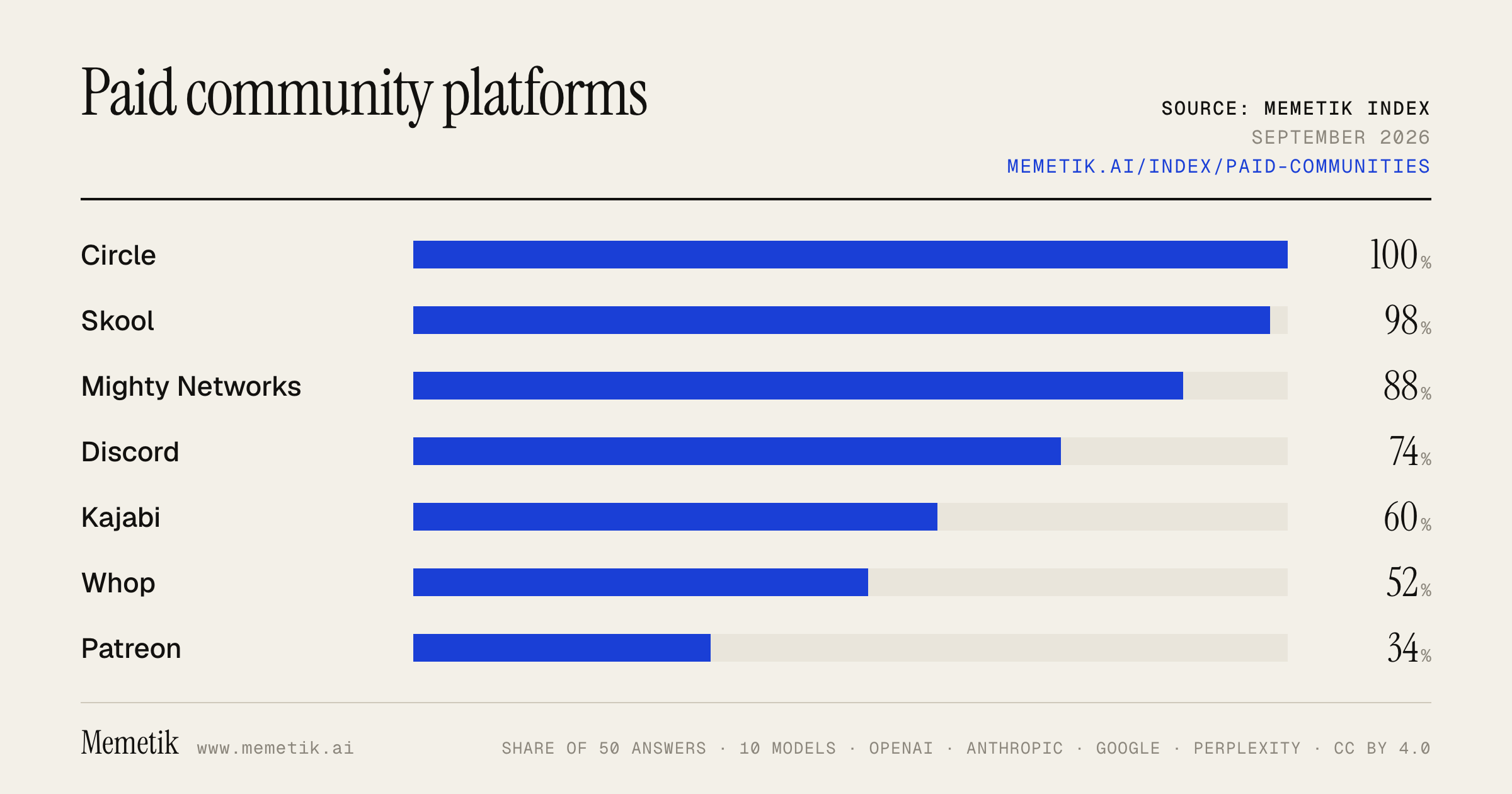
Where do AI models tell you to host a paid community?
Circle was named in 50 of 50 answers and came first in 30. Skool follows at 98%. 13 vendors were named at least once. First edition, so there is no prior period.
Answer share
5 prompts × 10 models · 50 answers
By provider
10 models · 50 answers
OpenAI 3 models · 15 answers
- GPT-5.6 Solgpt-5.6-solmost named: Circle 100%
- GPT-5.6 Terragpt-5.6-terramost named: Circle 100%
- GPT-5.6 Lunagpt-5.6-lunamost named: Circle 100%
Anthropic 3 models · 15 answers
- Claude Opus 5claude-opus-5most named: Circle 100%
- Claude Sonnet 5claude-sonnet-5most named: Circle 100%
- Claude Fable 5claude-fable-5most named: Circle 100%
Google 2 models · 10 answers
- Gemini 3.6 Flashgemini-3.6-flashmost named: Circle 100%
- Gemini 3.5 Flashgemini-3.5-flashmost named: Circle 100%
Perplexity 2 models · 10 answers
- Sonar Prosonar-promost named: Circle 100%
- Sonar Reasoning Prosonar-reasoning-promost named: Circle 100%
Sources the models cited
- youtube.com84
- circle.so47
- guideflow.com39
- mightynetworks.com38
- whop.com36
- linodash.com32
- communipass.com31
- ventureharbour.com30
- customerhub.com30
- group.app29
- reddit.com29
- standingongiants.com27
ChatGPT via API returns no citations, so it does not contribute here.
The prompts
- What is the best platform to run a paid community for a creator? Name specific products.
- Which platform to run a paid community would you recommend to a creator in 2026?
- Compare the top platform to run a paid community options right now.
- I'm a creator and I need a platform to run a paid community. What should I use and why?
- Best platform to run a paid community for a paid Discord-style community?
Every answer
Raw model output, unedited
GPT-5.6 TerraWhat is the best platform to run a paid community for a creator? Name specific products.
**Best overall for most creators: Circle.** It’s the strongest choice if you want a polished, branded paid community—not merely a chat server. It combines memberships and paywalls with courses, events, livestreams, discussions, member profiles, analytics, a website builder, and Stripe-based payments. Its Professional plan is listed at **$89/month**, so it makes most sense once you have a validated offer or an audience ready to pay. ([circle.so](https://circle.so/membership?utm_source=openai))

Other strong, specific options:

| Platform | Best for | Why choose it | Main trade-off |
|---|---|---|---|
| **Circle** | Premium creator memberships, coaching, courses | Best all-around branded experience; content + community + events + paid tiers in one system | Higher fixed monthly cost |
| **Skool** | Simple, course-led communities and validating an idea fast | Minimal setup, familiar feed/forum format, gamification and discovery | Less customizable and more “Skool-branded”; reported low entry price comes with revenue fee considerations |
| **Mighty Networks** | Communities where member-to-member connection, events, and mobile app matter | Strong native community structure, courses, events, livestreaming, and app options | Can feel more complex; price starts around $79/month according to its current materials ([mightynetworks.com](https://www.mightynetworks.com/resources/membership-site-platforms?utm_source=openai)) |
| **Patreon** | Artists, podcasters, writers, musicians, and existing fan audiences | Fastest way to start paid membership; familiar checkout, free followers, paid tiers, one-time digital products, chats | Less ownership and brand control; community experience is lighter than a dedicated platform ([patreon.com](https://www.patreon.com/product/paid-membership?utm_source=openai)) |
| **Kajabi** | Creators whose business is primarily courses and marketing funnels | Strong checkout, email marketing, landing pages, and course sales | Community is usually secondary to the funnel/course business |
| **Discord + Patreon** | Gaming, streaming, crypto, or real-time chat-heavy audiences | Low-friction, highly active chat and voice; Patreon can gate access | Harder to organize, search, onboard, and make feel premium at scale ([support.patreon.com](https://support.patreon.com/hc/en-us/articles/360027483391-Community-tools-for-my-members?utm_source=openai)) |
| **Memberful + WordPress** | Creators who already own a WordPress site | More control over site, content, and membership stack | Requires more technical setup and separate community software |

### My practical recommendation

- **You have an established audience and want a premium, long-term membership:** **Circle**
- **You sell transformation, accountability, group coaching, or a course community:** **Skool** if simplicity is the priority; **Circle** if brand and flexibility matter more.
- **You are an artist/podcaster/writer monetizing fans and exclusive content:** **Patreon**
- **Your community’s value is live conversation, voice, and constant activity:** **Discord**, ideally paired with Patreon or another membership tool.
- **Your core business is courses, lead magnets, and email funnels:** **Kajabi**
- **You need a more app-centric, social-network-like member experience:** **Mighty Networks**

A useful rule: **do not select based on features alone.** Pick the platform that matches the behavior you want:
- discussions/resources/events → **Circle**
- daily accountability + lessons → **Skool**
- fan support + exclusive releases → **Patreon**
- fast chat/voice → **Discord**
- courses + marketing automation → **Kajabi**

If I had to name only one product for a typical serious creator launching a paid community today, I’d choose **Circle**.
- https://circle.so/membership?utm_source=openai
- https://www.mightynetworks.com/resources/membership-site-platforms?utm_source=openai
- https://www.patreon.com/product/paid-membership?utm_source=openai
- https://support.patreon.com/hc/en-us/articles/360027483391-Community-tools-for-my-members?utm_source=openai
GPT-5.6 TerraWhich platform to run a paid community would you recommend to a creator in 2026?
**My default recommendation: Circle** — for a creator building a *premium, branded paid community* rather than simply selling access to a feed.

It is the best all-around choice when the community needs organized discussions, member directories, events, courses/resources, multiple membership tiers, and a polished experience that can grow beyond a small cohort. It is especially suited to professional, business, education, or niche-expertise communities where content needs to stay findable instead of disappearing in chat. ([creatoreconomy.org](https://creatoreconomy.org/playbooks/best-community-platforms-for-creators/?utm_source=openai))

That said, the right platform depends on what members are truly paying for:

| If the paid offer is mainly… | I’d choose | Why |
|---|---|---|
| A premium professional or expertise network | **Circle** | Best default for structure, branding, and a more configurable community experience. ([creatoreconomy.org](https://creatoreconomy.org/playbooks/best-community-platforms-for-creators/?utm_source=openai)) |
| Coaching, accountability, cohort learning, and daily participation | **Skool** | Its simple community + classroom model and built-in gamification make it strong when habitual engagement is the retention engine. ([creatoreconomy.org](https://creatoreconomy.org/playbooks/best-community-platforms-for-creators/?utm_source=openai)) |
| A mobile-first community with courses, live events, and a social-network feel | **Mighty Networks** | Strong fit for creators who want community, courses, events, and app-like member interaction in one ecosystem. ([mightynetworks.com](https://www.mightynetworks.com/resources/community-platforms?utm_source=openai)) |
| Fan memberships—bonus episodes, posts, behind-the-scenes access | **Patreon** | Best when the creator’s ongoing output and audience relationship are the product; community is secondary. ([creatoreconomy.org](https://creatoreconomy.org/playbooks/best-community-platforms-for-creators/?utm_source=openai)) |
| A course business that also needs email funnels and marketing automation | **Kajabi** | Choose it when the business is course-and-marketing-first, not when peer community is the core value. ([jeanmariecordaro.com](https://www.jeanmariecordaro.com/index.php/best-platforms-paid-communities-2026/?utm_source=openai)) |

### My practical rule

- **Pick Circle** if you want to build a durable, premium membership brand.
- **Pick Skool** if you want the simplest path to an engaging coaching/accountability community.
- **Pick Mighty Networks** if mobile usage, events, and a more social experience are non-negotiable.
- **Don’t start on Patreon or Discord** if your main promise is high-quality member-to-member connection. They can work well as acquisition or fan-support layers, but they are usually weaker foundations for a structured, high-ticket community. ([creatoreconomy.org](https://creatoreconomy.org/playbooks/best-community-platforms-for-creators/?utm_source=openai))

### Before committing

Run a small paid founding cohort—say 20–50 people—for 30–60 days. Evaluate the platform based on:

1. **Activation:** Do members introduce themselves and take a first useful action?
2. **Peer value:** Are members replying to one another without you carrying every conversation?
3. **Retention:** Would they still pay if you skipped one week of publishing?
4. **Operations:** Can you easily onboard, segment, moderate, host events, and export member data?
5. **Economics at scale:** Compare the subscription cost *and* transaction fees at your expected revenue level; the cheapest starting plan is not always cheapest after a few hundred members. ([cartmango.com](https://cartmango.com/community-platform-for-creators/?utm_source=openai))

If I were advising a creator with no further context, I’d launch a branded founding cohort on **Circle**, unless the offer is explicitly coaching/accountability-led—then I’d start on **Skool**.
- https://creatoreconomy.org/playbooks/best-community-platforms-for-creators/?utm_source=openai
- https://www.mightynetworks.com/resources/community-platforms?utm_source=openai
- https://www.jeanmariecordaro.com/index.php/best-platforms-paid-communities-2026/?utm_source=openai
- https://cartmango.com/community-platform-for-creators/?utm_source=openai
GPT-5.6 TerraCompare the top platform to run a paid community options right now.
## Best overall for a paid community: **Circle**

If your community itself is the product—not merely a bonus for a course—**Circle is the strongest all-around choice right now**. It combines paid memberships and access controls with discussions, events, livestreams, courses, landing pages, email, analytics, and automations under your own brand. Its published plans start at **$89/month** for Professional and **$199/month** for Business. ([circle.so](https://circle.so/platform?utm_source=openai))

### The top options compared

| Platform | Best for | Strengths | Trade-offs | Published starting price* |
|---|---|---|---|---|
| **Circle** | Serious paid memberships, cohorts, creator communities | Deep community structure, payments/access tiers, courses, events, branded site, email and workflows | More setup and a higher base cost than lightweight tools | **$89/mo** ([circle.so](https://circle.so/platform?utm_source=openai)) |
| **Mighty Networks** | Social, mobile-centric member communities | Strong peer-to-peer engagement, gamification, flexible Spaces, courses and events | Can feel more like a social network than a focused membership hub | **$79/mo** ([mightynetworks.com](https://www.mightynetworks.com/resources/community-platforms?utm_source=openai)) |
| **Skool** | Validating a simple coaching/community offer fast | Very simple community + classroom model and low entry price | Less brand control and business flexibility; its percentage fee becomes meaningful as revenue grows | **$9/mo + 10% fee** ([mightynetworks.com](https://www.mightynetworks.com/resources/community-platforms?utm_source=openai)) |
| **Kajabi** | Course-first businesses with marketing funnels | Excellent fit when email marketing, checkout, offers, and structured courses drive the business; paid/tiered community access is integrated | Community experience is generally secondary to the course-and-funnel system | **$143/mo** in current published comparisons ([kajabi.com](https://www.kajabi.com/product/communities?utm_source=openai)) |
| **Discord** | Real-time chat/voice communities, especially audiences already using it | Familiar, fast, inexpensive starting point | Weakest choice for a premium, polished, structured membership without additional payment/access tooling | Free base tier ([mightynetworks.com](https://www.mightynetworks.com/resources/community-platforms?utm_source=openai)) |

\*Platform pricing changes frequently; confirm at checkout before committing.

## My recommendation by situation

- **Choose Circle** if you want to build a durable, premium membership business with tiers, content, events, and a branded member experience. This is my default recommendation for most paid communities.
- **Choose Mighty Networks** if the transformation comes mainly from members meeting, posting, and connecting with one another—particularly if mobile engagement matters most.
- **Choose Skool** if you are launching your first paid group and want maximum simplicity. It is compelling for a quick test, but reassess once revenue grows because of the percentage-based fee. ([mightynetworks.com](https://www.mightynetworks.com/resources/community-platforms?utm_source=openai))
- **Choose Kajabi** if your real business is courses, coaching, and marketing automation, and the community supports that offer rather than being the primary value. Kajabi supports standalone, bundled, private, paid, and tiered community access. ([kajabi.com](https://www.kajabi.com/product/communities?utm_source=openai))
- **Use Discord only** if your audience already strongly prefers it and live chat/voice is the core benefit. For high-ticket or professional memberships, a dedicated platform usually creates a better perceived experience.

## Simple decision

**Starting from scratch? Pick Circle.**
**Selling a course-led program? Pick Kajabi.**
**Building a highly social, mobile community? Pick Mighty Networks.**
**Testing cheaply and quickly? Pick Skool.**

A practical rule: do not select based on feature count. Select based on the weekly member habit you are selling—structured learning, networking, live accountability, or rapid chat. The platform should make that habit effortless.
GPT-5.6 TerraI'm a creator and I need a platform to run a paid community. What should I use and why?
**My default recommendation: use Circle** if you want to build a real paid community under *your* brand—not merely sell supporter access.

Why Circle is the best fit for most serious creator memberships:

- It puts **community, paid tiers, courses, events, livestreams, member profiles, a website, and payments** in one branded place.
- You can sell **recurring, one-time, and tiered memberships**, including coupons, trials, affiliates, and Stripe Tax support.
- It gives you more control over the member experience than a social platform or chat server: organized spaces, searchable content, events, direct messaging, and a custom domain.
- Pricing currently begins at **$89/month** for Professional, with a **2% platform transaction fee**; its higher Business tier is $199/month with a 1% fee. ([circle.so](https://circle.so/pricing?utm_source=openai))

### Choose based on your stage

| If you are… | Use | Why |
|---|---|---|
| Building a premium membership, cohort, mastermind, education community, or coaching hub | **Circle** | Best all-around branded, community-first operating system. |
| Starting with an existing fan audience that already knows Patreon | **Patreon** | Fastest way to turn fans into paying members; includes memberships, posts, chats, DMs, email, video/livestreaming, and discovery. |
| Testing a low-priced group/coaching offer and want maximum simplicity | **Skool** | Lower-cost, deliberately simple community + course setup; less brand control and depth. |
| Selling courses first, with community as a supporting feature | **Kajabi** | Better when funnels, email marketing, and course sales are the center of the business rather than member-to-member interaction. |
| Running a free, high-velocity chat community | **Discord** | Great for live conversation, but I would not make it the primary home for a premium, structured membership unless your audience already lives there. |

### When Patreon is the better choice

Pick **Patreon** instead of Circle if your business is fundamentally “fans support my ongoing creative work” — for example, a podcast, musician, illustrator, YouTuber, writer, or media creator releasing exclusive work regularly. It is free to start, offers audience discovery, and handles membership tiers and community tools. But for creator pages published after **August 4, 2025**, Patreon’s standard platform fee is **10% of income**, before payment processing and other applicable fees. ([support.patreon.com](https://support.patreon.com/hc/en-us/articles/11111747095181-Creator-fees-overview?utm_source=openai))

That percentage matters as you grow. Ignoring payment-processing differences, Circle’s $89/month + 2% becomes cheaper than Patreon’s 10% platform cut at roughly **$1,113/month in membership revenue**. Below that, Patreon’s zero upfront software cost may be attractive; above it, Circle is often economically and strategically stronger.

### My practical call

- **You have a validated offer or expect to reach ~$1k/month quickly:** start on **Circle**.
- **You are just testing whether people will pay:** use **Skool** or Patreon, depending on whether the value is peer community/coaching (Skool) or creator support/exclusive content (Patreon).
- **You already have a Patreon audience:** don’t create unnecessary friction—start there, then migrate to Circle only when structure, branding, courses, events, or higher margins become important.

### Don’t choose the platform first—define the promise

A paid community succeeds because members can clearly answer: **“Why stay next month?”** Your recurring value should usually include at least two of:

1. Access to you: office hours, feedback, AMAs, coaching
2. Access to peers: introductions, accountability, networking
3. Ongoing outcomes: challenges, templates, curriculum, job leads, deal flow
4. Status/access: private rooms, early releases, member-only events

If your answer is mainly “a private chat,” use the simplest low-cost tool. If it is “a structured place where members learn, connect, attend events, and get results,” choose **Circle**.
GPT-5.6 TerraBest platform to run a paid community for a paid Discord-style community?
**Best overall: Circle** — if you want a *premium, professional, Discord-style community* that you fully brand and can grow into courses, events, live sessions, member directories, and multiple paid tiers.

Circle combines chat spaces and discussion areas with native paid memberships, trials, coupons, tiered access, affiliate tools, events, live rooms, and a branded web/mobile experience. Its Professional plan is currently listed at **$89/month plus a 2% transaction fee**. ([circle.so](https://circle.so/pricing?utm_source=openai))

### Choose based on your actual model

| If your priority is… | Best choice | Why |
|---|---|---|
| **A polished, branded paid membership business** | **Circle** | Best all-rounder; community + chat + courses + events + payments in one place. |
| **A true Discord-like chat culture / you already have a Discord server** | **Discord + Whop** | Keep Discord’s familiar real-time channel experience while Whop handles recurring billing, tiers, and access provisioning. ([docs.whop.com](https://docs.whop.com/memberships-and-access/access-discord-server/access-a-discord-server?utm_source=openai)) |
| **Simple community + course/coaching with strong gamification** | **Skool** | Very easy to operate; good for a creator-led group where lessons, challenges, and a feed matter more than sophisticated chat organization. Skool processes payments itself and currently offers Hobby and Pro plans with different transaction-fee structures. ([help.skool.com](https://help.skool.com/article/86-subscriptions-faq?utm_source=openai)) |
| **Fastest, lowest-friction start if members are already on Discord** | **Native Discord Server Subscriptions** | Built-in paid roles/perks, but generally less flexible as a full membership business and subject to Discord monetization eligibility. ([discord.com](https://discord.com/blog/server-and-creator-subscriptions?utm_source=openai)) |

### My recommendation

- **Starting a serious paid community from scratch:** **Circle**
- **Selling access to trading, gaming, creator, Web3, or highly chat-driven communities:** **Discord + Whop**
- **Selling coaching, education, accountability, or a course-led membership:** **Skool**

### One important caveat

Don’t choose Discord purely because it is inexpensive. It is excellent for rapid conversation, but paid communities often become hard to navigate: valuable answers disappear in channels, onboarding is weaker, and course/event/member-profile experiences are fragmented. Circle costs more but gives members a clearer feeling that they are paying for a structured product—not merely access to another chat server.

If you tell me your niche, expected member count, price point, and whether you need courses/events, I can give you a single platform recommendation and a suggested paid-tier setup.
Claude Sonnet 5What is the best platform to run a paid community for a creator? Name specific products.
There's no single "best" platform — it depends on how you want to run the community (chat-first, course-first, forum-first) and how much you want to spend. Here are the main ones creators actually use, based on current comparisons:

**Skool**
Popular for gamified coaching and accountability communities — combines a simple forum/feed with courses, leaderboards, and points.
Skool is often ranked best for gamified coaching and accountability groups.
 Flat pricing (~$99/mo) makes it a favorite for coaches and cohort-based programs.

**Circle**
Widely considered the top all-in-one option for creator-led communities.
Circle is an all-in-one branded community platform built for creators and businesses that want memberships, courses, events, and discussion in one place, shipping with a website builder, native payments, and structured spaces so you can run a paid community without stitching together three separate tools.
 Worth noting:
Circle and Skool are strong for solo creators, but both stack transaction fees on paid memberships, and Circle reserves custom SSO for its top custom-priced tier.


**Mighty Networks**
Good if you want your own branded mobile app and network-effect features.
With a Mighty Network, creators get all the tools they need to build a thriving community, and can monetize their following using custom Spaces that let you add courses, live events, live streaming, discussions, messaging, or long-form content — building a powerful creator business around your content.


**Kajabi**
Best if courses/marketing funnels are as important as the community itself —
it's often positioned as the best all-in-one for course creators who need marketing tools.


**Discord**
Still
the best free option for real-time communities
, and can be monetized via paid roles/subscriptions, though it lacks native course/content structure.

**Patreon**
Best suited to creators whose community is secondary to ongoing content/support —
it's widely used by creative professionals like YouTubers, webcomic artists, gamers, writers, podcasters, and musicians; getting started is free, but for paid memberships 10% of your income goes to Patreon.


**Podia**
A lighter-weight, budget-friendly option —
it's great for individual creators, creative professionals, writers, educators, and digital product sellers who want to build and manage exclusive membership communities.


**Newer/niche options** worth knowing about: **Heartbeat** (event/cohort-driven communities), **Nas.io** and **CommuniPass** (WhatsApp/Telegram-based paid groups popular outside the US), and **GroupApp** (positions itself against per-transaction fees for higher-revenue creators).

### Quick recommendation logic
- **Want simple, gamified, chat+course hybrid at low cost?** → Skool
- **Want the most polished, fully-branded, feature-rich option?** → Circle
- **Want your own mobile app and strong network effects?** → Mighty Networks
- **Courses are your main product, community is secondary?** → Kajabi or Thinkific
- **Want free/real-time chat with no upfront cost?** → Discord
- **Community is just a perk around ongoing content (podcast, art, videos)?** → Patreon

If you tell me your niche, audience size, and whether courses/events matter as much as discussion, I can narrow this down to one specific pick.
- https://idarb.com/2026/06/20/best-online-community-platforms-creators-educators-2026/
- https://www.guideflow.com/blog/user-community-platform
- https://bettermode.com/blog/all-in-one-community-platform
- https://www.mightynetworks.com/resources/community-platform-for-creators
- https://www.learnworlds.com/blog/community-building/best-community-platforms/
Claude Sonnet 5Which platform to run a paid community would you recommend to a creator in 2026?
Based on current 2026 comparisons, there's no single "best" platform — it really depends on what kind of community you're running, your budget tolerance for fees, and where your audience already hangs out. Here's a practical breakdown:

## Top picks by scenario

**Skool** — Best if you want simplicity and speed to launch.
Skool is an all-in-one community platform built around simplicity, with a deliberately minimal interface: a feed, courses, a calendar, and a gamified leaderboard, making it fast to launch and suited to creators who value getting live over configuring every setting.
 The tradeoff:
the lowest starting price is Skool's Hobby tier at $9/month, but it comes with higher transaction fees of 10% plus $0.30 per sale.


**Circle** — Best all-around choice for creators who want courses + community + events in one branded space.
Circle has become the go-to community platform for creators, educators, and brands who want a dedicated space to build engaged communities, with structured spaces for discussions, courses, events, live rooms, and resource libraries — all within one branded community, keeping communities organized even as they grow to thousands of members.
 It's also expanding into a broader business suite —
it has grown beyond being just a community platform into a full digital business suite, letting you build website pages as a storefront or landing pages, and run end-to-end email campaigns with broadcasts or automated workflows.
 Note that
email marketing isn't included in Circle's base plans.
 Also worth knowing:
Circle and Skool are strong for solo creators, but both stack transaction fees on paid memberships, and Circle reserves custom SSO for its top custom-priced tier.


**Discord (+ a payment layer like Whop or DoorFee)** — Best if your audience already lives there (gaming, trading, crypto, tech, fitness/creative niches).
If your audience lives on Discord — and for gaming, trading, crypto, tech, and a growing number of fitness and creative communities, they do — building your paid community on Discord makes sense since you're not asking people to download a new app or create a new account.
 The general principle here matters beyond just Discord:
the most important question isn't "which platform has the best features?" It's "where do your members already spend time?"


**Mighty Networks** — Best if you want a fully white-labeled, branded app experience.
If you want a fully branded experience with your own app, Mighty Networks or Circle's higher-tier plans are the move.


**Whop** — Best if you want built-in discovery/marketplace exposure.
Whop is best for sellers who want a marketplace and don't mind higher fees — it started as a reselling platform and evolved into a broader marketplace for digital products and communities, including its own marketplace where buyers can discover your community, a genuine advantage if you don't have an existing audience.


**Bettermode** — Really built more for B2B SaaS customer communities than solo creators, so worth skipping unless that's your use case.
Bettermode fits B2B SaaS teams that need a customer community platform for support deflection, feedback, and education, with customization and API depth that suit product teams wanting control — creators running paid course businesses will find a course-first platform closer to their model.


## My actual recommendation

If you're a typical creator (coach, course seller, niche expert building a paid membership) in 2026, I'd say:

1. **Start with Skool or Circle.** Skool if you want to launch fast with minimal setup and don't mind slightly higher transaction fees; Circle if you want more branding control, richer content structure, and plan to scale into a real digital business (courses, events, email).
2. **Default to Discord** only if your specific audience already congregates there — the golden rule from experienced community builders is
the best platform is the one your specific members will actually use
, not the one with the most features.
3. **Consider Whop** if you're starting from zero audience and want marketplace discovery to help you find your first paying members.

One overarching point worth internalizing:
a paid community platform comparison that ignores delivery channel flexibility is missing the variable most correlated with member retention
 — so before picking a tool, get clear on whether your members want a dedicated app, a chat-first experience, or something that blends courses with discussion.
- https://www.guideflow.com/blog/user-community-platform
- https://ventureharbour.com/best-community-software/
- https://www.customerhub.com/post/paid-community-platforms
- https://linodash.com/community-platforms/
- https://bettermode.com/blog/all-in-one-community-platform
- https://medium.com/@doorfee/best-tools-for-running-a-paid-community-in-2026-discord-telegram-and-beyond-df02bb54b1d5
- https://communipass.com/blog/paid-community-platform-comparison/
Claude Sonnet 5Compare the top platform to run a paid community options right now.
Based on current comparisons, three platforms consistently come out on top for running a **paid** community, but they suit different needs. Here's how they stack up:

## Circle
**Best for:** Premium, branded creator communities that want an all-in-one hub.

Circle is a subscription-based community platform with unlimited members on every tier and built-in monetisation tools, making it popular with creators running paid or private communities.

Circle excels at giving you structured spaces for different types of activity — separate spaces for discussions, courses, events, live rooms, and resource libraries, all within one branded community, so members navigate easily between content types without confusion, keeping communities organized even as they grow to thousands of members.
 It also
supports native events with scheduling, time zone handling, automatic reminders, built-in live streaming, and full white-labeling with branded mobile apps on higher plans.


The catch:
Circle stacks transaction fees on paid memberships, and reserves custom SSO for its top custom-priced tier.
 Email marketing is also a separate add-on —
there's a catch: email marketing isn't included in Circle's base plans.


## Skool
**Best for:** Creators who want to launch fast without fiddling with settings.

Skool is an all-in-one community platform built around simplicity — a feed, courses, a calendar, and a gamified leaderboard. That focus makes it fast to launch and easy for members to understand without a tour. Skool suits creators who value getting live over configuring every setting.

There is no free tier.


The tradeoff is cost at scale:
Skool's Hobby tier starts at $9/month, but it comes with higher transaction fees of 10% plus $0.30 per sale.
 That fee structure can eat significantly into revenue for larger paid communities compared to flat-fee competitors.

## Mighty Networks
**Best for:** Community-first experiences with light course delivery.

Mighty Networks centers everything around an activity feed, with chat, events, and a lightweight course library to keep members moving without overwhelm.
 It's a strong middle ground if you want more community "feel" than Skool's leaderboard-driven approach, without needing Circle's deeper structural complexity.

## Honest Mention: Kajabi
If your paid offer is really a course business with a community bolted on, Kajabi is often recommended instead — but not for community itself:
communities exist on Kajabi, but it shines most for course-led businesses, with website, funnels, email, and payments all bundled
. Reviewers note it has
weak features when it comes to running a community, even though you can sell one effectively
 (referring to Kajabi specifically, per the source's structure).

## Bottom line
- **Choose Circle** if you want the most polished, scalable, branded paid-community experience and don't mind higher price/complexity.
- **Choose Skool** if speed-to-launch and simplicity matter more than fee optimization, and you're comfortable with the 10%+$0.30 transaction cut.
- **Choose Mighty Networks** if you want a community-feed-first vibe with courses as a secondary feature rather than the main event.

For most people asking "what's the *top* platform right now," **Circle** tends to edge out as the go-to for serious, growing paid communities
because it has become the go-to community platform for creators, educators, and brands who want a dedicated space to build engaged communities
 — while **Skool** wins for solo creators prioritizing simplicity and fast setup over long-term fee efficiency.
- https://ventureharbour.com/best-community-software/
- https://www.customerhub.com/post/paid-community-platforms
- https://bettermode.com/blog/all-in-one-community-platform
- https://linodash.com/community-platforms/
- https://www.guideflow.com/blog/user-community-platform
- https://whop.com/blog/online-community-platforms/
Claude Sonnet 5I'm a creator and I need a platform to run a paid community. What should I use and why?
There are several solid options for running a paid community, and the right choice depends on your priorities (features, cost, control, existing audience, etc.). Here's a breakdown of the major platforms:

## Top Options

**Skool**
A popular all-in-one platform combining community discussion, courses, and gamification (points/levels leaderboard). Known for being clean and simple, with a flat monthly fee regardless of how many members you have—appealing if you plan to scale.

**Circle**
A polished, highly customizable community platform with spaces for discussions, courses, events, and live streams. Strong branding/white-label options and integrates well with email and other tools. Popular with coaches, course creators, and membership businesses.

**Discord**
Free to use with paid tiers for members via bots/integrations (like Patreon integration) or Discord's own monetization features. Great for real-time chat, voice, and highly engaged niche communities—especially gaming, tech, or younger audiences. Less polished for "course-like" structured content.

**Mighty Networks**
Community + courses + native mobile apps (branded as your own app) under one roof. Good if you want members to have an app-like experience without building one yourself.

**Patreon**
Simpler, more like a membership/subscription tool than a full community platform. Great if your "community" is more about tiered content access (posts, videos, behind-the-scenes) rather than deep discussion/interaction. Has some community features but they're less robust than Circle/Skool.

**Kajabi**
Best if you want courses + community + email marketing + landing pages bundled together. More expensive, but very much an all-in-one business tool.

**Slack**
Free/cheap for small paid communities, familiar interface, but not built for public-facing community monetization—you'd need to bolt on payment via Stripe or another tool manually.

## How to Choose

- **Want simplicity + flat pricing as you scale?** → Skool
- **Want deep customization/branding?** → Circle
- **Want real-time chat/voice, especially for gaming or tech niches?** → Discord
- **Want your own branded mobile app?** → Mighty Networks
- **Want tiered content delivery over deep interaction?** → Patreon
- **Want courses + marketing + community bundled?** → Kajabi

If you want, tell me more about your community's format (course-driven? Discussion-heavy? Live events? Niche topic?) and expected size, and I can help narrow down the best fit.
Claude Sonnet 5Best platform to run a paid community for a paid Discord-style community?
Choosing a platform for a paid community depends on what kind of experience you want to offer. Here's a breakdown of the top options in 2026:

## Discord Itself
Discord remains popular for paid communities, especially when paired with a payment/membership tool like **Whop**, **Patreon**, or **Discord's own Server Subscriptions** feature (available to eligible servers). Pros: familiar chat-based UX, great for real-time engagement, voice channels, and gaming/creator communities. Cons: poor content organization, hard to monetize natively without third-party tools, and content gets buried in chat history.

## Circle
Circle is one of the most popular dedicated "community platform" alternatives to Discord for paid memberships. It combines forums, chat, courses, events, and native payments in one branded space (no Discord/Slack UI). Great for coaches, creators, and businesses wanting a polished, ad-free, fully branded experience with built-in monetization (subscriptions, one-time payments, tiers).

## Skool
Skool has become extremely popular for paid communities, particularly among course creators and coaches. It combines community discussion feeds, courses, and gamification (points/leaderboards) in a very simple interface, with straightforward monetization built in.

## Mighty Networks
Mighty Networks is another strong option, especially if you want to combine community + courses + events + native apps (iOS/Android) under your own brand. It has robust monetization options including tiered memberships.

## Whop
Whop has grown as a marketplace/infrastructure layer specifically for monetizing Discord servers (and other digital products), handling payments, access control, and even acting as a storefront. If you want to keep using Discord itself but need a clean way to sell subscriptions/access, Whop is a common choice.

## Patreon
Patreon works well if your paid community is more about supporting a creator (with Discord as a perk) rather than the community being the core product itself.

---

### Quick recommendation:
- **Want to keep Discord's real-time chat feel** but add paid gating → **Discord + Whop** or **Discord + Patreon**
- **Want a more organized, branded, all-in-one paid community (forums + courses)** → **Skool** (simplicity, great for creators/coaches) or **Circle** (more customizable, professional branding)
- **Want mobile apps + video content + tiered plans** → **Mighty Networks**

If you let me know your audience type (gaming, coaching, SaaS, courses, etc.) and whether real-time chat or structured content matters more, I can narrow this down further.
Gemini 3.6 FlashWhat is the best platform to run a paid community for a creator? Name specific products.
There is no single "best" platform for running a paid community, as the right choice depends on your specific business model—whether you prioritize gamification, custom branding, course delivery, or low fees.

Specific platforms stand out as top performers based on common creator needs:

---

### 1. **Skool** — Best for Gamification & High Engagement
* **Ideal for:** Creators offering coaching, cohort-based programs, or gamified memberships.
* **Key Features:** Combined community post feed, classroom (courses), calendar, and built-in leaderboards/gamification.
* **Why creators choose it:** Extreme simplicity. The UI is intentionally distraction-free, and members unlock course content or rewards as they post and engage, driving high retention.
* **Pricing:** Simple flat rate (around $99/month per community).

### 2. **Circle.so** — Best for Premium Branding & Customization
* **Ideal for:** Creators, educators, and brands looking for a polished, highly customizable ecosystem.
* **Key Features:** Nested spaces, native live streaming, event calendars, rich course modules, direct messaging, and workflow automations.
* **Why creators choose it:** It looks and feels like a bespoke, modern SaaS product under your own custom domain. It integrates seamlessly with existing tech stacks (like WordPress or Webflow) or operates standalone.
* **Pricing:** Tiered monthly plans based on features, admin roles, and usage.

### 3. **Mighty Networks** — Best for Scalable Networks & Native Mobile Apps
* **Ideal for:** Large-scale communities, multi-tiered memberships, or creators who want a custom branded app.
* **Key Features:** Feed-based community spaces, native courses, live streaming, AI-powered member matching, and paid tiers/upsells.
* **Why creators choose it:** *Mighty Pro* allows creators to launch their own white-labeled iOS and Android apps. It is designed to scale complex communities with subgroup structures.
* **Pricing:** Tiered plans, with high-end options for white-label native apps.

### 4. **Heartbeat** — Best for Cohorts, Events, & Deep Tool Integrations
* **Ideal for:** Cohort-based course creators, incubators, and operational communities.
* **Key Features:** Real-time chat channels, docs/knowledge bases, event hosting, voice rooms, and built-in Zoom/Notion/Google Drive integrations.
* **Why creators choose it:** Excellent middle-ground between a forum and a real-time chat app (like Discord) with built-in tools for matching members for 1-on-1 chats and organizing live events.
* **Pricing:** Tiered pricing structure based on total active members.

### 5. **Patreon / Substack** — Best for Content-First Creators & Low Overhead
* **Ideal for:** Podcasters, writers, YouTubers, and artists who primarily monetize exclusive content rather than heavy community discussion.
* **Key Features:** Paywalled posts/newsletters, podcast RSS feeds, tier-based perks, and simple subscription management.
* **Why creators choose it:** No upfront monthly software costs—both platforms monetize via a revenue-share model (taking a percentage of earnings), making them zero-risk to launch.

---

### How to Choose:
* **Go with Skool** if you want maximum member participation and a friction-free layout.
* **Go with Circle** if you want sleek design, live events, and control over branding.
* **Go with Mighty Networks** if you want native mobile apps or complex multi-tier spaces.
* **Go with Substack/Patreon** if you want to sell exclusive content/podcasts without managing active message boards.
Gemini 3.6 FlashWhich platform to run a paid community would you recommend to a creator in 2026?
Choosing the right platform to run a paid community depends heavily on your **content type, target audience, and engagement style**.

Here are the top platforms for creators, categorized by their greatest strengths:

---

### 1. **Skool** — *Best for High Engagement & Gamification*
If your goal is to keep members active, complete courses, and interact with each other, **Skool** is one of the strongest options.
* **Why creators love it:** Simple, distraction-free UI that combines community posts, a course classroom, an event calendar, and a leaderboard into one seamless layout.
* **Key Feature:** Built-in gamification (members unlock perks/courses as they post, like, and level up).
* **Pricing:** Simple flat rate (~$99/month) plus standard payment processing fees.
* **Best for:** Course creators, coaches, and creators who want an easy-to-use community without complex setup.

---

### 2. **Circle.so** — *Best for Premium Branding & Customization*
If you want a polished, professional community platform that feels like an extension of your own brand website, **Circle** is the industry standard.
* **Why creators love it:** Highly customizable spaces (chat, posts, events, courses, paywalls) and excellent integrations (Zapier, ConvertKit, Teachable, website embeds).
* **Key Feature:** Flexible monetization options (recurring subscriptions, one-time payments, upsells, tiers) and customized mobile apps (at higher tiers).
* **Pricing:** Tiered plans starting around $49/mo, scaling up based on members and advanced features.
* **Best for:** Established creators, B2B networks, membership sites, and brand-first communities.

---

### 3. **Mighty Networks** — *Best for Native Mobile Apps & Complex Networks*
If your community heavily relies on a mobile-first experience or has multiple sub-groups and sub-topics, **Mighty Networks** shines.
* **Why creators love it:** Strong organizational tools ("Spaces"), live streaming, events, and courses built-in. You can also upgrade to **Mighty Pro** to get your own branded iOS/Android apps in the app stores.
* **Key Feature:** AI community assistance (helps spark discussions, organize spaces, and draft content) and deep activity feeds.
* **Pricing:** Tiered subscription plans starting around $39/mo.
* **Best for:** Mobile-focused audiences, large multi-topic communities, and creators building a dedicated brand app.

---

### 4. **Discord + Whop (or LaunchPass)** — *Best for Real-Time Chat & Niche Communities*
If your audience prefers instant messaging over forum-style feeds, pairing **Discord** with a monetization infrastructure like **Whop** is a popular path.
* **Why creators love it:** Discord is free, ultra-familiar to younger/tech-savvy audiences, and supports voice, video, and text channels. Whop acts as the storefront and access manager.
* **Key Feature:** Automated role management (members get instant Discord access upon paying and are removed if they cancel).
* **Pricing:** Free to host on Discord; Whop takes a small transaction fee (~3%).
* **Best for:** Trading, tech, gaming, crypto, Gen Z audiences, or fast-paced interactive hubs.

---

### 5. **Substack / Beehiiv** — *Best for Newsletter & Writing-First Creators*
If your main form of content is written (articles, deep dives, industry reports), starting with a newsletter platform that includes community chat/comments is usually better than launching a separate forum.
* **Why creators love it:** Frictionless onboarding—readers are already paying for your content and can participate in paywalled comments and chat threads right inside the app or email inbox.
* **Best for:** Writers, journalists, analysts, and thought leaders.

---

### How to Pick the Right One for You

| Your Priority | Recommended Platform |
| :--- | :--- |
| **Highest member retention & course completion** | **Skool** |
| **Sleek website look & custom integrations** | **Circle** |
| **Branded iOS/Android App** | **Mighty Networks** |
| **Real-time chat & low software costs** | **Discord + Whop** |
| **Written content / Newsletter monetization** | **Substack** or **Beehiiv** |

**Recommendation:**
* Choose **Skool** if you want something simple to set up that keeps members hooked via gamification and built-in courses.
* Choose **Circle** if you care deeply about white-label branding, custom design, and embedding the community into your existing tech stack.
Gemini 3.6 FlashCompare the top platform to run a paid community options right now.
When choosing the best platform to run a paid community, the right choice depends heavily on your business model—whether you prioritize **gamification, custom branding, live real-time chat, all-in-one course funnels, or simple content tiers.**

Here is a comparison of the top platforms today:

---

### 1. Skool
**Best For:** High engagement, simplicity, and gamified communities.

* **Overview:** Created by Sam Ovens and backed heavily by Alex Hormozi, Skool has exploded in popularity. It combines a community feed, classroom (courses), calendar, and leaderboard into one streamlined interface.
* **Key Features:**
  * Built-in gamification (members earn points by posting/replying, which unlocks higher levels and exclusive content).
  * Extremely clean, distraction-free layout (no complex settings).
  * Native search, member discovery, and auto-recurring subscriptions via Stripe.
* **Pricing:** Flat **$99/month per community** (includes all features, unlimited members, and unlimited courses).
* **Pros:** Unmatched engagement due to gamification; ultra-fast set up.
* **Cons:** Minimal design customization; no native video hosting for courses (requires YouTube/Vimeo embeds); no native real-time chat spaces.

---

### 2. Circle.so
**Best For:** Premium, highly customized communities and high-ticket cohorts.

* **Overview:** Circle is widely considered the gold standard for creator-led and modern brand communities. It looks like a hybrid between Slack and Facebook Groups, seamlessly embedded with your brand.
* **Key Features:**
  * Flexible "Spaces" for discussions, group chats, events, announcements, and courses.
  * Live events with native video hosting, automatic recordings, and RSVP management.
  * Custom domain, deep embeds into existing websites, and white-labeling options.
* **Pricing:** Starts around **$89/month** (Basic) up to **$219/month+** for Advanced features.
* **Pros:** Highly customizable; robust course and live event tools; powerful automated workflows and paywalls.
* **Cons:** Can feel complex to set up; higher total cost as member counts and feature needs scale.

---

### 3. Mighty Networks
**Best For:** Mobile-first communities and creators who want their own native mobile app.

* **Overview:** Mighty Networks focuses heavily on network effects and bringing people together based on location, interests, and activity within your spaces.
* **Key Features:**
  * "Spaces" structure for organizing feeds, chat, courses, and events under one roof.
  * AI-powered community building tools (Mighty Co-Host).
  * **Mighty Pro:** Option to publish your own branded, standalone app on the iOS and Google Play stores.
* **Pricing:** Starts at **$41/month** (Community plan), courses at **$99/month** (Business plan), and **Mighty Pro** for custom apps (enterprise pricing).
* **Pros:** Superior mobile experience; strong native activity feeds; powerful options for global or location-based member networking.
* **Cons:** Web UI can sometimes feel cluttered compared to Skool or Circle; higher tier needed for full course/chat functionality.

---

### 4. Whop (+ Discord or Telegram)
**Best For:** Trading, gaming, tech-savvy audiences, and high-frequency real-time chat.

* **Overview:** Whop is a marketplace and digital store infrastructure that integrates directly with platform engines like Discord, Telegram, or Whop's native apps.
* **Key Features:**
  * Instant paywalls for Discord roles, Telegram groups, software, and digital downloads.
  * Built-in marketplace for organic discovery of your community.
  * Crypto and fiat payment options.
* **Pricing:** **Free monthly fee**, but takes a **3% transaction fee** on sales.
* **Pros:** Zero upfront cost; best for communities centered around instant messaging and real-time alerts; affiliate marketing tools built-in.
* **Cons:** Discord/Telegram environments can feel chaotic for non-tech-savvy members; less suited for structured asynchronous learning.

---

### 5. Kajabi
**Best For:** All-in-one creators who want email marketing, landing pages, funnels, and courses alongside a community.

* **Overview:** Kajabi is an established behemoth for online course creators. Its updated "Kajabi Communities" product offers robust community spaces within its broader marketing ecosystem.
* **Key Features:**
  * Full marketing engine (sales pages, email automation, upsells, landing page builder).
  * Native live calls, meetups, challenges, and leaderboards inside the community feature.
  * Seamless integration between courses, marketing funnels, and paid access.
* **Pricing:** Starts at **$149/month** (Basic) up to **$399/month** (Pro).
* **Pros:** No third-party tools needed (replaces ActiveCampaign, Teachable, and Circle); built for monetization and sales funnels.
* **Cons:** Expensive; community-only experience isn't as specialized as dedicated community tools like Circle or Skool.

---

### Quick Comparison Matrix

| Platform | Best For | Standout Feature | Pricing Model |
| :--- | :--- | :--- | :--- |
| **Skool** | Gamified engagement & simple cohorts | Leaderboards & Level-unlocks | $99/mo flat |
| **Circle** | Premium custom branding & live events | Customizable spaces & live hosting | $89 - $219+/mo |
| **Mighty Networks**| Mobile-first & branded iOS/Android apps | Mighty Pro (your own app) | $41 - $99+/mo |
| **Whop + Discord** | Trading, tech, real-time messaging | Low fee structure & Discord roles | Free (3% fee) |
| **Kajabi** | All-in-one digital product ecosystem | Complete sales & email funnels | $149 - $399+/mo |

---

### How to Choose:

1. **Choose Skool** if your primary goal is maximizing active daily engagement, keeping things simple, and hosting standard courses.
2. **Choose Circle** if you are building a high-end corporate/coaching brand where customized design, event management, and rich media matter most.
3. **Choose Mighty Networks** if most of your members will interact via smartphones, or if you want your own standalone App Store app.
4. **Choose Whop / Discord** if your community relies on fast, high-volume real-time messaging (e.g., day trading, reselling, gaming, tech).
5. **Choose Kajabi** if you don't want to stitch together different software tools for emails, sales pages, courses, and payments.
Gemini 3.6 FlashI'm a creator and I need a platform to run a paid community. What should I use and why?
Choosing the right platform for a paid community depends heavily on what kind of content you create, how much control you want, and your budget/pricing structure.

Here are the top platforms currently available, along with their key strengths, drawbacks, and who they are best for:

---

### 1. Circle (Best Overall for Course Creators & Dedicated Communities)
Circle is built specifically for creators who want an all-in-one community hub with a clean, modern interface (similar to a blend of Slack and a forum).

* **Key Features:** Paid tiers/memberships, nested spaces/channels, direct messaging, native live streaming, built-in course hosting, and event calendars.
* **Pricing Model:** Flat monthly subscription (starts around $49–$99/month) plus standard credit card processing fees (Stripe). No transaction cut on higher tiers.
* **Why use it:** It keeps your brand front and center with white-labeling and custom domains. Your audience stays entirely on *your* platform without distractions.
* **Best for:** Creators who teach courses, host regular live events, or want a professional, dedicated home for their brand.

---

### 2. Skool (Best for Gamification, Simplicity & Cohort Courses)
Co-founded by Sam Ovens and popularized by creators like Alex Hormozi, Skool combines community, courses, and gamification into a single, straightforward dashboard.

* **Key Features:** Leaderboards, point systems unlocked by engagement, a unified community feed, calendar for events, and integrated video course hosting.
* **Pricing Model:** Flat $99/month per group + 2.9% + $0.30 transaction fee.
* **Why use it:** Gamification naturally keeps members active and posting. The interface is extremely simple and easy for non-tech-savvy members to navigate.
* **Best for:** Creators whose primary goal is high engagement, friendly competition, and selling cohort-based or video courses.

---

### 3. Skool vs. Circle Alternatives for Simple Subscriptions

#### **Patreon / Substack**
* **Why use it:** Extremely low friction—almost everyone already has a Patreon or Substack account.
* **Pricing Model:** Take a percentage of your monthly revenue (e.g., Patreon takes 8%–12% + processing; Substack takes 10% + processing).
* **Best for:** Podcasters, writers, artists, or YouTubers who offer simple perks, exclusive posts, or early-access content rather than an interactive chat room.

#### **Discord + Whop / LaunchPass**
* **Why use it:** If your audience is already on Discord (gamers, tech enthusiasts, crypto/trading groups, younger demographics), using a payment bot like **Whop** allows you to sell access to private Discord roles and channels.
* **Pricing Model:** Discord is free; platforms like Whop charge a low transaction fee (around 3%).
* **Best for:** Fast-paced real-time chat, voice channels, and audiences already comfortable with Discord.

#### **Mighty Networks**
* **Why use it:** Very similar to Circle, but places a heavier emphasis on native iOS/Android mobile apps and network building.
* **Pricing Model:** Monthly/annual subscription (starts around $41–$99/month) + transaction fees on lower plans.
* **Best for:** Creators who need a robust mobile app experience for their members.

---

### How to Choose: Decision Framework

1. **Choose Circle if:** You want a clean, professional, custom-branded hub that combines courses, events, discussions, and live video.
2. **Choose Skool if:** You want high daily user engagement through gamification and a simple, single-page interface.
3. **Choose Discord + Whop if:** Your audience is under 30 or heavy gamers/tech users who prefer real-time chat and voice hangouts over forums.
4. **Choose Patreon / Substack if:** You just want to monetise a newsletter or bonus audio/video content without managing an active chat forum.

***

**To help narrow it down:**
* What type of content do you create (e.g., video courses, live streams, newsletters, chat)?
* What platform/social channel does your audience currently live on?
Gemini 3.6 FlashBest platform to run a paid community for a paid Discord-style community?
The best platform for running a paid, **Discord-style** community depends on whether you want to **host directly on Discord itself using a payment gateway** or use an **all-in-one platform with a chat-first UI**.

The top choices fall into three distinct categories:

---

### Category 1: Real Discord + Payment Management Layer
*Best if you want the actual Discord interface, voice channels, and bot ecosystem.*

#### 1. **Whop** (Top Overall for Discord Monetization)
* **How it works:** Whop acts as a marketplace and checkout system that integrates natively with Discord. When someone purchases access on Whop, the bot automatically grants them roles in your Discord server and revokes them if they cancel. You can also host content (courses, ebooks) directly on Whop alongside your Discord.
* **Pricing:** 3% fee per transaction (no fixed monthly fee).
* **Best for:** Trading/finance groups, gaming communities, crypto, digital products, and creators who want zero upfront cost.

#### 2. **LaunchPass**
* **How it works:** A lightweight, reliable paywall tool specifically built for Discord and Slack. It handles automated role assignments, subscription billing via Stripe, and member management.
* **Pricing:** $29/month base fee + Stripe processing fees (or custom enterprise tiers).
* **Best for:** Creators who want a simple, predictable monthly fee without percentage-based cuts on high volume.

---

### Category 2: Modern All-in-One Alternatives (Discord-Style UI)
*Best if you want to own the platform, host courses, avoid Discord’s "gamer" association, and keep everything under your own brand.*

#### 3. **Heartbeat**
* **Why it feels like Discord:** It features real-time chat channels, voice channels, and pop-in voice rooms—giving it the exact "hangout" feel of Discord.
* **Why it’s better for business:** Includes native course builders, event calendars, direct billing via Stripe, and an organized document library.
* **Pricing:** Starts around $49/month.
* **Best for:** Masterminds, cohorts, and creators who want Discord’s real-time chat and voice features without the clutter of a third-party app.

#### 4. **Circle**
* **Why it works:** While more forum-based, Circle includes real-time group chat channels, live streaming, event hosting, and course modules.
* **Pricing:** Starts around $89/month.
* **Best for:** Premium paid memberships, professional networks, and creators who want high-end customization and mobile apps.

---

### Category 3: Lightweight, Gamified Alternatives

#### 5. **Skool**
* **Why it works:** Popularized for paid communities, Skool relies on a feed/forum structure (closer to Facebook Groups or Reddit than Discord), combined with gamification (leaderboards, unlockable content), courses, and a calendar.
* **Pricing:** $99/month per group.
* **Best for:** Course-heavy communities, coaching, and communities driven by engagement rewards.

---

### Summary Recommendation

* **If your audience is tech-savvy, gamers, or traders:** Use **Discord + Whop** (or LaunchPass). It keeps setup costs low and leverages an app your members already use daily.
* **If you want a Discord feel (voice + real-time chat) for a professional audience:** Choose **Heartbeat**.
* **If you care more about structured discussion, courses, and high-ticket memberships:** Choose **Circle** or **Skool**.
Sonar ProWhat is the best platform to run a paid community for a creator? Name specific products.
For most creators running a **paid community**, **Circle** is the strongest overall choice because it combines memberships, courses, events, and a polished branded experience in one platform.[1][4][10][16] If you want a simpler, more engagement-driven community, **Skool** is a popular alternative; if your business is course-heavy, **Kajabi** is often the better all-in-one option.[1][6][10][11]

The best specific product depends on your model:

- **Circle** — best overall for premium paid communities, branded memberships, and course-backed communities.[1][4][10][16]
- **Skool** — best for simple paid communities with strong engagement and built-in gamification.[1][9]
- **Mighty Networks** — best for creators who want a community with strong engagement, mobile apps, and events.[10][11][18]
- **Kajabi** — best if you need courses, marketing automation, and community in one platform.[6][10][11][14]
- **GroupApp** — best for coaching, cohort programs, certifications, and paid learning communities.[2]
- **Whop** — a strong option if low fees and flexible monetization matter most.[15]

If you want the shortest recommendation: **choose Circle** for the best overall balance of monetization, branding, and community features; **choose Skool** for simplicity; **choose Kajabi** for a course-first business; and **choose Mighty Networks** for higher-engagement community experiences.[1][10][11][16]
- https://www.creatorstackclub.com/blog/best-community-platforms-for-creators
- https://www.group.app/blog/community-platforms/
- https://blurbay.com/learn/tools/tools-for-managing-paid-online-communities/
- https://viasocket.com/discovery/blog/potufv/Community%20Platform/7-best-all-in-one-community-platforms-that-win
- https://www.raklet.com/blog/creator-community-platforms/
- https://www.beehiiv.com/blog/content-creator-platform
- https://zanfia.com/blog/best-community-platforms/
- https://rupa.pro/blog/17-platforms-that-pay-content-creators-tested/
- https://ventureharbour.com/best-community-software/
- https://www.customerhub.com/post/paid-community-platforms
- https://www.mightynetworks.com/resources/community-platforms
- https://www.mightynetworks.com/resources/community-platform-for-creators
- https://www.forbes.com/sites/meggenharris/2026/03/25/7-of-the-most-profitable-platforms-for-creators-in-2026--how-they-pay/
- https://bettermode.com/blog/all-in-one-community-platform
- https://whop.com/blog/online-community-platforms/
- https://circle.so/blog/best-content-creator-platforms
- https://thehiveindex.com/topics/content-creation/
- https://linodash.com/community-platforms/
- https://communipass.com/blog/creator-monetization-platform/
- https://www.reddit.com/r/influencermarketing/comments/1t7ant8/influencercreators_what_platform_is_best_for/
Sonar ProWhich platform to run a paid community would you recommend to a creator in 2026?
For **most creators in 2026, I’d recommend Circle** as the default platform for a paid community.[3][5][18]

Circle is the strongest **all-around** choice when you want a polished branded membership, good organization, and room to scale beyond a simple chat group.[3][5] Multiple 2026 guides also describe it as the best fit for creators monetizing premium communities, while Skool is often the simpler pick for those who want fast setup and heavier gamification.[2][12][16]

A practical way to choose:

- **Choose Circle** if you want the best balance of **brand control, structure, and paid membership features**.[3][5][12]
- **Choose Skool** if you want **simplicity**, a flat price, and strong gamification for a course/community style offer.[2][16]
- **Choose Mighty Networks** if your community depends heavily on **courses, events, and mobile-first engagement**.[3][13][17]
- **Choose Kajabi** if you want **funnels, email marketing, courses, and community** in one stack.[3][17]
- **Choose Whop or Memberful** if your priority is **monetization and ownership of the payment relationship** over rich community UX.[7][11][12]

If you want a single recommendation without more context, **Circle is the safest default**, while **Skool is the simplest alternative** for creators who care more about speed and ease than customization.[2][5][16]
- https://communipass.com/blog/paid-community-platform-comparison/
- https://dupple.com/learn/best-community-platforms
- https://www.customerhub.com/post/paid-community-platforms
- https://www.creategears.com/reviews/best-community-platforms-creators-2026
- https://circle.so/blog/best-community-platforms
- https://www.group.app/blog/community-platforms/
- https://gigmoneytips.com/best-community-platforms-2026/
- https://playcode.io/blog/best-community-platforms-2026
- https://kulcho.com/blog/paid-community-platforms-compared
- https://linodash.com/community-platforms/
- https://whop.com/blog/online-community-platforms/
- https://influenceflow.io/resources/community-platform-comparison-complete-guide-to-finding-the-right-fit-in-2026/
- https://www.phpfox.com/best-online-community-platforms-in-2026/
- https://zanfia.com/blog/best-community-platforms/
- https://www.storyprompt.com/blog/community-platforms
- https://ventureharbour.com/best-community-software/
- https://www.mightynetworks.com/resources/community-platforms
- https://hivebrite.io/best-online-community-platforms/
- https://www.learnworlds.com/blog/community-building/best-community-platforms/
- https://www.reddit.com/r/Entrepreneur/comments/1fl0937/what_platform_do_you_think_is_the_best_to_build_a/
Sonar ProCompare the top platform to run a paid community options right now.
If you want the **best default paid-community platform right now**, **Circle** is the strongest all-around choice for most creators because it combines paid-community features, organization, branding control, and broad feature depth; multiple 2026 comparisons name it the top pick or close second for premium communities.[2][4][8][10][19]

For the main alternatives, the best choice depends on your priority:

| Platform | Best for | Starting price | Why it stands out |
|---|---|---:|---|
| **Circle** | Serious paid communities that need structure and polish | **$89/mo** | Deep community tools, strong branding control, all-in-one setup[4][10][12] |
| **Mighty Networks** | Engagement-heavy memberships, events, challenges | **$79–$95/mo** | Strong retention features and native engagement tools[8][10][17][19] |
| **Skool** | Simplicity and gamified paid communities | **$99/mo** | Flat pricing and strong gamification/discovery[2] |
| **Heartbeat** | Lower-cost creator/coaching communities | **$49/mo** | Feature-rich and more affordable entry point[10] |
| **Kajabi** | Courses + marketing + community in one system | **$179/mo** | Best if the community is part of a broader digital business[3][10] |
| **Whop** | Monetization-first communities | No monthly fee mentioned | Appears cheapest to start and strong on payments/apps[2][11] |

A practical rule of thumb from the comparisons: choose **Circle** if you want the best balance of professionalism, organization, and member experience; choose **Mighty Networks** if engagement and retention are more important than polish; choose **Skool** if you want the simplest paid-community setup with predictable pricing.[2][8][10][17]

If you tell me your use case—*coaching, course community, paid membership, local community, or enterprise/customer community*—I can recommend the single best platform for that scenario.
- https://communipass.com/blog/paid-community-platform-comparison/
- https://dupple.com/learn/best-community-platforms
- https://www.customerhub.com/post/paid-community-platforms
- https://circle.so/blog/best-community-platforms
- https://www.creategears.com/reviews/best-community-platforms-creators-2026
- https://www.group.app/blog/community-platforms/
- https://gigmoneytips.com/best-community-platforms-2026/
- https://www.learningrevolution.net/online-community-platforms/
- https://kulcho.com/blog/paid-community-platforms-compared
- https://linodash.com/community-platforms/
- https://whop.com/blog/online-community-platforms/
- https://influenceflow.io/resources/community-platform-comparison-complete-guide-to-finding-the-right-fit-in-2026/
- https://www.phpfox.com/best-online-community-platforms-in-2026/
- https://zanfia.com/blog/best-community-platforms/
- https://www.storyprompt.com/blog/community-platforms
- https://ventureharbour.com/best-community-software/
- https://www.mightynetworks.com/resources/community-platforms
- https://hivebrite.io/best-online-community-platforms/
- https://www.learnworlds.com/blog/community-building/best-community-platforms/
- https://www.reddit.com/r/Entrepreneur/comments/1fl0937/what_platform_do_you_think_is_the_best_to_build_a/
Sonar ProI'm a creator and I need a platform to run a paid community. What should I use and why?
For most creators running a **paid community**, **Circle** is the best default choice because it combines **paid memberships, branded community spaces, events, and courses** in one polished product.[1][3][4][10][16][18]

If your priority is a more specific business model, the best alternative changes:

- **Circle** — best overall for a **premium, branded membership community** with strong organization and monetization.[1][4][10][16][18]
- **Mighty Networks** — best if you want a **high-engagement community** with strong member activity, native apps, and events.[10][11][18]
- **Skool** — best if you want **simplicity** and a low-friction setup for a paid learning community.[1][9]
- **Kajabi** — best if your community is part of a broader **course + email marketing + digital products** business.[6][10][11]
- **GroupApp** — best for **cohort programs, coaching, certifications, and training communities** where progression and completion matter.[2]
- **Discourse** — best if your paid community is really a **deep, searchable discussion forum** rather than a creator-style membership hub.[2]

If you want the shortest recommendation: choose **Circle** unless your model is specifically **cohort-based learning** or **course-first**, in which case **GroupApp** or **Kajabi** may fit better.[1][2][10][11]

Why Circle is usually the safest pick:
- It is repeatedly identified as a leading platform for **paid memberships** and **creator communities**.[1][3][4][10][16]
- It supports the core features most paid communities need: **spaces, member access control, events, live sessions, and monetization**.[4][14][18]
- It is positioned as strong for **organization, polish, and retention**, which matter when members are paying recurring fees.[1][2][10][18]

If you tell me your exact setup, I can narrow it to one platform:
- **Audience size**
- **Community type**: mastermind, coaching, course, membership, forum
- **Need for mobile app**
- **Need for courses or live events**
- **Budget**
- https://www.creatorstackclub.com/blog/best-community-platforms-for-creators
- https://www.group.app/blog/community-platforms/
- https://blurbay.com/learn/tools/tools-for-managing-paid-online-communities/
- https://viasocket.com/discovery/blog/potufv/Community%20Platform/7-best-all-in-one-community-platforms-that-win
- https://www.raklet.com/blog/creator-community-platforms/
- https://www.beehiiv.com/blog/content-creator-platform
- https://zanfia.com/blog/best-community-platforms/
- https://rupa.pro/blog/17-platforms-that-pay-content-creators-tested/
- https://ventureharbour.com/best-community-software/
- https://www.customerhub.com/post/paid-community-platforms
- https://www.mightynetworks.com/resources/community-platforms
- https://www.mightynetworks.com/resources/community-platform-for-creators
- https://www.forbes.com/sites/meggenharris/2026/03/25/7-of-the-most-profitable-platforms-for-creators-in-2026--how-they-pay/
- https://bettermode.com/blog/all-in-one-community-platform
- https://whop.com/blog/online-community-platforms/
- https://circle.so/blog/best-content-creator-platforms
- https://thehiveindex.com/topics/content-creation/
- https://linodash.com/community-platforms/
- https://communipass.com/blog/creator-monetization-platform/
- https://socially.so/blog/top-10-online-community-platforms-for-creators-in-2024
Sonar ProBest platform to run a paid community for a paid Discord-style community?
For a **paid Discord-style community**, the best default choice is usually **Skool** if you want the simplest setup and strong retention, while **Circle** is the better pick if you want a more polished, feature-rich branded community. Discord itself is still best for *free* real-time chat, but it is not the strongest native platform for paid access and monetization.[1][3][5][14][16][18]

- **Best overall default:** **Skool** — recommended by multiple sources as the strongest all-around option for most paid communities because it combines simplicity, flat pricing, and engagement features like gamification.[1][3][18]
- **Best for polish and customization:** **Circle** — repeatedly highlighted for branded communities that want discussions, courses, events, payments, and more control over the experience.[1][5][16][18]
- **Best if you want to keep the Discord feel:** **Discord + a monetization layer** such as LaunchPass or Whop — this works if real-time chat is the product, but it adds tooling complexity and is less native than purpose-built paid community platforms.[4][6][8][12][14]
- **Best all-in-one monetization option:** **Whop** — positioned as a strong choice when you want to sell and manage access, chats, and digital offers in one place.[4][8][12]

If your goal is **“paid community, but as close to Discord as possible”**, I’d choose:
- **Skool** if you want the easiest path to launch and membership retention.[1][3][18]
- **Circle** if you care more about brand, structure, and long-term platform quality.[5][16][18]
- **Discord + LaunchPass/Whop** only if live chat is the core value and you’re comfortable with extra setup.[4][6][12][14]

If you want, I can also give you a **decision table** for Skool vs Circle vs Discord+LaunchPass vs Whop based on pricing, features, and ease of migration.
- https://gigmoneytips.com/best-platforms-paid-discord-communities/
- https://communipass.com/blog/paid-community-platform-comparison/
- https://dupple.com/learn/best-community-platforms
- https://whop.com/blog/discord-alternatives/
- https://fourthwall.com/blog/discord-alternatives-10-best-platforms-for-community-building
- https://www.launchpass.com/discord/
- https://www.reddit.com/r/Entrepreneur/comments/1fl0937/what_platform_do_you_think_is_the_best_to_build_a/
- https://whop.com/blog/online-community-platforms/
- https://tms-outsource.com/blog/posts/apps-like-discord/
- https://www.usecarly.com/blog/discord-alternatives/
- https://www.mightynetworks.com/resources/discord-alternatives
- https://whop.com/blog/discord-vs-slack/
- https://www.podia.com/articles/best-online-community-platforms
- https://kompozy.io/creator-economy-tools/creator-membership-platforms
- https://marketingcasestudy.io/alternatives/discord/
- https://circle.so/blog/best-community-platforms
- https://taggart-tech.com/discord-alternatives/
- https://www.builtbyfoundry.io/blog/5-discord-alternatives-for-creators-2026
- https://www.reddit.com/r/discordapp/comments/1e8s5ie/other_community_building_platforms_like_discord/
- https://www.mightynetworks.com/resources/community-platforms
GPT-5.6 SolWhat is the best platform to run a paid community for a creator? Name specific products.
## Best overall: **Circle**

For most creators building a **paid, community-first membership**, I’d choose **Circle Professional**. It combines discussions, courses, events, livestreams, paid memberships, analytics, gamification, custom branding, and a custom domain in one polished product. The Professional plan currently starts at **$89/month**. ([circle.so](https://circle.so/pricing?utm_source=openai))

### Choose something else when:

- **Patreon — best for fan memberships and exclusive content.**
  Ideal for podcasters, artists, writers, and YouTubers whose offering centers on posts, videos, audio, newsletters, and membership tiers rather than member-to-member interaction. It has no upfront subscription cost, but new creators generally pay **10% of revenue**, plus processing and other applicable fees. ([support.patreon.com](https://support.patreon.com/hc/en-us/articles/11111747095181-Creator-fees-overview?utm_source=openai))

- **Skool — best for coaching groups and simple course communities.**
  Very easy to operate, with courses, calls, gamification, subscriptions, freemium access, tiers, and one-time payments. Its **Pro plan is $99/month with a 2.9% transaction fee**; the $9 Hobby plan charges 10%. ([skool.com](https://www.skool.com/pricing?utm_source=openai))

- **Mighty Networks — best for a community business or branded app.**
  Strong for structured memberships containing courses, events, subgroups, automations, and eventually a custom mobile app. Plans currently start at **$79/month**, with the Scale plan at **$179/month** and branded-app pricing available by quote. ([mightynetworks.com](https://www.mightynetworks.com/pricing/?via=ciroapp&utm_source=openai))

## My practical recommendation

1. **Pick Circle** if community interaction and a premium branded experience are central.
2. **Pick Patreon** if fans primarily pay to support you and receive exclusive content.
3. **Pick Skool** if you sell coaching, accountability, or educational programs and value simplicity.
4. **Pick Mighty Networks** if you expect a complex community ecosystem or want branded apps.

**Bottom line:** As of **September 2, 2026**, **Circle is the strongest default choice for a serious paid creator community**, while Patreon is better for straightforward creator subscriptions and Skool is better for coaching-led communities.
GPT-5.6 SolWhich platform to run a paid community would you recommend to a creator in 2026?
## My 2026 recommendation: **Circle**

For most established creators launching a **paid, brand-led community**, I’d choose **Circle**. It offers the strongest balance of:

- Polished, customizable member experience
- Discussions, events, courses and livestreams
- Paid memberships and tiered access
- Member directories and profiles
- Analytics, gamification and a custom domain
- Enough automation to scale without becoming overly complicated

As of **September 2, 2026**, Circle’s Professional plan starts at **$89/month**, supports unlimited members and charges a 2% platform transaction fee; Business is $199/month with more automation and a 1% fee. Payment-processing fees may apply separately. ([circle.so](https://circle.so/pricing?utm_source=openai))

### When I would choose something else

| Creator’s priority | Best choice | Why |
|---|---|---|
| Best overall branded community | **Circle** | Flexible, polished and suitable for several membership formats |
| Simplest community + course setup | **Skool** | Extremely straightforward interface and strong built-in gamification |
| Community plus complete marketing stack | **Kajabi** | Combines community, courses, email, funnels, checkout and products |
| Community-centric mobile experience | **Mighty Networks** | Strong spaces, events, courses, gamification and app options |
| Fan support rather than member networking | **Patreon** | Better when people primarily pay to support the creator and receive content |

### Why Skool isn’t my universal first choice

Skool is arguably easier to launch and operate. Its Pro plan is **$99/month**, includes unlimited members and courses, and charges **2.9% plus 30¢ per transaction** for transactions up to $899. Its $9 Hobby plan charges 10% plus 30¢. Skool now supports subscriptions, freemium communities, paid tiers and one-time payments. ([skool.com](https://www.skool.com/pricing?utm_source=openai))

I’d choose **Skool over Circle** when:

- The community is focused on accountability, coaching or learning
- You want members to understand the interface immediately
- Courses and gamification matter more than custom branding
- You don’t need sophisticated design, workflows or segmentation

### When Kajabi makes more sense

Choose **Kajabi** if the community is one part of a larger information-product business. It connects community access directly to courses, coaching, products, email, funnels, billing and tiered offers. That consolidation can justify its higher cost if it replaces multiple tools. ([kajabi.com](https://www.kajabi.com/product/communities?utm_source=openai))

### When Mighty Networks makes more sense

Mighty Networks is a solid choice when the community itself is the primary product and you want rich spaces, events, courses, automations and potentially a branded app. Its Launch plan is currently listed at **$79/month**, while Scale is $179/month. ([mightynetworks.com](https://www.mightynetworks.com/pricing/?via=ciroapp&utm_source=openai))

## Bottom line

- **Choose Circle** for a premium, branded paid community.
- **Choose Skool** for simplicity, coaching and accountability.
- **Choose Kajabi** when you also need email marketing, funnels and product delivery.
- **Choose Mighty Networks** when mobile community experience and complex programming are central.

If I had to recommend one platform without knowing anything else about the creator, it would be **Circle Professional**. However, for a first-time creator validating an unproven membership, **Skool’s simplicity may produce a faster launch**—provided the transaction-fee economics work at the expected revenue level.
GPT-5.6 SolCompare the top platform to run a paid community options right now.
## Best paid-community platforms as of September 2, 2026

**My overall recommendation: Circle.** It offers the strongest balance of community experience, branding, courses, events, monetization, analytics, and automation without forcing you into a much broader—and more expensive—marketing suite.

| Platform | Published starting price | Best for | Main strengths | Main drawbacks |
|---|---:|---|---|---|
| **Circle** | $89/month | Most professional paid communities | Polished UX, discussions, courses, events, livestreams, paid tiers, custom domain and branding | 2% platform transaction fee on Professional; advanced automation requires Business |
| **Skool** | $9/month Hobby; $99/month Pro | Coaches and creators prioritizing simplicity and engagement | Extremely easy to operate, unlimited members/courses, gamification, live calls | Minimal branding, design, email marketing and automation |
| **Mighty Networks** | $79/month | Community-led courses, cohorts and events | Courses, events, spaces, gamification and native community structure | More configuration and navigation complexity; advanced integrations cost more |
| **Kajabi** | Varies by plan | Established course or coaching businesses | Community integrated with website, email, funnels, products, checkout and automation | Expensive if you only need a community; community experience is less specialized |
| **Circle Business** | $199/month | Growing teams needing automation | Workflows, custom fields, APIs, branded notifications and stronger analytics | Higher fixed cost plus 1% transaction fee |

### 1. Circle — best overall

Circle Professional is **$89/month** and includes unlimited members, courses, discussions, events, live rooms and streams, paid memberships, gamification, analytics, custom branding and a custom domain. Its published platform transaction fee is 2%; Business is $199/month with a 1% fee and advanced workflows and APIs. ([circle.so](https://circle.so/pricing?utm_source=openai))

**Choose Circle if you want:**

- A premium, brand-controlled member experience
- Multiple membership tiers or content areas
- Courses plus genuine community interaction
- Events, directories and livestreaming
- A platform that can grow from a small membership into a larger operation

**Watch out for:** Circle’s platform fee comes on top of its monthly subscription, and email-marketing functionality may require its Email Hub add-on or another email platform.

**Verdict:** Best default choice for a serious paid membership business.

---

### 2. Skool — best for simplicity and fast launch

Skool’s Hobby plan costs **$9/month with a 10% transaction fee**. Pro costs **$99/month with a 2.9% transaction fee**. Both advertise unlimited members, courses, videos and live calls. ([skool.com](https://www.skool.com/pricing?utm_source=openai))

**Choose Skool if you want:**

- The fewest possible features and settings
- Community, courses, calendar and gamification in one simple interface
- To launch quickly without designing a complicated structure
- Members who are comfortable with Skool’s standardized look

At roughly **$1,268 in monthly community sales**, Pro’s lower published fee offsets its additional $90 monthly subscription cost. Below that revenue, Hobby can be cheaper; above it, Pro generally becomes the better deal.

**Watch out for:** Limited visual customization, owned-email capabilities, sophisticated automation and brand differentiation.

**Verdict:** Best for coaches, masterminds and accountability communities where participation matters more than branding.

---

### 3. Mighty Networks — best for community-led programs

Mighty’s Launch plan is **$79/month** and includes courses, events, badges, tags, gamification and basic automation. Scale is **$179/month** and adds more space features, integrations, paid events, APIs and stronger automation. Branded apps are available through custom-priced Mighty Pro. ([mightynetworks.com](https://www.mightynetworks.com/pricing/?via=ciroapp&utm_source=openai))

**Choose Mighty if you want:**

- Cohorts, challenges and recurring programming
- Many specialized spaces or subgroups
- Courses and events deeply tied to community activity
- A possible path toward branded mobile apps

**Watch out for:** Its flexibility can make the member experience feel busier than Circle or Skool. Carefully designed navigation and onboarding are important.

**Verdict:** Best when the community experience itself—rather than a content library—is the core product.

---

### 4. Kajabi — best all-in-one business system

Kajabi connects communities with offers, subscriptions, courses, coaching, websites, landing pages, email marketing and automation. It supports standalone paid communities, bundled access and multiple free or paid access groups. Current plans differ significantly in product, contact and community limits. ([kajabi.com](https://www.kajabi.com/product/communities?utm_source=openai))

**Choose Kajabi if you want:**

- Email, funnels, website, checkout, courses and community under one account
- Community as an add-on to an established information-product business
- Fewer third-party integrations
- Complex product bundles and automated customer journeys

**Watch out for:** You are paying for an entire creator-business system. If community is the main product, Circle, Skool or Mighty usually provides better value and a more focused experience.

**Verdict:** Best for an established course creator or coach already using—or replacing several tools with—Kajabi.

## Quick decision guide

- **Best overall:** **Circle**
- **Simplest and fastest:** **Skool**
- **Best for challenges, cohorts and community programming:** **Mighty Networks**
- **Best all-in-one marketing and course business:** **Kajabi**
- **Best for strong branding and professional member experience:** **Circle**
- **Best for a low-cost test:** **Skool Hobby**
- **Best potential branded-app path:** **Mighty Pro or Circle Plus**

## Bottom line

For most new paid communities, I would make the decision this way:

1. **Start with Circle** if you expect to build a durable, branded membership business.
2. **Choose Skool** if you want to validate the offer quickly and operational simplicity is paramount.
3. **Choose Mighty** if cohorts, challenges, events and member-led interaction constitute the product.
4. **Choose Kajabi** only if you also need its email, funnel, website, checkout and course stack.

Remember to compare **total cost**, not just subscription price: platform transaction fees, payment-processing fees, email tools, automation, branded apps and migration costs can materially change the result.
GPT-5.6 SolI'm a creator and I need a platform to run a paid community. What should I use and why?
## My default recommendation: **Circle**

For most creators building a **serious, branded paid community**, Circle offers the best balance of community features, courses, events, livestreaming, payments, analytics, and customization. Its Professional plan currently starts at **$89/month** and includes unlimited members, courses, discussions, events, paid memberships, a website builder, gamification, custom branding, and a custom domain. Circle charges a **2% platform transaction fee** on that plan, in addition to Stripe processing. ([circle.so](https://circle.so/pricing?utm_source=openai))

**Choose Circle if:**

- Your community is intended to become a meaningful, long-term business.
- Brand presentation matters.
- You need several membership tiers, courses, events, cohorts, or content areas.
- You want room to grow into automation and more sophisticated operations.
- You don’t want your product to feel like a Facebook group or chat server.

Its main drawback is cost: the **Business plan is $199/month**, and Circle’s transaction fee only drops from 2% to 1% at that level. ([help.circle.so](https://help.circle.so/p/payments/paywall-setup/paywall-transaction-fees?utm_source=openai))

## When I’d choose something else

### **Skool — best for simplicity and fast launch**

Use Skool if your offer is essentially:

> Community + course library + weekly calls + accountability

It is deliberately simple, has unlimited members and courses, and includes gamification and affiliate functionality. The **Hobby plan is $9/month with a 10% transaction fee**, while **Pro is $99/month with a 2.9% + $0.30 fee for most transactions**. ([skool.com](https://www.skool.com/pricing?utm_source=openai))

**Why choose it:**

- Very little setup or configuration
- Easy for members to understand
- Strong fit for coaching, masterminds and educational memberships
- Built-in gamification encourages participation

**Why not:**

- Limited branding and design freedom
- Less suitable for complex membership structures
- The 10% Hobby fee becomes expensive as you grow
- Membership prices are charged in USD

At roughly **$1,270 in monthly sales**, Skool Pro’s lower percentage fee generally offsets its additional $90 monthly subscription cost, ignoring differences involving unusually large transactions.

### **Mighty Networks — best for a mobile/community-first experience**

Choose Mighty Networks when member interaction, subgroups, chat and mobile usage matter more than sophisticated marketing.

Its current **Launch plan is $79/month when billed annually**, while **Scale is $179/month annually**. Both support unlimited members and spaces, courses, events and mobile access; Scale adds integrations, API access and more automation. A fully branded app requires Mighty Pro with custom pricing. ([mightynetworks.com](https://www.mightynetworks.com/pricing/?via=ciroapp&utm_source=openai))

**Good for:**

- Networking communities
- Membership associations
- Communities with numerous interest groups or cohorts
- Audiences that primarily participate on mobile

It can feel more like creating a private social network, whereas Circle generally feels more like building a polished membership product.

### **Kajabi — best if community is part of a larger creator business**

Choose Kajabi if you also need:

- Landing pages
- Email marketing
- Sales funnels
- Courses
- Coaching products
- Payments and offers

Kajabi connects its community directly with products, email, memberships and customer accounts. That consolidation can replace several separate tools. ([kajabi.com](https://www.kajabi.com/product/communities?utm_source=openai))

I would **not** buy Kajabi solely to run a community. It makes the most sense when the community supports a broader course, coaching or information-product business. Kajabi also introduced updated plans and pricing effective in **January 2026**, so check the exact plan limits before committing. ([kajabi.com](https://www.kajabi.com/updates/2025-pricing-updates?utm_source=openai))

## Quick decision table

| Your situation | Best choice |
|---|---|
| You want the best overall branded community platform | **Circle** |
| You want to launch quickly with minimal complexity | **Skool** |
| Your offer centers on courses, coaching and accountability | **Skool** |
| You need flexible spaces, events, tiers and professional branding | **Circle** |
| You want a private social-network/mobile experience | **Mighty Networks** |
| You need email, funnels, courses and community in one system | **Kajabi** |
| You eventually need your own branded mobile app | **Mighty Pro or Circle Plus** |

## Bottom line

**Start with Circle Professional** if you have a validated offer and can comfortably absorb approximately $89/month plus payment and platform fees.

Choose **Skool Pro** instead if speed, simplicity and engagement mechanics matter more than branding. If you are still validating demand, Skool Hobby can be an inexpensive test—but its 10% fee means it should usually be treated as a temporary starting point.

Before building everything, run a **30-day founding-member cohort** with 10–25 people. Platform choice matters, but your promise, programming, onboarding and member-to-member connections will matter considerably more.
- https://circle.so/pricing?utm_source=openai
- https://help.circle.so/p/payments/paywall-setup/paywall-transaction-fees?utm_source=openai
- https://www.skool.com/pricing?utm_source=openai
- https://www.mightynetworks.com/pricing/?via=ciroapp&utm_source=openai
- https://www.kajabi.com/product/communities?utm_source=openai
- https://www.kajabi.com/updates/2025-pricing-updates?utm_source=openai
GPT-5.6 SolBest platform to run a paid community for a paid Discord-style community?
## Best overall: **Heartbeat**

For a **paid, chat-first community that feels closer to Discord**, Heartbeat is my top choice. It combines channels/discussions, voice rooms, events, courses, member directories, workflows, and recurring payments without requiring members to juggle separate tools. Plans currently start at **$49/month**, with platform payment fees beginning at **5%** and decreasing on higher tiers. ([heartbeat.chat](https://www.heartbeat.chat/?utm_source=openai))

### Best alternatives

| Platform | Best for | Main drawback |
|---|---|---|
| **Heartbeat** | Best all-in-one Discord replacement | Higher transaction fee on entry plan |
| **Whop + Discord** | Keeping the actual Discord experience | Community remains dependent on Discord |
| **Circle** | Premium professional/educational communities | Less chat-first; starts at $89/month plus 2% transaction fee |
| **Skool** | Courses, coaching and gamification | More feed/forum-like than Discord |
| **Whop native** | Fast launch, discovery and flexible paid tiers | Less brand control than Circle/Heartbeat |

### My decision rule

- **Want the closest all-in-one Discord replacement?** → **Heartbeat**
- **Want to use Discord itself?** → **Whop + Discord**
  Whop handles recurring payments, membership tiers and gated access, while members continue using Discord. It can also host native chat, forums, courses, files and livestreams. ([docs.whop.com](https://docs.whop.com/manage-your-business/payment-processing/set-up-pricing?utm_source=openai))
- **Want a polished branded membership business?** → **Circle**
  Circle includes chat spaces, courses, events, live rooms and paid memberships. Its Professional plan is currently $89/month with a 2% platform transaction fee. ([circle.so](https://circle.so/pricing?utm_source=openai))
- **Selling a course/coaching program with community attached?** → **Skool**
  Its plans are currently $9/month with a 10% transaction fee or $99/month with a 2.9% fee. ([skool.com](https://www.skool.com/pricing?utm_source=openai))

**Bottom line:** Choose **Heartbeat** if the community experience is the product. Choose **Whop + Discord** if real-time chat, familiar Discord roles, bots and voice channels are essential.
GPT-5.6 LunaWhat is the best platform to run a paid community for a creator? Name specific products.
## Best overall: **Circle**

For most creators, I’d choose **Circle**. It offers the best balance of:

- Paid memberships and subscriptions
- Discussions, chat, courses, events, and live streams
- Custom branding and domains
- Member directory and profiles
- Gamification and analytics
- A more polished, professional experience than Discord or Facebook Groups

Circle’s Professional plan is currently listed at **$89/month** and includes unlimited members, paid memberships, courses, events, live rooms, live streams, custom branding, and a custom domain. ([circle.so](https://circle.so/pricing?utm_source=openai))

### Best platform by creator type

| Best for | Platform | Why |
|---|---|---|
| **Best overall** | **Circle** | Professional, flexible, and strong for paid communities, courses, events, and memberships |
| **Best for courses + community** | **Kajabi** | Combines community, courses, email marketing, landing pages, checkout, and automation |
| **Best for simple paid groups** | **Skool** | Very easy to launch; combines community, courses, gamification, and recurring payments |
| **Best for mobile-first communities** | **Mighty Networks** | Strong member discovery, events, courses, gamification, and branded-app options |
| **Best for fan memberships** | **Patreon** | Familiar to fans and excellent for creator subscriptions, exclusive posts, and benefits |
| **Best for real-time chat** | **Discord** | Great for highly active gaming, crypto, tech, or fandom communities—but weaker for structured content |
| **Best for selling digital products plus community** | **Podia** | Simpler and generally more approachable than Kajabi for smaller creators |

## My practical recommendation

### Choose **Circle** if:
You want a premium, branded community that feels like a destination—not just a chat server. It is particularly good for coaches, educators, newsletter creators, business creators, and professional memberships.

### Choose **Skool** if:
You want to launch quickly with minimal setup and your community revolves around a course, cohort, accountability, or transformation. Its game-like points, leaderboards, and simple interface can encourage participation.

### Choose **Kajabi** if:
The community is only one part of a larger creator business. Kajabi connects communities to offers, products, email marketing, checkout, courses, and automation. Its current plans start at **$179/month monthly** or **$143/month when billed annually**, making it substantially more expensive but more comprehensive. ([kajabi.com](https://www.kajabi.com/pricing?powered_by=true&utm_source=openai))

### Choose **Mighty Networks** if:
You want a more social, network-like experience, especially with events, member connections, courses, and potentially a branded mobile app. Its Launch plan is listed at **$79/month**, while Scale is **$179/month**. ([mightynetworks.com](https://www.mightynetworks.com/pricing/?via=ciroapp&utm_source=openai))

### Choose **Patreon** if:
You primarily have fans who want bonus content, early access, behind-the-scenes material, or a simple monthly subscription. It is easier for an existing fan base to understand, but it is less suitable for a structured educational or networking community.

### Choose **Discord** if:
Your community’s core behavior is live conversation. It works well as an engagement layer, but I generally would not make it the only platform for a paid course or premium knowledge community because information can become difficult to organize and discover.

## Bottom line

My shortlist would be:

1. **Circle** — best overall
2. **Skool** — best for a simple course/accountability community
3. **Kajabi** — best all-in-one creator business platform
4. **Mighty Networks** — best for social and mobile community experiences
5. **Patreon** — best for fan subscriptions
6. **Discord** — best for real-time conversation

**If you’re starting today and don’t have unusual requirements, use Circle.** If you already sell courses and email-based products, use Kajabi. If you want the fastest, simplest paid community launch, use Skool.
GPT-5.6 LunaWhich platform to run a paid community would you recommend to a creator in 2026?
## My default recommendation for 2026: **Circle**

For most serious creators, I’d choose **Circle Professional**. It offers the best balance of:

- Paid memberships and subscriptions
- Discussions, spaces, courses, events, and livestreams
- Custom branding and domains
- Member profiles, search, analytics, and gamification
- A cleaner, more premium experience than many creator-first platforms

Circle’s Professional plan is currently listed at **$89/month**, with a **2% transaction fee**; Business is **$199/month** and adds workflows, APIs, advanced automation, and branded notifications. ([circle.so](https://circle.so/pricing?utm_source=openai))

### Choose something else if:

| Your priority | Best choice | Why |
|---|---|---|
| **Fastest, simplest launch** | **Skool** | Excellent for coaching, courses, accountability, and community-driven learning. It combines classroom content, discussion, gamification, live calls, and unlimited members. Pro is $99/month plus 2.9% + $0.30 per transaction. ([skool.com](https://www.skool.com/pricing?utm_source=openai)) |
| **A social network with native mobile apps** | **Mighty Networks** | Better suited to broad memberships, associations, local/international communities, events, chat, and app-based participation. Its plans include native iOS and Android apps; higher plans add courses, livestreaming, storage, and more. ([mightynetworks.com](https://www.mightynetworks.com/pricing/explore?utm_source=openai)) |
| **Membership content matters more than community** | **Patreon** | Consider it if the product is mainly exclusive posts, videos, podcasts, or fan support—not an organized peer community. |
| **Maximum ownership and customization** | **Self-hosted forum/community** | Worth considering only once revenue justifies the technical and operational burden. |

## My practical decision rule

- **Creator education, coaching, or accountability:** Skool
- **Professional, premium, niche community:** Circle
- **Large lifestyle, interest, association, or app-centered network:** Mighty Networks
- **Fan membership attached to an existing audience:** Patreon

### Bottom line

If you haven’t validated the offer yet, start with **Skool** for speed and simplicity. If you already have a proven audience and want a more polished, scalable brand experience, choose **Circle**. My overall pick for a creator building a durable paid community in 2026 is **Circle**.
GPT-5.6 LunaCompare the top platform to run a paid community options right now.
## Best paid-community platforms right now

**Short answer:**
- **Best overall for a serious community:** **Circle**
- **Best for creators who want simplicity and built-in gamification:** **Skool**
- **Best for community-first brands and events:** **Mighty Networks**
- **Best if you also need funnels, email marketing, courses, and payments:** **Kajabi**

| Platform | Starting price* | Transaction fee | Best for | Main strengths | Main drawbacks |
|---|---:|---:|---|---|---|
| **Circle** | **$89/mo** | 2% on Professional | Premium communities, memberships, cohort programs | Polished UX, discussions, courses, events, live streams, branding, analytics, custom domain | More expensive; lower plans limit spaces, admins, and live attendance |
| **Skool** | **$9/mo Hobby** or **$99/mo Pro** | 10% Hobby; 2.9% + $0.30 Pro | Coaches, educators, paid groups, community + course offers | Extremely simple, unlimited members/courses/videos/live calls, gamification, affiliates | Less customizable; basic branding and community structure |
| **Mighty Networks** | **$35/mo annual Explore pricing** | Varies by plan/payment setup | Lifestyle, professional, local, or event-based communities | Strong mobile experience, events, livestreaming, chat, feed, courses, branding | Pricing and plan structure can be less straightforward; advanced business tools may require upgrades |
| **Kajabi** | **$179/mo monthly** or **$143/mo annually** for Basic | No revenue sharing; payment fees depend on processor | Experts selling courses, coaching, memberships, and marketing funnels | Full business stack: website, email, funnels, offers, products, community, automation | Expensive if you only need community; community features are not as community-specialized as Circle or Mighty |

\*Prices shown are current listed prices and may vary by billing cycle, payment processing, taxes, or plan changes. ([mightynetworks.com](https://www.mightynetworks.com/pricing/explore?utm_source=openai))

### 1. Circle — best overall

Choose **Circle** if the community experience itself is central to your business. It combines discussion spaces, courses, events, livestreams, live rooms, paid memberships, custom branding, analytics, and a custom domain. Its Professional plan is listed at **$89/month**, with a **2% transaction fee**. ([circle.so](https://circle.so/pricing?utm_source=openai))

**Best for:**
- Paid membership communities
- Cohort-based courses
- Professional networks
- Coaching programs
- Communities where design and organization matter

**Verdict:** The strongest balanced choice if you want a professional, branded community without building a large collection of tools.

### 2. Skool — best value and easiest launch

Choose **Skool** if you want to launch quickly and do not need extensive customization. Its current pricing lists **Hobby at $9/month with a 10% transaction fee** and **Pro at $99/month with a 2.9% + $0.30 transaction fee**. Both include unlimited members, courses, videos, and live calls. ([skool.com](https://www.skool.com/pricing?utm_source=openai))

Skool supports subscriptions, one-time payments, freemium offers, and tiered pricing. ([help.skool.com](https://help.skool.com/article/215-how-to-setup-pricing-for-the-group?utm_source=openai))

**Best for:**
- Solo creators
- Coaching communities
- Paid education groups
- Simple recurring memberships
- Communities where points, rankings, and activity drive engagement

**Verdict:** Probably the best starting point for a creator validating a paid community. The Pro plan becomes financially attractive once monthly revenue is high enough that the Hobby plan’s 10% fee exceeds the $90 price difference.

### 3. Mighty Networks — best for events and member interaction

Mighty Networks is a good fit when your product is built around member interaction, live events, chat, and a mobile-first experience. Its Explore plan is advertised at **$35/month when billed annually**, with activity feeds, chat spaces, events, livestreaming, courses, and custom branding. ([mightynetworks.com](https://www.mightynetworks.com/pricing/explore?utm_source=openai))

**Best for:**
- Local or interest-based communities
- Membership organizations
- Event-driven communities
- Fitness, wellness, travel, and lifestyle groups
- Communities that need both feed and real-time chat

**Verdict:** Better than Circle if events and member-to-member interaction are more important than advanced marketing and automation.

### 4. Kajabi — best all-in-one creator business platform

Kajabi makes the most sense when the community is only one part of a larger business. Its Basic plan currently lists **$179/month monthly** or **$143/month when billed annually**, including products, a website, email marketing, funnels, offers, and one community. ([kajabi.com](https://www.kajabi.com/pricing?powered_by=true&utm_source=openai))

**Best for:**
- Course businesses
- Coaching and consulting
- Memberships combined with email funnels
- Selling several digital products
- Businesses that want fewer integrations

**Verdict:** Powerful, but usually overkill for a community-only business. Select Kajabi when replacing several other tools—not merely when looking for a community forum.

## My recommendation by scenario

- **Starting from scratch with a simple paid group:** **Skool Pro**
- **Building a premium, polished membership brand:** **Circle**
- **Running recurring events, livestreams, or a mobile-centered network:** **Mighty Networks**
- **Selling courses, coaching, email funnels, and memberships together:** **Kajabi**
- **Lowest fixed cost:** **Skool Hobby**
- **Best long-term flexibility:** **Circle**
- **Best all-in-one business system:** **Kajabi**

### Bottom line

For most new paid communities, I would shortlist:

1. **Skool** if speed, simplicity, and low upfront cost matter most.
2. **Circle** if you already have an audience and want a premium, scalable member experience.
3. **Mighty Networks** if events, mobile engagement, and community interaction are the core product.
4. **Kajabi** only if you need a full creator-business operating system.
- https://www.mightynetworks.com/pricing/explore?utm_source=openai
- https://circle.so/pricing?utm_source=openai
- https://www.skool.com/pricing?utm_source=openai
- https://help.skool.com/article/215-how-to-setup-pricing-for-the-group?utm_source=openai
- https://www.kajabi.com/pricing?powered_by=true&utm_source=openai
GPT-5.6 LunaI'm a creator and I need a platform to run a paid community. What should I use and why?
## My default recommendation: **Circle**

For most creators building a serious paid community, I’d choose **Circle**. It offers discussions, courses, events, live streams/rooms, paid memberships, custom branding, a custom domain, analytics, and member profiles in one relatively polished experience. Its Professional plan is currently **$89/month**, with a **2% transaction fee**. ([circle.so](https://circle.so/pricing?utm_source=openai))

### Why Circle is the best general-purpose choice

- **Feels like your own product**, rather than a group attached to a social platform.
- Strong for combining **community, courses, office hours, events, and memberships**.
- More flexible and brandable than simpler creator-community tools.
- Good long-term choice if you expect to add multiple membership tiers, moderators, automations, or integrations.
- The platform is community-first, rather than treating community as an afterthought.

The main drawback is cost: it is harder to justify before you have a proven offer, and advanced workflows are on the **$199/month Business plan**. ([circle.so](https://circle.so/pricing?utm_source=openai))

## Pick a different platform if…

### Choose **Skool** if you want the simplest launch

Skool is probably the easiest option for a creator selling a **course plus community**. It combines a basic course area, discussions, events, live calls, gamification, and memberships with unlimited members. The current plans are **$9/month with a 10% transaction fee** or **$99/month with a 2.9% transaction fee**. ([skool.com](https://www.skool.com/pricing?utm_source=openai))

**Best for:** coaches, cohort programs, accountability groups, business education, and creators who want members to post and complete content.

**Trade-offs:** less design flexibility, less sophisticated marketing automation, and a more opinionated “feed + classroom” experience.

### Choose **Mighty Networks** if mobile and social interaction are central

Mighty is a strong choice for a community that behaves more like a **social network**: member profiles, direct messaging, events, courses, polls, gamification, and native iOS/Android apps. Its Launch plan is listed at **$79/month**, while Scale is **$179/month when paid annually**. ([mightynetworks.com](https://www.mightynetworks.com/pricing/?via=ciroapp&utm_source=openai))

**Best for:** fitness, wellness, memberships organized around events, local or interest-based communities, and communities where member-to-member interaction is the main product.

**Trade-offs:** can feel more complex to configure, and some valuable capabilities are reserved for higher tiers.

### Choose **Kajabi** if the community supports a larger information business

Kajabi makes sense if you also need **email marketing, landing pages, funnels, websites, digital products, offers, and customer management**. Its community is integrated with its products, access groups, and payment infrastructure. ([kajabi.com](https://www.kajabi.com/product/communities?utm_source=openai))

**Best for:** established educators, coaches, consultants, and creators selling courses, coaching, memberships, and upsells.

**Trade-offs:** usually expensive and more elaborate than necessary if all you really need is a paid community.

## Quick decision rule

- **Community is the main product:** Circle or Mighty Networks
- **Course plus community:** Skool
- **Community plus email funnels and digital products:** Kajabi
- **You’re still validating demand:** Skool’s $9 plan or a low-cost setup before committing to a larger platform

## My practical recommendation

If you have not yet launched, I’d do this:

1. Start with **Skool** if your offer is structured around lessons, coaching, or accountability.
2. Start with **Circle** if the value is discussion, networking, live events, and a premium branded experience.
3. Move to Kajabi only when you genuinely need its marketing and sales ecosystem.

**Bottom line:** choose **Circle** for the best all-around paid-community experience; choose **Skool** for the fastest and simplest creator launch.
GPT-5.6 LunaBest platform to run a paid community for a paid Discord-style community?
## Short answer

**For most paid Discord-style communities, I’d choose _Whop + Discord_** if real-time chat is the core experience.

If you want a more polished, all-in-one community with courses, events, content, and branding, choose **Circle**. If your community is primarily education/coaching with gamification, choose **Skool**.

### My ranking

| Platform | Best for | Main drawback |
|---|---|---|
| **Whop + Discord** | Chat-first paid communities, memberships, multiple tiers | Less polished as a standalone community home |
| **Circle** | Professional, branded all-in-one communities | Higher monthly cost |
| **Skool** | Coaching, courses, accountability, simple launches | Less flexible and less “Discord-like” |
| **Discord + separate payment tool** | Maximum chat flexibility and customization | More tools to configure and maintain |

## Best overall: Whop + Discord

Whop is particularly strong if you need:

- Monthly, annual, one-time, lifetime, or free-trial pricing
- Multiple membership tiers
- Payment pages and checkout
- Automatic access management
- Real-time chat through Discord or Whop’s own chat
- Courses, forums, livestreams, files, and other add-ons
- A marketplace/discovery channel for potential members

Whop supports recurring subscriptions and can package different apps or experiences into different products. Its paid-group setup is designed around combining chat, forums, content, and payment access. ([docs.whop.com](https://docs.whop.com/manage-your-business/payment-processing/set-up-pricing?utm_source=openai))

**Use this setup if your members expect Discord:**

> Landing page → Whop checkout → automatic Discord role/access → Discord community

This keeps Discord as the familiar member experience while Whop handles monetization and access control.

## Best polished alternative: Circle

Choose **Circle** if you want your community to feel like a professional membership product rather than a Discord server.

It includes discussions, group chat, direct messaging, events, courses, live rooms, livestreams, paid memberships, custom branding, a custom domain, analytics, and mobile/desktop apps. Its Professional plan is currently listed at **$89/month**, with a **2% transaction fee**; the Business plan is **$199/month**, with a 1% transaction fee. ([circle.so](https://circle.so/pricing?utm_source=openai))

Circle is best for:

- Expert memberships
- Founder or professional networks
- Cohort-based programs
- Communities where content organization matters
- Brands that want a custom, white-labeled feel

## Best for courses and coaching: Skool

Skool is usually the simplest choice when the paid community is built around:

- A course or curriculum
- Weekly calls
- Accountability
- Gamification
- Leaderboards
- Coaching and implementation

Its current plans are listed as **$9/month Hobby** with a 10% transaction fee and **$99/month Pro** with a 2.9% transaction fee. Skool supports subscriptions, freemium memberships, tiers, trials, and one-time payments. ([skool.com](https://www.skool.com/pricing?utm_source=openai))

It is easier to launch than Circle, but it feels more like a course-and-accountability community than a highly customizable Discord replacement.

## My recommendation by situation

- **Trading, gaming, creator, networking, signals, deal flow, or chat-heavy group:** **Whop + Discord**
- **Premium professional membership:** **Circle**
- **Coaching, education, fitness, or accountability:** **Skool**
- **Large existing Discord audience:** Keep **Discord** and add a payment/access layer rather than migrating everyone
- **Need maximum ownership and customization:** Discord plus your own Stripe/access automation, though this requires more technical maintenance

### Bottom line

If you specifically mean **“a paid community that feels like Discord,” choose _Whop + Discord_**.

If you mean **“a premium community business with chat included,” choose _Circle_**.

I would avoid building the entire business directly around Discord alone unless you already have a strong technical setup for payments, renewals, failed-payment handling, refunds, role removal, and member onboarding.
Claude Opus 5What is the best platform to run a paid community for a creator? Name specific products.
Short answer: for most creators in 2026, the realistic shortlist is **Skool, Circle, Mighty Networks, Discord (+ a paywall tool), Patreon, and Substack** — and the "best" depends on what you're actually selling. Let me check current state of these platforms before giving specifics.
Here's the honest breakdown. There's no universal "best" — the right pick depends on what your community actually *is*.
For most creators choosing a paid community platform in 2026, the real decision comes down to Circle versus Skool — both are purpose-built for creator communities, both have strong product velocity, and both have meaningful creator adoption.


## The main contenders

**Skool** — best for coaching, accountability, and simple paid learning groups.
Flat $99/month with leaderboards and a built-in discovery marketplace
. One comparison that ran a 50-member paid community on all three platforms for 60 days found
Skool led on engagement (68% weekly) and churn (12%)
. Its weakness:
limited multi-tier support
, and it's
best for communities under 500 members
.

**Circle** — best if you need structure and multiple price tiers.
$89–$219/month, betting on structured spaces and workflow automation
, and
best for communities of 500–5,000+ members that need organizational structure
.
It handles multi-tier membership best via tiered spaces and access control.
 Caveat on branding:
white-label apps only come on higher plans (Pro+ at $399/month) — on the basic Pro plan, members use the generic Circle app that shows all Circle communities they've joined.


**Mighty Networks** — best if a branded mobile app is non-negotiable.
Branded white-label apps are included on the Business plan ($119/month) and above, so members see only your community with your logo and colors.

Pricing runs roughly $41–$360/month.


**Discord** — free, and still the right answer for informal, chat-native audiences (gaming, dev, crypto, anime). Pair it with a paywall bot for subscriptions.
Its moderation power is overkill for most creator communities and requires technical expertise to configure.


**Kajabi / Thinkific / Podia** — pick these if the *course* is the product and community is a bonus.
If you sell structured content that members consume individually — video courses, certifications, tutorials — you need a course platform like Thinkific or Kajabi.

Podia's free plan lets you sell courses, downloads, and memberships with an 8% fee.


**Patreon / Substack** — worth naming because many creators over-engineer this. If you're selling *access to you and your content* rather than member-to-member interaction, Patreon (video/audio creators) or Substack (writers) will get you to revenue faster with zero platform fee upfront.

## My actual recommendation

- **Just starting, under ~200 members, coaching or accountability?** → **Skool.** Fastest to launch, hardest to screw up.
- **Multiple tiers, cohorts, or a real business you'll run for years?** → **Circle.**
- **Big existing audience where your brand is the asset?** → **Mighty Networks** (branded app) or Circle Pro+.
- **Chat-first, young, or gaming audience?** → **Discord** with a paid-role bot.
- **You're a writer or podcaster, not a community operator?** → **Substack or Patreon.** Don't buy a community platform for a newsletter business.

One useful pattern worth stealing:
use Discord as a free community layer and a dedicated platform like Circle or Skool as the paid tier.


The bigger warning:
community is often a feature, not a product — the real revenue frequently comes from live sessions, courses, or coaching delivered to members, not from community access fees alone.
 Decide what you're actually selling before you pay for a platform.
- https://www.creatorstackclub.com/blog/best-community-platforms-for-creators
- https://idarb.com/2026/06/20/best-online-community-platforms-creators-educators-2026/
- https://edubracket.com/articles/skool-vs-circle-vs-mighty-networks
- https://earnifyhub.com/creator-economy/circle-vs-mighty-networks-vs-skool-2026
- https://talkspresso.com/blog/circle-alternatives-communities-2026
Claude Opus 5Which platform to run a paid community would you recommend to a creator in 2026?
Great question — the paid community space has shifted a lot recently. Let me check the current landscape before recommending.
I should be upfront: nearly every source above is published by a company selling its own community platform, so "best of 2026" lists are marketing documents more than neutral tests.
Bettermode, for example, states plainly that it built its product for B2B SaaS customer communities, "so that's the lens here."
 Read them for pricing facts, not verdicts. With that caveat, here's my honest read.

**My default recommendation: Circle**, if you want a branded, content-heavy async community with courses attached.
Circle and Mighty Networks are generally regarded as the stronger options for content-heavy async communities
, and Circle has the deepest ecosystem and migration path. The catch worth knowing before you commit:
Circle and Skool both add transaction fees on top of paid memberships, and Circle restricts custom SSO to its top custom-priced tier.


**Pick something else if:**

- **Your community lives on Discord already.**
Discord's channels, roles, voice and bots are excellent for engagement, but native monetization is limited outside the US
 — so you'd pair it with a payments layer. Whop is the common choice here, though note that claim comes from Whop's own blog:
it markets itself on 2.7% fees, customization, and integrated monetization
.
- **Courses and funnels are the actual product, community is the bonus.** Kajabi is the standard answer.
It runs roughly $89–$399/month with 0% transaction fees
, which beats fee-taking platforms once your revenue is meaningful. But
its community layer reportedly shows limits with cohort-based programs, certifications, or stage-by-stage progression, which affects completion and retention
 — and that assessment is from GroupApp, a competitor in exactly that cohort niche, so weigh it accordingly.
- **You're testing whether anyone will pay at all.** Don't buy software yet.
Patreon is free to start and takes 10% of paid membership income
 — expensive at scale, but zero fixed cost while you validate.

**The thing that should actually drive your decision** is fee structure versus revenue. A percentage cut (Patreon at 10%, Whop at 2.7%) is cheap when you're making $500/month and brutal at $20k/month; a flat SaaS fee is the reverse. Do that arithmetic at your realistic 12-month revenue and it'll narrow the field faster than any feature list.

Two caveats on the above: I couldn't verify current Circle or Skool pricing directly — my second search didn't go through, and the figures I did cite come from vendor blogs, so confirm them on the pricing pages before deciding. I'd also treat Zanfia and CommuniPass, which appeared in results promoting themselves, as unproven relative to the established options.

If you tell me your audience size, what you're selling, and expected monthly revenue, I can give you a much sharper single answer.
Claude Opus 5Compare the top platform to run a paid community options right now.
I can help compare paid community platforms. Let me search for current information on the leading options.

Let me look into this.
Here's how the leading paid-community platforms stack up right now. One note upfront: the second search didn't run, so pricing below comes from the sources I did reach — verify current numbers directly with each vendor before committing.

## The main contenders

**Circle — the default for most creators**
Circle has become the go-to community platform for creators, educators, and brands who want a dedicated space to build engaged communities, with a clean, modern interface and organization tools that scale well.

You can create separate spaces for discussions, courses, events, live rooms, and resource libraries within one branded community, which keeps things organized even at thousands of members.

It also supports native events with scheduling, time zone handling, automatic reminders, and built-in live streaming.
Circle's Professional tier starts at $89/month with a 2% transaction fee and supports unlimited members.

One reviewer found Circle's automation and integrations more comprehensive than Mighty Networks'
, though
it reserves custom SSO for its top custom-priced tier.


**Skool — cheapest entry, priciest fees**
Skool's Hobby tier is the lowest starting price at $9/month, but carries higher transaction fees of 10% plus $0.30 per sale.
 The tradeoff is structural:
Skool places all discussions and events into a single threaded feed
 rather than a hierarchy — fine for simple communities, messy as you grow.

**Mighty Networks — engagement and social feel**
Reviewers call it the best platform for building custom, high-engagement social communities, integrating community features with courses and memberships.

It has three paid tiers plus custom enterprise; paid plans limit you by number of hosts, moderators, and spaces, but all allow unlimited members and include iOS/Android apps.

Launch runs $95/month ($79 annually)
 and
Scale runs $215/month ($179 annually)
, with
Mighty Pro at custom pricing for branded mobile apps and a dedicated strategy team.


**Heartbeat** —
Starter offers core features for $49/month but caps at 1,000 members.


**Bettermode** —
its $399 entry point isn't really competing for creators; it's priced for companies with a community budget.
 Aimed at
B2B SaaS companies running a customer or support community.


**Discord** —
stands out for real-time chat but lacks core features for paid, branded communities; it's best suited for free chat communities.


## The decision that actually matters: fees vs. subscription

Transaction fees dominate the math once you have real revenue.
Some platforms charge 10% on your revenue and call it a "low-cost" option; at $3,000/month in community revenue, that fee costs $3,600/year — more than many annual platform subscriptions.


One tester's threshold analysis:
under $450/month in sales, Swarm Launch at $19 is cheapest; above $450, GroupApp Grow at $64 takes over and never gives the lead back because it charges no transaction fee at all — cheapest at $1,000/month, at $5,000, and above.


## My read

- **Under ~$500/month revenue:** a cheap tier like Skool's $9 is fine; the 10% fee costs you little in absolute terms.
- **$1,000–$5,000/month:** Circle Professional or a zero-fee platform. This is where 10% fees start costing more than the software.
- **Courses + community together:** Circle or Mighty Networks.
Both let you combine courses, events, and paid memberships in one place.

- **Need a branded app:** Mighty Pro or Circle's higher tiers, where
full white-labeling and branded mobile apps
 live.
- **B2B customer community:** Bettermode, not a creator tool.

The honest caveat from the reviewers themselves:
most platforms do some of these things well, and none do all of them
, and
the right choice depends on your audience's behavior, your monetization model, and how much platform overhead you're willing to manage.


If you tell me your expected monthly revenue and whether you're selling courses alongside access, I can narrow this to one or two.
- https://www.customerhub.com/post/paid-community-platforms
- https://ventureharbour.com/best-community-software/
- https://bettermode.com/blog/all-in-one-community-platform
- https://linodash.com/community-platforms/
- https://www.group.app/blog/community-apps/
- https://communipass.com/blog/paid-community-platform-comparison/
Claude Opus 5I'm a creator and I need a platform to run a paid community. What should I use and why?
Happy to help you think through this. Since platform features, pricing, and market positions shift fairly often, let me pull current information before recommending.

Before I search, one thing worth flagging: the honest answer to "what should I use" depends heavily on details I don't have yet. But let me get the current landscape first.
Before the recommendations, a caveat about what I found: nearly every source above is published by a platform that sells one of these products.
The Mighty Networks article recommends Mighty Networks
,
the Circle article recommends Circle
,
the Whop article recommends Whop
,
the LinoDash "I tested them all" piece lands on GroupApp
 — which is also
the platform whose founder wrote another of the listicles
. One source is at least transparent about this:
Bettermode states it built its product for B2B SaaS companies and says where a creator tool is genuinely the better call, they say so
.

So treat feature claims below as roughly reliable and rankings as marketing. Two names I'd be actively skeptical of — Zanfia and CommuniPass — appear only in their own blog posts, with no third-party corroboration. I wouldn't build a business on either without independent verification.

## What I can't tell you yet

I genuinely can't name your best platform, because the answer hinges on things you haven't told me:

- **Is community the product, or a wrapper around courses?** This is the single biggest fork in the road.
- **Where does your audience already hang out?** Discord natives churn out of forum software, and vice versa.
- **What's your price point and expected member count?** This determines whether transaction fees or monthly subscription dominates your costs.
- **Do you need a branded mobile app**, or is web fine?

## The real decision framework

**Fees are the trap to watch.**
Watch for platforms that take transaction fees on top of your monthly subscription
 —
Circle and Skool both stack transaction fees on paid memberships
. The math flips depending on scale: at $500/mo revenue, a 2.7% fee beats a $89/mo subscription easily. At $20k/mo, a 0%-fee platform like
Kajabi ($89–$399/mo, 0% transaction fees)
 or
GroupApp (no platform transaction fees)
 saves you hundreds monthly. Run your own numbers at your actual revenue.

**Rough fits by use case** (feature claims, discount the rankings):

- **Course-led business** —
Kajabi bundles website, funnels, email, and payments; communities exist but it shines most for course-led businesses
. Note the tradeoff:
for cohort-based programs or stage-by-stage progression, Kajabi's community layer shows its limits
.
- **Discussion is the core value** — Circle and Mighty Networks are the two most consistently named.
Mighty Networks centers on an activity feed with chat, events, and a lightweight course library
.
- **Audience already on Discord** —
Discord has strong free engagement features but lacks native monetization for users outside the US
;
it works for paid communities when managed through a layer like Whop
.
- **Testing the concept first** —
Facebook Groups struggle with algorithm, privacy, and monetization limits, and creators often outgrow them, but they're a reasonable place to test a concept
.

## What I'd actually suggest

Don't commit yet. Shortlist two platforms, and use free trials to test with 10–20 real members before migrating anyone. Migration is the expensive mistake here, not picking a slightly suboptimal platform.

If you tell me your content format, audience size, price point, and where your people currently gather, I can narrow this to a specific recommendation with reasoning — and flag which fee structure actually wins at your revenue.
- https://www.mightynetworks.com/resources/community-platform-for-creators
- https://circle.so/blog/best-content-creator-platforms
- https://whop.com/blog/online-community-platforms/
- https://linodash.com/community-platforms/
- https://www.group.app/blog/community-platforms/
- https://bettermode.com/blog/all-in-one-community-platform
- https://www.customerhub.com/post/paid-community-platforms
Claude Opus 5Best platform to run a paid community for a paid Discord-style community?
Since community platform features and pricing change frequently, let me look up the current landscape for you.
Here's the honest breakdown. First, a clarifying question buried in your phrasing: do you want to *stay on Discord* and just gate it behind payment, or do you want a Discord-*like* chat experience on a purpose-built platform? Those lead to different answers.

## Option A: Keep Discord, bolt on payments

Discord itself isn't built for this.
Discord stands out for real-time chat but lacks core features for paid, branded communities
, and
it's best suited for real-time discussions and free chat communities
.

Your paths:
- **Discord Server Subscriptions** (native) — simplest, but Discord takes a meaningful cut, and you don't own the payment relationship or member list.
- **Whop** — the most popular Discord-monetization layer right now; handles checkout, auto role assignment, and cancellation revocation.
It's frequently listed among the top community platforms of 2026
 (note: that source is Whop's own blog, so read the ranking accordingly).

**The tradeoff:** you get Discord's unbeatable real-time energy, but content discoverability is terrible (everything scrolls away), and you're renting on someone else's terms. Discord can suspend a server, and you can't easily export members.

## Option B: Purpose-built paid community platforms

| Platform | Starting price | Transaction fee | Best for |
|---|---|---|---|
| **Skool** |
$9/mo (Hobby)
 |
10% + $0.30
 | Dead-simple, gamified, low upfront |
| **Heartbeat** |
$49/mo, capped at 1,000 members
 | — | Closest Discord-like feel + value |
| **Circle** |
$89/mo (Professional), unlimited members
 |
2%
 | Best overall, structured content |
| **Mighty Networks** |
$95/mo Launch ($79 annual)
 | — | Branded apps, courses |
| **GroupApp** |
$64/mo (Grow)
 |
none
 | High revenue, fee-averse |

## My recommendation

**If your community is chat-first and real-time:** Heartbeat. It's the closest thing to Discord's feel with native paid memberships, and
one reviewer gave it the "value for money" crown over Circle, finding it more cost-effective and easier to use, particularly for newer creators and coaches
.

**If you also want courses, events, and a resource library:** Circle.
It topped one 2026 reviewer's list as best overall
, and
its "Spaces" model lets you create separate areas for discussions, courses, events, live rooms, and resource libraries in one branded community — which keeps things organized even at thousands of members
. That structure is the specific thing Discord is worst at.

**If you're validating an idea and want minimal risk:** Skool at $9/mo. Just be aware the 10% fee flips the math fast — at $5K/month revenue you're paying ~$500 in fees versus Circle's ~$100 + $89 flat.

## The thing worth thinking about before you pick

Run the fee math against your *projected* revenue, not today's. And weigh ownership seriously:
judge any paid community platform on who owns the member list and data, how payments work and whether the customer relationship is yours, pricing flexibility, what you can host beyond chat, whether you can run it on your own domain, and how it feels day-to-day for members
.
The more the community lives on your own domain with the member list, payments, and rules in your hands, the more durable the business becomes.


One caveat on my sources: several of these comparison articles are published by platforms that appear in their own rankings, so treat the "best overall" verdicts as directional rather than neutral. The pricing figures are the more reliable part.

If you tell me your expected member count, price point, and whether you need courses, I can narrow this to one pick.
Claude Fable 5What is the best platform to run a paid community for a creator? Name specific products.
There's no single "best" — it depends on your model — but here are the leading products and where each wins:

**Top picks**

1. **Circle** — The default choice for most creators.
Circle has become the go-to community platform for creators
, combining discussions, paid memberships, courses, live sessions, and even email.
Circle helps you bring readers together through community discussions, paid memberships, and live sessions — and you can email subscribers via Circle's Email Hub
. One caveat:
Circle and Skool are strong for solo creators, but both stack transaction fees on paid memberships, and Circle reserves custom SSO for its top custom-priced tier
.

2. **Mighty Networks** — Best if engagement is the product.
It's best for social-first memberships that thrive on daily interaction, challenges, and high engagement — great for creator communities and interest-based groups
.
Custom Spaces let you add courses, live events, live streaming, discussions, messaging, or long-form content
.

3. **Skool** — Popular for simple community + course setups, but with tradeoffs:
Skool is popular and a good starting point for many creators but falls short on branding, community management, and value for money
.

4. **Kajabi** — Best if the community is attached to a course/coaching funnel business.
Aimed at online coaches, course creators, and educators ($89–$399/mo, 0% transaction fees), it combines course hosting, email marketing, funnels, and checkout into one system
. However,
if your business depends on cohort-based programs or certifications, Kajabi's community layer starts to show its limits
.

5. **Whop** — Good for selling many digital products alongside community access;
it stands out for creators with low 2.7% fees, full customization, and integrated monetization tools in one platform
.

6. **Discord (+ a monetization layer)** — Great UX for chat-centric communities, but
it offers excellent free engagement features while lacking native monetization options for users outside the US
;
it works well for paid communities if you manage your Discord via a platform like Whop
.

**My quick recommendation**

- General paid membership/community: **Circle**
- Engagement-driven community with challenges: **Mighty Networks**
- Course-led funnel business: **Kajabi**
- Chat-native audience (gaming, trading, tech): **Discord + Whop**

Also worth checking key evaluation criteria before committing:
integrated payments with recurring subscriptions, trials, and coupons — and watch for platforms that take transaction fees on top of your monthly subscription
.
- https://www.customerhub.com/post/paid-community-platforms
- https://circle.so/blog/best-content-creator-platforms
- https://bettermode.com/blog/all-in-one-community-platform
- https://www.group.app/blog/community-platforms/
- https://www.mightynetworks.com/resources/community-platform-for-creators
- https://linodash.com/community-platforms/
- https://whop.com/blog/online-community-platforms/
Claude Fable 5Which platform to run a paid community would you recommend to a creator in 2026?
For most creators launching a paid community in 2026, my top recommendation is **Circle**, with **Skool** as a budget-friendly runner-up — but the right choice depends on your specific needs.

## Top pick: Circle


Circle is rated the top pick for premium communities, starting at $89/mo, with Skool as runner-up for simplicity and monetisation
.
Circle is an all-in-one branded community platform built for creators who want memberships, courses, events, and discussion in one place, and it ships with a website builder, native payments, and structured spaces
.
It's widely regarded as the strongest all-around community platform, with excellent organization and engagement tools
, and
its automation and integrations are more comprehensive than Mighty Networks
. Expect
$89–$199/mo plus a 0.5%–2% transaction fee
.

## Alternatives by use case

- **Tight budget / fast launch — Skool:**
best for the fastest, simplest launch
, at
$9 or $99/mo plus 2.9% to 10% transaction fees
. Note the hefty fee on the cheap plan.
- **Mobile-first community — Mighty Networks:**
best for high-engagement communities with native mobile apps
,
from $79/mo
.
- **Full course/marketing business — Kajabi:**
best if you need courses, marketing, and community in one tool
.
- **Course-heavy communities — Heartbeat:**
good for course-heavy communities with automated onboarding
, from $49/mo.
- **Free chat-based option — Discord:**
best for real-time chat and always-on energy
, though
it's best suited for real-time discussions and free chat communities
 rather than structured paid memberships.

## Bottom line


There's no single best platform, only the best fit for your model
. If you want a polished, branded paid membership with courses and events, go with **Circle**. If you're just validating the idea cheaply, start with **Skool** and migrate later if needed.
Claude Fable 5Compare the top platform to run a paid community options right now.
Here's a comparison of the top platforms for running a paid community right now:

## Quick comparison

| Platform | Starting price | Transaction fees | Best for |
|---|---|---|---|
| **Circle** |
From $89/mo, with 0.5%–2% + Stripe fees
 | Low | Premium, all-in-one memberships |
| **Skool** |
$9 or $99/mo, with 2.9%–10% fees
 | High on cheap plan | Simplicity, daily engagement |
| **Mighty Networks** |
From $79/mo
 | — | Mobile-first communities |
| **Kajabi** |
$143/mo (annual billing)
 | — | Community + courses + funnels |
| **Heartbeat** |
$49/mo, 3% fee, 1,000 members
 | Moderate | Course-heavy communities |

## Details

**Circle** — the most common "top pick."
Circle is the strongest all-around community platform with excellent organization and engagement tools
, and it's
best for structured, paid communities that combine discussions, courses, events, and basic email
. Pricing tiers:
Professional at $89/mo with a 2% fee and Business at $199/mo with a 1% fee, both with unlimited members
.

**Skool** — the budget/simplicity option. It's
best for beginners and programs that rely on daily participation and accountability
 and
the fastest, simplest launch
. Watch fees though:
the $9 Hobby plan takes 10% + $0.30, while the $99 Pro plan drops to 2.9% + $0.30
.

**Mighty Networks** —
best for high-engagement communities with native mobile apps
, and one review even calls it
best overall community platform for running paid memberships, challenges, events
.

**Kajabi** —
best if you need courses, marketing, and community in one tool
, i.e., a full business-in-a-box, but it's the priciest of the group.

**Heartbeat** —
good for course-heavy communities with automated onboarding
 at a lower entry price.

(Discord and Facebook Groups are free alternatives, but they lack native payments/branding, so they're weaker for a *paid* community.)

## Which should you pick?

- **Budget/testing an idea:** Skool ($9) — accept the 10% cut until revenue justifies upgrading.
- **Serious paid membership with your brand:** Circle — best balance of polish, features, and low fees.
- **Mobile app matters:** Mighty Networks.
- **Selling courses with heavy marketing funnels:** Kajabi.

One tip when comparing:
factor in the base plan, platform and processor transaction fees, courses, events, storage, email, branded apps, and support — the lowest subscription is not always the lowest production cost
.

Want me to dig deeper into any one of these based on your community size or price point?
- https://bettermode.com/blog/all-in-one-community-platform
- https://www.learningrevolution.net/online-community-platforms/
- https://ventureharbour.com/best-community-software/
- https://www.customerhub.com/post/paid-community-platforms
- https://www.guideflow.com/blog/user-community-platform
- https://playcode.io/blog/best-community-platforms-2026
Claude Fable 5I'm a creator and I need a platform to run a paid community. What should I use and why?
Great question — the right answer depends on what your community is centered around. Here's a quick breakdown of the top options:

## Top picks by use case

**Circle — best all-around for most creators.**
Circle has become the go-to community platform for creators
, combining discussions, paid memberships, courses, and events in a polished, branded space. It even lets you
bring readers together through community discussions, paid memberships, and live sessions, and continue emailing subscribers exclusive content via Circle's Email Hub
. One caveat:
Circle and Skool are strong for solo creators, but both stack transaction fees on paid memberships, and Circle reserves custom SSO for its top custom-priced tier
.

**Mighty Networks — best for engagement-driven communities.** It's
best for social-first memberships that thrive on daily interaction, challenges, and high engagement — great for creator communities and interest-based groups
.
Creators can monetize their following using custom Spaces with courses, live events, live streaming, discussions, messaging, or long-form content
.

**Kajabi — best if courses and marketing funnels are your core business.**
Aimed at online coaches, course creators, and educators selling digital products ($89–$399/month, 0% transaction fees), it combines course hosting, email marketing, funnels, and checkout into one system
. However,
if your business depends on cohort-based programs, certifications, or tight stage-by-stage progression, Kajabi's community layer starts to show its limits
.

**Skool — simple and popular, but limited.**
Skool is popular and a good starting point for many creators, but it falls short on branding, community management, and value for money
.

**Discord (+ a monetization layer like Whop) — best for chat-heavy communities.**
Discord offers excellent free engagement features but lacks native monetization options for users outside the US
, though it's
perfect for paid communities if you manage your Discord via a platform like Whop
.

## What to evaluate before choosing

- **Fees:**
Watch for platforms that take transaction fees on top of your monthly subscription
.
- **Courses:**
Most creators combine community with education — built-in course builders, drip content, resource libraries, and progress tracking add significant value
.
- **Payments:** Look for
integrated payment systems (usually Stripe) with support for recurring subscriptions, free trials, one-time purchases, and coupon codes
.
- **Scalability:** Ask
whether the platform will still work as your community grows and your revenue depends on people renewing their subscriptions
.

## My recommendation

If I had to pick one: **Circle** if you want a professional, branded membership hub; **Mighty Networks** if daily engagement is the product itself; **Kajabi** if courses + marketing are the core and community is secondary. And skip Facebook Groups —
because of challenges with the algorithm, privacy, and limited monetization, most creators find that a Facebook Group either flops, or they outgrow it too fast
.

Want me to compare pricing in detail for your expected member count?
- https://www.customerhub.com/post/paid-community-platforms
- https://circle.so/blog/best-content-creator-platforms
- https://bettermode.com/blog/all-in-one-community-platform
- https://www.group.app/blog/community-platforms/
- https://www.mightynetworks.com/resources/community-platform-for-creators
- https://linodash.com/community-platforms/
- https://whop.com/blog/online-community-platforms/
Claude Fable 5Best platform to run a paid community for a paid Discord-style community?
For a paid, Discord-style community, here are the strongest options depending on what you value:

## Top pick for most creators: Circle
Circle is the most commonly recommended platform for this use case.
Unlike Discord, which centers on real-time chat for gaming, Circle is designed for creators, educators, coaches, and brands who need structure, monetization, and professional branding — it combines discussions, courses, live events, and payments in one place
. It also has Discord-style features like
direct messages (DMs) and group chats
. Pricing:
Professional runs $89/month billed annually (or $129 month-to-month), Business is $199/month annually, with no free plan but a 14-day trial
. One caveat:
add-ons like custom email sending, Stripe fees, and platform fees on paid memberships can push real costs above the sticker price
.

## Other options worth considering
- **Mighty Networks** – community + courses + memberships, very similar positioning to Circle; strong if you want a mobile-app experience for members.
- **GroupApp** –
best for creators, coaches, and trainers running paid communities where programs need structure, with pricing from $0–$384/month and 0% transaction fees on every plan
.
- **Bettermode** – better fit if you're building a branded B2B or customer community rather than a creator membership.
- **Stay on Discord + a paywall tool (Whop, LaunchPass)** – if your members genuinely love Discord's real-time chat/voice vibe, gating a server with a payment layer is cheapest. But note
Discord itself offers you no native way to make money — it wants users paying for Nitro, not paying you
.

## Why people are moving off Discord specifically
Beyond monetization gaps,
Discord's 2026 age-verification rollout — requiring facial scans or government ID for some features — plus a vendor breach that leaked roughly 70,000 government ID images has made paid-community members nervous
.

**Bottom line:** If you're charging for access and want a professional, all-in-one experience, **Circle** is the safest default. If real-time chat/voice culture is the core of your community, keep Discord and add Whop/LaunchPass for payments.
Gemini 3.5 FlashWhat is the best platform to run a paid community for a creator? Name specific products.
There is no single "best" platform for every creator, because the ideal choice depends entirely on **how** you plan to engage your audience. The market is split into a few clear categories: **structured learning and forums, simple gamified hubs, video-first engagement,** and **chat-heavy rooms**.

The top platforms for running a paid community, categorized by their strengths, include the following:

---

### 1. The Best All-in-Ones (Forums + Courses + Events)
If you want to build a professional, beautifully branded, and highly organized "destination" that replaces Facebook Groups, these are the gold standards.

*   **Circle**
    *   **The Vibe:** Sleek, modern, and highly organized. It feels like a private, premium social network.
    *   **Best For:** Creators who want a polished, custom-branded space that brings discussion threads, online courses, live streams, and events under one roof.
    *   **Why it's great:** Excellent notification management, deep customization, robust event RSVP systems, and powerful native live-streaming capabilities.
*   **Mighty Networks**
    *   **The Vibe:** A feature-rich, high-scale community ecosystem.
    *   **Best For:** Creators who prioritize a **native mobile app experience** and want to eventually upgrade to their own white-labeled app in the Apple and Google Play stores.
    *   **Why it's great:** Extremely powerful for structuring cohorts, memberships, and localized subgroups. It also features built-in AI tools (Mighty Co-Host) to help prompt discussions and keep members engaged.

---

### 2. The Best for Gamification & Simplicity
If you want to reduce "platform fatigue" and get members hooked on participating, go with the industry's most popular streamlined tool.

*   **Skool**
    *   **The Vibe:** Clean, ultra-simple, and highly gamified.
    *   **Best For:** Creators who want high engagement with zero tech headaches. It focuses strictly on three tabs: Community, Classroom (Courses), and Calendar (Events).
    *   **Why it's great:** Leaderboards and gamification are built into the core experience. Members earn points and level up by posting and commenting, and you can unlock specific course modules only when members reach certain levels. It has incredibly high retention because it is so easy to navigate.

---

### 3. The Best for Live Video & Interactive Engagement
For creators whose primary medium is video and who want a more human, face-to-face community feel.

*   **Swarm** (Swarm.to)
    *   **The Vibe:** High-energy, human, and interactive.
    *   **Best For:** Coaches, mentors, and creators who struggle to keep text-based forums active and want to build a community centered around video.
    *   **Why it's great:** It is built from the ground up as a "video-first" platform. Instead of static text posts, members and creators interact using video homework submissions, video-driven discussion hubs, and seamless native live-streaming.

---

### 4. The Best for Real-Time, Chat-First Communities
If your community is highly conversational and members want to chat in real-time throughout the day.

*   **Discord** (using launchpad tools like **Whop** or **Levellr**)
    *   **The Vibe:** Fast-paced, always-on chat room.
    *   **Best For:** Creators in gaming, crypto, day trading, or tech, where real-time chat, voice channels, and rapid updates are essential.
    *   **Why it's great:** Millions of people already use Discord daily, meaning zero friction for onboarding. By pairing it with a paywall manager like **Whop** (which handles subscriptions, tier access, and user roles), you can easily monetize a highly interactive Discord server.

---

### Summary: Which one should you choose?
*   Choose **Circle** if you want a premium, gorgeous, and structured forum with courses and events.
*   Choose **Skool** if you want maximum member engagement, zero setup headaches, and gamified leaderboards.
*   Choose **Mighty Networks** if you eventually want your own custom, branded mobile app.
*   Choose **Swarm** if you want a high-ticket coaching community driven by video homework and live video interactions.
*   Choose **Discord + Whop** if your audience prefers instant, real-time messaging over structured forums.
Gemini 3.5 FlashWhich platform to run a paid community would you recommend to a creator in 2026?
There is no single "best" platform for running a paid community. Instead, the right platform depends entirely on **how your community is structured, where your audience already hangs out, and how much you value custom branding versus engagement features.**

The top platforms for paid communities fall into five distinct categories, each excelling at a different type of creator business:

---

### 1. The Best for Pure Engagement & Gamification: **Skool**
If your primary concern is member retention and getting people to actually participate, Skool is a top choice. It is designed with a minimalist layout that ruthlessly prioritizes engagement over complex customization.
* **How it works:** It puts a discussion forum, a course classroom, and an event calendar all in one single, distraction-free tab. Its core feature is gamification: members earn points and level up by posting and commenting, which can automatically unlock exclusive courses or rewards.
* **Pricing:**
  * **Hobby Plan:** $9/month (+ a 10% transaction fee) — great for testing and validation.
  * **Pro Plan:** $99/month (+ standard 2.9% transaction fee).
* **Best for:** Coaches, educators, and creators running challenge-based communities or cohort programs who want a high-energy, "sticky" community without tech bloat.
* **Downside:** Zero design customization. Every Skool community looks exactly the same, and it does not have native email marketing or funnel tools.

### 2. The Best for Premium, White-Label Branding: **Circle**
If you want your community to look like a premium, bespoke extension of your brand, Circle is the industry gold standard.
* **How it works:** Circle is highly customizable, allowing you to organize conversations into specific spaces and groups, build complex course curricula, host live streams, and process payments under your own brand. It also offers options for fully branded custom iOS and Android apps (for higher-tier plans).
* **Pricing:** Starts at $89/month.
* **Best for:** High-ticket memberships, professional networks, B2B creators, and businesses that require complete control over design, custom domains, and member user-flow.
* **Downside:** It has a steeper learning curve than Skool. It has so many features that it can feel overwhelming for a solo creator to set up and manage alone.

### 3. The Best for Video-First Engagement: **Swarm**
A rising favorite for creators is **Swarm (swarm.to)**. It solves a major issue: the fact that text-based forums can feel clinical or turn into ghost towns over time.
* **How it works:** Swarm focuses on video-first interaction. Rather than just typing out messages, members can interact via short video responses, submit video "homework" for courses, and engage in deeply human, interactive spaces. It also features built-in AI tools to assist with community moderation and engagement.
* **Best for:** Creators who thrive on video, such as fitness instructors, creative artists, or high-touch coaches who want to offer personal feedback at scale.

### 4. The Best for Mobile-First & Geographic Audiences: **Mighty Networks**
Mighty Networks is similar to Circle but places a heavy emphasis on mobile apps and location-based connections.
* **How it works:** It features an "Explore" page that connects members based on where they live, making it ideal for digital nomad groups or communities that also host real-world, local meetups.
* **Pricing:** Starts at around $41/month (plus transaction fees).
* **Best for:** Creators whose communities require a robust mobile-first experience or those aiming to build localized, location-aware networks.

### 5. The Best for "Zero Friction" Communities: **CommuniPass / Telegram / Discord**
Sometimes, the biggest obstacle to a paid community is forcing your members to download yet another app.
* **How it works:** Platforms like **CommuniPass** allow you to sell paid memberships to private channels on messaging apps your audience already uses daily—like **Telegram, WhatsApp, or Discord**. The software manages the checkout, automatically invites paid members, and revokes access if they cancel.
* **Best for:** Creators with highly active, fast-paced audiences (such as trading/finance alerts, daily tips, or casual gaming) who want maximum convenience and zero onboarding friction.

---

### Which one should you choose?

* **Choose Skool** if you want your community to feel like a game and want the highest percentage of active members.
* **Choose Circle** if you are charging a premium price, want your own custom domain/branding, and need advanced course layouts.
* **Choose Swarm** if you want to build your relationship with members through video interaction and face-to-face feedback.
* **Choose CommuniPass (with WhatsApp/Telegram/Discord)** if you want your paid community to live inside the apps your members are already using all day.
Gemini 3.5 FlashCompare the top platform to run a paid community options right now.
Choosing the right paid community platform comes down to one core realization: **the best platform isn't the one with the most features; it’s the one that matches your specific business model.**

The community platform market has segmented into highly distinct "philosophies." To help you cut through the noise, here is a breakdown of the top platforms currently dominating the market, grouped by who they serve best.

---

### 1. Circle: Best "All-in-One" for Professional & Premium Communities
If you want a polished, sleek, highly branded environment that feels like a private social network or a modern corporate hub, **Circle** remains the gold standard. It strikes a masterful balance between asynchronous discussions, structured courses, and live events.

*   **The Philosophy:** Structured organization. Circle allows you to create separate "spaces" for discussions, chat channels, events, and courses.
*   **Standout Features:**
    *   Highly customizable layout and robust white-labeling options (custom domains).
    *   Native live-streaming and event RSVP managers (no Zoom integration required).
    *   Robust paywalls with flexible subscription tiers, free trials, and upsells.
    *   Great workflows for automated member onboarding.
*   **Best For:** Professional networks, coaches, content creators with premium-priced memberships, and brands looking for a clean, distraction-free environment.

### 2. Skool: Best for High-Engagement Gamification & Simple Setups
Acquired and heavily popularized by Alex Hormozi, **Skool** has completely taken over the "creator mastermind" space. It rejects complex layouts and visual branding in favor of one thing: keeping members addicted to logging in and participating.

*   **The Philosophy:** Ultra-simplification and gamification. Everything in Skool is contained in just three main tabs: Community (forum), Classroom (courses), and Calendar (events).
*   **Standout Features:**
    *   **Built-in Gamification:** Members earn XP (experience points) by getting likes on their posts, which unlocks higher levels. Creators can gate certain courses or perks behind these levels, naturally driving engagement.
    *   **The Leaderboard:** A highly visual ranking of the most active members.
    *   **Unified Interface:** Because it’s so simple, there is almost zero learning curve for non-tech-savvy members.
*   **Best For:** Cohort-based course creators, masterminds, and communities where peer-to-peer accountability and gamification are the primary retention drivers.

### 3. Mighty Networks: Best for Native Mobile Apps & Scaling Brands
If you want your community to have its own dedicated app in the Apple and Google Play app stores under *your* name, **Mighty Networks** is the market leader.

*   **The Philosophy:** Mobile-first, fully integrated ecosystem. Mighty Networks uses a proprietary framework called "Community Design" and heavily leverages AI to help run your community.
*   **Standout Features:**
    *   **Mighty Pro:** The gold standard for getting custom-branded iOS and Android apps without hiring a team of developers.
    *   **"Mighty Co-Host" AI:** An advanced built-in AI that helps you draft icebreakers, suggest content, and generate marketing materials to keep the community active.
    *   **Deep Customization:** Robust capability to build out complex member landing pages, courses, groups, and event pages.
*   **Best For:** Established brands, organizations, or high-volume creators who need complete control over their brand identity and want to offer a premium, mobile-native experience.

### 4. Heartbeat: Best for "Chat-First" & Real-Time Connection
If you like the real-time, fast-paced nature of Slack or Discord but want something built specifically for a paid business, **Heartbeat** is the ideal choice.

*   **The Philosophy:** Chat-first. It blends the instant-messaging feel of modern workplace tools with structured content hosting.
*   **Standout Features:**
    *   Deep integrations with other software (Notion, Google Docs, etc.).
    *   Great voice-channel capabilities (very similar to Discord).
    *   Built-in tools to matchmake members (e.g., auto-introducing members for 1-on-1 coffee chats).
*   **Best For:** Active, high-touch communities, startup cohorts, and groups where members primarily want to chat in real-time rather than read long forum posts.

### 5. Swarm: The "Video-First" Rising Challenger
**Swarm** has emerged as a disruptive, highly talked-about platform. It targets the biggest pain point of online platforms: low long-term engagement and "ghost town" forums.

*   **The Philosophy:** Human connection through video. It is built to make asynchronous video interactions feel completely natural.
*   **Standout Features:**
    *   **Video-First Interactions:** Members can easily submit video homework, ask video questions, and respond via video—acting almost like a private, structured TikTok/Loom hybrid for your group.
    *   **Built-in Teleprompter:** Helps creators record quick updates or course videos natively.
    *   **No Transaction Fees:** Keeps costs highly predictable for growing creators.
*   **Best For:** Coaches, fitness instructors, hands-on educators, and creators looking for high retention through raw, human interaction.

---

### Comparison Summary: Which Should You Choose?

| Platform | Best For | Core Vibe | Pricing Model | Key Advantage |
| :--- | :--- | :--- | :--- | :--- |
| **Circle** | Premium memberships & content hubs | Clean, organized, professional | Tiered monthly subscription | Seamless integration of courses, events, and discussions. |
| **Skool** | Course creators & high-engagement groups | Gamified, minimal, highly social | Flat $99/mo | Insanely high engagement driven by built-in game mechanics. |
| **Mighty Networks** | Established brands wanting their own app | Fully branded, deep, custom ecosystem | Tiered subscription (Pro tier is custom) | Branded iOS/Android apps & powerful built-in AI tools. |
| **Heartbeat** | Chatty, collaborative cohorts | Slack/Discord but structured | Tiered monthly subscription | Incredible real-time chat, matchmaking, and deep integrations. |
| **Swarm** | Video-first learning & coaching | Intimate, high-trust, visual | Tiered monthly subscription | Video responses and video homework make it feel incredibly human. |

### How to Make Your Final Decision:
1.  **If your community values instant, casual chatter:** Go with **Heartbeat**.
2.  **If your community revolves around gamification, action-taking, and courses:** Go with **Skool**.
3.  **If you want a polished, highly-branded, structured business directory or resource hub:** Go with **Circle**.
4.  **If you must have your own white-labeled app on the App Store:** Go with **Mighty Networks**.
5.  **If your program relies on video submissions, direct feedback, and intimate coaching:** Try **Swarm**.
Gemini 3.5 FlashI'm a creator and I need a platform to run a paid community. What should I use and why?
Choosing the right platform for a paid community is one of the most important business decisions you will make as a creator. Unlike a standard social media follow, a paid community represents an active, ongoing relationship. Because of this, **switching platforms later is incredibly painful**—you risk losing members who don’t want to migrate or set up new billing.

To find your perfect fit, you first need to decide on your structural format, and then match your business goals to the platform built specifically for them.

---

### Step 1: The Foundational Choice (Async vs. Real-Time)
Before looking at specific platforms, decide how your community will talk to each other:
1. **Async-First (Threaded Forums/Spaces):** Organizes discussions into topics and threads. This is best for professional, high-ticket, or mature audiences who don't want to live in a chat room but want high-value, searchable discussions they can catch up on weekly.
2. **Real-Time Chat:** Feeds that look like group chats (e.g., Discord or Slack). Great for young, highly active audiences, gamers, or day-traders who want to chat throughout the day. *Warning: Can lead to member fatigue and FOMO if they feel they can't keep up.*

---

### Step 2: The Best Platforms by Creator Type

Here is a breakdown of the leading platforms for running a paid community, categorized by what they do best:

#### 1. Circle — *Best Overall for a Premium, Brand-First Community*
If you want your community to look highly professional, beautifully designed, and organized under your own brand, Circle is the gold standard.
* **Why use it:** It perfectly blends forum-style discussions with organized spaces, native live-streaming, events, courses, and direct messaging. It feels like a private, polished social network.
* **Monetization:** Strong built-in paywalls. You can sell recurring subscriptions, tier access, or bundle courses and community together.
* **Best for:** Creators, educators, and businesses who want a premium, high-value, organized home for their audience.

#### 2. Skool — *Best for Gamification and Cohort Learning*
Backed by Alex Hormozi, Skool has exploded in popularity because of how simple and addictive it is.
* **Why use it:** Skool keeps everything on one single page: Community, Classroom (courses), and Calendar (events). Its killer feature is **gamification**—members earn points by posting and helping others, which unlocks higher levels, custom badges, and exclusive courses you lock behind those levels.
* **Monetization:** Simple, flat-rate pricing ($99/month for unlimited members) and an incredibly easy checkout system.
* **Best for:** Coaches, masterminds, and course creators where keeping members engaged, motivated, and interactive is the #1 priority.

#### 3. Heartbeat — *Best for Coaching and Program Management*
Heartbeat is often compared to Slack but built specifically for creators running organized coaching programs.
* **Why use it:** It bridges the gap between async forums and real-time chat. It features deep integration with Google Calendar, Zoom, and Notion, and boasts powerful automation tools (e.g., auto-matching members for weekly 1-on-1s, automated check-ins, and onboarding sequences).
* **Monetization:** Direct subscription and one-time payment features.
* **Best for:** Creators running mastermind groups, group coaching programs, or accountability clubs that require high structural organization.

#### 4. Mighty Networks — *Best for Large-Scale, Native App Communities*
Mighty Networks is one of the most established platforms in the space, known for its deep feature set.
* **Why use it:** It is incredibly robust, featuring a heavy focus on feed-based activity, events, and complex sub-groups. Most importantly, if you scale up to their "Mighty Pro" tier, they will build and launch **your own branded app** directly in the Apple and Google Play app stores.
* **Monetization:** Multi-tiered memberships, physical or digital event tickets, and courses.
* **Best for:** Large, established creators or brands who want a white-label mobile app under their own name.

#### 5. Kajabi or Zenler — *Best "All-In-One" for Heavy Course/Marketing Focus*
If your community is actually a secondary feature to a massive library of online courses, email marketing funnels, and websites, you might want an all-in-one platform.
* **Why use them:** Kajabi and New Zenler handle your entire business—landing pages, complex email marketing, checkout flows, and video courses—meaning you don't need to string 5 different softwares together.
* **Best for:** Creators whose primary revenue comes from structured, high-volume online courses and email marketing funnels.

#### 6. Discord — *Best for Real-Time Chat & Tech-Savvy Audiences*
Discord is free, highly customizable with bots, and already used by millions of people daily.
* **Why use it:** If your audience is already on Discord, forcing them to download a new app is hard. By using integration tools like **LaunchPass** or **Whop**, you can easily gate Discord channels behind a monthly subscription.
* **Best for:** Gamers, crypto/web3 spaces, developers, day-traders, or creators targeting Gen Z audiences who live in real-time chat.

---

### Summary Checklist: Which should you choose?

* **Choose Circle** if you want a premium, gorgeous, multi-space community that feels like your own high-end private social network.
* **Choose Skool** if your community relies on members completing courses, taking action, and you want gamified leaderboards to keep them engaged.
* **Choose Heartbeat** if you are running a group coaching program and need calendar integrations and automated member-matching.
* **Choose Discord** if your audience is young, hyper-active, and already using the app daily.
* **Choose Kajabi / Zenler** if you are a "course creator first, community builder second" and want one login to control your emails, website, and courses.
Gemini 3.5 FlashBest platform to run a paid community for a paid Discord-style community?
If you want to run a **paid, Discord-style community**, you have two main strategic paths to choose from:

1. **Option A: Build inside the actual Discord app** (and use a third-party checkout/monetization tool). This is best if your audience is already on Discord or if you heavily rely on voice channels, bot integrations, and real-time gaming/trading/crypto vibes.
2. **Option B: Use a "Discord alternative"** (standalone community software). This is best if you want a cleaner, less chaotic, professional-looking space where you can also host courses, events, and forums under your own brand.

---

### Option A: Hosting on Actual Discord (Best Monetization Tools)
If you decide to use Discord itself, you need a software layer that automatically handles payments via Stripe/Crypto, assigns roles to users when they pay, and automatically kicks them out or revokes their roles if they cancel.

#### 1. Whop (The Marketplace Leader)
* **How it works:** Whop is a digital marketplace that connects seamlessly to Discord. It is highly popular for trading, sports betting, reselling, and developer communities.
* **Pros:**
  * Has its own marketplace with millions of active users, allowing for organic discovery.
  * Incredible feature set (supports affiliates, free trials, promo codes, and multi-tier memberships).
  * Supports selling additional digital products (e.g., PDFs, software, courses) alongside Discord access.
* **Cons:** 3% to 7.9% transaction fees depending on your setup and traffic source.
* **Best for:** Creators who want maximum features, have no coding skills, and want a ready-to-use storefront.

#### 2. LaunchPass (The "Set It and Forget It" Classic)
* **How it works:** A lightweight, straightforward bot that connects your Stripe account directly to your Discord server.
* **Pros:**
  * Extremely easy and fast to set up (takes literally 5 minutes).
  * Very clean checkout widget that you can embed directly on your own website.
* **Cons:** Lacks deep analytics, has limited built-in marketing tools, and charges a flat $29/month plus a transaction fee.
* **Best for:** Creators who already have a website and an established audience, and just need a reliable checkout-to-role integration.

#### 3. Subscord or DoorFee (For Lower Fees)
* **How it works:** Highly focused Discord billing tools that prioritize direct-to-Stripe payouts and ultra-low transaction fees.
* **Pros:**
  * Lower transaction fees (Subscord offers 0% platform fees on higher plans, keeping your revenue directly in your Stripe account).
  * You retain full control over your customer list and data.
* **Cons:** Lacks the organic "marketplace discovery" of Whop.
* **Best for:** Established creators making high volume (over $5,000–$10,000/month) who want to minimize fee drag.

---

### Option B: Best Standalone Alternatives (Discord-Style Layouts)
If you like the structural feel of Discord (sidebars, categorized channels, instant messaging) but want a cleaner environment, better branding, and built-in features like structured courses, these are the top platforms:

#### 1. Circle (The Gold Standard for Premium Communities)
* **How it works:** Circle is a highly polished community platform that feels like a cross between Facebook Groups, Discord, and Slack.
* **Pros:**
  * Beautiful, modern user interface that looks highly professional and trustworthy.
  * Excellent structured layout with "Spaces" (which can act as real-time chat, forum-style feeds, events, or courses).
  * Built-in paywalls, group video calls, and robust member directories.
* **Cons:** Expensive (pricing starts at $99/mo and scales up).
* **Best for:** Creators, educators, masterminds, and professional businesses who want a high-ticket, premium feel.

#### 2. Skool (The Gamification & Course Champion)
* **How it works:** Backed by Alex Hormozi, Skool is designed for simplicity, education, and extreme engagement.
* **Pros:**
  * Clean, highly engaging design built around a leaderboard and gamification system (members earn points/badges for posting).
  * Incredibly intuitive. It combines community threads, a course classroom, and an event calendar under one roof.
  * Simple, flat pricing: $99/month for unlimited members.
* **Cons:** Lacks Discord-style "instant/live chat" (it relies on forum-style posts, meaning conversations are more asynchronous). No native voice channels.
* **Best for:** Coaching businesses, cohort courses, and info-product sellers where learning and engagement are top priorities.

#### 3. Mighty Networks
* **How it works:** A powerful, mature, all-in-one platform for courses, memberships, and live events.
* **Pros:**
  * Highly customizable. You can even pay to have your own custom-branded iOS and Android apps in the app stores.
  * Built-in livestreaming and event spaces.
* **Cons:** The user interface has a steeper learning curve than Circle or Skool.
* **Best for:** Large, established creators or brands who want a highly customized, branded white-label mobile app.

---

### Summary: Which should you choose?

* **Choose Whop + Discord** if your audience is younger, tech-savvy, or deeply involved in fast-paced niches like trading, gaming, crypto, or reselling.
* **Choose Circle** if you want to charge a premium price for a professional mastermind, network, or branded course community that needs real-time chat spaces.
* **Choose Skool** if you are an educator or coach whose primary goals are teaching, gamification, and keeping people engaged through challenges.
Sonar Reasoning ProWhat is the best platform to run a paid community for a creator? Name specific products.
For most individual creators running a **paid community**, **Circle** is the strongest all‑around platform; close alternatives depending on your model are **Skool**, **Mighty Networks**, **Kajabi**, **GroupApp**, **Patreon**, **Whop**, and **Discord** (with add‑ons).[1][3][4][9][10][14][16][18]

Below is a concise breakdown so you can pick based on how you monetize and engage.

---

### Best overall default pick

**Circle**

- **Best for:** Knowledge creators, coaches, and course sellers who want a polished, branded paid community with structured spaces, events, and native payments.[1][3][4][9][10][14][16][18]
- **Why it stands out:**
  - Frequently rated **top or “best all‑around”** for premium paid communities and creator businesses.[1][3][4][9][10][14][16][18]
  - Native **Stripe** monetization for memberships, private spaces, cohorts, and events.[1][4][18]
  - Strong support for **courses**, live events, and community in one place.[1][14][16][18]
  - White‑label branding and optional branded mobile apps.[3][14][18]

If you want a single recommendation without overthinking, **Circle is the safest, creator‑friendly choice** for a paid community.

---

### Top alternatives by use case

**Skool**

- **Best for:** Simple **community + course** combos with built‑in gamification and leaderboards.[1][4][9][11]
- **Why choose it:**
  - Native Stripe memberships and straightforward pricing oriented around a flat monthly fee.[1][4][9]
  - Gamification is a core feature, which boosts engagement for education‑driven communities.[1][4][11]

**Mighty Networks**

- **Best for:** High‑engagement, **social‑first communities** with strong mobile experience and courses.[10][11][14][18]
- **Why choose it:**
  - Designed for creators monetizing **courses, memberships, and content** together.[11][14][18]
  - Visually rich posts, polls, quizzes, and engagement tools; flexible “Spaces” to organize members.[11][18]
  - Native mobile apps and features tailored to “community businesses” with live events.[10][11][14][18]

**Kajabi**

- **Best for:** Established creators who want **all‑in‑one: courses, email marketing, funnels, and community**.[6][10][14][18][19]
- **Why choose it:**
  - Built specifically around **recurring revenue** from memberships and digital products.[6][19]
  - Combines courses, coaching, community, newsletters, and downloads in one platform.[14][18][19]

**GroupApp**

- **Best for:** **Cohort programs, certifications, and structured learning communities** where completion and retention are key.[2][18]
- **Why choose it:**
  - Designed for coaching programs and paid learning communities where member progress and renewals drive revenue.[2]

**Heartbeat**

- **Best for:** **Content‑driven communities** that want a mix of chat, community, and teaching.[2][9][18]
- **Why choose it:**
  - Frequently listed as a strong option for smaller learning communities and content‑centric groups.[2][9][18]

**Patreon**

- **Best for:** Creators who already have an audience and want a **simple recurring membership** with minimal setup.[6][13]
- **Why choose it:**
  - Built around **paid memberships** and exclusive content access.[6][13]
  - Excellent if your main goal is recurring support (tiers, perks) and you don’t need sophisticated community structure.[6]

**Whop**

- **Best for:** Creators and online businesses who want strong **monetization tools, low fees, and customization**.[15]
- **Why choose it:**
  - Emphasizes low platform fees (around 2.7%), integrated payments, and robust monetization features.[15]
  - Offers customizable community experiences and drag‑and‑drop apps.[15]

**Discord (with payment layer)**

- **Best for:** Large, **real‑time chat** communities where synchronous interaction matters more than structured courses.[9][11][20]
- **Why choose it:**
  - Widely recommended as the main free/low‑cost option for real‑time communities.[9][20]
  - Works well when paired with external payment tools or platforms like Whop to gate access.[9][11][15][20]

---

### Quick comparison (for paid creator communities)

| Platform       | Best for                                              | Key strengths for paid communities                                                                 |
|----------------|-------------------------------------------------------|-----------------------------------------------------------------------------------------------------|
| **Circle**     | Premium, branded paid communities & course‑backed hubs[1][3][4][9][10][14][16][18] | Native memberships, structured spaces, events, courses, white‑label & strong UX                    |
| **Skool**      | Simple learning communities with gamification[1][4][9][11]
- https://www.creatorstackclub.com/blog/best-community-platforms-for-creators
- https://www.group.app/blog/community-platforms/
- https://blurbay.com/learn/tools/tools-for-managing-paid-online-communities/
- https://viasocket.com/discovery/blog/potufv/Community%20Platform/7-best-all-in-one-community-platforms-that-win
- https://www.raklet.com/blog/creator-community-platforms/
- https://www.beehiiv.com/blog/content-creator-platform
- https://zanfia.com/blog/best-community-platforms/
- https://rupa.pro/blog/17-platforms-that-pay-content-creators-tested/
- https://ventureharbour.com/best-community-software/
- https://www.customerhub.com/post/paid-community-platforms
- https://www.mightynetworks.com/resources/community-platforms
- https://www.mightynetworks.com/resources/community-platform-for-creators
- https://www.forbes.com/sites/meggenharris/2026/03/25/7-of-the-most-profitable-platforms-for-creators-in-2026--how-they-pay/
- https://bettermode.com/blog/all-in-one-community-platform
- https://whop.com/blog/online-community-platforms/
- https://circle.so/blog/best-content-creator-platforms
- https://thehiveindex.com/topics/content-creation/
- https://linodash.com/community-platforms/
- https://communipass.com/blog/creator-monetization-platform/
- https://www.reddit.com/r/influencermarketing/comments/1t7ant8/influencercreators_what_platform_is_best_for/
Sonar Reasoning ProWhich platform to run a paid community would you recommend to a creator in 2026?
For most creators running a **paid community in 2026**, the best default choice is **Circle**, with **Skool** as the leading alternative if you want maximum simplicity and built‑in gamification.[2][3][4][9][11][15]

The “right” platform still depends on your **business model, audience, and budget**, so I’ll outline when each major option makes the most sense.

---

## Why Circle is the default recommendation

Multiple 2026 comparison guides rank **Circle** as the strongest all‑around platform for paid, premium communities.[3][4][9][11][15]

Key advantages for a creator:

- **Built for paid memberships and premium communities**
  Circle is repeatedly described as *best for premium or paid communities* and “best all‑in‑one community platform overall.”[3][4][9][11][15]
  It supports memberships, courses, events, and community spaces under one branded hub.[4][9][17][18]

- **Serious business features & scalability**
  Guides highlight Circle as “best for scaling a serious community business” and a “top pick” for premium communities.[4][15]
  You get flexible spaces, native event hosting, email tools, and the ability to structure complex communities (tiers, cohorts, topics) as you grow.[4][9][17]

- **Branding and ownership**
  Circle is positioned as the go‑to for **clean, branded paid memberships** where you want your own look and feel.[5][9][17]
  It supports white‑labeling, custom domains, and branded mobile apps at higher tiers, which matters if your community is part of a long‑term brand.[9][17]

- **Monetization features baked in**
  Circle includes monetization tools (paid spaces, subscriptions, bundles) plus integrations for payment processors, making it easier to run recurring revenue memberships.[9][11][17]

If you’re a creator who sees your community as a core **business asset** (not just a side Discord), Circle is the safest default that will still serve you if you scale from tens to thousands of paying members.[4][9][11][15][17]

---

## When Skool is a better fit

Several 2026 reviews explicitly say: **“Skool is the best default for most paid communities”** because of its simplicity and pricing.[2]

Skool is especially good if:

- **You want a simple, “no‑ops” setup**
  Skool is described as best for “paid communities that want simplicity” and “deliberately simple paid learning communities.”[2][7]
  The interface is minimal, with courses + community + gamification in one place, which reduces friction for members and admins.[2][7][15]

- **You like flat, predictable pricing**
  Skool’s flat pricing around **$99/month** for its Pro plan is a selling point in multiple guides.[2]
  That’s attractive if you want to avoid complex tiered SaaS pricing as you grow.

- **You want built‑in gamification and discovery**
  Reviews highlight Skool’s **gamification** and a **discovery directory** that can bring in new members organically.[2]
  This is useful for creators who rely on engagement (levels, leaderboards) to keep people active.

- **Your audience is creator‑native (YouTube, online education)**
  A creator‑focused review notes that YouTube creators “consistently choose Skool for paid communities because it reduces friction for both owners and members.”[15]
  Reddit discussions echo that Skool simplifies monetization for community builders willing to invest in a platform.[20]

If your community is primarily **learning‑focused**, you don’t need complex customization, and you want to get to revenue quickly without heavy configuration, Skool is often the best fit.[2][7][15][20]

---

## Other strong options depending on your model

If Circle or Skool don’t quite match your business, these platforms are worth considering:

- **Mighty Networks** – high‑engagement, app‑centric communities
  Widely recommended for creators and coaches who want **courses, live events, mobile apps, and strong engagement tools** in one place.[3][13][17][18]
  Best if you care about *native mobile experience* and community‑led courses/events.[13][17][18]

- **Kajabi** – if you want funnels + courses + community in one tool
  Often described as best where you need **courses, marketing, and community** in a single platform (funnels, email, landing pages).[3][5][17]
  A strong fit for creators selling structured programs and needing robust marketing automation.

- **GroupApp / CustomerHub / Heartbeat** – coaching & cohorts
  - **GroupApp**: Best for **coaching programs, certifications, cohort‑based courses, and learning communities** where completion and retention drive revenue.[5][16]
  - **CustomerHub**: Ideal for **coaches and creators** wanting branded member portals that integrate with existing tools.[3]
  - **Heartbeat**: Good for newer coaches who want **courses and community together at a lower cost** than some all‑in‑one platforms.[5]

- **Memberful / Substack / Beehiiv** – if subscriptions or writing are your core
  - **Memberful**: Recommended when you want a **simple subscription membership** while owning your stack and controlling fees.[6][11]
  - **
- https://communipass.com/blog/paid-community-platform-comparison/
- https://dupple.com/learn/best-community-platforms
- https://www.customerhub.com/post/paid-community-platforms
- https://circle.so/blog/best-community-platforms
- https://www.group.app/blog/community-platforms/
- https://gigmoneytips.com/best-community-platforms-2026/
- https://playcode.io/blog/best-community-platforms-2026
- https://kulcho.com/blog/paid-community-platforms-compared
- https://linodash.com/community-platforms/
- https://whop.com/blog/online-community-platforms/
- https://influenceflow.io/resources/community-platform-comparison-complete-guide-to-finding-the-right-fit-in-2026/
- https://zanfia.com/blog/best-community-platforms/
- https://www.phpfox.com/best-online-community-platforms-in-2026/
- https://www.storyprompt.com/blog/community-platforms
- https://ventureharbour.com/best-community-software/
- https://www.group.app/blog/community-apps/
- https://www.mightynetworks.com/resources/community-platforms
- https://www.learnworlds.com/blog/community-building/best-community-platforms/
- https://hivebrite.io/best-online-community-platforms/
- https://www.reddit.com/r/Entrepreneur/comments/1fl0937/what_platform_do_you_think_is_the_best_to_build_a/
Sonar Reasoning ProCompare the top platform to run a paid community options right now.
There is no single universally “best” platform; for most paid communities the leading options are **Circle**, **Mighty Networks**, and **Skool**, with **Kajabi** and **Whop** as strong contenders depending on whether you need full-stack business tools or maximum monetization with low fixed costs.[2][3][8][10][11][16][17] The right pick turns on how much you value simplicity vs. customization, engagement tools, and whether your community is part of a broader courses/education business.[3][8][9][10]

### Quick recommendations by scenario

- **“I just want a great, polished paid community hub” → Circle**
  Circle is widely rated the strongest all‑around platform for paid communities and premium memberships, balancing structure, branding, events, and courses.[3][5][7][10][12][16]

- **“My community revolves around recurring challenges, events, and engagement” → Mighty Networks**
  Mighty Networks is frequently chosen as the top platform for paid memberships focused on retention, events, and challenges.[8][10][17][18]

- **“I want the simplest setup with flat pricing + gamification” → Skool**
  Skool is often recommended as the default for most paid communities thanks to flat pricing, simple UX, and strong gamification.[2][16][20]

- **“Community is part of a full digital-product business (courses, funnels, email)” → Kajabi**
  Kajabi is repeatedly highlighted as the best all‑in‑one digital business platform when you need courses, marketing, and community in one tool.[3][10]

- **“I care most about monetization flexibility and low fixed costs” → Whop**
  Whop emphasizes integrated payments and monetization and is described as a top low‑cost option because it charges no monthly fee, only on transactions.[2][11]

---

### Side‑by‑side comparison of top paid community platforms

| Platform | Best for | Starting price (approx.) | Key strengths | Main tradeoffs |
| --- | --- | --- | --- | --- |
| **Circle** | **Structured, premium paid communities** with courses, events, and memberships[3][8][10][12] | ~**$89/mo** for Pro tier, higher for Business/Plus[4][10][16] | Widely described as the **best all‑around/premium platform** for paid communities; supports structured spaces, courses, events, native payments, and strong branding/white‑label options.[3][5][7][10][16] | More expensive than “lightweight” tools; learning curve if you use advanced features; may be overkill for very simple or early‑stage communities.[3][10][16] |
| **Mighty Networks** | **High‑engagement memberships**, challenges, and events, especially for creators/edupreneurs[8][10][17][18] | ~**$79–95/mo** for core plans[8][10][18] | Frequently ranked **top pick for paid memberships**, built around retention with challenges, events, rich posts, polls, and mobile apps; very flexible “Spaces” for structuring communities.[8][10][17][18] | Interface can feel busier vs. Circle; less emphasis on “polish” and more on
- https://communipass.com/blog/paid-community-platform-comparison/
- https://dupple.com/learn/best-community-platforms
- https://www.customerhub.com/post/paid-community-platforms
- https://circle.so/blog/best-community-platforms
- https://www.creategears.com/reviews/best-community-platforms-creators-2026
- https://www.group.app/blog/community-platforms/
- https://gigmoneytips.com/best-community-platforms-2026/
- https://www.learningrevolution.net/online-community-platforms/
- https://kulcho.com/blog/paid-community-platforms-compared
- https://linodash.com/community-platforms/
- https://whop.com/blog/online-community-platforms/
- https://influenceflow.io/resources/community-platform-comparison-complete-guide-to-finding-the-right-fit-in-2026/
- https://www.phpfox.com/best-online-community-platforms-in-2026/
- https://zanfia.com/blog/best-community-platforms/
- https://www.storyprompt.com/blog/community-platforms
- https://ventureharbour.com/best-community-software/
- https://www.mightynetworks.com/resources/community-platforms
- https://www.learnworlds.com/blog/community-building/best-community-platforms/
- https://hivebrite.io/best-online-community-platforms/
- https://www.reddit.com/r/Entrepreneur/comments/1fl0937/what_platform_do_you_think_is_the_best_to_build_a/
Sonar Reasoning ProI'm a creator and I need a platform to run a paid community. What should I use and why?
For most creators who want the *community itself* to be the product, **Circle** is the best default choice: it is widely regarded as the leading platform for premium paid communities, with native memberships, a polished member experience, and strong tools for organizing content and events.[1][3][9][10][16][18] If your model is more like “simple patron-only feed” or you’re very price‑sensitive, a lighter platform such as **Patreon** or **Skool** may fit better.[6][9][13][20]

Below is how to decide quickly, then why Circle is usually the right starting point.

---

### What you should use (by scenario)

| If you mainly want… | Use this first | Why it fits |
| --- | --- | --- |
| **A polished, branded paid community with tiers, events, and/or courses** | **Circle** | Built specifically for creators and course sellers running paid communities; supports paid memberships via Stripe, private spaces, events, and a clean, white‑label experience.[1][3][4][14][18] Often named the strongest overall platform for paid communities and premium memberships.[9][10][16] |
| **A simple, low‑cost community + course hub** | **Skool** | Designed for simple paid community learning; lower starting price than Circle, with community + courses tightly integrated.[1][4][9] Good for testing an idea before investing in a more expensive stack.[11] |
| **A social‑network‑style, high‑engagement app (mobile‑first)** | **Mighty Networks** | Optimized for high‑engagement communities with rich posts, polls, events, and flexible “spaces”; often recommended for creator-led, event‑driven, or interest‑based communities.[4][10][11][18] |
| **Courses + marketing + community all in one business platform** | **Kajabi** | All‑in‑one for digital products: courses, email marketing, funnels, and community; recommended when you need a full “course business” plus a member area in one tool.[6][10][18][19] |
| **A simple way for fans to pay monthly for access/content** | **Patreon** | Built around recurring memberships; lets you gate posts, channels, or benefits behind tiers with minimal setup.[6][13][20] Best when the main value is exclusive content or simple access, not a structured community environment. |
| **Coaching, cohorts, certifications, structured learning communities** | **GroupApp / Heartbeat / CommuniPass** | GroupApp is optimized for coaching, cohorts, and certification-style programs where progression/completion matter.[2] Heartbeat is highlighted as affordable and good for creators and coaches with courses.[9][18] CommuniPass is tailored to structured programs and automations.[19] |
| **Maximum flexibility and customization, strong monetization tools** | **Whop / Bettermode** | Whop is positioned for creators with strong monetization tools, low fees, and high customization.[15] Bettermode is more enterprise‑oriented, with deep customization and advanced reporting.[14][18] |
| **A free or nearly free real‑time chat community** | **Discord** | Great for large, synchronous communities; often recommended as the main free alternative for real‑time chat communities, though not purpose‑built for structured paid memberships.[9][11][15] |

---

### Why Circle is usually the best default for a paid creator community

**1. Built specifically for paid communities and memberships**

Multiple independent reviews describe Circle as one of the strongest or top‑overall platforms for premium, paid communities and creator memberships.[1][3][9][10][16][18]

- It has **native monetization** (via Stripe) so you can charge for memberships, private spaces, cohorts, or events without bolting on extra tools.[1][4][9]
- It supports **unlimited members** on all tiers, which is important if you plan to scale.[9]

This makes it particularly strong when the *community itself* (access, discussions, and events) is your main product rather than an
- https://www.creatorstackclub.com/blog/best-community-platforms-for-creators
- https://www.group.app/blog/community-platforms/
- https://blurbay.com/learn/tools/tools-for-managing-paid-online-communities/
- https://viasocket.com/discovery/blog/potufv/Community%20Platform/7-best-all-in-one-community-platforms-that-win
- https://www.raklet.com/blog/creator-community-platforms/
- https://www.beehiiv.com/blog/content-creator-platform
- https://zanfia.com/blog/best-community-platforms/
- https://rupa.pro/blog/17-platforms-that-pay-content-creators-tested/
- https://ventureharbour.com/best-community-software/
- https://www.customerhub.com/post/paid-community-platforms
- https://www.mightynetworks.com/resources/community-platforms
- https://www.mightynetworks.com/resources/community-platform-for-creators
- https://www.forbes.com/sites/meggenharris/2026/03/25/7-of-the-most-profitable-platforms-for-creators-in-2026--how-they-pay/
- https://bettermode.com/blog/all-in-one-community-platform
- https://whop.com/blog/online-community-platforms/
- https://circle.so/blog/best-content-creator-platforms
- https://thehiveindex.com/topics/content-creation/
- https://linodash.com/community-platforms/
- https://communipass.com/blog/creator-monetization-platform/
- https://socially.so/blog/top-10-online-community-platforms-for-creators-in-2024
Sonar Reasoning ProBest platform to run a paid community for a paid Discord-style community?
For most paid, Discord-style communities, **Skool** is the best all‑around default, while **Whop** or **LaunchPass** are the strongest options if you want to keep using Discord itself and just add a paywall.[3][4][6][18]

The “best” choice depends on whether you want to **keep Discord** and bolt on payments, or **move to a purpose‑built paid community platform**.

---

### 1. If you want to keep using Discord

Use a payment/membership layer that gates access to your existing Discord server:

- **Whop**
  - Purpose‑built for monetizing communities with Discord at the core.[4][8]
  - Lets you host, sell, and manage memberships, exclusive chats, and digital offers in one place.[4]
  - Explicitly recommended as “the best Discord alternative” *for growing and monetizing a community*.[4][12]
  - Best if your product *is* a Discord server and you want a storefront + automation.

- **LaunchPass**
  - Designed specifically to “launch a paid Discord subscription service in 60 seconds.”[6]
  - Simple way to charge for Discord access and manage member roles automatically.[6]
  - Good if you want a straightforward paywall with minimal setup.

- **Patreon (or similar membership platforms)**
  - Common “fastest path” to monetizing a Discord community if you already have an audience.[1]
  - Members pay on Patreon and are granted access to Discord tiers via integration.[1][14]
  - Downsides: billing is owned by Patreon, and you’re adding an extra platform and fee.[14]

**Use these if:**
- Real‑time chat and channels are central.
- You don’t need courses, complex structure, or a branded app.
- You want to stay in the Discord ecosystem and just charge for access.

---

### 2. If you want a standalone paid community (Discord vibe, but more “business‑grade”)

These platforms give you community spaces, payments, and often courses/events in one place, with more structure than Discord.

- **Skool – best default for most paid communities**
  - Recommended as the best all‑around choice for most paid communities due to flat pricing and strong gamification.[3][18]
  - Flat **$99/month** pricing makes costs predictable as you grow.[3][18]
  - Combines community, content, and a discovery directory that can bring in new members organically.[3]
  - Favored by creators who want simplicity and a built‑in retention loop.[3][7][18]

- **Circle – best for polished, customizable paid communities**
  - Designed for creators, coaches, and educators building paid communities.[5][16]
  - Combines discussions, courses, events, payments, and branded mobile apps in one platform.[5][16]
  - Starts around **$89/month** after a trial and scales up with advanced features.[5][16][18]
  - Recommended when you want more features and customization than Skool.[3][18]

- **Mighty Networks – strong all‑in‑one alternative**
  - Positions itself as a top‑rated community platform and “best Discord alternative” for bringing content, courses, community, and commerce together.[11][20]
  - Built for creators launching paid community businesses with courses and live events.[20]
  - Pricing for creator plans typically starts in the **$79–$89/month** range.[20]

**Use these if:**
- You want native payments, member management, and often courses/events.
- You’re building a higher‑ticket or more structured program where Discord’s chaotic chat isn’t ideal.[14][18]
- You care about branding, control over the experience, and owning the billing relationship.[14][16]

---

### 3. How to choose based on your use case

- **You already have an active Discord server and just want to charge for it:**
  - Start with **Whop** or **LaunchPass**. They’re optimized for paid Discord access and minimize migration.[4][6][8]

- **You’re starting a new paid community and want a simple, creator‑friendly setup:**
  - Default to **Skool** for flat pricing, simple UX, and strong retention features.[3][18]

- **You’re building a premium, content‑heavy, or coaching‑style program:**
  - Choose **Circle** or **Mighty Networks** for deeper structure (courses, events, spaces) and more polish.[5][16][20]

- **You expect Discord‑style real‑time chat to be the core of the experience, but want better monetization and structure than “Discord + Patreon”:**
  - Use **Skool** if you value simplicity and gamification.[3][18]
  - Use **Circle** if you need advanced features and branding.[5][16][18]

If you share your audience size, price point (low‑ticket vs high‑ticket), and whether you already run a Discord, I can recommend a single best-fit platform and a basic setup plan.
- https://gigmoneytips.com/best-platforms-paid-discord-communities/
- https://communipass.com/blog/paid-community-platform-comparison/
- https://dupple.com/learn/best-community-platforms
- https://whop.com/blog/discord-alternatives/
- https://fourthwall.com/blog/discord-alternatives-10-best-platforms-for-community-building
- https://www.launchpass.com/discord/
- https://www.reddit.com/r/Entrepreneur/comments/1fl0937/what_platform_do_you_think_is_the_best_to_build_a/
- https://whop.com/blog/online-community-platforms/
- https://tms-outsource.com/blog/posts/apps-like-discord/
- https://www.usecarly.com/blog/discord-alternatives/
- https://www.mightynetworks.com/resources/discord-alternatives
- https://whop.com/blog/discord-vs-slack/
- https://www.podia.com/articles/best-online-community-platforms
- https://kompozy.io/creator-economy-tools/creator-membership-platforms
- https://marketingcasestudy.io/alternatives/discord/
- https://circle.so/blog/best-community-platforms
- https://taggart-tech.com/discord-alternatives/
- https://www.builtbyfoundry.io/blog/5-discord-alternatives-for-creators-2026
- https://www.reddit.com/r/discordapp/comments/1e8s5ie/other_community_building_platforms_like_discord/
- https://www.mightynetworks.com/resources/community-platforms