Index / Creator economy
Which newsletter platform do AI models recommend?
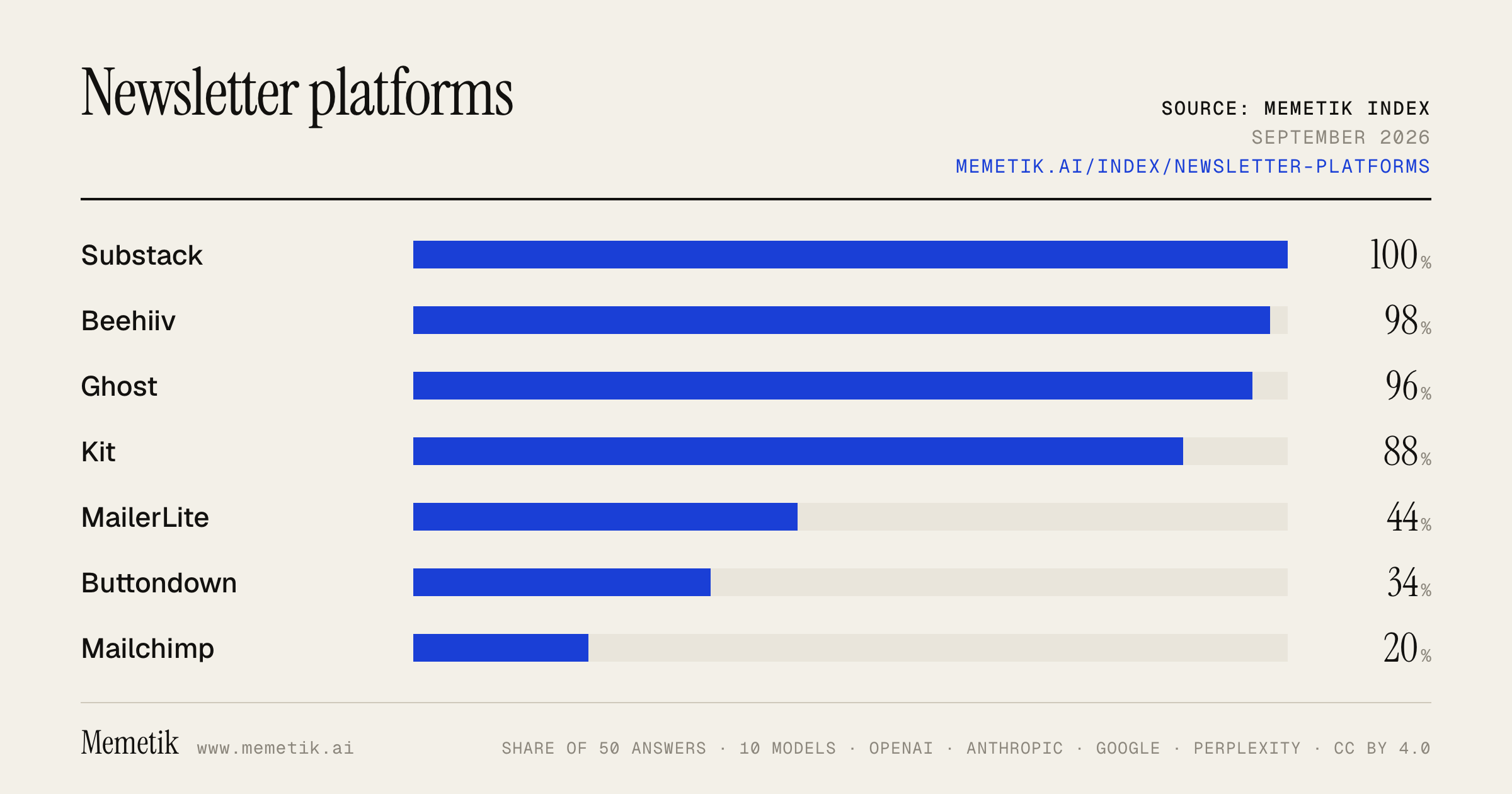
Substack was named in 50 of 50 answers and came first in 32. Beehiiv follows at 98%. 10 vendors were named at least once. First edition, so there is no prior period.
Answer share
5 prompts × 10 models · 50 answers
By provider
10 models · 50 answers
OpenAI 3 models · 15 answers
- GPT-5.6 Solgpt-5.6-solmost named: Substack 100%
- GPT-5.6 Terragpt-5.6-terramost named: Substack 100%
- GPT-5.6 Lunagpt-5.6-lunamost named: Substack 100%
Anthropic 3 models · 15 answers
- Claude Opus 5claude-opus-5most named: Substack 100%
- Claude Sonnet 5claude-sonnet-5most named: Substack 100%
- Claude Fable 5claude-fable-5most named: Substack 100%
Google 2 models · 10 answers
- Gemini 3.6 Flashgemini-3.6-flashmost named: Substack 100%
- Gemini 3.5 Flashgemini-3.5-flashmost named: Substack 100%
Perplexity 2 models · 10 answers
- Sonar Prosonar-promost named: Substack 100%
- Sonar Reasoning Prosonar-reasoning-promost named: Substack 100%
Sources the models cited
- beehiiv.com112
- youtube.com98
- storyflow.so66
- sequenzy.com65
- letters.byburk.net31
- skrapp.io31
- reddit.com31
- thatmarketingbuddy.com30
- valueaddvc.com29
- emailtooltester.com27
- mrktcorrect.com26
- mailsoftly.com23
ChatGPT via API returns no citations, so it does not contribute here.
The prompts
- What is the best newsletter platform for a writer? Name specific products.
- Which newsletter platform would you recommend to a writer in 2026?
- Compare the top newsletter platform options right now.
- I'm a writer and I need a newsletter platform. What should I use and why?
- Best newsletter platform for a paid newsletter?
Every answer
Raw model output, unedited
GPT-5.6 TerraWhat is the best newsletter platform for a writer? Name specific products.
**Best overall for most independent writers: Substack.**

Choose **Substack** if you want to publish quickly, build a reader community, and potentially charge subscriptions without assembling a technical stack. Its major advantage is **built-in discovery**—recommendations, Notes, and its reader network can help writers who do not already have a large email list. It is free to start; for paid subscriptions it takes a 10% platform fee, in addition to payment-processing fees. ([support.substack.com](https://support.substack.com/hc/en-us/articles/360037607131-How-much-does-Substack-cost?utm_source=openai))

But “best” changes with your goal:

| If you want… | Pick | Why |
|---|---|---|
| The simplest serious writing publication | **Substack** | Best all-in-one default for essays, criticism, reporting, fiction, and paid memberships. |
| A publication you fully brand and control | **Ghost** | Best for a writer building a standalone website/publication rather than living primarily on a platform network. Strong choice for SEO, archives, memberships, and a professional editorial site. |
| Sophisticated email marketing | **Kit** (formerly ConvertKit) | Best if the newsletter supports books, courses, consulting, speaking, or other products. Stronger automations and audience segmentation than writer-first platforms. |
| Fast audience growth and referrals | **beehiiv** | Best for growth-minded newsletter operators, especially for referral programs, ad monetization, and publication analytics. Less “literary magazine” feeling than Substack or Ghost. |
| A clean, minimalist writing workflow | **Buttondown** | Excellent for a writer who wants plain, dependable email publishing with minimal distraction or social-platform features. |
| Lower-cost general email newsletter | **MailerLite** | Good for writers who mainly need a straightforward email list, forms, landing pages, and basic automation—not a full membership publication. |

### My practical recommendation

- **Starting from zero and want paid readers:** **Substack**
- **Building a long-term author brand/site:** **Ghost**
- **Selling books, services, or courses alongside writing:** **Kit**
- **Trying to grow aggressively as a media business:** **beehiiv**
- **Want the least complicated, most writerly tool:** **Buttondown**

One warning: don’t choose solely based on monthly price. For a writer, the bigger question is whether you value **platform discovery** (Substack), **ownership and a branded home** (Ghost), or **marketing automation** (Kit). Switching later is possible, but changing links, workflows, archives, and reader habits is inconvenient.
GPT-5.6 TerraWhich newsletter platform would you recommend to a writer in 2026?
**My default recommendation for a writer in 2026: Ghost(Pro), on the Publisher plan.**

It is the best long-term choice if you want your newsletter to feel like **your publication**, not merely a profile on someone else’s network. You get a custom site and domain, built-in newsletters, paid memberships, multiple paid tiers, audience segmentation, analytics, integrations, and **0% platform transaction fees** (you still pay Stripe’s processing fees). The Publisher plan is listed at **$29/month billed annually** and includes paid subscriptions. ([ghost.org](https://ghost.org/pricing?utm_source=openai))

### Why I’d choose it
- **Better economics once you monetize.** At $29/month, Ghost costs about **$348/year** before payment processing. A platform that takes 10% of paid-subscription revenue becomes more expensive above roughly **$3,480/year** in subscription revenue. Ghost does not add a revenue share. ([ghost.org](https://ghost.org/pricing?utm_source=openai))
- **Real publication flexibility.** You can run several newsletters, target free or paid segments, protect posts, offer tips, and create multiple pricing tiers rather than a single basic paid offering. ([ghost.org](https://ghost.org/pricing?utm_source=openai))
- **A durable home for your writing.** Ghost is open source, has a full Content API, supports custom themes, and lets the website—not just the inbox—be central to the reader experience. ([ghost.org](https://ghost.org/pricing?utm_source=openai))

### When I would choose something else
- **Choose Substack** if you are brand-new, want the least setup, and value its built-in reader network more than branding, customization, and fee efficiency. It is a valid “start publishing this afternoon” option—but its 10% cut of subscription revenue can become costly. ([ghost.org](https://ghost.org/vs/substack/?utm_source=openai))
- **Choose a growth/marketing-oriented platform such as beehiiv or Kit** if your newsletter is primarily a lead-generation engine for a course, consulting practice, sponsorship business, or ecommerce funnel—not mainly a reader-supported publication.
- **Choose self-hosted Ghost** only if you are comfortable managing hosting, updates, backups, and a bulk-email provider. Ghost(Pro) includes email delivery and handles that configuration for you. ([docs.ghost.org](https://docs.ghost.org/newsletters?utm_source=openai))

### Simple decision
- **Serious independent writer, paid subscriptions, long-term brand:** **Ghost(Pro) Publisher**
- **Testing an idea with zero technical friction:** **Substack**
- **Marketing funnel / sophisticated automations:** **Kit or beehiiv**

If I were advising one writer with no additional context, I’d say: **start on Ghost(Pro) Publisher and build your publication on your own domain from day one.**
GPT-5.6 TerraCompare the top newsletter platform options right now.
## Newsletter platform comparison — best options by use case

| Platform | Best for | Major strengths | Main trade-offs |
|---|---|---|---|
| **beehiiv** | Growth-focused newsletters and media businesses | Built-in recommendation/referral growth loops, ad network, paid subscriptions, strong newsletter analytics, and no *platform* percentage cut on paid revenue | Less ideal than a marketing-automation-first tool for intricate customer journeys or sales CRM workflows |
| **Substack** | Independent writers who want to launch a paid publication fast | Easiest “write, publish, charge readers” workflow; built-in reader network and community-oriented publishing | Less brand/control flexibility; the platform’s revenue share becomes meaningful as paid income grows |
| **Kit** | Creators selling products, services, coaching, or courses | Best-in-class creator automations, tagging/segmentation, landing pages, and commerce integrations | Generally not as newsletter-media-centric for ad sales, referral-led growth, or publication analytics |
| **Ghost** | Publishers who want ownership of their site and membership business | Excellent website, SEO, publishing, memberships, custom branding, and data/control | More technical responsibility; growth and newsletter-specific monetization tools are less turnkey |
| **MailerLite** | Small businesses needing an affordable, straightforward email tool | Good value, clean editor, landing pages, basic automations, and broad marketing-email functionality | Less sophisticated for creator monetization and media-style audience growth |
| **Mailchimp** | Established businesses with broader marketing needs | Mature templates, integrations, reporting, ecommerce/marketing features, and team workflows | Can become comparatively expensive as contacts and feature needs rise; not optimized around newsletter-first publishing |

### My short recommendations

- **Pick beehiiv** if you are building a **newsletter business**: free + paid issues, sponsorships/ads, referrals, multiple publications, and audience growth are central. Its current plans include segmentation and core newsletter tools at launch level, while automations, A/B tests, referral programs, paid subscriptions, and the ad network sit on higher tiers. ([beehiiv.com](https://www.beehiiv.com/pricing?utm_source=openai))
- **Pick Substack** if your priority is simply **starting a writer-led paid newsletter quickly** and benefiting from an existing publishing ecosystem. It is usually the lowest-friction option, but consider the long-run revenue-share cost if you expect substantial subscriptions.
- **Pick Kit** if the newsletter supports a **creator business**—for example, courses, consulting, a YouTube channel, or digital products—and behavior-based automation matters more than ad monetization. One current comparison notes Kit’s paid Creator plans starting around **$39/month at 1,000 subscribers**, though plan details should be confirmed at checkout. ([beehiiv.com](https://www.beehiiv.com/blog/the-best-services-for-your-email-newsletter-10-options?utm_source=openai))
- **Pick Ghost** if your newsletter should live inside a **publisher-owned website and membership operation**. It is particularly compelling when SEO, a branded site, and control over the stack matter more than turnkey audience discovery.
- **Pick MailerLite** if you want a **low-cost conventional email-marketing platform** for a small business, rather than a newsletter-native media platform.
- **Pick Mailchimp** if newsletter is one component of a broader **marketing/ecommerce stack**. It has broad capabilities, but pricing can climb materially at larger lists; one current comparison cites roughly **$135/month for its Standard plan at 10,000 contacts**. ([beehiiv.com](https://www.beehiiv.com/blog/email-newsletter-app?utm_source=openai))

## Best choice by scenario

1. **Starting a free newsletter with ambitions to monetize:** **beehiiv**
2. **Solo writer launching paid subscriptions this weekend:** **Substack**
3. **Coach, educator, or creator selling offers:** **Kit**
4. **Magazine, niche publisher, or SEO-led membership site:** **Ghost**
5. **Local business / simple email marketing on a budget:** **MailerLite**
6. **Larger marketing team or ecommerce brand:** **Mailchimp**

## What matters most before choosing

1. **Revenue model:** paid subscriptions, sponsorships, products/services, or simply customer retention?
2. **Ownership:** do you need a fully owned website and maximum portability, or value a built-in network?
3. **Growth:** will referrals, recommendation networks, and ad marketplaces be important?
4. **Automation:** do you need sophisticated onboarding and behavior-triggered sequences?
5. **True cost at your expected list size:** compare at **1,000, 10,000, and 50,000 subscribers**, not just the free tier.

**Default answer:** for a serious new newsletter business in 2026, I would start with **beehiiv**; for a writer who wants extreme simplicity, **Substack**; for a creator-led sales funnel, **Kit**; and for maximum publishing ownership, **Ghost**. beehiiv’s current positioning is especially strong for newsletters that need combined growth, monetization, analytics, and publishing tools rather than just campaign email. ([beehiiv.com](https://www.beehiiv.com/pricing?utm_source=openai))
GPT-5.6 TerraI'm a writer and I need a newsletter platform. What should I use and why?
**My default recommendation: start on Substack**—especially if you’re a solo writer, want to publish soon, and expect your business to be primarily reader subscriptions.

### Why Substack is the best default
- **It removes operational friction.** Writing, email delivery, a web archive, paid posts, podcasts/video, comments, chat, payments, analytics, and basic growth tools are in one place. That means more time writing and less time assembling a software stack. ([substack.com](https://substack.com/features?utm_source=openai))
- **It has built-in discovery.** Recommendations, Notes, search, referrals, and the broader Substack network can bring in readers who do not already know you—an unusually valuable feature for a new independent writer. ([substack.com](https://substack.com/about?utm_source=openai))
- **The upfront cost is low.** A free publication has no monthly platform fee or subscriber cap. If you later enable paid subscriptions, Substack takes 10% of subscription revenue, in addition to Stripe processing/billing fees. ([support.substack.com](https://support.substack.com/hc/en-us/articles/360037607131-How-much-does-Substack-cost?utm_source=openai))
- **You are not trapped there.** Substack says you can use a custom domain and export your subscriber data and content. ([substack.com](https://substack.com/features?utm_source=openai))

**A sensible launch plan:** publish free for 8–12 issues, establish a clear promise and cadence, then introduce paid membership once readers understand what they get by supporting you. Substack supports free, monthly, annual, and founding-member tiers; for U.S.-dollar accounts, its current minimum paid prices are $5/month and $30/year. ([support.substack.com](https://support.substack.com/hc/en-us/articles/360037459952-How-do-I-set-up-a-paid-publication?utm_source=openai))

### When I would *not* choose Substack
Choose a different platform if your main priority is one of these:

| Your priority | Better platform to evaluate | Why |
|---|---|---|
| A highly branded publication/site you fully control | **Ghost** | Better fit for a publication that feels like your own magazine or media site, rather than a presence inside a network. |
| Fast list growth, ad sales, sponsorships, or referral mechanics | **beehiiv** | Better suited to a growth-and-advertising newsletter business. |
| Selling courses, digital products, coaching, or sophisticated automated funnels | **Kit** | Better fit when the newsletter is one component of a broader creator-sales business. |
| A conventional email-marketing operation for a company rather than a writer-led publication | **MailerLite** or **ConvertKit/Kit** | More traditional CRM and marketing-automation orientation. |

### The key tradeoff
Substack is cheaper in **time and complexity**, but potentially expensive in **revenue share** once you have meaningful paid income. At $10,000/month in subscriptions, its 10% platform fee alone would be $1,000/month before payment-processing fees. If you expect to reach that scale quickly and can drive your own audience, a fixed-fee, self-hosted-style option such as Ghost may be financially preferable.

### Bottom line
- **New solo writer / paid essays, criticism, reporting, fiction, personal expertise:** **Substack**
- **Writer building a durable, independent media brand:** **Ghost**
- **Newsletter operator focused on growth and sponsors:** **beehiiv**
- **Expert selling products/services in addition to writing:** **Kit**

If you have no existing audience, I’d choose **Substack now**, use your own domain from day one, keep regular backups of your list/content, and reassess after you have either meaningful subscription revenue or a clear need for deeper branding and automation.
- https://substack.com/features?utm_source=openai
- https://substack.com/about?utm_source=openai
- https://support.substack.com/hc/en-us/articles/360037607131-How-much-does-Substack-cost?utm_source=openai
- https://support.substack.com/hc/en-us/articles/360037459952-How-do-I-set-up-a-paid-publication?utm_source=openai
GPT-5.6 TerraBest newsletter platform for a paid newsletter?
**Best default for most solo creators: Substack.**

Choose it if you want to launch a paid newsletter quickly, without assembling separate tools for email, payments, hosting, and community. It supports free, monthly, annual, and founding-member subscriptions; trials, coupons, gifts, group plans, podcasts, video, and a built-in discovery/referral network. ([substack.com](https://substack.com/features?utm_source=openai))

**The trade-off:** Substack takes **10% of paid-subscription revenue**, on top of Stripe processing and recurring-billing fees. For a US-dollar account, its minimum price is **$5/month or $30/year**. ([support.substack.com](https://support.substack.com/hc/en-us/articles/360037607131-How-much-does-Substack-cost?utm_source=openai))

### My practical recommendation
- **Starting from zero / want discovery:** **Substack**
- **You already have an audience and want a more standalone, branded publication:** **Ghost**
- **You are primarily a marketing/business newsletter and care most about growth automations:** **beehiiv**
- **You sell courses, products, or services alongside the newsletter:** **Kit**

If you’re unsure, start on **Substack** for 3–6 months. Its lack of upfront cost and built-in reader network reduce launch friction, and it lets you export your subscriber and publication data if you later outgrow it. ([substack.com](https://substack.com/features?utm_source=openai))

One caveat: once revenue is meaningful, the 10% platform share becomes expensive. At that stage, it is worth comparing Ghost or beehiiv’s flat-fee plans against Substack’s revenue share.
Claude Sonnet 5What is the best newsletter platform for a writer? Name specific products.
For a writer specifically (as opposed to a marketer or business), the top platforms consistently recommended are:

**1. Substack — Best for pure simplicity and built-in audience discovery**

If you just want to write and let the platform handle everything else, Substack is the simplest option (but takes a 10% cut).

It offers newsletters, paid subscriptions, and a web archive, with built-in discovery and reader recommendations, making it fast to set up for solo writers and indie creators.
 It's the go-to choice if you want zero technical setup and just want to focus on writing.

**2. Beehiiv — Best for growth and monetization**

Beehiiv is the strongest all-around newsletter platform for creators who want to monetize, with a built-in ad network, referral system, and 0% cut on paid subscriptions.
 It's ideal for writers who eventually want to turn their newsletter into a business with ads, referral-driven growth, and premium tiers.

**3. Ghost — Best for full ownership and a proper website**

For full ownership and a proper website alongside your newsletter, Ghost is the best choice.
 This suits writers who want their newsletter to double as a full publication/blog they fully control (self-hostable, open-source).

**4. Kit (formerly ConvertKit) — Best if you plan to sell digital products**

ConvertKit (Kit) is better if you sell digital products.
 It combines newsletter publishing with commerce tools (selling ebooks, courses, etc.) alongside a recommendation network for growth.

**5. Buttondown — Best for minimalist/markdown-first writers**

Buttondown is noted as the pick for minimalists and developers, with markdown-native writing as its key strength.
 Good if you want a distraction-free, no-frills writing tool.

### Quick recommendation:
- **Just want to write, no fuss?** → Substack
- **Want to grow and monetize seriously?** → Beehiiv
- **Want your own branded site/publication?** → Ghost
- **Selling courses/products alongside your writing?** → Kit

For most individual writers starting out, **Substack** or **Beehiiv** are the two most commonly recommended, with the choice boiling down to: Substack for simplicity, Beehiiv for growth/monetization tools.
Claude Sonnet 5Which newsletter platform would you recommend to a writer in 2026?
Based on 2026 comparisons, the "best" choice really depends on what you value most as a writer:

**Substack — best if you just want to write, with zero setup**

Substack is free forever and takes 10% of paid subscription revenue. It has over 35 million active subscriptions, and that network matters because new newsletters get discovered organically without paid ads.
 It's ideal if you want to
start writing today without thinking about tools, with your priority on building an audience before monetizing.


**Beehiiv — best if growth and monetization are day-one priorities**

It offers built-in monetization (ads, premium, boosts), a free plan up to 2,500 subscribers, and advanced growth tools like referral systems and recommendations.
 The tradeoffs:
no built-in digital product sales like ConvertKit, and it's a younger platform with a smaller ecosystem and more limited automation compared to dedicated ESPs.


**Ghost — best if you want full ownership and independence**
Good for
publishers wanting a membership website, with paid newsletters and moderate automation, starting around $9/month.
 It's self-hostable, so you're not locked into someone else's platform or revenue cut.

**Kit (formerly ConvertKit) — best for creators selling digital products**

Kit is best for content creators wanting paid subscriptions, with a free plan up to 10,000 subscribers.


**Buttondown — best for minimalist/technical writers**

It's the cleanest choice for technical writers who want markdown, code-friendly formatting, a simple archive, and minimal newsletter overhead.


**My recommendation:** If you're a writer focused purely on writing and building an audience without fussing over tools or infrastructure, **Substack** remains the go-to in 2026 thanks to its built-in discovery network and zero-cost entry. If you're more entrepreneurial and want stronger growth/monetization mechanics from day one (referral programs, ad network, boosts), **Beehiiv** is the strongest alternative. And if long-term independence and owning your platform matters more than convenience, **Ghost** is worth the modest monthly cost.
- https://newsletterinsight.com/2026/03/01/the-best-newsletter-platform-in-2026/
- https://aistackpicks.com/reviews/best-newsletter-platform-for-creators-2026/
- https://memorable.design/best-newsletter-platforms-2026/
- https://www.marketermilk.com/blog/best-newsletter-platforms
- https://www.sequenzy.com/blog/best-newsletter-platforms
Claude Sonnet 5Compare the top newsletter platform options right now.
Based on current comparisons and testing, here's how the top newsletter platforms stack up right now:

## Substack
Still the go-to for pure writers and discovery-driven growth.
Substack is still the dominant newsletter publishing platform in 2026 with the strongest discovery features (Notes, the recommendation engine, the Substack app).
 It's
free for writers (10% revenue share on paid subscriptions), though the honest limitation is that the revenue share is steep for established newsletters, and the platform owns the relationship with paying subscribers.
 It also benefits from network effects —
its network of over 35 million active subscriptions helps you grow your subscriber base organically via referrals and recommendations.
 The tradeoff:
it's strictly meant for publishing content, so you won't be able to run typical email marketing campaigns, like sequences.


**Best for:** Writers who prioritize discovery and don't mind a revenue cut.

## beehiiv
Currently rated the most powerful all-around option by several reviewers.
Beehiiv claims to be the most powerful newsletter platform on the planet, and while it's a bold statement, it's an impressive platform that's earned the Best Newsletter Tool badge for 2025 & 2026.

It's very easy to use and packed with powerful growth and monetization features, including a unique range of paid subscription options like "Pay what you want" and "Lifetime subscriptions."
 Unlike Substack,
it has a built-in ad network, referral system, and charges 0% on paid subscriptions.


**Best for:** Creators who want Substack-like publishing plus stronger monetization/growth tooling without the revenue cut.

## Kit (formerly ConvertKit)
The pick for creators planning to build a business around their list.
Kit might have begun as a simple text-only newsletter platform, but it's now an all-in-one platform designed for creators who mean business, offering segmentation, automation, landing pages, and unique options to grow and monetize a list.
 Its free tier is notably generous:
Kit has the biggest free plan here now: up to 10,000 subscribers, broadcasts, landing pages and forms, tagging, and you can sell digital products with it.
 However,
automations and email sequences are on the Creator plan at $33/month, so the free plan is great for sending, not for funnels.

The Creator Network for cross-promotion and integrations (SparkLoop, Gumroad, Shopify) are the reasons pros pick it.


**Best for:** Creators building an audience with monetization/automation plans, willing to pay as they scale.

## Ghost
A strong choice for writers who want full ownership. Positioned as the **Best for Bloggers** option, Ghost gives you a self-owned publishing platform rather than a hosted network — appealing if you don't want a platform taking a revenue cut or controlling subscriber relationships (as Substack does).

## MailerLite
Once a budget favorite, but its free tier has shrunk significantly.
Its free plan changed — going from 1,000 subscribers to 500 in September 2025, then to 250 in July 2026, while emails per month dropped from 12,000 to 2,500.
 One reviewer noted
"that's a trial now, basically," adding, "For me this sounds like MailerLite has real issues keeping up with the industry."
 The core product is still solid —
drag-and-drop editor, automation, landing pages, clear stats — nothing changed there
 — but it's no longer the best free option.

## Mailchimp / Sender
More traditional email-marketing tools that also work for newsletters, generally recommended for beginners or small businesses rather than solo creators.
Sender or Mailchimp are the best newsletter platforms for beginners, thanks to simple setup, free plans, and ready-to-use templates.

If you're a writer, Beehiiv or Substack offer a more intuitive, publishing-first newsletter experience.


## Bottom Line
- **Writer/discovery focus, don't mind a cut:** Substack
- **Best all-around publishing + monetization:** beehiiv
- **Building a creator business (automation, funnels, products):** Kit
- **Want full platform ownership:** Ghost
- **Simple business email/newsletter needs:** Mailchimp or Sender

The market has clearly split into "publishing-first" platforms (Substack, beehiiv, Ghost) versus "marketing-first" tools (Mailchimp, MailerLite, Brevo) —
email marketing tools are built for businesses running campaigns, automations, and CRM workflows, while newsletter platforms are built for creators, writers, and publishers who want to build an audience and monetize through subscriptions or ads.
 Your best pick depends on whether you're prioritizing discovery, monetization control, or automation power.
- https://storyflow.so/blog/best-newsletter-tools-2026
- https://www.bigmailer.io/newsletter-platforms/
- https://www.emailtooltester.com/en/best-newsletter-platforms/
- https://thatmarketingbuddy.com/best/newsletter-platforms
- https://letters.byburk.net/p/best-newsletter-platforms-2026
- https://www.sender.net/blog/best-newsletter-platforms/
Claude Sonnet 5I'm a writer and I need a newsletter platform. What should I use and why?
# Choosing a Newsletter Platform

Great question! Since this depends heavily on your specific priorities (budget, audience size, monetization goals, design needs), let me give you an overview of the main options and what makes each one a good fit for different types of writers.
Here's a rundown of the top options for writers, and how to pick based on your priorities:

## Substack — Best for simplicity + built-in discovery

Substack is still the dominant newsletter publishing platform in 2026 with the strongest discovery features (Notes, the recommendation engine, the Substack app), making it the leading distribution choice for writers who want their newsletter discovered by readers of similar newsletters.
 It's
a clean, distraction-free editor designed for writing and formatting newsletters quickly, letting writers focus solely on content without dealing with design complexities or coding.


- **Cost:**
Free to use with unlimited subscribers, but takes a 10% fee on paid subscriptions.

- **Trade-off:**
The 10% revenue share is steep for established newsletters, and the platform owns the relationship with paying subscribers.

- **Great if:** You're just starting out, want zero technical setup, and value being part of a built-in reader community.
It has a strong community aspect — many writers credit their growth to fellow Substack writers and readers, so it feels more collaborative than competitive.


## Beehiiv — Best if the newsletter *is* your business

Beehiiv is the better choice when the newsletter itself is the business, with the strongest built-in growth and monetization stack: recommendations, referrals, ad marketplace, paid subscriptions, and audience analytics.
 Pricing starts
from $34/month for Scale (1,000-10,000 subscribers)
 — no revenue cut, unlike Substack.
Beehiiv and Kit have the strongest deliverability reputations in 2026.


## Ghost — Best for writers who want full ownership + a "blog feel"

Ghost lets you own your subscriber list and platform without revenue share — it's the established self-hostable option, more writer-shaped than Beehiiv's growth-focused approach.
 Plans start
from $9/mo.


## Kit (formerly ConvertKit) — Best for bloggers/content creators wanting automation

Kit is often recommended for bloggers and content creators
 who want more email-marketing horsepower (segmentation, automation sequences) than Substack offers, while still being creator-friendly.

## Buttondown — Best for minimalist/technical writers

Buttondown is the cleanest choice for technical writers who want markdown, code-friendly formatting, a simple archive, and minimal newsletter overhead — it's less of a marketing platform, but that is the point.


## MailerLite — Best free option with real features

MailerLite is arguably the best free newsletter platform, offering a generous free plan with up to 1,000 subscribers, advanced design tools, automation, and robust analytics — plus segmentation, A/B testing, and customizable templates that most free plans lack.


## The Math That Actually Matters
One sharp point from a recent analysis:
cost comes down to this — Substack and Gumroad take a percentage, while Kit, beehiiv, and Ghost take a flat fee and 0% of revenue. At $200/month in paid subscriptions, 10% is just $20, so flat fees look silly by comparison; but at $2,000/month, Substack takes $200 while beehiiv still only costs $43 — somewhere in between, the math flips, though most writers never get there.


Also worth noting:
switching platforms later costs you readers — a migration means a new sender, new confirmation emails, and a chunk of subscribers who never re-subscribe.
 So it's worth thinking a step or two ahead.

---

### My honest recommendation
- **Just starting out / want an audience fast?** → **Substack**
- **Already have subscribers and want to monetize seriously without giving up a cut forever?** → **Beehiiv** or **Ghost**
- **Want a personal, blog-like home for essays with full design control?** → **Ghost**
- **Want minimalist, no-fuss, code-friendly?** → **Buttondown**

What's your situation — are you starting from zero, or migrating an existing audience? And is monetization a near-term goal or a "someday" thing? That'll help narrow it down further.
- https://storyflow.so/blog/best-newsletter-tools-2026
- https://technologyadvice.com/blog/information-technology/best-newsletter-platforms/
- https://www.emailtooltester.com/en/best-newsletter-platforms/
- https://www.sequenzy.com/blog/best-newsletter-platforms
- https://www.narrareach.com/blog/best-newsletter-platforms
- https://skrapp.io/blog/best-newsletter-platforms/
- https://letters.byburk.net/p/best-newsletter-platforms-2026
Claude Sonnet 5Best newsletter platform for a paid newsletter?
For a paid newsletter, three platforms come up again and again, and the "best" one really depends on what you value most: simplicity, growth tools, or full control.

## Top picks

**Substack** — Best if you just want to write and let the platform handle everything.

Substack is the platform most people think of when they hear "newsletter." It's free to use, takes about five minutes to set up, and has a built-in discovery network with 35+ million active subscriptions.
 The catch:
you give up customization and pay a 10% revenue cut on paid subscribers (plus Stripe fees).


**Beehiiv** — Best if you're treating the newsletter as a business.

beehiiv was built by the team behind Morning Brew, and it shows — the ad network, Boosts (paid cross-promotions), and referral program are all built in.
 Most importantly for a paid newsletter:
paid subscriptions have a 0% platform fee — that's significant, since Substack takes 10% and Kit charges 3.5% plus transaction fees. beehiiv takes nothing.

beehiiv is built for growth, with referral programs, an ad network, cross-promotion between newsletters, custom domains, and paid subscriptions — and it takes 0% of your paid subscription revenue, only Stripe's fee.


**Ghost** — Best if you want full ownership, a real website, and no platform lock-in.

Ghost lets you turn your blog into a newsletter, with a stripped-down, text-forward editor similar to Substack, but with slightly more newsletter-centric features and a focus on paid subscriptions.

It's essentially a blog with a newsletter attached — open source, runs on your domain, handles paid memberships, and has arguably the best design of any option.
 Pricing:
Ghost(Pro) starts at $18/month billed yearly for 1,000 members (Starter plan doesn't include paid subscriptions); the Publisher plan is $29/month with 0% fee on subscription revenue.
 You can also self-host for free, though
most people don't have the technical setup for that.


**Kit (formerly ConvertKit)** — Good middle ground for creators who also sell digital products.

Kit has the biggest free plan among these options — up to 10,000 subscribers, broadcasts, landing pages/forms, tagging, and digital product sales — though automations and sequences require the $33/month Creator plan. Its Creator Network for cross-promotion and integrations (SparkLoop, Gumroad, Shopify) are why pros pick it.


## Bottom line

- **Want zero setup and built-in discovery?** → Substack (simplest, but 10% cut)
- **Want to maximize revenue and growth tools?** → Beehiiv (0% fee, ad network, referrals)
- **Want full design/data control and a proper website?** → Ghost (best design, but costs money upfront, no revenue cut)
- **Want newsletter + automations + digital products?** → Kit

If revenue retention matters most to you, Beehiiv or Ghost will save you money long-term since neither takes a cut of subscription revenue, unlike Substack's 10%.
Gemini 3.6 FlashWhat is the best newsletter platform for a writer? Name specific products.
There is no single "best" newsletter platform for every writer, as the ideal choice depends on your monetization strategy, technical needs, and target audience. However, the newsletter landscape is currently dominated by four major platforms, each excelling in a specific area:

---

### 1. **Substack** — *Best for Frictionless Writing & Built-in Discovery*
Substack is the default choice for essayists, journalists, and independent writers who want to focus purely on writing without dealing with web design or marketing setups.
* **Why it's great:** It functions like a hybrid between an email list and a social network. Features like **Substack Notes** and the platform's recommendation engine allow other writers to cross-promote your publication, helping you gain subscribers organically.
* **Pricing:** Completely free to start and send emails. Substack only makes money if you turn on paid subscriptions, taking a **10% cut** of paid subscription revenue.
* **Best for:** Writers who want zero upfront costs, low technical management, and the benefit of a built-in ecosystem.

---

### 2. **beehiiv** — *Best for Newsletter-First Businesses & Growth*
Created by former engineers and growth marketers behind *The Morning Brew*, beehiiv is built specifically to turn a newsletter into a media business.
* **Why it's great:** It offers built-in growth tools (referral programs, 3D analytics, recommendation networks) and monetization options right out of the box—including an ad network, paid subscriptions, and "boosts" where you get paid to recommend other newsletters. Unlike Substack, beehiiv takes **0% commission** on your paid subscriber revenue.
* **Pricing:** Generous free tier (up to 2,500 subscribers). Flat-rate monthly pricing tiers kick in as you scale.
* **Best for:** Creators who treat their newsletter as a primary media product, want to monetize via sponsorships/ads, and want advanced growth features.

---

### 3. **Ghost** — *Best for Full Ownership & Customization*
Ghost is an open-source, non-profit platform designed for serious publishers and professional creators who want total control over their brand, code, and subscriber data.
* **Why it's great:** Ghost acts as a full-fledged content management system (CMS) and blogging platform with built-in newsletter capabilities. You can completely design your site, set up custom domains, and keep **100% of your paid revenue** (minus credit card processing fees).
* **Pricing:** Paid hosting plans (Ghost(Pro)) start based on audience size, or you can self-host the open-source software for free if you are tech-savvy.
* **Best for:** Established writers, publications, or developers who want complete design freedom, open-source technology, and zero platform take-rates.

---

### 4. **Kit** *(Formerly ConvertKit)* — *Best for Creator Economy & Selling Products*
Kit is an email marketing power engine built for creators who write newsletters as part of a broader business (selling books, courses, coaching, or digital downloads).
* **Why it's great:** It has industry-leading email visual automations, tagging, and audience segmentation. You can easily build automated welcome sequences, funnel readers into different lists, and sell digital products natively.
* **Pricing:** Free plan for up to 1,000 subscribers (basic features). Tiered pricing scales as your list grows.
* **Best for:** Non-fiction writers, authors, coaches, and course creators who need automated email funnels alongside a traditional newsletter.

---

### Honorable Mentions
* **Buttondown:** A lightweight, Markdown-friendly platform loved by software developers, tech writers, and minimalists who want a simple, clutter-free writing tool.
* **MailerLite:** A classic email marketing tool with a simple drag-and-drop builder, suitable for authors who just need simple landing pages and basic automation.

### Quick Decision Framework
* **Pick Substack** if you want to write immediately, spend $0, and leverage a social network to find readers.
* **Pick beehiiv** if your goal is to build a massive media newsletter and run ads/sponsorships.
* **Pick Ghost** if you want a clean, custom website and full ownership of your media brand.
* **Pick Kit** if you sell digital products, books, or courses and need advanced automated funnels.
Gemini 3.6 FlashWhich newsletter platform would you recommend to a writer in 2026?
The "best" newsletter platform depends heavily on your goals, technical comfort level, and monetization strategy. The market has matured around a few key players that cater to different types of writers:

---

### 1. **Substack** — Best for: *Solo Writers & Pure Content Discovery*
If your priority is simply writing, building a personal audience, and relying on discovery features without dealing with complex marketing tech, **Substack** remains the top choice.

* **Why choose it:**
  * **Built-in Network Effects:** Substack’s ecosystem (Substack Notes, recommendations, and mobile app) acts like a hybrid social network, helping new readers discover your work organically.
  * **Zero Base Cost:** It is completely free to send emails to free subscribers.
* **Monetization:** Free until you launch paid subscriptions, after which Substack takes a **10% cut** of paid subscription revenue (plus Stripe processing fees).
* **Drawbacks:** Limited customization/design options, lack of advanced marketing automations or workflows, and the 10% cut can become expensive at scale compared to flat monthly fees.

---

### 2. **beehiiv** — Best for: *Growth-Oriented Creators & Media Brands*
Founded by early Morning Brew employees, **beehiiv** is purpose-built for creators who want to scale their newsletter like a digital media business.

* **Why choose it:**
  * **Powerful Growth & Monetization:** Features a built-in Ad Network (earning you sponsored ad placements), a Boosts referral system (pay/get paid to recommend newsletters), and robust analytics.
  * **0% Commission on Paid Subs:** You keep 100% of your subscription revenue (minus Stripe fees).
  * **Generous Starter Tier:** Offers a free plan up to 2,500 subscribers with flexible custom web/newsletter design tools.
* **Monetization:** Flat monthly pricing once you upgrade to unlock premium growth, custom domain, and automation features.
* **Drawbacks:** Doesn’t have the same built-in consumer discovery ecosystem that Substack’s mobile app/Notes platform provides.

---

### 3. **Ghost** — Best for: *Complete Ownership, Design Freedom & Tech-Savvy Writers*
**Ghost** is a non-profit, open-source publishing platform designed for writers who want full control over their site, design, and subscriber data.

* **Why choose it:**
  * **Full Ownership & Portability:** You own your content and subscriber database completely with zero platform lock-in.
  * **Customization:** Highly customizable themes and web layouts that feel like a professional publication rather than just an email list.
  * **0% Cut on Monetization:** Integrates directly with Stripe—you keep all revenue.
* **Monetization:** Paid platform (starts around $9–$15/month for Ghost Pro hosting, or free if self-hosted on your own server).
* **Drawbacks:** No built-in audience network; you have to handle all marketing and distribution yourself. Setting up advanced customizations may require basic technical skills.

---

### 4. **Kit (formerly ConvertKit)** — Best for: *Creators Selling Products, Courses, or Services*
If your newsletter is part of a broader business (selling ebooks, coaching, digital downloads, or courses), **Kit** is an industry standard.

* **Why choose it:**
  * **Advanced Automations:** Industry-leading visual automation builders, tagging, and audience segmentation.
  * **Free Tier:** Has expanded its free plan up to 10,000 subscribers for basic sending and simple digital product sales.
* **Drawbacks:** Can get expensive on paid tiers as your subscriber count grows compared to flat-fee platforms.

---

### Quick Decision Guide

1. **"I just want to write essays/journalism, have people discover me, and charge for subscriptions eventually."**
   👉 **Choose Substack**

2. **"I want to run my newsletter like a modern media company with ads, growth loops, and custom design."**
   👉 **Choose beehiiv**

3. **"I want a beautiful, professional, independent website/blog and 100% control of my brand."**
   👉 **Choose Ghost**

4. **"I am a creator using email automations to sell products, courses, or digital assets."**
   👉 **Choose Kit**
Gemini 3.6 FlashCompare the top newsletter platform options right now.
Choosing the best newsletter platform depends primarily on your business model—whether you're prioritizing built-in audience growth, aggressive monetization, full design control, or digital product sales.

Below is a breakdown of the top options right now across core use cases:

---

### 1. **Substack** — Best for Zero-Cost Setup & Built-In Network Growth
* **Best For:** Writers, journalists, and solo creators who want a plug-and-play platform with built-in discovery mechanisms.
* **Pricing Model:** 100% Free to publish. Takes a **10% revenue cut** on paid subscriber revenue (plus standard Stripe fees).
* **Key Features:**
  * Strong social network effects via **Substack Notes** and built-in recommendation exchanges.
  * Podcast, video, and community thread support built-in.
  * Simple, distraction-free writing interface.
* **Pros:** $0 upfront cost for lists of any size. High passive growth potential through Substack's ecosystem.
* **Cons:** Limited visual customization, weak email marketing automation, and the 10% platform fee becomes expensive once paid subscriptions scale up.

---

### 2. **Beehiiv** — Best for Newsletter Businesses & Growth Hacking
* **Best For:** Dedicated newsletter creators, media businesses, and publications focused on aggressive list growth and multiple revenue streams.
* **Pricing Model:** Free plan for up to 2,500 subscribers; paid tiers typically range from ~$40–$99+/month depending on features and list size. **0% fee on paid subscriber revenue**.
* **Key Features:**
  * Integrated **Ad Network** and native sponsor matching.
  * **Beehiiv Boosts** (paid recommendation network where creators pay each other per subscriber gained).
  * Built-in referral programs, customizable web landing pages, and advanced analytics.
* **Pros:** Highly optimized for list growth and monetization. Excellent scale-up economics since they don't take a cut of your subscriber revenue.
* **Cons:** Advanced growth tools require paid tiers. Takes more effort to configure than Substack.

---

### 3. **Kit (formerly ConvertKit)** — Best for Selling Digital Products & Courses
* **Best For:** Content creators, educators, coaches, and digital entrepreneurs who sell products alongside their newsletter.
* **Pricing Model:** Free tier for up to 10,000 subscribers (basic functionality); paid plans scale by subscriber count.
* **Key Features:**
  * Advanced visual email automation builders and tag-based audience segmentation.
  * Integrated commerce store for selling courses, ebooks, and digital downloads.
  * Creator Network for cross-promotions.
* **Pros:** Best-in-class email marketing automation and segmentation. Strong ecosystem for selling non-subscription digital products.
* **Cons:** Higher pricing on large lists compared to flat-rate platforms. Web landing pages are less like full publication websites compared to Ghost or Beehiiv.

---

### 4. **Ghost** — Best for Full Ownership, SEO, & Customization
* **Best For:** Professional bloggers, businesses, and publishers who want full design control, strong SEO, and complete platform ownership.
* **Pricing Model:** Open-source (Free if self-hosted); **Ghost(Pro)** managed hosting starts around $9–$25/month. **0% fee on paid subscriber revenue**.
* **Key Features:**
  * Full publication website with native blogging, custom code execution, and SEO optimization.
  * Open-source software (you truly own your platform and code).
  * Native paid subscriptions via Stripe with zero platform commission.
* **Pros:** Highly customizable, ultra-fast website loading, and total data independence.
* **Cons:** Minimal built-in cross-promotional network (growth relies more on search/SEO and external marketing). Requires moderate technical setup if self-hosting.

---

### 5. **Buttondown / MailerLite** — Best for Lightweight or Budget Newsletters
* **Buttondown:** A developer-friendly, minimalist platform ideal for text-focused or code-heavy newsletters with transparent pricing and Markdown support.
* **MailerLite:** Highly affordable, easy drag-and-drop builder for traditional businesses or creators looking for a balance between standard email marketing and simple newsletter delivery.

---

### Quick Decision Framework

* **Choose Substack if:** You want $0 upfront costs, care most about writing, and want access to a massive built-in reader network.
* **Choose Beehiiv if:** You want to treat your newsletter like a business (monetize via ads, paid tiers, and referral programs).
* **Choose Kit if:** You are selling online courses, digital products, or rely heavily on complex automated email flows.
* **Choose Ghost if:** You want complete control over your branding, design, SEO, and tech stack without paying revenue cuts.
Gemini 3.6 FlashI'm a writer and I need a newsletter platform. What should I use and why?
Choosing the best newsletter platform depends heavily on your main goal as a writer: are you trying to build a community from scratch, scale a full-fledged media business, maintain total ownership over your site design, or sell products like books and courses?

The major options breakdown by use case:

---

### 1. **Substack** — Best for starting out, ease of use, & free organic discovery
* **The Pitch:** Zero cost to publish; built-in social discovery mechanics (Substack Notes, recommendations network).
* **How Pricing Works:** Completely free until you launch a paid newsletter subscription, after which Substack takes a **10% fee** per transaction.
* **Why Use It:**
  * **Built-in Audience Growth:** The recommendation engine and Substack Notes act like a lightweight social network, helping new readers discover your writing natively.
  * **Zero Friction:** No web design required—just write, hit send, and start building an audience.
* **Drawbacks:** Very limited customization/branding, minimal email automation capabilities, and higher long-term transaction fees if you generate substantial paid subscriber revenue.

---

### 2. **Beehiiv** — Best for growth hacking, monetizing via ads, & scaling a media brand
* **The Pitch:** Built by the team behind *Morning Brew*, optimized specifically for growing newsletters fast and monetizing in multiple ways.
* **How Pricing Works:** Generous free plan (up to 2,500 subscribers with unlimited emails); flat-rate monthly subscription pricing as your list expands.
* **Why Use It:**
  * **Monetization Options:** Built-in ad network, sponsorship marketplace, referral programs, and paid subscriptions (with 0% commission fees taken by Beehiiv on paid plans).
  * **Growth Engine:** Excellent growth tools, including cross-promotions, boost networks, and deep analytics.
* **Drawbacks:** Can feel slightly overwhelming or "marketer-heavy" if you just want a simple space to publish long-form essays.

---

### 3. **Kit (formerly ConvertKit)** — Best for authors & creators selling products/services
* **The Pitch:** Creator-focused email marketing platform built around visual automations and sales funnels.
* **How Pricing Works:** Generous free tier for basic sending (up to 10,000 subscribers), but key features (automations, team access) require a paid monthly tier.
* **Why Use It:**
  * **Advanced Automations:** Ideal for setting up automated welcome sequences, tagging readers based on interests, and sending pitch emails for books, courses, or coaching.
  * **Digital Storefront:** Built-in tools to sell digital downloads and tip jars.
* **Drawbacks:** The landing page and email templates favor functional creator emails rather than traditional aesthetic publication/blog-style layouts.

---

### 4. **Ghost** — Best for technical control, design freedom, & complete ownership
* **The Pitch:** An open-source publishing platform built specifically for independent journalists and publishers.
* **How Pricing Works:** Hosted platform (Ghost(Pro)) starts at ~$9/month, or completely free if you self-host on your own servers. No platform cut on paid subscriptions.
* **Why Use It:**
  * **Complete Data & Brand Ownership:** Total control over the look, feel, custom domain, and underlying code of your publication.
  * **Clean Reading Experience:** Beautiful, minimalist themes and slick native membership capabilities.
* **Drawbacks:** Requires a higher level of technical setup than Substack or Beehiiv, and lacks a built-in cross-recommendation discovery network.

---

### Which one should you pick?

* **Choose Substack if:** You are starting from zero subscribers, don't want to pay monthly fees upfront, and rely on platform discovery to build an initial reader base.
* **Choose Beehiiv if:** You view your newsletter as a business, want to monetize via sponsor ads/referrals, and prioritize rapid growth.
* **Choose Kit if:** You are an author, coach, or creator who plans to sell books, courses, or digital products to your email list.
* **Choose Ghost if:** You are an established writer who wants full design control, customized branding, and zero middleman fees on membership revenue.
Gemini 3.6 FlashBest newsletter platform for a paid newsletter?
Choosing the best platform for a **paid newsletter** depends primarily on your business model, expected revenue, technical comfort, and how much control you want over your branding.

Here are the four best choices, depending on your specific situation:

---

### 1. **Substack** — *Best for Zero Upfront Costs & Built-In Network Growth*
Substack remains the go-to platform for writers launching a new publication without an existing audience.

* **Pricing:** **$0/month**, but takes a **10% cut** of your paid subscription revenue (plus Stripe payment processing fees).
* **Pros:**
  * Zero fixed monthly costs—you only pay when you make money.
  * Powerful recommendation engine and social features (*Substack Notes*) drive organic, discovery-led subscriber growth.
  * Extremely easy to set up and start publishing immediately.
* **Cons:**
  * That 10% fee gets expensive at scale (e.g., at $5,000/month in revenue, Substack takes $500/month).
  * Minimal customization options for your site/emails; hard to stand out visually.
  * Limited advanced email marketing features (automations, deep segmentation).
* **Best for:** Solo writers, journalists, and thought leaders getting started from scratch who prioritize ease of use and discovery over branding.

---

### 2. **beehiiv** — *Best for Scaling, Multiple Revenue Streams, and Growth Marketing*
Built by the team behind *Morning Brew*, beehiiv is tailored for creators who treat their newsletter like a growth-focused media business.

* **Pricing:** Free plan for up to 2,500 free subscribers. Paid plans start at around **$40–$49/month** to enable paid subscriptions ( billed annually or monthly). **0% transaction fees** (you keep 100% of revenue minus Stripe fees).
* **Pros:**
  * **0% platform take-rate** on paid subscriptions.
  * Native ad network, boosted referral tools, and 1-click cross-promotions to accelerate growth.
  * Rich analytics, built-in website builder, and solid automation tools.
* **Cons:**
  * Steeper learning curve than Substack.
  * High fixed monthly cost once you need advanced growth or monetization features.
* **Best for:** Creators aiming to scale fast and monetize through both paid tiers and ad sponsorships.

---

### 3. **Ghost** — *Best for Full Customization, Ownership, and High Earners*
Ghost is an open-source non-profit platform designed for publishers who want total control over design, SEO, and user experience.

* **Pricing:** Hosted via *Ghost(Pro)* starting at **$9–$18/month** (scales based on total subscribers), or **100% free** if you self-host on your own server. **0% platform fee** on paid tiers.
* **Pros:**
  * Complete design freedom with custom CSS, themes, and full SEO control.
  * **0% platform cut** on subscription revenue.
  * You own your platform and code; no risk of platform lock-in.
  * Very clean, distraction-free writing interface and fast loading speeds.
* **Cons:**
  * Requires more technical setup and upkeep, especially if self-hosted.
  * No built-in discovery network (you must bring or market your own audience).
* **Best for:** Established creators, niche media outlets, or designers who want a customized site and scale past $1,000+/month in subscription revenue.

---

### 4. **Kit (formerly ConvertKit)** — *Best for Selling Products, Courses, and Digital Goods*
If your paid newsletter is part of a larger creator ecosystem (digital products, courses, coaching), Kit offers the most powerful email marketing automations.

* **Pricing:** Free plan for basic email sends. Paid plans start around **$9–$15/month** depending on list size. **0% platform fee** on recurring subscriptions if paid via Stripe integration, or 3.5% + $0.30 if using native Kit Commerce.
* **Pros:**
  * World-class automation rules, tagging, and audience segmentation.
  * Creator Network allows cross-promotions with thousands of other creators.
  * Ideal for upsells, downsells, and selling non-newsletter products alongside a paid tier.
* **Cons:**
  * Higher monthly cost as subscriber counts increase.
  * Less focused on providing a standalone publication website compared to Ghost or Beehiiv.
* **Best for:** Creators who use a newsletter to feed a broader business model (courses, paid communities, ebooks).

---

### Summary Recommendation: Which should you choose?

1. **Choose Substack** if you have zero budget, no existing audience, and want built-in discovery to help get your first 100 paying subscribers.
2. **Choose beehiiv** if you want to run a modern, venture-style newsletter business with referral programs, sponsors, and paid subscriptions under one roof.
3. **Choose Ghost** if you already have an audience, expect to make over $500/month, and want custom design + 0% platform fees.
Sonar ProWhat is the best newsletter platform for a writer? Name specific products.
For most **writers**, the best choice is usually **Substack** if you want the simplest path to publishing, audience discovery, and paid subscriptions.[1][3][9] If you want stronger **growth tools** and more control over monetization, **beehiiv** is often the better all-around platform.[1][2][12]

Here are the most relevant specific products:

- **Substack** — best for independent writers who want a fast, simple newsletter with built-in discovery and paid subscriptions.[1][3][9]
- **beehiiv** — best for writers focused on growth, analytics, and building a newsletter business with more monetization options.[1][2][12]
- **Ghost** — best for writers who want more ownership, design control, and a blog/newsletter hybrid.[3][8][11]
- **Kit** — best if you also want to sell digital products or use more advanced creator automation.[1][4][9]
- **MailerLite** — best budget-friendly option for writers who want good features without a high cost.[4][7][9]

If you want the shortest recommendation: **Substack for simplicity, beehiiv for growth, Ghost for ownership, Kit for products**.[1][4][10][11]
- https://www.sequenzy.com/blog/best-newsletter-platforms
- https://thatmarketingbuddy.com/best/newsletter-platforms
- https://www.narrareach.com/blog/best-newsletter-platforms
- https://www.emailtooltester.com/en/best-newsletter-platforms/
- https://ownletter.com/best/newsletter-platforms-for-writers
- https://thebrandhopper.com/tools/best-newsletter-platforms-for-creators-compared/
- https://brilliantauthor.com/articles/author-newsletter-platform
- https://skrapp.io/blog/best-newsletter-platforms/
- https://bestwriting.com/best-newsletter-platforms-for-writers
- https://tajo.io/blog/best-newsletter-platforms/
- https://storyflow.so/blog/best-newsletter-tools-2026
- https://www.marketermilk.com/blog/best-newsletter-platforms
- https://blog.foster.co/the-best-newsletter-platforms-for-writers/
- https://www.reddit.com/r/LetterOperators/comments/1gcicey/best_newsletter_platforms_for_content_creators/
- https://narrareach-blog.ghost.io/best-free-newsletter-platforms/
- https://www.reddit.com/r/writers/comments/1qifdia/which_newsletter_platform_is_best_for_authors/
- https://www.linkedin.com/pulse/7-best-newsletter-platforms-2025-your-complete-guide-email-patton-mfmic
- https://simonkjones.substack.com/p/email-platforms-for-writers-in-2024
Sonar ProWhich newsletter platform would you recommend to a writer in 2026?
For a **writer in 2026**, I’d recommend **Substack** if you want the fastest, simplest way to start publishing and possibly charge readers later.[1][7][15] If your priority is **growth and monetization features**, **beehiiv** is the stronger all-around choice.[1][3][6][18]

A practical way to choose:

- **Choose Substack** if you want:
  - the easiest setup,
  - built-in audience discovery,
  - a straightforward paid newsletter model.[1][7][10][15]

- **Choose beehiiv** if you want:
  - stronger growth tools,
  - more control over monetization,
  - a more feature-rich newsletter business platform.[1][3][6][18]

- **Choose Ghost** if you want:
  - your own publication website,
  - **0% platform fees**,
  - a more ownership-focused setup.[4][5]

- **Choose MailerLite** if you want:
  - a budget-friendly, simple email tool,
  - good basic automation,
  - a less creator-network-driven approach.[12][16][20]

If you want one default recommendation for most independent writers, it is **Substack for simplicity** and **beehiiv for long-term growth**.[1][3][18]
- https://www.sequenzy.com/blog/best-newsletter-platforms
- https://thatmarketingbuddy.com/best/newsletter-platforms
- https://mailtoolfinder.com/blog/best-newsletter-platforms/
- https://www.narrareach.com/blog/best-newsletter-platforms
- https://luxethemes.com/resources/best-newsletter-platforms
- https://www.emailtooltester.com/en/best-newsletter-platforms/
- https://marketingcasestudy.io/blog/best-newsletter-platforms/
- https://storyflow.so/blog/best-newsletter-tools-2026
- https://skrapp.io/blog/best-newsletter-platforms/
- https://www.bigmailer.io/newsletter-platforms/
- https://tajo.io/blog/best-newsletter-platforms/
- https://kindlepreneur.com/best-email-services-for-authors/
- https://www.marketermilk.com/blog/best-newsletter-platforms
- https://blog.fika.bar/top-7-newsletter-platforms-in-2026-01KMJHX0R06DJR4Y0P7BZJQDQX
- https://zanfia.com/blog/best-free-newsletter-platforms/
- https://brilliantauthor.com/articles/author-newsletter-platform
- https://www.sender.net/blog/best-newsletter-platforms/
- https://narrareach-blog.ghost.io/best-free-newsletter-platforms/
- https://www.reddit.com/r/writers/comments/1qifdia/which_newsletter_platform_is_best_for_authors/
- https://janefriedman.com/email-newsletters-for-authors/
Sonar ProCompare the top newsletter platform options right now.
The **top newsletter platform** depends on your goal, but right now the strongest short list is **beehiiv**, **Kit**, **Substack**, **Ghost**, **MailerLite**, and **Mailchimp**. Across 2026 reviews, **beehiiv** is most often the pick for growth and monetization, **Kit** for creators selling products, **Substack** for simplicity and paid readership, **Ghost** for ownership, **MailerLite** for value, and **Mailchimp** for broader business use.[1][3][4][5][6][10][11][14]

| Platform | Best for | Key strengths | Main tradeoff |
|---|---|---|---|
| **beehiiv** | Growth-focused newsletters | Built-in monetization, referral tools, ad network, strong creator focus | Less ideal if you want a general-purpose marketing suite[1][4][6][11][17] |
| **Kit** | Creators selling digital products | Strong automation, commerce tools, good creator workflows | More expensive than budget tools; some plans include platform fees on free tiers[2][4][10][13] |
| **Substack** | Writers wanting simplicity and discovery | Very easy to start, built-in audience/discovery, paid subscriptions | Less control and more platform dependence; revenue share on paid plans[4][6][10][11][18] |
| **Ghost** | Independent publishers and self-hosters | Full ownership, open-source, memberships built in | Requires more setup/hosting decisions than hosted creator tools[4][5][6][11][18] |
| **MailerLite** | Budget-conscious users | Low cost, simple UI, solid deliverability and design | Fewer monetization/discovery features than beehiiv or Substack[4][6][10][11] |
| **Mailchimp** | Small businesses needing all-purpose email marketing | Familiar, broad integrations, automations, CRM-style features | Newsletter-first creators often find it less specialized[2][4][5][9][14] |

If you want the fastest recommendation:
- **Best overall for a newsletter business:** **beehiiv**.[1][4][6][11][17]
- **Best for creators selling products or courses:** **Kit**.[2][4][10][13]
- **Best for writing with minimal setup:** **Substack**.[4][6][10][11][18]
- **Best for full control and ownership:** **Ghost**.[4][5][6][11][18]
- **Best budget option:** **MailerLite**.[4][6][10][11]
- **Best general email marketing platform:** **Mailchimp**.[2][5][9][14]

A practical way to choose is:
- Pick **beehiiv** if growth, referrals, and ad monetization matter most.[1][4][6][11]
- Pick **Kit** if you want email plus digital-product sales and automations.[2][10][13]
- Pick **Substack** if your priority is publishing quickly and getting discovered.[4][6][11][18]
- Pick **Ghost** if you want independence and a membership site/newsletter hybrid.[4][5][6][11]
- Pick **MailerLite** if price and simplicity matter more than advanced monetization.[4][6][10][11]
- Pick **Mailchimp** if you need a broader marketing stack for a small business.[2][5][9][14]

If you want, I can also turn this into a **“best for creators vs businesses”** ranking or a **pricing comparison table** with the current starter plans.
- https://www.sequenzy.com/blog/best-newsletter-platforms
- https://skrapp.io/blog/best-newsletter-platforms/
- https://www.marketermilk.com/blog/best-newsletter-platforms
- https://eanasir.co/article/best-newsletter-platforms-2026/
- https://www.bigmailer.io/newsletter-platforms/
- https://www.narrareach.com/blog/best-newsletter-platforms
- https://www.mightynetworks.com/resources/newsletter-software
- https://luxethemes.com/resources/best-newsletter-platforms
- https://technologyadvice.com/blog/information-technology/best-newsletter-platforms/
- https://www.emailtooltester.com/en/best-newsletter-platforms/
- https://newsletter.co/
- https://adspyder.io/blog/top-newsletter-platforms/
- https://zapier.com/blog/best-email-newsletter-software/
- https://behindrankings.com/best-newsletter-platforms/
- https://whop.com/blog/online-newsletter-platforms/
- https://thatmarketingbuddy.com/best/newsletter-platforms
- https://marketingcasestudy.io/blog/best-newsletter-platforms/
- https://www.producthunt.com/categories/newsletter-platforms
- https://www.campaignmonitor.com/blog/email-marketing/best-email-newsletter-software-compared
- https://www.emailvendorselection.com/email-newsletter-software/
Sonar ProI'm a writer and I need a newsletter platform. What should I use and why?
If you’re a **writer**, the best default choice is usually **Substack** if you want the simplest way to start writing, publishing, and optionally charging readers. It is repeatedly described as the strongest option for writers who value **speed, simplicity, and built-in audience discovery** over customization and ownership. [1][3][5][9][20]

If your priorities are different, the best platform changes:

- **Substack** — best if you want the **fastest path to a paid newsletter** with minimal setup and built-in discovery. It’s especially strong when you want to focus on writing, not marketing infrastructure. [1][5][7][9][20]
- **Beehiiv** — best if you care most about **growth, monetization features, referrals, and ad revenue**. Multiple sources call it the strongest all-around choice for growth-focused creators and monetizing newsletters. [1][3][4][6][10][16]
- **MailerLite** — best if you want a **simple, affordable email tool** and you’re more interested in classic email marketing than platform-native discovery. It’s often recommended for authors who want ease of use and a strong free plan. [2][8][14][15]
- **Ghost** — best if you want **full ownership, a publication-style website, and more design control**. [3][4][7][11]
- **Kit** — best if you plan to sell **digital products** alongside your newsletter. [1][3][6][11][15]

A practical recommendation for most writers is:

- Choose **Substack** if you are starting from zero and want the least friction. [1][5][7][9]
- Choose **Beehiiv** if you already know growth and monetization will matter and you want more serious business features. [1][3][4][6][10]
- Choose **MailerLite** if you want a budget-friendly, straightforward email service and don’t need a built-in creator network. [2][8][15]

One important tradeoff: **Substack is simplest, but it takes a revenue cut on paid subscriptions**, while **beehiiv and Ghost are positioned more around ownership and growth/control**. [1][4][5][7][10]

If you want, I can also give you a **1-question recommendation** based on whether your priority is **simplicity, growth, ownership, or monetization**.
- https://www.sequenzy.com/blog/best-newsletter-platforms
- https://brilliantauthor.com/articles/author-newsletter-platform
- https://mailtoolfinder.com/blog/best-newsletter-platforms/
- https://thatmarketingbuddy.com/best/newsletter-platforms
- https://biztechscout.com/en/article/best-newsletter-platforms-2026
- https://www.emailtooltester.com/en/best-newsletter-platforms/
- https://www.narrareach.com/blog/best-newsletter-platforms
- https://kindlepreneur.com/best-email-services-for-authors/
- https://marketingcasestudy.io/blog/best-newsletter-platforms/
- https://eanasir.co/article/best-newsletter-platforms-2026/
- https://storyflow.so/blog/best-newsletter-tools-2026
- https://shop.creatorwood.tv/blogs/top-articles/5-best-newsletter-platforms-for-authors-in-2025
- https://www.reddit.com/r/selfpublish/comments/1ehtsjg/best_newsletter_service_provider/
- https://www.marketermilk.com/blog/best-newsletter-platforms
- https://skrapp.io/blog/best-newsletter-platforms/
- https://narrareach-blog.ghost.io/best-free-newsletter-platforms/
- https://www.reddit.com/r/LetterOperators/comments/1gcicey/best_newsletter_platforms_for_content_creators/
- https://www.reddit.com/r/writers/comments/1qifdia/which_newsletter_platform_is_best_for_authors/
- https://www.linkedin.com/pulse/7-best-newsletter-platforms-2025-your-complete-guide-email-patton-mfmic
- https://technologyadvice.com/blog/information-technology/best-newsletter-platforms/
Sonar ProBest newsletter platform for a paid newsletter?
For a **paid newsletter**, the best default choice is usually **Beehiiv** if you want the strongest mix of monetization, growth tools, and control over revenue.[1][6][10] If you want the **simplest way to launch quickly**, **Substack** is the easiest start, but it typically charges a **10% fee** on paid subscriptions.[1][6][8][9]

A practical way to choose:

| Platform | Best for | Main tradeoff |
|---|---|---|
| **Beehiiv** | Growing a newsletter business with paid subscriptions | More setup and higher upfront cost than Substack[1][6][8][10] |
| **Substack** | Fast launch and simple paid publishing | Takes a revenue cut and offers less control/flexibility[1][6][8][9] |
| **Kit** | Creators selling paid newsletters plus digital products | More creator-commerce focused, not as simple as Substack[2][6] |
| **Ghost** | Full ownership and self-hosting | More technical setup[6] |
| **MailerLite** | User-friendly, fair pricing, good value | Less purpose-built for media-style newsletter growth than Beehiiv[3][6] |

If you want the shortest recommendation:
- **Choose Beehiiv** if your goal is to **build and scale a paid newsletter business**.[1][6][10]
- **Choose Substack** if your goal is to **start today with the least friction**.[1][6][9]
- **Choose Kit** if you plan to sell **paid content plus other digital products**.[2][6]

If you want, I can also recommend the best platform based on your exact use case: **solo writer, media brand, creator business, or audience already on another email list**.
- https://www.sequenzy.com/blog/best-newsletter-platforms
- https://zapier.com/blog/best-email-newsletter-software/
- https://www.mailerlite.com/paid-newsletter-platform
- https://marketful.com/blog/best-paid-newsletter-platforms/
- https://www.sender.net/blog/best-newsletter-platforms/
- https://letterbench.com/best-newsletter-platforms
- https://www.marketermilk.com/blog/best-newsletter-platforms
- https://www.narrareach.com/blog/best-newsletter-platforms
- https://skrapp.io/blog/best-newsletter-platforms/
- https://www.emailtooltester.com/en/best-newsletter-platforms/
- https://behindrankings.com/best-newsletter-platforms/
- https://blog.fika.bar/top-7-newsletter-platforms-in-2026-01KMJHX0R06DJR4Y0P7BZJQDQX
- https://www.theleap.co/blog/best-paid-newsletter-platforms/
- https://www.bigmailer.io/newsletter-platforms/
- https://www.linkedin.com/pulse/7-best-newsletter-platforms-2025-your-complete-guide-email-patton-mfmic
- https://xoomar.com/blog/roundup/email-marketing-platforms-paid-newsletters
- https://biztechscout.com/en/article/best-newsletter-platforms-2026
- https://thatmarketingbuddy.com/best/newsletter-platforms
- https://www.reddit.com/r/Newsletters/comments/1qjj6ft/best_newsletter_platform_to_begin_scale_with/
- https://narrareach-blog.ghost.io/best-free-newsletter-platforms/
GPT-5.6 SolWhat is the best newsletter platform for a writer? Name specific products.
## Best overall for most writers: **Substack**

Choose **Substack** if you want to start quickly, publish free or paid newsletters, and benefit from built-in reader discovery. It requires little technical setup, but its percentage-based fee on paid subscriptions can become expensive as revenue grows.

## Best alternatives

- **Ghost — best for serious independent publications.** You get a customizable website, strong SEO, memberships, paid subscriptions, and **0% platform transaction fees**. Ghost(Pro) starts at **$18/month annually**; paid subscriptions and custom themes require the **Publisher plan, starting at $29/month annually**. ([ghost.org](https://ghost.org/pricing?utm_source=openai))
- **beehiiv — best for audience growth and advertising.** Strong referral, recommendation, analytics, automation, paid-subscription, and native-ad tools. Its free Launch plan supports up to **2,500 subscribers** and unlimited sends; paid plans add monetization and take **0% of paid-subscription revenue**, excluding payment-processing fees. ([beehiiv.com](https://www.beehiiv.com/pricing?utm_source=openai))
- **Kit — best for writers selling books, courses, coaching, or digital products.** It excels at email sequences, subscriber tagging, segmentation, landing pages, and sales automations. The free plan has limited automation; the Creator plan starts around **$33/month annually for 1,000 subscribers**. ([kit.com](https://kit.com/pricing?success=true&utm_source=openai))
- **Buttondown — best for minimalists.** A clean, writing-oriented email tool without a large social network or complicated marketing interface. It suits writers who already have a website or audience.
- **MailerLite — best budget email-marketing option.** Good for conventional newsletters, landing pages, automations, and product promotion, though it feels more like marketing software than a publishing platform.

### My recommendation

- **Starting from zero and want simplicity:** Substack
- **Building a durable writer-owned publication:** Ghost
- **Trying to grow a large newsletter business:** beehiiv
- **Selling multiple products or services:** Kit
- **Wanting a distraction-free email tool:** Buttondown

If I had to choose one without further context, I’d pick **Ghost** for a committed professional writer and **Substack** for someone testing a newsletter idea. Prices and features above are current as of **September 2, 2026**.
GPT-5.6 SolWhich newsletter platform would you recommend to a writer in 2026?
## My recommendation: **Substack for most writers**

In 2026, I’d choose **Substack** if the primary goal is to **write, build a readership, and potentially sell subscriptions** without managing much technology.

**Why:**

- Extremely easy to publish and launch paid memberships.
- Its built-in social and recommendation features can help readers discover your work.
- No upfront publishing fee, regardless of audience size.
- You can export your subscriber list if you later migrate.

The principal drawback is cost: Substack takes **10% of paid-subscription revenue**, in addition to Stripe’s payment-processing and recurring-billing fees. ([support.substack.com](https://support.substack.com/hc/en-us/articles/360037607131-How-much-does-Substack-cost?utm_source=openai))

### Choose something else when:

- **Ghost:** Best if you already have an audience, want a publication under your own brand, and expect substantial subscription revenue. Its flat-fee model can become much cheaper than surrendering 10% as revenue grows, although it requires more setup and audience-building effort. ([ghost.org](https://ghost.org/resources/pricing-subscription-newsletter/?utm_source=openai))
- **beehiiv:** Best if you’re building a **newsletter business** driven by growth, advertising and sponsorships. Its free Launch plan currently supports up to 2,500 subscribers; paid plans add advertising, automations, digital products and a 0% platform take on paid subscriptions. ([beehiiv.com](https://www.beehiiv.com/pricing?utm_source=openai))
- **Kit:** Best if the newsletter supports a broader creator business—courses, books, coaching or other products—and you need sophisticated email sequences and segmentation.

### Simple decision rule

| Your priority | Recommended platform |
|---|---|
| Writing and community with minimal setup | **Substack** |
| Independent, branded paid publication | **Ghost** |
| Growth, ads and newsletter-business tooling | **beehiiv** |
| Selling products or services through email | **Kit** |

**Bottom line:** Start with **Substack** if you’re primarily a writer and aren’t certain what the business will become. Start with **Ghost** if independence and long-term economics matter more than built-in discovery.
GPT-5.6 SolCompare the top newsletter platform options right now.
## Best newsletter platforms right now

**Short answer:**

- **beehiiv:** Best overall for building a newsletter-first media business
- **Substack:** Best for launching a paid publication with minimal setup
- **Kit:** Best for creators selling courses, products, coaching, or memberships
- **Ghost:** Best for owning a highly customized publication and website
- **Mailchimp:** Best for conventional business email marketing
- **Buttondown:** Best for a simple, writing-focused newsletter

*Comparison current as of September 2, 2026. Pricing can vary by list size, billing cycle, and promotions.*

| Platform | Best for | Pricing model | Major strengths | Main drawbacks |
|---|---|---|---|---|
| **beehiiv** | Newsletter startups, media companies, growth-focused publishers | Free entry plan; Scale starts around **$43/month** | Referral and recommendation tools, ad network, analytics, website, automations, paid subscriptions with 0% platform take rate | Important monetization and automation features require Scale; less suited to complex sales CRM work |
| **Substack** | Writers wanting the easiest possible paid-newsletter launch | Usually free for free newsletters; takes a percentage of paid subscription revenue | Extremely easy publishing, built-in discovery/network effects, comments and community, podcasts and app distribution | Revenue fee becomes expensive at scale; limited design, automation, segmentation, and brand control |
| **Kit** | Creators who sell things beyond the newsletter | Free newsletter plan up to **10,000 subscribers**; paid plans scale with audience/features | Excellent automations, tagging, landing pages and creator-commerce features; unlimited sends | Less publication-like than beehiiv or Ghost; costs rise as the audience grows |
| **Ghost** | Independent publications prioritizing ownership and design | Ghost(Pro) starts around **$18/month annually**; paid subscriptions begin on Publisher, around **$29/month annually** | Custom website and themes, open-source option, strong SEO, no platform payment fee, excellent brand ownership | Growth/discovery tools are weaker; customization may require technical help |
| **Mailchimp** | Small businesses, ecommerce and broader marketing campaigns | Contact- and sending-based plans | Mature email marketing, templates, integrations, segmentation, customer journeys and commerce tools | Pricing can become complicated or expensive; not optimized for newsletter-native growth or paid editorial publishing |
| **Buttondown** | Writers and developers who value simplicity | Subscriber-based monthly pricing | Clean editor, minimal interface, good Markdown support and straightforward operation | Limited built-in discovery, advertising and sophisticated publication-growth tooling |

### 1. beehiiv — best overall for newsletter growth

beehiiv combines email publishing with a hosted site, custom domains, analytics and a recommendation network. Its Scale plan adds automations, referrals, an ad network, digital products and paid subscriptions. beehiiv states that it takes **0% of paid-subscription revenue**, excluding payment-processing fees. ([beehiiv.com](https://www.beehiiv.com/?via=nlsupply&utm_source=openai))

**Choose it if:** You want to grow a newsletter into a serious media asset and potentially monetize through both subscriptions and advertising.

**Skip it if:** You primarily need sales funnels, ecommerce lifecycle marketing or a traditional customer CRM.

### 2. Substack — best for the fastest launch

Substack remains the lowest-friction choice: write, publish, turn on payments and interact with readers without assembling a website or marketing stack.

Its tradeoff is economic and operational. A percentage-based revenue fee can eventually cost much more than flat-rate software, while design control, segmentation and advanced automation remain comparatively limited.

**Choose it if:** You value simplicity, community and built-in reader discovery more than customization.

**Skip it if:** You already have a sizable paid audience or want complete ownership of the customer experience.

### 3. Kit — best creator-business platform

Kit’s free Newsletter plan supports up to **10,000 subscribers** with unlimited sends. Its stronger differentiator is creator commerce: tagging, sequences, behavioral automations, landing pages and product sales. Kit’s native paid-newsletter processing starts at **3.5% plus $0.30 per transaction**. ([kit.com](https://kit.com/pricing?success=true&utm_source=openai))

**Choose it if:** The newsletter supports courses, books, consulting, memberships, sponsorships or digital products.

**Skip it if:** The newsletter itself is the primary product and you want a polished publication website or media-company growth tools.

### 4. Ghost — best for ownership and customization

Ghost is essentially a publication CMS, website, membership system and newsletter platform in one. Ghost(Pro) starts at approximately **$18 per month billed annually** for 1,000 members; the approximately **$29 Publisher plan** adds custom themes, paid subscriptions, integrations and advanced analytics. Ghost says it charges no additional payment fee. ([ghost.org](https://ghost.org/pricing?utm_source=openai))

**Choose it if:** Your website, SEO, visual identity and platform independence are strategic assets.

**Skip it if:** You want built-in audience discovery or sophisticated no-code growth features out of the box.

### 5. Mailchimp — best for conventional businesses

Mailchimp is better viewed as a broad email-marketing system than a dedicated publishing platform. It makes sense when newsletters are one component of customer marketing alongside promotions, ecommerce activity and automated journeys.

**Choose it if:** You operate a store, local business, nonprofit or marketing department.

**Skip it if:** You’re building a paid editorial publication or newsletter-native media company.

## My recommendations by scenario

- **Starting a free newsletter you expect to scale:** beehiiv
- **Testing a writing idea with no technical setup:** Substack
- **Launching a paid newsletter immediately:** Substack for simplicity; Ghost or beehiiv for better long-term economics
- **Selling courses, services or digital products:** Kit
- **Building a premium branded publication:** Ghost
- **Monetizing primarily with advertising:** beehiiv
- **Running ecommerce or customer marketing:** Mailchimp
- **Wanting a deliberately minimal writing tool:** Buttondown

## Bottom line

For most serious new newsletter businesses, I’d narrow the decision to:

1. **beehiiv** if growth and monetization are the priorities.
2. **Kit** if the newsletter feeds a broader creator business.
3. **Ghost** if ownership, design and a durable website matter most.
4. **Substack** if eliminating setup and operational complexity matters more than fees and customization.
GPT-5.6 SolI'm a writer and I need a newsletter platform. What should I use and why?
## Short answer

**Start with Substack** if your priority is writing, publishing quickly, and finding readers without becoming an email-marketing specialist.

Choose something else if you already know you need greater control:

- **Ghost** for an independent publication you fully brand and monetize.
- **Kit** for a broader creator business involving books, courses, products, launches, or sophisticated email sequences.

## My recommendation by situation

### 1. Substack — best default for most writers

**Use it if:** You write essays, criticism, reporting, fiction, cultural commentary, or a personal newsletter and want the simplest route from draft to reader.

**Why:**

- No upfront publishing fee.
- Built-in subscriptions, comments, recommendations, and reader discovery.
- Minimal setup and administration.
- Particularly well suited to writing-led publications.

The downside is monetization cost: Substack takes **10% of paid-subscription revenue**, in addition to Stripe’s payment-processing and billing fees. That is inexpensive while testing an idea but potentially costly once subscription revenue becomes substantial. ([support.substack.com](https://support.substack.com/hc/en-us/articles/360037607131-How-much-does-Substack-cost?utm_source=openai))

**Verdict:** The best choice when your main goal is to **write consistently and grow an audience with minimal friction**.

---

### 2. Ghost — best for building an independent publication

**Use it if:** You care about your own website, visual identity, SEO, membership structure, and long-term control.

**Why:**

- Combines a proper website, blog, newsletter, and membership system.
- Ghost charges a predictable hosting fee rather than taking a percentage of subscription revenue.
- Supports paid subscriptions, custom themes, analytics, integrations, and multiple newsletters.
- Feels more like owning a publication than maintaining an account on someone else’s network.

As of September 2, 2026, managed Ghost(Pro) plans start at **$18 per month billed annually**; the **Publisher plan starts at $29 per month billed annually** and adds paid subscriptions and custom themes. Pricing increases with membership size. ([ghost.org](https://ghost.org/pricing?utm_source=openai))

**Verdict:** Best if you’re serious about creating a **durable media property or paid publication** under your own brand.

**Useful financial rule:** At $1,000 a month in paid-subscription revenue, Substack’s 10% platform share is roughly $100 a month before payment-processing costs. At that point, Ghost’s fixed fee can become attractive—although you should also value Substack’s built-in discovery.

---

### 3. Kit — best for writers selling more than subscriptions

**Use it if:** Your newsletter supports books, workshops, coaching, speaking, courses, memberships, or digital products.

**Why:**

- Strong tagging, segmentation, landing pages, forms, and sales features.
- Better suited to welcome sequences, launch campaigns, reader magnets, and automated funnels.
- Lets you treat subscribers differently based on interests and actions.
- Supports selling digital products and subscriptions.

Kit currently offers a free newsletter plan for up to **10,000 subscribers**, with unlimited broadcasts, forms, landing pages, tagging, segmentation, and basic selling tools. Paid plans add more substantial sequences and automation; official listed annual-billing prices for 1,000 subscribers are currently **$33 per month for Creator** and **$66 per month for Pro**. ([kit.com](https://kit.com/pricing?gspk=ZWYzYTlhYzgyNThm&gsxid=jIuGdd99E5yOR2&ps_partner_key=ZWYzYTlhYzgyNThm&ps_xid=jIuGdd99E5yOR2&pscd=partners.kit.com&utm_source=openai))

**Verdict:** Best if the newsletter is the **marketing and relationship engine for your overall writing business**, rather than the product itself.

---

## Simple decision table

| Your priority | Choose |
|---|---|
| Start writing this week with almost no setup | **Substack** |
| Benefit from built-in reader discovery | **Substack** |
| Build a branded, independent publication | **Ghost** |
| Keep more paid-subscription revenue as you grow | **Ghost** |
| Sell books, courses, workshops, or services | **Kit** |
| Create automated reader journeys and launches | **Kit** |
| Still uncertain and have no existing audience | **Substack** |

## What I would do

If you’re beginning from zero, I’d launch on **Substack**, use a consistent title and visual identity, and obtain a domain you control. Publish for three to six months and determine whether you enjoy the format and can attract readers.

I’d start directly on **Ghost** instead if you already have an audience, expect paid subscriptions to become meaningful, or want the newsletter to function as your primary professional website.

I’d choose **Kit** if you already know your business model will be built around selling books, courses, consulting, workshops, or other products.

Whatever you choose, periodically export and back up your subscriber list. **The list—not the software—is the essential asset.**
- https://support.substack.com/hc/en-us/articles/360037607131-How-much-does-Substack-cost?utm_source=openai
- https://ghost.org/pricing?utm_source=openai
- https://kit.com/pricing?gspk=ZWYzYTlhYzgyNThm&gsxid=jIuGdd99E5yOR2&ps_partner_key=ZWYzYTlhYzgyNThm&ps_xid=jIuGdd99E5yOR2&pscd=partners.kit.com&utm_source=openai
GPT-5.6 SolBest newsletter platform for a paid newsletter?
## Best overall: **beehiiv**

For most people building a **paid newsletter as a business**, I’d choose **beehiiv**. Its Scale plan starts around **$43/month when billed annually**, supports paid subscriptions, and takes **0% of subscription revenue** beyond Stripe’s processing fees. It also includes referrals, recommendations, automations, analytics, and advertising tools. ([beehiiv.com](https://www.beehiiv.com/pricing?utm_source=openai))

### Better alternatives for specific needs

- **Substack — easiest launch and built-in discovery**
  Excellent if you want minimal setup and access to a reader network. Publishing is free, but Substack takes **10% of every paid subscription**, in addition to Stripe fees. That becomes expensive once revenue grows. ([support.substack.com](https://support.substack.com/hc/en-us/articles/360037607131-How-much-does-Substack-cost?utm_source=openai))

- **Ghost — best for ownership and a premium branded publication**
  Best if your website, SEO, customization, and brand control matter most. Paid subscriptions start on its Publisher plan at approximately **$29/month billed annually**, with **no Ghost transaction fee**. It requires slightly more setup than Substack. ([ghost.org](https://ghost.org/pricing?utm_source=openai))

- **Kit — best if the newsletter supports courses or a creator business**
  Strong automations and sales funnels for creators selling coaching, courses, memberships, and digital products. Its commerce fee is currently **3.5% + $0.30 per transaction**, inclusive of payment processing. ([kit.com](https://kit.com/features/commerce/paid-newsletter?utm_source=openai))

### Quick decision

| Your priority | Pick |
|---|---|
| Growth tools and newsletter monetization | **beehiiv** |
| Simplest possible launch | **Substack** |
| Maximum ownership and brand control | **Ghost** |
| Courses, products and sophisticated funnels | **Kit** |

**Bottom line:** Start with **beehiiv** if you’re serious about growing a standalone newsletter business. Choose **Substack** only if convenience and network discovery outweigh giving up 10% of revenue.
GPT-5.6 LunaWhat is the best newsletter platform for a writer? Name specific products.
## Short answer

**For most writers, I’d choose _Ghost_ if you want a serious, independent publication; _Substack_ if you want the easiest launch and built-in writer network; and _beehiiv_ if you want to grow a newsletter business.**

### Best overall for an independent writer: **Ghost**

Ghost is my default recommendation for a writer who wants a polished website, newsletter, memberships, and long-term ownership of their brand.

**Why choose it:**
- Excellent writing and publishing experience
- Your own website and custom domain
- Paid memberships and multiple subscription tiers
- No platform fee on paid subscriptions—only payment-processing costs
- Better branding and customization than Substack

Ghost(Pro) starts at **$18/month billed annually** for a newsletter site, while the Publisher plan is **$29/month billed annually** and adds paid subscriptions and advanced features. ([ghost.org](https://ghost.org/pricing?utm_source=openai))

**Best for:** Authors, journalists, essayists, critics, and writers building a durable publication or personal media brand.

**Downside:** You generally have to bring your own audience; Ghost has little built-in discovery.

---

## Other strong choices

### 1. **Substack — best for starting quickly**

Choose **Substack** if your priority is simply publishing your writing and finding readers with minimal setup.

**Strengths:**
- Free to publish, regardless of subscriber count
- Very simple editor and email delivery
- Built-in discovery through recommendations, Notes, and the Substack ecosystem
- Supports paid subscriptions, podcasts, and other formats
- Familiar to readers and easy to share

Substack takes **10% of paid-subscription revenue**, in addition to Stripe processing and recurring-billing fees. ([support.substack.com](https://support.substack.com/hc/en-us/articles/360037607131-How-much-does-Substack-cost?utm_source=openai))

**Best for:** Personal essays, newsletters based on personality or expertise, journalism, criticism, and writers testing an idea.

**Downside:** Less control over branding and business infrastructure. If you become successful with paid subscriptions, the 10% revenue share can become expensive.

---

### 2. **beehiiv — best for growth and monetization**

Choose **beehiiv** if you view your newsletter as a business rather than only a publication.

**Strengths:**
- Strong referral and recommendation tools
- Audience analytics and segmentation
- Automations and surveys
- Advertising and sponsorship tools
- Digital products and paid subscriptions
- Custom domains and a hosted website

Its free Launch plan supports up to **2,500 subscribers**. The Scale plan is listed at **$43/month billed annually** and includes features such as automations, digital products, advanced analytics, and **0% take rate on paid subscriptions**. ([beehiiv.com](https://www.beehiiv.com/pricing?utm_source=openai))

**Best for:** Business newsletters, paid research, niche publications, finance/news/commentary, and writers planning to scale.

**Downside:** It can feel more like a marketing platform than a calm, beautiful writing environment.

---

### 3. **Kit — best for writers who sell products**

**Kit**—formerly ConvertKit—is a good option if your newsletter supports books, courses, workshops, coaching, consulting, or digital downloads.

**Strengths:**
- Strong creator-focused email automation
- Tags and audience segmentation
- Landing pages and signup forms
- Supports digital products and paid subscriptions
- Useful for building an email funnel around a book or business

**Best for:** Nonfiction authors, writing instructors, coaches, and creators with products to sell.

**Downside:** Its publishing and website experience is usually less attractive for a publication centered on essays or articles.

---

### 4. **Buttondown — best minimalist option**

**Buttondown** is worth considering if you want a straightforward, writer-friendly email tool without the social-network feel of Substack.

**Best for:**
- Plain-text newsletters
- Technical or academic writers
- Small, focused publications
- Writers who value simplicity and clean email delivery

**Downside:** It has fewer built-in growth, membership, and publishing features than Ghost or beehiiv.

---

## My practical recommendation

| Your priority | Best platform |
|---|---|
| Start publishing today with almost no setup | **Substack** |
| Own a polished publication and brand | **Ghost** |
| Grow aggressively and monetize through ads/products | **beehiiv** |
| Sell books, courses, or services | **Kit** |
| Send simple, elegant email newsletters | **Buttondown** |

### If I were choosing for different writers

- **Essayist or novelist:** Ghost
- **Journalist building an audience:** Substack initially, Ghost later
- **Business or finance writer:** beehiiv
- **Author selling books or courses:** Kit or Ghost
- **Writer experimenting with a new idea:** Substack
- **Established writer wanting independence:** Ghost

**Bottom line:** Start with **Substack** if speed and discovery matter most. Start with **Ghost** if you already have an audience—or care about owning the publication long-term. Choose **beehiiv** if growth mechanics and monetization are central to the project.
GPT-5.6 LunaWhich newsletter platform would you recommend to a writer in 2026?
## My recommendation: **beehiiv**

For most writers starting or growing a serious newsletter in **2026**, I’d choose **beehiiv**. It combines a writing-focused publication site with stronger growth and monetization tools than most alternatives: referrals, recommendations, audience analytics, sponsorship/ad options, and paid subscriptions. beehiiv advertises **0% platform fees on paid subscriptions** on qualifying plans, though you still pay payment-processor fees and a monthly subscription once you move beyond its free tier. ([beehiiv.com](https://www.beehiiv.com/pricing?utm_source=openai))

### Choose something else if…

- **Substack** — best if you want the simplest setup and the strongest built-in writer/reader network. It’s effectively free to start, but Substack takes **10% of paid subscription revenue**, in addition to payment-processing fees. Its discovery features—recommendations, the app, and Notes—are a meaningful advantage. ([support.substack.com](https://support.substack.com/hc/en-us/articles/360037607131-How-much-does-Substack-cost?utm_source=openai))
- **Ghost** — best if you care most about owning a polished website, controlling your brand, and avoiding a percentage cut of subscriptions. Ghost takes no platform fee on memberships, but you pay for hosting, and it generally requires more setup and ownership of your growth strategy. ([ghost.org](https://ghost.org/pricing?utm_source=openai))
- **Kit** — best if the newsletter supports courses, books, coaching, products, or sophisticated email sequences. It is more of an email-marketing and commerce system than a publication-first platform. ([techradar.com](https://www.techradar.com/reviews/convertkit?utm_source=openai))

### Simple decision rule

| Your priority | Pick |
|---|---|
| Build a newsletter business | **beehiiv** |
| Start writing immediately and get platform discovery | **Substack** |
| Build a durable publication website | **Ghost** |
| Sell books, courses, or products | **Kit** |

**Bottom line:** Start with **beehiiv** if you expect to grow, sell sponsorships, or monetize in several ways. Start with **Substack** if your main goal is to write consistently with minimal technical friction and benefit from its existing reader ecosystem. Export your subscriber list regularly whichever platform you choose.
GPT-5.6 LunaCompare the top newsletter platform options right now.
## Newsletter platforms worth considering right now

The “best” choice depends mainly on whether you’re building a **media business**, selling products, growing a creator audience, or running marketing campaigns.

| Platform | Best for | Main strengths | Main drawbacks | Pricing model |
|---|---|---|---|---|
| **beehiiv** | Growth-focused newsletters and media businesses | Built-in referrals, recommendations, ad network, paid subscriptions, website, analytics, unlimited sends | More expensive once you outgrow the free tier; can be more complex than needed for a simple newsletter | Free up to 2,500 subscribers; paid plans currently start around $43/month annually for Scale, depending on tier ([beehiiv.com](https://www.beehiiv.com/pricing?utm_source=openai)) |
| **Kit** *(formerly ConvertKit)* | Creators selling products, courses, or services | Excellent automations, tagging, sequences, landing pages, creator commerce, paid subscriptions | Less polished visual email design; weaker native publishing/discovery ecosystem | Free and subscriber-based paid plans; costs rise with list size |
| **Substack** | Writers who want the fastest, simplest launch | Extremely easy setup, built-in reader network, publishing site, paid subscriptions, podcasts and posts | Limited customization and automation; takes a substantial cut of paid subscription revenue | Free to publish; typically takes 10% of paid subscription revenue, plus payment processing ([beehiiv.com](https://www.beehiiv.com/pricing?utm_source=openai)) |
| **Ghost** | Independent publications that want ownership and a premium website | Excellent publishing CMS, memberships, newsletters, custom domains, strong branding, open-source/self-hosting option | Higher setup/operating burden; fewer built-in growth and ad tools than beehiiv | Paid hosted plans or self-hosting; generally attractive at larger audiences because it does not take a percentage of subscription revenue |
| **Mailchimp** | Small businesses and conventional email marketing | Mature templates, drag-and-drop editor, integrations, campaigns, customer marketing features | Expensive at scale; less optimized for newsletter-native growth and paid publishing | Contact-based pricing, with features varying by plan |
| **MailerLite** | Budget-conscious businesses and simple newsletters | Good value, easy editor, landing pages, forms, automations, websites | Fewer advanced media-business monetization and discovery features | Subscriber-based pricing; usually cheaper and simpler than Mailchimp |
| **Buttondown** | Minimalist, text-first newsletters and technical users | Clean writing experience, lightweight workflows, Markdown/API support, relatively simple pricing | Limited visual design, growth, commerce, and website features | Paid subscriber-based pricing |

## My practical ranking by use case

### Choose **beehiiv** if you want to build a newsletter business

It is probably the strongest all-around option for a publication that plans to grow through referrals, recommendations, advertising, sponsorships, paid subscriptions, or digital products. Its free Launch plan includes up to 2,500 subscribers, unlimited sends, a website, analytics, custom domains, and a recommendation network. ([beehiiv.com](https://www.beehiiv.com/pricing?utm_source=openai))

**Best fit:** business, finance, sports, news, niche media, and high-volume newsletters.

### Choose **Kit** if the newsletter supports a creator business

Kit is better than beehiiv when your newsletter is primarily a funnel for **courses, coaching, books, digital products, affiliate offers, or services**. Its strongest area is automation: sequences, tags, segments, and subscriber journeys.

**Best fit:** authors, educators, consultants, YouTubers, coaches, and creators selling products.

### Choose **Substack** if you want to start publishing immediately

Substack has the lowest friction. You can create a publication, publish posts, collect subscribers, and turn on paid subscriptions without much technical setup. Its built-in network can also help with discovery.

The tradeoff is control: your design, automation, segmentation, and monetization options are more constrained. The 10% revenue share can also become expensive. For example, on $5,000/month in paid subscriptions, a 10% platform fee is roughly $500/month before payment processing.

**Best fit:** personal essays, commentary, journalism, books, podcasts, and writers validating an idea.

### Choose **Ghost** if ownership and brand control matter most

Ghost is the strongest choice for a serious publication that wants a polished, independent website and control over its brand and membership model. It is particularly appealing if you already have technical resources or want to self-host.

**Best fit:** professional publications, magazines, editorial brands, and businesses that want a newsletter plus a full content site.

### Choose **MailerLite** for good value and straightforward email marketing

MailerLite is often a better small-business choice than Mailchimp if you want forms, landing pages, automations, and newsletters without paying for a large marketing suite.

**Best fit:** local businesses, nonprofits, agencies, ecommerce beginners, and service businesses.

### Choose **Mailchimp** if integrations and conventional marketing tools are the priority

Mailchimp remains a safe choice for businesses that need broad integrations, recognizable workflows, templates, and standard marketing campaigns. It is usually less compelling for a creator or media company building a paid publication.

**Best fit:** established small businesses with existing Mailchimp integrations or customer-marketing workflows.

## Cost considerations

The headline price is not the whole story:

- **Substack:** no upfront platform fee, but the 10% revenue share becomes costly once paid subscriptions grow. ([beehiiv.com](https://www.beehiiv.com/pricing?utm_source=openai))
- **beehiiv:** free at small scale, then subscription-based pricing; its paid plans advertise 0% platform take rate on paid subscriptions. ([beehiiv.com](https://www.beehiiv.com/pricing?utm_source=openai))
- **Kit, Mailchimp, and MailerLite:** typically charge according to subscriber/contact count, so inactive or duplicate contacts can increase your bill.
- **Ghost:** subscription pricing is more predictable and avoids a platform percentage, but you pay for the hosted service or manage hosting yourself.
- **All platforms:** payment processors such as Stripe may charge separate transaction fees.

## Bottom line

- **Best overall for a newsletter business:** **beehiiv**
- **Best for creators selling products:** **Kit**
- **Best for a writer starting quickly:** **Substack**
- **Best for an owned publication website:** **Ghost**
- **Best budget business option:** **MailerLite**
- **Best for established marketing integrations:** **Mailchimp**
- **Best minimalist option:** **Buttondown**

If you’re starting from zero and unsure, I’d generally choose **beehiiv for a publication**, **Kit for a creator business**, or **Substack for writing-first experimentation**.
GPT-5.6 LunaI'm a writer and I need a newsletter platform. What should I use and why?
For most writers, I’d choose **Ghost**—unless your top priority is getting discovered inside a built-in social network.

## My recommendation: Ghost

**Why:** Ghost gives you a professional website, newsletter, memberships, and paid subscriptions in one place. It’s better for building an independent author brand than simply publishing on someone else’s platform. Ghost’s hosted plans start at **$18/month when billed annually**, and Ghost says it takes **no platform fee** from paid subscriptions; you pay payment-processing fees separately. ([ghost.org](https://ghost.org/pricing?utm_source=openai))

Choose Ghost if you want:

- Your own domain and a polished archive of your work
- Control over design and branding
- Free and paid membership tiers
- Long-term ownership and portability
- A newsletter that could eventually support books, courses, consulting, or a publication

The main downside is that Ghost has less built-in audience discovery than Substack, and it costs money from the beginning.

## Best alternatives

### Choose **Substack** if you want the simplest launch

Substack is the easiest option for a writer who mainly wants to publish essays and potentially charge subscribers. Publishing is free regardless of list size, but Substack takes **10% of paid subscription revenue**, in addition to Stripe’s processing and billing fees. ([support.substack.com](https://support.substack.com/hc/en-us/articles/360037607131-How-much-does-Substack-cost?utm_source=openai))

**Best for:** personal essays, criticism, cultural writing, serialized work, and writers who want to start immediately with minimal setup.

**Trade-off:** less control over your site and economics. You’re also more dependent on Substack’s platform and audience ecosystem.

### Choose **beehiiv** if growth and monetization are central

beehiiv is especially strong for newsletters that behave like media businesses. Its free Launch plan supports up to **2,500 subscribers**; its paid Scale plan includes automations, referrals, digital products, an ad network, and **0% take rate on paid subscriptions**, listed at **$43/month when billed annually**. ([beehiiv.com](https://www.beehiiv.com/pricing?utm_source=openai))

**Best for:** business writing, technology, finance, news, professional audiences, sponsorships, referrals, and aggressive list growth.

**Trade-off:** it can feel more like a publishing-growth business tool than a quiet home for literary writing.

### Choose **Kit** if email marketing and products matter

Kit is strongest when your newsletter is part of a broader creator business. It includes landing pages, automations, tagging, segmentation, digital products, and subscriptions. Its paid Creator plan starts at **$39/month for up to 1,000 subscribers**. ([help.kit.com](https://help.kit.com/en/articles/4494683-creator-plan-vs-creator-pro-plan?utm_source=openai))

**Best for:** writers selling books, workshops, courses, coaching, downloads, or other products.

**Trade-off:** it’s more of an email-marketing system than a beautiful publication platform.

## Quick decision

- **I want to publish essays with almost no friction:** **Substack**
- **I want to build an independent author website and newsletter:** **Ghost**
- **I want newsletter growth, ads, referrals, and analytics:** **beehiiv**
- **I want to sell books, courses, or products:** **Kit**
- **I’m unsure and want the safest long-term choice:** **Ghost**

### Bottom line

If you’re primarily **a writer**, not a newsletter entrepreneur, start with **Ghost**. If you’re testing an idea and don’t want to pay anything yet, start with **Substack**. If the newsletter is intended to become a scalable media business, use **beehiiv**.
GPT-5.6 LunaBest newsletter platform for a paid newsletter?
## Best overall: **beehiiv**

For most serious **paid newsletters**, I’d choose **beehiiv**—especially if you plan to grow beyond your personal network.

| Platform | Best for | Platform fee on paid subscriptions | Main trade-off |
|---|---|---:|---|
| **beehiiv** | Growth-focused newsletters | **0%** beyond payment processing | Paid subscriptions require a paid plan |
| **Ghost** | Owning a publication/business | **0%** beyond Stripe | Higher fixed monthly cost; less built-in discovery |
| **Substack** | Fastest, simplest launch | **10%**, plus Stripe fees | Very easy, but expensive as revenue grows |
| **Kit** | Newsletter + courses/products | Generally payment-processing fees; Commerce is **3.5% + $0.30** per USD sale | Better creator-business tools than publication tools |

### My recommendation by situation

**Choose beehiiv if:**
- You want referral programs, recommendations, analytics, growth tools, or ads.
- You expect to build a sizable audience.
- You want to avoid giving up 10% of subscription revenue. beehiiv advertises 0% take rate on paid subscriptions, though you still pay its plan cost and payment-processor fees. ([beehiiv.com](https://www.beehiiv.com/pricing?utm_source=openai))

**Choose Ghost if:**
- You want your own branded website and member database.
- You care about ownership, SEO, customization, and long-term independence.
- You’re comfortable paying a monthly hosting fee. Ghost’s Publisher plan is listed at $29/month when billed yearly, with 0% platform transaction fees; Stripe fees still apply. ([ghost.org](https://ghost.org/pricing?utm_source=openai))

**Choose Substack if:**
- You’re validating an idea and want to launch today with minimal setup.
- You value Substack’s reader network and built-in discovery.
- You don’t mind the economics. Substack is free to publish on, but takes 10% of paid transactions in addition to Stripe charges. ([support.substack.com](https://support.substack.com/hc/en-us/articles/360037607131-How-much-does-Substack-cost?utm_source=openai))

**Choose Kit if:**
- Your newsletter is part of a broader creator business involving courses, ebooks, coaching, or digital products.
- You need sophisticated automations and audience segmentation.
- You want to sell a paid newsletter alongside other products. Kit supports paid newsletters and charges 3.5% + $0.30 per USD Commerce transaction, with no separate Commerce monthly fee. ([help.kit.com](https://help.kit.com/en/articles/4199324-sell-digital-products-with-kit-overview-and-faqs?utm_source=openai))

### Simple answer

- **Best overall:** beehiiv
- **Best for maximum ownership:** Ghost
- **Best for easiest launch:** Substack
- **Best for newsletter plus products:** Kit

If you’re starting from zero and unsure whether people will pay, start with **Substack** for simplicity—or **beehiiv’s free tier** for a more scalable setup—then migrate once the business is proven.
- https://www.beehiiv.com/pricing?utm_source=openai
- https://ghost.org/pricing?utm_source=openai
- https://support.substack.com/hc/en-us/articles/360037607131-How-much-does-Substack-cost?utm_source=openai
- https://help.kit.com/en/articles/4199324-sell-digital-products-with-kit-overview-and-faqs?utm_source=openai
Claude Opus 5What is the best newsletter platform for a writer? Name specific products.
The "best" depends on what you're optimizing for, so let me give you the specific products and where each one wins.

**Substack** — The default recommendation for most writers. It's free until you charge money (then 10% of subscription revenue, plus payment processing). Its real advantage isn't the software, it's the network: recommendations, Notes, and the app drive meaningful discovery that other platforms can't match. The tradeoff is that you're building on someone else's turf, the aesthetic is homogenous, and the platform has had recurring controversies over content moderation that some writers find disqualifying.

**Beehiiv** — Built by former Morning Brew people, and it shows. Better analytics, native ad network, referral programs, and stronger growth tooling than Substack. Flat monthly pricing rather than a revenue cut, which becomes dramatically cheaper once you're earning real money. Best for writers who think of themselves as building a media business.

**Ghost** — Open source, non-profit-owned, and you own everything. Best-in-class editor, no revenue cut on the paid plans, and it doubles as a full website/CMS. Self-host for near-free if you're technical, or pay for Ghost(Pro). Best for writers who want independence and are willing to do their own audience growth.

**Buttondown** — Small, indie, markdown-first, genuinely pleasant. Minimal, fast, no social layer or algorithmic anything. Best for writers who want a plain email tool and nothing else.

**Kit (formerly ConvertKit)** — Aimed at creators selling products beyond subscriptions: courses, books, coaching. Strong automation and tagging. Best if the newsletter is a funnel rather than the product itself.

**MailerLite** — Cheap, capable, generous free tier, but generic. Fine if you want to spend nothing and don't care about community features.

If I had to name one: **Substack if you need an audience, beehiiv if you already have one and want to monetize it seriously, Ghost if you want to own your platform outright.** Most writers who leave Substack leave for one of the latter two.

One practical note: check that whichever platform you choose lets you export your subscriber list as a CSV without friction. All of the above currently do, and it's the thing that makes the decision reversible.
Claude Opus 5Which newsletter platform would you recommend to a writer in 2026?
I should check what's current in the newsletter platform landscape, since this space changes quickly.
A caveat worth flagging up front: most "best newsletter platform" roundups run affiliate programs, and beehiiv's is unusually generous — so the fact that it tops many 2026 lists isn't purely editorial judgment. One of the sources above is explicit about this problem, saying its quiz
"is blind to commission; the engine cannot see who pays us"
, which tells you it's a concern in this category. Treat the rankings as a starting point, not a verdict, and note that these lists lump writers in with e-commerce marketers who need very different things.

With that said, the choice comes down to four real options for a writer:

**Substack — if discovery matters more than control.**
It's the pick if you just want to write with zero setup.

Its distinguishing features are built-in discovery and reader recommendations, plus the fastest setup of any platform
, and it's
free with unlimited subscribers, taking a 10% cut of paid revenue only.
 The network effect is the entire reason to choose it — no other platform sends you subscribers you didn't earn yourself. The tradeoffs: that 10% is permanent and compounds badly at scale (on $100k/year, you're paying $10k for what beehiiv would charge ~$500 for), you're renting your audience's attention from a company whose content-moderation controversies periodically become *your* brand problem, and design customization is minimal.

**beehiiv — if you're treating this as a business.**
It's the strongest all-around option for creators who want to monetize, with a built-in ad network, referral system, and 0% on paid subscriptions.

It was founded by early Morning Brew team members, and combines a solid writing experience with growth tools and customization competitors don't match.
 Free
up to 2,500 subscribers, then $43/month annually.
 The catch is that the growth toolkit is genuinely useful only if you'll *use* it — referral programs and ad placements require ongoing operational work. A writer who just wants to write is paying for a dashboard they'll ignore.

**Ghost — if ownership is non-negotiable.**
It's the best choice for full ownership and a proper website alongside your newsletter
, and it's
open-source with memberships, from $9/month or free if you self-host.
 Best if your newsletter is one part of a broader site (essays, archives, a portfolio). Self-hosting is only free in the sense that your time is worthless — budget for real maintenance unless you enjoy it.

**Buttondown — if you want the tool to disappear.**
Minimalist and privacy-focused, with a markdown editor and hosted archives
,
free to 100 subscribers, then $9/month.


**My actual recommendation:** if you have no audience yet, start on Substack. The discovery engine is worth the 10% when your subscriber count is near zero, and that math inverts once you're earning meaningfully — at which point migrating is a real but survivable annoyance. If you already have a following you're bringing with you, skip Substack entirely and go to beehiiv or Ghost, since you'd be paying a network tax for a network you don't need.

Two things that matter more than the platform: whether you can export your subscriber list on demand (all four allow this — verify before committing), and whether you'll still be publishing in six months. The most common newsletter failure is abandonment, not tooling.

What kind of writing, and do you have an existing audience?
- https://ownletter.com/best
- https://aistackpicks.com/reviews/best-newsletter-platform-for-creators-2026/
- https://zanfia.com/blog/best-free-newsletter-platforms/
- https://thatmarketingbuddy.com/best/newsletter-platforms
- https://mailtoolfinder.com/blog/best-newsletter-platforms/
- https://www.sequenzy.com/blog/best-newsletter-platforms
Claude Opus 5Compare the top newsletter platform options right now.
I'll look into the current state of newsletter platforms for you.
Here's how the main options stack up as of now:

## The publishing-first platforms

**beehiiv** — The current critical favorite.
EmailToolTester awarded it their Best Newsletter Tool badge for both 2025 and 2026
, and
it's known for being easy to use with strong growth and monetization features, including unusual paid subscription options like "pay what you want" and lifetime subscriptions
.
It also has a built-in ad network, a referral system, and takes 0% on paid subscriptions.
 The tradeoff: you pay a monthly fee.

**Substack** — Still the discovery king.
It remains the dominant publishing platform with the strongest discovery features (Notes, the recommendation engine, the app), making it the best choice if you want to be found by readers of similar newsletters
.
Its network of 35M+ active subscriptions helps growth via referrals and recommendations.

It's free to publish but takes a 10% revenue share on paid subscriptions — steep for established newsletters, and the platform owns the relationship with your paying subscribers.
 Also
it's strictly for publishing, so you can't run typical email marketing campaigns like sequences
.

**Ghost** —
Along with Buttondown, the pick if you primarily want a writing tool
. Open-source, self-hostable, no revenue cut — best if you want full ownership and a real website alongside the newsletter.

**Kit (formerly ConvertKit)** —
Now an all-in-one creator platform that goes beyond segmentation, automation, and landing pages to offer list-growth and monetization tools
.
Worth it if you need more advanced email features than Substack offers.


## Notable change to know about

**MailerLite has quietly gutted its free plan.**
It went from 1,000 subscribers to 500 in September 2025, then to 250 in July 2026, with monthly email sends dropping from 12,000 to 2,500 — effectively a trial now.

The tool itself is still a solid classic email platform, but it's no longer the place to start for free.


## Budget / niche options

-
EmailOctopus and Brevo if you mainly want cheap sending

-
Sendy — a $69 one-time licence running on your own Amazon SES account, making per-email cost negligible at scale, but you self-host and manage deliverability and bounces yourself

-
Sender or Mailchimp for beginners, thanks to simple setup, free plans, and ready-made templates


## Quick recommendation

| If you… | Pick |
|---|---|
| Want max discovery, minimal setup | Substack |
| Want growth tools + keep 100% of revenue | beehiiv |
| Want ownership & a real site | Ghost |
| Need automation/sequences | Kit |
| Just want cheap sending | EmailOctopus / Brevo |

One useful framing:
newsletter platforms and email marketing tools aren't the same thing — tools like ActiveCampaign, Brevo, and HubSpot are built for businesses running campaigns and CRM workflows, while newsletter platforms are built for creators who want to build an audience and monetize via subscriptions or ads.
 Decide which of those you actually are first.

Worth noting: pricing on these changes frequently, so confirm current rates on each platform's pricing page before committing. What's your subscriber count and are you planning to monetize? That narrows this down a lot.
- https://www.emailtooltester.com/en/best-newsletter-platforms/
- https://thatmarketingbuddy.com/best/newsletter-platforms
- https://storyflow.so/blog/best-newsletter-tools-2026
- https://www.bigmailer.io/newsletter-platforms/
- https://www.sequenzy.com/blog/best-newsletter-platforms
- https://letters.byburk.net/p/best-newsletter-platforms-2026
- https://www.sender.net/blog/best-newsletter-platforms/
Claude Opus 5I'm a writer and I need a newsletter platform. What should I use and why?
Great question — the newsletter platform landscape has shifted a lot recently, so let me check what the current options and pricing look like.
Before I answer: almost every source above is an affiliate-driven "best of" listicle, and they mostly converge on beehiiv as the top pick — which is also the platform with the most generous affiliate program.
One of them openly acknowledges the issue, claiming its scoring engine "is blind to commission"
, and
another displays a "20% OFF" beehiiv promo right in its comparison table
. So treat the rankings as a menu of options, not a verdict. What actually matters is which tradeoff you want to make.

**The real decision is a three-way fork.**

**1. You want readers to find you → Substack.**
It's free to use and takes a 10% revenue share on paid subscriptions, aimed at writers and journalists who want something straightforward.

Its distinguishing feature is built-in discovery and reader recommendations
 — other writers' recommendations can drive a meaningful share of early growth, which no other platform on this list replicates. The cost: that 10% is permanent, and you're renting space in someone else's network. If Substack's brand or content-moderation decisions become a liability, that reflects on you, and your archive lives on their domain.

**2. You want to own the whole thing → Ghost.**
It's the best choice for full ownership and a proper website alongside your newsletter
, and
it's open-source with free self-hosting available
 — meaning your content and subscriber list are portable in a way they simply aren't elsewhere. The cost is real: no built-in discovery, so every subscriber comes from your own effort, and self-hosting assumes you're comfortable with technical setup.

**3. You want growth machinery and ad revenue → beehiiv.**
It has a built-in ad network, referral system, and charges 0% on paid subscriptions.
 The caveat is that "0%" applies on higher tiers —
the free tier caps at 2,500 subscribers
 and
paid plans run around $43/month
. So it's not free, it's deferred. It also optimizes for newsletter-as-business rather than newsletter-as-writing.

**My actual recommendation:** since you described yourself as a writer rather than someone building a media business, start on **Substack** if you have no existing audience, or **Ghost** if you already have readers who'll follow you. Substack's 10% cut is the cheapest customer acquisition you'll find at zero subscribers; once you're earning enough that 10% exceeds Ghost's flat monthly fee, migrating is a straightforward arithmetic decision. beehiiv's growth tooling mostly solves problems you don't have yet.

Two things worth knowing: pricing here changes constantly and the figures above conflict across sources —
one lists beehiiv starting at $49/mo for 10K subscribers
 while
another says $43/mo
 — so verify current rates directly before committing. And whichever you pick, export your subscriber list regularly. That list is the only asset that's genuinely yours.

If you tell me your rough audience size and whether you're planning to charge, I can narrow this further.
- https://ownletter.com/best
- https://www.marketermilk.com/blog/best-newsletter-platforms
- https://skrapp.io/blog/best-newsletter-platforms/
- https://zanfia.com/blog/best-free-newsletter-platforms/
- https://thatmarketingbuddy.com/best/newsletter-platforms
- https://www.sequenzy.com/blog/best-newsletter-platforms
Claude Opus 5Best newsletter platform for a paid newsletter?
The best choice depends on your priorities, so let me search for current information on what's available.
The honest answer: it comes down to a tradeoff between **discovery/simplicity (Substack)** and **keeping your revenue + control (beehiiv or Ghost)**.

## The main contenders

**Substack — best for writers starting from zero**
It's free to use, handles newsletter, blog, podcast, and paid subscriptions in one place, plus social features. You can connect a custom domain and export your list at any time, and it comes with a built-in network of recommendations, Notes, and an app.

Its posts also rank in Google search, which can drive more readers than social feeds.


The catch:
it takes 10% of paid subscriptions, plus Stripe fees, with no cap.

The editor is limited and there's little automation beyond a welcome email.
 At $50k/year in revenue, that 10% is $5,000 annually — far more than any competitor's subscription fee.

**beehiiv — best if the newsletter is a business**
The free Launch plan covers up to 2,500 subscribers with unlimited sends, Scale is $43/month, and beehiiv takes 0% of your paid subscription revenue — only Stripe's fee. That's a big difference from Substack once money comes in.

Paid plans unlock monetization features including a variety of paid subscription options and ads, without taking a cut.
 Downside:
it's a lot of platform if you just want to send emails, and the jump from free to $43 is steep.


**Ghost — best for full ownership**
It's excellent as a CMS, but if you only need newsletter functionality, a dedicated newsletter platform is probably a better fit.
 It's open-source, takes 0% of revenue, and you can self-host — but expect more setup work.

**MailerLite — best budget option**
You can sell paid newsletters, digital products, and bookings with 0% commissions.

The free plan covers up to 1,000 subscribers with design tools, automation, and analytics.
 Weaker on the "publication" side, though —
a MailerLite campaign disappears the day after you send it, whereas a Substack post is a page that keeps working.


## How I'd decide

- **No audience yet, want zero friction** → Substack. The discovery network is worth the 10% early on, and you can migrate later.
- **Already have an audience, or expect real revenue** → beehiiv. Do the math: once ~$5,200/year in subscriptions, beehiiv's $43/month plan is cheaper than Substack's cut.
- **Want to own everything, comfortable with technical setup** → Ghost.

One practical note: whichever you pick, make sure you can export your subscriber list and that payments run through *your* Stripe account. That's what makes switching later painless.

What's your situation — starting fresh or already have subscribers?
- https://letters.byburk.net/p/best-newsletter-platforms-2026
- https://www.emailtooltester.com/en/best-newsletter-platforms/
- https://www.marketermilk.com/blog/best-newsletter-platforms
- https://sourceforge.net/software/paid-newsletter-subscription/
- https://technologyadvice.com/blog/information-technology/best-newsletter-platforms/
Claude Fable 5What is the best newsletter platform for a writer? Name specific products.
For a writer, the top contenders are Substack, beehiiv, Ghost, and Kit (formerly ConvertKit). Here's how they compare:

**Substack — best for pure writers who want simplicity and discovery.**
Substack is still the dominant newsletter publishing platform in 2026 with the strongest discovery features (Notes, the recommendation engine, the Substack app). For writers who want to be discovered by readers of similar newsletters, it's the leading distribution, and it's free for writers with a 10% revenue share on paid subscriptions.
 It offers
a clean, distraction-free editor designed for writing newsletters quickly, and every newsletter is sent via email and simultaneously published to your Substack-hosted website, building a searchable archive
. The main downside:
the 10% revenue share is steep for established newsletters, and the platform owns the relationship with paying subscribers
.

**beehiiv — best for growth and monetization without a revenue cut.**
Beehiiv is a powerful platform for writers, podcasters, and journalists looking to grow and monetize; the free plan helps beginners build a list and set up a website, while paid plans unlock monetization features including paid subscriptions and ads without taking a cut of earnings
. Pricing
starts around $34/month for the Scale plan (1,000–10,000 subscribers)
.

**Ghost — best for owning your platform.**
Ghost lets you own your subscriber list without revenue share; it's the established self-hostable option, from $9/month or self-hosted
.

**Kit (ConvertKit) — best if you sell products/courses too.**
It's strongest when newsletters connect to courses, downloads, sponsorships, digital products, and creator-led sales funnels — more commercial than Substack
. Also,
Kit's free plan lets you send unlimited emails to up to 10,000 subscribers
.

**On cost:**
Kit, beehiiv, and Ghost take a flat fee and 0% of revenue. At $200/month in paid subscriptions, Substack's 10% is only $20; at $2,000/month, Substack takes $200 while beehiiv costs $43 — somewhere in between, the math flips
.

**My recommendation:** Start with **Substack** if you're primarily a writer wanting zero setup, free publishing, and built-in audience discovery —
if you want to just write and have the platform handle everything else, Substack is hard to beat
. Switch to **beehiiv** or **Ghost** if your paid subscriber revenue grows large enough that the 10% cut hurts, or if you want full control over your brand and audience.
- https://storyflow.so/blog/best-newsletter-tools-2026
- https://technologyadvice.com/blog/information-technology/best-newsletter-platforms/
- https://www.emailtooltester.com/en/best-newsletter-platforms/
- https://www.sequenzy.com/blog/best-newsletter-platforms
- https://letters.byburk.net/p/best-newsletter-platforms-2026
- https://thatmarketingbuddy.com/best/newsletter-platforms
Claude Fable 5Which newsletter platform would you recommend to a writer in 2026?
For a writer in 2026, the answer depends on your priorities, but a few platforms consistently stand out:

**Substack — best for pure writing and discovery.**
Substack is the pick if you just want to write with zero setup
, and it
offers built-in discovery and reader recommendations with the fastest setup, free to publish with a 10% platform fee plus Stripe on paid subscriptions
.
It remains the strongest choice for audience discovery.


**Beehiiv — best for growth and monetization.**
Reviewers rate Beehiiv as the best newsletter platform for creators in 2026 if monetization and growth are your priorities
, with
built-in monetization (ads, premium, boosts), a free plan up to 2,500 subscribers, and advanced growth tools like a referral system and recommendations
. Notably, it
has a built-in ad network, referral system, and charges 0% on paid subscriptions
.

**Other good fits:**
- **Ghost** —
best for full ownership and a proper website alongside your newsletter

- **Kit (ConvertKit)** —
better if you sell digital products

- **Buttondown** —
serves technical writers who value simplicity
, with a clean, Markdown-based approach

**My recommendation:** Start with **Substack** if you're new and want the easiest path to readers and paid subscriptions — the 10% cut only matters once you're earning. Switch to (or start with) **Beehiiv** if you plan to grow aggressively and want to keep 100% of subscription revenue, or **Ghost** if owning your platform and having a full website matters most.
Claude Fable 5Compare the top newsletter platform options right now.
# Top Newsletter Platforms Compared (2026)

Here's how the leading options stack up right now:

## The Big Players

**beehiiv** —
Beehiiv wins for most creators in 2026: free to start, built-in monetization, and the best growth tools in the category
. It offers a
free plan with 2,500 subscribers and unlimited sends
, with
paid plans starting around $49/mo
. Key strengths include
an ad network, boosts, and paid subscriptions
.

**Substack** — Best for writers who want zero setup. It's
completely free with no subscriber cap, but takes a 10% cut once you monetize
.
Choose it if you want to write today with zero friction and aren't ready to monetize yet
.

**Kit (formerly ConvertKit)** —
The most generous free plan, supporting up to 10,000 subscribers
.
Choose Kit if selling digital products is central to your business model — its Commerce features are genuinely better
.

**MailerLite** —
Best for small businesses with modest newsletter needs and a tight budget
, with
plans from $9/mo
.

**Ghost** — Good for
publishers wanting blog + newsletter + memberships, from $11/mo up to 5,000 subscribers
, and it's
open-source with a free self-host option
.

## Specialized picks

- **Business/automation:**
ActiveCampaign for complex B2B automation sequences; HubSpot if you need CRM + email in one place

- **E-commerce:**
Omnisend for Shopify or WooCommerce stores
; Klaviyo is another strong e-commerce option
- **Design-first:**
Flodesk at a $38/mo flat rate, known for beautiful templates

- **Budget:**
Brevo (free 300 emails/day), Sender, or EmailOctopus (free to 2.5k, cheap on SES)

- **All-in-one:**
Mailchimp for small businesses wanting all-in-one marketing with a built-in CRM, free plan then from $13/month


## Quick decision guide

| Your goal | Best pick |
|---|---|
| Grow & monetize a newsletter | beehiiv |
| Just write, minimal setup | Substack |
| Sell digital products | Kit |
| Cheap + simple | MailerLite |
| Blog + memberships | Ghost |
| E-commerce | Omnisend/Klaviyo |
| Advanced automation | ActiveCampaign |

Want me to dig deeper into any of these for your specific use case (audience size, monetization plans, budget)?
- https://aistackpicks.com/reviews/best-newsletter-platform-for-creators-2026/
- https://www.emailtooltester.com/en/blog/free-newsletter-platforms/
- https://www.lucianoviterale.com/blog/email-marketing/best-email-newsletter-platforms/
- https://www.marketermilk.com/blog/best-newsletter-platforms
- https://www.sequenzy.com/blog/best-newsletter-platforms
- https://www.sender.net/blog/best-newsletter-platforms/
- https://www.campaignmonitor.com/blog/email-marketing/best-email-newsletter-software-compared
Claude Fable 5I'm a writer and I need a newsletter platform. What should I use and why?
For a writer, the choice mostly comes down to four platforms, and the right one depends on your goals:

## Top recommendation: Substack (if you just want to write)


Substack is one of the most recognizable free newsletter platforms, designed primarily for individual writers and creators
. It's
free with a 10% revenue share for paid creators, ideal for writers, journalists, and anyone looking for a straightforward newsletter platform
. Its big advantages are
built-in discovery and reader recommendations, plus the fastest setup
 — meaning readers can actually find you through the network. The general consensus:
choose Substack if you want to write today with zero friction and aren't ready to monetize yet
, though the 10% cut stings once you earn serious money.

## Beehiiv (if growth is your priority)

Several reviewers rate
Beehiiv as the winner for most creators in 2026 — free to start, with built-in monetization and the best growth tools in the category
. It offers
referral systems and ad monetization
, and has a
free plan up to 2,500 subscribers, with paid plans starting around $43/month
. You keep 100% of subscription revenue on paid plans.

## Ghost (if you want a full publication)

Ghost is best for
publishers wanting blog + newsletter + memberships, from $11/mo up to 5,000 subscribers
 — it's
open-source with memberships, and free if you self-host
. No revenue cut, and you fully own your site and brand.

## Kit / ConvertKit (if you'll sell products)


Choose Kit if selling digital products is central to your business model — its Commerce features are genuinely better
, and it has a
free tier up to 10k subscribers
.

**My bottom-line advice:** As one comparison put it,
if you're a writer, Beehiiv or Substack offer a more intuitive, publishing-first newsletter experience
. Start with **Substack** if you value simplicity and audience discovery; pick **Beehiiv** or **Ghost** if you expect meaningful paid revenue and want to avoid the 10% cut. Whatever you choose, make sure you can export your subscriber list — that's your real asset.
- https://zanfia.com/blog/best-free-newsletter-platforms/
- https://skrapp.io/blog/best-newsletter-platforms/
- https://aistackpicks.com/reviews/best-newsletter-platform-for-creators-2026/
- https://www.marketermilk.com/blog/best-newsletter-platforms
- https://www.sequenzy.com/blog/best-newsletter-platforms
- https://www.sender.net/blog/best-newsletter-platforms/
Claude Fable 5Best newsletter platform for a paid newsletter?
For a paid newsletter specifically, the choice mostly comes down to two platforms:

## Top picks

**Substack — best for getting started fast**
-
It's free, and does newsletter, blog, podcast, and paid subscriptions in one place
, plus
it comes with a network: recommendations, Notes, and the app
 to help you get discovered.
- The catch:
it takes 10% of paid subscriptions, plus Stripe fees, with no cap
, and
the editor is limited with little automation beyond a welcome email
.
- A nice bonus for writers:
it ranks on Google — one reviewer notes getting more readers from search than any social feed
.

**Beehiiv — best if you're building a business**
-
Beehiiv takes 0% of your paid subscription revenue, only Stripe's fee — a big difference from Substack once money comes in
.
-
Its paid plans unlock monetization (ads, paid subscriptions, Boosts) and growth tools
, but
the jump from free to $43/month is steep
.

Reviewers broadly agree that
the strongest paid-newsletter platforms are Substack and Beehiiv — both let creators charge subscribers for premium content and monetize directly through the platform
. In short:
Substack is simpler to launch but takes a revenue cut, while Beehiiv offers more growth and monetization tools on paid plans
.

## Worth considering

- **Ghost** — great if you want full ownership;
it's strong as a CMS, though possibly overkill if you just need newsletter functionality
.
- **Kit (formerly ConvertKit)** —
the biggest free plan (up to 10,000 subscribers) with broadcasts, landing pages, tagging, and digital product sales
; better if you want automation and funnels.
- **MailerLite** — lets you
sell paid newsletters, digital products, and bookings with 0% commission
 on a budget.

## Quick recommendation

- **Just want to write and charge, with zero upfront cost + discovery:** Substack
- **Expect meaningful revenue and want to keep it all:** Beehiiv (or Ghost for max independence)
- **Want marketing automation alongside paid content:** Kit

If you tell me your expected list size and price point, I can help you estimate which one is actually cheaper for you — the 10% cut vs. flat monthly fee math flips once revenue grows.
Gemini 3.5 FlashWhat is the best newsletter platform for a writer? Name specific products.
For writers, there is no single "best" newsletter platform because the right choice depends heavily on how you plan to use it. Do you want to build a paid subscriber base? Do you want to sell courses and books? Or do you just want a distraction-free space to write?

The industry is dominated by four distinct products, each optimized for a different style of writer:

---

### 1. Substack
**Best for:** Independent writers who want simplicity and built-in audience discovery.

Substack is the pioneer of the modern paid newsletter boom. It is designed specifically for writers, journalists, and thinkers who want to publish their work and charge a subscription fee with zero technical setup.

* **The Pros:**
  * **Built-in Network Effects:** Features like "Substack Notes," recommendations, and the Substack reader app help you get discovered by other writers' audiences. This is by far Substack’s biggest advantage over its competitors.
  * **Completely Free to Start:** There are no monthly fees. You can have an unlimited number of free subscribers without paying a dime.
* **The Cons:**
  * **The 10% Cut:** When you start charging for paid subscriptions, Substack takes a hefty 10% cut of your revenue (plus Stripe fees).
  * **Very Limited Customization:** The layout and email designs are notoriously rigid; your newsletter will look a lot like everyone else's.
  * **No Marketing Automations:** You cannot set up complex automated email welcome sequences or sophisticated lead-generation funnels.

### 2. beehiiv
**Best for:** Writers who view their newsletter as a growing media business.

Beehiiv was built by some of the early team members behind *The Morning Brew*. It is aggressively focused on growth, monetization, and newsletter mechanics.

* **The Pros:**
  * **Powerful Growth & Monetization Stack:** Beehiiv features a built-in referral program (like *Morning Brew*), cross-recommendations, an ad network that hooks you up with sponsors, and easy-to-use audience polling.
  * **Keep 100% of Your Paid Revenue:** Unlike Substack, Beehiiv does not take a percentage cut of your subscription earnings.
  * **Strong Free Tier:** Their free plan allows up to 2,500 subscribers and includes unlimited sends.
* **The Cons:**
  * **Scaling Monthly Costs:** Once you grow past the free plan, you pay a flat monthly fee (starting at $49/month).
  * **Steeper Learning Curve:** With advanced analytics, 3D redirect forms, and marketing automation, it has a busier interface than Substack.

### 3. Ghost
**Best for:** Professional bloggers and independent publishers who want 100% control and ownership.

Ghost is a non-profit, open-source publishing platform. Instead of being just an email tool, Ghost is a full-fledged Content Management System (CMS)—meaning it functions as a highly professional, beautifully styled website that *also* sends newsletters.

* **The Pros:**
  * **Unmatched Customization:** You can purchase or design stunning, highly professional custom themes. Your brand is entirely your own.
  * **0% Transaction Fees:** Like Beehiiv, Ghost does not take a cut of your subscription revenue.
  * **True Portability:** Because Ghost is open-source, you are never locked into their hosting. If you wanted to, you could download your entire site and self-host it on your own servers.
* **The Cons:**
  * **No Free Tier (if hosted by them):** Ghost's official hosting (Ghost Pro) starts around $9/month, and pricing scales up as your audience grows.
  * **More Technical:** It requires a bit of tech-savviness to set up custom domains, integrations, and complex design adjustments.

### 4. Kit (formerly ConvertKit)
**Best for:** Authors, creators, and novelists who sell digital products, books, or courses.

Kit is the ultimate email marketing platform for creators. While it has robust newsletter features, its primary superpower is **automation** and **sales funnels**.

* **The Pros:**
  * **Top-tier Automations:** If you want a subscriber to download a free chapter of your book, receive a 5-day automated welcome sequence, get tagged based on what link they clicked, and then receive a pitch to buy your novel, Kit is the gold standard.
  * **Digital Product Selling:** It has robust native features for selling PDFs, courses, and digital products directly through your landing pages.
  * **Great Free Plan:** They offer a highly generous free plan for up to 10,000 subscribers (though you'll need to upgrade to access advanced automations).
* **The Cons:**
  * **Expensive Paid Plans:** Once you outgrow the free tier or want automated sequences, Kit’s pricing scales up based on your subscriber count and can become quite expensive for hobbyists.
  * **Minimalist Blog Functionality:** While it handles email incredibly well, its web-publishing (blogging) archive interface is not nearly as sleek or reader-friendly as Substack or Ghost.

---

### Which one should you choose?

* **Choose Substack** if you just want to write, build an intellectual audience, and avoid dealing with marketing tech or monthly hosting bills.
* **Choose Beehiiv** if you want to turn your newsletter into a business, get sponsors, use referral programs, and keep 100% of your paid subscription revenue.
* **Choose Ghost** if you want a beautiful, professional, independent website with a built-in paywall, and you value complete design freedom.
* **Choose Kit** if you are an author selling books, templates, or courses, and you need sophisticated automated email funnels to drive sales.
Gemini 3.5 FlashWhich newsletter platform would you recommend to a writer in 2026?
To recommend the perfect newsletter platform in 2026, it helps to understand that the industry has largely consolidated around **three major distinct strategies**. Choosing the right one depends entirely on how you plan to grow, customize, and make money from your writing.

The "Big Three" options for writers each solve a completely different problem:

---

### 1. Substack: Best for the "Cold Start" and Network Discovery
If you are starting from absolute zero, do not have an existing audience, and want the easiest possible writing experience, **Substack** remains the undisputed king.

*   **The Big Sell:** Substack isn't just an email tool; it’s a social network. Through its "Recommendations" engine, **Substack Notes**, and its reader app, Substack actively sends you readers. When another writer in a similar niche recommends you, their subscribers can join your list in one click.
*   **The Cost:** It is **100% free** to host your newsletter and send unlimited emails to unlimited free subscribers. However, if you turn on paid subscriptions, Substack takes a **10% cut** of your revenue (plus Stripe fees).
*   **The Catch:** There is almost no design customization; every Substack publication looks roughly the same. Furthermore, if your paid newsletter scales (e.g., you make $50,000/year), paying Substack 10% ($5,000) becomes incredibly expensive compared to flat-rate competitors.
*   **Who it’s for:** Creative writers, journalists, essayists, and beginners who want zero technical setup and need help getting discovered.

---

### 2. beehiiv: Best for Growth, Scale, and Native Monetization
If you view your newsletter as a fast-growing digital media business, **beehiiv** is the industry powerhouse.

*   **The Big Sell:** beehiiv is packed with built-in growth loops—including an advanced referral program, 1-click recommendations, and deep 3D analytics. Most importantly, they offer **0% take-rate on paid subscriptions** (you keep all your subscription money aside from Stripe fees) and a highly lucrative **native Ad Network** that allows you to easily place sponsored ads in your newsletter from day one.
*   **The Cost:** Free for up to 2,500 subscribers with basic features. After that, plans scale to flat monthly tiers (ranging from $39 to $99+/month).
*   **The Catch:** Unlike Substack, beehiiv doesn't have a built-in "social media" network to push organic traffic to you. You have to drive your own growth, though their marketing tools make that easier.
*   **Who it’s for:** Writers who want to treat their newsletter like a publication, scale quickly, use affiliate or sponsor-based monetization, and avoid paying a percentage of their earnings as they grow.

---

### 3. Ghost: Best for Full Ownership, Privacy, and Customization
If you are a professional writer who wants absolute control over your website, brand design, and data, **Ghost** is the premier open-source platform.

*   **The Big Sell:** Ghost is a fully customizable website and newsletter in one. You own the code, you own the design, and you own the data. There are no algorithmic feeds trying to capture your audience. Like beehiiv, they take **0% of your subscription revenue**.
*   **The Cost:** If you use their managed hosting (Ghost Pro), plans start around $9 to $25/month depending on your subscriber count. If you are technically savvy, you can actually self-host Ghost on your own server for next to nothing.
*   **The Catch:** Zero built-in discovery. Ghost sends you exactly zero readers—you have to do all of your own SEO, social media marketing, and external outreach to get people to your site. There is also a steeper learning curve compared to Substack’s simple editor.
*   **Who it’s for:** Established authors, tech-savvy writers, and publishers who want a highly professional, custom-branded site and value long-term independent ownership.

---

### Alternative Mentions
*   **Kit (formerly ConvertKit):** If your writing is just *one* part of a larger creator business (e.g., you also sell courses, coaching, physical products, or digital downloads), Kit remains the industry gold standard for complex email automations, sequencing, and tagging.
*   **Buttondown:** If you are a developer, programmer, or minimalist who wants a lightweight markdown editor with zero clutter or corporate bloat, Buttondown is a beloved, independent cult-favorite.

### The Recommendation Matrix

| If your primary goal is... | ...then you should choose: |
| :--- | :--- |
| **"I just want to write, get discovered organically, and don't care about branding."** | **Substack** |
| **"I want to scale a newsletter, make money from ads/sponsors, and use growth hacks."** | **beehiiv** |
| **"I want a gorgeous, custom website that I completely own and control."** | **Ghost** |
| **"I want to sell digital products, courses, and build complex email sequences."** | **Kit (ConvertKit)** |
Gemini 3.5 FlashCompare the top newsletter platform options right now.
Selecting the right newsletter platform depends heavily on **who you are** and **what you are trying to build**. The landscape has evolved significantly: general-purpose email tools have gotten more expensive, while creator-focused "all-in-one" newsletter platforms have exploded with growth and monetization features.

A breakdown of the top newsletter platforms compares them by their best use cases, pros, cons, and pricing structures.

---

### 1. **Beehiiv** — Best for Scaling a Newsletter Business
Originally founded by members of the early *Morning Brew* team, Beehiiv is built specifically for growth-minded creators and media companies who want to treat their newsletter as a standalone business.
*   **Best for:** Creators who want to rapidly grow, utilize built-in ad networks, and host a highly customizable, SEO-optimized newsletter site.
*   **The Vibe:** Modern, feature-packed, and highly growth-oriented.
*   **Pros:**
    *   No platform cut taken on paid subscriptions (unlike Substack).
    *   Powerful native monetization, including the **beehiiv Ad Network** and native boosts.
    *   Excellent built-in growth tools like an automated referral program, recommendations, and advanced analytics.
*   **Cons:**
    *   Its visual email automations are somewhat basic compared to advanced marketing CRMs like Kit or ActiveCampaign.
    *   Can feel overwhelming to beginners who just want to write.
*   **Pricing:** Free plan for up to 2,500 subscribers (extremely generous). Paid plans start at $49/month with flat-rate pricing (meaning you don't pay more just because your list grows, up to certain tier caps).

### 2. **Substack** — Best for Independent Writers & Journalists
Substack remains the king of simplicity. It treats the newsletter like a publication, combining an incredibly straightforward writing interface with a social ecosystem.
*   **Best for:** Traditional writers, essayists, journalists, and thought leaders who want zero technical friction and just want to write and get paid.
*   **The Vibe:** Clean, minimalist, and reader-first.
*   **Pros:**
    *   **Built-in Discovery:** The Substack network is its biggest superpower; the recommendation engine and Substack app can organic drive a massive percentage of your subscribers.
    *   Entirely free to send emails to unlimited subscribers (if you don’t charge for subscriptions).
*   **Cons:**
    *   **10% Platform Cut:** If you launch a paid newsletter, Substack takes a steep 10% of your revenue (plus credit card processing fees).
    *   Almost no automation capabilities, no complex segmentation, and limited design options.
*   **Pricing:** Free to use. Only charges a 10% fee on paid subscription revenue.

### 3. **Kit (formerly ConvertKit)** — Best for Content Creators Selling Products
In late 2024, ConvertKit officially rebranded to **Kit**. It remains the gold standard for "creator commerce"—meaning creators who don’t just write newsletters, but also sell online courses, coaching, eBooks, and services.
*   **Best for:** Bloggers, podcasters, YouTubers, and digital product sellers who rely heavily on complex automated email sequences and product launches.
*   **The Vibe:** Highly organized, database-driven, and automation-heavy.
*   **Pros:**
    *   Incredibly powerful visual automation builder (e.g., "if subscriber clicks this link, tag them, wait 2 days, and send product offer").
    *   "Creator Network" recommendations that allow you to partner with other creators to grow your list.
    *   Deep integrations with almost every other online business tool (Shopify, Teachable, Zapier, etc.).
*   **Cons:**
    *   The email builder is historically plain and text-first, lacking heavy graphic design templates.
    *   Can get expensive quickly because they charge based on the total size of your subscriber list.
*   **Pricing:** Free plan up to 10,000 subscribers (though automation is locked behind paid plans). Paid Creator plans start around $39/month and scale upward with list size.

### 4. **MailerLite** — Best All-Rounder & Value Option
If you aren't a traditional "creator" but rather a small business, local brand, or hobbyist looking for a balance between modern newsletters and marketing automation, MailerLite is fantastic.
*   **Best for:** Small businesses, freelancers, and beginners who want advanced features without the steep learning curve or high prices of Mailchimp.
*   **The Vibe:** Friendly, intuitive, and budget-friendly.
*   **Pros:**
    *   Very user-friendly drag-and-drop editor with a massive library of gorgeous, clean templates.
    *   Excellent customer service and highly reliable deliverability rates.
    *   Features like landing pages, automated welcome series, and simple segmenting are highly accessible.
*   **Cons:**
    *   It doesn’t have the native "growth loops" (like built-in ad networks or creator recommendation networks) that Beehiiv and Kit offer.
*   **Pricing:** Free plan for up to 1,000 subscribers. Paid plans start very reasonably around $10 to $15/month and scale incrementally.

### 5. **Flodesk** — Best for Highly Aesthetic & Visual Newsletters
While most platforms try to limit your visual designs to keep file sizes small and improve deliverability, Flodesk is built for people who care deeply about typography, layout, and stunning aesthetics.
*   **Best for:** Designers, artists, wedding photographers, lifestyle brands, and influencers where visual appeal drives conversions.
*   **The Vibe:** Elegantly designed, curated, and beautiful.
*   **Pros:**
    *   Unrivaled design flexibility with patented layout technology that forces custom fonts to render correctly across Gmail, Outlook, and Apple Mail.
    *   **Flat-rate pricing:** They do not punish you for growing. Whether you have 100 subscribers or 100,000 subscribers, you pay the exact same flat fee.
*   **Cons:**
    *   Extremely limited when it comes to integrations, analytics, and complex automation workflows.
*   **Pricing:** Flat-rate of $38/month for Email, or $49/month if you bundle with their digital checkout/e-commerce feature (Flodesk Checkout).

---

### Summary: Which one should you choose?

*   **Go with Beehiiv** if your primary goal is to **monetize via ads, sponsorships, and paid subscriptions**, and you want your newsletter to eventually become its own profitable business entity.
*   **Go with Substack** if you are a **pure writer or journalist
Gemini 3.5 FlashI'm a writer and I need a newsletter platform. What should I use and why?
As a writer, choosing a newsletter platform depends entirely on **how you want to make money, how much control you want over your design, and how you plan to find readers.**

There is no single "best" platform, but there are clear winners depending on your specific goals. Here is a breakdown of the top four newsletter platforms for writers in 2026, categorized by what they do best.

---

### 1. Substack
**Best for:** Pure writers, solo creators, and anyone starting from absolute zero.

Substack remains the cultural hub for writers. Its core philosophy is simplicity: it removes all technical and design hurdles so you can focus strictly on writing and publishing.

*   **How it works:** It acts as both an email service and a blog. It is entirely free to use, no matter how many free subscribers you have. If you turn on paid subscriptions, Substack takes a **10% cut** of your revenue (plus Stripe fees).
*   **The Killer Feature (Discovery):** Substack’s ecosystem is unmatched for growth. Through **Substack Notes** (their Twitter-like feed) and their built-in **recommendation engine** (where other writers recommend your publication), you can gain hundreds of subscribers without doing external marketing.
*   **The Downside:** Extremely limited customization. Every Substack looks essentially the same. You also don't get advanced email automations (like welcome sequences) or detailed segmentation.
*   **Why choose it?** You just want to write, you want the easiest setup possible, and you want to leverage an active network of readers to grow.

---

### 2. beehiiv
**Best for:** Writers who want to build a "media business," use sponsorships, and scale quickly.

beehiiv was built by the team behind the *Morning Brew* newsletter. It is designed to turn a newsletter into a profitable, high-growth business.

*   **How it works:** Unlike Substack, beehiiv does not take a percentage of your paid subscription revenue (0% platform fees). Instead, they offer a generous free plan (up to 2,500 subscribers) and then charge a flat monthly fee as you grow.
*   **The Killer Feature (Monetization & Growth):** beehiiv has a built-in **Ad Network** where you can apply to display ads from top brands with a single click, taking the pain out of finding sponsors. They also have world-class growth features built right in, like a milestone-based referral program (e.g., "Refer 3 friends, get a free ebook") and paid recommendation swaps with other newsletters.
*   **The Downside:** There is a steeper learning curve compared to Substack. If you aren’t interested in running a "business" (analyzing open rates, managing sponsorships, running referral programs), the dashboard can feel like overkill.
*   **Why choose it?** You want to monetize through a mix of ads, sponsorships, and paid subscriptions, and you want a platform optimized for rapid audience growth.

---

### 3. Kit (formerly ConvertKit)
**Best for:** Authors and creators who sell other products (books, courses, coaching).

Kit is the ultimate email marketing platform for "professional creators". While Substack and beehiiv focus on the *newsletter* being the product, Kit is designed to use the newsletter to sell *other* things.

*   **How it works:** It features a very powerful, visual automation builder. You can set up complex "funnels." For example, if a reader clicks a link about your upcoming book, Kit can automatically tag them and send them a targeted 3-part email sequence to buy the book when it launches.
*   **The Killer Feature (Automation & Segmentation):** The sheer control you have over who gets what email and when. You can easily segment your list into "casual readers," "past buyers," and "superfans."
*   **The Downside:** It gets expensive quickly. While they have a free tier (up to 1,000 subscribers), their paid tiers scale by subscriber count, and they do not have the built-in ad networks or social feeds that beehiiv and Substack have.
*   **Why choose it?** You are an author with a backlist of books to sell, you host workshops or sell courses, and you need advanced email automation to run your business.

---

### 4. Ghost
**Best for:** Independent journalists, serious publishers, and those who want 100% ownership and custom design.

Ghost is a non-profit, open-source publishing platform. It’s essentially a modern, faster, and more secure alternative to WordPress that is specifically optimized for newsletters and memberships.

*   **How it works:** Ghost is a fully customizable website first, and an email newsletter second. They charge a flat monthly hosting fee (or you can host it yourself for free on your own servers if you are tech-savvy). They take **0%** of your subscription revenue.
*   **The Killer Feature (Total Control & Aesthetics):** Ghost websites and newsletters look stunning, highly professional, and completely custom. Because it is open-source, you own your data, your code, and your audience entirely. You are not locked into any proprietary platform.
*   **The Downside:** It is not a "plug-and-play" tool. Setting up a custom theme requires some technical comfort, and there are no built-in "discovery" features, meaning you have to do all your own marketing and SEO to get found.
*   **Why choose it?** You want a beautiful, professional, independent website with a built-in newsletter, and you want to pay a flat fee rather than giving up a cut of your earnings.

---

### The Verdict: Which should you choose?

*   Choose **Substack** if you want to write under your own name, hate dealing with technology, and want the easiest way to find new readers organically.
*   Choose **beehiiv** if your goal is to build a modern digital publication, scale your subscriber count, and make money through ads/sponsorships.
*   Choose **Kit** if you already have books, services, or products to sell and need smart email automations to sell them.
*   Choose **Ghost** if you want a beautiful, highly customized website that you have absolute ownership over.
Gemini 3.5 FlashBest newsletter platform for a paid newsletter?
When building a **paid newsletter**, the "best" platform depends on how much you want to customize your brand, how you want to be billed, and whether you want built-in discovery tools to help you find readers.

The paid newsletter market is dominated by four major platforms, each suited to a different type of creator.

---

### 1. Substack
**Best for:** Beginners, solo writers, and those who want built-in discovery with zero upfront costs.

Substack popularized the modern paid newsletter. It functions like a mix between a blogging platform, an email newsletter, and a social network.

*   **How the Paid Model Works:** Substack is completely free to use, no matter how many free subscribers you have. However, **they take a 10% cut** of your paid subscription revenue (plus standard Stripe credit card processing fees).
*   **Pros:**
    *   **The Network Effect:** Features like "Substack Notes" and "Recommendations" (where other writers recommend your publication) drive massive organic growth. A significant percentage of your subscribers can come directly from the Substack ecosystem.
    *   Extremely easy to set up and start writing.
    *   No monthly platform fees.
*   **Cons:**
    *   If your newsletter becomes highly successful, a 10% revenue cut can scale into thousands of dollars a month—far more expensive than a flat fee.
    *   Very limited design customization and layout options.
    *   No advanced email marketing automation or complex tagging.

### 2. Beehiiv
**Best for:** Growth-minded creators and publishers who want to run their newsletter like a modern media business.

Created by the team behind *Morning Brew*, Beehiiv is built specifically for rapid scaling and monetization.

*   **How the Paid Model Works:** Beehiiv charges a flat monthly subscription fee based on your total subscriber count. Crucially, **they take 0% of your paid subscription revenue** (you only pay standard Stripe processing fees).
*   **Pros:**
    *   **Keep 100% of your subscription revenue** (minus Stripe fees), which is incredibly cost-effective as you scale.
    *   Powerful built-in growth tools, including a customizable referral program, an ad network, and "Beehiiv Boosts" (a co-registration network where you pay or get paid to recommend other newsletters).
    *   Excellent native analytics, A/B testing, and automation.
*   **Cons:**
    *   You have to pay a flat monthly fee to unlock paid subscriptions and growth tools, meaning upfront costs before you make your first dollar.
    *   The platform has a slight learning curve compared to Substack's minimalist interface.

### 3. Ghost
**Best for:** Independent publishers, journalists, and developers who want complete ownership, custom design, and a full website.

Ghost is an open-source, non-profit platform. It is a powerful Content Management System (CMS) that doubles as a newsletter provider.

*   **How the Paid Model Works:** Like Beehiiv, Ghost takes **0% platform fees** on your paid subscriptions. You can self-host Ghost for free (if you are highly technical) or pay for their managed hosting (Ghost(Pro)), which scales based on your subscriber count.
*   **Pros:**
    *   **Total Ownership:** You own the platform, the data, and the design. It is highly customizable, with hundreds of gorgeous, premium themes.
    *   Outstanding SEO-optimized website and blogging interface.
    *   0% transaction fees (outside of Stripe).
*   **Cons:**
    *   It requires more technical setup and maintenance than Substack or Beehiiv.
    *   It does not feature a built-in recommendation engine or ad network; you must bring your own audience.

### 4. Kit (formerly ConvertKit)
**Best for:** Creators who sell multiple things (newsletters, digital products, coaching, courses).

Kit is a powerhouse for professional creators. If your paid newsletter is just one piece of a larger business ecosystem, Kit is an excellent hub.

*   **How the Paid Model Works:** Kit charges a monthly flat fee based on subscriber volume. For paid newsletters, you can use "Kit Commerce" to sell subscriptions (they take a **3.5% + $0.30 transaction fee**), or you can integrate it with Stripe directly to avoid their transaction cut.
*   **Pros:**
    *   Industry-leading email automation, segmentation, and tagging. You can trigger complex email sequences based on user behavior.
    *   "Creator Network" allows you to partner with other creators to recommend each other’s newsletters.
    *   Allows you to easily sell digital downloads, tip jars, and coaching directly alongside your newsletter.
*   **Cons:**
    *   Can get very expensive as your subscriber list grows.
    *   The email builder is historically more plain/text-focused, and the platform doesn't host a full-featured "blog" website in the way Ghost or Substack does.

---

### Which one should you choose?

1.  **Choose Substack if:** You want to write, get paid, and do zero tech setup. It's also the best choice if you are starting from absolute zero and want to leverage Substack’s internal network to find your first 1,000 subscribers.
2.  **Choose Beehiiv if:** You already have a decent following, plan to scale rapidly, want to keep 100% of your subscription revenue, and eventually want to monetize through ads/sponsorships in addition to subscriptions.
3.  **Choose Ghost if:** You want a gorgeous, professional website that feels like an independent magazine or publication, and you value absolute brand control and design customization.
4.  **Choose Kit if:** You are an established creator who wants to build automated funnels to upsell paid subscribers into courses, books, or coaching programs.
Sonar Reasoning ProWhat is the best newsletter platform for a writer? Name specific products.
For an individual **writer**, there is no single “best” platform, but the strongest options are **Substack** for simplicity and built‑in audience, and **Beehiiv** if you want to grow and monetize a newsletter as a business.[1][2][5]
If you care more about **ownership, design, or selling products**, then **Ghost**, **Kit/ConvertKit**, and **MailerLite** are often better fits for writers.[4][8][15]

### Top platforms for writers and what they’re best at

- **Substack – Best for writing-first, discovery, and paid subscriptions**
  - Designed for independent writers and journalists who want the fastest path from idea to monetizable publication.[1][6]
  - Offers a simple editor, hosted blog-style site, paid subscriptions, and a discovery network that can bring you new readers.[1][2][13]
  - Free to publish; charges about 10% on paid subscription revenue.[2][14]
  - Recommended by many guides as the default starting point for new writers with 0–500 subscribers.[2][15][16]

- **Beehiiv – Best for treating your newsletter like a growth-focused business**
  - Built around growth tools (referral programs, recommendations), analytics, and an ad network.[4][5][7]
  - Charges **0%** platform fee on subscriptions on its higher tiers, making it attractive if you plan to scale paid content.[4][5]
  - Frequently ranked as the top choice for creators who want to monetize and grow aggressively.[4][5][7][10]

- **Ghost – Best for ownership, design, and running a full publication**
  - Open-source, can be self-hosted or hosted, giving strong control over your site and data.[10][13]
  - Combines a blog, membership site, and newsletter in one, with built‑in paid subscriptions and good deliverability.[4][13][14]
  - Often recommended for writers who want a proper website plus newsletter under their own domain.[4][13][18]

- **Kit / ConvertKit – Best for writers who also sell digital products or courses**
  - Created for content creators; strong automations, tagging, and integrations for selling books, courses, and other products.[1][8][14]
  - Has native monetization tools and a “creator network” for promotion.[2][7]
  - Frequently cited as “best overall” for creators who need more than a simple newsletter.[8][14][20]

- **MailerLite – Best budget-friendly option for authors and simple newsletters**
  - Generous free plan and low-cost paid plans, with solid automation and templates.[3][8][15]
  - Often recommended specifically for authors who want something simple, affordable, and easy to learn.[3][9][20]
  - Commonly named the **best free** or economical newsletter service for writers and small creators.[3][9][15]

- **Mailchimp – Best if you need traditional email marketing features**
  - Well-known, feature-rich platform with lists, segments, and complex campaigns.[8][14]
  - Typically recommended more for small businesses than for pure independent writers, but many authors use it.[3][8][20]

- **Buttondown – Best for technical or minimalist writers who value simplicity**
  - Lightweight, developer-friendly, and minimal interface that “gets out of the way.”[5][10][13]
  - Highlighted as a great fit for technical writers and indie creators who want a very simple tool.[5][10][15]

### How to choose, in plain terms

- If you **just want to write and maybe charge subscriptions** with minimal friction: choose **Substack**.[1][2][15]
- If you want to **build a newsletter business with growth, ads, and scaling revenue**: choose **Beehiiv**.[1][4][5]
- If you want **full ownership, a custom site, and a publication feel**: choose **Ghost**.[4][10][13]
- If your writing is tied to **selling books, courses, or other digital products**: choose **Kit/ConvertKit**.[1][8][14]
- If you’re an **author on a budget** who wants a straightforward email tool: choose **MailerLite**.[3][9][20]

For most individual writers starting today, beginning on **Substack** (for ease and discovery) or **Beehiiv** (for growth and business focus) is the most defensible choice, and you can later move to Ghost or Kit/ConvertKit if your needs become more complex.[1][2][5]
- https://www.sequenzy.com/blog/best-newsletter-platforms
- https://www.narrareach.com/blog/best-newsletter-platforms
- https://brilliantauthor.com/articles/author-newsletter-platform
- https://thatmarketingbuddy.com/best/newsletter-platforms
- https://mailtoolfinder.com/blog/best-newsletter-platforms/
- https://thebrandhopper.com/tools/best-newsletter-platforms-for-creators-compared/
- https://www.emailtooltester.com/en/best-newsletter-platforms/
- https://thinkclarify.com/best-newsletter-platforms/
- https://kindlepreneur.com/best-email-services-for-authors/
- https://tajo.io/blog/best-newsletter-platforms/
- https://www.reddit.com/r/selfpublish/comments/1ehtsjg/best_newsletter_service_provider/
- https://www.reddit.com/r/writers/comments/1qifdia/which_newsletter_platform_is_best_for_authors/
- https://storyflow.so/blog/best-newsletter-tools-2026
- https://skrapp.io/blog/best-newsletter-platforms/
- https://narrareach-blog.ghost.io/best-free-newsletter-platforms/
- https://blog.foster.co/the-best-newsletter-platforms-for-writers/
- https://www.reddit.com/r/LetterOperators/comments/1gcicey/best_newsletter_platforms_for_content_creators/
- https://www.marketermilk.com/blog/best-newsletter-platforms
- https://simonkjones.substack.com/p/email-platforms-for-writers-in-2024
- https://janefriedman.com/email-newsletters-for-authors/
Sonar Reasoning ProWhich newsletter platform would you recommend to a writer in 2026?
For an individual **writer** in 2026, the safest default is **Substack** for its simplicity and built‑in readership, with **beehiiv** as the best alternative if you’re focused on aggressive growth and business‑style monetization.

**When I’d recommend Substack (default for most writers)**
Choose **Substack** if your priority is *writing, publishing fast, and getting paid subscribers with minimal setup*:

- Multiple 2026 comparisons rate Substack as the **best platform for independent writers**, emphasizing its zero setup, simple editor, and “just write” experience.[1][7][8][11][15][18]
- It has a strong **discovery network** (recommendations, reading app, charts), which is still a major advantage if you’re starting from a small audience.[1][4][8][11][15][18]
- Paid subscriptions and billing are built in; you can start a paid newsletter without touching technical settings.[1][4][7][11][18]
- It’s **free to use** for free newsletters; if you add paid subscriptions, Substack takes about **10% of your paid revenue** instead of charging a monthly SaaS fee.[4][5][10][15]

Substack is the better answer if you think of yourself first as a *writer/journalist* and only second as a “newsletter entrepreneur.”

**When I’d recommend beehiiv instead**
Pick **beehiiv** if you’re treating your newsletter like a *growth-focused business*:

- Several 2026 reviews call beehiiv the **top overall platform for creators who want to monetize**, citing its advanced growth tools, referrals, and analytics.[1][2][3][6][13][17][18]
- It has **0% revenue share** on higher tiers (you keep subscription revenue) and adds monetization via an ad/recommendation network.[1][3][4][5][18]
- Free up to roughly **2,500 subscribers**, then moves to flat monthly pricing with no platform cut on paid subs.[4][18]
- Better suited if you care about **segmentation, funnels, and scaling
- https://www.sequenzy.com/blog/best-newsletter-platforms
- https://thatmarketingbuddy.com/best/newsletter-platforms
- https://mailtoolfinder.com/blog/best-newsletter-platforms/
- https://www.narrareach.com/blog/best-newsletter-platforms
- https://luxethemes.com/resources/best-newsletter-platforms
- https://www.emailtooltester.com/en/best-newsletter-platforms/
- https://marketingcasestudy.io/blog/best-newsletter-platforms/
- https://storyflow.so/blog/best-newsletter-tools-2026
- https://kindlepreneur.com/best-email-services-for-authors/
- https://skrapp.io/blog/best-newsletter-platforms/
- https://www.bigmailer.io/newsletter-platforms/
- https://tajo.io/blog/best-newsletter-platforms/
- https://www.marketermilk.com/blog/best-newsletter-platforms
- https://blog.fika.bar/top-7-newsletter-platforms-in-2026-01KMJHX0R06DJR4Y0P7BZJQDQX
- https://zanfia.com/blog/best-free-newsletter-platforms/
- https://brilliantauthor.com/articles/author-newsletter-platform
- https://www.sender.net/blog/best-newsletter-platforms/
- https://narrareach-blog.ghost.io/best-free-newsletter-platforms/
- https://www.reddit.com/r/writers/comments/1qifdia/which_newsletter_platform_is_best_for_authors/
- https://www.reddit.com/r/selfpublish/comments/1ehtsjg/best_newsletter_service_provider/
Sonar Reasoning ProCompare the top newsletter platform options right now.
The **top newsletter platforms right now are Beehiiv, Kit (ConvertKit), Substack, Ghost, MailerLite, and Mailchimp**, with each standing out for different goals such as growth, monetization, simplicity, ownership, or business automation.[3][5][6][10][11][14][16]

Below is a structured comparison to help you choose based on what you’re trying to do.

---

## Quick recommendations by goal

- **Grow and monetize a creator-style newsletter:** **Beehiiv**[1][5]
- **Sell digital products/courses to your audience:** **Kit (ConvertKit / Kit)**[4][5]
- **Run a paid newsletter with minimal setup and built-in audience discovery:** **Substack**[4][6][11]
- **Own your stack (open-source, custom site + memberships):** **Ghost**[4][6][11]
- **Simple, affordable email with good design and automation for creators/SMBs:** **MailerLite**[3][5][6][9]
- **Traditional email marketing + CRM, especially for small businesses and e‑commerce:** **Mailchimp**[2][4][5][9]

Other strong options for specific needs include **Omnisend** (e‑commerce), **Brevo** (budget all‑in‑one), **ActiveCampaign** (advanced automation), and **Buttondown** (minimalist / developer‑friendly).[5][6][12][18]

---

## Side‑by‑side comparison of top platforms

### Creator‑first newsletter platforms

| Platform | Best for | Free tier | Typical paid from* | Monetization model | Key strengths | Main trade‑offs |
|---------|----------|-----------|---------------------|--------------------|--------------|-----------------|
| **Beehiiv** | Growth‑focused creators and newsletter businesses[1][5][11] | Yes, up to ~2,500 subscribers[4][6][11] | Around $39/mo[6][11] | Built‑in paid subscriptions + ad network, 0% rev share[4][6][11] | Strong referral system, native ad marketplace, growth tools, good deliverability[4][6][11][17] | Less suited to complex non‑newsletter marketing (multi‑channel, deep CRM) than classic ESPs[5][9] |
| **Kit (ConvertKit / Kit)** | Bloggers, creators selling products/courses[4][5][10][11] | Yes, up to ~10,000 subscribers[4][6][10][11][13] | Around $25–33/mo tier for smaller lists[4][6][10][11][13] | Digital products, paid newsletters, tip jars; 0% fee on paid plans[4][6][10] | Visual automations, landing pages, commerce tools tightly integrated[4][5][10][11][14] | More complex than Substack/Beehiiv to set up; not as discovery‑focused as Substack[6][10][11] |
| **Substack** | Writers who want paid subscriptions and community with minimal setup[4][5][6][10][11][17] | Yes, unlimited subs on free plan[4][6][11] | No SaaS fee; takes ~10% of paid revenue[4][6][11] | Paid subscriptions with built‑in discovery and recommendations[4][6][11] | Extremely simple start, built‑in audience network and recommendation system[6][11][18] | Less control over design/stack; takes revenue share; limited advanced automations vs ESPs[6][10][11] |
| **Ghost** | Independent publishers and developers wanting full ownership[4][5][6][7][11][16] | Self‑host
- https://www.sequenzy.com/blog/best-newsletter-platforms
- https://skrapp.io/blog/best-newsletter-platforms/
- https://www.marketermilk.com/blog/best-newsletter-platforms
- https://eanasir.co/article/best-newsletter-platforms-2026/
- https://www.bigmailer.io/newsletter-platforms/
- https://www.narrareach.com/blog/best-newsletter-platforms
- https://www.mightynetworks.com/resources/newsletter-software
- https://luxethemes.com/resources/best-newsletter-platforms
- https://technologyadvice.com/blog/information-technology/best-newsletter-platforms/
- https://www.emailtooltester.com/en/best-newsletter-platforms/
- https://newsletter.co/
- https://adspyder.io/blog/top-newsletter-platforms/
- https://zapier.com/blog/best-email-newsletter-software/
- https://behindrankings.com/best-newsletter-platforms/
- https://whop.com/blog/online-newsletter-platforms/
- https://thatmarketingbuddy.com/best/newsletter-platforms
- https://marketingcasestudy.io/blog/best-newsletter-platforms/
- https://www.producthunt.com/categories/newsletter-platforms
- https://www.campaignmonitor.com/blog/email-marketing/best-email-newsletter-software-compared
- https://www.emailvendorselection.com/email-newsletter-software/
Sonar Reasoning ProI'm a writer and I need a newsletter platform. What should I use and why?
If you’re a writer and your main goal is to *publish consistently, build an audience, and eventually get paid*, start with **Substack**; once you care more about advanced growth tools and keeping all your revenue, consider moving to **Beehiiv** or **Ghost**.

Below is a concise breakdown of *what to use and why*, based on what most working writers prioritize.

---

## 1. If you just want to write and grow a paid newsletter

**Use: Substack**

**Why it fits writers:**

- **Designed for writers first.** Multiple guides list Substack as the **best platform for writers** because it’s built around long-form writing, reader relationships, and simple publishing.[1][5][18][19]
- **Simplicity and low friction.** You can sign up, write, send, and charge paid subscriptions without touching complex “email marketing” tools or funnels.[1][5][9][19]
- **Built‑in discovery and recommendations.** Substack has a network of readers and writers; people can discover you via recommendations, categories, and the Substack app, which is a real advantage if you don’t yet have a big audience.[1][7][11][18]
- **Free to start, no monthly fee.** You can run a full newsletter with unlimited subscribers on the free tier; Substack only charges a **10% cut on paid subscription revenue**, which makes it attractive when you’re testing paid content.[5][7][10][14]

Several detailed reviews explicitly say that for writers *starting a paid newsletter*, the honest recommendation is: **“Start with Substack (free, simple), upgrade to Beehiiv when you’re ready to grow seriously.”**[1]

**Choose Substack if:**

- You don’t want to think about tech or design; you just want a clean place to publish.
- You want to test paid subscriptions with zero upfront cost.
- You like the idea of a writer‑centric community and discovery network.

---

## 2. If you’re serious about growth, monetization, and owning more of the business

**Use: Beehiiv**

**Why it’s strong once you’re growing:**

- **Best all‑around for monetization and growth.** Multiple 2026 roundups call Beehiiv the **strongest all‑around newsletter platform for creators who want to grow and monetize**, citing its growth features and modern toolset.[3][4][5][6][10][13][15]
- **0% revenue share on paid subscriptions.** Unlike Substack, Beehiiv does **not take a cut of your subscription revenue**; you pay a monthly fee instead, which becomes attractive as your paying audience grows.[4][5][7][10][14]
- **Growth tools built in.** Beehiiv includes a **referral program**, an **ad network**, and other audience‑growth loops that reviewers consistently highlight as best‑in‑class for creators.[3][4][10][15]
- **Free tier, then scalable plans.** You can start for free (typically up to a few thousand subscribers) and then move to paid tiers when growth or advanced features justify the cost.[5][7][10]

**Choose Beehiiv if:**

- You care about **growth analytics, referrals, and ad revenue** more than community features.
- You expect substantial paid subscription income and would rather pay a fixed fee than lose 10% of revenue.
- You see your newsletter as a core media product/business and want tools built for scaling.

---

## 3. If you want a proper website and maximum ownership

**Use: Ghost**

**Why Ghost is appealing to “publication”‑minded writers:**

- **Full ownership and design control.** Ghost is consistently recommended for writers or publishers who want a **full website plus newsletter**, with control over branding, layout, and infrastructure.[4][5][7][10][11][13]
- **No revenue cut.** Like Beehiiv, Ghost takes **0%** of your subscription revenue; you pay a predictable monthly fee, which favors serious publishing businesses.[7][10]
- **Professional publishing setup.** Reviews describe Ghost as *unmatched for publication websites* and ideal for “serious publishers” who need more than a simple newsletter feed.[3][4][11]

**Choose Ghost if:**

- You want your own branded site where your newsletter, archives, and possibly other content (blog, essays, courses) live together.
- You care about long‑term ownership and are comfortable with a slightly more technical setup.
- You’re building a publication or author brand beyond a simple newsletter.

---

## 4. If budget and simple author marketing matter more than advanced features
- https://www.sequenzy.com/blog/best-newsletter-platforms
- https://brilliantauthor.com/articles/author-newsletter-platform
- https://mailtoolfinder.com/blog/best-newsletter-platforms/
- https://thatmarketingbuddy.com/best/newsletter-platforms
- https://biztechscout.com/en/article/best-newsletter-platforms-2026
- https://www.emailtooltester.com/en/best-newsletter-platforms/
- https://www.narrareach.com/blog/best-newsletter-platforms
- https://kindlepreneur.com/best-email-services-for-authors/
- https://marketingcasestudy.io/blog/best-newsletter-platforms/
- https://eanasir.co/article/best-newsletter-platforms-2026/
- https://storyflow.so/blog/best-newsletter-tools-2026
- https://www.reddit.com/r/selfpublish/comments/1ehtsjg/best_newsletter_service_provider/
- https://www.marketermilk.com/blog/best-newsletter-platforms
- https://skrapp.io/blog/best-newsletter-platforms/
- https://narrareach-blog.ghost.io/best-free-newsletter-platforms/
- https://www.reddit.com/r/LetterOperators/comments/1gcicey/best_newsletter_platforms_for_content_creators/
- https://www.reddit.com/r/writers/comments/1qifdia/which_newsletter_platform_is_best_for_authors/
- https://www.linkedin.com/pulse/7-best-newsletter-platforms-2025-your-complete-guide-email-patton-mfmic
- https://technologyadvice.com/blog/information-technology/best-newsletter-platforms/
- https://simonkjones.substack.com/p/email-platforms-for-writers-in-2024
Sonar Reasoning ProBest newsletter platform for a paid newsletter?
For most people running a **paid newsletter**, the strongest choices are **Beehiiv** or **Substack**, with **Kit (formerly ConvertKit)** being the best fit if you also sell other digital products; the “best” option depends mainly on whether you care more about **fees & growth tools** (Beehiiv), **simplicity & discovery** (Substack), or **automation & commerce** (Kit)[2][3][5][6][8][16].

Below is a concise breakdown to help you choose based on your priorities.

---

### Top platforms specifically strong for paid newsletters

| Platform | Best for | Pricing model (high level) | Key advantages | Main tradeoffs |
|---------|----------|----------------------------|----------------|----------------|
| **Substack** | Writers validating a paid newsletter, discovery-focused creators | Free to use; takes **~10% of paid subscription revenue**[8][14][17] | Extremely simple to launch and run; built-in billing for paid subs; discovery network and recommendations; good for “write → send → get paid” workflows[3][5][16][19] | 10% platform fee on paid subs; fewer advanced automations and funnel tools than dedicated email marketing platforms[5][6][16] |
| **Beehiiv** | Newsletter-first businesses focused on growth and monetization | Free tier (up to ~2,500 subs), then paid plans starting around **$39–$49/month**, **0% revenue cut**[8][17][18] | Strongest overall for monetizing newsletters; built-in ads, referrals, and growth tools; keeps all subscription revenue; excellent deliverability[5][10][11][15][18] | More complex than Substack; serious monetization requires moving to paid plans; not as writing-centric as Substack’s community[3][5][8] |
| **Kit (ConvertKit)** | Creators selling *newsletters + courses + digital products* | Generous free plan (up to 10k subs) with paid plans from **~$33/month** for 1k subscribers[2] | Zapier’s pick as *best for paid newsletters*; native commerce, paid newsletters, and segmentation; great for multi-product funnels and automation-heavy creator businesses[2][3][6][16] | Less built-in discovery than Substack; more complex setup than a pure publishing tool; best value when you’re using its broader creator-commerce features[2][6][16] |
| **Ghost (self-hosted or hosted)** | Publishers who want full ownership and an on-site membership model | No revenue cut; software/hosting from **~$9/month** self-hosted or higher for managed plans[6][17] | Full control over site + newsletter + paid memberships; no platform fee on subscriptions; good for media-style brands[6][17] | Requires more setup/technical comfort; no built-in discovery; you handle your own growth stack and integrations[6][17] |

---

### How to pick the “best” one for *your* paid newsletter

Use this as a quick decision guide:

- **You want the fastest, cheapest way to test if people will pay for your writing.**
  - Choose **Substack**.
  - It is widely cited as the easiest way to launch a paid newsletter with no upfront software cost and built-in billing and discovery[3][5][14][16][19].

- **You’re serious about building a newsletter-first business and care about keeping every subscription dollar.**
  - Choose **Beehiiv**.
  - Multiple independent reviews rank Beehiiv as the top pick for monetizing newsletters, with 0% revenue cut and strong built-in monetization and growth tools[5][10][11][15][18].

- **You’re a creator selling courses, downloads, or other digital products alongside your newsletter.**
  - Choose **Kit (ConvertKit)**.
  - Zapier calls Kit the *best email newsletter platform for paid newsletters*, especially when you’re selling digital products and need robust segmentation and automations[2]. Other reviews echo that it shines in multi-product creator businesses[3][6][16].

- **You want maximum control, brand ownership, and are comfortable with a bit more technical setup.**
  - Choose **Ghost**.
  - It is recommended for publishers who want self-hosting, full data ownership, and no platform fee on paid subscribers[6][17].

---

### If you only want one recommendation

- **Most newsletter-first, paid-subscription businesses** will be best served by **Beehiiv** (keep all revenue, strong monetization and growth tools)[5][10][11][18].
- **Most solo writers testing a paid newsletter idea with minimal friction** will be best served by **Substack** (no upfront cost, built-in billing and discovery)[3][5][14][16][19].

If you share a bit about your audience size, technical comfort, and how you plan to monetize (subscriptions only vs. products/courses),
- https://www.mailerlite.com/paid-newsletter-platform
- https://zapier.com/blog/best-email-newsletter-software/
- https://www.sequenzy.com/blog/best-newsletter-platforms
- https://marketful.com/blog/best-paid-newsletter-platforms/
- https://www.sender.net/blog/best-newsletter-platforms/
- https://letterbench.com/best-newsletter-platforms
- https://www.marketermilk.com/blog/best-newsletter-platforms
- https://www.narrareach.com/blog/best-newsletter-platforms
- https://skrapp.io/blog/best-newsletter-platforms/
- https://www.emailtooltester.com/en/best-newsletter-platforms/
- https://behindrankings.com/best-newsletter-platforms/
- https://blog.fika.bar/top-7-newsletter-platforms-in-2026-01KMJHX0R06DJR4Y0P7BZJQDQX
- https://www.theleap.co/blog/best-paid-newsletter-platforms/
- https://www.bigmailer.io/newsletter-platforms/
- https://www.linkedin.com/pulse/7-best-newsletter-platforms-2025-your-complete-guide-email-patton-mfmic
- https://xoomar.com/blog/roundup/email-marketing-platforms-paid-newsletters
- https://biztechscout.com/en/article/best-newsletter-platforms-2026
- https://thatmarketingbuddy.com/best/newsletter-platforms
- https://narrareach-blog.ghost.io/best-free-newsletter-platforms/
- https://www.emailvendorselection.com/email-newsletter-software/