Index / AI infra
Which LLM observability platform do AI models recommend?
LangSmith was named in 50 of 50 answers and came first in 8. Langfuse follows at 96%. 13 vendors were named at least once. First edition, so there is no prior period.
Answer share
5 prompts × 10 models · 50 answers
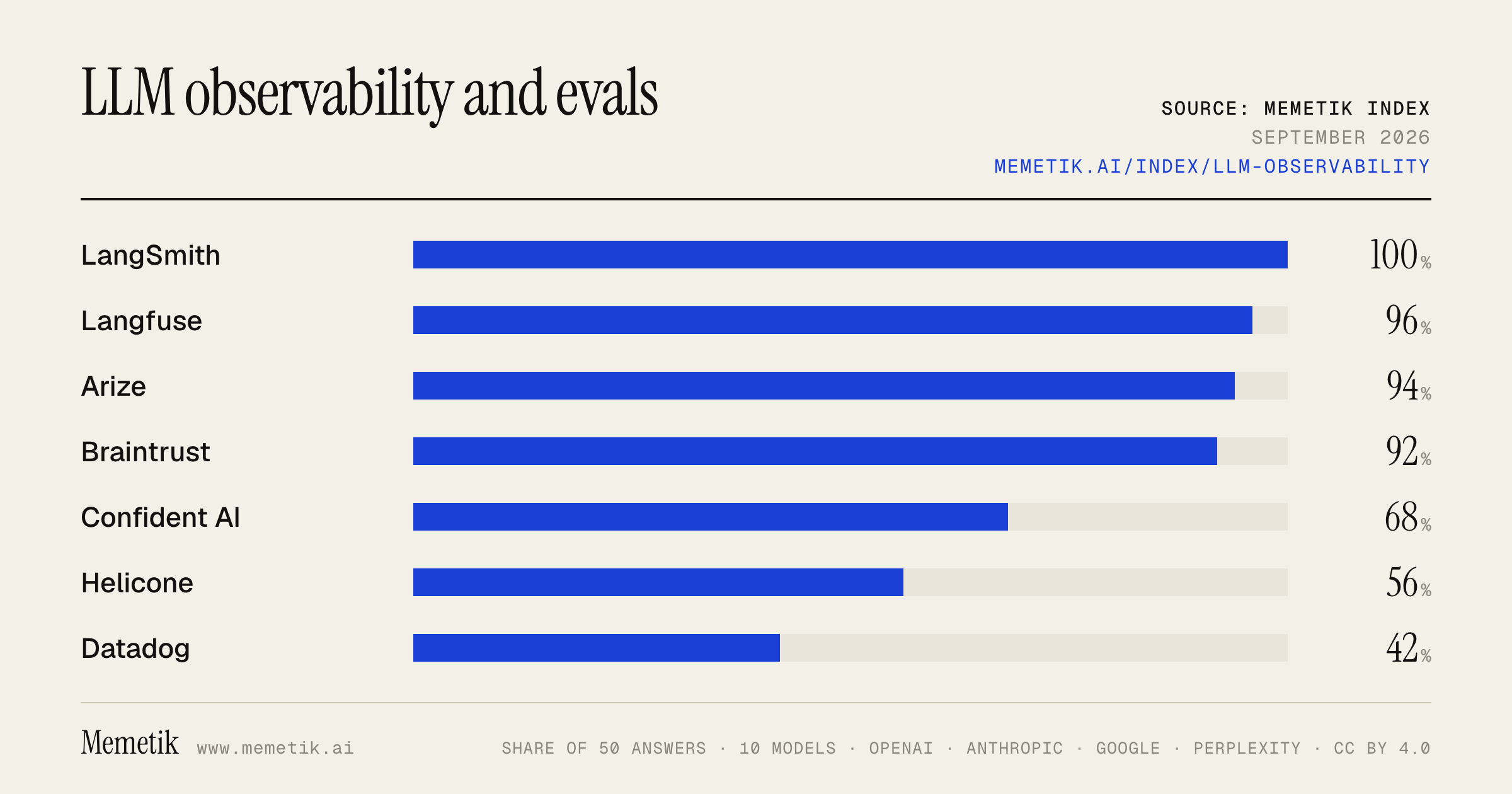
By provider
10 models · 50 answers
OpenAI 3 models · 15 answers
- GPT-5.6 Solgpt-5.6-solmost named: LangSmith 100%
- GPT-5.6 Terragpt-5.6-terramost named: LangSmith 100%
- GPT-5.6 Lunagpt-5.6-lunamost named: LangSmith 100%
Anthropic 3 models · 15 answers
- Claude Opus 5claude-opus-5most named: LangSmith 100%
- Claude Sonnet 5claude-sonnet-5most named: LangSmith 100%
- Claude Fable 5claude-fable-5most named: LangSmith 100%
Google 2 models · 10 answers
- Gemini 3.6 Flashgemini-3.6-flashmost named: LangSmith 100%
- Gemini 3.5 Flashgemini-3.5-flashmost named: LangSmith 100%
Perplexity 2 models · 10 answers
- Sonar Prosonar-promost named: LangSmith 100%
- Sonar Reasoning Prosonar-reasoning-promost named: LangSmith 100%
Sources the models cited
- confident-ai.com155
- braintrust.dev99
- reddit.com88
- firecrawl.dev72
- youtube.com70
- langchain.com67
- mintlify.com57
- medium.com53
- marktechpost.com49
- mlflow.org44
- signoz.io44
- arize.com27
ChatGPT via API returns no citations, so it does not contribute here.
The prompts
- What is the best LLM observability and evaluation platform for an AI engineer? Name specific products.
- Which LLM observability and evaluation platform would you recommend to an AI engineer in 2026?
- Compare the top LLM observability and evaluation platform options right now.
- I'm an AI engineer and I need a LLM observability and evaluation platform. What should I use and why?
- Best LLM observability and evaluation platform for tracing and evals in production?
Every answer
Raw model output, unedited
GPT-5.6 TerraWhat is the best LLM observability and evaluation platform for an AI engineer? Name specific products.
There isn’t one objectively best platform—the right choice depends mostly on whether you prioritize **agent tracing**, **evaluation-driven development**, or **open/self-hosted infrastructure**.

## My practical recommendation

**Best default for most AI engineers: LangSmith.**
Choose it if you want a polished, end-to-end workflow for tracing agent runs, curating datasets, running offline and production evaluations, prompt iteration, and deployment—especially if you use **LangChain or LangGraph**. It is also positioned as framework-agnostic, so it is not limited to LangChain-based applications. ([docs.langchain.com](https://docs.langchain.com/langsmith/evaluation?utm_source=openai))

## Best products by situation

| Situation | Product | Why |
|---|---|---|
| **Best overall / fastest path to a solid engineering loop** | **LangSmith** | Strong all-in-one tracing + datasets + offline/online evals + agent workflow support. Especially compelling with LangGraph/LangChain. ([docs.langchain.com](https://docs.langchain.com/langsmith/evaluation?utm_source=openai)) |
| **Best open-source and self-hosted choice** | **Arize Phoenix** | Open-source, local-first, based on OpenTelemetry/OpenInference; includes tracing, datasets, experiments, evaluations, prompt tooling, and trace replay. ([arize.com](https://arize.com/docs/phoenix/?utm_source=openai)) |
| **Best for eval-first product teams** | **Braintrust** | A strong choice when benchmark datasets, experiments, regression testing, and an iterative “evaluate every change” workflow are the center of your process. It supports work from browser iteration through experiments and production monitoring. ([braintrust.dev](https://www.braintrust.dev/?utm_source=openai)) |
| **Best if your team already uses W&B for ML experimentation** | **Weights & Biases Weave** | Combines LLM tracing, prompt management, evaluations, and cost tracking with W&B’s familiar experiment-tracking ecosystem. ([wb-21fd5541.mintlify.app](https://wb-21fd5541.mintlify.app/get-started?utm_source=openai)) |
| **Best managed enterprise option with an open-source on-ramp** | **Arize AX + Phoenix** | Start with Phoenix for local/self-hosted development, then use Arize AX where you need managed infrastructure, production monitoring, online evals, and enterprise controls. ([arize.com](https://arize.com/?utm_source=openai)) |

## If I had to choose today

- **Using LangGraph/LangChain or want the most frictionless integrated platform:** **LangSmith**
- **Need data control, open standards, local development, or self-hosting:** **Arize Phoenix**
- **Want evals to be the release gate and primary engineering discipline:** **Braintrust**
- **Already standardized on W&B for model experiments:** **W&B Weave**

## What to validate in a pilot

Don’t select based only on dashboards. Run the same 1–2 week pilot in two tools and test whether each can:

1. Capture full traces: model calls, retrieval, tool calls, handoffs, retries, latency, token/cost data.
2. Create a versioned “golden” evaluation set from production failures.
3. Run deterministic, rubric-based LLM-judge, and human evaluations.
4. Compare prompt/model/agent versions and expose regressions before release.
5. Export telemetry and avoid trapping you in a proprietary trace schema.
6. Handle privacy requirements: redaction, retention, access control, and self-hosting if needed.

**Bottom line:** Start with **LangSmith** for the best broadly useful AI-engineering experience; choose **Phoenix** instead if openness and self-hosting are non-negotiable.
GPT-5.6 TerraWhich LLM observability and evaluation platform would you recommend to an AI engineer in 2026?
**My default recommendation in 2026: Langfuse.**

For a typical AI engineer building a production, multi-model or agentic application, it offers the most balanced combination of **LLM tracing, prompt/version management, datasets, evaluation workflows, and self-hosting/open-source flexibility**. That makes it a strong choice when you want to avoid tying core telemetry to a particular agent framework or managed vendor. ([thoughtworks.com](https://www.thoughtworks.com/content/dam/thoughtworks/documents/radar/2026/04/tr_technology_radar_vol_34_en.pdf?utm_source=openai))

Choose something else when your context is decisive:

- **LangSmith** — best if your application is deeply built around **LangChain/LangGraph** and fast, native graph debugging matters most. ([cipherprojects.com](https://www.cipherprojects.com/blog/posts/langsmith-vs-phoenix-vs-braintrust/?utm_source=openai))
- **Braintrust** — best if the central problem is **evaluation rigor**: curated datasets, experiment comparison, and regression/CI gates for every prompt, model, or tool change. ([marsdevs.com](https://www.marsdevs.com/compare/llm-observability-tools-compared?utm_source=openai))
- **Arize Phoenix** — best if you prioritize a **vendor-neutral, OpenTelemetry-oriented** stack, local debugging, and strong RAG/evaluation analysis. ([arize.com](https://arize.com/docs/phoenix/evaluation/llm-evals/evaluator-traces?utm_source=openai))
- **Datadog LLM Observability** — reasonable if your team already operates in Datadog and wants AI traces alongside established service telemetry, rather than another standalone platform. ([marsdevs.com](https://www.marsdevs.com/compare/llm-observability-tools-compared?utm_source=openai))

My practical setup would be:

1. Instrument with **OpenTelemetry/OpenInference-compatible spans** where possible.
2. Use **Langfuse** as the primary trace, prompt, and evaluation workspace.
3. Turn real production failures into a versioned eval set.
4. Gate prompt/model/agent changes on a small, fast regression suite plus periodic human review.

That last loop matters more than dashboard polish: **trace → identify failure → add eval case → block regression**. If your organization is LangGraph-native, substitute LangSmith; if evaluation gates are the product team’s dominant concern, substitute Braintrust.
- https://www.thoughtworks.com/content/dam/thoughtworks/documents/radar/2026/04/tr_technology_radar_vol_34_en.pdf?utm_source=openai
- https://www.cipherprojects.com/blog/posts/langsmith-vs-phoenix-vs-braintrust/?utm_source=openai
- https://www.marsdevs.com/compare/llm-observability-tools-compared?utm_source=openai
- https://arize.com/docs/phoenix/evaluation/llm-evals/evaluator-traces?utm_source=openai
GPT-5.6 TerraCompare the top LLM observability and evaluation platform options right now.
## Bottom line

For most teams evaluating **LLM / agent observability plus quality evaluation**, the leading short list is:

1. **LangSmith** — best integrated choice for LangChain/LangGraph teams and mature offline + production eval workflows.
2. **Langfuse** — best default for teams that want an **open-source, self-hostable, broadly interoperable** platform.
3. **Arize Phoenix** — best for **open-source, OpenTelemetry/OpenInference-native** tracing and flexible, developer-centric evals.
4. **Braintrust** — strongest candidate to evaluate if your center of gravity is **experimentation, eval-driven development, and cross-functional review**, rather than merely collecting traces.

As of **September 2, 2026**, the biggest differentiator is not whether a product can record an LLM call—they all can. It is whether it closes the loop:

> production traces → curated failure set → reproducible experiment → CI/release gate → production-quality monitoring.

---

## Comparison at a glance

| Platform | Best for | Observability | Evaluation workflow | Open source / self-host | Main trade-off |
|---|---|---|---|---|---|
| **LangSmith** | LangChain/LangGraph and teams wanting a polished end-to-end agent engineering platform | Strong hierarchical traces, production monitoring | Strong offline and online evals; human, code, LLM-judge, pairwise evals | Cloud, hybrid, and self-hosted options | More platform-aligned with the LangChain ecosystem; proprietary core |
| **Langfuse** | General-purpose teams prioritizing data control and openness | Strong OTel-native trace capture; cost, latency, metadata, sessions | Datasets, experiments, custom/LLM/human evals, annotation queues | **MIT open source; self-hostable** | You own more operational and evaluation-design responsibility |
| **Arize Phoenix** | Engineering/data-science teams that want open instrumentation and deep debugging | Strong trace/span-level debugging via OpenTelemetry + OpenInference | Code, LLM, and human labels; datasets, experiments, prompt tooling | **Open source; self-hosted** | More developer-oriented; managed enterprise functionality is a separate Arize offering |
| **Braintrust** | Evals-first product development and experimentation | Agent observability | Strong reputation/category fit for experiment and evaluation-centric workflows | Primarily managed commercial platform | Assess fit for your deployment, governance, and observability-depth requirements in a POC |

---

## 1. LangSmith — best polished “single platform” option

**Choose it when:** you are using LangChain or LangGraph heavily, want quick time-to-value, and need a coherent platform for tracing, test datasets, experiments, online evaluation, prompt work, and deployment.

LangSmith supports both **offline evaluations** against curated datasets and **online evaluations** on production traffic. Its evaluator options include human review, code rules, LLM-as-a-judge, and pairwise comparison; production evaluators can be sampled and filtered to control cost. It also offers cloud, hybrid, and self-hosted deployment choices. ([docs.langchain.com](https://docs.langchain.com/langsmith/evaluation?utm_source=openai))

**Where it stands out**
- Particularly smooth if your app already uses LangChain/LangGraph.
- Strong lifecycle model: capture failures from real traffic, turn them into dataset examples, test a change, and monitor it after release.
- Good fit where product teams need understandable experiment comparison—not just raw telemetry.

**Watch-outs**
- If open source, data-plane control, or vendor neutrality are non-negotiable, compare it closely with Langfuse and Phoenix.
- Even with framework-agnostic instrumentation, its ecosystem affinity is naturally strongest around LangChain tooling.

**Verdict:** The safest “buy one platform and get productive quickly” choice, especially in the LangChain/LangGraph world.

---

## 2. Langfuse — best open-source, self-hosted default

**Choose it when:** you want an open platform, need to keep telemetry in your own environment, use varied models/frameworks, or want the flexibility to avoid a tightly coupled agent framework.

Langfuse combines tracing, prompt management, datasets, experiments, evaluation, analytics, and human annotation. Its traces capture LLM calls, retrieval, and tool actions; it supports LLM-judge, heuristic/code, and human review workflows. Langfuse is MIT-licensed, self-hostable, OpenTelemetry-native, and designed to work across frameworks and providers. ([langfuse.com](https://langfuse.com/?utm_source=openai))

**Where it stands out**
- **Data ownership:** a strong choice for regulated or privacy-sensitive deployments.
- **Interoperability:** OTel-native design helps prevent instrumentation lock-in.
- **Practical production analytics:** latency, cost, quality signals, user/session metadata, dashboards, and alerts.
- **Complete OSS story:** self-hosting runs the same underlying infrastructure model used for Langfuse Cloud, though enterprise deployment capabilities may differ. ([langfuse.com](https://langfuse.com/self-hosting?source=post_page-----f67396a2172c--------------------------------&utm_source=openai))

**Watch-outs**
- “Self-hosted” is not synonymous with “zero-cost”: plan for storage, ClickHouse/DB operations, upgrades, security, and on-call ownership.
- Like every platform, its evaluation value depends on the quality of your golden datasets, rubrics, and calibration against human judgments.

**Verdict:** The best overall choice for organizations that value **open source + self-hosting + broad stack support** without giving up a complete eval/observability loop.

---

## 3. Arize Phoenix — best OTel/OpenInference-native engineering choice

**Choose it when:** you want transparent, standards-oriented instrumentation; need flexible trace-level debugging; or have engineering and ML/data-science users who want to build custom eval logic.

Phoenix is an open-source observability and evaluation platform built around **OpenTelemetry** and **OpenInference**. It captures model calls, retrieval, tool use, and custom logic, and supports instrumentation across common frameworks, providers, and languages. Its evaluation stack supports LLM-based evaluators, code checks, and human labels, with datasets and experiments to compare prompts, models, and retrieval changes. ([arize.com](https://arize.com/docs/phoenix?utm_source=openai))

**Where it stands out**
- Very strong fit for **agent traces**, RAG debugging, and span-level analysis.
- Open standards reduce concern about being trapped by a proprietary tracing schema.
- The Phoenix Evals library can be used independently and supports configurable judge models, prebuilt templates for common tasks, custom evaluation, batching, and explanations. ([arizeai-433a7140.mintlify.app](https://arizeai-433a7140.mintlify.app/docs/phoenix/evaluation/llm-evals?utm_source=openai))
- Strong option if you want an OSS core but may later want a managed enterprise path through Arize.

**Watch-outs**
- It is often best appreciated by technical teams; if nontechnical prompt owners need a highly guided workflow, test the UX with them directly.
- Decide whether Phoenix OSS alone meets governance, access-control, retention, and support needs—or whether the managed Arize offering is required.

**Verdict:** Best for teams that see observability as **real telemetry infrastructure**, want
- https://docs.langchain.com/langsmith/evaluation?utm_source=openai
- https://langfuse.com/?utm_source=openai
- https://langfuse.com/self-hosting?source=post_page-----f67396a2172c--------------------------------&utm_source=openai
- https://arize.com/docs/phoenix?utm_source=openai
- https://arizeai-433a7140.mintlify.app/docs/phoenix/evaluation/llm-evals?utm_source=openai
GPT-5.6 TerraI'm an AI engineer and I need a LLM observability and evaluation platform. What should I use and why?
**Default recommendation: Langfuse** — especially if you want one platform that is not tightly coupled to a single agent framework or cloud vendor.

Why it is the best default:
- It combines **tracing/observability, prompt management, datasets, experiments, and evaluations** in one engineering workflow.
- Its core is **open source and self-hostable**, so it is a strong choice if production prompts, retrieved context, customer data, or traces cannot freely leave your environment.
- You can begin on managed cloud for speed, then move to the same underlying infrastructure under your control if compliance or scale demands it. ([langfuse.com](https://langfuse.com/self-hosting?utm_source=openai))

## Pick by situation

| If your priority is… | Use | Why |
|---|---|---|
| **Best general-purpose, vendor-neutral default** | **Langfuse** | Integrated tracing + prompt/version workflow + evals, with credible self-hosting. ([langfuse.com](https://langfuse.com/self-hosting?utm_source=openai)) |
| **Open standards / deep debugging / RAG and agent analysis** | **Arize Phoenix** | Open-source, built around OpenTelemetry and OpenInference; supports tracing, datasets, experiments, prompt iteration, LLM/code/human evaluation, and self-hosting. ([arize.com](https://arize.com/docs/phoenix?utm_source=openai)) |
| **You are heavily committed to LangChain/LangGraph** | **LangSmith** | Its evaluation system spans pre-deployment testing through production monitoring, and is naturally convenient in that ecosystem. ([docs.langchain.com](https://docs.langchain.com/langsmith/evaluation-concepts?utm_source=openai)) |
| **Your team already uses W&B for ML experiments** | **W&B Weave** | Keeps LLM tracing, datasets, and evaluations alongside existing W&B experiment/reproducibility practices. ([docs.wandb.ai](https://docs.wandb.ai/weave/concepts/what-is-weave?utm_source=openai)) |

## My practical decision

1. **Choose Langfuse** if portability, data control, and an all-in-one LLM engineering surface matter most.
2. **Choose Phoenix** instead if you prioritize an **OpenTelemetry-first architecture**, rich trace-level diagnosis, and RAG/agent evaluation workflows. Phoenix explicitly captures model calls, retrieval, tools, and custom logic, and supports LLM-judge, code-based, and human-label evals. ([arize.com](https://arize.com/docs/phoenix?utm_source=openai))
3. **Choose LangSmith** only if LangChain/LangGraph is a strategic dependency—not merely a library you happen to use today.
4. **Choose Weave** when W&B is already where your datasets, experiment lineage, and team habits live.

## What I would require before committing

Do a one-week bake-off with **Langfuse and Phoenix** against a real staging service. Instrument via **OpenTelemetry**, rather than locking app code to a proprietary tracing SDK wherever possible. Phoenix natively accepts OTLP and supports common LLM providers, frameworks, and multiple languages; that makes this an especially useful portability benchmark. ([arize.com](https://arize.com/docs/phoenix?utm_source=openai))

Score each on:

- **Trace fidelity:** model calls, tool calls, retrieval chunks, retries, handoffs, sessions.
- **Evaluation workflow:** offline regression suite, LLM-as-judge, deterministic checks, human review queues, production sampling.
- **Experiment comparability:** can you compare prompt/model/retriever/agent versions on the *same frozen dataset*?
- **Operational concerns:** PII redaction, retention, RBAC/SSO, export, multi-tenancy, cost at your expected trace volume.
- **Developer friction:** time-to-first-trace, SDK quality, CI integration, and whether failures can be turned from production traces into durable test cases.

One important caveat: observability is not evaluation. A platform can show beautiful traces while your product quality still regresses. Establish a versioned “golden” dataset, task-specific deterministic checks, calibrated judge rubrics, and sampled human review; then use the platform to connect those scores back to production traces and releases.

**Bottom line:** use **Langfuse** as the default procurement choice; use **Phoenix** if open telemetry, self-hosting, and diagnostic depth are your strongest requirements.
GPT-5.6 TerraBest LLM observability and evaluation platform for tracing and evals in production?
**Best overall: LangSmith** — especially if you need **production tracing and a tightly integrated evaluation loop**, not just dashboards.

Why it’s the strongest default:
- Framework-agnostic tracing via SDKs/integrations and OpenTelemetry support; captures multi-step agent/tool/retrieval behavior, latency, token/cost, errors, and feedback. ([langchain.com](https://www.langchain.com/langsmith/observability?utm_source=openai))
- Supports both **offline evals** (regression tests, benchmarks, backtests on curated datasets) and **online evals** on real production runs/threads. ([docs.langchain.com](https://docs.langchain.com/langsmith/evaluation-concepts?utm_source=openai))
- Good workflow continuity: turn production failures into dataset examples, run comparisons, add human review, and monitor quality/cost/latency over time. ([docs.langchain.com](https://docs.langchain.com/langsmith/observability-llm-tutorial?utm_source=openai))
- Viable for security-sensitive enterprises through BYOC/self-hosted options, though self-hosting is an Enterprise add-on. ([langchain.com](https://www.langchain.com/langsmith/observability?utm_source=openai))

**Choose LangSmith if:** you’re building agents/RAG in production and want a single place for debugging, eval datasets, LLM-as-judge/code evaluators, experiment comparison, annotation, and online monitoring.

**Best alternative for open-source/self-managed flexibility: Arize Phoenix.** Phoenix supports tracing plus deterministic and LLM-judge evaluations against traces, datasets, and arbitrary sources; its SDK-oriented approach provides more direct control over evaluator logic and judge models. ([arize.com](https://arize.com/docs/phoenix/evaluation/llm-evals/evaluator-traces?utm_source=openai))

### Practical recommendation
- **Most teams:** start with **LangSmith**.
- **You prioritize open-source control / custom eval pipelines:** use **Phoenix**.
- **Do not buy based on tracing alone:** require that the platform can (1) sample/redact production traces, (2) run online quality/safety evals, (3) promote bad production cases into a regression dataset, and (4) compare releases by quality *and* cost/latency.

A sensible production setup is: trace 100% of errors and a sampled portion of successful traffic; run cheap deterministic checks broadly; run LLM-judge evals on sampled traffic; and convert confirmed failures into a versioned offline regression suite.
- https://www.langchain.com/langsmith/observability?utm_source=openai
- https://docs.langchain.com/langsmith/evaluation-concepts?utm_source=openai
- https://docs.langchain.com/langsmith/observability-llm-tutorial?utm_source=openai
- https://arize.com/docs/phoenix/evaluation/llm-evals/evaluator-traces?utm_source=openai
Claude Sonnet 5What is the best LLM observability and evaluation platform for an AI engineer? Name specific products.
There's no single universal "best" — the right choice depends on whether you want open-source/self-hosted flexibility, tight LangChain integration, or an evaluation-first workflow. Here's how the leading products actually break down for an AI engineer:

## Top picks by use case

**Langfuse** — The most widely adopted open-source option.
Langfuse is the open source leader in this space, with over 28,000 GitHub stars and an MIT license that lets you self-host without restrictions, covering the full observability stack: tracing with multi-turn conversation support, prompt versioning with a built-in playground, and flexible evaluation through LLM-as-judge, user feedback, or custom metrics.

Integration is straightforward, with native SDKs for Python and JavaScript, connectors for LangChain, LlamaIndex, and 50+ other frameworks, plus OpenTelemetry support.
 Good default choice if you want a self-hostable, framework-agnostic platform.

**LangSmith** — Best if you're already in the LangChain ecosystem.
If you're already building with LangChain or LangGraph, LangSmith is the path of least resistance.


**Opik (by Comet)** — Strong open-source alternative with a broad feature set.
Opik's complete set of AI agent tracing, debugging, LLM evaluation, production monitoring, and prompt engineering tools is available in a free open-source version as well as a generous free cloud tier, making it easy for developers building agents to try it.

The Apache-2.0 build ships the backend too, so you self-host the whole platform, carrying tracing, evaluation, prompt and agent optimization, guardrails, and production monitoring with online evaluation rules.


**Braintrust** — Praised for the tightest developer loop.
For engineers shipping a reliable LLM app faster, Braintrust and LangSmith offer the tightest build-eval-ship loop.


**Arize (and its open-source Phoenix)** — Best for enterprise-grade evaluation rigor.
Arize offers enterprise-grade eval rigor with a self-hosted option and an open-source on-ramp (Phoenix).


**Confident AI (built on DeepEval)** — The most evaluation-centric platform, treating quality scoring as the core primitive rather than an add-on to tracing.
It makes evaluation the core of observability — every trace scored with 50+ research-backed metrics, quality drops trigger alerts via PagerDuty/Slack/Teams, traces auto-curate into datasets, and the entire workflow is accessible to PMs, QA, and domain experts.


## How the market is segmented

Analysts generally split these tools into three camps:
traditional APM platforms (Datadog, New Relic) adding LLM tabs for tokens and latency, AI-native tracing tools (Langfuse, LangSmith) that go deep on trace capture, and AI gateways (Helicone, Portkey) that sit between your app and LLM providers for routing, caching, and cost tracking.
 Separately,
AI-native observability platforms like Langfuse, LangSmith, Braintrust, Arize, and Opik treat the LLM trace as the primary object, capturing nested spans across agents, retrievers, and tools, and attaching evaluation scores to production traffic.


## My recommendation

For a typical AI engineer building/shipping LLM apps today:

1. **Start with Langfuse** if you want open-source, self-hostable, framework-agnostic tracing + eval with minimal lock-in.
2. **Use LangSmith** if your stack is already LangChain/LangGraph-based.
3. **Consider Braintrust or Confident AI** if evaluation quality (not just observability) is your primary pain point — e.g., you need rigorous scoring, regression testing, and dataset curation baked into the workflow.
4. **Look at Arize/Phoenix** if you're at enterprise scale and need rigorous, auditable evaluation pipelines, especially for RAG systems.

There isn't one "best" tool crowned across the board — it really is a case of matching the tool's specialty (tracing depth vs. evaluation rigor vs. gateway/cost features) to what's actually blocking you in production.
- https://www.firecrawl.dev/blog/best-llm-observability-tools
- https://medium.com/data-science-collective/top-llm-observability-platforms-in-2026-2c1c37619766
- https://www.kosmoy.com/resources/blog/best-llm-evaluation-platforms-2026/
- https://www.confident-ai.com/knowledge-base/compare/10-llm-observability-tools-to-evaluate-and-monitor-ai-2026
- https://www.marktechpost.com/2026/08/09/top-llm-observability-and-evaluation-platforms-in-2026-langfuse-langsmith-braintrust-arize-and-more-compared/
Claude Sonnet 5Which LLM observability and evaluation platform would you recommend to an AI engineer in 2026?
Based on the current landscape in 2026, there isn't a single universal answer — it really depends on your stack, team size, and whether you prioritize open-source flexibility, evaluation depth, or enterprise polish. Here's how I'd break down the recommendation:

## My general recommendation: **Langfuse** (for most teams)


Langfuse is the open source leader in this space, with over 28,000 GitHub stars and an MIT license that lets you self-host without restrictions, covering the full observability stack including tracing with multi-turn conversation support, prompt versioning, and flexible evaluation.

It has native SDKs for Python and JavaScript, plus connectors for LangChain, LlamaIndex, and 50+ other frameworks, with OpenTelemetry support so you can pipe traces into your existing observability stack.
 It's a great default because it balances openness, maturity, and a low-friction adoption path. Worth noting:
it was recently acquired by ClickHouse, signaling a strong long-term investment in its data infrastructure.


## If you want evaluation to be the core (not an add-on)

**Confident AI** (built on the open-source DeepEval library) is worth a serious look.
It makes evaluation the core of observability — every trace scored with 50+ research-backed metrics, quality drops trigger alerts via PagerDuty/Slack/Teams, traces auto-curate into datasets, and the entire workflow is accessible to PMs, QA, and domain experts.
 The broader category thesis here matters:
the real question is whether your AI is producing good outputs — the tools that matter in 2026 close the gap between observing AI behavior and evaluating AI quality by scoring outputs, alerting on quality degradation, detecting drift, and feeding production insights back into development.


## Other strong options depending on your needs

- **Opik** (by Comet) — if you want a fully open-source, self-hostable, all-in-one option.
The Apache-2.0 build ships the backend too, so you self-host the whole platform, carrying tracing, evaluation, prompt and agent optimization, guardrails, and production monitoring with online evaluation rules.


- **LangSmith** —
if you're already building with LangChain or LangGraph, LangSmith is the path of least resistance.


- **Braintrust or Arize** — for tighter enterprise eval workflows.
Braintrust and LangSmith offer the tightest build-eval-ship loop, while Arize provides enterprise-grade eval rigor with a self-hosted option and an open-source on-ramp (Phoenix).


- **OpenObserve** — if you want to avoid running a separate LLM tool alongside your infrastructure monitoring stack.
It offers native OpenTelemetry LLM tracing, per-model and per-session cost tracking, and unified correlation with logs, metrics, infrastructure traces, and RUM, all in a platform you can self-host or run managed.


## Bottom line for an AI engineer in 2026

- **Solo dev / startup, want flexibility and self-hosting** → Langfuse or Opik
- **Evaluation quality is your #1 pain point** → Confident AI
- **Already deep in LangChain/LangGraph ecosystem** → LangSmith
- **Enterprise scale, need rigorous eval + governance** → Arize or Braintrust
- **Want to avoid a second observability stack entirely** → OpenObserve

The broader trend worth knowing:
the LLM observability platform market is sized at $2.69 billion in 2026, up from $1.97 billion in 2025, and Gartner predicts that by 2028, LLM observability investments will account for 50% of GenAI deployments, up from 15% in early 2026.
 This is a fast-moving space, so it's worth revisiting your choice every 6-12 months as these platforms rapidly add capabilities.
- https://www.firecrawl.dev/blog/best-llm-observability-tools
- https://openobserve.ai/blog/llm-observability-tools/
- https://www.confident-ai.com/knowledge-base/compare/10-llm-observability-tools-to-evaluate-and-monitor-ai-2026
- https://medium.com/data-science-collective/top-llm-observability-platforms-in-2026-2c1c37619766
- https://www.kosmoy.com/resources/blog/best-llm-evaluation-platforms-2026/
- https://openobserve.ai/blog/top-10-llm-observability-tools/
- https://www.marktechpost.com/2026/08/09/top-llm-observability-and-evaluation-platforms-in-2026-langfuse-langsmith-braintrust-arize-and-more-compared/
Claude Sonnet 5Compare the top LLM observability and evaluation platform options right now.
Based on current market analysis, here's a comparison of the leading LLM observability and evaluation platforms in 2026.

## Market Context

The category has grown significantly:
the LLM observability platform market is sized at $2.69 billion in 2026, up from $1.97 billion in 2025, and is projected to reach $9.26 billion by 2030 at a 36.2% forecast CAGR.
 Adoption of monitoring is outpacing evaluation rigor —
a LangChain survey of 1,300+ professionals found 57% now run agents in production, nearly 89% have implemented observability, but only 52.4% run offline evaluations and 37.3% run online evaluations, with 29.5% reporting no evaluation at all.


## The Core Platforms

**Langfuse, LangSmith, Braintrust, Arize, Opik** are generally treated as the AI-native leaders.
These platforms treat the LLM trace as the primary object, capturing nested spans across agents, retrievers, and tools, and attaching evaluation scores to production traffic.


### Langfuse
The most popular open-source, LLM-specific option.
It has 21,000+ GitHub stars (as of February 2026) and is the most widely adopted open source LLM-specific observability platform.
 It was recently acquired by ClickHouse, per one source's citation list, signaling consolidation in the space.

### Opik (by Comet)
Strong open-source contender with broad capability coverage.
Of the free, self-hostable options, Opik covers the most ground — four of five core capabilities — under Apache 2.0.

The Apache-2.0 build ships the full backend for self-hosting, and it carries tracing, evaluation, prompt and agent optimization, guardrails, and production monitoring with online evaluation rules.


### Arize (including Phoenix)
Enterprise-grade platform with a strong open-source project (Phoenix) feeding into its commercial offering, frequently shortlisted alongside LangSmith and Braintrust in enterprise evaluations.

### LangSmith
Tightly integrated with the LangChain ecosystem; commonly bundled into "top tier" comparisons for teams already building with LangChain/LangGraph.

### Braintrust
Positioned as an evaluation-first platform with strong dataset/experiment management, popular with teams that prioritize rigorous pre-deployment testing.

### MLflow
Differentiated by breadth across the ML lifecycle, not just LLMs.
It's noted as the only tool that combines open-source licensing, deep agent tracing with replay, prompt versioning, and automated evaluation in a single platform, whereas other tools either specialize in one dimension or require a commercial SaaS dependency.

It supports trace logging, prompt management, and evaluation scoring with a familiar interface for teams already using Comet for traditional ML experiments, with the integration story strongest for teams wanting a single platform spanning classical ML tracking and LLM observability.
 (Note: this claim about Comet appears to be a source artifact — MLflow is a Databricks/Linux Foundation project, so verify current ownership details independently.)

### OpenObserve
Pitches itself as a unified infrastructure + LLM observability platform rather than an LLM-specialist tool.
It offers native OpenTelemetry LLM tracing, per-model and per-session cost tracking, and unified correlation with logs, metrics, infrastructure traces, and RUM in a platform you can self-host or run managed — avoiding a second tool or manual timestamp-matching when a cost spike or quality regression hits.
 Its LLM-specific evaluation depth is thinner:
LLM-specific features like LLM-as-judge evaluation and prompt management are handled through integrations rather than built-in modules, best paired with Langfuse or Opik for full eval coverage.


### Confident AI / DeepEval
Evaluation-heavy platform emphasizing closing the loop between production and testing.
Its standout feature is automatic dataset curation from production traces, where failures surface directly in evaluation datasets, plus collaborative annotation workflows letting non-technical teammates review traces and run evaluations without involving engineering.

It also pushes further than most observability tools on quality-aware alerting, with alerts firing on evaluation-score regressions like faithfulness drops or safety failures, not just latency spikes.
 It also ships a red-teaming companion:
the DeepTeam companion library adds red teaming aligned to OWASP Top 10 for LLMs and NIST AI RMF, covering jailbreaks, PII leakage, prompt injection, and bias.


### Helicone
A lighter-weight, proxy-based option.
Setup is fast since you route traffic through Helicone and get dashboards without deep instrumentation in every service, but observability is request-centric — deep agent graphs, span-level reasoning steps, and rich production evaluation loops are not the core story.


## How to Choose

Analysts suggest evaluating platforms less by feature checklists and more by evaluation maturity:
ranking should be based on evaluation maturity, depth of production insight, cross-functional accessibility, and how well the platform connects what you see in production to what you test before the next deploy — not logo count or integration lists.
 Practically:
- https://www.marktechpost.com/2026/08/09/top-llm-observability-and-evaluation-platforms-in-2026-langfuse-langsmith-braintrust-arize-and-more-compared/
- https://openobserve.ai/blog/llm-observability-tools/
- https://medium.com/data-science-collective/top-llm-observability-platforms-in-2026-2c1c37619766
- https://mlflow.org/articles/top-llm-observability-tools-in-2026-a-pro-guide/
- https://openobserve.ai/blog/top-10-llm-observability-tools/
- https://www.firecrawl.dev/blog/best-llm-observability-tools
- https://www.confident-ai.com/knowledge-base/compare/top-7-llm-observability-tools
Claude Sonnet 5I'm an AI engineer and I need a LLM observability and evaluation platform. What should I use and why?
# LLM Observability and Evaluation Platforms

Since this is a fast-moving space, let me pull current information to give you an accurate comparison.
Given the crowded and fast-evolving landscape, here's a practical breakdown to help you choose based on your actual constraints rather than a single "best" answer.

## Quick recommendation matrix

**If you want the safest default for most teams:** **Langfuse**. It's open source (MIT core), self-hostable for full data ownership, and covers tracing, prompt versioning, and evaluation in one place.
It's open source, MIT licensed, and works with everything
, which makes it a low-risk starting point since you're not locked into a vendor and can migrate later.

**If you're building with LangChain/LangGraph:** **LangSmith**.
It offers LangChain/LangGraph integration with per-seat plus per-trace pricing, and a free tier of 5,000 traces/month
. The tradeoff is it's proprietary and works best (though not exclusively) within the LangChain ecosystem.

**If evaluation quality is your top priority (not just logging):** **Confident AI**.
It's positioned as an evaluation-first observability tool, evaluating production traces with 50+ research-backed metrics, alerting on quality and drift, and auto-curating datasets
. Good fit if you care more about systematically catching hallucinations/regressions than raw trace visualization.

**If you're doing heavy RAG work:** **Arize Phoenix**. It's
open source and OpenTelemetry-native with no vendor lock-in
, and is specifically called out as strong for
RAG debugging and production monitoring
. It pairs well with Arize AX if you later need enterprise-scale ML monitoring alongside LLM tracing.

**If you already use MLflow for traditional ML:** **MLflow** now has a genuinely competitive GenAI story —
it's the only tool that combines open-source licensing, deep agent tracing with replay, prompt versioning, and automated evaluation in a single platform
. Strong pick if you want one platform spanning classic ML and LLM workflows.

**If you want a lightweight cost/latency layer rather than deep evals:** **Helicone** or **Portkey** — these act more as an API gateway with logging than a full eval suite. Helicone is good for
fastest setup and caching
, while Portkey shines for
multi-provider routing
 across 250+ models.

**If you're already paying for Datadog/enterprise APM:** Just extend that —
Datadog LLM Observability is best suited for organizations that already rely on Datadog for infrastructure and application monitoring
, so you avoid tool sprawl.

**Newer entrant worth watching:** **Pydantic Logfire**, which pitches itself as
AI-native depth, full-stack tracing, and open standards
, with OTel-native, SQL-queryable traces and a generous free tier (10M spans/month).

## How I'd actually decide

1. **Open source / self-hosting required?** → Langfuse, Arize Phoenix, or MLflow.
2. **Already committed to LangChain?** → LangSmith is the path of least resistance.
3. **Evals matter more than pretty traces?** → Confident AI or Braintrust (the latter is noted for
prompt experimentation
 and CI/CD-style eval gates).
4. **Multi-agent systems specifically?** → LangWatch or Latitude, both built with agent-native tracing (causal session traces, handoff visibility) rather than single-call logging.
5. **You just need cost/latency visibility, not deep quality evals?** → Helicone or Portkey as a thin gateway layer.

For most AI engineers starting fresh without strong framework lock-in, **Langfuse** is the pragmatic default (open source, flexible, low switching cost), with **Confident AI** or **Arize Phoenix** as the upgrade path once evaluation rigor becomes the bottleneck rather than basic tracing.

One caveat: this space changes monthly — pricing tiers, feature sets, and "best for X" claims shift fast, so I'd treat vendor comparison pages (including the ones I cited) with some skepticism since several are published by competing platforms themselves.
- https://www.firecrawl.dev/blog/best-llm-observability-tools
- https://pydantic.dev/articles/best-ai-observability-platform
- https://www.confident-ai.com/knowledge-base/compare/top-7-llm-observability-tools
- https://www.onpage.com/top-12-ai-and-llm-observability-tools-in-2026-compared-open-source-and-paid/
- https://mlflow.org/articles/top-llm-observability-tools-in-2026-a-pro-guide/
Claude Sonnet 5Best LLM observability and evaluation platform for tracing and evals in production?
There's no single "best" platform — it depends on your stack, team, and priorities (self-hosting, framework lock-in, cost, evaluation depth). Here's how the leading options stack up for **production tracing + evals** as of 2026:

## Top contenders

**Langfuse, LangSmith, Braintrust, Arize, and Opik** are generally treated as the core "AI-native" observability platforms —
they treat the LLM trace as the primary object, capturing nested spans across agents, retrievers, and tools, and attaching evaluation scores to production traffic.


- **LangSmith** — Best if you're deep in the LangChain/LangGraph ecosystem. It offers
deep LangChain and LangGraph trace capture and agent graph visualization, annotation queues for structured human review, and LLM-as-a-judge evaluation workflows tied to traced runs
. The tradeoff:
if you're not using LangChain, much of the value disappears, and framework-agnostic tracing requires more setup.


- **Braintrust** — Takes an evaluation-first approach.
While it handles tracing and logging, its real strength is the experiment framework — define a dataset, run prompt variations against it, and compare results side by side, making it ideal for systematic prompt iteration. It supports human review workflows alongside automated evals, with datasets created directly from production logs.
 It's also built for speed:
it's designed for teams where not everyone is deeply technical, with a purpose-built database (Brainstore) that efficiently analyzes production traces and an AI proxy for automatic logging with minimal setup.


- **Arize (Phoenix)** — Best for
enterprises with an existing ML observability practice and a warehouse they want traces to flow into
, with a free, self-hostable open-source option (Phoenix).

- **MLflow** — Strong if you already use it for ML experiment tracking.
Tracing is OpenTelemetry-native with GenAI Semantic Conventions support, one-line auto-tracing for OpenAI, Anthropic, LangChain, LlamaIndex, DSPy, and more, plus a slimmer production SDK optimized for minimal overhead. Evaluation includes 50+ built-in metrics and LLM judges, with results linked directly to the traces that produced them.
 It also uniquely offers
production-grade evaluation with built-in LLM judges, multi-turn evaluation, integration with RAGAS/DeepEval/Phoenix/TruLens/Guardrails AI, and prompt optimization algorithms like GEPA and MIPRO that automatically improve prompts based on eval results.


- **Confident AI** — Positions itself around eval-driven observability rather than just tracing.
It provides full tracing across LLM calls, tool use, agent steps, and multi-agent workflows, but its main differentiator is running online evals directly on production traces to monitor hallucinations, faithfulness, and answer relevance — detecting issues in real time and pinpointing which prompts, agents, or tools cause degraded performance.
 It also
closes the loop between monitoring and pre-release testing: production traces can be curated into evaluation datasets, queued for human annotation, and reused for regression testing.


- **Galileo** — Notable for cost efficiency at scale:
its differentiator is economic — running LLM-as-a-judge at production volume means a model call for every scored trace, and Galileo distills those judges into compact "Luna" models that run at low latency and, by their claim, 96% lower cost than using a frontier model as judge
 (though that benchmark is self-reported).

- **LangWatch / Portkey** — More niche:
LangWatch offers open-source, multi-agent observability with online evaluation and a production-to-simulation loop (infrastructure APM out of scope), while Portkey is primarily an AI gateway with multi-provider routing, caching, and cost tracking — observability there is provider-level, not output-quality.


## How to choose
The market has effectively split into camps:
AI-native trace-first platforms, and open-source/source-available evaluation libraries like Arize Phoenix, DeepEval, MLflow, and RAGAS.
 Practical framing:

- **Already on LangChain/LangGraph** → LangSmith
- **Want systematic prompt/eval iteration with a clean UI** → Braintrust
- **Want open-source, self-hosted, OTel-native, and already invested in MLflow** → MLflow
- **Want evaluation-as-the-core-signal with alerting and human-in-the-loop workflows** → Confident AI
- **Enterprise-scale with existing data warehouse/ML observability needs** → Arize
- **Cost-sensitive at high judge-call volume** → Galileo

If you tell me your stack (framework, self-host vs. SaaS, team technical level, budget), I can narrow this down to a single best fit.
- https://www.marktechpost.com/2026/08/09/top-llm-observability-and-evaluation-platforms-in-2026-langfuse-langsmith-braintrust-arize-and-more-compared/amp/
- https://www.confident-ai.com/knowledge-base/compare/top-7-llm-observability-tools
- https://www.firecrawl.dev/blog/best-llm-observability-tools
- https://mlflow.org/top-5-agent-observability-tools/
- https://medium.com/data-science-collective/top-llm-observability-platforms-in-2026-2c1c37619766
- https://www.truefoundry.com/blog/llm-observability-tools
- https://www.confident-ai.com/knowledge-base/compare/10-llm-observability-tools-to-evaluate-and-monitor-ai-2026
Gemini 3.6 FlashWhat is the best LLM observability and evaluation platform for an AI engineer? Name specific products.
Choosing the "best" LLM observability and evaluation platform depends heavily on your setup (e.g., open-source vs. managed SaaS, ecosystem lock-in, and whether you are building simple RAG systems or complex agentic workflows).

However, leading production-grade platforms stand out based on developer workflows, tracing depth, evaluation capabilities, and integration flexibility:

---

### 1. The Open-Source & Developer-First Champions

#### **Langfuse** (Best Open-Source Platform Overall)
* **Why it stands out:** Fully open-source (Apache 2.0/MIT) and built natively for developers. It offers fine-grained execution tracing (inputs, outputs, token costs, latencies) and syncs cleanly with OpenTelemetry standards.
* **Evals & Features:** Supports user feedback collection, automated LLM-as-a-judge evaluations, score tracking over time, and a prompt management hub.
* **Best for:** Engineers who want complete control over their infrastructure, self-hosting options (via Docker/Kubernetes), and no vendor lock-in.

#### **Comet Opik** (Best Open-Source for Agentic Systems)
* **Why it stands out:** An Apache 2.0 open-source observability framework built to handle deeply nested agent traces, multi-turn interactions, and tool calls.
* **Evals & Features:** Includes automated trace analysis, prompt evaluation pipelines, continuous monitoring, and ML-centric experiment tracking.
* **Best for:** Teams looking for a fully open-source stack designed specifically around agents and complex tool chaining.

---

### 2. The Ecosystem-Integrated Standard

#### **LangSmith** (Best for LangChain / LangGraph Ecosystems)
* **Why it stands out:** Built by the team behind LangChain, it seamlessly integrates with LangChain/LangGraph applications out of the box (requiring zero-config tracing in most cases).
* **Evals & Features:** Top-tier prompt playground, dataset curation directly from production logs, automated offline/online evals, and specialized annotation queues for human feedback.
* **Best for:** Teams already using LangChain or LangGraph who need deep, native step-by-step agent debugging and regression testing.

---

### 3. The Quality- & Evaluation-First Platforms

#### **Confident AI (DeepEval)** (Best for CI/CD & Metric Depth)
* **Why it stands out:** Powered by the popular open-source `DeepEval` framework, Confident AI focuses heavily on *evaluation as the core of observability* rather than just basic logging.
* **Evals & Features:** Offers 50+ research-backed, out-of-the-box metrics (e.g., answer relevancy, faithfulness, tool correctness, bias, toxicity). It surfaces failure patterns automatically and seamlessly integrates into CI/CD build gates to prevent regressions.
* **Best for:** AI teams that prioritize rigorous automated testing, regression prevention, and strict metric alignment.

#### **Braintrust** (Best for Developer Workflows & Speed)
* **Why it stands out:** Extremely fast, lightweight SDKs designed to fit into standard software engineering workflows (like writing standard `jest` or `pytest` unit tests for LLMs).
* **Evals & Features:** Combines high-speed evaluation pipelines with prompt management, real-time tracing, and automated dataset creation from logs.
* **Best for:** Fast-moving startup teams who want evaluation integrated into their existing code-testing pipelines without setup friction.

---

### 4. Enterprise Observability & Agent Specialists

#### **Arize AI / Phoenix** (Best for Enterprise & Root-Cause Debugging)
* **Why it stands out:** Arize brings long-standing ML drift detection and enterprise observability experience into the LLM space. Their open-source project, **Phoenix**, offers rich visualization for embeddings and agent trace graphs.
* **Evals & Features:** Advanced session-level evaluation, embedding drift detection, hallucination tracking, and AI-assisted debugging tools (like Alyx).
* **Best for:** Enterprise AI teams and data science groups needing strict compliance (SOC2/HIPAA) alongside deep vector search and agent debugging capabilities.

#### **Galileo AI** (Best for Guardrails & Specialized Model Scoring)
* **Why it stands out:** Specialized in high-speed, cost-effective evaluation using purpose-built small language models rather than relying purely on expensive API calls to GPT-4.
* **Evals & Features:** Real-time production guardrails, robust hallucination detection metrics, agent tool-call evaluation, and cost-efficiency scoring.
* **Best for:** Enterprise teams needing low-latency, real-time guardrails and cost-optimized evaluators in production.

---

### Summary Recommendation

* **Go with Langfuse or Comet Opik** if you want an **open-source**, self-hostable platform with full control over your telemetry data.
* **Go with LangSmith** if you build heavily within the **LangChain/LangGraph** framework.
* **Go with Confident AI** if your primary challenge is **evaluating agent quality** and preventing regressions in CI/CD pipelines.
* **Go with Arize or Galileo** if you work in an **enterprise setting** that requires robust governance, embedding drift tracking, or specialized guardrails.
Gemini 3.6 FlashWhich LLM observability and evaluation platform would you recommend to an AI engineer in 2026?
Choosing the right LLM observability and evaluation platform depends heavily on your team's stack, budget, privacy constraints, and architecture (e.g., simple RAG pipelines vs. complex multi-turn AI agents).

The market has largely converged around **OpenTelemetry standards (OpenInference)** for tracing and span-level data, but tools differentiate based on open-source flexibility, evaluation depth, or native framework support.

Recommendations categorized by primary engineering use cases:

---

### 1. **Best Overall Open-Source & Self-Hosted: Langfuse**
* **Best for:** Teams looking for data privacy, self-hosting flexibility (MIT license), and comprehensive tracing without vendor lock-in.
* **Key Strengths:**
  * Excellent UI for tracing multi-step agent calls, sub-agent handoffs, and tool executions.
  * Native OpenTelemetry support, easy dataset generation from production logs, and cost/latency analytics.
  * Generous cloud free tier or zero-cost self-hosted Docker/K8s deployments.

### 2. **Best for Agentic AI Workflows & Evals: Arize Phoenix / Arize AX**
* **Best for:** Complex multi-agent applications, RAG performance analysis, and ML observability standardisation.
* **Key Strengths:**
  * **Phoenix** is a powerful local-first, open-source tool that runs with zero cloud setup—ideal for rapid local evaluation.
  * Deep evaluation library (`phoenix.evals`) with pre-built evaluators for hallucination, tool usage, context relevance, and drift detection.
  * Scales seamlessly to the enterprise-grade Arize AX platform if you need real-time monitoring and compliance (SOC2/HIPAA).

### 3. **Best for Fast Prototyping & Enterprise Evals: Braintrust**
* **Best for:** Teams prioritizing speed, prompt engineering playgrounds, and tight CI/CD quality gates.
* **Key Strengths:**
  * Blazing fast UI built specifically around rapid iteration, A/B testing prompts, and side-by-side run evaluations.
  * Exceptional developer experience (DX) for logging function-calling spans, creating custom evaluators, and integrating regression tests into CI pipelines.

### 4. **Best if standardizing on LangChain / LangGraph: LangSmith**
* **Best for:** Teams already heavily using LangGraph, Deep Agents, or the LangChain ecosystem.
* **Key Strengths:**
  * Deep, native integration with `LangGraph` state management makes debugging looping agent traces almost effortless.
  * Powerful annotation queues, trace-to-dataset features, and LLM-as-a-judge evaluation frameworks.
  * *Note:* Works with custom Python/TS code too, though its biggest value proposition is within its native ecosystem.

### 5. **Best Open-Source Challenger: Comet Opik**
* **Best for:** Teams wanting an Apache 2.0 open-source tool that unifies classic ML experiment tracking with LLM evaluation.
* **Key Strengths:**
  * Tracks multi-turn agent spans, prompt versions, and evaluation metrics.
  * Highly extensible for data science teams moving from traditional ML to GenAI applications.

---

### Quick Decision Matrix

| Your Primary Need | Recommended Tool |
| :--- | :--- |
| **Self-Hosted / Open-Source / Production** | **Langfuse** |
| **Local Evaluation / OpenTelemetry / RAG Evals** | **Arize Phoenix** |
| **Fast CI/CD Evals & Prompt Playgrounds** | **Braintrust** |
| **LangGraph / LangChain Native Stack** | **LangSmith** |
| **Data Science & ML-Unified Tracking** | **Comet Opik** |

### Recommendation Summary
If starting a **new production system**, **Langfuse** is recommended for its balance of data control, affordability, and UI developer experience. For **local eval experimentation** or heavy RAG/agent debugging, starting with **Arize Phoenix** is a great zero-risk path.
Gemini 3.6 FlashCompare the top LLM observability and evaluation platform options right now.
The landscape for LLM observability, evaluation, and tracing has matured significantly, dividing into a few primary categories: **all-in-one developer platforms**, **open-source first options**, **enterprise ML/eval specialists**, and **gateway-first platforms**.

Here is a detailed comparison of the top LLM observability and evaluation platform options right now.

---

### 1. The Top Platforms at a Glance

| Platform | Primary Strength | Open Source / Self-Host? | Core Focus |
| :--- | :--- | :--- | :--- |
| **LangSmith** | Native LangChain integration & rich debugging | Managed SaaS (Enterprise self-host available) | Full-lifecycle tracing, prompt playground, evals |
| **Langfuse** | Flexible, lightweight, transparent pricing | **Yes** (MIT License) | Open-source tracing, metrics, evals, prompt management |
| **Arize Phoenix** | Deep embedding analysis & RAG triad evaluation | **Yes** (Phoenix) + SaaS (Arize AI) | Advanced telemetry, RAG evals, drift detection |
| **Braintrust** | CI/CD evaluation workflows & prompt playgrounds | Proprietary SaaS | High-speed testing, enterprise prompt engineering |
| **Helicone** | Simple zero-code setup via API proxy | **Yes** (Open Core) | Latency, cost tracking, caching, simple logging |
| **Portkey** | AI Gateway + Observability & Fallbacks | **Yes** (Gateway is OS) | Multi-provider routing, load balancing, guardrails |
| **DeepEval / Confident AI**| Unit-test style evals for CI/CD pipelines | **Yes** (DeepEval core) | Pytest-like assertion frameworks & LLM benchmarks |

---

### 2. Detailed Platform Breakdown

#### **1. LangSmith**
* **Best for:** Developers using the LangChain ecosystem or those wanting an all-in-one suite for prompt engineering, tracing, and annotation.
* **Key Features:**
  * Flawless nested span tracing across agentic workflows and multi-step chains.
  * Robust prompt playground that integrates directly with datasets.
  * Online and offline evaluation (LLM-as-a-judge, custom heuristics, human feedback queues).
* **Pros:** Deep ecosystem integration; best-in-class UI for inspecting complex multi-agent execution graphs.
* **Cons:** Native integrations lean heavily toward LangChain (though open SDKs exist); can get expensive at high trace volumes.

#### **2. Langfuse**
* **Best for:** Teams requiring open-source software, self-hosting options (for data privacy/compliance), or framework-agnostic tracing.
* **Key Features:**
  * Open telemetry (OTel) compatible tracing for LlamaIndex, LangChain, Instructor, and raw API calls.
  * Built-in prompt management with version control and dataset integration.
  * Score/eval tracking (automated via LLM-as-a-judge or human annotation).
* **Pros:** Fully open-source; lightweight integration; cost-effective transparent pricing.
* **Cons:** Analytics and visualization are slightly less specialized for classic ML embeddings compared to tools like Arize.

#### **3. Arize AI / Phoenix**
* **Best for:** Data science and ML engineering teams needing advanced vector/embedding analysis and specialized RAG evaluations.
* **Key Features:**
  * **Evals:** Built-in frameworks for evaluating the **RAG Triad** (Context Relevance, Groundedness, Answer Relevance).
  * Visualization of embedding spaces to identify hallucination clusters and retrieval failures.
  * OpenTelemetry-based tracing and seamless integration with LlamaIndex and DSPy.
* **Pros:** Industry gold standard for vector observability and hallucination detection. Phoenix can run locally inside a Jupyter Notebook.
* **Cons:** Can feel complex if you just need simple API cost logging and basic prompt management.

#### **4. Braintrust**
* **Best for:** Enterprise product teams focused heavily on continuous integration (CI/CD) testing and iteration speed.
* **Key Features:**
  * Rapid backtesting: run automated eval suites on hundreds of test cases in seconds.
  * Prompt playground tightly coupled with software deployment workflows.
  * Cross-organization dataset management and annotation UI.
* **Pros:** Extremely fast SDKs; excellent developer experience tailored to unit-testing LLM outputs.
* **Cons:** Closed source; higher entry price point targeted primarily at enterprise teams.

#### **5. Helicone**
* **Best for:** Teams looking for a quick, friction-free way to log API calls, track costs, and add caching without changing their code structure.
* **Key Features:**
  * Configured via a simple base URL / proxy header change.
  * Automatic caching, rate limiting, and fallback capabilities.
  * User-level usage tracking, cost analytics, and basic evaluation capabilities.
* **Pros:** Sets up in under 5 minutes; minimal performance overhead; great for cost control.
* **Cons:** Less depth for multi-agent graph visualizations or multi-step logic tracing compared to LangSmith/Langfuse.

#### **6. Portkey**
* **Best for:** Production-grade deployments needing enterprise resiliency, routing, and guardrails alongside observability.
* **Key Features:**
  * Unified API gateway offering failover handling, load balancing, and semantic caching across 200+ models.
  * Granular cost, latency, and token monitoring.
  * Integrated guardrails to check for PII leaks, harmful content, or schema validation.
* **Pros:** Combines production infra (gateway) with observability; ideal for high-traffic apps.
* **Cons:** Primarily optimized around model gateway interactions rather than internal app-logic tracing.

#### **7. DeepEval (Confident AI)**
* **Best for:** Developers looking to write programmatic, unit-test style evaluations directly into Python test suites (`pytest`).
* **Key Features:**
  * 14+ pre-built metrics (Hallucination, Answer Relevancy, G-Eval, Toxicity, Bias).
  * Seamless CI/CD integration—fail pull requests if LLM outputs drop below quality thresholds.
  * Web platform (Confident AI) for tracking eval trends over time.
* **Pros:** Familiar developer paradigm (feels like standard software unit testing); highly modular metric definitions.
* **Cons:** Focused primarily on evaluation/testing rather than real-time production APM/tracing.
Gemini 3.6 FlashI'm an AI engineer and I need a LLM observability and evaluation platform. What should I use and why?
Choosing the right LLM observability and evaluation platform depends primarily on **your stack, deployment model (open-source vs. managed), and primary focus (deep agent tracing vs. eval workflows)**.

---

### Key Recommendations Based on Team Priorities

#### 1. Best Open-Source & Self-Hosted Option: **Langfuse**
* **Best for:** Teams looking for full data privacy/compliance (SOC2/GDPR/HIPAA), MIT open-source licensing, or cost-effective self-hosting.
* **Why use it:**
  * **OpenTelemetry Native:** Easily instruments multi-step pipelines and agent workflows.
  * **Unified Platform:** Combines trace visualization, prompt management/versioning, dataset curation, and LLM-as-a-Judge evaluations.
  * **Zero Lock-In:** Runs on a ClickHouse back-end and can be deployed on-prem or via managed cloud.

#### 2. Best for Deep Orchestration & Agents (LangChain / LangGraph Stack): **LangSmith**
* **Best for:** Engineers heavily embedded in the LangChain/LangGraph ecosystem or building multi-agent, non-deterministic workflows.
* **Why use it:**
  * **Deep Agent Tracing:** Handles nested tool calls, multi-turn states, sub-agent handoffs, and retries natively.
  * **Playground & Feedback Loops:** Quickly convert problematic production traces into test cases or run offline dataset evaluations.
  * **Cons:** Closed-source and can get expensive at high token/trace volumes.

#### 3. Best Evaluation-First & Quality-Focused Platform: **Braintrust** or **Confident AI (DeepEval)**
* **Best for:** CI/CD regression testing, non-engineering collaboration (PMs/domain experts), and rigor around evaluation metrics.
* **Why use them:**
  * **Braintrust:** Excellent developer experience for setting up local evaluation scripts, CI/CD quality gates, and automated regression testing before shipping to production.
  * **Confident AI / DeepEval:** Strongest for research-backed metrics (hallucination detection, toxicity, RAG alignment), multi-turn simulation, and red-teaming.

#### 4. Best for Enterprise ML Infrastructure & Open Telemetry: **Arize Phoenix / Opik**
* **Best for:** Teams transitioning from traditional MLOps, looking for OpenTelemetry standards, or needing deep statistical drift/bias monitoring.
* **Why use them:**
  * **Arize Phoenix:** Open-source (Elastic License), framework-agnostic, and integrates seamlessly with OpenInference standards. Excellent for tracking performance, embedding drift, and standard agent tracing.
  * **Opik (by Comet):** Apache 2.0 open-source platform offering agent tracing, automated trace analysis, and prompt engineering tools.

---

### Summary Checklist for Selection

| Requirement | Top Recommendation |
| :--- | :--- |
| **Self-Hosted / Open-Source (MIT)** | **Langfuse** |
| **LangChain / LangGraph Ecosystem** | **LangSmith** |
| **CI/CD Quality Gates & High-Rigor Evals** | **Braintrust** or **Confident AI** |
| **Proxy Gateway & Fast Cost-Tracking** | **Helicone** or **Portkey** |
| **Enterprise ML & OTel Integration** | **Arize Phoenix** |

### Recommendation
If you want a **secure, flexible, and budget-friendly** start, go with **Langfuse**. If you are already building with **LangGraph** or want maximum speed in prototyping, opt for **LangSmith**. For **pre-production evaluation and CI testing**, evaluate **Braintrust** or **Confident AI**.
Gemini 3.6 FlashBest LLM observability and evaluation platform for tracing and evals in production?
Selecting the best LLM observability and evaluation platform depends on your stack, budget, and data privacy requirements. The market has matured into specific categories, where tools excel either as open-source developer platforms, enterprise-first evaluation engines, or all-in-one developer environments.

---

### 1. Best Open-Source / Self-Hosted Choices
If you care deeply about data privacy, SOC2/GDPR compliance, or avoiding vendor lock-in, open-source options are usually the best starting point.

*   **Langfuse**
    *   **Best for:** Most engineering teams wanting a modern, open-source platform.
    *   **Tracing:** Excellent multi-step execution graphs, latency per span, token cost tracking, and session replays. Fully framework-agnostic (works with Python, JS/TS, LangChain, LlamaIndex, OpenAI SDK, etc.).
    *   **Evals:** Built-in LLM-as-a-judge capabilities, user feedback collection (thumbs up/down), annotation queues for human review, and offline eval runs tied to dataset versions.
    *   **Why choose it:** Completely self-hostable via Docker/K8s with zero telemetry loss, highly active community, and affordable managed cloud.

*   **Arize Phoenix / Opik (by Comet)**
    *   **Best for:** Deep ML-style evals and OpenTelemetry compliance.
    *   **Tracing:** Native support for OpenTelemetry GenAI standards.
    *   **Evals:** Very strong for RAG evaluation (retrieval quality, context relevance, faithfulness via frameworks like Ragas or native evaluators) and hallucination detection.
    *   **Why choose it:** If you want an open-core solution with heavy focus on statistical drift, embedding analysis, and RAG evaluation.

---

### 2. Best Enterprise & Product-Focused Platforms
If you have budget and need non-technical team members (PMs, domain experts) involved in dataset curation, automated online/offline evals, and prompt engineering.

*   **Braintrust**
    *   **Best for:** Product-driven AI teams running continuous eval-driven development.
    *   **Tracing:** Extremely fast UI, low-latency SDK tracing for multi-step agents.
    *   **Evals:** Industry gold standard for continuous CI/CD prompt evals, regression testing, and production sampling. Integrates seamlessly with human-in-the-loop workflows.
    *   **Why choose it:** It connects production tracing directly back to test datasets, making it easy to turn a failed production trace into a regression test case with a single click.

*   **LangSmith**
    *   **Best for:** Teams built on LangChain/LangGraph (though it is framework-agnostic).
    *   **Tracing:** Best-in-class multi-agent, nested trace trees and state-machine step tracking.
    *   **Evals:** Online evaluation on production samples, annotation queues, prompt playgrounds, and fine-tuning export tools.
    *   **Why choose it:** Unmatched for complex multi-agent workflows and complex execution graphs.

*   **Galileo AI & Confident AI (DeepEval)**
    *   **Best for:** High-accuracy automated evaluation guardrails at scale.
    *   **Evals:** Uses small, fast, low-cost specialized evaluator models (e.g., Galileo's Luna models) instead of calling expensive main LLMs for every trace eval, significantly reducing monitoring costs.

---

### 3. Best for Infrastructure / APM-Native Environments

*   **Datadog LLM Observability / SigNoz**
    *   **Best for:** Ops teams already using traditional APM.
    *   **Why choose it:** Connects LLM traces and token costs directly to your backend infrastructure (microservices, database queries, host CPU/memory). *(Note: Evals are basic compared to dedicated tools like Braintrust or Langfuse).*

*   **Portkey / Helicone**
    *   **Best for:** AI Gateway-first architectures.
    *   **Why choose it:** Provides routing, retries, load balancing, and prompt caching right at the proxy level with zero overhead, alongside basic tracing and logging.

---

### Summary Recommendation

1.  **For Open-Source & Self-Hosting:** Pick **Langfuse** (all-around winner) or **Arize Phoenix** (if heavily focused on RAG & OpenTelemetry).
2.  **For Best-in-Class Evals & CI/CD Workflows:** Pick **Braintrust**.
3.  **For Complex Multi-Agent Frameworks:** Pick **LangSmith**.
4.  **For Existing Infrastructure APM:** Pick **Datadog** or **SigNoz**.
Sonar ProWhat is the best LLM observability and evaluation platform for an AI engineer? Name specific products.
For an AI engineer, the **best overall choice** is usually **Confident AI** if you want evaluation-first observability, or **LangSmith** if your stack is centered on LangChain and you want strong tracing plus eval workflows.[1][6] If you prefer open source and self-hosting, **Langfuse** is the most commonly recommended option.[2][6][16]

The main products to consider are:

- **Confident AI** — best for evaluation-first observability, quality-aware alerts, trace scoring, and cross-functional workflows.[1][4][9][13]
- **LangSmith** — best for LangChain-native or framework-agnostic agent debugging, tracing, annotation queues, and evals.[1][6]
- **Langfuse** — best open-source option for self-hosted tracing, prompts, datasets, and evals.[2][6][16][18]
- **Braintrust** — strong evaluation-first platform with monitoring, optimization, and trace search.[3][4][10]
- **Arize Phoenix** — good for OpenTelemetry-native evaluation and RAG/LLM debugging.[2][4]
- **Galileo AI** — useful for LLM-judge governance and runtime guardrails.[4]
- **Datadog** — best if you already use Datadog for broader enterprise observability.[4][2]
- **Helicone** — good for API-level visibility, cost tracking, caching, and routing.[6][2]
- **MLflow** — attractive if you want end-to-end GenAI lifecycle management with prompt versioning and trace replay.[7]
- **OpenObserve** — worth considering if you want LLM observability combined with infrastructure monitoring in one system.[12]

If you want the shortest recommendation:
- **Best overall:** Confident AI.[1][4][13]
- **Best for LangChain engineers:** LangSmith.[1][6]
- **Best open source:** Langfuse.[2][6][16][18]
- **Best eval-first alternative:** Braintrust.[3][10]
- https://www.confident-ai.com/knowledge-base/compare/10-llm-observability-tools-to-evaluate-and-monitor-ai-2026
- https://www.firecrawl.dev/blog/best-llm-observability-tools
- https://www.braintrust.dev/articles/top-10-llm-observability-tools-2025
- https://www.confident-ai.com/knowledge-base/compare/best-enterprise-llm-observability-tools
- https://www.getmaxim.ai/articles/top-5-llm-observability-platforms-in-2026-3/
- https://www.langchain.com/resources/llm-observability-tools
- https://mlflow.org/articles/top-llm-observability-tools-in-2026-a-pro-guide/
- https://gogloby.com/insights/best-llm-observability-tools/
- https://www.confident-ai.com/knowledge-base/compare/best-llm-observability-platforms-to-improve-ai-product-reliability-2026
- https://www.braintrust.dev/articles/best-ai-observability-tools-2026
- https://www.reddit.com/r/LangChain/comments/1neh5sw/what_are_the_best_open_source_llm_observability/
- https://openobserve.ai/blog/llm-observability-tools/
- https://www.confident-ai.com/knowledge-base/compare/top-7-llm-observability-tools
- https://galileo.ai/blog/best-llm-observability-tools-compared-for-2024
- https://www.truefoundry.com/blog/llm-observability-tools
- https://posthog.com/blog/best-open-source-llm-observability-tools
- https://logz.io/blog/top-llm-observability-tools/
- https://lakefs.io/blog/llm-observability-tools/
Sonar ProWhich LLM observability and evaluation platform would you recommend to an AI engineer in 2026?
If I had to recommend **one default platform** to an AI engineer in 2026, I’d pick **Langfuse** for the broadest mix of observability, evaluation, self-hosting, and framework-agnostic adoption.[3][7][12] It shows up repeatedly in 2026 roundups as a top all-in-one choice, especially for teams that want **open-source control** without giving up tracing, datasets, and eval workflows.[3][12][17]

That said, the *best* choice depends on what you optimize for:

- **Langfuse** — best overall for most engineering teams that want **open-source observability + evals** and flexibility across frameworks.[3][12][17]
- **LangSmith** — best if your stack is heavily **LangChain-based** and you want native agent debugging, monitoring, and eval workflows.[12]
- **Arize Phoenix** — best for **RAG debugging** and teams that want an **OpenTelemetry-native** evaluation tool with low vendor lock-in.[4][9][11]
- **Braintrust** — best for **evaluation-driven workflows**, CI gates, and structured testing/experimentation.[3][8]
- **Confident AI** — best if you want **evaluation-first observability** with strong production alerting and cross-functional quality workflows.[1][14]
- **MLflow** — best if you want **end-to-end GenAI lifecycle management** in a broader ML platform, including prompt versioning and trace replay.[6][10]

If you want a practical rule of thumb:

- Choose **Langfuse** for the most balanced default.
- Choose **LangSmith** if you live in LangChain.
- Choose **Phoenix** if RAG quality/debugging is the core problem.
- Choose **Braintrust** or **Confident AI** if evaluation quality gates are the main priority.[1][3][4][8][12]

If you want, I can also give you a **2026 decision matrix** for these platforms by team size, budget, self-hosting needs, and LangChain vs non-LangChain stack.
- https://www.confident-ai.com/knowledge-base/compare/10-llm-observability-tools-to-evaluate-and-monitor-ai-2026
- https://www.braintrust.dev/articles/best-human-in-the-loop-llm-evaluation-platforms-2026
- https://www.marktechpost.com/2026/08/09/top-llm-observability-and-evaluation-platforms-in-2026-langfuse-langsmith-braintrust-arize-and-more-compared/
- https://www.firecrawl.dev/blog/best-llm-observability-tools
- https://futureagi.com/blog/llm-observability-monitoring-2025/
- https://mlflow.org/articles/top-llm-observability-tools-in-2026-a-pro-guide/
- https://zylos.ai/research/2026-01-10-llm-observability
- https://www.braintrust.dev/articles/best-llm-monitoring-tools-2026
- https://www.onpage.com/top-12-ai-and-llm-observability-tools-in-2026-compared-open-source-and-paid/
- https://mlflow.org/articles/tags/top-llm-observability-tools-in-2026/
- https://langwatch.ai/blog/top-10-llm-observability-tools-complete-guide-for-2026
- https://www.langchain.com/resources/llm-observability-tools
- https://www.getmaxim.ai/articles/top-5-llm-observability-platforms-in-2026-3/
- https://www.confident-ai.com/knowledge-base/compare/top-7-llm-observability-tools
- https://montecarlo.ai/blog-agent-observability-tools
- https://galileo.ai/blog/best-llm-observability-tools-compared-for-2024
- https://signoz.io/comparisons/llm-observability-tools/
- https://rhesis.ai/post/best-llm-evaluation-testing-tools
- https://www.truefoundry.com/blog/best-ai-observability-platforms-for-llms-in-2026
Sonar ProCompare the top LLM observability and evaluation platform options right now.
The **top LLM observability and evaluation platforms right now** cluster into a few clear categories: **evaluation-first platforms**, **developer/debugging platforms**, **open-source/self-hosted options**, and **APM/gateway-adjacent platforms**.[1][5][8] If you want the strongest “observe → evaluate → act” loop, **Confident AI** is positioned as the evaluation-first leader; if you want the most established LangChain-native workflow, **LangSmith** is a top choice; if you want open source and self-hosting, **Langfuse** is the most consistently recommended; and if you want broad infrastructure observability beyond LLMs, **OpenObserve** or **Datadog** are the better fit.[1][4][5][8][14]

| Platform | Best for | Strengths | Tradeoffs |
|---|---|---|---|
| **Confident AI** | Quality-aware observability and production evaluation | Evaluation-first design, 50+ metrics, alerting on quality drops, dataset curation, collaborative workflows for PMs/QA/domain experts | Less focused on general infra/APM depth than observability-native platforms[1][16] |
| **LangSmith** | LangChain-native debugging and agent engineering | Strong tracing, annotation queues, review/monitoring, broad agent workflow support, good enterprise packaging | Best experience is strongest inside LangChain-oriented stacks[1][8] |
| **Langfuse** | Open-source tracing, prompts, datasets, evals | MIT/open-source posture, self-hosting, SQL/data ownership appeal, broad adoption for tracing and evaluation | More setup and customization than managed SaaS tools[8][11][14] |
| **Braintrust** | Teams that want evaluation tightly integrated with monitoring | Strong built-in evals, generous free tier, useful for regression detection before prod | Less centered on self-hosted/open-source workflows than Langfuse[2][3][11][13] |
| **Arize AI / Phoenix** | Enterprise ML monitoring heritage with LLM tracing | Strong evaluation/monitoring heritage, good for enterprise ML teams, Phoenix is open source | More enterprise/ML-observability oriented than pure LLM workflow tooling[5][7][10][11] |
| **Maxim AI** | Deep production evaluation at trace/span/session level | Continuous online evaluators, strong evaluation depth | Smaller ecosystem/less general-purpose APM focus than broader platforms[6][13] |
| **Helicone** | Fast API-level visibility and cost control | Minimal setup, gateway-style request logs, routing/caching/cost tracking | Less about deep output-quality evaluation than eval-first tools[8][17] |
| **Portkey** | Multi-provider gateway with routing and guardrails | Routing, fallbacks, guardrails, request logs, cost/tracing at provider level | Observability is more provider/request oriented than quality-evaluation oriented[1][8] |
| **OpenObserve** | Unified infra + LLM observability | Logs, metrics, traces, RUM, OpenTelemetry-native, unified deployment | LLM-specific eval workflows are less specialized than purpose-built eval platforms[4][5] |
| **Datadog** | Enterprises already standardized on Datadog | Strong existing APM integration, LLM spans inside a broader observability stack | Not purpose-built for LLM evaluation workflows[5][8][13] |

The most important practical split is **evaluation-first vs. observability-first**. Confident AI, Braintrust, Maxim, and Arize/Phoenix emphasize evaluation and quality monitoring, while LangSmith and Langfuse are especially strong for debugging and trace inspection, and OpenObserve/Datadog are better if you need LLM telemetry inside a broader infra-observability stack.[1][5][6][8][13]

A few quick recommendations by use case:

- **Best overall for eval-driven teams:** **Confident AI**.[1][16]
- **Best for LangChain-heavy teams:** **LangSmith**.[1][8]
- **Best open source/self-hosted option:** **Langfuse**.[8][11][14]
- **Best for broad platform observability:** **OpenObserve** or **Datadog**.[4][5]
- **Best for strong built-in evaluation with a good free tier:** **Braintrust**.[2][11][13]
- **Best for enterprise ML teams extending existing observability:** **Arize AI / Phoenix**.[5][7][10][11]
- **Best for gateway/cost/routing visibility:** **Helicone** or **Portkey**.[1][8][17]

If you want, I can turn this into a **ranked shortlist for your stack** based on whether you use **LangChain, OpenTelemetry, self-hosting, RAG, agents, or enterprise compliance requirements**.
- https://www.confident-ai.com/knowledge-base/compare/10-llm-observability-tools-to-evaluate-and-monitor-ai-2026
- https://fast.io/resources/top-llm-observability-platforms/
- https://www.braintrust.dev/articles/top-10-llm-observability-tools-2025
- https://openobserve.ai/blog/llm-observability-tools/
- https://openobserve.ai/blog/top-10-llm-observability-tools/
- https://www.getmaxim.ai/articles/top-5-llm-observability-platforms-in-2026-3/
- https://www.confident-ai.com/knowledge-base/compare/best-enterprise-llm-observability-tools
- https://www.langchain.com/resources/llm-observability-tools
- https://www.zenml.io/blog/best-llm-observability-tools
- https://www.firecrawl.dev/blog/best-llm-observability-tools
- https://www.braintrust.dev/articles/best-ai-observability-tools-2026
- https://www.reddit.com/r/LangChain/comments/1neh5sw/what_are_the_best_open_source_llm_observability/
- https://www.braintrust.dev/articles/best-llm-monitoring-tools-2026
- https://lakefs.io/blog/llm-observability-tools/
- https://galileo.ai/blog/best-llm-observability-tools-compared-for-2024
- https://www.confident-ai.com/knowledge-base/compare/top-7-llm-observability-tools
- https://www.truefoundry.com/blog/llm-observability-tools
- https://posthog.com/blog/best-open-source-llm-observability-tools
Sonar ProI'm an AI engineer and I need a LLM observability and evaluation platform. What should I use and why?
If you want the **best default choice for an AI engineer**, I’d start with **Langfuse** if you want open-source/self-hosted observability, or **Confident AI** if your main goal is **evaluation-first quality monitoring** rather than just tracing. The strongest recommendation depends on whether you care more about *developer-controlled instrumentation* or *production quality workflows*.[2][1][4]

- **Choose Langfuse** if you want a **self-hostable, full-stack LLM observability platform** with traces, prompts, datasets, and evals, and you want something broadly useful across models and frameworks.[2][6][16]
- **Choose Confident AI** if you want **observability that is centered on evaluation**, with production trace scoring, quality alerts, dataset curation, and collaboration across engineers, PMs, QA, and domain experts.[1][4][9][13]
- **Choose LangSmith** if your stack is heavily **LangChain/LangGraph**-based or you want fast setup for agent tracing plus evals and annotation workflows.[6][8][10]
- **Choose Arize Phoenix** if you want **open-source, OpenTelemetry-native debugging**, especially for RAG evaluation and vendor-neutral tracing.[2][10]
- **Choose Datadog** if you already have a mature **APM/infra observability** setup and mainly want LLM telemetry correlated with logs, metrics, and traces.[1][4][6]

For most AI engineering teams, the practical decision is:

| Need | Best fit | Why |
|---|---|---|
| Open-source + self-hosting | **Langfuse** | Broad observability, strong default for teams that want control and portability.[2][6][16] |
| Evaluation-first quality improvement | **Confident AI** | Built to score production traces and close the loop between observability and evals.[1][4][9][13] |
| LangChain-native workflow | **LangSmith** | Fastest path if you already live in LangChain/LangGraph, with tracing and eval tooling.[6][8][10] |
| RAG debugging / vendor neutrality | **Arize Phoenix** | Good for OpenTelemetry-style tracing and retrieval-quality analysis.[2][10] |
| Existing enterprise monitoring stack | **Datadog** | Best when you already pay for APM and want AI telemetry in the same place.[1][4][6] |

If you want a single recommendation without more constraints: **Langfuse is the safest default for an AI engineer**, because multiple sources call it the strongest open-source/self-hosted option and a broad all-in-one platform.[2][16] If your priority is *“tell me whether the model output is actually good in production”*, then **Confident AI** is the more specialized choice because it explicitly makes evaluation the core of observability.[1][4][9]

If you tell me your stack, I can narrow it to one pick:
- LangChain/LangGraph or not
- self-hosted vs SaaS
- mostly RAG, agents, or chatbots
- need for human evals / annotation / data flywheel
- enterprise compliance requirements
- https://www.confident-ai.com/knowledge-base/compare/10-llm-observability-tools-to-evaluate-and-monitor-ai-2026
- https://www.firecrawl.dev/blog/best-llm-observability-tools
- https://www.braintrust.dev/articles/top-10-llm-observability-tools-2025
- https://www.confident-ai.com/knowledge-base/compare/best-enterprise-llm-observability-tools
- https://www.getmaxim.ai/articles/top-5-llm-observability-platforms-in-2026-3/
- https://www.langchain.com/resources/llm-observability-tools
- https://mlflow.org/articles/top-llm-observability-tools-in-2026-a-pro-guide/
- https://gogloby.com/insights/best-llm-observability-tools/
- https://www.confident-ai.com/knowledge-base/compare/best-llm-observability-platforms-to-improve-ai-product-reliability-2026
- https://www.braintrust.dev/articles/best-ai-observability-tools-2026
- https://www.reddit.com/r/LangChain/comments/1neh5sw/what_are_the_best_open_source_llm_observability/
- https://openobserve.ai/blog/llm-observability-tools/
- https://www.confident-ai.com/knowledge-base/compare/top-7-llm-observability-tools
- https://galileo.ai/blog/best-llm-observability-tools-compared-for-2024
- https://www.truefoundry.com/blog/llm-observability-tools
- https://posthog.com/blog/best-open-source-llm-observability-tools
- https://logz.io/blog/top-llm-observability-tools/
- https://lakefs.io/blog/llm-observability-tools/
Sonar ProBest LLM observability and evaluation platform for tracing and evals in production?
The **best overall choice for tracing + evals in production** is usually **Langfuse** if you want a strong open-source, self-hostable platform with tracing, prompt management, datasets, experiments, and evals.[2][4][6][12] If your priority is **evaluation-first observability**—automatic scoring of production traces, quality-aware alerting, and workflows that include PMs/domain experts—**Confident AI** is the strongest fit according to multiple 2026 comparisons.[1][3][11]

A practical way to choose:

| Need | Best fit | Why |
|---|---|---|
| **Open-source, full tracing + evals** | **Langfuse** | Repeatedly described as a full open-source stack for tracing, prompt management, datasets, experiments, and evals.[2][4][6][12] |
| **Evaluation-first production monitoring** | **Confident AI** | Emphasizes scoring every trace, alerting on quality/drift, and closing the loop from production traces to eval datasets.[1][3][11] |
| **Enterprise observability with AI + infra telemetry** | **OpenObserve** | Strong when you want LLM tracing plus logs, metrics, infrastructure traces, and cost tracking in one system.[5][8] |
| **Best inside LangChain workflows** | **LangSmith** | Commonly recommended for teams already in the LangChain ecosystem and for lower-friction setup.[6][8] |
| **Best overall AI observability platform in one vendor’s view** | **Braintrust** | Marketed as comprehensive traces + automated evals + monitoring + cost analytics.[10] |

If you want a single recommendation without extra constraints:
- Choose **Langfuse** for the safest general-purpose production stack, especially if you want open source and self-hosting.[2][4][6][12]
- Choose **Confident AI** if “production evals” matters more than anything else and you want the platform to center quality measurement and regression detection.[1][3][11]

If you tell me your stack, I can narrow it down further—for example:
- **LangChain/LangGraph**
- **Open source vs SaaS**
- **Need self-hosting/compliance**
- **Most important: tracing, evals, cost, or debugging**
- https://www.confident-ai.com/knowledge-base/compare/10-llm-observability-tools-to-evaluate-and-monitor-ai-2026
- https://www.firecrawl.dev/blog/best-llm-observability-tools
- https://www.confident-ai.com/knowledge-base/compare/best-enterprise-llm-observability-tools
- https://roadmap.sh/ai-engineer/observability-tools
- https://openobserve.ai/blog/top-10-llm-observability-tools/
- https://www.langchain.com/resources/llm-observability-tools
- https://machinelearningmastery.com/llm-observability-tools-for-reliable-ai-applications/
- https://openobserve.ai/blog/llm-observability-tools/
- https://www.reddit.com/r/LangChain/comments/1neh5sw/what_are_the_best_open_source_llm_observability/
- https://www.braintrust.dev/articles/best-ai-observability-tools-2026
- https://www.confident-ai.com/knowledge-base/compare/top-7-llm-observability-tools
- https://lakefs.io/blog/llm-observability-tools/
- https://galileo.ai/blog/best-llm-observability-tools-compared-for-2024
- https://logz.io/blog/top-llm-observability-tools/
- https://www.truefoundry.com/blog/llm-observability-tools
- https://posthog.com/blog/best-open-source-llm-observability-tools
GPT-5.6 SolWhat is the best LLM observability and evaluation platform for an AI engineer? Name specific products.
## Best overall: **Braintrust**

For most AI engineers building production LLM applications or agents, I’d pick **Braintrust**. It provides a particularly coherent loop:

**trace production → identify failures → add them to datasets → run evaluations → compare experiments → enforce CI/CD quality gates**

It supports code-based scorers, LLM-as-judge, human feedback, online production scoring, prompt/model playgrounds, and experiment comparison. Its evaluation-first design makes it more useful than a platform that primarily collects attractive traces. ([braintrust.dev](https://www.braintrust.dev/docs/evaluate?utm_source=openai))

## Best products by use case

| Product | Best for | Main trade-off |
|---|---|---|
| **Braintrust** | Best overall; rigorous evaluations and regression testing | Commercial platform; less control than self-hosting |
| **LangSmith** | LangChain/LangGraph applications and agent debugging | Strongest value inside the LangChain ecosystem |
| **Langfuse** | Open-source, self-hosted, privacy-sensitive deployments | More infrastructure and workflow assembly on your side |
| **Arize Phoenix** | OpenTelemetry-native tracing, RAG analysis, local experimentation | Self-hosted Phoenix can feel more like an engineering toolkit than polished SaaS |
| **Arize AX** | Larger enterprises needing managed production monitoring | Likely heavier and more expensive than an individual engineer needs |
| **Weights & Biases Weave** | Teams already using W&B for ML experiments | Less compelling if you do not use the broader W&B platform |
| **Galileo** | Enterprise evaluation, guardrails, and quality monitoring | More enterprise-oriented procurement and workflow |
| **Helicone** | Simple proxy-based logging, cost and latency monitoring | Not my first choice for sophisticated evaluation programs |

### **LangSmith**
Choose it if you use **LangGraph or LangChain**. Its tracing and Studio workflow are optimized for inspecting agent execution, thread state and individual graph nodes; production examples can be converted into evaluation datasets. It can also be used outside LangChain, but ecosystem integration is its clearest advantage. ([langchain.com](https://www.langchain.com/langsmith/observability?utm_source=openai))

### **Langfuse**
My preferred open-source choice when you want a polished, full-stack platform. It covers production traces, prompt management, datasets, experiments, human annotation, automated evaluators, and online and offline evaluation. ([langfuse.com](https://langfuse.com/docs/evaluation/overview?trk=public_post_comment-text&utm_source=openai))

### **Arize Phoenix**
Choose Phoenix if you prioritize **OpenTelemetry/OpenInference**, local-first development, RAG diagnostics or vendor-neutral instrumentation. It supports tracing, datasets, experiments, prompt management, span replay and code- or model-based evaluators, and can run locally, in containers or as a hosted service. ([arize.com](https://arize.com/docs/phoenix/?utm_source=openai))

## My practical recommendation

1. **Typical AI product team:** Braintrust
2. **LangGraph-heavy agent stack:** LangSmith
3. **Must self-host:** Langfuse
4. **OTel-native or RAG research workflow:** Arize Phoenix
5. **Large enterprise with mature ML monitoring needs:** Arize AX or Galileo
6. **Mostly need API logging and cost visibility:** Helicone

Before committing, run the same small bake-off in your top two choices:

- Instrument one production agent or RAG pipeline.
- Import 50–100 representative examples.
- Implement one deterministic scorer and one LLM judge.
- Compare two prompt/model versions.
- Add an evaluation gate to CI.
- Turn a failed production trace into a regression test.

The winner should be the platform that makes that loop easiest—not necessarily the one with the most dashboards. **If forced to name one product, my answer is Braintrust; if open source is mandatory, Langfuse.**
GPT-5.6 SolWhich LLM observability and evaluation platform would you recommend to an AI engineer in 2026?
## Recommendation for 2026: **Braintrust**

As of **September 2, 2026**, I’d recommend **Braintrust** as the default choice for an AI engineer who wants one platform covering both **LLM/agent evaluation and production observability**.

Its strongest advantage is the workflow connecting:

1. Production traces
2. Human, code-based, and model-based scoring
3. Failed traces converted into evaluation datasets
4. Regression experiments
5. CI checks and production monitoring

That closed loop is usually more valuable than tracing alone. Braintrust supports tracing of LLM calls, retrievals, and tool invocations; online scoring; alerts; datasets; experiments; and numerous provider/framework integrations. ([braintrust.dev](https://www.braintrust.dev/docs?utm_source=openai))

### When I would choose something else

| Situation | Better choice | Reason |
|---|---|---|
| Open-source, local-first, or infrastructure-controlled deployment | **Arize Phoenix** | Strong tracing, datasets, experiments, prompt tooling, and LLM/code evaluators, built around OpenTelemetry/OpenInference. It can run locally, in notebooks, containers, Kubernetes, or hosted infrastructure. ([arize.com](https://arize.com/docs/phoenix/?utm_source=openai)) |
| Heavily invested in LangGraph/LangChain | **LangSmith** | Particularly convenient debugging and evaluation experience for LangGraph applications, while still supporting broader instrumentation and OpenTelemetry. ([docs.langchain.com](https://docs.langchain.com/langsmith/observability-studio?utm_source=openai)) |
| Want an open-source, product-oriented LLM engineering suite | **Langfuse** | Combines tracing, evaluations, prompt management, datasets, and framework integrations in an open-source platform. ([langfuse.com](https://langfuse.com/docs?trk=public_post_main-feed-card-text&utm_source=openai)) |
| Traditional ML plus LLM monitoring across a large organization | **Arize AX/Phoenix** | Better fit when LLM systems must coexist with broader model observability, governance, labeling, and enterprise monitoring requirements. ([phoenix.arize.com](https://phoenix.arize.com/pricing/?utm_source=openai)) |

## My practical ranking

1. **Braintrust** — best default for evaluation-driven product development
2. **Arize Phoenix** — best open/local-first option
3. **LangSmith** — best for LangGraph-heavy teams
4. **Langfuse** — strong open-source general-purpose alternative

Before committing, I would run a one-week bake-off using the same application and test:

- Agent and tool-call trace readability
- Dataset versioning and experiment comparison
- Custom deterministic evaluators
- LLM-as-judge calibration
- Production sampling and online evaluations
- CI integration
- OpenTelemetry export and data portability
- Cost at your expected span volume
- Retention, SSO, RBAC, and data-residency requirements

**Bottom line:** choose **Braintrust** if evaluation quality and iteration speed are the priority. Choose **Phoenix** if deployment control, open instrumentation, and avoiding deep platform lock-in matter more.
- https://www.braintrust.dev/docs?utm_source=openai
- https://arize.com/docs/phoenix/?utm_source=openai
- https://docs.langchain.com/langsmith/observability-studio?utm_source=openai
- https://langfuse.com/docs?trk=public_post_main-feed-card-text&utm_source=openai
- https://phoenix.arize.com/pricing/?utm_source=openai
GPT-5.6 SolCompare the top LLM observability and evaluation platform options right now.
## Bottom line

As of **September 2, 2026**, the strongest general-purpose shortlist is:

1. **LangSmith** — best for LangChain/LangGraph teams and complex agent debugging
2. **Braintrust** — best evaluation-first platform and CI/regression workflow
3. **Langfuse** — best open-source, self-hosted all-rounder
4. **Arize Phoenix / AX** — best for OpenTelemetry-native observability and deeper analysis
5. **Weights & Biases Weave** — worth considering if your organization already uses W&B
6. **Helicone** — best when you primarily want gateway-level logging, cost, latency, and model-routing visibility

There is no universal winner: the main decision is whether you prioritize **evaluation**, **production observability**, **self-hosting**, or **ecosystem integration**.

## Comparison

| Platform | Strongest at | Evaluation | Observability | Deployment / openness | Main drawbacks |
|---|---|---|---|---|---|
| **LangSmith** | Agent tracing and LangGraph/LangChain workflow | Excellent | Excellent | SaaS; enterprise self-hosted/hybrid | Pricing can become complex; strongest ecosystem advantage is tied to LangChain |
| **Braintrust** | Dataset-driven evals and regression testing | **Best-in-class** | Very good | Primarily commercial SaaS | Less attractive when strict open-source/self-hosting is mandatory |
| **Langfuse** | Open-source LLM engineering platform | Very good | Very good | **Open source and self-hostable**, plus cloud | More operational work when self-hosting; advanced analysis can require custom implementation |
| **Arize Phoenix / AX** | OpenTelemetry, tracing, RAG analysis and production monitoring | Excellent | **Excellent** | Phoenix is open-source/local-first; AX adds managed enterprise capabilities | Product split between Phoenix and AX can make packaging less obvious |
| **W&B Weave** | Experiment tracking across ML and GenAI | Very good | Good | Commercial platform with W&B ecosystem | Most compelling for existing W&B users; less focused than specialists on production LLM operations |
| **Helicone** | Low-friction request logging and gateway analytics | Moderate | Very good for model calls | Cloud and self-hosting options | Not as deep for agent trajectories or rigorous eval lifecycle management |
| **Datadog LLM Observability** | Unified AI and conventional application monitoring | Good | Excellent operationally | Enterprise SaaS | Generally less eval-centric; cost and vendor breadth may be excessive for AI-only teams |
| **Comet Opik** | Open-source tracing and evals | Very good | Very good | Open source plus managed service | Smaller ecosystem and mindshare than the leading four |

---

## The leading four in more detail

### 1. LangSmith: best for agent-heavy applications

LangSmith offers nested traces, production monitoring, online LLM-as-judge and code evaluators, trajectory monitoring, alerts, clustering and analysis of failure patterns. It also supports OpenTelemetry, so it is not limited strictly to LangChain applications. ([langchain.com](https://www.langchain.com/langsmith/observability?utm_source=openai))

**Choose it when:**

- You use LangGraph or LangChain.
- You need to inspect multi-step agent and tool behavior.
- Developers should move directly from a failed trace to a dataset, experiment or fix.
- You want agent deployment and observability increasingly consolidated in one vendor.

**Watch out for:**

- Commercial dependency.
- Usage-based pricing requires forecasting.
- Some of the differentiation matters less for simple prompt-response applications.

The current published plans include a free Developer tier with **5,000 base traces per month**, a **$39-per-seat/month Plus tier** with 10,000 base traces, and custom enterprise pricing. Enterprise adds self-hosted and hybrid options, advanced access controls and support SLAs. ([langchain.com](https://www.langchain.com/pricing?utm_source=openai))

**Verdict:** The default choice for a LangGraph-centered agent stack.

---

### 2. Braintrust: best for evaluation-driven engineering

Braintrust has one of the cleanest workflows for versioned datasets, experiments, prompt/model comparisons, code scorers, model-based judges and human evaluation. Its particularly strong pattern is converting bad production traces into regression cases and running those cases in CI. Production traffic can also be scored and monitored for quality, cost and latency. ([braintrust.dev](https://www.braintrust.dev/learn/ai-observability/v0?utm_source=openai))

**Choose it when:**

- “No prompt or model change ships without an eval” is your operating principle.
- You need repeatable experiments and release gates.
- Product managers or subject-matter experts will participate in evaluation.
- You want observability tightly connected to dataset curation.

**Watch out for:**

- It is less suitable than Langfuse or Phoenix when open-source infrastructure is a hard requirement.
- Teams interested mostly in logging and dashboards may not exploit its strongest capabilities.

**Verdict:** My first choice when **evaluation rigor and regression prevention** matter more than self-hosting.

---

### 3. Langfuse: best open-source all-rounder

Langfuse combines tracing, prompt management, evaluation, datasets, experiments, dashboards and analytics in an open-source LLM engineering platform. ([static.langfuse.com](https://static.langfuse.com/langfuse_overview_oct_25_24.pdf?utm_source=openai))

**Choose it when:**

- You need self-hosting, privacy or data residency control.
- You want a broad platform without committing to a particular agent framework.
- You prefer standard instrumentation and a relatively portable architecture.
- You want both prompt operations and observability in the same product.

**Watch out for:**

- “Open-source” does not mean zero cost: operating databases, upgrades, retention and high-volume tracing can become substantial work.
- Large organizations may need to build more of their own analytical and operational conventions around it.
- Conduct a careful feature-by-feature check between its cloud and self-managed editions.

**Verdict:** The safest default for teams that say, “We want something capable, framework-neutral and self-hostable.”

---

### 4. Arize Phoenix / AX: best for open standards and analytical depth

Phoenix is an open-source, local-first platform covering tracing, evaluation, datasets, experiments and prompt iteration. It is built around OpenTelemetry and OpenInference. AX provides the managed production layer, including online evaluations, monitoring, dashboards, annotation and enterprise controls. ([arize.com](https://arize.com/docs/phoenix/?utm_source=openai))

**Choose it when:**

- OpenTelemetry interoperability is important.
- You have RAG systems or complex agent traces that require deeper analysis.
- Your organization already has data-science/model-observability practices.
- You want to start locally with open source and later move to a managed enterprise platform.

**Watch out for:**

- Understand explicitly which capabilities live in Phoenix versus AX.
- It may feel more analytical than developer-workflow-oriented compared with Braintrust.
- Smaller teams should ensure they need its breadth.

Arize currently lists AX Free with **25,000 spans/month**, AX Pro at **$50/month** with 50,000 spans/month, and custom enterprise plans. Phoenix remains free and open source. ([arize.com](https://arize.com/pricing/?utm_source=openai))

**Verdict:** A strong choice for platform teams prioritizing **OTel, self-hosting and serious production monitoring**.

---

## Recommendations by scenario

### Early-stage startup

Pick **Langfuse Cloud**, **Phoenix/AX Free**, or **LangSmith** if you already use LangGraph.

Avoid building an elaborate evaluation bureaucracy initially. Start with:

- tracing;
- https://www.langchain.com/langsmith/observability?utm_source=openai
- https://www.langchain.com/pricing?utm_source=openai
- https://www.braintrust.dev/learn/ai-observability/v0?utm_source=openai
- https://static.langfuse.com/langfuse_overview_oct_25_24.pdf?utm_source=openai
- https://arize.com/docs/phoenix/?utm_source=openai
- https://arize.com/pricing/?utm_source=openai
GPT-5.6 SolI'm an AI engineer and I need a LLM observability and evaluation platform. What should I use and why?
## Short answer

**For most AI engineering teams, I’d start with Braintrust.** It provides the cleanest evaluation-first workflow across tracing, production examples, human annotation, datasets, experiments, regression testing, and monitoring. That makes it especially suitable when your objective is not merely inspecting calls, but systematically improving application quality. ([braintrust.dev](https://www.braintrust.dev/docs?utm_source=openai))

Choose something else when:

- **Arize Phoenix** — you prioritize open source, self-hosting, OpenTelemetry, or avoiding vendor lock-in.
- **LangSmith** — you are heavily invested in LangChain/LangGraph.
- **Langfuse** — you want a broad open-source LLM engineering platform with tracing, prompt management, datasets, and evaluations.
- **Arize’s commercial platform** — you need enterprise-scale monitoring spanning both traditional ML and generative AI.

## My recommendation by scenario

| Your situation | Recommended platform | Why |
|---|---|---|
| Evaluation-driven product team | **Braintrust** | Strong workflow from traces → annotations → datasets → experiments → deployment monitoring |
| Self-hosted/privacy-sensitive system | **Arize Phoenix** | Open-source, deployable with Docker/Kubernetes, and built on OpenTelemetry/OpenInference |
| LangGraph/LangChain application | **LangSmith** | Tight framework integration and mature tracing, datasets, offline evals, and online evaluators |
| Want an open-source all-in-one platform | **Langfuse** | Tracing, prompt management, model/human evals, datasets, and self-hosting |
| Traditional ML plus LLM monitoring | **Arize commercial platform** | Better fit when LLM systems are part of a wider ML observability program |

## Why I would choose Braintrust by default

### 1. Evaluation is the primary abstraction

A tracing platform helps you answer:

> “Why did this request fail?”

An evaluation platform should additionally answer:

> “Is version B better than version A, on which segments, and is it safe to ship?”

Braintrust’s documented workflow connects instrumentation, observation, annotation, evaluation, deployment, and production monitoring. That feedback loop is more valuable than a dashboard centered primarily on token counts and latency. ([braintrust.dev](https://www.braintrust.dev/docs?utm_source=openai))

### 2. It supports the full improvement loop

A useful platform needs to let you:

1. Capture production traces.
2. Find and categorize failures.
3. Turn failures into dataset examples.
4. add human, deterministic, and model-based scores.
5. Run candidate versions against the dataset.
6. Compare quality, latency, and cost.
7. block regressions in CI.
8. Monitor the shipped version.

Braintrust is deliberately organized around this lifecycle rather than treating evaluations as an observability add-on. ([braintrust.dev](https://www.braintrust.dev/docs?utm_source=openai))

### 3. It is relatively framework-neutral

If your system combines custom orchestration, multiple model providers, retrieval, tools, and agents, you generally do not want your evaluation layer coupled to one application framework. Braintrust supports tracing and evaluations as platform-level concerns rather than requiring LangChain as the application abstraction. ([braintrust.dev](https://www.braintrust.dev/docs?utm_source=openai))

## When Phoenix is the better answer

Choose **Arize Phoenix** if self-hosting, data control, interoperability, or extensibility matters more than managed-product convenience.

Phoenix provides:

- Distributed tracing of model calls, retrieval, tool use, and custom application logic.
- OpenTelemetry/OTLP ingestion using OpenInference instrumentation.
- Python, TypeScript, and Java support.
- LLM-based, code-based, and human evaluations.
- Datasets and experiments.
- Prompt management, playgrounds, and span replay.
- Local, containerized, Kubernetes, and cloud deployment options. ([arize.com](https://arize.com/docs/phoenix/?utm_source=openai))

That makes Phoenix my preferred foundation for:

- Regulated or private workloads.
- Teams already operating an OpenTelemetry stack.
- Organizations that want portable instrumentation.
- Engineers willing to own storage, upgrades, access controls, and operational reliability.

One nuance: Phoenix is source-available under the **Elastic License 2.0**, rather than a conventional permissive license such as Apache 2.0 or MIT. Review the license if embedding, redistributing, or offering it as part of another service. ([github.com](https://github.com/Arize-ai/phoenix?utm_source=openai))

## When LangSmith is the better answer

Choose **LangSmith** if LangGraph or LangChain is central to your stack.

Its evaluation workflow supports:

- Curated datasets built from manual examples, synthetic data, or production traces.
- Human evaluation, deterministic rules, LLM-as-judge, and pairwise comparisons.
- Offline experiments and version comparisons.
- Online evaluators over sampled production traces.
- Feedback loops that convert production failures into regression cases.
- Cloud, hybrid, and self-hosted deployment options. ([docs.langchain.com](https://docs.langchain.com/langsmith/evaluation?utm_source=openai))

The main reason to select LangSmith is integration efficiency. LangGraph execution structure maps naturally into its traces, so debugging complex agent runs generally requires less custom instrumentation.

I would not choose it solely because the application makes a few LangChain calls. Choose it when LangGraph/LangChain is an architectural dependency and the integration advantage outweighs increased ecosystem coupling.

## What I would implement

Regardless of vendor, use this structure:

### Instrumentation

Capture hierarchical spans for:

- User request
- Agent or workflow run
- Model invocation
- Retrieval query
- Reranking
- Tool call
- Guardrail
- Structured-output validation
- External service call

Include metadata such as:

```text
environment
application_version
prompt_version
model
model_parameters
tenant
user_segment
workflow
experiment
retrieval_index_version
tool_version
feature_flags
```

Prefer **OpenTelemetry-compatible instrumentation** where practical. Phoenix natively accepts OTLP and uses OpenInference, making it particularly strong for portable telemetry. ([arize.com](https://arize.com/docs/phoenix?utm_source=openai))

### Evaluation layers

Use multiple evaluator types rather than trusting a single LLM judge:

1. **Deterministic**
   - JSON/schema validity
   - Required citations
   - Tool selection
   - Exact-match business rules
   - Safety patterns
   - Latency and cost limits

2. **Task-specific**
   - Retrieval recall
   - Citation correctness
   - Groundedness
   - Instruction following
   - Successful task completion

3. **LLM judges**
   - Rubric-based quality
   - Pairwise preference
   - Error classification
   - Tone and completeness

4. **Human review**
   - Calibrate judges.
   - Audit high-impact cases.
   - Resolve ambiguous examples.
   - Track inter-annotator agreement.

Phoenix, Braintrust, and LangSmith all support combinations of model-based, programmatic, and human evaluation workflows. ([arize.com](https://arize.com/docs/phoenix?utm_source=openai))

### Dataset strategy

Maintain at least four datasets:

- **Golden set:** small, carefully reviewed release gate.
- **Regression set:** every important production failure.
- **Broad benchmark:** representative traffic distribution.
- **Adversarial set:** prompt injection, ambiguous requests, malformed inputs, and tool failures.

Version the examples and evaluator rubrics alongside the application. Your platform should facilitate experiments, but the release criteria should remain reviewable in
GPT-5.6 SolBest LLM observability and evaluation platform for tracing and evals in production?
## Short answer

**My overall pick: Braintrust** if your priority is a tight **production tracing → online scoring → dataset → regression-eval/CI** workflow. It combines detailed agent traces, live scoring with code/LLM/human graders, alerts, and converting production failures directly into eval datasets. ([braintrust.dev](https://www.braintrust.dev/learn/ai-observability/v0?utm_source=openai))

However, the best choice depends on your constraints:

| Need | Best choice | Why |
|---|---|---|
| **Best overall for production evals** | **Braintrust** | Strongest eval-first workflow and clean production-to-CI feedback loop |
| **Best open/self-hosted default** | **Langfuse** | Integrated tracing, evals, prompt management, datasets and experiments; credible self-hostable option |
| **Best for LangGraph/LangChain** | **LangSmith** | Excellent tracing/debugging and native ecosystem integration, while remaining usable outside LangChain |
| **Best OpenTelemetry-native option** | **Arize Phoenix** | Vendor-neutral instrumentation, strong RAG analysis, experiments and self-hosting |
| **Best for mature enterprise ML observability** | **Arize AX/Phoenix** | Stronger broader observability story beyond only LLM calls |

### My recommendation

1. **Choose Braintrust** if evaluation quality and release gating are the core requirements.
2. **Choose Langfuse** if data control, open source and self-hosting matter most. Thoughtworks describes it as a credible integrated choice for tracing, evaluations, prompt management and systematic experiments. ([thoughtworks.com](https://www.thoughtworks.com/content/dam/thoughtworks/documents/radar/2026/04/tr_technology_radar_vol_34_en.pdf?utm_source=openai))
3. **Choose LangSmith** if you are heavily invested in LangGraph. It offers production tracing, monitoring and evaluations, with a free tier and usage-based plans. ([langchain.com](https://www.langchain.com/pricing?utm_source=openai))
4. **Choose Phoenix** if you want OpenTelemetry/OpenInference portability or sophisticated RAG debugging. It supports tracing, evaluators, datasets, experiments and local/container/Kubernetes deployment. ([github.com](https://github.com/Arize-ai/phoenix?utm_source=openai))

**Bottom line:** For a greenfield SaaS deployment, I’d start a proof of concept with **Braintrust and Langfuse**, send the same OpenTelemetry-style traces to both, and compare evaluator authoring, production sampling, annotation workflows, CI integration and projected trace costs. If forced to select one without further context: **Braintrust for eval-centric teams; Langfuse for infrastructure-conscious teams.**
- https://www.braintrust.dev/learn/ai-observability/v0?utm_source=openai
- https://www.thoughtworks.com/content/dam/thoughtworks/documents/radar/2026/04/tr_technology_radar_vol_34_en.pdf?utm_source=openai
- https://www.langchain.com/pricing?utm_source=openai
- https://github.com/Arize-ai/phoenix?utm_source=openai
GPT-5.6 LunaWhat is the best LLM observability and evaluation platform for an AI engineer? Name specific products.
## Short answer

**For most AI engineers, I’d pick _Braintrust_ as the best dedicated LLM observability + evaluation platform.** It combines production tracing, LLM-as-judge/code/human scoring, regression datasets, CI evaluation, alerts, and a workflow for turning production failures into tests. ([braintrust.dev](https://www.braintrust.dev/learn/ai-observability/v0?utm_source=openai))

That said, the best choice depends heavily on your stack:

| Best for | Product |
|---|---|
| Best overall for eval-driven development | **Braintrust** |
| LangChain/LangGraph teams | **LangSmith** |
| Open-source, self-hosted, OpenTelemetry-native stack | **Arize Phoenix** |
| Existing enterprise observability platform | **Datadog LLM Observability** |
| Lightweight/open-source tracing and prompt analytics | **Langfuse** |
| Evaluation-first testing and quality management | **Confident AI / DeepEval** |
| Large-scale enterprise AI quality, safety, and monitoring | **Arize AX** or **Galileo** |

## My recommendations

### 1. Braintrust — best default choice

Choose **Braintrust** if you are actively shipping AI features and want evaluation to be part of the software-development lifecycle.

**Strengths:**

- Production traces for model calls, tools, retrieval, and agent steps
- LLM-as-a-judge, deterministic code scorers, and human review
- Convert bad production traces into evaluation datasets
- Run regression tests in CI
- Score live traffic and alert on quality, latency, or cost regressions
- Good fit for teams comparing prompts, models, and agent implementations

Its strongest differentiator is the feedback loop from **production trace → curated dataset → regression test → CI gate**. ([braintrust.dev](https://www.braintrust.dev/learn/ai-observability/v0?utm_source=openai))

**Weaknesses:** It is more opinionated than a pure telemetry backend, and teams with highly customized infrastructure may prefer an OpenTelemetry-first system.

**My verdict:** Best choice for a serious AI application team that cares about shipping reliable changes quickly.

---

### 2. LangSmith — best for LangChain and LangGraph

Choose **LangSmith** if your application uses **LangChain, LangGraph, or the broader LangChain ecosystem**.

**Strengths:**

- Excellent visibility into chains, agents, tools, retrievers, and intermediate steps
- Dataset-based evaluations and experiment comparison
- Supports LLM-as-judge and custom evaluators
- Can run evaluations through pytest, Vitest, GitHub workflows, or nightly builds
- Evaluation can be used independently of observability

LangSmith is particularly attractive when your application’s execution model already maps closely to LangChain concepts. ([langchain.com](https://www.langchain.com/langsmith/evaluation?utm_source=openai))

**Weaknesses:** It is less compelling if you want maximum vendor neutrality or are not using LangChain-related frameworks.

**My verdict:** The obvious choice for LangGraph agents; probably the fastest path to useful traces for that stack.

---

### 3. Arize Phoenix — best open-source/self-hosted option

Choose **Arize Phoenix** if you want to self-host, minimize vendor lock-in, or build around **OpenTelemetry/OpenInference**.

**Strengths:**

- Open-source and self-hostable
- Tracing for model calls, retrieval, tools, and custom application logic
- Dataset and experiment workflows
- Built-in and custom LLM-based evaluators
- Human annotations and integrations with tools such as Ragas, DeepEval, and Cleanlab
- Broad support across providers and frameworks

Phoenix is built on OpenTelemetry and OpenInference, making it a good architectural choice if you want to preserve flexibility around the backend. ([arize.com](https://arize.com/docs/phoenix?utm_source=openai))

**Weaknesses:** You may need more engineering effort than with a fully managed, opinionated SaaS workflow.

**My verdict:** Best for infrastructure-conscious teams, regulated environments, and engineers who want control over their telemetry and deployment.

---

### 4. Langfuse — best lightweight open-source alternative

**Langfuse** is worth considering when you want an open-source product with straightforward tracing, prompt management, cost tracking, and evaluations.

I would generally place it alongside Phoenix, but with a slightly more tracing-and-prompt-management-oriented feel, whereas Phoenix is especially attractive for OpenTelemetry/OpenInference-based experimentation and evaluation workflows.

**My verdict:** A strong option for smaller teams that want to get observability running quickly without adopting a large enterprise platform.

---

### 5. Datadog LLM Observability — best if Datadog is already standard

If your organization already uses Datadog for logs, metrics, traces, security, and incident response, **Datadog LLM Observability** may be the most practical choice.

**Strengths:**

- AI traces alongside conventional application traces
- Unified service, infrastructure, latency, and cost monitoring
- Easier adoption for platform/SRE teams
- Enterprise alerting and operational dashboards

**Weaknesses:** It is typically less specialized than Braintrust or LangSmith for dataset curation, prompt iteration, and eval-driven development.

**My verdict:** Choose it for operational consolidation—not necessarily because it is the best standalone LLM evaluation product.

---

### 6. Confident AI / DeepEval — best eval-first complement

**DeepEval** and **Confident AI** are strong choices when the primary problem is building and managing evaluation suites rather than debugging production infrastructure.

Use them for:

- RAG faithfulness and relevance tests
- Answer correctness and contextual recall
- Agent-task completion
- Safety and hallucination checks
- Regression tests in development and CI

I would often pair an eval-focused tool with Phoenix, Langfuse, or Datadog rather than treat it as the only observability system.

## What I would choose by scenario

- **New startup building agents:** Braintrust
- **LangGraph production agent:** LangSmith
- **Self-hosted or privacy-sensitive environment:** Arize Phoenix
- **Already standardized on Datadog:** Datadog LLM Observability
- **Need open-source tracing with low setup overhead:** Langfuse
- **Research-heavy or evaluation-heavy team:** Phoenix + DeepEval
- **Enterprise platform team:** Datadog plus Braintrust or Arize AX

## My practical ranking

1. **Braintrust** — best integrated eval-development workflow
2. **LangSmith** — best for LangChain/LangGraph
3. **Arize Phoenix** — best open/self-hosted and OTel-native choice
4. **Langfuse** — strong open-source general-purpose option
5. **Datadog LLM Observability** — best operational integration
6. **Confident AI / DeepEval** — best as an eval-focused layer

One architectural recommendation: **instrument with OpenTelemetry/OpenInference where possible**, and avoid making your application depend directly on one vendor’s tracing API. That lets you change backends later while preserving your traces, datasets, and evaluation logic. Phoenix is especially aligned with that approach. ([arize.com](https://arize.com/docs/phoenix?utm_source=openai))
GPT-5.6 LunaWhich LLM observability and evaluation platform would you recommend to an AI engineer in 2026?
## Recommendation: **Braintrust**

As of **September 2, 2026**, I’d recommend **Braintrust** as the best default for an AI engineer who wants one platform covering both **production observability and serious evaluation workflows**.

Why:

- **Evaluation is central, not an afterthought.** Braintrust supports playground experiments, systematic evals, regression testing, CI workflows, and continuous production monitoring. ([braintrust.dev](https://www.braintrust.dev/docs/evaluate?utm_source=openai))
- **It closes the production-to-test loop.** You can turn problematic production traces into evaluation datasets, rerun them against new prompts/models, and use them as regression tests. ([braintrust.dev](https://www.braintrust.dev/learn/ai-observability/v0?utm_source=openai))
- **It observes agent behavior, not just model calls.** Its traces include LLM calls, tool invocations, retrieval steps, costs, latency, and quality scores. ([braintrust.dev](https://www.braintrust.dev/learn/ai-observability/v0?utm_source=openai))
- **It supports multiple stacks.** The platform advertises integrations with OpenAI, Anthropic, Bedrock, LangChain, CrewAI, LlamaIndex, Vercel AI SDK, OpenTelemetry, and others. ([braintrust.dev](https://www.braintrust.dev/learn/ai-observability/v0?utm_source=openai))
- **It supports both automated and human evaluation**, including LLM-as-judge, code-based scorers, and human feedback. ([braintrust.dev](https://www.braintrust.dev/learn/ai-observability/v0?utm_source=openai))

### My practical decision rule

| If your priority is… | Choose |
|---|---|
| Best combined observability + eval workflow | **Braintrust** |
| Self-hosting, open source, and maximum control | **Langfuse** |
| LangChain/LangGraph is your core stack | **LangSmith** |
| OpenTelemetry-native debugging and local deployment | **Arize Phoenix** |
| Lightweight API proxy, cost, and latency visibility | **Helicone** |

### When I would *not* choose Braintrust

Choose **Langfuse** instead if data residency, self-hosting, or avoiding vendor lock-in dominates. Choose **LangSmith** if nearly everything is built with LangChain or LangGraph and you value the most direct framework integration. Choose **Phoenix** if you want an OpenTelemetry/OpenInference-based, open-source debugging and evaluation layer that can run locally or in your own infrastructure. Phoenix provides tracing, evaluations, datasets, experiments, prompt management, and playground functionality. ([arize.com](https://arize.com/docs/phoenix/?utm_source=openai))

### Bottom line

For a new production AI system in 2026, I would start with:

> **Braintrust for the evaluation and feedback loop, with OpenTelemetry/OpenInference instrumentation underneath where practical.**

The important qualification is that no platform replaces a well-designed evaluation corpus. Your own failure cases, human labels, deterministic checks, and domain-specific graders will matter more than the dashboard. Braintrust is my choice because it makes maintaining that loop—from **trace → annotation → dataset → experiment → CI gate → production monitoring**—particularly explicit.
GPT-5.6 LunaCompare the top LLM observability and evaluation platform options right now.
## Short answer

For most teams evaluating the market today:

- **Best default for LangChain/LangGraph teams:** **LangSmith**
- **Best evaluation-first platform:** **Braintrust**
- **Best open-source/self-hosted option:** **Langfuse**
- **Best open-source option for deep tracing, RAG, and agent evaluation:** **Arize Phoenix**
- **Best enterprise AI-observability choice:** **Arize AX**
- **Best if you already use a broader ML/experiment stack:** **Weights & Biases Weave**
- **Best lightweight gateway/cost-monitoring option:** **Helicone**

The important distinction is that “LLM observability” and “LLM evaluation” overlap but are not the same:

- **Observability:** What happened in production? Which prompt, model, tool, retrieval step, or agent decision caused the problem?
- **Evaluation:** Is the output or trajectory good? Did a code/model/prompt change improve quality without causing regressions?

## Comparison matrix

| Platform | Primary strength | Evaluation depth | Observability depth | Self-hosting | Best fit |
|---|---|---:|---:|---:|---|
| **LangSmith** | Integrated development workflow | High | High | Limited/enterprise-dependent | LangChain and LangGraph applications |
| **Braintrust** | Production-to-eval feedback loop | **Very high** | High | Generally SaaS-oriented | Teams shipping frequent model/prompt changes |
| **Langfuse** | Open-source tracing and prompt management | High | High | **Strong** | Privacy-sensitive or infrastructure-controlled teams |
| **Arize Phoenix** | Open-source tracing, RAG, and agent evaluation | **Very high** | High | **Strong** | RAG, agents, experimentation, and technical debugging |
| **Arize AX** | Enterprise AI observability and quality workflows | **Very high** | **Very high** | Enterprise options | Larger organizations and regulated workloads |
| **W&B Weave** | Experiment tracking and ML-platform integration | High | High | Enterprise options | Existing Weights & Biases users and ML teams |
| **Helicone** | Simple request logging, analytics, and gateway features | Medium | Medium | Varies by deployment | Fast startup, API monitoring, cost and latency visibility |
| **Datadog LLM Observability** | Unified enterprise application monitoring | Medium | **Very high operationally** | Via Datadog environment | Organizations standardized on Datadog |

## Platform-by-platform assessment

### 1. LangSmith

LangSmith is strongest when your application is built with **LangChain or LangGraph**. Its workflow connects traces, prompts, datasets, Studio-based debugging, and evaluation experiments. You can inspect executions, modify prompts, run an assistant against a dataset, and turn useful production interactions into evaluation examples. ([docs.langchain.com](https://docs.langchain.com/langsmith/observability-studio?utm_source=openai))

**Strengths**

- Excellent LangChain/LangGraph integration
- Strong debugging experience for chains and agents
- Good dataset, prompt, and experiment workflow
- Mature tooling for human feedback and regression testing
- Natural choice if LangGraph Studio is already central to development

**Weaknesses**

- Less compelling if you are not using the LangChain ecosystem
- Can encourage framework-specific coupling
- Enterprise deployment, governance, and pricing need careful review for larger or regulated workloads

**Choose it when:** your developers already use LangChain/LangGraph and want the shortest path from local debugging to production monitoring.

---

### 2. Braintrust

Braintrust is probably the clearest **evaluation-first** choice. Its documented workflow is: instrument production, observe traces, annotate failures, evaluate changes, and deploy. It emphasizes turning production traces into datasets and regression tests, scoring live traffic, and alerting on quality, latency, or cost thresholds. ([braintrust.dev](https://www.braintrust.dev/docs?utm_source=openai))

**Strengths**

- Excellent experiment and regression-testing workflow
- Strong support for LLM-as-judge, code-based, and human scoring
- Good production-to-dataset feedback loop
- Useful quality, latency, and cost monitoring
- Broad integrations across providers and frameworks

**Weaknesses**

- More SaaS-centric than the open-source alternatives
- May be more platform than you need if your main requirement is basic tracing
- Advanced governance and deployment requirements should be validated during procurement

**Choose it when:** your main problem is answering, “Did this model, prompt, or agent change improve the product?”

---

### 3. Langfuse

Langfuse is a strong **open-source, observability-first** platform. Its current documentation covers tracing, prompt and model analytics, user feedback, LLM-as-a-judge evaluations, experiments, annotation queues, custom scores, and dataset-based testing. ([langfuse.com](https://langfuse.com/docs?trk=public_post-text&utm_source=openai))

**Strengths**

- Strong self-hosting and data-control story
- Broad provider and framework compatibility
- Good tracing, prompt versioning, cost tracking, and user feedback
- Flexible scoring API for custom evaluators
- Good fit for teams wanting a relatively neutral, vendor-independent layer

**Weaknesses**

- Evaluation workflows may require more custom design than Braintrust
- Deep agent-specific analysis may not be as specialized as Phoenix or Arize AX
- Operating the platform yourself adds infrastructure and upgrade responsibility

**Choose it when:** you want a practical, open-source platform with broad compatibility and control over where trace data lives.

---

### 4. Arize Phoenix

Phoenix is an open-source platform focused on **experimentation, evaluation, and troubleshooting**. It uses OpenTelemetry/OpenInference-style instrumentation and includes tracing, evaluations, datasets, experiments, prompt management, playground workflows, and span replay. ([arize.com](https://arize.com/docs/phoenix/?utm_source=openai))

**Strengths**

- Excellent for RAG debugging and retrieval evaluation
- Strong tracing of LLM calls, retrieval, and tool execution
- Good prebuilt and custom evaluators
- Supports code-based and LLM-as-judge evaluation
- Local, containerized, or cloud deployment
- Open standards reduce instrumentation lock-in

**Weaknesses**

- May require more technical setup and evaluation design
- Less of an all-purpose enterprise operations suite than Arize AX or Datadog
- Teams seeking turnkey product analytics may find it less opinionated

**Choose it when:** engineers and data scientists need to understand *why* an agent or RAG system failed, not merely whether it failed.

---

### 5. Arize AX

Arize AX is the managed enterprise platform built around Arize’s AI-observability stack. Arize positions it as adding managed infrastructure, advanced agent observability, online and offline evaluations, human annotations, session/trajectory evaluation, and enterprise controls on top of the Phoenix ecosystem. ([arize.com](https://arize.com/?utm_source=openai))

**Strengths**

- Deep agent and session-level evaluation
- Strong RAG and model-quality analysis
- Online evaluations on production traces
- Human review and labeling workflows
- Enterprise security, RBAC, audit, regional hosting, and compliance options

**Weaknesses**

- Likely overkill for a small application
- Typically requires a sales-led evaluation for serious production use
- Cost and implementation effort may be higher than open-source alternatives

**Choose it when:** AI quality is business-critical and you need managed infrastructure, enterprise controls, and sophisticated quality workflows.

---

### 6. Weights & Biases Weave

Weave is most attractive for teams already using **Weights & Biases** for ML experiments, datasets, and model development. It fits naturally where LLM application traces and evaluations need to coexist with broader machine-learning experimentation.

**Strengths**

- Good fit for ML-centric organizations
- Strong experiment and artifact lineage potential
- Useful when model, dataset, and application evaluation are managed together
- Familiar governance and workflow for existing W&B customers

**Weaknesses**

- Less compelling if you only need LLM tracing
- Can feel heavier than specialized developer-first tools
- Evaluate the current depth of agent-specific debugging and production alerting for your use case

**Choose it when:** your AI application team already lives in W&B and wants LLM evaluation integrated with conventional ML experimentation.

---

### 7. Helicone

Hel
GPT-5.6 LunaI'm an AI engineer and I need a LLM observability and evaluation platform. What should I use and why?
## Short answer

**My default recommendation: Arize Phoenix**—especially if you want an engineering-oriented platform that is open-source/self-hostable, framework-agnostic, and strong across both tracing and evaluation.

Choose **LangSmith** instead if your stack is heavily based on **LangChain/LangGraph** and you want the smoothest integrated development workflow.

Choose **Braintrust** if your top priority is **evaluation-driven development and CI-style regression testing**, rather than broad production observability.

## My recommendation by situation

| Situation | Use | Why |
|---|---|---|
| General-purpose AI application or agent platform | **Arize Phoenix** | OpenTelemetry/OpenInference-based tracing, evaluations, datasets, experiments, prompt iteration, and self-hosting |
| LangChain/LangGraph-heavy system | **LangSmith** | Best integrated workflow for tracing, datasets, prompt iteration, experiments, and production evaluation |
| Evals are the product-development bottleneck | **Braintrust** | Strong evaluation/test workflow and good fit for comparing prompts, models, and application versions |
| Privacy, data residency, or infrastructure control is critical | **Phoenix** or **Langfuse** | Prefer a self-hosted/open deployment; validate commercial-license and support terms carefully |
| Mostly need request logs, cost, latency, and provider analytics | A gateway/observability tool such as **Helicone**, or your existing telemetry stack | Often simpler than adopting a full evaluation platform |
| Enterprise model monitoring across traditional ML and LLMs | **Arize AX** or an incumbent platform such as Datadog/W&B | Better fit when LLM monitoring must coexist with broader model or infrastructure governance |

## Why I would start with Phoenix

Phoenix has the most balanced architecture for an AI engineer:

- **Tracing:** Captures model calls, retrieval, tool use, and custom application logic.
- **Standards:** Uses OpenTelemetry and OpenInference rather than forcing a proprietary tracing model.
- **Evaluation:** Supports LLM-as-a-judge evaluators, code-based checks, human labels, and integrations with evaluation libraries such as Ragas and DeepEval.
- **Experimentation:** Lets you create datasets from real traces and compare prompt, model, retrieval, or application changes on the same inputs.
- **Deployment flexibility:** It can run locally, in containers/Kubernetes, or through Phoenix Cloud. ([arize.com](https://arize.com/docs/phoenix?utm_source=openai))

That combination matters because observability and evaluation should form a loop:

> production trace → identify failure → add example to dataset → run evaluator → compare fix → deploy with monitoring

Phoenix explicitly supports that trace-to-dataset-to-experiment workflow. ([arize.com](https://arize.com/docs/phoenix?utm_source=openai))

## When LangSmith is the better choice

Use LangSmith when you are already committed to LangChain or LangGraph. Its strongest advantage is the integrated developer experience: inspect traces, turn runs into dataset examples, modify prompts, run experiments, and evaluate the application within the same ecosystem. LangSmith supports evaluation throughout the lifecycle, from pre-deployment tests through production monitoring. ([docs.langchain.com](https://docs.langchain.com/langsmith/evaluation-concepts?utm_source=openai))

I would not select it merely because you use one LangChain component. I would select it when:

- LangChain/LangGraph is central to your architecture.
- Your team wants a managed SaaS product.
- You value fast onboarding over maximum vendor neutrality.
- You want framework-specific agent debugging and Studio workflows.

If your application is mostly custom Python/TypeScript, uses multiple agent frameworks, or you want to preserve portability, Phoenix is probably the safer default.

## When Braintrust is the better choice

Choose Braintrust if your team thinks of LLM quality primarily as a **software-testing problem**:

- You have a meaningful curated evaluation set.
- Prompt/model changes need regression gates.
- Developers want experiment comparisons during pull requests or release workflows.
- You care more about eval ergonomics than comprehensive runtime telemetry.

A useful distinction is:

- **Phoenix/LangSmith:** “What happened in production, and how do I debug it?”
- **Braintrust:** “Did this code or prompt change improve the system, and should it ship?”

In practice, teams sometimes use an evaluation-first tool alongside a separate production tracing system. Platform capabilities and pricing change quickly, so I would run your own pilot before committing.

## What I would deploy

For a new system, I would use:

1. **OpenTelemetry/OpenInference instrumentation** in the application.
2. **Phoenix** as the initial trace and evaluation backend.
3. A versioned evaluation set containing:
   - normal user requests,
   - known failures,
   - adversarial inputs,
   - retrieval edge cases,
   - tool-use failures,
   - structured-output violations.
4. Deterministic checks wherever possible:
   - JSON/schema validity,
   - citation presence,
   - required fields,
   - tool-call validity,
   - latency and token budgets,
   - retrieval hit/recall checks.
5. LLM judges only for semantic properties such as correctness, helpfulness, groundedness, and instruction following.
6. Production sampling plus human review for uncertain or high-impact cases.

Phoenix supports the instrumentation and evaluation pieces needed for this workflow, including dataset experiments and human annotations. ([arize.com](https://arize.com/docs/phoenix?utm_source=openai))

## Evaluation criteria I would use in a vendor bake-off

Do not evaluate platforms only on dashboard quality. Test these concrete workflows:

### 1. Instrumentation

Can you trace:

- nested agent steps,
- streaming responses,
- retries,
- parallel tool calls,
- retrieval spans,
- token usage and cost,
- arbitrary custom application logic?

### 2. Debugging

Can an engineer answer:

- Why was this answer wrong?
- Which retrieved documents were used?
- Which prompt version ran?
- Which tool call failed?
- Where did latency or token usage spike?

### 3. Evaluation

Can you run:

- code-based evaluators,
- LLM-as-a-judge evaluators,
- pairwise comparisons,
- reference-based and reference-free tests,
- span-level evaluations,
- human annotation,
- evaluations in CI?

### 4. Dataset workflow

Can you easily turn production failures into permanent regression tests?

This is one of the highest-value features in the entire category.

### 5. Operational fit

Check:

- self-hosting and data residency,
- retention controls,
- PII redaction,
- RBAC and SSO,
- API/export support,
- OpenTelemetry compatibility,
- pricing based on traces, spans, seats, or evaluation volume.

## Bottom line

My practical ranking would be:

1. **Arize Phoenix** — best default for an engineering team that wants portability, self-hosting, strong tracing, and serious evaluations.
2. **LangSmith** — best if LangChain/LangGraph is foundational to your stack.
3. **Braintrust** — best if eval-driven development and release regression testing are the primary requirements.
4. **Langfuse** — worth serious consideration when open deployment and straightforward observability are more important than the deepest evaluation workflow.
5. **Datadog/W&B/Arize AX** — consider when LLM telemetry must fit into an existing enterprise observability or ML-governance platform.

If I were making the decision for a new, multi-framework production system today, I would **pilot Phoenix first**, instrument through OpenTelemetry/OpenInference, and compare it directly against LangSmith or Braintrust using 20–50 real traces and a small regression dataset.
GPT-5.6 LunaBest LLM observability and evaluation platform for tracing and evals in production?
## Short answer

**Best overall for production tracing + evals: [LangSmith](https://www.langchain.com/langsmith).**

It has the most complete workflow for agent applications:

- End-to-end tracing of LLM calls, retrieval, tools, and agent steps
- Offline datasets and regression experiments
- Online LLM-as-judge and code-based evals on production traffic
- Human annotation and judge calibration
- Dashboards, cost/latency monitoring, alerts, and failure analysis
- Particularly strong support for LangChain and LangGraph

LangSmith explicitly supports running evaluations against production traces and monitoring online quality metrics, making it a strong single-platform choice. ([langchain.com](https://www.langchain.com/langsmith/observability?utm_source=openai))

## My practical ranking

| Platform | Best for | Main trade-off |
|---|---|---|
| **LangSmith** | Best all-around platform, especially agents and LangGraph | Proprietary SaaS; strongest inside the LangChain ecosystem |
| **Braintrust** | Eval-first development, CI gates, prompt/model regression testing | Less compelling if deep production observability is your primary need |
| **Arize Phoenix / Arize AX** | OpenTelemetry-native tracing, evaluation, enterprise observability, self-hosting | Phoenix and the commercial AX product are distinct; enterprise features may require AX |
| **Langfuse** | Open-source, framework-agnostic tracing and cost visibility | May require more assembly for sophisticated eval and monitoring workflows |
| **Helicone** | Simple API gateway, request logging, cost tracking, routing | Better for API-level observability than complex agent evaluation |

### Choose **LangSmith** if:
You are building a serious agent or RAG system and want one integrated loop:

> production trace → inspect failure → create dataset → run evaluator → compare prompt/model → monitor online

It is my default recommendation for most teams shipping agents today.

### Choose **Braintrust** if:
Your highest priority is **evaluation quality and release confidence** rather than broad observability. Its core idea—using the same data model for production logs and evals—works well for turning real failures into regression tests. ([braintrust.dev](https://www.braintrust.dev/learn/tracing/v0?utm_source=openai))

A common setup is:

- Braintrust for evals, experiments, and CI
- A separate observability platform for infrastructure and production operations

### Choose **Phoenix / Arize** if:
You need:

- OpenTelemetry/OpenInference compatibility
- Framework and language neutrality
- Self-hosting or stronger data control
- Detailed RAG and agent trace analysis
- A path from open source to enterprise observability

Phoenix supports tracing, LLM/code/human evaluations, datasets, experiments, and production-trace-driven iteration. ([arize.com](https://arize.com/docs/phoenix?utm_source=openai))

## Recommendation by scenario

- **LangChain/LangGraph agent:** LangSmith
- **Non-LangChain, enterprise, OTel-heavy stack:** Arize Phoenix/AX
- **Startup wanting evals in CI/CD:** Braintrust
- **Self-hosting and open source:** Langfuse or Phoenix
- **Mostly tracking model API cost, latency, and errors:** Helicone
- **Already standardized on Datadog:** Evaluate Datadog’s AI/agent observability first, but control span volume carefully

## What I would deploy

For a new production agent:

1. **LangSmith** for tracing, datasets, online evals, human review, and alerts.
2. Export or mirror traces into your existing infrastructure observability system.
3. Use deterministic checks wherever possible:
   - JSON/schema validity
   - tool-call success
   - citation presence
   - retrieval hit rate
   - policy/PII checks
   - latency and cost budgets
4. Add LLM-as-judge evaluators only for subjective dimensions such as helpfulness, groundedness, and tone.
5. Convert production failures into a versioned regression dataset.

The key distinction is that **tracing tells you what happened, while evals tell you whether it was good**. The best platform is the one that makes it easy to connect those two workflows—not merely collect spans.
Claude Opus 5What is the best LLM observability and evaluation platform for an AI engineer? Name specific products.
I'll look into the current landscape for you.
There's no single "best" — and I want to flag upfront that a lot of the ranked listicles in this space are compromised. In the results I found,
the Medium piece naming Opik the best platform was sponsored by Comet, which builds Opik
,
Confident AI's guide names Confident AI the best tool
, OpenObserve's two guides both name OpenObserve the strongest choice, and
Kosmoy discloses that it sells one of the products it compares
. Treat "top 10" rankings as marketing until proven otherwise.

Here's a more honest breakdown by situation:

**Langfuse** — the default recommendation for most engineers.
MIT-licensed with unrestricted self-hosting, covering tracing with multi-turn conversation support, prompt versioning with a playground, and LLM-as-judge/custom-metric evaluation.

It supports human annotation queues and dataset-based regression testing that runs in CI via GitHub Actions.

It was recently acquired by ClickHouse
 — good for infrastructure investment, worth watching for pricing/licensing drift. Known tradeoff:
the UI is functional but less polished than commercial alternatives.


**Braintrust** — the strongest pick if evaluation is your primary bottleneck rather than debugging.
It's the eval-first platform in this category, behind one of 2026's largest funding rounds in AI evaluation and observability.


**LangSmith** —
the path of least resistance if you're already building with LangChain or LangGraph.
 Less compelling otherwise, since you're buying into one vendor's framework ecosystem.

**Arize** —
the usual pick for enterprise-grade eval rigor with self-hosting
, relevant if you have compliance requirements.

**Datadog / New Relic / Dynatrace** — worth considering only if you already run one of them, purely to avoid a second vendor.

A few things that matter more than the tool choice: instrument with **OpenTelemetry** where possible.
Langfuse supports OTel, so you can pipe traces into your existing stack
 — this is your main defense against lock-in, since migrating traces later is painful.

Also, the industry data suggests the real gap isn't observability tooling.
Nearly 89% of teams have implemented observability for their agents, but 52.4% run offline evaluations, 37.3% run online evaluations, and 29.5% report no evaluation at all.
 Most teams can see their traces fine; they just have no systematic way to judge whether outputs are good. Buying a platform doesn't fix that — writing a real eval dataset for your domain does.

**My actual advice:** start with Langfuse self-hosted or on its free tier. It's free, it's not lock-in, and it'll tell you within a few weeks whether your bottleneck is debugging (stay) or eval sophistication (move to Braintrust). Don't buy an enterprise contract before you know which problem you have.
- https://medium.com/data-science-collective/top-llm-observability-platforms-in-2026-2c1c37619766
- https://www.confident-ai.com/knowledge-base/compare/10-llm-observability-tools-to-evaluate-and-monitor-ai-2026
- https://www.kosmoy.com/resources/blog/best-llm-evaluation-platforms-2026/
- https://www.firecrawl.dev/blog/best-llm-observability-tools
- https://www.marktechpost.com/2026/08/09/top-llm-observability-and-evaluation-platforms-in-2026-langfuse-langsmith-braintrust-arize-and-more-compared/
- https://openobserve.ai/blog/llm-observability-tools/
Claude Opus 5Which LLM observability and evaluation platform would you recommend to an AI engineer in 2026?
I'll look into the current state of this space, since tooling here evolves quickly.
Before the recommendations, one caveat worth flagging: nearly every "best LLM observability tool in 2026" listicle is published by a vendor in the space, and each one crowns itself. In the results above, TrueFoundry's blog ranks TrueFoundry #1,
MLflow's article concludes MLflow is the only tool combining open-source licensing, agent tracing with replay, prompt versioning, and automated evaluation in one platform
,
Confident AI's comparison declares Confident AI the best tool of 2026
, OpenObserve's guide picks OpenObserve for every category, and
Pydantic's comparison leads with Pydantic Logfire
. So treat the rankings as marketing and the feature/pricing tables as roughly useful. With that said:

## My actual recommendation

**Start with Langfuse.** It's the most consistently recommended option across sources that aren't selling it —
it's picked as the top all-in-one choice for most teams starting out, being open source, MIT licensed, and broadly compatible
. The practical case: you can self-host for free, it's OTel-compatible so your instrumentation isn't a dead end, and
cloud plans start around $29/month with a free tier of 50k events/month
. If it doesn't fit, you haven't lost your traces.

**Consider these instead depending on your situation:**

- **Evals are your bottleneck, not tracing** → Braintrust.
It's the eval-first option with CI/CD gates, though proprietary
. Notably pricier:
from ~$249/mo after the free tier
. Arize Phoenix is the open-source alternative here —
OpenTelemetry-native with no vendor lock-in
.
- **You're deep in LangChain/LangGraph** → LangSmith, purely for
the depth of native integration
. Watch the per-seat pricing as your team grows.
- **Your org already pays for Datadog** → use it.
The honest advice is to use the APM you already have
, accepting that
it's an add-on to their existing APM and the tradeoff is cost, running well above alternatives per span
.
- **You already use MLflow or W&B for training** → Opik/Weave/MLflow keep everything in one place, which is worth more than marginal feature wins.

## How I'd actually decide

The differentiating features these comparison tables emphasize matter less than you'd think in practice. What tends to bite teams instead:

1. **Instrument with OpenTelemetry from day one.** This is the single highest-leverage decision — it makes the platform choice reversible, which is the real answer to "what if I pick wrong."
2. **Check span/trace volume pricing against realistic agent traffic.** A multi-step agent generates far more spans per user request than a single chat completion. Free tiers advertised in traces or spans per month evaporate fast.
3. **Decide whether non-engineers need access.** Several platforms differentiate here —
Braintrust on UI-driven playgrounds for non-coders
,
Confident AI on letting PMs and domain experts participate
. If it's only you and two engineers, ignore this entirely and don't pay for it.
4. **Self-hosting requirements.** If data residency is non-negotiable, that filter alone eliminates most of the list and Langfuse/Phoenix/MLflow become the shortlist by default.

One thing I can't tell you from search results: how these hold up under load or how good the eval quality actually is. Run a week of real production traffic through your top two before committing — the tables above won't surface the friction that matters.
- https://mlflow.org/articles/top-llm-observability-tools-in-2026-a-pro-guide/
- https://www.confident-ai.com/knowledge-base/compare/top-7-llm-observability-tools
- https://pydantic.dev/articles/best-ai-observability-platform
- https://www.firecrawl.dev/blog/best-llm-observability-tools
- https://www.comet.com/site/blog/llm-observability-tools/
Claude Opus 5Compare the top LLM observability and evaluation platform options right now.
I'll look into the current landscape of LLM observability and evaluation platforms for you.
# LLM Observability & Evaluation Platforms: Current Landscape

First, some context on why this category matters right now:
Gartner predicts that by 2028, LLM observability investments will account for 50% of GenAI deployments, up from 15% in early 2026.

LangChain's State of Agent Engineering survey of 1,300+ professionals found 57% now run agents in production and nearly 89% have implemented observability — but evaluation lags, with 52.4% running offline evals, 37.3% running online evals, and 29.5% reporting no evaluation at all.


---

## The Main Contenders

### Langfuse — the open-source default

Langfuse is the open source leader in this space, with over 28,000 GitHub stars and an MIT license that lets you self-host without restrictions.

It covers the full stack: tracing with multi-turn conversation support, prompt versioning with a built-in playground, and flexible evaluation through LLM-as-judge, user feedback, or custom metrics.

It captures nested traces for LLM calls, retrieval, embedding, and agent actions via OpenTelemetry, LangChain, OpenAI SDK, and LiteLLM integrations, with a signature nested trace view that collapses a multi-step RAG or agent run into a stepable tree showing per-span latencies and token counts.


Native Python and JS SDKs, connectors for LangChain, LlamaIndex and 50+ other frameworks, OpenTelemetry support, a generous free cloud tier, and well-documented self-hosting.
 **Trade-off:**
the UI is functional but less polished than some commercial alternatives.


### Braintrust — eval-first

Braintrust is the eval-first platform, backed by one of 2026's largest funding rounds in the AI evaluation and observability category.

It uses framework-agnostic SDKs across Python, TypeScript, and other languages to capture full agent traces.
 Pick this if evaluation rigor — not dashboards — is your bottleneck.

### Opik (Comet) — most generous open source

Opik bundles AI agent tracing, debugging, LLM evaluation, production monitoring, and prompt engineering in a free open-source version plus a generous free cloud tier.

The Apache-2.0 build ships the backend too, so you self-host the whole platform, including tracing, evaluation, prompt and agent optimization, guardrails, and production monitoring with online evaluation rules.

The catch: Ollie, the agent that analyzes traces and recommends fixes, requires Enterprise if self-hosting — the free cloud tier includes it but caps at 25k spans/month.


### LangSmith — if you're on LangChain

If you're already building with LangChain or LangGraph, LangSmith is the path of least resistance.


### Confident AI / DeepEval — evaluation depth

An evaluation-first platform built around DeepEval, one of the most widely adopted open-source LLM evaluation frameworks, bringing 50+ research-backed metrics rather than treating evaluation as a separate step.


### Arize AI — enterprise ML heritage
Frequently ranked among the top commercial options;
its open-source Phoenix project is a common pick when self-hosting or license terms are a hard requirement.


### MLflow — extend what you have

Makes the most sense for teams already using it for ML experiment tracking, since adding LLM observability extends an existing workflow rather than introducing a new tool.


---

## ⚠️ Notable change: Helicone

Following Mintlify's acquisition of Helicone in March 2026, the platform has transitioned to maintenance mode.
 It still appears on many "best of" lists, so verify before adopting. Its model was gateway-based:
sitting in front of LLM providers for unified logging, cost, latency and error visibility with fast setup — but observability stays request-centric, without deep agent graphs, span-level reasoning, or rich production eval loops.


---

## How to Choose


The useful framing is three axes: tracing depth, evaluation capability, and production monitoring.

A platform can be strong on one and weak on another — gateways excel at monitoring but skip deep tracing, while eval libraries score outputs but don't watch production.


The single most important capability to look for:
the best platforms feed production traces back into eval datasets, so every real-world failure becomes a future regression test.


| Your situation | Start with |
|---|---|
| Want open source, broad framework support | Langfuse |
| Evaluation is the hard problem | Braintrust or Confident AI |
| Want full self-hosted stack, free | Opik |
| Already on LangChain/LangGraph | LangSmith |
| Already on MLflow | MLflow |
| Need unified LLM + infra monitoring | OpenObserve or Arize |

For self-hosting and data residency,
fully self-hostable options
- https://www.marktechpost.com/2026/08/09/top-llm-observability-and-evaluation-platforms-in-2026-langfuse-langsmith-braintrust-arize-and-more-compared/amp/
- https://www.firecrawl.dev/blog/best-llm-observability-tools
- https://medium.com/data-science-collective/top-llm-observability-platforms-in-2026-2c1c37619766
- https://openobserve.ai/blog/top-10-llm-observability-tools/
- https://www.confident-ai.com/knowledge-base/compare/top-7-llm-observability-tools
Claude Opus 5I'm an AI engineer and I need a LLM observability and evaluation platform. What should I use and why?
LLM observability and eval tooling has shifted fast over the past couple of years, so let me check what the current landscape looks like before recommending anything.
Before the recommendations, one caveat worth flagging: most "top 10 LLM observability tools" articles are vendor content marketing. Notice that the TrueFoundry blog ranks TrueFoundry #1, the OpenObserve blog ranks OpenObserve #1, and the Confident AI blog ranks Confident AI #1. Treat those rankings as ads. I've weighted the more independent sources below and leaned on structural facts (licensing, integrations, ownership) rather than "best of" claims.

## The short answer

**Start with Langfuse.** For most AI engineers it's the highest-expected-value default:
MIT-licensed with self-hosting, covering tracing with multi-turn conversation support, prompt versioning with a built-in playground, and evaluation via LLM-as-judge, user feedback, or custom metrics
.
It captures nested traces for LLM calls, retrieval, embedding, and agent actions through OpenTelemetry, LangChain, OpenAI SDK, and LiteLLM integrations
, and
has native Python/JS SDKs plus 50+ framework connectors, OpenTelemetry export, and a generous free cloud tier
. One relevant recent development:
Langfuse was acquired by ClickHouse
 — likely good for the storage layer, though as with any acquisition it's worth watching how the open-source roadmap evolves.

The main knock is cosmetic:
the UI is functional but less polished than some commercial alternatives
.

## When something else is the better pick

- **You're already on LangChain/LangGraph → LangSmith.**
It's the path of least resistance if you're building on that stack.

- **Evaluation is your actual bottleneck → Braintrust.**
It's the eval-first platform in this category, behind one of 2026's largest funding rounds in AI evaluation and observability.
 Choose this if you're running experiments and regression suites more than debugging production incidents.
- **You want everything self-hosted and open → Opik (Comet).**
The Apache-2.0 build ships the backend, so you self-host the whole platform, with tracing, evaluation, prompt and agent optimization, guardrails, and production monitoring with online evaluation rules.

- **You already use MLflow → just extend it.**
Adding LLM observability there extends an existing workflow rather than introducing a new tool.


**One to avoid right now:** Helicone.
Following Mintlify's acquisition in March 2026, the platform has transitioned to maintenance mode.
 Don't build on it for a new project.

## The decision criterion that actually matters

Don't pick on feature-checklist breadth. The thing that separates a tool you'll still use in a year from shelfware is the closed loop:
the best platforms feed production traces back into eval datasets, so every real-world failure becomes a future regression test
. Be skeptical of category mismatches —
gateways excel at monitoring but skip deep tracing, and eval libraries score outputs but don't watch production
. A gateway-based tool will look great in a demo and then fail you the first time you need to debug a multi-step agent.

Worth knowing that eval is where most teams are weakest, so this is where you can differentiate:
while ~89% of teams surveyed have implemented agent observability, only 52.4% run offline evals, 37.3% run online evals, and 29.5% report no evaluation at all
.

## Practical suggestion

Instrument with **OpenTelemetry semantic conventions** rather than a vendor SDK where you can. Langfuse, Arize Phoenix, OpenObserve, and others all ingest OTel, so you keep the option to switch backends without re-instrumenting. Given how much consolidation this space is seeing — two acquisitions in the results above alone — that portability is worth the small upfront cost.

Concretely: run Langfuse Cloud's free tier for a week on a real workload, and if the eval ergonomics frustrate you, try Braintrust on the same traces before committing.

If you tell me your stack (framework, agents vs. single-shot RAG, self-hosting/data-residency constraints, team size), I can narrow this to one recommendation.
- https://www.firecrawl.dev/blog/best-llm-observability-tools
- https://www.marktechpost.com/2026/08/09/top-llm-observability-and-evaluation-platforms-in-2026-langfuse-langsmith-braintrust-arize-and-more-compared/amp/
- https://openobserve.ai/blog/llm-observability-tools/
- https://medium.com/data-science-collective/top-llm-observability-platforms-in-2026-2c1c37619766
- https://www.confident-ai.com/knowledge-base/compare/top-7-llm-observability-tools
Claude Opus 5Best LLM observability and evaluation platform for tracing and evals in production?
I'll look into the current state of LLM observability and eval platforms for you.
There's no single "best" — the right pick depends on your stack and constraints. Here's how the landscape breaks down as of 2026:

## The main contenders

**Langfuse** — the most common default for teams starting out.
Open source under MIT, and generally recommended for most teams starting out.

It's strong for debugging agent workflows with session replays that reconstruct conversation histories, evaluator templates for hallucination and toxicity, and free self-hosting for core features.
 One thing to note:
it was acquired by ClickHouse in January 2026, which may affect the long-term roadmap, though current capabilities are unchanged.


**LangSmith** — the obvious choice if you're already on LangChain/LangGraph.
Free tier, from $39/seat/mo, closed source, best for LangChain-native tracing, annotation queues, and agent debugging.
 Weaker fit if you're not in that ecosystem.

**Braintrust** —
tracing plus prompt evaluation, free tier with paid plans from $249/mo.

Generally positioned as the pick for prompt experimentation.
 Popular with teams where the eval/prompt-iteration loop is the core workflow.

**Arize (Phoenix / AX)** — best for scale and enterprise.
Phoenix is open source under ELv2, AX starts at $50/mo, and it's aimed at enterprise ML/LLM monitoring in high-volume production environments.

Phoenix is also the pick if you want OpenTelemetry-native with no vendor lock-in.


**MLflow** — worth considering if your team already uses it.
It's notable as combining open-source licensing, deep agent tracing with replay, prompt versioning, and automated evaluation in one platform.


## Choosing

A few decision axes that matter more than the vendor rankings:

- **OTel-native or not.**
The practical 2026 differentiator is whether a tool is OpenTelemetry-native, accepting `gen_ai.*` spans through your existing Collector pipeline, or requires proprietary instrumentation.
 Instrumenting via OTel keeps you portable if you switch vendors later.
- **Do you already have an APM?**
One reasonable take is to just use Datadog or New Relic if you're already paying for them.

- **Data residency.** If self-hosting is a hard requirement, that narrows you fast to Langfuse, Phoenix, or MLflow.

## By use case
For RAG apps, TruLens or Phoenix for retrieval quality metrics; for agents, Langfuse or LangSmith for multi-step debugging; for chatbots, Helicone for fast setup; for cost control, Helicone or Portkey as your gateway layer.


## Practical recommendation

If you have no strong existing constraints, **start with Langfuse self-hosted, instrumented via OpenTelemetry.** It's free, MIT-licensed, and the OTel instrumentation means switching costs stay low if you outgrow it. Move to Arize AX or Braintrust when you hit real scale or need a heavier eval/annotation workflow.

One caveat on research: many of the "top 10" listicles in this space are published by the vendors themselves — the Confident AI, TrueFoundry, MLflow, and OpenObserve articles above each rank their own product first. Treat rankings accordingly and weight the OSS options you can trial for free.
- https://www.firecrawl.dev/blog/best-llm-observability-tools
- https://signoz.io/comparisons/llm-observability-tools/
- https://latitude.so/blog/best-ai-agent-observability-tools-2026-comparison
- https://www.confident-ai.com/knowledge-base/compare/10-llm-observability-tools-to-evaluate-and-monitor-ai-2026
- https://www.confident-ai.com/knowledge-base/compare/top-7-llm-observability-tools
- https://mlflow.org/articles/top-llm-observability-tools-in-2026-a-pro-guide/
Claude Fable 5What is the best LLM observability and evaluation platform for an AI engineer? Name specific products.
There's no single winner — it depends on your stack and priorities — but here are the standout products and when each is "best":

## Top picks

**Langfuse** — best default for most engineers. It's
open source, MIT licensed, and works with everything
, offering
prompt logging, chain tracing, and prompt versioning with cloud or self-hosted deployment
. Ideal if you want
self-hosted tracing with full data ownership and custom eval wiring
, with cloud pricing
from ~$29/mo
.

**LangSmith** — best if you use LangChain/LangGraph. It's a
proprietary AI-native observability and evaluation platform, best for debugging LangChain and LangGraph agents
, with
execution tracing, prompt evaluation, agent monitoring, and run analytics
.

**Braintrust** — best for evaluation-first workflows, i.e.,
connecting evaluations to production traces
 and
teams focused on prompt iteration with trace-backed debugging
; it also emphasizes
eval-first CI/CD gates
.

**Arize Phoenix** — best fully open-source eval option:
OpenTelemetry-native with no vendor lock-in
, strong for
RAG analysis and open-standard instrumentation
.

## Other strong contenders

- **Helicone / Portkey** — gateway-style tools, best for
cost control as your gateway layer
; Helicone offers
fast proxy-based cost and usage tracking
.
- **Confident AI (DeepEval)** —
eval-driven observability with trace-level evals, hallucination/bias detection, and dataset auto-curation
.
- **MLflow** — good if you already use it; it
combines open-source licensing, deep agent tracing with replay, prompt versioning, and automated evaluation in one platform
.
- **Galileo AI** —
enterprise-scale quality analysis and guardrails
.

## Bottom line

If forced to name one: **Langfuse** for a general-purpose, open-source, self-hostable platform covering tracing, prompts, and evals. Choose **LangSmith** if you're deep in LangChain, or **Braintrust** if rigorous evals in CI/CD matter more than tracing.
- https://www.firecrawl.dev/blog/best-llm-observability-tools
- https://www.truefoundry.com/blog/llm-observability-tools
- https://www.confident-ai.com/knowledge-base/compare/top-7-llm-observability-tools
- https://pydantic.dev/articles/best-ai-observability-platform
- https://nexos.ai/blog/llm-observability-tools/
- https://mlflow.org/articles/top-llm-observability-tools-in-2026-a-pro-guide/
Claude Fable 5Which LLM observability and evaluation platform would you recommend to an AI engineer in 2026?
There's no single "best" — it depends on your stack and constraints. But here's how I'd frame it, with the caveat that many 2026 "top tools" lists are vendor-written and rank themselves first.

## My default recommendation: Langfuse

For most AI engineers, Langfuse is the safest starting point. It's
MIT-licensed at its core and suited for self-hosted tracing, prompts, and evaluations
, and one independent roundup names it the
all-in-one top pick because it's open source, MIT licensed, and works with everything
. It offers
open-source LLM tracing and prompts, OTel compatibility, free self-hosting, and cloud from ~$29/mo
. You get full data ownership, no vendor lock-in, and a mature evals/prompt-management workflow.

## Strong alternatives by situation

- **You're on LangChain/LangGraph**: LangSmith, which is
proprietary and best for debugging LangChain and LangGraph agents
.
- **Evaluation-first workflows / rigorous eval pipelines**: Braintrust —
an evaluation and observability platform best for connecting evaluations to production traces
 — or Confident AI (pairs with the DeepEval library, though note its own comparison articles rank itself #1).
- **RAG debugging on open standards**: Arize Phoenix, which is
open-source and best for RAG analysis and open-standard instrumentation
, plus
OpenTelemetry-native with no vendor lock-in
.
- **Fast setup / cost tracking**: Helicone or Portkey —
Helicone or Portkey as your gateway layer for cost control
.
- **Enterprise with existing APM**:
Datadog or New Relic if you're already paying for them
.
- **ML + LLM in one place**:
MLflow if your team already uses it for experiment tracking
.

## Practical advice

Since most of these instrument via OpenTelemetry-compatible SDKs now, switching costs are lower than they used to be. I'd prototype with Langfuse (self-hosted or free cloud tier) plus a code-based eval library like DeepEval or Phoenix evals, and only move to a paid platform (Braintrust, LangSmith, Confident AI) if your team needs collaborative eval UIs, CI/CD gates, or enterprise governance.
Claude Fable 5Compare the top LLM observability and evaluation platform options right now.
Here's a comparison of the leading LLM observability and evaluation platforms as of mid-2026. Context first:
Gartner predicts that by 2028, LLM observability investments will account for 50% of GenAI deployments, up from 15% in early 2026, and LangChain's survey of 1,300+ professionals found 57% now run agents in production, with nearly 89% having implemented observability — though evaluation lags, with 29.5% reporting no evaluation at all
.

## Top Options

**Langfuse — best open-source all-rounder**
-
The open-source leader with over 28,000 GitHub stars and an MIT license allowing unrestricted self-hosting; it covers tracing with multi-turn conversation support, prompt versioning with a built-in playground, and flexible evaluation via LLM-as-judge, user feedback, or custom metrics
.
Native Python/JavaScript SDKs, 50+ framework connectors, and OpenTelemetry support
.
-
Supports LLM-as-judge evaluators, human annotation queues, custom scores, dataset-based regression testing in CI, evaluator templates for hallucination/toxicity/relevance, plus cost breakdowns by model, user, or session
.
A new observations-centric data model shipped in March 2026 with 10x+ dashboard performance gains, ahead of a v4 claimed to run up to 165x faster
.
- Notably,
it was recently acquired by ClickHouse, signalling strong long-term investment in its data infrastructure
. Trade-off:
the UI is functional but less polished than some commercial alternatives
.

**LangSmith — best for the LangChain ecosystem**
-
If you're already building with LangChain or LangGraph, LangSmith is the path of least resistance
. Strong tracing and dataset/eval workflows, but it's closed-source and tied to the LangChain ecosystem.

**Braintrust — eval-first**
-
The eval-first platform, backed by one of 2026's largest funding rounds in the AI evaluation and observability category
, with framework-agnostic Python/TypeScript SDKs. Best if rigorous experiment/eval loops matter more than infra-style monitoring.

**Arize (Phoenix) — enterprise ML observability heritage**
- Consistently ranked among
commonly adopted platforms in 2026, alongside TrueFoundry, LangSmith, Weights & Biases, and Helicone
. Phoenix (open source) is popular for RAG debugging; Arize AX targets enterprise drift/quality monitoring.

**Opik (Comet) — generous open-source option**
-
Offers agent tracing, debugging, evaluation, production monitoring, and prompt engineering in a free open-source version plus a generous cloud tier; the Apache-2.0 build ships the backend so you can self-host the whole platform, including guardrails and online evaluation rules
.

**Confident AI (DeepEval) — evaluation-centric**
-
An evaluation-first LLM observability platform built around DeepEval, one of the most widely adopted open-source LLM evaluation frameworks
.

**Helicone — fastest setup, gateway-style**
-
Setup is fast — route traffic through Helicone and get dashboards without deep instrumentation — but observability is request-centric; deep agent graphs and rich production evaluation loops aren't the core story
.

**Enterprise APM extensions** — Datadog, New Relic, Dynatrace, and Honeycomb now offer LLM modules, best if you want LLM traces correlated with existing infrastructure monitoring.

## Quick guidance

- **Open source / self-host:** Langfuse (or Opik)
- **LangChain shop:** LangSmith
- **Eval rigor first:** Braintrust or Confident AI
- **Quick proxy-based start:** Helicone
- **Already on an APM:** Datadog/New Relic LLM modules

Note that
the best tool depends on whether you need infrastructure correlation, how deep your evaluation requirements are, and whether self-hosting or vendor lock-in are hard constraints
 — and be aware several "top 10" lists (TrueFoundry, OpenObserve, Confident AI) rank their own product first, so weigh vendor-authored rankings accordingly.
- https://www.marktechpost.com/2026/08/09/top-llm-observability-and-evaluation-platforms-in-2026-langfuse-langsmith-braintrust-arize-and-more-compared/amp/
- https://www.firecrawl.dev/blog/best-llm-observability-tools
- https://openobserve.ai/blog/llm-observability-tools/
- https://www.truefoundry.com/blog/best-ai-observability-platforms-for-llms-in-2026
- https://medium.com/data-science-collective/top-llm-observability-platforms-in-2026-2c1c37619766
- https://www.confident-ai.com/knowledge-base/compare/top-7-llm-observability-tools
- https://openobserve.ai/blog/top-10-llm-observability-tools/
Claude Fable 5I'm an AI engineer and I need a LLM observability and evaluation platform. What should I use and why?
Here's a rundown of the current landscape and my recommendations. Note that
observability is now standard practice — LangChain's State of Agent Engineering survey of 1,300+ professionals found 57% run agents in production and nearly 89% have implemented observability, though evaluation lags behind (52.4% run offline evals, 37.3% online, and 29.5% report no evaluation at all)
.

## Top recommendation: Langfuse (best default for most engineers)


Langfuse is the open-source leader in this space, with over 28,000 GitHub stars and an MIT license that lets you self-host without restrictions. It covers the full stack: tracing with multi-turn conversation support, prompt versioning with a built-in playground, and flexible evaluation via LLM-as-judge, user feedback, or custom metrics.

Native SDKs exist for Python and JavaScript, plus connectors for LangChain, LlamaIndex, and 50+ other frameworks; OpenTelemetry support lets you pipe traces into your existing stack, and the cloud version has a generous free tier.
 It's also seen major recent investment —
a new observations-centric data model shipped in March 2026 with 10x+ dashboard performance gains, laying groundwork for Langfuse v4
, and
it was recently acquired by ClickHouse, signaling strong long-term investment in its data infrastructure
. On the eval side,
it supports LLM-as-a-judge evaluators, human annotation queues, custom scores, and dataset-based regression testing in CI via GitHub Actions, with evaluator templates for hallucination, toxicity, and relevance
. Main drawback:
the UI is functional but less polished than some commercial alternatives
.

## Strong alternatives depending on your situation

- **LangSmith** —
if you're already building with LangChain or LangGraph, LangSmith is the path of least resistance
.
- **Braintrust** — if evals are your priority over observability.
It's the eval-first platform, backed by one of 2026's largest funding rounds in the AI evaluation and observability category
.
- **Opik (Comet)** — another solid open-source option:
the Apache-2.0 build ships the backend so you can self-host the whole platform, with tracing, evaluation, prompt/agent optimization, guardrails, and production monitoring with online evaluation rules
.
- **Helicone** — fastest setup if you just want cost/latency dashboards:
you route traffic through it and get dashboards without deep instrumentation, but observability is request-centric — deep agent graphs and rich production evaluation loops aren't the core story
.
- **PostHog** —
bundles LLM observability with product analytics, session replay, feature flags, and A/B testing — useful if you want to understand how users actually interact with your LLM features
.

## How to decide

Key criteria to weigh:
evaluation capabilities (LLM-as-judge, human annotation, hallucination detection), prompt management, cost tracking granularity, whether the tool also covers infrastructure, and licensing — MIT, Apache 2.0, and Elastic License 2.0 carry very different implications
.

**Bottom line:** Start with **Langfuse** — it's open source (MIT), framework-agnostic, OTel-compatible, covers both observability and evals well, and you can self-host or use the free cloud tier with no lock-in. Switch to LangSmith only if you're deep in the LangChain ecosystem, or Braintrust if rigorous eval workflows are your primary need.
- https://www.marktechpost.com/2026/08/09/top-llm-observability-and-evaluation-platforms-in-2026-langfuse-langsmith-braintrust-arize-and-more-compared/amp/
- https://www.firecrawl.dev/blog/best-llm-observability-tools
- https://openobserve.ai/blog/llm-observability-tools/
- https://medium.com/data-science-collective/top-llm-observability-platforms-in-2026-2c1c37619766
- https://www.confident-ai.com/knowledge-base/compare/top-7-llm-observability-tools
Claude Fable 5Best LLM observability and evaluation platform for tracing and evals in production?
There's no single "best" — it depends on your stack and priorities. But here's the current landscape:

## Context


LangChain's survey of 1,300+ professionals found 57% now run agents in production, ~89% have implemented observability, but evaluation lags: 52.4% run offline evals, 37.3% online, and 29.5% report no evaluation at all
. Tracing is table stakes; the eval loop is where platforms differentiate.

## Top picks by scenario

**Langfuse — best open-source / self-hosted default.**
It's the open-source leader with 28,000+ GitHub stars and an MIT license for unrestricted self-hosting, covering tracing with multi-turn conversation support, prompt versioning with a playground, and evaluation via LLM-as-judge, user feedback, or custom metrics
.
It supports human annotation queues, dataset-based regression testing in CI via GitHub Actions, evaluator templates for hallucination/toxicity/relevance, plus cost breakdowns by model, user, or session and session replays
.
It was recently acquired by ClickHouse, signalling strong long-term investment in its data infrastructure
. Main drawback:
the UI is functional but less polished than some commercial alternatives
.

**LangSmith — best if you're on LangChain/LangGraph.**
If you're already building with LangChain or LangGraph, LangSmith is the path of least resistance
.

**Braintrust — best eval-first commercial option.**
It's the eval-first platform, behind one of 2026's largest funding rounds in the AI evaluation and observability category
, with framework-agnostic Python/TypeScript SDKs. Great if evals-in-CI and experiment comparison matter more than deep infra monitoring.

**Arize (Phoenix) — best for ML-heavy teams** needing drift detection, embeddings analysis, and enterprise scale; Phoenix is its open-source counterpart.

**Opik (Comet) — strong open-source alternative.**
The Apache-2.0 build ships the backend so you self-host the whole platform, with tracing, evaluation, prompt/agent optimization, guardrails, and production monitoring with online evaluation rules
.

**Confident AI (DeepEval)** —
an evaluation-first observability platform built around DeepEval, one of the most widely adopted open-source LLM eval libraries
 — good if you want code-first metric definitions.

Also worth knowing: Helicone is great for quick gateway-based cost/latency tracking, but
its observability is request-centric — deep agent graphs, span-level reasoning steps, and rich production evaluation loops are not the core story
. Datadog/New Relic make sense if you want LLM traces inside existing APM.

## My recommendation

- **Default choice:** **Langfuse** — open-source, OTel-compatible, self-hostable, solid evals, no lock-in.
- **Eval-driven development at scale:** **Braintrust**.
- **LangChain shop:** **LangSmith**.
- **Enterprise ML org:** **Arize**.

If you tell me your stack (framework, agent vs. RAG, self-host requirements, team size), I can narrow it to one.
- https://www.marktechpost.com/2026/08/09/top-llm-observability-and-evaluation-platforms-in-2026-langfuse-langsmith-braintrust-arize-and-more-compared/amp/
- https://www.firecrawl.dev/blog/best-llm-observability-tools
- https://openobserve.ai/blog/llm-observability-tools/
- https://medium.com/data-science-collective/top-llm-observability-platforms-in-2026-2c1c37619766
- https://www.confident-ai.com/knowledge-base/compare/top-7-llm-observability-tools
Gemini 3.5 FlashWhat is the best LLM observability and evaluation platform for an AI engineer? Name specific products.
As an AI engineer, there is no single "best" LLM observability and evaluation platform for every situation. Instead, the landscape has matured into distinct categories. The right choice depends on your **tech stack**, **open-source preference**, **security/hosting constraints**, and whether you need **advanced evaluations (CI/CD gates)** or **lightweight API proxies**.

The leading platforms are categorized below by their strengths to help you find the right fit:

---

### 1. The Best for Rapid CI/CD & Systematic Evaluation: **Braintrust**
If your primary goal is to **prevent regressions, run CI/CD evaluation gates, and systematically improve prompt quality**, Braintrust is a top industry choice.
* **Why it’s great:** It excels at closing the loop between production and development. When an LLM fails in production, you can instantly turn that trace into a test case, add it to your "golden dataset," and run automated regression tests on new prompt versions before merging code.
* **Best for:** Fast-moving teams building LLM-native applications where rapid iteration and rigorous, code-based evaluation are vital.

### 2. The Best Open-Source & Self-Hosted Option: **Langfuse**
If you need **complete data privacy, cost tracking, and deep trace inspection without SaaS lock-in**, Langfuse is the developer favorite.
* **Why it’s great:** It is highly developer-centric, incredibly lightweight, and fully open-source (with excellent self-hosting support via Docker/Vercel). It provides beautiful tree-graph trace views for complex multi-agent workflows, native SDKs, prompt management/versioning, and detailed token-cost analytics.
* **Best for:** Startups, indie developers, and enterprises with strict data privacy requirements who want a robust, open-source tracing UI.

### 3. The Best OpenTelemetry-Native & Local Debugging Tool: **Arize Phoenix**
If you are building complex AI agents and need an **open-source, local-first debugging tool** that natively scales to production, Arize Phoenix is the standard.
* **Why it’s great:** Built by Arize, Phoenix is a lightweight, local-first tool that you can run in a Jupyter Notebook or a local Docker container. It is deeply rooted in **OpenInference / OpenTelemetry standards** (preventing vendor lock-in). It excels at visualizing complex multi-step agent trajectories and embedding-space visualization to catch retrieval-augmented generation (RAG) issues.
* **Best for:** AI engineers building complex multi-agent systems and RAG pipelines who want a powerful local workspace for debugging.

### 4. The Best Framework-Native Tool: **LangSmith** (by LangChain)
If your application is built on top of **LangChain or LangGraph**, LangSmith is the most seamless platform you can use.
* **Why it’s great:** It auto-instruments your code. You don't have to manually write tracing spans; simply setting environment variables immediately logs every model call, agent decision, tool invocation, and latency metric directly to your dashboard. It also features robust prompt playground and dataset-building workflows.
* **Best for:** Teams deeply integrated into the LangChain / LangGraph ecosystem.

### 5. The Best Proxy/Gateway-Style Observability: **Helicone** or **Portkey**
If you want **observability with almost zero code changes**, proxy-style gateways are highly efficient.
* **Why it’s great:** Instead of installing complex SDKs, you simply change your base API URL (e.g., swapping OpenAI's API base URL for Helicone's). These tools intercept requests to track costs, log prompts, cache duplicate requests (saving you money during development), handle rate-limiting, and offer automatic fallbacks if an LLM provider goes down.
* **Best for:** Teams who want instant, low-friction cost tracking, caching, and request logging across multiple model providers.

### 6. The Best "Evaluation-First" and Research-Backed Tool: **Confident AI** (DeepEval)
If your primary concern is **automated hallucination, safety, and toxicity detection**, Confident AI is highly specialized.
* **Why it’s great:** It is built on top of *DeepEval* (the popular open-source LLM evaluation framework). Every single trace or production interaction is systematically scored against dozens of research-backed metrics (such as G-Eval, answer relevancy, faithfulness, and tool correctness) rather than just being logged as raw text.
* **Best for:** Teams requiring continuous, production-level automated quality assurance and guardrails.

---

### Summary Recommendation for AI Engineers:

* Go with **Braintrust** if you have the budget and want a top-tier tool for team collaboration and regression testing.
* Go with **Langfuse** if you want a powerful, clean, self-hostable open-source tracing and cost-monitoring UI.
* Go with **Arize Phoenix** if you are heavily developing agents locally and want open-standards telemetry.
* Go with **LangSmith** if you are already using LangChain/LangGraph.
* Go with **Helicone** if you just want to drop in a base URL to instantly track latency, cost, and cache prompts.
Gemini 3.5 FlashWhich LLM observability and evaluation platform would you recommend to an AI engineer in 2026?
The LLM observability and evaluation landscape has undergone a major shift. Simply "logging" prompts and tracking latency (standard APM) is no longer enough. The focus has pivoted heavily toward **evaluating output quality** (faithfulness, hallucination detection, agentic reasoning loops) and **connecting production failures back to CI/CD regression testing**.

The "best" platform depends on your specific architecture, tech stack, and budget. Below is a categorized recommendation guide to help you choose the right tool:

---

### 1. The Best All-Rounders (AI-Native Tracing & Eval)
These tools treat the **LLM trace** as the core unit, mapping complex agent workflows, nested tool calls, and retrieval steps, while linking them to evaluation scores.

*   **Langfuse**
    *   **Best For:** Teams wanting an open-source, flexible, and highly cost-effective self-hosted solution.
    *   **Why choose it:** It has an MIT-licensed core and natively supports **OpenTelemetry**. Langfuse is exceptional for session replays (reconstructing multi-turn conversations) and lets you attach custom LLM-as-a-judge or heuristic evaluation scores directly to production traces.
    *   **Verdict:** The go-to open-source standard for indie hackers, startups, and enterprises alike.
*   **LangSmith**
    *   **Best For:** Teams heavily integrated into the LangChain or LangGraph ecosystems.
    *   **Why choose it:** It is incredibly seamless if you are building complex multi-agent state machines with LangGraph. It features excellent debugging UI for nested runs, prompt playgrounds, human-in-the-loop annotation queues, and robust dataset management.
    *   **Verdict:** The gold standard if you are already in the LangChain ecosystem, though it can get expensive at scale and is closed-source.

---

### 2. The Best for Pure Evaluation & Quality Testing (Evals-First)
If your primary concern is "is my AI output actually correct, safe, and context-aligned?" rather than just logging infrastructure data, you should look here:

*   **Confident AI (DeepEval)**
    *   **Best For:** Engineering teams requiring highly rigorous, research-backed evaluation metrics and continuous testing.
    *   **Why choose it:** Confident AI (powered by the popular open-source `DeepEval` library) is built entirely around closing the gap between *observing* and *evaluating*. It offers over 50+ out-of-the-box, research-backed metrics (such as G-Eval, RAG faithfulness, hallucination, and safety). It is heavily geared towards CI/CD regression testing—allowing you to easily pull failing production traces, auto-curate them into datasets, and run test suites before deploying new code.
    *   **Verdict:** The absolute best platform for unit-testing LLM applications and establishing quantitative trust.

---

### 3. The Best for Collaborative Teams & Prompt Optimization
*   **Braintrust**
    *   **Best For:** Cross-functional teams (engineers, PMs, domain experts) optimizing prompts and utilizing human-in-the-loop evals.
    *   **Why choose it:** Braintrust treats evaluation as a collaborative loop. It makes it exceptionally easy to build "golden datasets" from production data, run side-by-side prompt playgrounds, and allow non-technical domain experts to grade/annotate model outputs directly inside the platform.
    *   **Verdict:** Ideal for Series A/B+ startups and enterprise teams where prompt engineers, PMs, and software developers must collaborate on model quality.

---

### 4. The Best for Edge Cases & Specific Architectures
*   **Arize Phoenix** (Best Local/RAG-focused Eval): Completely open-source and free to run locally. It has incredible visualizers for vector databases, helping you physically see where your RAG retriever is pulling bad context chunks.
*   **Portkey / Helicone** (Best AI Gateway): If you want minimal code instrumentation and prefer to route all API calls through a proxy. They are excellent for automatic caching, semantic routing, fallback LLMs, and immediate cost/latency tracking, though they sit higher up than deep agent tracing.

---

### Summary Decision Matrix:

| If your priority is... | ...your best choice is: | Why? |
| :--- | :--- | :--- |
| **Open-source & Self-hosted** | **Langfuse** | MIT-licensed, highly performant, handles complex agent tracing. |
| **Rigorous Testing & CI/CD** | **Confident AI (DeepEval)** | Built entirely around quantitative metrics and test suite regressions. |
| **LangChain/LangGraph Native** | **LangSmith** | Perfect, out-of-the-box integration with your existing agent framework. |
| **Team Collaboration & Playgrounds** | **Braintrust** | Superb UI for comparing prompt variants and managing human feedback loops. |
Gemini 3.5 FlashCompare the top LLM observability and evaluation platform options right now.
The LLM observability and evaluation landscape has matured significantly. Initially, platforms simply logged raw API requests. Today, the market is highly specialized, moving toward **multi-turn agent tracing, programmatic evaluations (LLM-as-a-judge), and CI/CD quality gates**.

The top platforms are categorized below by their "core DNA," followed by a detailed head-to-head comparison to help you choose the right tool for your stack.

---

### Category 1: The AI-Native Observability & Tracing Giants
*These platforms excel at capturing every step of complex AI workflows—including multi-agent loops, RAG retrievals, and tool calls.*

#### 1. LangSmith
* **Best For:** Teams heavily invested in the LangChain or LangGraph ecosystems.
* **How it works:** It acts as an all-in-one suite. With a single environment variable, it automatically parses and traces every step of a LangChain/LangGraph workflow (including nested agent runs, latency, and token costs).
* **Key Features:** Deep tracing interface, native prompt playground/versioning, annotation queues for human labeling, and basic online/offline evaluations.
* **The Catch:** While it supports non-LangChain frameworks, instrumenting custom Python/TypeScript stacks takes more manual effort. Self-hosting is generally restricted to high-cost Enterprise tiers, meaning your data runs through their cloud by default.

#### 2. Langfuse (Open Source / MIT)
* **Best For:** Teams wanting enterprise-grade observability and tracing with absolute control over their data (self-hosting).
* **How it works:** Highly popular and fully framework-agnostic. It captures nested spans, latency, and costs via lightweight SDKs and integrates smoothly with standard APIs.
* **Key Features:** True MIT-licensed core, managed LLM-as-a-judge, evaluation annotation queues, prompt management, and seamless self-hosting via Docker/Kubernetes.
* **The Catch:** Langfuse is primarily an observe-and-score platform. It does not natively provide active runtime guardrails or gateway-level proxy routing out-of-the-box (you must pair it with external tools like LiteLLM).

---

### Category 2: The "Eval-First" & CI/CD Testing Platforms
*While they do tracing, these tools treat the evaluation of AI output quality as the primary product, focusing heavily on preventing regressions before code ships.*

#### 3. Braintrust
* **Best For:** Teams seeking an enterprise, "eval-first" workflow tied tightly to CI/CD and regression testing.
* **How it works:** Braintrust is optimized for systematically testing prompts, models, and system versions side-by-side against golden datasets.
* **Key Features:** Exceptional performance in running rapid offline eval experiments, comparing runs side-by-side, auto-generating datasets from production failures, and blocking PRs if quality scores drop. It also features an AI Gateway for proxying requests.
* **The Catch:** Braintrust is a premium, closed-source SaaS. Self-hosting requires a dedicated enterprise contract, and its pricing can scale aggressively as you add team members.

#### 4. Confident AI (Powered by DeepEval)
* **Best For:** Teams prioritizing rigorous, research-backed metrics and cross-functional workflows (enabling Product Managers and QA to evaluate).
* **How it works:** It acts as the commercial platform layer built on top of **DeepEval**, the leading open-source LLM evaluation framework.
* **Key Features:** Access to 50+ specialized, research-backed metrics (covering RAG triad, safety, hallucination, and multi-turn conversations). It excels at auto-curating production failures into test datasets and providing a non-technical UI so PMs and domain experts can grade responses without writing code.
* **The Catch:** The open-source DeepEval SDK is incredible for local unit tests, but to run automated production feedback loops and shared team dashboards, you must upgrade to the paid Confident AI platform.

---

### Category 3: OpenTelemetry-Native & Enterprise Platforms
*Designed for deep infrastructure compatibility and advanced data science analytics.*

#### 5. Arize Phoenix
* **Best For:** Data science-heavy teams and enterprises that want OTel-native (OpenTelemetry) tracing and statistical model monitoring.
* **How it works:** Built from Arize’s heritage in traditional machine learning observability. Phoenix is a highly popular, open-source local notebook tool that scales to a massive enterprise cloud (Arize AI).
* **Key Features:** Native support for OpenTelemetry/OpenInference standards. Excellent capabilities in vector embedding visualization, UMAP clustering (to visually isolate where RAG models are hallucinating), and drift detection.
* **The Catch:** The UI and terminology are geared heavily toward data scientists and ML engineers rather than product developers or PMs. Its open-source license (Elastic License 2.0) has restrictions regarding hosting it as a paid commercial service.

#### 6. Comet Opik
* **Best For:** Teams looking for a fully-featured, strictly Apache 2.0-licensed open-source alternative to proprietary enterprise platforms.
* **How it works:** A relatively newer entrant that arrived with highly mature features, backed by Comet's long history in ML experimentation.
* **Key Features:** In addition to tracing and 30+ built-in eval metrics, Opik uniquely features an **Agent Optimizer**—an algorithm-driven tool that doesn’t just score your prompt, but actively iterates and suggests prompt rewrites to improve scores.
* **The Catch:** As a newer tool, its community ecosystem and third-party integrations are still catching up to giants like Langfuse or Arize Phoenix.

---

### Feature Comparison Matrix

| Feature | LangSmith | Langfuse | Braintrust | Confident AI / DeepEval | Arize Phoenix | Comet Opik |
| :--- | :--- | :--- | :--- | :--- | :--- | :--- |
| **Primary Focus** | Tracing & Ecosystem | Open-source Tracing | CI/CD Evals & Experiments | Multi-metric Evaluation | OTel Tracing & Embeddings | Open OSS Platform & Prompt Tuning |
| **Open Source** | No (SaaS/Enterprise) | Yes (MIT Core) | No (SaaS/Enterprise) | SDK is OSS, Platform is SaaS | Yes (Elastic License 2.0)
 [
Gemini 3.5 FlashI'm an AI engineer and I need a LLM observability and evaluation platform. What should I use and why?
The LLM observability and evaluation space has matured significantly. We have moved past basic logging of prompts and completions. Today, building complex agentic systems requires **nested multi-step tracing, automated "LLM-as-a-judge" evaluation, prompt playground iteration, and dataset curation loops**.

Because there is no "one-size-fits-all" solution, the best tool for you depends entirely on your architectural requirements, framework choices, budget, and data privacy needs.

---

### 1. Langfuse: The Best All-Rounder (Open-Source & Self-Hostable)
If you want an open-source, fully-featured, framework-agnostic platform, **Langfuse** is the industry standard.
* **Why use it:** It is incredibly developer-friendly, provides great SDKs, and can be easily self-hosted via Docker/Kubernetes if you have strict data privacy and security requirements.
* **Core Strengths:**
  * High-fidelity, span-based nested tracing (perfect for tracking sequential tool calls in agents).
  * Production evaluation (out-of-the-box LLM-as-a-judge, user feedback/annotation tracking).
  * Native prompt management and versioning.
* **Best for:** Startups and enterprises looking for a cost-effective, self-hostable, or highly customizable open-source stack without being locked into a specific framework.

### 2. LangSmith: The Best for Complex Agents & Iterative Engineering
If you are heavily integrated into the LangChain ecosystem (or even if you aren't—it is framework-agnostic now), **LangSmith** is arguably the most feature-complete developer platform on the market.
* **Why use it:** LangSmith bridges the gap between production observability and the developer workflow better than almost anyone else. It excels at capturing the chaotic "multi-turn" nature of complex agents.
* **Core Strengths:**
  * Effortless tracing of complex loops, retries, and sub-agent handoffs.
  * "Production-to-Simulation" loops: You can easily click on a failing production trace, convert it into an evaluation dataset, tweak your prompt in the playground, and run a backtest to see if the tweak fixes the failure.
  * Top-tier annotation queues for human-in-the-loop feedback.
* **Best for:** Teams building complex, multi-step autonomous agents (especially those using LangGraph) who want the slickest UI for debugging, dataset curation, and iterative testing.

### 3. Braintrust: The Best for Enterprise-Grade Evaluation & CI/CD
If your biggest pain point is **systematic testing and prevention of regressions** when shipping code, **Braintrust** is the premium choice.
* **Why use it:** It treats evaluation as code. It is designed to act like a unit-testing framework for LLMs, allowing you to run huge, parallelized offline evals before merging pull requests.
* **Core Strengths:**
  * Highly optimized, blazing-fast evaluation runs that fit directly into CI/CD pipelines.
  * Beautiful comparison views that let you see exactly how a prompt/model change affects outputs across hundreds of test cases side-by-side.
  * Robust, enterprise-ready playground and dataset management.
* **Best for:** Scaling product teams that need rigid QA processes, automated regression testing on every code push, and a highly polished UI for non-technical domain experts to review outputs.

### 4. Arize Phoenix: The Best for RAG & Advanced Drift Detection
If you are building complex Retrieval-Augmented Generation (RAG) pipelines and need to pinpoint *exactly* where retrieval or generation failed, **Arize Phoenix** is built for this.
* **Why use it:** Developed by the ML observability veterans at Arize, Phoenix is open-source (under Elastic License 2.0) and specializes heavily in the data science and analytical side of evaluations.
* **Core Strengths:**
  * Unrivaled analysis of embedding spaces and vector drift.
  * Deep evaluation of RAG metrics (relevance, faithfulness, hallucination detection) using pre-built heuristic and LLM-as-a-judge templates.
  * Light-weight, zero-config local startup (you can spin it up inside a Jupyter notebook during development).
* **Best for:** Teams building advanced RAG architectures who need deep diagnostic insights into embeddings, vector database performance, and data drift.

### 5. Portkey / Helicone: The Best "Gateway" Approach
If you want observability with minimal code instrumenting, you should look at AI gateways like **Portkey** or **Helicone**.
* **Why use it:** Instead of installing complex SDKs to trace application spans, you simply swap your base API URL (e.g., pointing OpenAI or Anthropic SDKs to their gateway instead).
* **Core Strengths:**
  * Instant logging of inputs, outputs, latencies, and costs.
  * Essential gateway features: automatic fallback models, load balancing, request caching, and rate-limit retries built-in.
* **Best for:** Teams who want a "zero-effort" setup to monitor API costs, latencies, and token usage, and require reliability features (like caching and routing) at the API level.

---

### Summary Recommendation: Which one should you pick today?

1. **"I want an open-source, self-hosted, feature-rich tool that works with anything."**
   👉 Go with **Langfuse**.
2. **"I want the absolute best UX for tracing agents, fixing bad runs, and curating golden datasets."**
   👉 Go with **LangSmith**.
3. **"We have strict QA processes, want to run evaluations in GitHub Actions on every commit, and need a premium enterprise platform."**
   👉 Go with **Braintrust**.
4. **"I'm building a complex RAG app and need to visualize embeddings and troubleshoot retrieval accuracy."**
   👉 Go with **Arize Phoenix**.
Gemini 3.5 FlashBest LLM observability and evaluation platform for tracing and evals in production?
In the LLM observability space, the market has matured beyond basic prompt logging. Because agents and RAG systems break quietly rather than throwing standard stack traces, the modern requirement is a platform that seamlessly binds **deep span-based tracing** (understanding tool calls, routing, and sub-agents) with **online evaluations** (scoring live production traffic using LLM-as-a-judge or heuristic metrics).

Several platforms stand out as the "best" depending on your infrastructure constraints, workflow preferences, and budget:

---

### 1. Langfuse: Best Overall & Best Open-Source (Self-Hostable)
*Acquired by ClickHouse, Langfuse is the industry darling for teams wanting developer-centric tracing without getting locked into a massive SaaS contract.*

* **Why it’s great:** It features a highly polished UI, SDKs for Python and JS/TS, and excellent OpenTelemetry integration. It treats tracing, prompt versioning, and dataset curation as first-class citizens.
* **The Eval Loop:** You can run automated LLM-as-a-judge evaluations directly on production traces, set up annotation queues for human feedback, and export failed production traces straight into offline test datasets.
* **The Catch:** Since being acquired by ClickHouse, its open-source version runs on a ClickHouse/Postgres backend. Managing a self-hosted ClickHouse cluster at high scale requires dedicated DevOps resources.
* **Best for:** Developer-led teams that want a highly reliable, framework-agnostic, open-source-first platform they can self-host or use via a generous cloud tier.

### 2. LangSmith: Best for Teams Deep in the LangChain/LangGraph Ecosystem
*Built by LangChain, LangSmith is the gold standard for debugging complex, multi-agent orchestrations.*

* **Why it’s great:** If you use `LangGraph` or `LangChain`, instrumentation is literally one environment variable away. It renders complex multi-agent execution trees, parallel steps, and tool calls with unmatched clarity.
* **The Eval Loop:** It excels at "production-to-test" pipelines. You can capture a faulty production trace, turn it into a test case in one click, write a custom Python evaluator, and run regression tests in your CI/CD pipelines.
* **The Catch:** Pricing can scale rapidly. It bills both per seat and per trace (and because complex agents generate multiple internal spans, a single user request can eat multiple trace credits quickly).
* **Best for:** Engineering teams building highly complex, multi-agent workflows, particularly those already utilizing LangChain's libraries.

### 3. Confident AI (DeepEval): Best for Evaluation-First & Enterprise Teams
*While other tools added evals to their tracing platform, Confident AI built a tracing platform around their powerful open-source evaluation library, DeepEval.*

* **Why it’s great:** It has the most robust pre-production and production evaluation suite. Instead of writing LLM-as-a-judge prompts from scratch, Confident AI comes with 50+ pre-built, research-backed metrics (e.g., faithfulness, hallucination, answer relevancy, safety, PII detection).
* **The Eval Loop:** Every single production trace is continuously scored. When quality drops below a threshold, it triggers alerts (PagerDuty, Slack), auto-curates the bad traces into regression datasets, and aligns your metrics based on human feedback.
* **The Catch:** It is heavily SaaS-focused, and while the `DeepEval` library is open-source, the enterprise production features require their cloud/managed platform.
* **Best for:** Teams where AI quality, security (red-teaming, prompt injection protection), and systematic regression testing are top priorities.

### 4. Braintrust: Best for Performance, Scale, and Enterprise LLMOps
*Braintrust positions itself as an enterprise-grade LLMOps platform focused on speed, security, and continuous deployment.*

* **Why it’s great:** It is incredibly fast and highly optimized for enterprise scale. Its UI is exceptionally clean, making it highly usable for both technical engineers and product managers who need to tweak prompts or review outputs.
* **The Eval Loop:** Its evaluation engine is built for continuous integration. You can easily define custom scorers, run high-volume evaluations, and track prompt version history to ensure no changes degrade production performance.
* **The Catch:** It is a premium, closed-source enterprise product. The pricing and learning curve target serious engineering organizations rather than hobbyists or early-stage startups.
* **Best for:** High-scale, professional product teams requiring top-tier enterprise collaboration, speed, and strict version-controlled prompt management.

### 5. Arize Phoenix (Arize AX): Best for OpenTelemetry-Native & ML-First Teams
*Arize has a long-standing history in traditional ML observability, and Phoenix is their highly successful open-source LLM tracing framework built entirely on OpenTelemetry.*

* **Why it’s great:** Because Phoenix is native to OpenTelemetry (and maintains the OpenInference standard), you are not locked into any vendor's proprietary SDK. You can run Phoenix entirely locally in a Jupyter Notebook for debugging, and then route the exact same telemetry to their enterprise cloud platform (Arize AX) for production.
* **The Eval Loop:** It specializes heavily in RAG (Retrieval-Augmented Generation) metrics and embedding-space visualization. It is excellent at letting you visualize *why* a retrieval step failed by mapping queries and documents in vector space.
* **The Catch:** It can feel more "data science/MLOps-oriented" compared to the pure developer-friendly workflows of Langfuse or LangSmith.
* **Best for:** Enterprise ML platform teams that demand OpenTelemetry-compliance, heavy RAG architectures, and vector-space analytics.

---

### 6. Quick Alternatives to Keep on Your Radar
* **Comet Opik:** A rapidly growing, Apache-2.0 licensed open-source alternative to Langfuse. It offers tracing, LLM-as-a-judge evals, and prompt engineering UI without the massive infrastructure overhead of self-hosting ClickHouse.
* **Helicone / Portkey:** Excellent if you want a **Gateway-first** approach. Instead of writing tracing code inside your application logic, you just route your API requests through their proxy. This immediately gives you cost tracking, caching, retries, and basic tracing with zero friction.

---

### Summary Recommendation: Which should you choose?

1. Choose **Langfuse** if you want the overall industry standard that balances a fantastic UI, powerful online evaluations, and the flexibility to either use a cheap SaaS tier or self-host.
2. Choose **Confident AI** if your application is highly sensitive to hallucinations, correctness, or safety, and you want production monitoring built around automated, research-backed metrics.
3. Choose **LangSmith** if your app is deeply integrated into `LangChain` or `LangGraph` and you have the budget for premier agent tracing.
4. Choose **Braintrust** if you are a fast-moving enterprise team looking for top-tier prompt playground workflows, high-speed evals, and a highly collaborative workspace for PMs and engineers.
Sonar Reasoning ProWhat is the best LLM observability and evaluation platform for an AI engineer? Name specific products.
For an AI engineer, there is no single universally “best” LLM observability and evaluation platform; the strongest options in 2026 are **Confident AI, LangSmith, Langfuse, Braintrust, Arize Phoenix, and MLflow**, with the right choice depending on whether you prioritize evaluation-first workflows, LangChain-native tracing, open source/self-hosting, or end‑to‑end ML lifecycle coverage.[1][2][3][5][7][8][9][18]

Below is a concise comparison focused on practical engineering use.

---

### How to choose (in practice)

Key dimensions that matter for an AI engineer:

- **Evaluation-first vs. telemetry-first** (do you care more about scoring outputs or just tracing/cost/latency?)
- **Framework fit** (e.g., LangChain / agent frameworks vs. custom stack)
- **Open source & self-hosting** vs. SaaS
- **Breadth of lifecycle** (just LLM observability vs. full ML/GenAI lifecycle, governance, infra)

---

### Leading platforms and where they shine

| Platform | Type | Best for an AI engineer who… | Open source? | Key strengths |
|---------|------|------------------------------|--------------|---------------|
| **Confident AI** | Evaluation‑first observability | Wants **evaluation at the core of observability** (every trace scored) and production‑grade alerting/workflows across teams | No (enterprise self‑hosting available) | Evaluates every trace with 50+ research‑backed metrics, quality‑aware alerts (PagerDuty/Slack/Teams), drift detection, failure clustering, and cross‑functional workflows for PMs/QA/eng.[1][5][10] |
| **LangSmith** | Agent observability & evaluation | Builds **LangChain or agentic systems** and wants deep tracing, evals, annotation queues, and failure clustering tightly integrated with LangChain | No | Framework‑agnostic but **LangChain‑native** tracing, evals, monitoring, annotation queues, and automatic clustering of recurring failures for root‑cause debugging.[1][3][7][9] |
| **Langfuse** | Open‑source observability & evals | Wants **self‑hosted, open‑source** traces, prompt management, metrics, and evals, with flexibility and data residency control | Yes (MIT) | Widely cited as the most used open‑source LLM observability tool, with tracing, evaluations, prompt versioning, metrics, and dashboards; MIT‑licensed and self‑hostable.[2][3][6][7][16][18] |
| **Braintrust** | Eval‑centric AI observability | Wants **evaluation‑first quality scoring**, fast trace search, and flexible deployment (including hybrid/self‑hosted) | Partly (cloud platform) | Positions itself as “best overall AI observability” with comprehensive agent traces, automated evaluation, real‑time monitoring, cost analytics, and very fast trace search.[4][7][9][11] |
| **Arize Phoenix** | ML/LLM observability | Is used to **ML observability tooling** and wants notebook‑friendly RAG debugging and OpenTelemetry‑native integration | OSS core with cloud | Frequently recommended for RAG and LLM debugging; OpenTelemetry‑native, notebook‑first, good for standards‑based ML/LLM monitoring without deep vendor lock‑in.[2][3][8][9] |
| **MLflow (GenAI extensions)** | End‑to‑end GenAI lifecycle | Wants **full ML/GenAI lifecycle management** (experiments, models, prompts, agents) with observability and LLM‑as‑a‑judge eval in one place | OSS with enterprise options | Provides prompt versioning, agent tracing, trace replay, and LLM‑as‑a‑judge evaluation as part of a broader experiment and model management platform.[8] |
| **Maxim AI** | Evaluation & observability | Is building **production‑grade AI agents** and wants a purpose‑built evaluation+observability layer | No | Described as an end‑to‑end AI evaluation and observability platform for production‑grade agents and LLM applications.[6][9] |
| **Helicone** | Gateway + observability | Wants **API‑level visibility, cost tracking, caching, and routing** with minimal instrumentation | OSS + SaaS | LLM gateway that adds observability, cost analytics, caching, and routing, useful for quickly getting telemetry with low code changes.[2][3][7][9] |
| **Datadog LLM Observability** | APM‑native AI observability | Already uses **Datadog** and wants LLM spans, metrics, and traces inside existing APM dashboards | No | Adds LLM observability into Datadog’s broader APM/telemetry stack; best suited when you prefer not to introduce a new specialized platform.[5][7][9] |
| **PostHog (LLM analytics)** | Product + LLM analytics | Wants **LLM observability alongside product analytics, session replay, A/B testing, feature flags** | Yes (core) | Integrates LLM observability with product analytics and experimentation, giving full visibility from user sessions to LLM behavior.[16] |
| **OpenObserve** | Open‑source infra + LLM observability | Needs **unified infra + LLM observability** (logs, metrics, traces, RUM) in one open‑source stack | Yes | Recommended as a top open‑source choice for teams that want infrastructure monitoring and LLM observability in a single deployment.[13] |

---

### Practical recommendations by typical scenario

- **You care most about rigorous evaluation and production reliability (alerts, drift, quality workflows):**
  - Strong fit: **Confident AI** (evaluation‑first observability with scoring on every trace, drift detection, and quality‑aware alerting).[1][5][10]
  -
- https://www.confident-ai.com/knowledge-base/compare/10-llm-observability-tools-to-evaluate-and-monitor-ai-2026
- https://www.firecrawl.dev/blog/best-llm-observability-tools
- https://www.morphllm.com/llm-observability-tools
- https://www.braintrust.dev/articles/top-10-llm-observability-tools-2025
- https://www.confident-ai.com/knowledge-base/compare/best-enterprise-llm-observability-tools
- https://www.getmaxim.ai/articles/top-5-llm-observability-platforms-in-2026-3/
- https://www.langchain.com/resources/llm-observability-tools
- https://mlflow.org/articles/top-llm-observability-tools-in-2026-a-pro-guide/
- https://gogloby.com/insights/best-llm-observability-tools/
- https://www.confident-ai.com/knowledge-base/compare/best-llm-observability-platforms-to-improve-ai-product-reliability-2026
- https://www.braintrust.dev/articles/best-ai-observability-tools-2026
- https://www.reddit.com/r/LangChain/comments/1neh5sw/what_are_the_best_open_source_llm_observability/
- https://openobserve.ai/blog/llm-observability-tools/
- https://galileo.ai/blog/best-llm-observability-tools-compared-for-2024
- https://www.truefoundry.com/blog/llm-observability-tools
- https://posthog.com/blog/best-open-source-llm-observability-tools
- https://logz.io/blog/top-llm-observability-tools/
- https://lakefs.io/blog/llm-observability-tools/
Sonar Reasoning ProWhich LLM observability and evaluation platform would you recommend to an AI engineer in 2026?
For a typical AI engineer in 2026, the strongest default choice is **Langfuse** for LLM observability and evaluation, with **Braintrust** or **Confident AI** as top picks if you want evaluation‑first, CI/CD‑style production workflows, and **LangSmith** if you are heavily invested in LangChain.[2][4][7][8][12][15]

Below is how I’d choose, depending on your stack and constraints.

---

### Best defaults by common use case

- **General multi‑framework LLM apps (open source, self‑host, strong evals)**
  → **Langfuse**
  Langfuse is an open‑source, MIT‑licensed platform focused on tracing plus evaluation, with deep observability, datasets, and analytics, and is repeatedly highlighted as a top “all‑in‑one” choice in 2026.[2][4][7][9][18] It supports self‑hosting, OpenTelemetry, and works across frameworks, making it a robust default for most engineering teams.[7][11][12]

- **LangChain‑heavy projects / framework‑native workflows**
  → **LangSmith**
  LangSmith is explicitly described as a LangChain‑native observability and evaluation platform, with tracing, evaluation, and annotation workflows tailored to LangChain agents.[2][7][9][12][20] If your pipelines are built around LangChain, this gives you the smoothest integration.

- **Production‑grade, evaluation‑first workflows (CI/CD, quality gates, human‑in‑the‑loop)**
  → **Braintrust** or **Confident AI**
  Braintrust is positioned as an eval‑first, CI/CD‑style platform with strong workflows for dataset‑driven evaluation, quality gates, and continuous testing of LLM apps in production.[2][3][7][8][9]
  Confident AI is similarly “evaluation‑first observability,” scoring every trace with many research‑backed metrics, triggering alerts on quality drift, and auto‑curating datasets for cross‑functional teams.[1][15]
  Choose one of these if you care more about *evaluation and quality automation* than about owning an open‑source stack.

- **RAG‑heavy systems, data/ML drift, OpenTelemetry integration**
  → **Arize Phoenix**
  Phoenix is an open‑source AI observability and evaluation tool, noted as a top option for RAG debugging, production monitoring, and ML+LLM drift analysis, with OpenTelemetry‑native integrations.[4][6][7][9][14]

- **Full ML + LLM lifecycle in an ML‑mature organization**
  → **MLflow**
  MLflow is described as leading the field for end‑to‑end GenAI lifecycle management, with prompt versioning, agent tracing, trace replay, and LLM‑as‑a‑Judge evaluation built into one platform.[6][10][18] If
- https://www.confident-ai.com/knowledge-base/compare/10-llm-observability-tools-to-evaluate-and-monitor-ai-2026
- https://www.marktechpost.com/2026/08/09/top-llm-observability-and-evaluation-platforms-in-2026-langfuse-langsmith-braintrust-arize-and-more-compared/
- https://www.braintrust.dev/articles/best-human-in-the-loop-llm-evaluation-platforms-2026
- https://www.firecrawl.dev/blog/best-llm-observability-tools
- https://futureagi.com/blog/llm-observability-monitoring-2025/
- https://mlflow.org/articles/top-llm-observability-tools-in-2026-a-pro-guide/
- https://zylos.ai/research/2026-01-10-llm-observability
- https://www.braintrust.dev/articles/best-llm-monitoring-tools-2026
- https://www.onpage.com/top-12-ai-and-llm-observability-tools-in-2026-compared-open-source-and-paid/
- https://mlflow.org/articles/tags/top-llm-observability-tools-in-2026/
- https://langwatch.ai/blog/top-10-llm-observability-tools-complete-guide-for-2026
- https://www.langchain.com/resources/llm-observability-tools
- https://www.getmaxim.ai/articles/top-5-llm-observability-platforms-in-2026-3/
- https://www.reddit.com/r/LLMDevs/comments/1uw388i/top_ai_evaluation_platforms_in_depth_comparison/
- https://www.confident-ai.com/knowledge-base/compare/top-7-llm-observability-tools
- https://montecarlo.ai/blog-agent-observability-tools
- https://galileo.ai/blog/best-llm-observability-tools-compared-for-2024
- https://signoz.io/comparisons/llm-observability-tools/
- https://www.reddit.com/r/LocalLLM/comments/1sbfaqx/top_18_llm_observability_tools_to_monitor/
- https://www.truefoundry.com/blog/best-ai-observability-platforms-for-llms-in-2026
Sonar Reasoning ProCompare the top LLM observability and evaluation platform options right now.
The leading LLM observability and evaluation platforms today cluster into a few “top tier” options: **Confident AI, LangSmith, Langfuse, Braintrust, Arize Phoenix, Datadog LLM Observability, OpenObserve, MLflow, Helicone, and PostHog**, plus **Maxim AI** for very deep evaluation. These tools differ mainly in how much they focus on *evaluation vs tracing*, *open source vs SaaS*, and *LLM-only vs full infrastructure/APM*.

---

## 1. Landscape overview: what “top” means right now

Across multiple independent comparisons, a fairly consistent set of tools appears as the most widely adopted or most recommended:

- One roundup identifies **Langfuse, LangSmith, Helicone, Braintrust, Arize Phoenix, Datadog LLM Observability, W&B Weave, and PostHog** as “the eight most adopted” LLM observability tools.[2]
- MLflow’s guide argues **MLflow leads** for end‑to‑end GenAI lifecycle, with **LangSmith, Arize Phoenix, Langfuse, and AgentOps** as key alternatives.[4]
- Enterprise‑focused comparisons name **Confident AI** as “best overall” for evaluation‑first observability, with **Arize AI, Datadog, LangSmith, Langfuse, Galileo, and Braintrust** as leading options in their niches.[8]
- Open‑source oriented lists highlight **Langfuse, Arize Phoenix, OpenObserve, TruLens, Evidently AI, ZenML, PostHog, MLflow, and Traceloop/OpenLLMetry**.[6][7][11][12][17][18]
- Several buyer’s guides and vendor‑neutral posts call out **Braintrust** as a “best overall AI observability platform,” emphasizing comprehensive agent traces plus automated evals.[15]

The result is a core set of platforms worth comparing directly.

---

## 2. Quick comparison of leading platforms

| Platform | Core focus
- https://www.confident-ai.com/knowledge-base/compare/10-llm-observability-tools-to-evaluate-and-monitor-ai-2026
- https://www.morphllm.com/llm-observability-tools
- https://fast.io/resources/top-llm-observability-platforms/
- https://mlflow.org/articles/top-llm-observability-tools-in-2026-a-pro-guide/
- https://www.braintrust.dev/articles/top-10-llm-observability-tools-2025
- https://openobserve.ai/blog/llm-observability-tools/
- https://openobserve.ai/blog/top-10-llm-observability-tools/
- https://www.confident-ai.com/knowledge-base/compare/best-enterprise-llm-observability-tools
- https://www.langchain.com/resources/llm-observability-tools
- https://www.getmaxim.ai/articles/top-5-llm-observability-platforms-in-2026-3/
- https://www.zenml.io/blog/best-llm-observability-tools
- https://www.firecrawl.dev/blog/best-llm-observability-tools
- https://www.reddit.com/r/LangChain/comments/1neh5sw/what_are_the_best_open_source_llm_observability/
- https://www.truefoundry.com/blog/llm-observability-tools
- https://www.braintrust.dev/articles/best-ai-observability-tools-2026
- https://galileo.ai/blog/best-llm-observability-tools-compared-for-2024
- https://lakefs.io/blog/llm-observability-tools/
- https://posthog.com/blog/best-open-source-llm-observability-tools
Sonar Reasoning ProI'm an AI engineer and I need a LLM observability and evaluation platform. What should I use and why?
You should pick an observability platform based on **how you ship LLM features** (stack, hosting, and how serious you are about evaluation), not on a generic “top tool” list. In 2026, the strongest options for *combined observability + evaluation* are **Confident AI or Maxim AI** (SaaS, evaluation‑first), **Langfuse** (open source/self‑hosted), and **LangSmith** (LangChain/agent‑heavy stacks), with **Arize Phoenix** and **Datadog LLM Observability** as key complements in specific situations.[1][2
- https://www.confident-ai.com/knowledge-base/compare/10-llm-observability-tools-to-evaluate-and-monitor-ai-2026
- https://www.firecrawl.dev/blog/best-llm-observability-tools
- https://www.morphllm.com/llm-observability-tools
- https://www.braintrust.dev/articles/top-10-llm-observability-tools-2025
- https://www.confident-ai.com/knowledge-base/compare/best-enterprise-llm-observability-tools
- https://www.getmaxim.ai/articles/top-5-llm-observability-platforms-in-2026-3/
- https://www.langchain.com/resources/llm-observability-tools
- https://mlflow.org/articles/top-llm-observability-tools-in-2026-a-pro-guide/
- https://gogloby.com/insights/best-llm-observability-tools/
- https://www.confident-ai.com/knowledge-base/compare/best-llm-observability-platforms-to-improve-ai-product-reliability-2026
- https://www.braintrust.dev/articles/best-ai-observability-tools-2026
- https://www.reddit.com/r/LangChain/comments/1neh5sw/what_are_the_best_open_source_llm_observability/
- https://openobserve.ai/blog/llm-observability-tools/
- https://galileo.ai/blog/best-llm-observability-tools-compared-for-2024
- https://www.truefoundry.com/blog/llm-observability-tools
- https://posthog.com/blog/best-open-source-llm-observability-tools
- https://logz.io/blog/top-llm-observability-tools/
- https://lakefs.io/blog/llm-observability-tools/
Sonar Reasoning ProBest LLM observability and evaluation platform for tracing and evals in production?
There is no single “best” platform for all teams, but for **production tracing + evals** the strongest choices are: **Confident AI** for evaluation‑first SaaS and enterprise, **Langfuse** as the leading open‑source/self‑hosted option, **OpenObserve** when you need LLM + infra observability together, and **LangSmith/MLflow** if you’re already in the LangChain or MLflow ecosystems.[1][2][3][4][5][6][8][9][12][17]

Below is a concise breakdown so you can pick based on your stack, hosting preferences, and governance needs.

---

### Top platforms by primary use case

| Platform        | Hosting        | Best for                                          | Key strengths for tracing & evals |
|-----------------|----------------|---------------------------------------------------|------------------------------------|
| **Confident AI** | SaaS + enterprise self‑host | Eval‑driven production monitoring, enterprise governance | Scores every trace with 50+ metrics, quality‑aware alerts, failure clustering, cross‑functional workflows.[1][3] |
| **Langfuse**     | Open source, self‑host + cloud | Open‑source observability + evals for agents/LLM apps | Rich tracing, prompt mgmt, datasets, experiments, evals; most used open‑source tool.[5][12][17] |
| **OpenObserve**  | Open source + managed | Unified LLM + infra observability (logs/metrics/traces) | Native OpenTelemetry LLM tracing, cost tracking, correlation with infra telemetry.[4][9] |
| **LangSmith**    | SaaS          | Teams deeply on LangChain                         | Low‑friction tracing/evals for LangChain pipelines.[8][16] |
| **MLflow (LLM)** | Open source + SaaS | Full GenAI lifecycle (training + apps)           | Agent observability, prompt versioning, trace replay, LLM‑as‑judge evals.[6] |
| **Braintrust**   | SaaS          | General AI observability with automated evals     | Comprehensive agent traces, automated evaluation, monitoring, cost analytics.[13] |
| **LangWatch**    | SaaS          | All‑in‑one monitoring + evals + agent testing     | Monitoring, evaluation, and agent testing in one tool.[11] |
| **Maxim AI**     | SaaS          | Production‑grade agents needing end‑to‑end evals  | End‑to‑end evaluation and observability for LLM agents.[7] |

---

### When to choose each

**1. Evaluation‑first SaaS (strong recommendation if you care most about output quality)**
- **Confident AI** focuses on *evaluation as the core of observability*: every trace is scored with 50+ research‑backed metrics (faithfulness, relevance, safety, hallucinations, etc.), quality drops trigger alerts via PagerDuty/Slack/Teams, and traces auto‑curate into datasets for regression testing.[1]
- Enterprise features include SSO, custom RBAC, audit trails, multi‑region data residency, and self‑hosting options, making it a “best overall” enterprise LLM observability platform.[3]
- Best fit if you want: **production evals, quality‑aware alerting, and governance**, and you’re comfortable with a commercial platform.[1][3]

**2. Open‑source, self‑hosted tracing + evals**
- **Langfuse** is widely cited as the most fully featured and most used open‑source LLM observability tool.[12][17]
  - Provides **agent tracing, prompt management, datasets, experiments, and evals**, giving a full workspace for production AI agents.[5][12]
  - Recommended as a “safest starting point” for most teams needing open‑source flexibility plus production‑ready features.[2][5]
- Best fit if you want: **self‑hosting, deep traces and evals, OSS stack**, with strong community support.[2][5][12][17]

**3. LLM + infrastructure observability in one stack**
- **OpenObserve** is positioned as the best open‑source all‑around
- https://www.confident-ai.com/knowledge-base/compare/10-llm-observability-tools-to-evaluate-and-monitor-ai-2026
- https://www.firecrawl.dev/blog/best-llm-observability-tools
- https://www.confident-ai.com/knowledge-base/compare/best-enterprise-llm-observability-tools
- https://openobserve.ai/blog/top-10-llm-observability-tools/
- https://www.langchain.com/resources/llm-observability-tools
- https://mlflow.org/articles/top-llm-observability-tools-in-2026-a-pro-guide/
- https://www.getmaxim.ai/articles/top-5-llm-observability-platforms-in-2026-3/
- https://machinelearningmastery.com/llm-observability-tools-for-reliable-ai-applications/
- https://openobserve.ai/blog/llm-observability-tools/
- https://www.reddit.com/r/LangChain/comments/1neh5sw/what_are_the_best_open_source_llm_observability/
- https://langwatch.ai/blog/4-best-tools-for-monitoring-llm-agentapplications-in-2026
- https://lakefs.io/blog/llm-observability-tools/
- https://www.braintrust.dev/articles/best-ai-observability-tools-2026
- https://galileo.ai/blog/best-llm-observability-tools-compared-for-2024
- https://logz.io/blog/top-llm-observability-tools/
- https://www.truefoundry.com/blog/llm-observability-tools
- https://posthog.com/blog/best-open-source-llm-observability-tools