Index / AI infra
Which LLM API do AI models recommend you build on?
OpenAI was named in 50 of 50 answers and came first in 33. Google follows at 100%. 15 vendors were named at least once. First edition, so there is no prior period.
Answer share
5 prompts × 10 models · 50 answers
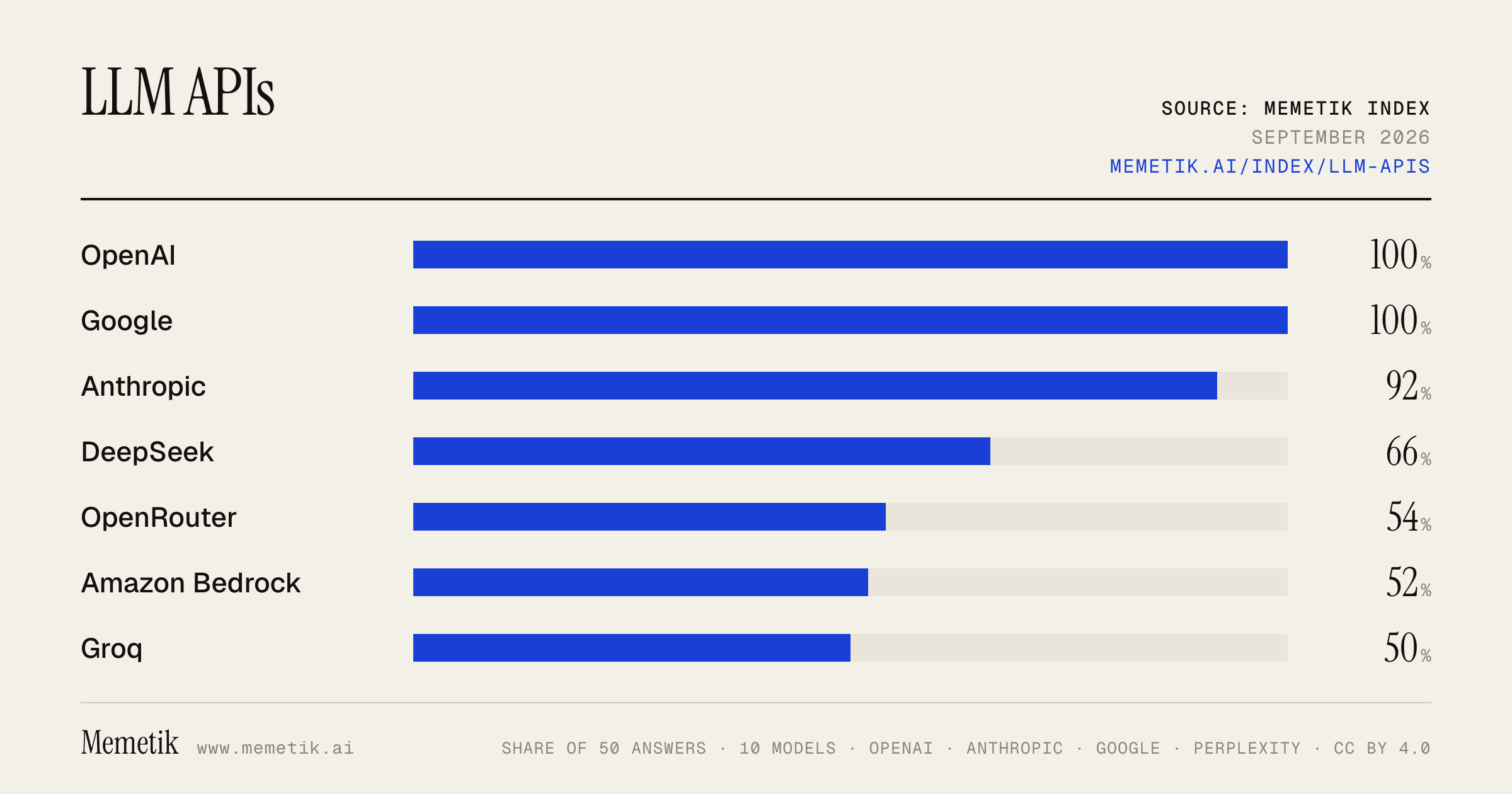
By provider
10 models · 50 answers
OpenAI 3 models · 15 answers
- GPT-5.6 Solgpt-5.6-solmost named: OpenAI 100%
- GPT-5.6 Terragpt-5.6-terramost named: OpenAI 100%
- GPT-5.6 Lunagpt-5.6-lunamost named: OpenAI 100%
Anthropic 3 models · 15 answers
- Claude Opus 5claude-opus-5most named: OpenAI 100%
- Claude Sonnet 5claude-sonnet-5most named: OpenAI 100%
- Claude Fable 5claude-fable-5most named: OpenAI 100%
Google 2 models · 10 answers
- Gemini 3.6 Flashgemini-3.6-flashmost named: OpenAI 100%
- Gemini 3.5 Flashgemini-3.5-flashmost named: OpenAI 100%
Perplexity 2 models · 10 answers
- Sonar Prosonar-promost named: OpenAI 100%
- Sonar Reasoning Prosonar-reasoning-promost named: OpenAI 100%
Sources the models cited
- syncfusion.com140
- braintrust.dev88
- dataiku.com59
- ofox.ai56
- futureagi.substack.com45
- reddit.com45
- pecollective.com41
- medium.com32
- fireworks.ai26
- edenai.co22
- tokenmix.ai22
- ai.google.dev21
ChatGPT via API returns no citations, so it does not contribute here.
The prompts
- What is the best LLM API to build a product on for a developer? Name specific products.
- Which LLM API to build a product on would you recommend to a developer in 2026?
- Compare the top LLM API to build a product on options right now.
- I'm a developer and I need a LLM API to build a product on. What should I use and why?
- Best LLM API to build a product on for an AI startup balancing cost and quality?
Every answer
Raw model output, unedited
GPT-5.6 TerraWhat is the best LLM API to build a product on for a developer? Name specific products.
## Best default for most developers: **OpenAI API — GPT‑5.6 Terra**

If I were starting a serious product today, I’d build the first version on **OpenAI’s Responses API** using **`gpt-5.6-terra`**.

It is the best all-around default because it gives you a strong balance of reasoning/coding quality, price, a very large context window, structured outputs, function calling, and integrated agent capabilities such as web search, file search, and computer use. Its listed price is **$2/M input tokens and $12/M output tokens**, with a **1.05M-token context window**. ([developers.openai.com](https://developers.openai.com/api/docs/models/gpt?utm_source=openai))

### Specific recommendations by use case

| Use case | Product/model I’d choose | Why |
|---|---|---|
| **Best default for a new SaaS / AI product** | **OpenAI API — `gpt-5.6-terra`** | Strong general reasoning and coding, built-in tools, mature developer platform. |
| **Maximum quality for difficult agents, code, analysis** | **OpenAI API — `gpt-5.6-sol`** | OpenAI positions it as its flagship for complex professional work; use it when fewer errors matter more than token cost. ([developers.openai.com](https://developers.openai.com/api/docs/models/gpt?utm_source=openai)) |
| **High-volume, cost-sensitive production tasks** | **OpenAI API — `gpt-5.6-luna`** | Very low listed cost—**$0.20/M input, $1.20/M output**—while retaining the same large context limit and tool ecosystem. Good for classification, extraction, routing, and first-pass support/chat flows. ([developers.openai.com](https://developers.openai.com/api/docs/models/gpt?utm_source=openai)) |
| **Very cheap fast multimodal / agent workflows** | **Gemini API — `gemini-3.7-flash`** | Strong value option, especially if you need Google Search grounding, Google ecosystem integrations, or a generous development free tier. Its promotional paid price through **December 31, 2026** is listed as **$0.75/M input and $3.75/M output**. ([ai.google.dev](https://ai.google.dev/gemini-api/docs/pricing?hl=en&utm_source=openai)) |
| **Enterprise cloud procurement / multi-model strategy** | **AWS Bedrock, Google Vertex AI, or Azure AI Foundry** | Choose a cloud-hosted model platform if identity, private networking, regional controls, centralized procurement, or vendor contracts dominate your decision. |
| **Second-provider fallback / model experimentation** | **Anthropic Claude API** | Worth supporting behind an abstraction layer, especially to compare its models on writing, coding, and long-document tasks against OpenAI and Gemini. Anthropic provides standard API pricing, caching, and Batch API options. ([docs.anthropic.com](https://docs.anthropic.com/en/docs/about-claude/pricing?4810b549_page=3&73cdfb14_page=2&939688b5_page=1&e768fcd2_page=2&utm_source=openai)) |

## Practical answer

For most developers:

1. **Start:** `gpt-5.6-terra`
2. **Route cheap/simple requests:** `gpt-5.6-luna`
3. **Escalate difficult requests:** `gpt-5.6-sol`
4. **Keep Gemini 3.7 Flash as a benchmark and potential low-cost second provider.**

That is usually better than betting the entire product on one “best” model.

## Architecture advice

Do **not** hard-code your business logic around a single vendor’s SDK. Put a thin internal interface in front of the models:

```ts
generate({
  modelTier: "cheap" | "standard" | "premium",
  messages,
  tools,
  responseSchema
})
```

Then map, for example:

```ts
cheap    -> gpt-5.6-luna
standard -> gpt-5.6-terra
premium  -> gpt-5.6-sol
```

This lets you A/B test Gemini or Claude later, route by task complexity, control costs, and reduce vendor-lock-in pain.

## One caveat

The “best” API depends more on your product’s evaluation set than public benchmarks. Before committing, build 50–200 representative prompts from your real workflow and measure:

- task success / human preference
- structured-output validity
- tool-call correctness
- latency
- cost per successful task
- refusal and hallucination behavior

But absent special constraints, **OpenAI Responses API + GPT‑5.6 Terra is my clearest recommendation for a developer building a product in 2026.**GPT-5.6 TerraWhich LLM API to build a product on would you recommend to a developer in 2026?
**My default recommendation in 2026: build on the OpenAI API, using the Responses API, with `gpt-5.6-terra` as the default production model.**

It’s the best general-purpose starting point for a developer shipping an AI product because it combines strong reasoning/coding capability with built-in primitives you will otherwise spend substantial time assembling yourself: function calling, web search, file search, computer use, vision, and multimodal workflows. OpenAI positions `gpt-5.6-terra` as the intelligence/cost balance, while `gpt-5.6-sol` is the higher-capability option and `gpt-5.6-luna` is the economical high-volume tier. ([developers.openai.com](https://developers.openai.com/api/docs/models?utm_source=openai))

### Practical stack

| Workload | Recommended model |
|---|---|
| Default customer-facing assistant, workflow automation, coding | **GPT-5.6 Terra** |
| Difficult planning, high-stakes review, complex agent tasks | **GPT-5.6 Sol** |
| Classification, extraction, routing, simple support, bulk generation | **GPT-5.6 Luna** |
| Voice, transcription, image creation | OpenAI’s specialized realtime/audio/image APIs |

At listed API rates, Terra is $2/M input and $12/M output tokens, while Luna is $0.20/M input and $1.20/M output tokens—so routing routine requests to Luna can matter far more to unit economics than minor prompt tweaks. ([developers.openai.com](https://developers.openai.com/api/docs/models?utm_source=openai))

### The important caveat: do **not** hardwire your product to one vendor

Use OpenAI as your **primary**, but put a thin provider interface around it from day one:

```ts
generate({ modelClass: "default" | "premium" | "cheap", messages, tools })
```

Keep prompts, tool schemas, evaluation cases, and conversation state portable. This lets you add a second provider when there is a concrete reason—not because “multi-model” sounds sophisticated.

### When I’d choose Gemini instead

Choose the **Gemini API** as the primary platform if the product’s differentiator is tightly connected to Google’s ecosystem—especially Google Search grounding, Maps grounding, Google Cloud, or very large multimodal/document contexts. Gemini’s paid offering includes Search and Maps grounding, batch discounts, context caching, and managed-agent capabilities; its current Flash pricing is also competitive for agentic/multimodal workloads. ([ai.google.dev](https://ai.google.dev/gemini-api/docs/pricing?hl=en&utm_source=openai))

### What I would avoid

- **Don’t pick based solely on leaderboard rank.** Your actual tool calls, retrieval corpus, latency targets, languages, refusal behavior, and long-running-agent reliability matter more.
- **Don’t begin with a complex multi-agent architecture.** Start with one model, explicit tools, durable workflow state, and human escalation.
- **Don’t use the premium model for every request.** Create an eval set from real user tasks, then route only the difficult slice to Sol.
- **Don’t couple business logic to chat-completions-era abstractions.** For OpenAI, the Responses API is the forward-oriented interface for tool-using and stateful reasoning workflows. ([cdn.openai.com](https://cdn.openai.com/pdf/47c0215b-8976-4f60-8e13-d69c2ddbc15e/a-practical-guide-to-building-with-gpt-5.pdf?utm_source=openai))

### Bottom line

If you gave me no further product context, I would choose:

> **OpenAI Responses API + GPT-5.6 Terra as default + Luna for cheap tasks + Sol as an escalation path, behind a small provider abstraction.**

That is the lowest-risk path to shipping a polished AI product quickly while retaining leverage to optimize cost or add Gemini later.GPT-5.6 TerraCompare the top LLM API to build a product on options right now.
## Short answer

For most new products, I’d start with **OpenAI GPT‑5.6 Terra via the Responses API** as the default, while keeping a provider abstraction so you can also route selected tasks to **Claude Sonnet 4.6** and **Gemini 3.7 Flash**.

- **Best default / balanced product API:** **OpenAI GPT‑5.6 Terra**
- **Best premium coding and complex autonomous work:** **Claude Fable 5.1** (use selectively; expensive)
- **Best low-cost, high-volume option:** **OpenAI GPT‑5.6 Luna**
- **Best inexpensive multimodal / Google-native product path:** **Gemini 3.7 Flash**
- **Best “quality alternative worth evaluating” for writing, document workflows, and coding:** **Claude Sonnet 4.6**

## Practical comparison — September 2, 2026

| API / model | Best use | List price per 1M tokens (input / output) | Why choose it | Main caveat |
|---|---|---:|---|---|
| **OpenAI GPT‑5.6 Terra** | Default agent, SaaS copilot, coding/product reasoning | **$2 / $12** | Strong balance of capability and cost; 1.05M-token context; integrated function calling, web search, file search, and computer-use tools. | Output-heavy apps can become costly; tool calls and reasoning need observability. |
| **OpenAI GPT‑5.6 Sol** | Hardest reasoning/coding calls | **$4 / $20** | Flagship option with the same broad built-in tool surface and 1.05M context. | Use as an escalation tier, not your default, unless quality clearly pays for itself. |
| **OpenAI GPT‑5.6 Luna** | Extraction, classification, support triage, high-volume chat | **$0.20 / $1.20** | Extremely favorable economics while retaining the current GPT‑5.6 API/tool ecosystem. | Validate carefully on complex multi-step tasks before using it for high-stakes decisions. |
| **Anthropic Claude Sonnet 4.6** | High-quality knowledge work, coding, long-document tasks | **$3 / $15** | Competitive frontier mid-tier pricing; prompt-cache reads are **$0.30/M**, valuable when every request carries a large static policy, codebase, or corpus. | You should benchmark it against Terra on *your* tasks; model quality differences tend to be workload-specific. |
| **Anthropic Claude Fable 5.1** | Difficult repo-scale coding and long-running agent work | **$10 / $50** | Anthropic positions it for ambitious codebase-wide engineering, code review, performance work, and multi-day autonomous tasks. | Premium cost—reserve for an explicit “expert mode” or background jobs with measurable ROI. |
| **Google Gemini 3.7 Flash** | Cost-efficient multimodal apps, Google-stack products, fast iteration | **$0.75 / $3.75** promotional through **December 31, 2026** | Very attractive price and Google reports improvements for coding, agentic, and web-development workflows. | The listed promotional price is scheduled to rise to **$1.50 / $7.50** afterward; do not base unit economics solely on the promo rate. |

OpenAI’s current catalog explicitly recommends Sol for complex reasoning/coding, Terra for the intelligence/cost balance, and Luna for high-volume cost-sensitive work; all three list vision, multilingual support, and a 1.05M-token context window. ([developers.openai.com](https://developers.openai.com/api/docs/models?utm_source=openai)) Anthropic’s current rate card lists Sonnet 4.6 at $3/$15 and Opus-class models at higher price points, while Fable 5.1 is listed separately at $10/$50 for frontier coding work. ([www-cdn.anthropic.com](https://www-cdn.anthropic.com/files/4zrzovbb/website/5678bc2f5978e5bcd4f1fe7c14b2c72284dcf9f8.pdf?utm_source=openai)) Gemini’s current developer documentation lists the Flash promotional pricing and its December 31, 2026 expiration. ([ai.google.dev](https://ai.google.dev/gemini-api/docs/latest-model?hl=en&utm_source=openai))

## What I would choose by product type

### 1. You’re building a general B2B SaaS copilot or agent
**Choose OpenAI Terra first.**

It is the cleanest “one vendor, broadest starting surface” option: structured tool calling plus hosted web/file/computer capabilities means fewer components to assemble in v1. Then use:
- **Luna** for low-risk bulk tasks;
- **Sol** only for hard cases or paid premium workflows.

OpenAI’s Responses API is specifically the forward path for GPT‑5-class agentic workflows and supports state/reasoning handling across turns and tools. ([cdn.openai.com](https://cdn.openai.com/pdf/47c0215b-8976-4f60-8e13-d69c2ddbc15e/a-practical-guide-to-building-with-gpt-5.pdf?utm_source=openai))

### 2. You’re building an AI coding product
**Run a head-to-head evaluation of OpenAI Sol/Terra vs. Claude Fable/Sonnet.**

My default commercial architecture:
- **Terra** for normal interactive coding;
- **Fable 5.1** for difficult repository-wide tasks, code review, or background engineering jobs;
- a cheaper model for code search, classification, summaries, and routing.

Fable’s economics make it hard to justify as the model behind every autocomplete or chat turn, but it can be worthwhile when it removes an engineer-hour or successfully completes a multi-step task. ([anthropic.com](https://www.anthropic.com/claude/fable?utm_source=openai))

### 3. You’re building consumer chat, support, extraction, or high-volume workflows
**Start with Luna or Gemini 3.7 Flash.**

- Pick **Luna** if you value a unified OpenAI stack and can accept model-routing within it.
- Pick **Gemini Flash** if your product is strongly Google-native, heavily multimodal, or its observed quality on your test set is comparable.

At list rates, a request with **1M input + 250K output tokens** would cost roughly:
- Luna: **$0.50**
- Gemini 3.7 Flash promotional: **$1.69**
- Terra: **$5.00**
- Sonnet 4.6: **$6.75**
- Sol: **$9.00**
- Fable 5.1: **$22.50**

That is only a rough unit-economics illustration—not a quality-adjusted comparison. Caching, hidden reasoning/intermediate tokens, tools, retries, and output verbosity can dominate actual cost. The providers all document token-, cache-, and in
- https://developers.openai.com/api/docs/models?utm_source=openai
- https://www-cdn.anthropic.com/files/4zrzovbb/website/5678bc2f5978e5bcd4f1fe7c14b2c72284dcf9f8.pdf?utm_source=openai
- https://ai.google.dev/gemini-api/docs/latest-model?hl=en&utm_source=openai
- https://cdn.openai.com/pdf/47c0215b-8976-4f60-8e13-d69c2ddbc15e/a-practical-guide-to-building-with-gpt-5.pdf?utm_source=openai
- https://www.anthropic.com/claude/fable?utm_source=openai
GPT-5.6 TerraI'm a developer and I need a LLM API to build a product on. What should I use and why?
## Short answer

If you need to pick **one API today**, I’d start with the **OpenAI API**, using the **Responses API** and a model tier appropriate to each task:

- **GPT-5.6 Terra** as a strong default for production features.
- **GPT-5.6 Luna** for high-volume, latency/cost-sensitive classification, extraction, and simpler chat.
- **GPT-5.6 Sol** only where better reasoning or coding materially improves outcomes.

That is the best general-purpose choice when you want strong coding/reasoning, multimodal input, structured tool calls, and a coherent platform for building agentic product features. OpenAI’s current frontier lineup supports text and image input, long context, function calling, web/file search, and computer-use tools; the listed prices range from $0.20/$1.20 per million input/output tokens for Luna to $4/$20 for Sol. ([platform.openai.com](https://platform.openai.com/docs/models/gpt-4-turbo-and-gpt-4?utm_source=openai))

But the right answer depends more on **your product constraints** than on leaderboard quality.

## My decision guide

| If your primary need is… | Start with | Why |
|---|---|---|
| A broadly capable product: workflows, copilots, coding, multimodal UX, tool use | **OpenAI API** | Strong all-around model family and integrated product primitives. |
| High-quality prose, document analysis, or you specifically prefer Claude behavior | **Anthropic API** | Claude’s direct API offers prompt caching and a straightforward tool-use model; caching can make repeated large instructions or documents much cheaper. ([docs.anthropic.com](https://docs.anthropic.com/en/docs/about-claude/pricing?4810b549_page=3&73cdfb14_page=2&939688b5_page=1&e768fcd2_page=2&utm_source=openai)) |
| Very large-context workloads, Google Search grounding, or deep Google Cloud alignment | **Gemini API / Vertex AI** | Competitive token economics, context caching, batch discounts, and native Google Search grounding. Paid-tier content is not used to improve Google products, while free-tier content is. ([ai.google.dev](https://ai.google.dev/gemini-api/docs/pricing?authuser=1&utm_source=openai)) |
| AWS-native enterprise deployment, IAM controls, regional requirements, or multi-model procurement | **Amazon Bedrock** | A managed routing layer for multiple model providers with AWS IAM, regional/cross-region controls, usage attribution, and several compatible API surfaces. ([docs.aws.amazon.com](https://docs.aws.amazon.com/en_us/bedrock/latest/userguide/models.html?utm_source=openai)) |

## What I would actually build

Use an **LLM gateway in your own code**, even if you begin with only OpenAI:

```text
app → your ai-service → provider adapter → LLM API
                     ↘ tracing / evals / cost logs
```

Your internal interface should support:

- `generate(messages, tools, schema, model_policy)`
- streaming
- structured JSON output
- tool/function calls
- retries and fallbacks
- request IDs, token/cost logging, and tracing
- offline evaluation fixtures

Then define policies rather than hard-coding model IDs:

```ts
const modelPolicy = {
  fast: "small/cheap model",
  default: "balanced model",
  hard: "frontier reasoning model",
};
```

This gives you portability without prematurely building a “universal abstraction” that masks important provider-specific capabilities.

## Important practical advice

1. **Do not select by benchmark alone.**
   Assemble 50–200 realistic examples from your product: messy customer input, long documents, tool failures, adversarial prompts, extraction edge cases, and expected outputs. Compare quality, latency, and total cost.

2. **Use small models by default; route hard cases upward.**
   Most production LLM bills come from repeatedly using a flagship model for tasks such as tagging, normalization, routing, or basic extraction.

3. **Favor structured outputs for product logic.**
   Have the model return validated schemas for actions, extracted fields, and UI state. Treat free-form prose as presentation—not as a reliable database or control plane.

4. **Treat “agents” as bounded workflows.**
   Give models narrowly scoped tools, validate tool arguments server-side, cap tool-loop iterations, require confirmation for destructive actions, and design fallbacks. Don’t hand unrestricted credentials or shell/database access to a model.

5. **Think about data residency before committing.**
   Bedrock can be compelling if AWS controls and regional routing are non-negotiable, but note that cross-region inference can process requests in one of several destination regions unless you select a geography-limited profile and configure policies accordingly. ([docs.aws.amazon.com](https://docs.aws.amazon.com/bedrock/latest/userguide/inference-profiles-support.html?utm_source=openai))

## Bottom-line recommendation

- **Early-stage SaaS / developer product:** OpenAI first, with an internal provider adapter and an eval harness from day one.
- **Enterprise already standardized on AWS:** Bedrock, unless a direct-provider feature is decisive.
- **Long-document or Google-search-centric product:** Evaluate Gemini alongside OpenAI.
- **Writing-heavy, nuanced assistant product:** Evaluate Claude alongside OpenAI.

The mistake is not choosing the “wrong” model on day one. The mistake is coupling your product logic to one model’s prompt behavior and having no evaluation set when models, pricing, and capabilities change.- https://platform.openai.com/docs/models/gpt-4-turbo-and-gpt-4?utm_source=openai
- https://docs.anthropic.com/en/docs/about-claude/pricing?4810b549_page=3&73cdfb14_page=2&939688b5_page=1&e768fcd2_page=2&utm_source=openai
- https://ai.google.dev/gemini-api/docs/pricing?authuser=1&utm_source=openai
- https://docs.aws.amazon.com/en_us/bedrock/latest/userguide/models.html?utm_source=openai
- https://docs.aws.amazon.com/bedrock/latest/userguide/inference-profiles-support.html?utm_source=openai
GPT-5.6 TerraBest LLM API to build a product on for an AI startup balancing cost and quality?
**Best default for most AI startups: OpenAI API, with a model-routing setup.**

I’d start with **OpenAI’s Responses API** and make **GPT‑5.6 Terra** the initial “quality default,” while using **GPT‑5.6 Luna** for high-volume, lower-risk tasks and escalating hard requests to **GPT‑5.6 Sol**. Current listed standard pricing is roughly **$2/$12 per 1M input/output tokens for Terra**, **$0.20/$1.20 for Luna**, and **$4/$20 for Sol**. That gives you a practical quality ladder without rebuilding your stack around separate providers. ([openai.com](https://openai.com/api/?utm_source=openai))

### My decision guide

| If your product is primarily… | Start with | Why |
|---|---|---|
| General AI SaaS, assistants, workflow automation, tool use | **OpenAI** | Strong all-around platform; easy tiered routing and mature agent/voice tooling. ([openai.com](https://openai.com/api/?utm_source=openai)) |
| Coding-heavy, long-form analysis, high-stakes agent behavior | **Anthropic Claude Sonnet** as a serious A/B-test challenger | Anthropic positions Sonnet as its performance/speed balance and emphasizes coding, tool selection, instruction following, and agentic workflows. ([anthropic.com](https://www.anthropic.com/claude/api?utm_source=openai)) |
| Very high volume, multimodal/document workloads, price sensitivity | **Gemini Flash** | Google’s current Gemini Flash pricing is competitive—e.g. Gemini 3.7 Flash is listed at $0.75 input / $3.75 output per million tokens on paid standard—and batch processing halves those token rates. ([ai.google.dev](https://ai.google.dev/gemini-api/docs/pricing?hl=en&utm_source=openai)) |
| Frontier tasks where one excellent result matters more than cost | Premium OpenAI or Claude tier | Reserve these for an escalation path, not every request. Anthropic’s Fable 5.1, for example, is listed at $10/$50 per 1M input/output tokens. ([anthropic.com](https://www.anthropic.com/claude/fable?utm_source=openai)) |

### Recommended launch architecture

1. **Use one primary provider**—I’d choose OpenAI first for most teams.
2. **Put a thin provider abstraction in your backend** so switching/routing is a config change rather than a rewrite.
3. Implement three routes:
   - **Cheap/default:** GPT‑5.6 Luna or Gemini Flash
   - **Standard:** GPT‑5.6 Terra
   - **Escalation:** GPT‑5.6 Sol or a Claude premium/Sonnet route
4. Create an eval set of **100–300 real user tasks** before optimizing based on public benchmarks.
5. Track **task success, latency, cost per successful task, and human correction rate**—not merely cost per token.

### Important cost reality

Optimize **output tokens** before obsessing over input price. Outputs are often several times more expensive than inputs; concise system prompts, capped output lengths, structured responses, caching, and routing simple tasks to smaller models usually matter more than squeezing a few cents from the headline model rate. OpenAI and Google both offer lower-cost batch-style processing options for asynchronous workloads. ([ai.google.dev](https://ai.google.dev/gemini-api/docs/pricing?hl=en&utm_source=openai))

### Bottom line

- **Want the simplest strong choice:** **OpenAI, start on Terra.**
- **Want the lowest cost at scale:** benchmark **Gemini Flash** against Luna for *your* tasks.
- **Building a coding/research/agent product:** benchmark **Claude Sonnet** alongside OpenAI before committing.
- **Do not hard-lock to one model:** your routing and proprietary workflow/evals—not the base model—are the durable startup advantage.
Claude Sonnet 5What is the best LLM API to build a product on for a developer? Name specific products.
There's no single "best" LLM API — it depends on what you're building. Here's a practical breakdown based on current offerings:

## First-party model APIs (most common choice)

**OpenAI API** — The default choice for most developers.
It offers mature SDKs, structured output, tools, streaming, image, audio, and agent features in one first-party ecosystem
. Best if you want the broadest, most battle-tested platform with the largest community/tooling ecosystem.

**Anthropic (Claude) API** —
Strong agentic models, a 1M-token context window on current models, and a focused Messages API
. It's particularly strong for coding assistants and long-running autonomous agents. On benchmarks,
Claude Opus 4.5 leads in code generation at 80.9% on SWE-bench Verified, making it well-suited for long-horizon software engineering
.

**Google Gemini API** —
Best for low-cost multimodal prototyping — text, image, audio, and video input plus free access on eligible models
. Good pick if your product needs to understand images/video/audio, or you want a generous free tier for prototyping.

**DeepSeek API** —
The cheapest serious text API, with very low token prices, OpenAI- and Anthropic-format base URLs, 1M context, and tool calling
. A good option if cost is your primary constraint and you don't need cutting-edge reasoning.

## Aggregator / multi-model APIs (great for flexibility)

**OpenRouter** —
Provides a single interface for a broad catalog of language models, letting developers compare providers and change a model identifier without rebuilding every integration
. This is very popular for indie/startup developers who want to avoid vendor lock-in and easily A/B test models.

**Together AI** —
Good for open-model inference and fine-tuning, with serverless inference, fine-tuning, dedicated endpoints, and GPU infrastructure
.

**Groq** — Known for extremely fast inference speed (LPU hardware), good if latency matters more than model choice — though it has a narrower model catalog and deprecates models aggressively.

**Fireworks AI** — Good middle ground with
200+ models with Day-0 support for new open-source releases, plus chat, vision, audio, image generation, embeddings, and a full post-training stack
.

## Enterprise/cloud-native options

**Amazon Bedrock** —
Best for enterprise teams already on AWS, offering IAM, regional controls, cloud governance, managed agents, and a broad provider catalog
.

**Azure OpenAI** — Similar rationale for teams already in the Microsoft/Azure ecosystem, with added compliance/regulatory controls.

## My practical recommendation

- **Just starting out / building an MVP:** Start with the **OpenAI API** — best docs, most Stack Overflow answers, most tutorials, and the SDK works with almost every framework (LangChain, LlamaIndex, Vercel AI SDK, etc.).
- **Building a coding tool or agent that needs to reason over large codebases:** Use **Anthropic's Claude API**.
- **Need multimodal (image/video/audio) at low cost, or want a free tier to prototype:** Use **Google Gemini API**.
- **Cost is the #1 constraint and you're doing high-volume text tasks:** Use **DeepSeek API**.
- **Want to avoid lock-in and swap models easily as pricing/quality shifts:** Build on **OpenRouter**, since
it and similar providers support the OpenAI SDK protocol, meaning switching between providers is a configuration change rather than a code rewrite
.

If you tell me more about your product (chatbot, coding assistant, content generation, agentic workflow, budget constraints, etc.), I can give a more specific recommendation.
Claude Sonnet 5Which LLM API to build a product on would you recommend to a developer in 2026?
Here's my take, based on the current 2026 landscape:

## Short answer: it depends on what you're building, but here's a practical framework

There's no single "best" API anymore—the market has matured to the point where
teams choose based on workflow and constraints, not just raw model quality
. That said, here's how I'd break it down:

### If you want the safest general-purpose default
**Anthropic (Claude) or OpenAI (GPT-5)** —
OpenAI and Claude lead in agentic workflows and developer speed
. Both have mature SDKs, strong documentation, and are the default choice if you're building agents, coding tools, or complex tool-calling workflows. Claude in particular is
known for alignment and long-context excellence
, while
GPT-5 remains top-tier in reasoning, instruction following, and multilingual capabilities, with the o2 series enhancing code generation and mathematical reasoning for high-precision tasks
.

### If multimodal or long-context is your priority
**Google Gemini** —
Gemini dominates multimodal long-context tasks
, and offers
native multimodal capabilities with strong ecosystem integration
. Great if your product processes video, large documents, or mixed media.

### If you're cost-sensitive or building at scale
**DeepSeek** is worth serious consideration —
it disrupted pricing at the bottom end
 of the market. More broadly,
prices per million output tokens now range from $0.08 all the way to $25 depending on which model you pick
, so if you're running high-volume inference, shopping around can mean the difference between a sustainable unit economics model and burning cash.

### If you're in a regulated industry (finance, healthcare, government)
**Azure OpenAI or AWS Bedrock** — these
excel in regulated enterprise environments
, and
both have increased their enterprise tooling
 around compliance, audit trails, and data residency.

### If you're in the EU or need data sovereignty
**Mistral** offers
an EU-friendly open-weight path
, which matters if GDPR or EU data residency is a hard requirement for your product.

### If you don't want to lock into one vendor
Consider a **unified gateway** like OpenRouter, Braintrust Gateway, Portkey, or LiteLLM instead of calling a single provider directly.
A unified LLM API provides your application with a single endpoint and SDK for accessing models from multiple providers, so instead of maintaining separate integrations for GPT, Claude, Gemini, and open models, teams can switch models by changing the model parameter
. This is increasingly the pragmatic choice because
the OpenAI-compatible interface has become the common standard, so the stronger buying decision now depends on what surrounds the API call
 — things like caching, observability, and fallback behavior.

## My actual recommendation for a developer starting fresh in 2026

1. **Prototype with a gateway** (OpenRouter or similar) so you're not locked into one model choice while you figure out what your product actually needs.
2. **Default to Claude or GPT-5** for anything agentic or coding-heavy — these remain the most battle-tested for complex reasoning and tool use.
3. **Benchmark DeepSeek or open-weight models** (via Groq/Together/SiliconFlow for speed) once you know your traffic patterns — you may be able to cut costs 5-10x for tasks that don't need frontier-level reasoning.
4. **Only commit to Azure/Bedrock** if compliance requirements force your hand — the lock-in and overhead aren't worth it otherwise.

One important caveat:
two years ago most developers defaulted to OpenAI and moved on, but today that shortcut is expensive since the market has real competition now and each provider has carved out a specific lane
. The single biggest mistake I'd flag is picking a model based on hype rather than your actual workload —
picking the wrong one can mean paying 10 times more than necessary, or dealing with uptime issues when your app goes down
.

What are you building? I can give a more specific recommendation if you tell me the use case (chatbot, coding assistant, RAG pipeline, agents, etc.) and constraints (budget, latency needs, compliance requirements).
Claude Sonnet 5Compare the top LLM API to build a product on options right now.
Based on current information, here's a comparison of the top LLM API options for building products right now:

## The Big Three Frontier Model APIs

**OpenAI (GPT-5 family)**
The most mature ecosystem with the broadest SDK support and widest developer mindshare, which is why many gateway tools default to "OpenAI-compatible" formats as the industry standard.
All five major free-tier providers support OpenAI-compatible SDKs, which means switching between them is a one-line configuration change
 — a sign of how dominant OpenAI's API shape has become as the de facto standard.

**Anthropic (Claude)**
Strongest pick if trust, safety, and auditability matter to your product.
If you are building a product that touches sensitive data, regulated industries, or vulnerable users, Claude's refusal behavior is more predictable and auditable than its competitors.
 It also integrates cleanly into common backend stacks —
Anthropic's Python SDK follows familiar conventions and works smoothly with async frameworks like FastAPI and Celery, and if your team already works in Python, the Claude API slots in cleanly.


**Google (Gemini)**
The strongest choice for multimodal and long-context workloads.
Gemini 2.5 Pro, Gemini 2.5 Flash (GA), and Gemini 3.1 Pro (Preview) are best for long-context multimodal workloads like video, audio, and docs at scale
, and
Flash variants are ideal for high-throughput, low-cost workloads.
 For teams already on Google Cloud,
Vertex AI integrates fine-tuning, storage, auth, and deployment into one stack
, though
Vertex AI adds operational overhead if you're not already on Google Cloud, and the standalone Gemini API is simple, but migration to production paths is non-trivial.
 Note that
Gemini 3.1 Pro is preview as of February 2026 and Gemini 3.1 Flash-Lite entered developer preview in March 2026, so for stable production workloads, Gemini 2.5 Pro and Flash remain the recommended GA models.


## Open-Weight / Cost-Optimized Alternatives

Newer open-weight models are closing the gap fast.
GLM-5 is considered a top LLM in 2026 built for complex systems engineering and long-horizon agentic tasks
, while
Gemini 3 Flash stands out for teams that need strong reasoning with lower latency and lower cost, combining much of Gemini 3 Pro's reasoning capability
 at a fraction of the price.

## Unified Gateways / Multi-Provider Routers (increasingly the practical default)

Rather than picking one vendor, many teams now build on a gateway layer so they aren't locked in:

- **OpenRouter** — best if you want maximum provider reach and flexibility.
Choose OpenRouter if routing across many LLM providers matters.

- **Fireworks, Together AI, DeepInfra** — best for raw speed/cost on open models.
Choose Fireworks AI, Together AI, or DeepInfra if latency, throughput, and open-source model serving matter more than provider diversity.
 More specifically,
DeepInfra and Fireworks lead on raw open-model price and speed, Together on model breadth and fine-tuning, Baseten on managed custom models, and OpenRouter on reach.

- **Vercel AI Gateway / AI SDK** — best if you're already in that ecosystem.
Vercel AI Gateway is a good fit for teams already building on Vercel or the AI SDK, providing multi-provider access, usage monitoring, and fallback controls within the Vercel workflow.

- **LiteLLM** — best for self-hosted control.
LiteLLM is for teams that need an open-source proxy and have the infrastructure capacity to run it, and it works best when deployment control is more important than having tracing and evaluation built into the gateway product.

- **Braintrust Gateway** — best if evals/observability are core to your workflow.
Braintrust Gateway is the strongest choice for production AI teams because every routed call can flow into the same tracing, evaluation, and quality workflow used to debug failures and control releases.


## What Actually Matters for Production (not just benchmarks)

A useful framing from a recent analysis:
teams rarely fail because they picked the "wrong" model — they fail because the platform's operational details don't match their workload.
 Key practical factors to weigh:

- **Onboarding**:
SDK maturity and example depth decide whether "Hello, world" takes 10 minutes or half a day.

- **Latency**:
Streaming TTFT (time-to-first-token) matters more than raw TPS for latency-sensitive apps; caching helps TTFT, not generation speed.

- **Cost control**:
Learn the batch API and prompt caching knobs or pay 40–60% more than you need.

- **Lock-in risk**:
Proprietary caching keys, computer-use runtimes, and quota models can become hard dependencies, so abst
- https://www.dataiku.com/blog/best-llm-apis-for-developers
- https://mongoengine.org/best-llm-apis-for-developers/
- https://www.syncfusion.com/blogs/post/top-llm-api-comparison-2026
- https://www.edenai.co/post/best-large-language-model-apis
- https://wisgate.ai/blogs/best-ai-api-platforms-2026-compared
- https://oneinfer.ai/blogs/best-llm-inference-api-2026-7-providers-compared
- https://www.braintrust.dev/articles/best-unified-llm-api-providers-2026
Claude Sonnet 5I'm a developer and I need a LLM API to build a product on. What should I use and why?
Choosing the right LLM API depends heavily on your specific use case, budget, and priorities. Let me break down the current landscape to help you decide.

## Top Options and Their Strengths

**OpenAI (GPT-4o, o1, GPT-4o-mini)**
- Most mature ecosystem with extensive documentation, tooling, and community support
- Strong general-purpose performance across coding, reasoning, and creative tasks
- Function calling, vision, and structured outputs are well-developed
- Good choice if you want the "safe default" with the most third-party integrations (LangChain, LlamaIndex, etc.)

**Anthropic (Claude, e.g., Claude 3.5/4 series)**
- Excellent for coding tasks, long-context reasoning, and following complex instructions carefully
- Very strong at handling large documents (large context windows)
- Often praised for more nuanced, careful outputs and lower hallucination rates in benchmarks
- Great if your product involves document analysis, coding assistants, or agentic workflows

**Google (Gemini)**
- Deep integration with Google Cloud infrastructure
- Strong multimodal capabilities (native video/audio/image understanding)
- Competitive pricing, especially for the Flash models
- Good if you're already in the GCP ecosystem or need multimodal features

**Open-source options (Llama, Mistral, Qwen, DeepSeek)**
- Run via providers like Together AI, Fireworks, Groq, or self-hosted
- Best if you need data privacy/control, want to fine-tune, or want to avoid per-token costs at scale
- Groq specifically offers extremely fast inference speeds for open models

## How to Decide

1. **Cost sensitivity**: If you're processing huge volumes, smaller/cheaper models (GPT-4o-mini, Gemini Flash, or open-source via Groq) matter a lot.
2. **Coding-heavy product**: Claude models are frequently favored by developers for code generation and debugging.
3. **Need multimodal (image/video/audio)**: Gemini has an edge in native multimodal handling.
4. **Data privacy/compliance**: Self-hosted open-source models or enterprise agreements with Azure OpenAI give more control.
5. **Latency-critical apps**: Groq-hosted open models or smaller models are much faster than large frontier models.
6. **Agentic workflows/tool use**: Both OpenAI and Anthropic have robust function-calling/tool-use APIs; Anthropic's is often noted for reliability in multi-step tasks.

## Practical Recommendation

If you're just starting and unsure, prototype with **OpenAI's GPT-4o-mini or Claude 3.5 Sonnet** — both offer a strong balance of cost, capability, and documentation. Use an abstraction layer (like LangChain, LiteLLM, or Vercel AI SDK) so you can swap providers easily without rewriting your whole integration — this is smart since the "best" model changes every few months.

Would you like me to look up current pricing and benchmark comparisons to give you more concrete numbers for your decision?
Claude Sonnet 5Best LLM API to build a product on for an AI startup balancing cost and quality?
There's no single "best" LLM API — it depends on what you're optimizing for. Here's the current landscape (as of late 2026) broken down by priority:

## If you want the best all-around balance
**GPT-5.2 or Gemini 3.1 Pro** are the standout picks for quality-to-cost among flagship models right now.
GPT-5.2 offers the strongest quality-to-cost ratio among flagship models, costing 65% less than Claude Opus 4.6 on input tokens while matching or exceeding it on many popular benchmarks.
 Meanwhile,
Gemini 3.1 Pro is the price leader in the flagship tier, directly competitive with GPT-5.2 on quality metrics and coming in slightly better on output pricing, with Google's multimodal capabilities making it a natural choice for workloads mixing text with images, video, or audio.


## If cost is the dominant factor
- **DeepSeek V4** is frequently cited as the best "quality-per-dollar" open-weight option, with
the price floor for frontier-adjacent quality, shipping a 1M-token context, and scoring 80.6% on SWE-bench Verified, the highest open-weights entry, tied with Gemini 3.1 Pro.

- **Together AI, Groq, Fireworks, and Mistral** are the go-to infra providers for serving open models cheaply.
For startups and SMBs, Together AI, Mistral, and DeepSeek offer the best cost-to-performance ratios, and Together AI's pay-as-you-go model works well for variable traffic patterns.

- Groq in particular is good for ultra-cheap/free experimentation:
Groq Llama 3.3 8B runs at $0.05/$0.08 per million tokens with 14K free requests/day, while Qwen3 Turbo has the lowest input price at $0.04/$0.14.


## If you're enterprise/compliance-focused

Azure OpenAI provides 99.9% uptime SLAs with ISO, SOC, and HIPAA compliance for regulated industries, while Amazon Bedrock offers unified billing and AWS security integration — both support private endpoints and role-based access controls.


## Practical strategy most startups actually use: hybrid/tiered routing
Rather than picking one API, the smarter approach for an early-stage AI startup is to route requests by task difficulty:
-
Start with cheaper alternatives (Groq, DeepSeek, Gemini Flash-Lite) for 80% of tasks, and reserve premium models like OpenAI's flagship for the 20% of tasks where quality difference matters — this hybrid approach cuts costs 50-70% versus using one premium provider for everything.

-
Model routing alone can cut costs 40-60% by sending simple tasks to cheap models,
 and combining this with prompt caching compounds the savings.

**One important caveat:**
if you pick the cheapest option and build your product entirely around it, migrating between LLM APIs later takes 2-4 weeks of engineering time — using an OpenAI-compatible API or a unified gateway from the start avoids this lock-in.
 Tools like OpenRouter or similar gateways let you swap models without rewriting your app.

### My actual recommendation
For a typical AI startup building a product today:
1. **Default model**: GPT-5.2 or Gemini 3.1 Pro for your core quality-sensitive features (best quality/cost tradeoff at the flagship tier).
2. **Cheap tier**: DeepSeek V4 or Gemini Flash-Lite for high-volume, lower-stakes tasks (summarization, classification, simple chat).
3. **Architecture**: Build with an abstraction layer (OpenRouter, LiteLLM, or a unified gateway) from day one —
new models launch regularly, so build abstraction layers so you can switch providers without rewriting your application code.

4. Add prompt caching and complexity-based routing early — it's the single highest-leverage cost lever.

If you tell me more about your specific use case (chat product, coding assistant, data extraction, agents, etc.) and expected scale, I can narrow this down to a more specific recommendation.
Gemini 3.6 FlashWhat is the best LLM API to build a product on for a developer? Name specific products.
There is no single "best" LLM API overall, because the ideal choice depends heavily on what you are building (e.g., complex coding agents, high-volume classification, low-latency search, or enterprise-grade privacy).

The top LLM APIs for developers are categorized below by specific use cases, along with the top multi-model routers.

---

### 1. Best for Complex Coding, Logic, and AI Agents
* **Anthropic API (Claude 3.5 / 3.7 Sonnet & Opus)**
  * **Why it’s the best:** Anthropic’s Claude models lead the industry in precise instruction-following, structured tool output (JSON/Function Calling), and continuous agentic coding tasks. Developers building code assistants, automated workflows, or complex agents often start here because of its lower hallucination rate in long multi-turn execution loops.
  * **Key Features:** Computer Use APIs, massive context handling, reliable function calling, prompt caching.

### 2. Best All-Rounder & Fastest Ecosystem Integration
* **OpenAI API (GPT-4o, GPT-4o-mini, o1/o3 reasoning series)**
  * **Why it’s the best:** OpenAI sets the industry standard API protocol that nearly all other providers mirror. It boasts the strongest developer tooling, fine-tuning infrastructure, audio/vision/text multimodal endpoints, and seamless integration with third-party frameworks like LangChain or LlamaIndex.
  * **Key Features:** Built-in Code Interpreter and File Search tool endpoints, Structured Outputs (Guaranteed JSON Schema validation), Batch API for 50% cost discounts.

### 3. Best for Long Context Window & Multimodal (Image/Video/Audio)
* **Google AI Studio / Gemini API (Gemini 1.5 Pro & Gemini Flash)**
  * **Why it’s the best:** Google provides massive context windows (up to 1M–2M+ tokens natively), enabling you to pass entire codebases, long PDFs, or hours of video directly into a single request without complex RAG chunking.
  * **Key Features:** Generous free tier for prototyping, native multimodal processing (handles audio, video, images, text out of the box), dynamic system instruction caching.

### 4. Best for Speed & Ultra-Low Latency Inference
* **Groq API**
  * **Why it’s the best:** Powered by custom LPU hardware, Groq offers lightning-fast inference rates (often 300–500+ tokens/sec) for hosted open-weights models. This is crucial for real-time voice, live streaming text, or interactive user applications.
  * **Models Hosted:** Llama 3/3.3, DeepSeek, Mixtral, Whisper.

### 5. Best Low-Cost / Open-Weight Hosted APIs
* **DeepSeek API & Fireworks AI / Together AI**
  * **Why it’s the best:** For developers needing frontier-level performance at a fraction of the cost, DeepSeek’s native API (or hosted via **Fireworks AI** / **Together AI**) provides deep reasoning models (like DeepSeek-R1/V3) for pennies per million tokens.
  * **Key Features:** OpenAI-compatible API endpoints, structured generation, dynamic speculative decoding for high speed.

### 6. Best Unified Gateway (To Avoid Vendor Lock-In)
* **OpenRouter** or **Portkey / LiteLLM**
  * **Why it’s the best:** Instead of binding your app to a single provider, API gateway/aggregator solutions let you call OpenAI, Anthropic, Google, Meta, and open-source models using a single unified API key and interface.
  * **Key Features:** Fallbacks (if OpenAI goes down, route to Anthropic), dynamic model routing by task/cost, built-in rate-limit management.

---

### Summary Recommendation for Developers
1. **Building an Agent/Code Assistant:** Start with **Anthropic API** (Claude Sonnet) or **OpenAI API**.
2. **Prototyping / RAG over massive documents:** Start with **Google AI Studio** (Gemini).
3. **High-Volume / Budget-Constrained Apps:** Use **DeepSeek API** or **OpenAI GPT-4o-mini**.
4. **Real-time / Instant response UI:** Use **Groq API**.
5. **Production safety & redundancy:** Wrap your API calls in **OpenRouter** or **LiteLLM**.
Gemini 3.6 FlashWhich LLM API to build a product on would you recommend to a developer in 2026?
Choosing the right LLM API in 2026 depends heavily on your application's primary requirement—whether that is complex reasoning, low-latency agent execution, massive context handling, or raw cost-efficiency.

Because the landscape has largely standardized around OpenAI-compatible API schemas, **the best approach is often to use an abstraction layer/router alongside 1–2 primary direct APIs.**

Recommendations broken down by primary use cases include:

---

### 1. Best Overall for Complex Reasoning & Coding: **Anthropic Claude API**
* **Primary Models:** Claude 3.5 / Claude 4 family (Sonnet & Opus).
* **Why Choose It:** Anthropic remains the benchmark choice for coding assistants, multi-step agentic workflows, long-horizon software engineering tasks, and complex instruction-following. Its state-management features, strict output structuring, and strong performance on agent benchmarks make it standard for production AI tools.
* **Best For:** AI agents, software dev tools, complex logic, multi-document analysis.

### 2. Best for Ecosystem, Tooling & Native Features: **OpenAI API**
* **Primary Models:** GPT-4.1 series, GPT-5, o-series reasoning models.
* **Why Choose It:** OpenAI still offers the richest single-provider developer ecosystem. With out-of-the-box support for multimodal capabilities (text, vision, audio), fine-tuning, embeddings, and real-time WebSockets, it provides the fastest time-to-market if you need multiple AI modalities within a single integration.
* **Best For:** Multi-modal apps, standard SaaS features, rapid prototyping.

### 3. Best for Massive Context & Free-Tier Prototyping: **Google Gemini API / Vertex AI**
* **Primary Models:** Gemini 2.5 Pro / Flash, Gemini Flash-Lite.
* **Why Choose It:** If your application processes long documents, entire code repositories, audio files, or hours of video natively, Gemini’s 1M+ token context windows lead the market. Google AI Studio also offers one of the most generous free/low-cost tiers for early development.
* **Best For:** Large document processing, video/audio multimodal RAG, high-volume cost-sensitive tasks.

### 4. Best for Speed & Low Token Cost: **Groq / Together AI / DeepSeek**
* **Primary Models:** Open-weight models (Llama series, DeepSeek R1/V3, Qwen).
* **Why Choose It:** If you are building consumer-facing sub-second chat, code completion, or need to run millions of daily low-margin calls:
  * **Groq:** Delivers unmatched Tokens Per Second (TPS) via specialized LPU hardware, making it the top pick for sub-second latency.
  * **Together AI / DeepSeek API:** Offers extremely aggressive per-million-token pricing for open-weights, ideal for keeping margins high as you scale.
* **Best For:** Ultra-low latency requirements, high-volume production, budget optimization.

### 5. Best Strategy for Flexibility: **Unified Routers (OpenRouter, Braintrust, LiteLLM)**
* **Why Use One:** Integrating directly through a unified proxy or API gateway (like OpenRouter or self-hosted LiteLLM) allows you to swap model strings (e.g., from `claude` to `gpt` or `deepseek`) with zero code changes. It provides built-in fallback routing if a single API provider experiences downtime or rate limits.

---

### Suggested Stack to Build On

1. **Start with an OpenAI-compatible client library** (or use an LLM proxy like LiteLLM/Braintrust Gateway) so you aren't vendor-locked.
2. **Default model:** Use **Claude 3.5/4 Sonnet** or **GPT-4.1/5** for your main processing logic.
3. **Cost/Speed route:** Route simple tasks, fast classification, or high-volume sub-prompts to **Gemini Flash** or an open-weight model hosted on **Groq/Together**.
4. **Enterprise compliance:** If data privacy, SOC 2, or HIPAA compliance is required, route the calls through **AWS Bedrock** or **Azure OpenAI** instead of standard public developer endpoints.
Gemini 3.6 FlashCompare the top LLM API to build a product on options right now.
Choosing the right LLM API for building a product depends on your specific priorities: **coding/agentic reliability, raw reasoning, cost efficiency, low latency, or context size**.

The LLM API landscape is categorized into **native frontier providers**, **budget/reasoning disrupters**, and **specialized inference providers**.

---

### 1. The Frontier Giants (Best for Reliability & Complex Workflows)

#### **Anthropic Claude (Claude 3.5 / 3.7 / Opus)**
* **Best For:** Complex agentic workflows, software engineering, long-form writing, and multi-step tool use.
* **Strengths:**
  * Unmatched accuracy in coding, precise instruction following, and tool orchestration.
  * Native computer-use capabilities and strong structured output capabilities.
  * Very high output quality with lower rates of hallucination in multi-turn chats.
* **Drawbacks:** Higher tier models (Opus) remain expensive relative to budget alternatives; rate limits on brand new model SKUs can be strict initially.
* **Ideal Product Fit:** AI coding assistants, autonomous workflow agents, complex B2B SaaS tools.

#### **OpenAI API (GPT-4o, GPT-4o-mini, o1 / o3 / o-series reasoning)**
* **Best For:** Industry standard, general-purpose apps, fast structured JSON generation, and multi-modal voice/vision integrations.
* **Strengths:**
  * Excellent developer ecosystem and developer tooling (Assistants API, fine-tuning, native prompt caching).
  * Strong specialized reasoning models (`o1`, `o3-mini`) for hard math, science, and multi-step logic.
  * Reliable function calling and fast response times with mini/lightweight tiers.
* **Drawbacks:** Can be prone to verbosity; cost stacks up fast if heavily relying on reasoning models for high-throughput apps.
* **Ideal Product Fit:** Consumer apps, enterprise productivity tools, voice agents (Realtime API), and high-reliability API backends.

#### **Google Gemini API (Gemini 1.5 Pro, 2.0 / 2.5 Flash)**
* **Best For:** Massive context processing, multimodal inputs (native audio/video/image), and low-cost bulk processing.
* **Strengths:**
  * **Context Window Leader:** Up to 2 million tokens native context window.
  * **Native Multimodality:** Ingests long video, entire codebases, audio files, or dense PDF libraries without separate pre-processing pipelines.
  * **Gemini Flash Pricing:** Extremely competitive pricing per million tokens with aggressive prompt caching discounts.
* **Drawbacks:** Function calling and strict JSON schema adherence can occasionally require more defensive prompt engineering compared to Claude or OpenAI.
* **Ideal Product Fit:** Document/media analysis engines, full-repo code search, customer support over large knowledge bases.

---

### 2. High-Efficiency & Low-Cost Alternatives

#### **DeepSeek API (DeepSeek-V3 / R1)**
* **Best For:** Open-architecture efficiency, cheap deep-reasoning, and cost-conscious startups.
* **Strengths:**
  * **Ultra-low cost:** Up to 80–90% cheaper than traditional frontier reasoning models with near-parity benchmarks on coding and math.
  * Native OpenAI-compatible API protocol makes drop-in integration straightforward.
* **Drawbacks:** Native server availability and latency spikes during peak usage (though third-party hosts like Fireworks, Together, or Azure Inference mitigate this).
* **Ideal Product Fit:** Bootstrapped products, high-token reasoning agents, background batch processing pipelines.

---

### 3. Open-Weight & Specialized Inference Providers

If you prefer using open-weights models (like Meta Llama 3.x, DeepSeek, or Mistral) without managing self-hosted GPUs:

| Provider | Primary Advantage | Best Use Case |
| :--- | :--- | :--- |
| **Groq** | Ultra-low latency (custom LPU hardware) | Real-time chat, voice interface backends, sub-second responses. |
| **Fireworks AI / Together AI** | High throughput, custom LoRA fine-tuning support | Running open-weight models at scale with custom fine-tuned weights. |
| **OpenRouter** | Single API key routing with failover logic | Multi-model prototyping, fallback handling, side-by-side model testing. |
| **AWS Bedrock / Azure AI** | Enterprise security, SOC2/HIPAA compliance, regional data residency | B2B enterprise apps with strict compliance, SLA, and procurement requirements. |

---

### Key Decision Matrix

1. **"I am building an AI coder or autonomous agent."**
   $\rightarrow$ **Anthropic Claude** (Sonnet) or **OpenAI** (`o3-mini`/`GPT-4o`).
2. **"I need to ingest massive documents, hours of video, or entire codebases."**
   $\rightarrow$ **Google Gemini 1.5/2.0 Pro**.
3. **"I need sub-second TTFT (Time To First Token) for live conversation or streaming."**
   $\rightarrow$ **Groq** (hosting Llama/DeepSeek) or **Gemini Flash**.
4. **"I need maximum reasoning capability at the lowest possible token cost."**
   $\rightarrow$ **DeepSeek (R1/V3)** via direct API or hosted on Fireworks/Together.
5. **"I am serving regulated enterprise clients (Healthcare/Finance)."**
   $\rightarrow$ **Azure OpenAI** or **AWS Bedrock** for enterprise SLAs, regional data locks, and existing procurement pathways.

*Pro Tip:* Use standard **OpenAI-compatible client libraries** or routing layers (like Braintrust, OpenRouter, or LiteLLM) in your production code. This allows you to swap model backends or set up automatic failover without rewriting your application logic.
Gemini 3.6 FlashI'm a developer and I need a LLM API to build a product on. What should I use and why?
Choosing the right LLM API depends heavily on your application’s core requirement—whether that is top-tier reasoning, ultra-fast latency, massive context handling, or budget efficiency.

Rather than relying on a single provider, modern AI applications usually leverage a mix of **Direct Labs**, **Open-Weight Hosts/Routers**, and **Enterprise Cloud Providers**.

### 1. Directly from Model Developers (Frontier Quality)
Use these when you need cutting-edge capabilities and the latest features natively on "day zero".

*   **Anthropic (Claude): Best for Coding, Agents, & Complex Workflows**
    *   **Why use it:** Claude models (like Claude Sonnet) are widely considered top-tier for coding, following precise system instructions, and handling long-form agentic tasks with minimal hallucination.
    *   **Best for:** AI coding assistants, complex multi-step agents, and strict JSON output compliance.
*   **OpenAI (GPT / o-series): Best for All-Around Ecosystem & Reasoning**
    *   **Why use it:** OpenAI offers an unmatched developer ecosystem, reliable function calling, multimodal capabilities, and dedicated reasoning models (like the `o` series).
    *   **Best for:** General-purpose products, deep reasoning tasks, and apps leveraging assistant paradigms or structured outputs.
*   **Google Gemini: Best for Massive Multimodal & Context Length**
    *   **Why use it:** Offers massive context windows (1M to 2M+ tokens) at highly competitive prices, alongside native multimodal processing for video, audio, images, and text.
    *   **Best for:** Processing entire codebases, long document analysis, audio/video processing, and high-volume background jobs.

### 2. Open-Weight Hosts & Specialized Providers (Speed & Cost)
Use these when cost and latency are your primary bottlenecks.

*   **DeepSeek API:**
    *   **Why use it:** Extremely cheap while performing at or near frontier levels for coding and reasoning tasks. Fully OpenAI-compatible.
    *   **Best for:** High-volume batch processing, background code analysis, or budget-conscious startups.
*   **Groq / Together AI / Fireworks AI:**
    *   **Why use it:** Specializes in serving open models (e.g., Llama, Qwen, DeepSeek) at blazing fast speeds. Groq, for instance, uses custom hardware (LPUs) to deliver extremely high tokens-per-second output.
    *   **Best for:** Real-time voice agents, interactive auto-complete, and low-latency chatbots.

### 3. Unified Routers & Gateways (Model Agnostic / Flexibility)
*   **OpenRouter / Braintrust / Portkey:**
    *   **Why use it:** A single OpenAI-compatible SDK/endpoint that lets you switch between 100+ models from different providers simply by changing a string.
    *   **Best for:** Rapid prototyping, fallback/redundancy routing, and avoiding vendor lock-in.

### 4. Enterprise Clouds (Security & Compliance)
*   **AWS Bedrock / Azure OpenAI:**
    *   **Why use it:** If you already have existing cloud infrastructure, AWS/Azure commitments, or strict SOC2/HIPAA compliance requirements.

---

### How to Choose for Your Product:

1. **For Rapid MVP / Prototyping:** Start with **OpenRouter** or an **OpenAI SDK** pointed at a unified gateway. It lets you test GPT, Claude, Gemini, and open models without rewriting client code.
2. **For Production AI Agents & Coding Tools:** Use **Claude (Anthropic)** or **OpenAI** for your primary agent loops where precision matters.
3. **For High-Volume, Cost-Sensitive Features:** Implement **Model Routing**. Route simple tasks (intent classification, extraction, light summarizing) to **Gemini Flash**, **DeepSeek**, or a lightweight open-source model via **Groq/Together**, saving 60-80% on token costs. Reserve frontier models for complex multi-step reasoning.
Gemini 3.6 FlashBest LLM API to build a product on for an AI startup balancing cost and quality?
For an AI startup looking to maximize output quality while keeping infrastructure costs manageable, the short answer is that **you should not pick just one single model.**

The current standard strategy among successful AI startups is **smart model routing**: using lightweight, low-cost models for 70–80% of routine background tasks (classification, RAG extraction, preliminary parsing), and routing only high-stakes reasoning or complex code generation to top-tier models.

Evaluating the best APIs by role provides a clear blueprint for structuring this setup:

---

### 1. The High-Volume Workhorse (Best Quality-to-Price Ratio)
*For classification, summaries, chat interfaces, and general execution at scale.*

* **Google Gemini Flash (e.g., 2.5 Flash / Flash-Lite)**
  * **Why:** Ultra-cheap input/output rates combined with a massive context window (up to 1M+ tokens). It provides prompt caching that dramatically slashes costs for repetitive system instructions or RAG contexts.
  * **Best for:** Fast user-facing responses, document processing, and general daily operations.
* **DeepSeek V3 / Flash Series**
  * **Why:** DeepSeek drastically disrupted inference economics. DeepSeek’s API rates rival open-source hosting costs while matching or beating major mid-tier models in coding and math.
  * **Best for:** Logic-heavy background processing, data structuring, and cost-sensitive scale.

---

### 2. The Frontier Heavy-Lifters (Highest Quality, Reserved Usage)
*For multi-step complex agents, heavy code generation, edge cases, and final evaluation.*

* **Anthropic Claude (Sonnet / Opus)**
  * **Why:** Anthropic remains the benchmark for complex tool-calling, agentic reliability, nuanced prose, and long-horizon tasks. It is more expensive per token, but it requires fewer prompt iterations to get structured outputs right.
  * **Best for:** Advanced reasoning agents, writing codebases, and high-value workflows where hallucination is catastrophic.
* **OpenAI (GPT-4o / GPT-5 class & Mini variants)**
  * **Why:** Excellent API stability, state-of-the-art vision capabilities, strong ecosystem tool integration, and competitive pricing on their "mini/nano" tier models.
  * **Best for:** Multimodal features, structured JSON extraction via strict schemas, and fallback reasoning.

---

### 3. The Open-Model Inference Hosts (Maximum Speed & Control)
*If you want to run open-weight models (like Llama or Qwen) without managing GPU clusters.*

* **Groq**
  * **Why:** Uses custom LPU hardware delivering extreme generation speeds (300–500+ tokens/sec). Exceptional for real-time voice or sub-second UI interactions.
* **Fireworks AI / Together AI**
  * **Why:** Extremely low token prices on open models (Llama 3.3, Qwen 2.5/3, DeepSeek), support for fine-tuning, and fast cold starts. Great unit economics as you grow.

---

### Recommended Architecture for an Early-Stage Startup

1. **Use an API Gateway / Unified Interface Layer**
   * Integrate via an abstraction layer like **OpenRouter** (for easy prototyping across 70+ models) or open-source proxies like **LiteLLM**.
   * *Why:* Avoids vendor lock-in and lets you swap underlying providers or route models based on latency and cost using a single integration.

2. **Implement a Tiered Model Router**
   ```
   User Request -> Intent Classifier (Gemini Flash / DeepSeek Flash)
                       ├── Simple Task  --> Handle directly via Low-Cost Model ($)
                       └── Complex Task --> Route to Claude Sonnet / GPT-5 ($$$)
   ```

3. **Turn On Prompt Caching Immediately**
   * Both OpenAI, Anthropic, and Google offer massive discounts (often up to 50-80%) on input tokens if your system prompts or static RAG documents remain constant.

---

### Summary Recommendation

* **For the absolute best cost/quality sweet spot today:** Start by pairing **Google Gemini 2.5 Flash** (or **DeepSeek**) for primary tasks with **Claude 3.5/3.7 Sonnet** for complex edge cases.
* **If speed is your primary product differentiator:** Use **Groq**.
* **To keep infrastructure flexible:** Route everything through **LiteLLM** or **OpenRouter** so you can migrate model vendors without code rewrites.
Sonar ProWhat is the best LLM API to build a product on for a developer? Name specific products.
For most developers building a product, the best default choices are **OpenAI API** and **Anthropic API**: OpenAI is usually the safest pick for ecosystem depth and tooling, while Anthropic is often preferred for top-tier model quality and agentic reliability.[5][4]

If you want specific products to consider, the strongest options are:

- **OpenAI API** with **GPT-5.6 / GPT-4o** for the broadest developer ecosystem, mature tooling, and reliable general-purpose product builds.[5][2][4]
- **Anthropic API** with **Claude Opus 5** for the best model quality and strong agent-style workflows.[5]
- **Google Gemini API** with **Gemini 3.1 Pro** for multimodal apps and long-context use cases, especially when you want strong value.[5][4]
- **OpenRouter** if you want one API key to access many models and switch providers easily.[5]
- **Groq Cloud** if your product needs very low latency and high throughput for short responses.[11][12]
- **Braintrust Gateway** if you care most about production tracing, evals, and unified routing across models.[13]
- **Azure OpenAI** or **AWS Bedrock** if you are building in a regulated enterprise environment.[4]

If you want a single recommendation:
- Choose **OpenAI API** if you want the most balanced default for shipping a product.
- Choose **Anthropic API** if model quality is your top priority.
- Choose **Google Gemini API** if your app needs long context or multimodal features.[5][4]

For coding-focused products specifically, sources also highlight **OpenAI GPT-4o/GPT-4**, **Claude**, and **Gemini** as the main contenders, with OpenAI often described as the most widely adopted developer API.[2][14][19]
- https://www.dataiku.com/blog/best-llm-apis-for-developers
- https://mongoengine.org/best-llm-apis-for-developers/
- https://www.morphllm.com/llm-api
- https://www.syncfusion.com/blogs/post/top-llm-api-comparison-2026
- https://theairankings.com/best-llm-apis/
- https://learn.ryzlabs.com/llm-development/10-best-llm-apis-for-developers-in-2026
- https://codelucky.com/top-10-llm-apis-for-developers-compared-2026/
- https://www.datacamp.com/blog/best-llm-api-providers
- https://klymentiev.com/blog/free-llm-api
- https://www.reddit.com/r/LLMDevs/comments/1m0nera/what_llm_apis_are_you_guys_using/
- https://www.flaex.ai/blog/free-llm-api
- https://tokenmix.ai/blog/best-llm-api-providers
- https://www.braintrust.dev/articles/best-unified-llm-api-providers-2026
- https://university.tenten.co/t/best-llm-api-for-coding/1418
- https://tokenmix.ai/blog/free-llm-api
- https://www.reddit.com/r/LLMDevs/comments/1pxzxwb/if_you_had_to_choose_one_llm_api_today/
- https://futureagi.com/blog/top-11-llm-api-providers-2025/
- https://www.reddit.com/r/LLMDevs/comments/1dnb3ob/llm_apis_price_comparison_by_model/
- https://www.edenai.co/post/best-large-language-model-apis
- https://github.com/nejib1/Free-LLM
Sonar ProWhich LLM API to build a product on would you recommend to a developer in 2026?
For most developers building a product in **2026**, I’d recommend starting with **Anthropic’s Claude API** as the default choice, especially if your product depends on strong reasoning, coding, and generally high-quality responses.[1][2][4] If you want the most practical “one API for many models” setup, a **multi-provider gateway** that can route to OpenAI, Claude, Gemini, and others is the safer long-term foundation.[2][11][16]

Here’s the shortest useful decision rule:

- **Claude API**: best general default for quality and reasoning.[1][2][4]
- **OpenAI API**: best if you want the broadest ecosystem and strong agentic / tool-use workflows.[1][2]
- **Gemini API**: best if your product needs **cheap long context** or multimodal work at scale.[2][4][9]
- **DeepSeek**: best when **cost per token** is the main constraint.[2][5]
- **Groq**: best when **latency** is the product requirement.[10][15]
- **OpenRouter / similar gateway**: best if you want to avoid vendor lock-in and route by task.[2][3][11]

If you force me to pick just **one** API for a new product today, I would pick **Claude** for most teams, because the sources consistently place it at or near the top for production quality and coding while remaining a strong default for general product work.[1][2][4] If your product is more infrastructure-heavy or agent-heavy, I would instead pick **OpenAI** because the ecosystem and integration maturity are repeatedly highlighted as a major advantage.[1][2][20]

A good practical strategy is:

- Start with **Claude or OpenAI** for the main product experience.[1][2][20]
- Add **Gemini** for long-context or cost-sensitive routes.[2][4][9]
- Add **Groq** if response speed materially affects UX.[10][15]
- Use a **gateway/router** if you expect to change providers or optimize by task over time.[2][11][16]

If you want, I can turn this into a **recommendation by product type** such as SaaS, coding assistant, customer support bot, RAG app, or agentic workflow.
- https://www.syncfusion.com/blogs/post/top-llm-api-comparison-2026
- https://www.datallmlab.com/blog/best-llm-api-2026.html
- https://klymentiev.com/blog/free-llm-api
- https://llmversus.com/blog/top-10-llm-apis-2026
- https://www.morphllm.com/llm-api
- https://futureagi.substack.com/p/top-11-llm-api-providers-in-2026
- https://codelucky.com/top-10-llm-apis-for-developers-compared-2026/
- https://www.dataiku.com/blog/best-llm-apis-for-developers
- https://www.toolkiti.org/blog/top-llm-apis-2026-compared
- https://tokenmix.ai/blog/best-llm-api-providers
- https://shareai.now/blog/insights/llm-api-providers/
- https://www.ipfoxy.com/blog/brand-spotlights/5789
- https://dev.to/jays_tech/i-compared-the-best-llms-in-may-2026-what-actually-matters-in-production-2a6
- https://godofprompt.ai/blog/top-llm-api-providers/
- https://toolchase.com/blog/best-llm-api-platforms-2026/
- https://wavespeed.ai/blog/posts/best-llm-api-provider-2026/
- https://ofox.ai/blog/best-llm-api-providers-2026/
- https://fireworks.ai/blog/best-llm-api-providers
- https://www.edenai.co/post/best-large-language-model-apis
- https://www.datacamp.com/blog/best-llm-api-providers
Sonar ProCompare the top LLM API to build a product on options right now.
If you want the **default best LLM API to build a product on**, the market split in the provided results is: **OpenAI** for the broadest ecosystem and tooling, **Anthropic** for the strongest model quality/agentic reliability, and **Google Gemini** for the cheapest frontier-adjacent option with the longest context windows.[3][7]

A practical way to choose is below:

| Provider | Best for | Strengths | Tradeoffs |
|---|---|---|---|
| **OpenAI API** | General product building, broad integrations, fastest path to shipping | Broad ecosystem/tooling and strong all-around capability[7] | Often not the cheapest option at the frontier tier[4][7] |
| **Anthropic API** | Agentic workflows, coding, long-doc reasoning | Highest model quality claims in several comparisons; strong for agents and coding[3][7] | Can be pricier than lower-cost alternatives[4][7] |
| **Google Gemini API** | Long-context apps, multimodal, cost-sensitive frontier use | Long context and strong multimodal capability; often lower priced[3][4][7] | Some teams prefer OpenAI/Anthropic for tooling maturity[7] |
| **Mistral AI** | EU-friendly, open-weight oriented products | Good option for regional/compliance preferences and open-weight path[3][4] | Smaller ecosystem than OpenAI/Anthropic/Google[3][4] |
| **DeepSeek / other low-cost APIs** | Extreme cost efficiency | Lowest-cost tiers in several comparisons[3][5] | Less consistent “default” choice for a production product than the top first-party APIs[3][5] |

For a new product, the most defensible default is:

- **Choose OpenAI** if you want the safest all-round starting point and expect to iterate quickly with common tooling.[7]
- **Choose Anthropic** if your product depends heavily on reasoning quality, coding assistance, or agent reliability.[3][7]
- **Choose Gemini** if your app needs very long context, multimodal inputs, or lower cost at scale.[3][4][7]

If you want the **single best one to start with**, the results lean toward **OpenAI or Anthropic** as the two default first-party APIs for most teams building production products.[7] If you want the **cheapest serious option**, Gemini and some newer low-cost providers are strong candidates, but they are usually better treated as optimization options after product-market fit rather than the initial default.[3][5][7]

If you want, I can turn this into a **decision matrix for your exact product** (chat app, coding assistant, support bot, research tool, voice app, or multimodal app).
- https://mongoengine.org/best-llm-apis-for-developers/
- https://www.dataiku.com/blog/best-llm-apis-for-developers
- https://www.syncfusion.com/blogs/post/top-llm-api-comparison-2026
- https://codelucky.com/top-10-llm-apis-for-developers-compared-2026/
- https://www.morphllm.com/llm-api
- https://www.datacamp.com/blog/best-llm-api-providers
- https://theairankings.com/best-llm-apis/
- https://www.braintrust.dev/articles/best-unified-llm-api-providers-2026
- https://www.ipfoxy.com/blog/brand-spotlights/5789
- https://anyapi.ai/blog/best-llm-api-providers
- https://fireworks.ai/blog/best-llm-api-providers
- https://www.edenai.co/post/best-large-language-model-apis
- https://artificialanalysis.ai/leaderboards/providers
- https://medium.com/@future_agi/top-11-llm-api-providers-in-2025-9613f0150279
- https://www.reddit.com/r/learnpython/comments/1lk7omn/which_llm_api_to_use/
- https://sourceforge.net/software/llm-api/
- https://www.helicone.ai/blog/llm-api-providers
- https://university.tenten.co/t/best-llm-api-for-coding/1418
- https://github.com/mnfst/awesome-free-llm-apis
- https://www.reddit.com/r/vibecoding/comments/1sjfxjl/whats_the_best_value_llm_api_subscription_i_can/
Sonar ProI'm a developer and I need a LLM API to build a product on. What should I use and why?
If you want a **safe default**, use **OpenAI** first; if you want the **strongest model quality for agentic/code-heavy work**, use **Anthropic**; if you want the **best value and long context**, use **Google Gemini**. For most developers building a product, the practical answer is: start with **OpenAI API or Anthropic API**, then benchmark against your own workload before committing.[2][5][6]

A useful way to choose is by your dominant constraint:

| Your priority | Best fit | Why |
|---|---|---|
| Broad tooling, mature ecosystem, easiest default | **OpenAI** | Largest developer ecosystem and a reliable general-purpose choice.[2][5][6] |
| Best reasoning / coding quality | **Anthropic** | Commonly positioned as the strongest model-quality option for agentic and coding workflows.[5][6] |
| Lowest cost for frontier-like capability | **Google Gemini** | Often the cheapest frontier-adjacent option, with a strong free tier and long context.[5][7] |
| Ultra-low cost | **DeepSeek** | Frequently cited as the cost leader, though usually chosen when budget matters most.[3][7][11] |
| Enterprise governance / cloud-native deployment | **Azure OpenAI** or **AWS Bedrock** | Better fit when you need centralized controls and existing cloud procurement.[4][6] |

For a product you plan to ship, I would recommend this decision order:

1. **Prototype with OpenAI or Anthropic** because both are repeatedly described as the default starting points for most teams, with OpenAI favored for ecosystem breadth and Anthropic for model quality.[2][5][6]
2. **Benchmark on your real tasks** such as support chat, extraction, coding assistant, or RAG, because the best provider depends heavily on workload.[2][6][8]
3. **Add a fallback or routing layer** if reliability or cost matters, since multi-model access is a common production pattern.[5][13]
4. **Switch or split traffic** once you have data on latency, cost, and output quality.[2][19]

If you want one answer without caveats: **pick OpenAI if you want the easiest, most general-purpose path; pick Anthropic if quality matters more than ecosystem; pick Gemini if cost and context length matter most**.[2][5][6]
- https://www.dataiku.com/blog/best-llm-apis-for-developers
- https://mongoengine.org/best-llm-apis-for-developers/
- https://www.morphllm.com/llm-api
- https://codelucky.com/top-10-llm-apis-for-developers-compared-2026/
- https://theairankings.com/best-llm-apis/
- https://www.syncfusion.com/blogs/post/top-llm-api-comparison-2026
- https://agdex.ai/blog/best-llm-apis-2026
- https://www.datacamp.com/blog/best-llm-api-providers
- https://apibenchmarks.com/llm
- https://www.reddit.com/r/LLMDevs/comments/1m0nera/what_llm_apis_are_you_guys_using/
- https://tokenmix.ai/blog/best-llm-api-providers
- https://www.edenai.co/post/best-large-language-model-apis
- https://www.braintrust.dev/articles/best-unified-llm-api-providers-2026
- https://godofprompt.ai/blog/top-llm-api-providers/
- https://tokenmix.ai/blog/free-llm-api
- https://www.reddit.com/r/LLMDevs/comments/1pxzxwb/if_you_had_to_choose_one_llm_api_today/
- https://university.tenten.co/t/best-llm-api-for-coding/1418
- https://futureagi.com/blog/top-11-llm-api-providers-2025/
- https://artificialanalysis.ai/leaderboards/providers
- https://github.com/mnfst/awesome-free-llm-apis
Sonar ProBest LLM API to build a product on for an AI startup balancing cost and quality?
For most AI startups, the best **default choice** is **OpenAI** or **Anthropic** for MVP speed and reliability, but the best **cost-quality balance** for a product that must stay cheap is usually **DeepSeek V4 / V4 Flash** or **Gemini 2.0 Flash / Flash-Lite** depending on your workload.[4][10][18]

A practical way to choose:

- **Best overall for MVP / fastest shipping:** **OpenAI** or **Anthropic** because they have strong documentation, tooling, and ecosystem support, which helps small teams move quickly.[14][20]
- **Best cost-quality balance for text-heavy products:** **DeepSeek V4 Flash** is repeatedly highlighted as a top pick and is described as near frontier quality at much lower cost.[3][4][5][18]
- **Best ultra-low-cost option:** **Gemini 2.0 Flash-Lite / Flash** and **DeepSeek** sit near the lowest end of current-generation pricing while still being capable for production use.[4][18]
- **Best for higher-quality reasoning / premium output:** **Claude** or higher-tier **GPT/Gemini** models, but these typically cost more.[4][10][20]

If you want a simple startup recommendation:

- **Use OpenAI or Anthropic** if you are still validating the product and value developer experience more than token cost.[14][20]
- **Use DeepSeek V4 Flash** if you already know the product works and need the **lowest cost per good answer** for text-centric workflows.[3][5][18]
- **Use Gemini** if your product needs **long context** or you expect large-document workflows.[4]

For many startups, the strongest approach is **tiered routing**: start with a cheap strong model for most requests, then escalate only the hard cases to a premium model.[5] That usually gives the best balance of cost and quality in practice.[5][15]

If you want, I can also give you a **specific recommendation by product type** — for example: chatbot, coding copilot, RAG app, agentic workflow, or consumer app.
- https://costgoat.com/compare/llm-api
- https://tokenmix.ai/blog/cheapest-llm-api-for-startups
- https://global-apis.com/blog/cheap-ai-api-startups-guide
- https://agdex.ai/blog/best-llm-apis-2026
- https://www.morphllm.com/llm-api
- https://www.cloudzero.com/blog/llm-api-pricing-comparison/
- https://www.linkedin.com/posts/rory-de-groot_ai-llm-apipricing-activity-7367143434748420096-UO9X
- https://www.tooljunction.io/buyers-guide/8-best-llm-tools-for-startups-on-a-budget
- https://www.reddit.com/r/ArtificialInteligence/comments/1vc0jav/i_compared_18_major_llm_api_prices_in_2026_the/
- https://www.toolkiti.org/blog/top-llm-apis-2026-compared
- https://tokenmix.ai/blog/best-llm-api-providers
- https://fireworks.ai/blog/best-llm-api-providers
- https://www.llmwaves.com/blog/best-llm-api-providers
- https://www.syncfusion.com/blogs/post/top-llm-api-comparison-2026
- https://aisuperior.com/llm-api-cost-comparison/
- https://medium.com/before-you-launch/a-broke-b-chs-guide-to-tech-start-up-choosing-llm-api-prices-ad451a2abfd6
- https://www.siliconflow.com/articles/the-cheapest-llm-api-provider
- https://techsy.io/en/blog/llm-api-pricing-comparison
- https://aisuperior.com/low-cost-llm-api/
- https://www.datacamp.com/blog/best-llm-api-providers
GPT-5.6 SolWhat is the best LLM API to build a product on for a developer? Name specific products.
## Short answer

**For most developers, the best default is the OpenAI API—specifically the Responses API with GPT-5.6 Terra.**

It offers a strong combination of model quality, coding/reasoning, multimodal input, tool use, large context, and a relatively straightforward developer experience. OpenAI positions **GPT-5.6 Sol** for maximum capability, **Terra** for balancing intelligence and cost, and **Luna** for inexpensive high-volume workloads. ([platform.openai.com](https://platform.openai.com/docs/models/gpt-4-turbo-and-gpt-4?utm_source=openai))

## Best products by use case

| Use case | Recommended product |
|---|---|
| Best overall/default | **OpenAI Responses API — GPT-5.6 Terra** |
| Hardest reasoning and coding | **OpenAI Responses API — GPT-5.6 Sol** |
| High-volume, lower-cost features | **OpenAI Responses API — GPT-5.6 Luna** |
| Multimodal/video-heavy applications | **Google Gemini API — Gemini 3.6 Flash** |
| Lowest-cost Google option | **Google Gemini API — Gemini 3.5 Flash-Lite** |
| Enterprise AWS deployment | **Amazon Bedrock** |
| Avoiding dependence on one model company | **Amazon Bedrock**, optionally behind your own abstraction |
| Self-hosting/open weights | **OpenAI gpt-oss-20b/120b**, or comparable open-weight models |

Google currently describes **Gemini 3.6 Flash** as balancing speed and intelligence for agentic and multimodal tasks, while **Gemini 3.5 Flash-Lite** targets high-throughput, cost-sensitive execution. For production, Google recommends pinning a stable model identifier rather than using a hot-swapped `latest` alias. ([ai.google.dev](https://ai.google.dev/gemini-api/docs/models?authuser=77&hl=en&utm_source=openai))

**Amazon Bedrock** is preferable when you already operate on AWS, require centralized IAM/governance, or want access to models from multiple providers through one platform. Its catalog supports hundreds of foundation models, and AWS says models remain available for at least 12 months before their Bedrock end-of-life date. ([docs.aws.amazon.com](https://docs.aws.amazon.com/bedrock/latest/userguide/model-cards.html?utm_source=openai))

## My practical recommendation

Start with:

```text
Primary: OpenAI Responses API + GPT-5.6 Terra
Premium fallback: GPT-5.6 Sol
Cheap/fast path: GPT-5.6 Luna
Secondary provider: Google Gemini API + Gemini 3.6 Flash
```

Do **not** deeply couple your application to one model’s response format. Put a small internal interface around:

```typescript
interface LLMProvider {
  generate(request: GenerateRequest): Promise<GenerateResponse>;
  stream(request: GenerateRequest): AsyncIterable<GenerateEvent>;
}
```

Also store prompts, evaluations, model configuration, and tool definitions outside provider-specific code. This gives you negotiating leverage and makes outages, price changes, and model migrations manageable.

## Bottom line

- **Indie developer or startup:** OpenAI Responses API
- **Multimodal or Google Cloud-centric product:** Gemini API
- **AWS enterprise product with governance requirements:** Amazon Bedrock
- **Extremely sensitive to vendor lock-in:** Bedrock or a two-provider OpenAI/Gemini setup

If I had to choose **one specific product today**, I would build on **OpenAI’s Responses API using GPT-5.6 Terra**, while preserving the ability to route selected workloads to Gemini.GPT-5.6 SolWhich LLM API to build a product on would you recommend to a developer in 2026?
## Short answer

**As of September 2, 2026, I’d start most new products on OpenAI’s Responses API, but design the application so the model provider is replaceable.**

My default stack would be:

- **Primary:** OpenAI **GPT‑5.6 Terra**
- **Escalation model:** **GPT‑5.6 Sol** for difficult requests
- **Economy model:** **GPT‑5.6 Luna** for classification, extraction, routing, and high-volume tasks
- **Secondary provider:** Google **Gemini 3.7 Flash**
- **Enterprise/AWS alternative:** Amazon Bedrock

OpenAI’s current lineup makes this tiered approach unusually straightforward: Terra balances intelligence and cost, Sol targets complex reasoning and coding, and Luna targets inexpensive high-volume work. All three expose roughly a 1.05-million-token context window and OpenAI’s integrated tool stack through the Responses API. ([platform.openai.com](https://platform.openai.com/docs/models/gpt-4-turbo-and-gpt-4?utm_source=openai))

## Why OpenAI would be my default

1. **Best general product surface**
   A product often needs more than text completion: structured output, function calling, web/file search, multimodality, computer interaction, streaming, and eventually voice. OpenAI’s current API presents these capabilities through a relatively cohesive platform. ([platform.openai.com](https://platform.openai.com/docs/models/gpt-4-turbo-and-gpt-4?utm_source=openai))

2. **Clear model ladder**
   You can develop against one API while routing requests by difficulty:
   - Luna: **$0.20 input / $1.20 output per million tokens**
   - Terra: **$2 / $12**
   - Sol: **$4 / $20**
   These were the listed prices on September 2, 2026. ([platform.openai.com](https://platform.openai.com/docs/models/gpt-4-turbo-and-gpt-4?utm_source=openai))

3. **Good default for agentic products**
   If the product will execute tools, manipulate files, search, write code, or complete multi-step tasks, integrated tooling and consistent model behavior generally matter more than winning one benchmark.

## When I’d choose something else

### Choose Gemini if cost and multimodal throughput dominate

Gemini 3.7 Flash is a compelling secondary—and potentially primary—choice for high-volume multimodal or agentic workloads. Its promotional price through **December 31, 2026** is **$0.75 per million input tokens and $3.75 per million output tokens**, with higher pricing scheduled for **January 1, 2027**. Google also offers batch discounts, context caching, and native Search and Maps grounding. ([ai.google.dev](https://ai.google.dev/gemini-api/docs/pricing?hl=en&utm_source=openai))

I’d seriously consider Gemini first for:

- Video, document, and large-context analysis
- Google Workspace or Google Cloud integration
- Search- or Maps-heavy applications
- Workloads where Terra-level pricing is too expensive but Luna is insufficient

Be careful not to build unit economics solely around Gemini’s temporary 2026 promotional pricing.

### Choose Amazon Bedrock for AWS-centric enterprise deployment

Use Bedrock when IAM, procurement, regional controls, centralized billing, or access to several model families matters more than getting each provider’s newest features immediately. Bedrock offers models from multiple providers, supports several API styles, and provides regional and cross-region inference options. ([docs.aws.amazon.com](https://docs.aws.amazon.com/bedrock/latest/userguide/inference-profiles-support.html?utm_source=openai))

It is particularly attractive when:

- Your customers require AWS-native security controls
- Data residency is contractual
- You need provider choice under one cloud agreement
- You want CloudWatch, IAM, cost tagging, and AWS governance

The tradeoff is another platform layer, some feature lag, and model/API compatibility differences.

## The architecture I recommend

Don’t scatter provider-specific calls throughout the codebase. Create a narrow internal interface:

```ts
interface LLM {
  generate(request: {
    messages: Message[];
    tools?: Tool[];
    responseSchema?: JSONSchema;
    quality: "economy" | "standard" | "frontier";
  }): Promise<LLMResult>;
}
```

Then implement:

```text
OpenAIAdapter
GeminiAdapter
BedrockAdapter   // if enterprise requirements justify it
```

Normalize only what your product actually uses:

- Messages
- Tool calls
- Structured output
- Streaming events
- Usage and cost
- Retryable errors
- Safety refusals
- Request IDs and traces

Avoid attempting a universal abstraction over every provider feature. Keep an **escape hatch** for provider-specific capabilities.

## More important than the initial provider

Before committing, build an evaluation set of approximately 100–500 representative product tasks and measure:

- Task success rate
- Tool-call correctness
- Structured-output validity
- Hallucination rate
- P50 and P95 latency
- Cost per successfully completed task
- Safety/refusal behavior
- Performance under long conversations
- Regression between model versions

Evaluate **cost per successful task**, not cost per token. A model that costs twice as much but completes the task reliably on its first attempt can be cheaper overall.

## Bottom line

If you want one concrete recommendation:

> **Build version one with OpenAI’s Responses API and GPT‑5.6 Terra, route trivial work to Luna and difficult work to Sol, and maintain a working Gemini adapter as leverage and failover.**

Choose Bedrock instead when AWS governance and procurement are first-class product requirements. Most importantly, pin model versions, maintain evaluations, and assume your preferred model will change several times during the life of the product.GPT-5.6 SolCompare the top LLM API to build a product on options right now.
## Bottom line

**As of September 2, 2026**, I’d shortlist **OpenAI, Google Gemini, and Anthropic** for most products. Add **Mistral** when deployment control or European hosting matters, **Cohere** for enterprise retrieval, and **xAI** when its particular model behavior or ecosystem is strategically useful.

My default choices:

- **Best overall product platform:** OpenAI
- **Best price/performance and very large-context alternative:** Google Gemini
- **Best second provider for demanding text/coding workflows:** Anthropic
- **Best for deployment flexibility or European requirements:** Mistral
- **Best retrieval-centric enterprise specialist:** Cohere
- **Best architecture:** Use a provider-neutral layer and maintain at least one fallback model

## Practical comparison

| Provider | Best reasons to choose it | Main concerns | Best fit |
|---|---|---|---|
| **OpenAI** | Broad API platform; strong reasoning and coding; native tools, structured output, vision, voice, image generation and computer use | Premium flagship output can be expensive; platform-specific agent features increase lock-in | General SaaS, coding products, agents, multimodal and voice apps |
| **Google Gemini** | Aggressive pricing; long context; strong multimodal capabilities; Google Search/Maps grounding; good Google Cloud integration | Preview-model churn and quota tiers require attention; reasoning tokens can affect apparent pricing | Document/video processing, high-volume workloads, Google Cloud products |
| **Anthropic Claude** | Frequently strong at writing, coding, long-form analysis and instruction following; good tool-use primitives | Smaller first-party media/API ecosystem than OpenAI or Google; benchmark on latency and effective cost | Coding agents, professional knowledge work, complex text workflows |
| **Mistral** | Deployment flexibility, open-weight options and European positioning | Smaller managed-platform ecosystem; quality can vary more by task/model tier | Regulated deployments, EU-oriented organizations, self-hosting pathways |
| **Cohere** | Enterprise search, embeddings, reranking and retrieval-focused stack | Less commonly the default for broad consumer multimodal products | RAG, internal search, enterprise knowledge systems |
| **xAI** | Competitive frontier option and potentially useful real-time/X-adjacent ecosystem | Smaller enterprise ecosystem and less mature multi-provider operational track record | Products specifically benefiting from Grok behavior or xAI integrations |
| **AWS Bedrock / Azure AI / Vertex AI** | Enterprise identity, networking, procurement, governance and access to multiple model families | Extra abstraction, region/model availability differences, and sometimes slower access to new features | Enterprises already standardized on a major cloud |

## Current price anchors

Pricing alone is misleading—models tokenize differently and may generate different quantities of hidden reasoning and output tokens—but these anchors show the current spread.

### OpenAI

OpenAI currently recommends:

| Model | Input / 1M tokens | Output / 1M tokens | Context | Positioning |
|---|---:|---:|---:|---|
| **GPT-5.6 Sol** | $4 | $20 | 1.05M | Maximum reasoning/coding quality |
| **GPT-5.6 Terra** | $2 | $12 | 1.05M | Quality/cost balance |
| **GPT-5.6 Luna** | $0.20 | $1.20 | 1.05M | High-volume, cost-sensitive work |

The models support text and image input, up to 128K output, function calling, web/file search and computer-use tooling. ([developers.openai.com](https://developers.openai.com/api/docs/models?utm_source=openai))

**Interpretation:** Luna is attractive for extraction, classification and simpler conversations; Terra is the likely production default; Sol should be routed only to work where increased intelligence produces measurable value.

### Google Gemini

Google’s newly introduced **Gemini 3.7 Flash** has promotional pricing of **$0.75 input and $3.75 output per million tokens through December 31, 2026**. The announced post-promotional price is $1.50/$7.50. Google positions it particularly around coding, web development and agentic tasks. ([ai.google.dev](https://ai.google.dev/gemini-api/docs/latest-model?hl=en&utm_source=openai))

Google also provides:

- A free AI Studio environment
- Paid and free API tiers
- Context caching
- Batch/flex pricing options
- Search and Maps grounding
- Spend- and usage-based quota tiers ([ai.google.dev](https://ai.google.dev/gemini-api/docs/billing?utm_source=openai))

**Interpretation:** Gemini is especially compelling when prompts contain large documents, media or substantial cached context, but include grounding fees, reasoning tokens and quota behavior in your cost model.

## Recommendations by product type

### Customer-facing SaaS copilot

Start with:

1. **OpenAI Terra** as the primary model
2. **Gemini Flash** as a cheaper fallback or high-volume route
3. Evaluate **Claude** against your hardest writing and reasoning examples

OpenAI has the simplest broad platform story when your roadmap may expand into voice, images, browser/computer interaction or managed retrieval.

### Coding agent

Benchmark all three of:

- OpenAI flagship/balanced model
- Claude’s current top coding model
- Gemini 3.7 Flash or current Pro-tier model

Measure **successful completed tasks per dollar**, not tokens. Coding agents can become expensive through retries, long tool traces and repeated repository context.

### RAG or enterprise search

Evaluate:

- OpenAI or Anthropic for final generation
- Cohere and vendor-independent rerankers for retrieval
- Gemini when documents are huge or already stored in Google Cloud

Retrieval quality, citations and access-control correctness often matter more than a small difference in generation benchmarks.

### High-volume classification, extraction or support automation

Use a cascade:

1. Rules or conventional classifier
2. Cheap model such as GPT-5.6 Luna or a Gemini Flash-tier model
3. Stronger model only when confidence is low

A router usually produces greater savings than negotiating a small token-price discount.

### Voice or real-time multimodal product

OpenAI deserves the first evaluation because it offers a broad native real-time speech stack alongside transcription and text-to-speech models. ([developers.openai.com](https://developers.openai.com/api/docs/models?utm_source=openai))

### Regulated or data-residency-sensitive product

Compare:

- Cloud-managed OpenAI/Anthropic/Gemini offerings
- Azure, Bedrock or Vertex AI deployments
- Mistral or open-weight models where dedicated or self-managed infrastructure is necessary

Review retention, training usage, subprocessors, regions, encryption and zero-data-retention eligibility separately from model quality.

## How I would make the decision

Run a bake-off using **100–500 real production tasks** and score:

1. Task success or human preference
2. Hallucination and policy-violation rate
3. P50 and P95 latency
4. Total input, cached, reasoning and output cost
5. Tool-call correctness
6. Structured-output validity
7. Rate-limit and timeout frequency
8. Safety behavior
9
GPT-5.6 SolI'm a developer and I need a LLM API to build a product on. What should I use and why?
## Short answer

**Start with OpenAI’s Responses API and GPT‑5.6 Terra as your default model.** Use GPT‑5.6 Sol for the hardest reasoning/coding requests and Luna for inexpensive, high-volume work. OpenAI’s current lineup explicitly separates these cost/capability tiers, while supporting text, images, tool use, and large contexts through one API. ([platform.openai.com](https://platform.openai.com/docs/models/gpt-4-turbo-and-gpt-4?utm_source=openai))

But design a thin provider abstraction and benchmark at least one alternative—usually Google Gemini or Anthropic—before committing significant volume.

## Why I’d choose OpenAI first

- **Strong general-purpose baseline:** suitable for assistants, structured extraction, coding, RAG, and agents.
- **One primary API surface:** the Responses API covers multimodal input, tools, and stateful agent-style workflows.
- **Clear model routing:** use a balanced model normally, escalate difficult requests, and downgrade simple ones.
- **Good developer velocity:** SDKs and hosted tools reduce how much infrastructure you must build yourself.
- **Large context availability:** the current flagship supports roughly a one-million-token context window, although you should still use retrieval rather than stuffing everything into prompts. ([platform.openai.com](https://platform.openai.com/docs/models/gpt-4-turbo-and-gpt-4?utm_source=openai))

A practical router might look like:

```text
classification, rewriting, extraction  → low-cost model
normal product interactions            → balanced model
complex coding, planning, edge cases    → flagship model
```

## When I’d choose something else

### Google Gemini

Choose Gemini when your product is heavily multimodal, processes very large documents/video, or is already built around Google Cloud. Google currently offers separate Pro, Flash, Flash-Lite, live voice, image, video, embedding, and managed research/agent models. For production, Google recommends pinning a stable model version rather than relying on a `latest` alias that can be hot-swapped. ([ai.google.dev](https://ai.google.dev/gemini-api/docs/models?utm_source=openai))

### Anthropic

Include Anthropic in your evaluation if your core workload is:

- Long-form writing
- Coding and repository-level work
- Complex instruction following
- Tool-using agents

I would not select it—or any provider—based solely on public benchmarks. Test it on your own prompts, documents, tools, and failure cases.

### Amazon Bedrock

Choose Bedrock when **AWS procurement, IAM, regional controls, centralized governance, or access to multiple model vendors** matters more than getting every provider feature immediately. Bedrock exposes a large model catalog and lets you change models behind an AWS-managed interface, though model availability, API compatibility, regions, and lifecycle differ by model. ([docs.aws.amazon.com](https://docs.aws.amazon.com/bedrock/latest/userguide/foundation-models-reference.html?utm_source=openai))

Bedrock also gives models explicit Active, Legacy, and End-of-Life states; migrations are not necessarily automatic. ([docs.aws.amazon.com](https://docs.aws.amazon.com/bedrock/latest/userguide/model-lifecycle.html?utm_source=openai))

## How to make the actual decision

Build an evaluation set of **100–500 real product requests**, including adversarial and ambiguous cases. Measure:

1. **Task success**, judged by humans or deterministic checks
2. **Total cost per successful task**, not price per token
3. **End-to-end latency**, especially p95 and p99
4. **Structured-output validity**
5. **Tool-call accuracy**
6. **Hallucination and citation quality**
7. **Safety/refusal behavior**
8. **Rate limits and reliability**
9. **Data retention, residency, and compliance**
10. **Model deprecation and migration policy**

Weight these according to your product. A model that costs twice as much per token can be cheaper overall if it finishes in one call instead of requiring retries and repair calls.

## Architecture I recommend

- Use the provider’s native API initially; don’t let a compatibility layer hide useful features.
- Put your own interface around model calls:
  ```ts
  generate(request): Promise<ModelResponse>
  ```
- Store prompts and model configuration outside application code.
- Pin production model versions when possible.
- Log latency, token usage, tool calls, schema failures, and user feedback.
- Add fallbacks only after you have observed real failure modes.
- Avoid automatic cross-provider fallback for sensitive conversations unless you have consistent privacy and compliance agreements.
- Keep business logic deterministic; use the LLM for interpretation and generation, not as your database or authorization layer.

## Bottom line

**For a new general-purpose product: OpenAI first, GPT‑5.6 Terra by default, with Sol/Luna routing.**

Choose **Gemini** for multimodal or Google-centric workloads, **Anthropic** when your own evaluation shows an advantage in coding or long-form agent work, and **Bedrock** when AWS governance and vendor flexibility dominate. The best production choice should ultimately be the winner of your workload-specific evaluation—not whichever model tops a generic benchmark this month.
- https://platform.openai.com/docs/models/gpt-4-turbo-and-gpt-4?utm_source=openai
- https://ai.google.dev/gemini-api/docs/models?utm_source=openai
- https://docs.aws.amazon.com/bedrock/latest/userguide/foundation-models-reference.html?utm_source=openai
- https://docs.aws.amazon.com/bedrock/latest/userguide/model-lifecycle.html?utm_source=openai
GPT-5.6 SolBest LLM API to build a product on for an AI startup balancing cost and quality?
## Short answer

**As of September 2, 2026, I’d start with OpenAI’s GPT‑5.6 family—but build a routing layer so you aren’t locked in.**

- **Default model:** **GPT‑5.6 Terra** for a strong balance of quality, reliability, tooling, and cost.
- **High-volume/simple requests:** **GPT‑5.6 Luna**.
- **Difficult requests:** escalate selectively to **GPT‑5.6 Sol**.
- **Best price/performance alternative:** test **Gemini 3.7 Flash**, especially for coding, multimodal, or agentic workloads.

### Current standard API pricing

| Model | Input / 1M tokens | Output / 1M tokens | Best use |
|---|---:|---:|---|
| GPT‑5.6 Luna | $0.20 | $1.20 | Classification, extraction, routine chat |
| Gemini 3.7 Flash* | $0.75 | $3.75 | Aggressive price/performance |
| GPT‑5.6 Terra | $2.00 | $12.00 | Primary production model |
| GPT‑5.6 Sol | $4.00 | $20.00 | Hard reasoning and coding |

OpenAI describes Terra specifically as balancing intelligence and cost, Luna as its cost-sensitive model, and Sol as its flagship. All three list a 1.05-million-token context window and integrated function, web, file-search, and computer-use tools. ([developers.openai.com](https://developers.openai.com/api/docs/models?utm_source=openai))

Gemini 3.7 Flash’s listed price is promotional through **December 31, 2026**; Google says it will subsequently become $1.50 input and $7.50 output per million tokens. ([ai.google.dev](https://ai.google.dev/gemini-api/docs/latest-model?hl=en&utm_source=openai))

## My recommendation by startup type

- **General SaaS/copilot:** OpenAI Terra + Luna routing.
- **Coding or agent startup:** benchmark Terra against Gemini 3.7 Flash; don’t decide from public benchmarks alone.
- **Consumer app with thin margins:** Luna first, escalating only low-confidence requests.
- **Premium professional product:** Terra by default, Sol only for tasks where better answers materially affect revenue.
- **Extremely high scale:** evaluate open-weight/self-hosted models—but only after API spending exceeds the operational cost of serving GPUs.

For example, at **100M input + 20M output tokens/month**, list-price inference would be approximately:

- Luna: **$44**
- Gemini 3.7 Flash promotional: **$150**
- Terra: **$440**
- Sol: **$800**

Actual agent costs may be higher because reasoning, tool loops, long outputs, search, and uncached context can add billable usage.

## Most important architectural advice

Don’t hard-code your product directly to one provider’s SDK. Create an internal interface such as:

```ts
generate({
  taskType,
  messages,
  tools,
  qualityTier,
  maxCost,
  responseSchema
})
```

Then maintain a small evaluation set of 100–500 real customer tasks and measure:

1. Task success rate
2. Cost per successful task—not merely cost per token
3. P95 latency
4. Structured-output and tool-call reliability
5. Safety/refusal errors
6. Rate-limit and availability failures

Use a cheap model first, then escalate when validation fails or confidence is low. This usually produces a larger saving than selecting the cheapest provider globally.

**Bottom line:** Choose **GPT‑5.6 Terra as the safest initial default**, route routine traffic to **Luna**, and run a serious bake-off against **Gemini 3.7 Flash**. The best long-term choice is a model router backed by your own product-specific evaluations, not permanent allegiance to one API.GPT-5.6 LunaWhat is the best LLM API to build a product on for a developer? Name specific products.
## Short answer

**For most developers, start with the OpenAI API—specifically `GPT-5.6 Terra`—and keep a provider abstraction so you can add Gemini or Anthropic later.**

It offers a strong combination of:

- High-quality general reasoning and coding
- Mature SDKs and documentation
- Tool/function calling
- Structured outputs
- Vision
- Web, file, and computer-use tools
- Specialized realtime voice, transcription, image, and moderation APIs

OpenAI currently describes **GPT-5.6 Sol** as its highest-end model, **GPT-5.6 Terra** as the intelligence/cost balance, and **GPT-5.6 Luna** as the high-volume option. ([platform.openai.com](https://platform.openai.com/docs/models/gpt-4-turbo-and-gpt-4?utm_source=openai))

## My recommendations by use case

| Use case | Product I’d choose | Why |
|---|---|---|
| **Default SaaS product** | **OpenAI GPT-5.6 Terra** | Best all-around starting point; strong tools and developer ecosystem |
| **Maximum quality on difficult reasoning/coding** | **OpenAI GPT-5.6 Sol** | Use for complex tasks where accuracy matters more than cost |
| **High-volume classification, extraction, and simple generation** | **OpenAI GPT-5.6 Luna** | Much lower cost while retaining the same general API direction |
| **Very long documents or large context windows** | **Google Gemini 3.6 Flash** | Competitive pricing and a very large context window; especially attractive for document-heavy products |
| **Google Search/Maps-grounded products** | **Google Gemini API** | Native grounding with Google Search and Maps |
| **Coding assistants and agentic software development** | **OpenAI GPT-5.6 Sol** or **Gemini 3.7 Flash** | Both are explicitly positioned for coding and agentic workflows; benchmark your own workload |
| **Realtime voice applications** | **OpenAI GPT-Realtime-2.1** | Specialized realtime speech and tool-use models are available in the same platform |
| **Image generation inside the same product stack** | **OpenAI GPT-Image-2** | Convenient if your text, image, and moderation stack is all OpenAI |
| **Lowest-cost frontier-style inference** | **Gemini 3.6 Flash** | Current listed pricing is $0.75 per million input tokens and $3.75 per million output tokens through December 31, 2026 |
| **Self-hosting or avoiding dependence on one API vendor** | **Open-weight models**, such as OpenAI `gpt-oss-120b` or Mistral models | More operational complexity, but better deployment control |

Google’s Gemini pricing and model lineup make it particularly attractive for high-volume or long-context applications. Gemini 3.6 Flash is listed at $0.75 per million input tokens and $3.75 per million output tokens through **December 31, 2026**, with higher prices scheduled afterward. ([ai.google.dev](https://ai.google.dev/gemini-api/docs/pricing?authuser=1&utm_source=openai)) Google also positions Gemini 3.7 Flash for code generation and multi-step agentic workflows. ([ai.google.dev](https://ai.google.dev/gemini-api/docs/latest-model?hl=en&utm_source=openai))

## What I would actually build

I would use:

```text
Primary model:      OpenAI GPT-5.6 Terra
Escalation model:   OpenAI GPT-5.6 Sol
Cheap/background:   OpenAI GPT-5.6 Luna or Gemini 3.6 Flash
Embeddings:         OpenAI text-embedding-3-large or equivalent
Moderation:         OpenAI moderation API
Provider fallback:  Gemini API and/or Anthropic API
```

Use the stronger model selectively:

- **Terra** for normal user requests
- **Sol** for difficult requests, escalations, planning, and code generation
- **Luna/Gemini Flash** for summarization, tagging, extraction, routing, and background jobs

This “model routing” approach usually matters more than choosing a single theoretically best model.

## When I would not choose OpenAI first

Choose **Google Gemini API** first if:

- Your product processes huge PDFs, transcripts, or long repositories
- You need Google Search or Maps grounding
- Your cost model is highly sensitive to token prices
- You are already deeply invested in Google Cloud

Choose **Anthropic Claude** first if your early testing shows it performs better for your particular writing, analysis, or coding workflow. Claude is a serious option, but I would not select it solely based on general reputation—run a representative evaluation set.

Choose **self-hosted/open-weight models** if:

- Data residency or deployment control is essential
- You need predictable marginal costs at very high volume
- You have ML infrastructure expertise
- You can tolerate model-serving, scaling, monitoring, and upgrade work

## Important developer advice

Do **not** tightly couple your application to one model’s unique response format. Create an internal interface such as:

```ts
type LLMRequest = {
  messages: Message[];
  tools?: Tool[];
  responseSchema?: JsonSchema;
  reasoningLevel?: "low" | "medium" | "high";
};

type LLMResponse = {
  text: string;
  toolCalls?: ToolCall[];
  usage?: Usage;
  model: string;
};
```

Then log:

- Prompt version
- Model and model version
- Latency
- Input/output tokens
- Cost
- Tool-call success rate
- Structured-output validity
- Human or automated quality scores

Before committing, test 100–500 real examples against at least:

1. **OpenAI GPT-5.6 Terra**
2. **Google Gemini 3.6 Flash**
3. **Your preferred high-end model**, such as GPT-5.6 Sol or Claude

### Bottom line

- **Best default:** OpenAI API + **GPT-5.6 Terra**
- **Best high-end option:** OpenAI **GPT-5.6 Sol**
- **Best cost/long-context alternative:** Google **Gemini 3.6 Flash**
- **Best strategy:** Build around an abstraction layer and route different workloads to different models rather than betting the whole product on one provider.GPT-5.6 LunaWhich LLM API to build a product on would you recommend to a developer in 2026?
## Short answer

**For most developers in September 2026, I’d start with OpenAI’s API—but I would not make your product dependent on a single provider.**

Use:

- **OpenAI** as the default general-purpose platform
- **Anthropic** when coding, long-horizon reasoning, or careful writing is central
- **Google Gemini** when price, very long context, multimodality, or Google Cloud integration dominates
- **Mistral** when European hosting, open-weight models, or cost control matters

The best production architecture is usually **one primary API plus a provider abstraction layer and a second provider tested as fallback**.

## My recommendation by product type

| Product | First API I’d test | Why |
|---|---|---|
| General SaaS copilot | **OpenAI** | Broad capabilities, mature tooling, strong ecosystem, multimodal and tool-calling support |
| Coding / developer agent | **Anthropic** or OpenAI | Claude remains particularly compelling for codebase work; OpenAI is attractive if you need a broader platform |
| High-volume classification, extraction, summarization | **Gemini** or Mistral | Competitive low-cost models and batch-oriented economics |
| Search/research assistant | **Gemini** or OpenAI | Native grounding/search options and multimodal capabilities |
| Complex autonomous agent | **OpenAI or Anthropic** | Strong reasoning/tool-use models; benchmark your actual workflows rather than relying on leaderboards |
| Google Workspace / GCP product | **Gemini** | Simplifies integration with Google’s cloud and enterprise ecosystem |
| EU data residency / open deployment | **Mistral** | Regional inference options and open-weight models, including Apache 2.0 offerings |
| Regulated enterprise workload | **Azure OpenAI, AWS Bedrock, or Vertex AI** | Procurement, identity, regional deployment, and enterprise controls may matter more than model quality |

## Why OpenAI is my default

OpenAI currently offers a broad platform rather than just a model endpoint: multiple model tiers, multimodal capabilities, tool use, structured outputs, and an established developer ecosystem. Its current API lineup includes GPT‑5.6 variants, with listed pricing ranging from relatively inexpensive models to higher-end reasoning models. ([openai.com](https://openai.com/api/?src_trk=em666deaf2a5d218.35417987272343890&utm_source=openai))

That makes it a sensible starting point if you are building:

- A customer-facing assistant
- A workflow automation product
- An agent that calls APIs or manipulates files
- A product that may later need vision, speech, image generation, or other modalities
- Something where developer velocity matters more than minimizing every token

I would **not** choose it solely because it is “the smartest.” In 2026, model quality is close enough across the leading providers that **latency, tool reliability, rate limits, safety behavior, uptime, and pricing predictability** may matter more to your business.

## When I’d choose Anthropic instead

I’d seriously consider Anthropic as the primary provider for:

- Software-engineering agents
- Document-heavy knowledge work
- Long, nuanced responses
- Tasks where following detailed instructions reliably is important

Anthropic’s 2026 pricing includes premium Claude models with substantially higher output-token prices than many smaller or mid-tier competitors, although batch processing and prompt caching can reduce effective cost. ([www-cdn.anthropic.com](https://www-cdn.anthropic.com/files/4zrzovbb/website/3684c2faafb97418665782cea0001f439f74b1d2.pdf?utm_source=openai))

The tradeoff is that Anthropic can become expensive if your application repeatedly sends large contexts or generates lengthy outputs. I’d use aggressive prompt caching, context compaction, and model routing rather than sending every request to its flagship model.

## When Gemini is the better choice

Choose Gemini first if your product needs:

- Very large context windows
- High-volume, cost-sensitive inference
- Native multimodal processing
- Google Search grounding
- Tight integration with Google Cloud, Workspace, or other Google services

Google’s current Gemini API pricing includes multiple performance tiers and separate economics for features such as search grounding, batch/flex inference, and video generation. ([ai.google.dev](https://ai.google.dev/gemini-api/docs/pricing?authuser=1&utm_source=openai))

Gemini is especially worth testing for applications that process large documents, images, video, or large batches of relatively routine requests. I’d still validate structured-output reliability and tool-call behavior on your own data; those details can matter more than headline benchmark performance.

## When Mistral makes sense

Mistral is a strong choice when you prioritize:

- European or regional inference
- Open-weight deployment options
- Lower inference costs
- Multilingual workloads
- Specialized OCR and document processing

Mistral’s current catalog includes low-cost Small models, a multimodal Medium model, open-weight Large models, OCR APIs, regional inference, caching discounts, and 50%-discounted batch processing. ([mistral.ai](https://mistral.ai/pricing/api/?utm_source=openai))

I would not necessarily make it the default for every consumer-facing product, but it should be on your shortlist if data sovereignty, deployment flexibility, or gross margin is important.

## The architecture I’d use

Do not scatter provider-specific API calls throughout your codebase. Create an internal interface such as:

```text
generate(
  model_tier,
  messages,
  tools,
  response_schema,
  latency_budget,
  cost_budget
)
```

Then implement providers behind it.

At minimum, support:

1. **Primary model** — best quality for your core task
2. **Cheap model** — routing, classification, extraction, simple replies
3. **Fallback provider** — outages, rate limits, or price changes
4. **Offline evaluation suite** — 100–500 representative production examples
5. **Usage and cost logging** — input tokens, output tokens, latency, retries, tool errors
6. **Prompt/version tracking** — so model upgrades do not silently change behavior

I would initially route perhaps **80–90% of traffic to one provider**, while continuously testing a second provider on a sample of requests. Avoid premature multi-provider complexity, but avoid irreversible lock-in.

## My practical 2026 stack

If I were starting a new product today:

- **Primary:** OpenAI
- **Secondary/fallback:** Anthropic or Gemini
- **Cheap routing/extraction:** Gemini Flash-class model or Mistral Small
- **Provider abstraction:** LiteLLM, an internal gateway, or equivalent
- **Evaluation:** task-specific regression tests, not generic benchmarks
- **Production controls:** token budgets, timeouts, retries, caching, moderation, audit logs

## Bottom line

**Default recommendation: OpenAI.**
**Best alternative for coding and deep knowledge work: Anthropic.**
**Best alternative for scale, multimodality, and price-sensitive workloads: Gemini.**
**Best alternative for sovereignty and open deployment: Mistral.**

But the decisive test should be a two-week bake-off using your actual prompts and data. Compare **成功 rate, tool-call accuracy, latency, total cost per completed task, and user retention**—not just tokens per request or benchmark scores.
- https://openai.com/api/?src_trk=em666deaf2a5d218.35417987272343890&utm_source=openai
- https://www-cdn.anthropic.com/files/4zrzovbb/website/3684c2faafb97418665782cea0001f439f74b1d2.pdf?utm_source=openai
- https://ai.google.dev/gemini-api/docs/pricing?authuser=1&utm_source=openai
- https://mistral.ai/pricing/api/?utm_source=openai
GPT-5.6 LunaCompare the top LLM API to build a product on options right now.
## Short answer

For most new products **today (September 2, 2026)**, I’d start with:

1. **OpenAI GPT‑5.6 Terra** — best default for broad product development, agents, structured outputs, coding, and tool use.
2. **Google Gemini 3.7 Flash** — strongest price/performance candidate, especially for high-volume, multimodal, and long-context workloads.
3. **OpenAI GPT‑5.6 Luna** — best low-cost production workhorse.
4. **OpenAI GPT‑5.6 Sol** — use when maximum reasoning quality matters more than cost.
5. **Anthropic Claude** — worth testing for writing, analysis, and coding, but I would benchmark it directly against the first two before committing.

### My default recommendation

Use a **model router**, not a single model:

- **Luna or Gemini Flash** for routine/high-volume requests
- **Terra** for normal product workflows
- **Sol** for difficult reasoning, coding, or high-value decisions
- Keep a second provider available for resilience and quality comparison

---

## Comparison

| Option | Best for | Main advantage | Main drawback |
|---|---|---|---|
| **OpenAI GPT‑5.6 Terra** | General-purpose SaaS, agents, coding, structured workflows | Strong all-around capability and broad built-in tools | More expensive than small models |
| **OpenAI GPT‑5.6 Luna** | Classification, extraction, support automation, simple agents | Very low cost with the same general platform | Weaker on difficult reasoning |
| **OpenAI GPT‑5.6 Sol** | Complex reasoning, coding, research, high-value automation | Highest capability in the OpenAI lineup | Expensive output tokens |
| **Google Gemini 3.7 Flash** | Massive volume, multimodal apps, long documents, cost-sensitive products | Promotional pricing is $0.75/M input and $3.75/M output through December 31, 2026; standard pricing is listed as $1.50/M input and $7.50/M output afterward. ([ai.google.dev](https://ai.google.dev/gemini-api/docs/latest-model?hl=en&utm_source=openai)) | Preview/promotional terms and quotas may change |
| **Anthropic Claude** | Long-form writing, nuanced analysis, coding | Often a strong qualitative alternative | Requires separate testing for tool reliability, latency, and cost |
| **Mistral / DeepSeek / other lower-cost APIs** | Open-weight preferences, specialized deployments, aggressive cost optimization | Potentially low price or deployment flexibility | More variation in reliability, tooling, support, and enterprise features |

## Current published pricing snapshot

Prices below are per **1 million tokens**, before caching, batch discounts, tools, or infrastructure charges.

| Model | Input | Output |
|---|---:|---:|
| **GPT‑5.6 Sol** | $4 | $20 |
| **GPT‑5.6 Terra** | $2 | $12 |
| **GPT‑5.6 Luna** | $0.20 | $1.20 |
| **Gemini 3.7 Flash — introductory** | $0.75 | $3.75 |
| **Gemini 3.7 Flash — after promotion** | $1.50 | $7.50 |

OpenAI lists a roughly **1.05 million-token context window** for its GPT‑5.6 flagship models, with up to **128K output tokens**, plus functions, web search, file search, and computer-use capabilities. ([developers.openai.com](https://developers.openai.com/api/docs/models?utm_source=openai)) OpenAI separately confirms the Terra and Luna prices above as effective from July 30, 2026. ([openai.com](https://openai.com/index/advancing-the-price-performance-frontier-with-gpt-5-6/?utm_source=openai))

Google’s Gemini API bills input, output, cached tokens, and cache storage separately. It also offers multimodal input and tools such as search grounding and code execution; code execution itself has no additional enablement fee, although its generated intermediate tokens can be billed. ([ai.google.dev](https://ai.google.dev/gemini-api/docs/pricing?authuser=1&utm_source=openai))

---

## Cost example

Suppose one million requests per month, each using:

- 1,000 input tokens
- 300 output tokens

That equals:

- **1 billion input tokens**
- **300 million output tokens**

Approximate model cost:

| Model | Monthly token cost |
|---|---:|
| GPT‑5.6 Luna | **$560** |
| Gemini 3.7 Flash introductory | **$1,875** |
| Gemini 3.7 Flash standard | **$3,750** |
| GPT‑5.6 Terra | **$5,600** |
| GPT‑5.6 Sol | **$10,000** |

This illustrates an important point: **the cheapest model is not always the cheapest product**. If a stronger model resolves a task in one call instead of requiring retries, validation, or human review, its effective cost can be lower.

---

## Which should you choose?

### Choose OpenAI if:

- You want the safest general-purpose starting point.
- Your product needs tool calling, structured outputs, web/file search, or computer use.
- You want one vendor covering text, vision, speech, realtime, image generation, and agents.
- You expect to move between cheap and powerful models using one API ecosystem.

The strongest initial architecture would be **Luna + Terra**, with Sol as an escalation model.

### Choose Gemini if:

- Your product processes lots of documents, images, audio, or video.
- Price and context length matter heavily.
- You are already deeply invested in Google Cloud.
- Search grounding and Google ecosystem integration are central.

Gemini’s rate limits are project- and tier-based, and higher tiers depend partly on billing history and spending, so validate production quotas early rather than assuming the advertised model capability equals immediately available throughput. ([ai.google.dev](https://ai.google.dev/gemini-api/docs/rate-limits?authuser=2&utm_source=openai))

### Choose Anthropic if:

- Your product’s value depends heavily on nuanced writing or analysis.
- Claude performs better on your specific coding or instruction-following evaluations.
- You want a second provider for quality or availability diversification.

I would not select Anthropic—or any provider—based only on public benchmark rankings. Run your own representative test set.

---

## Recommended product architecture

```text
Incoming request
      |
      v
Classify difficulty / modality / latency requirement
      |
      +--> Simple extraction, routing, classification --> Luna or Gemini Flash
      |
      +--> Normal generation, tool use, support workflow --> Terra
      |
      +--> Difficult reasoning, coding, high-value decision --> Sol
      |
      +--> Fallback / quality comparison --> Gemini or Claude
```

Also implement:

- Provider abstraction layer
- JSON-schema validation
- Retries with exponential backoff
- Token and cost logging per feature
- Prompt/version tracking
- Offline evaluation set
- Fallback provider
- Human review for consequential decisions
- Caching for repeated long instructions or documents

## Final recommendation

If you want one answer:

> **Build the first version on OpenAI GPT‑5.6 Terra, route cheap tasks to GPT‑5.6 Luna, and keep Gemini 3.7 Flash as a cost/performance alternative.**

If your product is primarily **high-volume multimodal processing or document analysis**, test **Gemini 3.7 Flash first**. If it is primarily **agents, coding, structured business workflows, or a broad SaaS assistant**, start with **OpenAI**.- https://ai.google.dev/gemini-api/docs/latest-model?hl=en&utm_source=openai
- https://developers.openai.com/api/docs/models?utm_source=openai
- https://openai.com/index/advancing-the-price-performance-frontier-with-gpt-5-6/?utm_source=openai
- https://ai.google.dev/gemini-api/docs/pricing?authuser=1&utm_source=openai
- https://ai.google.dev/gemini-api/docs/rate-limits?authuser=2&utm_source=openai
GPT-5.6 LunaI'm a developer and I need a LLM API to build a product on. What should I use and why?
## Short answer

**Start with OpenAI’s API unless you have a specific reason not to.** It currently offers a strong general-purpose model lineup, multimodal input, structured outputs/function calling, web search, file search, computer-use capabilities, and a mature SDK/API ecosystem. OpenAI’s current model guidance is essentially: flagship for difficult reasoning/coding, a mid-tier model for the quality–cost balance, and a small model for high-volume workloads. ([developers.openai.com](https://developers.openai.com/api/docs/models?utm_source=openai))

That said, I would **abstract your application behind a provider-neutral interface** and evaluate at least OpenAI, Anthropic, and Google on your actual workload before committing.

## My practical recommendations

| Choose | If your priority is |
|---|---|
| **OpenAI API** | Best default, broad tools, structured generation, multimodal apps, agents |
| **Anthropic API** | Coding, long-form writing, careful instruction following, complex text workflows |
| **Google Gemini API** | Very large context, Google Search/Maps grounding, low-cost high-volume multimodal workloads |
| **Mistral API** | Cost control, European hosting/data considerations, open-weight options, document processing |
| **Cloud marketplace** — Bedrock, Vertex AI, Azure | Centralized enterprise billing, IAM, compliance, or avoiding a single direct vendor |

### 1. OpenAI — best default

Use it for:

- SaaS copilots
- Customer support
- Agentic workflows
- Code generation
- Structured extraction
- Multimodal applications
- Products that need built-in search, file retrieval, or computer-use tools

Why:

- Broad capability coverage in one API
- Current models support text and image input, multilingual capabilities, vision, function calling, web search, file search, and computer use. ([developers.openai.com](https://developers.openai.com/api/docs/models?utm_source=openai))
- Good fit if you want to move quickly without assembling many separate services

**Potential downside:** top-tier reasoning models can be expensive, and model behavior/API details evolve quickly. Use model aliases carefully and maintain regression tests.

### 2. Anthropic — strongest alternative for reasoning and code-heavy products

Consider it if your product is primarily:

- Software engineering
- Code review or repository analysis
- Long documents
- Research and synthesis
- High-quality writing
- Multi-step text reasoning

Anthropic supports standard usage, prompt caching, and batch processing; its published pricing distinguishes input, output, cache, and batch costs. ([docs.anthropic.com](https://docs.anthropic.com/en/docs/about-claude/pricing?4810b549_page=3&73cdfb14_page=2&939688b5_page=1&e768fcd2_page=2&utm_source=openai))

**Potential downside:** tooling and multimodal/agent features may not align as neatly with your product as OpenAI’s, so test the complete workflow—not just chat quality.

### 3. Google Gemini — compelling for context, grounding, and price

Choose Gemini when you need:

- Very large prompts or document collections
- Native Google Search or Maps grounding
- Audio/video-heavy applications
- Low-cost inference
- Google Cloud/Vertex AI integration

Google’s Gemini API offers paid production tiers, context caching, batch processing at a stated 50% reduction, and Search/Maps grounding options. ([ai.google.dev](https://ai.google.dev/gemini-api/docs/pricing?authuser=0&utm_source=openai))

**Important caveat:** Google’s free tier says submitted content may be used to improve products, while the paid tier says it is not; do not treat the free tier as a production privacy configuration. ([ai.google.dev](https://ai.google.dev/gemini-api/docs/pricing?authuser=0&utm_source=openai))

### 4. Mistral — attractive for cost and deployment flexibility

Mistral is worth evaluating when:

- Token cost is central to your unit economics
- You want open-weight models or more deployment control
- You have European data-residency requirements
- You need OCR/document intelligence
- Your application is multilingual

Its current catalog includes small, medium, and large models, plus OCR and document APIs. For example, its published pricing lists Mistral Small 4 at substantially lower per-token rates than its larger models, and offers batch and cached-input discounts. ([mistral.ai](https://mistral.ai/pricing/api/?utm_source=openai))

**Potential downside:** you may need more application-level engineering to match the ecosystem and agent tooling of the largest providers.

## What I would build

Use a small internal interface rather than calling a provider everywhere:

```ts
interface LLM {
  generate(input: GenerateInput): Promise<GenerateResult>;
  stream(input: GenerateInput): AsyncIterable<Chunk>;
}
```

Then configure models by task:

```ts
const models = {
  fast: "provider-small-model",
  standard: "provider-balanced-model",
  reasoning: "provider-frontier-model",
  extraction: "provider-structured-model",
};
```

Also include:

1. **Structured outputs** with JSON Schema validation
2. **Retries and timeouts**
3. **Per-user and per-feature token budgets**
4. **Prompt/version tracking**
5. **Request and response observability**
6. **PII redaction**
7. **Fallback providers**
8. **An evaluation dataset before launch**
9. **Caching and batch processing where latency permits**
10. **A model alias/config layer**, so you can change models without redeploying business logic

## How to decide empirically

Create 100–500 representative examples and score each provider on:

- Task correctness
- Structured-output validity
- Hallucination rate
- Tool-call accuracy
- Latency, especially p95/p99
- Cost per successful task—not merely cost per token
- Safety/refusal behavior
- Performance on your worst cases
- Reliability under rate limits and transient errors

A useful cost formula is:

```text
monthly_cost =
  requests *
  ((input_tokens / 1_000_000) * input_price
 + (output_tokens / 1_000_000) * output_price)
```

But optimize for **cost per successful result**. A cheaper model that requires retries, validation, or human correction may be more expensive overall.

## My default stack

For a new product, I’d use:

- **Primary:** OpenAI
- **Fallback/benchmark:** Anthropic
- **Cost/context benchmark:** Gemini
- **Specialized or self-hosting option:** Mistral
- **Provider abstraction:** your own thin adapter, or a gateway only if it does not obscure model-specific features

If you tell me your product category, expected requests/month, latency target, data sensitivity, and whether you need RAG, tool use, or code generation, I can recommend a more specific architecture and model mix.- https://developers.openai.com/api/docs/models?utm_source=openai
- https://docs.anthropic.com/en/docs/about-claude/pricing?4810b549_page=3&73cdfb14_page=2&939688b5_page=1&e768fcd2_page=2&utm_source=openai
- https://ai.google.dev/gemini-api/docs/pricing?authuser=0&utm_source=openai
- https://mistral.ai/pricing/api/?utm_source=openai
GPT-5.6 LunaBest LLM API to build a product on for an AI startup balancing cost and quality?
## Short answer

**For most AI startups, I’d start with OpenAI as the primary API, but design your application behind a provider abstraction and route cheaper workloads to Gemini or DeepSeek.**

That gives you:

- Strong overall quality and reliability
- Mature tooling for structured outputs, tool calling, vision, and agents
- Good developer ecosystem
- A straightforward path to production
- Flexibility to optimize cost later without rewriting your product

There is no universally best provider—the right choice depends heavily on your task, output length, latency requirements, and volume.

## My practical ranking

| Provider | Best for | Cost position | Main tradeoff |
|---|---|---:|---|
| **OpenAI** | Best general-purpose default; agents and product UX | Medium | Often not the cheapest |
| **Google Gemini** | High-volume, multimodal, long-context workloads | Low–medium | API/product behavior can vary by model tier |
| **Anthropic Claude** | Writing, coding, nuanced reasoning, instruction following | Medium–high | Premium pricing, especially for long-context usage |
| **DeepSeek** | Extremely cost-sensitive text/reasoning workloads | Very low | I’d validate reliability, latency, moderation, and regional/compliance fit carefully |

### 1. Best default: OpenAI

Choose OpenAI if you need a broad platform with strong support for:

- Structured JSON outputs
- Function/tool calling
- Multimodal inputs
- Agentic workflows
- Production SDKs and documentation
- Consistent customer-facing responses

OpenAI’s current model lineup supports text and image input, text output, multilingual capabilities, vision, and the Responses API. ([developers.openai.com](https://developers.openai.com/api/docs/models?utm_source=openai))

**My recommendation:** use a high-quality model for difficult requests and a smaller model for classification, extraction, routing, rewriting, and simple support questions. OpenAI’s own guidance similarly recommends matching model capability to task difficulty rather than using the strongest model everywhere. ([cdn.openai.com](https://cdn.openai.com/business-guides-and-resources/a-practical-guide-to-building-agents.pdf?utm_source=openai))

### 2. Best cost/quality candidate: Gemini

Gemini is especially attractive if your product handles:

- Large documents or large conversation histories
- Images, video, or audio
- High request volumes
- Simple-to-moderate agentic tasks
- Google Search or Maps grounding

Google lists inexpensive Flash-Lite tiers—for example, Gemini 3.1 Flash-Lite is listed at **$0.25 per million input tokens and $1.50 per million output tokens** on Standard pricing, with lower Flex/Batch rates. ([ai.google.dev](https://ai.google.dev/gemini-api/docs/pricing?authuser=1&utm_source=openai))

**My recommendation:** benchmark Gemini Flash or Flash-Lite against your actual production prompts. It may be the best economic choice if quality is sufficient.

### 3. Best for high-quality writing and reasoning: Claude

Claude is a strong candidate for:

- Long-form writing
- Coding assistance
- Legal, analytical, or editorial workflows
- Tasks where following detailed instructions matters
- Customer-facing responses requiring nuance

Anthropic specifically positions Claude around instruction following, tool selection, error correction, and complex AI workflows. ([anthropic.com](https://www.anthropic.com/claude/api?utm_source=openai))

The downside is cost. Anthropic’s published pricing shows substantially higher rates for premium Claude models, particularly with 1M-token context windows. ([www-cdn.anthropic.com](https://www-cdn.anthropic.com/files/4zrzovbb/website/5678bc2f5978e5bcd4f1fe7c14b2c72284dcf9f8.pdf?utm_source=openai))

**My recommendation:** use Claude selectively as a premium fallback or for the workflows where its quality materially improves conversion, retention, or user trust.

### 4. Best ultra-low-cost option: DeepSeek

DeepSeek is worth testing if your main concern is inference cost. Its published pricing lists DeepSeek-V4-Flash at **$0.14 per million cache-miss input tokens and $0.28 per million output tokens**, with even lower cache-hit pricing. DeepSeek also advertises 1M-token context, JSON output, and tool calls. ([api-docs.deepseek.com](https://api-docs.deepseek.com/quick_start/pricing/?push_animated=1&show_loading=0&theme=light&webview_progress_bar=1&utm_source=openai))

However, price is only one part of total cost. Evaluate:

- Latency and uptime
- Rate limits and concurrency
- Output consistency
- Safety and refusal behavior
- Data residency and compliance requirements
- Quality on your specific tasks

DeepSeek documents model-specific concurrency limits, so load testing matters before making it your sole provider. ([api-docs.deepseek.com](https://api-docs.deepseek.com/quick_start/rate_limit/?utm_source=openai))

## What I would build

### Recommended initial architecture

```text
Application
   |
LLM gateway / provider interface
   |
   |-- OpenAI: primary model for complex/customer-facing requests
   |-- Gemini: cheaper high-volume and multimodal requests
   |-- DeepSeek: low-cost batch or less sensitive workloads
   |-- Claude: premium fallback for difficult writing/reasoning
```

Do not hard-code your business logic to one provider’s proprietary API. Keep an internal interface such as:

```typescript
generate({
  task,
  messages,
  tools,
  responseSchema,
  latencyClass,
  qualityClass
})
```

Then route by task:

- **Simple extraction/classification:** Gemini Flash-Lite or a small OpenAI model
- **Standard chat/support:** OpenAI or Gemini Flash
- **Complex reasoning:** OpenAI or Claude
- **Long documents:** Gemini, depending on benchmark results
- **Batch processing:** cheapest acceptable model, potentially DeepSeek
- **Sensitive/high-value customer interactions:** highest-quality model that passes evaluation

## How to decide empirically

Before committing, create a test set of **200–1,000 real or realistic examples** and measure:

1. Task accuracy
2. Structured-output validity
3. Tool-call success rate
4. Hallucination/error rate
5. Latency p50/p95
6. Cost per successful task—not merely cost per token
7. Refusal and safety behavior
8. Rate-limit behavior under load

The key metric is:

> **Cost per successful user outcome**

A model that costs 30% more but reduces retries, human review, or failed workflows may be cheaper overall.

## Bottom line

- **Choose OpenAI** if you want the safest general-purpose starting point.
- **Choose Gemini** if cost, multimodality, or long context dominates.
- **Choose Claude** if premium writing/reasoning quality is central to the product.
- **Choose DeepSeek** if minimizing token cost is critical and your workloads pass rigorous reliability and compliance tests.
- **Best startup strategy:** OpenAI or Gemini as the initial default, with a provider abstraction and model routing from day one.- https://developers.openai.com/api/docs/models?utm_source=openai
- https://cdn.openai.com/business-guides-and-resources/a-practical-guide-to-building-agents.pdf?utm_source=openai
- https://ai.google.dev/gemini-api/docs/pricing?authuser=1&utm_source=openai
- https://www.anthropic.com/claude/api?utm_source=openai
- https://www-cdn.anthropic.com/files/4zrzovbb/website/5678bc2f5978e5bcd4f1fe7c14b2c72284dcf9f8.pdf?utm_source=openai
- https://api-docs.deepseek.com/quick_start/pricing/?push_animated=1&show_loading=0&theme=light&webview_progress_bar=1&utm_source=openai
- https://api-docs.deepseek.com/quick_start/rate_limit/?utm_source=openai
Claude Opus 5What is the best LLM API to build a product on for a developer? Name specific products.
I'll look into the current state of LLM APIs to give you an informed recommendation.
There's no single "best" — the honest answer depends on what you're building. But here's how I'd narrow it down concretely.

## The three defaults worth considering first

**Anthropic Claude API** — Best if your product involves code generation, agentic workflows, tool use, or long-document reasoning.
Claude Opus 4.5 ranks among the top models for coding and programming
. The tradeoff is price: it's on the expensive end of the market.

**Google Gemini API (via AI Studio / Vertex AI)** — Best price-to-performance at scale, and the strongest free tier for prototyping.
Google AI Studio stands out for the most generous token throughput among free tiers
. Also the best choice if you need large context windows or heavy multimodal (image/video/audio) input. Vertex AI is the path when you need enterprise compliance.

**OpenAI API** — Best ecosystem maturity: most third-party integrations, most Stack Overflow answers, most libraries assume it works. It's rarely the *cheapest* or *single best* at any one thing anymore, but it's the lowest-risk default and the fastest to hire for.

## Don't lock yourself to one

This is the more important recommendation.
There are now more than 12 production-ready LLM API providers, with prices per million output tokens ranging from roughly $0.08 to $25 depending on the model
, and
picking the wrong one for your workload can mean paying many times more than necessary
.

The good news is that switching is cheap by design:
most providers now expose an OpenAI-compatible endpoint, so teams can keep the client already in their application when adding or testing a new model
. Practically, that means write your integration against the OpenAI SDK shape, keep the model name in config, and you can swap providers in a line.

For routing across providers, look at **OpenRouter** (broadest catalog, easiest to start), **LiteLLM** (open-source, self-hostable), or **Vercel AI Gateway** if you're already on Vercel.
These route requests to OpenAI, Anthropic, Google, and open-model providers through a single integration
.

## Situational picks

- **Latency-critical UX** (voice, real-time chat): **Groq**.
Its custom LPU hardware is designed for very fast responses, and it exposes OpenAI-compatible endpoints
.
- **Cost-sensitive, high-volume, simple tasks** (classification, extraction, summarization): **DeepSeek**, or open-weight models via **Together AI** / **Fireworks**. Often 10–50x cheaper than frontier models for work that doesn't need frontier reasoning.
- **Data residency / self-hosting requirements**: open-weight models (Llama, Qwen, Mistral) on your own infrastructure, or **Mistral's** API for an EU-based provider.
- **Already on AWS/Azure**: **Bedrock** or **Azure OpenAI** — the procurement and compliance story is usually worth more than a marginally better model.

## What I'd actually do

1. Prototype on **Gemini's free tier** to validate the idea at zero cost.
2. Build the integration through **OpenRouter** or **LiteLLM** so the model is a config value, not a hardcoded dependency.
3. Ship v1 on whichever frontier model gives you acceptable quality — likely **Claude** if it's agentic/code-heavy, **Gemini** or **GPT** otherwise.
4. Once you have real traffic and real evals, downgrade the easy requests to cheaper models. Most products find 70–80% of calls don't need a frontier model.

One caveat on the sources here: much of the "best LLM API" content online is published by vendors ranking themselves favorably, so treat specific rankings skeptically and benchmark on your own workload. Also, model releases move fast enough that specific version names age in weeks — verify current pricing and model availability directly on provider docs before committing.

What are you building? I can give a much sharper recommendation with that context.
- https://www.edenai.co/post/best-large-language-model-apis
- https://www.dataiku.com/blog/best-llm-apis-for-developers
- https://medium.com/no-time/ranking-the-top-10-llm-api-providers-for-developers-in-2026-2c40cf6ac9d7
- https://www.braintrust.dev/articles/best-unified-llm-api-providers-2026
- https://visionvix.com/best-free-llm-api/
Claude Opus 5Which LLM API to build a product on would you recommend to a developer in 2026?
I'll look up the current state of the major LLM APIs so my recommendation reflects what's actually available now rather than older information.
I should flag something up front: I'm made by Anthropic, which sells one of the APIs you'd be choosing between (Claude). Take my read accordingly — I'll try to be even-handed, but you should weight a recommendation from me differently than one from a neutral source.

Also worth noting on the search results: a lot of "best LLM API 2026" content is SEO-driven, where the top-ranked vendor happens to be whoever published the article. The Braintrust piece rates Braintrust Gateway first; the SiliconFlow piece rates SiliconFlow first; the Dataiku piece routes toward Dataiku's own governance layer. That's not a reason to dismiss them, but their rankings aren't independent evidence.

**The honest headline: there isn't one right answer, and the differences between frontier APIs matter less than the differences in your use case.**

The main labs — Anthropic, OpenAI, Google — are close enough on general capability that for most products, any of them will work.
Recent comparisons put Claude Opus 4.5, Gemini 3.1 Pro, GPT-5.2, and open models like GLM-5 and MiniMax M2.5 in the same tier for coding
, which tells you the field is crowded at the top rather than that one option dominates.

**Rough guidance by situation:**

- **Coding, agents, long multi-step tool use** — Claude and Gemini both benchmark well here. I'd suggest testing both on your actual workload rather than trusting my word given the conflict of interest.
- **Cost-sensitive, high-volume, simple tasks** — open-weight models via Groq, Together, DeepSeek, or similar.
Output token prices span roughly $0.08 to $25 per million depending on model
, so this is where architecture choices actually move your margins.
- **Deep ecosystem integration** — whichever cloud you're already on. Bedrock, Vertex, or Azure often wins on procurement and compliance grounds regardless of model quality.
- **Real-time/web-grounded** —
Grok is positioned around live search and fresh information
, and Gemini has strong grounding too.

**The advice I'd actually give, independent of vendor:** don't marry an API.
Unified endpoints and OpenAI-compatible interfaces mean you can route across providers through a single integration and swap models with a parameter
. Build an abstraction layer early, run your own evals on your real tasks, and keep switching cheap. Model rankings have reshuffled every few months for years now, and anything I tell you about which model is "best" has a shelf life of maybe a quarter.

The lock-in risks that actually bite are the non-model ones: prompt caching behavior, fine-tuning artifacts, provider-specific tool-calling formats, and rate limit ceilings at scale. Those are worth evaluating more carefully than benchmark deltas.

If you tell me what you're building — latency needs, volume, budget, whether it's agentic — I can be more specific, with the same caveat about where I come from.
Claude Opus 5Compare the top LLM API to build a product on options right now.
I'll look into the current state of LLM APIs to give you an accurate comparison.
# LLM API Comparison for Product Builders

Before diving in, one important caveat: I searched for current information, but the results I got back are mostly SEO-driven listicles and vendor blogs — several of which have obvious commercial incentives (SiliconFlow ranking SiliconFlow #1, Braintrust ranking Braintrust #1, Fireworks reviewing competitors). Treat specific model names, benchmark numbers, and prices below as leads to verify on official pricing pages rather than as settled fact.

## The Three Frontier Providers

These remain the default choices for most products:

| Provider | Typical strength | Notes |
|---|---|---|
| **OpenAI** | Broadest ecosystem, most tooling/docs | Largest community, easiest hiring |
| **Anthropic (Claude)** | Coding, long-context, predictable safety behavior |
If you're building on sensitive data, regulated industries, or vulnerable users, Claude's refusal behavior is described as more predictable and auditable than competitors
 |
| **Google (Gemini)** | Cost/latency at the low end, multimodal |
Gemini 3 Flash is positioned for teams needing strong reasoning with lower latency and cost, combining much of Gemini 3 Pro's capability
 |

On coding benchmarks specifically,
one comparison lists Claude Opus 4.8 (88.6% SWE-bench Verified, $5/$25 per 1M tokens) and GPT-5.5 (88.7%, $5/$30) as the top available coding models
. Those two numbers are within noise of each other — don't pick based on a 0.1% gap.

## The Cost Tier

If your product is margin-sensitive or high-volume:
DeepSeek V4 Flash is cited as the cheapest at $0.14/$0.28 per 1M tokens, with MiniMax M3 ($0.60/$2.40) called the best value as the cheapest model scoring above 80% on SWE-bench Verified
. Open-weight options also give you an exit ramp —
Mistral's Apache 2.0 licensing eliminates licensing costs and allows self-hosting
.

## Gateways / Routers

Worth considering as an architectural layer rather than a provider choice.
A unified API routes requests to OpenAI, Anthropic, Google, and open-model providers through a single integration, removing the need for separate SDKs, auth flows, and billing layers.
 OpenRouter, LiteLLM (self-hosted), Portkey, and Vercel AI Gateway are the commonly named options.

## My Actual Recommendation

**Don't pick one.** The strongest signal across sources is that this is a solved problem architecturally:
most production systems don't pick one model — they route each request to the cheapest model that can handle it
. Concretely,
use cheap models for classification, routing, and simple tasks, and reserve expensive models for complex reasoning
.

Two things make this cheap to do:

1.
Most providers support OpenAI-compatible SDKs, so switching between them is roughly a one-line configuration change.
 Write your integration behind a thin interface and you preserve optionality.
2.
Prompt caching, batch processing, and context management can reportedly cut bills by 50–90%
 — likely a bigger lever than provider choice.

**If you're regulated or enterprise:** the calculus shifts toward
Azure OpenAI (uptime SLAs, ISO/SOC/HIPAA compliance) or Amazon Bedrock (unified billing, AWS security integration)
.

**The step I'd actually prioritize:**
benchmark real-world latency, token usage, and output quality on your own workloads — this will reveal fit better than any published benchmark.
 Public leaderboards are heavily gamed and rarely reflect your prompt distribution.

One more caveat worth flagging: pricing is moving fast right now.
One source notes a ~40% price increase on H100 GPUs from October 2025 through March 2026 and advises verifying current pricing before committing to an architecture decision.


Happy to go deeper on any specific dimension — if you tell me your use case (latency budget, volume, task type, compliance constraints), I can give you a much sharper recommendation than a generic ranking.
Claude Opus 5I'm a developer and I need a LLM API to build a product on. What should I use and why?
Great question — and the honest answer is that "best" depends heavily on what you're building. Let me get current pricing and capability info, since this space changes fast.
Before I answer, I should flag something: I'm made by Anthropic, which sells one of the APIs you're asking about. Treat my Claude-related opinions with appropriate skepticism, and weigh the recommendation against your own benchmarking. I'll try to be genuinely even-handed.

Also, the search results I got back are mostly SEO listicles and vendor-sponsored comparisons — the kind of content that ranks well but often has commercial incentives baked in.
One of them names its own gateway product the "best unified LLM API provider" and then links you to sign up.
 So take the specific rankings with a grain of salt. The structural observations are more useful than the leaderboards.

## The most important structural fact


Nearly all major providers now support OpenAI-compatible SDKs, which means switching between them is often close to a one-line configuration change.

Most unified API providers expose an OpenAI-compatible endpoint, so teams can keep their existing client when adding or testing a new model.


This substantially de-risks the decision. **Pick something reasonable, abstract your model calls behind a thin internal interface, and stay ready to switch.** Don't over-agonize on day one.

## How to actually choose

**Frontier reasoning / complex coding.** Claude, GPT, and Gemini flagship tiers all cluster near the top here.
One comparison lists Claude Opus 4.5, Gemini 3.1 Pro, MiniMax M2.5, GPT-5.2, and GLM-5 as leading coding models.
 These rankings shuffle every few months and benchmark gaps are frequently smaller than the marketing implies. Test on *your* prompts.

**Cost-sensitive, high-volume work.** This is where the decision actually matters.
Prices per million output tokens range from about $0.08 to $25 depending on the model.

Picking wrong for your workload can mean paying roughly 10x more than necessary.
 If you're doing classification, extraction, or routing at scale, a cheap open-weight model via DeepSeek, Together, or Groq will likely beat any frontier model on cost-per-outcome.

**Latency-critical.**
Groq's custom LPU hardware targets fast, deterministic responses and exposes OpenAI-compatible endpoints — aimed at chatbots, real-time assistants, and streaming interactions.


**Prototyping.**
Free tiers plus open-weight models make it realistic to build a functional AI app without spending money during prototyping.
 Google AI Studio's free tier is genuinely generous for early experimentation.

## The caveat worth taking seriously


Free tiers are built for individual developers working alone — the moment you have a second team member, a paying customer, or a regulated data environment, the questions change entirely.

Specifically: no audit trails for compliance logging, no scoped access controls, and no cost visibility across users and applications.


For a *product*, also check: data retention and training-on-your-data policies, rate limits at your projected scale, SLA and status page history, and whether you need a BAA/SOC 2/DPA.

## My honest recommendation

**Two-model strategy.** A frontier model for the hard path, a cheap fast model for the easy path, routed behind your own abstraction. Most production apps discover the majority of their traffic doesn't need the expensive model.

**For which frontier model:** if you're doing heavy code generation or long-context agentic work, Claude is a legitimately strong default — and yes, I'm biased. GPT has the deepest ecosystem and tooling maturity. Gemini has the best price-performance at long context and the strongest free tier. Any of the three is a defensible choice, and the gaps are narrower than any listicle will tell you.

**Consider a gateway** (OpenRouter, LiteLLM, Portkey) if you want provider flexibility and fallback from day one —
these route to OpenAI, Anthropic, Google, and open-model providers through a single integration
. Cost: an added dependency and a bit of latency.

**Skip the benchmarks; run your own eval.** Fifty representative prompts from your actual use case, scored by hand, will tell you more than every ranking in those search results combined.

What are you building? I can get much more specific with that.
- https://www.braintrust.dev/articles/best-unified-llm-api-providers-2026
- https://www.dataiku.com/blog/best-llm-apis-for-developers
- https://www.edenai.co/post/best-large-language-model-apis
- https://medium.com/no-time/ranking-the-top-10-llm-api-providers-for-developers-in-2026-2c40cf6ac9d7
- https://visionvix.com/best-free-llm-api/
Claude Opus 5Best LLM API to build a product on for an AI startup balancing cost and quality?
Let me search for the latest on this, since model lineups and pricing shift fast.
Short answer: **don't pick one API — pick a default mid-tier model, and route around it.** The current price/quality landscape makes a single-vendor bet unnecessary and slightly risky.

## The tiers, as of now


The floor for mainstream LLM APIs sits near $0.20 per million input tokens, held by GPT-5.6 Luna at $0.20/$1.20 after OpenAI's July 30 price cut. Flagships run $5–$10 input: GPT-5.6 Sol ($5/$30), Claude Opus 5 ($5/$25), Claude Fable 5 ($10/$50). Mid-tier production models cluster at $2 input.

That $2 point is the most contested price in AI — Anthropic made Sonnet 5's introductory $2 permanent rather than letting it lapse to $3.


Ranked by the metric you actually care about:
the cheapest production-grade model (quality score 70+) is Grok 4.5 at $2.00/$6.00, and the cheapest frontier-tier model (score 80+) is Claude Opus 5 at $5.00/$25.00.
 Below that,
DeepSeek V4 is often cited as best quality-per-dollar at $0.30/$0.50
, and
Qwen3.7 Flash is the cheapest paid API at $0.03/$0.13.


## What I'd actually do

**Default to the $2 mid-tier** (Sonnet 5, GPT-5.6 Luna, or Gemini Flash-class). This is where the price war is fiercest, which means you benefit from competition rather than getting locked into a vendor's margin.

**Then route.**
Route easy queries to cheap models and escalate to premium ones only when needed.
 The reported savings are real:
using cheaper models for ~80% of tasks and reserving a frontier model for the 20% where quality matters cuts costs 50–70% versus using a premium model for everything.


**Practical levers, in order of impact:**
- **Model selection first.**
Moving up a tier can multiply cost ~4x while quality improvements often don't scale linearly.
 Benchmark on *your* task —
that's what reveals the sweet spots where cost and performance align.

- **Prompt caching and batching.**
Caching to reduce redundant calls is a standard tiering tactic
, and
grouping requests where latency permits helps too.

- **Abstract your provider layer on day one.** A thin internal interface (or a gateway) so swapping models is a config change, not a refactor.

## Caveats worth pricing in

The ultra-cheap tier has strings attached:
smaller context windows, and many enterprise teams route around offshore providers for data-governance reasons — which is its own cost conversation.
 If you're selling to enterprises, DeepSeek/Qwen in the critical path may cost you deals worth more than the token savings.

Also, be skeptical of headline per-token numbers.
The cheapest API isn't the one with the lowest per-token price — it's the one delivering acceptable quality at the lowest total monthly cost, including free tiers, rate limits, and hidden fees.
 Retries on a weak model can easily erase its price advantage.

One reassuring data point on anxiety level:
across startup-scale deployments, spend runs roughly $0–50/month pre-launch, $50–200 at early traction, and $200–1,000 at growth stage — typically 2–5% of total cloud infrastructure spend.
 Below real scale, optimize for iteration speed and output quality, not tokens. The cost problem is a good problem to have later.

**If you want a single starting answer:** Claude Sonnet 5 or GPT-5.6 Luna as your default, a cheap model for classification/extraction/summarization, and a frontier model behind an escalation path. Revisit in a quarter — these prices moved twice this summer alone.
Claude Fable 5What is the best LLM API to build a product on for a developer? Name specific products.
There's no single "best" — it depends on your workload — but here's the practical landscape as of 2026:

**Top picks by use case**

- **Anthropic Claude API (Claude Opus 4.5)** or **Google Gemini API (Gemini 3.1 Pro)** — best for coding-heavy and complex reasoning products.
The best LLMs in 2026 for coding generation and programming are Claude Opus 4.5, Gemini 3.1 Pro, MiniMax M2.5, GPT-5.2, and GLM-5
.
- **OpenAI API (GPT-5.2)** — still the safest general-purpose default with the biggest ecosystem, though defaulting to it blindly is no longer smart:
two years ago, most developers defaulted to OpenAI and moved on, but today that shortcut is expensive — the market has real competition now, and each provider has carved out a specific lane
.
- **Groq** — best for speed.
Groq's inference platform is built around custom LPU hardware for ultra-fast responses, exposes OpenAI-compatible endpoints, and is best for chatbots, real-time assistants, and streaming interactions
.
- **OpenRouter** (or a similar gateway) — best if you want flexibility.
A unified LLM API routes requests to OpenAI, Anthropic, Google, and open-model providers through a single integration, removing the need for separate SDKs, authentication flows, and billing layers
.
- **Google AI Studio / OpenRouter free tiers** — best for prototyping cheaply.
OpenRouter, Google AI Studio, HuggingFace Inference, Groq, and Cloudflare Workers AI all support OpenAI-compatible SDKs, meaning switching between them is a one-line configuration change
.

**Why choice matters:**
prices per million output tokens range from $0.08 to $25 depending on the model, which changes what you can build and how much your app costs to run once it has users
.

**My concrete recommendation:** build against an OpenAI-compatible interface (nearly everyone supports it), start with **Claude Opus 4.5 or GPT-5.2** for quality-critical paths, use **Gemini Flash or a cheap open model via Groq/OpenRouter** for high-volume/low-stakes calls, and keep the model name in config so you can swap providers as pricing and quality shift.
- https://www.edenai.co/post/best-large-language-model-apis
- https://medium.com/no-time/ranking-the-top-10-llm-api-providers-for-developers-in-2026-2c40cf6ac9d7
- https://visionvix.com/best-free-llm-api/
- https://www.braintrust.dev/articles/best-unified-llm-api-providers-2026
- https://www.dataiku.com/blog/best-llm-apis-for-developers
Claude Fable 5Which LLM API to build a product on would you recommend to a developer in 2026?
There isn't one right answer in 2026 — the honest recommendation depends on your workload.
A couple of years ago most developers defaulted to OpenAI, but that shortcut is now expensive: the market has real competition, each provider has carved out a specific lane, and picking the wrong one can mean paying 10x more than necessary or dealing with uptime issues
.
Output token prices now range from about $0.08 to $25 per million tokens across more than a dozen production-ready providers
.

Here's how I'd break it down:

**By use case:**
- **Coding/agentic products:**
the top models for code generation in 2026 are Claude Opus 4.5, Gemini 3.1 Pro, MiniMax M2.5, GPT-5.2, and GLM-5
. Anthropic (Claude) and Google (Gemini) APIs are the safest first choices here.
- **Real-time / fresh information:**
Grok-4 stands out when developers need real-time search and live information access
.
- **Low latency at scale:**
Groq's LPU-based platform offers ultra-fast inference with OpenAI-compatible endpoints, ideal for chatbots, real-time assistants, and streaming interactions
.
- **Cost-sensitive or open-weight needs:** open-source model hosts like Hugging Face, Mistral, and Groq are strong;
competitive pricing and generous free tiers make it possible to prototype without spending anything
.

**My practical advice:** don't hard-wire yourself to one vendor.
A unified LLM API (e.g., OpenRouter, Vercel AI Gateway, LiteLLM, Portkey) routes requests to OpenAI, Anthropic, Google, and open-model providers through a single OpenAI-compatible integration, removing the need for separate SDKs, auth flows, and billing layers
.
Since most providers support OpenAI-compatible SDKs, switching between them is often a one-line configuration change
.

So: if forced to pick one, I'd start with **Anthropic or Google's API** for frontier quality (especially agentic/coding products), but architect through an **abstraction layer** so you can swap models as pricing and benchmarks shift — which in this market happens every few months.
- https://medium.com/no-time/ranking-the-top-10-llm-api-providers-for-developers-in-2026-2c40cf6ac9d7
- https://www.edenai.co/post/best-large-language-model-apis
- https://visionvix.com/best-free-llm-api/
- https://www.dataiku.com/blog/best-llm-apis-for-developers
- https://www.braintrust.dev/articles/best-unified-llm-api-providers-2026
Claude Fable 5Compare the top LLM API to build a product on options right now.
Here's how the top LLM API options stack up right now for building a product:

## The Big Picture

The market has changed a lot recently.
Three big changes reshaped developer choices: 1M+ context windows became normal across major vendors, making long-context workflows (codebases, legal docs, video transcripts) mainstream; agentic capabilities matured — computer use, multi-step tool calls, and structured reasoning are no longer experimental, with Claude and OpenAI notably ahead; and the cost spread widened dramatically, with DeepSeek disrupting pricing at the bottom end, Azure and Bedrock increasing enterprise tooling, and OpenAI and Anthropic improving caching and batch options
. Cost differences are dramatic —
prices per million output tokens range from $0.08 all the way to $25 depending on which model you pick
.

## Provider-by-Provider

| Provider | Best For |
|---|---|
| **OpenAI (GPT-5 / o-series)** | All-around leader;
top-tier in reasoning, instruction following, and multilingual capabilities, with the o-series enhancing code generation and mathematical reasoning for high-precision tasks
 |
| **Anthropic (Claude)** |
Alignment and long-context excellence
; strong for agentic/coding workflows |
| **Google (Gemini)** |
Native multimodal + ecosystem integration
;
dominates multimodal long-context tasks
 |
| **Azure OpenAI / AWS Bedrock** |
Excel in regulated enterprise environments
 |
| **Mistral** |
An EU-friendly open-weight path
 with a privacy focus |
| **DeepSeek** |
High value with strong reasoning
 — the budget disruptor |

For pure model quality on coding,
the best models in 2026 for coding are Claude Opus 4.5, Gemini 3.1 Pro, MiniMax M2.5, GPT-5.2, and GLM-5
.

## Key Takeaway


In 2026, teams choose based on workflow + constraints, not just raw model quality
 — and
teams rarely fail because they picked the "wrong" model; they fail because the platform's operational details don't match their workload
.

**Practical advice:**
- **Agentic products / coding tools** → OpenAI or Anthropic
- **Multimodal or very long-context apps** → Gemini
- **Enterprise compliance requirements** → Azure OpenAI or Bedrock
- **Cost-sensitive, high-volume workloads** → DeepSeek or open-weight models

Also consider a **unified gateway** (OpenRouter, Vercel AI Gateway, Braintrust, etc.) to avoid lock-in —
a unified LLM API gives your app a single endpoint for models from multiple providers, so teams can switch models by changing the model parameter; the OpenAI-compatible interface has become the common standard
. This lets you swap models as the leaderboard shifts without rewriting your integration.

Want me to dig deeper into pricing specifics or a particular use case (e.g., chatbot vs. coding agent vs. RAG)?
- https://www.syncfusion.com/blogs/post/top-llm-api-comparison-2026
- https://medium.com/no-time/ranking-the-top-10-llm-api-providers-for-developers-in-2026-2c40cf6ac9d7
- https://www.ipfoxy.com/blog/brand-spotlights/5789
- https://www.edenai.co/post/best-large-language-model-apis
- https://www.braintrust.dev/articles/best-unified-llm-api-providers-2026
Claude Fable 5I'm a developer and I need a LLM API to build a product on. What should I use and why?
It depends on your workload, but here's the current landscape and how to choose:

## The short answer

There's no single "best" API anymore —
in 2026, teams choose based on workflow + constraints, not just raw model quality
. Broadly:
OpenAI and Claude lead in agentic workflows and developer speed, Gemini dominates multimodal long-context tasks, Azure OpenAI and AWS Bedrock excel in regulated enterprise environments, Mistral offers an EU-friendly open-weight path
, and DeepSeek competes hard on price.

## How to pick by use case

- **Agentic products / coding tools**: Anthropic (Claude) or OpenAI.
Computer use, multi-step tool calls, and structured reasoning are no longer experimental, and some providers are still ahead here (notably Claude and OpenAI)
. For coding specifically,
the best LLMs in 2026 for coding are Claude Opus 4.5, Gemini 3.1 Pro, MiniMax M2.5, GPT-5.2, and GLM-5
.
- **Multimodal or long-context (video, huge docs)**: Gemini. Note that
1M+ context windows became normal across major vendors, making long-context workflows (codebases, legal docs, video transcripts) mainstream
.
- **Cost-sensitive / high-volume**: DeepSeek or open-weight models.
DeepSeek disrupted pricing at the bottom end
, and
DeepSeek's V3 release pushed inference costs down across the market
.
- **Enterprise/compliance requirements**: Azure OpenAI or AWS Bedrock, which
increased their enterprise tooling
.
- **EU data residency / privacy**:
Mistral — Europe's strongest model with a privacy focus
.

## Practical advice

1. **Don't default blindly.**
Two years ago most developers defaulted to OpenAI; today that shortcut is expensive. Each provider has carved out a specific lane, and picking the wrong one can mean paying 10x more than necessary
. Output pricing ranges
from $0.08 all the way to $25 per million output tokens depending on the model
.

2. **Consider a gateway to stay flexible.**
A unified LLM API (OpenRouter, LiteLLM, Vercel AI Gateway, etc.) gives you a single endpoint and SDK for multiple providers, so you can switch models by changing the model parameter
. This lets you swap models later without rewriting your integration —
the OpenAI-compatible interface has become the common standard
.

3. **Use caching/batching.**
OpenAI and Anthropic improved caching and batch options, making large contexts cheaper in practice
 — this often matters more than sticker price.

4. **Prototype cheap.** Free tiers (Google AI Studio, Groq, OpenRouter) are great for validating your product before committing —
developers can build, test, and iterate on AI applications without a budget approval
.

**My recommendation for most developers**: prototype with Claude or GPT via an OpenAI-compatible gateway, benchmark on *your* actual task, then optimize by routing cheap/simple requests to a low-cost model and hard requests to a frontier model. Model quality per task changes every few months, so build your architecture to be model-agnostic.
- https://www.syncfusion.com/blogs/post/top-llm-api-comparison-2026
- https://www.edenai.co/post/best-large-language-model-apis
- https://www.dataiku.com/blog/best-llm-apis-for-developers
- https://www.ipfoxy.com/blog/brand-spotlights/5789
- https://medium.com/no-time/ranking-the-top-10-llm-api-providers-for-developers-in-2026-2c40cf6ac9d7
- https://www.braintrust.dev/articles/best-unified-llm-api-providers-2026
Claude Fable 5Best LLM API to build a product on for an AI startup balancing cost and quality?
There's no single winner — the right pick depends on your workload. Here's how the landscape breaks down:

**Mid-tier "sweet spot" models (best default for most startups)**
-
Claude Sonnet 4.5 at $3/$15 per 1M is considered the sweet spot of cost and quality
, and
for complex tasks, Claude Sonnet and GPT-5.4 balance quality and cost better than the cheapest models
.
-
For cost-sensitive agents, Claude Haiku 4.5 and GPT-5 mini offer roughly 80% of the quality at 20% of the price
.
-
For frontier reasoning, GPT-5 ($1.25/$10 per 1M) and Gemini 3 Pro ($1.25/$10) are both excellent
.

**Budget / high-volume tiers**
-
For bulk classification, GPT-5 nano ($0.05/$0.40) and Gemini 3 Flash-Lite are the cost leaders
.
-
DeepSeek V3.2 is the standout value play — near-frontier reasoning at commodity prices
, offering
~85–90% of GPT-5.2 quality at ~8% of the cost
. Open-source value rankings
tend to be topped by DeepSeek V4 Flash variants
.

**Premium quality (when correctness matters most)**
-
Claude Opus leads quality benchmarks on reasoning, coding, and long-context comprehension at $5/$25 per 1M
 —
worth it for frontier reasoning where correctness beats cost
.

**Practical recommendations for a startup**

1. **Use a tiered approach**: route simple/high-volume calls to a cheap model (GPT-5 mini/nano, Haiku, or DeepSeek) and complex calls to Sonnet or GPT-5.
Route through a gateway (e.g., OpenRouter/LiteLLM) so switching providers is easy
 — avoid lock-in early.
2. **Match your infra**:
for startups, Together AI or Mistral are good for cost, with GPT-5 mini as a default quality pick; enterprises often go Azure OpenAI, Bedrock, or Vertex depending on their cloud
.
3. **Verify with independent benchmarks**:
check vendor claims against an independent source like Artificial Analysis
, ideally with evals on your own actual tasks.

**Bottom line:** If I had to pick one API to start with, go **Claude Sonnet or GPT-5/GPT-5 mini** as the quality baseline, then optimize costs later by routing cheaper traffic to Haiku/nano/DeepSeek once you know your usage patterns. The bigger win is architecting for model-swappability from day one, since
the same task can cost $0.04 per million tokens on one provider and $25.00 on another — a 625× price difference
.
Gemini 3.5 FlashWhat is the best LLM API to build a product on for a developer? Name specific products.
Because there is no single "best" API for every product, the choice depends heavily on your use case: **complex logic/agents, long-context multimodality, ultra-fast performance, or raw cost-efficiency.**

Evaluating the top developer LLM APIs categorizes them by their primary strengths:

---

### 1. Best for Logic, Coding, & Agentic Workflows: **Anthropic (Claude API)**
If you are building complex developer tools, autonomous AI agents, or products that require heavy logical reasoning and code execution, Anthropic is the industry standard.
*   **Flagship Models:** `Claude 3.5 Sonnet`, `Claude Opus` series.
*   **Why it’s the best for developers:** Anthropic’s models consistently lead on benchmarks like *SWE-bench* (evaluating real-world software engineering tasks). Their API supports **Computer Use** (allowing models to interact with screen elements) and has native support for **JSON Mode / Tool Use** (function calling) that is incredibly stable compared to competitors.
*   **Developer Experience:** Highly intuitive Python and TypeScript SDKs, structured outputs, and excellent prompt-caching features that cut input token costs by up to 90% for repeated, long system prompts.

### 2. Best Overall Ecosystem & Production-Ready Scaling: **OpenAI API**
For general-purpose consumer applications, rapid prototyping, and massive scale, OpenAI remains the default "safe bet".
*   **Flagship Models:** `GPT-4o`, `GPT-4o-mini`, and the reasoning-focused `o-series` (`o1`, `o1-mini`).
*   **Why it’s the best for developers:** OpenAI's API standard has become the *de facto* interface of the web—almost every third-party library, framework (like LangChain or LlamaIndex), and alternative API host is built to be "OpenAI-compatible".
*   **Developer Experience:** Features like **Structured Outputs** (which guarantee 100% adherence to a JSON schema you define) make UI integration seamless. They also provide the most comprehensive suite of auxiliary APIs, including Whisper (voice-to-text), TTS (text-to-speech), DALL-E (images), and a powerful fine-tuning interface.

### 3. Best for Long Context & Multimodality: **Google Gemini API (Google AI Studio)**
If your product involves analyzing massive documents, entire codebases, or processing raw audio and video, Google’s offering is unmatched.
*   **Flagship Models:** `Gemini 1.5 Pro` and `Gemini 1.5 Flash`.
*   **Why it’s the best for developers:** Gemini features a massive **2-million token context window**. You can literally upload an hour of video, an entire codebase, or 30 standard-sized PDFs directly into a single API call.
*   **Developer Experience:** Google AI Studio offers a highly generous **free tier** for developers during the prototyping phase. Once you scale, their pricing per token (especially with context caching enabled) is highly competitive.

### 4. Best for Ultra-Low Latency & Speed: **Groq API**
If your product requires near-instantaneous responses (like real-time conversational voice agents or autocomplete features), Groq is the industry leader in speed.
*   **Flagship Models:** Hosted open-weights models like `Llama 3` (Meta) and `Mixtral` (Mistral AI).
*   **Why it’s the best for developers:** Groq uses custom hardware (LPUs) rather than standard GPUs, allowing them to output text at speeds exceeding **500+ tokens per second** on smaller models.
*   **Developer Experience:** Groq’s API is fully OpenAI-compatible (you only have to swap out the base URL and API key in your existing OpenAI SDK setup). It is incredibly fast to integrate and highly cost-efficient.

### 5. Best for Flexibility and Multi-Model Routing: **OpenRouter**
If you do not want to be locked into a single model provider, OpenRouter is a "unified API" that acts as an aggregator.
*   **Flagship Models:** Access to *all* of the above (OpenAI, Anthropic, Gemini, Mistral, Llama, DeepSeek, etc.).
*   **Why it’s the best for developers:** Instead of managing 5 different API keys, 5 billing accounts, and 5 different SDKs, you use **one OpenAI-compatible endpoint**.
*   **Developer Experience:** You can implement automatic fallback routing (e.g., "if Anthropic is down, automatically fall back to OpenAI") with a single line of code. It allows you to test different models side-by-side to find the best fit for your product without rewriting your backend.

---

### Summary Recommendation for Your Product:
1.  **Choose Anthropic (Claude)** if your product relies on complex logic, writing code, or autonomous agents.
2.  **Choose OpenAI** if you want the most reliable, standard infrastructure with easy access to voice and image generation.
3.  **Choose Google Gemini** if you are building RAG (Retrieval-Augmented Generation) applications over huge files or analyzing audio/video.
4.  **Choose OpenRouter** if you are still in the R&D phase and want to experiment with different models without integration friction.
Gemini 3.5 FlashWhich LLM API to build a product on would you recommend to a developer in 2026?
In 2026, the strategy for choosing an LLM API has shifted from simply "who has the smartest model" to **"which API matches your product’s architecture and operational constraints."** LLM APIs are no longer just commodities; developers now choose providers based on context limits, agentic reasoning capabilities, regional data requirements, and middleware integrations.

To recommend the best LLM API for your product, we can break down the landscape into five clear categories depending on your specific needs:

---

### 1. For Agentic Workflows & General Developer Speed: **OpenAI API**
If your product relies on complex agentic workflows, function calling, structured outputs, or you simply want to get to market as quickly as possible, **OpenAI** remains the default industry gold standard.
*   **The Models:** GPT-4o, GPT-4o-mini, and the highly-capable reasoning models (the **o-series** like o1/o3).
*   **Why choose it:** OpenAI still boasts the most battle-tested API ecosystem. Their SDKs, developer tooling, documentation, and native integrations are highly refined. The reasoning-native models excel spectacularly at planning, generating reliable structured JSON (essential for database integrations), and self-correcting agent steps.
*   **Cons:** Highly restricted rate limits on new accounts, strict content moderation, and higher costs for frontier-class reasoning models.

### 2. For Coding Assistants & Heavy Reasoning: **Anthropic Claude API**
If your product is a software development tool, a code generator, or requires deep, nuanced reasoning over massive codebases, **Anthropic** is the premier choice.
*   **The Models:** Claude 3.5 Sonnet and the Claude 3/4 Opus family.
*   **Why choose it:** Claude remains the absolute developer favorite for writing code, analyzing complex logic, and executing agentic coding workflows. Anthropic’s prompt caching mechanism is also exceptionally fast and highly cost-effective, allowing you to pass entire code repositories or documentation bases into the context window without paying full price for repeated tokens.
*   **Cons:** It can be pricier than other platforms for general conversational tasks, and they have strict safety filters that can sometimes trigger false positives.

### 3. For Massive Datasets, Multimodality & Video: **Google Gemini API (via Google AI Studio / Vertex)**
If your application needs to parse whole databases, read hours of audio/video, or ingest entire textbooks, **Google Gemini** is uncontested.
*   **The Models:** Gemini 1.5 Pro, Gemini 2.0/3.0, and Flash variants.
*   **Why choose it:** Google’s **2-million token context window** is an absolute superpower for developers. It enables "needle-in-a-haystack" retrieval across huge document structures, eliminating the immediate need for complex Retrieval-Augmented Generation (RAG) pipelines in early product phases. Google AI Studio also offers a highly generous free tier for prototyping and development.
*   **Cons:** The API and developer console have historically felt slightly more disjointed than OpenAI's, though Google Cloud's Vertex AI is excellent if you require heavy enterprise infrastructure.

### 4. For Ultra-Low Cost or "Wrapper" Applications: **DeepSeek API**
If your business model operates on thin margins, or you need to run massive volumes of API calls where OpenAI or Anthropic would break the bank, **DeepSeek** is the disruptor of choice.
*   **The Models:** DeepSeek-V3 / DeepSeek-Coder.
*   **Why choose it:** DeepSeek offers near-frontier performance at a **fraction of the cost** (often up to 90% cheaper than OpenAI's equivalent tiers). Better yet, DeepSeek uses an OpenAI-compatible API structure. This means you can use the official OpenAI SDK in your codebase and simply swap the base URL and API key to route to DeepSeek, instantly cutting your costs.
*   **Cons:** Hosting is primarily based in China, which presents data residency, compliance, and latency issues for some US- and EU-based enterprise applications.

### 5. For Architectural Flexibility & Agility: **Unified APIs (OpenRouter or Braintrust Gateway)**
In 2026, one of the smartest architectural decisions a developer can make is **not binding the application to a single LLM provider**. If you want to experiment with different models dynamically, use **OpenRouter** or **Braintrust Gateway**.
*   **Why choose them:** A unified gateway provides a single API endpoint and SDK. By changing a single `model` parameter string, you can switch from OpenAI to Anthropic, Google, or open-source models like LLaMA.
*   **Benefits:**
    *   **Single Invoice:** You pay one vendor instead of managing accounts with OpenAI, Anthropic, Google, and DeepSeek individually.
    *   **Failover Routing:** If OpenAI experiences an outage, your gateway can automatically reroute the API call to Anthropic or LLaMA seamlessly, preventing app downtime.
    *   **No Vendor Lock-In:** You can continuously optimize for the cheapest or fastest model as the AI landscape shifts week-to-week.

---

### Summary Recommendation for 2026:

1.  **For 90% of SaaS startups:** Integrate an **LLM Gateway (like OpenRouter, LiteLLM, or Braintrust)**. Start by pointing it at **Claude 3.5 Sonnet** (for reasoning/coding) and **GPT-4o-mini** (for cheap, fast tasks).
2.  **For highly sensitive enterprise apps:** Go directly to **Azure OpenAI** or **AWS Bedrock** to ensure enterprise compliance, data residency, and virtual private cloud (VPC) security.
3.  **For bootstrap projects on a budget:** Route through **DeepSeek** or leverage **Google AI Studio's** free/low-cost tiers.
Gemini 3.5 FlashCompare the top LLM API to build a product on options right now.
Selecting the right LLM API for building a product is no longer just about choosing the smartest model. The landscape has matured to the point where cost-efficiency, speed, context window depth, agentic reliability (tool calling/computer use), and platform lock-in are the real differentiating factors in production.

The top LLM API options are evaluated below across five distinct archetypes to help you choose based on your product’s specific requirements.

---

### 1. The Industry Standards: OpenAI & Anthropic Claude
*Best for: Multi-agent systems, complex coding, and structured data extraction.*

For most startups, the default starting point is either OpenAI or Anthropic. They have the most mature SDKs, the highest-quality developer documentation, and the most reliable structured output (JSON mode) schemas.

*   **Anthropic (Claude):**
    *   **The Strength:** Excellent for complex reasoning, system engineering, and tool execution. Their flagship models lead in code generation (dominating benchmarks like SWE-bench).
    *   **Agentic Edge:** Anthropic has prioritized "computer use" and multi-step agentic execution natively through its API.
    *   **Cost-saving feature:** **Prompt Caching**. If your app feeds the same massive prompt (e.g., a codebase, a textbook, or long instructions) to multiple API calls, Claude caches it, cutting input token costs by up to 90% and drastically reducing Time-To-First-Token (TTFT).
*   **OpenAI (GPT Series):**
    *   **The Strength:** The gold standard for developer velocity and ecosystem integrations. Features like GPT-5-tier reasoning and extremely high throughput (tokens-per-second) make OpenAI incredibly reliable for high-traffic consumer apps.
    *   **Agentic Edge:** Their Assistants API simplifies managing chat threads, file searches, and state management, so you don't have to build that infrastructure yourself.
    *   **Cost-saving feature:** Native **Batch API** (allowing you to submit non-time-sensitive requests for 50% off, returned within 24 hours).

---

### 2. The Multi-Modal & Long-Context Champion: Google Gemini API
*Best for: Products handling massive context (video, entire codebases, audio files) and budget-conscious MVPs.*

Google has built a massive moat around context length and pricing structure.

*   **The 1M–2M Context Window:** While other providers support up to 128k–200k tokens, Gemini handles millions of tokens. If your product parses entire video files, hours of audio, or thousands of pages of PDF documents natively without needing a complex RAG (Retrieval-Augmented Generation) architecture, Gemini is the only viable choice.
*   **Unbeatable Pricing at the Low End:** The "Flash" models (like Gemini Flash-Lite) are incredibly inexpensive, priced as low as ~$0.10 per million input tokens. If you are building a product that requires millions of simple categorization, translation, or classification tasks, Gemini's margins are hard to beat.

---

### 3. The Price-Performance Disruptor: DeepSeek
*Best for: Early-stage startups, high-throughput products, and bootstrapped SaaS apps.*

DeepSeek has fundamentally shifted the economics of building AI products by offering frontier-class reasoning and chat capabilities at a fraction of Western providers' costs.

*   **DeepSeek R1 & V4:** DeepSeek offers reasoning (similar to OpenAI's o1/o3 lines) and standard chat models at prices up to 90% cheaper than OpenAI and Anthropic.
*   **OpenAI-Compatibility:** They offer a drop-in replacement API. You can literally change your base URL and API key in an OpenAI SDK setup to DeepSeek, and it will immediately work, making it the easiest "cost-saving lever" you can pull for your startup.
*   **The Tradeoff:** Uptime and regional latency can occasionally be more volatile than the highly redundant servers of Microsoft or Google.

---

### 4. The "Pick-Your-Own" Open-Source Providers: Together AI, Fireworks AI, and Groq
*Best for: Highly customized applications, low-latency requirements, and bypassing rate limits.*

If you want to use open-weight models (like Meta's Llama, Mistral, or Qwen) rather than proprietary ones, calling a specialized serverless inference provider is much easier and cheaper than hosting the model yourself.

*   **Groq:** Uses custom LPU (Language Processing Unit) hardware to achieve lightning-fast tokens-per-second. Ideal if your product's core selling point is "real-time, instantaneous replies".
*   **Together AI / Fireworks AI:** Both provide extremely reliable, scalable access to dozens of open-source models. They also allow you to upload your own weights, meaning you can fine-tune a Llama model on your own dataset and serve it through their infrastructure at scale.

---

### 5. The Unified Gateways: OpenRouter & Vercel AI SDK
*Best for: "Future-proofing" your app and avoiding vendor lock-in.*

A highly recommended architecture for 2026 is using a **Unified API Gateway** rather than binding your application code to one specific SDK.

*   **OpenRouter:** Allows you to call almost any model (from GPT-5 and Claude to DeepSeek and open-source models) using a single, unified API key and a standardized OpenAI-compatible payload.
*   **Vercel AI SDK:** If you are building on Next.js/React, the Vercel AI SDK provides a clean, unified middleware layer. You can seamlessly route different requests to different providers based on cost, speed, or current API outages.

---

### Summary: Which one should you build on?

| If your product needs... | Recommended API Choice | Why? |
| :--- | :--- | :--- |
| **Complex Logic / Coding Agents** | **Anthropic (Claude)** | Leads in agentic execution, tool-calling reliability, and SWE benchmarks. |
| **Maximum Developer Speed & Stability** | **OpenAI** | Most mature SDKs, excellent Assistant API, robust enterprise infrastructure. |
| **Massive Context (Video/PDFs)** | **Google Gemini** | Industry-leading 2M context window and unmatched pricing on smaller "Flash" models. |
| **Lowest Possible Cost** | **DeepSeek** | Frontier-level reasoning and chat capabilities at a 90% discount. |
| **Real-Time Latency (Sub-second)** | **Groq** | Custom hardware optimized purely for blazing-fast inference speeds. |
| **No Vendor Lock-In** | **OpenRouter / Vercel AI SDK** | Let you swap models in production with a single line of code. |
Gemini 3.5 FlashI'm a developer and I need a LLM API to build a product on. What should I use and why?
When building a new AI-powered product, **there is no single "best" LLM API.** Instead, your choice should be dictated by your specific **product constraint** (e.g., maximum intelligence, lowest cost, longest context, or speed).

The primary LLM APIs are categorized below by their "superpowers," followed by an architecture strategy that will prevent vendor lock-in.

---

### 1. The Industry Standards (Best for Agentic Workflows & Developer Velocity)
If you want the absolute highest-quality reasoning, reliable tool-calling, and the best SDK support, stick to the two market leaders.

*   **OpenAI API (GPT-4o, GPT-o1, or GPT-o3 series):**
    *   **Why use it:** It remains the gold standard for developer experience. Their SDKs are the most mature, the community is the largest, and third-party developer tools default to OpenAI compatibility. OpenAI's structured outputs (JSON schema enforcement) are incredibly robust, making it the safest choice for parsing AI responses back into your database.
    *   **Best for:** General-purpose products, startups optimizing for speed-to-market, and products requiring complex multi-step "agentic" reasoning.
*   **Anthropic API (Claude 3.5 Sonnet or newer Claude families):**
    *   **Why use it:** Claude is widely regarded by developers as the absolute best model for coding, logic, and nuanced writing. It features highly sophisticated prompt-caching capabilities (which can slash costs by up to 90% for long system prompts) and is deeply optimized for "computer use" and multi-step tool execution.
    *   **Best for:** Code-generation tools, complex enterprise software, highly analytical agents, and customer-facing support agents that need a highly safe, polite, and logical tone.

### 2. The Budget Champions (Best for Scale & High-Volume Tasks)
If you are processing millions of daily transactions, classifying text, extracting data, or building a consumer app with tight margins, the frontier models will bankrupt you.

*   **DeepSeek API (e.g., DeepSeek-V3 or DeepSeek-R1 series):**
    *   **Why use it:** DeepSeek has disrupted the industry by offering performance near the level of OpenAI/Anthropic at a **fraction of the cost** (often up to 10x cheaper). It features native OpenAI compatibility, meaning you can drop their endpoint directly into your existing OpenAI-based code by just changing the base URL and API key.
    *   **Best for:** Startups on a bootstrap budget, high-volume classification, simple data extraction, and heavy background-processing pipelines.
*   **Groq API (for hosting open models like Llama 3 or Mistral):**
    *   **Why use it:** Groq uses proprietary hardware (LPUs) to serve open-weight models at blistering, near-instantaneous speeds (hundreds of tokens per second).
    *   **Best for:** Conversational voice agents, real-time search, and interactive autocomplete features where time-to-first-token (TTFT) is critical.

### 3. The Long-Context Powerhouse
If your product requires analyzing entire books, massive legal folders, long video transcripts, or massive code repositories in a single API call, look to Google.

*   **Google Gemini API (Gemini 1.5 Pro / Flash or newer):**
    *   **Why use it:** Google offers a massive **2-million-token context window** natively. Even better, they offer highly efficient **context caching**, allowing you to store massive datasets in the model's working memory cheaply so you don't pay to upload the same 1-million-token PDF with every single query. Gemini is also natively multimodal, accepting audio, video, images, and text.
    *   **Best for:** Document analysis, video and audio intelligence tools, and applications requiring search over large, localized codebases.

### 4. The Unified Route (Highly Recommended for Early-Stage Startups)
As a developer, the biggest mistake you can make early on is hard-coding your application to a single LLM provider. Models get deprecated, prices drop, and better options launch almost monthly.

*   **OpenRouter or Braintrust Gateway:**
    *   **Why use it:** These are **unified LLM APIs**. You write your code once using the standard OpenAI SDK, but route the request to a single gateway. By simply changing the `model` string (e.g., from `gpt-4o` to `claude-3-5-sonnet` or `meta-llama/llama-3`), you can swap your application's brain instantly without rewriting your codebase.
    *   **Best for:** Rapid prototyping, multi-model workflows, and maintaining architectural flexibility.

---

### Recommendation: What should you do today?

1.  **If you are building an MVP to launch fast:** Start with **OpenAI (GPT-4o-mini / GPT-4o)** or **Anthropic (Claude 3.5 Sonnet)**. Their reliability, rich documentation, and predictability will save you hours of debugging.
2.  **How to write your code:** Do not use provider-specific SDKs if you can avoid it. Wrap your LLM calls using an abstraction library (like **LangChain**, **LlamaIndex**, or **Vercel AI SDK** in Node.js/TypeScript) or point your client toward a proxy gateway like **OpenRouter**. This ensures you can switch to a cheaper model (like DeepSeek) or a faster model (like Llama on Groq) in minutes if your product goes viral and costs spike.
Gemini 3.5 FlashBest LLM API to build a product on for an AI startup balancing cost and quality?
For an AI startup looking to ship a production-grade product, balancing cost and quality is the ultimate survival metric. To do this effectively, **do not rely on a single model.**

The industry consensus has shifted toward a **hybrid routing architecture**:
1. **The Nano/Utility Tier** (For classification, vector search pre-filtering, basic extraction, and initial RAG routing).
2. **The Workhorse Tier** (For general conversational agents, multi-step structured data extraction, and general coding).
3. **The Frontier/Reasoning Tier** (For highly complex math, deep coding tasks, and multi-step agent planning).

---

### 1. The Best "Bang-for-Your-Buck" Models (By Tier)

#### **The Workhorse Tier (High Quality, Low Cost)**
*   **DeepSeek V4 Pro** (or V4-Flash for faster, simpler tasks)
    *   **The Cost:** ~$0.435 per 1M input / $0.87 per 1M output tokens.
    *   **The Quality:** Highly competitive with Western closed-source flagships (like GPT-4o or Claude 3.5 Sonnet) but at **1/10th of the cost**. It excels in coding, mathematics, and complex instruction-following.
*   **Llama 3.3 70B (Open-Weight)**
    *   **The Cost:** ~$0.10 to $0.23 per 1M input / $0.32 to $0.40 per 1M output tokens (when hosted on deep-discount open-weight providers).
    *   **The Quality:** Excellent for general-purpose text, agentic tool calling, and translation.

#### **The Reasoning Tier (When Complex Logic is Required)**
*   **DeepSeek R1** (and its V4-integrated reasoning modes)
    *   **The Cost:** ~$0.70 to $0.77 per 1M input / $2.25 to $2.50 per 1M output tokens.
    *   **The Quality:** Competes directly with premium reasoning models like OpenAI’s `o1` and `o3-mini`. DeepSeek R1 handles complex reasoning, math, and code generation at a fraction of OpenAI’s rates.

#### **The Multimodal / Large-Context Tier**
*   **Gemini 2.5 / 3.1 Flash**
    *   **The Cost:** ~$0.30 per 1M input / $2.50 per 1M output tokens.
    *   **The Quality:** If your product requires massive context windows (up to 1M–2M tokens) for processing entire books, codebases, or video/audio inputs directly, Google’s Flash models are incredibly cost-effective.

---

### 2. The Best API Providers to Run These Models

You have three primary options for where to purchase your tokens. The best choice depends on your startup's development stage:

#### **Option A: The Open-Weight Specialized Hosts (Cheapest & Fastest)**
*If your product relies on Llama 3.3 or DeepSeek models, do not use proprietary APIs. Run them on specialized hosts.*
*   **DeepInfra:** Arguably the most price-competitive serverless host. They offer rock-bottom pricing on open models (e.g., Llama 3.3 70B at $0.10/$0.32 per 1M tokens) with highly competitive uptime.
*   **Groq:** Unbeatable if your startup requires **sub-second latency**. Groq is incredibly fast for real-time applications (like conversational voice bots), though its model catalog is slightly narrower.

#### **Option B: Unified API Gateways / Routers (Best for Agility)**
*If you are still prototyping, iterating rapidly, or want an automatic failover to prevent downtime, use a gateway.*
*   **OpenRouter** or **Requesty:** These platforms allow you to route to over 300 models with a single API key using a drop-in OpenAI-compatible SDK.
    *   **The Startup Benefit:** You can write your code once and swap from DeepSeek to Gemini to Claude with a one-line configuration change.
    *   They also offer features like **automatic failover** (if DeepInfra goes down, it instantly routes to Together AI) and **smart routing** (sending easy requests to cheap models and hard ones to premium models).

#### **Option C: Direct Native APIs (Best for Security & Compliance)**
*If your customers are enterprises requiring strict data governance or regional data residency.*
*   **Google AI Studio / Vertex AI** (for Gemini) or **Azure OpenAI** (for Microsoft-backed security).

---

### 3. Golden Rules of Startup LLM Architecture to Keep Costs Down

1.  **Enforce Prompt Caching:** Ensure the provider you use supports prompt caching (like Anthropic, OpenAI, or DeepSeek). Caching repeated system instructions or static RAG data cuts your input costs by **40% to 90%** on recurring calls.
2.  **Use the Batch API for Non-UI Tasks:** If you have asynchronous operations (e.g., processing data overnight, generating offline reports, or doing bulk evaluations), use the Batch API. Providers like OpenAI, Google, and Together AI offer **50% off** for queries with a 24-hour turnaround time.
3.  **Abstract Early:** Do not hardcode vendor-specific SDKs. Use a wrapper or an unified router (like the Vercel AI SDK, LangChain, or OpenRouter) so that when a new, cheaper model drops next week, migrating takes minutes, not weeks.
Sonar Reasoning ProWhat is the best LLM API to build a product on for a developer? Name specific products.
There is no single “best” LLM API for every product; most modern comparisons recommend **OpenAI** and **Anthropic (Claude)** as the default first choices, with **Google Gemini** close behind, and different options winning on cost, governance, or flexibility.[2][5][6]

For a developer building a new product, these are the most sensible starting points, with concrete reasons and use cases:

### 1. Safest general-purpose defaults

- **OpenAI API (GPT‑4o / GPT‑5.x family)**
  - **Why use it:** Widely considered the **safest default** for general-purpose apps due to mature SDKs, documentation, broad ecosystem, and reliable uptime.[2][5][6][7]
  - **Best for:**
    - Fast iteration and prototyping
    - Complex conversational agents and tools/agents workflows[5]
    - Rich ecosystem (Assistants, fine-tuning, eval tools, vector store integrations)[5][6]
  - Several independent reviews call OpenAI **“best overall”** or the default for most teams because of performance + ease of integration.[2][5][6][7][15]

- **Anthropic Claude API (Claude Opus / Claude Sonnet)**
  - **Why use it:** Multiple rankings place **Claude Opus 5** as the **strongest model for reasoning and agentic reliability**, and name the Anthropic API the overall winner on raw model quality.[6][17]
  - **Best for:**
    - Complex reasoning, planning and tool-using agents[5][6]
    - Long, structured documents and safer outputs
    - Teams that prioritize output quality and “refusal” behavior over maximal creativity
  - One ranking explicitly calls **Anthropic API with Claude Opus** the **“Winner”** for top model quality in 2026.[6]

- **Google Gemini API (Gemini 3.x Pro / Flash)**
  - **Why use it:** Strong in **multimodal** tasks (text, code, images, video) and **very long context**, often at lower per‑token prices than top OpenAI/Anthropic models.[5][6][14][15]
  - **Best for:**
    - Apps that need long documents, RAG with huge contexts, or multimodal inputs
    - Cost-sensitive workloads needing strong but cheaper models[6][14][15]
  - Several guides name **Gemini 3.1 Pro** “best value and longest context” or “best first stop for broad testing.”[6][14]

### 2. Enterprise and compliance-focused choices

- **Azure OpenAI Service**
  - **Why use it:** Same OpenAI models, but deployed on Azure with enterprise controls (VNet, private endpoints, regional residency), which many regulated orgs require.[5][15]
  - **Best for:**
    - Enterprises already on Azure
    - Strict data residency, compliance, and security requirements[5]

- **AWS Bedrock**
  - **Why use it:** Multi-model platform on AWS (Anthropic, Amazon models, others) with IAM, logging, and integration into AWS services.[5][15]
  - **Best for:**
    - Products tightly coupled to AWS infrastructure
    - Teams wanting multiple foundation models behind one managed service[5]

### 3. Open-weight / EU-friendly and cost-focused options

- **Mistral AI – “La Plateforme”**
  - **Why use it:** Provides **open-weight** models (can be self-hosted) plus hosted API, with emphasis on avoiding vendor lock-in and supporting edge deployments.[5][19]
  - **Best for:**
    - EU-focused teams and privacy-sensitive deployments
    - Products that might later move from hosted to self-hosted models[5][19]

- **DeepSeek, Moonshot, Z.AI, etc. (via their own APIs)**
  - **Why use them:** Many Asian providers now offer high-quality, low-cost models (e.g., DeepSeek V4, Qwen, GLM) with competitive context and pricing.[4][5][17]
  - **Best for:**
    - Cost-sensitive apps at scale
    - Markets where these providers offer latency or legal advantages[4][5]

- **Groq Cloud (for speed + cost)**
  - **Why use it:** Uses custom hardware to serve open models (Llama, Gemma, DeepSeek) with extremely low latency and some of the cheapest per‑million‑token prices; one comparison notes **Llama 8B at $0.05 / $0.08 per million tokens**, among the cheapest production APIs.[10][11]
  - **Best for:**
    - Ultra-low latency chat, streaming, and short responses
    - High-volume workloads where cost per token is critical[11]

### 4. Unified / router APIs (if you want flexibility)

If you want to avoid betting on a single provider, use a **unified LLM gateway**:

- **Braintrust Gateway**
  - **Why use it:** Designed for **production AI teams**, routing calls across many models while feeding all traffic into a shared tracing, evaluation, and quality workflow.[12]
  - **Best for:**
    - Teams that want a single tracing/eval pipeline while testing many models
    - Products that may swap models frequently without changing app code[12]

- **OpenRouter, Together, etc.**
  - **Why use them:** Aggregate 100–300+ models (OpenAI, Anthropic, Mistral, local/open models) behind an **OpenAI-compatible API**, making it easy to A/B test and switch.[6][14][18]
  - **Best for:**
    - Early-stage products exploring many models
    - Developers who want a single client library but multiple backends[14][18]

### 5. How to choose for your specific product

Most expert comparisons emphasize that **“there is no single best API”**; the right choice depends on whether you optimize for **quality, ecosystem, price, speed, or governance**.[3][5][6][8]
A simple way to pick:

| Your top priority | Primary API to start with | Why this is a good default |
| --- | --- | --- |
| **Fastest path to shipping** | **OpenAI API** | Best- https://www.dataiku.com/blog/best-llm-apis-for-developers
- https://mongoengine.org/best-llm-apis-for-developers/
- https://www.datacamp.com/blog/best-llm-api-providers
- https://www.morphllm.com/llm-api
- https://www.syncfusion.com/blogs/post/top-llm-api-comparison-2026
- https://theairankings.com/best-llm-apis/
- https://learn.ryzlabs.com/llm-development/10-best-llm-apis-for-developers-in-2026
- https://codelucky.com/top-10-llm-apis-for-developers-compared-2026/
- https://klymentiev.com/blog/free-llm-api
- https://www.reddit.com/r/LLMDevs/comments/1m0nera/what_llm_apis_are_you_guys_using/
- https://tokenmix.ai/blog/best-llm-api-providers
- https://www.braintrust.dev/articles/best-unified-llm-api-providers-2026
- https://university.tenten.co/t/best-llm-api-for-coding/1418
- https://tokenmix.ai/blog/free-llm-api
- https://futureagi.com/blog/top-11-llm-api-providers-2025/
- https://www.reddit.com/r/LLMDevs/comments/1dnb3ob/llm_apis_price_comparison_by_model/
- https://www.edenai.co/post/best-large-language-model-apis
- https://github.com/nejib1/Free-LLM
- https://medium.com/@future_agi/top-11-llm-api-providers-in-2025-9613f0150279
- https://github.com/mnfst/awesome-free-llm-apis
Sonar Reasoning ProWhich LLM API to build a product on would you recommend to a developer in 2026?
I would not recommend betting your product on a single LLM in 2026—instead, build on a **unified multi‑provider gateway** (e.g. Braintrust Gateway, ShareAI, or WaveSpeedAI) and route to frontier models like **Claude Opus/Sonnet, GPT‑5.x, Gemini 2–3, and DeepSeek** based on the task and cost profile.[1][7][14][18]
If you want one concrete default: use a **Braintrust‑style gateway with Claude Sonnet/Opus as your general‑purpose model, GPT‑5.x for tool‑heavy/agentic flows, and Gemini/DeepSeek for cost‑sensitive long‑context work.**[1][2][7][8]

---

### 1. Core recommendation: don’t lock into one model

- There is **no universal “best” LLM API in 2026**; quality, cost, latency, and data constraints vary too much across products.[1][19]
- Guides that benchmark 2026 APIs explicitly conclude that for most teams **“the smartest starting point is a gateway that reaches all of them”** instead of committing to one vendor.[1]
- Unified providers like **Braintrust Gateway**, **ShareAI**, and **WaveSpeedAI** expose multiple models (OpenAI, Anthropic, Google, open‑source) through a single OpenAI‑compatible API and add routing, observability, caching, and evaluation on top.[7][14][18]

Because of that, my recommendation is:

> **Build your product on a unified gateway, treat “model” as a configuration variable, and route different workloads to different LLMs.**[1][7][14][18]

---

### 2. Which gateway to use?

Among unified APIs, 2026 comparisons broadly agree on the following:

- **Braintrust Gateway – best overall for production AI teams**
  - Evaluated as the *“strongest choice for production AI teams because every routed call can flow into the same tracing, evaluation, and quality workflow”*.[7]
  - **Best for:** one API that handles model access, tracing, evaluation, caching, and release checks.[7]

- **ShareAI – best for multi‑provider routing & observability**
  - Ranked as **“best for multi‑provider routing, observability & BYOI”**, with detailed latency and context window comparisons across providers.[14]

- **WaveSpeedAI – best when you want “everything under one key”**
  - Recommended for *“production workloads that need access to every frontier and open‑source model, OpenAI‑compatible code, no cold starts, and transparent per‑token pricing — without managing multiple vendor relationships”*.[18]

Any of these three fits the “build once, switch models freely” design.
If you want one name: **Braintrust Gateway** is the safest default for a new product that cares about production‑grade tracing, evaluation, and model agility.[7]

---

### 3. Which *models* to use through that gateway?

Across 2026 benchmarks, you can think in terms of four defaults:[1][2][8][9][11][15][16]

| Need | Recommended model(s) | Why |
|---|---|---|
| **Best general reasoning & safety** | **Claude Opus 4 / Claude Sonnet 4** | Top‑tier reasoning scores (e.g. SWE‑bench), strong coding, and safety tooling; often ranked as “peak quality” or tied for #1 with GPT‑4.1.[1][2][15] |
| **Agentic workflows, tools, terminal, rich multimodal** | **GPT‑5.x line** | Benchmarks highlight GPT‑5 for terminal automation, function‑heavy agents, and apps needing vision plus audio together.[1][15] |
| **Cheap, very long‑context, multimodal** | **Gemini 2.5 / 3.1 Pro or Flash** | Recommended for long‑context multimodal work and “budget‑sensitive frontier usage”; Flash variants are frequently cited as the sweet spot for cost.[1][4][8][9][15] |
| **Lowest cost per token, especially text‑only** | **DeepSeek V4‑Pro / V4 Flash or Groq Llama 8B** | DeepSeek is repeatedly identified as “lowest cost per token”; Groq’s Llama 8B is cited as the
- https://www.datallmlab.com/blog/best-llm-api-2026.html
- https://llmversus.com/blog/top-10-llm-apis-2026
- https://www.syncfusion.com/blogs/post/top-llm-api-comparison-2026
- https://klymentiev.com/blog/free-llm-api
- https://www.dataiku.com/blog/best-llm-apis-for-developers
- https://www.morphllm.com/llm-api
- https://www.braintrust.dev/articles/best-unified-llm-api-providers-2026
- https://codelucky.com/top-10-llm-apis-for-developers-compared-2026/
- https://www.toolkiti.org/blog/top-llm-apis-2026-compared
- https://futureagi.substack.com/p/top-11-llm-api-providers-in-2026
- https://tokenmix.ai/blog/best-llm-api-providers
- https://www.ipfoxy.com/blog/brand-spotlights/5789
- https://godofprompt.ai/blog/top-llm-api-providers/
- https://shareai.now/blog/insights/llm-api-providers/
- https://dev.to/jays_tech/i-compared-the-best-llms-in-may-2026-what-actually-matters-in-production-2a6
- https://toolchase.com/blog/best-llm-api-platforms-2026/
- https://fireworks.ai/blog/best-llm-api-providers
- https://wavespeed.ai/blog/posts/best-llm-api-provider-2026/
- https://ofox.ai/blog/best-llm-api-providers-2026/
- https://openrouter.ai/blog/tutorials/free-llm-apis-compared/
Sonar Reasoning ProCompare the top LLM API to build a product on options right now.
For a new product today, the **default short list** of LLM APIs to seriously consider is: **Anthropic (Claude)**, **OpenAI**, **Google Gemini**, **Azure OpenAI / AWS Bedrock** (if you’re deep in those clouds), and **Mistral / DeepSeek** if you care a lot about cost or EU/open‑weight models.[2][3][7]

Below is how they compare and when each is the “right” answer.

---

## 1. Quick recommendations by scenario

- **Fastest path to a strong general‑purpose product**
  - **Anthropic API (Claude)** or **OpenAI API** as your main provider.[2][7][9]
  - Most teams can start with one of these and add others later.

- **Best raw model quality & agent reliability**
  - **Anthropic (Claude Opus / Sonnet series)** is often ranked top for reasoning, tool use, and coding quality on recent benchmarks.[4][7][13]

- **Best ecosystem, tooling, and integrations**
  - **OpenAI** has the broadest ecosystem (SDKs, tutorials, 3rd‑party integrations, plugins, agent/tooling frameworks).[7][8][9]

- **Best for long‑context multimodal (text + images + video) and generous free tier**
  - **Google Gemini API** (Gemini 2.5 / 3.x Pro & Flash) — very long context windows (up to or above 1M–2M tokens), strong multimodal, relatively low price per token, and a good free tier.[2][3][7]

- **Best if you are a regulated / enterprise shop (banking, healthcare, gov)**
  - **Azure OpenAI** or **AWS Bedrock**, because of compliance, VPC integration, and data‑governance features on top of strong models (OpenAI, Anthropic, Llama, etc.).[2][7][9]

- **Best for EU‑friendly & open‑weight models**
  - **Mistral AI** (Mistral Large, etc.) — European company, strong open‑weight models, solid coding performance, and competitive pricing.[2][3][9]

- **Best for ultra‑low‑cost API while staying OpenAI‑compatible**
  - **DeepSeek** (e.g., V4 Flash) — among the very cheapest per‑token prices with OpenAI‑compatible APIs.[2][4]

- **Best if you want to stay multi‑provider from day one**
  - Use a **unified / routing API** like **OpenRouter, Braintrust Gateway, Together AI, Vercel AI Gateway, Portkey, LiteLLM**, etc., which give you one OpenAI‑style interface and access to many providers/models.[5][10][11]

---

## 2. Head‑to‑head: top first‑party APIs

### A. Anthropic (Claude API)

- **Flagship models**
  - Claude Opus 4.x/5 and Sonnet 4.x series, typically with **1M token context windows**.[2][3][4][7]
- **Strengths**
  - Frequently ranked **#1 for model quality** and **agentic reliability** (tools, multi‑step workflows, coding, long docs).[4][7][13]
  - Very strong on safety‑aligned outputs and following complex instructions.[1][7]
- **Weaknesses / watchouts**
  - Slightly smaller ecosystem than OpenAI (f
- https://mongoengine.org/best-llm-apis-for-developers/
- https://www.syncfusion.com/blogs/post/top-llm-api-comparison-2026
- https://codelucky.com/top-10-llm-apis-for-developers-compared-2026/
- https://www.morphllm.com/llm-api
- https://www.dataiku.com/blog/best-llm-apis-for-developers
- https://www.datacamp.com/blog/best-llm-api-providers
- https://theairankings.com/best-llm-apis/
- https://www.ipfoxy.com/blog/brand-spotlights/5789
- https://anyapi.ai/blog/best-llm-api-providers
- https://www.braintrust.dev/articles/best-unified-llm-api-providers-2026
- https://fireworks.ai/blog/best-llm-api-providers
- https://blog.prodia.com/post/10-free-llm-apis-to-enhance-your-product-development-process
- https://www.edenai.co/post/best-large-language-model-apis
- https://www.reddit.com/r/learnpython/comments/1lk7omn/which_llm_api_to_use/
- https://artificialanalysis.ai/leaderboards/providers
- https://medium.com/@future_agi/top-11-llm-api-providers-in-2025-9613f0150279
- https://sourceforge.net/software/llm-api/
- https://www.helicone.ai/blog/llm-api-providers
- https://university.tenten.co/t/best-llm-api-for-coding/1418
- https://www.reddit.com/r/vibecoding/comments/1sjfxjl/whats_the_best_value_llm_api_subscription_i_can/
Sonar Reasoning ProI'm a developer and I need a LLM API to build a product on. What should I use and why?
You will almost always be safe starting with the **OpenAI API** as your primary LLM, then benchmarking **Anthropic Claude** and **Google Gemini** against your real workloads before you lock anything in.[2][5][6][7]
OpenAI gives you the fastest time-to-product and best ecosystem; Anthropic is the top choice when safety and reliability are critical; Gemini is the best value for long-context and multimodal use.[2][5][6][7]

---

### 1. Default choice for most products

**If you have no strong constraints yet** (regulatory, region, extreme cost):

- **OpenAI API (GPT-5.x family)**
  - Considered the **default general-purpose LLM API** in 2026 for most teams.[2][6][7]
  - **Best ecosystem**: mature SDKs, tools, examples, and community support; top scores for documentation and ecosystem.[7][8]
  - Great for rapid prototyping: many developers report getting a working prototype with GPT-4/5 in under an hour.[9][17]
  - Strong models for reasoning, coding, and agents; one of the two leading “agentic workflow” platforms alongside Claude.[7][10]

- **Anthropic Claude API (Claude Opus / Sonnet)**
  - Ranked as **#1 for model quality and agent reliability** (Claude Opus 5).[6]
  - Frequently recommended as the **best coding and reasoning model**, especially for dev tools and complex workflows.[5][10][11]
  - Praised for **predictable, safe outputs** and large context windows, making it attractive for regulated industries and safety-sensitive apps.[2][5][7]

- **Google Gemini API (Gemini 3.1 Pro and family)**
  - Identified as the **cheapest frontier-level option** with the **longest context** and the **most generous free tier** among the big three.[5][6]
  - Strong at **multimodal and long-context tasks** (large inputs, documents, codebases, video).[5][7][11]
  - Good fit if your app is deeply integrated with Google Cloud or needs low-cost, large-context LLM calls.[5][6]

For most developers, the usual path is: **start on OpenAI → test Anthropic & Gemini with your own prompts → keep one or two providers in production**.[2][3][5][10]

---

### 2. How to decide: match provider to your main constraint

Multiple comparisons emphasize that *“the best LLM API is the one that fits your workload and constraints, not a single ‘best model.’”*[5][7][10]

Use this quick mapping:

- **Fastest time-to-market / best ecosystem**
  - → **OpenAI** (primary), optionally **Anthropic** in parallel.[2][6][7][8]

- **Strongest reasoning + coding quality**
  - → **Anthropic Claude Opus** or **top-tier GPT-5** with high reasoning effort.[5][6][10][11]

- **Cheapest frontier-level API**
  - → **DeepSeek V4** and similar low-cost providers (compatible with OpenAI-style APIs).[3][5][10][16]

- **Longest context + multimodal (text+image+audio+video)**
  - → **Gemini Pro** (Google), optionally **Llama via Groq** for huge text context.[5][6][7]

- **Regulated, enterprise, or strict data governance**
  - → **Azure OpenAI** or **AWS Bedrock** (OpenAI/Anthropic/Gemini via cloud with enterprise governance).[5][7][20]

- **EU data residency / open-weight models**
  - → **Mistral** or open-weight inference via providers like Fireworks or Together.[5][7][16][20]

- **Ultra-low latency (voice or real-time agents)**
  - → **Groq** (very fast inference on a narrow model catalog).[10][16]

- **Want one SDK that can hit many providers**
  - → Unified/aggregator APIs like **OpenRouter**, **TokenMix**, or other unified LLM APIs.[3][10][12][20]

---

### 3. Concrete recommendations by typical product type

If you can roughly classify what you’re building, you can pick more confidently:

- **Consumer-facing chat or productivity app**
  - Start with **OpenAI** for core chat and features; its ecosystem, SDKs, and tooling make it quickest to ship.[2][7][8][9]
  - Benchmark **Claude** on a sample of your hardest prompts; if quality
- https://www.dataiku.com/blog/best-llm-apis-for-developers
- https://mongoengine.org/best-llm-apis-for-developers/
- https://www.morphllm.com/llm-api
- https://www.datacamp.com/blog/best-llm-api-providers
- https://codelucky.com/top-10-llm-apis-for-developers-compared-2026/
- https://theairankings.com/best-llm-apis/
- https://www.syncfusion.com/blogs/post/top-llm-api-comparison-2026
- https://apibenchmarks.com/llm
- https://www.reddit.com/r/LLMDevs/comments/1m0nera/what_llm_apis_are_you_guys_using/
- https://tokenmix.ai/blog/best-llm-api-providers
- https://www.edenai.co/post/best-large-language-model-apis
- https://www.braintrust.dev/articles/best-unified-llm-api-providers-2026
- https://godofprompt.ai/blog/top-llm-api-providers/
- https://university.tenten.co/t/best-llm-api-for-coding/1418
- https://futureagi.com/blog/top-11-llm-api-providers-2025/
- https://fireworks.ai/blog/best-llm-api-providers
- https://www.reddit.com/r/LLMDevs/comments/1pxzxwb/if_you_had_to_choose_one_llm_api_today/
- https://artificialanalysis.ai/leaderboards/providers
- https://github.com/mnfst/awesome-free-llm-apis
- https://www.helicone.ai/blog/llm-api-providers
Sonar Reasoning ProBest LLM API to build a product on for an AI startup balancing cost and quality?
The most cost‑effective *single* LLM API for a startup right now is **Gemini 2.5 Flash‑Lite** or **DeepSeek V4 Flash** as your default model, combined with a mainstream provider like **OpenAI** or **Anthropic** for the minority of calls that truly need frontier‑level quality.[3][7][8][16]
This lets you keep 80–90% of your traffic on very cheap, high‑quality models while escalating only high‑value requests to GPT‑5‑class or Claude Opus/Sonnet models where better reasoning measurably moves your metrics.[2][11][20]

---

### 1. Core recommendation for cost + quality

**Primary “workhorse” model**

- **Gemini 2.5 Flash‑Lite (Google Gemini API)**
  - Input: about **$0.075 per million tokens**, Output: **$0.30 per million tokens**.[3]
  - Identified as the **“cheapest capable production LLM API”** and explicitly as the **“best startup choice”** thanks to low cost, generous free tier, and large context window.[3]
  - Good general‑purpose quality for chat, copilots, and SaaS workflows, with enough context to handle long documents in product settings.[3]

- **DeepSeek V4 Flash (via DeepSeek or resellers such as Global API)**
  - Pricing around **$0.14/M input** and **$0.28/M output**, with much cheaper cached reads on repeat prompts and a **1M‑token context**.[2]
  - Benchmarks: ~**86% MMLU** and **88% HumanEval pass@1**, reported to be within 3–5% of GPT‑4o on many tests — *very strong* quality for the price.[7]
  - Recommended explicitly as **“our top pick”** for startups needing high‑quality LLM at minimal cost, with clear packaging for MVP → scale.[7]

Both of these give you **near‑frontier performance at a fraction of GPT‑5 / Claude Opus pricing**, which is exactly the cost–quality tradeoff most early‑stage SaaS products need.[2][3][7]

---

### 2. Why not just pick the “cheapest LLM”?

Pure lowest‑price options exist, but they usually trade off quality or ecosystem:

- **Groq Llama 8B**
  - Extremely cheap
- https://costgoat.com/compare/llm-api
- https://www.morphllm.com/llm-api
- https://www.vortenza.com/guides/llm-cost-comparison-2026
- https://tokenmix.ai/blog/cheapest-llm-api-for-startups
- https://fungies.io/llm-api-pricing-comparison-2026-6/
- https://www.cloudzero.com/blog/llm-api-pricing-comparison/
- https://global-apis.com/da/blog/cheap-ai-api-startups-guide
- https://llmendpoint.com/best/best-llm-apis-for-startups
- https://www.tooljunction.io/buyers-guide/8-best-llm-tools-for-startups-on-a-budget
- https://www.reddit.com/r/ArtificialInteligence/comments/1vc0jav/i_compared_18_major_llm_api_prices_in_2026_the/
- https://www.linkedin.com/posts/rory-de-groot_ai-llm-apipricing-activity-7367143434748420096-UO9X
- https://tokenmix.ai/blog/best-llm-api-providers
- https://www.siliconflow.com/articles/the-cheapest-llm-api-provider
- https://fireworks.ai/blog/best-llm-api-providers
- https://telnyx.com/resources/llm-api
- https://www.syncfusion.com/blogs/post/top-llm-api-comparison-2026
- https://medium.com/before-you-launch/a-broke-b-chs-guide-to-tech-start-up-choosing-llm-api-prices-ad451a2abfd6
- https://aisuperior.com/low-cost-llm-api/
- https://www.datacamp.com/blog/best-llm-api-providers
- https://futureagi.com/blog/top-11-llm-api-providers-2025/