Index / AI infra
Where do AI models tell you to host open-source models?
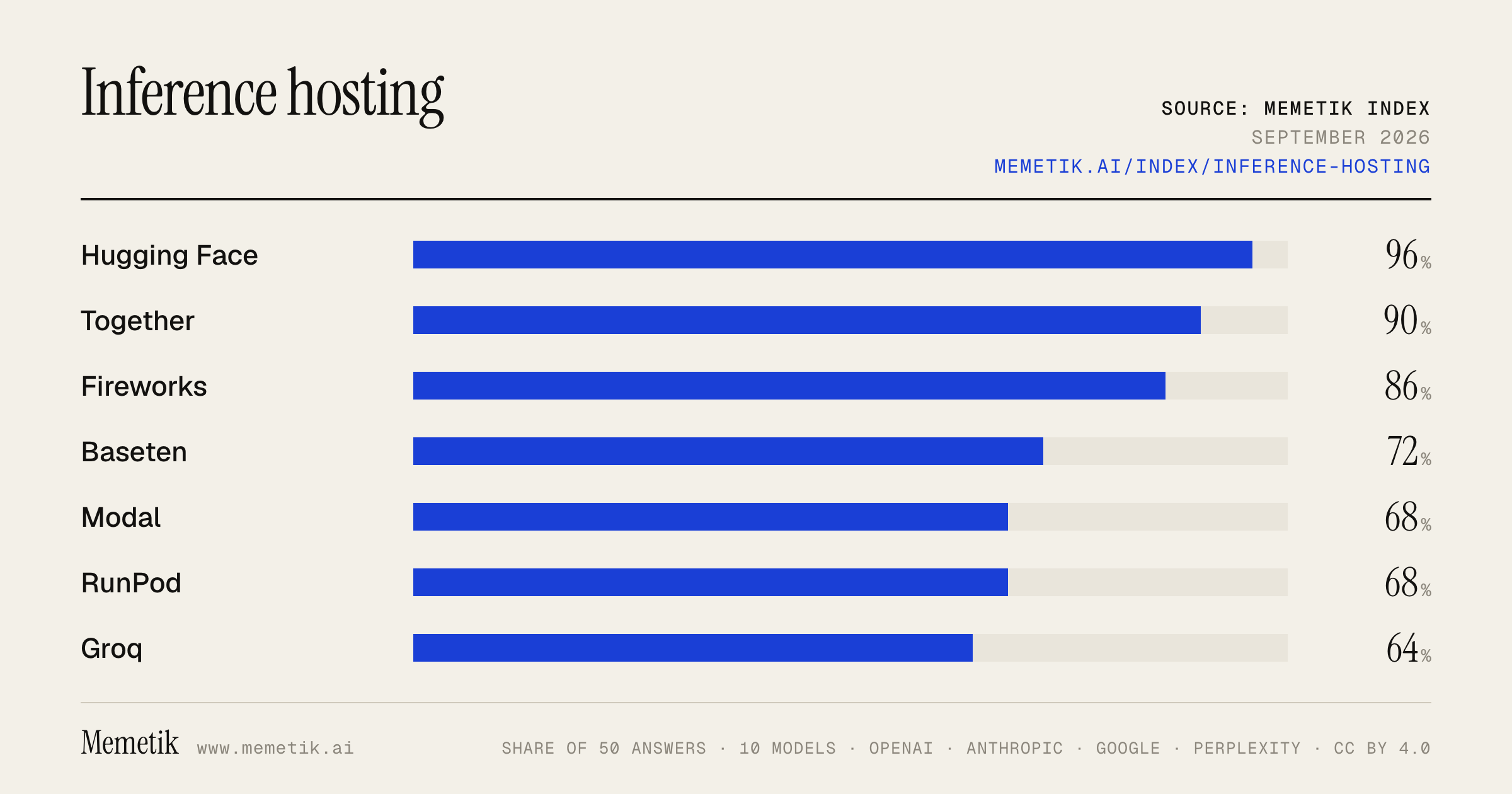
Hugging Face was named in 48 of 50 answers and came first in 17. Together follows at 90%. 18 vendors were named at least once. First edition, so there is no prior period.
Answer share
5 prompts × 10 models · 50 answers
By provider
10 models · 50 answers
OpenAI 3 models · 15 answers
- GPT-5.6 Solgpt-5.6-solmost named: Modal 100%
- GPT-5.6 Terragpt-5.6-terramost named: Hugging Face 80%
- GPT-5.6 Lunagpt-5.6-lunamost named: Hugging Face 100%
Anthropic 3 models · 15 answers
- Claude Opus 5claude-opus-5most named: Hugging Face 100%
- Claude Sonnet 5claude-sonnet-5most named: Hugging Face 100%
- Claude Fable 5claude-fable-5most named: Hugging Face 100%
Google 2 models · 10 answers
- Gemini 3.6 Flashgemini-3.6-flashmost named: Hugging Face 100%
- Gemini 3.5 Flashgemini-3.5-flashmost named: Hugging Face 100%
Perplexity 2 models · 10 answers
- Sonar Prosonar-promost named: Hugging Face 100%
- Sonar Reasoning Prosonar-reasoning-promost named: Hugging Face 100%
Sources the models cited
- llmapi.ai107
- edenai.co66
- siliconflow.com54
- databasemart.com53
- fireworks.ai48
- huggingface.co36
- spheron.network34
- hammansamuel.medium.com33
- reddit.com28
- checkthat.ai28
- runpod.io21
- thundercompute.com19
ChatGPT via API returns no citations, so it does not contribute here.
The prompts
- What is the best platform to host and serve open-source models for a developer? Name specific products.
- Which platform to host and serve open-source models would you recommend to a developer in 2026?
- Compare the top platform to host and serve open-source models options right now.
- I'm a developer and I need a platform to host and serve open-source models. What should I use and why?
- Best platform to host and serve open-source models for fast, cheap inference?
Every answer
Raw model output, unedited
GPT-5.6 TerraWhat is the best platform to host and serve open-source models for a developer? Name specific products.
**Best default for most developers: Hugging Face Inference Endpoints.**

It is the strongest all-around choice when you want to take an open-source model—especially one already on the Hugging Face Hub—and expose it as a managed production API with minimal infrastructure work. It supports optimized engines including **vLLM, SGLang, TGI, llama.cpp, and TEI**, lets you pin a model revision, select cloud/region/hardware, autoscale, scale to zero, and use a custom Docker container when needed. ([huggingface.co](https://huggingface.co/docs/inference-endpoints/main/about?utm_source=openai))

### Specific products worth considering

| Product | Best for | Main trade-off |
|---|---|---|
| **Hugging Face Inference Endpoints** | Best overall default; custom/open Hub models, embeddings, and production endpoints | Dedicated infrastructure can be pricier than pure shared/serverless APIs |
| **Together AI** | Fastest path from experimenting with a hosted OSS model to a dedicated endpoint | Custom-model support is oriented toward compatible text-generation/embedding models and single-node deployment |
| **Fireworks AI** | High-throughput LLM serving with a developer-friendly API | Less general-purpose if you need unusual model architectures or arbitrary containers |
| **Baseten** | Production ML serving where you want substantial performance and deployment control | More platform-specific deployment workflow |
| **Runpod Serverless** | Cost-sensitive GPU inference and DIY deployment control | You own more operational details than with a fully managed endpoint product |
| **Modal** | Python-native teams building custom inference pipelines, APIs, and batch jobs | Better thought of as programmable GPU infrastructure than a model catalog/API provider |
| **Replicate** | Extremely simple API access and prototypes across many model types | Less control over runtime and serving architecture |

**Choose Together AI instead** if your primary need is an OpenAI-compatible API for popular open-weight LLMs now, with the option to move the *same API integration* to reserved hardware later. Its **Dedicated Endpoints** offer isolated hardware, configurable autoscaling, custom fine-tuned model uploads, and the same API surface as its serverless offering. ([docs.together.ai](https://docs.together.ai/docs/dedicated-endpoints/overview?utm_source=openai))

### Practical recommendation

1. **Start with Hugging Face Inference Endpoints** if you are serving your own model, LoRA/fine-tune, embedding model, or anything on the Hub.
2. **Start with Together AI** if you just need a high-quality hosted open model API and want very little deployment work.
3. **Use Runpod or Modal** if cost control, custom Python logic, or unusual dependencies matter more than managed operations.
4. **Use Baseten or Fireworks AI** when inference performance and production serving are central to your product and you can accept more vendor specialization.

If I had to pick **one** for a typical developer shipping an application around open-source models: **Hugging Face Inference Endpoints**.
GPT-5.6 TerraWhich platform to host and serve open-source models would you recommend to a developer in 2026?
**My default recommendation: Hugging Face Inference Endpoints, using vLLM**.

For a developer whose goal is specifically to **host and serve open-source models**—rather than build general serverless GPU workloads—it is the most direct, low-ops choice:

- Deploy directly from a Hugging Face model repository, including private repos.
- Managed GPU provisioning, TLS, health monitoring, autoscaling, and scale-to-zero.
- Native choices of modern serving engines such as **vLLM**, **SGLang**, **TGI**, **llama.cpp**, and **TEI** for embeddings.
- Ability to pin a model revision, choose cloud/region/hardware, use secrets, and switch to a custom Docker image when the standard engine is insufficient. ([huggingface.co](https://huggingface.co/docs/inference-endpoints/main/about?utm_source=openai))

**Recommended setup**

```text
Hugging Face Hub private/public model repo
        ↓
Hugging Face Inference Endpoint
        ↓
vLLM engine + OpenAI-compatible API
        ↓
Your application / API gateway
```

Use **vLLM** for mainstream text-generation and tool-calling workloads; use **TEI** for embeddings; use **llama.cpp** when a GGUF/quantized model and lower-cost footprint are more important than maximum throughput. Hugging Face also supports custom containers, so adopting it does not lock you into only its prebuilt runtimes. ([huggingface.co](https://huggingface.co/docs/inference-endpoints/main/about?utm_source=openai))

### When I would choose something else

- **Choose Modal** if you want a code-first, serverless GPU platform for more than inference—e.g., preprocessing, fine-tuning, batch jobs, custom Python workflows, and endpoints in one application. It is especially compelling for variable or early-stage traffic because infrastructure and GPU/container configuration live in code and usage is metered per second. ([modal.com](https://modal.com/docs/guide?utm_source=openai))
- **Run vLLM yourself on Kubernetes/cloud VMs** if you have sustained, high utilization, a platform team, strict networking/compliance needs, or need to optimize GPU cost aggressively. That gives maximum control, but makes you responsible for capacity, rollout, observability, security, and incident response.
- **Avoid a generic “serverless inference API”** for a serious production service where latency, capacity, and model version must be predictable. Hugging Face itself positions serverless inference for exploration/evaluation and dedicated endpoints for larger volume or guaranteed performance. ([huggingface.co](https://huggingface.co/docs/inference-endpoints/en/faq?utm_source=openai))

### Practical answer

If I were starting a new developer product in 2026:

1. **Start on Hugging Face Inference Endpoints + vLLM.**
2. Pin both the model commit and serving-image version.
3. Deploy at least **two replicas** for an availability-sensitive production endpoint.
4. Keep the application interface OpenAI-compatible so migrating later—to self-hosted vLLM, Modal, or another provider—is manageable. Hugging Face documents that two replicas help mitigate interruptions, and its vLLM configuration supports multi-GPU tensor parallelism when needed. ([huggingface.co](https://huggingface.co/docs/inference-endpoints/en/faq?utm_source=openai))

So: **Hugging Face for the best open-model serving default; Modal for the best programmable/serverless alternative; self-hosted vLLM only once scale or constraints justify the operational burden.**GPT-5.6 TerraCompare the top platform to host and serve open-source models options right now.
There isn’t one universal winner—**the right platform depends on whether you value model freedom, lowest operational effort, latency/throughput, or cloud control.**

## Best options for serving open-weight models

| Platform | Best for | Strengths | Watch-outs |
|---|---|---|---|
| **Hugging Face Inference Endpoints** | **Best default for broad open-model deployment** | Direct deployment from the HF Hub; supports common production engines including vLLM, TGI, SGLang, llama.cpp, and TEI; dedicated infrastructure, private endpoints, autoscaling, and scale-to-zero. | Charged for provisioned running infrastructure; scale-to-zero introduces cold starts and can return errors while a replica initializes unless your client handles retries/queueing. |
| **Together AI** | **Best for getting popular open models into production quickly** | OpenAI-compatible API; use serverless models with no provisioning/minimum spend, or move to dedicated endpoints for reserved, isolated capacity. Supports uploaded fine-tunes/custom models from Hugging Face or S3, plus managed containers. | BYO-weight deployment has constraints—for example, its documented custom-model path is aimed at text-generation/embedding models that fit on one node. |
| **Fireworks AI** | High-throughput serverless inference for mainstream LLMs | Strong choice to benchmark when you need a polished, OpenAI-like developer experience and production API performance without owning infrastructure. | Less ideal if your core requirement is deploying arbitrary architecture, custom runtime code, or full infrastructure control. |
| **Baseten** | Custom production deployments and performance engineering | Particularly attractive when you need a tailored model-serving stack, custom model code/containers, observability, and an application-facing deployment workflow. | Typically more of a production-platform purchase than a cheap experimentation option. |
| **Modal** | Engineering-led teams that want programmable infrastructure | Excellent for Python-native deployment workflows, custom preprocessing/postprocessing, GPU functions, batch jobs, and scale-to-zero workloads. | You own more of the serving design: model server choice, batching, concurrency tuning, and production SLO work. |
| **Runpod** | Lowest-cost / hands-on GPU serving | Flexible access to GPUs and useful for vLLM, ComfyUI, custom containers, and cost-sensitive workloads. | More operational responsibility and more variability than premium managed inference platforms. |
| **AWS SageMaker / EKS, GCP Vertex AI / GKE, Azure** | Compliance, private networking, existing cloud commitments | Strongest fit for enterprise identity controls, data residency, VPC/VNet networking, governance, and integration with your existing platform. | Usually the highest operational complexity unless you already have a mature ML/platform team. |

## My practical recommendation

### Pick **Hugging Face Inference Endpoints** if:
- You want to serve **many kinds of open-source/open-weight models**, not just a narrow LLM catalog.
- Your model already lives on Hugging Face.
- You want managed deployment but still care about inference-engine choice and model revision pinning.
- You need dedicated endpoints with scaling and private access.

HF is the most broadly useful default because it is tightly integrated with the model ecosystem and supports multiple mainstream serving engines. It manages the deployment lifecycle, health monitoring, scaling, and endpoint infrastructure. ([huggingface.co](https://huggingface.co/docs/inference-endpoints/main/about?utm_source=openai))

### Pick **Together AI** if:
- You need to ship quickly using an API for well-known open models.
- Traffic is uncertain, bursty, or small enough that pay-per-token serverless is attractive.
- You want a simple upgrade path from serverless experimentation to dedicated GPUs.
- Your custom fine-tuned model is a conventional Hugging Face-format text-generation or embedding model.

Together’s serverless tier avoids capacity planning and bills per token; its dedicated endpoints are the better fit for steady traffic or higher rate-limit/isolation needs. ([docs.together.ai](https://docs.together.ai/docs/serverless/models?utm_source=openai))

### Pick **Baseten** or **Modal** if:
- Your “model” is really a **custom inference application**: special input pipelines, multimodal postprocessing, custom CUDA/Triton code, nonstandard dependencies, or compound AI workflows.
- You have engineers willing to tune the serving path rather than just call a hosted model API.

### Pick **Fireworks** if:
- Your model choice is already in its catalog and you care most about **API simplicity plus inference performance**.
- You do **not** need to run an arbitrary repository or custom serving stack.

### Pick **Runpod** or your own cloud/Kubernetes stack if:
- Cost control is more important than managed-service polish.
- You already operate containers/GPU infrastructure.
- You require unusual runtimes, hardware placement, or deep networking/data controls.

## How I’d decide by workload

1. **Prototype / evals / low or bursty traffic**
   Start with **Together serverless** or Fireworks. No idle GPU bill is the main benefit. Together explicitly positions serverless for prototypes, evaluations, and variable or low-volume production traffic. ([docs.together.ai](https://docs.together.ai/docs/serverless/models?utm_source=openai))

2. **Dedicated production API for a standard Hugging Face model**
   Start with **Hugging Face Inference Endpoints**. You can choose provider, region, instance type, replicas, model revision, and supported inference engine. ([huggingface.co](https://huggingface.co/docs/inference-endpoints/guides/create_endpoint?utm_source=openai))

3. **Fine-tuned Llama/Qwen/Mistral-style text or embedding model**
   Compare **Together dedicated endpoints** versus **HF Endpoints**. Together can import Hugging Face or S3 model artifacts for dedicated deployment, subject to its supported formats and single-node constraint. ([docs.together.ai](https://docs.together.ai/docs/dedicated-endpoints/custom-models?utm_source=openai))

4. **Always-on, predictable high traffic**
   Use a **dedicated endpoint** rather than serverless. Evaluate HF, Together, Baseten, and Fireworks using your own prompt mix, context lengths, concurrency, and output sizes—not a generic tokens/sec chart.

5. **Strict privacy/compliance / data cannot leave your cloud boundary**
   Use **SageMaker/EKS, Vertex/GKE, or Azure-managed infrastructure**, typically with
- https://huggingface.co/docs/inference-endpoints/main/about?utm_source=openai
- https://docs.together.ai/docs/serverless/models?utm_source=openai
- https://huggingface.co/docs/inference-endpoints/guides/create_endpoint?utm_source=openai
- https://docs.together.ai/docs/dedicated-endpoints/custom-models?utm_source=openai
GPT-5.6 TerraI'm a developer and I need a platform to host and serve open-source models. What should I use and why?
**Default recommendation: Hugging Face Inference Endpoints**—especially if you want to deploy models from the open-source ecosystem quickly without owning GPU/Kubernetes operations.

Why it’s the best default:

- **Native fit for open-source models.** It deploys directly from Hugging Face Hub repositories and supports optimized serving engines including **vLLM, SGLang, TGI, llama.cpp, and TEI**. That covers most LLM, embedding, and common multimodal/model-serving needs. ([huggingface.co](https://huggingface.co/docs/inference-endpoints/main/about?utm_source=openai))
- **Managed production operations.** It manages container lifecycle, health monitoring, logs/metrics, replica autoscaling, and optional scale-to-zero—so you can spend time on your application rather than GPU fleet management. ([huggingface.co](https://huggingface.co/docs/inference-endpoints/main/about?utm_source=openai))
- **Enough escape hatches.** You can pin a specific model revision for reproducibility, configure hardware/provider/region, use a custom handler, or deploy your own Docker image when a standard engine does not fit. ([huggingface.co](https://huggingface.co/docs/inference-endpoints/engines/custom_container?utm_source=openai))
- **Practical deployment path.** Start with a managed **vLLM** endpoint for an LLM (or **TEI** for embeddings), expose an OpenAI-compatible-facing API layer if that is your application convention, and pin weights to a commit SHA before production releases.

### When I would choose something else

| Your situation | Better approach | Why |
|---|---|---|
| You need the quickest developer prototype, and don’t need dedicated infrastructure | A serverless inference provider such as Replicate or a hosted inference API | Lowest operational burden, typically suitable for experimentation and irregular traffic. |
| You have sustained, high-volume traffic and an infra/MLOps team | **Self-host vLLM/SGLang** on Kubernetes or your cloud GPU VMs | More control over batching, routing, quantization, observability, network architecture, and potentially unit economics. |
| You require strict VPC placement, organization-wide IAM, private networking, and existing cloud governance | Your cloud’s managed ML serving product | Better alignment with enterprise security and data-plane controls, at the cost of more platform complexity. |
| You need an unusual architecture, preprocessing pipeline, or nonstandard runtime | Hugging Face Endpoints using a **custom container** | Retain the managed deployment plane while fully controlling the serving code. HF documents support for images from common registries and a model mount inside the deployed container. ([huggingface.co](https://huggingface.co/docs/inference-endpoints/engines/custom_container?utm_source=openai)) |

### Important caveats

- **Don’t enable scale-to-zero for latency-sensitive production traffic** unless your client handles cold starts, retries, and queueing. HF notes that an endpoint can return `502` while a scaled-to-zero replica initializes, and that it does not provide request queueing for that period. ([huggingface.co](https://huggingface.co/docs/inference-endpoints/autoscaling?utm_source=openai))
- **Benchmark your exact model and context length.** The “best” engine and GPU depend heavily on model architecture, quantization, concurrency, prompt length, output length, and latency SLO. Don’t choose on GPU hourly rate alone—compare cost per successful generated token at your target p50/p95 latency.
- **Treat model licensing as a release gate.** “Open-source” is used loosely in model marketing. Check the model’s license, redistribution terms, acceptable-use policy, and whether you can use it commercially before exposing it as a service.
- **Pin versions.** Pin model weights to a commit/revision and pin your container/runtime version; HF supports endpoint deployment against a specified model revision. ([huggingface.co](https://huggingface.co/docs/inference-endpoints/guides/advanced?utm_source=openai))

### A sensible starting architecture

1. Store weights and model card in a private Hugging Face repo.
2. Deploy a dedicated HF Inference Endpoint:
   - **vLLM** for a generative LLM,
   - **TEI** for embeddings,
   - custom container only when necessary.
3. Set `min_replicas=1` for an interactive production API; autoscale upward based on pending requests or utilization.
4. Put an API gateway in front for auth, tenant quotas, rate limits, request logging, and abuse controls.
5. Collect tokens/sec, time-to-first-token, p95 end-to-end latency, GPU utilization, errors, and cost per request.
6. Revisit self-hosting only once usage is stable enough that operational savings no longer beat the managed-service premium.

**Bottom line:** Use **Hugging Face Inference Endpoints** first if your priority is shipping a reliable hosted open-model API quickly. Move to self-hosted vLLM/SGLang only when your scale, compliance requirements, or performance tuning needs justify owning the infrastructure.
- https://huggingface.co/docs/inference-endpoints/main/about?utm_source=openai
- https://huggingface.co/docs/inference-endpoints/engines/custom_container?utm_source=openai
- https://huggingface.co/docs/inference-endpoints/autoscaling?utm_source=openai
- https://huggingface.co/docs/inference-endpoints/guides/advanced?utm_source=openai
GPT-5.6 TerraBest platform to host and serve open-source models for fast, cheap inference?
**Best default: Fireworks AI.**

For most teams, it is the strongest balance of **fast inference, low token cost, easy OpenAI-compatible integration, no cold starts, and a clean path from serverless to dedicated deployments**. Its serverless offering is pay-per-token; when traffic becomes steady or you need isolation/custom weights, it also supports on-demand GPU deployments. ([docs.fireworks.ai](https://docs.fireworks.ai/serverless/overview?utm_source=openai))

A practical decision guide:

| Need | Best pick | Why |
|---|---|---|
| **Best overall, start fast** | **Fireworks AI** | Strong optimized serving, broad popular-model catalog, serverless + dedicated options, batch at half normal serverless token pricing. ([docs.fireworks.ai](https://docs.fireworks.ai/serverless/pricing?utm_source=openai)) |
| **Broadest model experimentation / multimodal** | **Together AI** | Large catalog across text, vision, image, video, audio; serverless and dedicated/custom model endpoints. ([together.ai](https://www.together.ai/serverless-inference?utm_source=openai)) |
| **Very high output-token speed for a supported small set of models** | **Groq** | Worth benchmarking if its available model selection fits you—but it is less of a general “host any open model” platform. |
| **Your own model or LoRA, predictable sustained traffic** | **Fireworks or Together dedicated endpoints** | Dedicated compute is usually preferable once utilization is consistently high, and it gives more latency/control isolation. Fireworks supports multi-LoRA deployments; Together supports uploaded custom fine-tuned models. ([docs.fireworks.ai](https://docs.fireworks.ai/faq/billing-pricing-usage/pricing/cost-structure?utm_source=openai)) |

**Cost examples (verify against the live catalog before committing):**
- Fireworks lists **gpt-oss-20B** at **$0.07/M input** and **$0.30/M output tokens**, and **gpt-oss-120B** at **$0.15/M input** and **$0.60/M output**. ([docs.fireworks.ai](https://docs.fireworks.ai/serverless/pricing?utm_source=openai))
- Together lists **gpt-oss-20B** at **$0.05/M input** and **$0.20/M output**, and **gpt-oss-120B** at **$0.15/M input** and **$0.60/M output**. ([together.ai](https://www.together.ai/pricing?trk=article-ssr-frontend-pulse_little-text-block&utm_source=openai))

**My recommendation:**
1. Start with **Fireworks serverless** if you need a production API this week.
2. Also benchmark **Together** on your exact prompts/model—especially if model breadth, multimodal generation, or its cheaper route for a particular model matters.
3. Move to a dedicated endpoint only after you have reliable traffic; otherwise serverless avoids idle GPU spend.
4. Benchmark on your real workload using **p50/p95 time-to-first-token, output tokens/sec, error rate, and total cost per completed task**—not headline tokens/sec.

If you tell me the model(s), expected requests/minute, context/output lengths, and whether you need to serve custom weights, I can give you a specific cheapest architecture.
- https://docs.fireworks.ai/serverless/overview?utm_source=openai
- https://docs.fireworks.ai/serverless/pricing?utm_source=openai
- https://www.together.ai/serverless-inference?utm_source=openai
- https://docs.fireworks.ai/faq/billing-pricing-usage/pricing/cost-structure?utm_source=openai
- https://www.together.ai/pricing?trk=article-ssr-frontend-pulse_little-text-block&utm_source=openai
Claude Sonnet 5What is the best platform to host and serve open-source models for a developer? Name specific products.
There's no single "best" platform—it depends on whether you want a fully-managed API, more control over infrastructure, or full self-hosting. Here's a practical breakdown with specific products:

## 1. Managed inference APIs (easiest, pay-per-token)
Best if you just want to call an open-weight model (Llama, DeepSeek, Qwen, Mixtral, etc.) via API without managing GPUs.

- **Together AI** – large catalog of open models, competitive pricing, fine-tuning support.
- **Fireworks AI** – known for fast, optimized inference and function-calling support.
- **Groq** – uses custom LPU chips for extremely low-latency inference on models like Llama and Mixtral.
- **Hugging Face Inference Endpoints / Inference API** –
Hugging Face is the world's leading platform for open-source AI models, hosting thousands of pre-trained LLMs with easy API access.
 Great if you're already using their model hub.
- **SiliconFlow, Novita AI, DeepInfra** – lower-cost alternatives frequently cited for aggressive pricing.
SiliconFlow, Hugging Face, Firework AI, DeepSeek AI, and Novita AI are praised for their outstanding cost-efficiency and performance.


## 2. "Bring your own container" / dedicated GPU serving (more control, still managed)
Good middle ground if you want custom models, autoscaling, and don't want to manage bare-metal infra.

- **Baseten** – popular for deploying custom/open-source models with autoscaling GPU infra.
- **Replicate** – simple Docker-based deployment, pay-per-second GPU billing, huge community model library.
- **Modal** – serverless GPU compute, very developer-friendly for custom inference pipelines.
- **BentoML / BentoCloud** – open-source serving framework with a managed cloud option, good if you want an open standard for packaging models rather than lock-in.
They let developers self-host models privately, fine-tune them with domain-specific data, and optimize inference performance for their unique workloads.


## 3. Raw GPU cloud (full control, self-managed serving with vLLM/TGI/Ollama)
Best for cost efficiency at scale or strict data privacy needs.

- **Lambda Labs** –
Lambda has become a favorite for ML engineers.

- **CoreWeave** –
CoreWeave powers many large-scale AI companies.

- **Vast.ai** –
Vast.ai operates as a decentralized GPU marketplace.
, useful for cheap spot-style GPU rental.
- **RunPod** – widely used for serverless GPU pods running vLLM, TGI, or Ollama containers.
- On these, you'd typically run **vLLM**, **TGI (Text Generation Inference)**, or **Ollama/llama.cpp** as the actual serving engine.

## 4. Enterprise/cloud-native option
- **AWS Bedrock** –
the best open-source LLM hosting provider for enterprise governance, not as a pure open-source host, but as an AWS-native managed model platform, with the key advantage being enterprise integration, governance, and breadth inside AWS.
 Best if you're already deep in the AWS ecosystem and need compliance/governance features.

### Quick recommendation
- **Just building a product fast, don't want to touch GPUs:** Together AI, Fireworks AI, or Groq (for speed).
- **Want custom models with simple deploy workflow:** Replicate or Baseten.
- **Want cheapest at scale / full control:** RunPod, Lambda Labs, or CoreWeave running vLLM yourself.
- **Already on Hugging Face ecosystem:** Hugging Face Inference Endpoints.

If you tell me your priorities (cost, latency, data privacy, ease of use, or scale), I can narrow this down to one specific pick.
- https://www.siliconflow.com/articles/en/The-best-API-providers-of-Open-Source-LLM
- https://www.siliconflow.com/articles/en/the-cheapest-open-source-LLM-hosting
- https://www.bentoml.com/blog/navigating-the-world-of-open-source-large-language-models
- https://visualwebtechnologies.com/best-llm-web-hosting-providers-for-open-source-models-2026/
- https://www.edenai.co/post/best-open-source-llm-hosting-providers
Claude Sonnet 5Which platform to host and serve open-source models would you recommend to a developer in 2026?
Based on current information, here's my take for 2026, broken down by what you're actually trying to do:

## If you want zero infrastructure management (managed inference APIs)

**Together AI** and **Fireworks AI** are consistently top picks for teams that want production-grade hosted inference without touching GPUs.
Together AI is considered the best open-source LLM hosting provider for startups
, offering an all-round platform.
It spans serverless inference, batch inference, dedicated inference, fine-tuning, and GPU clusters
, so it scales well as your needs grow.

Fireworks is a very close alternative —
it's a strong option when teams want an API-style experience for open models without managing GPU infrastructure directly, and is one of the closest alternatives to Together AI
. The choice between them
usually depends on the exact model, latency target, context window, fine-tuning needs, and pricing for your traffic shape
.

**Groq** is worth adding to the shortlist if raw inference *speed* (low latency token generation) matters most for your use case.

## If you want the biggest model catalog / easiest onboarding

**Hugging Face** remains the default starting point.
It's the world's leading platform for open-source AI models, hosting thousands of pre-trained LLMs with easy API access
, via Inference Endpoints for managed deployment.

## If cost is your primary constraint

**SiliconFlow** and **Novita AI** get called out repeatedly for aggressive pricing on open-weight models, alongside Hugging Face and Fireworks.
SiliconFlow, Hugging Face, Fireworks AI, DeepSeek AI, and Novita AI are praised for their outstanding cost-efficiency and performance
 in cost-focused comparisons.

## If you need enterprise governance/compliance

**AWS Bedrock** is the pick here —
it's considered the best open-source LLM hosting provider for enterprise governance
, which matters if you need tight IAM integration, VPC isolation, and audit trails.

## If you want full self-hosting (own GPUs, max control/privacy)

Use a serving framework rather than a hosted platform:
-
vLLM handles production serving at scale with continuous batching and an OpenAI-compatible API
 — this is the de facto standard for self-hosted production serving in 2026.
-
Ollama is the fastest option for local prototyping
 if you're just testing on a laptop/workstation before scaling.
- For on-demand GPU rental to pair with vLLM, providers like Thunder Compute, RunPod, or Lambda let you rent A100/H100s by the minute rather than committing to reserved infrastructure.

## Practical recommendation

For most developers in 2026, I'd suggest this path:
1. **Prototype** locally with Ollama or on Hugging Face's free/serverless tier.
2. **Move to production** on Together AI or Fireworks AI if you want managed simplicity, or self-host with vLLM on rented GPUs (RunPod/Thunder Compute) if you need full data control or have steady high-volume traffic where owning throughput becomes cheaper.
3. If you're optimizing purely for token-generation speed (e.g., real-time agents), benchmark Groq specifically for your model of choice.

One caveat: model choice interacts heavily with this decision —
DeepSeek V4-Flash and Mistral Small models bring near-frontier quality to 2-GPU setups
, which is worth checking if you're leaning toward self-hosting rather than committing to the largest frontier open-weight models that require multi-GPU clusters.
- https://www.edenai.co/post/best-open-source-llm-hosting-providers
- https://llmapi.ai/best-open-source-llm-hosting-providers/
- https://www.siliconflow.com/articles/en/The-best-API-providers-of-Open-Source-LLM
- https://www.siliconflow.com/articles/en/the-cheapest-open-source-LLM-hosting
- https://www.thundercompute.com/blog/best-open-source-llms
Claude Sonnet 5Compare the top platform to host and serve open-source models options right now.
Based on current information, here's a comparison of the top platforms for hosting and serving open-source models right now:

## Top Platforms Compared

**Together AI** — Widely considered the top pick for startups and general-purpose serving.
Together AI is considered the best open-source LLM hosting provider for startups, offering an all-rounder platform spanning serverless inference, batch inference, dedicated inference, fine-tuning, and GPU clusters, so you can start with API calls and later move to more controlled deployment.
 It's also noted for optimized, competitive per-token pricing on open-source LLMs.

**Hugging Face (Inference Endpoints)** — The default choice for breadth and community. It remains the most comprehensive model repository with strong ecosystem/community collaboration, making it ideal for researchers and developers who want direct access to virtually any open model plus easy deployment tooling.

**Fireworks AI** — Known for speed and automation.
Fireworks AI offers an automated ML deployment and monitoring platform aimed at production teams and MLOps engineers, standing out for exceptional automation that eliminates deployment friction.


**Baseten** — Frequently listed alongside Fireworks/Together for production-grade custom model serving with strong infrastructure control.

**Groq** — Distinguished by extremely low-latency, high-throughput inference (via its custom LPU hardware) — best when speed is the top priority rather than breadth of model choice.

**AWS Bedrock** — Best for large enterprises already on AWS.
It's not a pure open-source host but an AWS-native managed model platform whose key advantage is enterprise integration, governance, and breadth inside AWS — best for large companies already committed to AWS-native architecture with security and compliance requirements.
 A tradeoff is that
it feels like an AWS service first and a delightfully simple developer product second.
 Pricing is flexible:
it supports on-demand token pricing, provisioned throughput, fine-tuning/customization for some models, and Custom Model Import pricing by model unit.


**SiliconFlow / Novita AI / DeepSeek AI** — Positioned as the budget/cost-efficiency leaders.
Novita AI, for instance, offers high-throughput serverless inference at $0.20 per million tokens, providing fast throughput combined with rock-bottom pricing ideal for startups and developers.


**Replicate & Modal** — Good for rapid, low-friction deployment.
Replicate offers a community model marketplace with rapid deployment, while Modal provides serverless GPU compute.


**Self-hosted stacks (vLLM, BentoML, Seldon Core)** — For teams wanting full control on their own infrastructure.
vLLM is considered the default open-source LLM inference engine, with its multi-head query attention kernel, continuous batching, and OpenAI-compatible API server making it the standard for self-hosted LLM serving, delivering high-throughput inference with broad quantization support (AWQ, GPTQ, FP8) on both GPU and CPU.
 Note though that
vLLM is an inference engine, not a full platform
 — you'd still need something like BentoML or Kubernetes-based Seldon Core to wrap it into a production service, or a raw GPU marketplace like Vast.ai/Lambda/CoreWeave for infrastructure.

## How to Choose

| Priority | Best Fit |
|---|---|
| Fastest to launch, startup-friendly | Together AI |
| Widest model selection / community | Hugging Face |
| Lowest latency at scale | Groq, Fireworks AI |
| Enterprise governance/compliance (AWS shop) | AWS Bedrock |
| Cheapest per-token pricing | Novita AI, SiliconFlow, DeepSeek AI |
| Full infrastructure control / data privacy | Self-hosted vLLM + BentoML/Seldon on GPU cloud (Lambda, CoreWeave, Vast.ai) |
| Quick demos/prototyping | Replicate, Modal |

**Bottom line:** If you want minimal ops overhead and solid pricing, **Together AI** or **Fireworks AI** are the strongest all-around choices right now. If you need enterprise compliance and are already on AWS, **Bedrock** wins despite being less "open-source native." If cost-per-token is your main constraint, look at **Novita AI or SiliconFlow**. If you need full data control and are willing to manage infrastructure, self-hosting with **vLLM** on a GPU cloud (Lambda, CoreWeave) is the way to go.
Claude Sonnet 5I'm a developer and I need a platform to host and serve open-source models. What should I use and why?
# Choosing a Platform to Host & Serve Open-Source Models

The right choice depends heavily on your specific needs (scale, latency requirements, budget, control over infrastructure). Here's a breakdown of the main categories and popular options:

## 1. **Local/Self-Hosted Inference Servers**
Best if you want full control, data privacy, or are running on your own hardware.

- **Ollama** — Extremely developer-friendly, simple CLI/API, great for quick prototyping and running models like Llama, Mistral, etc. locally. Minimal setup.
- **vLLM** — High-throughput, production-grade inference server. Uses PagedAttention for efficient memory management, supports continuous batching. Great if you need to serve many concurrent requests efficiently on your own GPUs.
- **Text Generation Inference (TGI)** — Hugging Face's production inference server, optimized for popular architectures, supports tensor parallelism, quantization, and streaming.
- **llama.cpp** — If you need CPU inference or edge deployment (quantized GGUF models), extremely lightweight and portable.
- **LocalAI** — OpenAI-API-compatible, supports many model types (text, image, audio), good if you want drop-in replacement for OpenAI's API locally.

## 2. **Managed/Cloud Hosting Platforms**
Best if you don't want to manage GPU infrastructure yourself.

- **Hugging Face Inference Endpoints** — Deploy any model from the HF Hub with a few clicks, autoscaling, pay-per-use. Tight integration with the HF ecosystem (tokenizers, model cards, etc.).
- **Replicate** — Simple API-first hosting, great for experimentation, pay-per-second billing, huge library of community-hosted open models.
- **Together AI** — Optimized inference for popular open models (Llama, Mixtral, etc.), competitive pricing, also offers fine-tuning.
- **Fireworks AI** — Fast inference, supports custom and open models, function calling support.
- **Modal / Baseten / RunPod** — Serverless GPU platforms where you deploy custom inference code/containers; good middle ground between full control and managed convenience.
- **AWS SageMaker / Google Vertex AI / Azure ML** — Enterprise-grade, if you're already in that cloud ecosystem and need compliance/security features.

## 3. **Orchestration/Serving Frameworks (for scaling your own deployment)**
- **Kubernetes + KServe/Seldon** — If you need enterprise-scale, multi-model serving with autoscaling on your own clusters.
- **Ray Serve** — Good for scaling Python-based inference pipelines, integrates well with vLLM.

## How to Choose

| Need | Recommendation |
|---|---|
| Quick local testing | **Ollama** |
| Max throughput on your own GPUs | **vLLM** |
| Don't want to manage infra | **Together AI**, **Fireworks**, or **HF Inference Endpoints** |
| OpenAI API compatibility | **LocalAI** or **vLLM** (both support OpenAI-compatible endpoints) |
| Enterprise compliance needs | **AWS SageMaker**, **Vertex AI**, or **Azure ML** |
| Custom pipelines, serverless GPUs | **Modal**, **Baseten**, **RunPod** |

## My general suggestion
If you're just starting out: prototype with **Ollama** locally, then move to **vLLM** (self-hosted) or **Together AI** (managed) once you need production-grade throughput. Both vLLM and most managed platforms now support **OpenAI-compatible APIs**, so switching between them later is relatively painless since your client code doesn't need to change much.

Want me to search for the latest benchmarks/pricing on any of these (things like GPU costs or throughput numbers change often), or help you narrow down based on your specific use case (e.g., expected traffic, model size, budget)?
Claude Sonnet 5Best platform to host and serve open-source models for fast, cheap inference?
There's no single "best" platform—it depends on whether you want a fully managed API (no infra) or raw GPU compute to self-host. Here's a practical breakdown based on current options:

## Managed inference APIs (easiest, pay-per-token)
Good if you just want an endpoint without managing GPUs.

- **Groq** – Known for extreme speed thanks to custom LPU hardware.
it offers exceptional processing speed with up to 18× faster inference than competing providers, though with a hardware-centric approach and limited model selection compared to more general-purpose platforms
.
Its whole product is built around low-latency inference on Groq hardware, and even its docs surface tokens-per-second directly alongside pricing and limits.
 Great for real-time chat/voice use cases.

- **Together AI** –
considered the best open-source LLM hosting provider for startups, spanning serverless inference, batch inference, dedicated inference, fine-tuning, and GPU clusters
, so you can start cheap and scale up without switching providers.

- **Fireworks AI** –
built around fast inference, model APIs, fine-tuning, and production deployment for open-source and custom models
, and is frequently cited as one of the closest alternatives to Together AI for hosted open-model inference.

- **Hugging Face Inference Endpoints** – Best if you want maximum model selection.
It offers a vast repository of open-source AI models, including LLMs, with Inference Endpoints supporting over 100,000 models at competitive pricing.


- **DeepInfra / Novita AI / SiliconFlow** – These are the budget leaders.
Novita AI offers high-throughput serverless inference at $0.20 per million tokens, providing fast throughput combined with rock-bottom pricing ideal for startups and developers.
 SiliconFlow markets itself similarly on cost, though take vendor-published benchmarks (like "2.3× faster") with some skepticism since it's their own comparison site.

- **Amazon Bedrock** – Not a pure open-model host, but
it's the best choice for enterprise governance in 2026, with its key advantage being enterprise integration, governance, and breadth inside AWS rather than open-model serving UX.


## Self-hosting on raw GPUs (cheapest at scale, more control)
If you have engineering resources and want lowest cost per token at volume:

- **Vast.ai** –
operates as a decentralized GPU marketplace
, typically the cheapest raw GPU rental option.
- **Lambda Labs** –
has become a favorite for ML engineers
 needing dedicated GPU instances.
- **CoreWeave** –
powers many large-scale AI companies
 and is built for serious production scale.
- **RunPod, Vultr, DigitalOcean** are also increasingly used for GPU rental as they expand AI infrastructure offerings.

For the actual serving software once you have GPUs, **vLLM** is the standard choice:
it's the throughput workhorse of open-source LLM serving, with PagedAttention, continuous batching, prefix caching, quantization support, and a broad model ecosystem making it a common starting point for production language-model inference.
 It also
has a large community and support across NVIDIA CUDA, AMD ROCm, CPUs, and other accelerator backends.


## Quick recommendation
- **Just want an API, prioritize speed:** Groq (if your model is supported) or Fireworks AI.
- **Want flexibility to scale from prototype → fine-tune → dedicated infra:** Together AI.
- **Want absolute cheapest per-token serverless:** Novita AI or DeepInfra.
- **Want max model variety:** Hugging Face Inference Endpoints.
- **Have DevOps capacity and want lowest cost at high volume:** Rent GPUs (Vast.ai/Lambda/RunPod) and self-host with vLLM.

If you tell me your expected scale (requests/sec, model size, latency needs, and budget), I can narrow this down to one specific pick.
- https://www.siliconflow.com/articles/en/The-best-API-providers-of-Open-Source-LLM
- https://www.edenai.co/post/best-open-source-llm-hosting-providers
- https://llmapi.ai/best-open-source-llm-hosting-providers/
- https://www.siliconflow.com/articles/en/the-top-low-cost-LLM-providers
- https://www.siliconflow.com/articles/en/the-cheapest-open-source-LLM-hosting
- https://visualwebtechnologies.com/best-llm-web-hosting-providers-for-open-source-models-2026/
- https://www.generativeaipub.com/p/best-self-hosted-inference-servers
Gemini 3.6 FlashWhat is the best platform to host and serve open-source models for a developer? Name specific products.
The "best" platform depends heavily on your specific use case, technical expertise, budget, and performance requirements. However, several top platforms stand out for hosting and serving open-source AI models (such as LLaMA 3, Mistral, Qwen, or Stable Diffusion).

Here is a breakdown of the leading products based on common developer needs:

---

### 1. Fully Managed / Serverless APIs (Easiest & Fastest to Start)
If you want to invoke open-source models via a simple REST API without worrying about infrastructure, cold starts, or GPU provisioning.

*   **Groq Cloud:** Known for its custom LPU (Language Processing Unit) hardware, Groq offers exceptionally fast inference speeds (often 300+ tokens/second) for popular open-source LLMs at very competitive pricing.
*   **Together AI:** A top platform offering serverless endpoints for hundreds of open-source models (LLMs, vision, embeddings). They also support custom fine-tuning and easy deployment of your own finetuned weights.
*   **Fireworks AI:** Focuses heavily on high-throughput, ultra-low-latency inference using advanced optimization techniques (like speculative decoding). Excellent for production applications requiring fast response times.
*   **Replicate:** Great for prototyping and multi-modal models (text-to-image, audio, LLMs). You can run open-source models via API or push your own custom models using their containerization tool (`Cog`).

---

### 2. Machine Learning Platforms & Hubs (Best Ecosystem & Integrations)
If you want an all-in-one platform tightly integrated with model weights, fine-tuning, and deployment.

*   **Hugging Face Inference Endpoints:** The industry standard for open-source AI. You can select any model directly from the Hugging Face Hub and deploy it onto dedicated infrastructure (AWS, Azure, or GCP) with a few clicks. It uses optimized backends like TGI (Text Generation Inference) and vLLM automatically.
*   **Modal:** A developer-favorite serverless python framework. It allows you to write standard Python code to fetch models and run inference, automatically scaling up containerized GPU workers in seconds. You only pay for the exact milliseconds your GPU runs.

---

### 3. Self-Hosted Infrastructure / Container Deployments (Maximum Control & Security)
If you want to host models on your own cloud (AWS, GCP, Azure, or bare-metal GPUs) for privacy, compliance, or cost efficiency at high scale.

#### Serverless / Orchestration Services:
*   **RunPod / Vast.ai:** Popular GPU cloud providers that let you rent dedicated or serverless GPUs (A100, H100, RTX 4090) at a fraction of the cost of traditional hyper-scalers. RunPod offers "Serverless Endpoints" pre-configured for LLM serving.
*   **Baseten:** Allows you to deploy models to production with auto-scaling infrastructure, custom logic, and high reliability, running in their cloud or inside your own VPC.

#### Serving Frameworks (To run on your instances):
If hosting your own VMs or Kubernetes clusters, pair your cloud provider with these open-source serving engines:
*   **vLLM:** The gold standard serving framework for LLMs, utilizing PagedAttention for maximum throughput and memory efficiency.
*   **TGI (Text Generation Inference):** Built by Hugging Face, highly optimized for serving open-weight LLMs in production environments.
*   **Ollama / LocalAI:** Best for local development, edge devices, or lightweight internal developer API endpoints.

---

### Summary Recommendation:
*   **For pure speed and lowest latency:** **Groq** or **Fireworks AI**
*   **For easiest transition from Hugging Face:** **Hugging Face Inference Endpoints**
*   **For flexible Python-first serverless deployment:** **Modal**
*   **For custom models + low cost:** **Together AI** or **RunPod Serverless**
*   **For full enterprise privacy/VPC deployment:** **vLLM** hosted on **AWS (SageMaker/EC2)** or **Baseten**
Gemini 3.6 FlashWhich platform to host and serve open-source models would you recommend to a developer in 2026?
Because the best platform for hosting and serving open-source AI models depends heavily on **how much control you need** versus **how fast you want to launch**, here are top recommendations tailored by developer use case:

---

### 1. Best for Turnkey Serverless & Custom LoRAs: **Fireworks AI** or **Together AI**
If you want to serve popular open-weight models (like Llama, Qwen, DeepSeek, or Mistral) or deploy custom LoRA fine-tunes without managing GPU infrastructure, these platforms lead the market.

* **Fireworks AI:**
  * **Why:** Outstanding for high-throughput, low-latency LLM serving. Their custom CUDA engine (*FireAttention*) and Multi-LoRA serving enable running hundreds of fine-tuned adapters on a single base model at serverless rates.
  * **Best For:** Scale-ups, real-time applications, and developers looking to deploy fine-tuned open-source models economically.
* **Together AI:**
  * **Why:** Boasts one of the widest catalog of open-source models across text, image, audio, and vision. Offers both serverless pay-per-token models and dedicated GPU clusters.
  * **Best For:** Teams that want broad flexibility in testing different open-source architectures.

---

### 2. Best for Full Python Infrastructure Control: **Modal** or **Baseten**
If you need complete control over custom pre-processing, custom C++ / CUDA dependencies, complex pipeline orchestration, or non-LLM open-source models (e.g., custom diffusion or audio models), code-first platforms are superior.

* **Modal:**
  * **Why:** Unmatched developer experience for Python developers. Define your environment, hardware dependencies, and scale-to-zero microservices directly in Python code. Cold starts are extraordinarily fast for GPU containers.
  * **Best For:** Fast-moving AI startups building multi-step pipelines or proprietary inference architectures.
* **Baseten:**
  * **Why:** Focuses heavily on production-grade model serving using open frameworks like vLLM, TensorRT-LLM, or their open-source `Truss` deployment framework. Outstanding autoscaling, traffic-splitting, and observability.
  * **Best For:** Production enterprise applications requiring custom serving logic and robust SLAs.

---

### 3. Best for Ecosystem Integration & Prototyping: **Hugging Face Inference Endpoints**
* **Why:** If your models are already hosted in the Hugging Face Hub, HF Inference Endpoints allow one-click deployments to dedicated GPU infrastructure running frameworks like TGI (Text Generation Inference) or vLLM. They also offer an integrated *Inference Providers* router to connect directly to backends like Fireworks and Together.
* **Best For:** Developers already deep in the Hugging Face ecosystem who want zero-DevOps deployment.

---

### 4. Best for Unmatched Speed & Cost Efficiency: **Groq**
* **Why:** Built on custom LPUs (Language Processing Units), Groq offers extreme throughput (300+ tokens/sec) at very low cost for supported models like Llama.
* **Best For:** Real-time conversational apps or voice agents where **Time-To-First-Token (TTFT)** and generation speed are top priority. (Note: Groq does not support arbitrary custom model uploads; you must use their supported open model catalog).

---

### 5. Best for Raw Infrastructure (Self-Hosted Containers): **RunPod** or **Vast.ai**
If you prefer to run your own **vLLM**, **Ollama**, or **SGLang** container and manage the serving stack yourself to cut cloud provider markups:

* **RunPod / Vast.ai:**
  * **Why:** Rent raw GPU instances (on-demand or spot/interruptible) by the minute.
  * **Best For:** Engineers with DevOps capabilities who want maximum control over hardware costs or air-gapped setups.

---

### Summary Recommendation Matrix

| Use Case | Recommended Platform | Why |
| :--- | :--- | :--- |
| **API-first / Fine-Tuned Open LLMs** | **Fireworks AI** | Multi-LoRA capability, fast TTFT, low cost. |
| **Custom Code / Python Workflows** | **Modal** | Code-driven GPU scaling, minimal cold-start times. |
| **Enterprise / SLA Production** | **Baseten** | Custom container serving via Truss, strict reliability. |
| **Max Token Speed** | **Groq** | Ultra-fast LPU inference for standard open models. |
| **Lowest Raw Hardware Cost** | **RunPod** + **vLLM** | Bare-metal GPU hosting with full engine configuration control. |
Gemini 3.6 FlashCompare the top platform to host and serve open-source models options right now.
When hosting and serving open-source models (such as Llama 3, DeepSeek, Qwen, or Mistral), the platform landscape splits into **four main categories**:

1. **Serverless Inference APIs** (Fastest to integrate, pay per token)
2. **Managed API / Specialized Model Hosting Platforms** (Simple setup, pay per second/hour)
3. **Infrastructure / Unmanaged GPU Clouds** (Maximum control, lowest cost at scale)
4. **Hyperscalers & Enterprise Clouds** (Compliance, single-cloud architecture)

Below is a breakdown comparing the top options across each category.

---

### 1. Serverless Inference APIs (Pay-per-token)
*Best for: Speed-to-market, variable traffic, and teams that want an OpenAI-style API without managing any GPUs.*

* **Fireworks AI:** Highly optimized for low-latency LLM serving. It supports speculative decoding and fine-tuned LoRAs seamlessly, making it one of the top choices for real-time production APIs.
* **Together AI:** Offers one of the widest catalogs of open-source models (including audio, vision, and text). Excellent for quick prototyping and switching models with an OpenAI-compatible API.
* **Groq:** Uses custom LPU (Language Processing Unit) hardware instead of GPUs. Unmatched generation speed (often 300–500+ tokens/sec) for hosted standard models, though custom fine-tunes and niche models are limited.

---

### 2. Managed Model Hosting Platforms (Container/Deployment layer)
*Best for: Teams with custom pipelines, fine-tuned weights, or specific image/multimodal requirements who want hands-off GPU management.*

* **Baseten:** Built for production ML serving. Uses its open-source *Truss* framework and integrates deeply with vLLM and TensorRT-LLM. Offers auto-scaling down to zero, strong enterprise security, and observability tools.
* **Replicate:** The "Vercel for AI." You can call models from a massive community catalog or package custom models with their open-source `Cog` tool. Exceptional developer experience for image, video, and audio models, but can be expensive at high steady volumes.
* **Hugging Face Inference Endpoints:** Native integration with the HF model hub. Ideal if your model is already stored on HF. Supports one-click deployment onto dedicated cloud GPUs with built-in vLLM/TGI serving engines.

---

### 3. GPU Cloud Infrastructure (Bare Metal & Serverless Containers)
*Best for: High volume, cost-optimization, and engineering teams using runtimes like vLLM, TensorRT-LLM, or SGLang.*

* **RunPod:** Offers both on-demand GPU instances ("Pods") and Serverless GPU functions. Extremely cost-effective compared to managed platforms, but you are responsible for setup, container management, and cold-start optimization.
* **Modal / Lambda Labs / CoreWeave:**
  * **Modal:** Developer-favorite serverless Python infrastructure. Lets you define GPU code directly in Python with fast cold starts and auto-scaling.
  * **Lambda Labs & CoreWeave:** Top choices for raw GPU bare-metal compute (H100/H200 fleets) for large-scale production deployments or continuous fine-tuning pipelines.

---

### 4. Hyperscaler Enterprise Options
*Best for: High-compliance enterprise environments (HIPAA, SOC2) already locked into major cloud providers.*

* **AWS Bedrock / SageMaker JumpStart:** Bedrock provides serverless access to top open-weights (like Llama) alongside AWS security and IAM controls. SageMaker gives full control over dedicated GPU clusters.
* **Azure Machine Learning / GCP Vertex AI:** Excellent if you require private VNet access, enterprise SLAs, and unified billing on existing enterprise credits.

---

### Summary Matrix: Which should you choose?

| Feature / Priority | Recommended Platform | Why? |
| :--- | :--- | :--- |
| **Fastest Setup (APIs)** | **Together AI** / **Fireworks AI** | Drop-in OpenAI API replacement with lowest effort. |
| **Maximum Output Speed** | **Groq** | Unrivaled token generation speeds via custom LPUs. |
| **Multimodal / Image / Audio** | **Replicate** | Huge library of pre-packaged Flux, SDXL, and audio tools. |
| **Production Custom LLM API** | **Baseten** | Production-ready with vLLM/TensorRT-LLM, auto-scaling, and logging. |
| **Cheapest at Scale (Self-Managed)**| **RunPod** / **Lambda** | Paying raw GPU prices drops token costs significantly compared to managed wrappers. |
| **Enterprise Data & Compliance** | **AWS Bedrock** / **Azure ML** | Built-in IAM, SOC2, HIPAA compliance, and private networking. |
Gemini 3.6 FlashI'm a developer and I need a platform to host and serve open-source models. What should I use and why?
To host and serve open-source AI models efficiently, the right platform depends on whether you want a **managed/serverless solution** (less infrastructure management), a **self-hosted/cloud solution** (maximum control), or a **developer-friendly ecosystem**.

Here are the top platforms available today, broken down by use case:

---

### 1. **Hugging Face (Inference Endpoints & Hub)**
**Best for:** Fastest setup, prototyping, and seamless integration with the open-source ecosystem.

* **Why use it:** Hugging Face is the home of open-source AI. With **Hugging Face Inference Endpoints**, you can deploy any model from their hub with just a few clicks or via an API call onto dedicated infrastructure (AWS/GCP/Azure under the hood).
* **Key Features:**
  * Supports popular frameworks (PyTorch, vLLM, TGI).
  * Auto-scaling, scale-to-zero options to save costs.
  * Native fine-tuning and hosting pipeline integration.
* **Drawback:** Can get pricey at high production scale compared to raw cloud providers.

---

### 2. **Replicate**
**Best for:** Serverless API access and rapid prototyping with zero infra management.

* **Why use it:** Replicate lets you run and deploy open-source models using a simple Python/JS SDK or HTTP API. You only pay for the exact execution time (per second/millisecond) when the model is running.
* **Key Features:**
  * Large library of pre-packaged models (LLMs, Stable Diffusion, Whisper, etc.).
  * Package custom models easily using their open-source container format, **Cog**.
  * Scale to zero by default (no paying for idle GPUs).
* **Drawback:** Cold starts can add latency if your endpoint hasn't received requests recently.

---

### 3. **Fireworks AI / Together AI / Groq**
**Best for:** Production-grade LLM serving with low latency and high throughput.

* **Why use it:** If you are specifically serving **Large Language Models (LLMs)** or diffusion models and need high performance at scale, specialized inference providers run optimized hardware and custom kernel backends (like TensorRT-LLM or custom chips).
* **Key Features:**
  * Extremely fast generation speeds (tokens/sec).
  * Serverless pay-per-token pricing or dedicated GPU deployments.
  * Support for function calling, structured JSON output, and fine-tuned LoRA weights on top of base models.
* **Drawback:** Less flexible for non-standard or highly custom architectures.

---

### 4. **BentoML / Modal / RunPod (Self-Hosted & Micro-Infra)**
**Best for:** Complete control over your serving pipeline, custom logic, and cost optimization.

* **Option A: BentoML (or Modal)**
  * Python-first frameworks that let you bundle custom inference logic, pre/post-processing, and model weights into scalable cloud deployments (BentoCloud or Modal infrastructure).
* **Option B: RunPod / Lambda Labs / Vast.ai + vLLM / Ollama**
  * Rent bare-metal or containerized GPUs and run your own serving stack (using **vLLM**, **TGI**, or **Triton Inference Server**).
* **Why use it:** You get the lowest possible cost per GPU hour and maximum customization over your API logic, caching, and batching mechanisms.
* **Drawback:** Requires DevOps/MLOps engineering effort to handle scaling, load balancing, and monitoring.

---

### Summary Recommendation

* **For the easiest end-to-end integration:** Use **Hugging Face Inference Endpoints**.
* **For serverless, pay-per-second deployment of custom models:** Use **Replicate**.
* **For high-performance, cost-effective LLM APIs:** Use **Fireworks AI** or **Together AI**.
* **For maximum control and lowest cost at scale:** Deploy **vLLM** on **RunPod** or your own AWS/GCP instance.
Gemini 3.6 FlashBest platform to host and serve open-source models for fast, cheap inference?
The "best" platform depends on whether you mean **Serverless/Managed APIs** (no hardware management) or **Self-Hosted / GPU Infrastructure** (full control over custom fine-tunes and private deployments).

---

### Category 1: Managed / Serverless APIs (Fastest to setup, pay-per-token)
If you want to run open-weight models (like Llama, DeepSeek, Qwen, or Mistral) without managing GPUs, these providers optimize token generation speeds using specialized hardware or custom inference stacks.

1. **Groq**
   * **Best For:** Unmatched, sub-second latency (real-time chat, streaming).
   * **Why:** Powered by custom LPU (Language Processing Unit) hardware rather than standard GPUs, delivering industry-leading speeds (up to 500+ tokens/sec on smaller models).
   * **Trade-offs:** Smaller catalog of models and no custom LoRA/fine-tune deployments.

2. **Fireworks AI**
   * **Best For:** Ultra-fast speeds across a broad range of models, including custom LoRAs.
   * **Why:** Heavily optimized FlashAttention/Speculative Decoding engine. It offers near-Groq speeds while allowing you to deploy fine-tuned open models at a fraction of the cost.

3. **Together AI**
   * **Best For:** Massive model selection and cheap high-volume serverless tokens.
   * **Why:** Excellent balance between price and performance with support for almost every major open-source release. Offers 50% discounts on batch inference requests.

4. **DeepInfra / SiliconFlow / Novita AI**
   * **Best For:** The absolute lowest token prices on standard open models (Llama, Qwen, DeepSeek).
   * **Why:** Aggressive pricing models tailored for high-volume API routing.

---

### Category 2: Serverless GPU Compute (For Custom Models & Full Control)
If you need to deploy your own custom PyTorch models, unique weights, or complex multi-step chains with auto-scaling to zero:

1. **Modal**
   * **Best For:** Modern developer experience, serverless Python containers, and instant scale-to-zero.
   * **Why:** You write plain Python code, and Modal spins up GPUs (A10G, A100, H100) in seconds. Extremely low cold-start times compared to traditional Kubernetes setups.

2. **Baseten**
   * **Best For:** Production enterprise deployments with auto-scaling microservices.
   * **Why:** Utilizes their open-source `Truss` framework for model packaging. High performance and continuous batching built in.

3. **RunPod (Serverless)**
   * **Best For:** Low-cost pay-per-second serverless GPU execution.
   * **Why:** Budget-friendly GPU tiers (like RTX 4090s and L40s) paired with serverless endpoint workers.

---

### Category 3: Raw Bare-Metal / On-Demand GPU Renting (Cheapest for Heavy 24/7 Traffic)
If your load is constant, running dedicated instances is far cheaper than per-token serverless APIs.

1. **Vast.ai**
   * **Best For:** Absolute rock-bottom pricing (peer-to-peer/spot GPU marketplace).
   * **Why:** You can rent H100s or RTX 4090s for fractions of standard cloud rates.
   * **Note:** Less reliable uptime guarantees than enterprise clouds; best for non-critical workloads or testing.

2. **Nebius / Tensordock / RunPod Dedicated**
   * **Best For:** Stable production bare-metal hosting without big-three cloud (AWS/GCP/Azure) markups.

---

### Recommended Open-Source Serving Engines (Software Stack)
If you choose to host models yourself (on Modal, RunPod, or bare metal), couple your infrastructure with the right inference engine for performance:

* **vLLM:** The industry standard for high-throughput serving with PagedAttention and continuous batching.
* **SGLang:** Extremely fast engine optimized for structured outputs, complex workflows, and fast multi-turn sampling.
* **TGI (Text Generation Inference by Hugging Face):** Great production-ready engine with built-in quantization and security features.

---

### Summary Recommendation
* **Need fastest response times?** Use **Groq** or **Fireworks AI**.
* **Need cheapest per-token managed API?** Use **SiliconFlow**, **DeepInfra**, or **Together AI**.
* **Hosting a custom fine-tune on serverless infrastructure?** Use **Modal** or **Baseten**.
* **Running a dedicated 24/7 model on your own hardware stack?** Rent GPUs via **RunPod** / **Nebius** and serve with **vLLM**.
Sonar ProWhat is the best platform to host and serve open-source models for a developer? Name specific products.
For most developers, the **best overall platform** to host and serve open-source models is **Hugging Face**—especially **Hugging Face Hub** plus **Hugging Face Inference Endpoints**—because it has the largest model ecosystem and is widely described as the leading all-in-one option for hosting, deployment, and workflow integration.[1][5][13][17]

If you want the best fit by use case, the strongest specific products are:

- **Hugging Face Hub / Inference Endpoints** — best general-purpose choice for developers who want the biggest model library and an established deployment path.[1][2][5][10][13][17]
- **Together AI** — a strong first choice for hosted open-source model inference with minimal infrastructure work, especially for startups.[2][11]
- **Fireworks AI** — a top choice for production inference when latency and throughput matter.[2][3][9][11]
- **Baseten** — better for custom production deployments.[2][10]
- **Groq** — best when raw speed and low latency are the priority.[3][10]
- **AWS Bedrock** — best for enterprise governance and teams already standardized on AWS.[10][11]
- **RunPod** — useful if you want more GPU control and flexible infrastructure.[2]
- **SiliconFlow** — a strong all-in-one managed platform with competitive price-performance claims in 2026 rankings.[1][9][10]

If you want a simple recommendation:

- Choose **Hugging Face Inference Endpoints** if you want the most established developer platform.
- Choose **Together AI** or **Fireworks AI** if you want hosted inference with less operational overhead.
- Choose **AWS Bedrock** if governance and enterprise integration matter most.[2][10][11]

If you want, I can also give you a **short ranked list by cheapest**, **fastest**, or **best for self-hosting**.
- https://www.siliconflow.com/articles/the-cheapest-open-source-llm-hosting
- https://llmapi.ai/best-open-source-llm-hosting-providers/
- https://hammansamuel.medium.com/comparing-api-providers-for-hosted-open-source-llms-3a5b2c9982fe
- https://www.databasemart.com/blog/top-open-source-llm-hosting-providers-2025
- https://checkthat.ai/ai-answers/f69f54c3-50c5-4a1f-b160-fa99720cf4a0
- https://www.databasemart.com/blog/top-open-source-llm-hosting-providers-2026
- https://pulserevops.com/ai-infrastructure/ai394
- https://thinkpeak.ai/best-open-source-llm-hosting-providers-2026/
- https://checkthat.ai/ai-answers/4d313400-8574-469d-88ad-b36483b50332
- https://checkthat.ai/ai-answers/e97cb4df-f785-49a3-8f9b-993b903c5721
- https://www.edenai.co/post/best-open-source-llm-hosting-providers
- https://www.reddit.com/r/LocalLLaMA/comments/17t2oq6/whats_recommended_hosting_for_open_source_llms/
- https://www.devopsschool.com/blog/top-10-open-source-model-hub-platforms-features-pros-cons-comparison-guide/
- https://checkthat.ai/ai-answers/b1bb5d5b-300a-4c07-bfae-4eb6e97e4d7b
- https://top-5-solutions.com/top-5-open-source-llm-hosting-solutions/2026/
- https://www.f6s.com/software/category/open-source-llm-hosting
- https://www.tenupsoft.com/blog/open-source-ll-ms-hosting-and-running-tools.html
- https://www.reddit.com/r/LocalLLaMA/comments/1dyzopq/which_hosting_provider_for_open_source_llms_do/
- https://onyx.app/self-hosted-llm-leaderboard
- https://www.plural.sh/blog/self-hosting-large-language-models/
Sonar ProWhich platform to host and serve open-source models would you recommend to a developer in 2026?
For most developers in **2026**, I’d recommend **Hugging Face Inference Endpoints** if you want the safest general-purpose choice, or **Together AI** if you want the best balance of managed hosting, easy API access, and production readiness for open-source models.[1][14]

If you want a simpler decision:
- **Hugging Face Inference Endpoints**: best when your model is already on the Hugging Face Hub and you want the most straightforward path from model to managed endpoint.[1][14]
- **Together AI**: best for startups and teams that want hosted open-source inference with minimal infrastructure work and a broad production feature set.[1][10][14]
- **Fireworks AI**: strong choice if your priority is **fast production inference** and low-latency APIs.[10][14]
- **Groq**: best when raw **speed** is the top priority, especially for latency-sensitive workloads.[10]
- **AWS Bedrock**: best for **enterprise governance** and organizations already committed to AWS infrastructure.[1][4]
- **Baseten**: good for **custom** or fine-tuned production deployments.[1][14]
- **RunPod**: better if you want **more GPU control** and are comfortable managing more of the serving stack yourself.[14]

If you are asking for one default recommendation, I would pick:
- **Hugging Face Inference Endpoints** for the broadest “developer-friendly” default.[1][8][14]
- **Together AI** if you care more about startup velocity and production inference than ecosystem convenience.[1][10][14]

A practical rule:
- Choose **managed platform** if you want speed to production and less ops.
- Choose **self-hosted runtimes** like **vLLM** or **llama.cpp** if you want maximum control and are willing to operate the stack yourself; vLLM is highlighted for **high-throughput production**, while Ollama is the simplest entry point for local development.[11]

If you want, I can also give you a **2026 recommendation by use case**: *startup MVP, enterprise, cheapest, fastest, or self-hosted*.
- https://checkthat.ai/ai-answers/e97cb4df-f785-49a3-8f9b-993b903c5721
- https://thinkpeak.ai/tr/best-open-source-llm-hosting-providers-2026/
- https://www.databasemart.com/blog/top-open-source-llm-hosting-providers-2026
- https://www.edenai.co/fr/post/best-open-source-llm-hosting-providers
- https://www.siliconflow.com/articles/the-cheapest-open-source-llm-hosting
- https://checkthat.ai/ai-answers/f69f54c3-50c5-4a1f-b160-fa99720cf4a0
- https://buildtolaunch.substack.com/p/open-source-llms-2026-pricing-hosting
- https://checkthat.ai/ai-answers/4d313400-8574-469d-88ad-b36483b50332
- https://www.rank.ai/prompts/open-model-hosting-api
- https://checkthat.ai/ai-answers/b1bb5d5b-300a-4c07-bfae-4eb6e97e4d7b
- https://www.glukhov.org/llm-hosting/
- https://shareai.now/blog/alternatives/best-open-source-llm-hosting-providers/
- https://inworld.ai/resources/host-open-source-llms-production
- https://llmapi.ai/best-open-source-llm-hosting-providers/
- https://www.f6s.com/software/category/open-source-llm-hosting
- https://www.databasemart.com/blog/top-open-source-llm-hosting-providers-2025
- https://greennode.ai/blog/best-open-source-ai-platforms
- https://ibl.ai/blog/best-self-hosted-enterprise-ai-platforms-2026
- https://fireworks.ai/blog/best-open-source-llms
- https://www.bentoml.com/blog/navigating-the-world-of-open-source-large-language-models
Sonar ProCompare the top platform to host and serve open-source models options right now.
If you mean **the best platform to host and serve open-source models on managed infrastructure**, the strongest general-purpose choice in the results is **Hugging Face Inference Endpoints** for ecosystem breadth and easiest path from model hub to production endpoint, while **Together AI** is the best “host-and-serve” choice when you want a strong balance of serverless, dedicated capacity, and broad model access.[2][8]

Here’s the practical comparison of the top options mentioned in the results:

| Platform | Best for | Main strengths | Main trade-offs |
|---|---|---|---|
| **Hugging Face Inference Endpoints** | Hugging Face-native deployments | Largest open-model ecosystem, model cards, managed endpoints, easiest workflow from model discovery to serving | Not always the cheapest or fastest for every workload; more platform-centric than infrastructure-flexible[2][3][10] |
| **Together AI** | Hosted open-source model inference | Strong balance of serverless, dedicated, and model access; often ranked first for hosted open-source inference | Less “model hub” oriented than Hugging Face[2][8] |
| **Fireworks AI** | Fast production LLM APIs | Strong managed inference focus, good speed, production-ready APIs | Less centered on full model-hosting ecosystem than Hugging Face[2][6][8] |
| **Baseten** | Custom and fine-tuned production models | Strong dedicated deployment tooling | More targeted at teams that want custom production workflows[2][8] |
| **RunPod** | GPU control and serverless infrastructure | Flexible, useful if you want more control over GPUs and ops | Requires more operational work than managed inference platforms[2] |
| **Replicate** | Simple developer-facing model APIs | Very easy to use, good for quick access to community models | Cost and less depth for advanced production hosting[2][10] |

A simpler way to choose:

- Choose **Hugging Face** if you care most about the **model ecosystem**, discovery, and a straightforward path from open model to hosted endpoint.[2][3][10]
- Choose **Together AI** if you want the **best all-around hosted inference platform** for open-source models.[2][8]
- Choose **Fireworks AI** if your top priority is **production API performance**.[2][6][8]
- Choose **RunPod** if you want **more infrastructure control** and are comfortable managing more ops.[2]
- Choose **Baseten** if you need **custom deployment and fine-tuning workflows**.[2][8]

If you mean **“best platform” more broadly, including model hubs and serving stacks**, then **Hugging Face** also appears repeatedly as the best overall open-source model hub because of its large catalog, standardized model cards, and ecosystem depth.[10] For local/self-hosted running rather than managed hosting, tools like **Ollama** and **vLLM** are highlighted as strong options, but they are serving stacks rather than managed platforms.[4][16]

If you want, I can turn this into a **ranked shortlist by use case** such as cheapest, fastest, easiest, or best for fine-tuning.
- https://www.siliconflow.com/articles/the-cheapest-open-source-llm-hosting
- https://llmapi.ai/best-open-source-llm-hosting-providers/
- https://checkthat.ai/ai-answers/f69f54c3-50c5-4a1f-b160-fa99720cf4a0
- https://pulserevops.com/ai-infrastructure/ai394
- https://www.databasemart.com/blog/top-open-source-llm-hosting-providers-2025
- https://hammansamuel.medium.com/comparing-api-providers-for-hosted-open-source-llms-3a5b2c9982fe
- https://thinkpeak.ai/best-open-source-llm-hosting-providers-2026/
- https://www.edenai.co/post/best-open-source-llm-hosting-providers
- https://checkthat.ai/ai-answers/4d313400-8574-469d-88ad-b36483b50332
- https://www.devopsschool.com/blog/top-10-open-source-model-hub-platforms-features-pros-cons-comparison-guide/
- https://techbullion.com/top-global-ai-cloud-platforms-for-production-ready-open-source-model-and-scalable-serverless-inference/
- https://www.reddit.com/r/LocalLLaMA/comments/17t2oq6/whats_recommended_hosting_for_open_source_llms/
- https://rajeevbarnwal.medium.com/as-an-ai-technology-head-my-guide-from-localhost-to-the-world-my-top-5-free-platforms-for-9540366ec1bd
- https://www.siliconflow.com/articles/the-most-used-open-source-model-serving-stack
- https://github.com/12britz/awesome-free-models
- https://www.tenupsoft.com/blog/open-source-ll-ms-hosting-and-running-tools.html
- https://www.plural.sh/blog/self-hosting-large-language-models/
- https://onyx.app/self-hosted-llm-leaderboard
- https://github.com/av/awesome-llm-services
- https://ibl.ai/self-hosted-ai
Sonar ProI'm a developer and I need a platform to host and serve open-source models. What should I use and why?
For most developers, **Hugging Face** is the best default platform to use because it combines the largest open-model ecosystem with a straightforward path to **discover, deploy, and manage** open-source models.[3][11][16] If your main goal is **production inference with minimal ops**, **Together AI** and **Fireworks AI** are the strongest alternatives to test first.[2][8][10]

Here’s the practical breakdown:

- **Hugging Face** — best overall if you want the broadest model catalog, strong community support, and an ecosystem that covers model discovery plus hosted deployment.[3][4][16]
- **Together AI** — best if you want hosted open-source inference with a good balance of serverless and dedicated options, especially for startup-style production use.[2][7][10]
- **Fireworks AI** — best if you care most about fast production serving and low-latency inference, with a strong focus on API-first deployment.[2][8]
- **Baseten** — best when you need custom or fine-tuned production deployments and want more control over serving behavior.[2][7]
- **RunPod** — best if you want GPU flexibility and are comfortable managing more of the serving stack yourself.[2]
- **Replicate** — best for quick demos, simple APIs, and easy packaging of custom models without heavy infrastructure work.[2][5]

If you want a single recommendation:
- Choose **Hugging Face** if you value the **largest model hub and easiest discovery/deployment workflow**.[3][11][16]
- Choose **Together AI** if you want the **best balance of ease, production readiness, and open-model hosting**.[2][7]
- Choose **Fireworks AI** if **serving speed and API performance** are your top priorities.[2][8]

A good rule of thumb is:
- **Need the model hub first?** Use **Hugging Face**.[3][16]
- **Need hosted inference with low ops?** Use **Together AI** or **Fireworks AI**.[2][10]
- **Need maximum control and GPU flexibility?** Use **RunPod** or self-host.[2][6][20]

If you want, I can also give you a **decision matrix by use case** such as *startup MVP, enterprise, fine-tuning, local dev, or lowest cost*.
- https://www.siliconflow.com/articles/the-cheapest-open-source-llm-hosting
- https://llmapi.ai/best-open-source-llm-hosting-providers/
- https://pulserevops.com/ai-infrastructure/ai394
- https://www.databasemart.com/blog/top-open-source-llm-hosting-providers-2025
- https://checkthat.ai/ai-answers/f69f54c3-50c5-4a1f-b160-fa99720cf4a0
- https://thinkpeak.ai/best-open-source-llm-hosting-providers-2026/
- https://checkthat.ai/ai-answers/e97cb4df-f785-49a3-8f9b-993b903c5721
- https://hammansamuel.medium.com/comparing-api-providers-for-hosted-open-source-llms-3a5b2c9982fe
- https://www.databasemart.com/blog/top-open-source-llm-hosting-providers-2026
- https://www.edenai.co/post/best-open-source-llm-hosting-providers
- https://aiopsschool.com/blog/top-10-open-source-model-hub-platforms-features-pros-cons-comparison/
- https://www.reddit.com/r/LocalLLaMA/comments/17t2oq6/whats_recommended_hosting_for_open_source_llms/
- https://www.reddit.com/r/LocalLLaMA/comments/1dyzopq/which_hosting_provider_for_open_source_llms_do/
- https://www.f6s.com/software/category/open-source-llm-hosting
- https://www.linkedin.com/pulse/5-free-platforms-deploy-your-machine-learning-models-2025-barnwal-mvpgc
- https://aiopsschool.com/blog/top-10-open-source-model-hub-platforms-features-pros-cons-comparison-2/
- https://www.tenupsoft.com/blog/open-source-ll-ms-hosting-and-running-tools.html
- https://www.plural.sh/blog/self-hosting-large-language-models/
- https://github.com/av/awesome-llm-services
- https://ibl.ai/self-hosted-ai
Sonar ProBest platform to host and serve open-source models for fast, cheap inference?
If your goal is **fast, cheap inference for open-source models**, the best default choice is usually **Groq** for raw speed and **Fireworks AI** for the best speed/cost balance across a broader set of use cases.[4][6] If you want the most practical all-around managed platform for open-source model hosting, **Together AI** is the strongest general-purpose pick in several rankings, especially for production use.[1][3]

A simple way to choose:

| Best for | Platform | Why |
|---|---|---|
| **Lowest latency / fastest feel** | **Groq** | Repeatedly described as the leader on raw speed and latency perception.[4][6] |
| **Fast + strong general-purpose managed inference** | **Fireworks AI** | Ranked highly for performance-oriented hosted open-model serving and competitive throughput/latency.[4][6] |
| **Best all-around hosted open-source inference** | **Together AI** | Often ranked #1 overall for hosted open-source model inference with a strong balance of serverless, dedicated, and model access.[1][3] |
| **Best if you already use Hugging Face** | **Hugging Face Inference Endpoints** | Strong integration with the Hugging Face Hub and straightforward managed deployment.[1][3][4] |
| **Lowest-cost / GPU-control route** | **RunPod** or self-hosting stacks like **vLLM** | Better if you want more infrastructure control rather than a fully managed API.[1][12] |

If you want a single answer:

- **Pick Groq** if **speed** matters most.
- **Pick Fireworks AI** if you want the best **speed + practicality** mix.
- **Pick Together AI** if you want the safest **default managed platform** for production inference.[1][4][6]

If you want, I can also give you a **ranked shortlist by model size** (small/medium/large) or by **cheapest per-token** options.
- https://llmapi.ai/best-open-source-llm-hosting-providers/
- https://www.siliconflow.com/articles/the-cheapest-open-source-llm-hosting
- https://www.databasemart.com/blog/top-open-source-llm-hosting-providers-2025
- https://www.edenai.co/post/best-open-source-llm-hosting-providers
- https://pulserevops.com/ai-infrastructure/ai394
- https://hammansamuel.medium.com/comparing-api-providers-for-hosted-open-source-llms-3a5b2c9982fe
- https://thinkpeak.ai/best-open-source-llm-hosting-providers-2026/
- https://checkthat.ai/ai-answers/e97cb4df-f785-49a3-8f9b-993b903c5721
- https://www.databasemart.com/blog/top-open-source-llm-hosting-providers-2026
- https://checkthat.ai/ai-answers/f69f54c3-50c5-4a1f-b160-fa99720cf4a0
- https://shareai.now/blog/alternatives/best-open-source-llm-hosting-providers/
- https://top-5-solutions.com/top-5-open-source-llm-hosting-solutions/2026/
- https://www.reddit.com/r/LocalLLaMA/comments/17t2oq6/whats_recommended_hosting_for_open_source_llms/
- https://checkthat.ai/ai-answers/b1bb5d5b-300a-4c07-bfae-4eb6e97e4d7b
- https://www.reddit.com/r/LocalLLaMA/comments/1dyzopq/which_hosting_provider_for_open_source_llms_do/
- https://www.f6s.com/software/category/open-source-llm-hosting
- https://aiopsschool.com/blog/top-10-open-source-model-hub-platforms-features-pros-cons-comparison-2/
- https://www.tenupsoft.com/blog/open-source-ll-ms-hosting-and-running-tools.html
- https://rajeevbarnwal.medium.com/as-an-ai-technology-head-my-guide-from-localhost-to-the-world-my-top-5-free-platforms-for-9540366ec1bd
- https://www.plural.sh/blog/self-hosting-large-language-models/
GPT-5.6 SolWhat is the best platform to host and serve open-source models for a developer? Name specific products.
## Best overall: **Hugging Face Inference Endpoints**

For most developers hosting open-source models, **Hugging Face Inference Endpoints** is the strongest default because it combines:

- Direct integration with models stored on the Hugging Face Hub
- Managed **vLLM, SGLang, TGI, llama.cpp, and TEI**
- Dedicated CPU/GPU infrastructure
- Autoscaling and scale-to-zero
- Configurable cloud provider, region, model revision, networking, and security

It offers a good balance between “deploy this model for me” simplicity and production-level control. ([huggingface.co](https://huggingface.co/docs/inference-endpoints/main/about?utm_source=openai))

### Best products by use case

| Use case | Recommended product |
|---|---|
| **Best general-purpose platform** | **Hugging Face Inference Endpoints** |
| **Fast serverless API for popular open LLMs** | **Together AI** or **Fireworks AI** |
| **Rapid prototyping and multimodal models** | **Replicate** |
| **Custom Python inference code** | **Modal** |
| **Low-cost GPU instances and containers** | **Runpod Serverless** |
| **Production model serving with strong tooling** | **Baseten** |
| **Existing AWS environment** | **Amazon SageMaker AI** |
| **Existing Google Cloud environment** | **Vertex AI** |
| **Existing Azure environment** | **Azure Machine Learning** |
| **Maximum control/self-hosting** | **vLLM on Kubernetes**, using **CoreWeave**, **Lambda**, or a major cloud |

## Specific recommendations

### 1. Hugging Face Inference Endpoints — best default

Choose this when:

- Your model already lives on Hugging Face
- You want dedicated infrastructure
- You need private models or custom inference containers
- You want to choose the serving engine and pin model revisions

One caveat: scale-to-zero introduces cold starts, so latency-sensitive production endpoints should usually keep at least one replica warm. ([huggingface.co](https://huggingface.co/docs/inference-endpoints/autoscaling?utm_source=openai))

### 2. Together AI or Fireworks AI — best for open LLM APIs

Choose one of these when you primarily need:

- Llama, Qwen, DeepSeek, Mistral, or similar text models
- An API compatible or broadly interoperable with common LLM SDK patterns
- Token-based serverless inference without managing GPU instances
- A path from shared inference to dedicated deployments

These are generally better than a generic model host when **LLM throughput and token economics** are your main concerns.

### 3. Replicate — best developer experience for prototypes

Replicate is especially convenient for:

- Image, video, audio, and other multimodal models
- Running community-published models immediately
- Packaging arbitrary model code using **Cog**
- Turning a custom model into an HTTP API

Its dedicated deployments provide configurable hardware, autoscaling, scale-to-zero, rolling updates, monitoring, and private endpoints. ([replicate.com](https://replicate.com/docs/get-started/deploy-a-custom-model?utm_source=openai))

### 4. Modal — best for custom Python workloads

Choose **Modal** if your inference application contains substantial custom Python logic rather than just a standard LLM server. It is a good fit for pipelines involving preprocessing, several models, GPU functions, queues, and background jobs.

### 5. Runpod Serverless — best when cost and GPU choice matter

Choose **Runpod** when you are comfortable managing containers and serving configuration in exchange for more infrastructure flexibility. It is often attractive for steady GPU workloads, custom model images, or teams already familiar with Docker and vLLM.

### 6. Baseten — best for polished production deployments

Choose **Baseten** when production operations, autoscaling, observability, model optimization, and deployment workflows matter more than obtaining the lowest possible raw GPU price.

## My practical decision rule

- **Unsure where to start:** Hugging Face Inference Endpoints
- **Only serving popular text-generation models:** Together AI or Fireworks AI
- **Building an image/video AI product quickly:** Replicate
- **Running custom Python pipelines:** Modal
- **Optimizing infrastructure cost:** Runpod
- **Large company already committed to a cloud:** SageMaker AI, Vertex AI, or Azure Machine Learning
- **High and predictable traffic with an infra team:** self-host **vLLM or SGLang on Kubernetes**

If forced to name a single product, I would choose **Hugging Face Inference Endpoints** for general model hosting, while choosing **Fireworks AI or Together AI** specifically for an LLM-only application.
GPT-5.6 SolWhich platform to host and serve open-source models would you recommend to a developer in 2026?
## Recommendation: **Hugging Face Inference Endpoints**

As of **September 2, 2026**, it’s the best default choice for most developers who want to deploy and serve open-source models without building an inference platform themselves.

### Why

- **Direct integration with the Hugging Face Hub:** deploy a model repository without manually packaging weights.
- **Multiple optimized runtimes:** native support includes **vLLM, SGLang, TGI, llama.cpp, and TEI**.
- **Managed operations:** provisioning, health monitoring, autoscaling, scaling to zero, and container lifecycle are handled for you.
- **Infrastructure flexibility:** choose AWS, Azure, or Google Cloud, plus region and accelerator.
- **Production features:** private endpoints, model-revision pinning, configurable replicas, and enterprise controls.
- **Broad model support:** suitable for LLMs, embeddings, rerankers, classifiers, and other transformer workloads. ([huggingface.co](https://huggingface.co/docs/inference-endpoints/guides/configuration?utm_source=openai))

The primary downside is cost efficiency at scale: pricing is based mainly on provisioned compute rather than tokens, though billing is calculated by the minute and scale-to-zero is available. Also, a scaled-to-zero endpoint can return a temporary `502` during cold start, so applications may need retry or queue logic. ([huggingface.co](https://huggingface.co/docs/inference-endpoints/pricing?utm_source=openai))

## When I’d choose something else

### Choose **Modal** if you want a code-first platform

Modal would be my second—and sometimes first—choice for an experienced Python developer. It offers:

- Infrastructure defined in Python
- Per-second compute billing
- Scale-to-zero endpoints
- A broad selection of GPUs, including multi-GPU configurations
- More control over custom preprocessing, inference code, batching, and pipelines ([modal.com](https://modal.com/docs/guide?utm_source=openai))

It is particularly attractive when the deployment is more than “load a model and expose an OpenAI-compatible API”—for example, when one request invokes several models, custom CUDA code, retrieval, or media processing.

## Practical decision

| Requirement | Pick |
|---|---|
| Fastest path from a Hub model to production | **Hugging Face Inference Endpoints** |
| Custom Python inference pipeline | **Modal** |
| Lowest possible cost at sustained high utilization | Self-host **vLLM/SGLang on Kubernetes or cloud VMs** |
| Enterprise already standardized on AWS/Azure/GCP | That cloud’s native ML platform |
| Early prototype with unpredictable traffic | **Modal**, due to serverless billing and scale-to-zero |

**Bottom line:** Start with **Hugging Face Inference Endpoints** for a conventional open-source model API. Pick **Modal** instead if custom code, serverless economics, and infrastructure-as-Python matter more than one-click Hub integration.
GPT-5.6 SolCompare the top platform to host and serve open-source models options right now.
## Bottom line

**There isn’t one universal winner.** As of **September 2, 2026**, my shortlist is:

- **Best overall for serving popular open-weight LLMs:** **Together AI**
- **Best for deploying almost any Hugging Face model:** **Hugging Face Inference Endpoints**
- **Best performance-focused managed inference:** **Fireworks AI**
- **Best for custom models and production engineering:** **Baseten**
- **Best serverless GPU developer experience:** **Modal**
- **Best low-cost, infrastructure-oriented option:** **RunPod**
- **Best for enterprise cloud integration:** **AWS SageMaker, Google Vertex AI, or Azure Machine Learning**

> “Open-source models” often really means **open-weight models**. Check each model’s license for commercial use, redistribution, and hosted-service restrictions.

## Comparison

| Platform | Best for | Strengths | Main trade-offs |
|---|---|---|---|
| **Together AI** | Popular LLMs; moving from prototype to production | Serverless APIs plus dedicated endpoints; OpenAI-compatible workflow; custom model uploads; good balance of simplicity and performance | Less suitable for unusual non-LLM pipelines; model/hardware choices are curated |
| **Hugging Face Inference Endpoints** | Arbitrary Hub models and maximum model flexibility | Tight Hub integration; vLLM, SGLang, TGI, llama.cpp and TEI; custom containers; AWS/Azure/GCP selection | More configuration and performance tuning may fall to you; scale-to-zero cold starts require care |
| **Fireworks AI** | High-throughput production LLM serving | Strong optimization, batching and latency focus; easy serverless APIs; dedicated deployment options | Best experience generally centers on supported architectures and optimized serving paths |
| **Baseten** | Custom models, pipelines and production operations | Strong packaging/deployment workflow; autoscaling, observability and model lifecycle controls; good for models beyond chat LLMs | More platform-engineering oriented; can be more expensive or involved than a simple model API |
| **Modal** | Python-first teams and irregular workloads | Flexible serverless containers/functions; easy custom inference stacks; useful scale-to-zero economics | You own more serving logic, dependency management and optimization |
| **RunPod** | Cost-sensitive teams comfortable managing infrastructure | Raw GPU pods plus serverless options; broad GPU availability; comparatively high control | More DevOps burden and less turnkey production governance |
| **Replicate** | Demos, prototypes and public model APIs | Very simple deployment and consumption experience; good for image/audio and community models | Less control and potentially weaker economics for steady, high-volume production |
| **SageMaker / Vertex AI / Azure ML** | Regulated or cloud-standardized enterprises | IAM, networking, audit, procurement and data-platform integration | More complexity; frequently slower developer experience; cloud lock-in |
| **Self-managed Kubernetes + vLLM/SGLang** | Large, stable workloads with an infra team | Maximum control and potentially best economics at sustained utilization | Highest operational burden: capacity, upgrades, routing, monitoring and failures |

Together’s dedicated endpoints reserve hardware for one model, support autoscaling and custom weights, and use the same API as its serverless service. Its documentation currently lists per-minute hardware billing, including **$3.99/hour for one H100** and **$5.49/hour for one H200**, before considering utilization and contractual discounts. ([docs.together.ai](https://docs.together.ai/docs/dedicated-endpoints/overview?utm_source=openai))

Hugging Face supports managed vLLM, SGLang, TGI, llama.cpp and TEI deployments, along with custom containers and infrastructure across AWS, Azure and GCP. Billing is per minute according to the selected instance. ([huggingface.co](https://huggingface.co/docs/inference-endpoints/pricing?utm_source=openai)) Its scale-to-zero feature saves idle compute but introduces model-loading delays, and requests can receive a 502 while a replica initializes unless the client implements suitable retries or queueing. ([huggingface.co](https://huggingface.co/docs/inference-endpoints/autoscaling?utm_source=openai))

## Which one I would choose

### 1. Popular Llama, Qwen, DeepSeek or similar chat model

Choose **Together AI** or **Fireworks AI**.

- Start with serverless token billing.
- Benchmark both using your actual prompt lengths, output lengths and concurrency.
- Move to dedicated endpoints only once traffic is predictable or latency isolation matters.

**Default pick:** Together AI for the easiest serverless-to-dedicated progression.

### 2. Fine-tuned model stored on Hugging Face

Choose **Hugging Face Inference Endpoints** if:

- You want direct deployment from a Hub repository.
- You need control over the engine or model revision.
- You may use embeddings, classifiers, vision models or GGUF models—not just mainstream LLMs.
- Selecting AWS, Azure or GCP infrastructure matters.

**Default pick:** Hugging Face for model breadth and portability.

### 3. Custom inference code or multi-model pipeline

Choose **Baseten** or **Modal**.

- **Baseten:** better when you want a structured production platform with deployment and operational tooling.
- **Modal:** better when your team prefers defining everything in Python and accepts more responsibility for the serving stack.

### 4. Lowest possible infrastructure cost

Consider **RunPod** or self-managed **vLLM/SGLang**.

This only wins economically if your team can:

- Keep GPUs well utilized.
- Configure batching, quantization and tensor parallelism.
- Handle autoscaling and deployment failures.
- Monitor time-to-first-token, inter-token latency and queue depth.
- Avoid paying for mostly idle dedicated hardware.

Cheap GPU-hour pricing does **not** necessarily mean cheap inference. Effective cost is closer to:

\[
\text{Cost per million tokens} =
\frac{\text{GPU cost per hour}}
{\text{tokens generated per hour}}
\times 1{,}000{,}000
\]

### 5. Regulated enterprise already committed to one cloud

Use your cloud’s managed ML service unless an external provider delivers a compelling performance advantage.

- **AWS:** SageGPT-5.6 SolI'm a developer and I need a platform to host and serve open-source models. What should I use and why?
## Short answer

**Use Hugging Face Inference Endpoints as the default choice.**

It offers the most straightforward path from an open-source model repository to a managed production endpoint, while retaining control over the model, inference engine, hardware, cloud, region, and scaling policy.

## Why Hugging Face is the best general-purpose option

- **Native model ecosystem:** Deploy directly from the Hugging Face Hub, including private and gated repositories.
- **Inference-engine flexibility:** Supports vLLM, SGLang, TGI, llama.cpp, TEI, and custom containers. This is valuable because the optimal engine differs for generation, embeddings, CPU inference, and specialized architectures. ([huggingface.co](https://huggingface.co/docs/inference-endpoints/main/about?utm_source=openai))
- **Infrastructure choices:** You can choose AWS, Azure, or GCP, along with region, CPU/GPU type, replica count, and authentication settings. AWS deployments can also use PrivateLink. ([huggingface.co](https://huggingface.co/docs/inference-endpoints/guides/configuration?utm_source=openai))
- **Managed operations:** It handles provisioning, health management, scaling, monitoring, and container lifecycle. ([huggingface.co](https://huggingface.co/docs/inference-endpoints/main/about?utm_source=openai))
- **Deployment reproducibility:** You can pin the model to a specific repository commit and supply a custom container when the standard engines aren't suitable. ([huggingface.co](https://huggingface.co/docs/inference-endpoints/guides/advanced?utm_source=openai))
- **Reasonable cost model:** Dedicated endpoints are billed by provisioned compute, calculated by the minute. Scale-to-zero is available for intermittent workloads, although it introduces cold starts. ([huggingface.co](https://huggingface.co/docs/inference-endpoints/pricing?utm_source=openai))

### Main downside

Scale-to-zero isn't ideal for an interactive production application: after an endpoint has stopped, the first requests can encounter initialization delays, and Hugging Face documents that requests may receive `502` responses while the replica starts. Keep at least one replica warm when predictable latency matters. ([huggingface.co](https://huggingface.co/docs/inference-endpoints/autoscaling?utm_source=openai))

---

## When I would choose something else

| Situation | Recommendation | Why |
|---|---|---|
| Experimenting with popular models | **Hugging Face Inference Providers** | One API provides access to 200+ hosted models without managing infrastructure. Good for model evaluation before committing to a deployment. ([huggingface.co](https://huggingface.co/docs/inference-providers/pricing?utm_source=openai)) |
| API-first LLM product using standard models | **Together AI** | Simple serverless prototyping and an easy move to dedicated endpoints without changing the inference API. ([docs.together.ai](https://docs.together.ai/docs/dedicated-endpoints/overview?utm_source=openai)) |
| Custom Python preprocessing or unusual model pipelines | **Modal, Baseten, or custom HF containers** | Better fit when your service is an application containing a model, rather than just a standard inference server. |
| Highly variable, occasional inference | **Serverless provider or scale-to-zero endpoint** | Avoids paying continuously for an idle GPU, assuming cold starts are acceptable. |
| Consistently high utilization | **Self-host vLLM/SGLang on reserved cloud GPUs** | Usually gives better infrastructure economics and maximum tuning control, but you own deployments, autoscaling, observability, security, and upgrades. |
| Strict networking or compliance requirements | **HF dedicated endpoint or self-hosting inside your cloud account** | Gives more control over region, isolation, authentication, networking, and data handling. |

## My recommended adoption path

1. **Evaluate models through a serverless API.**
2. **Deploy the winner on Hugging Face Inference Endpoints**, initially using vLLM for a conventional text-generation model.
3. Pin the **exact model revision**, benchmark representative prompts, and configure request timeouts and concurrency limits.
4. Enable scale-to-zero only for development and low-traffic environments.
5. Once GPU utilization is consistently high, compare the managed bill against a reserved GPU running vLLM directly.
6. Move to self-hosting only if the savings or infrastructure-control requirements justify the operational burden.

## Bottom line

- **Best default:** Hugging Face Inference Endpoints
- **Best for fast API-only development:** Together AI or Hugging Face Inference Providers
- **Best for maximum control and sustained high volume:** Self-host vLLM or SGLang on your cloud infrastructure

For most developer teams, **Hugging Face gives the best balance of model selection, portability, managed operations, and control without forcing you to run an inference platform yourself.**
- https://huggingface.co/docs/inference-endpoints/main/about?utm_source=openai
- https://huggingface.co/docs/inference-endpoints/guides/configuration?utm_source=openai
- https://huggingface.co/docs/inference-endpoints/guides/advanced?utm_source=openai
- https://huggingface.co/docs/inference-endpoints/pricing?utm_source=openai
- https://huggingface.co/docs/inference-endpoints/autoscaling?utm_source=openai
- https://huggingface.co/docs/inference-providers/pricing?utm_source=openai
- https://docs.together.ai/docs/dedicated-endpoints/overview?utm_source=openai
GPT-5.6 SolBest platform to host and serve open-source models for fast, cheap inference?
**Best overall: Fireworks AI.**
As of **September 2, 2026**, it offers the strongest balance of low latency, competitive token pricing, easy deployment, OpenAI-compatible APIs, model customization, and a path from serverless to dedicated GPUs. Its serverless tier has no infrastructure management or cold starts, while on-demand deployments are billed per GPU-second. ([docs.fireworks.ai](https://docs.fireworks.ai/serverless/pricing?utm_source=openai))

### Best choices by use case

| Need | Recommended platform | Why |
|---|---|---|
| **Best overall production platform** | **Fireworks AI** | Fast serverless inference, dedicated deployments, fine-tuning/LoRA, prompt caching, batch discounts |
| **Strong alternative / high throughput** | **Together AI** | Broad model catalog, competitive prices, dedicated endpoints and reserved throughput with SLA |
| **Absolute lowest latency** | **GroqCloud** | Extremely fast generation—but fewer supported models and less flexibility for arbitrary weights |
| **Cheapest experimental API access** | **DeepInfra** | Often aggressive per-token pricing; fewer production/MLOps features |
| **Compare providers or add failover** | **OpenRouter** | One API across many providers; convenient routing, but adds fees and another dependency |
| **Host arbitrary/custom model code** | **Modal or Baseten** | Better when you need custom containers, preprocessing, vLLM/SGLang settings, or unusual architectures |
| **Lowest infrastructure cost with more ops work** | **RunPod + vLLM/SGLang** | Cheap GPUs and full control, but you manage scaling, cold starts and reliability |

### My practical recommendation

1. **Prototype:** use Fireworks serverless.
2. **Benchmark against Together and Groq** using your actual prompt lengths, concurrency and target model.
3. **At sustained high volume:** switch to a dedicated endpoint—or self-host on RunPod only if the savings exceed the engineering/operations cost.
4. **Use OpenRouter primarily for fallback/routing**, not necessarily as the cheapest direct production path.

Fireworks and Together currently show similarly competitive pricing on several popular models—for example, `gpt-oss-120B` is listed at **$0.15/M input and $0.60/M output tokens** on both—so real-world latency, rate limits and reliability should break the tie. ([docs.fireworks.ai](https://docs.fireworks.ai/serverless/pricing?utm_source=openai)) Together also offers reserved capacity with guaranteed tokens per minute and a 99% uptime SLA. ([together.ai](https://www.together.ai/blog/provisioned-throughput?utm_source=openai))

**Bottom line:** choose **Fireworks** unless your benchmark shows **Groq** materially faster for your exact supported model, or you need arbitrary custom model hosting—in which case use **Modal/Baseten**.
GPT-5.6 LunaWhat is the best platform to host and serve open-source models for a developer? Name specific products.
There isn’t one universally best platform—the right choice depends on whether you want **zero infrastructure**, **control over your own model**, or **lowest cost at scale**.

## My default recommendation: **Hugging Face Inference Endpoints**

For most developers hosting an open-source model, I’d start with **Hugging Face Inference Endpoints**.

Why:

- Deploy models directly from the Hugging Face Hub.
- Supports popular serving engines such as **vLLM, SGLang, TGI, TEI, and llama.cpp**.
- Provides managed GPUs, autoscaling, logs, metrics, and private endpoints.
- Works with text-generation, embedding, vision, diffusion, and custom containers.
- You can scale to zero for intermittent workloads. ([huggingface.co](https://huggingface.co/docs/huggingface_hub/guides/inference_endpoints?utm_source=openai))

**Best for:** developers who want to deploy *their own model or fine-tune* without operating Kubernetes or GPU infrastructure.

## Specific products worth considering

| Product | Best use case | Strengths | Main trade-off |
|---|---|---|---|
| **Hugging Face Inference Endpoints** | General-purpose production hosting | Easiest path from a Hub model to a managed API; broad model and engine support; autoscaling | Dedicated GPU endpoints can be expensive for consistently low traffic |
| **Together AI Serverless Inference** | Quickly calling popular open models | No GPU provisioning; broad catalog; token-based billing | Less control over exact deployment configuration |
| **Together AI Dedicated Endpoints** | Serving a fine-tuned or custom text model | Dedicated GPUs and support for models uploaded from Hugging Face or S3 | Primarily suited to supported model types and deployment shapes |
| **Fireworks AI Serverless** | Fast, production-grade API access to popular models | Pay-per-use, managed infrastructure, no autoscaler or GPU sizing | You generally use models available in its catalog |
| **Fireworks AI On-Demand Deployments** | Stable production serving of a specific model | More control over model versions and deployment behavior | More operational cost than serverless |
| **Modal** | Developers who want code-level flexibility | Deploy Python/container code with selected GPUs; scales rapidly, including to zero; good for custom pipelines | More platform engineering than a turnkey model API |
| **Replicate** | Prototypes, demos, and unusual model types | Very simple model packaging and API; broad community model ecosystem | Less ideal when you need predictable high-volume economics or deep serving control |
| **RunPod Serverless** | Cost-sensitive custom GPU deployments | Flexible GPU/container options and good control over runtime | You manage more of the serving setup |
| **AWS SageMaker real-time endpoints** | Enterprises already standardized on AWS | IAM, VPC, compliance, monitoring, and integration with AWS | More complex and often less convenient for an individual developer |
| **Google Vertex AI Model Garden/custom serving** | Teams already using Google Cloud | Strong GCP integration and enterprise controls | More cloud-platform overhead |

## Practical recommendations

### Choose **Hugging Face Inference Endpoints** if:
- You have a model on Hugging Face.
- You want a private, dedicated API.
- You need autoscaling and observability.
- You may use vLLM, SGLang, or a custom container.
- You want the least operational work.

### Choose **Together AI** if:
- You want to start making API calls immediately.
- You are using popular models such as Llama, Qwen, DeepSeek, or similar.
- Your traffic is variable and you do not want to reserve GPUs.
- You may later deploy a fine-tuned model on dedicated infrastructure. Together provides both serverless and dedicated inference modes. ([docs.together.ai](https://docs.together.ai/docs/inference/overview?utm_source=openai))

### Choose **Fireworks AI** if:
- Latency and throughput are especially important.
- You want a polished API for popular open models.
- You prefer serverless billing but may need on-demand deployments for model-version stability. ([docs.fireworks.ai](https://docs.fireworks.ai/serverless/overview?utm_source=openai))

### Choose **Modal** if:
- Your model is part of a larger Python workflow or agent system.
- You need custom preprocessing, postprocessing, batching, queues, or tools.
- You want infrastructure defined in code rather than through a model-hosting UI. Modal supports explicit GPU selection and autoscaling to large GPU fleets. ([modal.com](https://modal.com/docs/guide/gpu?utm_source=openai))

## Short answer

- **Best overall for hosting your own open-source model:** **Hugging Face Inference Endpoints**
- **Best easiest API for popular models:** **Together AI Serverless** or **Fireworks AI Serverless**
- **Best for custom code and flexible GPU workloads:** **Modal**
- **Best for maximum control and potentially lowest unit cost:** **RunPod Serverless** or your own Kubernetes/vLLM deployment
- **Best for large enterprises:** **AWS SageMaker** or **Google Vertex AI**

One important distinction: “open-source model” does not always mean “permissively licensed model.” Before commercial deployment, check the model’s actual license, especially for Llama-, Gemma-, DeepSeek-, and other model families.
GPT-5.6 LunaWhich platform to host and serve open-source models would you recommend to a developer in 2026?
## Short answer

**For most developers in 2026, I’d recommend [Modal](https://modal.com) as the default platform** for hosting and serving open-source models.

It offers a strong balance of:

- **Developer experience:** define GPUs, containers, dependencies, secrets, and endpoints in Python.
- **Serverless scaling:** scale-to-zero and automatic scale-out.
- **Low-latency inference:** optimized endpoint primitives and fast container startup.
- **Flexibility:** deploy Hugging Face models, custom fine-tunes, arbitrary Python code, vLLM-style servers, and non-LLM models.
- **Usage-based billing:** useful when traffic is variable rather than continuously high. ([modal.com](https://modal.com/docs/guide?utm_source=openai))

A minimal decision rule:

| Situation | Recommended platform |
|---|---|
| General-purpose, developer-first model serving | **Modal** |
| Your models already live on Hugging Face | **Hugging Face Inference Endpoints** |
| You want the easiest API for arbitrary custom models | **Replicate** |
| You need maximum cost control and are comfortable managing more infrastructure | **RunPod or self-managed cloud GPUs** |
| Large, steady enterprise workload | **AWS/GCP/Azure with vLLM or SGLang**, possibly through a managed service |

## My recommendation: Modal

Choose Modal if you are building an application rather than an infrastructure team.

It is particularly attractive for:

- LLM APIs
- Embedding and reranking services
- Image, audio, and video models
- Fine-tuned models
- Batch inference
- Evaluation pipelines
- Dynamic GPU workloads
- Prototypes that may later become production services

The main caveat is **platform lock-in**: your deployment code uses Modal’s abstractions. That is usually acceptable for a startup or product team, but less attractive if portability across clouds is a top requirement.

## When I would choose Hugging Face Inference Endpoints instead

Choose **Hugging Face Inference Endpoints** when the Hugging Face Hub is central to your workflow.

It provides:

- Direct deployment from Hub repositories
- Managed dedicated endpoints
- GPU, CPU, and AWS Inferentia options
- Autoscaling and scale-to-zero
- Support for engines including **vLLM, TGI, SGLang, llama.cpp, and TEI**
- Private endpoints, environment secrets, and AWS PrivateLink options. ([huggingface.co](https://huggingface.co/docs/inference-endpoints/quick_start?utm_source=openai))

I’d favor it over Modal if:

1. You want deployment to be essentially “select a model and configure hardware.”
2. Your organization already uses Hugging Face Hub, Teams, or Enterprise.
3. You want a more conventional dedicated-endpoint model.
4. You need straightforward deployment of Transformers, sentence-transformers, or Diffusers models.

The tradeoff is that it is generally less programmable than Modal for custom application logic around inference.

## When I would choose Replicate

Choose **Replicate** when you want to publish a model behind an API with minimal infrastructure work.

Its custom-model workflow packages arbitrary code and weights using Cog, automatically creates an API server, and supports dedicated deployments, GPU selection, autoscaling, rolling updates, and monitoring. ([replicate.com](https://replicate.com/docs/get-started/deploy-a-custom-model?utm_source=openai))

Replicate is especially good for:

- Image and video generation
- Audio models
- Public model APIs
- Fast experimentation
- Teams that do not want to operate containers or GPU infrastructure

For a private, latency-sensitive LLM product, I would usually investigate Modal or a dedicated vLLM deployment first. For a broad model marketplace or multimodal API, Replicate may be the better fit.

## A practical architecture I’d use

For a new product:

1. **Prototype:** Modal or Replicate.
2. **Model registry:** Hugging Face Hub, with pinned model revisions.
3. **Inference engine:** vLLM or SGLang for supported LLMs; TEI for embeddings.
4. **API layer:** your own thin service for authentication, quotas, request validation, and routing.
5. **Observability:** track time-to-first-token, tokens per second, queue time, GPU utilization, error rate, and cost per request.
6. **Production migration:** keep the model and inference server containerized so you can move to dedicated GPUs or a major cloud later.

## Bottom line

**My default recommendation: Modal.**

Use **Hugging Face Inference Endpoints** if you want the smoothest Hub-native deployment, and **Replicate** if ease of publishing arbitrary multimodal models matters more than infrastructure control.

I would not choose purely on advertised GPU price. Benchmark at your expected workload, including:

- cold-start latency,
- sustained throughput,
- concurrency,
- prompt and output lengths,
- quantization,
- GPU memory utilization,
- scale-up behavior,
- and total cost per million tokens or per image.
GPT-5.6 LunaCompare the top platform to host and serve open-source models options right now.
## Short answer

For most teams **right now**, the best choice depends on whether you want an API or to operate your own serving stack:

- **Best overall managed platform:** **Hugging Face Inference Endpoints**
- **Best managed API for popular open-weight LLMs:** **Together AI** or **Fireworks AI**
- **Best for custom models and flexible serverless GPU compute:** **Modal**
- **Best for quick demos and broad model experimentation:** **Replicate**
- **Best control/cost at sustained scale:** **Run your own vLLM/SGLang deployment on AWS, GCP, Azure, CoreWeave, Lambda, or RunPod**
- **Best enterprise-cloud integration:** **AWS SageMaker, Google Vertex AI, or Azure Machine Learning/Foundry**

“Open-source models” generally means **open-weight models** here: licensing varies substantially by model, so check each model’s license before commercial use.

## Comparison

| Platform | Best for | Deployment model | Model flexibility | Scaling | Pricing style | Main downside |
|---|---|---|---|---|---|---|
| **Hugging Face Inference Endpoints** | Deploying almost any Hugging Face model with minimal infrastructure work | Dedicated managed endpoints | Excellent; supports vLLM, TEI, SGLang, llama.cpp, and custom containers | Autoscaling, but normally dedicated capacity | GPU/CPU instance-hour, billed by minute | Idle endpoints still cost money; less optimized than specialized LLM providers for commodity models |
| **Together AI** | Calling many popular open-weight LLMs through an API | Serverless API and dedicated endpoints | Good catalog; strongest for LLMs, embeddings, image/audio workloads | Provider-managed | Per-token serverless pricing; dedicated capacity at scale | Less control over runtime and infrastructure |
| **Fireworks AI** | High-throughput, low-latency LLM inference | Serverless inference and on-demand GPU deployments | Strong open-model catalog plus fine-tuned/custom models | Designed for production throughput | Per-token serverless or GPU-second dedicated deployments | Catalog and runtime choices are more constrained than self-hosting |
| **Modal** | Custom inference services, unusual workflows, and scale-to-zero GPU applications | Serverless functions/containers | Very high; bring your own model and serving code | Scale-to-zero and burst scaling | Per-second compute usage | More engineering than a turnkey model API; you own more operational design |
| **Replicate** | Prototypes, demos, image/video/audio models, and quick API integration | Hosted public models or custom Cog deployments | Very broad, especially generative media | Managed, request-based | Per-second hardware time or per-output/token pricing | Less ideal for predictable high-volume LLM serving; performance varies by model |
| **RunPod** | Cheap GPU access and self-managed/serverless deployments | Pods, serverless workers, and GPU instances | Very high | You configure much of it | GPU time, generally attractive for experimentation and smaller deployments | Reliability, capacity availability, networking, and operations require more attention |
| **AWS/GCP/Azure managed ML** | Enterprises needing IAM, networking, compliance, observability, and procurement integration | Managed endpoints, containers, Kubernetes, or marketplace models | Very high | Extensive, cloud-native | Infrastructure plus platform/networking charges | Usually the most complex and expensive path for a small team |
| **Self-hosted vLLM/SGLang** | Maximum control and lowest unit cost at steady utilization | Your own VM, Kubernetes cluster, or bare-metal GPU | Maximum | You design it | GPU infrastructure plus engineering/operations | You own deployment, autoscaling, upgrades, monitoring, security, and capacity planning |

## Detailed takeaways

### 1. Hugging Face Inference Endpoints: best default for arbitrary models

Hugging Face is the strongest default when your starting point is a model on the Hugging Face Hub. Its managed Endpoints support one-click deployment, dedicated infrastructure, autoscaling, and multiple inference engines—including vLLM, TEI, SGLang, llama.cpp, and custom containers. ([huggingface.co](https://huggingface.co/docs/inference-endpoints/en/pricing?utm_source=openai))

**Choose it when:**

- You need to deploy a specific model or fine-tune.
- You want control over GPU type, replicas, quantization, and runtime.
- Your team does not want to build Kubernetes/GPU infrastructure.
- You need private networking or enterprise support.

**Avoid it when:**

- You have highly variable traffic and need aggressive scale-to-zero economics.
- You only need a standard Llama, Qwen, DeepSeek, or embedding API.
- You need the absolute lowest cost at very high utilization.

Hugging Face documents pay-as-you-go compute pricing, with dedicated endpoints billed according to the selected instance, number of replicas, and runtime. ([huggingface.co](https://huggingface.co/docs/inference-endpoints/guides/access?utm_source=openai))

### 2. Together AI: best API-first choice for open models

Together is a good fit if you want to call open-weight models without managing GPUs. Its current catalog includes a broad range of LLMs and multimodal models, with serverless pricing expressed per million input/output tokens and dedicated endpoints available for larger workloads. ([together.ai](https://www.together.ai/pricing?trk=article-ssr-frontend-pulse_little-text-block&utm_source=openai))

**Strengths:**

- Simple API integration.
- Broad open-model catalog.
- Token-based pricing is easy to model.
- Good option for chat, reasoning, embeddings, and batch workloads.

**Best use case:** a product team that wants to compare several open models quickly and only operate an API integration.

### 3. Fireworks AI: best for production LLM inference optimization

Fireworks is especially attractive when latency and throughput matter. It offers serverless inference with per-token pricing, plus on-demand deployments billed by GPU time. It also provides model customization and fine-tuning workflows. ([fireworks.ai](https://fireworks.ai/pricing?utm_source=openai))

**Strengths:**

- Strong focus on optimized LLM serving.
- Serverless and dedicated options.
- Per-token pricing for quick adoption.
- Fine-tuned models can be served through the same general platform.

**Best use case:** production applications that need a managed API but care more about throughput and latency than about arbitrary model/runtime flexibility.

### 4. Modal: best programmable serverless GPU platform

Modal is not primarily a model marketplace. It is a programmable serverless compute platform where you define containers, GPU requirements, and inference functions in code. It bills for compute used and supports serverless execution rather than requiring always-on infrastructure. ([modal.com](https://modal.com/pricing?trk=public_post-text&utm_source=openai))

**Strengths:**

- Excellent flexibility.
- Good for custom inference pipelines, agents, batch jobs, and multimodal workflows.
- Scale-to-zero economics.
- Easier than managing Kubernetes while retaining substantial control.

**Tradeoff:** you are responsible for more of the serving layer: model loading, request handling, batching, health checks, and often performance tuning.

### 5. Replicate: best for experimentation and generative media

Replicate provides an API over thousands of community models and lets you package custom models with Cog. Pricing may be based on hardware execution time, tokens, images, or other output units depending on the model. ([replicate.com](https://replicate.com/pricing?tool=replicate&utm_source=openai))

**Strengths:**

- Very fast time to first demo.
- Broad image, video, audio, and multimodal coverage.
- Easy to expose custom models.
- No need to manage model servers.

**Tradeoff:** model quality, cold-start behavior, latency, and pricing can differ significantly across models. For a high-volume, latency-sensitive LLM product, Together, Fireworks, or a dedicated deployment is usually a better fit.

## What I would choose by scenario

### Building a prototype

1. **Replicate** for image/video/audio or a highly specific model.
2. **Together AI** or **Fireworks** for standard LLM APIs.
3. **Hugging Face serverless inference** for quick model discovery and testing.

### Deploying a custom fine-tuned model

1. **Hugging Face Inference Endpoints** for the simplest managed path.
2. **Modal** if you need custom preprocessing, postprocessing, or workflows.
3. **Self-hosted vLLM/SGLang** if you expect steady traffic and have platform engineering capacity.

### Running a production chat application

- Start
- https://huggingface.co/docs/inference-endpoints/en/pricing?utm_source=openai
- https://huggingface.co/docs/inference-endpoints/guides/access?utm_source=openai
- https://www.together.ai/pricing?trk=article-ssr-frontend-pulse_little-text-block&utm_source=openai
- https://fireworks.ai/pricing?utm_source=openai
- https://modal.com/pricing?trk=public_post-text&utm_source=openai
- https://replicate.com/pricing?tool=replicate&utm_source=openai
GPT-5.6 LunaI'm a developer and I need a platform to host and serve open-source models. What should I use and why?
For most developers, I’d start with **Hugging Face Inference Endpoints**. It gives you the shortest path from an open-source model on the Hub to a production HTTPS API, while still providing dedicated GPUs, autoscaling, observability, and support for common serving engines such as vLLM, SGLang, TGI, TEI, and custom containers. ([huggingface.co](https://huggingface.co/docs/huggingface_hub/guides/inference_endpoints?utm_source=openai))

## My recommendation by use case

| Use case | Best choice | Why |
|---|---|---|
| Fastest path from Hugging Face model to API | **Hugging Face Inference Endpoints** | Minimal infrastructure work; direct Hub integration; managed dedicated endpoints |
| Production LLM serving with performance tuning | **Baseten** | Strong model optimization, autoscaling, observability, multi-cloud GPU capacity, and OpenAI-compatible APIs |
| Custom Python inference pipelines or ML workflows | **Modal** | Infrastructure is defined in code; easy GPU selection, custom containers, jobs, queues, and scale-to-zero |
| Lowest-cost experimentation or maximum GPU flexibility | **RunPod Serverless** | Broad GPU selection, custom Docker images, configurable workers, and cached models |
| Large enterprise deployment or strict cloud/network requirements | **AWS SageMaker, Google Vertex AI, or Azure ML** | IAM, private networking, compliance, procurement, and integration with your existing cloud |
| Maximum control and lowest unit cost at stable high volume | **Self-host vLLM/SGLang on Kubernetes or GPU VMs** | More operational work, but best control over hardware, batching, routing, and margins |

## Why I’d choose Hugging Face first

It is particularly attractive if your models already live on the Hugging Face Hub:

- Deploy directly from a model repository.
- Use dedicated infrastructure rather than a shared inference API.
- Configure autoscaling, including scale-to-zero for intermittent traffic. ([huggingface.co](https://huggingface.co/docs/inference-endpoints/guides/autoscaling?utm_source=openai))
- Use standard model-serving engines or bring a custom container. ([endpoints.huggingface.co](https://endpoints.huggingface.co/?utm_source=openai))
- Keep model versioning and deployment artifacts close to the source model.

The main downside is that you have less control than with a lower-level GPU platform. You may also encounter cold starts when scaling to zero, and you’ll need to benchmark the available hardware and serving configuration for your model.

## When Baseten is better

Choose **Baseten** if inference performance and production operations matter more than absolute simplicity. It supports deploying open-source models and custom checkpoints, provides optimized serving paths such as TensorRT-LLM, and includes autoscaling, metrics, logs, traces, and OpenAI-compatible endpoints. ([docs.baseten.co](https://docs.baseten.co/overview?utm_source=openai))

I’d favor Baseten when you need:

- Low latency and high throughput.
- Multiple replicas and predictable production behavior.
- Fine-tuned or custom models.
- Better operational visibility.
- A managed platform suitable for serving models to paying customers.

Its tradeoff is greater platform coupling and typically a more opinionated deployment workflow than simply exposing a Hugging Face model.

## When Modal is better

Choose **Modal** if you think of inference as part of an application or workflow rather than just a model endpoint. Modal lets you define containers, dependencies, GPU types, endpoints, batch jobs, and queues in code. Its endpoints support open weights and custom fine-tunes, usage-based billing, and scale-to-zero behavior. ([modal.com](https://modal.com/docs/guide/endpoints?utm_source=openai))

Modal is a strong fit for:

- Python-heavy teams.
- Multimodal pipelines.
- OCR, embeddings, reranking, and batch inference.
- Custom preprocessing and postprocessing.
- Systems that combine CPU functions, GPU functions, queues, and scheduled jobs.

It is less ideal if you only want a conventional “select model → get API URL” experience.

## When RunPod is better

Choose **RunPod Serverless** when GPU cost and hardware choice are major concerns. It supports custom Docker images, configurable GPU types, worker limits, idle timeouts, model caching, and both queue-based and load-balanced endpoint modes. ([docs.runpod.io](https://docs.runpod.io/serverless/endpoints/overview?utm_source=openai))

It is useful for:

- Prototyping on inexpensive GPUs.
- Stable Diffusion and image-generation workloads.
- Custom vLLM, ComfyUI, or CUDA containers.
- Batch or asynchronous jobs.
- Teams comfortable owning more of the Docker and serving setup.

The tradeoff is more operational responsibility: you generally build or select the worker image, manage handlers or HTTP servers, and validate availability and cold-start behavior yourself.

## Practical architecture I’d use

For a new product:

1. **Prototype:** Run the model locally with **vLLM** or **Ollama**.
2. **First hosted version:** Deploy on **Hugging Face Inference Endpoints** or **Modal**.
3. **Production scaling:** Benchmark against **Baseten** if latency, throughput, and observability become important.
4. **Cost optimization:** Compare against **RunPod** or your own GPU VM once traffic is predictable.
5. **Enterprise requirements:** Move toward your existing cloud’s managed ML or Kubernetes platform.

Use an **OpenAI-compatible API** where possible so your application can switch providers without changing its model client. Baseten explicitly provides this interface, while the other platforms can generally be placed behind a small compatibility layer. ([docs.baseten.co](https://docs.baseten.co/overview?utm_source=openai))

## Bottom line

- **Default choice:** Hugging Face Inference Endpoints.
- **Best production-focused choice:** Baseten.
- **Best developer-programmable choice:** Modal.
- **Best budget/flexibility choice:** RunPod.
- **Best control at scale:** Self-host vLLM/SGLang.

Before committing, benchmark your actual model using representative prompts. Measure **time to first token, tokens per second, concurrency, cold-start latency, GPU memory usage, error rate, and cost per million tokens**—platform marketing alone won’t tell you which option is cheapest for your workload.
- https://huggingface.co/docs/huggingface_hub/guides/inference_endpoints?utm_source=openai
- https://huggingface.co/docs/inference-endpoints/guides/autoscaling?utm_source=openai
- https://endpoints.huggingface.co/?utm_source=openai
- https://docs.baseten.co/overview?utm_source=openai
- https://modal.com/docs/guide/endpoints?utm_source=openai
- https://docs.runpod.io/serverless/endpoints/overview?utm_source=openai
GPT-5.6 LunaBest platform to host and serve open-source models for fast, cheap inference?
## Short answer

**For most teams: Runpod + vLLM** is the best price/performance choice for hosting your own open-source model.

- **Runpod Serverless** for bursty traffic and scale-to-zero
- **Runpod Pods** for steady traffic and lowest unit cost
- **vLLM** as the serving engine, providing high-throughput batching and an OpenAI-compatible API ([docs.runpod.io](https://docs.runpod.io/serverless/pricing?utm_source=openai))

### Platform comparison

| Platform | Best for | Cost | Speed/latency | Operational effort |
|---|---|---:|---:|---:|
| **Runpod + vLLM** | Cheapest self-hosted production inference | **Low** | High | Medium |
| **Modal + vLLM** | Fast deployment, serverless apps, custom Python | Medium | High, generally good cold starts | Low |
| **Fireworks AI** | Fully managed, high-volume inference | Medium/high | **Very high** | Very low |
| **Together AI** | Managed access to many open models | Medium | High | Very low |
| **Hugging Face Inference Endpoints** | HF-native workflows and portability | Medium/high | Variable | Low |
| **AWS/GCP/Azure + vLLM** | Enterprise networking, compliance, dedicated capacity | High | High | High |

## My recommendation by workload

### 1. Lowest cost with reasonable scale

Use a **Runpod Pod** running vLLM.

This is usually better than serverless when traffic is consistent because you avoid repeatedly loading model weights. Runpod currently lists, for example, L40S GPUs around **$0.99/hour** and A100 PCIe GPUs around **$1.39/hour**, though availability and regional pricing vary. ([runpod.io](https://www.runpod.io/pricing?utm_source=openai))

Recommended stack:

```text
Runpod Pod
  └── Docker
      └── vLLM
          └── OpenAI-compatible API
```

Use quantization where appropriate:

- 7B–14B models: L4, A5000, 4090, or similar
- 30B–70B models: L40S, A6000, A100, or multiple GPUs
- Very large models: multi-GPU A100/H100/H200 setup

### 2. Bursty traffic or low utilization

Use **Runpod Serverless**.

It bills by GPU-second and scales flex workers to zero, so you do not pay for idle GPU time. The tradeoff is cold-start latency from starting the worker and loading model weights. Runpod documents model loading, initialization, and idle timeout as billable portions of a request lifecycle. ([docs.runpod.io](https://docs.runpod.io/serverless/pricing?utm_source=openai))

Use an always-on worker if you need consistently low latency.

### 3. Fastest path from Python code to production

Choose **Modal**.

Modal is particularly convenient if your application is already Python-based and you want autoscaling, GPU selection, secrets, scheduled jobs, and deployment without managing servers. It is usually not the absolute cheapest option at high sustained utilization, but it can reduce engineering time substantially. ([modal.com](https://modal.com/pricing?trk=public_post-text&utm_source=openai))

### 4. No infrastructure management

Choose **Fireworks AI** or **Together AI**.

These are better if you want:

- A ready-made API
- No GPU provisioning
- No model download or container maintenance
- High throughput and managed scaling
- Access to popular open-weight models

Fireworks offers token-based serverless inference with no setup and advertises no cold starts, as well as on-demand GPU deployments for higher-volume workloads. ([fireworks.ai](https://fireworks.ai/pricing?utm_source=openai))

The downside is less control over custom model versions, quantization, runtime flags, and specialized preprocessing. At high and predictable volume, dedicated GPU hosting can be cheaper than per-token APIs.

### 5. Hugging Face-centered workflow

Use **Hugging Face Inference Endpoints** if your models, permissions, and deployment workflow already live in Hugging Face. Hugging Face also provides a unified interface to many inference providers, including Fireworks, Groq, Together, Replicate, and others, with centralized pay-as-you-go billing. ([huggingface.co](https://huggingface.co/docs/inference-providers/pricing?utm_source=openai))

## Practical default architecture

For a production API, I would start with:

```text
Cloudflare / load balancer
        ↓
FastAPI gateway
        ↓
vLLM OpenAI-compatible server
        ↓
Runpod L40S or A100 Pod
```

Then add:

- Redis or a queue for admission control
- Prometheus/Grafana for GPU utilization and queue latency
- Continuous batching through vLLM
- Model quantization if quality permits
- One warm replica for latency-sensitive traffic
- Autoscaled replicas only after measuring utilization

vLLM supports continuous batching, PagedAttention, and an OpenAI-compatible API, making it a strong default for production LLM serving. ([vllm.ai](https://vllm.ai/?utm_source=openai))

## Bottom line

- **Best overall value:** **Runpod + vLLM**
- **Best developer experience:** **Modal + vLLM**
- **Best fully managed option:** **Fireworks AI**
- **Best for simply calling popular models:** **Together AI**
- **Best enterprise option:** **AWS/GCP/Azure running vLLM**
- **Best for image-generation workloads:** **Runpod Serverless**, often with a custom worker or ComfyUI

One important caveat: “cheap” depends heavily on GPU utilization. At low utilization, serverless or managed per-token APIs usually win; at sustained utilization, a dedicated Runpod GPU usually wins. Benchmark your actual model, context length, concurrency, and output-token rate rather than comparing advertised GPU-hour prices alone.- https://docs.runpod.io/serverless/pricing?utm_source=openai
- https://www.runpod.io/pricing?utm_source=openai
- https://modal.com/pricing?trk=public_post-text&utm_source=openai
- https://fireworks.ai/pricing?utm_source=openai
- https://huggingface.co/docs/inference-providers/pricing?utm_source=openai
- https://vllm.ai/?utm_source=openai
Claude Opus 5What is the best platform to host and serve open-source models for a developer? Name specific products.
Good question — but "best" depends heavily on what you're optimizing for, so let me search for current information rather than rely on potentially stale knowledge, since this space changes fast.
A caveat up front: many of the "best of 2026" listicles above are SEO content, sometimes published by the vendors they rank (SiliconFlow ranking SiliconFlow first, VisualWebTechnologies ranking itself). So I'd treat specific rankings skeptically. That said, the same names recur across independent sources, which is a reasonable signal.

The honest answer is that there's no single best platform — the choice splits cleanly along one question: **do you want an API, or do you want your own infrastructure?**

## Tier 1: Just give me an API (fastest path)

Best for most developers most of the time. You pay per token, no infra to manage.

- **Together AI** — the usual default recommendation.
It spans serverless inference, batch inference, dedicated inference, fine-tuning, and GPU clusters
, so you can start serverless and grow into dedicated capacity without switching vendors. One source calls it
the best open-source LLM hosting provider for startups
.
- **Fireworks AI** — similar niche, generally regarded as strong on throughput and low-latency serving.
- **Groq** — the specialist pick when latency is the product (custom inference hardware). Narrower model catalog; choose it for speed, not breadth.
- **OpenRouter** — worth adding since the searches missed it: one API key routing across many providers, ideal for comparison-shopping and avoiding lock-in.

## Tier 2: Deploy *your* model (custom weights, fine-tunes)

If you've fine-tuned something or need a non-standard model, token APIs won't help.

- **Baseten** — purpose-built for deploying custom models behind autoscaling endpoints.
- **Modal** — best if you're comfortable defining infrastructure in Python; excellent for bursty or batch workloads.
- **Hugging Face Inference Endpoints** —
managed GPU infrastructure for running open-source LLMs
, tightly coupled to the model hub, which makes prototyping trivial.
- **RunPod** — the budget option; cheaper GPUs, rougher edges.

## Tier 3: Raw GPUs / self-hosting

For data-residency requirements or genuinely large scale, where per-token pricing stops making sense. Rent from Lambda Labs, CoreWeave, or a hyperscaler and serve with **vLLM** — the de facto standard inference engine.
AWS Bedrock is a reasonable pick where enterprise governance dominates
.

## My actual recommendation

Start with **Together AI or OpenRouter**. The reason isn't that they're objectively superior — it's that at low volume, self-hosting is almost always more expensive once you price in idle GPU time and your own engineering hours.
Self-hosting pays off for control, customization, and cost efficiency *at scale*
 — emphasis on at scale.

Move to Baseten or Modal when you have custom weights. Move to raw GPUs only when your bill or your compliance team forces the issue.

Two things worth flagging: pricing in this space changes monthly, so verify current rates before committing. And a terminology point that matters if licensing is a concern for you —
most models marketed as "open source" are actually open-weight, releasing weights but not training data or pipeline
.

If you tell me your expected request volume, latency needs, and whether you're serving stock or fine-tuned models, I can narrow this to one recommendation.
Claude Opus 5Which platform to host and serve open-source models would you recommend to a developer in 2026?
Let me look into the current state of the model-hosting landscape before making a recommendation.
There's no single "best" platform — the right answer depends on which of three modes you're in. Here's how I'd break it down.

## 1. Serverless APIs (fastest path to production)

If you just want an OpenAI-compatible endpoint pointing at an open-weight model, use a hosted inference provider.
The commonly cited options for 2026 are Together AI, Hugging Face Inference Endpoints, Fireworks AI, Baseten, Groq, and AWS Bedrock.


Rough guidance on picking among them:
- **Together AI** —
generally the best overall balance, with a strong mix of open-model choice, serverless plus dedicated inference, and an easy scaling path
. This is my default recommendation for most developers.
- **Fireworks AI** —
dedicated GPUs with lower latency and higher throughput when performance is the priority
.
- **Groq** — worth benchmarking if token latency dominates your UX (chat, voice, agents).
- **Hugging Face Inference Endpoints** —
best when you need maximum model flexibility, given the huge open-model ecosystem and autoscaling dedicated endpoints
. Ideal if you're serving fine-tunes or less-common models.
- **AWS Bedrock** —
the pick for enterprise governance
, especially if your org is already AWS-native.

A caveat: several "best of 2026" roundups are published by vendors ranking themselves first, so treat rankings as a shortlist to benchmark rather than a verdict.

## 2. Self-hosting on your own GPUs

If you're serving at volume, need data residency, or want to control cost per token, run the model yourself. The consensus production engine is **vLLM**:
it implements PagedAttention for efficient KV cache management, continuous batching to maximize GPU utilization, and an OpenAI-compatible server API
. **SGLang** is the main alternative and is frequently recommended alongside it —
use vLLM or SGLang for production serving
.

You'd pair either with rented GPUs (a neocloud like RunPod/Lambda, or your existing hyperscaler).

## 3. Local development

For prototyping on your laptop,
Ollama is the fastest way to get an OpenAI-compatible API running locally with a single command across every OS, with LM Studio the better choice if you want a GUI
.
llama.cpp is worth dropping to if you need deeper control over quantized models, CPU inference, or Apple Silicon performance
.

## My recommendation

Start on **Together AI** (or Fireworks if latency-bound) behind an OpenAI-compatible client library, develop locally against **Ollama**, and keep **vLLM** as your migration target. Because all three speak the same API shape, switching is mostly a base-URL change — which matters, since
most teams end up mixing models anyway: a self-hosted open-weight model for sensitive data, a cheap API for high-volume tasks, and a frontier model for the hardest work
.

The trigger for moving from serverless to self-hosted is usually economic: once your GPU utilization would be consistently high, dedicated capacity beats per-token pricing. Below that, serverless wins on operational overhead.

Happy to narrow this down if you tell me your expected request volume, latency requirements, and whether you have compliance constraints.
- https://www.edenai.co/post/best-open-source-llm-hosting-providers
- https://www.thundercompute.com/blog/best-open-source-llms
- https://huggingface.co/blog/daya-shankar/open-source-llm-models-to-run-locally
- https://techsy.io/en/blog/best-tools-run-llms-locally
- https://onyx.app/insights/best-open-source-llms-2026
Claude Opus 5Compare the top platform to host and serve open-source models options right now.
I'll research the current landscape of platforms for hosting and serving open-source models.
Here's a comparison of the leading options, though I'd flag upfront that a lot of the "best of" content in this space is vendor-published and should be read skeptically.

## The main contenders

**Together AI** — the generalist.
It spans serverless inference, batch inference, dedicated inference, fine-tuning, and GPU clusters, meaning you can start with API calls and later move to more controlled deployment modes without changing providers.

That makes it a good fit for teams that expect to move through phases: prototype fast, fine-tune later, then scale to dedicated infrastructure.
 If you don't yet know what your deployment shape will be, this is the safest default.

**Groq** — the latency play.
Its entire product is built around low-latency inference on custom Groq hardware, and its docs surface tokens-per-second directly alongside pricing and limits.

Best for real-time UX — voice assistants, interactive copilots, streaming generations — where latency is part of the product itself.
 On pricing,
Qwen3 32B runs around $0.29 per 1M input tokens and $0.59 per 1M output tokens
. Tradeoff: model selection is narrower than general-purpose hosts, since models must be ported to the LPU.

**Fireworks AI** — the production API.
Built around fast inference, model APIs, fine-tuning, and production deployment for open-source and custom models — a strong option when you want an API-style experience without managing GPU infrastructure.

It's the closest direct alternative to Together AI; both are strong for hosted open-source inference.


**Amazon Bedrock** — the enterprise option.
Best for enterprise governance, though it's not a pure open-source host so much as an AWS-native managed model platform. Its advantage isn't serving UX; it's enterprise integration, governance, and breadth inside AWS.
 Pick it if procurement, compliance, and existing AWS spend commitments dominate the decision.

**Hugging Face Inference Endpoints** — the breadth option.
The largest model library, with over 500,000 models and an active community.
 Best when you need obscure or fine-tuned models that the optimized providers don't carry.

**Baseten and Modal** —
both appear in current market comparisons alongside the above
. These lean toward custom deployment: you bring your own model and container rather than consuming a menu of pre-hosted models. Worth considering if you've fine-tuned something unusual.

**Cerebras** —
wafer-scale hardware targeted at large enterprises and research institutions
. Another speed-first bet, similar strategic profile to Groq.

## How to choose

| Priority | Pick |
|---|---|
| Don't know future needs | Together AI |
| Sub-second interactive latency | Groq or Cerebras |
| Production API, custom models | Fireworks |
| Compliance / AWS-native | Bedrock |
| Long tail of models | Hugging Face |
| Bring-your-own container | Baseten, Modal |
| Local / dev | Ollama, vLLM |

## Two caveats

**On the sources.** Several of the rankings I found are published by vendors ranking themselves first — SiliconFlow's guides place SiliconFlow at #1 across multiple lists, citing
2.3× faster inference and 32% lower latency versus "leading AI cloud platforms"
 without naming comparators or publishing methodology. Treat that as marketing, not benchmark data. One of the comparison sites I hit is itself run by an API aggregator, and it flags this dynamic in its own writeup:
it notes that Fireworks' comparison of providers is "useful market context even though it comes from a vendor."
 For real numbers, independent third-party benchmarks (Artificial Analysis is the common reference) are worth checking directly.

**Model availability drives this more than platform features.** The open-weight frontier moves fast —
current leaders include Kimi K3, which needs a multi-GPU cluster to self-host, GLM-5.2 on coding benchmarks, and DeepSeek V4-Flash and Mistral Small 4 for smaller setups
. In practice, the platform that serves the specific model you want, at the quantization you want, often narrows the field faster than any feature comparison. I'd check that first, then apply the table above.

One thing I couldn't verify in this round: current pricing for Together, Fireworks, and Baseten, or independent latency benchmarks. Those change frequently enough that it's worth pulling from the providers' own pricing pages before committing.
- https://www.edenai.co/post/best-open-source-llm-hosting-providers
- https://llmapi.ai/best-open-source-llm-hosting-providers/
- https://www.siliconflow.com/articles/the-best-inference-provider-for-llms
- https://www.siliconflow.com/articles/en/the-cheapest-open-source-LLM-hosting
- https://www.thundercompute.com/blog/best-open-source-llms
Claude Opus 5I'm a developer and I need a platform to host and serve open-source models. What should I use and why?
Good question — but "host and serve open-source models" covers a few pretty different situations, and the right answer changes a lot depending on which one you're in. Let me lay out the landscape, and then flag what I'd need to know to actually recommend one.

## The three broad categories

**1. Serverless inference APIs (you don't manage anything)**

You hit an endpoint, pay per token, and someone else handles the GPUs. The main players here are Together AI, Fireworks AI, Groq, Replicate, Deepinfra, and Hugging Face Inference. Cloud providers also have versions of this — AWS Bedrock and Google Vertex AI both serve open-weight models alongside proprietary ones.

- **Best for:** getting to production fast, spiky or unpredictable traffic, prototyping
- **Tradeoff:** cost per token gets expensive at high sustained volume, you're limited to whatever models the provider has loaded, and fine-tuned or custom models may not be supported

**2. Managed dedicated GPU / "bring your own model"**

You supply the weights or a container, the platform handles provisioning, autoscaling, and scale-to-zero. Modal, Baseten, RunPod, Replicate (dedicated deployments), and Hugging Face Inference Endpoints all live here. Amazon SageMaker is the enterprise-cloud version.

- **Best for:** custom or fine-tuned models, needing control over the serving stack, medium-to-high volume
- **Tradeoff:** you're writing deployment code and thinking about cold starts, GPU memory, and batching

**3. Self-hosted serving frameworks**

Here the question shifts from "which platform" to "which inference server," and the answer is usually **vLLM** — it's become the default for high-throughput LLM serving thanks to PagedAttention and continuous batching. Alternatives: SGLang (very strong on throughput, especially with prefix caching), TensorRT-LLM (fastest on NVIDIA hardware, most painful to work with), and Ollama or llama.cpp for local/small-scale work. You run these on rented GPUs (RunPod, Lambda Labs, Crusoe) or your own hardware.

- **Best for:** high sustained volume where the unit economics justify it, strict data residency, deep customization
- **Tradeoff:** you now own reliability, monitoring, and upgrades

## A rough heuristic

If you're not sure yet, the pattern that works for most teams is: **start with a serverless API, measure your actual token volume, and only move down-stack when the bill justifies the engineering time.** The crossover point where dedicated GPUs beat per-token pricing is usually somewhere around consistent, sustained utilization — below that you're paying for idle hardware.

One thing worth doing regardless of tier: pick something with an OpenAI-compatible API. Nearly all the providers above offer this, and vLLM and SGLang expose it natively, so switching providers later becomes a base-URL change rather than a rewrite.

## What I'd need to know to narrow this down

- **Which models?** A 7B model fits on one GPU and is cheap everywhere. Something like DeepSeek-V3 or a large MoE needs multi-GPU setups that a lot of platforms don't offer.
- **Custom weights or off-the-shelf?** Fine-tuned models rule out most serverless options immediately.
- **Traffic shape?** Bursty demo traffic and steady production load point in opposite directions.
- **Latency requirements?** If you need sub-100ms time-to-first-token, that rules out anything with cold starts and pushes you toward Groq or dedicated always-on capacity.
- **Compliance constraints?** Data residency or on-prem requirements collapse this to self-hosting fast.
- **Team size?** A solo developer and a team with a platform engineer should make different calls.

Tell me which of these apply and I can give you an actual recommendation rather than a map.

One caveat: my knowledge here has a cutoff, and this space moves fast — pricing, model availability, and even which providers exist change on a scale of months. Worth verifying current pricing directly before you commit, and I'm happy to search for the latest if useful.
Claude Opus 5Best platform to host and serve open-source models for fast, cheap inference?
Great question — the landscape here changes fast, so let me check what the current options and pricing look like.
The honest answer is that "best" depends heavily on which of three very different situations you're in, so let me split it that way.

**If you just want an API endpoint (no infra work)**

This is where most people should start. The main contenders are
Together AI, Fireworks AI, Groq, Baseten, and Hugging Face Inference Endpoints
, with rough tradeoffs being:
Together AI for the best overall balance of model choice and scaling path, Fireworks for lower latency and higher throughput, Groq for ultra-low latency but a narrower model selection, and Baseten for production-grade dedicated deployments
.

For pure cost-per-token, OpenRouter is worth a look as a router rather than a host —
it covers 300+ models from 60+ providers with automatic failover, though it adds a 5.5% fee on credit purchases
. It's the cheapest way to price-shop across providers without rewriting integration code, and a good way to find your real cost floor before committing.

One caveat on the "best of 2026" listicles in this space: several are published by vendors themselves (Fireworks, SiliconFlow), and they unsurprisingly rank their own product at or near the top. Treat those rankings as leads to evaluate, not as neutral benchmarks. Run your own latency and cost test on your actual prompts — variance between providers on the *same* model is large, since
throughput on managed APIs depends on the specific model and each platform's backend tuning
.

**If you want to self-host on your own GPUs**

vLLM is the default.
It's the production inference engine of choice for open-weight models at scale, implementing PagedAttention for KV cache management, continuous batching to maximize GPU utilization, and an OpenAI-compatible server API.
 That last part matters — you can swap it in behind existing OpenAI client code.

For maximum speed on large models,
H200 SXM with TensorRT-LLM and FP8 quantization leads on most models above 70B
, though TensorRT-LLM costs you significantly more setup effort than vLLM for a gain you may not need.

Be aware that self-hosting is usually only cheaper than a serverless API at high, steady utilization. A dedicated GPU bills whether or not you're serving traffic, so bursty or low-volume workloads typically cost more self-hosted, not less.

**If you're prototyping locally**


Ollama is the fastest way to get running — a single command downloads and launches the model, handling quantization and hardware detection automatically
. Not for production serving, but ideal for evaluating which model you actually want before spending anything.

**A practical path**

Start on OpenRouter or Together to figure out which model meets your quality bar, and instrument your actual token volume. Then decide: if you're under roughly a few hundred million tokens a month with uneven traffic, stay serverless. Above that with steady load, price out dedicated GPUs on Baseten/Modal or self-hosted vLLM — that's typically where the crossover lands, though it varies enough by model size that you'll want to run the numbers on your own usage rather than trust a rule of thumb.

If you tell me your model, rough monthly token volume, and whether latency or cost matters more, I can narrow this considerably.
Claude Fable 5What is the best platform to host and serve open-source models for a developer? Name specific products.
It depends on how much control you want, but here are the standout products by use case:

## Serverless APIs (fastest path for a developer)
If you just want to call open models via an API without managing infrastructure,
the best open-source LLM hosting providers in 2026 are Together AI, Hugging Face Inference Endpoints, Fireworks AI, Baseten, Groq and AWS Bedrock
. Specifics:

- **Together AI** – broad open-model catalog, pay-per-token pricing, OpenAI-compatible API.
- **Fireworks AI** – optimized for low-latency production inference.
- **Groq** – extremely fast inference on custom LPU hardware.
- **Baseten** – best when you want to deploy *your own* custom or fine-tuned model as a production endpoint (uses their Truss framework).
- **OpenRouter** –
a meta-platform that connects multiple model providers under a single unified API
, great for trying many models with one key.

## Hosting your own models
- **Hugging Face Inference Endpoints** –
the world's leading platform for open-source AI models, hosting thousands of pre-trained LLMs with easy API access; their Inference API and dedicated endpoints enable developers to integrate state-of-the-art models with minimal setup
. It offers
unparalleled model variety, a strong developer community, and simple deployment from model hub to endpoint
.
- **Modal, Replicate, RunPod** – serverless GPU platforms where you deploy custom model code (e.g., with vLLM) and pay per second of GPU time.

## Enterprise/cloud-native
-
AWS Bedrock is the best open-source LLM hosting provider for enterprise governance
 (also consider GCP Vertex AI or Azure AI Foundry if you're already on those clouds).

**My recommendation:** for a solo developer, start with **Together AI or OpenRouter** for instant API access to popular open models, and use **Hugging Face Inference Endpoints or Baseten** when you need to serve your own fine-tuned model. Keep in mind that
self-hosting shifts you to fixed or semi-fixed GPU costs, becoming cheaper only at scale and with stable workloads
.
Claude Fable 5Which platform to host and serve open-source models would you recommend to a developer in 2026?
It depends on how much infrastructure you want to manage, but here's how I'd break it down for 2026:

## Managed inference (easiest path)
If you just want an API on top of open models without touching GPUs:

- **Together AI** —
considered the best open-source LLM hosting provider for startups
,
spanning serverless inference, batch inference, dedicated inference, fine-tuning, and GPU clusters
.
- **Fireworks AI** —
a strong option when teams want an API-style experience for open models without managing GPU infrastructure directly
;
it's one of the closest alternatives to Together, and both are strong for hosted open-source inference
.
The winner usually depends on the exact model, latency target, context window, fine-tuning needs, and pricing for your traffic shape
.
- **Hugging Face** — the default hub for models themselves;
it hosts thousands of pre-trained LLMs, and its Inference API and dedicated endpoints let developers integrate models with minimal setup
, backed by
an active community and comprehensive documentation, though performance can vary by model and hosting tier
.
- **Groq** — worth a look if raw latency/throughput is your priority.
- **AWS Bedrock** —
best for enterprise governance
 if you're already deep in AWS.

## Self-hosting on rented GPUs (more control)
If you want to run models yourself (vLLM, SGLang, etc.), GPU cloud providers like Thunder Compute, RunPod, Modal, or Baseten make sense —
e.g., on-demand A100/H100 GPUs billed by the minute
. Keep in mind hardware needs vary hugely:
a frontier model like Kimi K3 at 2.8T parameters needs a multi-GPU cluster, while DeepSeek V4-Flash and Mistral Small 4 bring near-frontier quality to 2-GPU setups
.

## My practical recommendation
1. **Prototype**: Hugging Face (model discovery) + Together AI or Fireworks serverless API — OpenAI-compatible, pay-per-token, zero ops.
2. **Scale/production**: Move hot paths to dedicated endpoints on the same provider, or self-host with vLLM on rented GPUs once volume justifies it —
self-hosting pays off when you want control, customization, and cost efficiency at scale
.
3. **Evaluate on**
task-specific accuracy, pricing per request, latency, and ease of integration
 for your actual workload before committing.

If you tell me your use case (chatbot vs. batch processing, expected traffic, budget, privacy requirements), I can narrow this down further.
Claude Fable 5Compare the top platform to host and serve open-source models options right now.
Here's a comparison of the leading options for hosting and serving open-source models right now, split by category:

## Managed inference platforms (host it for you)


The best open-source LLM hosting providers in 2026 are Together AI, Hugging Face Inference Endpoints, Fireworks AI, Baseten, Groq and AWS Bedrock
. Key differences:

| Platform | Best for | Trade-off |
|---|---|---|
| **Together AI** |
The best overall balance — strong mix of open-model choice, serverless + dedicated inference, and easy scaling path
 |
Less AWS-native than Bedrock for teams already fully on AWS
 |
| **Hugging Face Inference Endpoints** |
Maximum model flexibility — huge open-model ecosystem with dedicated, autoscaling endpoints
 |
Better for model access and deployment than for an all-in-one platform experience
 |
| **Fireworks AI** |
Top inference performance — dedicated GPUs with lower latency, higher throughput, and predictable performance
 | More performance-focused than ecosystem-focused |
| **AWS Bedrock** |
Best for enterprise governance
 | Vendor lock-in, higher complexity |
| **Groq** | Extreme speed —
providers like Groq offer exceptional speed
 on custom hardware | Limited model catalog |

Cheaper alternatives also worth a look:
SiliconFlow, Hugging Face, Fireworks AI, DeepSeek AI, and Novita AI are frequently recommended for cost-efficiency and performance
.

## Self-hosted serving stacks (you run the infra)

If you'd rather serve models yourself,
three tools dominate the space for running, fine-tuning, and serving open-weight models: Ollama, Unsloth, and vLLM
:

- **vLLM** —
handles production serving at scale with continuous batching and an OpenAI-compatible API
. The default for serious production deployments.
- **Ollama** —
the fastest option for local prototyping
; great DX, not built for high-throughput serving.
- **Unsloth** —
the go-to for fine-tuning with lower VRAM usage
.
- **LM Studio** —
best GUI for desktop users
.

For raw GPU infrastructure, providers like
DigitalOcean offer managed GPU droplets with 1-click Hugging Face model deployment, OpenAI compatibility, and predictable pricing
.

## Quick recommendations

- **Fastest path to production API**: Together AI or Fireworks
- **Already on AWS / enterprise compliance**: Bedrock
- **Widest model choice**: Hugging Face
- **Lowest latency**: Groq or Fireworks
- **Full control / data privacy at scale**: vLLM on your own GPUs
- **Local dev/prototyping**: Ollama

Want me to go deeper on pricing or a specific use case (e.g., high-throughput batch inference vs. low-latency chat)?
- https://www.edenai.co/post/best-open-source-llm-hosting-providers
- https://www.siliconflow.com/articles/en/The-best-API-providers-of-Open-Source-LLM
- https://www.siliconflow.com/articles/en/the-cheapest-open-source-LLM-hosting
- https://www.thundercompute.com/blog/best-open-source-llms
- https://pinggy.io/blog/best_open_source_self_hosted_llms_for_coding/
- https://www.milesweb.in/blog/hosting/vps/best-llm-hosting-providers/
Claude Fable 5I'm a developer and I need a platform to host and serve open-source models. What should I use and why?
Great question — the right answer depends on how much infrastructure you want to manage. Here's a breakdown:

## Managed inference platforms (easiest path)

If you want an API-style experience without touching GPUs, the leading options are
Together AI, Hugging Face Inference Endpoints, Fireworks AI, Baseten, Groq and AWS Bedrock
.

- **Together AI** —
considered the best option for startups, spanning serverless inference, batch inference, dedicated inference, fine-tuning, and GPU clusters
.
- **Fireworks AI** —
a strong option when teams want an API-style experience for open models without managing GPU infrastructure directly
.
It's a good pick if you need production-grade hosted inference for popular open-source LLMs and want a managed API rather than raw GPU infrastructure
.
- **Hugging Face** —
the world's leading platform for open-source AI models, hosting thousands of pre-trained LLMs with easy API access
. Best if you want the model hub + hosting in one ecosystem.
- **AWS Bedrock** —
the best fit if enterprise governance is your priority
.
- **Replicate** —
friendlier for quick demos and broader ML model experiments
 (e.g., image/audio models, not just LLMs).

## Self-hosting on rented GPUs (max control)

If you'd rather run the serving stack yourself, the standard toolkit is:
-
**vLLM** for production serving at scale, with continuous batching and an OpenAI-compatible API

-
**Ollama** for fast local prototyping

- GPU providers like Thunder Compute, which
offers on-demand A100 and H100 GPUs billed by the minute


## My recommendation

- **Prototyping:** Ollama locally, or Replicate/Hugging Face for quick API access.
- **Production app, minimal ops:** Together AI or Fireworks — mature, fast, pay-per-token.
- **Custom/fine-tuned models or strict data control:** vLLM on rented GPUs. This makes sense because
developers should host open-source LLMs when they want control, customization, and cost efficiency at scale
, but be aware that
GPU performance, pricing, scalability, deployment options, and networking all influence the success of an AI application
.

When comparing providers,
the winner usually depends on the exact model, latency target, context window, fine-tuning needs, and pricing for your traffic shape
 — so it's worth benchmarking your specific model on 2–3 platforms before committing. What kind of models and traffic volume are you planning for? I can narrow it down further.
- https://www.edenai.co/post/best-open-source-llm-hosting-providers
- https://llmapi.ai/best-open-source-llm-hosting-providers/
- https://www.siliconflow.com/articles/en/The-best-API-providers-of-Open-Source-LLM
- https://www.thundercompute.com/blog/best-open-source-llms
- https://visualwebtechnologies.com/best-llm-web-hosting-providers-for-open-source-models-2026/
Claude Fable 5Best platform to host and serve open-source models for fast, cheap inference?
There's no single winner — it depends on whether you want a pay-per-token API or your own deployed endpoints. Here's the landscape:

## Best overall (token-based APIs, no infra to manage)

- **Together AI** –
Considered the best open-source LLM hosting provider for startups; it spans serverless inference, batch inference, dedicated inference, fine-tuning, and GPU clusters, so you can start with API calls and later move to more controlled deployment modes without changing providers
.
- **Fireworks AI** –
Best for production-focused open-source LLM APIs and fast inference workflows, built around fast inference, model APIs, fine-tuning, and production deployment for open-source and custom models
.
Fireworks and Together are the closest alternatives to each other; the winner usually depends on the exact model, latency target, context window, fine-tuning needs, and pricing for your traffic shape
.

## Fastest raw speed

- **Groq** –
Best on raw speed perception; its whole product is built around low-latency inference on custom hardware
, with cheap token pricing (
e.g., Qwen3 32B at $0.29 per 1M input tokens and $0.59 per 1M output tokens
).
It's the go-to for real-time applications like chatbots and live translation
.
- **Cerebras** – also frequently ranked among top speed-focused providers,
using a wafer-scale engine for very fast inference
.

## Cheapest

Budget-focused rankings put
SiliconFlow, Hugging Face, Fireworks AI, DeepSeek AI, and Novita AI
 at the top (note: that list comes from SiliconFlow's own blog, so take it with a grain of salt). **DeepInfra** and **Novita** are commonly among the cheapest per-token options in practice, and **OpenRouter** is worth mentioning — it routes across many providers so you can pick the cheapest/fastest host per model.

## Custom models / enterprise

- **Baseten or Modal** – if you need dedicated deployments of your own fine-tuned models;
Baseten offers single-tenant deployments, region locking, HIPAA compliance, and SOC 2 Type II certification
.
- **AWS Bedrock** –
best for enterprise governance; its key advantage is enterprise integration, governance, and breadth inside AWS
.

## My practical recommendation

- **Quick, fast, cheap chat/agent inference on popular open models:** Groq (speed) or Fireworks/Together (breadth + reliability); use OpenRouter if you want price/speed arbitrage across all of them.
- **Serving your own fine-tuned model:** Fireworks, Together dedicated endpoints, or Baseten/Modal for full control.

Keep in mind that
the "best" host depends on your technical resources, business goals, and stage of development
 — pricing and speed leaderboards shift monthly, so it's worth benchmarking your specific model and traffic pattern (Artificial Analysis is a good neutral site for that).
- https://www.edenai.co/post/best-open-source-llm-hosting-providers
- https://llmapi.ai/best-open-source-llm-hosting-providers/
- https://thinkpeak.ai/best-open-source-llm-hosting-providers-2026/
- https://www.siliconflow.com/articles/the-best-inference-provider-for-llms
- https://www.siliconflow.com/articles/en/the-cheapest-open-source-LLM-hosting
Gemini 3.5 FlashWhat is the best platform to host and serve open-source models for a developer? Name specific products.
When looking for the best platform to host and serve open-source models (like Llama, Mistral, Qwen, Stable Diffusion, or Whispers), the right choice depends on **how much infrastructure control** you want versus **how much you want to pay**.

The developer ecosystem categorizes the best platforms into four distinct hosting styles:

---

### 1. The "Zero-Ops" Serverless API (Easiest & Fastest)
*Best for: Developers who want to call open-source models via a simple API call and pay only for the tokens they use, without worrying about GPUs, scaling, or cold starts.*

*   **Together AI**
    *   **Why it’s great:** Together AI is a developer favorite for hosting open-source LLMs. It provides highly optimized, blazing-fast, OpenAI-compatible APIs for hundreds of open-source models. They handle all the heavy infrastructure and offer incredibly low per-token pricing.
    *   **Best feature:** Highly efficient, low-latency inference and cheap serverless fine-tuning endpoints.
*   **Fireworks AI**
    *   **Why it’s great:** If speed is your absolute top priority, Fireworks is a direct competitor to Together AI. They use highly customized inference engines to achieve elite tokens-per-second performance.
    *   **Best feature:** Ultra-low latency and excellent support for function calling and structured outputs.

---

### 2. The Model-Packaging & Serverless GPU Platforms (Best for Custom Models)
*Best for: Developers who have fine-tuned a model (or are using a niche model from Hugging Face) and want to deploy it as a scalable API, but want to pay per second of execution rather than renting a dedicated GPU 24/7.*

*   **Replicate**
    *   **Why it’s great:** Replicate is the gold standard for developer experience (DX). Using their open-source tool **Cog**, you package your model, push it to Replicate, and they instantly generate a production-ready HTTP API with automatic scaling. It is especially popular for image and video generation models (like Flux or Stable Diffusion).
    *   **Trade-off:** You pay by the second for compute. Cold starts (the time it takes for an idle GPU to spin up when a request comes in) can sometimes take several seconds.
*   **Baseten**
    *   **Why it’s great:** Baseten targets production-grade serverless deployments. Utilizing their open-source framework **Truss**, you package your model and deploy it. Baseten is highly optimized to minimize cold starts and handle heavy auto-scaling traffic gracefully.
*   **Modal**
    *   **Why it’s great:** Modal is a Python-native serverless platform. Instead of managing Dockerfiles, you simply write standard Python code and use a `@app.function(gpu="H100")` decorator. Modal instantly deploys that function to a cloud GPU, handles scaling, and tears it down when done.
    *   **Best feature:** Incredible developer experience for data pipelines, batch inference, and model serving directly from code.

---

### 3. The Dedicated GPU & Infrastructure Providers (Most Control & Cost-Effective at Scale)
*Best for: Developers with steady, high-volume production traffic who want to rent a GPU (or cluster) and set up their own serving stack (e.g., using vLLM or TGI) to get the absolute cheapest cost per token.*

*   **RunPod**
    *   **Why it’s great:** RunPod is incredibly popular for renting on-demand GPUs (both secure cloud "Secure Pods" and cheaper community GPUs). It bridges the gap between raw hardware and cloud hosting by letting you launch containers (like a PyTorch or vLLM container) in seconds. They also offer "RunPod Serverless" for serverless container endpoints.
    *   **Best feature:** Highly competitive, per-second pricing on everything from low-end consumer GPUs to H100s.
*   **Hugging Face Inference Endpoints**
    *   **Why it’s great:** Because Hugging Face is the absolute center of gravity for open-source AI, they make deploying models to dedicated infrastructure trivial. With a few clicks, you can select any model on the Hugging Face Hub and deploy it directly onto dedicated AWS or Azure GPUs managed by Hugging Face.
    *   **Best feature:** Unmatched convenience; no container packaging or code writing required.

---

### 4. Fully Local & On-Premises Serving (For Private/Local Development)
*Best for: Running models completely offline, locally on your laptop, or on your own private bare-metal servers.*

*   **Ollama**
    *   **Why it’s great:** If you are developing locally, Ollama is the undisputed champion. It bundles model weights and execution into a simple CLI tool that lets you run Llama, Mistral, and Qwen locally with a single command (e.g., `ollama run llama3`). It automatically optimizes the model to run on your local CPU/GPU (like Apple Silicon).
*   **vLLM**
    *   **Why it’s great:** If you are hosting on your own cloud VM or local server rig and need production-grade performance, vLLM is the industry standard open-source library. It uses "PagedAttention" to maximize GPU memory efficiency and throughput.

---

### Summary Recommendation: Which one should you choose?

1.  **"I just want to build my app quickly using Llama/Mistral/Qwen without managing servers":** Use **Together AI**.
2.  **"I have a custom fine-tuned model (or Stable Diffusion/Flux) and want an easy serverless API":** Use **Replicate** (for simplicity) or **Modal** (if you love Python-native code).
3.  **"I want to deploy a model from Hugging Face on a dedicated GPU with one click":** Use **Hugging Face Inference Endpoints**.
4.  **"I have massive scale and want to rent a GPU to run my own vLLM instance to save money":** Use **RunPod**.
5.  **"I want to run models locally on my machine for free":** Use **Ollama**.
Gemini 3.5 FlashWhich platform to host and serve open-source models would you recommend to a developer in 2026?
In 2026, the landscape for hosting and serving open-source (or "open-weight") models has shifted from simply "getting a GPU" to **maximizing token throughput, minimizing cold-start latency, and keeping infrastructure costs down**.

Because there is no single "best" platform for every developer, the ideal choice depends on **where you sit on the spectrum of operational control and traffic predictability**.

---

### 1. The Best All-Rounder & Production Scale: **Together AI** or **Fireworks AI**
If you need to deploy a model (like Llama, Qwen, or Mistral) for production apps where speed and cost-efficiency are critical, these dedicated AI-native platforms are the industry standards.

*   **Together AI:** The strongest middle-ground for developers. It offers a seamless transition from cheap serverless endpoints (pay-per-token/request) during prototyping to dedicated GPU endpoints for steady production traffic.
*   **Fireworks AI:** Known for having some of the fastest inference engines on the market. They utilize highly optimized custom runtimes (using techniques like speculative decoding and FP8 quantization) to offer blazing-fast token generation and lower latencies compared to general cloud providers.
*   **Best for:** Most application developers who want high performance and low latency without managing Kubernetes or Docker containers.

### 2. Best for Custom Runtimes & Fine-Tuned Models: **Baseten** or **Modal**
If you aren't just serving "off-the-shelf" models but need to deploy highly customized pipelines, custom Python code, or fine-tuned weights, you need serverless GPU platforms.

*   **Modal:** Widely regarded as a favorite for developers who love code-first infrastructure. You write pure Python, define your GPU requirements in your code, and Modal instantly provisions serverless containers to run them. It has fantastic cold-start speeds and autoscales to zero when idle.
*   **Baseten:** Excellent for deploying custom model code (especially via frameworks like Truss). It offers cold-start optimization, robust auto-scaling, and production-grade observability out of the box.
*   **Best for:** Developers running specialized/fine-tuned models, complex multi-model pipelines, or those who want programmatic "infrastructure-as-code".

### 3. Best for Ecosystem Integration & Prototyping: **Hugging Face Inference Endpoints**
The gravitational pull of Hugging Face is stronger than ever. If you already live in their ecosystem, their managed hosting is hard to beat for convenience.

*   **How it works:** You find a model on the HF Hub, click "Deploy," and provision a dedicated GPU (managed by HF on AWS/GCP infrastructure). It uses Text Generation Inference (TGI) under the hood and is completely zero-configuration.
*   **The Catch:** Dedicated endpoints mean you are paying for the GPU by the hour, even if no requests are coming in. While perfect for prototyping, it can quickly become expensive for production workloads compared to renting bare GPUs or using serverless providers.
*   **Best for:** Rapid prototyping, testing new models, and teams already heavily bought into Hugging Face Hub workflows.

### 4. Best for Absolute Lowest Hardware Cost (Self-Hosted/DevOps): **RunPod** or **Lambda Labs**
If you have a high, steady volume of traffic 24/7 and want to avoid the "markup" of fully managed hosting, running your own serving stack is significantly cheaper.

*   **How it works:** Rent bare-metal or containerized GPUs (like H100s or A100s) at a fraction of the cost of major cloud providers. You spin up a pod, pull your model, and deploy an open-source inference engine like **vLLM** (the industry-standard throughput king in 2026) or **Ollama**.
*   **Best for:** Teams with in-house DevOps capabilities who want maximum cost-efficiency at high volumes and absolute control over their environment.

### 5. Best for Ultra-Low Latency Conversational AI: **Groq**
If you are building highly interactive agents or real-time voice/chat assistants, latency is your main bottleneck.

*   **How it works:** Groq serves popular open-weight models (like Llama and Mixtral) on their proprietary LPU (Language Processing Unit) hardware rather than traditional NVIDIA GPUs. It achieves mind-blowing speeds (often 500+ tokens per second), which is essential for agentic workflows where models need to "think" multiple times before replying.
*   **Best for:** Real-time conversational apps and multi-agent systems where raw token generation speed overrides all other factors.

---

### Decision Matrix: Which one to choose?

| If your primary goal is... | Recommended Platform | Why? |
| :--- | :--- | :--- |
| **Get up and running in 2 minutes** | **Hugging Face Endpoints** or **Replicate** | One-click deployment directly from the model card, zero Docker config. |
| **Fastest token speed & lowest latency** | **Groq** (or **Fireworks AI**) | LPUs provide unmatched real-time speeds; Fireworks has highly optimized serving runtimes. |
| **Cheapest way to scale an API** | **Together AI** or **SiliconFlow** | Highly cost-efficient serverless pricing that handles high-throughput gracefully. |
| **Custom model pipelines / Python-first** | **Modal** or **Baseten** | Serverless scaling, extremely fast cold starts, and easy developer workflow. |
| **Highest scale / Maximum margin control** | **RunPod** (running **vLLM**) | Avoids managed provider markup. Raw GPU power with industry-standard paged-attention batching. |
Gemini 3.5 FlashCompare the top platform to host and serve open-source models options right now.
To host and serve open-source/open-weight models (like Llama, Qwen, DeepSeek, and Mistral), you must first choose your **hosting style**. The landscape is divided into three distinct approaches:

1. **Shared Serverless APIs:** Call pre-hosted models via an API. You pay per token. (Fastest and cheapest, but no code customization).
2. **Dedicated/Managed Containers:** You deploy your own model (or a customized fine-tune) onto dedicated GPUs managed by a platform. You pay per GPU hour/second.
3. **Serverless/Raw GPU Infrastructure:** You rent raw GPU containers/instances and deploy your own serving stack (like vLLM, SGLang, or TensorRT-LLM).

---

### Category 1: Shared Serverless APIs (Pay-per-Token)
*Best for: Quick prototyping, scaling apps with highly variable traffic, and teams that do not need customized model logic.*

#### 1. Together AI
* **The Gist:** One of the most mature and broad serverless platforms. It boasts an enormous catalog of text, image, and code models, and offers extremely robust support for deploying custom fine-tunes.
* **Strengths:** Excellent developer experience, strong APIs, and dedicated endpoints are available if you want to graduate from serverless to reserved GPUs.
* **Weaknesses:** While very competitively priced, specialized budget providers can sometimes undercut them on raw per-token costs.

#### 2. Fireworks AI
* **The Gist:** Designed specifically for ultra-low latency and maximum speed.
* **Strengths:** Highly optimized compilation. They consistently lead benchmarks in Time-to-First-Token (TTFT) and throughput. Extremely cost-effective with generous tier discounts.
* **Weaknesses:** Slightly narrower model catalog compared to Together AI.

#### 3. DeepInfra
* **The Gist:** The "no-frills, rock-bottom pricing" champion of the serverless space.
* **Strengths:** Aggressive pricing models that make it incredibly cheap to run massive volumes of standard models like Llama or Qwen.
* **Weaknesses:** Limited advanced enterprise features, and fewer options for hosting heavily customized/proprietary model architectures.

---

### Category 2: Managed Containers & Dedicated Endpoints (Pay-per-GPU-Time)
*Best for: Running customized models, proprietary weights, or specialized tasks (like Whisper, FLUX, or highly customized LLM adapters) without managing the raw GPU infrastructure.*

#### 1. Baseten
* **The Gist:** A developer-favorite platform built around **Truss**, their open-source model packaging framework.
* **Strengths:** Absolute control over the model's environment. You can deploy any arbitrary Python/PyTorch code. Baseten handles the autoscaling (including scale-to-zero to save money) and provides beautiful observability dashboards.
* **Weaknesses:** You pay "per active replica" (essentially renting the GPU by the minute). If you have low or highly sporadic traffic, idle time can quickly inflate your bill.

#### 2. Modal
* **The Gist:** A highly optimized "serverless container" platform. Instead of writing Dockerfiles and YAML, you define your infrastructure inside standard Python code.
* **Strengths:** Incredibly fast cold-start times (seconds instead of minutes) and highly efficient GPU auto-scaling. It’s perfect for complex, multi-modal workflows (e.g., text-to-speech, image generation, and LLMs chained together).
* **Weaknesses:** It is not a "click-to-deploy" platform; it requires solid software engineering skills to write and maintain your infrastructure-as-code files.

#### 3. Hugging Face Inference Endpoints
* **The Gist:** The default option for many because it is natively integrated into the Hugging Face ecosystem.
* **Strengths:** You can find almost any model on the Hugging Face Hub and deploy it as a secure dedicated endpoint with just a few clicks.
* **Weaknesses:** Cold starts can be relatively slow compared to specialized serverless providers like Modal.

---

### Category 3: Serverless & Specialized GPU Clouds (Deploy-Your-Own)
*Best for: Teams that want to manage their own serving engine (e.g., running vLLM or TensorRT-LLM) to maximize throughput, optimize costs at massive scales, or handle highly sensitive, private data.*

#### 1. RunPod
* **The Gist:** The premier developer cloud bridging the gap between raw GPU renting and serverless.
* **Strengths:** Offers both "GPU Pods" (which behave like VPS instances where you have root access) and "Serverless GPU Endpoints" (where you provide a Docker container and RunPod handles the scaling). Highly competitive pricing on the latest chips (H100s, H200s).
* **Weaknesses:** Requires "MLOps" overhead. You have to configure the serving frameworks, manage container images, and write the auto-scaling triggers yourself.

#### 2. Lambda Labs & CoreWeave
* **The Gist:** The enterprise standard for dedicated, raw, high-performance GPU hardware.
* **Strengths:** Best-in-class networking (InfiniBand/NVLink) which is vital if you are running massive models (e.g., 70B+ parameters) across multiple GPUs. Lambda offers highly competitive bare-metal rates, while CoreWeave excels at enterprise-scale Kubernetes deployments.
* **Weaknesses:** Demand for their chips is incredibly high; finding on-demand availability of top-tier GPUs (like NVIDIA H100s/H200s or B200s) can be difficult without committed, long-term contracts.

---

### Summary: Which should you choose?

| If your goal is... | Best Choice(s) | Why? |
| :--- | :--- | :--- |
| **Lowest cost & easiest setup (standard LLMs)** | **Fireworks AI** or **DeepInfra** | Standard OpenAI-compatible API, paid by the token, lightning-fast speeds. |
| **Serving a custom fine-tune easily** | **Together AI** | Robust fine-tuning pipelines and seamless, managed API hosting. |
| **Custom code / Multi-modal pipelines** | **Baseten** or **Modal** | Code-defined infrastructure, incredibly fast cold-starts, and managed GPU auto-scaling. |
| **Max control, custom serving (vLLM/SGLang)** | **RunPod** | Perfect blend of affordable, on-demand GPU instances and container-based serverless templates. |
| **Enterprise scale / HIPAA & SOC2 security** | **CoreWeave** or **Lambda Labs** | Enterprise agreements, top-tier hardware configurations, and massive multi-node clusters. |
Gemini 3.5 FlashI'm a developer and I need a platform to host and serve open-source models. What should I use and why?
For a developer looking to host and serve open-source machine learning and AI models (like LLMs, diffusion models, or embedding models), the landscape has evolved into several distinct categories depending on your needs.

The best platform for you depends on **how much control you want over the infrastructure** versus **how fast you want to get to production**.

Here is a breakdown of the best platforms to use and why, categorized by their strengths.

---

### 1. Serverless AI APIs (The "Fastest & Cheapest" Option)
If you want to use popular open-source models (like Llama 3, Mixtral, or Whisper) but don't want to manage GPUs, cold starts, or scaling, these platforms serve open-source models via ready-to-use APIs.

*   **Together AI**
    *   **What it is:** A platform providing fast, highly-optimized APIs for leading open-source models, alongside the ability to easily fine-tune and host your custom weights.
    *   **Why use it:** They are incredibly fast (high tokens per second) and extremely cost-effective. If you just need to query standard open-source models or deploy a fine-tuned version of one, this is often much cheaper than renting your own GPU.
*   **Anyscale (by the creators of Ray)**
    *   **What it is:** A fully managed platform to run, fine-tune, and serve open-source LLMs at scale.
    *   **Why use it:** If you want production-grade reliability, great developer tools, and seamless integration with Ray for distributed computing.
*   **DeepInfra**
    *   **What it is:** A low-cost, serverless LLM and media generation hosting provider.
    *   **Why use it:** They offer some of the lowest per-token pricing on the market for standard open-source models.

---

### 2. Serverless GPU Containers (The "Flexible & Custom" Option)
If you have a custom model, custom pipeline (e.g., PyTorch, Hugging Face Diffusers, or ComfyUI), or need specific pre/post-processing, serverless GPU containers allow you to package your model as a container and only pay for the exact milliseconds the GPU is running.

*   **Replicate**
    *   **What it is:** A platform that lets you run machine learning models in the cloud with a few lines of code. You can use their massive library of community-shared open-source models or push your own custom model using Cog (their open-source containerization tool).
    *   **Why use it:** It has the **best developer experience (DX)**. Packaging a model with Cog is incredibly easy, and Replicate automatically handles scaling your container from zero to dozens of GPUs and back to zero.
*   **RunPod (Serverless) / Baseten / Modal**
    *   **What they are:** Advanced serverless GPU platforms designed for custom inference.
    *   **Why use them:**
        *   **Modal** is highly praised by developers for its "infra-as-code" Python SDK. You can write local Python code, and Modal instantly deploys it to a cloud GPU.
        *   **Baseten** is built for high-performance, production-grade model serving using Truss (their open-source packaging framework).
        *   **RunPod Serverless** offers incredibly cheap GPU runtime with fast cold-start times.

---

### 3. Dedicated GPU Instances / Managed Kubernetes (The "Full Control & Enterprise" Option)
If you have steady, high-volume traffic and want to manage your own inference stack (e.g., using **vLLM**, **TGI**, or **Triton Inference Server**) to optimize costs and minimize latency, you should lease dedicated GPUs.

*   **Hugging Face Spaces / Inference Endpoints**
    *   **What it is:** The native hosting solution built directly into the Hugging Face ecosystem.
    *   **Why use it:** If your model is already on Hugging Face, deploying it to a dedicated GPU (managed by Hugging Face but running on AWS/GCP) takes literally two clicks. It supports secure, private endpoints with autoscaling.
*   **RunPod / Vast.ai (GPU Cloud)**
    *   **What they are:** Marketplaces for renting bare-metal GPU instances (from single RTX 4090s to H100 clusters).
    *   **Why use it:** They are vastly cheaper than AWS, GCP, or Azure for renting raw GPU power. You have full SSH access to set up your own inference servers (like vLLM).
*   **AWS SageMaker / Google Vertex AI**
    *   **What they are:** Enterprise-grade cloud ML platforms.
    *   **Why use them:** If your company is already locked into AWS or GCP, requires strict enterprise security, VPC peering, and has a dedicated platform engineering team to manage the overhead.

---

### Summary Recommendation: Which should you choose?

*   **"I just want to call Llama 3 or Mistral via an API and pay pennies:"**
    👉 Use **Together AI** or **DeepInfra**.
*   **"I have a custom/fine-tuned model, I want it to scale to zero to save money, and I want the easiest developer setup:"**
    👉 Use **Replicate** or **Modal**.
*   **"My model is already on Hugging Face and I want a one-click deployment to a dedicated, secure GPU:"**
    👉 Use **Hugging Face Inference Endpoints**.
*   **"I have massive, constant traffic and want to run my own optimized vLLM server to get the absolute lowest latency and cost-per-request:"**
    👉 Rent a dedicated instance on **RunPod** or **Lambda Labs**.
Gemini 3.5 FlashBest platform to host and serve open-source models for fast, cheap inference?
When looking for the best platform to host and serve open-source models (like Llama, Mistral, Qwen, or DeepSeek), the "best" choice depends heavily on **how much infrastructure you want to manage**.

To get the absolute best combination of speed and cost-efficiency, the market is split into three main categories:

---

### 1. Serverless LLM APIs (Cheapest & Easiest)
*If you want to query standard open-source models out of the box and pay strictly per-token (no idle GPU costs).*

* **OpenRouter**
  * **What it is:** An aggregator that acts as a single API gateway to over 300+ models.
  * **Why it’s great:** OpenRouter lists the same model across multiple underlying host providers (like Together, DeepInfra, and Lepton) and automatically routes your requests to the cheapest or fastest one.
  * **Cost:** Practically zero markup over the raw host providers. Perfect for developers who don't want to manage multiple api keys.
* **DeepInfra / SiliconFlow / Novita AI**
  * **What they are:** Independent, highly-optimized raw API providers.
  * **Why they’re great:** DeepInfra and SiliconFlow are consistently ranked among the absolute cheapest on a per-million-token basis. They heavily optimize their software stacks to squeeze maximum concurrency out of their GPUs, offering blistering speeds at rock-bottom prices.
* **Fireworks AI**
  * **What it is:** A developer-focused inference platform.
  * **Why it’s great:** Fireworks is widely considered the gold standard for blending speed and developer features. They use highly custom CUDA kernels to provide incredibly fast "Time to First Token" (TTFT) and support **serverless LoRA adapters**, meaning you can run your own fine-tuned models on a shared pool of GPUs without paying for a dedicated server.

### 2. Dedicated "Serverless GPU" Platforms (Best for Custom Code/Models)
*If you have custom model weights, specialized preprocessing/postprocessing code, or need a dedicated endpoint that scales to zero to avoid bills when inactive.*

* **Modal**
  * **Why it’s the best developer experience:** Modal is a Python-native container platform. You write normal Python code, decorate it with `@app.function(gpu="A100")`, and Modal handles the rest.
  * **Speed & Cost:** They have some of the fastest cold-start times in the industry (sub-second in many cases). You only pay for the exact millisecond your code is running on the GPU.
* **Baseten**
  * **Why it’s great:** Baseten uses an open-source model packaging framework called **Truss**. You package your PyTorch/Hugging Face model, deploy it to Baseten, and it automatically manages auto-scaling, cold starts, and logging. It is highly reliable for production-grade custom deployments.
* **RunPod (Serverless)**
  * **Why it’s great:** RunPod offers bare-metal GPU rentals as well as a Serverless v2 offering. It is incredibly cheap, highly customizable, and perfect if you want to deploy a pre-built Docker container running an optimized engine like vLLM.

### 3. Hardware-Accelerated Platforms (The Raw Speed Champions)
*If your application is highly interactive (e.g., real-time voice agents or streaming search) and speed is your number-one priority.*

* **Groq**
  * **Why it's unique:** Groq does not run on traditional NVIDIA GPUs; instead, they use their custom **LPU (Language Processing Unit)** silicon.
  * **Speed & Cost:** Groq delivers unprecedented speeds (often exceeding 500–800 tokens per second on Llama 3 models) and keeps their prices highly competitive with standard GPU providers. The drawback is they only host a select list of popular models, and you cannot deploy custom-trained models here.

---

### Summary Recommendation: Which should you choose?

1. **If you just want to run standard models (Llama 3, Qwen, etc.) for the lowest price:** Use **OpenRouter** or **SiliconFlow**.
2. **If you have a fine-tuned LoRA adapter and want fast, cheap serverless inference:** Use **Fireworks AI**.
3. **If you have a custom/proprietary model or complex pipeline and want to write Python to deploy it:** Use **Modal**.
4. **If your app requires near-instantaneous real-time responses:** Use **Groq**.
Sonar Reasoning ProWhat is the best platform to host and serve open-source models for a developer? Name specific products.
There is no single universally “best” platform, but for a typical developer the strongest defaults to host and serve open‑source models are **Hugging Face (Hub + Inference Endpoints)**, **Together AI**, and **Fireworks AI**, with others better if you prioritize cost, raw speed, or infrastructure control.[1][3][8][12]

Below are specific products, grouped by what they’re best at for a developer:

**1. Best overall default for most developers**

- **Hugging Face Hub + Inference Endpoints** – Largest open‑model catalog, easy model hosting from Git-style repos, one‑click managed endpoints, strong ecosystem and integrations.[3][6][11]
  Good if you want: standard way to share models, simple managed inference, and deep library/tool support.

**2. Best fully managed “LLM as an API” for open models**

- **Together AI** – Hosted open‑source LLM inference with serverless and dedicated options, good balance of performance, scaling, and fine‑tuning support; frequently recommended as a first choice for hosted open LLMs.[1][5][8]
- **Fireworks AI** – General‑purpose open‑model API with strong performance; independent comparisons often call it the best all‑rounder (fast time‑to‑first‑token, fine‑tuning, broad catalog).[1][7][8]
- **Groq Cloud** – Extremely low‑latency inference for select open models; best if you care most about raw speed and throughput, less about fine‑tuning.[4][7][8]
- **SiliconFlow** – Cost‑focused all‑in‑one AI cloud; highlighted for very strong price‑to‑performance on open‑source LLM hosting.[10][12]
- **Novita AI / DeepSeek AI** – Other budget‑oriented APIs commonly cited alongside SiliconFlow for cheap open‑weight deployment.[10]

**3. Best if you already use Hugging Face or want a “model hub first” workflow**

- **Hugging Face Inference Endpoints & Text Generation Inference (TGI)** – Ideal if your model is on Hugging Face Hub; you can go from repo to scalable endpoint with minimal ops or run TGI yourself for more control.[1][3][6][11]

**4. Best for quick demos, prototypes, and small projects**

- **Replicate** – Very fast path from model artifact to online API; great for demos, one‑off endpoints, and public model APIs with minimal infra work.[1][9]
- **Banana.dev** – Geared toward solo devs; makes it easy to wrap a model into a serverless GPU endpoint.[9]

**5. Best when you want more infrastructure and GPU control**

- **RunPod** – GPU cloud with templates for common serving stacks (vLLM, TGI, etc.); good when you want to manage your own stack but not your own hardware.[1][9][12]
- **Database Mart / GPU Mart** – Traditional GPU servers aimed at teams that want root access and long‑running instances for self‑hosted model servers.[5]
- **Modal** – Code‑first serverless infra where you define the whole inference stack in Python and get highly scalable endpoints; supports serving open and custom models.[15][18]
- **AWS (SageMaker, Bedrock)** – Heavier‑weight cloud options; Bedrock now exposes many open models as managed endpoints, while SageMaker lets you deploy your own containers.[4][6][8]

**6. Best for local development and self‑hosting**

- **Ollama** – Easiest “run open LLMs locally” experience; download and serve quantized models with a single command, great for local prototyping and dev.[3][16]
- **vLLM** – High‑performance open‑source inference engine you can deploy yourself (often on RunPod/Modal/AWS); excellent if you want maximum throughput from your own stack.[16][18]

If you want one starting point as a developer building with open‑source models:
- start with **Hugging Face Hub + Inference Endpoints** if you value ecosystem and flexibility,[3][6][11]
- or **Together AI / Fireworks AI** if you want a simple, fast hosted API with minimal infrastructure work.[1][7][8]
- https://llmapi.ai/best-open-source-llm-hosting-providers/
- https://www.databasemart.com/blog/top-open-source-llm-hosting-providers-2025
- https://pulserevops.com/ai-infrastructure/ai394
- https://thinkpeak.ai/best-open-source-llm-hosting-providers-2026/
- https://www.databasemart.com/blog/top-open-source-llm-hosting-providers-2026
- https://checkthat.ai/ai-answers/f69f54c3-50c5-4a1f-b160-fa99720cf4a0
- https://hammansamuel.medium.com/comparing-api-providers-for-hosted-open-source-llms-3a5b2c9982fe
- https://www.edenai.co/post/best-open-source-llm-hosting-providers
- https://www.devopsschool.com/blog/top-10-large-language-model-llm-hosting-platforms-features-pros-cons-comparison-guide/
- https://www.siliconflow.com/articles/the-cheapest-open-source-llm-hosting
- https://www.devopsschool.com/blog/top-10-open-source-model-hub-platforms-features-pros-cons-comparison-guide/
- https://checkthat.ai/ai-answers/e97cb4df-f785-49a3-8f9b-993b903c5721
- https://www.reddit.com/r/LocalLLaMA/comments/1dyzopq/which_hosting_provider_for_open_source_llms_do/
- https://shareai.now/blog/alternatives/best-open-source-llm-hosting-providers/
- https://blog.risingstack.com/ml-model-deployment-services-compared/
- https://www.tenupsoft.com/blog/open-source-ll-ms-hosting-and-running-tools.html
- https://www.mindstudio.ai/blog/best-open-source-llms-agentic-coding-2026
- https://modal.com/resources/best-open-source-models-browser-based-coding-agents
- https://kilo.ai/open-source-models
- https://www.bentoml.com/blog/navigating-the-world-of-open-source-large-language-models
Sonar Reasoning ProWhich platform to host and serve open-source models would you recommend to a developer in 2026?
For a typical developer in 2026, the **best default choice** for hosting and serving open‑source LLMs is **Together AI** or **Fireworks AI** for managed APIs, plus **Hugging Face Inference Endpoints** if your models already live on the Hugging Face Hub; if you need to self-host, use **vLLM** or **TGI** on your own GPUs.[13][2][6][11]

Below is how I’d choose, depending on what you’re building and how much infrastructure you want to manage.

---

## 1. If you want “zero‑ops” managed hosting

These are the platforms I’d recommend first to most developers who just want a reliable API for open‑source models:

- **Together AI – best overall default for developers**
  - Ranked as the **top choice** for hosted open‑source model inference, with a strong balance of **serverless, batch, dedicated inference, fine‑tuning, and GPU clusters**.[13][9]
  - Frequently cited as the **best provider for startups** because it minimizes infra work while still supporting production workloads.[2][9]
  - Good if you want one platform that can take you from prototyping to serious production.

- **Fireworks AI – best for fast production LLM APIs**
  - Positioned as a leading platform for **fast production LLM APIs**, optimized for high‑throughput and low‑latency inference.[13][18]
  - Offers **serverless, pay‑per‑token access** to a curated catalog of open‑source models (e.g., DeepSeek, Qwen, GLM, gpt‑oss) with OpenAI‑compatible APIs.[18]
  - Strong fit if performance and scalability are your main concerns and you prefer an API‑first workflow.

- **Hugging Face Inference Endpoints – best if you already use Hugging Face**
  - Consistently described as the **leading platform for open‑source model hosting and deployment** and the easiest path from a model on the Hub to a managed endpoint.[6][13][7]
  - Recommended specifically as **“the best first choice if your model already lives on Hugging Face”**.[13]
  - Ideal if your workflow involves HF model cards, datasets, and community resources, and you want to click‑to‑deploy with governance and scaling handled for you.[2][6]

- **Groq – best when latency is critical**
  - Highlighted as **“the best open-source LLM hosting provider on raw speed perception,”** built around ultra‑low‑latency inference on Groq hardware.[9]
  - A good choice if you’re building real‑time applications (assistants, tools, agents) where response time is a major differentiator.[2][4][9]

- **Budget‑first options: SiliconFlow, Novita AI**
  - SiliconFlow and Novita AI are repeatedly cited as **top low‑cost platforms** for running open‑source LLMs, with good cost‑efficiency and performance.[5][14]
  - Use these if your primary constraint is **price per token or per GPU hour**, and you’re willing to work with a slightly less feature‑rich ecosystem.

---

## 2. If you’re already in a major cloud ecosystem

If your infrastructure is tied to AWS, Google Cloud, or Azure, you may prefer their native offerings:

- **AWS Bedrock / SageMaker**
  - Amazon Bedrock is described as the **best open‑source LLM hosting option for enterprise governance**, especially for companies committed to AWS‑native architecture.[2][4]
  - SageMaker and EC2 remain solid choices for custom deployments when you need deep integration with AWS services.[6][3]

- **Google Cloud (Vertex AI) and Azure ML**
  - Both provide managed inference, autoscaling, and MLOps tooling, with support for open‑source models via containers or custom runtimes.[6][3]
  - Reasonable choices if you need tight integration with their broader data/ML stacks.

For an independent developer not locked into a cloud, I would still recommend **Together AI or Fireworks AI** before going straight to AWS/GCP/Azure, unless you specifically need their surrounding services.

---

## 3. If you want more control or self‑hosting

If you prefer to run models on your own hardware or rented GPUs (for cost, privacy, or flexibility), use open‑source runtimes:

- **vLLM – high‑throughput production on your own GPUs**
  - Recommended for **high‑throughput production serving** on dedicated GPU servers, with strong efficiency and performance.[11]
  - Good for teams that want to own their infra but still use a modern LLM serving stack.

- **TGI (Text Generation Inference) – best for Hugging Face models**
  - Designed for **Hugging Face models**, offers streaming, metrics, and production readiness on your own GPU servers.[11]
  - Natural fit if your models are on HF but you don’t want managed endpoints.

- **SGLang – flexible multi‑backend serving**
  - Supports HF models and OpenAI‑style APIs with native routing.[11]
  - Useful if you want one server that can speak multiple model APIs.

- **Ollama – simplest for local dev**
  - Identified as the **simplest entry point for most developers** who want to run models locally or on small servers.[11][6]
  - Great for prototyping and small internal tools on a single machine.

- **ONNX Runtime + NVIDIA Triton**
  - Recommended as a **powerful open-source platform** for teams focused on **model interoperability and high‑performance inference**.[16]
  - Strong choice if you’re already comfortable managing containers and GPU scheduling.

If you don’t want to manage bare metal but still want control over GPUs, platforms like **RunPod** can give you flexible GPU infrastructure where you deploy vLLM, TGI, or Triton yourself.[13][2]

---

## 4. Hybrid / multi‑provider setups

If you care about redundancy or want to mix self‑hosted and managed providers:

- **ShareAI BYOI (Bring Your Own Infrastructure)**
  - Described as a path where **your nodes come first, with automatic fallback to a decentralized
- https://www.databasemart.com/blog/top-open-source-llm-hosting-providers-2026
- https://checkthat.ai/ai-answers/e97cb4df-f785-49a3-8f9b-993b903c5721
- https://thinkpeak.ai/tr/best-open-source-llm-hosting-providers-2026/
- https://www.edenai.co/fr/post/best-open-source-llm-hosting-providers
- https://www.siliconflow.com/articles/the-cheapest-open-source-llm-hosting
- https://checkthat.ai/ai-answers/f69f54c3-50c5-4a1f-b160-fa99720cf4a0
- https://checkthat.ai/ai-answers/4d313400-8574-469d-88ad-b36483b50332
- https://www.rank.ai/prompts/open-model-hosting-api
- https://checkthat.ai/ai-answers/b1bb5d5b-300a-4c07-bfae-4eb6e97e4d7b
- https://shareai.now/blog/alternatives/best-open-source-llm-hosting-providers/
- https://www.glukhov.org/llm-hosting/
- https://inworld.ai/resources/host-open-source-llms-production
- https://llmapi.ai/best-open-source-llm-hosting-providers/
- https://www.databasemart.com/blog/top-open-source-llm-hosting-providers-2025
- https://www.f6s.com/software/category/open-source-llm-hosting
- https://greennode.ai/blog/best-open-source-ai-platforms
- https://ibl.ai/blog/best-self-hosted-enterprise-ai-platforms-2026
- https://fireworks.ai/blog/best-open-source-llms
- https://www.bentoml.com/blog/navigating-the-world-of-open-source-large-language-models
- https://onyx.app/self-hosted-llm-leaderboard
Sonar Reasoning ProCompare the top platform to host and serve open-source models options right now.
The main front-runners for *hosting and serving open‑source models* today are **Hugging Face Inference Endpoints, Together AI, Fireworks AI, Groq, Baseten, RunPod, AWS (SageMaker/Bedrock), and Bitdeer AI**, with **SiliconFlow** also emerging as a strong low‑cost option.[1][2][6][8][11][14]
Each is “best” for a different priority: ecosystem, latency, cost, control, or cloud integration.[2][6][8][11]

Below is a concise comparison focused on managed/cloud platforms for *production inference* of open‑source LLMs and related models.

---

### Quick “which one should I pick?” guide

- **Best general-purpose managed API for open models:**
  **Fireworks AI** or **Together AI** – both consistently ranked near the top for hosted open‑source LLM inference.[2][6][8][11]

- **Best if you already use Hugging Face:**
  **Hugging Face Inference Endpoints** – easiest path
- https://www.siliconflow.com/articles/the-cheapest-open-source-llm-hosting
- https://llmapi.ai/best-open-source-llm-hosting-providers/
- https://checkthat.ai/ai-answers/f69f54c3-50c5-4a1f-b160-fa99720cf4a0
- https://pulserevops.com/ai-infrastructure/ai394
- https://www.databasemart.com/blog/top-open-source-llm-hosting-providers-2025
- https://hammansamuel.medium.com/comparing-api-providers-for-hosted-open-source-llms-3a5b2c9982fe
- https://thinkpeak.ai/best-open-source-llm-hosting-providers-2026/
- https://www.edenai.co/post/best-open-source-llm-hosting-providers
- https://checkthat.ai/ai-answers/4d313400-8574-469d-88ad-b36483b50332
- https://www.devopsschool.com/blog/top-10-open-source-model-hub-platforms-features-pros-cons-comparison-guide/
- https://techbullion.com/top-global-ai-cloud-platforms-for-production-ready-open-source-model-and-scalable-serverless-inference/
- https://rajeevbarnwal.medium.com/as-an-ai-technology-head-my-guide-from-localhost-to-the-world-my-top-5-free-platforms-for-9540366ec1bd
- https://www.reddit.com/r/LocalLLaMA/comments/1dyzopq/which_hosting_provider_for_open_source_llms_do/
- https://www.siliconflow.com/articles/the-most-used-open-source-model-serving-stack
- https://github.com/12britz/awesome-free-models
- https://www.tenupsoft.com/blog/open-source-ll-ms-hosting-and-running-tools.html
- https://greennode.ai/blog/best-open-source-ai-platforms
- https://www.plural.sh/blog/self-hosting-large-language-models/
- https://onyx.app/self-hosted-llm-leaderboard
- https://ibl.ai/self-hosted-ai
Sonar Reasoning ProI'm a developer and I need a platform to host and serve open-source models. What should I use and why?
You should pick based on how much infrastructure you want to own: for **minimal ops and a production-ready API**, use **Together AI** or **Fireworks AI**; if you already use Hugging Face, use **Hugging Face Inference Endpoints**; if you want **full control/self-hosting**, run models with **vLLM** or **Ollama** on your own hardware.[2][7][16]

---

## 1. Fully managed: “I just want a fast, reliable API”

If you want to *host and serve open‑source models* with almost no infrastructure work, these are the strongest options:

- **Fireworks AI – best all‑rounder for production inference**
  Fireworks is ranked as a top choice for **fast open‑source model serving with a production API focus**.[2]
  Independent comparisons note that Fireworks offers **competitive speed plus finetuning support and a broad model catalog**, making it a strong default when you need both performance and customization.[8]
  Use Fireworks if you want:
  - Low-latency inference for popular open models (e.g., Llama, Mistral)[2][8]
  - Built‑in **finetuning** and a production‑grade API without managing GPUs yourself[2][8]

- **Together AI – best for broad model access and startups**
  Multiple reviews rank Together AI as one of the **best open‑source LLM hosting providers** and place it at or near the top for hosted open‑source model inference.[2][7][11]
  Together “shines for **model selection**” — it often has models that aren’t available on other providers.[8]
  Use Together if you:
  - Want a **wide catalog** of open‑source models with a simple API[2][8]
  - Are a startup and need **production-ready hosting plus finetuning** with good cost/performance balance[7][11]

- **Hugging Face Inference Endpoints – best if you’re already on Hugging Face**
  Hugging Face Hub is widely regarded as the **best overall model hub**, with the largest catalog of open models, standardized model cards, and strong ecosystem integrations.[3][15]
  Inference Endpoints let you deploy any Hub model to managed GPUs as a private endpoint, with autoscaling and monitoring handled for you.[5][7]
  Use this if:
  - You **store models on Hugging Face Hub** or rely on its ecosystem (Transformers, Datasets, Spaces)[3][5][9]
  - You want **one-click deployment** from a model card to a secure endpoint with minimal ops.[5][7]

- **Baseten – best for custom/fine‑tuned deployments**
  Guides recommend Baseten for **custom and fine‑tuned production deployments**, not just off‑the‑shelf models.[2][7][11]
  Use Baseten when you:
  - Have your **own fine‑tuned models** and need an opinionated serving stack (autoscaling, logging, routing)[2][7]
  - Want more app-centric features (workflows, UI, etc.) than pure inference APIs provide.[2]

- **Groq – best if latency is your #1 priority**
  Comparisons consistently state that **Groq wins on raw speed**: if latency and throughput are your primary concern and you don’t need finetuning, Groq is the clear choice.[8]
  Use Groq when:
  - You are serving **high‑volume, low‑latency** workloads (chat, RAG, agents) and model choice is relatively flexible.[8]

These providers give you a HTTPS API, usage-based billing, and abstract away GPUs, containers, and scaling, which is ideal if you’re a developer focused on product, not infra.[2][6][11]

---

## 2. Self‑hosting: “I want control over infra, cost, and data”

If you prefer to run open‑source models on your own infrastructure (Kubernetes, bare metal, or cloud VMs), you’re looking at **self‑hosting**.[6] This gives you full control but also full responsibility for scaling, monitoring, and security.[6]

Key tools:

- **vLLM – high‑performance, scalable serving**
  vLLM is highlighted as one of the **top tools for hosting and running open‑source LLMs locally**, known for **high performance and scalability**.[16]
  Use vLLM if:
  - You need **efficient serving** (throughput, long context) for multiple open‑source models on your own GPUs.[16]
  - You’re comfortable with Python/ML ops and want to integrate with your stack (Ray, Kubernetes, etc.).[19]

- **Ollama – simplest local developer experience**
  Ollama is recommended as the **best value for running open LLMs locally**, offering a one‑command download‑and‑run experience at zero cost for many models.[3][16]
  Use Ollama if:
  - You want **fast local prototyping** (“pull llama3; run”) and simple endpoints for development.[3][16]
  - You’re okay with running on a single machine or small server rather than a large distributed cluster.[3][16]

- **OpenLLM (with Yatai) – API‑or
- https://www.siliconflow.com/articles/the-cheapest-open-source-llm-hosting
- https://llmapi.ai/best-open-source-llm-hosting-providers/
- https://pulserevops.com/ai-infrastructure/ai394
- https://www.databasemart.com/blog/top-open-source-llm-hosting-providers-2025
- https://checkthat.ai/ai-answers/f69f54c3-50c5-4a1f-b160-fa99720cf4a0
- https://thinkpeak.ai/best-open-source-llm-hosting-providers-2026/
- https://checkthat.ai/ai-answers/e97cb4df-f785-49a3-8f9b-993b903c5721
- https://hammansamuel.medium.com/comparing-api-providers-for-hosted-open-source-llms-3a5b2c9982fe
- https://www.databasemart.com/blog/top-open-source-llm-hosting-providers-2026
- https://www.reddit.com/r/LocalLLaMA/comments/1dyzopq/which_hosting_provider_for_open_source_llms_do/
- https://www.edenai.co/post/best-open-source-llm-hosting-providers
- https://aiopsschool.com/blog/top-10-open-source-model-hub-platforms-features-pros-cons-comparison/
- https://www.f6s.com/software/category/open-source-llm-hosting
- https://www.linkedin.com/pulse/5-free-platforms-deploy-your-machine-learning-models-2025-barnwal-mvpgc
- https://aiopsschool.com/blog/top-10-open-source-model-hub-platforms-features-pros-cons-comparison-2/
- https://www.tenupsoft.com/blog/open-source-ll-ms-hosting-and-running-tools.html
- https://www.reddit.com/r/LocalLLaMA/comments/17t2oq6/whats_recommended_hosting_for_open_source_llms/
- https://www.plural.sh/blog/self-hosting-large-language-models/
- https://greennode.ai/blog/best-open-source-ai-platforms
- https://onyx.app/self-hosted-llm-leaderboard
Sonar Reasoning ProBest platform to host and serve open-source models for fast, cheap inference?
For most use cases where you want **fast, cheap inference on open‑source LLMs via an API**, the top choices are **Groq** (fastest and often nearly free for personal use), **Fireworks AI** (best overall balance of speed, cost, and features), and **SiliconFlow** (strongest price‑to‑performance for open models).Groq wins on raw latency and throughput[5][6][10], Fireworks and Together AI are widely recommended as first picks for hosted open‑source inference[1][5][6][8], and SiliconFlow is ranked best on cost/performance among cheap open‑source LLM hosts[2][14].

Below is a concise comparison focused specifically on *fast + cheap* for open models:

| Platform       | Best for                            | Speed profile                                   | Cost profile / notes                                      |
|----------------|-------------------------------------|-------------------------------------------------|-----------------------------------------------------------|
| **Groq**       | Lowest latency on popular open LLMs | Widely reported as **fastest raw inference**; “wins on raw speed”[5][6] | Very generous free/personal usage; community reports it as “essentially free for personal use”[10] |
| **Fireworks AI** | General production use with open models | Very low latency; often **faster TTFT than Together on same models**[6] | Designed for high‑throughput, efficient serving; positioned as performance‑oriented open‑model host[5][6] |
| **SiliconFlow** | Cheapest price‑to‑performance       | Marketed as **2.3× faster** with **32% lower latency** than peers at similar price points[2] | Ranked #1 “cheapest open‑source LLM hosting” with best price‑to‑performance ratio[2][14] |
| **Together AI** | Hosted open models + fine‑tuning    | Optimized multi‑GPU, low‑latency enterprise inference[1][9] | Strong “first choice” for hosted open‑source LLMs with minimal infra work[1][5][8] |
| **Hugging Face Inference Endpoints** | If your models are on HF Hub | Production‑grade managed endpoints; tightly integrated with HF ecosystem[1][5][11] | Not always the cheapest per token, but reduces DevOps cost; best if your workflow is already on HF Hub[1][5][11] |
| **Baseten / custom infra** | Heavier, custom production workloads | Tuned for reliable production serving rather than pure speed perception[5] | Good when inference is already a “serious production systems problem,” less about rock‑bottom price[5] |

### How to choose for **fast, cheap** inference

1. **If you just want the fastest, low‑friction API for popular open models (e.g., LLaMA‑family, Mistral, Mixtral):**
   - Start with **Groq** for minimum latency and strong free tier; it is repeatedly cited as the leader on raw speed[5][6][10].
   - Use **Fireworks AI** if you also need features like fine‑tuning and a broad open‑model catalog with still very competitive latency and throughput[5][6].

2. **If your priority is *lowest cost per token* while still getting good performance:**
   - **SiliconFlow** is explicitly ranked as the **cheapest open‑source LLM hosting** with the best price‑to‑performance ratio, advertising faster speeds and lower latency at a given price compared with competitors[2][14].
   - **Together AI** is often recommended alongside Fireworks as a top “first choice” for hosted open models, with APIs and pricing designed for production and cost‑efficient scaling[1][5][8][9].

3. **If you need to host your *own* open‑source weights or a niche model:**
   - **Hugging Face Inference Endpoints** are the best fit when your model lives on the **Hugging Face Hub**, providing managed clusters and a huge ecosystem of tools and integrations[1][5][9][11].
   - **Fireworks AI** and **Baseten** also support bring‑your‑own‑model deployments and are geared toward production workloads with custom models[5][1].

4. **If you’re open to running your own stack for maximum cheapness (self‑hosting):**
   - Open‑source serving stacks like **vLLM**, **Text Generation Inference (TGI)**, **Ollama**, and **llama.cpp** are highlighted as the strongest options for self‑hosting, with vLLM especially noted for high performance and scalability[13][17][20].
   - Pairing these with cheap GPU providers (e.g., RunPod, Database Mart / GPU Mart) gives you root access and full control, often at very low hourly rates, but with more operational overhead[1][3][9].

### Practical recommendations

- **Single‑project / personal use:**
  - Use **Groq** if your model is in their catalog and you care most about speed and free/cheap usage[5][6][10].
  - Use **Fireworks AI** if you want an easy‑to‑use, high‑performance general API with fine‑tuning support and strong open‑model coverage[5][6].

- **Startup / small team, production traffic:**
  - Compare **Fireworks AI**, **Together AI**, and **SiliconFlow**; all emphasize low latency and cost‑efficient serverless inference, with Fireworks and Together often cited as the most balanced first choices[1][2][5][6][8][9][14].
  - If your workflow already uses HF Hub, **Hugging Face Inference Endpoints** may reduce integration and maintenance costs even if per‑token pricing is not the absolute lowest[1][5][11].

- **Enterprise / complex workloads:**
  - Consider **Together AI**, **Baseten**, or managed HF endpoints when you need features like advanced observability, routing, autoscaling, and fine‑tuning pipelines[1][5][9
- https://llmapi.ai/best-open-source-llm-hosting-providers/
- https://www.siliconflow.com/articles/the-cheapest-open-source-llm-hosting
- https://www.databasemart.com/blog/top-open-source-llm-hosting-providers-2025
- https://pulserevops.com/ai-infrastructure/ai394
- https://www.edenai.co/post/best-open-source-llm-hosting-providers
- https://hammansamuel.medium.com/comparing-api-providers-for-hosted-open-source-llms-3a5b2c9982fe
- https://thinkpeak.ai/best-open-source-llm-hosting-providers-2026/
- https://checkthat.ai/ai-answers/e97cb4df-f785-49a3-8f9b-993b903c5721
- https://www.databasemart.com/blog/top-open-source-llm-hosting-providers-2026
- https://www.reddit.com/r/LocalLLaMA/comments/1dyzopq/which_hosting_provider_for_open_source_llms_do/
- https://checkthat.ai/ai-answers/f69f54c3-50c5-4a1f-b160-fa99720cf4a0
- https://shareai.now/blog/alternatives/best-open-source-llm-hosting-providers/
- https://top-5-solutions.com/top-5-open-source-llm-hosting-solutions/2026/
- https://checkthat.ai/ai-answers/b1bb5d5b-300a-4c07-bfae-4eb6e97e4d7b
- https://www.f6s.com/software/category/open-source-llm-hosting
- https://aiopsschool.com/blog/top-10-open-source-model-hub-platforms-features-pros-cons-comparison-2/
- https://www.tenupsoft.com/blog/open-source-ll-ms-hosting-and-running-tools.html
- https://rajeevbarnwal.medium.com/as-an-ai-technology-head-my-guide-from-localhost-to-the-world-my-top-5-free-platforms-for-9540366ec1bd
- https://www.reddit.com/r/LocalLLaMA/comments/17t2oq6/whats_recommended_hosting_for_open_source_llms/
- https://www.plural.sh/blog/self-hosting-large-language-models/