Index / Creator economy
Where do AI models tell you to sell a course?
Kajabi was named in 50 of 50 answers and came first in 15. Thinkific follows at 96%. 15 vendors were named at least once. First edition, so there is no prior period.
Answer share
5 prompts × 10 models · 50 answers
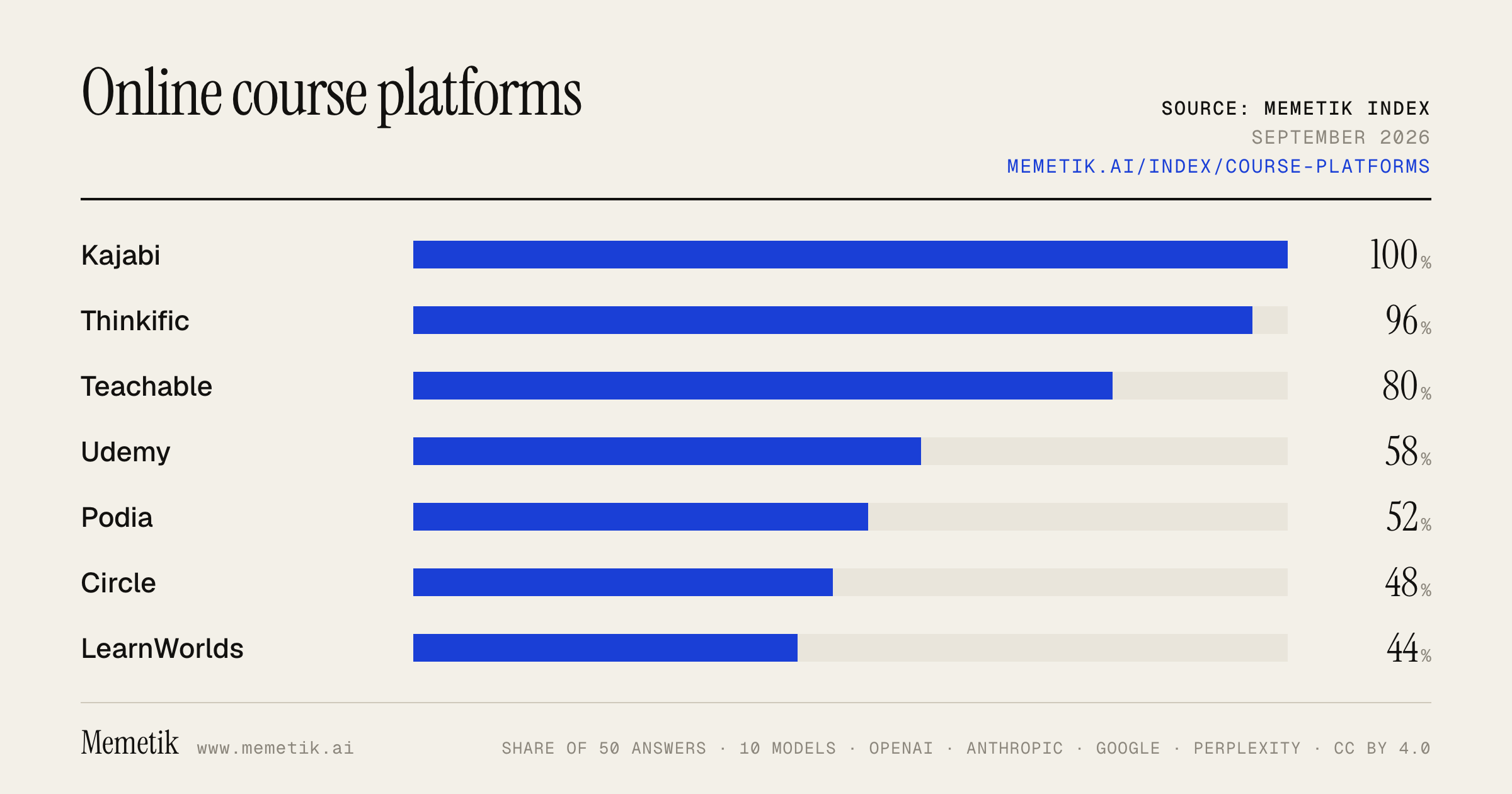
By provider
10 models · 50 answers
OpenAI 3 models · 15 answers
- GPT-5.6 Solgpt-5.6-solmost named: Kajabi 100%
- GPT-5.6 Terragpt-5.6-terramost named: Kajabi 100%
- GPT-5.6 Lunagpt-5.6-lunamost named: Kajabi 100%
Anthropic 3 models · 15 answers
- Claude Opus 5claude-opus-5most named: Kajabi 100%
- Claude Sonnet 5claude-sonnet-5most named: Kajabi 100%
- Claude Fable 5claude-fable-5most named: Kajabi 100%
Google 2 models · 10 answers
- Gemini 3.6 Flashgemini-3.6-flashmost named: Kajabi 100%
- Gemini 3.5 Flashgemini-3.5-flashmost named: Kajabi 100%
Perplexity 2 models · 10 answers
- Sonar Prosonar-promost named: Kajabi 100%
- Sonar Reasoning Prosonar-reasoning-promost named: Kajabi 100%
Sources the models cited
- youtube.com186
- storyflow.so65
- mihaelcacic.com44
- zapier.com43
- samcart.com29
- emailvendorselection.com27
- edubracket.com24
- circle.so21
- digistore24.com21
- guideflow.com20
- learnybox.com20
- teachable.com19
ChatGPT via API returns no citations, so it does not contribute here.
The prompts
- What is the best platform to sell an online course for a creator? Name specific products.
- Which platform to sell an online course would you recommend to a creator in 2026?
- Compare the top platform to sell an online course options right now.
- I'm a creator and I need a platform to sell an online course. What should I use and why?
- Best platform to sell an online course for selling a cohort-based course?
Every answer
Raw model output, unedited
GPT-5.6 TerraWhat is the best platform to sell an online course for a creator? Name specific products.
## Best overall for most creators: **Teachable**

Choose **Teachable** if you want to launch a polished, standalone course business without assembling a stack of tools. It combines course hosting, checkout, coupons, upsells, affiliate tools, mobile student apps, and handling for global payments/taxes. Its entry plan is relatively accessible, although it carries a **7.5% transaction fee**; higher plans remove that fee. ([teachable.com](https://www.teachable.com/pricing?utm_source=openai))

### Pick the platform based on your model

| If you are… | Best product | Why |
|---|---|---|
| Launching your first paid self-paced course | **Teachable** | Most balanced course + selling experience; strong checkout and marketing basics. ([teachable.com](https://www.teachable.com/pricing?utm_source=openai)) |
| Selling a high-ticket course, coaching, community, and email funnel together | **Kajabi** | Best all-in-one “creator business” system; no revenue sharing, but materially more expensive—its Basic plan is listed at **$143/month on annual billing**. ([kajabi.com](https://www.kajabi.com/pricing?utm_source=openai)) |
| Building a serious education brand with assessments, assignments, certificates, or live cohorts | **Thinkific** | Stronger learning-product focus. Its Start tier includes live cohorts/coaching, certificates, assignments, payment plans, subscriptions, bundles, and upsells. ([thinkific.com](https://www.thinkific.com/pricing/?country=US&countrySetBy=geo&experiment=KiOHJhjkLqKoLpYuxEew.1&gspk=anVzdGlub2JyaWVuNTU1Ng&gsxid=xK9lXQCxbXqS99&ip=52.167.144.216&ps_partner_key=anVzdGlub2JyaWVuNTU1Ng&ps_xid=xK9lXQCxbXqS99&pscd=try.thinkific.com&utm_source=openai)) |
| Wanting the simplest, lower-friction site for a course plus downloads, coaching, email, and community | **Podia** | Especially good for a solo creator who values simplicity over advanced learning design. Its annual-billed Mover plan is **$42/month with a 5% fee**; Shaker is **$84/month with no Podia transaction fee**. ([podia.com](https://www.podia.com/pricing?utm_source=openai)) |

## My practical recommendation

- **Start with Teachable** if the course itself is your main product and you want to validate demand quickly.
- **Start with Podia** if you also sell templates, downloads, coaching, or memberships and want a simpler all-in-one storefront.
- **Use Thinkific** if learner outcomes and a more formal educational experience matter—e.g., certification, instructor-led cohorts, assignments, or corporate training.
- **Use Kajabi** only if you already have an audience or a proven offer and want to consolidate your website, email, funnels, community, and course business in one premium system.

One important cost rule: avoid choosing only by monthly subscription. For an early-stage creator, a lower monthly plan with a transaction fee can be cheaper until revenue grows; once sales are consistent, moving to a zero-platform-fee tier often makes more sense.
- https://www.teachable.com/pricing?utm_source=openai
- https://www.kajabi.com/pricing?utm_source=openai
- https://www.thinkific.com/pricing/?country=US&countrySetBy=geo&experiment=KiOHJhjkLqKoLpYuxEew.1&gspk=anVzdGlub2JyaWVuNTU1Ng&gsxid=xK9lXQCxbXqS99&ip=52.167.144.216&ps_partner_key=anVzdGlub2JyaWVuNTU1Ng&ps_xid=xK9lXQCxbXqS99&pscd=try.thinkific.com&utm_source=openai
- https://www.podia.com/pricing?utm_source=openai
GPT-5.6 TerraWhich platform to sell an online course would you recommend to a creator in 2026?
## Recommendation: **Thinkific** for most independent course creators

In 2026, I’d choose **Thinkific** if your priority is building a polished, standalone learning business—not merely uploading videos behind a paywall.

Its **Basic** plan is **$54/month month-to-month** or **$40/month when billed annually** and includes unlimited courses, video lessons, quizzes, a community, checkout, coupons, abandoned-cart emails, dashboards, and a custom domain. Thinkific says it does **not take a commission on course sales**; payment-processing costs still apply, and extra platform fees can apply if you use certain third-party gateways rather than its native payments product. ([thinkific.com](https://www.thinkific.com/pricing/?country=US&countrySetBy=geo&experiment=KiOHJhjkLqKoLpYuxEew.1&gspk=anVzdGlub2JyaWVuNTU1Ng&gsxid=xK9lXQCxbXqS99&ip=52.167.144.216&ps_partner_key=anVzdGlub2JyaWVuNTU1Ng&ps_xid=xK9lXQCxbXqS99&pscd=try.thinkific.com&utm_source=openai))

Choose **Thinkific Start**—currently **$109/month monthly or $82/month annually**—if you need the features that often matter for a premium course: live cohorts/coaching, certificates, graded assignments, payment plans, upsells, memberships, and deeper site customization. ([thinkific.com](https://www.thinkific.com/pricing/?country=US&countrySetBy=geo&experiment=KiOHJhjkLqKoLpYuxEew.1&gspk=anVzdGlub2JyaWVuNTU1Ng&gsxid=xK9lXQCxbXqS99&ip=52.167.144.216&ps_partner_key=anVzdGlub2JyaWVuNTU1Ng&ps_xid=xK9lXQCxbXqS99&pscd=try.thinkific.com&utm_source=openai))

### Pick something else if…

- **You want the lowest upfront software cost and managed tax/payment operations:** **Teachable** is compelling. Its annual-billed plans begin at **$29/month**, but the Starter tier has a **7.5% transaction fee** under Teachable Payments; Builder and above have 0% platform transaction fees. Teachable Payments can handle payouts, tax, fraud protection, and subscriptions in supported markets. ([support.teachable.com](https://support.teachable.com/en/articles/11682410-new-teachable-plans-in-june-2025?utm_source=openai))
  **My take:** good for a first launch, but move past Starter quickly if sales gain traction.

- **You already have an audience and want email marketing, funnels, landing pages, community, and courses in one system:** **Kajabi** is the premium all-in-one option. It begins at **$179/month monthly** or **$143/month annually**, so I would only choose it if it replaces tools you already pay for—not just to host one course. ([kajabi.com](https://www.kajabi.com/pricing?utm_source=openai))

- **You have no audience and need discovery more than brand control:** consider a marketplace such as **Udemy** as an *additional* distribution channel, not your primary business home. Marketplace economics can be materially weaker: Kajabi’s comparison notes Udemy instructors retain 37% of certain organic sales and 15% of subscription revenue as of January 2026. ([kajabi.com](https://www.kajabi.com/blog/how-to-create-and-sell-online-course-2026?utm_source=openai))

### Practical decision

| Your situation | Best pick |
|---|---|
| Serious flagship course; want ownership and a professional learning experience | **Thinkific** |
| New creator, validating a small course on a tighter budget | **Teachable** |
| Course + newsletter + funnels + community all under one roof | **Kajabi** |
| Need marketplace discovery | **Udemy, alongside—not instead of—your own platform** |

**Bottom line:** Start with **Thinkific Basic** if you are selling a straightforward self-paced course; choose **Thinkific Start** if you plan to offer cohorts, certificates, coaching, or memberships. It offers the best balance of course-delivery quality, ownership, and economics for a creator building a durable brand.
- https://www.thinkific.com/pricing/?country=US&countrySetBy=geo&experiment=KiOHJhjkLqKoLpYuxEew.1&gspk=anVzdGlub2JyaWVuNTU1Ng&gsxid=xK9lXQCxbXqS99&ip=52.167.144.216&ps_partner_key=anVzdGlub2JyaWVuNTU1Ng&ps_xid=xK9lXQCxbXqS99&pscd=try.thinkific.com&utm_source=openai
- https://support.teachable.com/en/articles/11682410-new-teachable-plans-in-june-2025?utm_source=openai
- https://www.kajabi.com/pricing?utm_source=openai
- https://www.kajabi.com/blog/how-to-create-and-sell-online-course-2026?utm_source=openai
GPT-5.6 TerraCompare the top platform to sell an online course options right now.
## Bottom line

There is no single “best” course-selling platform—the right choice depends on whether your priority is **course experience, marketing, simplicity, community, or minimizing operational overhead**.

My practical shortlist:

| Platform | Best for | Main upside | Main trade-off |
|---|---|---|---|
| **Teachable** | Most solo creators selling straightforward courses | Strong checkout, built-in selling tools, managed payments/tax options | Starter tier has a meaningful transaction fee; less flexible than a full marketing stack |
| **Thinkific** | Professional education businesses and B2B training | Robust course delivery, customization, integrations | You may need separate tools for email marketing/community |
| **Kajabi** | Creators who want an all-in-one business platform | Courses + website + email marketing + funnels + memberships | Premium cost; can be overkill for one course |
| **Podia** | First-time creators who value ease and low complexity | Simple setup for courses, downloads, memberships, email | Less sophisticated learning and enterprise functionality |
| **LearnWorlds** | Premium, interactive learning experiences | Advanced assessments, interactive video, learning features | Steeper learning curve and more setup |
| **Mighty Networks** | Community-led courses and paid memberships | Excellent member/community experience | Not the strongest choice if a conventional course storefront is the main product |
| **Gumroad** | Testing a small course or selling simple digital products | Fastest path to launch | Weak branding, learning design, and customer experience versus dedicated LMS platforms |

## Best choice by situation

### 1. **Best overall for an independent course creator: Teachable**
Choose **Teachable** if you want to launch a polished paid course without stitching together payment, tax, checkout, affiliate, coupon, and student-management tools.

It supports one-time prices, subscriptions, payment plans, bundles, memberships, coupons, upsells, order bumps, affiliate marketing, abandoned-cart recovery, and managed tax handling through its native payments setup. Its current annual-billing plans begin at **$29/month** (Starter), then **$69** (Builder), **$139** (Growth), and **$309** (Advanced). The Starter plan has a **7.5% platform transaction fee**; Builder and above have 0% platform transaction fees when using Teachable Payments, though card-processing fees still apply. ([support.teachable.com](https://support.teachable.com/en/articles/11682410-new-teachable-plans-in-june-2025?utm_source=openai))

**Pick it if:** you are a solo expert, coach, or creator and want the best balance of course delivery and selling mechanics.

**Avoid it if:** you need deeply custom learning paths, corporate training administration, or an all-in-one email-and-funnel suite.

> **My recommendation:** Teachable Builder is often the sensible entry point once you expect any real sales volume—the Starter platform fee can become more expensive than the plan upgrade surprisingly quickly.

---

### 2. **Best for course quality and scalable education businesses: Thinkific**
Choose **Thinkific** when the **learning product itself** is your competitive advantage: structured programs, professional branding, cohorts, certificates, corporate clients, or a growing catalog.

It is generally the better fit than Teachable for businesses that need a more configurable learning environment and expect to integrate external marketing, CRM, analytics, or community tools.

**Pick it if:**
- You sell training to teams or organizations
- You need more control over student experience and site structure
- You expect a multi-course academy rather than a single creator product
- You already use another system for email and funnels

**Avoid it if:** you want all marketing automation included in one subscription.

---

### 3. **Best all-in-one option: Kajabi**
Choose **Kajabi** if you want one platform for your **website, landing pages, email marketing, automations, offers, memberships, and courses**.

Kajabi is usually the most attractive option for a creator with an audience who wants to run launches and nurture leads without connecting several products. It is especially good for consultants, coaches, and high-ticket personal brands.

**Pick it if:**
- You need automated email sequences and funnels
- You sell a course alongside coaching, a community, or a membership
- You prefer fewer integrations, even at a higher monthly cost
- Your course price is high enough that software cost is a secondary concern

**Avoid it if:** you are validating a first $99–$299 course. It can be too expensive before your offer is proven.

---

### 4. **Best simple, budget-conscious option: Podia**
Choose **Podia** if you want to get selling quickly and dislike complicated software.

It combines courses, digital downloads, memberships, basic email marketing, and a storefront in a friendlier, lighter-weight package than Kajabi.

**Pick it if:**
- This is your first course
- You sell downloadable templates, guides, or workshops too
- You need uncomplicated setup more than advanced course design
- You want a clean storefront without building a full tech stack

**Avoid it if:** your course needs advanced tests, compliance tracking, rich interactive content, or robust enterprise features.

---

### 5. **Best premium-learning experience: LearnWorlds**
Choose **LearnWorlds** if completion, engagement, and instructional design matter more than simply hosting video modules.

It is a strong option for educators, certification programs, professional-skills training, and brands selling premium programs where learners expect more than videos and PDFs.

**Pick it if:**
- You need interactive video, assessments, certificates, or detailed learner analytics
- You run credentialing or structured education programs
- Your course is high-ticket and the learner experience supports the price

**Avoid it if:** you want the simplest possible launch process.

---

### 6. **Best for a course built around community: Mighty Networks**
Choose **Mighty Networks** when the real product is not merely the curriculum—it is the **member network, discussion, accountability, events, and recurring participation**.

It is well suited to cohort programs, masterminds, fitness communities, creator memberships, and professional groups.

**Pick it if:** people joining and interacting with each other is central to the value proposition.

**Avoid it if:** you mainly need conventional sales pages, polished self-paced modules, and a traditional LMS workflow.

---

### 7. **Best for validating an idea quickly: Gumroad**
Choose **Gumroad** when you need to test demand with minimum setup—for example, a mini-course, recorded workshop, paid guide, or bundle.

**Pick it if:** you have an audience now and want a checkout link today.

**Avoid it if:** brand control, student experience, upsells, affiliates, or a long-term course business matter.

---

## How I would choose

- **You have one course and want to sell it professionally:** **Teachable**
- **You want courses plus email funnels and a full business website:** **Kajabi**
- **You want a serious academy or corporate/B2B training operation:** **Thinkific**
- **You want the simplest inexpensive launch:** **Podia
GPT-5.6 TerraI'm a creator and I need a platform to sell an online course. What should I use and why?
## My default recommendation: **Teachable**

For most solo creators launching a first paid course, I’d use **Teachable’s Builder plan**. It gives you a polished, branded course site without requiring you to stitch together video hosting, checkout, student access, quizzes, certificates, payment plans, and basic community features yourself. It also supports memberships, bundles, an iOS student app, drip content, assessments, completion tracking, and certificates. ([support.teachable.com](https://support.teachable.com/en/articles/11682410-new-teachable-plans-in-june-2025?utm_source=openai))

### Why it’s the best default
- **Simple enough to launch quickly.** Your focus should be validating the offer and selling it—not becoming an LMS administrator.
- **Built for direct sales under your own brand.** You control pricing, student access, and your customer list rather than relying on a marketplace’s rules.
- **Lower operational burden for U.S. creators.** Teachable Pay can calculate, collect, and remit applicable sales taxes, VAT, and GST, plus offers checkout methods such as cards, PayPal, Apple Pay, Google Pay, Klarna, and Afterpay. ([support.teachable.com](https://support.teachable.com/en/articles/11682550-comparing-teachable-gateways?utm_source=openai))
- **Sane economics once sales start.** Teachable Builder is listed at **$69/month when billed annually** and has **0% Teachable transaction fees**; its $29/month Starter tier charges 7.5% on sales. Standard payment-processing fees still apply on either plan. ([support.teachable.com](https://support.teachable.com/en/articles/11682553-teachable-fees?utm_source=openai))

**Practical rule:** if your course brings in more than roughly **$533/month**, the extra $40/month for Builder is generally cheaper than paying the Starter plan’s 7.5% platform fee.

## Use a different platform if this describes you

| Your situation | Better fit | Why |
|---|---|---|
| You want an **all-in-one marketing business**—email campaigns, landing pages, funnels, checkout, course, community—in one vendor | **Kajabi** | Kajabi positions itself as one unified system for courses, marketing, payments, and community. Choose it when reducing integrations matters more than minimizing monthly software cost. ([kajabi.com](https://www.kajabi.com/product/online-courses?utm_source=openai)) |
| You need a more dedicated learning-business platform and are willing to evaluate payment/tax fees carefully | **Thinkific** | It has its own payments and tax solution, but its current published U.S. Thinkific Payments rate is 3.9% + $0.30 per transaction, plus a 0.5% fee when its sales-tax/VAT solution assesses tax. Third-party gateway fees can also apply depending on plan. ([support.thinkific.com](https://support.thinkific.com/hc/en-us/articles/360030721393-How-much-does-Thinkific-cost?utm_source=openai)) |
| You have **no audience yet** and need discovery more than brand control | A course marketplace, as a secondary channel | A marketplace may help exposure, but it gives you less control over price, customer relationship, and brand. Don’t make it the core of your business if you expect to build a long-term creator brand. ([teachable.com](https://www.teachable.com/blog/course-hosting-platform?utm_source=openai)) |

## What I’d do in your position

1. Start on **Teachable Builder**.
2. Sell one clear flagship course with:
   - a one-time payment,
   - an optional payment plan,
   - a limited-time launch bonus,
   - a simple completion certificate if relevant.
3. Build your audience on an email list you own—not solely on social media.
4. Move to **Kajabi** only if you find yourself paying for or struggling to connect several separate tools for email, landing pages, automations, and community.

**Bottom line:** Choose **Teachable** if you want the fastest, lowest-complexity path to a professional paid course. Choose **Kajabi** if marketing automation is central to your business from day one and you value consolidation over lower cost.
- https://support.teachable.com/en/articles/11682410-new-teachable-plans-in-june-2025?utm_source=openai
- https://support.teachable.com/en/articles/11682550-comparing-teachable-gateways?utm_source=openai
- https://support.teachable.com/en/articles/11682553-teachable-fees?utm_source=openai
- https://www.kajabi.com/product/online-courses?utm_source=openai
- https://support.thinkific.com/hc/en-us/articles/360030721393-How-much-does-Thinkific-cost?utm_source=openai
- https://www.teachable.com/blog/course-hosting-platform?utm_source=openai
GPT-5.6 TerraBest platform to sell an online course for selling a cohort-based course?
## Best overall for a cohort-based course: **Maven**

If you’re selling a **live, premium, time-bound cohort course**, I’d start with **Maven**. It is purpose-built around the cohort model: live workshops, schedules, projects, peer interaction, recordings, and repeatable course runs. Its entry model is also friendly for validating a first cohort: the builder is free to start, and Maven takes **10% of course revenue** (plus Stripe processing) once you sell. ([maven.com](https://maven.com/maven/course-accelerator?utm_source=openai))

**Choose Maven if:**
- Your program is high-touch and live (e.g., 4–8 weeks).
- You’re charging a premium price, usually hundreds to several thousand dollars.
- You want to launch quickly without assembling lots of tools.
- Your credibility or content is oriented toward professionals, operators, creators, or career development.

**Watch-out:** A 10% platform share can become expensive at scale, and Maven’s brand/platform may be less ideal if you need complete control of the customer journey.

## Best alternative if community is the product: **Circle**

Choose **Circle** if the ongoing peer community, discussion, networking, office hours, or alumni membership is as valuable as the curriculum itself. It combines course spaces, live events/streams, chat, discussions, memberships, payments, email, and automations. It explicitly supports cohort experiences with shared deadlines and live sessions. ([circle.so](https://circle.so/platform/course-creators?utm_source=openai))

**Best for:** coaching programs, creator education, mastermind-style cohorts, and courses where you want to convert graduates into a recurring paid community.

## Best if marketing and funnels are your bottleneck: **Kajabi**

Choose **Kajabi** if you already have—or want—an all-in-one marketing machine: landing pages, checkout, email campaigns, automation, payments, and course delivery. Kajabi now supports actual scheduled **Cohort Courses**, including synchronized progression and live video sessions, although that capability is limited to its **Growth and Pro** plans. ([help.kajabi.com](https://help.kajabi.com/articles/products/courses/how-to-create-a-cohort-based-course?utm_source=openai))

**Best for:** an established audience, paid ads, polished launches, upsells, and a course business that will include evergreen products too.

## Best for a conventional learning-business setup: **Thinkific**

Choose **Thinkific** if you need a more traditional LMS approach—student administration, branded learning experience, cohorts/groups, reporting, and communities. Its Groups feature can organize learners by cohort, and its community can be gated by course, bundle, or group. ([support.thinkific.com](https://support.thinkific.com/hc/en-us/articles/360030350854-Groups?utm_source=openai))

**Best for:** training companies, certifications, B2B/client training, and more structured education operations.

### My practical recommendation

- **First live cohort / premium expert-led course:** **Maven**
- **Community-led cohort + recurring membership:** **Circle**
- **You need landing pages, email funnels, and upsells built in:** **Kajabi**
- **Formal training, B2B, or certification use case:** **Thinkific**

If you have not yet validated demand, don’t overbuild. Run your first cohort on **Maven** (or Circle if community is central), sell it manually through a simple landing page and calls, then migrate only after you know your offer, pricing, and delivery format work.
- https://maven.com/maven/course-accelerator?utm_source=openai
- https://circle.so/platform/course-creators?utm_source=openai
- https://help.kajabi.com/articles/products/courses/how-to-create-a-cohort-based-course?utm_source=openai
- https://support.thinkific.com/hc/en-us/articles/360030350854-Groups?utm_source=openai
Claude Sonnet 5What is the best platform to sell an online course for a creator? Name specific products.
There's no single "best" platform — it depends on your priorities (branding control, ease of use, existing audience, or all-in-one marketing). Here are the top specific products creators actually use, based on current comparisons:

**1. Kajabi** – The go-to all-in-one option for creators who want everything (courses, website, email marketing, funnels, payments) under one login.
Kajabi handles courses, websites, landing pages, email marketing, automations, funnels, and payments, making it ideal if you want your entire business in one system.
 The tradeoff is cost —
it raised prices significantly in January 2026, with Basic up 20% and Growth up 25% after a decade of stable pricing.


**2. Teachable** – Best for beginners who want something simple and clean.
It's one of the simplest, most beginner-friendly places to sell online courses, focusing on ease of use and clean course delivery — you can set up your first course quickly even without design experience, and it handles hosting, payments, and basic customization.
 Its free tier does charge
a 10% transaction fee, with paid plans beginning at $39/month
.

**3. Thinkific** – A strong middle-ground choice for creators who want more control over content and pricing without heavy technical work.
It's a dedicated platform for selling online courses that handles everything from course hosting to payment processing, with a free plan supporting up to three courses and paid plans starting at $36/month.


**4. Podia** – Good if you want to bundle multiple product types beyond courses.
Podia combines digital downloads, online courses, coaching, and memberships
 in one place, with transaction fees around
5-8% depending on plan
.

**5. Udemy** – Best if you want instant access to an existing audience rather than building your own.
Marketplace platforms give you immediate access to a large audience, but you have less control over pricing and branding
 — this is the tradeoff with Udemy specifically.

**6. Gumroad** – The simplest option for lightweight, one-off digital products/courses rather than a full learning platform.
Gumroad is ideal for creators selling simple digital products
, though it carries a higher transaction fee (around 10%) than dedicated course platforms.

**7. LearnWorlds** – Worth considering if interactivity matters most.
It's a course-selling platform built for creators who want interactive, high-engagement learning experiences alongside robust ecommerce tools.


### Quick recommendation by use case:
- **Want an all-in-one business (marketing + sales + courses)?** → Kajabi
- **First course, want simplicity?** → Teachable
- **Want balance of control + affordability?** → Thinkific
- **Selling courses + other digital products/coaching?** → Podia
- **No existing audience, want built-in traffic?** → Udemy
- **Just want a simple checkout page for a downloadable course?** → Gumroad

If you tell me your specific situation (audience size, budget, whether you want full branding control vs. built-in traffic), I can narrow this down further.
- https://www.schoolmaker.com/blog/where-to-sell-online-courses
- https://www.learningrevolution.net/best-online-course-platforms/
- https://savingsgrove.com/blogs/guides/sell-online-courses-platforms
- https://vezill.com/blogs/best-platforms-to-sell-online-courses
- https://zanfia.com/blog/best-platform-for-selling-online-courses/
Claude Sonnet 5Which platform to sell an online course would you recommend to a creator in 2026?
There's no single "best" platform — it really depends on your business model, budget, and how hands-on you want to be. Here's how I'd break it down for 2026:

## If you want an all-in-one business hub
**Kajabi** is still a top pick for creators who want courses, email marketing, funnels, landing pages, and payments all in one system.
Kajabi remains one of the most popular all-in-one course platforms in 2026, powerful and polished, well-suited to creators who want full control over branding and marketing, handling courses, websites, landing pages, email marketing, automations, funnels, and payments.
 One comparison test found
Kajabi delivered the highest revenue per student in their test, with built-in email marketing, funnels, and zero transaction fees
 — though it's pricier (around $249/mo for the plan tested).

## If you want simplicity and are just starting out
**Teachable** remains a solid beginner-friendly choice.
It's one of the simplest, most beginner-friendly places to sell online courses, focused on ease of use and clean course delivery — you can set up your first course quickly even without design experience, and the platform handles hosting, payments, and basic customization.
 It also
still has the largest creator base (150,000+ creators), with a solid course builder and a checkout experience that converts well.
 The catch:
the 5% transaction fee on its Basic plan makes it more expensive than Thinkific's $49/mo with 0% fee once you're selling over roughly $2,200/month.


## If you want a dedicated course-hosting tool with no transaction fees
**Thinkific** is a strong middle ground.
It's a dedicated platform for selling online courses, letting creators build, market, and deliver courses without technical expertise, handling everything from hosting to payment processing — with a free plan supporting up to three courses and paid plans starting at $36/month.


## If you want community + course hybrid
Platforms combining learning with community are trending.
These platforms combine learning with community and support, hugely popular in 2026 because students want connection and guidance, not just videos.
 Skool and Mighty Networks fall into this category if cohort-based or membership-style engagement matters to you.

## If you want dead-simple, low-friction selling
**Gumroad** is worth considering if you don't want to build funnels or a full storefront.
There's no storefront or funnel setup required — you just upload your product, share a link, and start selling courses, memberships, or downloads with almost no friction, while Gumroad handles checkout, delivery, and payments.
 It's also
a Merchant of Record, handling taxes, compliance, and billing — a big advantage if you're selling globally.


## My recommendation
- **Solo creator, first course, tight budget** → Thinkific or Teachable
- **Building a full digital business (courses + email + funnels)** → Kajabi
- **Want community-driven engagement** → Skool or Mighty Networks
- **Want zero setup, just sell a PDF/video course fast** → Gumroad

One important caveat:
platform choice alone swung net revenue by 38% on identical content with identical traffic
 in one comparison test — so the platform genuinely matters, not just as a hosting tool but for its built-in marketing and conversion features. I'd suggest starting with a platform that offers a free trial (most do), test your actual audience's buying behavior, and switch only if you hit a real limitation (like transaction fees eating into revenue at scale).
Claude Sonnet 5Compare the top platform to sell an online course options right now.
Here's a comparison of the top platforms for selling online courses right now, based on current reviews and testing data:

## Quick Overview

**Kajabi** — Best all-in-one for serious creators

Kajabi at $249/mo delivered the highest revenue per student in one recent test, with built-in email marketing, funnels, and zero transaction fees.
 It's positioned as
the premium choice that eliminates the need for 4-5 separate tools.
 Beyond courses,
Kajabi is an all-in-one platform where you can create and sell digital products such as courses, coaching, podcasts, memberships, communities, newsletters, and digital downloads, plus it includes a website builder, course delivery system, and email marketing.


**Thinkific** — Best value for course-first businesses

Thinkific at $49/mo offers zero transaction fees on all paid plans, the strongest course completion tools, and the best free tier for testing.

It's a dedicated platform letting creators build, market, and deliver courses without technical expertise, handling everything from hosting to payment processing.

The free plan supports up to three courses, while paid plans start at $36/month.


**Teachable** — Popular and easy to use, but fees add up

Teachable is one of the top platforms to create and sell online courses, with ease of use and features that many creators find very satisfactory.
 However,
Teachable charges 5% transaction fees on their Basic plan — for creators doing $10,000/month in sales, that's $500/month lost to fees.
 One in-depth comparison found
the 5% fee on Basic ($59/mo) makes it more expensive than Thinkific ($49/mo, 0% fee) for any course selling over ~$2,200/mo, while Teachable's Pro plan at $259/mo eliminates the fee but costs the same as Kajabi's Basic, which includes email, funnels, and community that Teachable lacks.


**Podia** — Best budget option

Podia's Mover plan starts at $23/mo
, making it a strong low-cost entry point for creators just getting started.

**Skool** — Best for community-led learning

Skool costs $99/mo flat, with a dead-simple interface, built-in gamification, and a 40% affiliate program.

If your business model is community + courses, nothing else comes close.


**Udemy** — Best for built-in audience (marketplace model)

Udemy is one of the biggest online learning marketplaces, with over 185,000+ courses, often regarded by instructors as the first and best platform for selling courses online.

Because Udemy already has over 49+ million learners, finding students is relatively easy compared to hosting your own course separately.
 The tradeoff:
marketplaces and course-creation platforms each have individual perks — course creation platforms have much more freedom for marketing, branding, and special features, while marketplaces give less control.


## Key Takeaway

One detailed 2026 test that built and sold an identical course across six platforms found that
platform choice alone swung net revenue by 38% on identical content with identical traffic
 — so the "best" platform really depends on your priorities:

- **Want everything bundled (email, funnels, community)?** → Kajabi
- **Want lowest fees with strong course tools?** → Thinkific
- **Want a built-in audience with no upfront cost?** → Udemy
- **Want the cheapest entry point?** → Podia
- **Building a community-first offer?** → Skool

If you tell me your budget, whether you already have an audience, and whether you want extras like community/email marketing built in, I can help narrow this down to the single best fit for you.
- https://edubracket.com/articles/best-course-platforms-to-sell-online
- https://devopscube.com/platforms-sell-online-courses/
- https://savingsgrove.com/blogs/guides/sell-online-courses-platforms
- https://zanfia.com/blog/best-platform-for-selling-online-courses/
- https://acowebs.com/platforms-selling-online-courses/
Claude Sonnet 5I'm a creator and I need a platform to sell an online course. What should I use and why?
# Choosing a Platform to Sell Your Online Course

The best choice depends on your priorities—ease of use, cost, marketing features, and how much control you want. Here's a breakdown of the top options:

## 1. **Teachable**
Great for beginners. Simple drag-and-drop course builder, handles hosting, payments, and basic marketing (coupons, affiliates) with minimal setup. Good if you want to launch quickly without technical fuss.

## 2. **Thinkific**
Similar to Teachable but with a more generous free plan and more customization options for course design. Good middle ground between ease-of-use and flexibility.

## 3. **Kajabi**
An all-in-one platform that bundles course hosting, email marketing, landing pages, and sales funnels. More expensive, but ideal if you want everything (marketing, website, courses) in one place without stitching together multiple tools.

## 4. **Podia**
Known for simplicity and low pricing, supports courses, downloads, memberships, and email marketing without transaction fees on paid plans. Good for creators who also want to sell other digital products alongside courses.

## 5. **Udemy**
A marketplace rather than a standalone platform—you upload your course and Udemy brings the audience, but you have less control over pricing and Udemy takes a significant revenue cut, especially on courses sold through their promotions/marketplace traffic.

## 6. **Self-hosted (WordPress + LMS plugin like LearnDash, or Gumroad for simpler delivery)**
Best if you want full control over branding, data, and pricing, and don't mind more setup work (or already have a WordPress site). Gumroad is especially simple if your "course" is more like a downloadable product/video bundle without complex progress tracking.

## How to Decide
- **Want the easiest launch with built-in payments?** → Teachable or Thinkific
- **Want an all-in-one marketing + course engine?** → Kajabi
- **Want low fees and multi-product flexibility?** → Podia
- **Want a built-in audience (but less control/lower margins)?** → Udemy
- **Want full ownership and customization?** → WordPress/LearnDash or Gumroad

If you can tell me more about your course topic, budget, technical comfort level, and whether you already have an audience, I can help narrow this down to the single best fit for your situation.
Claude Sonnet 5Best platform to sell an online course for selling a cohort-based course?
Based on current comparisons, there isn't a single "universal best" — it depends on your priorities. Here's a breakdown of the top options for selling cohort-based courses:

## Top Picks by Use Case

**Maven** — The go-to for premium, high-ticket cohort courses (think expert-led, $500–$3,000 programs).
Maven serves as a premium alternative for high-ticket, cohort-based learning, offering free setup in exchange for a 10% commission on your sales.
 Great if you want built-in discovery/marketplace exposure and don't mind a revenue cut.

**Ruzuku** — Built specifically with cohort workflows in mind for independent creators/coaches. It's a smaller, more specialized platform focused on things like scheduled cohorts and live session structure rather than being an all-in-one marketing suite.

**Kajabi** — Best if you want an all-in-one business hub, not just a course host.
Courses, community, and checkout live together, so you are not stitching five tools into a cohort program. Built-in marketing engine: email, landing pages, funnels, and automations mean you can recruit and nurture cohorts without a separate marketing platform.
 One creator noted:
"I moved over to Kajabi and had all that stuff under one roof, which was a blessing for my business."


**Mighty Networks** — Best if community/peer interaction is central to your course experience.
Mighty Networks flips the traditional course model on its head by putting community at the absolute center of the learning experience, building the course inside the community — powerful for creators who want to run cohort-based courses or facilitate masterminds where peer-to-peer interaction matters as much as content.


**Disco** — Geared toward fast-turnaround, AI-assisted cohort program creation, often used by organizations.
Disco is an AI-native social learning platform designed to turn organizational expertise into cohort-based programs in hours rather than weeks.


## How to Choose

- **Want a marketplace/discovery boost + don't mind a commission?** → Maven
- **Want dedicated cohort tooling without a bloated all-in-one suite?** → Ruzuku
- **Want courses + marketing + payments + community all in one subscription?** → Kajabi
- **Want the course to feel like a living community rather than a static curriculum?** → Mighty Networks
- **Selling internally/for a company or want speed via AI tools?** → Disco

For most independent creators launching their first paid cohort course, **Maven or Kajabi** tend to be the most recommended starting points — Maven if you want marketplace demand-generation help, Kajabi if you want full control over your own funnel and brand.
Gemini 3.6 FlashWhat is the best platform to sell an online course for a creator? Name specific products.
There is no single "best" platform to sell an online course, as the right choice depends on your existing audience, budget, and business model. However, creator-focused course platforms generally fall into four primary categories:

---

### 1. All-in-One Business Platforms
*Best if you want to run your entire creator business (courses, email marketing, sales funnels, and landing pages) under one roof.*

* **Kajabi**: Widely considered the gold standard for established creators and online entrepreneurs. It features built-in email marketing, customizable sales funnels (pipelines), podcasts, memberships, and automated checkouts.
  * *Best for:* Mid-to-advanced creators looking to scale high-ticket courses and subscriptions.
  * *Drawback:* Expensive monthly pricing compared to competitors.
* **Systeme.io**: A powerful, budget-friendly alternative to Kajabi. It offers a robust free tier with sales funnels, email automation, blogging, and course hosting.
  * *Best for:* Beginners and creators on a budget who still want an all-in-one setup.

---

### 2. Dedicated Standalone Course Platforms
*Best if you already have a website or marketing system and just want a dedicated platform to build, host, and deliver a high-quality learning experience.*

* **Teachable**: Extremely beginner-friendly with a sleek user interface for students, simple page builders, and integrated payment gateways with automated tax handling.
  * *Best for:* Solo creators looking for a hassle-free, traditional online school setup.
* **Thinkific**: Known for its flexibility, strong custom page-building tools, and site customization. Unlike many competitors, it doesn't take transaction fees on its basic plans.
  * *Best for:* Creators who want complete control over branding and content structure.
* **LearnWorlds**: Highly focused on interactive learning. Offers features like interactive video editing, built-in transcript generators, e-books, and SCORM support.
  * *Best for:* Creators selling advanced, interactive, or certified educational courses.

---

### 3. Community-Driven Platforms
*Best if your course relies heavily on discussion, live cohort calls, and active student engagement rather than just pre-recorded video modules.*

* **Skool**: Created specifically around gamified learning and community interaction. It combines community posts, classroom modules, calendars, and leaderboards into one simple interface.
  * *Best for:* Cohort-based courses, paid masterminds, and creator communities.
* **Circle**: A modern community platform that seamlessly integrates online courses with discussion spaces, live streams, and events.
  * *Best for:* Creators who want a polished, brandable, private alternative to Facebook groups paired with video courses.
* **Mighty Networks**: Combines courses, community, and event features into an customizable ecosystem, offering optional custom mobile apps.
  * *Best for:* Community-first creators and membership businesses.

---

### 4. Course Marketplaces
*Best if you have zero audience, no email list, and no existing traffic.*

* **Udemy**: The largest online learning marketplace. Hosting is free, and Udemy automatically promotes your course to millions of global users.
  * *Best for:* Beginners looking to validate a course idea without upfront costs.
  * *Drawback:* Udemy heavily discounts courses (often to $10–$20), takes a significant revenue share for traffic they generate, and does not let you capture student email addresses.
* **Skillshare**: Focuses on bite-sized creative skills (design, video editing, writing). Instructors are paid based on royalty share and minutes watched rather than flat course fees.
  * *Best for:* Creative professionals and short, project-based video content.

---

### 5. Creator Micro-Storefronts
*Best for short video courses, mini-training programs, or quick digital downloads.*

* **Stan Store**: A "link-in-bio" store built specifically for social media creators (TikTok, Instagram). Allows mobile users to purchase and view mini-courses in just a few taps.
* **Podia**: Simple, lightweight platform designed for selling digital downloads, webinars, subscriptions, and basic courses.

---

### Summary Recommendation: Which should you choose?

1. **If you have an established audience and want a complete business machine:** Go with **Kajabi**.
2. **If you want a dedicated, professional course experience for students:** Go with **Thinkific** or **Teachable**.
3. **If your course thrives on community interaction and live calls:** Go with **Skool** or **Circle**.
4. **If you are starting on a tight budget:** Go with **Systeme.io**.
5. **If you have no audience and need help with discovery:** Start with **Udemy**.
Gemini 3.6 FlashWhich platform to sell an online course would you recommend to a creator in 2026?
The best platform for selling an online course depends heavily on your **business model, budget, and tech stack**. However, distinct leaders emerge across the top creator archetypes:

---

### 1. The All-in-One Powerhouse (Best Overall for Serious Businesses)
* **Top Recommendation:** **Kajabi**
* **Best For:** Creators who want their website, email marketing, sales funnels, memberships, and course hosting in a single ecosystem.
* **Why Choose It:** It completely removes the need for third-party tools like ConvertKit/Kit or ClickFunnels. It boasts robust analytics, native checkout flows, and strong built-in automation.
* **Downside:** Expensive ($149+/month).
* **Alternative:** **Systeme.io** (Best value/budget option—offers a generous free tier with emails, funnels, and courses included).

---

### 2. Dedicated Course Builders (Best for Pure Educators)
* **Top Recommendation:** **Thinkific** or **Teachable**
* **Best For:** Instructors who already have a website (e.g., WordPress, Webflow, Squarespace) and just need a reliable, customizable Learning Management System (LMS).
* **Why Choose It:**
  * **Thinkific:** Highly customizable, excellent student-engagement features (quizzes, surveys, completion tracking), and no transaction fees on paid plans.
  * **Teachable:** Extremely beginner-friendly interface, built-in tax handling (VAT/sales tax), and solid affiliate management options.
* **Downside:** Basic email marketing capabilities compared to all-in-one software (you will likely need an external email provider like ConvertKit or ActiveCampaign).

---

### 3. Community-First Platforms (Best for Memberships & Cohorts)
* **Top Recommendation:** **Circle** or **Skool**
* **Best For:** Creators building interactive, community-driven courses, mastermind groups, or recurring subscription memberships.
* **Why Choose It:** Traditional courses often suffer from low completion rates. Platforms like Circle and Skool combine community feeds, live events, channels, and course modules into one fluid experience.
* **Downside:** Limited standard e-commerce features and basic sales page builders.

---

### 4. Interactive & Enterprise Learning (Best for High-End Courses)
* **Top Recommendation:** **LearnWorlds**
* **Best For:** Creators offering certification programs, B2B training, or high-touch interactive video content.
* **Why Choose It:** Outstanding interactive video editor (add quizzes/transcripts directly into videos), advanced assessment engines, robust mobile app branding, and SCORM compliance.

---

### 5. Sales & Checkout Specialists (Best for Single High-Ticket Products)
* **Top Recommendation:** **SamCart** or **ThriveCart**
* **Best For:** Marketers focusing heavily on high-converting checkout pages, order bumps, single-click upsells, and digital downloads.
* **Why Choose It:** Both offer lightweight course-hosting features built directly into powerful conversion-focused checkout software. ThriveCart offers a one-time lifetime payment model, saving on long-term SaaS fees.

---

### Summary Recommendation Matrix

| Goal | Best Choice |
| :--- | :--- |
| **Want an all-in-one business engine** | **Kajabi** |
| **Best feature-rich platform on a budget** | **Systeme.io** |
| **Simple, standalone course hosting** | **Thinkific** |
| **Focusing on cohort learning & community** | **Circle** or **Skool** |
| **One-time payment for software hosting** | **ThriveCart** |
Gemini 3.6 FlashCompare the top platform to sell an online course options right now.
Choosing the right platform to sell online courses comes down to your business model, budget, tech comfort, and marketing strategy. platforms fall into five distinct categories:

---

### 1. All-in-One Powerhouses
*Best for scaling a complete business with built-in sales funnels, email marketing, and websites.*

* **Kajabi**
  * **Strengths:** Industry gold standard for all-in-one business management. Powerful sales funnels (pipelines), advanced email automation, landing page builders, podcast hosting, and memberships. Zero transaction fees.
  * **Weaknesses:** Most expensive starting price (~$149+/mo). Can be overkill for creators who just want to host simple video lessons.
  * **Best For:** Established creators, coaches, and businesses monetizing high-ticket courses or memberships.

* **Systeme.io**
  * **Strengths:** Incredible value for budget-conscious creators. Includes email marketing, sales funnels, and course hosting for free (or low-cost upgrades).
  * **Weaknesses:** Basic UI, limited design customization, fewer high-end integrations compared to Kajabi.
  * **Best For:** Beginners building their first sales funnel without upfront software costs.

---

### 2. Dedicated Course Builders
*Best for focusing heavily on student learning experience, certificates, and structured curriculum.*

* **Thinkific**
  * **Strengths:** Strong focus on site customizability and instructional design. Offers live lessons, quizzes, certificates, and drips. Zero transaction fees on paid plans.
  * **Weaknesses:** Email marketing capabilities are limited; requires integration with tools like ConvertKit/Kit or ActiveCampaign for complex sales sequences.
  * **Best For:** Educators and companies wanting a branded online school.

* **Teachable**
  * **Strengths:** User-friendly interface, built-in tax handling (EU VAT and US sales tax via Teachable Pay), and reliable mobile app support.
  * **Weaknesses:** Has introduced higher fee structures and transaction fees on basic tiers. Limited landing page flexibility compared to dedicated page builders.
  * **Best For:** Solopreneurs who want a turn-key platform and don’t want to deal with global sales tax compliance.

* **LearnWorlds**
  * **Strengths:** Interactive video tools (in-video quizzes, pop-ups), robust mobile app creator, advanced SCORM support, and corporate training capabilities.
  * **Weaknesses:** Steeper learning curve due to heavy feature density.
  * **Best For:** Interactive, high-engagement courses and B2B/corporate training.

---

### 3. Community-First Platforms
*Best for cohort-based courses, masterminds, and social learning spaces where student interaction drives value.*

* **Skool**
  * **Strengths:** Extremely simple, gamified user interface combining courses, community feeds, and a shared calendar. High student engagement via point systems and leaderboards.
  * **Weaknesses:** Basic video hosting capabilities, simple layout with minimal custom branding.
  * **Best For:** Creators building active paid communities, memberships, or live cohort classes.

* **Circle.so**
  * **Strengths:** Modern UI, customizable spaces, integrated course hosting, live streaming, and rich event management.
  * **Weaknesses:** Higher price point for advanced course features; requires setup time to structure spaces.
  * **Best For:** Premium membership brands looking for a polished experience.

---

### 4. Marketplaces
*Best for zero upfront setup, leveraging an existing audience pool.*

* **Udemy**
  * **Strengths:** Millions of active users; no hosting costs or platform subscription fees. Excellent for gaining initial market traction.
  * **Weaknesses:** You do not own student data (can't export email addresses). Heavy reliance on Udemy platform discounts, resulting in lower revenue per course sale.
  * **Best For:** Beginners looking to test content demand without marketing experience.

---

### 5. Self-Hosted & Custom Options
*Best for full technical control and existing site owners.*

* **WordPress + LearnDash / BuddyBoss**
  * **Strengths:** Complete ownership over data, branding, and pricing. One-time or annual software fees rather than monthly SaaS costs.
  * **Weaknesses:** Requires manual setup, hosting maintenance, plugin updates, and integration management.
  * **Best For:** Tech-savvy users or businesses with existing WordPress sites.

---

### Platform Comparison Matrix

| Platform | Best Category | Free Plan available? | Built-in Email Marketing? | Transaction Fees? |
| :--- | :--- | :--- | :--- | :--- |
| **Kajabi** | All-in-One Enterprise | Trial only | Yes (Advanced) | 0% |
| **Systeme.io** | Budget All-in-One | Yes | Yes (Basic–Mid) | 0% (on paid plans) |
| **Thinkific** | Dedicated LMS | Trial/Limited | Basic only | 0% (on paid plans) |
| **Teachable** | Easy Setup LMS | Trial only | Basic only | 0–10% (plan dependent) |
| **Skool** | Community & Cohorts | Trial only | Basic automated | Payment processor fees only |
| **Udemy** | Marketplace | Free to post | No | Up to 63%+ revenue split |

---

### Recommendation Framework

1. **If you want an all-in-one business hub:** Choose **Kajabi** (high budget) or **Systeme.io** (starter/tight budget).
2. **If you want high-quality student learning & certificates:** Choose **Thinkific** or **LearnWorlds**.
3. **If community and interaction drive your revenue:** Choose **Skool** or **Circle**.
4. **If you have no audience and zero marketing budget:** Start on **Udemy**.
Gemini 3.6 FlashI'm a creator and I need a platform to sell an online course. What should I use and why?
Choosing the right course platform depends heavily on **how you plan to sell**, **your technical skills**, and **whether you need marketing tools built-in**.

Platforms generally fall into three distinct categories:

---

### 1. Dedicated Course Platforms (Best for Course-First Creators)
These platforms focus purely on video hosting, curriculum structuring, quizzes, and student experience.

*   **Thinkific**
    *   **Best for:** Creators who want full control over their brand and a structured learning experience.
    *   **Why use it:** Great custom site builder, zero transaction fees on paid plans, and excellent quiz/certificate tools.
    *   **Drawback:** Marketing features are basic, so you’ll need an external email marketing tool (e.g., ConvertKit).
*   **Teachable**
    *   **Best for:** Beginners who want an easy, straightforward setup to get a course online fast.
    *   **Why use it:** Very user-friendly with a smooth checkout process and built-in tax handling (EU VAT, etc.).
    *   **Drawback:** High transaction fees on lower-tier plans.

---

### 2. All-in-One Platforms (Best for Scaling & Marketing)
These tools handle course delivery *and* act as your entire online business infrastructure—replacing your email provider, website builder, sales funnels, and CRM.

*   **Kajabi**
    *   **Best for:** Established creators, coaches, or businesses ready to invest in serious growth.
    *   **Why use it:** Incredible email marketing, sales page builders, pipeline automations, and native checkout. You won't need to string together 5 different software tools.
    *   **Drawback:** Expensive, starting around $149–$199/month.
*   **Systeme.io**
    *   **Best for:** Budget-conscious creators wanting an all-in-one setup.
    *   **Why use it:** Offers a generous free plan that includes course hosting, sales funnels, and email marketing.
    *   **Drawback:** Interface and course player feel less modern compared to premium competitors.

---

### 3. Community-First Platforms (Best for Cohorts & Memberships)
If your course relies on discussion, live interaction, and high student engagement, traditional course players can feel isolated.

*   **Skool**
    *   **Best for:** Gamified learning, cohort-based courses, and community interaction.
    *   **Why use it:** Ultra-simple interface combining a community feed, calendar for live calls, and simple video modules. Its leaderboard/gamification features significantly drive completion rates.
    *   **Drawback:** Lacks advanced quiz or complex curriculum features.
*   **Circle** / **Mighty Networks**
    *   **Best for:** Premium paid memberships or modern cohort programs.
    *   **Why use it:** Highly customizable community spaces, live event streaming, and custom mobile apps.

---

### 4. Link-in-Bio Stores (Best for Social Media Creators)
*   **Stan Store**
    *   **Best for:** Creators selling short mini-courses or digital downloads directly from TikTok, Instagram, or YouTube Shorts.
    *   **Why use it:** Extremely fast checkout optimized for mobile users.

---

### How to Choose (Quick Recommendation Guide):

1. **If you already have an email list and an existing website:** Go with **Thinkific** or **Teachable** to host the video content.
2. **If you want to build a full sales funnel and send emails without 3rd-party integrations:** Go with **Kajabi** (or **Systeme.io** on a budget).
3. **If community and engagement are core to your offer:** Go with **Skool** or **Circle**.
4. **If you just want to launch a quick mini-course to a social media audience:** Go with **Stan Store**.

*To give you a more tailored recommendation: What is your course about, do you already have an email list/audience, and what is your budget?*
Gemini 3.6 FlashBest platform to sell an online course for selling a cohort-based course?
The "best" platform to sell a **cohort-based course (CBC)** depends on your priorities—such as whether you need an existing audience network, deep community interaction, or robust marketing and funnel tools.

Because cohort-based courses rely heavily on **live sessions, peer accountability, and community interaction**, traditional self-paced LMS tools (like basic Teachable or Thinkific) often fall short unless paired with third-party software.

The top platforms for cohort-based courses break down by main use case:

---

### 1. **Maven**
* **Best For:** Creators who want a built-in marketplace and dedicated cohort tools without setting up complex software.
* **Key Features:** Built specifically for cohort-based courses. Offers native Zoom integration, calendar sync, breakout rooms, homework submission, peer feedback, and automated reminders.
* **Why Choose It:** If you don't have a massive pre-existing audience, Maven’s discovery marketplace helps potential students find your course.
* **Pricing/Model:** Free to set up, but Maven takes a revenue share (typically 10–10%+) on course sales depending on whether the student came from your audience or their marketplace.

---

### 2. **Circle**
* **Best For:** Community-first cohort courses with premium branding and workflow automation.
* **Key Features:** Combines organized course hubs with rich community discussion feeds, space groups, direct messaging, events/live streams, and native payment processing.
* **Why Choose It:** It delivers an exceptional learner experience where community discussions are tightly tied to live events and course modules. It also offers powerful internal automations (e.g., auto-adding students to private chat spaces when a cohort starts).
* **Pricing:** Paid subscription (starts around ~$89/mo) with standard transaction fees on lower tiers.

---

### 3. **Disco**
* **Best For:** Scaling modern cohort programs, academies, or B2B training operations.
* **Key Features:** AI-driven facilitation, calendar-based content scheduling, peer-review systems, event management, and enterprise-grade analytics.
* **Why Choose It:** If you plan on running multiple concurrent cohorts or scaling to corporate team training, Disco offers operational tools designed to handle group logistics efficiently.
* **Pricing:** Tiered monthly subscription plans with scaling features.

---

### 4. **Mighty Networks**
* **Best For:** Mobile-first, community-driven cohorts with built-in networking.
* **Key Features:** Dedicated native mobile apps, event calendar with live streaming, chat spaces, structured course modules, and activity feeds.
* **Why Choose It:** Perfect if student-to-student networking and engagement on mobile devices are critical to your cohort experience.
* **Pricing:** Monthly subscription (requires the Business plan or higher for full course functionality).

---

### 5. **Kajabi**
* **Best For:** Creators who want an all-in-one sales, marketing, and course engine.
* **Key Features:** Industry-leading sales funnels, landing page builders, email marketing automation, checkout forms, basic community, and course delivery.
* **Why Choose It:** Kajabi isn't *purpose-built* strictly for cohorts like Maven or Disco, but if you need high-converting sales pipelines, email nurture sequences, and marketing tools in one platform, it’s a dominant player. You can simulate cohorts using drip schedules and Zoom integrations.
* **Pricing:** Higher starting tier (starts around ~$143–$149/mo).

---

### How to Choose:
* **Go with Maven** if you want an out-of-the-box CBC framework, native live tools, and help with audience discovery.
* **Go with Circle or Mighty Networks** if community engagement, discussion spaces, and mobile access drive your course completion rates.
* **Go with Disco** if you run structured, multi-cohort corporate or high-ticket learning experiences requiring AI facilitation.
* **Go with Kajabi** if your main challenge is sales marketing, funnels, and landing pages to convert high-ticket leads.
Sonar ProWhat is the best platform to sell an online course for a creator? Name specific products.
There isn’t one universally “best” platform for every creator; the best choice depends on whether you want **simplicity**, **marketing power**, or **access to an existing audience**.[3][9] If you want a strong default recommendation for most creators building their own course business, **Thinkific**, **Teachable**, **Podia**, and **Kajabi** are the most commonly recommended dedicated platforms, while **Udemy** is better if you want marketplace traffic instead of owning the customer relationship.[2][3][6][9]

**Best platforms by use case:**

| Use case | Best products | Why |
|---|---|---|
| **Simple, easy start** | **Podia**, **Teachable** | Both are repeatedly described as straightforward options for creators selling courses and digital products.[2][3][16] |
| **Best all-in-one marketing** | **Kajabi**, **Kartra** | These are positioned as strong all-in-one platforms with email marketing, funnels, and automation.[3][6][11] |
| **Best for course creation and structure** | **Thinkific**, **LearnWorlds** | These are often recommended for creators who want strong course tools and customization.[2][6][9] |
| **Best marketplace reach** | **Udemy**, **Skillshare** | These are best when you want built-in audience discovery rather than a standalone storefront.[3][9][15] |
| **Community-first selling** | **Mighty Networks**, **Circle** | These are recommended when courses are part of a paid community experience.[3][6] |

If you want a short answer: **Thinkific** is a solid “best overall” pick for many creators, **Kajabi** is best if you want advanced marketing built in, and **Podia** is best if you want the simplest setup at a lower cost.[3][6][9][16]

If you want, I can also narrow this down to the **best platform for your situation**—for example, based on your audience size, budget, and whether you want subscriptions, one-time payments, or a marketplace.
- https://esmerise.com/create-and-sell-online-courses/alternatives/best-platforms
- https://uteach.io/articles/best-platforms-for-online-courses
- https://zapier.com/blog/online-course-platforms/
- https://zanfia.com/blog/best-platform-for-selling-online-courses/
- https://www.mightynetworks.com/resources/best-platform-to-sell-courses-online
- https://www.learningrevolution.net/best-online-course-platforms/
- https://taap.bio/blog/best-platforms-for-selling-online-courses
- https://whop.com/blog/best-online-course-platforms/
- https://webflow.com/blog/online-course-platforms
- https://ecommerce-platforms.com/compare/top-5-best-platforms-publish-sell-online-courses-reviewed-compared
- https://www.dreamgrow.com/best-online-course-platforms/
- https://www.teachable.com/online-courses
- https://www.digistore24.com/en/blog/online-course-platforms/
- https://www.teachable.com/
- https://www.emailvendorselection.com/best-online-course-platforms/
- https://www.podia.com/articles/best-online-course-platforms
- https://thrivethemes.com/best-platforms-to-sell-online-courses/
- https://www.classonlive.com/sell-online-courses
- https://www.reddit.com/r/Entrepreneur/comments/139rihs/where_to_sell_a_course/
- https://www.reddit.com/r/onlinecourses/comments/1deudmh/how_do_i_create_and_sell_an_online_course_what/
Sonar ProWhich platform to sell an online course would you recommend to a creator in 2026?
For most creators in **2026**, I’d recommend **Thinkific** as the best default choice because it’s repeatedly positioned as the **overall winner** or a top pick, offers a **free plan**, and on paid tiers it has **0% platform transaction fees** with strong course-management tools.[4][2]

If your needs are different, the best platform changes:

- **Kajabi** if you want the strongest **all-in-one business** with marketing funnels, email, and higher-end automation.[8][12]
- **Teachable** if you want the simplest path for a **first course** and a creator-friendly setup.[3][13][16]
- **Podia** if you want the **simplest, lowest-cost** way to launch quickly.[1][8]
- **LearnWorlds** if you want **advanced, interactive courses** and a more premium learning experience.[8][20]
- **Udemy** if you have **no audience yet** and want built-in marketplace traffic instead of selling on your own site.[3][6][8]

A practical rule from the comparisons is:

- Choose **Thinkific** for the best balance of **price, flexibility, and course tools**.[4][8]
- Choose **Kajabi** if you care more about **marketing and business automation** than cost.[8][12]
- Choose **Udemy** if distribution is your main problem, not product setup.[3][6]

If you want, I can also give you a **1-minute decision tree** based on your audience size, budget, and whether you want community, memberships, or live cohorts.
- https://esmerise.com/create-and-sell-online-courses/alternatives/best-platforms
- https://zanfia.com/blog/best-platform-for-selling-online-courses/
- https://beproductiveeveryday.com/best-platforms-to-sell-online-courses/
- https://scribehow.com/o/2vqsl89dRkmzSaiJ11C6Sg/page/Best_Platforms_to_Create_and_Sell_Online_Courses_in_2026__OETIGh2yQVqgqCbkyQt13g
- https://www.emailvendorselection.com/best-online-course-platforms/
- https://rosieparsons.com/best-online-course-platforms-to-sell-courses-in-2026/
- https://www.digistore24.com/blog/online-course-platforms/
- https://webflow.com/blog/online-course-platforms
- https://whop.com/blog/best-online-course-platforms/
- https://taap.bio/blog/best-platforms-for-selling-online-courses
- https://learnybox.com/en/blog/best-platform-to-sell-online-courses/
- https://www.dreamgrow.com/best-online-course-platforms/
- https://devopscube.com/platforms-sell-online-courses/
- https://www.proprofstraining.com/blog/best-course-platform/
- https://www.samcart.com/blog/best-online-teaching-platforms-in-2026
- https://www.teachable.com/
- https://oasis-lms.com/post/the-best-lms-for-selling-courses-top-platforms-for-growth-minded-educators-and-organizations
- https://www.proprofstraining.com/blog/free-online-course-platforms/
- https://elearningindustry.com/best-online-course-platforms-create-and-sell-online-courses-watch-list
- https://www.learnworlds.com/blog/business/best-online-course-platforms/
Sonar ProCompare the top platform to sell an online course options right now.
If you want the **best overall platform to sell an online course right now**, **Thinkific** is the safest default for most creators because it is repeatedly positioned as an overall winner, offers a free plan, and on paid tiers it has **0% platform transaction fees**[5][3][2]. If your priority is **all-in-one marketing** rather than simplicity, **Kajabi** is the stronger premium option; if you want the **lowest-friction launch with a built-in audience**, **Udemy** is usually the best marketplace-style choice[8][20][7].

| Platform | Best for | Fees / pricing signals from results | Main strengths | Main tradeoff |
|---|---|---|---|---|
| **Thinkific** | Most creators; customization; B2B/group sales | Free plan mentioned; paid tiers with **0% platform transaction fees**[5][2][3] | Strong course builder, clean UX, scalable, no platform fee on paid plans[5][3] | Less built-in marketing automation than Kajabi[8][5] |
| **Kajabi** | Advanced marketing and “all-in-one” businesses | Premium subscription; one result lists it as a high-cost option[20][6] | Funnels, marketing automation, site + course bundle[8][20] | Higher price, less budget-friendly[6][8] |
| **Teachable** | First-time sellers and structured courses | Starter pricing appears around **$39/month**; lower tiers may carry transaction fees[5][12][14] | Very simple setup, solid checkout and student tools[12][16] | Can cost more on lower tiers because of fees[12][14] |
| **LearnWorlds** | Interactive/professional courses | Around **$29/month** in one result; some sources mention different pricing structures[20][14] | Interactive video, assessments, strong learning features[20] | More feature-rich than some beginners need[20] |
| **Podia** | Simplicity and digital products | Around **$33–$39/month** in results[14][5] | Easy all-in-one for courses, memberships, digital products[8][5] | Fewer advanced course/marketing tools than Kajabi or LearnWorlds[8] |
| **Udemy** | Creators with no audience yet | Free to create; marketplace revenue-share model[20][7] | Built-in traffic and discovery[7][20] | You trade control and margins for reach[20][7] |

**How to choose quickly:**
- Choose **Thinkific** if you want the best balance of price, control, and course-building depth[5][3].
- Choose **Kajabi** if you want the most complete marketing stack and can justify the premium cost[8][20].
- Choose **Teachable** if you want the easiest path to a polished hosted course and good sales tools[12][16].
- Choose **LearnWorlds** if your course depends on interactivity, quizzes, and a more premium learning experience[20].
- Choose **Udemy** if you need an existing marketplace to get your first students[7][20].

A practical reading of the results is that there is **no single universal winner**: platform choice depends on whether you value **control, marketing power, simplicity, or built-in audience** most[17][8][20]. If you want, I can turn this into a **“best platform by use case” recommendation** for your specific course type, budget, and audience size.
- https://esmerise.com/create-and-sell-online-courses/alternatives/best-platforms
- https://zanfia.com/blog/best-platform-for-selling-online-courses/
- https://beproductiveeveryday.com/best-platforms-to-sell-online-courses/
- https://www.emailvendorselection.com/best-online-course-platforms/
- https://scribehow.com/o/2vqsl89dRkmzSaiJ11C6Sg/page/Best_Platforms_to_Create_and_Sell_Online_Courses_in_2026__OETIGh2yQVqgqCbkyQt13g
- https://www.digistore24.com/blog/online-course-platforms/
- https://rosieparsons.com/best-online-course-platforms-to-sell-courses-in-2026/
- https://webflow.com/blog/online-course-platforms
- https://whop.com/blog/best-online-course-platforms/
- https://learnybox.com/en/blog/best-platform-to-sell-online-courses/
- https://www.dreamgrow.com/best-online-course-platforms/
- https://taap.bio/blog/best-platforms-for-selling-online-courses
- https://devopscube.com/platforms-sell-online-courses/
- https://www.proprofstraining.com/blog/best-course-platform/
- https://www.samcart.com/blog/best-online-teaching-platforms-in-2026
- https://www.teachable.com/
- https://oasis-lms.com/post/the-best-lms-for-selling-courses-top-platforms-for-growth-minded-educators-and-organizations
- https://www.proprofstraining.com/blog/free-online-course-platforms/
- https://elearningindustry.com/best-online-course-platforms-create-and-sell-online-courses-watch-list
- https://www.learnworlds.com/blog/business/best-online-course-platforms/
Sonar ProI'm a creator and I need a platform to sell an online course. What should I use and why?
The best platform depends on your goals, but for most creators I’d recommend **Teachable**, **Podia**, or **Thinkific**. If you want the simplest all-in-one setup, **Podia** is a strong choice; if you want a more traditional course business with strong selling tools, **Teachable** is a solid default; and if you want the best value and room to scale, **Thinkific** is often the best fit.[1][4][16]

A practical way to choose:

- **Choose Teachable** if you want a straightforward course platform with strong selling tools and a flexible builder.[11][13]
- **Choose Podia** if you want an all-in-one platform for courses, memberships, and digital downloads with a simpler creator experience.[16]
- **Choose Thinkific** if you want a scalable course platform with strong features for the price and no platform transaction fees on paid plans.[4][5]
- **Choose Kajabi** if you want an all-in-one business hub with email marketing, funnels, and landing pages built in, and you are willing to pay more.[4][9]
- **Choose Payhip** if you are just starting and want a free plan with 0% platform fees.[2]
- **Choose LearnWorlds** if your course needs interactive content, assessments, or a more branded academy experience.[2][9]
- **Choose Udemy or Skillshare** if your priority is reaching an existing marketplace audience rather than owning the customer relationship.[9]

The main tradeoff is this: **marketplace platforms** like Udemy can help you get discovered faster, while **owned platforms** like Kajabi, Teachable, Thinkific, and Podia give you more control over pricing, branding, and customer data.[9] For a creator building a course business as a real revenue stream, an owned platform is usually the better long-term choice.[9]

If you want the shortest answer: **use Podia if you want easy and simple, Teachable if you want a strong general-purpose course platform, or Thinkific if you want the best value and scalability.**[1][4][16]

If you want, I can also recommend **the single best platform for your exact situation** if you tell me:
- your budget
- whether you already have an audience
- whether you want memberships/community
- whether you want to sell one course or many
- https://esmerise.com/create-and-sell-online-courses/alternatives/best-platforms
- https://fungies.io/9-best-platforms-to-sell-online-courses-2026/
- https://zapier.com/blog/online-course-platforms/
- https://www.miniloop.ai/blog/online-course-platforms
- https://taap.bio/blog/best-platforms-for-selling-online-courses
- https://www.mightynetworks.com/resources/best-platform-to-sell-courses-online
- https://whop.com/blog/best-online-course-platforms/
- https://zanfia.com/blog/best-platform-for-selling-online-courses/
- https://webflow.com/blog/online-course-platforms
- https://www.dreamgrow.com/best-online-course-platforms/
- https://www.teachable.com/online-courses
- https://www.digistore24.com/en/blog/online-course-platforms/
- https://www.teachable.com/
- https://www.emailvendorselection.com/best-online-course-platforms/
- https://thrivethemes.com/best-platforms-to-sell-online-courses/
- https://www.podia.com/articles/best-online-course-platforms
- https://www.classonlive.com/sell-online-courses
- https://www.reddit.com/r/Entrepreneur/comments/139rihs/where_to_sell_a_course/
- https://www.reddit.com/r/onlinecourses/comments/1deudmh/how_do_i_create_and_sell_an_online_course_what/
- https://medium.com/sellpal/best-ten-websites-to-sell-courses-465fb8b44188
Sonar ProBest platform to sell an online course for selling a cohort-based course?
The **best platform** depends on what you mean by “best,” but for most creators selling a **premium cohort-based course**, **Kajabi** is the strongest all-in-one fit because it combines scheduled course delivery, checkout, email, and funnels in one platform.[8][4]

If your priority is different, these are the clearest alternatives:
- **Maven** if you want a **marketplace** that helps you teach or take cohort courses.[2]
- **Skool** if you want a **simple community-led cohort** experience.[8]
- **Mighty Networks** if your cohort is part of a **broader membership/community** and you want courses, community, livestreaming, and commerce together.[8][18]
- **Thinkific** if you want a strong **course-first platform** that can also scale into regular courses or memberships later.[4]
- **Circle** if your cohort is primarily about **community engagement**.[4]

A practical rule of thumb:
- Choose **Kajabi** for premium, marketed cohorts with funnels and email.[8]
- Choose **Maven** if you want distribution through a cohort marketplace.[2]
- Choose **Skool** or **Circle** if community is the main product.[8][4]
- Choose **Thinkific** if you want the most flexible general course platform.[4]

If you want, I can also give you a **top 3 recommendation based on your budget, audience size, and whether you want a marketplace or self-hosted course**.
- https://www.mihaelcacic.com/best/best-cohort-based-course-platforms/
- https://skillscouter.com/best-cohort-based-course-platforms/
- https://www.ruzuku.com/learn/articles/best-platform-cohort-courses
- https://sellcoursesonline.com/cohort-based-course-platforms
- https://www.educate-me.co/blog/best-cohort-based-learning-platforms
- https://www.guideflow.com/blog/cohort-based-learning-platform
- https://www.group.app/blog/cohort-learning-platforms/
- https://everythinglms.xyz/guides/how-to-choose-a-course-platform-for-cohort-based-programs/
- https://www.disco.co/blog/best-cohort-based-learning-platforms
- https://www.disco.co/blog/best-cohort-training-platforms-2026
- https://freshlearn.com/blog/cohort-based-platforms/
- https://www.proprofstraining.com/blog/cohort-based-learning-platform/
- https://www.disco.co/blog/cohort-platforms-applications-enrollment-2026
- https://www.reddit.com/r/edtech/comments/mbt85d/what_is_the_best_platform_for_cohort_based/
- https://www.disco.co/blog/best-cohort-platforms-with-community-2026
- https://novoed.com/cohort-based-learning/
- https://www.teachfloor.com/cohort-based-learning
- https://www.mightynetworks.com/resources/cohort-based-course-platforms
- https://www.reddit.com/r/edtech/comments/1kym46i/best_lms_for_live_cohortbased_courses/
- https://maven.com/
GPT-5.6 SolWhat is the best platform to sell an online course for a creator? Name specific products.
## Best overall: **Kajabi**

For an established creator who wants to **sell courses, build landing pages, run email marketing, create funnels, offer coaching, memberships, and community from one system**, Kajabi is the strongest all-in-one choice. It reduces the need to connect several separate tools, although it is typically a premium-priced option. ([kajabi.com](https://www.kajabi.com/product/online-courses?utm_source=openai))

## Best alternatives by use case

| Platform | Best for | Main trade-off |
|---|---|---|
| **Kajabi** | Serious creator businesses needing courses + marketing automation | Expensive if you only need course hosting |
| **Thinkific** | Course-first businesses prioritizing learning experience and customization | Marketing tools are less comprehensive than Kajabi |
| **Teachable** | Creators wanting straightforward setup, checkout, payments, and tax handling | Product/student limits and fees vary by plan |
| **Podia** | Beginners wanting a simple, affordable all-in-one platform | Less sophisticated course and marketing functionality |
| **Circle** | Community-led courses, cohorts, memberships, and group interaction | Not as strong as Kajabi for funnels and email marketing |
| **Mighty Networks** | Membership communities with courses and mobile engagement | Better for recurring communities than traditional course catalogs |
| **LearnWorlds** | Professional training academies needing assessments and interactive learning | More complexity than many individual creators need |
| **Gumroad** | Testing a simple video course or digital product quickly | Limited structured-learning experience |

### My specific recommendations

**Choose Kajabi if:**

- You already have an audience.
- You expect to sell a premium course.
- Email sequences, landing pages, upsells, memberships, and coaching matter.
- You would otherwise pay separately for an LMS, website builder, email platform, and funnel tool.

**Choose Thinkific if:**

- The educational product itself is the priority.
- You need unlimited courses, communities, live sessions, bundles, memberships, or integrations.
- You already use another marketing system such as ConvertKit/Kit, ActiveCampaign, or HubSpot. ([thinkific.com](https://www.thinkific.com/pricing/?country=US&countrySetBy=geo&experiment=KiOHJhjkLqKoLpYuxEew.1&gspk=anVzdGlub2JyaWVuNTU1Ng&gsxid=xK9lXQCxbXqS99&ip=52.167.144.216&ps_partner_key=anVzdGlub2JyaWVuNTU1Ng&ps_xid=xK9lXQCxbXqS99&pscd=try.thinkific.com&utm_source=openai))

**Choose Teachable if:**

- You want a relatively quick launch with strong payment infrastructure.
- You value built-in handling for US sales tax and international VAT/GST.
- You want mobile student apps, upsells, bundles, affiliates, and abandoned-cart features. As of September 2, 2026, its listed annual-plan rates begin at **$29/month for Starter**, with a 7.5% platform transaction fee; Builder is **$69/month annually** with no platform transaction fee. ([teachable.com](https://www.teachable.com/pricing?utm_source=openai))

**Choose Podia if:**

- You are launching your first course and want simplicity.
- You also sell downloads, coaching, webinars, or memberships.
- You do not need advanced assessments or extensive design control.

As of September 2, 2026, Podia’s annual billing starts at **$42/month**, carrying a 5% platform fee; the **$84/month Shaker** plan removes Podia’s transaction fee and adds affiliates, upsells, PayPal, and Zapier. ([podia.com](https://www.podia.com/pricing?utm_source=openai))

## Bottom line

- **Best overall creator-business platform:** **Kajabi**
- **Best pure course platform:** **Thinkific**
- **Best for easy payments and administration:** **Teachable**
- **Best beginner-friendly value:** **Podia**
- **Best community-led course platform:** **Circle**

If I had to make one recommendation without any other information: **use Kajabi if the course is becoming a major business; use Podia or Teachable if you are validating your first course.**
- https://www.kajabi.com/product/online-courses?utm_source=openai
- https://www.thinkific.com/pricing/?country=US&countrySetBy=geo&experiment=KiOHJhjkLqKoLpYuxEew.1&gspk=anVzdGlub2JyaWVuNTU1Ng&gsxid=xK9lXQCxbXqS99&ip=52.167.144.216&ps_partner_key=anVzdGlub2JyaWVuNTU1Ng&ps_xid=xK9lXQCxbXqS99&pscd=try.thinkific.com&utm_source=openai
- https://www.teachable.com/pricing?utm_source=openai
- https://www.podia.com/pricing?utm_source=openai
GPT-5.6 SolWhich platform to sell an online course would you recommend to a creator in 2026?
## My 2026 recommendation: **Thinkific**

For most independent creators who want to build a serious, branded course business, **Thinkific offers the best overall balance** of course delivery, student experience, customization, communities, and room to grow—without forcing you into a large all-in-one marketing system.

As of **September 2, 2026**, Thinkific’s listed monthly prices start at **$54 for Basic**, **$109 for Start**, and **$219 for Grow**; annual billing lowers the effective monthly cost of Basic to approximately **$40**. Its 2026 updates include a rebuilt learner experience, improved course builder, communities with live events, and mobile-app support. ([support.thinkific.com](https://support.thinkific.com/hc/en-us/articles/41582716364567-Thinkific-s-2026-Plan-Pricing-Update-What-It-Means-for-You?utm_source=openai))

### Choose something else if…

- **Kajabi — best for an established creator:** Choose it when you want courses, email marketing, funnels, coaching, memberships, communities, and digital products in one system. It can replace several separate tools, but it is usually more platform—and expense—than a first-time creator needs. ([kajabi.com](https://www.kajabi.com/pricing?utm_source=openai))
- **Teachable — best for the easiest course-first launch:** Its Builder plan is **$69/month billed annually** and has no Teachable platform transaction fee. The $29 Starter plan charges **7.5% per sale**, so it can become expensive as revenue grows. Standard U.S. card processing is listed at 2.9% plus $0.30. ([support.teachable.com](https://support.teachable.com/en/articles/11682553-teachable-fees?utm_source=openai))
- **Podia — best for simplicity:** A good choice for selling a straightforward combination of courses, downloads, coaching, and memberships. It supports one-time payments, payment plans, and subscriptions, but it is less suitable when advanced learning-management features are central to the business. ([help.podia.com](https://help.podia.com/en/articles/11748332-setting-up-a-price-for-your-product?utm_source=openai))

### Quick decision table

| Your situation | Recommended platform |
|---|---|
| Building a long-term, course-focused brand | **Thinkific** |
| Already have an audience and need funnels/email automation | **Kajabi** |
| Want the fastest conventional course launch | **Teachable** |
| Want a simple, low-complexity digital storefront | **Podia** |
| Community is the primary product, with courses secondary | Consider a community-first platform rather than a traditional LMS |

**Bottom line:** Start with **Thinkific** if the course itself is the core product. Choose **Kajabi** only when your business already needs an integrated marketing and sales stack. Before paying annually, test the checkout, mobile student experience, refund process, email integration, and student-data export.
- https://support.thinkific.com/hc/en-us/articles/41582716364567-Thinkific-s-2026-Plan-Pricing-Update-What-It-Means-for-You?utm_source=openai
- https://www.kajabi.com/pricing?utm_source=openai
- https://support.teachable.com/en/articles/11682553-teachable-fees?utm_source=openai
- https://help.podia.com/en/articles/11748332-setting-up-a-price-for-your-product?utm_source=openai
GPT-5.6 SolCompare the top platform to sell an online course options right now.
## Best online-course platforms right now

**As of September 2, 2026, Thinkific is my best overall recommendation** for most independent course businesses. However, the right choice depends on whether you prioritize marketing, simplicity, advanced learning tools, or marketplace exposure.

| Platform | Best for | Main strengths | Main drawbacks | Starting cost* |
|---|---|---|---|---|
| **Thinkific** | Best overall course business | Strong course builder, unlimited courses, communities, checkout tools, custom domain and good scalability | Memberships, certificates and payment plans require higher tiers | **$54 monthly or $40/month annually** |
| **Teachable** | Beginners wanting easy selling and payments | Easy setup, courses, coaching, downloads and memberships; strong global payments and tax handling | Starter plan charges 7.5% per sale; product limits vary by plan | **$29/month annually** for Starter |
| **Kajabi** | Marketing-heavy premium businesses | Courses, website, email marketing, funnels, community and commerce in one system | Expensive; course-assessment tools are less specialized than learning-first platforms | Premium-priced |
| **LearnWorlds** | Advanced or professional education | Interactive video, assessments, certificates, learning analytics and strong website customization | More complicated to configure and manage | Mid-priced |
| **Podia** | Simplicity and multiple digital products | Courses, downloads, coaching, community, email and storefront in a beginner-friendly package | Less advanced course design, assessment and reporting | Budget-to-mid-priced |
| **Udemy** | Reaching an audience without building your own | Built-in marketplace, discovery and minimal storefront setup | Limited customer ownership, discounting pressure and lower revenue control | No conventional monthly platform fee |

\*Pricing changes frequently and may exclude payment processing, transaction fees, optional apps and taxes.

### 1. Thinkific — best overall

Thinkific offers the strongest balance between **course delivery, branding, commerce and scalability**. Its Basic plan includes unlimited courses, quizzes, discussions, a community, digital products, order bumps, coupons, abandoned-cart emails and a custom domain. The Start plan adds certificates, assignments, bundles, subscriptions, payment plans and live cohorts. ([thinkific.com](https://www.thinkific.com/pricing/?country=US&countrySetBy=geo&experiment=KiOHJhjkLqKoLpYuxEew.1&gspk=anVzdGlub2JyaWVuNTU1Ng&gsxid=xK9lXQCxbXqS99&ip=52.167.144.216&ps_partner_key=anVzdGlub2JyaWVuNTU1Ng&ps_xid=xK9lXQCxbXqS99&pscd=try.thinkific.com&utm_source=openai))

Current advertised US pricing:

- **Basic:** $54 monthly or $40/month billed annually
- **Start:** $109 monthly or $82/month billed annually
- **Grow:** $219 monthly

Thinkific raised affected plan prices by approximately 10% beginning **August 13, 2026**, so older comparisons may show lower figures. ([support.thinkific.com](https://support.thinkific.com/hc/en-us/articles/41582716364567-Thinkific-s-2026-Plan-Pricing-Update-What-It-Means-for-You?utm_source=openai))

**Choose it if:** The course itself and the student experience are your primary products.

### 2. Teachable — best beginner-friendly alternative

Teachable is especially convenient when you want to sell **courses, coaching, memberships and digital downloads** without configuring a complicated technology stack. It supports local payment methods, international tax handling, subscriptions and payment plans. ([teachable.com](https://www.teachable.com/?utm_source=openai))

Annual-billing prices listed for its current plan structure are:

- **Starter:** $29/month
- **Builder:** $69/month
- **Growth:** $139/month
- **Advanced:** $309/month

The important catch is that **Starter charges a 7.5% platform transaction fee**; Builder, Growth and Custom advertise 0% platform transaction fees when eligible payment systems are used. Payment-processing fees still apply. ([teachable.com](https://www.teachable.com/?utm_source=openai))

**Choose it if:** You want the fastest straightforward launch and value integrated payment administration.

### 3. Kajabi — best all-in-one marketing system

Kajabi makes the most sense when you would otherwise pay separately for:

- Course hosting
- Website and landing pages
- Email automation
- Sales funnels
- Community
- Coaching and memberships

It is generally a **marketing platform with course delivery**, whereas Thinkific and LearnWorlds are more learning-oriented. Kajabi is particularly suitable for premium programs, coaching businesses and established personal brands.

**Choose it if:** Email campaigns and automated funnels are as important as the course itself.

### 4. LearnWorlds — best for advanced learning experiences

LearnWorlds is a good fit for academies requiring deeper instructional capabilities, including interactive content, assessments, certificates and learner analytics.

**Choose it if:** You operate a professional academy, certification program or training business and are willing to accept a steeper learning curve.

### 5. Podia — best for simplicity

Podia is appealing to solo creators selling a mixture of courses, downloads, webinars, coaching and memberships. It is generally easier to learn than more sophisticated learning-management systems, but it gives you fewer options for advanced testing, reporting and course design.

**Choose it if:** You want a simple digital storefront rather than a feature-heavy LMS.

### 6. Udemy — best marketplace option

Udemy is fundamentally different: it can expose your course to an existing marketplace, but you sacrifice control over pricing, branding and the customer relationship.

A sensible strategy is often to publish an introductory course on a marketplace for discovery while hosting premium training on your own platform—subject to the marketplace’s current policies.

## My recommendations by situation

- **Most creators:** **Thinkific Start**
- **Testing your first course cheaply:** **Teachable Starter**, but account for the 7.5% fee
- **Heavy email marketing and funnels:** **Kajabi**
- **Professional academy or certification:** **LearnWorlds**
- **Courses plus simple digital downloads:** **Podia**
- **No existing audience:** **Udemy**, understanding the control trade-offs

### Bottom line

If you already have—or plan to build—your own audience, start by trialing **Thinkific and Teachable**. Pick **Thinkific** for stronger course infrastructure and long-term flexibility; pick **Teachable** for the simplest launch and payment administration. Choose **Kajabi** instead when replacing several marketing tools justifies its higher subscription cost.
- https://www.thinkific.com/pricing/?country=US&countrySetBy=geo&experiment=KiOHJhjkLqKoLpYuxEew.1&gspk=anVzdGlub2JyaWVuNTU1Ng&gsxid=xK9lXQCxbXqS99&ip=52.167.144.216&ps_partner_key=anVzdGlub2JyaWVuNTU1Ng&ps_xid=xK9lXQCxbXqS99&pscd=try.thinkific.com&utm_source=openai
- https://support.thinkific.com/hc/en-us/articles/41582716364567-Thinkific-s-2026-Plan-Pricing-Update-What-It-Means-for-You?utm_source=openai
- https://www.teachable.com/?utm_source=openai
GPT-5.6 SolI'm a creator and I need a platform to sell an online course. What should I use and why?
## My default recommendation: **Thinkific**

For most creators selling a substantial self-paced course, Thinkific offers the best balance of:

- Strong course delivery: video, quizzes, discussions and progress tracking
- Unlimited courses on its entry plan
- Built-in checkout, coupons, order bumps and abandoned-cart emails
- Your own domain and branding
- **No platform commission on sales**, although normal payment-processing fees still apply

As of **September 2, 2026**, its Basic plan is listed at **$54/month**, or **$40/month when billed annually**. ([thinkific.com](https://www.thinkific.com/pricing/?country=US&countrySetBy=geo&experiment=JyzoPtfiKAorhNRUEWou.0&ip=207.46.13.155&utm_source=openai))

### Choose something else if…

| Your situation | Best fit | Why |
|---|---|---|
| You want a dedicated, professional course platform | **Thinkific** | Strong learning features, brand control and no sales commission |
| You want the simplest international selling setup | **Teachable** | Handles U.S. sales tax and EU/UK VAT, supports local payment methods and offers courses, coaching, downloads and memberships |
| You want email marketing and funnels built in | **Kajabi** | Replaces several tools with one system for courses, email, landing pages and sales automation |
| You are primarily selling a community or membership | **A community-first platform** | Better when discussion and ongoing interaction matter more than structured lessons |
| You are validating your first course with almost no budget | **A low-overhead storefront** | Launch quickly, accept higher per-sale fees temporarily, then migrate after proving demand |

### The important trade-offs

**Teachable** is easier operationally, particularly if you expect international customers. However, its Starter plan currently charges a **7.5% transaction fee**; higher plans remove that platform fee when eligible payment systems are used. It also supports payment plans, subscriptions, coaching, memberships and downloads. ([support.teachable.com](https://support.teachable.com/en/articles/15627279-price-your-products?utm_source=openai))

**Kajabi** makes sense when you would otherwise pay separately for course hosting, email marketing, funnels and landing pages. Its listed pricing starts at **$89/month**, or **$71/month billed annually**, and Kajabi says it does not take a share of revenue. The drawback is paying for a broad marketing suite you may not yet need. ([kajabi.com](https://www.kajabi.com/pricing?web=1&utm_source=openai))

## My practical advice

1. **Use Thinkific** if you already have an audience or email list.
2. **Use Teachable** if tax handling and international checkout simplicity are major priorities.
3. **Use Kajabi** only if you actively need its built-in email and funnel system.
4. Avoid building a custom WordPress course site for your first launch—the extra maintenance usually distracts from validating and selling the course.
5. Pay monthly until you have consistent sales; switch to annual billing only after the platform has proved itself.

**Bottom line:** Start with **Thinkific Basic** unless global tax administration or built-in marketing automation is your dominant concern. It gives you a credible student experience without taking a percentage of every sale.
GPT-5.6 SolBest platform to sell an online course for selling a cohort-based course?
## Best overall: **Maven**

For a **live, cohort-based course**, Maven is the strongest purpose-built option—especially for a first launch.

**Why:**
- Designed specifically for scheduled cohorts, live sessions and projects
- Built-in landing pages, checkout and student communications
- Marketplace discovery can help generate enrollments
- No upfront subscription; Maven currently takes **10% of course revenue**, plus Stripe fees
- Well suited to premium, outcome-driven courses; Maven reports typical course pricing of **$800–$2,500** ([help.maven.com](https://help.maven.com/en/articles/6732396-pricing-your-course?utm_source=openai))

### When to choose something else

| Platform | Best for | Main trade-off |
|---|---|---|
| **Maven** | First-time creators and premium professional cohorts | 10% revenue share |
| **Circle** | Owning your brand and building a long-term community | Monthly fee; you generate your own traffic |
| **Kajabi** | Strong funnels, email marketing and multiple digital products | Less purpose-built for cohort operations |
| **Disco** | Training companies running multiple sophisticated cohorts | Starts around $399/month annually |
| **Teachfloor** | Boot camps, peer review and structured learning | Smaller creator ecosystem |

**Circle** is my second choice. It supports fixed cohort dates, courses, discussions, events, livestreams, paid memberships and custom branding. Its Professional plan is currently listed at **$89/month**. ([circle.so](https://circle.so/platform/courses?utm_source=openai))

### Simple recommendation

- **Testing your first cohort:** Maven
- **Already have a large email list or audience:** Circle
- **Want funnels and automated marketing:** Kajabi
- **Running a serious training academy or B2B program:** Disco or Teachfloor

**Bottom line:** Start with **Maven** if the course is premium and instructor-led. Choose **Circle** if community ownership, branding and avoiding a percentage-based platform fee matter more.
GPT-5.6 LunaWhat is the best platform to sell an online course for a creator? Name specific products.
## Best overall for most creators: **Thinkific**

**Thinkific** is my default recommendation if your main product is an online course. It offers strong course-building and student-learning features without forcing you to pay for a large all-in-one marketing suite you may not use. It’s especially suitable for video courses, quizzes, assignments, memberships, and multiple pricing tiers. ([kajabi.com](https://www.kajabi.com/blog/kajabi-vs-teachable-vs-thinkific?utm_source=openai))

### Specific platform recommendations

| Platform | Best for | Main advantage | Main drawback |
|---|---|---|---|
| **Thinkific** | Most independent course creators | Strong course experience and flexible curriculum | Marketing automation is less comprehensive than Kajabi |
| **Kajabi** | Established creators, coaches, and experts | Courses, email marketing, funnels, website, memberships, and community in one system | Expensive if you only need course hosting |
| **Teachable** | Beginners who want to launch quickly | Simple setup, checkout, payments, and course delivery | Lower-priced plans may include transaction fees or feature limits |
| **Podia** | Creators selling courses plus downloads, coaching, or memberships | Simple, affordable storefront for multiple digital products | Less advanced for sophisticated learning design |
| **LearnWorlds** | Professional educators and interactive courses | Advanced assessments, interactive video, and learner tools | More complex to configure |
| **Circle** | Community-led courses and cohorts | Excellent discussions, events, and member engagement | Course functionality is secondary to community |
| **Skool** | Paid community with a course component | Gamification and simple community experience | Less flexible for polished, traditional course sites |
| **Udemy** | Creators who need marketplace discovery | Existing audience of potential buyers | Less control over branding, pricing, and customer ownership |
| **Gumroad** | Testing a small course or mini-course | Very fast setup with no monthly platform commitment | Not a full-featured learning-management system |

## My practical picks

### Choose **Thinkific** if:
- You have an audience already.
- You want your own branded course site.
- Your primary business is selling structured courses.
- You want strong student navigation, quizzes, assignments, and course organization.

### Choose **Kajabi** if:
- You sell high-ticket courses, coaching, or memberships.
- Email funnels and automated marketing are central to your business.
- You want to replace several tools—website, email platform, landing pages, checkout, and course hosting—with one product. Kajabi is positioned as the most comprehensive all-in-one option, but its higher cost makes it harder to justify for a first course. ([kajabi.com](https://www.kajabi.com/blog/kajabi-vs-teachable-vs-thinkific?utm_source=openai))

### Choose **Teachable** if:
- You want the quickest beginner-friendly launch.
- You care more about simplicity than advanced course design.
- You’re comfortable checking the transaction-fee structure of the plan you select. ([kajabi.com](https://www.kajabi.com/blog/kajabi-vs-teachable-vs-thinkific?utm_source=openai))

### Choose **Podia** if:
- You plan to sell a mix of courses, ebooks, templates, downloads, coaching, and memberships.
- You want a simpler alternative to Kajabi.
- You don’t need advanced assessments or highly customized learning paths. ([podia.com](https://www.podia.com/articles/best-online-course-platforms?utm_source=openai))

### Choose **Circle** or **Skool** if:
- The community—not the course lessons—is the core value.
- You’re running a cohort, mastermind, accountability group, or membership.
- Student interaction and recurring engagement matter more than traditional LMS features.

### Choose **Udemy** if:
- You have little or no audience.
- You want access to a marketplace rather than building your own sales funnel.
- You accept reduced control over branding, pricing, promotions, and customer relationships.

## Bottom line

- **Best overall course platform:** **Thinkific**
- **Best all-in-one creator business platform:** **Kajabi**
- **Best beginner option:** **Teachable**
- **Best for multiple digital products:** **Podia**
- **Best community-first option:** **Circle**
- **Best marketplace for built-in discovery:** **Udemy**
- **Best for validating a small product cheaply:** **Gumroad**

For most creators, I’d start with **Thinkific** unless you specifically need Kajabi’s built-in marketing ecosystem or Circle/Skool’s community-first model. Before committing annually, test one complete purchase, refund, student-login flow, email notification, and data export.
GPT-5.6 LunaWhich platform to sell an online course would you recommend to a creator in 2026?
## My recommendation for 2026: **Thinkific**

For most creators selling a structured course—especially if you already have an audience—I’d choose **Thinkific**. It offers a strong course-building experience, multiple monetization options, and—according to current 2026 comparisons—generally avoids the high per-sale platform fees found on some entry-level plans. ([stackscored.com](https://www.stackscored.com/pricing/lms/?utm_source=openai))

### Choose based on your business model

| Platform | Best for | Main trade-off |
|---|---|---|
| **Thinkific** | Best overall for most course creators | You may need separate email/funnel tools |
| **Kajabi** | An all-in-one business: website, email, funnels, memberships, and courses | Expensive if you only need course hosting |
| **Teachable** | Simplicity and getting a first course live quickly | Lower tiers may charge substantial transaction fees |
| **LearnWorlds** | Interactive, polished learning experiences and branded academies | More features—and complexity—than many solo creators need |
| **Podia** | Courses plus downloads, memberships, and a simple storefront | Less sophisticated learning and marketing functionality |
| **Mighty Networks / Skool** | Community-first courses, cohorts, and memberships | Not ideal if the course itself is the primary product |

### My practical picks

- **Starting your first course:** Thinkific or Teachable
- **Selling one evergreen course with an existing audience:** Thinkific
- **Building a larger creator business with funnels and email automation:** Kajabi
- **Teaching a highly interactive or professional course:** LearnWorlds
- **Selling downloads, memberships, and a lightweight course together:** Podia
- **Running a paid community with course content attached:** Mighty Networks or Skool

LearnWorlds currently lists a Starter plan at **$29/month monthly or $24/month when billed annually**, with a 5% enrollment fee, while its Pro Trainer plan removes enrollment fees at a higher monthly price. ([learnworlds.com](https://www.learnworlds.com/pricing/?utm_source=openai)) Current third-party comparisons place Thinkific’s entry pricing around the mid-$30s monthly when billed annually, while Teachable’s lower-priced plans can impose a percentage fee per sale. ([stackscored.com](https://www.stackscored.com/pricing/lms/?utm_source=openai))

### The decision rule I’d use

Choose **Thinkific** unless one of these is true:

1. **You need built-in marketing automation and funnels** → Kajabi.
2. **You need unusually interactive course features** → LearnWorlds.
3. **You want the fastest, simplest setup and have low initial sales volume** → Teachable.
4. **Your main product is a community or cohort experience** → Mighty Networks or Skool.

Before committing annually, test one complete purchase, refund, coupon, student-login flow, and data export. Also compare **total cost at your expected sales volume**, not just the monthly subscription—transaction fees can matter more than the base price once sales grow.
GPT-5.6 LunaCompare the top platform to sell an online course options right now.
## Best platforms to sell an online course right now

For a U.S.-based creator, the best choice depends mainly on whether you need **simple course hosting**, **built-in marketing**, or **access to an existing marketplace**.

| Platform | Best for | Starting price* | Platform transaction fee | Main strengths | Main drawbacks |
|---|---|---:|---:|---|---|
| **Teachable** | Most new course creators | **$39/mo** monthly or **$29/mo annually** | **7.5%** on Starter; **0%** on Builder and above | Easy setup, mobile apps, certificates, upsells, affiliate tools, tax handling, global payments | Starter fee is high; marketing automation is less comprehensive than Kajabi |
| **Thinkific** | Course-focused businesses wanting flexibility | Plan pricing varies by current offer | Payment processing applies; third-party gateways may add **0.5%–5%**, depending on plan | Strong learning experience, communities, memberships, quizzes, certificates, good customization | Pricing and payment fees are more complicated; advanced marketing usually requires integrations |
| **Kajabi** | Coaches and experts building a complete online business | About **$179/mo** monthly or **$143/mo annually** for Basic, according to its current comparison page | **0%** with Kajabi Payments; third-party processing may incur a fee | Courses, email marketing, funnels, website, CRM, community, memberships, podcasts | Expensive if you only need course hosting; fewer products/contacts on lower plans |
| **Udemy** | Sellers who want marketplace discovery | No normal monthly platform subscription | Revenue share varies by how the sale is generated | Large built-in audience, marketplace search, no need to build a website or funnel | You have less control over pricing, branding, customer data, and the buyer relationship |

\*Prices and fees can vary by billing cycle, country, payment method, promotions, and plan changes.

### 1. Teachable: best overall starting point

Teachable is usually the safest default for a first course. Its current Starter plan is inexpensive, supports up to five products, and includes tools such as student apps, certificates, upsells, affiliate sales, and global tax/payment handling. However, the **7.5% platform fee** makes it less attractive once sales become substantial. Its Builder plan is listed at **$89/month with 0% platform transaction fees**. ([teachable.com](https://www.teachable.com/pricing?gspk=YjBlNmZmZmRmODkz&gsxid=wVKOWfprnmH1XU&ps_partner_key=YjBlNmZmZmRmODkz&ps_xid=wVKOWfprnmH1XU&pscd=partnerstack.teachable.com&utm_source=openai))

**Choose Teachable if:**

- You want to launch quickly.
- You prefer a simple, polished checkout.
- You want built-in tax handling and mobile apps.
- You are comfortable upgrading once sales grow.

### 2. Thinkific: best course-building flexibility

Thinkific is particularly strong when the learning experience is the priority. It supports courses, communities, memberships, quizzes, certificates, and structured learning products. Thinkific Payments lists U.S. card processing at **3.9% + $0.30 per transaction**, with additional fees possible for tax handling or payment types such as buy-now-pay-later. Third-party gateway fees can range from **5% on the Free plan to 1% on the Start plan and 0% on higher plans**, according to Thinkific’s fee documentation. ([support.thinkific.com](https://support.thinkific.com/hc/en-us/articles/360030721393-How-much-does-Thinkific-cost?utm_source=openai))

**Choose Thinkific if:**

- You want more control over course structure and student experience.
- You plan to offer communities, memberships, or multiple learning products.
- You already use separate email, CRM, or funnel tools.
- You want a platform centered more on education than marketing.

### 3. Kajabi: best all-in-one business platform

Kajabi is the strongest option if your course is part of a broader expert business. Its plans combine course hosting with websites, landing pages, email marketing, funnels, CRM functionality, memberships, and community features. Its current Basic pricing is substantially higher than Teachable or Thinkific, but it can replace several other subscriptions. Kajabi advertises no platform transaction fee when using Kajabi Payments. ([thinkific.com](https://www.thinkific.com/blog/best-online-course-platforms/?utm_source=openai))

**Choose Kajabi if:**

- You sell coaching, memberships, digital products, or premium programs.
- Email marketing and funnels are central to your business.
- You want one integrated system instead of several connected tools.
- You sell enough to justify a roughly $150–$200-plus monthly platform cost.

### 4. Udemy: best for marketplace reach

Udemy is different from the others: it is primarily a **course marketplace**, not your own branded course business. It can expose your course to existing learners, but you generally sacrifice control over pricing, branding, customer data, and the customer journey. A marketplace can be useful for audience discovery, while a self-hosted platform is generally better for premium pricing and long-term customer relationships. ([thinkific.com](https://www.thinkific.com/blog/self-hosted-marketplaces-online-course-platform/?utm_source=openai))

**Choose Udemy if:**

- You have little or no audience.
- You want validation or marketplace exposure.
- You are willing to compete on Udemy’s pricing and promotion model.
- The course is relatively low-priced and high-volume.

## My practical recommendation

- **First course, small audience:** **Teachable Starter**
- **Serious course business with customization:** **Thinkific**
- **Premium coaching/course business:** **Kajabi**
- **Need marketplace discovery:** **Udemy**, potentially alongside your own platform

### Simple break-even view

If you sell a **$500 course**:

- A 7.5% Teachable platform fee equals **$37.50 per sale** before payment processing.
- A $179/month Kajabi plan costs roughly the same as that fee at about **five sales per month**.
- A $89/month Teachable Builder plan costs roughly the same as its Starter fee at about **three $500 sales per month**.

Therefore, **Teachable Starter is economical for testing**, but upgrading to a zero-platform-fee plan—or using Kajabi—can make sense quickly for higher-priced courses. Payment processing fees still apply in all cases. ([support.teachable.com](https://support.teachable.com/en/articles/11682553-teachable-fees?utm_source=openai))

**Bottom line:** Start with **Teachable** for simplicity, choose **Thinkific** for a stronger education platform, and choose **Kajabi** if you want your course platform to function as the operating system for your entire business.
- https://www.teachable.com/pricing?gspk=YjBlNmZmZmRmODkz&gsxid=wVKOWfprnmH1XU&ps_partner_key=YjBlNmZmZmRmODkz&ps_xid=wVKOWfprnmH1XU&pscd=partnerstack.teachable.com&utm_source=openai
- https://support.thinkific.com/hc/en-us/articles/360030721393-How-much-does-Thinkific-cost?utm_source=openai
- https://www.thinkific.com/blog/best-online-course-platforms/?utm_source=openai
- https://www.thinkific.com/blog/self-hosted-marketplaces-online-course-platform/?utm_source=openai
- https://support.teachable.com/en/articles/11682553-teachable-fees?utm_source=openai
GPT-5.6 LunaI'm a creator and I need a platform to sell an online course. What should I use and why?
## My default recommendation: **Podia**

For most independent creators launching their first course, I’d choose **Podia** because it combines course hosting, checkout, email marketing, digital downloads, memberships, coaching, and community in one relatively simple storefront. Its current plans start at **$42/month when billed annually**; the entry plan charges a 5% transaction fee, while the $84/month Shaker plan has no platform transaction fee. ([podia.com](https://www.podia.com/pricing?via=chuks&utm_source=openai))

### Why Podia is a good fit

- **Easy to launch** without stitching together a website, payment processor, email tool, and course host.
- Supports **one-time purchases, payment plans, subscriptions, bundles, coaching, and memberships**. ([help.podia.com](https://help.podia.com/en/articles/11748332-setting-up-a-price-for-your-product?utm_source=openai))
- Better suited to a creator selling several types of products—not just a single course.
- Includes a **30-day trial**, so you can build and test before committing. ([podia.com](https://www.podia.com/pricing?via=chuks&utm_source=openai))
- The main tradeoff is that the lower-priced plan has a 5% transaction fee and more limited email-subscriber capacity.

## Which platform to use by situation

| Your situation | Best choice | Why |
|---|---|---|
| You want the simplest all-in-one creator business | **Podia** | Courses, downloads, email, memberships, coaching, and community together |
| You care most about student experience and course structure | **Thinkific** | Strong course-building, learner management, quizzes, completion tracking, communities, and integrations |
| You already have a sizable audience and want advanced marketing automation | **Kajabi** | Combines courses with sophisticated funnels, email marketing, websites, and automation—but starts at a much higher price |
| You want a familiar, straightforward course platform | **Teachable** | Easy course publishing, checkout, pricing plans, coupons, bundles, memberships, and coaching |
| You want access to an existing marketplace audience | **Udemy** | Useful for discovery, but you give up more control over branding, pricing, customer relationship, and revenue |

**Thinkific** is my runner-up if your course is the central product and you want a more education-focused platform. Its current product emphasizes unlimited courses, checkout tools, order bumps, gifting, coupons, learner analytics, certificates, communities, and mobile support. ([support.thinkific.com](https://support.thinkific.com/hc/en-us/articles/41582716364567-Thinkific-s-2026-Plan-Pricing-Update-What-It-Means-for-You?utm_source=openai))

**Kajabi** makes sense when the platform’s marketing features can directly justify the cost. Its current pricing begins around **$179/month monthly** or **$143/month billed annually**, with higher plans for more products, contacts, websites, and administrators. ([kajabi.com](https://www.kajabi.com/pricing?utm_source=openai))

**Teachable** is a solid middle-ground option, but carefully compare plan limits and fees. Its current plans range from **$29/month billed annually for Starter** to higher tiers, and its features vary substantially by plan. ([support.teachable.com](https://support.teachable.com/en/articles/11682410-new-teachable-plans-in-june-2025?utm_source=openai))

## My practical decision rule

- **Budget-conscious, solo creator:** Podia
- **Professional course business:** Thinkific
- **High-ticket coaching/course funnel:** Kajabi
- **You want to publish quickly and keep things conventional:** Teachable

I would **not** begin with Kajabi unless you already have revenue, an email list, or a clear need for advanced marketing automation. For a first course, the biggest risk is usually not missing features—it’s paying for a complex platform before validating that people will buy.

### Recommended starting setup

Use **Podia’s trial**, create:

1. A free lead magnet or mini-course
2. One paid flagship course
3. A simple email welcome sequence
4. A one-time purchase plus payment-plan option
5. A basic community or coaching upsell

If your sales and student-management needs outgrow Podia, migrate to Thinkific or Kajabi later.
- https://www.podia.com/pricing?via=chuks&utm_source=openai
- https://help.podia.com/en/articles/11748332-setting-up-a-price-for-your-product?utm_source=openai
- https://support.thinkific.com/hc/en-us/articles/41582716364567-Thinkific-s-2026-Plan-Pricing-Update-What-It-Means-for-You?utm_source=openai
- https://www.kajabi.com/pricing?utm_source=openai
- https://support.teachable.com/en/articles/11682410-new-teachable-plans-in-june-2025?utm_source=openai
GPT-5.6 LunaBest platform to sell an online course for selling a cohort-based course?
## Best overall: **Circle**

For most cohort-based courses, I’d choose **Circle** because it combines:

- Course lessons and progress tracking
- Cohort discussions and group interaction
- Live sessions, events, and office hours
- Direct messaging
- Paid memberships and one-time course payments
- Community access after the cohort ends

Circle’s Professional plan is currently listed at **$89/month** and includes courses, events, live rooms/streams, discussions, paid memberships, and custom branding. ([circle.so](https://circle.so/pricing?utm_source=openai))

### Choose based on your situation

| Your situation | Best platform | Why |
|---|---|---|
| You already have an audience and want a strong community experience | **Circle** | Best blend of course delivery, live interaction, and community |
| You need built-in marketplace exposure and cohort-specific launch tools | **Maven** | Designed specifically around cohort-based courses and workshops; supports creating additional cohorts and course discovery |
| You want an all-in-one business system | **Kajabi** | Combines course delivery, landing pages, email marketing, funnels, payments, website, and community |
| You want the lowest-cost simple setup | **Circle + Stripe/Zoom** or **Thinkific** | Avoid paying for a large all-in-one marketing stack before validating demand |

Maven is especially attractive if you **do not yet have a large audience**, since courses can be listed in its cohort-course marketplace. However, it uses a platform fee—Maven’s current guidance references a standard **10% platform fee**, with additional promotional-program terms. ([help.maven.com](https://help.maven.com/en/articles/11888621-expert-guide-to-the-student-growth-program?utm_source=openai))

Kajabi is better if your main challenge is **marketing and selling**, rather than community. Its native cohort-course feature is available on the **Growth and Pro plans**; current listed pricing is $249/month and $499/month when billed monthly, or lower with annual billing. ([help.kajabi.com](https://help.kajabi.com/articles/products/courses/how-to-create-a-cohort-based-course?utm_source=openai))

## My practical recommendation

- **Start with Circle** if you can generate your own leads.
- **Use Maven** if you want a specialized cohort platform and possible discovery.
- **Use Kajabi** only if you also need its email marketing, funnels, website, and broader digital-product business features.

For a first cohort, I would avoid overbuilding: **Circle + Zoom + Stripe** is usually enough. Once you’ve validated the course and sales process, you can move to Kajabi or add specialized marketing tools.
Claude Opus 5What is the best platform to sell an online course for a creator? Name specific products.
There are several strong options depending on your priorities. Let me look at the current landscape for you.
There's no single "best" — it depends on your budget, whether you already have an audience, and how much marketing infrastructure you want bundled in. Here are the specific products worth considering:

**Teachable** — the standard recommendation for a first course.
It's frequently cited as the best option for creators starting fast, with course building, payments, and digital products in one place.
 Pricing starts around
$29/mo, but note the 7.5% transaction fee on the Starter plan (0% on Builder and above)
. Good polished student experience, low commitment.

**Thinkific** — best if you want to keep every dollar.
It charges 0% transaction fees on all plans
, starting around
$36/mo
. Stronger on actual course pedagogy — assignments, quizzes, exams, cohorts. Also has a limited free plan.

**Kajabi** — the all-in-one for established businesses.
Courses, email, funnels, and memberships under one roof.
 But it's expensive:
Basic is now $143/mo after a 2025 price increase
. Only worth it if you're selling high-ticket offers and would otherwise pay for email + funnel tools separately.

**Podia** — the budget/simplicity pick.
Starts around $33/mo with 5% fees on Mover and 0% on Shaker — but web only, no mobile app.


**Skool** — cheapest entry point at
$9/mo, though fees are steep on the Hobby tier (10% + $0.30) and it lacks quizzes
. Best for community-first, cohort-style offers.

**Mighty Networks** or **Circle** — if the community *is* the product.
Mighty Networks makes sense when the course is inseparable from the community.


**LearnWorlds** —
best for engagement-heavy learning with interactive video, assessments, and certificates
, and it starts cheap at
$29/mo
.

**Udemy** — a different model entirely.
It's the largest marketplace, good for validating a topic with zero upfront investment by tapping into 70M+ learners
, but
creators lose a significant portion of income
 —
revenue share runs 63–85%
.

**My actual recommendation:** if you have an audience already, start with **Thinkific** (0% fees means the platform cost is fixed and your margins stay intact as you scale). If you don't have an audience yet, put a course on **Udemy** first to validate demand, then migrate. Only move to **Kajabi** once you're doing enough revenue that consolidating your email and funnel stack actually saves money.

One caveat: pricing on these platforms changes often and the tiers are structured to obscure transaction fees, so verify current numbers directly before committing.
Claude Opus 5Which platform to sell an online course would you recommend to a creator in 2026?
I'd love to give you a solid recommendation — let me check what the current landscape looks like, since these platforms change pricing and features frequently.
Here's the honest answer: there's no single "best" platform — the right pick depends on where you are as a creator. Also worth knowing upfront that most of the "best platform" articles you'll find are published by the platforms themselves (LearnWorlds ranks LearnWorlds first, Circle ranks Circle first, SamCart ranks SamCart first), so read those rankings with skepticism.

Here's how I'd break it down:

**If you're launching your first course: Teachable or Thinkific**
One independent comparison landed on Thinkific for first-time creators and Kajabi for established creators who want everything in one place.

Teachable is generally recommended for creators starting fast — course building, payments, and digital products in one place — while Thinkific suits education and training businesses wanting branded delivery without a full website stack.


Watch the fee structure carefully:
Teachable starts around $29/mo but charges 7.5% on its Starter tier (0% on Builder and above), while Thinkific starts around $36/mo with 0% fees using Thinkific Payments.
 On a $500 course, that 7.5% cut adds up fast — often faster than the price difference between plans.

**If you're on a tight budget: Podia or Systeme.io**
Systeme.io is the strongest free option (one course plus email to 2,000 contacts at no cost), and Podia is a good budget pick that handles email and community in one place.
 The tradeoff with Podia:
it's web-only with no mobile app.


**If you're established with real revenue: Kajabi — with a caveat**
Kajabi is the all-in-one play when you want courses, email, funnels, and memberships under one roof.
 But it's gotten expensive:
the Basic plan is now $143/mo following a price increase, and there's a new surcharge in 2026 if you bring your own Stripe account.
 It only makes sense if consolidating three or four other tools justifies the cost.

**If community is central to your course: Circle, Skool, or Mighty Networks**
Circle claims community-powered courses hit 40–60% completion versus a 10–15% industry average
 — treat that as marketing, since it's their own data, but the underlying point that cohorts and accountability drive completion is well supported.

**If you already run WordPress: LearnDash**
Full ownership, no monthly fees, deep customization
 —
pricing starts around $199/year.
 More setup work, but you own the whole stack.

**One thing to consider that's separate from all of this:** if you have no audience yet, a marketplace like Udemy is a different strategy entirely.
You get instant exposure — upload and go — but you trade away pricing control.
 Hosted platforms give you margin and customer relationships but zero traffic; you have to bring the audience.

**My actual recommendation:** if you're starting out, go with Thinkific or Teachable on a paid tier (skip the free plans — the transaction fees will cost you more than the subscription once you make a few sales). Don't over-invest in tooling before you've validated that people will buy. Most first courses fail on audience and offer, not on platform features — so pick something decent in an afternoon and spend your energy on the course and the launch instead.

If you tell me your niche, audience size, and price point, I can narrow this down considerably.
Claude Opus 5Compare the top platform to sell an online course options right now.
I'll research the current online course platform landscape for you.
Here's how the leading platforms stack up right now:

## The Main Contenders

**Thinkific** — the most common "best overall" pick.
It's rated the best platform in 2026 for first-time creators, starting at $40/month billed annually, with a 30-day free trial and no transaction fees when you use Thinkific Payments.

It's positioned as best for education and training businesses wanting branded course delivery without a full website stack.
 Note that pricing citations vary by source —
one review lists it at free or $74/month
 — so check the live pricing page, since plan tiers differ.

**Kajabi** — the premium all-in-one.
Kajabi raised prices significantly in January 2026 and now starts at $179/month, making the most sense if you can replace your email tool, funnel builder, and hosting with it.

The argument for it is that it replaces email marketing, sales funnels, and website tools, making it better value than it looks if you're already paying for those separately.

It suits advanced creators or industry experts building a brand with a podcast, app, community, and memberships.


**Teachable** — the fast-start option.
It's often named best for creators starting fast, combining course building, payments, and digital products in one place.
 The catch is fees:
Teachable no longer offers a free plan, its entry-level Starter plan is $39/month with a 7.5% transaction fee, and zero transaction fees only start at the Builder plan at $89/month.


## Budget & Niche Alternatives

- **Systeme.io** —
free up to 2,000 contacts, covering 1 course and email, making it the best genuinely free all-in-one option.

- **LearnWorlds** —
geared toward the most engaging, professional course experiences, from $29/month with a free trial.

- **Podia** —
solid value for basic needs like email and memberships.

- **Udemy** —
a marketplace rather than a builder: great for discoverability but restrictive on pricing.

- **Mighty Networks** —
best if community is the main product and courses are a smaller piece.

- **LearnDash** —
the top WordPress LMS plugin at $189 if you want to host on your own site.


## How to Choose


There's no single winner — just the right tool for the job.
 A rough decision path:

| Your situation | Best fit |
|---|---|
| Testing an idea, minimal budget | Systeme.io or Thinkific free tier |
| First real paid course | Thinkific (no transaction fees) |
| Established business, want one system | Kajabi |
| Low-ticket, high-volume selling | Teachable Builder or SamCart/ThriveCart |
| Audience is really a community | Mighty Networks or Skool |
| Already on WordPress | LearnDash |

The biggest hidden cost is transaction fees — a 7.5% cut on Teachable's Starter plan exceeds the price gap to a fee-free tier once you're past roughly $700/month in sales.
A sensible approach is to sign up for a trial or free plan, test a basic setup, and export your content before scaling up.


One caveat: many comparison sites in this space run affiliate programs —
one of the sources above openly discloses that it earns commissions on purchases made through its links
 — so rankings can be influenced by payout rates. Verify pricing directly on each vendor's site before committing.
Claude Opus 5I'm a creator and I need a platform to sell an online course. What should I use and why?
Happy to help you think through this. Let me get current information on the platform landscape, since pricing and features shift often.
I got results, but I want to flag something before answering: the search results are mostly SEO listicles, and several are compromised as sources. One names its own parent company the "best" platform.
Another discloses that it contains affiliate links and earns commissions on purchases
 — which is the norm in this niche, not the exception. A third promotes a platform I'd never heard of as the top pick. So I'd treat specific rankings from these as marketing, not evidence.

What I can offer more confidently is the decision framework, plus pricing anchors where multiple independent sources agree.

## The real question isn't "which platform," it's "which constraint binds you"

**If you have no audience yet:** Your bottleneck is distribution, not hosting. A marketplace like Udemy puts you in front of buyers who are already searching — you trade most of the revenue for that. Worth it for a first course where the goal is validation and learning what people actually pay for. Note that
Coursera absorbed Udemy's marketplace in a May 2026 merger
, so that landscape is actively consolidating and worth checking directly.

**If you have an email list or following:** You own the distribution, so you want to keep the margin. This is where the hosted platforms make sense.

**If you want to test before building anything:** Sell the course before you make it. A payment link and a Google Doc syllabus will tell you more in two weeks than any platform comparison. Plenty of creators build a full course on a $99/month platform for something nobody wanted.

## The hosted platforms, roughly

The commonly cited tier is
Thinkific, Teachable, and Kajabi for creators wanting course design and branding tools
. On pricing, one source lists
Thinkific with a free tier or paid plans around $74/month, and Teachable starting around $29/month
 — but verify these directly, since course platform pricing changes often and these guides go stale fast.

The rough shape of the differences:

- **Teachable** — cheapest entry, simplest. Good default if you just need to host and charge.
- **Thinkific** — more course-building depth, free tier to start.
- **Kajabi** — bundles email, landing pages, and funnels. Costs meaningfully more. Only worth it if you'd otherwise be paying separately for those tools.
- **Podia** — usually the simplest of the group, decent if you're selling a mix of digital products.

Watch for **transaction fees on cheaper tiers**. A platform that's $29/month but takes 5% of sales is more expensive than a $99/month plan once you're doing real volume. Run the math at your expected revenue, not at zero.

## My actual recommendation

Start with Teachable or Thinkific's free/entry tier. Both are reversible decisions — you can export your content and move. Don't buy Kajabi-tier tooling until you've proven the course sells, because the all-in-one pitch mainly pays off when you're already running email sequences and funnels you'd otherwise pay for separately.

One caveat on the current hype: several of these results push AI features and built-in community as 2026 differentiators. Community genuinely does help completion rates, but it's also a lot of ongoing work to run — don't pay for it unless you'll actually show up in it.

If you tell me your audience size, price point, and whether you're already paying for email marketing, I can narrow this considerably — that's what actually determines the answer.
Claude Opus 5Best platform to sell an online course for selling a cohort-based course?
Let me look into the current landscape of course platforms, since features and pricing shift often.
Quick clarification on your question: it reads like you're building a course *about* selling cohort-based courses — meta, but the platform choice is the same either way. Here's how the landscape breaks down.

## The main contenders

**Maven** — Best if you want built-in discovery and don't already have an audience. It's purpose-built for cohort courses and takes a revenue share rather than a monthly fee.
One reviewer whose founder teaches on Maven ranks it first for its instructor-friendly economics and discovery reach
. Downside: you're renting their brand, and their audience skews tech/product/marketing professionals — which is actually a decent fit for a course on selling courses.

**Kajabi** — Best if you want to own the whole funnel.
It's an all-in-one system for running an entire knowledge business, with native live session scheduling, built-in community, email marketing automation, sales funnels, and no transaction fees on any plan
.
Reviewers point full course businesses toward Kajabi
. If your course teaches people to sell courses, running it on the same stack you're teaching is a real credibility asset. Priciest option, though.

**Circle** — Best if community is the product and content is secondary.
Community-led programs point toward Circle, Skool, or Mighty Networks
. Cheaper than Kajabi, excellent discussion UX, weaker on sales/marketing tooling.

**Disco** — Best if you're running multiple cohorts on repeat and want automation doing the ops.
It's purpose-built for cohort and social learning, combining curriculum management, community tools, live events, and AI automation without external tools filling gaps
. Probably overkill for a first cohort.

**Thinkific** —
The low-risk place to test the idea before committing
.

## My recommendation for your case

For a *first* cohort teaching course-selling, I'd go **Maven if you lack an audience, Kajabi if you have one.** The distribution question matters more than the feature comparison — you can run a great cohort on almost any of these, but you can't manufacture enrollments.

Honestly, the cheapest viable version is Zoom + a Circle or Slack space + Stripe payment links. Many successful first cohorts run exactly this way, and you learn what you actually need before you buy it.
The advice worth taking: run a single small cohort before investing in a bigger plan, since the right platform is the one that disappears into the background — and you only learn which one that is by running a group through it.


One caveat on my sources: several of the "best platform" roundups above are published by Disco itself, and at least one review site disclosed an affiliate relationship. Treat rankings accordingly.

What's your situation on audience size and price point? That changes the answer more than anything else.
Claude Fable 5What is the best platform to sell an online course for a creator? Name specific products.
There's no single "best" — it depends on your audience size, budget, and how much marketing you want built in. Here are the specific products that consistently top the list, and who each fits:

## Top picks by use case

- **Teachable** —
Best for creators starting fast, with course building, payments, and digital products in one place
.
Starts at $29/mo with a 7.5% fee on the Starter plan, 0% on Builder and up
. Great first-course platform.
- **Thinkific** —
Best for maximizing revenue thanks to 0% transaction fees
, and
has a free plan (limited to one course) with paid plans starting at $36/month
.
- **Kajabi** —
Best all-in-one for creators when you want courses, email, funnels, and memberships under one roof
. Powerful but pricey:
factor in the 2025 price increase — Basic is now $143/mo
. Best for high-ticket, marketing-heavy businesses.
- **Podia** —
Best budget option for beginners
;
good for lean operators wanting quick publishing, memberships, and digital downloads
.
- **LearnWorlds** —
Best for engagement-heavy learning: interactive video, assessments, and certificates
, starting around $29/mo.
- **Circle / Mighty Networks / Skool** —
Circle for community-driven learning, Mighty Networks for mobile-first delivery, Skool for simple and small-scale
. Pick these if community is central to your course.
- **Udemy** —
Best for new course creators who want to validate a course topic with zero upfront investment via its marketplace of 70+ million learners
 — but the trade-off is steep:
its revenue share takes 63–85%
 of marketplace sales.

## My recommendation

- **No audience yet?** Test demand on **Udemy**, or launch cheaply on **Podia** or Thinkific's free plan.
- **Have an audience and want to own it?** **Teachable** or **Thinkific** — best value and control.
- **Established creator selling high-ticket programs?** **Kajabi** — the all-in-one marketing stack justifies the cost.
- https://www.guideflow.com/blog/online-course-platform
- https://circle.so/blog/best-online-course-platforms
- https://marketerschoice.com/best-online-course-platforms/
- https://www.proprofstraining.com/blog/free-online-course-creator/
- https://ezycourse.com/blog/best-online-course-platforms
- https://www.samcart.com/blog/best-online-teaching-platforms-in-2026
Claude Fable 5Which platform to sell an online course would you recommend to a creator in 2026?
It depends on your stage and goals — there's no single "best" platform. Here's how the 2026 landscape breaks down:

## Top recommendations by situation

**First-time creator (best overall balance): Thinkific**
Multiple reviewers rate it highly —
the best online course platform in 2026 is Thinkific for first-time creators
, and it's called
the top pick for most creators starting out or scaling a course business, with a multimedia course builder with drip scheduling, email marketing, live lessons, memberships, and no transaction fees on any paid plan
. It
starts around $36/mo with 0% fees via Thinkific Payments
.

**Quick, easy launch: Teachable**

Best for creators starting fast, with course building, payments, and digital products in one place
, starting around
$29/mo, with 7.5% fees on Starter and 0% on Builder+
.

**Established creator wanting an all-in-one business: Kajabi**

Kajabi is best for established creators who want everything in one place
 —
courses, email, funnels, and memberships under one roof
. Caveat: it's pricey —
factor in the 2025 price increase (Basic is now $143/mo)
, or
$179/mo monthly
.

**Community-driven learning: Circle or Mighty Networks**

Circle for community-driven learning and all-in-one simplicity... Mighty Networks for mobile-first delivery
.

**Zero budget / validation: Udemy or Systeme.io**
Udemy is
best for new course creators who want to validate a course topic with zero upfront investment by tapping into Udemy's massive marketplace of 70+ million learners
 — but
you trade pricing control for visibility
. Systeme.io offers
a free tier with 1 course and email up to 2,000 contacts at no cost
.

**WordPress site owner: LearnDash** —
full ownership, no monthly fees, deep customization
.

## My bottom-line advice

For most creators in 2026, **start with Thinkific** (or Teachable if you want the cheapest fast launch). It's affordable, has no transaction fees on paid plans, and scales well. Move to Kajabi only once you have revenue justifying $143+/mo, and use Udemy as a supplemental audience-discovery channel rather than your main storefront — since you don't own the customer relationship or pricing there.

What's your situation — do you already have an audience, and what's your budget? That would let me narrow it down further.
- https://ddiy.co/online-course-platforms/
- https://www.learningrevolution.net/best-online-course-platforms/
- https://circle.so/blog/best-online-course-platforms
- https://www.guideflow.com/blog/online-course-platform
- https://www.samcart.com/blog/best-online-teaching-platforms-in-2026
- https://ezycourse.com/blog/best-online-course-platforms
Claude Fable 5Compare the top platform to sell an online course options right now.
Here's a comparison of the leading online course platforms right now:

## The Top Contenders

**Kajabi — Best all-in-one for serious creators**

Kajabi ($249/mo) delivered the highest revenue per student in one head-to-head test, with built-in email marketing and funnels, and zero transaction fees
.
It's an all-in-one platform where you can sell courses, coaching, podcasts, memberships, communities, newsletters, and digital downloads
, and
it can eliminate the need for 4–5 separate tools
 — but it's the priciest option.

**Thinkific — Best value for course-first businesses**

Thinkific ($49/mo) has zero transaction fees on all paid plans, the strongest course completion tools, and the best free tier for testing
.
It handles everything from course hosting to payment processing, making it strong for educators who want full control over content and pricing; its free plan supports up to three courses
.

**Teachable — Easy to use, but watch the fees**

It supports video, text, code blocks with syntax highlighting, quizzes, and mobile access for learners
. The catch:
the 5% fee on its Basic plan ($59/mo) makes it more expensive than Thinkific for any course selling over ~$2,200/mo, and the Pro plan at $259/mo that eliminates the fee costs the same as Kajabi's Basic while lacking email, funnels, and community
.

**Skool — Best for community-led learning**

Skool ($99/mo flat) offers a dead-simple interface, built-in gamification, and a 40% affiliate program — if your business model is community + courses, nothing else comes close
.

**Podia — Best budget option**

Podia's Mover plan starts at just $23/mo
, making it good for beginners keeping costs low.

**Udemy — Best marketplace for built-in audience**

Udemy is one of the biggest online learning marketplaces, with over 185,000 courses
.
With over 49 million learners, finding students is easier compared to hosting your own course separately
 — but it takes a large revenue cut and you lose control over pricing.

## How to Choose

- **Marketplace vs. your own platform:**
Marketplaces like Udemy and Skillshare let you upload for free and take a share of sales — best for tutors with no online presence yet — while course creation platforms give more freedom in marketing, branding, and features
.
- **Fit by business model:**
For one-off courses, Teachable, Thinkific, or Udemy work well; for recurring revenue via memberships/community, Kajabi or Mighty Networks are better fits
.
- **It matters more than you'd think:**
On identical content and traffic, platform choice alone swung net revenue by 38% over 90 days
 in one real-world test.

**Bottom line:** Start with Thinkific if you're budget-conscious and course-focused, Kajabi if you want a full business suite and can afford it, Skool if community is central, and Udemy if you have no audience yet and want distribution over margins.
- https://edubracket.com/articles/best-course-platforms-to-sell-online
- https://devopscube.com/platforms-sell-online-courses/
- https://savingsgrove.com/blogs/guides/sell-online-courses-platforms
- https://acowebs.com/platforms-selling-online-courses/
- https://zanfia.com/blog/best-platform-for-selling-online-courses/
Claude Fable 5I'm a creator and I need a platform to sell an online course. What should I use and why?
The right choice depends mostly on whether you already have an audience and how much of an "all-in-one business" you want. Here's a breakdown:

## First, know the two main routes


Marketplaces like Udemy and Skillshare allow you to upload your course for free and take a share of the sale — best for tutors with no online presence yet. Course creation platforms, on the other hand, give you much more freedom for marketing, brand-building, and special features
.

## Top recommendations by situation

**No audience yet → Udemy.**
Its huge ready-to-sell market of over 49 million learners makes finding students relevantly easy compared to hosting your own course
. Trade-off: less control over pricing/branding and revenue share.

**Serious, established creator → Kajabi.** One 2026 head-to-head test rated it the
best all-in-one for serious creators at $249/mo, with the highest revenue per student, built-in email marketing and funnels, zero transaction fees — eliminating the need for 4-5 separate tools
.

**Course-first business on a budget → Thinkific.** It was rated
best value for course-first businesses at $49/mo, with zero transaction fees on all paid plans, the strongest course completion tools, and the best free tier for testing
.

**Community-driven model → Skool.**
$99/mo flat, dead-simple interface, built-in gamification — if your business model is community + courses, nothing else comes close
.

**Tightest budget → Podia** (~$23/mo Mover plan) or Gumroad, which is
dead-simple for selling digital products — no storefront, no funnel, no setup
.

## One caution on Teachable

It's popular and easy to use, but
the 5% fee on its Basic plan ($59/mo) makes it more expensive than Thinkific for any course selling over ~$2,200/mo
.

## Bottom line

Platform choice genuinely matters — in one controlled test,
platform choice alone swung net revenue by 38% on identical content with identical traffic
. My general advice: if you have no audience, start on Udemy to validate demand; if you have (or are building) an email list/social following, go with **Thinkific** to start cheap or **Kajabi** if you want marketing built in and expect meaningful revenue. What's your niche and current audience size? I can narrow it down further.
Claude Fable 5Best platform to sell an online course for selling a cohort-based course?
For a cohort-based course, the "best" platform depends on your model, but here's how the current landscape shakes out:

**Top picks by use case:**

- **Maven** – Best if you're an individual expert/creator.
SkillScouter ranks Maven first because of its instructor-friendly economics and discovery reach
, since it's a marketplace built specifically for cohort courses (it handles enrollment, payments, and brings you audience exposure).
- **Kajabi** – Best if you want a full course business under your own brand.
It's an all-in-one platform for running an entire knowledge business, with native live video session scheduling, built-in community with gamification, email marketing automation, sales funnels, and zero transaction fees on all plans
.
- **Circle, Skool, or Mighty Networks** – Best for
community-led programs
 where discussion and member interaction are the core value.
- **Disco** – Best for
dedicated academies
 and training companies.
It combines curriculum management, community tools, live event support, and AI automation in one platform
.
- **Thinkific** –
The low-risk place to test the idea before committing
.

**What to evaluate:**
Weigh four things: how strong the community tools are, how much of the live and operational work is handled for you, what it costs at your expected scale, and how much the space feels like your own brand.
 This matters more than with self-paced courses because
a cohort lives or dies on its community tools, live sessions, and structure
.

**My practical recommendation:** If you're a solo creator launching your first cohort, start with **Maven** (marketplace reach, no upfront cost) or **Circle/Skool** (if community is the product). If you already have an audience and email list, **Kajabi** gives you full ownership of the funnel. And regardless of choice,
run a single small cohort before you invest in a bigger plan
.

What's your situation — solo creator with an existing audience, or starting from scratch? That would narrow it down considerably.
Gemini 3.5 FlashWhat is the best platform to sell an online course for a creator? Name specific products.
The "best" platform to sell an online course is not a one-size-fits-all solution; it depends heavily on your budget, how you plan to market your course, and whether you want to build a community around your brand.

The top platforms for creators are categorized below by their primary strengths, along with specific product recommendations:

---

### 1. The "All-in-One" Business Powerhouses
These platforms are designed for creators who want to run their entire business under one roof. They don’t just host your course videos; they also handle your website, email marketing, landing pages, sales funnels, and checkout flows.

*   **Kajabi**
    *   **Best for:** Established creators, coaches, and businesses with a budget.
    *   **Why it’s great:** Kajabi is the industry standard for premium all-in-one platforms. It features powerful built-in email marketing, customizable landing pages, funnels (called "Pipelines"), podcasts, coaching schedulers, and high-quality course players.
    *   **Downside:** It is one of the most expensive options on the market.
*   **Systeme.io**
    *   **Best for:** Beginners and budget-conscious creators.
    *   **Why it’s great:** It is an incredibly affordable, highly capable alternative to Kajabi. It features an impressive "forever free" tier and paid plans that are much cheaper than competitors, offering course hosting, email automation, and sales funnels all in one place.

### 2. The Dedicated Course Specialists
These platforms focus primarily on the student learning experience, curriculum delivery, and beautiful course interfaces. While they have basic landing pages, you will likely need external tools for advanced email marketing.

*   **Thinkific**
    *   **Best for:** Traditional course delivery and interactive student features.
    *   **Why it’s great:** Thinkific is highly customizable, extremely reliable, and features robust multimedia capabilities (quizzes, surveys, and certifications). It offers a free tier to help you get started, and they do not charge transaction fees on their paid plans.
*   **Teachable**
    *   **Best for:** Ease of use and effortless student onboarding.
    *   **Why it’s great:** Teachable has one of the cleanest, most intuitive interfaces for both the creator and the student. It is widely used by solo creators because it handles VAT/sales taxes automatically behind the scenes (via Teachable BackOffice), saving you massive accounting headaches.

### 3. The Community-First Platforms
Modern creators increasingly focus on "cohort-based" or "community-first" learning rather than passive, pre-recorded video courses. These platforms build a thriving social network around your educational content.

*   **Skool**
    *   **Best for:** Creators prioritizing high student engagement, gamification, and discussion.
    *   **Why it’s great:** Created with a hyper-focus on community, Skool puts a Facebook-style discussion forum, a shared calendar (for group Zoom calls), and your course classroom all on one page. It uses leaderboard gamification (students unlock course modules by being active in the community) to keep completion rates high.
*   **Circle**
    *   **Best for:** Premium, highly branded community spaces.
    *   **Why it’s great:** Circle allows you to build a fully customized, private social network with spaces for chat, events, direct messaging, and course hosting. It looks incredibly professional and integrates seamlessly with external websites.

### 4. The "Link-in-Bio" and Social Commerce Tools
If you have a large following on TikTok, Instagram, or YouTube and want to sell short, high-impact digital products or courses directly to your audience without a complex website setup, this category is for you.

*   **Stan Store**
    *   **Best for:** Social media creators and mobile-first audiences.
    *   **Why it’s great:** Designed specifically to live in your social media bio link, Stan Store allows users to buy and consume your course on their mobile devices in just a couple of taps. It is incredibly fast to set up and highly optimized for impulse buys.

### 5. The Checkout-Optimized Platforms
If you already have a website (like WordPress or Webflow) and just need a powerful, high-converting checkout tool to deliver your courses, these are the best options.

*   **ThriveCart (with ThriveCart Learn)**
    *   **Best for:** Maximizing sales conversions with one-time payment structures.
    *   **Why it’s great:** Unlike most subscription-based software, ThriveCart is famous for offering a high-value **one-time lifetime fee**. Their built-in "Learn" platform allows you to host courses, while their checkout engine is unmatched for implementing 1-click upsells, bump offers, and affiliate programs.

---

### Which one should you choose?
*   Choose **Kajabi** if you have a budget and want a professional, hands-off setup where everything is in one software.
*   Choose **Thinkific** if you want to focus purely on the best possible educational and quiz experience for your students.
*   Choose **Skool** if you want to run a subscription membership where students learn together and talk to each other daily.
*   Choose **Stan Store** if you are a social media influencer selling simple courses straight from your bio link.
Gemini 3.5 FlashWhich platform to sell an online course would you recommend to a creator in 2026?
There is no single "best" platform for every creator, but the industry has highly specialized to the point where the best platform for you depends entirely on **how you plan to sell and structure your business**.

The top recommendations for course creators are broken down below by category to help you choose the right tool for your specific business model.

---

### 1. Best "All-in-One" Business Builders: **Kajabi** or **Kartra**
*If you want one single platform to build your website, send email newsletters, run high-converting sales funnels, and host your course.*

*   **Kajabi:** The undisputed industry heavyweight. It has highly polished templates, built-in blogging, email marketing, and landing pages. If you have the budget ($149+/month) and want to look highly professional without stitching together multiple tools, Kajabi is the gold standard.
*   **Kartra:** The top alternative to Kajabi. It is incredibly strong on sales funnels, behavior-triggered email marketing, and automated checkouts. If your strategy relies heavily on complex marketing funnels and upsells, Kartra offers massive value.

### 2. Best for Interactive & Academic Learning: **LearnWorlds** or **Thinkific**
*If your primary focus is student retention, actual learning, and providing a highly polished, interactive curriculum.*

*   **LearnWorlds:** If you want a platform that feels like a real digital school. It is highly customizable and packed with features like interactive video tools (adding questions directly inside videos), note-taking, advanced quizzes, and even its own white-label mobile app.
*   **Thinkific:** An incredibly stable, educator-first platform. It is widely praised for its ease of use, solid site-builder, and lack of transaction fees on its standard plans. Thinkific is excellent for scaling structured, multi-chapter curricula.

### 3. Best "Community-First" Platforms: **Skool** or **Circle**
*If you believe courses are dying and communities are succeeding. These platforms are designed for creators whose "course" is just one part of a wider paid membership, group coaching, or community hub.*

*   **Skool:** Skool has taken the creator world by storm. It gamifies the community experience (students earn points, unlock levels, and win prizes for participating) and puts a community feed, calendar, and classroom under one simple layout. If you are selling cohort-based courses or group mastermind memberships, Skool is arguably the most engaging platform on the market.
*   **Circle.so:** The best choice if you want a premium, highly professional community hub. Think of it as a beautiful, private alternative to a Facebook Group or Discord, with a dedicated "Classroom" tab to host your course videos and PDFs seamlessly.

### 4. Best on a Tight Budget: **Systeme.io**
*If you are launching your very first course and want to keep your overhead as close to zero as possible.*

*   **Systeme.io:** This has quickly become the favorite budget-friendly "all-in-one". Its free tier is incredibly generous, letting you build a funnel, send emails, and host a course for free until your list/student base grows. Once you scale, its paid plans are significantly cheaper than Kajabi or Kartra while offering many of the same features.

### 5. Best for Social Media & Link-in-Bio Sales: **Stan Store**
*If you are a TikTok, Instagram, or YouTube Shorts creator who wants to sell a mini-course directly through your profile link.*

*   **Stan Store:** Designed to keep mobile users inside the app. Instead of redirecting an Instagram follower to a heavy, multi-page website, Stan Store lets them buy and consume your digital product or mini-course in just two taps.

---

### How to Decide? Ask yourself:
1. **"I just want to build a community and sell access to my group."** $\rightarrow$ Choose **Skool** or **Circle**.
2. **"I want a beautiful, professional, multi-module course website and I have a budget."** $\rightarrow$ Choose **Kajabi**.
3. **"I want the absolute best learning experience with interactive features."** $\rightarrow$ Choose **LearnWorlds**.
4. **"I want a free or low-cost way to build a landing page, email list, and host a course."** $\rightarrow$ Choose **Systeme.io**.
Gemini 3.5 FlashCompare the top platform to sell an online course options right now.
Choosing the right platform to sell your online course depends entirely on your business model, budget, and how much control you want over your marketing, pricing, and student experience.

The top online course platforms are categorized below by their strengths to help you find the best fit:

---

### 1. The "All-in-One" Business Powerhouses
*Best for: Creators who want to run their entire business (email marketing, funnels, website, and courses) from a single dashboard.*

* **Kajabi**
  * **The Vibe:** The premium, industry-standard tool for scaling a serious digital product business.
  * **Pros:** Unmatched marketing automation, high-converting landing pages, built-in email marketing, funnels (pipelines), and community features. You don’t need to pay for external tools like Mailchimp or ClickFunnels.
  * **Cons:** It is expensive, with plans starting at over $149/month.
* **Systeme.io**
  * **The Vibe:** The ultimate budget-friendly alternative to Kajabi.
  * **Pros:** Highly generous free tier. It includes funnel builders, email marketing, and course hosting for free or very low monthly costs compared to competitors.
  * **Cons:** The user interface and course player design are relatively basic and lack some of the premium, polished feel of Kajabi or LearnWorlds.

---

### 2. The "Course-First" Dedicated Platforms
*Best for: Instructors focused on delivering a polished, highly interactive, and customizable student learning experience.*

* **Thinkific**
  * **The Vibe:** The most reliable and customizable platform specifically built for teaching.
  * **Pros:** Incredible site-builder, highly customizable course player, and powerful student engagement features (quizzes, assignments, certificates). It has a great free plan to get started and charges **0% transaction fees** on its basic paid plans.
  * **Cons:** To get advanced marketing features, you will have to integrate third-party tools (like Zapier or email marketing software).
* **Teachable**
  * **The Vibe:** A highly user-friendly platform focused on effortless onboarding and painless payment handling.
  * **Pros:** Very easy for beginners to set up and start selling quickly. They handle VAT/sales tax calculation for you (Teachable BackOffice), which is a massive headache-saver if you sell globally.
  * **Cons:** They charge transaction fees on lower plans (up to 10% on the free plan, plus processing fees).
* **LearnWorlds**
  * **The Vibe:** The absolute best for interactive, academic, or corporate-style learning.
  * **Pros:** Industry-leading interactive features. You can build interactive videos (with pop-up questions), detailed self-assessments, and issue formal, brandable certificates.
  * **Cons:** The dashboard has a steeper learning curve because of the sheer volume of advanced features.

---

### 3. The "Community-First" Hubs
*Best for: Creators building cohorts, mastermind groups, or recurring monthly memberships where interaction is just as important as the lectures.*

* **Skool**
  * **The Vibe:** A gamified, ultra-clean community and classroom space.
  * **Pros:** Immensely popular for its simplicity and gamification (students earn points, unlock levels, and get rewards by engaging). It combines a discussion forum, group calendar, and course classroom seamlessly into one tab.
  * **Cons:** Very limited customizability. You cannot deeply customize the branding, and it lacks complex quiz/assessment features.
* **Circle** or **Mighty Networks**
  * **The Vibe:** Modern, robust community platforms that also support robust course delivery.
  * **Pros:** Ideal if you want to build a "private social network" around your brand. Great for hosting live events, group chats, and feed-style discussions alongside structured courses.
  * **Cons:** Primarily built for community; the actual course-building interface is less robust than Thinkific or LearnWorlds.

---

### 4. The Marketplaces (No Marketing Required)
*Best for: Complete beginners who do not have an existing audience, email list, or marketing budget.*

* **Udemy**
  * **The Vibe:** The world's largest online course search engine.
  * **Pros:** Free to host your courses. Udemy already has millions of active buyers. If you optimize your keywords, Udemy will drive organic traffic and sales to your course without you lifting a finger.
  * **Cons:** You lose control over your business. Udemy heavily discounts courses (often to $10–$15), and they take a massive cut of the revenue (typically 63% if they drive the sale, though you keep 97% if they use your coupon link). You also cannot access your students' email addresses.

---

### Summary Recommendation: Which one should you choose?

| If your primary goal is... | ...your best option is: | Why? |
| :--- | :--- | :--- |
| **To scale a high-ticket, automated business** | **Kajabi** | Best-in-class email marketing, landing pages, and funnel building. |
| **To host on a budget (or for free)** | **Systeme.io** or **Thinkific** | Systeme.io is great for marketing-heavy budgets, while Thinkific is best for a pure, clean free learning experience. |
| **To deliver highly interactive/scientific courses** | **LearnWorlds** | Superior interactive video features, testing, and compliance. |
| **To build a subscription-based mastermind/cohort** | **Skool** or **Circle** | Perfect blend of social engagement, gamification, and easy-to-digest courses. |
| **To sell without doing any of your own marketing** | **Udemy** | Millions of built-in buyers, though you sacrifice pricing control and student data. |
Gemini 3.5 FlashI'm a creator and I need a platform to sell an online course. What should I use and why?
Choosing the "best" platform to sell your online course is less about finding a single perfect tool and more about matching a platform to your **current audience size, tech comfort, budget, and marketing strategy**.

The "Frankenstein stack"—where you tape together WordPress, Mailchimp, Stripe, and Zoom using Zapier—is largely a thing of the past. Modern creators want unified, streamlined platforms.

The most reliable platforms are broken down below by category to help you choose the right fit.

---

### 1. The All-in-Ones (Best for scaling a serious business)
If you want to run your entire business in one place—including your website, email marketing newsletters, complex sales funnels, and your actual course—choose an all-in-one.

*   **Kajabi**
    *   **Why use it:** It is the undisputed heavyweight for professional course creators who want a seamless, premium ecosystem. Its funnel builder (pipelines), robust email marketing automation, built-in CRM, and elegant mobile app for students are top-tier.
    *   **The Catch:** It is expensive, with plans typically starting around $149–$199/month.
    *   **Best for:** Creators who already have an audience (or a budget to run ads), want a premium look, and want to replace 4–5 other software subscriptions.
*   **Systeme.io**
    *   **Why use it:** Often called the "budget Kajabi". It offers almost all of the same features—sales funnels, email marketing, and course hosting—but has an incredibly generous **free tier** and highly affordable paid plans.
    *   **Best for:** Beginners, solo creators, or anyone on a budget who still wants automated marketing funnels without paying hundreds of dollars a month.

---

### 2. Dedicated Course Hosts (Best for "just teaching")
If you already have a website (like WordPress or Squarespace) or an email tool (like ConvertKit/Kit) and *only* need a professional, beautiful school storefront to host and deliver your curriculum.

*   **Teachable**
    *   **Why use it:** Extremely easy to get started. Teachable handles EU VAT/taxes automatically (a massive headache for international sellers), has excellent student checkout experiences, and offers clean video-and-text lesson layouts.
    *   **Best for:** Creators who want a plug-and-play, dependable school storefront without having to build a massive website.
*   **Thinkific**
    *   **Why use it:** Thinkific is highly customizable and puts heavy emphasis on actual *learning science*. It offers advanced features like randomized quizzes, native community features, and completion certificates, with zero transaction fees on their basic paid tiers.
    *   **Best for:** Creators whose primary focus is high student completion rates, academic structure, and interactive learning.

---

### 3. Community-First Platforms (Best for memberships and interaction)
If your "course" is less about pre-recorded videos and more about live sessions, discussion boards, cohort-based learning, and building an active student network.

*   **Circle** or **Mighty Networks**
    *   **Why use them:** Instead of putting your course behind a quiet wall, these platforms place your student discussion feed at the center of the experience. They let you offer courses, live events, group chats, and exclusive content side-by-side.
    *   **Best for:** Creators launching high-ticket cohort courses, masterminds, or recurring monthly paid memberships.
*   **Skool**
    *   **Why use it:** Skool gamifies learning. It relies on a simple interface that combines community discussion, course modules, and a leaderboard where students earn points and unlock bonuses by interacting.
    *   **Best for:** Highly engaged creators who want to build a self-sustaining, fun community around their education.

---

### 4. Marketplaces (Best if you have zero audience)
If you do not have an email list, social media following, or marketing budget, self-hosting a course means no one will find it.

*   **Udemy** or **Skillshare**
    *   **Why use them:** They are massive search engines for education. If you optimize your course keywords correctly, their built-in audience will find you.
    *   **The Catch:** You lose control over your pricing (Udemy heavily discounts courses) and you do not "own" your student data (you cannot easily export their email addresses).
    *   **Best for:** Beginners looking to test proof-of-concept for their teaching or build up a brand from absolute scratch.

---

### Which one should you choose? A Quick Cheat Sheet:

1.  **"I want a professional, beautiful course, and I already use other tools for my marketing":** Use **Teachable** or **Thinkific**.
2.  **"I want to run my entire business, email list, and sales page in one premium place":** Use **Kajabi**.
3.  **"I want the Kajabi setup but I have a $0 starting budget":** Use **Systeme.io**.
4.  **"My course is interactive and I want my students talking to each other":** Use **Circle** or **Skool**.
5.  **"I don't have an audience or a social media following yet":** Publish your first course on **Udemy**.
Gemini 3.5 FlashBest platform to sell an online course for selling a cohort-based course?
Because cohort-based courses (CBCs) rely heavily on **live sessions, community interaction, structured timelines, and peer accountability**, traditional "slide-and-video" course platforms often fall short.

The "best" platform depends on where you currently stand in your course-creation journey: whether you need built-in marketing and lead generation, an all-in-one business engine, or a community-first hub.

The top platforms for selling and running a cohort-based course are categorized below by their primary strengths:

---

### 1. Maven: Best for Audience-Building & Discovery (No Upfront Fees)
If you do not have a massive email list or social media following, Maven is the premier marketplace specifically designed for cohort-based courses.
* **How it works:** Maven operates as both a hosting platform and a discovery marketplace (similar to Udemy, but strictly for premium, high-ticket cohorts).
* **Key Features:** Native Zoom integration, landing page builder, student waitlists, interactive student dashboards, and built-in email marketing tools.
* **Why it’s great:** It has an active student marketplace. If Maven's algorithm or email newsletters drive students to your course, they help fill your seats.
* **Pricing:** Free to build and host; Maven takes a percentage of your sales (usually around 10% for students you bring, and up to 25% for students they acquire for you).

### 2. Disco: Best for Dedicated & Scalable Cohort Operations
If you are running a professional academy, corporate training program, or multiple scaling cohorts, Disco is the industry leader for specialized cohort-based management.
* **How it works:** Disco was built from the ground up for social, cohort-based learning—not self-paced slides. It acts as a premium, sleek operational hub.
* **Key Features:** Deep Slack and Zoom integrations, multi-cohort management (you can duplicate and run several cohorts simultaneously), automated event scheduling, progress tracking, and AI-driven social facilitation features.
* **Why it’s great:** It minimizes "operator fatigue." Managing calendar invites, live links, and direct messaging across 50+ students can be an administrative nightmare; Disco automates almost all of it.
* **Pricing:** Starts at around $79+/month (with scaling plans for organizations).

### 3. Circle: Best for Community-First Cohorts
For cohorts where peer-to-peer networking, continuous discussion, and active community engagement are the core value propositions, Circle is the gold standard.
* **How it works:** Circle is a community platform first, but it has highly evolved, robust course hosting and live event modules.
* **Key Features:** Beautiful, modern discussion forums, direct messaging, group chats, live streaming directly inside the platform (no Zoom required), interactive event calendars, and customizable paywalls.
* **Why it’s great:** Traditional course platforms often feel "dead" between live sessions. Circle keeps your students talking, sharing homework, and networking in real-time, resulting in massive completion rates.
* **Pricing:** Starts at $99/month (Basic plans do not include courses; you will need the Professional plan or higher).

### 4. Kajabi: Best All-in-One Business Engine
If you want to run your entire business—your website, sales funnels, email marketing, checkout system, and cohort portal—under one roof, Kajabi is the industry heavyweight.
* **How it works:** Kajabi handles the complex marketing sequences required to sell high-ticket cohorts.
* **Key Features:** Advanced sales pipelines (funnels), native email automation, robust checkout with one-click upsells, live video hosting, and built-in communities.
* **Why it’s great:** It completely eliminates "software fatigue" (trying to glue together WordPress, Mailchimp, Zoom, and Stripe). It excels at the **selling** and marketing aspect of high-ticket programs.
* **Pricing:** Starts at $149/month (billed annually).

### 5. Thinkific: Best for Affordable, Structured Academies
If you want a traditional, dependable course platform but need features that support live cohort schedules, Thinkific is the most robust and budget-friendly option.
* **How it works:** It allows you to build a highly structured curriculum but set it to "live" or "drip" release based on your cohort's start date.
* **Key Features:** Native Zoom integration (you can schedule and launch live Zoom classes directly inside the platform), 0% transaction fees on paid plans, robust student tracking, and assignment submission tools.
* **Why it’s great:** It has excellent, reliable learning management system (LMS) features. If your cohort relies heavily on structured modules, quizzes, and formal assignments alongside live classes, Thinkific handles this flawlessly.
* **Pricing:** Free basic tier; paid plans with cohort/live features start around $49–$99/month.

---

### Which one should you choose?

* **Choose Maven** if you are launching your first cohort, don't have a large audience, and want to leverage an existing marketplace to find students.
* **Choose Disco** if you are a professional creator or business wanting the absolute best, most modern operational tools to run multiple interactive cohorts.
* **Choose Circle** if the "magic" of your course comes from your students building relationships, discussing ideas, and networking with one another.
* **Choose Kajabi** if you have the budget and want a single powerhouse tool to build your landing pages, send your marketing emails, and process high-ticket transactions.
Sonar Reasoning ProWhat is the best platform to sell an online course for a creator? Name specific products.
For most independent creators who already have (or plan to build) their own audience, the best all‑around course platforms are **Kajabi**, **Teachable**, **Thinkific**, and **Podia**, while **Udemy** and **Skillshare** are top choices if you want a marketplace with built‑in students.[2][3][9][10]

Below are the strongest options, with when each tends to be “best” for a creator.

---

### 1. If you want an all‑in‑one business platform

**Kajabi** – *marketing‑heavy, all‑in‑one SaaS*
- Recommended as a top choice for creators who want courses, email marketing, funnels, and automation under one roof.[2][3][6][9]
- Often highlighted as the **best hosted online course platform** and a leading all‑in‑one option.[10][13]
- Best for: creators selling multiple products (courses, memberships, coaching) who want built‑in email, funnels, and automation rather than stitching tools together.[2][3][6][9]

**Kartra** – *advanced marketing + courses*
- Some reviewers call Kartra the **best overall course platform** because it combines course hosting, structured curriculum, email marketing, affiliate management, and page building in one tool.[11]
- Best for: experienced marketers or creators running complex funnels and wanting strong e‑commerce features in the same system.[11]

**Zanfia** (newer, AI‑driven)
- Positioned as a strong 2026 choice with an AI‑driven workspace and **0% platform transaction fees** on paid plans.[4]
- Best for: creators who care about AI tooling and minimizing platform fees.[4]

**Esmerise** (newer, all‑in‑one with community + app)
- Presented as a **top contender for 2026** for creators wanting modern, integrated courses, community, and a branded mobile app at strong value.[1]
- Best for: creators prioritizing community and mobile experience as part of their course business.[1]

---

### 2. If you want a simpler, creator‑friendly hosted platform

**Teachable** – *simple start, strong commerce*
- Frequently named among the best platforms; one comparison explicitly calls Teachable the **“Best Overall Online Course Platform.”**[10]
- Designed for creators selling courses, coaching, and digital products with hosted LMS, built‑in checkout, and memberships.[2][7][12][14]
- Best for: first‑time sellers and solo instructors who want a straightforward setup with room to grow.[2][3][7][10]

**Thinkific** – *scalable, good for B2B and lower fees*
- Recommended for creators “just starting out or scaling a course business,” with strong course creation tools.[6]
- Highlighted as **best for low fees** and good e‑commerce tools.[10][2]
- Also praised for B2B/group workflows and integrations.[7]
- Best for: creators wanting a robust but not overly complex platform, especially those selling to groups or businesses.[2][6][7][10]

**Podia** – *ease of use + digital products*
- Consistently described as one of the best platforms for simple course creation and selling **courses, memberships, and digital downloads**.[1][2][3][10][20]
- Often recommended for creators who want an affordable, simple solution and are launching their first product.[1][2][3][9][20]
- Best for: creators who value simplicity and also sell other digital products (downloads, bundles, memberships).[1][2][3][20]

**LearnWorlds** – *interactive and highly customizable*
- Recommended for creators who prioritize **interactive learning experiences** and granular customization.[2][3]
- Best for: educators who want advanced video, quizzes, and visually customized learning environments.[2][3]

---

### 3. If you want a marketplace with built‑in audience

**Udemy** – *large general‑interest marketplace*
- Frequently listed among the best platforms, especially for launching your first course and tapping into existing traffic.[2][3][10][15]
- Best for: creators who don’t yet have an audience and want reach via Udemy’s marketplace, accepting lower control and a revenue share.[2][3][10][15]

**Skillshare** – *creative skills marketplace*
- Often cited as one of the best platforms for **teaching creative skills** with fast course setup.[3][10][15]
- Best for: designers, artists, writers, and other creative professionals who want exposure and royalties based on watch time.[3][10][15]

**Whop** – *course + community marketplace*
- Listed as one of the best platforms to sell courses in 2026, with an all‑in‑one offering for courses, communities, paywalled chats, and downloads.[8]
- Promoted as “the best platform to sell online courses” in that review due to low flat transaction fees and community features.[8]
- Best for: creators who want marketplace exposure plus built‑in community/paywall tools.[8]

**Digistore24 / ClickBank** – *affiliate‑driven distribution*
- Digistore24 is recommended as a top platform because it combines affiliate network access with course hosting via its Digibiz24 product.[13]
- Best for: creators whose strategy relies heavily on affiliates driving traffic and sales.[13]

---

### 4. If you want community‑first or WordPress‑based control

**M
- https://esmerise.com/create-and-sell-online-courses/alternatives/best-platforms
- https://uteach.io/articles/best-platforms-for-online-courses
- https://zapier.com/blog/online-course-platforms/
- https://zanfia.com/blog/best-platform-for-selling-online-courses/
- https://www.mightynetworks.com/resources/best-platform-to-sell-courses-online
- https://www.learningrevolution.net/best-online-course-platforms/
- https://taap.bio/blog/best-platforms-for-selling-online-courses
- https://whop.com/blog/best-online-course-platforms/
- https://webflow.com/blog/online-course-platforms
- https://ecommerce-platforms.com/compare/top-5-best-platforms-publish-sell-online-courses-reviewed-compared
- https://www.dreamgrow.com/best-online-course-platforms/
- https://www.teachable.com/online-courses
- https://www.digistore24.com/en/blog/online-course-platforms/
- https://www.teachable.com/
- https://www.emailvendorselection.com/best-online-course-platforms/
- https://thrivethemes.com/best-platforms-to-sell-online-courses/
- https://www.classonlive.com/sell-online-courses
- https://www.reddit.com/r/Entrepreneur/comments/139rihs/where_to_sell_a_course/
- https://www.reddit.com/r/onlinecourses/comments/1deudmh/how_do_i_create_and_sell_an_online_course_what/
- https://medium.com/sellpal/best-ten-websites-to-sell-courses-465fb8b44188
Sonar Reasoning ProWhich platform to sell an online course would you recommend to a creator in 2026?
For most independent creators in 2026, **Thinkific** is the best default platform to sell an online course, with **Kajabi** or **Teachable** as top alternatives if you want more built‑in marketing automation, and **Udemy** if you mainly need marketplace traffic rather than owning your platform.[4][3][7][12]

There is no single universally “best” platform; the right choice depends on whether you prioritize **ownership and margins**, **marketing automation**, or **built‑in audience**.[7][18]

---

### Core recommendation

- **Thinkific (default for most creators)**
  Multiple 2026 comparisons rate Thinkific as the **best overall platform for most creators**, citing its free plan, **0% transaction fees on paid tiers**, clean course builder, and strong student management tools.[4][3][20]
  It’s well-suited if you:
  - Want to build your own audience and brand (not depend on a marketplace).[3][7]
  - Care about profit margins and predictable costs.[3][4]
  - Need a solid LMS (quizzes, completion tracking, bundles, B2B/group sales).[3][10][18]

---

### How to choose: leading options in 2026

| Platform   | Best for in 2026 | Why it’s recommended |
|-----------|------------------|----------------------|
| **Thinkific** | Most independent creators; scalable “owned” course business | Rated *best overall* for 2026 in several reviews; offers a free plan, 0% platform transaction fees on paid tiers, strong LMS features, and good B2B/group capabilities.[4][3][20][10] |
| **Te
- https://esmerise.com/create-and-sell-online-courses/alternatives/best-platforms
- https://zanfia.com/blog/best-platform-for-selling-online-courses/
- https://beproductiveeveryday.com/best-platforms-to-sell-online-courses/
- https://scribehow.com/o/2vqsl89dRkmzSaiJ11C6Sg/page/Best_Platforms_to_Create_and_Sell_Online_Courses_in_2026__OETIGh2yQVqgqCbkyQt13g
- https://rosieparsons.com/best-online-course-platforms-to-sell-courses-in-2026/
- https://www.digistore24.com/blog/online-course-platforms/
- https://webflow.com/blog/online-course-platforms
- https://whop.com/blog/best-online-course-platforms/
- https://learnybox.com/en/blog/best-platform-to-sell-online-courses/
- https://taap.bio/blog/best-platforms-for-selling-online-courses
- https://www.dreamgrow.com/best-online-course-platforms/
- https://schoolmaker.com/blog/where-to-sell-online-courses
- https://www.emailvendorselection.com/best-online-course-platforms/
- https://devopscube.com/platforms-sell-online-courses/
- https://www.proprofstraining.com/blog/best-course-platform/
- https://www.samcart.com/blog/best-online-teaching-platforms-in-2026
- https://www.teachable.com/
- https://oasis-lms.com/post/the-best-lms-for-selling-courses-top-platforms-for-growth-minded-educators-and-organizations
- https://elearningindustry.com/best-online-course-platforms-create-and-sell-online-courses-watch-list
- https://www.learnworlds.com/blog/business/best-online-course-platforms/
Sonar Reasoning ProCompare the top platform to sell an online course options right now.
The top platforms to sell an online course right now are **Thinkific, Teachable, Kajabi, LearnWorlds, Podia, and the marketplaces Udemy and Skillshare**; the “best” option depends mainly on whether you want to *own* your student base or tap into a *marketplace’s built-in audience*.[3][4][7][20]

Below is a concise comparison to help you choose.

---

### 1. First decision: marketplace vs. owning your platform

**Own-your-platform tools (Thinkific, Teachable, Kajabi, LearnWorlds, Podia, etc.)**

- You host your own school, set prices, branding, and customer journey.[4][7][20]
- Typically subscription-based, often with **0% platform transaction fees** on higher tiers.[3][4][20]
- You’re responsible for driving traffic (no “built-in”
- https://esmerise.com/create-and-sell-online-courses/alternatives/best-platforms
- https://zanfia.com/blog/best-platform-for-selling-online-courses/
- https://beproductiveeveryday.com/best-platforms-to-sell-online-courses/
- https://scribehow.com/o/2vqsl89dRkmzSaiJ11C6Sg/page/Best_Platforms_to_Create_and_Sell_Online_Courses_in_2026__OETIGh2yQVqgqCbkyQt13g
- https://rosieparsons.com/best-online-course-platforms-to-sell-courses-in-2026/
- https://www.digistore24.com/blog/online-course-platforms/
- https://webflow.com/blog/online-course-platforms
- https://whop.com/blog/best-online-course-platforms/
- https://learnybox.com/en/blog/best-platform-to-sell-online-courses/
- https://www.dreamgrow.com/best-online-course-platforms/
- https://taap.bio/blog/best-platforms-for-selling-online-courses
- https://schoolmaker.com/blog/where-to-sell-online-courses
- https://www.emailvendorselection.com/best-online-course-platforms/
- https://devopscube.com/platforms-sell-online-courses/
- https://www.proprofstraining.com/blog/best-course-platform/
- https://www.samcart.com/blog/best-online-teaching-platforms-in-2026
- https://www.teachable.com/
- https://oasis-lms.com/post/the-best-lms-for-selling-courses-top-platforms-for-growth-minded-educators-and-organizations
- https://elearningindustry.com/best-online-course-platforms-create-and-sell-online-courses-watch-list
- https://www.learnworlds.com/blog/business/best-online-course-platforms/
Sonar Reasoning ProI'm a creator and I need a platform to sell an online course. What should I use and why?
For most independent creators, the best path is to use a **dedicated course platform** where you own the site and customer relationship; **Teachable** or **Podia** are usually the strongest starting points, while **Kajabi** (or a similar all‑in‑one tool) makes sense once your business is more established and complex.[1][4][5][9]

Below is how to choose, and what I’d recommend in different situations.

---

## 1. First decision: marketplace vs your own platform

Before picking tools, decide whether you want to:

- **Sell on a marketplace** like **Udemy** or **Skillshare**
  - You get a **built‑in audience** on day one, but give up control over pricing, branding, and much of the customer relationship.[9]
  - Good for testing topics fast or if you have *no* audience yet.[9][17]

- **Build on a dedicated platform** like **Teachable, Podia, Thinkific, Kajabi, LearnWorlds**
  - You sell on **your own site**, set your own price, and fully own your customer list, in exchange for a monthly fee and doing your own marketing.[4][9][14]
  - Better if you’re serious about building a long‑term course business or brand.[4][9]

If you already have any kind of audience (social, newsletter, clients), a **dedicated platform you control** is usually the better choice.

---

## 2. Best options for most creators

### A. Easiest “start today” platforms

**Teachable**
- Known as a **beginner‑friendly, traditional choice** for creators.[1][4]
- Offers a hosted LMS, built‑in checkout, memberships, and
- https://esmerise.com/create-and-sell-online-courses/alternatives/best-platforms
- https://fungies.io/9-best-platforms-to-sell-online-courses-2026/
- https://zapier.com/blog/online-course-platforms/
- https://www.miniloop.ai/blog/online-course-platforms
- https://taap.bio/blog/best-platforms-for-selling-online-courses
- https://www.mightynetworks.com/resources/best-platform-to-sell-courses-online
- https://whop.com/blog/best-online-course-platforms/
- https://zanfia.com/blog/best-platform-for-selling-online-courses/
- https://webflow.com/blog/online-course-platforms
- https://www.dreamgrow.com/best-online-course-platforms/
- https://www.teachable.com/online-courses
- https://www.digistore24.com/en/blog/online-course-platforms/
- https://www.teachable.com/
- https://www.emailvendorselection.com/best-online-course-platforms/
- https://thrivethemes.com/best-platforms-to-sell-online-courses/
- https://www.classonlive.com/sell-online-courses
- https://www.reddit.com/r/Entrepreneur/comments/139rihs/where_to_sell_a_course/
- https://www.reddit.com/r/onlinecourses/comments/1deudmh/how_do_i_create_and_sell_an_online_course_what/
- https://medium.com/sellpal/best-ten-websites-to-sell-courses-465fb8b44188
- https://www.reddit.com/r/instructionaldesign/comments/13yh455/do_any_of_you_sell_courses_on_the_side_if_so_what/
Sonar Reasoning ProBest platform to sell an online course for selling a cohort-based course?
For most independent creators, the best platforms to **sell a cohort-based online course** are **Kajabi** or **Thinkific**, with **Maven** as the top *marketplace* option and **Circle** or **Mighty Networks** if your course is heavily community-driven.[4][2][8][15] There is no single “best” for every use case, but these are the most consistently top-ranked across 2026 comparisons.[4][7][8][10]

---

### 1. Start with your main priority

Different platforms excel at different things, so your “best” choice depends on whether you care most about:

- **Built‑in audience / marketplace**
- **All‑in‑one marketing & funnels**
- **Community‑centric cohorts**
- **Simplicity for small creator-led cohorts**
- **Enterprise or organizational training**

Multiple reviews stress that there is *no single best platform* for all cohort-based courses; instead, fit depends on your model and tech needs.[7][8][9]

---

### 2. Top picks by use case

#### A. You want built‑in discovery and a cohort marketplace

- **Maven** – *Best marketplace for cohort courses*
  - Ranked as the **“best marketplace to take or teach cohorts”** in 2026 roundups.[2][10]
  - Focused entirely on live, cohort-based courses with shared start dates and structured programs.[2][10]
  - Good if you want help with student acquisition and prefer to operate inside a curated marketplace rather than fully owning the tech stack.

Choose **Maven** if: you want access to an existing audience and aren’t focused on building your own standalone brand site.

---

#### B. You want a general-purpose course platform with strong cohort tools

- **Thinkific** – *Best overall traditional LMS for cohort + non‑cohort courses*
  - Recommended as the **top platform for teaching cohort-based courses** by SellCoursesOnline.[4]
  - Supports cohorts through features like scheduled content release, communities, and the ability to expand later into self‑paced courses and memberships.[4]
  - Good balance of usability, flexibility, and scalability for solo creators and small businesses.

Choose **Thinkific** if: you want a robust but not overly complex platform that works for both cohorts and regular courses, and you’re okay connecting external marketing tools.

---

#### C. You want an all‑in‑one system (site, payments, email, funnels)

- **Kajabi** – *Best “premium cohort” all‑in‑one stack*
  - Recommended as the strongest fit for **premium cohort programs** with scheduled delivery, offers, checkout, email, and funnels *in one platform*.[4][8][10]
  - Lets you build your website, landing pages, email automations, and course delivery without needing many external tools.[4][8]
  - Frequently ranked at or near the top among cohort tools because of its integrated marketing features.[8][10]

Choose **Kajabi** if: you want to sell higher‑ticket cohorts and value having landing pages, payments, email, and automations under one roof rather than stitching tools together.

---

#### D. You want community‑driven, discussion‑heavy cohorts

- **Circle** – *Best for community‑focused cohorts*
  - Recommended specifically for **community‑focused cohort courses** thanks to its engagement tools.[4][10][15]
  - Strong at hosting discussions, live events, and multiple cohorts inside a community hub.[4][10][15]

- **Mighty Networks** – *Best when cohorts sit inside a broader membership*
  - Positioned as the tool of choice when **cohorts are part of a wider membership community**.[8][10][15]
  - Offers a highly rated community platform with livestreaming, courses, content, and commerce in one place.[18]

- **GroupApp** – *Curriculum + community + automation in one*
  - Highlighted as the **strongest pick for creators and coaches who want curriculum, community, and automation together**.[7][10]

Choose **Circle**, **Mighty Networks**, or **GroupApp** if: your course’s value is heavily tied to peer interaction, ongoing community, and live discussion rather than just the curriculum.

---

#### E. You want simple cohort workflows as an independent instructor

- **Ruzuku** – *Simplest workflow for small creator cohorts*
  - Described as offering the **simplest cohort workflow** for independent creators: date‑based content dripping, integrated discussion, live Zoom sessions, and one‑click course duplication.[3]
  - Good if you want minimal
- https://www.mihaelcacic.com/best/best-cohort-based-course-platforms/
- https://skillscouter.com/best-cohort-based-course-platforms/
- https://www.ruzuku.com/learn/articles/best-platform-cohort-courses
- https://sellcoursesonline.com/cohort-based-course-platforms
- https://www.educate-me.co/blog/best-cohort-based-learning-platforms
- https://www.guideflow.com/blog/cohort-based-learning-platform
- https://www.group.app/blog/cohort-learning-platforms/
- https://everythinglms.xyz/guides/how-to-choose-a-course-platform-for-cohort-based-programs/
- https://www.disco.co/blog/best-cohort-based-learning-platforms
- https://www.disco.co/blog/best-cohort-training-platforms-2026
- https://freshlearn.com/blog/cohort-based-platforms/
- https://www.proprofstraining.com/blog/cohort-based-learning-platform/
- https://www.disco.co/blog/cohort-platforms-applications-enrollment-2026
- https://www.reddit.com/r/edtech/comments/mbt85d/what_is_the_best_platform_for_cohort_based/
- https://www.disco.co/blog/best-cohort-platforms-with-community-2026
- https://novoed.com/cohort-based-learning/
- https://www.teachfloor.com/cohort-based-learning
- https://www.mightynetworks.com/resources/cohort-based-course-platforms
- https://www.reddit.com/r/edtech/comments/1kym46i/best_lms_for_live_cohortbased_courses/
- https://maven.com/