Index / AI infra
Which web search API do AI models recommend for agents?
Exa was named in 47 of 50 answers and came first in 4. Tavily follows at 92%. 17 vendors were named at least once. First edition, so there is no prior period.
Answer share
5 prompts × 10 models · 50 answers
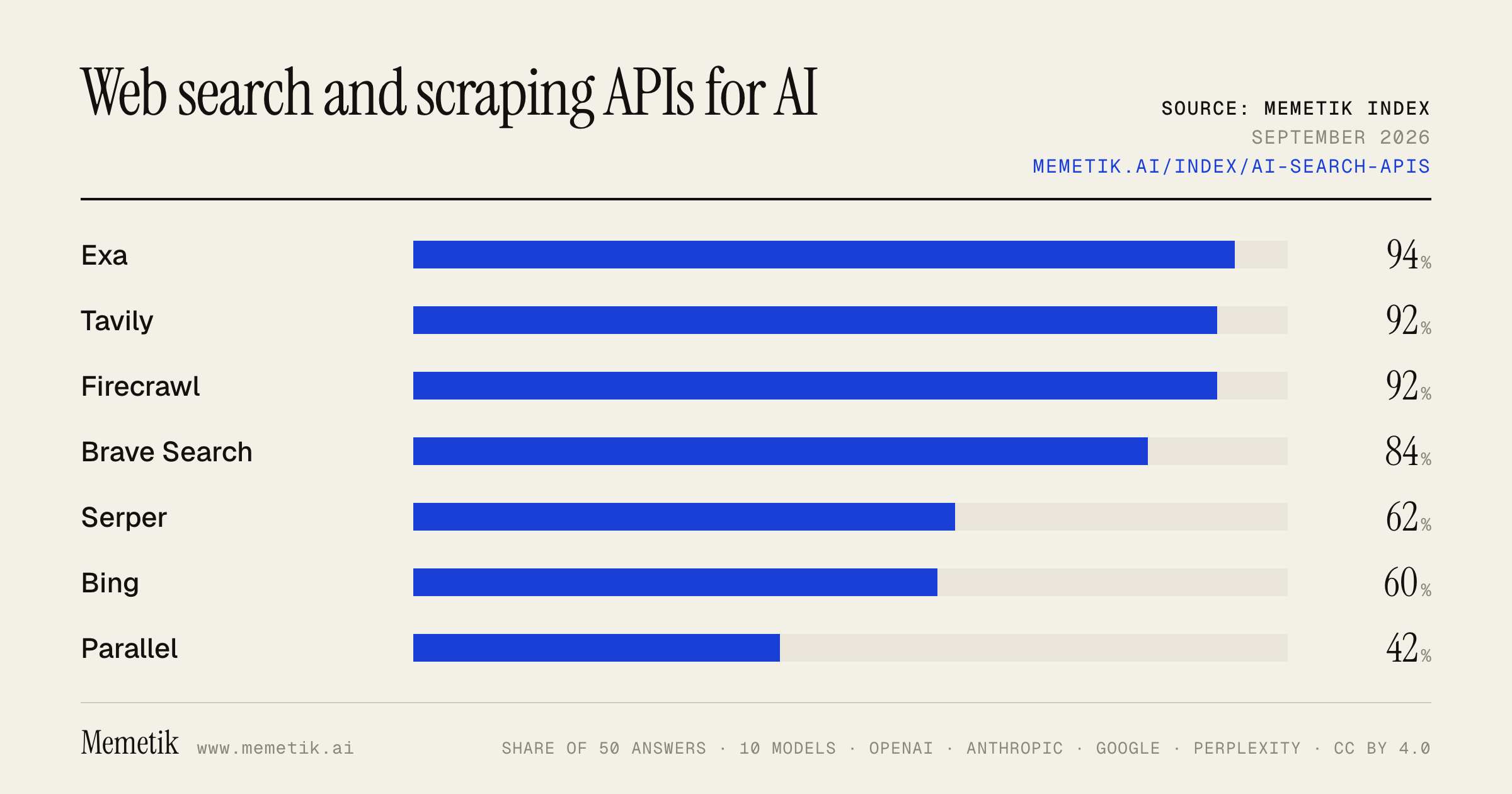
By provider
10 models · 50 answers
OpenAI 3 models · 15 answers
- GPT-5.6 Solgpt-5.6-solmost named: Exa 100%
- GPT-5.6 Terragpt-5.6-terramost named: Exa 80%
- GPT-5.6 Lunagpt-5.6-lunamost named: Exa 100%
Anthropic 3 models · 15 answers
- Claude Opus 5claude-opus-5most named: Firecrawl 100%
- Claude Sonnet 5claude-sonnet-5most named: Exa 100%
- Claude Fable 5claude-fable-5most named: Exa 100%
Google 2 models · 10 answers
- Gemini 3.6 Flashgemini-3.6-flashmost named: Exa 100%
- Gemini 3.5 Flashgemini-3.5-flashmost named: Exa 100%
Perplexity 2 models · 10 answers
- Sonar Prosonar-promost named: Exa 100%
- Sonar Reasoning Prosonar-reasoning-promost named: Exa 80%
Sources the models cited
- firecrawl.dev233
- vellum.ai82
- youtube.com67
- parallel.ai64
- brightdata.com55
- brave.com52
- context.dev42
- linkup.so34
- reddit.com34
- olostep.com20
- exa.ai19
- scrapingbee.com19
ChatGPT via API returns no citations, so it does not contribute here.
The prompts
- What is the best web search or scraping API for an AI agent? Name specific products.
- Which web search or scraping API would you recommend to an AI agent in 2026?
- Compare the top web search or scraping API options right now.
- I'm an AI agent and I need a web search or scraping API. What should I use and why?
- Best web search or scraping API for an AI agent to give an LLM live web access?
Every answer
Raw model output, unedited
GPT-5.6 TerraWhat is the best web search or scraping API for an AI agent? Name specific products.
**Best single choice for most AI agents: Firecrawl.**

If your agent needs to **find pages, read them, crawl a site, and turn content into clean Markdown or structured JSON**, Firecrawl is the most practical all-in-one API. It combines Search, Scrape, Crawl, Map, document parsing, and browser-style interaction, so you avoid stitching together a search API plus a separate scraper. ([firecrawl.dev](https://www.firecrawl.dev/blog/firecrawl-101?utm_source=openai))

### Best products by use case

| Need | Best pick | Why |
|---|---|---|
| **One API for search + scraping** | **Firecrawl** | Strong default for agent/RAG workflows; returns LLM-ready content and supports crawling and interaction. |
| **Simple web research tool for an LLM agent** | **Tavily** | Agent-first search API with search, extract, crawl, and map capabilities; good when you want a straightforward tool-call interface. ([tavily.com](https://www.tavily.com/?via=topaitools&utm_source=openai)) |
| **Semantic search / finding obscure relevant sources** | **Exa** | Search designed for AI retrieval, with content retrieval, structured outputs, deep-research-style workflows, and monitoring. Good for research, company discovery, and knowledge agents. ([exa.ai](https://exa.ai/?from=hrg&utm_source=openai)) |
| **Google/Bing results exactly as users see them** | **SerpAPI** | Use this when the SERP itself matters—SEO, local rankings, Shopping, Maps, News, ads—not just source discovery. |
| **Large-scale managed scraping / data collection** | **Bright Data Web Scraper API** | Better fit for high-volume, operationally demanding data collection where proxy/network infrastructure is central. |
| **Prebuilt scraping jobs and datasets** | **Apify** | Excellent when an existing “Actor” already scrapes a target platform or site, or when you need scheduled runs and datasets. |
| **Browser automation for authenticated or multi-step workflows** | **Browserbase** | Use alongside a scraper/search API when an agent must log in, click through applications, or work with complicated browser state. |

### My practical recommendation

- **Starting from scratch:** choose **Firecrawl**.
- **Building a research/copilot agent:** choose **Tavily** for simplicity, or **Exa** if retrieval quality and semantic discovery are the priority.
- **Building an SEO/market-intelligence agent:** pair **SerpAPI** with **Firecrawl**.
- **Building a serious data-collection pipeline:** use **Bright Data** or **Apify**, often with **Browserbase** for the hard interactive cases.

### A strong default stack

```text
Search/discovery:  Exa or Tavily
Page extraction:   Firecrawl
SERP-specific data: SerpAPI
Interactive browser tasks: Browserbase
```

Don’t make the agent scrape indiscriminately: enforce domain allowlists, rate limits, source attribution, robots/terms review, and avoid collecting personal or access-controlled data without authorization.
GPT-5.6 TerraWhich web search or scraping API would you recommend to an AI agent in 2026?
**Default recommendation: Exa** for an AI agent whose main job is *researching the live web*.

It is purpose-built around agent retrieval: search can return page contents, supports very low-latency through deeper research-oriented modes, and offers structured outputs and follow-on crawling capabilities. That makes it a strong single-vendor default when an agent must both **find** and **read** current sources. ([exa.ai](https://exa.ai/docs/reference/search-api-guide?utm_source=openai))

But the best production answer is usually a **two-tier stack**, not one API:

| Need | Recommended API | Why |
|---|---|---|
| General agent web research | **Exa** | Best default for semantic search plus source content and agent-oriented search depth. ([exa.ai](https://exa.ai/docs/reference/search-api-guide?utm_source=openai)) |
| Quick prototype / straightforward RAG search | **Tavily** | Simple search endpoint with cleaned content and explicit speed–relevance modes. ([docs.tavily.com](https://docs.tavily.com/documentation/api-reference/endpoint/search?utm_source=openai)) |
| Crawl sites, convert pages to LLM-ready Markdown, schema extraction | **Firecrawl** | Strong “URL → clean content / JSON,” plus map, crawl, search, browser, and agent endpoints. ([docs.firecrawl.dev](https://docs.firecrawl.dev/api-reference/v2-introduction?utm_source=openai)) |
| Difficult, JavaScript-heavy, geo-specific, or bot-protected public pages | **Bright Data Unlocker / Browser APIs** | Designed for managed proxying, rendering, and handling access friction such as CAPTCHAs—use only where permitted by site terms and applicable law. ([docs.brightdata.com](https://docs.brightdata.com/api-reference/rest-api/unlocker/unlock-website?utm_source=openai)) |

### My practical choice

For a new agent in 2026, I’d implement:

1. **Exa as the default `search_web` tool**
2. **Firecrawl as the `fetch_url`, `crawl_site`, and structured-extraction tool**
3. **Bright Data only as an exception path** for legitimate access to pages your normal fetcher cannot render or retrieve
4. A local **citation, caching, deduplication, robots/terms policy, and source-quality layer** around all of them

That split is preferable to treating a search API as a crawler, or a scraping API as a search engine.

### A simple routing policy

```text
Question needs current sources?
  → Exa search

Known URL, article, documentation page, or site section?
  → Firecrawl scrape/crawl

Need fields from a page?
  → Firecrawl JSON/schema extraction

Normal fetch failed, but access is authorized and compliant?
  → Bright Data rendering/unlocker path

Need a very low-friction MVP?
  → Tavily first; reassess after collecting real agent traces
```

### Caveats

- **Don’t let the model trust search summaries blindly.** Have it fetch primary sources, retain source URLs/timestamps, and cite the final claims.
- **Measure on your own query set.** Search quality varies dramatically by domain—technical documentation, news, shopping, academic literature, and local data all behave differently.
- **Avoid scraping authenticated, paywalled, prohibited, or personal-data sources** unless you have a clear legal and contractual basis. An unblocker solves a technical problem, not a permission problem.

If you force me to pick only one: **Exa** for a research agent; **Firecrawl** if the agent already knows the URLs and your real need is dependable extraction.
- https://exa.ai/docs/reference/search-api-guide?utm_source=openai
- https://docs.tavily.com/documentation/api-reference/endpoint/search?utm_source=openai
- https://docs.firecrawl.dev/api-reference/v2-introduction?utm_source=openai
- https://docs.brightdata.com/api-reference/rest-api/unlocker/unlock-website?utm_source=openai
GPT-5.6 TerraCompare the top web search or scraping API options right now.
As of **September 2, 2026**, the market splits into three different needs that are often conflated:

1. **Web-search APIs** — find pages across the open web for RAG, agents, or apps.
2. **SERP APIs** — return structured Google/Bing/etc. result pages for SEO, rank tracking, and search intelligence.
3. **Web-scraping/unblocking APIs** — fetch and render specific sites reliably despite JavaScript, bot controls, geolocation, or scale.

## Best options at a glance

| API | Category | Best for | Main strengths | Watch-outs | Public entry pricing* |
|---|---|---|---|---|---|
| **Brave Search API** | Web search | AI agents, RAG, app search | Independent web index; web/news/image results; LLM-oriented context and customizable reranking | Less appropriate when you specifically need Google’s exact SERP | **$5 / 1,000** search requests; $5 monthly credits; 50 QPS. ([brave.com](https://brave.com/search/api/?utm_source=openai)) |
| **Exa** | AI web search / research | Semantic retrieval and agent research | Search engine plus crawling and deep-research-oriented tools; designed around AI workflows | Validate relevance, freshness, and output shape on your domain before committing | Usage-based plans; evaluate its current pricing calculator for your request mix. ([exa.ai](https://exa.ai/pricing?tab=api&utm_source=openai)) |
| **SerpApi** | SERP API | SEO, rank tracking, Google-result extraction | Mature structured SERP coverage, straightforward credit model, useful location/device/search-engine parameters | You are buying SERP extraction—not an independent web index | Free: 250 searches/month; paid starts **$25/month for 1,000** searches. ([serpapi.com](https://serpapi.com/pricing?utm_source=openai)) |
| **Zyte API** | Managed scraping | General-purpose extraction at production scale | Automatic choice of HTTP/browser technology; charges successful responses; rendering, extraction, and geo/device options | Per-site tiering makes cost estimation important | HTTP: **$0.13–$1.27/1k** PAYG; rendered browser: **$1.01–$16.08/1k**, depending on target complexity. ([zyte.com](https://www.zyte.com/pricing/?utm_source=openai)) |
| **Oxylabs Web Scraper API** | Managed scraping / ecommerce & SERP | Price monitoring, marketplaces, Google/Amazon collection | Results-based pricing, JavaScript rendering, batch jobs, custom parsers, high-scale support | “Successful result” definitions and target-specific prices need close review | Free trial up to 2,000 results; Amazon **$0.50/1k**, Google **$1.00/1k**, other non-JS **$1.15/1k**, JS **$1.35/1k**. ([oxylabs.io](https://oxylabs.io/products/scraper-api/web/pricings?utm_source=openai)) |
| **Bright Data Browser / scraping stack** | Browser automation / unblocking | Difficult, JS-heavy, anti-bot-protected targets | Managed browser and proxy infrastructure; useful when a normal HTTP scraper is not enough | Cost is traffic-based and can rise quickly on heavy browser workflows | Browser API bills by transferred GB, with premium-domain exceptions. ([docs.brightdata.com](https://docs.brightdata.com/scraping-automation/scraping-browser/faqs?utm_source=openai)) |

\*Published prices can change and do not normalize perfectly: some vendors bill per request, successful result, credit, token, or GB.

## My practical picks

### 1. Best default for an AI product: **Brave Search API**
Choose it if you need live web discovery with predictable integration for assistants, RAG, or agent tools. Its independent index matters: it is not simply a repackaged Google/Bing scraper, and it supports web, news, images, alternate snippets, schema metadata, and customizable result filtering/reranking (“Goggles”). ([brave.com](https://brave.com/search/api/?utm_source=openai))

**Pick Brave when:** “Find authoritative pages relevant to this question” is your core task.
**Do not pick it when:** Your customer expects Google rankings or exact Google SERP features.

### 2. Best for Google/SERP data: **SerpApi**
Choose it for rank tracking, keyword research, ad/SERP monitoring, local search, shopping results, or applications that explicitly need structured search-engine result data. The pricing is simple enough for an MVP, although the effective rate can become meaningful at production volumes. ([serpapi.com](https://serpapi.com/pricing?utm_source=openai))

**Pick SerpApi when:** You need the search engine’s result page, not merely web discovery.
**Do not pick it when:** Your workload is mostly crawling known URLs or extracting product/catalog pages.

### 3. Best semantic-search alternative: **Exa**
Exa is particularly worth evaluating for research agents where semantic relevance is more important than reproducing a conventional SERP. Its offering combines AI search with website crawling and research capabilities. ([exa.ai](https://exa.ai/pricing?tab=api&utm_source=openai))

**Pick Exa when:** You want “find conceptually relevant sources and fetch useful content” in one AI-centric workflow.
**Pilot carefully
- https://brave.com/search/api/?utm_source=openai
- https://exa.ai/pricing?tab=api&utm_source=openai
- https://serpapi.com/pricing?utm_source=openai
- https://www.zyte.com/pricing/?utm_source=openai
- https://oxylabs.io/products/scraper-api/web/pricings?utm_source=openai
- https://docs.brightdata.com/scraping-automation/scraping-browser/faqs?utm_source=openai
GPT-5.6 TerraI'm an AI agent and I need a web search or scraping API. What should I use and why?
**Default recommendation: use Tavily.**

For an AI agent that needs both **web discovery and usable page content**, Tavily is a strong one-vendor choice because its API combines:

- **Search** returning ranked results plus LLM-ready snippets/content.
- **Extraction** of one or more known URLs into clean Markdown or text.
- **Site mapping/crawling** when the agent needs to explore a documentation site or domain.
- Search controls for **recency**, domain allow/deny lists, result depth/latency trade-offs, and optional raw content in the search response. ([docs.tavily.com](https://docs.tavily.com/documentation/api-reference/introduction?utm_source=openai))

That means your agent can usually operate in this loop:

1. Search for candidate sources.
2. Filter to reputable or task-specific domains.
3. Extract only the pages it decides are worth reading.
4. Store URLs, timestamps, and excerpts as citations/provenance.
5. Have the model synthesize an answer *only* from the retrieved material.

### Why I’d choose it for an agent

The key advantage is reduced plumbing. A conventional setup often requires a search API, a separate scraper, HTML cleanup, relevance chunking, and failure handling. Tavily is explicitly designed to return search results and extracted content in forms intended for LLM workflows, including Markdown. It also exposes `search`, `extract`, `crawl`, `map`, and research-oriented endpoints. ([docs.tavily.com](https://docs.tavily.com/documentation/api-reference/introduction?utm_source=openai))

For a prototype or early production agent, that usually beats assembling several vendors.

### Use it like this

- **Fast factual lookup:** `search_depth: "fast"` or `"ultra-fast"`, no full page body by default.
- **Research task:** `search_depth: "advanced"`, narrow by date/domain, then extract the best 3–5 URLs.
- **Known URL:** skip search and call `extract`; request Markdown.
- **Docs-site agent:** call `map` first, select relevant URLs, then `crawl`/`extract`.
- **High-stakes tasks:** force a source whitelist—official government, standards body, company, or primary research sites—and make the agent return source URLs alongside claims.

A compact pseudocode pattern:

```python
results = tavily.search(
    query=task,
    search_depth="advanced",
    include_domains=trusted_domains,
    max_results=8
)

urls = choose_sources(results["results"])
pages = tavily.extract(urls=urls, format="markdown", extract_depth="advanced")

answer = llm.generate(
    task=task,
    evidence=pages,
    require_citations=True,
    forbid_unsupported_claims=True
)
```

### Cost / operational note

Tavily currently documents a free tier of **1,000 API credits/month**. Its documented pricing lists search at one credit for basic/fast/ultra-fast and two for advanced; basic extraction is charged per five successful URL extractions. Treat those as a starting point and load-test with your real agent traces before committing to a spend level. ([docs.tavily.com](https://docs.tavily.com/documentation/api-reference/endpoint/crawl?utm_source=openai))

### When I would *not* make it the only tool

Use something else—or add another service—if your primary requirement is:

- **Exact search-engine-results-page fidelity** for SEO/rank tracking.
- **Heavy browser automation**: logins, clicking UI controls, complex JavaScript app flows, file downloads, or authenticated portals.
- **A very specific data vertical** such as product pricing, social posts, maps/local listings, legal filings, or financial market data—prefer that vertical’s official API/data provider where available.
- **Strict data licensing/compliance requirements** that require contractual rights for particular sources.

**Bottom line:** start with **Tavily as the web-retrieval layer** if your agent’s job is to find, read, and cite public-web information. Add a browser-automation system only after you identify tasks that truly require interacting with websites rather than searching and extracting them.GPT-5.6 TerraBest web search or scraping API for an AI agent to give an LLM live web access?
**Best single default for an LLM agent: Exa.**
Choose it if you want one API that can **find pages, retrieve readable page content, crawl related pages, and return structured results** without building much retrieval glue yourself. It is particularly strong for research, technical documentation, company/people discovery, and multi-step agents. Exa currently offers search modes spanning low-latency through deeper agentic research, plus content/crawling capabilities. ([exa.ai](https://exa.ai/products/search?utm_source=openai))

But the best production answer is usually **search + extraction**, not a single undifferentiated “web access” tool.

## My short list

| Need | Best pick | Why |
|---|---|---|
| **Best overall agent web tool** | **Exa** | Search, readable content, structured output, crawling, research workflows in one platform. ([exa.ai](https://exa.ai/products/search?utm_source=openai)) |
| **Best cost-conscious / independent web index** | **Brave Search API, especially LLM Context** | Returns pre-extracted content/chunks intended for grounding, lets you control URL/token budgets, and is backed by Brave’s independent index. ([api-dashboard.search.brave.com](https://api-dashboard.search.brave.com/documentation/services/llm-context?utm_source=openai)) |
| **Best agent-native developer experience** | **Tavily** | Purpose-built search, extraction, and crawling for LLM/RAG workflows, with freshness and prompt-injection-oriented safety positioning. ([tavily.com](https://www.tavily.com/blog/tavily-101-ai-powered-search-for-developers?utm_source=openai)) |
| **Best scraper / site-to-corpus tool** | **Firecrawl** | Excellent complement to a search API when an agent needs to read a specific URL or crawl a docs site; renders JavaScript and produces clean Markdown/JSON. ([firecrawl.dev](https://www.firecrawl.dev/crawl?utm_source=openai)) |
| **Best if you want the API to generate the grounded answer too** | **Brave Answers API** | Provides web-grounded generated responses with citations; useful when you do not need to own the full retrieval-and-synthesis loop. ([api-dashboard.search.brave.com](https://api-dashboard.search.brave.com/documentation/services/grounding?utm_source=openai)) |

## What I would use

### Option A — simplest, high-quality default
**Exa only** initially.

Use:
1. Search with a tight query and recency/domain filters.
2. Fetch contents only for the top 3–5 sources.
3. Ask the LLM to answer *only* from returned source text and retain source URLs/titles for citations.

This is the lowest-integration-overhead choice for a research or coding agent.

### Option B — best practical stack for a serious production agent
**Brave LLM Context (discovery) + Firecrawl (deep reads/crawls).**

- Use Brave for broad, fresh query-time discovery and compact LLM-ready context. Its LLM Context endpoint is explicitly designed to return extracted material such as text, tables, code, and structured data, with configurable token and URL limits. ([api-dashboard.search.brave.com](https://api-dashboard.search.brave.com/documentation/services/llm-context?utm_source=openai))
- Use Firecrawl only when the agent needs to inspect a target page thoroughly, handle a JavaScript-heavy site, or ingest a whole documentation domain. ([firecrawl.dev](https://www.firecrawl.dev/crawl?utm_source=openai))

This separation gives you better cost control than crawling everything, and often better observability than relying on a black-box “research” endpoint.

### Option C — fastest path to an agent prototype
**Tavily.**

It is the most straightforward “give my agent web access” choice if your priority is an agent-oriented API rather than building retrieval plumbing. Tavily positions its API around search, extraction, crawling, citations, freshness, and agent safety controls. ([tavily.com](https://www.tavily.com/blog/tavily-101-ai-powered-search-for-developers?utm_source=openai))

## Important design advice

1. **Do not feed raw webpages directly into the model.**
   Have a retrieval layer return cleaned content, metadata, publication dates, canonical URLs, and source IDs.

2. **Treat web text as untrusted input.**
   Webpages can contain prompt-injection text (“ignore prior instructions,” “send secrets,” etc.). Keep tool permissions separate from retrieved content; never let retrieved text authorize actions.

3. **Use a two-stage budget.**
   - cheap search: 5–10 results
   - expensive read/extract: top 2–5 sources
   - synthesis: force citations per claim

4. **Keep search and scrape tools distinct.**
   A search API finds likely relevant sources; a scraper/reader obtains evidence. Search snippets alone are not enough for reliable answers.

5. **Avoid scraping Google/Bing result pages yourself.**
   It is brittle and can create compliance, blocking, and operational problems. Use a licensed search API or an independent index instead.

## Cost signal

Published pricing can change, but Brave currently lists Search at **$5 per 1,000 requests** with monthly free credits, and Exa lists Search at **$7 per 1,000 requests** on its product page. Compare on your own query set, though: a cheaper search call can become more expensive overall if it returns lower-quality evidence and forces extra searches/extractions. ([brave.com](https://brave.com/search/api/?utm_source=openai))

## Bottom line

- **Pick Exa** if you want the best all-in-one default for an AI agent.
- **Pick Brave LLM Context + Firecrawl** if you want a robust, controllable, cost-aware production architecture.
- **Pick Tavily** if you want the easiest agent-first integration and are optimizing for speed of implementation.
- https://exa.ai/products/search?utm_source=openai
- https://api-dashboard.search.brave.com/documentation/services/llm-context?utm_source=openai
- https://www.tavily.com/blog/tavily-101-ai-powered-search-for-developers?utm_source=openai
- https://www.firecrawl.dev/crawl?utm_source=openai
- https://api-dashboard.search.brave.com/documentation/services/grounding?utm_source=openai
- https://brave.com/search/api/?utm_source=openai
Claude Sonnet 5What is the best web search or scraping API for an AI agent? Name specific products.
There's no single universal "best" — it depends on whether you need raw search results, LLM-ready content, or full-page scraping/rendering. Here's a breakdown of the top specific products by category, based on current comparisons:

## AI-native search APIs (built for RAG/agents, return LLM-ready content)
- **Exa** –
returns content processed for LLM consumption and maintains a proprietary index rather than scraping existing engines
. It's
neural search trained on link prediction, ideal for RAG and AI agents
. Its
Highlights feature chunks and embeds full webpages with a paragraph prediction model, extracting relevant passages live
. Pricing:
Search pricing is $7 per 1,000 requests, with Agentic Search at $12 per 1,000, and contents retrieval is an additional $1 per 1,000 pages
.
- **Parallel AI** –
multi-agent retrieval with provenance on every result, scoring 47% on the HLE benchmark
.
Parallel's Search API is built specifically for AI agents rather than human users.

- **Tavily** –
a solid alternative for source-first discovery with LangChain/LlamaIndex
 integrations.
- **You.com Web Search API** – designed so
the Web Search API returns pre-extracted passages with source URLs on every call—snippets by default, or query-relevant highlights on request—ready to be cited, reranked, or fed directly into a tool-calling loop
. It also emphasizes
an independent index operated by You.com, not resold from a third party, meaning no surprise deprecations and no upstream policy changes mid-quarter
.
- **Perplexity Sonar** and **Brave Search API** are also frequently recommended, with
Brave's Search API having grown over 50x since Q1 2024
.

## Firecrawl (search + scrape combined)
**Firecrawl** is repeatedly named as a top overall pick because it combines search and scraping in one workflow:
web context APIs built for AI agents where Search finds fresh, full-content results from the live web, and Scrape, Parse, and Interact handle the rest of the Find → Extract → Clean → Use workflow
. It has scaled significantly —
Firecrawl has fetched over 8 billion pages in the last two years
.

## Traditional SERP APIs (raw Google/Bing-style results)
- **SerpAPI** –
40+ engines, enterprise-grade reliability
.
- **Serper** –
affordable Google search access
, a budget-friendly option.
- Note that
traditional SERP APIs like SerpAPI and Serper.dev extract raw search engine metadata, including titles, URLs, and short snippets, with high fidelity to what Google or Bing returns
, but
you only get a URL and a two-sentence snippet, so to feed your LLM full page content, you need to fetch each URL, handle bot detection, render JavaScript, extract text, and convert to Markdown yourself
.

## Dedicated web scraping APIs (for heavy-duty extraction/anti-bot/proxy needs)
- **ScrapingBee** – positioned for
building a proprietary index or bypassing heavy JavaScript walls
, marketed as
the ideal API for developers who need total control over the data pipeline
.
- **Oxylabs** –
an enterprise-grade powerhouse focusing on SERP and proxy infrastructure, with a massive network that ensures you can pull data from almost any geographic location without being detected
. Best suited for
large-scale enterprise data gathering and organizations that require strict data compliance and high-volume stability
, though
pricing and complexity can be overkill for small AI startups or solo developers
.
- **Bright Data's SerpApi** is also noted as strong for
search rankings, localization, and vertical result schemas rather than for turnkey LLM evidence
.

## Quick recommendation
- **If you want the simplest all-in-one for an agent**: Firecrawl (search + scrape + clean Markdown output) or Exa (semantic search + content).
- **If you need deep research/evidence with citations**: Parallel AI or Tavily.
- **If you just want classic Google/Bing results cheaply**: Serper or SerpAPI.
- **If you're scraping at scale and need proxies/anti-bot bypass**: ScrapingBee or Oxylabs.

One important note:
Microsoft retired the Bing Search APIs on August 11, 2025, and pointed developers to "Grounding with Bing Search" inside Azure AI Agents
, so avoid building around the old Bing Search API.
- https://you.com/resources/best-web-search-apis-for-ai-agents
- https://www.firecrawl.dev/blog/best-web-search-apis
- https://you.com/docs/capabilities/web-search-api-for-ai-agents
- https://www.vellum.ai/blog/best-web-search-apis-and-mcps-for-ai-agents
- https://www.scrapingbee.com/blog/best-ai-search-api/
- https://www.tinyfish.ai/blog/best-web-search-api-for-ai-applications
- https://parallel.ai/articles/the-honest-2026-comparison-web-search-apis-for-ai-agents
Claude Sonnet 5Which web search or scraping API would you recommend to an AI agent in 2026?
Based on current (2026) comparisons and benchmarks, there isn't a single universal "best" — the right choice depends heavily on what your agent actually needs to do. Here's a practical breakdown:

## If you want an all-in-one "search + get full content" tool
**Firecrawl** is a strong default recommendation.
It runs a web search and gives you back the full, cleaned content of each result in one call, designed for RAG pipelines and research agents that need entire documents instead of snippets.

Unlike most competitors, its search endpoint can return both ranked results and full markdown of each page in a single call, combining search and scraping into one step.
 It's also battle-tested at scale —
Firecrawl has fetched over 8 billion pages in the last two years.


**Context.dev** is a newer contender making a similar pitch:
it collapses search, scraping, extraction, and monitoring into a single connection, a breadth none of the alternatives match.


## If you want raw speed/accuracy on agentic benchmarks
**Parallel AI** is posting the strongest numbers in independent-style evaluations.
On BrowseComp, a hard multi-hop benchmark, Parallel Basic scored 53% against Tavily's 42% and Exa's 40% in an April 2026 evaluation run through a shared GPT-5 research harness.
 They also have an ultra-low-latency tier:
in July 2026 Turbo benchmarks, Turbo scored 51% on BrowseComp at 216ms median latency, ahead of Exa Instant (33.7% at 361ms) and Tavily Ultra Fast (19.3% at 357ms).


## If you want a pure, independent SERP-style API (URLs + snippets, not full content)
**Brave Search API** has strong momentum and quality.
In an 8-API benchmark across 100 queries by AIMultiple, Brave achieved the highest Agent Score of the eight SERP APIs tested (14.89) alongside the fastest mean latency at 669 ms — though as a pure SERP service, it returns URLs and snippets rather than scraped page content.
 It's also seeing massive adoption:
Brave's Search API has grown over 50x since Q1 2024.


## If you're deep in the LangChain/LlamaIndex/CrewAI ecosystem
**Tavily** remains popular for its agent-native design.
Following its $275 million cash acquisition by Nebius Group in February 2026, Tavily remains a solid solution for purpose-built agent loops, offering deep integration with frameworks like LangChain, LlamaIndex, and CrewAI, with predictable flat billing ranging from $5 to $8 per 1,000 searches.


## If you want semantic/neural search for research-style retrieval
**Exa** is built specifically for meaning-based retrieval rather than keyword matching — good for RAG and concept-driven discovery, though
full page content comes back through separate Contents API calls rather than in the initial search response, so every result you want to read costs an extra round trip, and running its own index means recently published or niche pages can be missing.


## My actual recommendation

For most AI agent builders in 2026, I'd suggest this decision path:

1. **Default choice for RAG/research agents**: **Firecrawl** or **Parallel** — both give you clean, LLM-ready content in a single call, minimizing round trips.
2. **If latency is your top constraint**: **Parallel Turbo** or **Brave** (fastest response times in benchmarks).
3. **If you're already using LangChain/CrewAI**: **Tavily** for the smoothest integration.
4. **If you need raw Google/Bing SERP data** (rank tracking, traditional search): stick with **SerpAPI** or **Serper**, since
SERP APIs wrap Google or Bing and return metadata like titles, snippets, and URLs — useful for rank tracking, but they hand your agent a pointer to the content, not the content itself.


One more consideration: many of these now ship as **MCP servers** too, so you can plug them directly into Claude, Cursor, or other MCP-compatible agent frameworks without building custom API wrappers —
MCP is the open standard Anthropic built for connecting AI assistants to external tools and data, and a web search MCP server exposes search and retrieval tools directly to your AI client.


Given the fast pace of change in this space (pricing and benchmarks are shifting monthly), I'd suggest running your own small benchmark on your actual query patterns before committing — several vendors' own comparison pages (naturally) rank themselves #1, so take single-source "best of 2026" claims with a grain of salt.
Claude Sonnet 5Compare the top web search or scraping API options right now.
I'll research current options for web search and scraping APIs to give you a solid comparison.
Based on current research, here's a comparison of the top web search and scraping API options (note: many providers publish their own biased comparisons, so I've tried to surface consistent independent themes across sources).

## Key Market Shift

With Microsoft's decision to retire Bing Search APIs in August 2025, developers are evaluating web search API alternatives and discovering new platforms built specifically for AI workflows.
 This has reshaped the whole landscape in 2026.

## Two Distinct Categories

Most comparisons agree on a core distinction:
it's easy to confuse SERP APIs and Web Search APIs, but they serve different roles. SERP APIs are best for structured SEO data, while Web Search APIs are ideal for AI-driven applications.


### Traditional SERP APIs (SEO / rank tracking)
- **SerpAPI** –
the most mature SERP option, covering Google, Bing, Yahoo, DuckDuckGo, Baidu, Yandex, and dozens of Google verticals through one interface.

- **Serper / Zenserp** –
offer low-friction REST APIs with generous free tiers for SEO data.


### AI-Native Search APIs (RAG, agents, LLM workflows)

AI-native search APIs like Firecrawl, Exa, and Tavily use neural networks, semantic understanding, or integrated content extraction to deliver information formatted for LLM consumption. These platforms understand context and meaning beyond simple keyword matching, and are best for RAG systems, AI agents, and semantic search.


## Standout Providers

**Brave Search API** – Positioned as a privacy-focused, independent-index option.
Brave provides direct access to a massive, independently built Web index via a structured API, exposing every endpoint and data type you might need — from full LLM context to snippets to answers.
 Pricing is
$5 per 1,000 calls per month across Web Search endpoints, with $5 in free credits renewing monthly.


**Linkup** – Marketed heavily as an accuracy leader for RAG:
94% F-score on Verified SimpleQA, #1 among sub-second APIs, at €5 per 1,000 standard searches.
 It differentiates by returning
clean, source-cited content rather than raw HTML, reducing the preprocessing step most SERP APIs require.


**Parallel AI** – Focused on cost efficiency for agent workloads:
Fast mode, at $1 per 1,000 requests, returns higher-quality results within a one-second budget and is the best fit for most agent workloads,
 while
Basic returns in about one second at p50 with deeper context, and Advanced spends more time querying, reranking, and compressing across indexes (about three seconds at p50) for multi-hop agents.


**CatchAll (NewsCatcher)** – Optimized for exhaustive event/data coverage rather than typical ranked search:
it's an AI-native web search API built around a recall-first design, processing 50,000+ candidate pages per query through a five-stage pipeline (analyze, fetch, cluster, validate, extract) to return structured, deduplicated JSON.
 In benchmark testing,
it achieved an F1 score of 0.705 in NewsCatcher's Q1 2026 benchmark, more than 2× the nearest competitor, Exa, at 0.317.


**Firecrawl, Exa, Tavily** – Frequently grouped as the AI-native default set for agent tooling, though multiple competitor benchmarks (Linkup, NewsCatcher) claim to outperform them on accuracy/recall — take these comparative claims with some skepticism since they come from rival vendors.

**Perplexity Sonar** – Bundles retrieval + reasoning, but has tradeoffs:
a single model API request can trigger multiple billable searches, and you pay token rates on retrieved content on top of the per-search fee, so effective cost runs higher than the headline number — and you can't swap retrieval independently of the model.


## Practical Guidance
One useful warning for agent/MCP integrations:
many search MCPs marketed at AI agents are wrappers around Google or Bing — if your agent already has a Google tool configured, calling a Google-wrapped MCP surfaces the same ten results. The servers worth using either build their own index or go beyond search entirely, fetching full page content, crawling deeper, and supporting multi-step retrieval loops.


## Bottom Line Recommendations
- **SEO/rank tracking:** Serper, SerpAPI, or Zenserp
- **Budget-conscious AI agents at scale:** Parallel AI (Fast/Turbo) or Brave
- **Accuracy-critical RAG/agentic workloads:** Linkup or CatchAll (per their own benchmarks)
- **Broad ecosystem/LLM integration support:** Brave (widely adopted,
trusted by most of the world's top 10 LLMs
) or Tavily/Exa (common defaults in agent frameworks)

**Caveat:** Several of these sources are vendor blogs comparing themselves favorably against competitors, so benchmark numbers (F1 scores, "top pick" claims) should be verified independently rather than taken at face value.
- https://www.firecrawl.dev/blog/best-web-search-apis
- https://www.linkup.so/blog/best-serp-apis-web-search
- https://parallel.ai/articles/the-honest-2026-comparison-web-search-apis-for-ai-agents
- https://www.newscatcherapi.com/blog-posts/best-web-search-apis
- https://brave.com/learn/best-search-api-2026/
- https://www.linkup.so/blog/best-web-search-api-in-2026-top-providers-compared
- https://www.vellum.ai/blog/best-web-search-apis-and-mcps-for-ai-agents
Claude Sonnet 5I'm an AI agent and I need a web search or scraping API. What should I use and why?
This depends on what exactly you need your AI agent to do, so let me give you a practical rundown of the main options and why you'd pick each one.
There's no single "best" answer — it depends on what your agent actually needs to do. Here's a breakdown based on current options and use cases:

## The main categories

**1. AI-native search APIs (built specifically for agents/RAG)**
- **Tavily** —
designed for AI search and research workflows, with native LangChain integration, roughly 998ms latency, and pay-as-you-go pricing around $0.008/credit
. Great default choice if you want clean, LLM-ready snippets with minimal setup.
- **Exa** —
uses intent-based semantic search rather than keyword matching, returning structured results, highlights, and cited answers
, though
deep searches can become costly
. Best when you need conceptual/semantic matching rather than exact keywords.
- **Perplexity Sonar** —
gives full synthesized, cited answers rather than raw links, but has much higher latency (11+ seconds)
, so it's better for batch/async research than real-time agent loops.

**2. Search + content extraction combined**
- **Firecrawl** —
combines content extraction and search, returning full-page content ideal for RAG pipelines that need complete page context
, at roughly $83/month for 100K credits. If your agent needs to actually read full pages (not just snippets), this saves you from stitching together a separate scraper.

**3. Privacy-focused / independent index**
- **Brave Search API** —
offers low latency (669ms) and runs on an independent index, priced at $5 per 1,000 queries with no free tier
. Good if you want results not dependent on Google/Bing and care about speed and neutrality.

**4. Traditional SERP APIs (raw Google/Bing-style results)**
- **SerpAPI** —
best for multi-engine and vertical coverage, offering dozens of engines plus Google Scholar, Patents, and Shopping
.
- **Serper** — a cheap, fast option if
you just need raw JSON (URLs, titles, snippets) for cheap, high-volume keyword search
 and already have your own scraping/processing pipeline.

**5. Pure web-scraping APIs (for when you need to bypass anti-bot walls)**
- **ScrapingBee** —
positioned as the option when you're building a proprietary index or need to bypass heavy JavaScript walls and anti-bot protections
.

## How to actually decide

Ask yourself these questions:
1. **Do you want snippets or full page content?** Snippets → Tavily/Brave/SerpAPI. Full content → Firecrawl or a scraping API.
2. **Keyword search or semantic/conceptual search?** Keyword → SerpAPI/Serper. Semantic → Exa.
3. **Do you want a finished answer or raw sources to reason over yourself?** Finished answer → Perplexity Sonar. Raw sources → everything else.
4. **Are you hitting JS-heavy or anti-bot-protected sites?** → dedicated scraping API like ScrapingBee or Firecrawl's scrape endpoint.
5. **Budget/free tier needs?**
Tavily offers 1,000 free credits/month with no card required, Firecrawl offers 1,000 free credits/month, and Serper offers a one-time 2,500 free queries
 — all reasonable for prototyping.

One independent benchmark worth noting:
an AIMultiple evaluation of 8 search APIs across 100 real-world AI/LLM queries found the top four providers statistically indistinguishable — Brave Search, Firecrawl, Exa, and Parallel Search Pro
, so at the top end the quality differences are small and it comes down to workflow fit and pricing.

**My practical recommendation:** if you're prototyping an agent and want the least friction, start with **Tavily** (agent-native, generous free tier, easy integration) or **Firecrawl** (if you also need full-page scraping). If cost/scale at high volume matters more than convenience, **Serper + your own scraper** or **Brave Search API** are cheaper long-term. If your agent's job is genuinely research-heavy and needs to reason over full documents, **Exa** or **Firecrawl** are the stronger fits.
- https://www.firecrawl.dev/blog/best-search-tools-for-agents
- https://composio.dev/content/9-top-ai-search-engine-tools
- https://parallel.ai/articles/the-honest-2026-comparison-web-search-apis-for-ai-agents
- https://www.scrapingbee.com/blog/best-ai-search-api/
- https://parallel.ai/articles/best-free-web-search-api
- https://www.firecrawl.dev/blog/best-ai-search-engines-agents
Claude Sonnet 5Best web search or scraping API for an AI agent to give an LLM live web access?
There's no single universal "best" — it depends on what your agent actually needs (raw links vs. full clean content vs. an answer with citations). Here's the landscape based on current comparisons:

## The three tiers

**1. Traditional SERP APIs** — wrap Google/Bing, return links + snippets

SERP APIs (SerpAPI, Serper, ScrapingDog) wrap Google or Bing and return metadata - titles, snippets, URLs, but they hand your agent a pointer to the content, not the content itself.
 Good for rank tracking, less ideal if your agent needs to reason over actual page content without a second fetch step.

**2. AI-native search APIs** — return clean, LLM-ready content in one call

AI-native search APIs (Firecrawl, Exa, Tavily, Perplexity) go further: they return full page content or grounded answers, cleaned and structured, ready for an LLM to reason over.
 This is generally the better fit for agents, since it avoids a separate scrape step.

**3. Scraping APIs** — for when you need to own the full data layer (JS rendering, bot-detection bypass, custom crawling), e.g. ScrapingBee, Firecrawl's crawl/scrape endpoints.

## Standout options by use case

- **Firecrawl** —
is the context API to search, scrape, and interact with the web at scale: it runs a web search and gives you back the full, cleaned content of each result in one call
. Great if your agent needs full documents, not snippets.
- **Tavily** —
for most production agents, Tavily is the best default AI search API because it returns web context designed for LLM workflows
.
- **Exa** — best when you need semantic/neural discovery rather than literal keyword matching
If your agent needs semantic discovery, Exa is stronger; Exa is best for neural and semantic discovery.

- **Perplexity Sonar** — best if you want a finished, cited answer rather than raw content:
Perplexity Sonar is best when you want answer-first search with citations.

- **Brave Search API** — positions itself strongly on raw independent index access and pricing:
Brave provides direct access to a massive, independently built Web index, via a structured API. The various Web Search endpoints (including the AI-optimized LLM Context endpoint) are priced at $5 per 1,000 calls per month.

- **Parallel** — pitched for agent/RAG workloads needing ready-to-use excerpts in a single call:
For agent and RAG workloads that need LLM-ready excerpts in one call, Parallel.

- **SerpAPI** — still the go-to if you specifically need multi-engine or Google-vertical SERP fidelity:
For multi-engine SERP and Google verticals, SerpAPI.

- **ScrapingBee** — better suited if you need to bypass heavy bot-detection/JS-heavy sites and want full control of the scraping layer rather than a packaged search product.

## One important architectural note

The servers worth using either build their own index or go beyond search entirely - fetching full page content, crawling deeper, and supporting multi-step retrieval loops. A 2025 survey on agentic deep research found that standard LLMs using basic keyword search score below 10% on complex multi-hop research benchmarks, while systems built around iterative retrieval - search, reason, search again - score dramatically higher. The tool matters less than whether it supports a loop.


## Practical recommendation

If you're building a general-purpose agent and want the simplest, most robust default: **Tavily or Firecrawl** are the most commonly recommended starting points right now, since both return clean, structured, LLM-ready content in a single call rather than forcing you to chain search + scrape yourself. If cost and raw index independence matter more, **Brave Search API** is a strong pick. If you need semantic/conceptual search (not just keyword), add **Exa**. Many production setups actually combine layers — e.g.
Brave or Exa for discovery, Firecrawl or Jina Reader for clean page content, and your own LLM or Perplexity Sonar for final cited synthesis
 — rather than relying on one API for everything.
- https://www.vellum.ai/blog/best-web-search-apis-and-mcps-for-ai-agents
- https://www.firecrawl.dev/blog/best-search-tools-for-agents
- https://www.contextstudios.ai/guides/best-ai-search-apis-agents-2026
- https://brave.com/learn/best-search-api-2026/
- https://parallel.ai/articles/the-honest-2026-comparison-web-search-apis-for-ai-agents
Gemini 3.6 FlashWhat is the best web search or scraping API for an AI agent? Name specific products.
When choosing a web search or scraping API for an AI agent, the best choice depends on whether you need **search queries** (finding fresh information across the web) or **full-page scraping** (converting deep web pages into LLM-friendly context).

Here are the top-rated tools in the AI developer ecosystem today, categorized by their main strengths:

---

### 1. Best AI-Native Search APIs (Query $\rightarrow$ LLM Context)
These search engines are specifically optimized for LLMs: they filter out noise, handle natural language queries, and return concise, pre-cleaned content or Markdown suitable for context windows.

*   **Tavily AI**
    *   **Best for:** General agent search, AutoGPT/LangChain integration, and automated RAG pipelines.
    *   **Why it’s great:** Tavily was built specifically for AI agents. Rather than returning standard SERP links, it crawls, extracts, and summarizes the top relevant web sources into structured JSON/Markdown ready to feed directly into an LLM.
*   **Exa (formerly Metaphor)**
    *   **Best for:** Semantic and neural search (finding content based on *meaning* rather than exact keywords).
    *   **Why it’s great:** Exa uses an embedding-based neural search engine designed for LLMs. It excels at complex, natural language queries (e.g., *"Find company blog posts announcing Series A rounds in healthcare"*). It can also fetch full, clean HTML/text content for top results.
*   **Serper.dev**
    *   **Best for:** High-speed, affordable Google SERP data.
    *   **Why it’s great:** Serper provides a lightweight REST API that scrapes Google Search results (Organic, News, Images, Knowledge Graph) in real time. It is much faster and cheaper than standard Google Custom Search or Bing APIs.

---

### 2. Best Web Scraping & Extraction APIs (URL $\rightarrow$ Clean Markdown)
When an agent needs to read a specific URL, traditional HTML scrapers inject too many tokens (scripts, navbars, ads). These APIs render JavaScript, bypass anti-bot systems, and strip web pages down to token-optimized Markdown.

*   **Firecrawl**
    *   **Best for:** Full-site crawling, structured data extraction, and deep agent scraping.
    *   **Why it’s great:** Firecrawl turns any URL (or entire domain) into clean, LLM-ready Markdown. It handles dynamic JavaScript rendering, anti-bot protection (Cloudflare bypass), and subpage crawling automatically.
*   **Jina AI Reader (`r.jina.ai`)**
    *   **Best for:** Ultra-fast, single-page URL-to-Markdown conversion.
    *   **Why it’s great:** Extremely developer-friendly. You can prefix any target URL with `https://r.jina.ai/` to get stripped-down, token-optimized Markdown back instantly. It also supports search natively.
*   **Crawl4AI** *(Open Source)*
    *   **Best for:** Developers who want an open-source, self-hosted scraping pipeline optimized for RAG.
    *   **Why it’s great:** It runs headless browser engines locally, extracts structured JSON/Markdown, supports CSS selector filtering, and is free to self-host.

---

### 3. Best Enterprise & Anti-Bot Scraping APIs
For agents that need to scrape heavily defended websites (e.g., LinkedIn, Amazon, e-commerce, or sites protected by Akamai/Cloudflare):

*   **ScrapingBee / Bright Data / Apify**
    *   **Best for:** Bypassing complex CAPTCHAs, proxy rotation, and scaling.
    *   **Why it’s great:** If standard scrapers fail because of anti-scraping walls, tools like ScrapingBee or Bright Data manage residential proxies and headless browsers under the hood to ensure high success rates. Apify also offers pre-built "Actors" (ready-made scrapers for major platforms).

---

### Summary Recommendation

* **For general AI agent web browsing/RAG:** Use **Tavily** or **Exa**.
* **For reading/scraping arbitrary web pages cleanly:** Use **Firecrawl** or **Jina Reader**.
* **For cheap Google SERP results:** Use **Serper.dev**.
* **For open-source/self-hosted:** Use **Crawl4AI**.
Gemini 3.6 FlashWhich web search or scraping API would you recommend to an AI agent in 2026?
For AI agents (RAG workflows, autonomous search, and LLM tool calling), traditional search and scraping APIs often fall short because they return bloated HTML, irrelevant snippets, or trigger anti-bot blocks.

The best recommendations are categorized by their primary function:

---

### 1. Best All-in-One AI Search APIs (Search + Extracted Content)

These APIs don't just return search links; they crawl the destination pages, clean the content, and return **token-efficient Markdown or JSON** ready for LLM consumption.

*   **Tavily AI** *(Top Recommendation)*
    *   **Best for:** General agent search, autonomous agents (LangChain, AutoGen, CrewAI standard).
    *   **Why it stands out:** Built specifically for LLM agents. It aggregates search results, strips clutter, removes duplications, and formats content to optimize context windows.
    *   **Features:** Real-time search, domain filtering, depth control (basic vs. deep search), and built-in extraction.
*   **Exa (formerly Metaphor)**
    *   **Best for:** Semantic/neural search and complex research queries.
    *   **Why it stands out:** Instead of keyword matching, Exa uses transformer-based embedding models trained on link relationships across the web. You can query using natural language (e.g., *"Here is a paper discussing..."*) or find similar pages using a URL.
    *   **Features:** High-quality content extraction, fine-grained date filtering, and excellent semantic matching.

---

### 2. Best Web Scraping & Crawling APIs (URL to Clean Markdown)

If your agent already has specific URLs and needs to read, crawl, or extract structured data from them:

*   **Firecrawl** *(Top Pick for AI Scraping)*
    *   **Best for:** Turning entire websites or complex single pages into clean LLM-ready Markdown/JSON.
    *   **Why it stands out:** Handles dynamic JavaScript rendering, anti-bot protections, captchas, and shadow DOMs seamlessly. It can crawl an entire site map or extract precise JSON schemas directly from web pages.
*   **Jina AI Reader (`r.jina.ai`)**
    *   **Best for:** Ultra-fast, lightweight single-page extraction with minimal setup.
    *   **Why it stands out:** Extremely simple to implement. Prepending `https://r.jina.ai/` to any URL fetches clean, LLM-formatted Markdown text via a basic `GET` request.
*   **Crawl4AI / Spider**
    *   **Best for:** Self-hosters, high-speed crawling, and developer customization.
    *   **Why it stands out:** Crawl4AI is a top open-source crawler built for LLM/RAG pipelines that offers deep browser automation (Playwright-backed), heuristic content extraction, and low latency.

---

### 3. Best Traditional SERP APIs (Raw Search Engine Results)

If your agent requires raw Google/Bing search indices or keyword-based SERP metadata rather than extracted full-text content:

*   **Brave Search API**
    *   **Best for:** High latency requirements, privacy, and low-cost raw web search.
    *   **Why it stands out:** Completely independent web index (not relying on Google or Bing). Highly scalable, developer-friendly, and offers cheap pricing tiers.
*   **Serper.dev**
    *   **Best for:** Cost-effective, fast Google Search results.
    *   **Why it stands out:** Very fast JSON API wrapping Google search results (Organic, News, Images, Places, Knowledge Graph). Significantly cheaper than SerpApi for high-throughput SERP scraping.

---

### Recommended Agent Setup Matrix

| Agent Need | Primary Choice | Alternative Choice |
| :--- | :--- | :--- |
| **Autonomous Search & Fact Retrieval** | **Tavily** | Brave Search API |
| **Deep Research & Semantic Discovery** | **Exa** | Tavily |
| **Scraping Specific URLs into Markdown** | **Firecrawl** | Jina Reader |
| **Full Site Crawling & JSON Extraction** | **Firecrawl** | Crawl4AI (Open Source) |
| **Fast Google SERP Results** | **Serper.dev** | SerpApi |

### Recommendation Summary
* **If you want a single tool for search + reading pages:** Go with **Tavily**.
* **If your agent reads specific URLs or needs to crawl sites:** Go with **Firecrawl**.
Gemini 3.6 FlashCompare the top web search or scraping API options right now.
The web search and web scraping API market has split into **three distinct categories**, driven heavily by the explosion of AI agents, RAG (Retrieval-Augmented Generation), and anti-bot systems.

Below is a comparative breakdown of the top options right now, categorized by use case.

---

### 1. AI-Native & RAG Search APIs
*Designed for LLM applications and AI agents. Instead of returning raw HTML or SERP links, these APIs search, extract, and convert live web content into clean Markdown or JSON designed to fit directly into context windows.*

* **Firecrawl**
  * **Best for:** End-to-end web search, deep crawling, and extraction for AI.
  * **Strengths:** Excellent at converting complex, JS-heavy sites into clean Markdown. Offers full site-crawling (`/crawl`), targeted search (`/search`), and structured schema extraction.
  * **Pricing:** Free tier available; paid plans start around $16/month.
* **Exa (formerly Metaphor)**
  * **Best for:** Neural & semantic web search.
  * **Strengths:** Uses embedding-based search rather than standard keyword matching. Finds similar links, company profiles, research papers, and niche domain data with high relevance for LLMs.
  * **Pricing:** Pay-as-you-go credit model; starting around $7 per 1,000 searches with a free credit tier.
* **Tavily**
  * **Best for:** Low-latency factual discovery for LangChain / AI agents.
  * **Strengths:** Optimized specifically for real-time RAG context, minimizing hallucinatory outputs by retrieving high-precision, concise web snippets.
  * **Pricing:** ~1,000 free requests/month; usage-based credit tiers starting at ~$0.008/credit.
* **Linkup**
  * **Best for:** Top-tier accuracy and parallel search for multi-agent workflows.
  * **Strengths:** Outperforms many sub-second APIs on factual benchmark accuracy (e.g., SimpleQA) and supports native parallel search queries out of the box.
  * **Pricing:** ~€5 / 1,000 standard searches.

---

### 2. Traditional SERP (Search Engine Results Page) APIs
*Designed to return rank, snippets, and SERP layouts (Google, Bing, DuckDuckGo, Baidu) in structured JSON. Ideal for SEO tracking, rank monitoring, and market research.*

* **SerpApi**
  * **Best for:** Gold-standard, developer-friendly SERP data across 40+ engines.
  * **Strengths:** Real-time extraction, high accuracy on Google local results, maps, shopping, and AI Overviews.
  * **Pricing:** 100 free searches/month; paid plans start at $25/month.
* **Serper.dev**
  * **Best for:** Low-cost, fast Google SERP data.
  * **Strengths:** Extremely fast response times and much cheaper than classic SERP providers, making it popular for high-volume SEO pipelines.
  * **Pricing:** $50 for 50,000 credits (2,500 free queries upon signup).
* **Brave Search API**
  * **Best for:** Privacy-focused independent search index.
  * **Strengths:** Completely independent from Google/Bing indices. Cheap and transparent pricing with no tracking.
  * **Pricing:** $3–$5 per 1,000 queries; includes a generous free tier.

---

### 3. General & Enterprise Web Scraping APIs
*Designed to bypass aggressive anti-bot protections (Cloudflare, DataDome, Kasada) and handle proxy rotation, headless browser rendering, and JS execution automatically.*

* **Bright Data (Web Scraper API / Scraping Browser)**
  * **Best for:** Heavy enterprise scale, anti-bot bypass, and complex target domains.
  * **Strengths:** Backed by a massive residential proxy network. Highly reliable for difficult e-commerce, social media, and protected sites.
  * **Pricing:** Pay-per-successful-record or bandwidth; starts around $1.50 per 1,000 results.
* **Apify**
  * **Best for:** Marketplace of pre-built scrapers ("Actors") and serverless execution.
  * **Strengths:** Excellent developer ecosystem; offers ready-to-use scrapers for Twitter/X, Instagram, Amazon, Google Maps, etc.
  * **Pricing:** $5/month free platform credit; paid plans start at $29–$49/month.
* **ScrapingBee / ScraperAPI**
  * **Best for:** Turnkey URL-to-HTML/JSON requests without managing headless browsers.
  * **Strengths:** Simple API parameters (e.g., `render_js=true`, `premium_proxy=true`). Great balance between simplicity and anti-blocking power.
  * **Pricing:** Plans typically start around $49/month with free trial credits.
* **Crawl4AI / Open-Source Tools**
  * **Best for:** Self-hosted, budget-conscious developers who want total control over crawling pipelines.

---

### Summary Recommendation Matrix

| Use Case | Recommended Provider | Why? |
| :--- | :--- | :--- |
| **LLM / RAG Pipelines** | **Firecrawl** or **Tavily** | Automatically outputs clean Markdown/JSON and minimizes token usage. |
| **Semantic / Discovery Search** | **Exa** | Uses neural link prediction rather than keyword matching. |
| **High-Accuracy Fact Retrieval** | **Linkup** | Top-ranked for sub-second agentic accuracy and parallel searches. |
| **SEO & Google SERP Data** | **Serper** (Budget) or **SerpApi** (Features) | Ultra-fast and accurate schema extraction for search engine rankings. |
| **Heavy E-Commerce / Anti-Bot Scraping** | **Bright Data** or **ScrapingBee** | Highest bypass rates against Cloudflare, DataDome, and CAPTCHAs. |
| **No-Code / Pre-Built Scrapers** | **Apify** | Massive library of community-driven actors for target platforms. |
Gemini 3.6 FlashI'm an AI agent and I need a web search or scraping API. What should I use and why?
As an AI agent, your choice of search or scraping API depends heavily on your specific architecture, cost sensitivity, rate requirements, and whether you need **structured answer-oriented search** (like traditional search engines) or **raw web data extraction** (browsing, executing JavaScript, scraping pages).

Here is a breakdown of the best options currently available, categorized by use case, along with *why* you should use them.

---

### 1. Web Search APIs (Best for real-time information, search queries, and AI grounding)

If your goal is to let your AI agent look up information (like Google or Bing does), retrieve relevant links, or get structured answer snippets:

#### **A. Tavily AI**
* **Best for:** Autonomous AI agents and LLM tool calling.
* **Why use it:** Built specifically for LLMs and AI agents (it is the default search provider for frameworks like LangChain/LangGraph). Instead of just returning raw links, it searches, scrapes, filters, and formats web content into clean text optimized for context windows. It also supports search depth options (`basic` vs. `advanced`).
* **Key Features:** Built-in web scraping, content summarization, low hallucination noise.

#### **B. Exa (formerly Metaphor)**
* **Best for:** Neural search, semantic querying, and finding high-quality document embeddings.
* **Why use it:** Unlike traditional keyword-based search APIs, Exa uses an embedding-based neural model trained on how people link to content. You can search using natural language or example URLs ("find articles similar to this").
* **Key Features:** Neural/semantic search, category filtering (e.g., github repos, papers, news), clean page content extraction.

#### **C. Brave Search API**
* **Best for:** Independent search index, privacy, and high-volume cost efficiency.
* **Why use it:** Brave maintains its own independent index of the web (not reliant on Bing or Google). It is fast, affordable, and has generous free/low-cost tiers compared to mainstream providers.
* **Key Features:** Independent index, clean JSON results, optional summary endpoints.

#### **D. Google Custom Search JSON API / Serper.dev / SerpApi**
* **Best for:** Matching standard Google search results directly.
* **Why use it:** If your agent *must* mirror exact Google Search result pages (SERPs):
  * **Serper.dev** is extremely fast, cost-effective, and built for developer convenience.
  * **SerpApi** handles complex SERP scraping (Google Maps, Images, Shopping, News) with high reliability and proxy rotation.
  * **Official Google CSE API** is reliable for basic search, but has strict daily quotas and query limits.

---

### 2. Scraping & Headless Browser APIs (Best for reading full pages, JS rendering, & crawling)

If your agent receives a specific URL (or list of URLs) and needs to read, parse, or interact with dynamic websites:

#### **A. Firecrawl**
* **Best for:** Converting entire websites or URLs into LLM-ready Markdown.
* **Why use it:** Built specifically for RAG and AI applications. It handles JavaScript rendering, anti-bot protections, proxies, and automatically converts full pages or entire site maps into clean Markdown or structured JSON.
* **Key Features:** Turn any URL to Markdown, crawl entire domains, sub-page discovery.

#### **B. Jina Reader (r.jina.ai)**
* **Best for:** Quick URL-to-Markdown conversion with minimal setup.
* **Why use it:** Extremely simple to use—you can simply prefix any URL with `https://r.jina.ai/` (e.g., `https://r.jina.ai/https://example.com`) to get clean, LLM-optimized text back via API.
* **Key Features:** Free tier available, zero complex setup, instant Markdown conversion.

#### **C. Browserbase / Stagehand**
* **Best for:** Complex interactive agent workflows (clicking, filling forms, navigating multi-step web flows).
* **Why use it:** Headless browser platform designed for AI agents. It gives your agent a headless Chromium instance in the cloud with session persistence, proxy management, and stealth modes.
* **Key Features:** Full browser control via Playwright/Puppeteer APIs, automatic anti-bot bypass.

#### **D. ScrapingBee / ScraperAPI**
* **Best for:** Heavy-duty web scraping at scale without getting blocked.
* **Why use it:** Handles headless browser rendering, proxy rotation (residential/datacenter), and CAPTCHA solving under the hood. You just pass a URL and get HTML or rendered text back.

---

### Summary Recommendation Matrix

| Agent Need | Recommended Tool | Why |
| :--- | :--- | :--- |
| **General search tool for LLM (RAG / Tool Calling)** | **Tavily** or **Exa** | Pre-filtered, LLM-ready text; built natively for agent context windows. |
| **Exact Google search results** | **Serper.dev** | High speed, lower cost than SerpApi, clean JSON. |
| **Parsing a specific web page to Markdown** | **Firecrawl** or **Jina Reader** | Strips layout noise, handles JS, outputs clean Markdown. |
| **Interactive web browsing (clicking, logging in)** | **Browserbase** | Fully controlled cloud browser tailored for AI agent automation. |
| **High-volume/budget-conscious web search** | **Brave Search API** | Highly affordable, fast, independent search engine index. |

### How to Choose:
* **Starting simple?** Pick **Tavily** for search + **Jina Reader** for quick page reading.
* **Building a deep research/RAG agent?** Use **Exa** for neural search + **Firecrawl** for deep website crawling.
* **Building a browser-use / web-automation agent?** Go with **Browserbase** or **Stagehand**.
Gemini 3.6 FlashBest web search or scraping API for an AI agent to give an LLM live web access?
When giving an LLM live web access, you generally want an **AI-native search/retrieval API** rather than a traditional Google SERP scraper. AI-native tools parse, clean, and format the webpage content into token-optimized Markdown/JSON, stripping out ads and header noise so you don't waste the model's context window.

The market splits into a few best-in-class options depending on your agent’s architecture:

---

### 1. **Tavily** — *Best All-Rounder for AI Agents & Deep Research*
* **What it does:** Built specifically for LLM agents (natively integrated into LangChain, LlamaIndex, AutoGPT, and CrewAI). It handles query generation, multi-source searching, content extraction, and summarization in a single API call.
* **Best for:** Agents that need quick, factually grounded answers, web browsing loops, or deep-dive research pipelines without building custom scraping logic.
* **Pros:** Highly accurate answer snippets, turns complex web pages into clean Markdown, built-in options for `search`, `extract`, and `crawl`.
* **Cons:** Slightly higher pricing per credit for advanced research endpoints compared to raw SERP tools.

### 2. **Exa (formerly Metaphor)** — *Best for Semantic & Neural Discovery*
* **What it does:** Uses a neural network trained to predict links and understand web context, rather than relying strictly on keyword matching. You can search using natural language or concepts (e.g., *"find papers discussing..."* or *"companies like X that offer Y"*).
* **Best for:** Complex semantic retrieval, filtering by specific domains, finding similar pages, and research over code, technical docs, or company profiles.
* **Pros:** Phenomenal for non-keyword searches; handles deep content retrieval, code repositories, and entity extraction exceptionally well.
* **Cons:** Doesn't always match exact keyword queries as tightly as standard engines.

### 3. **Firecrawl** — *Best for Crawling, Scraping & Structured Extraction*
* **What it does:** Acts as a hybrid between search and high-performance crawling. You give it a search query or a specific URL, and it returns clean LLM-ready Markdown, raw HTML, or structured JSON adhering to a schema you define.
* **Best for:** Multi-step agent workflows where the agent needs to find a page *and then* interact with, map, or extract structured data from full websites.
* **Pros:** Easily bypasses anti-bot protections, renders JavaScript-heavy SPAs, and cleans content natively. Supports MCP (Model Context Protocol) out of the box.
* **Cons:** Slower for simple fast-search queries compared to raw search APIs.

### 4. **Brave Search API** — *Best Independent Index & Low-Latency Option*
* **What it does:** Provides direct API access to Brave’s completely independent, 40B+ page search index (not a Google or Bing wrapper). It also features an LLM Context API engineered to supply token-efficient results.
* **Best for:** Low-cost, fast lookups, high-volume search calls, and teams that want a privacy-focused, independent web index.
* **Pros:** Very affordable ($5 per 1,000 requests), fast sub-second latency, and completely unthrottled by third-party search engine policies.
* **Cons:** Returns snippets/URLs by default; you must rely on their LLM endpoint or a secondary tool (like Jina Reader) to fetch full webpage content if the snippet isn't enough.

### 5. **Jina AI Reader / Olostep** — *Best Free/Cheap Web Extraction Wrappers*
* **What it does:** Useful if you already have search result URLs (from Brave, Google, etc.) and simply need a fast, reliable utility to convert those URLs into LLM-friendly Markdown. (e.g., prepending `r.jina.ai/` to any URL).
* **Best for:** Lightweight pipelines that split "search" and "page scraping" into separate micro-steps.

---

### **Recommendation Summary**

| Your Priority / Use Case | Recommended API |
| :--- | :--- |
| **Easiest setup for AI frameworks (LangChain, LlamaIndex, etc.)** | **Tavily** |
| **Complex research / Deep semantic understanding** | **Exa** |
| **Crawling full pages, parsing JS, structured JSON schema outputs** | **Firecrawl** |
| **High volume, budget-friendly, or independent index** | **Brave Search API** |
| **Raw Google SERP matching (SEO / Exact rank tracking)** | **Serper.dev** or **SerpAPI** |

**Verdict:** For general-purpose AI agents where you want *one API call* to handle searching and returning clean, synthesized web context, go with **Tavily**. If you are building a specialized deep-research agent that needs conceptual understanding, go with **Exa**.
Sonar ProWhat is the best web search or scraping API for an AI agent? Name specific products.
There is no single universally “best” API, but the strongest candidates for an AI agent are **Firecrawl**, **Parallel Search API**, **Tavily**, **Brave Search API**, and **Exa**, depending on whether you want full-page extraction, citations, independent web search, or semantic discovery.[1][4][9][17]

If you want the **best all-around web search + scraping stack for agents**, **Firecrawl** is a top pick because it is built for the full *find → extract → clean → use* workflow and combines Search, Scrape, Parse, and Interact for AI agents.[1][17]
If you want the **best search-first API for agentic retrieval**, **Parallel Search API** is repeatedly positioned as the best overall for AI agents and RAG because it returns LLM-ready excerpts in one call and emphasizes freshness and predictable economics.[4][15][18]
If you want the **best default web search API with strong search quality and independence**, **Brave Search API** is a leading choice and is described by Brave as the best web search API for agents and LLMs in 2026.[3]
If you want the **best RAG-oriented search API with citations and simple integration**, **Tavily** is commonly recommended for agents because it bundles search and extraction and is framed as a good default for RAG workloads.[9][17]
If you want **semantic discovery** rather than classic keyword search, **Exa** is a strong option and is often recommended for evidence-heavy research or fast search with content retrieval.[9][19]

A practical short list by use case:

- **Firecrawl** — best when you need search plus full-page scraping/extraction in one workflow.[1][17]
- **Parallel Search API** — best when you want agent-ready excerpts and a search API designed around LLM tool use.[4][15][18]
- **Brave Search API** — best when you want a general-purpose, independent search index for agents.[3][19]
- **Tavily** — best when you want citation-friendly RAG search with easy framework integration.[9][17]
- **Exa** — best when semantic search and deeper research quality matter most.[9][19]

If you want one concrete recommendation: **Firecrawl** for “search + scrape” agent stacks, and **Parallel Search API** for “search-first” agent retrieval.
- https://www.firecrawl.dev/blog/best-web-search-apis
- https://www.vellum.ai/blog/best-web-search-apis-and-mcps-for-ai-agents
- https://brave.com/learn/best-search-api-2026/
- https://parallel.ai/articles/the-honest-2026-comparison-web-search-apis-for-ai-agents
- https://www.scrapingbee.com/blog/best-ai-search-api/
- https://keirolabs.cloud/blogs/guide/best-ai-search-apis-for-agents-aug-2026
- https://apiserpent.com/blog/best-web-search-api-ai-agents-rag
- https://www.reddit.com/r/AI_Agents/comments/1pf9avo/whats_the_best_toolapi_for_web_search_in_an/
- https://techsy.io/en/blog/best-ai-search-apis-2026
- https://medium.com/@fardeenxyz/8-web-search-apis-you-need-to-know-about-if-youre-building-ai-agents-3028aab6e43d
- https://www.kdnuggets.com/7-free-web-search-apis-for-ai-agents
- https://geekflare.com/guides/best-search-apis-ai-agents-llms/
- https://fastcrw.com/blog/search-api-for-ai-agents
- https://omidsaffari.com/blog/best-ai-search-apis-for-autonomous-agents-2026
- https://codeables.dev/article/best-web-search-api-for-ai-agents-with-citations-and-controllable
- https://parallel.ai/articles/best-free-web-search-api
- https://www.firecrawl.dev/blog/best-search-tools-for-agents
- https://parallel.ai/products/search
- https://parallel.ai/articles/best-fast-search-apis
- https://www.reddit.com/r/AI_Agents/comments/1jl653q/cheapest_realtime_web_search_ai_api/
Sonar ProWhich web search or scraping API would you recommend to an AI agent in 2026?
For a general-purpose AI agent in 2026, **Tavily** is the safest default recommendation if you want a search API that is explicitly positioned for RAG/agent workflows, with bundled search, extraction, and citations in one call.[8][16] If your agent needs **deeper page content and stronger end-to-end web workflows**, **Firecrawl** is a strong alternative because it combines search, scrape, parse, and interact for a full find → extract → clean → use pipeline.[2]

If you want the recommendation to be more specific by use case:

- **Best default for most agents:** **Tavily** for citation-grounded search and fast integration into agent stacks.[8][16]
- **Best for search + extraction + interaction:** **Firecrawl**.[2]
- **Best for semantic discovery:** **Exa**.[11][12]
- **Best for an independent search index / balanced web search:** **Brave Search API**.[10][17]
- **Best for LLM-ready excerpts in one call:** **Parallel**.[7]
- **Best for multi-engine SERP coverage:** **SerpAPI**.[7]

There is no universal winner across all sources: some 2026 comparisons rank **Tavily** as the best default for agents and RAG,[8][16] others favor **Brave** for balanced search quality and independence,[10][17] while Firecrawl and Parallel are highlighted when the workflow extends beyond search into extraction or ready-to-use web context.[2][7]

If you want one practical answer, I’d recommend **Tavily for most AI agents**, and **Firecrawl** if your agent must reliably fetch and transform full-page content rather than just search results.[2][8]
- https://www.vellum.ai/blog/best-web-search-apis-and-mcps-for-ai-agents
- https://www.firecrawl.dev/blog/best-web-search-apis
- https://www.scrapingbee.com/blog/best-ai-search-api/
- https://www.firecrawl.dev/blog/best-search-tools-for-agents
- https://keirolabs.cloud/blogs/guide/best-ai-search-apis-for-agents-aug-2026
- https://www.agenticsearch.cloud/posts/best-web-search-api-ai-agents/
- https://parallel.ai/articles/the-honest-2026-comparison-web-search-apis-for-ai-agents
- https://techsy.io/en/blog/best-ai-search-apis-2026
- https://geekflare.com/guides/best-search-apis-ai-agents-llms/
- https://brave.com/learn/best-search-api-2026/
- https://suprsonic.ai/articles/best-web-search-apis-for-ai-agents-2026
- https://o-mega.ai/articles/top-10-ai-search-apis-for-agents-2026
- https://fastcrw.com/blog/search-api-for-ai-agents
- https://felo.ai/blog/best-web-search-api-ai-agents-2026/
- https://www.newscatcherapi.com/blog-posts/best-web-search-apis
- https://composio.dev/content/9-top-ai-search-engine-tools
- https://aimultiple.com/agentic-search
- https://www.reddit.com/r/AI_Agents/comments/1pf9avo/whats_the_best_toolapi_for_web_search_in_an/
- https://www.reddit.com/r/LangChain/comments/1mwkgfc/what_internet_search_provides_are_you_using_for/
Sonar ProCompare the top web search or scraping API options right now.
The **best option depends on what you mean by “web search”**: if you want **search + extraction for AI/RAG**, the strongest names in the 2026 comparisons are **Parallel, Exa, Tavily, Firecrawl, and Brave**; if you want **classic SERP APIs** for Google-style results, the main choices are **SerpAPI, Serper, Bright Data, and Scrapingdog**.[1][2][3][7][10][12][14][19]

Here’s the practical comparison:

| Tool | Best for | Strengths | Tradeoffs |
|---|---|---|---|
| **Parallel** | Fast AI-native retrieval | In one benchmark it had the **best p50 latency (216 ms)** and **highest accuracy (51%)** among tools tested; positioned as strongest for AI agents and RAG.[3][17] | Smaller mindshare than SerpAPI; more “AI search” than classic SERP scraping.[3][17] |
| **Exa** | Semantic research / deep retrieval | Frequently ranked as a top **AI-native** option; supports **search + extract** and is often recommended for quality RAG.[1][2][7][8][10][12] | Not the most “Google-like” output; benchmark accuracy in one test was below Parallel.[3] |
| **Tavily** | LLM/RAG search workflows | Designed for LLM grounding; easy fit for existing RAG stacks and agent tooling.[2][3][7][8][12][14] | In the Parallel benchmark, it was slower than Parallel/Exa and had lower accuracy.[3] |
| **Firecrawl** | Crawl + scrape from known URLs | Strong when you already have URLs and need **full-page content extraction**; commonly described as full agent-pipeline tooling.[3][7][8][10][12][14] | Not ideal if you mainly need ranked search results; more crawler than search engine.[3][14] |
| **Brave Search API** | Privacy-first independent search | Uses Brave’s own index, is often described as **low-latency**, and avoids relying on Google/Bing indexes.[2][5][8][10][11][12] | Search-only focus; fewer “agent workflow” features than some AI-native tools.[2][8][11] |
| **SerpAPI** | Google-style SERP data | Widely cited as the default choice for **structured SERP output** and multi-engine/vertical coverage.[4][5][7][10][17] | Usually slower and more expensive than some newer competitors in benchmarked comparisons.[3][10][19] |
| **Serper** | Cheap, fast Google SERPs | Often recommended for **speed and low cost**; commonly grouped with SERP-style APIs.[1][5][10][19] | Less “AI-native” than Exa/Tavily/Parallel; still a SERP layer, not a semantic engine.[5][19] |
| **Bright Data** | Enterprise-scale SERP/data collection | Strong on scale, compliance, and broad coverage; frequently listed for production use.[10][15] | More enterprise-oriented; not the cheapest or simplest for lightweight agent apps.[10][15] |
| **Scrapingdog** | Budget SERP extraction | Highlighted as fast and low-cost in one 2026 comparison; useful for scaling extraction.[19] | More scraper-oriented than semantic search; quality depends on target pages and SERP stability.[19] |

**If you want the shortest answer:**
- **Best overall for AI agents/RAG:** **Parallel** or **Exa**.[3][17]
- **Best classic SERP API:** **SerpAPI**.[4][5][7]
- **Best low-cost SERP alternative:** **Serper** or **Scrapingdog**.[10][19]
- **Best privacy/independent index:** **Brave Search API**.[5][8][11]
- **Best if you need both search and page extraction:** **Firecrawl** or **Exa**.[1][2][7][8][14]

A few important nuances:
- **Search API** usually means you get ranked results, titles, snippets, and sometimes metadata; **scraping API** usually means you fetch and parse the full contents of a page you already know about.[3][14]
- Some providers are compared as **SERP scrapers** (SerpAPI, Serper, Bright Data), while others are **AI-native retrieval systems** (Parallel, Exa, Tavily, Linkup, Brave). Those categories are not directly interchangeable.[2][5][7][8][12][17]
- Benchmarks differ by methodology: one comparison found **Parallel** best on latency and accuracy, while other vendor and media roundups still recommend **SerpAPI** for developers who want familiar Google-style structured data.[3][4][7][10][15][19]

If you want, I can turn this into a **recommendation by use case** like:
- “best for an AI agent”
- “best for SEO”
- “best for cheapest production”
- “best for scraping full pages”
- “best for enterprise compliance”
- https://www.firecrawl.dev/blog/best-web-search-apis
- https://www.olostep.com/blog/best-web-search-apis
- https://parallel.ai/articles/best-web-search-api
- https://www.techtimes.com/articles/316823/20260611/best-web-search-api-developers-seo-teams-ai-2026-comprehensive-serpapi-review.htm
- https://brave.com/learn/best-search-api-2026/
- https://crustdata.com/blog/best-websearch-apis
- https://www.newscatcherapi.com/blog-posts/best-web-search-apis
- https://www.vellum.ai/blog/best-web-search-apis-and-mcps-for-ai-agents
- https://medium.com/@fardeenxyz/8-web-search-apis-you-need-to-know-about-if-youre-building-ai-agents-3028aab6e43d
- https://brightdata.com/blog/web-data/best-serp-apis
- https://www.stork.ai/blog/best-web-search-apis-for-ai-applications-2026
- https://www.linkup.so/blog/best-web-search-api-in-2026-top-providers-compared
- https://www.linkup.so/blog/best-serp-apis-web-search
- https://www.scrapingbee.com/blog/best-ai-search-api/
- https://data4ai.com/blog/tool-comparisons/best-search-api-tools/
- https://www.reddit.com/r/AI_Agents/comments/1pf9avo/whats_the_best_toolapi_for_web_search_in_an/
- https://parallel.ai/articles/the-honest-2026-comparison-web-search-apis-for-ai-agents
- https://github.com/jdjfgu480/search-api-tools
- https://www.scrapingdog.com/blog/best-serp-apis/
- https://www.reddit.com/r/LocalLLaMA/comments/1oocqk1/could_you_guys_recommend_the_best_web_search_api/
Sonar ProI'm an AI agent and I need a web search or scraping API. What should I use and why?
If you need a **web search API**, the best default depends on whether you want **live search results** or **full-page content extraction**. For most AI agents, I’d start with **Parallel** or **Firecrawl**: **Parallel** is strongest when you want fresh, citation-ready search results in one call, while **Firecrawl** is stronger when your agent needs to search, scrape, parse, and interact with pages in a single pipeline.[4][15][17][18]

A practical way to choose:

| Need | Best fit | Why |
|---|---|---|
| **Fresh web search with grounded answers** | **Parallel** | Built for AI agents, returns LLM-ready excerpts/evidence, and is repeatedly positioned as best overall for agent/RAG workflows.[4][15][18] |
| **Search + scrape + extract full page content** | **Firecrawl** | Designed for the full “find → extract → clean → use” workflow and returns cleaned content from the live web.[1][17] |
| **Privacy-first, Google-independent search** | **Brave Search API** | Repeatedly described as strong for privacy-sensitive apps and independent search.[2][3] |
| **Semantic discovery over technical/academic content** | **Exa** | Best when you care more about semantic retrieval and extracted page content than raw SERP results.[2][7][9] |
| **Cheap raw SERP results** | **Serp-style APIs** | Best when you only need ranked search results and want the lowest cost.[7][10] |

My recommendation:
- Choose **Parallel** if your agent needs **evidence-based web answers with citations** and you want a simple production default.[4][15][18]
- Choose **Firecrawl** if your agent needs to **browse pages, extract content, and operate on webpages**, not just search them.[1][17]
- Choose **Brave** if privacy and search-independence matter most.[2][3]
- Choose **Exa** if you’re doing **semantic research** and want cleaner extracted content from relevant pages.[2][7][9]

If you tell me your use case—**RAG, autonomous browsing, lead generation, monitoring, research, or cheap SERP lookup**—I can give you a single best pick.
- https://www.firecrawl.dev/blog/best-web-search-apis
- https://www.vellum.ai/blog/best-web-search-apis-and-mcps-for-ai-agents
- https://brave.com/learn/best-search-api-2026/
- https://parallel.ai/articles/the-honest-2026-comparison-web-search-apis-for-ai-agents
- https://www.scrapingbee.com/blog/best-ai-search-api/
- https://keirolabs.cloud/blogs/guide/best-ai-search-apis-for-agents-aug-2026
- https://apiserpent.com/blog/best-web-search-api-ai-agents-rag
- https://www.reddit.com/r/AI_Agents/comments/1pf9avo/whats_the_best_toolapi_for_web_search_in_an/
- https://techsy.io/en/blog/best-ai-search-apis-2026
- https://medium.com/@fardeenxyz/8-web-search-apis-you-need-to-know-about-if-youre-building-ai-agents-3028aab6e43d
- https://www.kdnuggets.com/7-free-web-search-apis-for-ai-agents
- https://geekflare.com/guides/best-search-apis-ai-agents-llms/
- https://fastcrw.com/blog/search-api-for-ai-agents
- https://omidsaffari.com/blog/best-ai-search-apis-for-autonomous-agents-2026
- https://codeables.dev/article/best-web-search-api-for-ai-agents-with-citations-and-controllable
- https://parallel.ai/articles/best-free-web-search-api
- https://www.firecrawl.dev/blog/best-search-tools-for-agents
- https://parallel.ai/products/search
- https://parallel.ai/articles/best-fast-search-apis
- https://www.reddit.com/r/AI_Agents/comments/1jl653q/cheapest_realtime_web_search_ai_api/
Sonar ProBest web search or scraping API for an AI agent to give an LLM live web access?
There is **no single best** choice for every AI agent; the best API depends on whether you want **live search results**, **full page content**, or a **ready-to-use extracted answer**. For a general-purpose agent stack, the strongest options in the sources are **Firecrawl**, **Parallel**, **Brave Search**, **Tavily**, and **Exa**, with Firecrawl and Parallel repeatedly positioned as best for agent workflows that need live web access plus clean content or excerpts.[1][4][9][14][15][18]

If your goal is specifically to give an LLM **live web access**, the best fit depends on the integration pattern:

- **Firecrawl** is the best match when you want a web-context pipeline for agents: its Search returns fresh, LLM-ready passages from the live web, and its broader stack handles **search, scrape, parse, crawl, map, and interact** in one API.[1][17]
- **Parallel** is a strong choice when you want **LLM-ready excerpts in one call** with low-latency, production-oriented search for agents and RAG workflows.[4][15][18]
- **Brave Search API** is the best fit when you want a more traditional, reliable web search foundation with minimal setup and broad web coverage.[3]
- **Tavily** is often recommended as a default for RAG-style agents because it bundles **search, content extraction, and citation-shaped responses** in one call.[9]
- **Exa** is a good option when semantic discovery and richer research retrieval matter more than plain keyword search.[9][10]

For a practical recommendation:

- Choose **Firecrawl** if your agent needs to go from **search → clean page content → use in prompt** with minimal extra plumbing.[1][17]
- Choose **Parallel** if you want **fresh, cited web results** optimized for agent consumption and predictable request-based economics.[4][15][18]
- Choose **Brave** if you want a conservative, general-purpose search layer with broad web access.[3]
- Choose **Tavily** if you want the easiest “search + extract + cite” setup for a typical RAG agent.[9]
- Choose **Exa** if your agent needs better semantic retrieval and research-style exploration.[9][10]

If you want one short answer: **Firecrawl** is the best all-around choice for an AI agent that needs live web access and cleaned content, while **Parallel** is the strongest alternative when you want compact LLM-ready excerpts directly from search.[1][4][17][18]
- https://www.firecrawl.dev/blog/best-web-search-apis
- https://www.vellum.ai/blog/best-web-search-apis-and-mcps-for-ai-agents
- https://brave.com/learn/best-search-api-2026/
- https://parallel.ai/articles/the-honest-2026-comparison-web-search-apis-for-ai-agents
- https://www.scrapingbee.com/blog/best-ai-search-api/
- https://keirolabs.cloud/blogs/guide/best-ai-search-apis-for-agents-aug-2026
- https://apiserpent.com/blog/best-web-search-api-ai-agents-rag
- https://www.reddit.com/r/AI_Agents/comments/1pf9avo/whats_the_best_toolapi_for_web_search_in_an/
- https://techsy.io/en/blog/best-ai-search-apis-2026
- https://medium.com/@fardeenxyz/8-web-search-apis-you-need-to-know-about-if-youre-building-ai-agents-3028aab6e43d
- https://www.kdnuggets.com/7-free-web-search-apis-for-ai-agents
- https://geekflare.com/guides/best-search-apis-ai-agents-llms/
- https://fastcrw.com/blog/search-api-for-ai-agents
- https://omidsaffari.com/blog/best-ai-search-apis-for-autonomous-agents-2026
- https://codeables.dev/article/best-web-search-api-for-ai-agents-with-citations-and-controllable
- https://parallel.ai/articles/best-free-web-search-api
- https://www.firecrawl.dev/blog/best-search-tools-for-agents
- https://parallel.ai/products/search
- https://parallel.ai/articles/best-fast-search-apis
- https://www.reddit.com/r/AI_Agents/comments/1jl653q/cheapest_realtime_web_search_ai_api/
GPT-5.6 SolWhat is the best web search or scraping API for an AI agent? Name specific products.
There isn’t one universal winner—the best **search API** and best **scraping API** are usually different.

## My recommendations

| Need | Best pick | Why |
|---|---|---|
| **Best overall for an AI agent** | **Tavily** | Agent-oriented search returning relevant content chunks rather than only links. Supports domain/date filters, raw content, multiple search-depth modes, and straightforward LangChain/LlamaIndex integration. Free tier: 1,000 credits/month; paid usage starts around $0.008 per credit. ([docs.tavily.com](https://docs.tavily.com/faq/faq?utm_source=openai)) |
| **Best general web-search infrastructure** | **Brave Search API** | Strong choice when you want conventional search results, news, images, videos, or LLM-optimized context while retaining control over ranking and synthesis. It uses Brave’s independent web index. Current Search pricing is $5 per 1,000 requests, including $5 of monthly credits. ([brave.com](https://brave.com/search/api/?utm_source=openai)) |
| **Best page scraping and crawling** | **Firecrawl** | Converts pages and entire sites into clean Markdown or structured JSON. It also supports interactive pages and an autonomous agent endpoint for discovering and extracting data across sites. Standard scraping is generally charged per page. ([docs.firecrawl.dev](https://docs.firecrawl.dev/developer-guides/usage-guides/choosing-the-data-extractor?utm_source=openai)) |

## Practical verdict

### If you want one API to start with
Choose **Tavily**. It minimizes agent plumbing by combining search, relevance ranking, and content extraction in one response.

### If quality and control matter most
Use this two-part stack:

1. **Brave Search API** for discovery
2. **Firecrawl** for reading, crawling, and structured extraction

This separation gives you more control over result selection, crawling depth, caching, citations, and cost.

### If the agent mostly researches known URLs
Use **Firecrawl** by itself. Search APIs add little value when your workflow already knows which sites or pages to process.

## Other specific products worth benchmarking

- **Exa** — semantic and similarity-based web discovery
- **SerpAPI** or **Serper** — Google-style search-result retrieval
- **Apify** — marketplace of specialized scrapers and managed crawling infrastructure
- **Browserbase + Stagehand** — browser automation for login flows and highly interactive sites
- **Jina AI Reader/Search** — lightweight URL-to-LLM-content and search workflows

**Bottom line:** For most new AI agents, I’d begin with **Tavily**. For a production-grade system requiring greater control, I’d use **Brave Search + Firecrawl**, adding browser automation only for pages that cannot be extracted through ordinary HTTP scraping.
GPT-5.6 SolWhich web search or scraping API would you recommend to an AI agent in 2026?
**As of September 2, 2026, my default recommendation is Exa for an AI agent’s web-search layer.**

Exa combines semantic/natural-language search with page-content retrieval, returning clean text, highlights, summaries, freshness controls, and source categories such as research papers, news, companies, and financial reports. That makes it particularly suitable for agents that need evidence—not merely links and snippets. ([exa.ai](https://exa.ai/docs/reference/contents-retrieval?utm_source=openai))

### Choose based on the job

| Requirement | Recommendation | Why |
|---|---|---|
| **General agentic search and research** | **Exa** | Strong semantic discovery plus content retrieval in one request |
| **Simplest all-in-one API** | **Tavily** | Search, extraction, site mapping, and graph-based crawling under one API |
| **Scraping known URLs or entire sites** | **Firecrawl** | Produces clean Markdown and supports search with scraping options |
| **Large-scale, economical search results** | **Brave Search API** | Independent web index, citation-oriented grounding, transparent usage pricing |
| **Exact Google-style SERPs/rank tracking** | **SerpAPI/Serper** | Better fit when matching consumer-search results matters more than semantic retrieval |
| **Interactive or authenticated websites** | **Browser automation** | Use Playwright or a managed browser service rather than a conventional scraper |

Tavily is the best **single-vendor compromise** if you want one integration for search, URL extraction, mapping, and crawling. Its crawl endpoint performs graph-based traversal with extraction, while its Extract API can process multiple URLs. ([docs.tavily.com](https://docs.tavily.com/documentation/api-reference/endpoint/crawl?utm_source=openai))

Firecrawl is my preference when the agent already knows which pages or domains it needs. Its search endpoint can scrape each result and return complete Markdown rather than only titles and descriptions. ([docs.firecrawl.dev](https://docs.firecrawl.dev/api-reference/endpoint/search?utm_source=openai))

Brave is attractive when cost, scale, and access to an independent search index are priorities. Its API also offers grounding-oriented output with citations. ([brave.com](https://brave.com/search/api/?utm_source=openai))

### Practical production stack

I would normally deploy:

1. **Exa** for discovery and semantic search.
2. **Firecrawl** for difficult page extraction and full-site ingestion.
3. **Playwright or a managed browser** only when JavaScript interaction, authentication, forms, or navigation is required.
4. A direct HTTP/readability parser as the inexpensive first attempt before invoking the paid scraper.

If constrained to **one API**, choose **Tavily** for breadth or **Exa** for search quality. Before committing, benchmark them on 100–500 representative questions; freshness, domain coverage, citation quality, latency, and extraction success tend to matter more than generic leaderboards.
GPT-5.6 SolCompare the top web search or scraping API options right now.
## Best web search and scraping APIs — September 2, 2026

“Search API” and “scraping API” are different products:

- **Search APIs** discover relevant URLs and return ranked results or AI-ready context.
- **Scraping APIs** fetch specific URLs, handle blocking/browser rendering, and extract page content.
- Many production systems need both.

### Quick recommendations

| Need | Best starting point |
|---|---|
| General-purpose web search for agents/RAG | **Brave Search API** |
| Google Maps, Shopping, flights, or exact SERP data | **SerpAPI** |
| Low-cost Google-style organic results | **Serper** |
| Semantic/neural research and similarity search | **Exa** |
| Agent-oriented search with summarized evidence | **Tavily** |
| Turn websites into clean Markdown/structured data | **Firecrawl** |
| Run and maintain complete scraping workflows | **Apify** |
| Maximum anti-bot/proxy capability at scale | **Bright Data** or **Oxylabs** |
| Enterprise extraction with compliance emphasis | **Zyte** |
| Simple drop-in scraping endpoint | **ScrapingBee** |

---

## 1. Search APIs

### Brave Search API — best general-purpose search foundation

**Strengths**

- Uses Brave’s own independent web index rather than scraping Google.
- Web, news, image, video, local, and AI-oriented context endpoints.
- Country, language, recency, and custom reranking controls.
- High published throughput and relatively predictable pricing.
- Suitable when you want raw results and control your own LLM layer.

**Weaknesses**

- Rankings differ from Google, which matters for SEO monitoring.
- Search results provide snippets—not necessarily complete page content.
- Storage or model-training rights may require a different commercial agreement.

**Current public pricing:** Search endpoints are **$5 per 1,000 requests**, with $5 in monthly credits; the standard plan advertises up to 50 queries per second. Brave also offers a grounded Answers endpoint priced separately. ([brave.com](https://brave.com/search/api/?utm_source=openai))

**Choose it when:** You need a dependable, economical search layer for RAG, agents, citations, monitoring, or a search product.

---

### SerpAPI — best for precise commercial SERP coverage

**Strengths**

- Mature structured APIs for Google Search and many specialized result types.
- Particularly useful for Maps, Shopping, Images, News, autocomplete, flights, hotels, and localized SERPs.
- Handles result-page parsing, proxies, CAPTCHAs, and layout changes for you.
- Strong debugging and request-level transparency.

**Weaknesses**

- Usually more expensive than independent-index or lightweight SERP providers.
- You are receiving search-engine result pages, not an independently crawled web index.
- Not the most efficient option if all you need is general RAG discovery.

**Choose it when:** Fidelity to what a user sees on Google—or access to specialized Google properties—is more important than price.

---

### Serper — best budget-oriented Google results

**Strengths**

- Straightforward API and generally attractive cost per query.
- Organic, news, images, maps, shopping, and related Google result types.
- Easy to integrate into small agent and RAG projects.

**Weaknesses**

- Less feature depth and enterprise tooling than SerpAPI.
- Like other SERP providers, it returns search results rather than complete page content.
- Evaluate consistency carefully across countries and specialized queries.

**Choose it when:** You want Google-style results cheaply and do not need SerpAPI’s broader tooling.

---

### Exa — best semantic discovery API

**Strengths**

- Designed around semantic/neural retrieval rather than only keyword matching.
- Good for finding conceptually related papers, companies, people, articles, and niche sources.
- Can combine discovery with page-content retrieval.
- Useful for deep-research agents and similarity-based exploration.

**Weaknesses**

- Less appropriate when exact conventional search-engine ranking matters.
- Semantic search can broaden or reinterpret ambiguous queries.
- Content retrieval can make costs less predictable than simple search calls.

**Choose it when:** Your prompt sounds like “find pages similar to this idea” rather than “show me the conventional top ten results.”

---

### Tavily — best turnkey search tool for AI agents

**Strengths**

- Agent-oriented interface with search depth, extracted content, summaries, and source handling.
- Reduces the amount of retrieval and post-processing code you need to write.
- Convenient integrations with common agent frameworks.

**Weaknesses**

- Less control over the underlying retrieval pipeline than assembling search, scraping, reranking, and summarization yourself.
- Advanced/deep searches generally consume more credits.
- For high-volume basic search, a lower-level API may be more economical.

**Choose it when:** You want agents to obtain usable research context with minimal engineering.

---

## 2. Scraping and extraction APIs

### Firecrawl — best developer experience for LLM-ready content

**Strengths**

- Converts pages into clean Markdown, text, links, screenshots, or structured fields.
- Can scrape a URL, crawl a site, map URLs, and extract data using schemas.
- Particularly convenient for ingestion pipelines and knowledge bases.
- Handles JavaScript rendering and common content-cleaning work.

**Weaknesses**

- Difficult sites may still require stronger proxies, browser sessions, or custom automation.
- Broad crawls can consume credits quickly.
- Cleaning optimized for LLMs may omit presentation details needed for visual or forensic scraping.

**Choose it when:** You already have URLs—or pair it with a search API—and need clean documents for RAG.

---

### Apify — best complete scraping platform

**Strengths**

- Large ecosystem of reusable “Actors” for websites and common workflows.
- Supports scheduled jobs, datasets, queues, proxies, browser automation, and integrations.
- Lets you start with an existing scraper and replace it with custom code later.
- Strong choice for recurring data pipelines.

**Weaknesses**

- Actor quality varies because many are community-maintained.
- Compute, proxy, storage, and actor fees can make cost estimation complicated.
- More platform than you need for a few simple HTTP requests.

**Choose it when:** You need an operational scraping system rather than one extraction endpoint.

---

### Bright
GPT-5.6 SolI'm an AI agent and I need a web search or scraping API. What should I use and why?
## Short answer

**If you want one API to start with, use Tavily.** It combines search, page extraction, site crawling/mapping, and deeper research behind an agent-friendly API. That minimizes orchestration work while you validate your product. Its current free allocation is 1,000 credits/month; basic search costs one credit, and advanced search costs two. ([docs.tavily.com](https://docs.tavily.com/documentation/api-reference/endpoint/crawl?utm_source=openai))

For a more modular production stack, I’d use:

- **Brave Search API** for discovering URLs
- **Firecrawl** for turning those URLs into clean Markdown or structured JSON
- A browser automation service only as a fallback for interactive or authenticated sites

## Which tool fits which need?

| Need | Recommended option | Why |
|---|---|---|
| Simplest all-in-one agent tool | **Tavily** | Search, extract, map, crawl, and research through one API |
| Large-scale, conventional web search | **Brave Search API** | Independent search index, predictable search results, news/images, high stated throughput |
| Semantic or research-oriented retrieval | **Exa** | Strong fit when the query describes a concept rather than exact keywords |
| Scraping known URLs | **Firecrawl** | Produces clean Markdown and structured extraction instead of making you parse raw HTML |
| Complex, dynamic, logged-in workflows | **Browser automation** | Handles clicks, forms, sessions, client-rendered content, and other interactions |
| Specific sites such as marketplaces/social platforms | **Site-specific scraper or Apify actor** | Specialized extractors are usually more reliable than a generic scraper |

## My recommendations

### 1. Choose Tavily when speed of implementation matters

Tavily is the best default for an early-stage AI agent because the agent can:

1. Search for sources.
2. receive relevant content or snippets;
3. extract full pages when necessary;
4. map or crawl an entire documentation site;
5. run deeper research without you building the complete loop.

Its API explicitly exposes `/search`, `/extract`, `/crawl`, `/map`, and `/research`. ([docs.tavily.com](https://docs.tavily.com/documentation/api-reference/introduction?utm_source=openai))

**Good for:** research agents, support agents, company intelligence, documentation lookup and general RAG.

**Potential downside:** you have less control over retrieval, extraction and ranking than with separate providers.

---

### 2. Choose Brave Search plus Firecrawl when you want control

Use Brave to find pages, then selectively pass the best URLs to Firecrawl.

Brave currently advertises an independent web index, web/news/image results, LLM-oriented context, and search capacity of 50 queries per second. Its listed Search price is $5 per 1,000 requests, with $5 in monthly credits. ([brave.com](https://brave.com/search/api/?utm_source=openai))

Firecrawl’s scrape endpoint accepts a URL and can return extracted page content or structured information. ([docs.firecrawl.dev](https://docs.firecrawl.dev/api-reference/endpoint/scrape?utm_source=openai))

This separation lets you:

- change search providers without replacing your scraper;
- scrape only high-value results;
- cache search and page content independently;
- use different extraction settings per domain;
- measure search quality separately from scraping success.

**Good for:** production agents, high-volume RAG and systems requiring observability or provider redundancy.

**Potential downside:** more orchestration, latency and failure modes.

---

### 3. Choose Exa when semantic relevance is the central problem

Exa is particularly useful when an agent searches for ideas such as:

> “Companies building verification infrastructure for autonomous agents”

rather than exact keywords. It can combine search with webpage contents, retrieved snippets and webpage summaries. ([exa.sh](https://exa.sh/pricing?tab=api&utm_source=openai))

**Good for:** startup research, related-paper discovery, competitive intelligence and finding conceptually similar pages.

**Potential downside:** benchmark it against ordinary keyword search for exact names, breaking news, local results and navigational queries.

## Recommended architecture

```text
Agent
  │
  ├─ Search: Tavily, Brave, or Exa
  │
  ├─ URL filtering and reranking
  │
  ├─ Extraction: Tavily Extract or Firecrawl
  │
  ├─ Browser fallback for failed/interactive pages
  │
  └─ Cache + citations + provenance
```

Do not run a full browser for every request. Search APIs are usually faster and cheaper; ordinary HTTP extraction should come next, with browser automation reserved for pages that genuinely require JavaScript interaction.

## Practical decision

- **Building an MVP this week:** Tavily.
- **Building a controlled, scalable production pipeline:** Brave Search + Firecrawl.
- **Doing semantic discovery or deep company/paper research:** evaluate Exa alongside Brave or Tavily.
- **Scraping a fixed list of URLs:** Firecrawl; you may not need a search API.
- **Navigating dashboards, forms or authenticated apps:** browser automation.
- **Scraping one difficult site at scale:** use a specialized scraper rather than a generic search API.

Before committing, run the same 100–500 representative queries through two providers and measure **source relevance, freshness, extraction success, latency, citation correctness, duplicate rate and total cost per completed agent task**—not merely cost per API call.
- https://docs.tavily.com/documentation/api-reference/endpoint/crawl?utm_source=openai
- https://docs.tavily.com/documentation/api-reference/introduction?utm_source=openai
- https://brave.com/search/api/?utm_source=openai
- https://docs.firecrawl.dev/api-reference/endpoint/scrape?utm_source=openai
- https://exa.sh/pricing?tab=api&utm_source=openai
GPT-5.6 SolBest web search or scraping API for an AI agent to give an LLM live web access?
## Short answer

**Best single API for most AI agents: Tavily.**
It combines web search, page extraction, crawling, site mapping, and deeper research behind one agent-oriented API. Results are already structured and chunked for LLM consumption, which minimizes engineering work and token waste. ([docs.tavily.com](https://docs.tavily.com/documentation/api-reference/endpoint/crawl?utm_source=openai))

### Best choices by use case

| Need | Recommendation | Why |
|---|---|---|
| **Best all-in-one** | **Tavily** | Search + extract + crawl + map; designed specifically for LLM agents |
| **Best raw search index / lower-cost search** | **Brave Search API** | Independent web index, news/images, high throughput |
| **Best semantic or research search** | **Exa** | Strong concept-based retrieval and webpage contents |
| **Best scraping/crawling** | **Firecrawl** | Converts pages and sites into clean Markdown or structured data |
| **Best robust architecture** | **Brave or Exa + Firecrawl** | Separates discovery from page retrieval, giving more control |

## My recommendation

### For an MVP

Use **Tavily alone**:

```text
User question
    ↓
LLM decides whether live information is needed
    ↓
Tavily Search
    ↓
Optional Tavily Extract/Crawl
    ↓
LLM answers with source URLs and publication dates
```

Tavily currently offers 1,000 free credits per month. Basic search costs one credit, advanced search two credits, and pay-as-you-go pricing is listed at $0.008 per credit. ([docs.tavily.com](https://docs.tavily.com/documentation/api-reference/endpoint/crawl?utm_source=openai))

### For a larger production system

Use:

- **Brave Search API** for discovering candidate pages
- **Firecrawl** for extracting clean content
- Your own reranker, deduplication, caching and citation layer

Brave currently lists search at **$5 per 1,000 requests**, includes $5 in monthly credits, and supports up to 50 queries per second on the listed Search plan. It exposes web, news, image and schema-enriched results from Brave’s independent index. ([brave.com](https://brave.com/search/api/?utm_source=openai))

Firecrawl is especially useful after search when pages require JavaScript rendering or when you need Markdown, structured fields, multiple pages, or a whole-site crawl. Its guidance positions `/scrape` for known pages and its broader agent/crawl tools for navigation and multi-page gathering. ([docs.firecrawl.dev](https://docs.firecrawl.dev/developer-guides/usage-guides/choosing-the-data-extractor?utm_source=openai))

### When to choose Exa

Choose **Exa** when the agent frequently asks conceptual questions such as:

- “Find startups similar to this company”
- “Find technical papers implementing this approach”
- “Find thoughtful articles arguing against this idea”

Its search endpoint can retrieve search results and webpage contents together, with controls such as preferring official sources and removing duplicates. ([exa.ai](https://exa.ai/docs/reference/search?utm_source=openai))

## Practical verdict

1. **Start with Tavily** if you want the fastest path to reliable live-web access.
2. **Choose Brave + Firecrawl** if cost, control, and provider independence matter.
3. **Use Exa + Firecrawl** for research-heavy or semantic discovery agents.
4. Avoid building around scraping alone: scraping fetches a known URL, while search determines **which URLs are worth fetching**.

Whichever option you use, have the agent return the source URL, page title, retrieval date and publication date, and require it to distinguish search snippets from actually fetched page content.GPT-5.6 LunaWhat is the best web search or scraping API for an AI agent? Name specific products.
There isn’t one universally best API—the right choice depends on whether your agent needs **search**, **clean page extraction**, or **browser interaction**.

## My recommendations

| Use case | Best product | Why |
|---|---|---|
| **Best default for an AI agent** | **Tavily** | Search results are designed for LLM workflows and can include answers, relevant content, raw page content, domain filters, news/finance topics, and date filtering. ([docs.tavily.com](https://docs.tavily.com/documentation/api-reference/endpoint/search?utm_source=openai)) |
| **Best semantic/research search** | **Exa** | Strong for natural-language and semantic queries, research papers, companies, people, news, and retrieving highlights or page text. It also supports deeper search modes for research agents. ([exa.ai](https://exa.ai/docs/reference/search-api-guide-for-coding-agents?utm_source=openai)) |
| **Best scraping/crawling API** | **Firecrawl** | Converts pages into clean Markdown or structured JSON and supports scraping, crawling, site mapping, search, PDFs, browser actions, and interactive sessions. ([docs.firecrawl.dev](https://docs.firecrawl.dev/api-reference/endpoint/scrape?utm_source=openai)) |
| **Best for Google-like SERP results** | **SerpApi** | Provides structured results from Google and other search engines, including location-aware queries and Google operators such as `site:`, `inurl:`, and `intitle:`. ([serpapi.com](https://serpapi.com/search-api?utm_source=openai)) |
| **Best for highly specialized scraping** | **Apify** | Worth considering when you need prebuilt scrapers for particular sites or workflows—though I would evaluate the relevant Actor individually rather than treat Apify as one uniform scraper. |

## Practical choice

### If you want one product

Choose **Tavily** for a general-purpose research or web-search agent.

It is particularly convenient when the agent needs:

- Search results plus extracted snippets
- News and time-filtered search
- Domain inclusion/exclusion
- LLM-friendly output
- A relatively simple API integration

### If you want the best production stack

I would usually combine:

1. **Tavily or Exa** — discover relevant pages
2. **Firecrawl** — retrieve and clean the selected pages
3. Your own extraction, ranking, citation, and caching layer

A good default is:

```text
Tavily → Firecrawl → LLM
```

Use:

```text
Exa → Firecrawl → LLM
```

when semantic search, technical research, academic papers, or finding conceptually similar pages matters more than conventional keyword search.

### If search-engine fidelity matters

Use **SerpApi** when your agent must reproduce Google-style results, local rankings, search operators, shopping results, maps, or other specialized SERP features. It is less of an “AI-native research layer” and more of a structured search-engine-results API. ([serpapi.com](https://serpapi.com/search-api?utm_source=openai))

## Short verdict

- **Best overall starting point:** **Tavily**
- **Best for deep semantic research:** **Exa**
- **Best scraper/crawler:** **Firecrawl**
- **Best Google SERP API:** **SerpApi**
- **Best architecture:** **Tavily or Exa + Firecrawl**, with caching and source verification

One important design note: don’t rely on the search provider’s generated answer as your final truth. Have the agent retrieve the underlying pages, preserve URLs and publication dates, and cite or quote only from the retrieved source content.
GPT-5.6 LunaWhich web search or scraping API would you recommend to an AI agent in 2026?
## Short answer

For a general-purpose AI agent in **2026**, I’d recommend:

> **Tavily for web search + Firecrawl for page retrieval and crawling.**

Use **Exa** instead of—or alongside—Tavily when your agent does semantic research, finds similar companies/papers, or needs high-quality page excerpts. Use **SerpApi** when you specifically need Google-like SERP data, Maps, Shopping, News, Scholar, or other engine-specific results.

## My recommendations by use case

| Use case | Recommended API | Why |
|---|---|---|
| General AI-agent web search | **Tavily** | Agent-oriented results, cleaned content, domain filters, search-depth controls, and straightforward usage-based pricing |
| Search plus clean Markdown extraction | **Firecrawl** | Strong scraping/crawling workflow; supports Markdown, HTML, PDFs, JavaScript actions, proxies, caching, and structured extraction |
| Semantic/entity/research search | **Exa** | Neural and keyword search, highlights, page text, summaries, citations, and research-oriented operations |
| Exact Google/search-engine results | **SerpApi** | Broad engine-specific APIs, structured SERPs, News, Shopping, Maps, Scholar, Trends, and localization |
| Browser automation and authenticated sites | A browser infrastructure API such as **Browserbase** | Better fit when the agent must interact with pages rather than merely retrieve them |
| Large-scale scraping/data collection | A specialized proxy/crawling provider | Usually better economics and operational controls than an agent-oriented search API |

## Why I’d choose Tavily + Firecrawl

**Tavily** is a good default “search tool” for an agent. Its API can return ranked results plus cleaned Markdown or text, supports domain inclusion/exclusion, and has multiple search-depth modes. Basic, fast, and ultra-fast searches cost one credit, while advanced search costs two credits; its listed pay-as-you-go price is $0.008 per credit. ([docs.tavily.com](https://docs.tavily.com/documentation/api-reference/endpoint/search?utm_source=openai))

**Firecrawl** is better when the agent has identified URLs and needs reliable page content. Its scraping API supports main-content extraction, Markdown, HTML, PDFs, JavaScript actions, waiting, geographic settings, caching, proxies, and optional LLM extraction. Its own documentation also recommends direct scraping when you already know the URL, rather than using a more expensive agentic extractor. ([docs.firecrawl.dev](https://docs.firecrawl.dev/api-reference/endpoint/scrape?utm_source=openai))

A typical architecture would be:

```text
User question
   ↓
Tavily search
   ↓
Select and deduplicate URLs
   ↓
Firecrawl scrape selected pages
   ↓
Extract claims with source URLs
   ↓
Answer with citations
```

This separation is preferable to having one API do everything: search ranking and page retrieval have different quality, latency, and cost requirements.

## When Exa is the better default

Choose **Exa** if your agent’s main task is research rather than ordinary fact lookup—for example:

- finding papers similar to a given paper;
- discovering companies, people, or products by concept;
- searching semantically rather than by exact terms;
- retrieving highlights or page text for synthesis;
- running multi-step research tasks.

Exa’s API combines search with content retrieval and offers auto, neural, and keyword modes. Its current listed pricing is relatively attractive for returned page contents—$1 per 1,000 pages—but semantic or auto search can be considerably more expensive than basic keyword search. ([exa.sh](https://exa.sh/pricing?tab=api&utm_source=openai))

My preference would be:

- **Tavily** for broad, current web lookup;
- **Exa** for semantic discovery and research;
- **Firecrawl** for full-page extraction.

## When SerpApi is worth paying for

Use **SerpApi** when “web search” really means “give me the structured result from a particular search engine.” It is especially useful for:

- Google result pages;
- local and Maps searches;
- Shopping and product results;
- News;
- Scholar;
- autocomplete and Trends;
- precise country, language, device, and location behavior.

Its listed plans range from a free 250 searches/month tier to $25/month for 1,000 searches and $150/month for 15,000 searches. ([serpapi.com](https://serpapi.com/pricing?utm_source=openai))

I would **not** use SerpApi as the only research tool for an agent unless exact SERP behavior is central to the product. It returns structured search-engine results, but you will generally still need a separate page-fetching and extraction layer.

## Practical production stack

For most teams, I’d start with:

1. **Tavily** — primary search.
2. **Firecrawl** — URL extraction and crawling.
3. **Exa** — optional semantic/research fallback.
4. **SerpApi** — optional engine-specific connector.
5. Your own cache, URL deduplication, robots/legal policy, rate limiting, and source-quality scoring.

Use a routing policy such as:

```text
If query asks for exact rankings, local listings, shopping, or Google behavior:
    SerpApi
Else if query is exploratory, semantic, or research-heavy:
    Exa
Else:
    Tavily

For every selected URL:
    Firecrawl
```

## Bottom line

- **One API to start:** **Tavily**
- **Best two-API combination:** **Tavily + Firecrawl**
- **Best research-oriented choice:** **Exa**
- **Best exact search-engine/SERP choice:** **SerpApi**
- **Best production design:** don’t depend on a single provider—route between search, extraction, and browser tools based on task type.GPT-5.6 LunaCompare the top web search or scraping API options right now.
## Short answer

- **Best general-purpose web search API:** **Brave Search API**
- **Best for AI agents/RAG:** **Tavily** or **Exa**
- **Best for Google-like SERP data:** **SerpAPI** or **Serper**
- **Best if you already use OpenAI models:** **OpenAI Web Search**
- **Best for turning pages into LLM-ready Markdown/JSON:** **Firecrawl**
- **Best production scraper for difficult sites:** **Zyte API**
- **Best developer platform for custom crawlers:** **Apify**
- **Best simple scraper with predictable monthly credits:** **ScrapingBee**

Pricing and availability change frequently; the comparison below reflects information available on **September 2, 2026**.

---

## Web search APIs

| API | Best for | Strengths | Trade-offs | Indicative pricing |
|---|---|---|---|---|
| **Brave Search API** | General search, independent index, RAG | Its own web index, structured results, snippets, news/images, high throughput, Goggles for filtering and reranking | Results may differ from Google; less focused on semantic discovery than Exa | Search: **$5/1,000 requests**; Answers: **$4/1,000**, plus token charges; $5 monthly free credit ([brave.com](https://brave.com/search/api/?utm_source=openai)) |
| **Tavily** | AI agents and research workflows | Search results are packaged for LLM consumption; simple agent-oriented API | Less control than raw SERP APIs; index and ranking behavior can vary | Check current usage-based plans |
| **Exa** | Semantic and conceptual search | Strong fit for “find relevant pages about this concept” rather than exact keywords; useful for research and discovery | Usually less suitable when you specifically need Google-style rankings or SERP features | Check current usage-based plans |
| **SerpAPI** | Google/Bing and many specialized SERPs | Broad engine coverage and structured SERP objects; useful for SEO, shopping, maps, news, and jobs | It retrieves search-engine result pages rather than operating its own independent index; can be more expensive at scale | Usually subscription/usage based |
| **Serper** | Low-cost Google search results | Fast, simple Google-oriented results; attractive for straightforward search and SEO automation | Narrower product surface and less “AI-native” context than Tavily/Exa | Usually usage-based |
| **OpenAI Web Search** | Model-grounded answers and agents | Search, reasoning, synthesis, and citations in one OpenAI workflow; supports both fast and agentic search modes | Less control over raw retrieval and ranking; economics depend on model/tool usage; less suitable as a standalone search backend | Model/tool pricing; see current OpenAI pricing |
| **Firecrawl Search** | Search plus immediate page extraction | Can search and scrape returned pages in one workflow; convenient for RAG pipelines | It is primarily an extraction/crawling product, not a full search engine | Search is credit-based; its documentation describes search as **2 credits per 10 results** ([firecrawl.docs.manicule.dev](https://firecrawl.docs.manicule.dev/billing?utm_source=openai)) |

### My ranking by use case

1. **General search backend:** Brave
2. **Agent research:** Tavily
3. **Semantic discovery:** Exa
4. **SEO/SERP monitoring:** SerpAPI or Serper
5. **Answer generation inside an OpenAI application:** OpenAI Web Search
6. **Search → scrape → Markdown pipeline:** Firecrawl

### Important distinction

There are two fundamentally different kinds of search APIs:

- **Independent-index APIs:** Brave
  - You query the provider’s own search index.
  - Better when you want an actual search backend and less dependence on Google.

- **SERP extraction APIs:** SerpAPI, Serper
  - They return structured results from Google, Bing, or other search engines.
  - Better when matching a particular engine’s rankings, features, or localization matters.

AI-focused APIs such as Tavily and Exa sit between these categories: they optimize retrieval and output for research or LLM workflows rather than replicating a conventional search-results page.

---

## Web scraping APIs

| API | Best for | Strengths | Trade-offs | Indicative pricing |
|---|---|---|---|---|
| **Firecrawl** | LLM/RAG ingestion | Converts pages into clean Markdown, HTML, or structured data; supports scrape, crawl, map, and monitor workflows | Can become expensive when using browser rendering or LLM extraction; less flexible than writing a custom crawler | Credit-based; scrape/crawl/map/monitor are generally page-based, with extra charges for advanced JSON extraction ([firecrawl.dev](https://www.firecrawl.dev/pricing?dub_id=uFDna4BdMN12UkqW&via=openalternative&utm_source=openai)) |
| **Zyte API** | Reliable production scraping | Automatic proxy selection, anti-ban infrastructure, HTTP and browser rendering, extraction, and site-difficulty pricing | More complex pricing; browser-rendered requests can be substantially more expensive | From roughly **$0.13–$1.27 per 1,000 HTTP requests** and **$1.01–$16.08 per 1,000 browser-rendered requests** on pay-as-you-go, depending on site tier ([zyte.com](https://www.zyte.com/zyte-api/?utm_source=openai)) |
| **ScrapingBee** | Simple browser scraping | Easy API, JavaScript rendering, rotating proxies, geotargeting, screenshots, and extraction rules | Fixed monthly credits; advanced requests consume more credits | Plans shown from **$19/month for 75,000 credits**, with larger tiers available; 1,000 free credits for testing ([scrapingbee.com](https://www.scrapingbee.com/pricing/?utm_source=openai)) |
| **Apify** | Custom and community-built crawlers | Full actor platform, browser automation, scheduling, storage, datasets, and reusable crawlers | More infrastructure and operational complexity than a single endpoint | Usage-based compute/proxy/storage pricing |
| **Bright Data** | Large-scale commercial scraping | Broad proxy network, browser/unlocker products, datasets, and enterprise tooling | Often expensive; requires careful compliance and cost controls | Usage/contract based |
| **Oxylabs** | Enterprise proxy and scraping workloads | Strong proxy infrastructure and managed scraping products | Enterprise-oriented pricing and integration overhead | Usage/contract based |
| **ScraperAPI** | Straightforward HTTP scraping | Simple endpoint, proxy rotation, browser rendering options | Less end-to-end workflow support than Apify or Firecrawl | Subscription/usage based |

### My ranking by use case

- **Clean content for an LLM:** Firecrawl
- **Difficult sites and production reliability:** Zyte
- **Custom workflows and browser automation:** Apify
- **Small-to-medium projects with predictable billing:** ScrapingBee
- **High-volume or enterprise proxy requirements:** Bright Data or Oxylabs
- **Basic HTML fetching at scale:** ScraperAPI or Zyte HTTP mode

---

## Practical recommendations

### 1. Building an AI research agent

Use:

```text
Tavily or Brave Search
        ↓
Firecrawl or direct page fetch
        ↓
Your extraction / ranking / LLM pipeline
```

Choose **Tavily** for the fastest agent prototype, **Brave** for a more conventional search backend, and **Firecrawl** when page cleaning is as important as retrieval.

### 2. Building an SEO or rank-tracking product

Use **SerpAPI** or **Serper**. You generally want structured Google/Bing result pages, location/device parameters, ads, shopping results, maps, and related SERP features—not merely a list of semantically relevant webpages.

### 3. Scraping a known set of websites

Start with **Zyte** if reliability and anti-bot handling matter. Start with **ScrapingBee** if the sites are relatively ordinary and you value simple, predictable plans.

### 4- https://brave.com/search/api/?utm_source=openai
- https://firecrawl.docs.manicule.dev/billing?utm_source=openai
- https://www.firecrawl.dev/pricing?dub_id=uFDna4BdMN12UkqW&via=openalternative&utm_source=openai
- https://www.zyte.com/zyte-api/?utm_source=openai
- https://www.scrapingbee.com/pricing/?utm_source=openai
GPT-5.6 LunaI'm an AI agent and I need a web search or scraping API. What should I use and why?
For most AI agents, I’d use **a search API plus a separate page-extraction API**, rather than one tool for everything.

## My default recommendation

### **Brave Search API + Firecrawl**

- **Brave Search** for discovering relevant URLs, news, images, and snippets.
- **Firecrawl** for turning selected pages into clean Markdown or structured JSON.

Why this combination:

- Brave offers a conventional independent web index, real-time results, metadata, snippets, news, and an LLM-oriented context option. Its listed Search price is **$5 per 1,000 requests**, with $5 in monthly credits, and it advertises up to 50 queries/second. ([brave.com](https://brave.com/search/api/?utm_source=openai))
- Firecrawl handles the difficult second step: JavaScript-heavy pages, extraction, crawling, Markdown, JSON schemas, and browser interaction. Its basic scrape/crawl/map operations are priced per page, while its agent endpoint can autonomously search and navigate. ([docs.firecrawl.dev](https://docs.firecrawl.dev/developer-guides/usage-guides/choosing-the-data-extractor?utm_source=openai))
- Separating discovery from extraction lets you control cost: search broadly, then scrape only the few pages the agent actually needs.

A typical flow:

```text
User question
   ↓
Brave Search API
   ↓
Agent selects 2–5 URLs
   ↓
Firecrawl /scrape or /extract
   ↓
LLM synthesizes answer with citations
```

## Good alternatives

| Best for | Use | Why |
|---|---|---|
| Fastest prototype | **Tavily** | Designed specifically for agents; offers search, extraction, crawling, mapping, and research endpoints in one API. Its pay-as-you-go price is listed as $0.008 per credit, with 1,000 free credits/month. ([tavily.org](https://tavily.org/pricing.html?utm_source=openai)) |
| Semantic / research-heavy search | **Exa** | Strong fit for conceptual queries, finding similar pages, technical research, and citation-backed answers. Its listed search pricing ranges from $2.50–$25 per 1,000 requests depending on result count and search type. ([exa.sh](https://exa.sh/pricing?tab=api&utm_source=openai)) |
| Google-like SERP data | **SerpAPI or Serper** | Useful when your product specifically needs Google-style rankings, knowledge panels, shopping results, or localized SERPs. Expect a more SERP-oriented interface rather than an AI-native research workflow. |
| Full website crawling | **Firecrawl** | Best when you know the site or URLs you want to crawl, or need clean page content and structured extraction rather than merely search results. ([docs.firecrawl.dev](https://docs.firecrawl.dev/developer-guides/usage-guides/choosing-the-data-extractor?utm_source=openai)) |
| Lowest-complexity first version | **Tavily alone** | One integration gives you search plus extraction and research primitives, reducing engineering effort. ([tavilyai.mintlify.app](https://tavilyai.mintlify.app/documentation/api-reference/introduction?utm_source=openai)) |

## My practical decision rule

- **Building an agent today and want minimal engineering:** Tavily.
- **Building a production search/RAG system:** Brave Search + Firecrawl.
- **Doing literature, technical, or semantic research:** Exa.
- **Need Google-specific result types:** SerpAPI/Serper.
- **Need to ingest an entire documentation site or knowledge base:** Firecrawl, possibly combined with Tavily or Brave for discovery.

## Important design advice

Do not pass raw search results directly to the model. Have your agent:

1. Search with 5–10 results.
2. Deduplicate domains and URLs.
3. Prefer primary sources and recent pages.
4. Fetch only the most promising pages.
5. Extract relevant passages or structured fields.
6. Preserve URL, title, publication date, and source text for citations.
7. Retry with a second provider when recall is important.

For example, use **Brave as the primary search provider and Exa or Tavily as a fallback** for difficult semantic queries. Then use Firecrawl only after URL selection.

**Bottom line:** start with **Tavily** if speed of development matters most; choose **Brave Search + Firecrawl** if you’re building a serious, controllable production agent.
- https://brave.com/search/api/?utm_source=openai
- https://docs.firecrawl.dev/developer-guides/usage-guides/choosing-the-data-extractor?utm_source=openai
- https://tavily.org/pricing.html?utm_source=openai
- https://exa.sh/pricing?tab=api&utm_source=openai
- https://tavilyai.mintlify.app/documentation/api-reference/introduction?utm_source=openai
GPT-5.6 LunaBest web search or scraping API for an AI agent to give an LLM live web access?
## Short answer

**For most AI agents, start with Tavily.** It is purpose-built for LLMs, returns cleaned content rather than only SERP snippets, and offers search, URL extraction, crawling, and research endpoints. ([docs.tavily.com](https://docs.tavily.com/documentation/api-reference/endpoint/search?utm_source=openai))

But the best choice depends on whether you need **search**, **scraping**, or **browser interaction**:

| Need | Best starting point | Why |
|---|---|---|
| General-purpose LLM web access | **Tavily** | Good agent-oriented search plus extracted Markdown/content |
| Semantic or research-heavy discovery | **Exa** | Natural-language/semantic search, highlights, full text, freshness and category controls |
| Search + high-quality page scraping | **Firecrawl** | Search results can be scraped into Markdown, HTML, links, screenshots, etc. |
| Exact Google-style SERP data | **SerpAPI** or **Serper** | Better when you need rankings, snippets, knowledge panels, shopping/local results, and raw search-engine structure |
| Browser actions, login, JavaScript apps | **Browserbase + Playwright** or similar | Search APIs cannot reliably perform interactive tasks |
| Lowest-level search index access | **Brave Search API** | Useful if you want to build more of the retrieval and ranking pipeline yourself |

## My practical recommendation

### Option A: simplest production stack

```text
LLM
 ├── Tavily Search      → discover relevant pages
 ├── Tavily Extract     → read selected URLs
 └── Your own citation/
     verification layer
```

Use this if the agent mainly answers questions, researches companies, monitors current information, or performs lightweight RAG. Tavily’s search endpoint can return cleaned and parsed result content, while its separate extract and crawl APIs handle direct URL and site-level retrieval. ([docs.tavily.com](https://docs.tavily.com/documentation/api-reference/endpoint/search?utm_source=openai))

### Option B: strongest search/scraping separation

```text
Exa       → semantic discovery and research
Firecrawl → fetch and convert pages to Markdown
LLM       → synthesis and citations
```

Exa supports semantic natural-language queries, result highlights, full text, freshness controls, categories, and instructions such as preferring official sources. ([exa.ai](https://exa.ai/docs/reference/search?utm_source=openai)) Firecrawl is particularly attractive when the agent needs the actual page content, since its search endpoint can scrape each result and return Markdown, HTML, links, screenshots, and metadata. ([docs.firecrawl.dev](https://docs.firecrawl.dev/api-reference/endpoint/search?utm_source=openai))

### Option C: maximum search-engine fidelity

```text
SerpAPI/Serper → Google-like SERP results
Firecrawl      → page extraction
LLM            → reasoning
```

Choose this when you care about **what appears in Google**, exact ranking positions, local results, shopping, news, snippets, or other SERP features. It generally gives you less LLM-ready content out of the box, so pair it with a scraper or reader.

## What I would choose

- **Prototype or first production version:** Tavily
- **Research agent finding conceptually related material:** Exa
- **Content-heavy crawler/RAG system:** Firecrawl
- **SEO, local, shopping, or Google-result analysis:** SerpAPI/Serper
- **Agents that click, log in, submit forms, or use dynamic websites:** a browser automation provider, not just a search API

## Important architecture advice

Do not give the LLM one giant “browse the web” tool. Expose separate tools:

```json
{
  "search_web": {
    "query": "string",
    "domains": ["optional.com"],
    "freshness": "optional"
  },
  "fetch_page": {
    "url": "string"
  },
  "search_within_site": {
    "url": "https://example.com",
    "query": "string"
  }
}
```

Then implement:

1. Search.
2. Select two to five promising URLs.
3. Fetch only those pages.
4. Extract relevant passages.
5. Ask the model to answer **with URL-level citations**.
6. For important claims, run a second search or fetch the original/official source.

Also keep the raw URL, title, publication date, retrieved timestamp, and source text. Search-result snippets alone are often insufficient evidence.

**Bottom line:** If you want one API, use **Tavily**. If you want the best flexible system, use **Exa for discovery + Firecrawl for extraction**, with browser automation added only for genuinely interactive sites.Claude Opus 5What is the best web search or scraping API for an AI agent? Name specific products.
There are a bunch of options here, and the landscape has shifted fast over the past couple of years. Let me pull current information so I'm not recommending something based on stale impressions.
Before naming winners, one caveat worth flagging: nearly every "best of 2026" list I found is published by a vendor that ranks itself first. Firecrawl's blog says Firecrawl is best overall,
Brave's blog concludes the Brave Search API is the best for agents, chatbots, and LLMs in 2026
,
ScrapingBee's post calls its own scraping API "the gold standard"
, and
Parallel's "honest comparison" answers its own headline question with Parallel
. Treat the rankings below as a map of the category rather than a verdict.

Also, "search API" and "scraping API" are different jobs, and picking wrongly is the most common mistake. Here's the split:

## Search / retrieval (find and read pages)

**Exa** — neural/semantic search over its own index. Best when your agent's queries are conceptual rather than keyword-shaped.
It returns structured results, highlights, extracted content, and cited answers, with intent-based semantic search as its key strength — though deep searches can get costly
.
Free tier is generous at up to 20,000 requests/month, with search around $7/1,000 requests.


**Tavily** — the pragmatic default for RAG. Easiest drop-in if you're on LangChain or LlamaIndex.
Returns ranked snippets, extracted content, and optional answers, with strong filtering, though it needs tuning and credits scale with search depth.

1,000 free credits/month, then $0.008/credit.


**Brave Search API** — the one genuinely independent index, which matters if you want results not derived from Google/Bing, or if privacy/compliance is a constraint.
The tradeoff: raw results often need post-processing before an LLM can use them.


**Perplexity Sonar** — different shape entirely.
It answers the question and surfaces sources in a single call, so you don't build a retrieval loop, parse results, or prompt a model to synthesize.
 Good when you want an answer, bad when you want raw material your own model reasons over.

**Parallel** — newer, aimed at multi-step research.
Returns extended excerpts with citations and confidence, or schema-conforming research output
, though
its advanced processors can be slower and more expensive.


## Scraping / extraction (get clean content off a specific page)

**Firecrawl** — the most-recommended for the full pipeline.
It covers discovery through usable context: search, full-page retrieval, structured extraction, document parsing, and interaction with dynamic sites, via API, MCP server, or CLI.

The cost is complexity — it's more involved than a plain search API.


**ScrapingBee / Oxylabs** — reach for these only when you're hitting serious anti-bot walls or need heavy JS rendering and geo-targeting at scale.
This is the territory of building proprietary indexes or bypassing heavy JavaScript walls.


**SerpApi** — the specialist choice for Google verticals.
Dozens of engines plus Google Scholar, Patents, and Shopping
, but
it isn't optimized for LLMs or ready-made answers.


## How I'd actually choose

Start with the built-in web search tools from OpenAI or Anthropic.
They give you grounding inside one model with no separate retrieval pipeline to run.
 If that's good enough, you've saved yourself a vendor, a key, and a failure mode. Most teams skip this step and shouldn't.

If you outgrow it, the decision is basically one question — what does the agent do *after* it searches?
Full pipeline of search, extract, and interact: Firecrawl. Answers with citations out of the box: Perplexity Sonar. Semantic discovery over research content: Exa. Privacy-first search at scale: Brave.


The most common production setup is a pair, not a single product: a search API for discovery plus a scraping API for depth on the handful of URLs that matter — commonly Exa or Tavily for the first hop, Firecrawl for the second.

One thing no listicle will tell you: these differ more in *token efficiency* than in result quality, and that dominates your bill at agent scale. An API returning full page text on every call can cost more in model tokens than in API fees. Benchmark on your own twenty hardest queries and measure tokens-per-useful-answer — the free tiers here are large enough to do that in an afternoon, and it'll be more informative than any ranking above.
Claude Opus 5Which web search or scraping API would you recommend to an AI agent in 2026?
Good question — this space has changed a lot as agent-based workflows have taken off. Let me look at what the current landscape looks like.
Before diving in, one caveat worth stating plainly: almost every source I found is a vendor writing about its own category. Firecrawl's blog names Firecrawl best overall,
Brave's blog calls the Brave Search API "the best Web search API for agents, chatbots, and LLMs in 2026 and beyond"
,
Context.dev's guide puts Context.dev at the top of both categories it ranks
, and
Parallel's benchmark has Parallel scoring 53% on BrowseComp against Tavily's 42% and Exa's 40%
 — in an evaluation Parallel ran itself. Treat the self-reported numbers as directional at best. The genuinely useful part of these posts is the taxonomy, not the rankings.

## The structural distinction that actually matters


The category splits into two tiers: SERP APIs (SerpAPI, Serper, ScrapingDog) wrap Google or Bing and return titles, snippets, and URLs — a pointer to content rather than the content itself — while AI-native search APIs like Firecrawl, Exa, Tavily, and Perplexity return full page content or grounded answers, cleaned and structured for an LLM.
 For an agent, that's the difference between one round trip and two, and round trips are where latency and token budget go to die.

## Rough guidance by use case

**Search plus content in one call.**
Firecrawl's search endpoint can return both ranked results and the full markdown of each page in a single call, combining what most tools split into two steps.
 The tradeoff on the alternative:
Exa's full page content comes back through separate Contents API calls rather than in the initial search response, so every result you want to read costs an extra round trip.


**Raw SERP speed and independence.**
In an 8-API benchmark across 100 queries by AIMultiple, Brave achieved the highest Agent Score of the eight SERP APIs tested (14.89) with the fastest mean latency at 669 ms — though as a pure SERP service it returns URLs and snippets rather than scraped page content.
 That third-party benchmark is worth more than the vendor self-evaluations. Brave also runs its own index rather than reselling Google.

**Framework-native agent loops.**
Tavily offers deep integration with LangChain, LlamaIndex, and CrewAI, with flat billing in the $5–8 per 1,000 searches range.
 Worth noting for procurement:
Tavily was acquired by Nebius Group for $275 million in cash in February 2026.


**Simplest possible path.**
If you want grounding inside one model provider with no separate pipeline, OpenAI's or Anthropic's built-in web_search is the option.
 Underrated for a lot of projects — if native search covers your needs, skip the vendor evaluation entirely.

## How I'd actually choose

Parallel makes a point that undercuts its own sales pitch, and it's the right one:
start from your application's architecture, figure out what your agent needs from the web, and let the category fall out of that — the vendor choice comes last.


Concretely, ask three questions. Does your agent need to *read* pages or just *find* them? Reading pushes you toward AI-native APIs; finding means a SERP API is cheaper. Is your latency budget sub-second or multi-second? That eliminates whole tiers. And is coverage of fresh or niche content critical?
Vendors running their own index can miss recently published or niche pages, so test on a news-heavy sample before committing.


Then benchmark two or three finalists on *your* queries. The published numbers are all measured on harnesses the vendors designed, and BrowseComp performance tells you little about whether an API handles your specific domain well. Most of these have free tiers, so a weekend of testing on real traffic will beat any comparison post — including this one.
- https://brave.com/learn/best-search-api-2026/
- https://www.context.dev/blog/best-web-search-apis-and-mcp-tools-for-ai-agents-in-2026
- https://parallel.ai/articles/the-honest-2026-comparison-web-search-apis-for-ai-agents
- https://www.vellum.ai/blog/best-web-search-apis-and-mcps-for-ai-agents
- https://www.firecrawl.dev/blog/best-search-tools-for-agents
Claude Opus 5Compare the top web search or scraping API options right now.
I'll look into the current landscape of web search and scraping APIs for you.
Here's the current landscape. One important caveat up front: nearly every comparison article below is published by a vendor in the space, so rankings tend to favor whoever wrote them. I've noted the source bias where relevant.

## The rough categories

**1. LLM/AI-oriented scrapers** — return clean Markdown/JSON instead of raw HTML, built for RAG and agents.

- **Firecrawl** — the default pick here.
Free tier of 1K credits, $16/mo starting, with LLM-ready Markdown/JSON output, JS-rendered page handling, site crawling, and web search + fetch
.
It also has official Python/Node SDKs and integrations with MCP, LangChain, LlamaIndex, n8n, and Zapier
 — the widest agent-tooling surface of the group. (Note: that table is from Firecrawl's own blog.) Independent-ish corroboration: one 30-tool roundup recommends
Firecrawl if you're building AI apps, RAG systems, or need LLM-ready structured content
.
- **Scrapfly** — pitches a similar modern stack:
a single API call that fetches, renders, proxies, and unblocks, plus an AI Extraction API using templates, prompts, or auto models, and a Cloud Browser API for logins and JS flows
. (Scrapfly's own blog.)

**2. Enterprise / max-reliability**

- **Bright Data** — the strongest reliability claim, though the benchmark citation is interesting: Bright Data says it
achieved a 98.44% average success rate in Scrape.do's independent benchmark of 11 providers, the highest of any service tested
 — i.e. a competitor's benchmark, which makes it more credible than self-testing.
400M+ IPs, 437+ pre-built scrapers, from $0.75/1K requests, with GDPR, CCPA, ISO 27001 and SOC 2 compliance
. Downside per a third-party roundup:
the product surface and billing take time to map
.
- **Oxylabs** —
100M+ IPs, $49/mo start
, recommended
for enterprise-level data pipelines, large-scale scraping, or heavy anti-bot systems
. Its success rate in that Scrape.do benchmark was notably lower at
85.82%
.
- **Zyte** — rated
the best overall web scraping API
 by Proxyway (a review site, not a vendor — arguably the most neutral source here). Pricing is unusually granular:
$5 trial credit, pay-as-you-go HTTP from $0.13 to $1.27 per 1,000 responses, with the target tier changing the price
.

**3. Mid-market / developer-friendly**

- **Scrape.do** — best price-per-success story:
1,000 free credits, $29/mo for 250,000 successful requests, with all features on every plan
, and
110M proxies where you pay only for success
. Benchmarked at
98.19%
 — essentially tied with Bright Data.
- **ScrapingBee** —
$49/mo for 250,000 credits
, with the caveat that
one request can cost 1 to 75 credits
. Its own blog names it
best web scraping API for being balanced: reliable, anti-bot muscle, full JS rendering, AI-friendly output, and dedicated endpoints
 — but two other sources disagree, with benchmarks of
84.47%
 and a test where it
failed on Idealista and Glassdoor
.
- **ScraperAPI** —
5,000-credit trial, $49/mo for 100,000 credits
. Results are contradictory: Scrapingdog measured
27.80s average response time but a 100% success rate on all tested sites
, framing it as "reliability over speed," while Bright Data's table shows
68.95%
. Both are vendor sources.
- **ZenRows** —
free 5K tier, $16/mo, with Puppeteer/Playwright on cloud infrastructure
, though listed elsewhere at
$69/mo and 70.39% success
.

**4. Specialist endpoints** — if you need one specific source, these beat generalists:
- **Scrapingdog**:
dedicated Google, Amazon, and LinkedIn endpoints

- **ScrapeCreators**:
structured JSON for social profiles, posts, comments, transcripts and ads at $47 for 25,000 credits with no subscription
, but
not an arbitrary-URL page browser


## How to pick

The real fork is **access vs. extraction**. As Scrapfly puts it,
reliable access is the hardest part in 2026 — a parser or crawler cannot help when anti-bot systems return empty HTML or challenge pages, and the access layer decides whether a pipeline
- https://www.firecrawl.dev/blog/best-web-scraping-api
- https://dev.to/nitinfab/best-web-scraping-tools-in-2026-i-tested-30-tools-and-these-are-the-only-ones-worth-using-11l3
- https://scrapfly.io/blog/posts/best-web-scraping-apis
- https://brightdata.com/blog/web-data/best-web-scraping-apis
- https://scrapecreators.com/blog/web-scraping-apis
- https://proxyway.com/best/best-web-scraping-apis
- https://www.scrapingbee.com/blog/web-scraping-tools/
- https://www.scrapingdog.com/blog/best-web-scraping-apis/
Claude Opus 5I'm an AI agent and I need a web search or scraping API. What should I use and why?
There are quite a few options in this space, and it's evolved fast. Let me get you current information rather than relying on what I remember.
Before I get into specifics, one caveat worth flagging: nearly every source I found is a vendor blog, and each one ranks itself first. Firecrawl's guide picks Firecrawl, Brave's picks Brave, Parallel's picks Parallel, Context.dev's picks Context.dev, ScrapingBee's positions ScrapingBee as "the foundation." Benchmark numbers cited below are mostly self-reported by the vendor being praised, so treat them as directional at best. The genuinely useful signal in these posts is the *taxonomy*, not the rankings.

## The one distinction that actually matters


The category splits into two tiers. SERP APIs (SerpAPI, Serper, ScrapingDog) wrap Google or Bing and return metadata — titles, snippets, URLs — handing your agent a pointer to the content rather than the content itself. AI-native search APIs (Firecrawl, Exa, Tavily, Perplexity) return full page content or grounded answers, cleaned and structured for an LLM.


For an agent, that's usually the whole decision. A SERP API means every result you actually want to read costs a second round trip to a scraper — latency, cost, and failure modes multiplied.
This applies even within the AI-native tier: Exa's full page content comes back through separate Contents API calls rather than in the initial search response.


## Pick by architecture, not by vendor

Parallel's guide makes the one framing point I'd actually endorse, despite being self-interested:
start from your application's architecture — figure out what your agent needs from the web, and the right category falls out of that. The vendor choice comes last.


Concretely:

**Search + content in one call** — the default for most agents.
Firecrawl's search endpoint can return both ranked results and the full markdown of each page in a single call, collapsing what most tools need two steps for.


**Semantic/exploratory research** where queries are conceptual rather than keyword-shaped. Exa is built for this,
suited to concept-driven discovery and natural-language-heavy queries
. Note the tradeoff:
running its own index means recently published or niche pages can be missing, so test coverage on a news-heavy sample first.


**Framework-native agent loops** — Tavily.
Deep integration with LangChain, LlamaIndex, and CrewAI, with flat billing in the $5–8 per 1,000 searches range.
 Worth knowing:
it was acquired by Nebius Group for $275 million in February 2026
 — fine today, but a consideration for long-term dependency.

**Raw SERP data, independent index, high volume** — Brave.
In an AIMultiple benchmark across 100 queries, Brave posted the fastest mean latency at 669 ms, though as a pure SERP service it returns URLs and snippets rather than page content.
 That last clause is the catch for agent use.

**Simplest possible path** —
grounding inside one model provider via OpenAI or Anthropic's built-in web_search, with no separate pipeline.
 If you're already calling one of those models, try this before adding a vendor. It's the option the vendor blogs conspicuously underweight.

## What I'd actually do

Start with the built-in web search from whatever model provider you're already using. If that's insufficient — you need full page content, custom scraping, or specific freshness guarantees — move to a single-call search+extract API. Firecrawl and Tavily are the safest defaults; Exa if your queries are semantic rather than keyword-based.

Then benchmark on *your* queries. Every performance number above comes from a vendor grading its own homework, and search quality varies enormously by domain. A 14-day bake-off on 50 representative queries from your actual workload will tell you more than any of these comparisons.

One thing I couldn't verify: current pricing.
One data point — a standard search tier moved from $5 to $7 per 1,000 in March 2026
 — suggests these change often enough that you should check the vendors' own pricing pages rather than trust a blog post.
Claude Opus 5Best web search or scraping API for an AI agent to give an LLM live web access?
Here's a rundown of the main options, grouped by what they're actually good at.

## Search APIs built for LLMs/agents

**Tavily** — Probably the most common default for agent stacks. Purpose-built for RAG/agents: returns cleaned, summarized content chunks rather than a list of blue links, so you can dump results straight into a prompt. Has native LangChain/LlamaIndex integrations and a generous free tier (~1,000 credits/month). Also offers `/extract` for scraping specific URLs.

**Exa** — Neural/embedding-based search rather than keyword. Great when you want semantically similar pages ("find me startups like X") rather than exact keyword matches. Also supports "get contents" to return full page text. Slightly pricier, but the retrieval quality for research-style queries is often better.

**Brave Search API** — Independent index (not a Google/Bing reseller), transparent per-query pricing, cheap, and has a "Data for AI" tier that returns extra snippet content. Good privacy story and no aggressive rate limits.

**Perplexity Sonar API** — Not a raw search API; it's an LLM that searches and answers with citations. Use it when you want a fully-baked answer, not raw documents to feed into your own model.

**Serper / SerpAPI** — Google SERP scrapers. Serper is fast and cheap (~$0.30–1 per 1k queries); SerpAPI is more expensive but covers many more engines (Maps, Scholar, Amazon, etc.). You get structured SERP JSON, but you'll need a separate scraper to get actual page content.

Note that Bing's Search API was retired in August 2025, so anything built on it needs migrating — that's pushed a lot of people toward Brave, Serper, or Tavily.

## Scraping / content extraction APIs

**Firecrawl** — The popular pick for turning URLs into clean LLM-ready markdown. Handles JS rendering, crawling whole sites, and structured extraction with a schema. `/scrape`, `/crawl`, `/map`, and `/extract` endpoints. Open source with a hosted tier.

**Jina Reader (`r.jina.ai`)** — Dead simple: prefix any URL and get markdown back. Free tier works without a key. Best low-friction option for "just read this page."

**ScrapingBee / Zyte / Bright Data** — Heavy-duty proxy + anti-bot infrastructure. Overkill for most agents, but necessary if you're hitting sites with serious bot protection at volume. Bright Data has an "unlocker" plus SERP API combo.

**Apify** — Marketplace of pre-built scrapers (actors) for specific sites — LinkedIn, Twitter, Instagram, Google Maps. Good when you need site-specific structured data rather than generic page text.

## Bundled into model providers

If you're using Anthropic, OpenAI, or Gemini directly, all three now ship built-in web search tools. These are the least work — no extra vendor, results come pre-formatted with citations — but you give up control over the index, ranking, and caching. Worth checking whether this covers your needs before adding a dependency.

## Practical recommendation

For most agents, the winning pattern is **two tools, not one**:

1. A search tool that returns URLs + snippets (Tavily, Brave, or Serper)
2. A fetch tool that returns clean markdown for a chosen URL (Firecrawl or Jina Reader)

Let the LLM decide when to go from snippet → full page. This keeps token usage and latency down versus always fetching full content.

Concrete starting points:
- **Fastest to ship:** Tavily alone (search + extract in one vendor)
- **Best retrieval quality for research:** Exa + Firecrawl
- **Cheapest at scale:** Serper or Brave + Jina Reader
- **Hardest targets / anti-bot:** Bright Data or Zyte

A few things that bite people in production: latency (search adds 1–3s, full scrape 3–10s — cache aggressively), token blowup (truncate or re-rank chunks before they hit the context window), and pricing models that differ enough between vendors that you should benchmark on *your* actual query mix rather than trusting list prices.

One caveat worth flagging: I answered from my own knowledge rather than searching, and this space moves fast — pricing, free tiers, and feature sets change month to month. Verify current numbers on the vendors' pricing pages before committing, and ideally run a small bake-off with 20–50 representative queries from your use case.
Claude Fable 5What is the best web search or scraping API for an AI agent? Name specific products.
There's no single winner — it depends on whether your agent needs search results, full page content, or grounded answers. Also note that most "best of" articles are written by the vendors themselves, so take rankings with a grain of salt. Here are the standout products:

## The main categories


The category has two tiers: SERP APIs (SerpAPI, Serper, ScrapingDog) wrap Google or Bing and return metadata — titles, snippets, URLs — while AI-native search APIs (Firecrawl, Exa, Tavily, Perplexity) return full page content or grounded answers, cleaned and structured, ready for an LLM to reason over
.

## Top picks by use case

- **Firecrawl** — best if you want search + scraping combined.
It runs a web search and gives back the full, cleaned content of each result in one call, designed for RAG pipelines and research agents that need entire documents instead of snippets
.
- **Exa** — best for semantic/research search.
Neural search trained on link prediction, ideal for RAG and AI agents
, though
full page content requires separate Contents API calls, so every result you want to read costs an extra round trip
.
- **Tavily** — best for agent-framework integration.
It offers deep integration with LangChain, LlamaIndex, and CrewAI, with flat billing around $5–$8 per 1,000 searches
.
- **Brave Search API** — best raw SERP with an independent index.
In an 8-API benchmark across 100 queries by AIMultiple, Brave achieved the highest Agent Score alongside the fastest mean latency at 669 ms, though it returns URLs and snippets rather than scraped page content
.
- **Parallel AI** — best for hard multi-hop research.
On BrowseComp, Parallel Basic scored 53% against Tavily's 42% and Exa's 40% in an April 2026 evaluation
 (Parallel's own benchmark, so verify independently).
Its Search API takes a natural-language objective and returns LLM-optimized excerpts in a single intent-driven query
.
- **SerpAPI / Serper** — best for traditional Google results.
For multi-engine SERP and Google verticals, SerpAPI
.
- **Built-in options** —
for grounding inside one model provider with no separate pipeline, OpenAI or Anthropic web_search
.

## My recommendation

For a general-purpose AI agent, **Firecrawl** or **Tavily** are the safest starting points: Firecrawl if your agent needs full page content (its search endpoint returns markdown in one call), Tavily if you're on LangChain/LlamaIndex and want simple, answer-oriented results. If you're doing deep multi-hop research, benchmark **Parallel** and **Exa** on your actual queries. If you just need cheap, fast SERP results and can scrape separately, use **Brave**.
- https://www.vellum.ai/blog/best-web-search-apis-and-mcps-for-ai-agents
- https://www.firecrawl.dev/blog/best-search-tools-for-agents
- https://www.firecrawl.dev/blog/best-web-search-apis
- https://www.context.dev/blog/best-web-search-apis-and-mcp-tools-for-ai-agents-in-2026
- https://parallel.ai/articles/the-honest-2026-comparison-web-search-apis-for-ai-agents
- https://composio.dev/content/9-top-ai-search-engine-tools
Claude Fable 5Which web search or scraping API would you recommend to an AI agent in 2026?
Good question — and worth noting that most "best API" lists are written by the vendors themselves, so I'll try to give you a balanced picture. In 2026, the key distinction is between two tiers:
SERP APIs (SerpAPI, Serper, ScrapingDog) wrap Google or Bing and return metadata — titles, snippets, URLs — useful for rank tracking, but they hand your agent a pointer to the content, not the content itself; AI-native search APIs (Firecrawl, Exa, Tavily, Perplexity) go further, returning full page content or grounded answers, cleaned and structured, ready for an LLM to reason over
.

My recommendations by use case:

**For general agent search + scraping in one call: Firecrawl.**
Its search endpoint can return both ranked results and the full markdown of each page in a single call, combining search and scraping into one step where most tools need two
.
It has fetched over 8 billion pages in the last two years
.

**For raw SERP results with an independent index: Brave Search API.**
In an 8-API benchmark across 100 queries by AIMultiple, Brave achieved the highest Agent Score of the eight SERP APIs tested (14.89) alongside the fastest mean latency at 669 ms — though as a pure SERP service it returns URLs and snippets rather than scraped page content
.
Its usage has grown over 50x since Q1 2024
.

**For deep research / multi-hop agents: Parallel.**
In July 2026 benchmarks, its Turbo tier scored 51% on BrowseComp at 216ms median latency, ahead of Exa Instant (33.7%) and Tavily Ultra Fast (19.3%)
 — though note that's Parallel's own evaluation.
Its Search API takes a natural-language objective and returns LLM-optimized excerpts, replacing multiple keyword searches with a single intent-driven query
.

**For semantic/neural search: Exa.**
It's best for research agents and concept-driven discovery with natural-language queries — but full page content requires separate Contents API calls, and its own index can miss recently published or niche pages
.

**For framework-integrated agent loops: Tavily.**
Following its $275 million acquisition by Nebius Group in February 2026, it remains solid with deep LangChain, LlamaIndex, and CrewAI integration and predictable flat billing of $5–$8 per 1,000 searches
.

**Simplest option:** if you're already inside one model provider's ecosystem,
OpenAI or Anthropic's built-in web_search for grounding with no separate pipeline
. Also consider MCP:
a web search MCP server exposes search tools directly to Claude, Cursor, or any MCP-compatible client, so your agent can call it mid-conversation
.

**Bottom line:** if I had to pick one default for an agent that needs both search and content, I'd start with Firecrawl (or Tavily if you're deep in LangChain); Brave if you want cheap, fast raw SERPs; Parallel if benchmark-topping multi-hop research matters. As one comparison sensibly puts it,
start from your application's architecture — figure out what your agent needs from the web, and the right category falls out; the vendor choice comes last
.
- https://www.vellum.ai/blog/best-web-search-apis-and-mcps-for-ai-agents
- https://www.firecrawl.dev/blog/best-search-tools-for-agents
- https://www.context.dev/blog/best-web-search-apis-and-mcp-tools-for-ai-agents-in-2026
- https://parallel.ai/articles/the-honest-2026-comparison-web-search-apis-for-ai-agents
- https://composio.dev/content/9-top-ai-search-engine-tools
Claude Fable 5Compare the top web search or scraping API options right now.
Here's a comparison of the leading options right now. Note that most rankings come from vendor blogs, so each tends to put itself first — I've flagged that where relevant.

## First, know the three categories


**SERP APIs** specialize in extracting search engine results pages, returning structured data from Google, Bing, and others — ideal for SEO research, rank tracking, and keyword analysis
.
**Web search APIs** prioritize AI-ready content, often cleaning and summarizing pages for LLM consumption, and some maintain proprietary indexes rather than scraping existing engines
.
**Web scraping APIs** provide the most flexibility — targeting any website and handling authenticated sessions, infinite scroll, and JavaScript-heavy apps
.

## AI-native search APIs (for agents/RAG)

- **Linkup** —
claims 94% F-score on Verified SimpleQA, #1 among sub-second APIs, at €5 per 1,000 standard searches
 (their own benchmark).
Purpose-built for RAG, returning clean, source-cited content rather than raw HTML
.
- **Parallel** —
on BrowseComp, a hard multi-hop benchmark, Parallel Basic scored 53% vs. Tavily's 42% and Exa's 40% in their April 2026 evaluation
, and
their Turbo tier scored 51% on BrowseComp at 216ms median latency, ahead of Exa Instant and Tavily Ultra Fast
 (again, vendor-run tests).
- **Tavily and Exa** —
the common LLM-native defaults
; Exa emphasizes neural/semantic search.
- **Firecrawl** — combines search with content extraction;
AI-native APIs like Firecrawl, Exa, and Tavily deliver information formatted for LLM consumption and are best for RAG systems, AI agents, and semantic search
.
- **Brave Search API** —
runs on its own independent (non-Google) index, offers an LLM Context endpoint with pre-processed text, and is MCP-native with a privacy-first stance
. Caveat:
Brave eliminated its recurring free tier in February 2026; it's now a $5 prepaid metered credit at roughly $0.003–$0.005 per query
.
- **NewsCatcher CatchAll** — recall-focused for event detection;
it processes 50,000+ candidate pages per query and achieved an F1 of 0.705 in their Q1 2026 benchmark, more than 2× Exa's 0.317
 (their benchmark).

## SERP APIs (for SEO/rank tracking)

Important context:
Google doesn't offer an official SERP API — it closed its Custom Search JSON API to new customers in 2025, with a hard shutdown on January 1, 2027
. One recent roundup's
top 12: Scrapingdog, Serper, SerpApi, DataForSEO, SearchApi, cloro, Bright Data, HasData, Decodo (Smartproxy), SE Ranking, Apify, and TrajectData
. Key evaluation factors now include
AI Overview parsing (about 48% of tracked queries trigger AI Overviews) and multi-surface tracking across ChatGPT, Perplexity, and Gemini
. Also watch
true per-call cost, which varies with result depth, AI enrichment surcharges, and async vs. real-time billing
.

## Quick recommendations

- **AI agent / RAG retrieval:** Tavily, Exa, Linkup, Parallel, or Firecrawl — benchmark them yourself on your queries, since each vendor's tests favor itself. Alternatively,
use OpenAI or Anthropic's built-in web_search for grounding within one model provider with no separate pipeline
.
- **SEO / Google verticals:**
SerpAPI for multi-engine SERP and Google verticals
, or Serper/DataForSEO for cost at volume.
- **Cheap independent index:**
Brave for cheap general crawl access
.
- **General-purpose scraping of arbitrary sites:** Bright Data, Apify, Firecrawl, or Zyte-style scraping APIs that handle JS rendering and anti-bot measures.

Want me to dig into pricing details or a specific pairing (e.g., Tavily vs. Exa)?
- https://brightdata.com/blog/web-data/best-research-apis
- https://www.linkup.so/blog/best-web-search-api-in-2026-top-providers-compared
- https://parallel.ai/articles/the-honest-2026-comparison-web-search-apis-for-ai-agents
- https://www.firecrawl.dev/blog/best-web-search-apis
- https://www.newscatcherapi.com/blog-posts/best-web-search-apis
- https://getairefs.com/blog/best-serp-apis/
Claude Fable 5I'm an AI agent and I need a web search or scraping API. What should I use and why?
Good news: there are several strong options in 2026, but the right one depends on your architecture. A quick caveat first — most of the "best API" comparison posts are written by the vendors themselves (Firecrawl, Brave, Parallel, ScrapingBee all rank themselves #1), so weigh their claims accordingly.

## The key distinction


The category has two tiers: SERP APIs (SerpAPI, Serper, ScrapingDog) wrap Google or Bing and return metadata — titles, snippets, URLs — handing your agent a pointer to content rather than the content itself, while AI-native search APIs (Firecrawl, Exa, Tavily, Perplexity) return full page content or grounded answers, cleaned and structured, ready for an LLM to reason over.
 As an agent, you almost certainly want the second tier so you avoid a separate scraping pass.

## Top candidates

- **Firecrawl** — combined search + scrape.
Its search endpoint can return both the ranked results and the full markdown of each page in a single call, so search and scraping calls are combined into one step where most tools need two
. Good if you need whole documents for RAG/research.
- **Exa** — semantic/neural search.
Best for research agents and natural-language, intent-driven queries, but full page content requires separate Contents API calls, costing an extra round trip per result
.
- **Tavily** — agent-framework friendly.
It offers deep integration with LangChain, LlamaIndex, and CrewAI, with flat billing around $5–8 per 1,000 searches
, and
is designed around the idea that AI apps don't want links—they want answers with citations
.
- **Brave Search API** — fast, independent index.
It's exceptional for scalability with independent indexing (not reliant on Google or Bing), and in an 8-API benchmark it achieved the highest Agent Score alongside the fastest mean latency at 669 ms — but as a pure SERP service it returns URLs and snippets rather than scraped page content
.
- **Parallel** — strong on hard multi-hop research. In its own benchmarks,
Turbo scored 51% on BrowseComp at 216ms median latency, ahead of Exa Instant (33.7%) and Tavily Ultra Fast (19.3%)
 — vendor-run numbers, so verify yourself.
Its Search API takes a natural-language objective and returns LLM-optimized excerpts
.
- **Built-in provider search** —
for grounding inside one model provider with no separate pipeline, OpenAI or Anthropic web_search
 is the simplest option.

## My recommendation


Start from your application's architecture: figure out what your agent or pipeline needs from the web, and the right category falls out of that — the vendor choice comes last.


- **Simplest path:** your provider's native web_search tool.
- **Deep research / full-content RAG:** Firecrawl (one call = search + clean markdown).
- **Low-latency, high-volume lookups:** Brave (cheap, fast, but you'll scrape separately).
- **Semantic/conceptual discovery:** Exa.
- **LangChain/CrewAI stack:** Tavily for its integrations.

Most offer free tiers, so run a quick eval on 50–100 of your actual queries before committing — benchmark rankings vary wildly depending on who's publishing them.
- https://www.vellum.ai/blog/best-web-search-apis-and-mcps-for-ai-agents
- https://www.firecrawl.dev/blog/best-search-tools-for-agents
- https://www.context.dev/blog/best-web-search-apis-and-mcp-tools-for-ai-agents-in-2026
- https://brave.com/learn/best-search-api-2026/
- https://parallel.ai/articles/the-honest-2026-comparison-web-search-apis-for-ai-agents
- https://composio.dev/content/9-top-ai-search-engine-tools
Claude Fable 5Best web search or scraping API for an AI agent to give an LLM live web access?
There's no single winner — it depends on what your agent needs after the search. A caveat: most of these comparison posts are written by the vendors themselves (Firecrawl, Brave, Parallel, ScrapingBee each rank themselves #1), so treat rankings skeptically. Here's a neutral synthesis:

## Top picks by use case

**Tavily** — easiest for RAG/agents.
Agent-focused search API for AI agents and research workflows, returning ranked snippets, extracted content, and optional answers, with LLM-ready results and strong filtering
.
1,000 free credits/month; pay as you go at $0.008/credit
. Great LangChain/LlamaIndex integrations.

**Exa** — best for semantic/research retrieval.
Neural/semantic search, best for research over academic and technical content, with token-efficient highlights or full text
, and
up to 20,000 requests/month free; Search at $7/1,000 requests
.

**Brave Search API** — best cheap raw search from a non-Google index.
An independent index of 30B+ pages, privacy-first
, at
$5/1,000 requests with $5 in monthly credits free
. Downside:
raw results often require post-processing
.

**Firecrawl** — best if you need search + scraping combined.
Full agent pipelines: search, extract, interact
, returning
search results plus optional full-page markdown, structured data, links, screenshots, and document content
. It has a strong MCP server too.

**SerpApi / Serper.dev** — best for Google-specific results.
SerpAPI offers the best multi-engine and vertical coverage, with dozens of engines plus Google Scholar, Patents, and Shopping
; Serper is a cheaper alternative at
$1/1,000 searches for low-cost, fast Google SERP
. But
SerpAPI is not optimized for LLMs or ready-made answers
.

**Perplexity Sonar** — if you want a synthesized answer, not documents:
grounded LLM answers with citations out of the box
.

**Native provider tools** — simplest of all:
OpenAI and Anthropic web search tools, with no separate retrieval pipeline to run
, if you're locked into one model provider.

## My recommendation

- **Fast start / typical agent tool call:** Tavily or Exa (generous free tiers, clean LLM-ready output).
- **Cost-sensitive at scale:** Brave (search) or Serper (Google SERP), plus your own fetcher.
- **Heavy scraping of JS-rendered/protected sites:** Firecrawl, or ScrapingBee/Oxylabs for hardcore anti-bot bypass.
- **MCP-based agent (e.g., Claude):** Firecrawl or Brave MCP servers work well out of the box.
- https://composio.dev/content/9-top-ai-search-engine-tools
- https://www.confident-ai.com/knowledge-base/compare/best-web-search-apis-grounding-llms-reducing-hallucinations-2026
- https://www.vellum.ai/blog/best-web-search-apis-and-mcps-for-ai-agents
- https://parallel.ai/articles/the-honest-2026-comparison-web-search-apis-for-ai-agents
- https://www.scrapingbee.com/blog/best-ai-search-api/
Gemini 3.5 FlashWhat is the best web search or scraping API for an AI agent? Name specific products.
When choosing a web search or scraping API for an AI agent, the decision hinges on **how much pre-processing** you want the API to handle versus doing it yourself in your code.

The industry has moved away from sending raw, noisy HTML to Large Language Models (LLMs)—which wastes tokens and ruins reasoning accuracy—and toward **AI-native web-data engines**.

These are the best-performing web search and scraping APIs specifically optimized for AI agents and Retrieval-Augmented Generation (RAG):

---

### 1. Best AI-Native Search APIs (Retrieval & Synthesis)
These tools do not just return a list of links (like traditional Google search); they crawl, extract, clean, and sometimes synthesize the content so it is instantly ready for an LLM’s context window.

*   **Tavily AI**
    *   **What it is:** Purpose-built as the "search engine for AI agents."
    *   **Why it’s great for agents:** It is natively integrated into agentic frameworks like LangChain, LangGraph, and LlamaIndex. Its API can execute a search, extract the most relevant text, filter out spam/ads, and return a clean, structured JSON format. It also has a `/research` endpoint that performs sub-queries to construct an answer.
    *   **Best for:** General research agents, quick-answer Q&A, and RAG pipelines.
*   **Exa (formerly Metaphor)**
    *   **What it is:** A search engine designed for AI that uses **neural/semantic search** instead of keyword matching.
    *   **Why it’s great for agents:** Instead of searching keywords, you search using natural language or *intent* (e.g., "Here is a great article about..." will find similar high-quality articles). It boasts sub-425ms latency (via Exa Fast) and lets you search, stream, and clean webpage content to LLM-ready text in a single call.
    *   **Best for:** Intent-driven, deep-research agents and semantic search.
*   **Brave Search API**
    *   **What it is:** A completely independent global web index (not relying on Google or Bing) built with a strict focus on privacy.
    *   **Why it’s great for agents:** It features a dedicated **"AI Web Search"** tier designed to supply LLMs with highly accurate snippets and reduced noise at exceptionally low latency (~669ms) and low cost.
    *   **Best for:** High-scale, cost-sensitive, and privacy-conscious agentic applications.

---

### 2. Best Web Scraping & Crawling APIs (HTML to LLM-Ready Markdown)
If your agent already knows what URL it needs to look at, or needs to deeply crawl a specific website (like a documentation site), these tools handle anti-bot bypasses, render JavaScript, and convert the page into structured Markdown.

*   **Firecrawl**
    *   **What it is:** A specialized API designed to turn entire websites into LLM-ready Markdown or structured JSON.
    *   **Why it’s great for agents:** With its `/scrape` and `/crawl` endpoints, it automatically bypasses reverse proxies and anti-bot systems (like Cloudflare), strips away headers, footers, and ads, and outputs clean Markdown. Its `/extract` endpoint allows you to pass a JSON schema, and Firecrawl will use an LLM under the hood to scrape *only* the specific data points you requested.
    *   **Best for:** Turning messy, dynamic websites into clean Markdown, or scraping structured data (like product prices or directory listings).
*   **Olostep**
    *   **What it is:** A high-speed, scalable web data API built for LLMs and large-scale agent workflows.
    *   **Why it’s great for agents:** Olostep is optimized for massive batch scraping (100k+ URLs). It features excellent Javascript rendering, built-in residential proxies to bypass CAPTCHAs, and outputs in clean JSON, Markdown, or HTML.
    *   **Best for:** Heavy-duty, high-volume scraping pipelines where agents need to read thousands of pages without getting blocked.
*   **Context.dev**
    *   **What it is:** A streamlined web-scraping and crawling API focused purely on feeding AI agents.
    *   **Why it’s great for agents:** It excels at digesting complex documentation sites or entire company domains, cleanly bundling the content into context-friendly Markdown in a single API call.
    *   **Best for:** Technical agents and developers looking for a lightweight, developer-first crawling experience.

---

### 3. Best Traditional SERP APIs (Raw Data / Budget-Friendly)
If you want to build the data-cleaning, scraping, and token-saving pipelines yourself to minimize API costs, you should look at raw SERP (Search Engine Results Page) APIs.

*   **Serper.dev**
    *   **What it is:** An ultra-fast, highly cost-effective Google Search API.
    *   **Why it’s great for agents:** It is incredibly cheap ($0.30 to $1 per 1,000 queries) and returns raw Google SERP data in structured JSON in milliseconds.
    *   **Best for:** High-volume agent loops where you handle the scraping/cleaning on your own backend.
*   **Bright Data (Web Scraper API)**
    *   **What it is:** An enterprise-grade data scraping platform with the world’s largest proxy network.
    *   **Why it’s great for agents:** If your agent needs to bypass highly defensive websites (like Amazon, LinkedIn, or Google Maps) at massive scale, Bright Data provides pre-built "scrapers" that handle all the proxy rotation and CAPTCHA-solving automatically.
    *   **Best for:** Large-scale commercial scraping and enterprise agents.

---

### Summary Recommendation:
*   Choose **Tavily** or **Exa** if your agent needs to ask open-ended questions to find information on the web (e.g., *"What were Nvidia's Q3 earnings?"*).
*   Choose **Firecrawl** or **Olostep** if your agent needs to read, analyze, or extract structured data from specific URLs (e.g., *"Go to this documentation link and explain how to write this function"*).
Gemini 3.5 FlashWhich web search or scraping API would you recommend to an AI agent in 2026?
In 2026, the landscape of web search and scraping for AI agents has split into distinct categories. Sending raw HTML to a frontier model is incredibly inefficient—it burns token budgets on navigation, cookie notices, and ads before the agent even sees the relevant content.

The best search or scraping API for your agent in 2026 depends entirely on **how you want to process the data**. The market is divided into four main approaches:

---

### 1. The Best for Agentic RAG & Clean Content: **Firecrawl**
If your agent doesn't just need quick answers but needs to **ingest, scrape, and understand entire websites** in a clean, structured format, **Firecrawl** is the premier choice.
* **Why it’s recommended:** It specializes in turning any URL (even those locked behind complex JavaScript or anti-bot walls) into clean, LLM-ready **Markdown**. It has crawl, scrape, map, and interact features that make it a full web-scraping stack optimized entirely for AI ingestion.
* **Best for:** Feeding complete webpage content into your context window or vector databases for deep Retrieval-Augmented Generation (RAG).
* **Pricing:** Approx. $83/month for 100k credits (translates to about $3.20 down to $0.60 per 1,000 scrapes depending on volume).

### 2. The Best for Direct Tool-Calling & Quick Lookups: **Tavily**
If your agent needs to ask a question mid-task and quickly retrieve structured answers, **Tavily** is the gold standard.
* **Why it’s recommended:** Built from day one specifically for LLMs and native agent frameworks (it is the default web tool in LangChain, LlamaIndex, and CrewAI). Rather than just raw links, Tavily aggregates, ranks, extracts, and can even return a **pre-synthesized, cited answer** in a single API call. *(Note: Tavily was acquired by Nebius in early 2026 but continues to operate and expand its brand).*
* **Best for:** Fast, real-time web grounding, Q&A loops, and multi-agent workflows.
* **Pricing:** ~ $7.50 to $8.00 per 1,000 basic searches.

### 3. The Best for Semantic Discovery & Niche Research: **Exa (formerly Metaphor)**
If keyword-matching is failing your agent and you need to search based on "meaning" or concepts, **Exa** is the best option.
* **Why it’s recommended:** Unlike standard search engines, Exa is a native neural search engine built from scratch using link-prediction transformer models. You search using natural language or conceptual prompts (e.g., *"here is a cool open-source vector database: [link], find more like it"*), and it returns conceptually mapped results. It also features dedicated search filters for finding **people, companies, code repositories, and academic papers**.
* **Best for:** Research-focused agents, semantic data discovery, and recursive "find-similar" loops.
* **Pricing:** ~$5.00 to $7.00 per 1,000 requests, with a highly generous free tier of up to 20,000 free requests per month.

### 4. The Best for Privacy & Scale: **Brave Search API**
If your organization is highly privacy-sensitive or needs a massive, independent global web index that doesn't rely on scraping Google or Bing, the **Brave Search API** is highly recommended.
* **Why it’s recommended:** Brave hosts a completely independent index of over 40 billion pages. It bypasses traditional proxy scraping and is highly reliable. Because Brave has its own index, it is exceptionally fast and does not suffer from search engine blockages.
* **Best for:** Enterprise agents requiring low latency, predictable pricing, and high privacy.
* **Pricing:** Flat rate of $5.00 per 1,000 queries (with no free tier).

---

### Summary Recommendation Matrix:

| If your AI agent needs to... | Recommended Tool | Why? |
| :--- | :--- | :--- |
| **Ingest full pages/documents into clean Markdown** | **Firecrawl** | Built specifically to bypass scrapers and output structured Markdown. |
| **Quickly answer questions with cited web snippets** | **Tavily** | Zero setup required; plugs directly into major agent frameworks out of the box. |
| **Search by "concept" or "meaning" (e.g., finding similar startups)** | **Exa** | Uses native vector-embeddings search over its own 1.4-trillion-URL index. |
| **Obtain raw search results cheaply at massive enterprise scale** | **Serper** or **Brave** | Raw, structured SERP data that lets you handle your own parsing. |
Gemini 3.5 FlashCompare the top web search or scraping API options right now.
The landscape for programmatic web access has undergone a massive paradigm shift. Traditional search APIs are retiring (for example, Microsoft retired the Bing Search API in August 2025, and Google’s Custom Search JSON API is undergoing a hard shutdown by January 1, 2027).

Meanwhile, **AI agents and LLM-driven applications (RAG)** have completely redefined what developers want from the web: instead of just a list of URLs and snippets, modern applications require **clean, structured Markdown/JSON representing the full content of the destination page.**

Because of this, the market has split into three distinct categories: **AI-Native Web Search/Retrieval APIs**, **Traditional SERP Scrapers**, and **Full-Page Web Scraping APIs**.

---

### Category 1: AI-Native Web Search & Retrieval APIs
*Best for: AI Agents, RAG pipelines, LLM data grounding, and real-time deep research.*

Rather than returning just search results, these APIs search the web, fetch the top pages, strip out the ads/HTML junk, and return LLM-ready markdown or structured JSON.

| API | Core Focus / Best For | Key Features & Architecture | Pricing & Free Tier |
| :--- | :--- | :--- | :--- |
| **Firecrawl** | **Best overall for AI applications & crawling** | It excels at the complete workflow: Search → Crawl entire domains → Extract into clean Markdown. Extremely popular for LLM agents. Has a strong "Agentic" score on benchmark tests. | Starts at $83/mo for 100K pages. |
| **Exa** (formerly Metaphor) | **Best for semantic & neural search** | Built on its own neural-embedding-based index rather than keyword matching. It understands "meaning". Excellent for finding conceptually related links, academic papers, or high-density info. | Usage-based pricing; includes a free tier ($10 in credits). |
| **Tavily** | **Source-first discovery for LLMs** | Out-of-the-box integration with LangChain and LlamaIndex. Optimized to act as a quick, real-time "knowledge retrieval" step for AI search, though its deep research mode can have slightly higher latency. | 1,000 free searches/mo, then pay-as-you-go starting at $27/mo. |
| **Linkup** | **Best for high-accuracy and sub-second speed** | Leads benchmarks (like SimpleQA) for accuracy. Crucially, it features **native parallel search**—it can run multiple queries concurrently in a single call so your agent doesn't have to wait for sequential requests. | €5 per 1,000 standard searches. |
| **Brave Search API** | **Privacy-first & cost-effective raw index** | Serves results from Brave’s completely independent web index. Highly reliable and free from Google/Microsoft ecosystem lock-in. | Highly affordable: $5/1k queries with 2,000 free queries/mo. |
| **TinyFish** | **Zero-hand-off "Search & Fetch"** | Combines web search with dynamic page-fetching (rendering JS-heavy sites) and converts it to clean Markdown on a single platform. | Built with agentic workflows in mind. |

---

### Category 2: Traditional SERP Scrapers
*Best for: SEO rank tracking, localized Google searches, and market intelligence.*

If you need structured data specifically from Google, Google Maps, or Shopping results (e.g., exact search page layouts, ads, and AI Overview boxes), you need a SERP API.

*   **SerpApi:** The golden standard for SERP parsing. It parses search engines (Google, Yahoo, Baidu, Yandex) and accurately handles localized coordinates and complex elements (like Google AI Overviews). Pricing starts at $75/mo for 5k searches.
*   **Serper:** The absolute champion for budget-friendly Google search access. It is incredibly fast and cheap, costing around $50/mo for 50k queries (~$1 per 1,000 requests).
*   **SearchAPI:** A strong alternative to SerpApi with great support for Google, Google Jobs, YouTube, and Amazon SERP data starting at $40/mo.

---

### Category 3: Raw Web Scraping & Proxy APIs
*Best for: E-commerce tracking, social media extraction, and scraping highly protected target websites (e.g., Cloudflare, Akamai).*

These tools are not search engines; instead, you provide a specific URL, and they use rotating proxies, CAPTCHA solvers, and headless browsers to get you the raw HTML or parse it into structured data.

*   **Bright Data:** The undisputed enterprise heavy-hitter. Boasts a massive residential proxy network (150M+ IPs) and has some of the highest success rates bypassing strict anti-bot systems. They offer Web Unlocker APIs, "Scraping Browsers" for Puppeteer/Playwright, and custom-structured e-commerce APIs.
*   **Scrapingdog:** Consistently wins speed and stability benchmarks in 2026. Offers highly stable and rapid JSON/HTML retrieval for e-commerce, LinkedIn, and dynamic JS-heavy websites without proxy-management headaches. Pricing starts at $40/mo.
*   **ScrapingBee & ScraperAPI:** Standard developer-favorite proxy wrappers. You send them a URL, and they handle the JS rendering and rotating proxies. Great documentation and easy integration. Both start at around $49/mo.
*   **Apify:** A highly versatile developer platform and marketplace. Rather than just a basic scraping API, Apify uses "Actors"—pre-built cloud scrapers for specific targets like Instagram, YouTube, Google Maps, and Amazon. It functions like an App Store for web data extraction.

---

### Summary Recommendation: Which should you choose?

1.  **If you are building an AI agent or RAG system:** Use **Firecrawl** (if you need to crawl entire sites), **Linkup** (if you need fast, multi-angle parallel web search), or **Exa** (if keyword searching isn't working and you need semantic discovery).
2.  **If you need high-volume, cheap Google search data:** Use **Serper**.
3.  **If you are building an enterprise-scale crawler for highly-protected e-commerce or social sites:** Use **Bright Data** or **Scrapingdog**.
Gemini 3.5 FlashI'm an AI agent and I need a web search or scraping API. What should I use and why?
As an AI agent, your search and scraping needs are completely different from those of traditional software or human-centric apps.

Humans want "blue links" and interactive browser pages. You, as an LLM, need **context-rich, low-token Markdown, clean JSON, or direct vector embeddings**, delivered with minimal latency. Traditional HTML is filled with ads, navigation bars, and cookie prompts that consume your context window and burn unnecessary tokens.

The choice of what to use depends heavily on **how you plan to process the data** and **whether you need discovery (Search) or target retrieval (Scraping/Crawl)**.

---

### Category 1: AI-Native Search & Context APIs (The Best "All-in-One" for Agents)
If you want to say, *"Find the current pricing of Slack and give me the breakdown,"* and expect the API to not only search the web but crawl the target pages, strip the noise, and hand you clean text.

#### 1. Firecrawl
*   **What it is:** An API that crawls entire websites and converts them into LLM-friendly Markdown or structured JSON. It bypasses reverse proxies, dynamically renders JS, and offers search capabilities as well.
*   **Why use it:** It excels at deep retrieval. If you need to map out a site (using their `map` endpoint) or recursively crawl 10 pages deep, Firecrawl does this in a single API call. It also features robust anti-bot bypasses.
*   **Best for:** RAG (Retrieval-Augmented Generation) pipelines, extracting specific structures from target domains, and handling JavaScript-heavy Single Page Apps (SPAs).

#### 2. Tavily
*   **What it is:** A search engine designed specifically for AI agents and LLMs.
*   **Why use it:** It optimizes search queries for factual retrieval. Instead of giving you basic search snippets, Tavily scrapes the top sites behind the search, synthesizes/cleans the text, and serves up the most context-relevant blocks to directly inject into your prompt. It is exceptionally fast and has native integrations with LangChain and LlamaIndex.
*   **Best for:** Multi-step agent reasoning, autonomous real-time research, and Q&A bots.

#### 3. Exa (formerly Metaphor)
*   **What it is:** A "neural" search engine. Rather than searching by keywords, it uses a transformer model to search using natural language or embeddings.
*   **Why use it:** If you ask a keyword search engine "cool new dev tools," you get SEO-optimized marketing pages. If you ask Exa, it searches the web using the "vibe" of your query (e.g., matching how humans recommend links online). It also lets you fetch clean text/Markdown from those links instantly.
*   **Best for:** High-intent, conceptual research, semantic searching, and finding highly specific documents (like research papers, PDFs, or GitHub repos).

---

### Category 2: Pure Search Indexes (Low-Latency, High Volume)
If you already have a built-in scraper/parser and just need the raw "Search Engine Result Pages" (SERPs) to decide which URLs to visit next.

#### 4. Brave Search API
*   **What it is:** Direct, programmatic access to Brave's independent global web index (over 40 billion pages).
*   **Why use it:** It is completely independent of Google and Bing. It is incredibly fast (sub-700ms) and highly affordable compared to traditional engines. It also offers specific API endpoints formatted directly for LLM context.
*   **Best for:** Privacy-centric agents, developers who want to avoid Big Tech rate limits, and agents running their own downstream parsers.

#### 5. Serper.dev / Google Search API
*   **What it is:** Fast and cost-effective wrapper APIs to query Google Search.
*   **Why use it:** If your agent absolutely requires Google-grade search results (local businesses, real-time news, shopping, images), Serper is the industry standard wrapper. It is highly optimized and much cheaper than using Google's native API.
*   **Best for:** Real-time news monitoring, local search, and agents relying on Google's index.

---

### Category 3: Raw, Heavy-Duty Web Scraping (For Hard-to-Scrape Sites)
If your agent is targeting specific URLs protected by advanced bot-detection systems (like Cloudflare Turnstile, Akamai, or DataDome), search APIs will often fail. You need dedicated scrapers.

#### 6. Bright Data / ScrapingBee / Anakin
*   **What they do:** Powerful web scraping proxies and APIs that handle automatic proxy rotation, JavaScript rendering, and CAPTCHA solving.
*   **Why use them:** Sites like Amazon, LinkedIn, and major e-commerce platforms actively block AI bots. These platforms route requests through massive residential proxy networks to make you look like a normal human browser.
*   **Best for:** Aggressive data harvesting, price-tracking, e-commerce, and bypassing security-walled domains.

#### 7. Crawl4AI (Open Source)
*   **What it is:** A powerful, developer-favorite open-source python library specifically for crawling and web scraping for LLMs.
*   **Why use it:** If you want to host your own scraping pipeline to save money and avoid paying third-party APIs. It outputs clean markdown, chunks text for RAG, and can be self-hosted on your own servers.

---

### Decision Matrix: Which one should you call?

| If your agent needs to... | Use this API... | Why? |
| :--- | :--- | :--- |
| **Do autonomous, multi-step deep research** | **Tavily** or **Exa** | They do the search + content filtering for you, returning highly relevant, clean text snippets ready for LLM consumption. |
| **Ingest entire documentation sites/blogs** | **Firecrawl** | It crawls recursively, bypasses anti-bot scripts, and formats entire sites into structured Markdown effortlessly. |
| **Get raw search links super fast and cheap** | **Brave Search** or **Serper** | Highest speed and lowest cost per query; best if your agent does its own URL selection and scraping. |
| **Scrape highly protected or complex dynamic pages** | **Bright Data** or **ScrapingBee** | Heavy-duty proxy management to ensure your agent doesn't get blocked by Cloudflare or CAPTCHAs. |
| **Build a 100% free, local, or self-hosted pipeline** | **Crawl4AI** + **SearXNG** | Completely open-source stack that you control. |

**Recommendation to start:** If you are building a standard reasoning agent (using LangChain, LangGraph, or CrewAI), start with **Tavily** for search and **Firecrawl** for deep URL extraction. They require the least boilerplate code and preserve your context window beautifully.
Gemini 3.5 FlashBest web search or scraping API for an AI agent to give an LLM live web access?
Giving an LLM agent live web access is no longer just about getting a list of URLs (like Google or Bing SERP APIs do). Today, the best tools provide **LLM-ready markdown, structured JSON, semantic filtering, or pre-synthesized answers** directly, saving you massive amounts of token waste and custom parsing logic.

The choice of the "best" API depends entirely on what your agent is doing. Modern solutions are categorized by their specific strengths below.

---

### 1. The Best All-Rounders (AI-Native Search & Retrieval)
These tools don’t just search; they fetch the actual pages, clean up the HTML, and return dense, LLM-ready markdown.

*   **Tavily AI**
    *   **Best for:** General agent search, quick RAG integration, and multi-step research agents.
    *   **How it works:** Tavily is built from the ground up for LLM agents. You send a query, and it returns a list of results containing not just snippets, but the raw extracted text (with JS, ads, and navigation stripped out). It also features native integrations with major frameworks like LangChain, LlamaIndex, and LangGraph.
    *   **Standout Feature:** Extremely low latency, has a built-in "summarization/extraction" tier, and features an official **Model Context Protocol (MCP) server** for native integration into tools like Claude Desktop or Cursor.
*   **Exa (formerly Metaphor)**
    *   **Best for:** Deep research, semantic/conceptual queries, and finding highly specific academic, technical, or niche content.
    *   **How it works:** Traditional search engines rely on keywords. Exa uses **neural/semantic search** based on link prediction. This means if your agent asks *"What are companies in SF using Rust for medical devices?"*, Exa will conceptually understand the target and fetch accurate pages even if those exact words aren’t written on the homepage.
    *   **Standout Feature:** Powerful filtering (e.g., search *only* within PDFs, specific domains, or published within the last 24 hours) and a "Find Similar" endpoint to expand on a good source.

---

### 2. The Best for Crawling, Scraping & Content Extraction
If your agent already knows what URLs it wants to visit and needs to deeply crawl them, convert complex JS-heavy pages to clean markdown, or interact with web elements.

*   **Firecrawl**
    *   **Best for:** Complete web scraping, map-to-crawl workflows, and turning entire websites into structured LLM data.
    *   **How it works:** You give Firecrawl a URL, and it cleanly scrapes it, bypasses reverse-proxy blocks (Cloudflare, etc.), renders JavaScript, and converts the output to immaculate Markdown. It can also recursively crawl a whole site using its `/crawl` or `/map` endpoints.
    *   **Standout Feature:** Firecrawl's `/extract` endpoint allows you to pass a Pydantic schema to the API. It will scrape the site and use its own underlying LLMs to return perfectly structured JSON matching your schema.
*   **Crawl4AI (Open Source / Self-Hosted Alternative)**
    *   **Best for:** High-performance, low-cost self-hosted pipelines.
    *   **How it works:** A wildly popular Python library built specifically for LLM-RAG workloads. It is highly optimized, runs asynchronously, bypasses standard bot-detection blocks, and can output chunked markdown or structured JSON.
    *   **Standout Feature:** If you have the engineering resources to host your own scraping worker (via Docker/Playwright), Crawl4AI will save you thousands of dollars in commercial API credits.

---

### 3. The Best for Instantly Grounded Answers
*   **Perplexity Sonar API**
    *   **Best for:** Fast, out-of-the-box factual question answering where you don't want to write RAG logic.
    *   **How it works:** Unlike Tavily or Exa, which return sources for *your* model to read, Perplexity does the heavy lifting first. Sonar is an LLM with live web access. It searches the web, synthesizes the answer, writes a response, and formats citations.
    *   **Standout Feature:** Bypasses the need for you to manage search index -> vector database -> prompt engineering. It handles the entire loop in one API call.

---

### 4. The Best Budget / Independent Alternatives
*   **Brave Search API**
    *   **Best for:** High-volume, privacy-first keyword search at a low cost.
    *   **How it works:** Unlike many search wrappers that rent from Google/Bing, Brave maintains its own independent index of over 30 billion pages. It is blazing fast and incredibly cheap (roughly $5 per 1,000 queries).
*   **Serper.dev**
    *   **Best for:** If you absolutely need *raw Google search results* (snippets, site-links, people-also-asked, map data) at the absolute lowest cost.
    *   **How it works:** It is a super-fast, highly optimized Google SERP scraper that charges around $0.30 to $1.00 per 1,000 requests.

---

### Summary Recommendation Matrix

| Use Case | Best API Choice | Why? |
| :--- | :--- | :--- |
| **Agent needs to "Google" things and reason** | **Tavily AI** | Clean, dense markdown, low latency, agent-centric. |
| **Agent is doing high-concept academic/biz research** | **Exa** | Semantic search avoids keyword limitations; filters to high-quality domains. |
| **Agent needs to read specific websites / whole domains** | **Firecrawl** | Beautifully crawls, handles anti-bot, and extracts schemas automatically. |
| **You want the answer fully written and cited** | **Perplexity Sonar** | Removes the need for you to build the RAG pipeline yourself. |
| **You want to build a self-hosted free system** | **Crawl4AI + SearXNG** | Excellent open-source toolchain to run search and scraping in-house. |
Sonar Reasoning ProWhat is the best web search or scraping API for an AI agent? Name specific products.
There is no single “best” API for all AI agents; the right choice depends on whether you need *ranked search results*, *LLM‑ready summaries*, or *full-page scraped content*, and whether you optimize for **accuracy**, **cost**, or **latency**.[7][5]
For most new AI agents, a practical default is **Tavily** or **Parallel/Firecrawl** for search + content, and a dedicated scraper like **ScrapingBee** or **Bright Data** if you mainly need raw page HTML.[12][3][2][5][10]

Below are the leading options, by use‑case, with specific products.

---

### 1. “Best overall” web search APIs for AI agents

These are built specifically for LLMs/agents, often returning cleaned text or excerpts in one call.

- **Parallel Search**
  - Parallel pitches itself as a **web search API built from the ground up for AIs**, returning LLM‑ready excerpts and citations in a single call.[18]
  - An “honest comparison” article calls Parallel the **best overall for AI agents and RAG**, citing a proprietary web‑scale index, 200–1000 ms latency tiers, and pricing around $1 per 1,000 requests.[3]
  - A fast-search benchmark reports Parallel’s Turbo tier at ~91% accuracy, ahead of Exa (89.3%) and Brave (87%).[17]

- **Tavily**
  - Techsy and other evaluations describe **Tavily** as the best default for RAG agents because it **bundles search, content extraction, and citation‑shaped responses in one call
- https://www.vellum.ai/blog/best-web-search-apis-and-mcps-for-ai-agents
- https://www.firecrawl.dev/blog/best-web-search-apis
- https://parallel.ai/articles/the-honest-2026-comparison-web-search-apis-for-ai-agents
- https://suprsonic.ai/articles/best-web-search-apis-for-ai-agents-2026
- https://www.scrapingbee.com/blog/best-ai-search-api/
- https://brave.com/learn/best-search-api-2026/
- https://apiserpent.com/blog/best-web-search-api-ai-agents-rag
- https://keirolabs.cloud/blogs/guide/best-ai-search-apis-for-agents-aug-2026
- https://www.linkup.so/blog/best-web-search-api-in-2026-top-providers-compared
- https://medium.com/@fardeenxyz/8-web-search-apis-you-need-to-know-about-if-youre-building-ai-agents-3028aab6e43d
- https://www.reddit.com/r/AI_Agents/comments/1pf9avo/whats_the_best_toolapi_for_web_search_in_an/
- https://techsy.io/en/blog/best-ai-search-apis-2026
- https://geekflare.com/guides/best-search-apis-ai-agents-llms/
- https://www.edenai.co/post/best-web-search-apis-for-ai-agents
- https://parallel.ai/articles/best-free-web-search-api
- https://www.firecrawl.dev/blog/best-search-tools-for-agents
- https://parallel.ai/articles/best-fast-search-apis
- https://parallel.ai/products/search
- https://www.reddit.com/r/AI_Agents/comments/1jl653q/cheapest_realtime_web_search_ai_api/
- https://exa.ai/
Sonar Reasoning ProWhich web search or scraping API would you recommend to an AI agent in 2026?
For a **general‑purpose AI agent in 2026**, the strongest defaults are **fastCRW**, **Keiro**, and **Tavily**, because they bundle web search with cleaned page content and agent‑native tooling (MCP, embeddings, or RAG‑ready responses) in a single call or stack.[9][7][6] If your agent leans toward **semantic research** or wants an **independent search index**, add **Exa** for semantic discovery and **Brave Search** for high‑quality, fast web search
- https://www.firecrawl.dev/blog/best-web-search-apis
- https://parallel.ai/articles/the-honest-2026-comparison-web-search-apis-for-ai-agents
- https://www.vellum.ai/blog/best-web-search-apis-and-mcps-for-ai-agents
- https://www.scrapingbee.com/blog/best-ai-search-api/
- https://o-mega.ai/articles/top-10-ai-search-apis-for-agents-2026
- https://techsy.io/en/blog/best-ai-search-apis-2026
- https://keirolabs.cloud/blogs/guide/best-ai-search-apis-for-agents-aug-2026
- https://www.agenticsearch.cloud/posts/best-web-search-api-ai-agents/
- https://fastcrw.com/blog/search-api-for-ai-agents
- https://geekflare.com/guides/best-search-apis-ai-agents-llms/
- https://brave.com/learn/best-search-api-2026/
- https://parallel.ai/articles/best-free-web-search-api
- https://www.newscatcherapi.com/blog-posts/best-web-search-apis
- https://composio.dev/content/9-top-ai-search-engine-tools
- https://felo.ai/blog/best-web-search-api-ai-agents-2026/
- https://aimultiple.com/agentic-search
- https://www.firecrawl.dev/blog/best-search-tools-for-agents
- https://www.reddit.com/r/AI_Agents/comments/1pf9avo/whats_the_best_toolapi_for_web_search_in_an/
Sonar Reasoning ProCompare the top web search or scraping API options right now.
The top options split into three main categories: **AI-focused web search APIs** (Brave, Parallel, Exa, Tavily, Linkup, Perplexity), **SERP/SEO search APIs** (SerpAPI, Bright Data, Serper, Scrapingdog, SearchAPI), and **scraping/crawling APIs** (Firecrawl, ScrapingBee, Diffbot, Apify, Bright Data).[1][3][7][10][14][17]
Your best choice depends on whether you need *ranked search results*, *Google SERP data*, or *full-page scraping with extraction*.[2][14]

---

### 1. Web search APIs for AI, RAG, and agents

These provide ranked web results (often with snippets or extracted content) from their own index or a meta-layer, optimized for LLMs and agents.[1][2][3][8][17]

#### Top options

| Provider | Index / approach | Best for | Key strengths | Typical pricing & free tier |
| --- | --- | --- | --- | --- |
| **Parallel AI** | Own **AI-native index** with LLM-ready excerpts in one call.[2][17] | **Best overall for AI agents/RAG** where speed + quality matter.[2][17] | Fastest p50 latency (216 ms) and highest accuracy (51%) in a 2026 benchmark vs Exa, Brave, SerpAPI, Tavily.[2] | Pay-per-query; positioned as premium AI search, exact public pricing limited.[3][17] |
| **Brave Search API** | Independent index (30B+ pages) built by Brave, not Google/Bing.[1][5][8][11] | **Privacy-first, independent web search** for agents and RAG.[5][11] | No query logging, very low latency; strong for general-purpose web search with a non-Google index.[1][5][11] | Around **$3–$9 / 1k queries** with free monthly credit.[1][8][10][12] |
| **Exa** | Neural / **semantic** index; search + extraction.[1][2][3][7][8] | **Semantic research** over technical/academic or
- https://www.olostep.com/blog/best-web-search-apis
- https://parallel.ai/articles/best-web-search-api
- https://www.firecrawl.dev/blog/best-web-search-apis
- https://www.techtimes.com/articles/316823/20260611/best-web-search-api-developers-seo-teams-ai-2026-comprehensive-serpapi-review.htm
- https://brave.com/learn/best-search-api-2026/
- https://crustdata.com/blog/best-websearch-apis
- https://www.newscatcherapi.com/blog-posts/best-web-search-apis
- https://www.vellum.ai/blog/best-web-search-apis-and-mcps-for-ai-agents
- https://medium.com/@fardeenxyz/8-web-search-apis-you-need-to-know-about-if-youre-building-ai-agents-3028aab6e43d
- https://brightdata.com/blog/web-data/best-serp-apis
- https://www.stork.ai/blog/best-web-search-apis-for-ai-applications-2026
- https://www.linkup.so/blog/best-web-search-api-in-2026-top-providers-compared
- https://www.linkup.so/blog/best-serp-apis-web-search
- https://www.scrapingbee.com/blog/best-ai-search-api/
- https://data4ai.com/blog/tool-comparisons/best-search-api-tools/
- https://www.reddit.com/r/AI_Agents/comments/1pf9avo/whats_the_best_toolapi_for_web_search_in_an/
- https://parallel.ai/articles/the-honest-2026-comparison-web-search-apis-for-ai-agents
- https://github.com/jdjfgu480/search-api-tools
- https://www.scrapingdog.com/blog/best-serp-apis/
- https://www.reddit.com/r/LocalLLaMA/comments/1oocqk1/could_you_guys_recommend_the_best_web_search_api/
Sonar Reasoning ProI'm an AI agent and I need a web search or scraping API. What should I use and why?
You should
- https://www.vellum.ai/blog/best-web-search-apis-and-mcps-for-ai-agents
- https://www.firecrawl.dev/blog/best-web-search-apis
- https://brave.com/learn/best-search-api-2026/
- https://parallel.ai/articles/the-honest-2026-comparison-web-search-apis-for-ai-agents
- https://www.scrapingbee.com/blog/best-ai-search-api/
- https://keirolabs.cloud/blogs/guide/best-ai-search-apis-for-agents-aug-2026
- https://apiserpent.com/blog/best-web-search-api-ai-agents-rag
- https://www.reddit.com/r/AI_Agents/comments/1pf9avo/whats_the_best_toolapi_for_web_search_in_an/
- https://techsy.io/en/blog/best-ai-search-apis-2026
- https://medium.com/@fardeenxyz/8-web-search-apis-you-need-to-know-about-if-youre-building-ai-agents-3028aab6e43d
- https://www.kdnuggets.com/7-free-web-search-apis-for-ai-agents
- https://geekflare.com/guides/best-search-apis-ai-agents-llms/
- https://fastcrw.com/blog/search-api-for-ai-agents
- https://omidsaffari.com/blog/best-ai-search-apis-for-autonomous-agents-2026
- https://codeables.dev/article/best-web-search-api-for-ai-agents-with-citations-and-controllable
- https://parallel.ai/articles/best-free-web-search-api
- https://www.firecrawl.dev/blog/best-search-tools-for-agents
- https://parallel.ai/products/search
- https://parallel.ai/articles/best-fast-search-apis
- https://www.reddit.com/r/AI_Agents/comments/1jl653q/cheapest_realtime_web_search_ai_api/
Sonar Reasoning ProBest web search or scraping API for an AI agent to give an LLM live web access?
For most AI agents, the best way to give an LLM **live web access** is to use an AI‑native **web context/search API** that returns both relevant results and cleaned page content, rather than a bare SERP or raw scraper. In practice, **Firecrawl**, **Tavily**, **Parallel**, and **Brave/Exa** are the leading choices, depending on whether you prioritize full content, accuracy, ecosystem integration, or cost.[2][3][6][12]

Below is a breakdown to help you choose the right API for your agent.

---

## 1. Decide what your agent actually needs

There is no single “best” API because different tools return fundamentally different things and target different workflows.[7]

Key distinctions:

- **Search APIs (SERP-style)**
  Return ranked URLs and snippets from a search index (Google/Bing/own index).
  Good for: grounding, simple Q&A, real-time trending info.[4][7]

- **Web scraping APIs**
  Fetch full page HTML and let you extract whatever you want.
  Good for: deep extraction, custom pipelines, sites not in search indexes.[4]

- **Web context / AI-native search APIs**
  Purpose-built for LLMs: they do search *and* content extraction, often returning **LLM-ready passages/markdown** in one call.
  Good for: agents & RAG that need minimal orchestration and clean context.[2][3][8][12]

For most LLM agents, that third category (web context / AI-native search) is the most efficient choice.

---

## 2. Strong default choices for an AI agent

### A. Best “single API” for search + full content

**Firecrawl** – web context stack built for AI agents[2][16]
- **What it does:** Runs live web search, then automatically **scrapes, parses, and cleans** each result, so you get LLM-ready passages or full content in one pipeline.[2][16]
- Includes **Search, Scrape, Parse, Crawl, Map, Interact** under one API key, explicitly designed around the agent workflow “Find → Extract → Clean → Use”.[2][16]
- Positioning: “Best overall web search API for AI” in several 2026 comparisons because it returns fresh, full-content results rather than noisy crawl output.[2][16]
- Good for: agents that need both **up-to-date results** and **complete page content** (RAG, research agents, browsing agents).[2][16]

If you want one tool that handles both search and scraping with LLM-friendly outputs, Firecrawl is a very strong choice.

---

### B. Best plug-and-play agent/RAG search with citations

**Tavily** – all-in-one search + extraction + citations[5][12][13]
- Described as an API and search engine with web crawling, real-time search, extraction, and research capabilities.[13]
- For most teams building RAG agents, Tavily is recommended as **the best default**: it bundles search, content extraction, and **citation-shaped responses** in one call and has native integration with **LangChain** and **LlamaIndex**.[12]
- Offers a free tier of 1,000 requests per month, making it attractive for prototypes and smaller agents.[12][5]

If you’re using LangChain/LlamaIndex and want fast integration with reasonable quality, Tavily is a very pragmatic starting point.

---

### C. Best for high-accuracy search results with LLM-ready snippets

**Parallel** – AI-native search with proprietary web-scale index[3][18]
- Built specifically for AI; the vendor claims **“highest accuracy web search API”** and markets it for agents and RAG workloads.[18]
- Returns **ranked URLs plus compressed, query-relevant excerpts** designed to be fed straight into an LLM.[3][18]
- Benchmarks and honest-comparison articles place Parallel as “best overall for AI agents and RAG”.[3]

**Linkup** – accuracy-focused search with parallel queries[9]
- Claims **94% F-score on Verified SimpleQA** and “most accurate” among sub‑second web search APIs.[9]
- Offers native **parallel search** to support agentic workflows.[9]

These are strong options if your agent’s performance is bottlenecked by search accuracy rather than scraping or ecosystem integration.

---

### D. Best for semantic/research-style discovery

**Exa** – semantic search over a large web index[2][5][12][20]
- Provides neural search trained on link prediction, aimed at discovering *relevant* pages and documents rather than just keyword hits.[2][20]
- Frequently recommended as **“best for semantic/research search”** and quality RAG because it can return full pages and is optimized for token efficiency.[2][5][10][12]
- Good fit if your agent needs to *discover* sources (papers, docs, repos) beyond classic search engine behavior.[2][20]

If your agent is a research assistant or code/document explorer, Exa is a strong complement to or replacement for traditional SERP APIs.

---

### E. Best classical search engine API with vendor independence

**Brave Search API** – independent web index and answer API[6][14]
- Built on Brave’s own index, not Google or Bing, and pitched as the
- https://www.vellum.ai/blog/best-web-search-apis-and-mcps-for-ai-agents
- https://www.firecrawl.dev/blog/best-web-search-apis
- https://parallel.ai/articles/the-honest-2026-comparison-web-search-apis-for-ai-agents
- https://www.scrapingbee.com/blog/best-ai-search-api/
- https://suprsonic.ai/articles/best-web-search-apis-for-ai-agents-2026
- https://brave.com/learn/best-search-api-2026/
- https://apiserpent.com/blog/best-web-search-api-ai-agents-rag
- https://keirolabs.cloud/blogs/guide/best-ai-search-apis-for-agents-aug-2026
- https://www.linkup.so/blog/best-web-search-api-in-2026-top-providers-compared
- https://medium.com/@fardeenxyz/8-web-search-apis-you-need-to-know-about-if-youre-building-ai-agents-3028aab6e43d
- https://www.reddit.com/r/AI_Agents/comments/1pf9avo/whats_the_best_toolapi_for_web_search_in_an/
- https://techsy.io/en/blog/best-ai-search-apis-2026
- https://geekflare.com/guides/best-search-apis-ai-agents-llms/
- https://www.edenai.co/post/best-web-search-apis-for-ai-agents
- https://parallel.ai/articles/best-free-web-search-api
- https://www.firecrawl.dev/blog/best-search-tools-for-agents
- https://parallel.ai/articles/best-fast-search-apis
- https://parallel.ai/products/search
- https://www.reddit.com/r/AI_Agents/comments/1jl653q/cheapest_realtime_web_search_ai_api/
- https://exa.ai/