Index / AI coding
Which AI code review tool do AI models recommend?
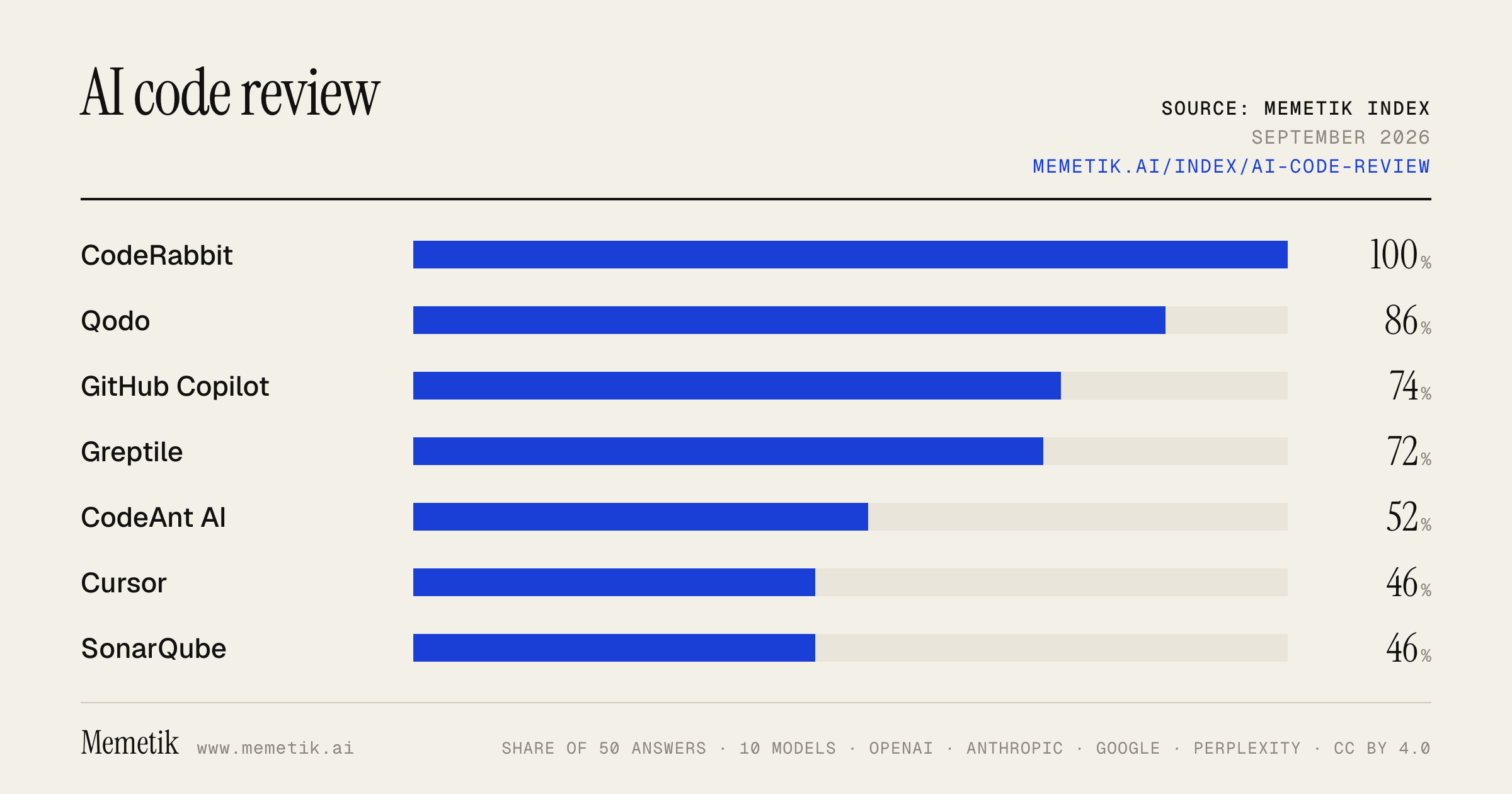
CodeRabbit was named in 50 of 50 answers and came first in 37. Qodo follows at 86%. 13 vendors were named at least once. First edition, so there is no prior period.
Answer share
5 prompts × 10 models · 50 answers
By provider
10 models · 50 answers
OpenAI 3 models · 15 answers
- GPT-5.6 Solgpt-5.6-solmost named: CodeRabbit 100%
- GPT-5.6 Terragpt-5.6-terramost named: CodeRabbit 100%
- GPT-5.6 Lunagpt-5.6-lunamost named: CodeRabbit 100%
Anthropic 3 models · 15 answers
- Claude Opus 5claude-opus-5most named: CodeRabbit 100%
- Claude Sonnet 5claude-sonnet-5most named: CodeRabbit 100%
- Claude Fable 5claude-fable-5most named: CodeRabbit 100%
Google 2 models · 10 answers
- Gemini 3.6 Flashgemini-3.6-flashmost named: CodeRabbit 100%
- Gemini 3.5 Flashgemini-3.5-flashmost named: CodeRabbit 100%
Perplexity 2 models · 10 answers
- Sonar Prosonar-promost named: CodeRabbit 100%
- Sonar Reasoning Prosonar-reasoning-promost named: CodeRabbit 100%
Sources the models cited
- youtube.com210
- codeant.ai151
- sourcegraph.com76
- m.youtube.com76
- techsy.io67
- deepsource.com51
- dev.to45
- greptile.com43
- pecollective.com27
- docs.coderabbit.ai22
- getoptimal.ai20
- qodo.ai19
ChatGPT via API returns no citations, so it does not contribute here.
The prompts
- What is the best AI code review tool for an engineering team? Name specific products.
- Which AI code review tool would you recommend to an engineering team in 2026?
- Compare the top AI code review tool options right now.
- I'm an engineering team and I need an AI code review tool. What should I use and why?
- Best AI code review tool for a fast-moving startup?
Every answer
Raw model output, unedited
GPT-5.6 TerraWhat is the best AI code review tool for an engineering team? Name specific products.
## Best default for most engineering teams: **CodeRabbit**

If you want one product recommendation without a long evaluation cycle, choose **CodeRabbit**. It is the strongest general-purpose option for automated pull-request review: broad Git-provider support (GitHub, GitLab, Azure DevOps, Bitbucket), PR summaries and review comments, configurable review behavior, IDE/CLI feedback, and integrations with issue/workflow tools. That breadth makes it a practical fit for a typical multi-repo engineering organization rather than just a GitHub-only team. ([docs.coderabbit.ai](https://docs.coderabbit.ai/?utm_source=openai))

But “best” depends on what problem you most need to solve:

| If your priority is… | Best product to evaluate first | Why |
|---|---|---|
| **A capable all-around AI PR reviewer** | **CodeRabbit** | Broad platform/workflow coverage; reviews in PRs, IDE, and CLI; supports team feedback and standards. ([docs.coderabbit.ai](https://docs.coderabbit.ai/?utm_source=openai)) |
| **Deep understanding of a large, interconnected codebase** | **Greptile** | Strong fit for teams that need repository-aware reviews, custom plain-English rules, and feedback informed by the codebase rather than only the diff. ([greptile.com](https://www.greptile.com/?utm_source=openai)) |
| **Enterprise governance, custom policy, and private deployment** | **Qodo** | Emphasizes cross-repo context, centralized “living” rules, organizational visibility, plus on-premises and single-tenant deployment options. ([qodo.ai](https://www.qodo.ai/?utm_source=openai)) |
| **You already standardize on Cursor** | **Cursor Bugbot** | Worth evaluating as the low-friction native choice, particularly if you want the review and developer environment under one vendor; validate its context depth and cost in your own repos. ([greptile.com](https://www.greptile.com/content-library/best-ai-code-review-tools?utm_source=openai)) |
| **You already pay for GitHub Copilot broadly** | **GitHub Copilot code review** | Worth piloting as the bundled/low-procurement option before adding another vendor; it is commonly positioned as the practical integrated choice for Copilot-heavy teams. ([stigstack.com](https://stigstack.com/comparisons/ai-code-review-tools/?utm_source=openai)) |

### My practical shortlist

1. **Start with CodeRabbit** for the broadest “plug it into PRs and get useful review coverage” outcome.
2. **Choose Greptile instead** if your recurring misses are architectural, cross-file, or codebase-context bugs.
3. **Choose Qodo instead** if compliance, coding-policy enforcement, platform-team ownership, or data-residency deployment are decisive requirements.

### How to decide without being fooled by demos

Run a **2–4 week pilot** on real PRs with two tools—not a synthetic benchmark. Measure:

- actionable findings accepted by engineers;
- false-positive / ignored-comment rate;
- severe defects found that human review missed;
- review latency and developer annoyance;
- support for your Git host, languages, monorepo, and CI;
- security, retention, training-data, and deployment requirements.

Treat any AI reviewer as a **first-pass reviewer, not a merge authority**. The winning tool is the one that catches meaningful issues while adding the least comment noise to your team’s actual codebase.
GPT-5.6 TerraWhich AI code review tool would you recommend to an engineering team in 2026?
**My default recommendation in 2026: CodeRabbit**—particularly for a team that wants an AI reviewer deployed quickly across ordinary pull-request workflows, without first adopting a new code-review process.

It is purpose-built for automated PR reviews and combines repository-aware AI feedback with conventional linters/security scanners; it also supports GitHub, GitLab, Azure DevOps, and Bitbucket, plus IDE and CLI feedback for earlier (“shift-left”) review. ([docs.coderabbit.ai](https://docs.coderabbit.ai/guides/code-review-overview?utm_source=openai))

### Choose a different tool when the context fits

| Situation | Recommendation | Why |
|---|---|---|
| **Most teams; mixed Git providers; want a strong standalone AI reviewer** | **CodeRabbit** | Broad integrations, automated/incremental PR review, suggested fixes, and layered AI + static-analysis workflow. ([docs.coderabbit.ai](https://docs.coderabbit.ai/guides/code-review-overview?utm_source=openai)) |
| **GitHub-native team; lowest-change rollout matters most** | **GitHub Copilot Code Review** | Best default pilot if Copilot and GitHub are already approved internally; it keeps review inside the platform developers already use. GitHub’s current documentation continues to support PR code-review workflows. ([code.visualstudio.com](https://code.visualstudio.com/docs/agents/guides/code-review-with-copilot?utm_source=openai)) |
| **Large enterprise with strict standards, multi-repo context, or on-prem requirements** | **Qodo** | Stronger fit when governance is the buying criterion: centralized rules, multi-repo context, administration, and an on-premise deployment option. ([docs.qodo.ai](https://docs.qodo.ai/code-review?utm_source=openai)) |
| **GitHub team that also wants stacked PRs, merge queue, and a modern review workflow** | **Graphite** | Consider it when you want to improve the *whole* review system—not merely add an AI bot. Its agent offers configurable rules/exclusions and PR-context chat, but it is most compelling if you want Graphite’s workflow product too. ([graphite.com](https://graphite.com/docs/ai-reviews-setup?utm_source=openai)) |
| **Open-source/self-managed experimentation** | **PR-Agent / Qodo’s open-source lineage** | A viable starting point for teams able to own the operational/model-integration burden themselves. ([qodo-merge-docs.qodo.ai](https://qodo-merge-docs.qodo.ai/index?utm_source=openai)) |

### How I would make the decision

Run a **four-week, two-repository pilot** between CodeRabbit and either Copilot (if GitHub-centric) or Qodo (if compliance/governance-centric). Do not judge on demo quality. Track:

- **Precision:** percentage of comments engineers mark as actionable.
- **Recall:** whether it catches seeded defects and bugs later found in QA/production.
- **Noise:** comments per PR and dismissal rate.
- **Latency and cost:** time-to-review plus marginal cost per merged PR.
- **Security and data posture:** source-code retention, model-training terms, access scopes, audit logs, SSO/SCIM, and self-hosting requirements.
- **Developer acceptance:** whether reviewers actually read and act on comments.

Set it to comment on **high-confidence bug/security/correctness findings first**. Add style or refactoring rules only after the signal is proven. An AI reviewer should be a first-pass reviewer and a prioritization aid—not an approval substitute for human ownership, tests, static analysis, dependency scanning, and threat modeling.

**Bottom line:** pick **CodeRabbit** as the broad default; pick **Copilot Code Review** for maximum GitHub simplicity; pick **Qodo** when governed, context-rich, potentially on-prem code review is the primary need; and pick **Graphite** if upgrading your PR workflow is part of the project.
- https://docs.coderabbit.ai/guides/code-review-overview?utm_source=openai
- https://code.visualstudio.com/docs/agents/guides/code-review-with-copilot?utm_source=openai
- https://docs.qodo.ai/code-review?utm_source=openai
- https://graphite.com/docs/ai-reviews-setup?utm_source=openai
- https://qodo-merge-docs.qodo.ai/index?utm_source=openai
GPT-5.6 TerraCompare the top AI code review tool options right now.
## Top AI code-review options as of September 2, 2026

For most teams, the strongest shortlist is **GitHub Copilot code review**, **CodeRabbit**, and **Qodo**. They overlap, but optimize for different workflows.

| Tool | Best for | Standout strengths | Watch-outs |
|---|---|---|---|
| **GitHub Copilot code review** | Teams already standardized on GitHub | Native PR workflow, IDE review, automatic review rules, agentic context gathering, suggested fixes | Paid-plan / AI-credit model; deepest workflow is GitHub-centric |
| **CodeRabbit** | Teams wanting a dedicated AI reviewer across PRs, IDE, and CLI | Purpose-built review experience, review walkthroughs, custom knowledge/context, autofix, linter/SAST integration, multi-repo analysis | Per-developer hourly review limits; meaningful PR review features require a paid plan |
| **Qodo** | Organizations that want review policies and tailored feedback | Multi-agent review, rule enforcement, context-aware PR feedback; useful for governing AI-generated code | Newer v2 experience means you should validate signal quality on your own repositories before a broad rollout |
| **GitHub Code Quality** *(companion, not a direct replacement)* | GitHub teams needing deterministic quality/security controls alongside AI review | CodeQL-backed rules, coverage metrics, optional merge gating, one-click/Copilot remediation | It complements Copilot review rather than replacing an AI reviewer |

### 1. GitHub Copilot code review — best default for GitHub-native teams

**Choose it if:** your code, pull requests, identity, permissions, and CI are already centered on GitHub.

Copilot can review PR diffs in any language, leave actionable inline feedback, and offer suggested changes that can be applied directly. It works on GitHub.com and in common developer environments including VS Code, Visual Studio, Xcode, JetBrains IDEs, the GitHub CLI, and GitHub Mobile. ([docs.github.com](https://docs.github.com/en/copilot/concepts/agents/code-review?utm_source=openai))

Its biggest advantage is **operational simplicity**: you can automatically request reviews when PRs open, when drafts are opened, or after new pushes. GitHub also supports a configurable “balanced” review effort for deeper analysis, repository instructions, MCP servers, and self-hosted runners for internal context. ([docs.github.com](https://docs.github.com/en/copilot/how-tos/copilot-on-github/set-up-copilot/configure-code-review?utm_source=openai))

**Trade-offs:** Code review is available on paid Copilot plans and consumes AI credits; agentic review behavior can also consume GitHub Actions minutes. GitHub’s documentation also says model selection is not exposed for code review. ([docs.github.com](https://docs.github.com/en/copilot/concepts/agents/code-review?utm_source=openai))

**My take:** If you want the lowest-friction rollout and already pay for Copilot, start here. Pair it with human review and deterministic checks—not as an approval substitute.

---

### 2. CodeRabbit — best dedicated AI PR-review product

**Choose it if:** you want AI review to be a first-class practice, rather than an add-on to a coding assistant.

CodeRabbit spans **PR review, IDE review, and CLI review**. Its paid plans add review-specific features such as repository knowledge, integrations, linter/SAST support, analytics, docstrings, and autofix. Its higher Pro+ tier extends beyond review into planning, test generation, and merge-conflict resolution. ([docs.coderabbit.ai](https://docs.coderabbit.ai/management/plans?utm_source=openai))

It is especially attractive if you need **cross-repository awareness**: CodeRabbit’s multi-repo analysis supports linked repositories, with plan-dependent limits. Its documentation lists one linked repo on Pro and up to ten on Pro+. ([docs.coderabbit.ai](https://docs.coderabbit.ai/management/plans?utm_source=openai))

**Pricing / capacity:** its documented annual pricing is **$24/developer/month for Pro** and **$48/developer/month for Pro+**; the product also applies per-developer hourly limits to PR, IDE, and CLI reviews. ([docs.coderabbit.ai](https://docs.coderabbit.ai/management/plans?utm_source=openai))

**Trade-offs:** evaluate the quota model against your actual PR volume—especially for teams that want automatic review on every push.

**My take:** This is the best option when the goal is a **specialized automated reviewer** with richer review workflows and configurable organizational context.

---

### 3. Qodo — best for policy-driven, context-heavy review

**Choose it if:** you care most about enforcing team-specific review rules and governing a large volume of AI-generated changes.

Qodo’s current v2 code-review offering emphasizes **multi-agent review, rule enforcement, and context-aware feedback directly in pull requests**. Its documentation positions the product around surfacing bugs and issues while integrating with existing Git workflows. Qodo v2 was released on **February 4, 2026**; its older Qodo Merge / PR-Agent experience remains available as v1. ([docs.qodo.ai](https://docs.qodo.ai/code-review?utm_source=openai))

**Trade-offs:** Because review quality depends heavily on your architecture, conventions, and false-positive tolerance, run a controlled comparison on representative PRs before standardizing. This applies to every AI reviewer, but especially to tools differentiated by custom rules and agents.

**My take:** Put Qodo on the shortlist when **enforceable engineering standards** and customized organizational review behavior matter more than merely getting generic bug comments.

---

### 4. GitHub Code Quality — add this when you need merge-enforceable checks

This is not the same thing as Copilot code review. GitHub Code Quality adds rules-based CodeQL findings on PRs, coverage metrics, optional merge gating, and remediation workflows. On the default branch, it can additionally surface AI-powered findings on recently changed files. GitHub explicitly frames it as complementary to Copilot code review. ([docs.github.com](https://docs.github.com/en/code-security/concepts/code-quality/code-quality?utm_source=openai))

**Best pattern for a GitHub team:**
**Copilot code review** for broad AI feedback + **Code Quality** for repeatable, auditable, merge-gated controls.

---

## Recommendation by situation

- **Small or midsize GitHub team:** **GitHub Copilot code review** first. It is the easiest deployment and likely already fits your toolchain.
- **Engineering organization seeking the strongest dedicated reviewer:** **CodeRabbit** first, with a pilot focused on false-positive rate, useful catches, and reviewer time saved.
- **Platform / enterprise team with strict internal conventions:** **Qodo** first, particularly if you want explicit review rules and context-aware policy enforcement.
- **Security-, reliability-, or compliance-sensitive GitHub repos:** use **Copilot code review + GitHub Code Quality**, while retaining human approval and CI gates.

## How to evaluate them fairly

Run a 2–4 week pilot using the same PR set and track:

1. **Precision:** What percentage of comments lead to
- https://docs.github.com/en/copilot/concepts/agents/code-review?utm_source=openai
- https://docs.github.com/en/copilot/how-tos/copilot-on-github/set-up-copilot/configure-code-review?utm_source=openai
- https://docs.coderabbit.ai/management/plans?utm_source=openai
- https://docs.qodo.ai/code-review?utm_source=openai
- https://docs.github.com/en/code-security/concepts/code-quality/code-quality?utm_source=openai
GPT-5.6 TerraI'm an engineering team and I need an AI code review tool. What should I use and why?
## Short answer

**For most engineering teams, I’d start with CodeRabbit.** It is the strongest default choice if you want a dedicated AI reviewer that works directly in pull requests, offers configurable review noise/strictness, understands repository context, incorporates static-analysis tooling, and can also be used in the IDE and CLI before code reaches a PR. ([docs.coderabbit.ai](https://docs.coderabbit.ai/guides/code-review-overview?utm_source=openai))

But the best choice depends chiefly on your Git host and security/governance requirements:

| If your situation is… | Use | Why |
|---|---|---|
| You use GitHub and already standardize on Copilot | **GitHub Copilot Code Review + GitHub Code Quality** | Lowest-friction, native PR workflow; automatic review options; Code Quality adds CodeQL-based rules, coverage signals, and optional merge gating. ([docs.github.com](https://docs.github.com/en/copilot/concepts/agents/code-review?utm_source=openai)) |
| You want the best general-purpose dedicated AI PR reviewer | **CodeRabbit** | Broad review workflow: PR summaries, severity-ranked findings, fixes, repository context, configurable triggers/path exclusions, IDE support, and CLI/pre-commit use. ([docs.coderabbit.ai](https://docs.coderabbit.ai/guides/code-review-overview?utm_source=openai)) |
| You need enterprise policy enforcement, cross-repo context, or on-prem deployment | **Qodo** | Its newer review workflow emphasizes multi-agent review, organization-specific rules, PR history and codebase context; its documentation also lists centralized governance and on-prem deployment. ([docs.qodo.ai](https://docs.qodo.ai/code-review?utm_source=openai)) |

## My practical recommendation

### Choose **CodeRabbit** if you need one tool today
It is a good fit where the pain is: “Our PRs are growing faster than senior reviewers can keep up.”

Why:
- Reviews newly opened PRs and can run incremental reviews for later pushes. ([docs.coderabbit.ai](https://docs.coderabbit.ai/guides/code-review-overview?utm_source=openai))
- Combines AI feedback with security/quality checks and supports repository-level context. ([docs.coderabbit.ai](https://docs.coderabbit.ai/guides/code-review-overview?utm_source=openai))
- Lets you control noise: limit branches, exclude generated/lock files, skip drafts, use labels/keywords, and decide when re-reviews occur. ([docs.coderabbit.ai](https://docs.coderabbit.ai/configuration/auto-review?utm_source=openai))
- Gives developers a shift-left option in VS Code-compatible editors and through CLI workflows, rather than making PR review the first feedback loop. ([docs.coderabbit.ai](https://docs.coderabbit.ai/index?utm_source=openai))

**Suggested configuration:** start in its lower-noise / high-signal mode, only auto-review non-draft PRs to your main integration branch, exclude generated files and lockfiles, and require humans to approve all production-impacting changes.

### Choose **GitHub Copilot Code Review** if consolidation matters more than specialized tooling
If your repositories are in GitHub and your developers already have paid Copilot access, this is probably the most economical operational decision. Copilot can be assigned to PRs or configured for automatic review; GitHub Code Quality complements it with rules-based CodeQL analysis, coverage metrics, suggested remediation, and optional ruleset-based blocking. ([docs.github.com](https://docs.github.com/en/copilot/concepts/agents/code-review?utm_source=openai))

This is especially compelling if your team values:
- fewer vendors and integrations,
- one administration/billing/security boundary,
- native GitHub reviewer and ruleset workflows.

## When I would pick Qodo instead

Pick **Qodo** over CodeRabbit when AI review must reflect **institutional engineering policy**, not just generic best practices—for example: a regulated environment, a large multi-repo platform, teams with detailed internal standards, or a need for on-prem deployment. Qodo’s current platform centers code review, multi-repository context, governance/rule management, and on-prem options. ([docs.qodo.ai](https://docs.qodo.ai/code-review?utm_source=openai))

## Don’t make the tool a merge authority on day one

AI review should be an additional reviewer, not a replacement for:
- unit/integration tests,
- SAST and dependency scanning,
- CI checks,
- human review for architectural, security-sensitive, and customer-impacting code.

Run a **4-week pilot** on 3–5 representative repositories. Measure:
1. **Accepted findings per 100 PRs** — signal quality.
2. **False-positive rate** — reviewer trust/noise.
3. **Median PR time to first review and merge** — throughput impact.
4. **Bugs caught before merge** that existing tests/lints missed.
5. **Developer sentiment** after two weeks, not just at kickoff.

Only make AI review required after the team agrees that its high-severity findings are consistently useful.

**Bottom line:**
- **Default choice:** CodeRabbit.
- **GitHub-centric / simplest stack:** GitHub Copilot Code Review + Code Quality.
- **Enterprise governance or on-prem:** Qodo.
- https://docs.coderabbit.ai/guides/code-review-overview?utm_source=openai
- https://docs.github.com/en/copilot/concepts/agents/code-review?utm_source=openai
- https://docs.qodo.ai/code-review?utm_source=openai
- https://docs.coderabbit.ai/configuration/auto-review?utm_source=openai
- https://docs.coderabbit.ai/index?utm_source=openai
GPT-5.6 TerraBest AI code review tool for a fast-moving startup?
## Best default choice: **CodeRabbit**

For a fast-moving startup, I’d start with **CodeRabbit**—especially if you want an AI reviewer that is opinionated, automated, and works across your engineering workflow rather than only inside one vendor’s ecosystem. It supports PR reviews on GitHub, GitLab, Azure DevOps, and Bitbucket, plus IDE and CLI feedback, so developers can catch issues before the PR review queue. ([docs.coderabbit.ai](https://docs.coderabbit.ai/?utm_source=openai))

### Why it’s the best startup default
- **Fast feedback loop:** automated inline PR comments and pre-commit/IDE options.
- **Less platform lock-in:** useful if Git hosting or editor choices may change.
- **Good for small teams:** catches routine bugs, missing edge cases, questionable patterns, and generates summaries—freeing humans to focus on architecture and product risk.
- **Can grow with you:** integration with issue trackers and visibility into review-flow metrics. ([docs.coderabbit.ai](https://docs.coderabbit.ai/?utm_source=openai))

## Choose something else when…

| Situation | Best pick | Why |
|---|---|---|
| You are all-in on GitHub and already buy Copilot | **GitHub Copilot Code Review** | Lowest-friction choice: native PR reviewer, automatic reviews/re-reviews, repo/path-specific instructions, adjustable review effort, and suggested fixes. ([docs.github.com](https://docs.github.com/en/copilot/how-tos/use-copilot-agents/request-a-code-review/use-code-review?ref=stdy.blog&tool=vscode&utm_source=openai)) |
| Your team lives in Cursor | **Cursor Bugbot** | Automatic PR reviews, manual triggers, and a direct “fix in Cursor” workflow make it compelling for a Cursor-standardized team. ([docs.cursor.com](https://docs.cursor.com/bugbot?utm_source=openai)) |
| You need more configurable, process-heavy review workflows | **Qodo** | Worth evaluating for more structured review policies and customization; its current v2 review experience emphasizes prioritized findings. ([docs.qodo.ai](https://docs.qodo.ai/code-review?utm_source=openai)) |

## Rollout advice

Don’t make an AI reviewer a merge gate in week one. Run it on **all PRs but advisory-only** for 2–3 weeks, then:
1. Track comment acceptance/dismissal rates.
2. Add repo-specific instructions: architecture boundaries, security requirements, testing expectations, and “don’t comment on formatting.”
3. Tune it to prioritize correctness, auth/payments, migrations, concurrency, and public API changes.
4. Keep human approval required for production-impacting code.

**Bottom line:**
- **CodeRabbit** = strongest general startup choice.
- **GitHub Copilot Review** = strongest choice if GitHub/Copilot is already your standard.
- **Cursor Bugbot** = strongest if Cursor is your standardized development environment.
Claude Sonnet 5What is the best AI code review tool for an engineering team? Name specific products.
There's no single "best" tool — it depends on your team's size, git platform, IDE, and whether you need security scanning bundled in. Here's a practical breakdown of the leading options as of 2026:

## Top general-purpose PR reviewers

- **CodeRabbit** –
the most installed AI code review app on GitHub, with over 2 million repositories connected, with a setup that's as simple as installing the GitHub app before it starts posting inline comments and PR summaries.
 It has a free tier, making it a low-risk starting point. On accuracy, though,
its pure LLM approach has a tradeoff — on the OpenSSF CVE Benchmark it scored 59.39% accuracy with a 36.19% F1 score.


- **Greptile** – Frequently recommended as
the strongest pure reviewer for teams that want only code review quality without analytics.


- **Qodo** – Often suggested
for enterprise governance
 needs, and one review site notes
a solo developer doesn't need Qodo's air-gapped deployment
, implying it's built for larger, security-conscious orgs.

- **Macroscope** – A newer, precision-focused entrant.
It's gaining traction among teams frustrated by noise, with its v3 engine (shipped February 2026) reporting 98% precision while detecting 3.5x more production-critical bugs than its previous version, with nitpick comments down 64% in Python and 80% in TypeScript.


- **CodeAnt AI** – According to an independent benchmark,
ranked using the Martian Code Review Bench, the first independent benchmark across 300,000 real PRs, CodeAnt AI placed #3 globally with a 51.7% F1 score.
 It's also notable because
it's one of the only tools that bundles AI-powered pull request reviews, SAST, secrets detection, IaC scanning, SCA, and DORA metrics together.


## IDE/ecosystem-native options

- **Cursor BugBot** – Best if your team already codes in Cursor, though it comes with a caveat:
since Cursor generates the code and then reviews it, the architecture is designed to be adversarial using different models for generation and review, but it's worth your team discussing that separation of concerns.


- **Claude Code Review (Anthropic)** –
A multi-agent review system built into Claude Code that dispatches 9 parallel sub-agents when you open a PR, each specialized in a different dimension of code quality like bug detection, test coverage, and more.
 Pricing is usage-based:
it has no flat monthly rate — it's token-based at $15-25/PR.


- **GitHub Copilot Code Review** – Convenient if you're all-in on GitHub, but watch the cost model:
Copilot at $10/mo looks cheap until code review shares your AI Credits pool with chat and agent mode, and since June 2026 also draws GitHub Actions minutes on every run.


- **ChatGPT Codex** –
OpenAI's full-stack coding agent that can autonomously write features, fix bugs, run tests, and review entire codebases, now running on the GPT-5.6 model family, integrating directly with GitHub to auto-review every PR.


## Security/quality-gate focused

- **SonarQube / SonarCloud** – Best if you want review bundled with a hard quality gate.
It's a code quality and security verification platform that integrates into CI/CD pipelines and pull requests, analyzes 40+ languages, and uses customizable quality gates to block merges that fail defined standards, with AI features that automatically write fixes.
 Pricing starts around
$34/mo but includes SAST, quality gates, and compliance reporting alongside AI review.


- **Semgrep** –
The most established open-source option for security-focused analysis
, though note
the open-source ecosystem overall has strong static analysis but no mature AI PR review equivalent to the commercial tools.


- **Panto AI** –
Offers a unified AI-driven code review and AppSec platform combining static analysis, secrets detection, dependency scanning, and infrastructure-as-code security into a single workflow.


## My practical recommendation

If you just want a fast, low-friction starting point: **CodeRabbit** (free tier, GitHub/GitLab native, minimal setup).

If code review quality/precision is your top priority and you're frustrated by noisy AI comments: **Greptile** or **Macroscope**.

If you need security scanning (SAST/secrets/IaC) bundled with AI review rather than running separate tools: **CodeAnt AI**, **SonarQube/SonarCloud**, or **Panto AI**.

If your team is already deep in a specific ecosystem: use the native option — **Cursor BugBot** for Cursor users, **Claude Code Review** or **GitHub Copilot Code Review** for Anthropic/GitHub-centric shops.

One useful framing from a recent guide:
for most engineering teams on GitHub or GitLab with 5–200 engineers, look for full codebase context, engineering analytics, flat pricing, and fast setup
- https://deepsource.com/resources/ai-code-review-tools
- https://getoptimal.ai/blog/best-ai-code-review-tools
- https://techsy.io/en/blog/best-ai-code-review-tools
- https://medium.com/@lewis_75321/the-best-ai-code-review-tools-in-2026-599c7dd1b305
- https://codeant.ai/blogs/best-ai-code-review-tools
- https://www.getpanto.ai/blog/best-ai-code-review-tools
- https://www.greptile.com/content-library/best-ai-code-review-tools
Claude Sonnet 5Which AI code review tool would you recommend to an engineering team in 2026?
I'll look into current options to give you an informed, up-to-date recommendation.
Based on current benchmarks and comparisons, here's what I'd recommend depending on your team's priorities:

## Top general recommendation: **CodeRabbit**
Across multiple independent write-ups, it comes up as the strongest all-around pick.
For the best all-around value, CodeRabbit works across all four major Git platforms with the lowest false positive rate.
 Real-world usage backs this up:
CodeRabbit integrates with GitHub and GitLab to automatically review pull requests, commenting on potential bugs, security issues, performance concerns, and style inconsistencies.

It catches issues that human reviewers miss, especially in unfamiliar codebases, and its signal-to-noise ratio is the best among AI review tools.
 It's also budget-friendly —
free for open source, and $15/user/month for private repos.
 One caveat:
it occasionally flags non-issues and needs tuning per repository.


## If you want the most thorough/deepest review: **Claude Code Review (Anthropic)**

Claude Code Review is the most thorough option, using 9 parallel sub-agents to catch bugs other tools miss.
 Technically,
it's Anthropic's multi-agent review system built into Claude Code — when you open a PR, it dispatches 9 parallel sub-agents, each specialized in a different dimension of code quality: bug detection, test coverage, and more.


## If you want AI review + real static analysis combined: **DeepSource**

DeepSource is the only tool that runs a deterministic static analysis engine before the AI agent touches the code
, and
the static pass applies 5,000+ rules across 30+ languages.
 This matters because accuracy differs wildly between tools —
accuracy varies wildly, from 6% to 82% on real vulnerabilities
 — so pairing AI with deterministic analysis reduces the risk of missed bugs or noisy false positives.

## If security/SAST consolidation is a priority: a SonarQube-style combined platform
If your team currently juggles separate SAST and AI review tools, some platforms (e.g., CodeAnt AI and similar all-in-one tools) target
engineering teams that want to replace their fragmented stack (review tool + SAST tool + developer metrics tool) with a single platform.


## If you manage cloud infrastructure heavily: **Gomboc**
It's a different lane —
it doesn't just flag security issues, it fixes them, focusing specifically on infrastructure-as-code security, analyzing Terraform, CloudFormation, and similar configurations to identify misconfigurations and then autonomously generating remediation pull requests.


## Important caveat on "best" rankings
Be cautious with listicles —
every top-ranking article about the best AI code review tools is written by a vendor; CodeRabbit's blog ranks CodeRabbit first, Qodo's blog ranks Qodo first.
 The more credible signal comes from independent benchmarks:
Martian, a research lab built by researchers from DeepMind, Anthropic, and Meta, and notably not in the business of selling code review tools, tested 17 tools across 300,000 real pull requests from open-source repositories, measuring which review comments developers actually acted on.
 Still,
no benchmark is definitive yet.


## Bottom line
Whichever tool you choose, treat it as a first-pass filter, not a replacement for human judgment:
AI reviewers are good at catching mechanical bugs and applying patterns consistently across hundreds of pull requests, but humans are still better at architectural decisions, judgment calls about scope and risk, and mentoring — the right code review process in 2026 puts AI in the first-pass reviewer role and humans in the deciding role.


**My concrete recommendation**: Start with **CodeRabbit** for the best balance of cost, low false-positive rate, and multi-platform support. If you're an Anthropic/Claude-heavy shop already, layer in **Claude Code Review** for deeper multi-agent analysis on critical PRs. If security and infra-as-code are major concerns, add **Gomboc** or a SAST-integrated tool like **DeepSource** to the stack rather than relying on one tool for everything.
- https://techsy.io/en/blog/best-ai-code-review-tools
- https://pecollective.com/blog/best-ai-coding-tools-2026/
- https://deepsource.com/resources/ai-code-review-tools
- https://codeant.ai/blogs/best-ai-code-review-tools
- https://www.gomboc.ai/blog/5-best-ai-code-review-tools-in-2026/index.html
- https://sourcegraph.com/blog/automated-code-review-tools
Claude Sonnet 5Compare the top AI code review tool options right now.
Here's a comparison of the leading AI code review tools available right now, based on multiple independent rankings and benchmarks.

## Top Contenders at a Glance

**CodeRabbit** — The most consistently well-rated all-rounder.
It's rated for all-around, multi-platform use at $24/dev/mo (Pro Plus $48), supporting GitHub, GitLab, Bitbucket, and Azure DevOps, with a 44% catch rate and low false positives.
 It's also praised for
PR walkthroughs and diff-level summaries with inline comments.


**Greptile** — Best for deep, whole-codebase understanding. One benchmark found it has an
82% catch rate (the highest), with a free tier or $30/dev/mo plus $1/review after 50
, and it's known for
full-codebase context review that catches bugs invisible from the diff alone.


**Qodo (formerly CodiumAI)** — Strong for enterprise/multi-repo teams.
Qodo offers multi-agent review with test generation, a free individual/free path, and strong monorepo support via its Context Engine, priced per seat.
 It also stands out for
Jira ticket compliance validation built into PR review.


**GitHub Copilot Code Review** — Best for zero-setup GitHub-native teams. It's
a zero-setup option for GitHub teams, priced $10-$39/user/mo (usage-based since June 2026), with a 54% catch rate but mixed quality.


**Cursor BugBot** — Tightly integrated with the Cursor IDE. It offers
agentic autofix with an 80% resolution rate, priced $20-$40/user/mo (usage-based)
, standing out for
diff review tied to the Cursor editor environment.


**Graphite Agent** — Best for high-velocity teams using stacked PRs. It has a
less than 5% negative comment rate, focused on stacked PRs with low noise, priced $20-$40/user/mo.


**SonarQube** — The enterprise static-analysis heavyweight, now with AI layered in. It's built for
enterprise code quality gates and compliance, with a Community edition and strong monorepo support, priced per LOC/per user.
 One source notes it has analyzed
750B+ lines analyzed daily, with an "AI Code Assurance"
 feature.

**CodeAnt AI** — A newer entrant that scores well on independent benchmarks.
CodeAnt AI ranked #3 globally with 51.7% F1 on the Martian Code Review Bench, offering a 14-day trial at $24/user/month across GitHub, GitLab, Bitbucket, and Azure DevOps
, positioned as
AI review + SAST + security in one.


**Codacy & Snyk Code** — More security/compliance-oriented. Codacy is used for
mixed-stack code quality + security in one UI
, while Snyk Code focuses on
security-focused SAST and SCA.


## Key Decision Factors

**Platform coverage matters a lot.** If you're not purely on GitHub, options narrow quickly —
only 4 tools support all major platforms (GitHub, GitLab, Bitbucket, Azure DevOps), with CodeAnt AI and CodeRabbit being the strongest among them.


**Accuracy varies widely and is still hard to verify independently.** Vendor-reported "catch rates" range from Greptile's claimed 82% down to CodeRabbit's 44% (with fewer false positives), and several tools like Qodo and Codacy have **no independent benchmark data** yet — so vendor claims should be weighed cautiously against noise/false-positive rates too.

**Pricing clusters around $20–30/user/month** for most AI-native tools (CodeRabbit, Greptile, Qodo, CodeAnt AI, Graphite), while GitHub Copilot is cheaper at the entry tier ($10+) and SonarQube's enterprise tier is priced very differently (per-LOC or $2,500+/year).

## Recommendation Framework

- **Multi-platform teams (GitLab/Bitbucket/Azure DevOps):** CodeAnt AI or CodeRabbit
- **Deepest codebase/architecture understanding:** Greptile
- **Already in the Cursor ecosystem:** Cursor BugBot
- **Enterprise compliance + security + SAST:** SonarQube or Snyk Code
- **Stacked-PR, high-velocity workflows:** Graphite
- **Cross-repo enterprise + ticket compliance:** Qodo
- **Zero setup, already paying for Copilot:** GitHub Copilot Code Review

Given how fast this space is moving (multiple sources note pricing and rankings have shifted significantly within the past few months), it's worth checking current vendor pricing pages before committing, as billing models in this category have been changing frequently.
Claude Sonnet 5I'm an engineering team and I need an AI code review tool. What should I use and why?
I'll research the current landscape of AI code review tools to give you an informed recommendation.
Based on current benchmarks and comparisons, here's my breakdown of the AI code review landscape, and how to pick the right tool for your team:

## The honest starting point

Take "best of" rankings with a grain of salt — as one comparison site itself points out,
"Every top-ranking article about the best AI code review tools is written by a vendor. CodeRabbit's blog ranks CodeRabbit first. Qodo's blog ranks Qodo first."
 The good news is there's now actual independent data to lean on rather than marketing copy.

The most credible benchmark comes from Martian:
a research lab built by researchers from DeepMind, Anthropic, and Meta, not in the business of selling code review tools, which tested 17 tools across 300,000 real pull requests from open-source repositories, measuring which review comments developers actually acted on.
 Importantly,
they open-sourced the dataset, the judge prompts, the evaluation pipeline, and the methodology, so anyone can reproduce the results.
 That said, it's brand new —
it was only launched in February 2026 and covers around 300,000 real-world PRs, and no benchmark is definitive yet.


A second independent effort from DeepSource benchmarks tools against real CVEs:
accuracy was measured against the OpenSSF CVE Benchmark, a public dataset of 200+ real-world production vulnerabilities across multiple languages and vulnerability classes.
 The spread is striking —
accuracy varies wildly, from 6% to 82% on real vulnerabilities.
 That gap alone is a good reason not to pick a tool by name recognition alone.

## Strong options depending on what you need

**CodeRabbit** — Generally considered the best all-around, budget-friendly pick.
It works across all four major Git platforms with the lowest false positive rate
 among competitors. It's also praised elsewhere for signal quality:
it catches issues that human reviewers miss, especially in unfamiliar codebases, and has the best signal-to-noise ratio among AI review tools.
 Pricing is approachable:
free for open source, $15/user/month for private repos.
 Its main weakness is minor:
it occasionally flags non-issues and needs tuning per repository.


**Claude Code Review (Anthropic)** — If thoroughness matters more than cost, this is worth a look.
It's Anthropic's multi-agent review system built into Claude Code — when you open a PR, it dispatches 9 parallel sub-agents, each specialized in a different dimension of code quality: bug detection, test coverage, and more.
 It's described as
the most thorough option, using 9 parallel sub-agents to catch bugs other tools miss.


**DeepSource** — Best if you want deterministic accuracy alongside AI judgment.
It's the only tool that runs a deterministic static analysis engine before the AI agent touches the code, applying 5,000+ rules across 30+ languages.
 Good fit if you're tired of AI-only tools hallucinating issues.

**SonarQube** — The established, rule-based static analysis veteran, useful if you want a mature, battle-tested engine rather than pure LLM review:
SonarQube is the longstanding rule-based static analysis platform for code smells, vulnerabilities, and duplication.


**Gomboc** — Niche but compelling if your pain point is infrastructure-as-code.
It doesn't just flag security issues, it fixes them — analyzing Terraform, CloudFormation, and similar configurations to identify misconfigurations and then autonomously generating remediation pull requests.


**CodeAnt AI** — Worth considering if tool sprawl is your problem.
Best for engineering teams that want to replace their fragmented stack (review tool + SAST tool + developer metrics tool) with a single platform.


## How I'd recommend you decide

1. **If you want the safest, most cost-effective default**: start with **CodeRabbit**. It has the best combination of low false-positive rate, multi-platform support, and reasonable pricing.
2. **If security/compliance is a top priority**: look at **DeepSource** or **SonarQube**, since deterministic static analysis reduces the risk of an LLM missing or hallucinating a real CVE-class vulnerability.
3. **If you're already deep in the Anthropic/Claude ecosystem**: Claude Code Review's multi-agent approach is the most rigorous.
4. **If infra-as-code security is your biggest exposure**: Gomboc's auto-remediation is unusually practical.
5. **If you're drowning in tool sprawl**: consolidate with something like CodeAnt AI rather than bolting on yet another point solution.

One process point worth internalizing regardless of tool choice:
AI reviewers are good at catching mechanical bugs and applying patterns consistently across hundreds of pull requests, but humans are still better at architectural decisions, judgment calls about scope and risk, and mentoring — the right code review process puts AI in the first-pass reviewer role and humans in the deciding role.


**Practical next step**: Given how fast this space is moving and how much benchmark accuracy varies by tool, I'd suggest running a 2-
- https://techsy.io/en/blog/best-ai-code-review-tools
- https://codeant.ai/blogs/best-ai-code-review-tools
- https://deepsource.com/resources/ai-code-review-tools
- https://pecollective.com/blog/best-ai-coding-tools-2026/
- https://sourcegraph.com/blog/automated-code-review-tools
- https://www.gomboc.ai/blog/5-best-ai-code-review-tools-in-2026/index.html
Claude Sonnet 5Best AI code review tool for a fast-moving startup?
For a fast-moving startup, the right pick depends mainly on budget, team size, and how much setup time you're willing to invest. Here's how the top options stack up:

## Top pick for most startups: **CodeRabbit**

CodeRabbit is the tool that most startups should try first, thanks to the cleanest combination of free tier, platform coverage, and review depth in the category.
 It
posts AI-generated comments directly on your pull requests, generates a plain-English summary of what the PR changes, and suggests fixes you can apply with one click.
 It also
works on GitHub, GitLab, Bitbucket, and Azure DevOps
, which matters if you're not purely a GitHub shop.

Pricing-wise, a small team (2–10 devs) would run
CodeRabbit Pro ($24/user/month)
. One caveat: it has moved to
usage-based billing in 2026 — the $30/seat/mo Pro plan includes only 50 credits, and every review beyond that costs $1, which has caused bills to spike hard for teams running agentic coding workflows that open dozens of PRs a day
.

## Best for AI-heavy / agentic coding workflows: **Greptile**
If your team leans heavily on AI coding agents (Cursor, Claude Code, Codex, Devin) generating lots of PRs, Greptile is worth a serious look.
Greptile is the strongest pick for teams whose pull requests come from coding agents like Claude Code, Cursor, Codex, and Devin.
 It's also startup-friendly on price:
Greptile offers a free Starter plan for one active developer with 50 credits per month and unlimited repositories, plus a 50% pre-Series A startup discount and free access for open-source projects.
 Setup is minimal too —
it installs as a GitHub or GitLab app with reviews live in around five minutes, with no YAML configuration required.


One tradeoff noted in benchmarks: Greptile has shown
more false positives than any competitor: 11 per benchmark run versus CodeRabbit's 2
, so
your team needs tolerance for noise, especially in the first few weeks.


## If security/compliance matters early: **CodeAnt AI or SonarQube**
- **CodeAnt AI** is
best for startups and mid-sized teams seeking a developer-friendly security scanning solution that prioritizes accuracy and actionable feedback over sheer volume of alerts
, and it's notable because
it combines SAST-driven defensive code review with offensive penetration testing in a single system, performing AST-aware, line-by-line analysis across the IDE, CLI, and CI/CD with 30,000+ deterministic checks alongside AI analysis for 30+ languages.

- **SonarQube** is a good fit if you want a verification layer for AI-generated code specifically:
its 2026 release puts more emphasis on AI-generated code, helping teams verify that code produced by AI coding tools still meets their quality and security standards before it reaches production.
 It starts around
$34/mo but includes SAST, quality gates, and compliance reporting alongside AI review.


## Cheapest path if you're already paying for Copilot: **GitHub Copilot Code Review**
At
$10/mo, though code review now shares your AI Credits pool with chat and agent mode, and since June 2026 also draws GitHub Actions minutes on every run
 — so it's not truly "free" if you're a heavy Copilot user already.

## My recommendation
For a typical seed/Series A startup: **start with CodeRabbit's free/open-source tier or Pro plan** — it has the best out-of-the-box balance of accuracy, low noise, and multi-platform support. If your engineers are shipping tons of AI-agent-generated PRs daily, **Greptile** is worth testing in parallel given its deeper codebase-aware context and generous startup discount — just budget time to tune down false positives. Layer in **Snyk** for dependency/security scanning either way, since
starting with CodeRabbit's free tier and Snyk's free tier for dependency scanning together covers 80% of what you need at zero cost.


The overarching advice from practitioners:
pick the tool that matches your team size, Git platform, and biggest pain point, then actually configure it properly — a well-configured CodeRabbit beats a poorly configured Greptile every time.
- https://dextralabs.com/blog/best-ai-code-review-tools-startups/
- https://devtoollab.com/blog/ai-code-review-tools
- https://techsy.io/en/blog/best-ai-code-review-tools
- https://www.greptile.com/content-library/best-ai-code-review-tools
- https://www.getpanto.ai/blog/best-ai-code-review-tools
- https://www.orbix.studio/blogs/best-ai-coding-tools
Gemini 3.6 FlashWhat is the best AI code review tool for an engineering team? Name specific products.
Selecting the best AI code review tool depends on your team's size, tech stack, and primary pain points (such as velocity, security, or enterprise compliance). Because developers are writing and generating code faster than ever using tools like Cursor, Claude, or Copilot, automated code review acts as a critical line of defense.

The top AI code review tools for engineering teams are categorized below by their primary strengths:

---

### 1. Best Overall for PR Review & Developer UX: **CodeRabbit**
* **Best for:** Fast-moving engineering teams, startups, and scale-ups using GitHub or GitLab.
* **Key Features:**
  * Context-aware pull request summaries, line-by-line feedback, and interactive sequence diagrams.
  * Auto-generates actionable one-click fix suggestions and prompt snippets for local IDEs.
  * CLI and IDE integration (VS Code, Cursor) allowing developers to run reviews locally before opening a PR.
  * Learns from team feedback (e.g., "ignore this rule in this directory") to reduce noise over time.
* **Why it stands out:** It strikes the best balance between ease of setup, actionable feedback, and low noise.

---

### 2. Best for Enterprise Governance & Large Codebases: **Qodo (formerly Codu.ai)**
* **Best for:** Enterprise engineering organizations managing complex microservices, strict compliance, or fragmented Git environments (Bitbucket, Azure DevOps, GitLab, GitHub).
* **Key Features:**
  * **Deep Codebase Understanding:** Indexes multi-repo architecture to catch breaking changes, duplicated logic, or architectural drift across microservices.
  * **Living Rules System:** Automatically codifies, versions, and enforces organizational standards across all teams.
  * Flexible deployment options, including self-hosted, on-premise, or air-gapped environments for strict security requirements.
* **Why it stands out:** Beyond simple diff checking, Qodo focuses on enterprise governance and codebase-wide consistency across the entire SDLC.

---

### 3. Best for Whole-Codebase Context & Architectural Impact: **Greptile**
* **Best for:** Mid-to-large engineering teams working on large, highly coupled codebases.
* **Key Features:**
  * Full codebase indexing rather than just inspecting the single PR diff.
  * Identifies downstream dependencies that a PR might break (e.g., modifying an API contract or database model).
  * Deep integration into pull request workflows with context-grounded reasoning.
* **Why it stands out:** While many tools only look at the changed lines of code, Greptile understands how a small PR impacts the entire graph of your project.

---

### 4. Best Native Platform Integrations

* **GitHub Copilot Code Review:**
  * *Best for:* Teams already fully invested in the GitHub Enterprise ecosystem.
  * *Pros:* Native integration directly inside GitHub PRs without requiring third-party SaaS tools.
  * *Cons:* Works best as a first pass; can occasionally share the same blind spots if the code was generated by Copilot itself.

* **Claude Code Review (Anthropic):**
  * *Best for:* Teams prioritizing deep reasoning, complex logic checks, and high-precision bug hunting.
  * *Pros:* Uses Anthropic's multi-agent review architecture to reason through complex PRs.
  * *Cons:* Usage-based API costs can compound quickly for high-volume teams compared to seat-based plans.

* **Cursor / Bugbot:**
  * *Best for:* Teams natively using Cursor as their primary IDE.
  * *Pros:* Native integration that catches logic bugs before and during PR generation.
  * *Cons:* Limited usefulness outside the Cursor environment or for teams using fragmented Git platforms.

---

### How to Choose the Right Tool for Your Team

| Criteria | Recommended Tool |
| :--- | :--- |
| **Fastest setup & best PR comments** | **CodeRabbit** |
| **Enterprise compliance, multi-repo, or on-prem** | **Qodo** |
| **Deep dependency & architectural checks** | **Greptile** |
| **Zero friction for existing GitHub Enterprise setups** | **GitHub Copilot Code Review** |

**Recommendation:** For most modern mid-sized teams, starting with **CodeRabbit** offers the fastest return on investment and immediate reduction in human review bottleneck. For large enterprise orgs concerned with policy enforcement and deep codebase architecture, **Qodo** is the stronger choice.
Gemini 3.6 FlashWhich AI code review tool would you recommend to an engineering team in 2026?
To recommend the right AI code review tool in **2026**, it helps to recognize that engineering teams face a specific challenge: **AI code generators (like Cursor, Claude Code, or Copilot) are producing code faster than ever, creating massive review bottlenecks.**

The goal of a modern AI reviewer is no longer just finding syntax errors or enforcing linting, but understanding **repository-wide context, catching subtle architectural regressions, detecting security flaws, and maintaining low false-positive rates.**

Top choices for engineering teams depend on specific infrastructure and priorities:

---

### 1. **Best Overall for Modern Teams: CodeRabbit**
* **Best for:** Teams looking for deep PR context, natural developer experience, and customizable review rules across GitHub/GitLab.
* **Why it stands out:** CodeRabbit remains a market leader for automated PR reviews. It doesn't just read the code diff—it generates high-level summaries, provides line-by-line actionable feedback, draws architectural diagrams, and allows developers to converse with the bot right inside PR comments.
* **Key Features:**
  * Interactive PR chat (ask it to rewrite a block or clarify context directly on GitHub/GitLab).
  * Highly configurable via custom instruction files (`.coderabbit.yaml`).
  * Strong balance between catching real bugs and keeping false alarms low.

### 2. **Best for Complex Codebases & Cross-File Logic: Greptile**
* **Best for:** Monorepos, large microservice architectures, and complex codebases where changes in one file break dependencies elsewhere.
* **Why it stands out:** Unlike lightweight tools that only review the raw `git diff`, Greptile indexes your **entire codebase** using continuous graph-based indexing.
* **Key Features:**
  * Understands hidden dependencies, breaking API changes, and implicit domain logic.
  * Excellent for catching edge-case bugs that diff-only tools completely miss.

### 3. **Best for Enterprise, Governance & Multi-Git Platforms: Qodo (formerly Codu/CodiumAI)**
* **Best for:** Enterprise teams requiring strict security compliance, multi-platform support (GitHub, GitLab, Bitbucket, Azure DevOps), and custom guardrails.
* **Why it stands out:** Qodo is heavily focused on test generation and enterprise code quality. It integrates across the entire software development lifecycle—from localized IDE checks to centralized pull request governance.
* **Key Features:**
  * Centralized rules engine to enforce naming conventions, security policies, and ticket traceability.
  * Flexible deployment options, including self-hosted, cloud, and air-gapped environments.

### 4. **Best Native Friction-Free Option: GitHub Copilot Code Review / Claude Code Review**
* **Best for:** Teams already locked into GitHub Enterprise or Anthropic’s ecosystem who want zero setup friction.
* **Why it stands out:** Major platforms now ship built-in PR review capabilities.
  * **GitHub Copilot Code Review:** Requires zero external SaaS configuration if your team is already paying for GitHub Copilot Business/Enterprise. It acts as a lightweight, low-effort first pass on PRs.
  * **Claude Code Review:** Anthropic's agentic review workflow leverages multi-agent Claude models to review diffs and automatically suggest patches directly inside GitHub workflows.

### 5. **Best All-In-One Security & Review Suite: CodeAnt AI**
* **Best for:** Security-conscious teams that want static analysis (SAST), secret detection, infrastructure-as-code (IaC) security, and AI code review wrapped into one.
* **Why it stands out:** Ranked highly in recent independent benchmarks (such as the open-source Martian AI Reviewer Benchmark). It replaces multiple disparate tools (e.g., Snyk + CodeRabbit + SonarQube) into a single unified pipeline across GitHub, GitLab, Bitbucket, and Azure DevOps.

---

### Summary Recommendation Matrix

| Team Profile | Recommended Tool |
| :--- | :--- |
| **Fast-growing startup / Scale-up** | **CodeRabbit** (Best overall balance of UX and intelligence) |
| **Large monorepo or legacy code** | **Greptile** (Deep full-codebase context) |
| **Enterprise / Multi-platform Git** | **Qodo** or **CodeAnt AI** (Strict security, SAST, on-prem option) |
| **Budget-conscious / GitHub heavy** | **GitHub Copilot PR Review** (Low friction, bundled in ecosystem) |

**Pro Tip for Adoption:** When rolling out an AI review tool, set its status to **"Non-blocking / Informational"** for the first month. AI code reviews work best as an automated "first pass" that filters out noise before human reviewers jump in—never as an absolute gatekeeper.
Gemini 3.6 FlashCompare the top AI code review tool options right now.
The AI code review market has evolved rapidly. As AI code generation (via Cursor, GitHub Copilot, Claude Code, etc.) has dramatically increased output speed, the bottleneck in software development has shifted from **writing code to reviewing pull requests (PRs)**.

Modern AI code review tools go far beyond simple linters or static analyzers (like SonarQube or ESLint). They evaluate multi-file context, check for architectural regressions, enforce custom team guidelines, and suggest automated bug fixes.

A breakdown of the top AI code review tools compares their strengths, limitations, and best use cases:

---

### 1. **CodeRabbit**
* **Best For:** Overall versatility, fast setup, and SMB to mid-market engineering teams.
* **Overview:** One of the most popular dedicated AI PR reviewers on the market. It hooks directly into your Git host (GitHub, GitLab, Bitbucket) and posts line-by-line review comments, PR summaries, and AST-based sequence diagrams.
* **Strengths:**
  * Highly interactive (you can chat directly with the bot in PR comments to request refactors).
  * Easy setup via a custom YAML file (`.coderabbit.yaml`) to specify advisory guidelines.
  * High signal-to-noise ratio compared to basic LLM wrappers.
* **Limitations:** Context length can be limited on extremely large monorepos; rule enforcement is mostly advisory rather than hard policy governance.

### 2. **Qodo (formerly CodiumAI / PR-Agent)**
* **Best For:** Enterprise governance, complex multi-repo architectures, and strict compliance environments.
* **Overview:** Qodo is a full AI code quality and governance platform. It provides agentic multi-pass reviews, auto-discovers team standards, and runs across the entire SDLC (IDE, PR, CLI).
* **Strengths:**
  * **Deep Codebase Context:** Industry-leading repo indexing that catches cross-file breaking changes and duplicated logic.
  * **Living Rules System:** Automatically codifies, versions, and enforces company coding standards over time.
  * **Platform Agnostic:** Works across GitHub, GitLab, Bitbucket, and Azure DevOps.
  * **Flexible Deployment:** Offers cloud, on-premise, and air-gapped enterprise options.
* **Limitations:** Steeper onboarding curve and heavier management footprint than simple plug-and-play tools.

### 3. **GitHub Copilot Code Review**
* **Best For:** GitHub-native teams already invested in the GitHub / Microsoft ecosystem.
* **Overview:** Built natively into GitHub PRs, this feature provides inline suggestions and PR summaries as part of GitHub Copilot Business/Enterprise tier plans.
* **Strengths:**
  * Zero friction for existing GitHub Copilot users.
  * Native UX inside the GitHub pull request interface.
  * Cost-effective if your organization already pays for Copilot licenses.
* **Limitations:**
  * **Single-Platform Lock-in:** Only works on GitHub (useless if your team uses GitLab or Bitbucket).
  * **Independence Problem:** Using the same underlying model family to *review* code that was used to *generate* it can result in shared blind spots.
  * Shallower multi-file context compared to dedicated platforms like Qodo or Greptile.

### 4. **Greptile**
* **Best For:** Deep monorepo understanding and catching architectural bugs in massive codebases.
* **Overview:** Greptile focuses heavily on codebase graph indexing. Rather than looking only at the PR diff, it scans how changes in a single file ripple across thousands of dependent files.
* **Strengths:**
  * Exceptional at spotting "invisible" cross-file breaking changes, type mismatches, and contract failures.
  * Very low rate of surface-level "nitpick" comments.
* **Limitations:** Lacks centralized rule lifecycle and governance enforcement features. High compute costs on massive codebases.

### 5. **Cursor BugBot / Claude Code Review**
* **Best For:** Developers looking for deep, autonomous reasoning on complex individual PRs.
* **Overview:** Built into the Cursor IDE ecosystem or run via terminal/CLI (e.g., Anthropic’s Claude Code agent).
* **Strengths:**
  * Leverages top-tier reasoning models (e.g., Claude 3.5/3.7/Sonnet) for deep logic checks.
  * Can proactively draft and execute bug fixes locally before code is even pushed.
* **Limitations:** High API usage cost per PR when run against large changes; lacks centralized org-wide dashboards, policy metrics, and multi-repo governance.

---

### Key Comparison at a Glance

| Tool | Core Strength | Codebase Context Depth | Multi-Git Host Support? | Best Pricing Model |
| :--- | :--- | :--- | :--- | :--- |
| **CodeRabbit** | Easy setup & conversational PRs | Medium (Diff + connected files) | Yes (GitHub, GitLab, Bitbucket) | Per-seat / Per-repo |
| **Qodo** | Enterprise governance & rules lifecycle | Deep (Full repo graph) | Yes (GitHub, GitLab, Bitbucket, Azure) | Enterprise per-seat |
| **GitHub Copilot** | Seamless GitHub integration | Medium | No (GitHub only) | Bundled with Copilot plans |
| **Greptile** | Cross-file architectural bug detection | Very Deep (Full graph) | Partial (GitHub, GitLab) | Usage / Per-seat |
| **Claude / Cursor BugBot** | Deep single-PR agentic reasoning | Local / Environment-based | Independent / CLI-driven | Token / API usage |

---

### Which Tool Should You Choose?

1. **If you want a fast, plug-and-play
Gemini 3.6 FlashI'm an engineering team and I need an AI code review tool. What should I use and why?
Choosing the right AI code review tool depends on your team’s repository ecosystem, primary pain points (e.g., false-positive noise vs. security context), and existing tech stack.

Because AI coding tools (like Cursor, GitHub Copilot, or Claude Code) allow engineers to ship significantly more code, human code review is often the new bottleneck. AI review tools help bridge that gap, but **signal-to-noise ratio is the most crucial factor**—a tool that generates spam comments on every PR will quickly be ignored by your engineers.

---

### Top Tool Recommendations by Use Case

#### 1. Best Overall for PR Automation & Fast Teams: **CodeRabbit**
* **Best for:** Teams on GitHub/GitLab looking for context-aware PR reviews, automated line-by-line comments, and summary generation out of the box.
* **Why use it:**
  * High quality for general logic errors, security checks, and test coverage suggestions.
  * Generates clean PR summaries and interactive workflow walk-throughs.
  * Allows developers to reply to AI comments inline to make code adjustments directly.
* **Drawback:** Can require fine-tuning rules/prompts to reduce noise on larger, specialized codebases.

#### 2. Best for Enterprise & Deep Codebase Understanding: **Qodo (formerly Codedium/CodiumAI)**
* **Best for:** Enterprises or large engineering orgs with complex monorepos, multi-platform git hosting (Bitbucket, Azure DevOps, GitLab, GitHub), and strict compliance rules.
* **Why use it:**
  * Uses a deep codebase context engine that checks PRs against architectural guidelines, breaking changes, and cross-repo dependencies.
  * Focuses heavily on test generation and verifying edge cases before code hits production.
  * Offers enterprise deployment options (SOC 2, zero data retention, on-prem/air-gapped).

#### 3. Best for Context-Aware Deep Logic & Monorepos: **Greptile**
* **Best for:** Teams working in massive, interconnected codebases where bugs stem from subtle cross-file breaking changes.
* **Why use it:**
  * Builds a full dependency graph of your entire repository, not just the diff submitted in the PR.
  * Understands "How does editing line 40 in `auth.ts` break the API response in `user_service.ts`?"
  * Delivers very low false-positive rates on complex architecture changes.

#### 4. Best Zero-Friction Option: **GitHub Copilot Code Review**
* **Best for:** Small-to-medium teams already heavily invested in the GitHub Enterprise / Copilot ecosystem.
* **Why use it:**
  * Native integration with zero setup overhead if you already use Copilot.
  * Smooth UX natively built into GitHub’s pull request review interface.
* **Drawback:** Lacks the deeper multi-repo architectural reasoning and security/SAST integrations found in specialized tools like Qodo or CodeAnt AI.

#### 5. Best All-in-One Security & Quality Bundle: **CodeAnt AI / DeepSource**
* **Best for:** Teams looking to consolidate SAST, dependency scanning, secrets detection, IaC security, and AI PR reviews into a single product.
* **Why use it:**
  * Acts as a unified guardrail by combining deterministic static analysis (low noise) with AI logic review.
  * Supports all 4 major git platforms (GitHub, GitLab, Bitbucket, Azure DevOps).

---

### How to Choose: Evaluation Framework

When selecting a tool for your team, test 2–3 options against these criteria:

1. **Signal-to-Noise Ratio (Critical):** Run a trial on 10–20 real PRs from your history (including a clean PR, a subtle bug PR, and a security flaw PR). Does the tool catch real bugs, or does it post trivial style nitpicks that annoy your engineers?
2. **Repository Scope Context:** Does the tool only look at the `.diff` file, or does it parse the entire repository graph to understand imported modules and side effects?
3. **Custom Rule Enforcement:** Can you feed it your internal style guide, architectural guidelines, or `.cursorrules` / `.coderabbit.yaml` to enforce company-specific best practices?
4. **Git Provider Support:** Ensure it native-supports your host (e.g., Bitbucket Server or Azure DevOps if you aren't on cloud GitHub).

### Final Recommendation

* **For most standard web/app development teams:** Start a trial with **CodeRabbit** for its developer experience and quick setup.
* **For large enterprises or multi-repo microservices:** Evaluate **Qodo** or **Greptile** for deep context accuracy.
* **If you want an easy addition to existing GitHub Copilot seats:** Enable **GitHub Copilot Code Review** first to establish a baseline.
Gemini 3.6 FlashBest AI code review tool for a fast-moving startup?
For a **fast-moving startup**, the best AI code review tool depends on where your friction lies: whether you need **plug-and-play speed**, **deep multi-file context**, or **lightweight, no-fluff PR automation**.

The top contenders for high-velocity teams break down as follows:

---

### 1. **CodeRabbit** — *Best Overall for Speed & Setup*
* **Why it’s great for startups:** It takes less than two minutes to connect to GitHub or GitLab and works out of the box. It automatically adds PR summaries, architecture/sequence diagrams, and inline code suggestions directly on the diff.
* **Key Strengths:**
  * **Low signal-to-noise ratio:** Allows tuning of tone and review profiles so it doesn't spam your developers with minor linting complaints.
  * Generates auto-committable code suggestion blocks right in GitHub.
  * Very cost-effective with clear self-serve pricing per dev.
* **Best if:** You want zero setup time, instant PR summaries, and actionable line-by-line feedback.

---

### 2. **Greptile** — *Best for Complex or Rapidly Growing Codebases*
* **Why it’s great for startups:** Unlike tools that only read the immediate Git diff, Greptile indexes your **entire codebase**.
* **Key Strengths:**
  * Catches breaking changes across microservices, imports, or API routes that a standard PR diff review would miss.
  * Great at answering questions like *"Does this PR break any downstream frontend hooks?"* or *"Does this comply with our existing database pattern elsewhere in the repo?"*
* **Best if:** You have a monorepo, multiple inter-dependent services, or legacy code that new hires struggle to keep up with.

---

### 3. **Qodo (formerly CodiumAI)** — *Best for Bug/Logic Catching & Custom Rules*
* **Why it’s great for startups:** Qodo (specifically Qodo Merge) focuses on heavy reasoning, logic verification, and security edge cases rather than superficial style nitpicks.
* **Key Strengths:**
  * Exceptional at catching logic flaws, race conditions, missing edge-case handling, and authorization issues.
  * **Custom Rules Engine:** You can write markdown-based rules (e.g., *"Always use our custom logger instead of console.log"*) to enforce start-up standards automatically.
* **Best if:** You ship fast with AI coders (like Cursor, Windsurf, or Claude Code) and need a strict guardrail to ensure AI-generated hallucinations don't breach production.

---

### 4. **GitHub Copilot Code Review** — *Best Native / Minimal Friction Option*
* **Why it’s great for startups:** If your team is already paying for GitHub Copilot Business/Enterprise, Copilot Code Review is built directly into GitHub's PR UI.
* **Key Strengths:**
  * No external vendor onboarding or third-party OAuth permissions required.
  * Native UX fits directly into the existing review flow.
* **Best if:** You want a basic AI reviewer layer without spending extra money or introducing new vendor risk.

---

### Summary Recommendation

* **Choose CodeRabbit** if you want the absolute fastest team onboarding with high-quality PR summaries and clean inline comments.
* **Choose Greptile** if your code lives in a complex monorepo or multi-repo architecture.
* **Choose Qodo** if you write code with generative AI tools and need an agentic reviewer that actively hunts down logic and security bugs.
Sonar ProWhat is the best AI code review tool for an engineering team? Name specific products.
The **best AI code review tool depends on what your engineering team needs**, but for a general-purpose team choice, **CodeRabbit** and **CodeAnt AI** come up most often as top picks in recent 2026 roundups. CodeRabbit is frequently recommended for fast PR-focused reviews, while CodeAnt AI is positioned as the best all-in-one option when you also want **SAST, secrets detection, IaC scanning, and developer metrics** in the same product.[1][3][4][10]

If you want a practical shortlist of specific products:

- **CodeRabbit** — best for teams that want strong PR summaries and inline review comments with broad platform support; it is often described as the best overall PR review bot or the fastest option for pure pull-request review.[1][3][4]
- **CodeAnt AI** — best for teams that want a single platform for **AI code review + security scanning + DORA metrics**; multiple sources frame it as the best overall enterprise or mid-size team choice.[1][10][16]
- **Greptile** — best when your team needs **deeper codebase context** and bug detection beyond the diff, especially in complex services or monorepos.[1][4][6]
- **Qodo** — best for platform or platform-engineering teams that need **cross-repo context** and workflow-aware review, with support for compliance-style checks.[2][9][12]
- **Graphite** — best for teams that already like stacked PR workflows and want review built into that system; it is often praised for velocity and deep context.[6][18]
- **SonarQube** — best if your team is more focused on **governance, static analysis, and compliance** than on conversational AI review.[1][4][14]
- **GitHub Copilot** — best if your team is already GitHub-native and wants the easiest starting point with minimal setup.[2][17][20]

A simple recommendation by team type:

- **Most engineering teams:** **CodeRabbit**
- **Teams wanting one platform for review + security + metrics:** **CodeAnt AI**
- **Complex monorepos / deep bug finding:** **Greptile**
- **Platform engineering / multi-repo workflows:** **Qodo**
- **Compliance-heavy orgs:** **SonarQube**
- **GitHub-first teams wanting minimal setup:** **GitHub Copilot**[1][2][4][9][10][14][17]

If you want, I can also give you a **ranked top 5** specifically for your team size, Git provider, and whether you care more about **speed, accuracy, security, or cost**.
- https://codeant.ai/blogs/best-ai-code-review-tools
- https://nimbalyst.com/blog/ai-code-review-tools-for-engineering-teams-2026/
- https://www.monterail.com/blog/ai-code-review-tools-compared-how-to-choose-best
- https://www.greptile.com/content-library/best-ai-code-review-tools
- https://sourcegraph.com/blog/automated-code-review-tools
- https://dev.to/heraldofsolace/the-best-ai-code-review-tools-of-2026-2mb3
- https://dev.to/therealmrmumba/my-top-10-ai-code-review-tools-you-can-actually-use-in-2025-paf
- https://manus.im/blog/best-ai-tools-for-code-review
- https://www.qodo.ai/blog/ai-code-review-tools/
- https://www.codeant.ai/blogs/best-ai-code-review-tools-for-developers
- https://deepsource.com/resources/ai-code-review-tools
- https://blog.logrocket.com/ai-code-review-tools-2025/
- https://www.augmentcode.com/tools/open-source-ai-code-review-tools-worth-trying
- https://www.sonarsource.com/resources/library/best-ai-code-review-tools/
- https://www.reddit.com/r/codereview/comments/1pqgmv4/whats_the_best_ai_code_review_tool/
- https://www.getpanto.ai/blog/best-ai-code-review-tools
- https://axify.io/blog/ai-code-review-tools
- https://dev.to/heraldofsolace/the-6-best-ai-code-review-tools-for-pull-requests-in-2025-4n43
- https://www.aikido.dev/blog/best-code-review-tools
- https://www.glean.com/blog/best-ai-tools-for-software-engineers
Sonar ProWhich AI code review tool would you recommend to an engineering team in 2026?
For most engineering teams in 2026, I’d recommend **CodeRabbit** as the default choice for dedicated AI code review because it is repeatedly positioned as the best overall or best dedicated reviewer, with broad platform support, low-noise PR feedback, and a usable free tier.[1][13][15][18]

That said, the *best* pick depends on what your team needs most:

- **CodeRabbit** — best all-around dedicated AI PR reviewer; good for teams that want fast, low-noise reviews across GitHub, GitLab, and Bitbucket.[1][13][15][18]
- **CodeAnt AI** — better if you want **one platform** for AI review plus **SAST, secrets detection, IaC security, and DORA metrics**.[1][9]
- **Greptile** — stronger choice for **large monorepos** or complex cross-file / cross-service context.[1][18]
- **Qodo Merge** — good if you want review plus **test generation** and deeper analysis.[1][7]
- **SonarQube / Semgrep / Snyk** — better if your priority is **security and compliance** rather than AI review alone.[2][9]

If you want a simple recommendation without more context:
- **Choose CodeRabbit** for most teams.
- **Choose CodeAnt AI** if you want review + security + metrics in one product.[1][9]

If you tell me your stack, repo size, and whether security or review speed matters more, I can narrow it to one best fit.
- https://codeant.ai/blogs/best-ai-code-review-tools
- https://sourcegraph.com/blog/automated-code-review-tools
- https://www.greptile.com/content-library/best-ai-code-review-tools
- https://dev.to/heraldofsolace/the-best-ai-code-review-tools-of-2026-2mb3
- https://www.augmentcode.com/tools/open-source-ai-code-review-tools-worth-trying
- https://www.gomboc.ai/blog/5-best-ai-code-review-tools-in-2026/index.html
- https://www.verdent.ai/guides/best-ai-for-code-review-2026
- https://www.aikido.dev/blog/best-ai-code-review-tools
- https://www.getpanto.ai/blog/best-ai-code-review-tools
- https://deepsource.com/resources/ai-code-review-tools
- https://techsy.io/en/blog/best-ai-code-review-tools
- https://getoptimal.ai/blog/best-ai-code-review-tools
- https://dev.to/rahulxsingh/best-ai-code-review-tools-in-2026-expert-picks-397b
- https://dev.to/moksh/best-ai-code-review-tools-in-2026-tested-ranked-20ie
- https://dev.to/rahulxsingh/best-ai-tools-for-developers-in-2026-code-review-generation-and-testing-3gnb
- https://www.reddit.com/r/codereview/comments/1pqgmv4/whats_the_best_ai_code_review_tool/
- https://github.com/orgs/community/discussions/187143
- https://dev.to/rahulxsingh/the-state-of-ai-code-review-in-2026-trends-tools-and-whats-next-2gfh
- https://checkmarx.com/learn/ai-security/top-12-ai-developer-tools-in-2026-for-security-coding-and-quality/
- https://www.verdent.ai/guides/best-ai-coding-assistant-2026
Sonar ProCompare the top AI code review tool options right now.
The strongest **AI code review tools right now** cluster into a few clear categories: **CodeRabbit** for fast, low-friction PR review; **Greptile** for deeper repo-wide understanding; **Qodo Merge** for test generation and structured review workflows; and **GitHub Copilot Code Review** if you want the most native GitHub experience.[1][2][15]

Here’s a practical comparison of the main options:

| Tool | Best for | Platform support | Strengths | Tradeoffs / cautions | Typical starting price |
|---|---|---|---|---|---|
| **CodeRabbit** | High-volume PR review and quick summaries | GitHub, GitLab, Bitbucket, Azure DevOps | Broad platform coverage, fast PR summaries, low noise, strong general-purpose workflow fit | Mostly PR/diff-focused rather than full repo reasoning | **$24/user/month** (often listed)[1][2][6][11] |
| **Greptile** | Deep, codebase-wide reasoning | GitHub, GitLab | Full-codebase context; good for catching bugs not obvious from the diff | Some comparisons note higher false positives/noise than PR-focused tools | **$30/seat/month** (Pro)[2][3][19] |
| **Qodo Merge** | Review + test generation + structured workflows | GitHub, GitLab, Bitbucket | Strong PR analysis, helpful for test generation and multi-step review processes | Pricing and packaging can be more complex than simpler PR bots | **$30/month** base + credits in some listings[1][15] |
| **GitHub Copilot Code Review** | Teams already deep in GitHub/Copilot | GitHub only | Lowest-friction adoption for GitHub-native teams; bundled with Copilot ecosystem | Diff/surface-level review compared with deeper repo-context tools | **$10–39** bundled, depending on plan[2] |
| **Graphite Agent** | Teams using stacked PRs | GitHub only | Good fit for stacked-change workflows and deeper codebase analysis | GitHub-only; best value depends on whether you use Graphite’s workflow | **$40/user/month** in one comparison[2] |
| **CodeAnt AI** | Review plus security scanning | GitHub, GitLab, Bitbucket, Azure DevOps | Combines AI review with SAST/security, useful if you want one tool for quality + security | Less specialized than best-in-class single-purpose tools | **$24/user/month**[1][6] |
| **Aikido Security** | Low-noise security-focused feedback | GitHub, GitLab, Azure DevOps, CircleCI, more | Strong compliance/security automation, high noise reduction in one comparison | More security-centric than pure code-review-centric | Pricing described as “predictable”/not always public[6] |
| **SonarQube / Semgrep / CodeQL** | Deterministic static analysis and policy enforcement | Varies by tool | Better for compliance, security rules, and repeatable checks than conversational review | Not “AI reviewers” in the same sense; less natural-language feedback | Varies; often free/community tiers[12][15][17] |

A few useful patterns emerge from the comparisons:

- **Best overall balance:** **CodeRabbit** shows up most often as the default recommendation for general teams because it is broad, easy to adopt, and good at fast PR feedback.[1][5][13][15]
- **Best for deeper reasoning:** **Greptile** is repeatedly positioned as the strongest option when you care about *full-codebase context* rather than just the diff.[2][3][15]
- **Best for tests and structured workflows:** **Qodo Merge** is the most frequently cited option when test generation and review rigor matter.[1][15]
- **Best if you already live in GitHub:** **GitHub Copilot Code Review** is the simplest choice for GitHub-centric teams, but it is usually not the deepest reviewer.[2][14]
- **Best security-plus-review combo:** **CodeAnt AI**, **Aikido**, **Semgrep**, and **SonarQube** are better when security, compliance, and rule enforcement matter as much as review comments.[6][12][15][17]

If you want a short decision rule:

- Choose **CodeRabbit** for the safest default.
- Choose **Greptile** for maximum codebase understanding.
- Choose **Qodo Merge** for test-heavy engineering workflows.
- Choose **GitHub Copilot Code Review** for GitHub-native convenience.
- Choose **CodeAnt AI** or **Aikido** if security/compliance is part of the requirement.[1][2][6][15]

If you want, I can also turn this into a **top-3 recommendation by team size** or a **buyer’s checklist** for evaluating these tools.
- https://codeant.ai/blogs/best-ai-code-review-tools
- https://dev.to/heraldofsolace/the-best-ai-code-review-tools-of-2026-2mb3
- https://www.greptile.com/content-library/best-ai-code-review-tools
- https://sourcegraph.com/blog/automated-code-review-tools
- https://dev.to/moksh/best-ai-code-review-tools-in-2026-tested-ranked-20ie
- https://www.aikido.dev/blog/best-ai-code-review-tools
- https://deepsource.com/resources/ai-code-review-tools
- https://getoptimal.ai/blog/best-ai-code-review-tools
- https://gitautoreview.com/blog/best-ai-code-review-tools-2026
- https://onehorizon.ai/blog/ai-powered-code-review-tools
- https://dev.to/rahulxsingh/best-ai-code-review-tools-in-2026-expert-picks-397b
- https://www.getpanto.ai/blog/best-ai-code-review-tools
- https://getunblocked.com/blog/best-ai-code-review-tools/
- https://dev.to/rahulxsingh/the-state-of-ai-code-review-in-2026-trends-tools-and-whats-next-2gfh
- https://www.callmissed.com/blog/the-best-ai-code-review-tools-in-2026-hands-on-developer-comparison
- https://dev.to/nnennandukwe/best-ai-code-review-tools-in-2026-a-developers-point-of-view-4d5h
- https://www.augmentcode.com/tools/open-source-ai-code-review-tools-worth-trying
- https://www.gomboc.ai/blog/5-best-ai-code-review-tools-in-2026/index.html
- https://www.verdent.ai/guides/best-ai-for-code-review-2026
- https://www.reddit.com/r/codereview/comments/1pqgmv4/whats_the_best_ai_code_review_tool/
Sonar ProI'm an engineering team and I need an AI code review tool. What should I use and why?
For most engineering teams, **CodeAnt AI** is the strongest default choice because it combines **AI code review, SAST, secrets detection, IaC security, and DORA metrics** in one platform, which reduces tool sprawl and operational overhead.[1][10] If your main goal is *fast PR feedback only*, **CodeRabbit** is a better fit; if you need *deeper bug detection in complex codebases*, **Greptile** is a stronger option.[1][4][6]

What to use depends on your team’s priorities:

| Need | Best pick | Why |
|---|---|---|
| **All-in-one review + security + metrics** | **CodeAnt AI** | Bundles AI review, security scanning, and engineering metrics in a single workflow.[1][10] |
| **Fast PR summaries and line-by-line comments** | **CodeRabbit** | Commonly positioned as the best pure PR review bot for speed and workflow simplicity.[1][10] |
| **Deep codebase understanding / complex architectures** | **Greptile** | Designed for stronger repo-wide context and deeper bug finding.[1][4][6] |
| **Enterprise quality/compliance focus** | **SonarQube** | Strong fit for regulated environments and static analysis governance.[1][10][14] |
| **Existing GitHub Copilot users** | **GitHub Copilot Code Review** | Low-friction option if you already pay for Copilot.[3] |

A practical recommendation:
- Choose **CodeAnt AI** if you want one tool that covers review, security, and engineering visibility.[1][10]
- Choose **CodeRabbit** if your pain point is reviewer throughput and you want lightweight PR automation.[1][10]
- Choose **Greptile** if your codebase is large, interconnected, or hard for diff-only tools to understand.[4][6]
- Choose **SonarQube** if compliance, standards enforcement, and static analysis depth matter more than AI-style comments.[1][14]

One important pattern from the comparisons is that many teams use **one AI reviewer plus one static-analysis/security tool** rather than relying on AI alone, because AI reviewers are strongest as a first-pass reviewer and not a replacement for human review or rule-based checks.[2][5]

If you want, I can also give you a **shortlist by company size** or a **decision tree based on GitHub/GitLab/Bitbucket, security needs, and budget**.
- https://codeant.ai/blogs/best-ai-code-review-tools
- https://nimbalyst.com/blog/ai-code-review-tools-for-engineering-teams-2026/
- https://www.monterail.com/blog/ai-code-review-tools-compared-how-to-choose-best
- https://www.greptile.com/content-library/best-ai-code-review-tools
- https://sourcegraph.com/blog/automated-code-review-tools
- https://dev.to/heraldofsolace/the-best-ai-code-review-tools-of-2026-2mb3
- https://dev.to/therealmrmumba/my-top-10-ai-code-review-tools-you-can-actually-use-in-2025-paf
- https://www.qodo.ai/blog/ai-code-review-tools/
- https://manus.im/blog/best-ai-tools-for-code-review
- https://www.codeant.ai/blogs/best-ai-code-review-tools-for-developers
- https://deepsource.com/resources/ai-code-review-tools
- https://blog.logrocket.com/ai-code-review-tools-2025/
- https://www.augmentcode.com/tools/open-source-ai-code-review-tools-worth-trying
- https://www.sonarsource.com/resources/library/best-ai-code-review-tools/
- https://www.reddit.com/r/codereview/comments/1pqgmv4/whats_the_best_ai_code_review_tool/
- https://www.getpanto.ai/blog/best-ai-code-review-tools
- https://axify.io/blog/ai-code-review-tools
- https://dev.to/heraldofsolace/the-6-best-ai-code-review-tools-for-pull-requests-in-2025-4n43
- https://www.aikido.dev/blog/best-code-review-tools
- https://www.glean.com/blog/best-ai-tools-for-software-engineers
Sonar ProBest AI code review tool for a fast-moving startup?
For a **fast-moving startup**, the best default choice is usually **CodeRabbit** if you want the quickest setup, broad Git platform support, and a low-friction free/low-cost path.[7][16] If your startup is especially concerned with **context-heavy bugs in interconnected systems**, **Greptile** is a strong alternative because it is positioned for startups needing enterprise-grade review quality and broader code context beyond the diff.[1][18]

A practical way to choose:

- **CodeRabbit** — best for most startups that want fast deployment, minimal configuration, and immediate PR-review value.[7][16]
- **Greptile** — best when your codebase is highly interconnected and diff-only review misses important context.[1][18]
- **Graphite** — best if you want to optimize the review workflow itself, especially for speed and stacked PRs.[19]
- **CodeAnt AI** — best if you want **code review + security scanning** in one tool.[12][15]
- **GitHub Copilot Code Review** — best if your team already uses Copilot and wants a bundled option.[4][7]

If you want a single recommendation without more constraints: **start with CodeRabbit** for speed and simplicity.[7][16] If you already know your biggest pain is missed context across services, choose **Greptile** instead.[1][18]

If you want, I can also give you a **2-minute decision matrix** for **GitHub vs GitLab**, **monorepo vs microservices**, or **security-focused vs velocity-focused** startup teams.
- https://www.greptile.com/content-library/best-ai-code-review-tools
- https://techsy.io/en/blog/best-ai-code-review-tools
- https://deepsource.com/resources/ai-code-review-tools
- https://sourcegraph.com/blog/automated-code-review-tools
- https://codeant.ai/blogs/best-ai-code-review-tools
- https://dextralabs.com/blog/best-ai-code-review-tools-startups/
- https://dev.to/heraldofsolace/the-best-ai-code-review-tools-of-2026-2mb3
- https://devtoollab.com/blog/ai-code-review-tools
- https://manus.im/blog/best-ai-tools-for-code-review
- https://www.augmentcode.com/tools/open-source-ai-code-review-tools-worth-trying
- https://blog.logrocket.com/ai-code-review-tools-2025/
- https://www.codeant.ai/blogs/best-ai-code-review-tools-for-developers
- https://www.qodo.ai/blog/ai-code-review/
- https://www.augmentcode.com/tools/best-ai-code-review-tools-2025
- https://www.getpanto.ai/blog/best-ai-code-review-tools
- https://www.aikido.dev/blog/best-code-review-tools
- https://www.reddit.com/r/codereview/comments/1pqgmv4/whats_the_best_ai_code_review_tool/
- https://www.greptile.com/
- https://dev.to/heraldofsolace/the-6-best-ai-code-review-tools-for-pull-requests-in-2025-4n43
- https://www.digitalocean.com/resources/articles/ai-code-review-tools
GPT-5.6 SolWhat is the best AI code review tool for an engineering team? Name specific products.
## Best overall: **CodeRabbit**

For most engineering teams, I’d start with **CodeRabbit**. It is purpose-built for pull-request review rather than being a general coding assistant, and offers automated PR reviews, one-click fixes, codebase-aware feedback, custom pre-merge checks, integrations with linters/SAST tools, and support for Jira and Linear. Enterprise options include self-hosting, SSO/RBAC, audit logs, and multi-organization support. Paid plans currently start at **$24 per developer/month billed annually**. ([coderabbit.ai](https://www.coderabbit.ai/pricing?utm_source=openai))

### Strong alternatives

| Product | Best for | Key consideration |
|---|---|---|
| **Qodo** | Large enterprises and regulated environments | Strong multi-repository context, organization-wide rule enforcement, GitHub/GitLab/Bitbucket/Azure DevOps support, and on-premises or single-tenant deployment. ([qodo.ai](https://www.qodo.ai/formerly-qodo-merge/?utm_source=openai)) |
| **GitHub Copilot Code Review** | Teams already standardized on GitHub and Copilot | The lowest-friction choice: reviews live directly in GitHub and can be enabled automatically across pull requests. Code review is included within the broader Copilot product rather than sold as a specialized review platform. ([github.com](https://github.com/features/copilot/plans?utm_source=openai)) |
| **Graphite Reviewer** | High-velocity GitHub teams wanting a complete review workflow | Combines AI reviews with stacked PRs, a merge queue, PR inbox, developer metrics, suggested fixes, and PR-based chat. It is more of a complete code-review workflow replacement than a standalone bot. ([graphite.com](https://www.graphite.com/?utm_source=openai)) |

## My recommendation by team type

- **Typical startup or mid-sized engineering team:** **CodeRabbit**
- **Large, multi-repository or compliance-heavy organization:** **Qodo**
- **Already paying for GitHub Copilot and want minimal procurement/setup:** **GitHub Copilot Code Review**
- **PR throughput and stacked changes are major bottlenecks:** **Graphite**

Before signing an annual contract, run a two-to-four-week pilot on the same repositories. Compare **valid bugs found, false-positive comments, reviewer time saved, developer comment-dismissal rate, security posture, and cost per active contributor**. AI review should be treated as a first-pass reviewer—not a replacement for human review of architecture, business logic, security-sensitive changes, or operational risk.
GPT-5.6 SolWhich AI code review tool would you recommend to an engineering team in 2026?
## Recommendation: **CodeRabbit for most engineering teams**

As of **September 2, 2026**, I’d choose **CodeRabbit Pro** as the default standalone AI code-review tool. It offers a strong combination of:

- Automated, context-aware pull-request reviews
- Bug, security, performance, and code-quality feedback
- One-click fixes and conversational follow-ups
- Team-specific learnings and coding standards
- IDE and CLI review—not just PR comments
- Integration with linters and SAST tools
- Cross-repository analysis on higher plans ([docs.coderabbit.ai](https://docs.coderabbit.ai/management/plans?utm_source=openai))

Pro currently costs **$24 per developer/month annually or $30 month-to-month**. One caveat is that reviews have per-developer hourly limits, although paid teams can purchase additional usage. ([docs.coderabbit.ai](https://docs.coderabbit.ai/management/plans?utm_source=openai))

### When I would choose something else

| Team situation | Recommended tool | Reason |
|---|---|---|
| Most small and midsize teams | **CodeRabbit Pro** | Best overall mix of review depth, workflow integration, customization, and usability |
| Large or highly governed organization | **Qodo** | Strong centralized rule enforcement, multi-agent review, organization-wide governance, multi-repository context, and on-premises deployment |
| Already standardized heavily on GitHub Copilot | **GitHub Copilot Code Review** | Lowest adoption friction and native GitHub experience |
| Sensitive code requiring private infrastructure | **Qodo Enterprise or CodeRabbit Enterprise** | Both advertise self-hosted/on-premises options |

Qodo is particularly compelling for platform-engineering organizations: its February 4, 2026 release introduced a multi-agent review architecture, centralized rules, contextual analysis, governance controls, and on-premises deployment. ([docs.qodo.ai](https://docs.qodo.ai/code-review?utm_source=openai))

GitHub Copilot Code Review is simpler and reviews code in any language, but I would select it primarily for consolidation and convenience rather than assuming it provides the strongest dedicated-review experience. Also note that, beginning June 1, 2026, its code-review workflows consume GitHub Actions minutes. ([docs.github.com](https://docs.github.com/en/copilot/concepts/agents/code-review?utm_source=openai))

## How I’d make the final purchase decision

Run **CodeRabbit and Qodo side by side for 30 days** on the same repositories. Measure:

1. Valid bugs found per 100 PRs
2. False-positive or ignored-comment rate
3. Critical defects missed
4. Reviewer time saved
5. Developer acceptance rate
6. Latency and usage-limit friction
7. Performance on your largest, most cross-repository changes

Seed several known defects—authorization mistakes, race conditions, incomplete error handling, API compatibility breaks, and missing tests—rather than evaluating tools only on ordinary PRs.

**Bottom line:** Start with **CodeRabbit Pro**. Choose **Qodo** instead if governance, architectural context, or private deployment matters more than quick adoption; use **Copilot Code Review** if minimizing vendors and setup is the overriding priority. AI review should remain an additional reviewer, not the final approval authority.
GPT-5.6 SolCompare the top AI code review tool options right now.
## Best AI code review tools — September 2026

| Tool | Best for | Strengths | Main drawbacks | Starting team price* |
|---|---|---|---|---|
| **CodeRabbit** | Best overall dedicated reviewer | Detailed PR reviews, one-click fixes, custom checks, linters/SAST integration, Jira/Linear support, CLI/IDE reviews, and strong multi-repository capabilities | Can be noisy without tuning; meaningful multi-repo and security capabilities require higher tiers; hourly review limits and possible usage charges complicate cost | **$24/developer/month annually** for Essentials; Team is $48 and Advanced is $72 ([coderabbit.ai](https://www.coderabbit.ai/pricing?utm_source=openai)) |
| **Greptile** | Best for deep codebase context | Repository-wide analysis, custom rules, external integrations, and a more focused reviewer experience; enterprise self-hosting is available | Credit-based pricing can become expensive for frequent or intensive reviews; fewer broader development-lifecycle features than CodeRabbit or Qodo | **$30/seat/month**, including 50 credits; extra credits are $1 ([greptile.com](https://www.greptile.com/pricing?utm_source=openai)) |
| **Qodo** | Best for enforcing team standards across the development lifecycle | Reviews in the IDE, PR, CLI, and Git workflows; agentic PR review, unlimited rules, pre-PR review skills, dashboards, and analytics | Credit-pack pricing requires estimating usage; its broader platform may feel excessive if you only need a PR bot | Pro Team starts around **$30**, with usage determined by the selected credit pack ([qodo.ai](https://www.qodo.ai/pricing/?utm_source=openai)) |
| **GitHub Copilot code review** | Best for GitHub-native convenience | Built directly into GitHub, easy reviewer assignment, and attractive if the organization already standardizes on Copilot | Usually less configurable than dedicated review platforms; review costs now include both AI-credit consumption and GitHub Actions minutes, making total cost less predictable | Bundled with eligible Copilot plans, with usage billed through **AI credits plus Actions minutes** ([docs.github.com](https://docs.github.com/en/copilot/reference/copilot-billing/models-and-pricing?utm_source=openai)) |

\*Prices can vary by billing term, usage and enterprise agreement.

## My practical ranking

### 1. CodeRabbit — best default choice

Choose it when you want a mature, dedicated reviewer that can:

- Comment automatically on every PR
- Suggest or apply fixes
- Enforce organization-specific checks
- Incorporate linter and security-tool output
- Review from both the PR and local development workflow
- Understand changes spanning multiple repositories on higher tiers

It has the broadest feature set here, but you should spend time configuring rules and severity thresholds. Otherwise, developers may begin ignoring excessive comments. ([coderabbit.ai](https://www.coderabbit.ai/pricing?utm_source=openai))

### 2. Greptile — best when finding subtle bugs is the priority

Greptile is the strongest alternative if you primarily care about codebase-aware analysis rather than an all-in-one developer platform. Its enterprise option also supports deployment inside your infrastructure.

The tradeoff is pricing: a standard review consumes one credit, while its more intensive TREX review consumes three. A busy team can exceed the included allowance quickly. ([greptile.com](https://www.greptile.com/pricing?utm_source=openai))

### 3. Qodo — best for centrally managed quality standards

Qodo makes the most sense for organizations that want the same rules applied before a PR, inside the PR, and from developers’ IDEs. Its dashboard and analytics capabilities are particularly relevant to engineering enablement or platform teams.

For a small team that only needs automated GitHub comments, it may be more platform than necessary. ([qodo.ai](https://www.qodo.ai/pricing/?utm_source=openai))

### 4. GitHub Copilot — best for minimal procurement and setup

If your developers already have Copilot and your repositories live entirely on GitHub, start here. It eliminates another vendor installation and user experience.

Its main weakness is cost visibility. As of June 1, 2026, code reviews consume both Copilot AI credits and GitHub Actions minutes. The review model is automatically selected rather than disclosed beforehand, so estimating the cost of individual reviews can be difficult. ([docs.github.com](https://docs.github.com/en/copilot/reference/copilot-billing/models-and-pricing?utm_source=openai))

## Recommendations by situation

- **Small startup:** CodeRabbit Essentials or Greptile Pro.
- **Solo developer:** Greptile’s free Starter plan is generous for moderate usage; CodeRabbit is free for public repositories. ([greptile.com](https://www.greptile.com/pricing?utm_source=openai))
- **Large monorepo or interconnected services:** Trial CodeRabbit Team against Greptile.
- **Enterprise with strict deployment requirements:** Consider CodeRabbit Enterprise or Greptile Enterprise; both advertise self-hosting options. ([greptile.com](https://www.greptile.com/pricing?utm_source=openai))
- **Existing GitHub/Copilot organization:** Enable Copilot review first, then introduce a dedicated tool only if its defect detection or customization proves insufficient.
- **Engineering organization focused on standardized practices and analytics:** Qodo.
- **Security-sensitive code:** Don’t treat any of these as a replacement for SAST, dependency scanning, secret detection or human security review.

## How I would choose

Run a two-week bakeoff using **CodeRabbit and either Greptile or Qodo** on the same 30–50 representative PRs. Track:

1. Confirmed defects found
2. False-positive comments
3. Important issues missed
4. Developer time spent responding
5. Review latency
6. Cost per reviewed PR
7. Percentage of suggestions actually accepted

My short answer: **CodeRabbit is the safest overall recommendation, Greptile is the most compelling focused alternative, Qodo is strongest for organization-wide quality governance, and GitHub Copilot is best when convenience matters more than maximum review depth.**
GPT-5.6 SolI'm an engineering team and I need an AI code review tool. What should I use and why?
## Short answer

**Start with CodeRabbit** if you want a dedicated AI reviewer that works across your pull-request workflow. It offers PR and CLI reviews, one-click fixes, codebase learnings, static-analysis integrations, and Jira/Linear context. As of **September 2, 2026**, its Essentials plan starts at **$24/developer/month billed annually**. ([docs.coderabbit.ai](https://docs.coderabbit.ai/management/plans?utm_source=openai))

However, choose differently if you have a strong platform constraint:

| Your situation | Best starting point | Why |
|---|---|---|
| General engineering team wanting a dedicated reviewer | **CodeRabbit** | Broad review workflow, configurable checks, autofixes and pre-commit/CLI support |
| Already standardized on GitHub Copilot | **GitHub Copilot code review** | Native GitHub policies, permissions and billing; less vendor sprawl |
| Large or regulated organization | **Qodo** | Centralized rules, governance, multi-repository context and on-premises deployment |
| Complex, interconnected codebase | **Greptile** | Designed around repository-wide understanding and automatic PR review |

## Why I’d start with CodeRabbit

It is focused specifically on review rather than treating review as an extra feature of a coding assistant. Its paid product includes:

- Automatic and incremental PR reviews
- Review from the CLI before opening a PR
- Suggested fixes
- Codebase learnings and multi-repository analysis on higher plans
- Integration with linters and SAST tools
- Custom pre-merge checks on higher plans
- Self-hosting, RBAC and audit logging at the enterprise tier ([docs.coderabbit.ai](https://docs.coderabbit.ai/management/plans?utm_source=openai))

The main risk is **noise**: any AI reviewer can produce plausible but low-value comments. Treat it as a fast first-pass reviewer—not as a replacement for human review of architecture, product behavior, threat models or operational consequences.

## When the alternatives are better

### GitHub Copilot code review

Use this if most developers already have Copilot and all important repositories live on GitHub. Its strongest argument is operational simplicity: it appears as a native reviewer and supports automatic review policies and selectable review effort.

Be careful with cost forecasting. GitHub currently charges code review through **AI credits plus GitHub Actions minutes**. GitHub estimates approximately **$0.05–$1 per Lite review** and **$0.25–$5 per Balanced review**, excluding Actions usage. ([docs.github.com](https://docs.github.com/en/copilot/reference/copilot-billing/models-and-pricing?utm_source=openai))

### Qodo

Use Qodo when centralized enforcement matters more than a lightweight reviewer. Its platform emphasizes:

- Organization-wide engineering rules
- Multi-repository context
- Ticket context
- Review governance
- SSO and centralized administration
- On-premises deployment ([docs.qodo.ai](https://docs.qodo.ai/?utm_source=openai))

That makes it particularly attractive for platform teams, regulated environments and organizations trying to standardize reviews across many teams.

### Greptile

Put Greptile in the evaluation if repository-wide context is your hardest problem—for example, changes frequently affect shared libraries, internal APIs or behavior several services away. Its stated focus is reviewing every PR with an understanding of the broader codebase. ([greptile.com](https://www.greptile.com/docs/introduction?utm_source=openai))

## How to choose without relying on vendor demos

Run a two-week bake-off using **50–100 previously merged PRs**:

1. Include real bugs, clean PRs, refactors, security fixes and cross-service changes.
2. Hide the eventual human-review comments from each tool.
3. Score every AI comment:
   - True issue
   - Useful but non-blocking
   - Style-only noise
   - Incorrect
   - Duplicate of existing automation
4. Track:
   - Valid issues per PR
   - False-positive rate
   - Developer time spent triaging comments
   - Important human findings the AI missed
   - Median review latency
   - Cost per reviewed PR
5. Select the tool with the highest **accepted findings per developer-minute**, not the largest number of comments.

**My default shortlist would be CodeRabbit versus GitHub Copilot**, adding Qodo if governance or on-premises deployment is required. Keep human approval mandatory and configure the winner to ignore formatting, generated code, dependency files and findings already covered by deterministic linters.
GPT-5.6 SolBest AI code review tool for a fast-moving startup?
## Best overall: **CodeRabbit**

For most fast-moving startups, I’d start with **CodeRabbit Essentials**. It plugs directly into GitHub or GitLab, reviews every PR, suggests one-click fixes, supports custom instructions, and integrates with Linear/Jira and common linters/SAST tools. Essentials currently starts at **$24 per PR-author/month when billed annually**, with a 14-day trial. ([coderabbit.ai](https://www.coderabbit.ai/pricing?utm_source=openai))

### Why it fits startups
- Minimal setup and workflow disruption
- Strong focus on catching logic and cross-file issues—not merely style
- Reviews available in PRs, CLI, and development loops
- You pay only for developers who create PRs
- Public repositories are free ([coderabbit.ai](https://www.coderabbit.ai/pricing?utm_source=openai))

## Consider these alternatives

| Tool | Best when | Trade-off |
|---|---|---|
| **Graphite** | You also want stacked PRs, a merge queue, PR inbox, and broader review workflow | Best value requires adopting more of Graphite; unlimited AI is **$40/user/month annually** ([graphite.com](https://www.graphite.com/pricing?utm_source=openai)) |
| **Greptile** | You have a complex codebase and prioritize deep repository context | Credit-based pricing can be less predictable; Pro is **$30/seat/month** with 50 standard-review credits ([greptile.com](https://www.greptile.com/?utm_source=openai)) |
| **Qodo** | You want review rules, IDE/pre-PR checks, analytics, and stronger process governance | Broader platform and credit model may be more than a small startup needs ([qodo.ai](https://www.qodo.ai/pricing/?utm_source=openai)) |

## My practical recommendation

1. Install **CodeRabbit** on 2–3 active repositories.
2. Run it for two weeks in **comment-only/non-blocking mode**.
3. Disable style-oriented comments already covered by ESLint, Ruff, Prettier, etc.
4. Measure:
   - valid bugs found,
   - comments dismissed,
   - median PR cycle time,
   - developer annoyance.
5. Compare against **Greptile** if CodeRabbit misses architectural or cross-repository problems.
6. Choose **Graphite** instead if slow human review and PR coordination—not defect detection—is your main bottleneck.

Don’t immediately make AI approval a merge requirement. A 2026 study of CodeRabbit reviews found mixed developer reception, with more than half of examined comments rejected, reinforcing that customization and a trial period matter. ([arxiv.org](https://arxiv.org/abs/2607.03316?utm_source=openai))

**Bottom line:** pick **CodeRabbit** for a standalone AI reviewer; pick **Graphite** if you’re willing to replace your broader PR workflow.
GPT-5.6 LunaWhat is the best AI code review tool for an engineering team? Name specific products.
## Short answer

**For most engineering teams, I’d start with CodeRabbit.** It is a dedicated pull-request reviewer, relatively easy to adopt, supports major Git platforms, and provides conversational follow-up on review comments. Independent 2026 comparisons generally rank it highly for standalone PR review and platform breadth. ([stigstack.com](https://stigstack.com/comparisons/ai-code-review-tools/?utm_source=openai))

However, the “best” choice depends on your workflow:

| Product | Best for | Main reason to choose it | Main trade-off |
|---|---|---|---|
| **CodeRabbit** | Most teams, especially GitHub/GitLab teams | Strong automated PR review, summaries, suggestions, and follow-up discussion | Can produce advisory feedback that still needs human judgment |
| **Qodo** — formerly CodiumAI | Larger or regulated engineering organizations | Governance, team-specific rules, multi-agent review, test generation, and enterprise deployment options | More complex and potentially heavier than needed for a small team |
| **GitHub Copilot Code Review** | Teams already standardized on GitHub Copilot | Native GitHub experience and minimal setup | Primarily attractive if you are all-in on GitHub; less suitable for heterogeneous platforms |
| **Greptile** | Large, complex repositories | Full-repository/code-graph context for cross-file and architectural issues | Less focused on long-term organizational rules and governance |
| **Cursor Bugbot** | Teams already using Cursor | Convenient review inside the Cursor workflow | Best fit is narrower if your team uses multiple IDEs or platforms |
| **SonarQube / SonarCloud** | Security, quality gates, and compliance | Mature static analysis, security rules, and CI enforcement | Not a pure LLM-style code reviewer; usually complements rather than replaces one |
| **Snyk Code** | Security-focused teams | Stronger emphasis on vulnerability detection and developer security workflows | Less focused on general design or maintainability review |

### My recommendation by team profile

- **5–30 developers, mostly GitHub:** **CodeRabbit**
- **Large enterprise, multiple repositories/platforms, strict standards:** **Qodo**
- **Already paying for GitHub Copilot and want low friction:** **GitHub Copilot Code Review**
- **Monorepo or highly interconnected codebase:** **Greptile**, possibly alongside CodeRabbit
- **Security/compliance is the primary concern:** **SonarQube/SonarCloud + Snyk Code**, with an AI PR reviewer layered on top
- **Cursor-centric startup team:** **Cursor Bugbot**

## What I would buy

For a typical engineering organization, I would run a short trial of:

1. **CodeRabbit** as the default reviewer
2. **Qodo** as the enterprise/governance alternative
3. **GitHub Copilot Code Review** as the low-cost/native baseline

Evaluate them against your own historical pull requests—not vendor demos—using:

- High-severity bugs caught
- False-positive comments per PR
- Cross-file and regression detection
- Security findings
- Ability to apply repository-specific rules
- Review latency
- Cost at your actual PR volume
- GitHub/GitLab/Bitbucket/Azure DevOps support
- Data retention, private networking, and audit requirements

One important caveat: **AI review should be an additional signal, not an approval authority.** Keep human review, tests, static analysis, dependency scanning, and CI quality gates. Research on AI review systems shows they can improve defect awareness, but they still vary substantially in coverage and can generate noisy or incorrect comments. ([arxiv.org](https://arxiv.org/abs/2412.18531?utm_source=openai))

**Bottom line:** choose **CodeRabbit** for the best general-purpose standalone tool; choose **Qodo** when governance, scale, and enterprise controls matter more than simplicity; choose **GitHub Copilot Code Review** when native GitHub integration and existing Copilot licensing dominate the decision.
GPT-5.6 LunaWhich AI code review tool would you recommend to an engineering team in 2026?
## Recommendation: **CodeRabbit** for most engineering teams in 2026

I’d make **CodeRabbit** the default choice for a team that wants an AI reviewer in its pull-request workflow—especially if you use GitHub or GitLab and want useful feedback without building an internal review pipeline.

Why:

- Strong PR-native workflow: summaries, line-level findings, walkthroughs, and follow-up discussion.
- Generally good balance between finding real defects and avoiding excessive noise.
- Broad adoption and integrations make rollout relatively low-friction.
- Recent independent evaluations have placed CodeRabbit among the strongest tools for high-severity bug detection, though results vary substantially by benchmark and repository. ([signal65.com](https://signal65.com/wp-content/uploads/2026/03/Signal65-Insights_Evaluating-AI-Code-Review-Tools.pdf?utm_source=openai))
- It is more focused on code review than general-purpose coding assistants, which helps keep the workflow clear.

### My shortlist

| Situation | Pick |
|---|---|
| **Best general-purpose PR reviewer** | **CodeRabbit** |
| Large codebase, complex dependencies, deeper context | **Qodo** or **Greptile** |
| Already standardized on GitHub Copilot | **GitHub Copilot Code Review** |
| Engineers already use Cursor heavily | **Cursor BugBot** |
| Strong security/static-analysis requirements | **SonarQube/SonarCloud or Snyk**, supplemented by an AI reviewer |
| Need self-hosting or maximum control | **Qodo’s self-hosted/open-source options** |

### When I’d choose Qodo instead

Choose **Qodo** if your main problem is not merely reviewing diffs, but understanding how a change affects a large, fast-moving codebase and generating or validating tests. Qodo’s 2026 release emphasizes multi-agent review and broader repository/PR-history context, and recent comparisons have rated it particularly well on recall and overall issue detection. ([en.wikipedia.org](https://en.wikipedia.org/wiki/Qodo?utm_source=openai))

### When Copilot is the better answer

If the team already pays for **GitHub Copilot Business or Enterprise**, start with **Copilot Code Review** before buying another product. The marginal cost and administrative simplicity may outweigh the difference in review depth. However, I would pilot it against CodeRabbit on your own historical PRs rather than assuming native integration means better review quality. Independent comparisons do not show a universal winner. ([signal65.com](https://signal65.com/wp-content/uploads/2026/03/Signal65-Insights_Evaluating-AI-Code-Review-Tools.pdf?utm_source=openai))

## How I’d deploy it

1. Run CodeRabbit in **comment-only mode** for two to four weeks.
2. Review its findings against 50–100 historical PRs, including known bugs and security fixes.
3. Configure it to comment only on:
   - correctness bugs,
   - security issues,
   - reliability and concurrency problems,
   - missing tests for behavior changes.
4. Suppress style and refactoring suggestions unless explicitly requested.
5. Never let it replace tests, SAST, dependency scanning, or human approval. AI reviewers still miss defects and can create false positives; the best current practice is human judgment at key decision points. ([arxiv.org](https://arxiv.org/abs/2605.17548?utm_source=openai))

**Bottom line:** Start with **CodeRabbit**. Choose **Qodo** for deeper enterprise-scale context and test-oriented workflows, or **GitHub Copilot Code Review** if minimizing vendors and cost is the priority.
GPT-5.6 LunaCompare the top AI code review tool options right now.
## AI code review tools: current shortlist

As of **September 2, 2026**, the strongest options fall into four categories:

- **Dedicated PR reviewers:** CodeRabbit, Qodo, Greptile
- **Native platform reviewers:** GitHub Copilot Code Review, GitLab Duo
- **AI coding tools with review features:** Cursor Bugbot
- **Static-analysis platforms adding AI:** SonarQube, Snyk, DeepSource

### At-a-glance comparison

| Tool | Best for | Main strength | Main weakness | Platform fit |
|---|---|---|---|---|
| **CodeRabbit** | Small-to-mid-sized teams wanting fast rollout | Mature, conversational PR reviews; broad Git-platform support | Can produce noisy or advisory feedback; governance is less structured | GitHub, GitLab, Bitbucket, Azure DevOps |
| **Qodo** | Larger engineering organizations | Cross-repository context, test generation, rules/governance, multi-agent review | More setup and likely more enterprise-oriented than lightweight tools | GitHub, GitLab, Bitbucket, Azure DevOps; IDE/CLI |
| **Greptile** | Architecture-aware reviews in large codebases | Full-codebase indexing and relationship awareness | Less focused on formal rule lifecycle and organization-wide governance | Primarily GitHub-centered workflows |
| **GitHub Copilot Code Review** | Teams already standardized on GitHub and Copilot | Native GitHub experience, easy adoption, suggested fixes | GitHub-centric; usage-based AI-credit economics; less specialized than dedicated reviewers | GitHub.com, CLI, IDEs, Azure DevOps preview |
| **Cursor Bugbot** | Cursor-centric teams | Convenient review inside an AI coding workflow | Limited value if your team does not use Cursor; narrower platform scope | Best suited to GitHub + Cursor |
| **SonarQube / SonarQube Cloud** | Security, reliability, and compliance programs | Mature static analysis, quality gates, security rules | AI feedback is generally less context-rich than agentic PR reviewers | Broad CI/CD and repository support |
| **Snyk Code** | Security-first development | Strong developer-security workflow and vulnerability focus | Not primarily a conversational architectural reviewer | Broad SCM and CI/CD integrations |
| **DeepSource** | Automated quality and security checks for smaller teams | Combines static analysis with AI-assisted suggestions | Less deep for complex cross-repository reasoning | Common Git hosting and CI workflows |

## Detailed takeaways

### 1. CodeRabbit — best default standalone PR reviewer

CodeRabbit is probably the safest starting point for a team that wants an AI reviewer operating directly on pull requests without building a large governance program. It reviews PRs on multiple Git platforms and also offers IDE and CLI workflows. Its documentation emphasizes context-aware reviews, one-click fixes, conversational follow-up, and integrations beyond the PR itself. ([docs.coderabbit.ai](https://docs.coderabbit.ai/?utm_source=openai))

**Choose it when:**

- You want a quick GitHub/GitLab/Bitbucket/Azure DevOps rollout.
- Developers want to ask follow-up questions about review findings.
- You want automated feedback on bugs, quality, security, and best practices.
- You are comfortable treating AI comments as advisory rather than hard policy enforcement.

**Watch for:**

- False positives and style-oriented comments.
- Review comments becoming background noise.
- The need to tune review instructions and severity thresholds.

**Best fit:** startups, SaaS teams, open-source projects, and teams wanting a low-friction trial.

---

### 2. Qodo — best for enterprise governance and test-focused review

Qodo is the strongest candidate when “AI review” means more than commenting on a diff. Its current positioning emphasizes cross-repository context, detecting breaking changes and dependency conflicts, a living rules system, visibility across repositories, and test generation. It supports GitHub, GitLab, Bitbucket, and Azure DevOps, including self-managed variants in some cases. ([qodo.ai](https://www.qodo.ai/?utm_source=openai))

**Choose it when:**

- You need organization-wide coding standards applied consistently.
- You review large monorepos or changes spanning multiple services.
- Missing tests and regression risk are major concerns.
- You need reporting, governance, or enterprise deployment options.
- Your repositories are split across several Git providers.

**Watch for:**

- More implementation and policy work than a simple PR bot.
- Potentially higher cost and administrative overhead.
- The need to validate whether its rule system matches your actual review process.

**Best fit:** larger engineering organizations, regulated environments, platform teams, and teams producing substantial AI-generated code.

---

### 3. Greptile — best for codebase and architecture context

Greptile’s differentiator is indexing the broader codebase rather than reviewing only the changed lines. That makes it attractive for questions such as:

- Does this API change break a distant consumer?
- Is this logic duplicated elsewhere?
- Does this alter an important dependency relationship?
- Does the change conflict with the architecture?

Independent comparisons characterize Greptile as particularly strong in full-codebase or code-graph context, while noting that it is less centered on formal rules governance than Qodo. ([stigstack.com](https://stigstack.com/comparisons/ai-code-review-tools/?utm_source=openai))

**Choose it when:**

- Your main review failures are cross-file or architectural.
- You have a large, interconnected codebase.
- Diff-only tools routinely miss downstream effects.

**Watch for:**

- Context indexing does not automatically equal enforceable engineering policy.
- Validate performance on your languages, generated code, and monorepo structure.
- Confirm repository-hosting and enterprise deployment requirements before committing.

**Best fit:** large application codebases and teams concerned with architectural regressions.

---

### 4. GitHub Copilot Code Review — best bundled option

Copilot Code Review is the most convenient option for teams already paying for GitHub Copilot and using GitHub as the center of development. It is available on paid Copilot plans and works across GitHub.com, GitHub CLI, GitHub Mobile, VS Code, Visual Studio, Xcode, JetBrains IDEs, and Azure DevOps public preview. ([docs.github.com](https://docs.github.com/en/copilot/concepts/agents/code-review?utm_source=openai))

**Choose it when:**

- Your code, issues, CI, and reviews are already in GitHub.
- You want minimal vendor sprawl and setup.
- Developers already use Copilot in their editors.
- You prefer native GitHub permissions, policies, and UI.

**Watch for:**

- It is strongly optimized for the GitHub ecosystem.
- Code review consumes AI credits; organizations need to understand budgets and additional-usage billing.
- It may be less specialized than tools whose primary product is code review.

**Best fit:** GitHub-first companies that want “good enough” automated review with minimal procurement and integration work.

---

### 5. Cursor Bugbot — best for Cursor-native teams

Cursor Bugbot makes sense if your developers already do most of their work in Cursor and want review feedback connected to that workflow. It is less compelling as a neutral, organization-wide review layer because its value depends heavily on adopting the Cursor ecosystem.

**Choose it when:**

- Cursor is already the team’s primary coding environment.
- You want a tight generate–review–fix loop.
- Your review workflow is GitHub-centric and relatively lightweight.

**Watch for:**

- Vendor and workflow lock-in.
- Narrower usefulness across mixed IDEs or multiple Git platforms.
- It should complement, not replace, tests, static analysis, and human design review.

**Best fit:** small teams and startups already standardized on Cursor.

---

## AI reviewer versus static-analysis platform

SonarQube, Snyk, and DeepSource should not be evaluated as exact substitutes for CodeRabbit or Qodo.

### Use an AI PR reviewer for:

- Logic errors
- Missing edge cases
- Risky refactors
- Incomplete tests
- Cross-file behavior
- Human-readable explanations
- Conversational investigation

### Use static analysis for:

- Security rules
- Taint/data-flow analysis
- Dependency and vulnerability detection
- Quality gates
- Compliance evidence
- Repeatable, deterministic checks

For serious production systems, the best setup is usually:

> **AI reviewer + compiler/type checker + tests + SAST/dependency scanning + human review**

AI review should be treated as an additional reviewer, not as a replacement
GPT-5.6 LunaI'm an engineering team and I need an AI code review tool. What should I use and why?
## Short answer

**For most engineering teams, I’d start with CodeRabbit.** It is purpose-built for automated pull-request review, integrates directly with GitHub/GitLab/Bitbucket, and can review code in PRs, IDEs, and the CLI. Its setup is quick, and it focuses on actionable comments about correctness, security, performance, and maintainability. ([docs.coderabbit.ai](https://docs.coderabbit.ai/?utm_source=openai))

But the best choice depends on your workflow:

| Situation | Best fit | Why |
|---|---|---|
| GitHub-only team already paying for Copilot | **GitHub Copilot Code Review** | Lowest friction and native GitHub integration |
| Small or mid-sized team wanting a dedicated PR reviewer | **CodeRabbit** | Fast setup, broad PR integrations, useful line-level feedback |
| Large enterprise or multiple Git platforms | **Qodo** | Stronger emphasis on repository context, organizational rules, governance, and GitHub/GitLab/Bitbucket/Azure DevOps support |
| Security/compliance is the primary concern | **SonarQube/Snyk plus an AI reviewer** | AI review should supplement—not replace—deterministic security and static-analysis tooling |
| You want an open/self-hosted approach | **Qodo’s open-source PR-Agent, evaluated carefully** | More control over deployment and models, but more operational responsibility |

## My recommendation

### Choose **CodeRabbit** if you want the best default

I’d choose it when:

- Your code is hosted primarily on GitHub or GitLab.
- You want reviews to happen automatically when a PR is opened or updated.
- You want developers to receive comments in the existing PR workflow rather than use a separate application.
- You need a relatively quick pilot with minimal platform work.

CodeRabbit also offers IDE and CLI review workflows, so developers can get feedback before opening a PR. ([docs.coderabbit.ai](https://docs.coderabbit.ai/?utm_source=openai))

**Main risk:** AI reviewers can be noisy. Configure it to comment only on high-confidence issues initially, and measure how often developers accept, dismiss, or discuss its findings.

### Choose **Qodo** for enterprise-scale engineering governance

I’d prefer Qodo when you have:

- Multiple repositories with shared engineering standards.
- GitHub plus GitLab, Bitbucket, or Azure DevOps.
- A need to encode rules such as API compatibility, database migration practices, logging requirements, or testing policies.
- Requirements for broader deployment and governance controls.

Qodo positions itself around full-codebase context, multi-agent review, organizational rules, and support across the major Git platforms. Those capabilities are more relevant to a large organization than simply generating comments on a diff. ([qodo.ai](https://www.qodo.ai/?utm_source=openai))

**Main risk:** It may be more platform than a small team needs. Validate the quality of its comments on your own repositories before committing to an organization-wide rollout.

### Choose **GitHub Copilot Code Review** for maximum convenience

If you are already standardized on GitHub and Copilot, this is the easiest option to trial. Copilot can review a pull request, summarize changes, suggest fixes, and be requested through GitHub’s normal review workflow or API. ([docs.github.com](https://docs.github.com/en/get-started/learning-to-code/getting-feedback-on-your-code-from-github-copilot?utm_source=openai))

It is particularly attractive when:

- You want one vendor and one security review.
- Developers already use Copilot.
- You want PR review and interactive assistance in GitHub.
- You do not need cross-platform repository governance.

**Main limitation:** It is best viewed as a convenient GitHub-native assistant, not necessarily as a complete code-quality governance platform. Also account for its quota and GitHub Actions implications; GitHub states that code-review workflows consume Actions minutes beginning June 1, 2026. ([github.com](https://github.com/features/copilot?utm_source=openai))

## How I would deploy it

Do not make the AI reviewer a merge gate on day one.

1. **Run it in advisory mode** for two to four weeks.
2. Review 100–200 representative PRs.
3. Track:
   - Valid findings per PR
   - False-positive rate
   - Accepted suggestions
   - Critical bugs found before merge
   - Review turnaround time
   - Developer satisfaction
4. Configure it to focus on:
   - Bugs and regressions
   - Security issues
   - Missing error handling
   - Breaking API or schema changes
   - Missing tests
   - Concurrency and data-consistency problems
5. Keep style, formatting, and obvious lint issues in deterministic tools such as ESLint, Ruff, Checkstyle, SonarQube, or equivalent.
6. Only gate merges on narrow, high-confidence categories after the pilot.

## Important caveat

An AI code reviewer is **not a replacement for human review, tests, SAST, dependency scanning, or runtime checks**. It is most useful as an additional reviewer that catches issues humans frequently miss—especially across changed files—but it can still hallucinate problems, miss real defects, and suggest unsafe fixes. GitHub itself recommends using Copilot alongside testing, code review practices, and security tools. ([github.com](https://github.com/features/copilot?utm_source=openai))

### Bottom line

- **Default choice:** CodeRabbit
- **Enterprise/multi-platform choice:** Qodo
- **Already all-in on GitHub Copilot:** start with Copilot Code Review
- **Security-sensitive system:** pair any of these with SAST, dependency scanning, tests, and human approval

If you share your Git host, team size, languages, compliance requirements, and approximate PR volume, I can narrow this to a specific recommendation and pilot plan.
GPT-5.6 LunaBest AI code review tool for a fast-moving startup?
## Best default: **Graphite**

For a fast-moving startup, I’d choose **Graphite** if you use GitHub and want more than an AI bot leaving PR comments. It combines AI reviews with stacked PRs, a PR inbox, merge queue, Slack notifications, and team insights—useful when the bottleneck is review coordination, not just bug detection. Its Team plan is listed at **$40/user/month billed annually** with unlimited AI reviews and merge-queue features. ([graphite.com](https://www.graphite.com/pricing?utm_source=openai))

### Quick decision guide

| Tool | Best for | Main tradeoff |
|---|---|---|
| **Graphite** | Fast-shipping GitHub teams that need review workflow, stacked PRs, and merge queues | More process/platform than a simple drop-in reviewer |
| **CodeRabbit** | Best general-purpose AI PR reviewer with broad integrations and suggested fixes | At **$24/developer/month annually**, review limits and plan complexity matter; higher tiers are needed for more advanced checks and security features. ([coderabbit.ai](https://www.coderabbit.ai/pricing?utm_source=openai)) |
| **Greptile** | Large or unfamiliar codebases where cross-file/repository context matters; also attractive if you need GitLab or self-hosting | Usage-based pricing: **$30/developer/month includes 50 standard reviews**, then additional usage costs extra. ([greptile.com](https://www.greptile.com/?utm_source=openai)) |

### My recommendation by startup stage

- **3–15 engineers, GitHub, shipping daily:** **Graphite Team**
- **Want the fastest low-friction trial:** **CodeRabbit**
- **Complex monorepo, many services, or GitLab:** **Greptile**
- **Security-sensitive product:** evaluate the tool against your data-retention, self-hosting, and model-provider requirements rather than trusting marketing claims.

### How I’d evaluate before committing

Run a 1–2 week bake-off on 20–30 real PRs and measure:

1. **Actionable findings per PR**
2. **False-positive comments**
3. **Bugs found that humans/CI missed**
4. **Time from PR opened to merge**
5. **Whether developers actually fix the suggestions**
6. **Cost per reviewed PR**

Keep the tool’s comments limited to **blocking correctness, security, reliability, and meaningful maintainability issues**. AI review becomes counterproductive when it comments on every stylistic preference.

**Bottom line:** Start with **Graphite** for a fast-moving GitHub startup; choose **CodeRabbit** if you want a focused reviewer without adopting a broader review workflow; choose **Greptile** when deep repository context or self-hosting is the priority.
Claude Opus 5What is the best AI code review tool for an engineering team? Name specific products.
Since code review tooling changes fast, let me check current options.
There's no single "best" — the right pick depends heavily on your Git platform, repo structure, and noise tolerance. Here are the main contenders and who each fits.

## The leading products

**CodeRabbit** — the safest default for most teams.
It runs $24/user/month with a limited free tier and supports GitHub, GitLab, and Bitbucket, and is generally rated best for fast PR summaries with low noise
.
One benchmark put it at a 44% catch rate with only 2 false positives — the lowest noise of the tools tested
.
Its standout feature is PR walkthroughs and diff-level summaries with inline comments
, and it offers self-hosting.

**Greptile** — pick this if your bugs come from cross-file/architectural issues.
Its differentiator is full-codebase context review that catches bugs invisible from the diff alone
, and
one comparison measured an 82% catch rate, the highest of the group, at $30/dev/month
. Expect more comments to triage in exchange for that depth.

**GitHub Copilot Code Review** — cheapest path if you're all-in on GitHub.
At around $10/user/month with a free tier, it has the widest IDE coverage
, though
catch rate has been measured around 54% with mixed quality
.

**Graphite** — best if you use stacked PRs.
Reported at under a 5% negative comment rate, $20–40/user/month, GitHub only
.

**Qodo Merge** — geared toward enterprise/multi-repo.
It's known for multi-agent review with test generation and strong monorepo support
, with
Jira ticket compliance validation built into PR review
.

**Cursor Bugbot** — worth it only if your team already lives in Cursor.
Agentic autofix with a reported 80% resolution rate
.

**SonarQube / Semgrep / Snyk Code** — these are complements, not replacements. They're deterministic static analysis for security and compliance gates, and
SonarQube in particular is positioned as enterprise SAST with an AI layer
.

## How I'd choose

- **Multi-platform (Bitbucket or Azure DevOps):** CodeRabbit —
only a handful of tools cover all major platforms
.
- **Large monorepo, subtle regressions:** Greptile.
- **Budget-constrained, GitHub-only:** Copilot Code Review.
- **Regulated environment:** an AI reviewer *plus* SonarQube or Semgrep for auditable rules.

Two caveats worth flagging: the comparison articles above are mostly vendor-published (the Greptile and CodeAnt pages rank their own products highly), so treat the catch-rate numbers as directional rather than authoritative. And the real differentiator in practice is signal-to-noise — a tool developers start ignoring has zero value regardless of benchmarks. Run two-week free trials of your top two on real PRs and count how many comments your engineers actually act on.
Claude Opus 5Which AI code review tool would you recommend to an engineering team in 2026?
I'll look into the current landscape for you.
Before the recommendation, an important caveat about what I found: nearly every "best AI code review tools 2026" article is published by a vendor that ranks itself at or near the top.
CodeRabbit's blog ranks CodeRabbit first, Qodo's blog ranks Qodo first
 — and the CodeAnt and DeepSource results above follow the same pattern. Even the pages claiming vendor-neutrality are usually doing content marketing. So I'd treat the specific numbers below as directional at best.

**On benchmarks**

Two independent-ish datasets came up.
Martian, a research lab, published a benchmark for code review agents in February 2026, testing 17 tools across roughly 300,000 real pull requests and measuring which review comments developers actually acted on, with the dataset and methodology open-sourced.
 That "did a human act on the comment" metric is the most useful signal here, since it captures noise rather than just raw detection. Note the caveats the source itself admits:
not all tools were submitted
, and coverage is incomplete.

The other is the OpenSSF CVE Benchmark, which
measures accuracy against 200+ real-world production vulnerabilities
. This one measures security vulnerability detection specifically, not general review quality — a tool can score well here and still be annoying on everyday PRs.

**What I'd actually suggest**

I don't think I can responsibly name a single winner from this evidence. What I can say:

- **CodeRabbit** is the most frequently cited default across sources with different incentives, generally on breadth of platform support and signal-to-noise.
Pricing was listed around $15/user/month for private repos
, though
billing models in this category churned significantly during 2026
, so verify.
- **DeepSource or CodeAnt** are worth looking at if you need SAST anyway, since combining static analysis with AI review avoids running two tools. Just note both of those recommendations come from those vendors' own pages.
- **Greptile, Graphite, Cursor Bugbot, and Claude Code Review** all appear repeatedly and are reasonable to include in a bake-off.

The framing I'd endorse most confidently is structural rather than product-specific:
AI reviewers are good at catching mechanical bugs and applying patterns consistently, while humans remain better at architectural decisions and judgment calls about scope and risk — so AI belongs in the first-pass role and humans in the deciding role.


**The practical move:** run two or three of these in shadow mode on your own repos for a few weeks and count how many comments your engineers actually act on. That's the same metric the Martian benchmark uses, and on your codebase it beats anyone's published ranking. False-positive tolerance is also team-specific — a tool that's tuned well for a monorepo with heavy test coverage may be noisy on a young codebase.

One caveat worth flagging: today is September 2026, and most of what I found was last updated between April and July. Pricing and model versions in this space move fast enough that it's worth checking vendor pages directly before you commit.
Claude Opus 5Compare the top AI code review tool options right now.
I'll look into the current landscape of AI code review tools for you.
Here's the current landscape, though I want to flag upfront that most of these comparisons come from vendors ranking themselves and each other, so treat the accuracy numbers with skepticism.

## The main contenders

**CodeRabbit** — the most common "safe default."
Priced at $24/dev/mo (Pro Plus $48), with support for GitHub, GitLab, Bitbucket, and Azure DevOps
, it has the broadest platform coverage of the AI-native tools. Its differentiator is
PR walkthroughs and diff-level summaries with inline comments
, and it's frequently cited for low noise —
one benchmark put it at 44% catch rate with only 2 false positives, the lowest noise in the set
. It also has
a free plan and OSS support
.

**Greptile** — the pick if you care about architectural context over diff-level nitpicking. Its selling point is
full-codebase context review that catches bugs invisible from the diff alone
.
Pricing runs $30/dev/mo plus $1/review after 50, and one benchmark gave it an 82% catch rate — the highest measured
. The tradeoff: high catch rate usually means more false positives, and
it's strongest on single-repo setups with no published free Cloud tier
 (though Greptile's own page now advertises
a free Starter plan for 1 active developer and free access for OSS
).

**GitHub Copilot Code Review** — the zero-friction option.
$10–$39/user/mo, GitHub-only, with a 54% catch rate but mixed quality
. If your team is already on Copilot, this is essentially free to try and requires no new vendor.

**Cursor Bugbot** —
$20–$40/user/mo usage-based, with an 80% resolution rate
. Worth noting sources disagree on scope: one lists it as
Cursor IDE only
, another as GitHub. Really only makes sense if your team is standardized on Cursor.

**Qodo Merge** — positioned for enterprise/cross-repo work.
Multi-agent review with test generation and strong monorepo support
, from
$30/mo on a credit-based pooled model
. Its niche feature is
Jira ticket compliance validation inside the PR review
.
No independent accuracy data
.

**Graphite Agent** —
$20–$40/user/mo, GitHub-only, with a reported sub-5% negative comment rate
. Buy this for the
stacked PR workflow
 with review as a bonus, not the reverse.

**SonarQube** — not really the same category. It's
deterministic SAST with an AI layer on top, priced at $34+/mo Cloud or custom for Server
.
Rule-based, so no F1 score applies — best for compliance and quality gates
. Most teams run this *alongside* an AI reviewer rather than instead of one.

## How I'd actually decide

The honest answer is that platform constraints narrow this faster than quality does:

- **On Bitbucket or Azure DevOps?** Your realistic choices are CodeRabbit or SonarQube —
only a handful of tools support all platforms
.
- **GitHub-only?** Start with Copilot Code Review since you may already own it, then trial Greptile or CodeRabbit to see if the upgrade justifies the cost.
- **Large monorepo?** Greptile or Qodo, both built for codebase-wide context.
- **Compliance requirements?** SonarQube or Semgrep as the base layer, AI reviewer on top.

## Two caveats worth weighing

First, the benchmark numbers across these sources are inconsistent — CodeRabbit appears at 44% catch in one and "46% runtime bug detection" in another, and Greptile is listed as both "not submitted" and "82% catch" depending on who's publishing.
Pricing and billing models have also churned significantly this year
, so verify current pricing directly with vendors.

Second, noise matters more than catch rate in practice. A tool that flags 82% of bugs but buries them in false positives gets ignored within two weeks. If you can, run two tools in shadow mode on the same 30–50 real PRs for a sprint and count how many comments your engineers actually act on. That single number will tell you more than any of these rankings.

The context for all this:
fully AI-generated code went from 1% to 27.6% of all pull requests in the past year
, which is why this category is moving so fast — and why anything you pick should be re-evaluated in six months.
Claude Opus 5I'm an engineering team and I need an AI code review tool. What should I use and why?
Good news: this space has matured a lot, and there are several strong options. Let me search for current information before giving you a recommendation.

Let me look at what's currently available and how these tools compare.
Before I give you a recommendation, I want to flag something important about what came back, because it affects how much weight you should put on any of it.

**Almost every source I found is published by a vendor in the category.** The "10 Best" list is on codeant.ai. The "7 Best" list is on deepsource.com. The "13 Best" list is on sourcegraph.com. The "5 Best" is on gomboc.ai. In each case, the publisher's own product is positioned favorably —
CodeAnt is described as "best for" teams wanting to replace their fragmented stack with a single platform
, and
DeepSource is framed as the only tool running deterministic static analysis before the AI agent touches the code
.

The irony is thick: several of these pages explicitly market themselves as the antidote to vendor bias.
One site notes that "Every top-ranking article about the best AI code review tools is written by a vendor," that CodeRabbit's blog ranks CodeRabbit first and Qodo's ranks Qodo first, then offers itself as "the vendor-neutral ranking you actually need."

Another states "No vendor funded this comparison"
 — on a vendor's domain. Claiming neutrality is not the same as having it.

There's also a benchmark problem. The two most-cited sources use *different* benchmarks measuring *different* things, which is why their rankings don't line up.
One measures accuracy against the OpenSSF CVE Benchmark, a dataset of 200+ real-world vulnerabilities, and calls it the only independent public benchmark for code review tools.

The other uses the Martian Code Review Bench, from a research lab of ex-DeepMind/Anthropic/Meta researchers, testing 17 tools across 300,000 real PRs by measuring which review comments developers actually acted on.
 Those are close to orthogonal metrics — "finds known CVEs" and "writes comments developers act on" are different products. A tool can win one and lose the other legitimately.

To its credit, the Martian-citing page discloses its own conflict:
it notes the benchmark launched only in February 2026, doesn't include CodeAnt AI, that "No benchmark is definitive yet," and that not all tools were submitted.
 That last point matters a lot — a benchmark of self-selected entrants tells you about the entrants, not the field.

**What I can say with reasonable confidence**, because it recurs across sources with different commercial interests:

- CodeRabbit is consistently well-regarded on signal-to-noise, though even a favorable mention adds that
it occasionally flags non-issues and needs per-repository tuning
. Two separate sources credit it on false-positive rate.
- Accuracy genuinely varies enormously between tools —
one benchmark found a range from 6% to 82% on real vulnerabilities
. Tool choice is a real decision, not a coin flip.
- The workflow consensus is durable:
AI as first-pass reviewer catching mechanical bugs and applying patterns consistently, humans deciding on architecture, risk, and maintainability
.

**What I'd actually recommend you do.** I don't think I should name a single winner for you, and not out of hedging — the honest reason is that the public comparison data is too compromised to support that, and your constraints matter more than the rankings anyway. The variables that should drive this are ones no listicle knows: your Git platform, your primary languages, whether you need SAST (if you do, the bundled-security options change the math), and your tolerance for false positives, which is the thing that actually kills adoption when engineers start ignoring the bot.

Shortlist three — CodeRabbit plus two others matching your stack — and run them in parallel on the same 20–30 real merged PRs from your own repo for two weeks. Then count, per tool, how many comments your engineers actually acted on versus dismissed. That single number is worth more than every ranking above, and it's the same metric the most credible benchmark uses. Most of these tools have free tiers or trials, so the cost is a couple weeks of mild PR noise.

If you tell me your platform, languages, team size, and whether you need security scanning, I can narrow the shortlist to specific candidates worth bakeoff slots.
Claude Opus 5Best AI code review tool for a fast-moving startup?
For a fast-moving startup, the practical answer is usually **GitHub Copilot's code review** (if you're already on GitHub) or **CodeRabbit** (if you want deeper, more opinionated reviews). But let me check what the current landscape looks like, since this space moves fast.
One caveat on those results before I give you my take: nearly every "best AI code review tool" article is published by a vendor in the category, and several of the ones above openly acknowledge this problem while doing the same thing themselves.
One notes that CodeRabbit's blog ranks CodeRabbit first and Qodo's blog ranks Qodo first
 — and that article's own top pick is a tool it happens to sell adjacent services around. So treat specific rankings and accuracy percentages as marketing until you've tested them yourself.

## My recommendation for a fast-moving startup

**Start with GitHub Copilot code review if you're already paying for Copilot.** It's zero additional procurement, zero new vendor, and it's in the PR flow your team already uses. For a small team shipping fast, the marginal review quality of a specialist tool rarely beats the value of not adding another tool, another bill, and another config file.

**Add CodeRabbit if the Copilot reviews feel too shallow.** It's the most commonly cited default in this category, with
pricing around $15/user/month for private repos
 and
free tiers for open source
. The recurring critique across sources is noise:
it occasionally flags non-issues and needs per-repository tuning
. Budget a couple of hours to tune it or your team will start ignoring the bot, which is the real failure mode.

**Consider Greptile or Cursor Bugbot** if your pain is specifically "reviewer doesn't understand our codebase." These lean on whole-repo context rather than diff-only review. Worth a trial if you have a large or unusual codebase.

## What actually matters more than the tool choice

- **Signal-to-noise beats detection rate.** A tool that finds 80% of bugs but comments on everything gets muted within two weeks. One that finds 50% and stays quiet otherwise gets read.
- **Keep AI as first-pass only.**
AI reviewers are good at mechanical bugs and consistent pattern application, while humans remain better at architectural decisions, scope and risk judgment, and mentoring
 — so put AI in the first-pass role and humans in the deciding role.
- **Don't buy a security tool by accident.** Several tools in this space are really SAST products with AI review attached. If you don't need SAST yet, you're paying for and reading output you don't want.

## Suggested approach

Run a two-week bake-off on your actual repo with two tools max — the one you already have access to, plus one challenger. Judge on a single metric: what percentage of comments did someone act on? That number on your codebase is worth more than any benchmark, since these tools' relative performance varies a lot by language, codebase size, and PR style.

One thing that would sharpen this: what's your stack and team size, and is your main pain slow reviews, bugs reaching production, or senior engineers drowning in PR queues? Those point to different tools.
Claude Fable 5What is the best AI code review tool for an engineering team? Name specific products.
There's no single "best" — it depends on your team's priorities — but a few specific products consistently come out on top:

## Top picks

**CodeRabbit** — the strongest all-around choice for most teams.
It works across all four major Git platforms with the lowest false positive rate
, and
integrates with GitHub and GitLab to automatically review pull requests, commenting on potential bugs, security issues, performance concerns, and style inconsistencies
.
Its signal-to-noise ratio is considered the best among AI review tools, it's free for open source, and costs $15/user/month for private repos
. Caveat:
it occasionally flags non-issues and needs tuning per repository
.

**Claude Code Review (Anthropic)** — best for depth.
It's considered the most thorough option, using 9 parallel sub-agents to catch bugs other tools miss
,
built into Claude Code
.

**Greptile** and **Qodo** — strong benchmark performers. In
the first independent benchmark for AI code review agents, published by Martian (researchers from DeepMind, Anthropic, and Meta), 17 tools were tested across 300,000 real pull requests, measuring which review comments developers actually acted on
 — Qodo, Greptile, and CodeRabbit all ranked among the top tools.

## Specialized picks

- **DeepSource** —
best for teams that want static analysis accuracy plus AI review in one platform; it runs a deterministic static analysis engine before the AI agent touches the code
.
- **CodeAnt AI** —
good for teams wanting to replace a fragmented stack (review tool + SAST tool + developer metrics tool) with a single platform
.
- **GitHub Copilot Code Review**, **Graphite**, and **Cursor Bugbot** — worth considering if you're already deep in those ecosystems.

## My recommendation

For a typical engineering team, start with a **CodeRabbit** trial — best balance of accuracy, low noise, platform coverage, and price. If you're security-heavy, evaluate DeepSource; if you already use Claude Code, its built-in review is the most thorough. One note: accuracy varies enormously across this category —
from 6% to 82% on real vulnerabilities
 — so pilot on your own repos before committing. And keep humans in the loop:
the right process puts AI in the first-pass reviewer role and humans in the deciding role, focused on architecture, risk, maintainability, and judgment
.
Claude Fable 5Which AI code review tool would you recommend to an engineering team in 2026?
There's no single "best" tool — it depends on your team's priorities — but here's a grounded way to think about it. One caveat first:
most top-ranking articles about AI code review tools are written by vendors — CodeRabbit's blog ranks CodeRabbit first, Qodo's blog ranks Qodo first
, so take rankings with skepticism.

**Recommendations by scenario:**

- **Best all-around default: CodeRabbit.**
It works across all four major Git platforms with the lowest false positive rate
, and
it integrates with GitHub and GitLab to automatically review pull requests, commenting on bugs, security issues, performance, and style; its signal-to-noise ratio is considered the best among AI review tools, and it's free for open source and $15/user/month for private repos
. Downside:
it occasionally flags non-issues and needs tuning per repository
.

- **Most thorough reviews: Claude Code Review.**
It's the most thorough option — Anthropic's multi-agent system that uses 9 parallel sub-agents specialized in different dimensions of code quality to catch bugs other tools miss
.

- **Consolidating your toolchain:** Platforms like DeepSource or CodeAnt make sense if you want fewer tools.
DeepSource is notable for running a deterministic static analysis engine before the AI agent touches the code
, and CodeAnt targets
teams that want to replace a fragmented stack (review tool + SAST tool + developer metrics tool) with a single platform
.

- **Infrastructure-as-code security specifically:**
Gomboc doesn't just flag security issues — it analyzes Terraform, CloudFormation, and similar configs and autonomously generates remediation pull requests
.

**How to evaluate:** Rely on independent data where possible.
Martian, a research lab not in the business of selling code review tools, published an independent benchmark testing 17 tools across 300,000 real pull requests, measuring which review comments developers actually acted on, with the dataset and methodology open-sourced
 — though
no benchmark is definitive yet and not all tools were submitted
. Accuracy differences are real:
accuracy varies wildly, from 6% to 82% on real vulnerabilities
.

Finally, keep expectations realistic:
AI reviewers excel at mechanical bugs and consistent pattern application, while humans remain better at architecture, risk judgment, and mentoring — the right 2026 process puts AI in the first-pass role and humans in the deciding role
.

**Bottom line:** For most teams, pilot CodeRabbit (broad platform support, good pricing, strong signal-to-noise) on a couple of active repos for a month, and compare it against Claude Code Review if depth matters more than cost. If you're security-heavy or want tool consolidation, look at DeepSource/CodeAnt instead.
- https://techsy.io/en/blog/best-ai-code-review-tools
- https://pecollective.com/blog/best-ai-coding-tools-2026/
- https://deepsource.com/resources/ai-code-review-tools
- https://codeant.ai/blogs/best-ai-code-review-tools
- https://www.gomboc.ai/blog/5-best-ai-code-review-tools-in-2026/index.html
- https://sourcegraph.com/blog/automated-code-review-tools
Claude Fable 5Compare the top AI code review tool options right now.
Here's a comparison of the leading AI code review tools as of mid-2026, based on independent evaluations rather than vendor marketing:

## The Top Contenders

**CodeRabbit** — The best all-around pick for most teams.
It works across all four major Git platforms with the lowest false positive rate
, and
it integrates with GitHub and GitLab to automatically review pull requests, commenting on potential bugs, security issues, performance concerns, and style inconsistencies
.
Its signal-to-noise ratio is considered the best among AI review tools
. Pricing:
free for open source, $15/user/month for private repos
. Weakness:
occasionally flags non-issues and needs tuning per repository
.

**Claude Code Review (Anthropic)** —
The most thorough option, using 9 parallel sub-agents to catch bugs other tools miss
.
Rather than a single model pass, it dispatches specialized sub-agents for different dimensions like bug detection and test coverage
. Best if depth matters more than speed/cost.

**DeepSource** — Best for teams wanting static analysis + AI combined.
It's notable for running a deterministic static analysis engine (5,000+ rules across 30+ languages) before the AI agent touches the code
.

**CodeAnt AI** — A consolidation play, ranked
#3 globally with 51.7% F1
 in one comparison.
Best for teams that want to replace a fragmented stack (review + SAST + developer metrics) with a single platform
.

**Codex (OpenAI)** — More than a reviewer:
a full-stack coding agent that can autonomously write features, fix bugs, run tests, and review entire codebases
.

**Gomboc** — Niche but unique for infrastructure teams:
it doesn't just flag security issues, it fixes them, focusing on infrastructure-as-code (Terraform, CloudFormation) and autonomously generating remediation PRs
.

Other frequently compared options include Greptile, Qodo, Graphite, Cursor Bugbot, GitHub Copilot Code Review, and SonarQube (
the longstanding rule-based static analysis platform
).

## Key Things to Know

1. **Accuracy varies enormously.**
Detection accuracy ranges from 6% to 82% on real vulnerabilities
 in independent testing, so benchmarks matter more than feature lists.
2. **Independent benchmarks now exist.**
Martian published the first independent benchmark for AI code review agents, testing 17 tools across 300,000 real pull requests and measuring which review comments developers actually acted on
 — though
no benchmark is definitive yet and not all tools were submitted
.
3. **AI complements, doesn't replace, humans.**
AI reviewers excel at mechanical bugs and consistent pattern application, while humans remain better at architecture and judgment calls — the recommended process puts AI in the first-pass role with humans deciding
.

**Quick recommendation:** CodeRabbit for general-purpose teams, Claude Code Review for maximum thoroughness, DeepSource or CodeAnt if you want security scanning bundled in, and Gomboc if your codebase is mostly IaC.
- https://techsy.io/en/blog/best-ai-code-review-tools
- https://pecollective.com/blog/best-ai-coding-tools-2026/
- https://deepsource.com/resources/ai-code-review-tools
- https://codeant.ai/blogs/best-ai-code-review-tools
- https://www.gomboc.ai/blog/5-best-ai-code-review-tools-in-2026/index.html
- https://sourcegraph.com/blog/automated-code-review-tools
Claude Fable 5I'm an engineering team and I need an AI code review tool. What should I use and why?
The right pick depends on your git platform, team size, and whether you also need security scanning. Here's a quick rundown of the strongest options in 2026:

## Top picks

**CodeRabbit — best all-around default.** It's
good for fast PR summaries with low noise, supports GitHub, GitLab, and Bitbucket, has a limited free tier, and starts at $24/user/month
. Independent testing found it had
a 44% catch rate with only 2 false positives — the lowest noise among tools tested
. Low noise matters a lot in practice: a chatty reviewer gets ignored quickly.

**Greptile — best for deep, codebase-aware review.** Its standout feature is
full-codebase context review that catches bugs invisible from the diff alone
, and it posted
an 82% catch rate (the highest measured), with a free tier or $30/dev/month
. Best if you have a large, complex codebase where architectural bugs are your main worry.

**GitHub Copilot Code Review — best zero-setup option** if you're already all-in on GitHub. It's
good for zero-setup GitHub teams at $10–$39/user/month, though tests showed a 54% catch rate with mixed quality
.

**Qodo Merge — best for enterprise/multi-repo needs**, offering
cross-repo dependency analysis across GitHub, GitLab, Bitbucket, and IDEs at $30–45/user/month
, plus
Jira ticket compliance validation built into PR review
.

## Decision shortcuts

-
If you're on 2+ git platforms (especially Bitbucket or Azure DevOps), start with CodeAnt AI or CodeRabbit — only four tools support all platforms, and these two are the strongest
.
- If security/compliance is a priority, pair an AI reviewer with deterministic static analysis:
SonarQube for enterprise quality gates and compliance, or Snyk Code for security-focused SAST
. AI review and rule-based SAST are complementary, not substitutes.
- If your team uses Cursor heavily,
Cursor BugBot has the lowest noise but works in the Cursor ecosystem only
.

## My recommendation

For most engineering teams: **start with CodeRabbit** (cheap, low-noise, multi-platform, free tier to trial), and **evaluate Greptile in parallel** if your codebase is large and you care most about catch rate. Run both on the same 2–4 weeks of real PRs and measure two things: how many real bugs each catches, and how often engineers dismiss their comments. Keep whichever your team actually reads.

One caveat worth knowing:
AI-generated code went from 1% to 27.6% of all pull requests in the past year, and it introduces significantly more vulnerabilities
 — so whichever tool you pick, don't drop human review for high-risk changes; use the AI as a first-pass filter.
Claude Fable 5Best AI code review tool for a fast-moving startup?
For a fast-moving startup, the short answer is: **CodeRabbit** is probably your best starting point, with a couple of alternatives depending on your priorities.

**Why CodeRabbit fits startups best:**
-
It works across all four major Git platforms and has the lowest false positive rate
 — low noise matters a lot when you're shipping fast and can't afford reviewers tuning out alerts.
-
It integrates with GitHub and GitLab to automatically review pull requests, commenting on potential bugs, security issues, performance concerns, and style inconsistencies
, and
its signal-to-noise ratio is considered the best among AI review tools
.
- Pricing is startup-friendly:
free for open source, $15/user/month for private repos
.
- One caveat:
it occasionally flags non-issues and needs tuning per repository
.

**Worth considering as alternatives:**
- **Claude Code Review** —
the most thorough option, using 9 parallel sub-agents to catch bugs other tools miss
. Great if depth of review is your top concern and you're already using Claude Code.
- **DeepSource** —
good for teams that want static analysis accuracy and AI review in one platform; it runs a deterministic static analysis engine before the AI agent touches the code
. A fit if you want to consolidate SAST + review into one tool.

**A note on how to use it:** don't expect AI to replace human review.
AI reviewers are good at catching mechanical bugs consistently across hundreds of PRs, but humans are still better at architectural decisions and judgment calls — the right process puts AI in the first-pass reviewer role and humans in the deciding role
.

My recommendation: trial CodeRabbit on a couple of active repos for two weeks (it's cheap and quick to set up), and only look at heavier options if you find it missing bugs that matter to you.
Gemini 3.5 FlashWhat is the best AI code review tool for an engineering team? Name specific products.
With the explosion of AI-generated code, the engineering bottleneck has officially shifted from *writing* code to *reviewing* it. In response, the AI code review market has matured beyond basic Pull Request (PR) summarizers into sophisticated, context-aware platforms that analyze entire codebases, enforce organizational rules, and run multi-agent security scans.

The "best" tool for your engineering team depends heavily on your hosting environment (GitHub, GitLab, Bitbucket, or Self-Managed) and your focus (speed vs. strict security compliance).

The top-performing AI code review tools for engineering teams are categorized below by their strengths:

---

### 1. Qodo (formerly CodiumAI)
**Best Overall for Enterprises & Multi-Platform Teams**
* **Supported Platforms:** GitHub, GitLab (including Self-Managed/Dedicated), Bitbucket, and Azure DevOps.
* **How it works:** Qodo utilizes a "multi-agent" approach. When a PR is opened, different specialized AI agents run simultaneously to check for different things: one looks for critical bugs, one for security vulnerabilities (like SQL injection), one for duplicate logic, and another for compliance with your team's custom rules.
* **Key Strengths:**
  * **Deep Codebase Understanding:** It doesn't just read the git diff; it indexes and understands your entire repository context. It can detect if a change in Repository A silently breaks an API contract or dependency in Repository B.
  * **Living Rules System:** You can set organization-wide or repo-specific rules (e.g., *"Every API endpoint must have rate-limiting middleware"*), and the AI will strictly enforce them.
  * **Enterprise-Grade Privacy:** Offers SOC 2 Type II compliance, zero data retention, and can be deployed in on-prem or air-gapped environments.

### 2. CodeRabbit
**Best for High Velocity & Actionable developer UX**
* **Supported Platforms:** GitHub and GitLab.
* **How it works:** CodeRabbit is a highly popular, fast, and conversational reviewer. It reviews PRs in real-time, providing inline comments, automated refactoring suggestions, and even architectural sequence diagrams to help human reviewers visualize the changes.
* **Key Strengths:**
  * **Interactive Code Reviews:** Developers can chat with the CodeRabbit bot directly inside the PR thread (e.g., *"Can you rewrite this method using async/await?"*), and it will generate the exact commit on the fly.
  * **High Signal-to-Noise Ratio:** CodeRabbit is praised for writing concise, human-like comments that developers actually act on, rather than spamming the PR with minor style complaints.

### 3. CodeAnt AI
**Best for Security, SAST, and DevSecOps Integration**
* **Supported Platforms:** GitHub, GitLab, Bitbucket, and Azure DevOps.
* **How it works:** CodeAnt AI approaches code review from a dual "quality and security" lens. Rather than just reviewing logic, it bundles automated code review with Static Application Security Testing (SAST), secrets detection, and Infrastructure as Code (IaC) security.
* **Key Strengths:**
  * **All-in-One Security Suite:** Perfect for teams that want to consolidate their tools. It replaces the need for a separate reviewer and a separate AppSec scanner.
  * **Auto-Fixing Vulnerabilities:** When it detects a vulnerability (such as a leaked secret or an insecure dependency), it doesn't just flag it—it writes the patch and opens a PR to fix it.

### 4. Greptile
**Best for Large, Complex Codebases (Context-First)**
* **Supported Platforms:** GitHub and GitLab.
* **How it works:** Many review tools struggle with large codebases because LLM context windows are limited. Greptile solves this by continuously indexing your entire codebase, APIs, and documentation.
* **Key Strengths:**
  * **Global Context:** Because it has mapped your whole codebase, it acts like a senior engineer who knows how the legacy code works. It is excellent at catching subtle architectural drift or identifying if a new PR is accidentally reinventing a utility function that already exists elsewhere in the project.

### 5. GitHub Copilot Code Review
**Best "Zero-Friction" Option for GitHub-centric Teams**
* **Supported Platforms:** GitHub only.
* **How it works:** If your team is already paying for GitHub Copilot, Copilot’s native PR review tool is the easiest to adopt. It integrates directly into the GitHub UI without requiring external API tokens or complex setup.
* **Key Strengths:**
  * **Familiar UX:** It reviews code and formats its findings cleanly in standard GitHub comment threads.
  * **Consolidated Billing:** There are no extra vendor procurement processes if you already use Copilot. *(Note: It is generally considered shallower in its depth of analysis compared to dedicated tools like Qodo or CodeRabbit).*

---

### Summary Recommendation for Your Team:

* If you are an **enterprise with strict data privacy**, use self-hosted git instances, or need to enforce strict engineering rules: **Go with [Qodo](https://www.qodo.ai/)**.
* If you want a **highly interactive, fast tool** to speed up day-to-day startup/scaleup PR cycles: **Go with [CodeRabbit](https://www.coderabbit.ai/)**.
* If your priority is **DevSecOps compliance and security scanning** integrated directly into the review process: **Go with [CodeAnt AI](https://www.codeant.ai/)**.
* If your codebase is a **massive, complex monolith** where changes frequently break distant, seemingly unrelated systems: **Go with [Greptile](https://www.greptile.com/)**.
Gemini 3.5 FlashWhich AI code review tool would you recommend to an engineering team in 2026?
As software development velocity reaches unprecedented speeds due to AI-assisted coding tools like Cursor, Windsurf, and Claude Code, **manual code review has become the primary bottleneck for engineering teams.** AI-generated code often looks correct on the surface but can introduce subtle architectural drift, edge-case bugs, or security vulnerabilities.

The best AI code review tool for your team in 2026 depends on **your codebase’s scale, your hosting environment, and your tolerance for "noise"** (false-positive comments).

The top recommendations for 2026 are categorized by team needs and use cases:

---

### 1. Best Overall for Enterprise & Multi-Repo Context: **Qodo (formerly CodiumAI)**
If your team manages a complex system across dozens or hundreds of repositories, **Qodo** is the industry leader for context-aware, large-scale code reviews.

* **Why it wins:** Unlike simple diff-checkers, Qodo’s "Context Engine" indexes your entire codebase. It catches breaking changes across service boundaries—for instance, if a change in Repo A breaks a dependency in Repo B.
* **Standout Feature:** **Multi-agent architecture** and automated test generation. Qodo doesn't just point out bugs; it automatically drafts unit tests for the untested paths inside your PR.
* **Enterprise-grade security:** It offers air-gapped, on-prem, and zero-data-retention options with SOC 2 Type II compliance.
* **VCS Integration:** Deep support for GitHub, GitLab, Bitbucket, and Azure DevOps.

### 2. Best for Deep Codebase Understanding & "Grepping": **Greptile**
If you have a massive, legacy codebase and you want an AI that reviews code like a senior engineer who has worked on the product for five years, **Greptile** is excellent.

* **Why it wins:** Instead of looking just at the PR's code diff, Greptile is designed to deeply index your entire codebase.
* **Standout Feature:** It excels at checking architectural compliance. It will flag code if it realizes a developer is writing a custom utility function when a perfectly good, pre-existing helper already exists elsewhere in the codebase.
* **Best for:** Rapidly growing teams struggling with architectural drift and tech debt.

### 3. Best for Seamless, Automated PR Workflows: **CodeRabbit**
If you want a tool that "just works" out of the box with minimal configuration, **CodeRabbit** is one of the most widely adopted tools on GitHub and GitLab.

* **Why it wins:** It is incredibly fast, offers a clean UI, and generates intuitive, line-by-line PR reviews and summaries.
* **Standout Feature:** Interactive PR chat. You can reply directly to CodeRabbit's comments on GitHub, asking it to rewrite a suggestion or explain its reasoning, and it will update the suggestion in real-time.
* **Best for:** Fast-moving startups and mid-market teams that want to instantly reduce PR review times.

### 4. Best Hybrid (Static Analysis + AI): **DeepSource**
AI is excellent at understanding intent, but traditional static analysis is still mathematically superior at finding hard, deterministic security flaws. **DeepSource** bridges this gap.

* **Why it wins:** DeepSource uses a hybrid approach: standard deterministic analyzers check for syntax, style, and known CVEs, while its AI review engine handles logical bugs and code optimization.
* **Standout Feature:** Exceptionally low false-positive rate. It is designed to be "silent" unless there is a genuine, actionable issue, avoiding the "AI comment noise" that frustrates developers.

---

### Which one should you choose?

| If your team... | Recommended Tool | Why? |
| :--- | :--- | :--- |
| **Is a large enterprise with multi-repo microservices, strict compliance, and security needs** | **Qodo** | Exceptional repository-wide context and agentic test-generation. |
| **Needs a plug-and-play PR reviewer that is highly interactive** | **CodeRabbit** | Incredible UX, interactive PR chat, and great developer adoption. |
| **Is tackling a legacy monolith and needs architectural enforcement** | **Greptile** | It understands your system's design patterns, not just the changes. |
| **Hates "AI spam" and wants highly accurate, deterministic reviews** | **DeepSource** | Combines the mathematical rigor of static analysis with targeted AI reasoning. |
Gemini 3.5 FlashCompare the top AI code review tool options right now.
The market for AI code review tools has matured into distinct categories. Instead of just offering "smart linters," today's top tools act as agentic reviewer suites that understand entire repositories, enforce strict organizational compliance, and even write "Fix-it-for-me" PR branches automatically.

The optimal choice depends on whether a team prioritizes **broad platform integration**, **deep codebase-wide reasoning**, **enterprise governance**, or **IDE-native reviews**.

---

### 1. The Industry Standards: General-Purpose PR Reviewers

These tools integrate directly into your Git provider (GitHub, GitLab, Bitbucket, Azure DevOps) and post line-by-line comments directly on your pull requests.

#### **CodeRabbit** (Best for overall value & rapid adoption)
*   **How it works:** CodeRabbit is one of the most widely used dedicated AI code reviewers. It analyzes pull request diffs, provides high-level summaries, and posts line-level feedback. It features customizable "review profiles" that dictate how strictly or casually it should review code.
*   **Pros:** Very low noise, broad platform support, fast setup, and a generous free tier for open-source repositories.
*   **Cons:** Primarily focuses on the PR diff rather than indexing the entire codebase, which can cause it to miss complex cross-file architectural bugs.
*   **Pricing:** Free for public repos; ~$24/user/month for Pro.

#### **CodeAnt AI** (Best for DevSecOps & Enterprise Quality Gates)
*   **How it works:** CodeAnt operates both as a PR reviewer and a pre-commit CLI tool. It specializes heavily in the convergence of AI code quality and security scanning (detecting SAST issues, secret leaks, and OWASP vulnerabilities).
*   **Pros:** Integrates security, quality, and compliance in one package; allows teams to set strict quality gates that can block non-compliant PRs automatically.
*   **Cons:** Can feel heavier and more restrictive than "advisory" reviewers like CodeRabbit.
*   **Pricing:** Tiered enterprise pricing; offers customized self-hosted options.

---

### 2. The Deep-Context & Whole-Repo Analyzers

These tools do not just look at the PR diff. They constantly index your entire repository so they can understand if a change in one file will break a completely different file.

#### **Greptile** (Best for finding deep, cross-file bugs)
*   **How it works:** Greptile continuously vectorizes and indexes your entire codebase. When a developer opens a PR, Greptile understands the architectural context, dependencies, and APIs across the whole repo.
*   **Pros:** Excellent at spotting subtle, system-wide breaking changes and architectural drift. Excellent "recall" (catches bugs other tools miss because of its deep repository memory).
*   **Cons:** Tends to produce more feedback comments ("higher noise") because it is highly sensitive to codebase-wide changes.
*   **Pricing:** Free starter tier (limited credits); Pro at $30/seat/month plus usage credits.

#### **Qodo** (Best for large enterprises requiring custom rulesets)
*   **How it works:** Recognized highly for "Code Understanding," Qodo (formerly Codium) uses a multi-agent review suite designed for complex, multi-repository enterprise environments.
*   **Pros:** Features a highly sophisticated, living **Rules System**. Instead of relying on vague natural language guidelines, Qodo discovers, codifies, versions, and tracks organizational compliance rules over time. Supports on-premises, air-gapped, and zero-data-retention deployments.
*   **Cons:** Setup and rule tuning require deliberate configuration to get the most out of it; less suited for lightweight indie projects.
*   **Pricing:** Pro Team starts at $30/user/month; custom enterprise contracts.

---

### 3. The Big Tech Ecosystems (IDE & Built-In Reviewers)

These tools are ideal if you want to keep your billing and workflows consolidated within your existing editor or code host ecosystem.

#### **GitHub Copilot Code Review** (Best for GitHub-exclusive teams)
*   **How it works:** Native to the GitHub platform, this tool provides integrated, low-friction code reviews directly on your PRs.
*   **Pros:** Frictionless adoption if you are already paying for Copilot Enterprise; lives naturally inside GitHub’s native interface.
*   **Cons:** "Independence" concern—many developers note that using the same AI tool to review code that was generated by that same tool can lead to shared blind spots. It is also locked entirely to GitHub.

#### **Cursor Bugbot** (Best for Cursor IDE power users)
*   **How it works:** From the creators of the Cursor IDE, Bugbot acts as a companion reviewer that can be triggered directly within the editor or on GitHub PRs.
*   **Pros:** Highly convenient for developers who live inside Cursor; excellent UX for quickly fixing issues right where you code.
*   **Cons:** Expensive relative to what it does if you don't use Cursor. Like Copilot, it has the "self-review" bias.
*   **Pricing:** ~$40/user/month (typically on top of standard Cursor pricing).

#### **Claude Code / Claude Code Review** (Best for CLI & advanced agent workflows)
*   **How it works:** Utilizing Anthropic's agentic command-line interface (`claude-code`), developers can run full, multi-agent codebase audits via commands like `Ultra Review`. Anthropic also offers GitHub Actions (`claude-code-action`) to run these audits in CI/CD.
*   **Pros:** Incredible reasoning capabilities. Uses an agentic loop to inspect files, execute deterministic checks, and run audits on request.
*   **Cons:** High token consumption makes it expensive per-PR if run naively at high volume. Integrating it deeply as an automated PR gate can still feel more "manual" and developer-orchestrated than out-of-the-box platforms like CodeRabbit.

---

### Quick Selection Matrix

| If your primary need is... | ...your best option is: | Why? |
| :--- | :--- | :--- |
| **Simple, low-noise PR reviews on standard git platforms** | **CodeRabbit** | Best balance of cost, ease of setup, and clear line-level feedback. |
| **Preventing complex, multi-file breaking changes** | **Greptile** | Indexes your entire repository to find hidden, cross-file architectural bugs. |
| **Strict corporate compliance & living rule enforcement** | **Qodo** | Strongest multi-repo context and a versioned rules engine for enterprise-grade governance. |
| **Unifying Security (SAST/Secrets) with Code Review** | **CodeAnt AI** | Built explicitly to catch security flaws and block non-compliant commits before they merge. |
| **Lowest adoption friction on GitHub** | **GitHub Copilot** | Native integration into GitHub PR pages without
Gemini 3.5 FlashI'm an engineering team and I need an AI code review tool. What should I use and why?
With the explosion of AI coding assistants (like Cursor, Claude Code, and Copilot), engineering teams are generating code faster than ever. However, this has created a massive bottleneck at the PR stage—**teams are shipping more code, and human reviewers are struggling to keep up with the review load.**

Choosing the right AI code review tool depends on your team's size, your Git provider, and what you prioritize: **broad static analysis and security scanning**, **deep codebase/architectural understanding**, or **lightweight, friction-free PR summaries**.

A breakdown of the best AI code review tools for engineering teams, grouped by their core strengths, highlights the top choices:

---

### 1. CodeRabbit — *Best All-Rounder & Best for Mixed Static/AI Analysis*
CodeRabbit is one of the most widely adopted and polished AI code review tools on the market. It integrates seamlessly into GitHub, GitLab, Bitbucket, and Azure DevOps.

*   **Why choose it:** It doesn't just rely on LLM prompts; it uniquely orchestrates **40+ open-source linters and SAST security scanners** (like Semgrep, ESLint, Bandit) under the hood. It translates raw linter errors and LLM findings into clean, conversational inline PR comments and high-level summaries.
*   **Key Feature:** "Learnings". If a developer disagrees with CodeRabbit on a PR or tells it to ignore a certain pattern, CodeRabbit remembers this rule across the entire repository so it doesn’t spam the team with the same false positives on future PRs.
*   **Best for:** Medium to large teams who want a highly polished, multi-platform tool that combines traditional linting/SAST security with modern AI review.
*   **Pricing:** Free tier for OSS; Pro plans start at around $24–$30/developer/month.

### 2. Qodo (formerly CodiumAI) — *Best for Deep Context & Enterprise*
Qodo is a heavy hitter built specifically for complex codebases. It has been recognized for its highly advanced "Code Understanding" engine, which maps how different repositories and services interact.

*   **Why choose it:** While many AI review tools only look at the specific diff in a single PR, Qodo understands the context of your entire repository. It can detect when a change inside an API service PR will silently break a dependent frontend or downstream client in a completely different repository.
*   **Key Feature:** Specialized Multi-Agent system and automated Unit Test generation. On top of standard code quality comments, Qodo’s specialized agents can actually write and attach working unit tests for untested code paths directly in the PR thread.
*   **Best for:** Complex architectures (like microservices), large-scale engineering teams, and enterprise setups that require self-hosted, on-prem, or air-gapped deployments.
*   **Pricing:** Team plan starts at $30/user/month.

### 3. Greptile — *Best for Architecture and "Vibe" Alignment*
Greptile operates on a "whole-codebase" paradigm. Instead of just analyzing the incoming code diff, it constantly indexes your entire codebase so it has senior-developer-level context of your custom abstractions, design patterns, and system architecture.

*   **Why choose it:** Greptile excels at catching violations of internal, company-specific design patterns. You can write custom rules in plain English (e.g., *"Make sure all database transactions use our custom wrapper instead of raw prisma client call"*) and it will enforce them flawlessly.
*   **Key Feature:** A conversational interface where you can chat with your codebase or ask Greptile directly in the PR why it made a specific suggestion.
*   **Best for:** Fast-moving startups or scale-ups who want the AI to review code like a human teammate who has memorized the entire codebase.
*   **Pricing:** Starts at $30/seat/month.

### 4. CodeAnt AI — *Best for Budget & Bundled Security*
CodeAnt AI is an emerging leader that has scored exceptionally well on independent AI code-review benchmarks (like the 2026 Martian benchmark) for providing the highest ratio of actionable, high-signal developer comments.

*   **Why choose it:** CodeAnt positions itself as an all-in-one developer guardrail. In a single platform, it bundles AI code review, SAST, secrets detection, IaC (Infrastructure as Code) security, and DORA metrics.
*   **Best for:** Teams looking for maximum bang-for-their-buck who want a single security-focused tool to replace multiple separate tools.
*   **Pricing:** Highly competitive at $24/user/month with support for GitHub, GitLab, Bitbucket, and Azure DevOps.

### 5. GitHub Copilot Code Review — *Best for Zero-Configuration*
If your team is already fully bought into the GitHub ecosystem and you are paying for GitHub Copilot Business or Enterprise, this feature is built right into your environment.

*   **Why choose it:** There are zero third-party integrations to configure. It sits directly within GitHub PRs and generates inline comments and summaries using GitHub's native interface.
*   **Limitation:** It is a relatively shallow reviewer. It usually evaluates only the raw diff of the file being changed, and it does not have the deep cross-repository reasoning or customizable security/linting engines that dedicated platforms like CodeRabbit or Qodo possess.
*   **Best for:** Teams on GitHub already paying for Copilot who want basic AI code reviews immediately without managing another vendor.

---

### How to Choose (Decision Matrix)

*   **If you want a reliable, easy-to-configure, multi-platform tool that just works out of the box:** Use **CodeRabbit**.
*   **If you have a complex codebase with microservices and want automated test generation:** Use **Qodo**.
*   **If you want the AI to enforce custom internal coding patterns and understand your entire architecture:** Use **Greptile**.
*   **If you want security, secrets detection, and high-quality comments on a budget:** Use **CodeAnt AI**.
*   **If you just want basic PR summaries on GitHub and already pay for Copilot:** Stick with **GitHub Copilot Code Review**.
Gemini 3.5 FlashBest AI code review tool for a fast-moving startup?
For a fast-moving startup, the absolute worst-case scenario with an AI code review tool is **"alert fatigue."** If a tool floods your Pull Requests (PRs) with trivial comments (such as minor syntax suggestions, style opinions, or incorrect warnings), developers will quickly ignore it, turning a potentially valuable safety net into pure noise.

In a startup, you need a tool that has **high precision** (meaning when it comments, it's actually right), a **deep understanding of context** (so it doesn't suggest refactoring things that are structured that way on purpose), and **speed**.

Based on independent benchmarks (specifically Martian’s 2026 *Code Review Bench*, which evaluates tools based on whether developers actually *acted* on the AI’s suggestions), here are the best AI code review tools for a fast-moving startup, categorized by your team's specific priorities:

---

### 1. The Best All-Rounder: **CodeRabbit**
If you want something that **just works** out of the box, integrates seamlessly with your Git provider (GitHub, GitLab), and strikes a great balance between catching bugs and staying out of your way, CodeRabbit is the industry standard.

* **Why it’s great for startups:** It is incredibly developer-friendly. Beyond catching bugs, it automatically writes highly accurate PR summaries, generates sequence/architecture diagrams of the changes, and suggests actual code diffs you can commit with a single click.
* **Signal-to-Noise:** It ranks very high on developer adoption benchmarks because its UI is polished and it minimizes "spammy" comments compared to older static analysis tools.
* **Best for:** Startups looking for a frictionless setup (takes 5 minutes) to act as a reliable "second set of eyes" on every PR.

### 2. Best for High Precision & Complex Codebases: **Greptile**
Unlike many reviewers that only look at the specific diff (the lines of code changed in the PR), Greptile continuously indexes your **entire codebase**.

* **Why it’s great for startups:** If you have a modular, multi-repo, or rapidly changing architecture, a diff-only reviewer will miss things. Greptile understands the relationship between your files. For example, if you change an API endpoint in the backend repo, Greptile can flag that you just broke a dependent client-side fetch in another repo.
* **Signal-to-Noise:** On independent benchmarks, Greptile frequently ranks **#1 in Precision** (often over 75%), meaning it has incredibly low false-positive rates.
* **Best for:** Fast-moving teams with complex backend logic, microservices, or deep APIs where code changes regularly trigger downstream side-effects.

### 3. Best for Compliance, Security & Multi-Git Teams: **CodeAnt AI**
If your startup operates in a regulated space (like FinTech, HealthTech, or B2B SaaS aiming for SOC 2) or if you aren't using GitHub (e.g., you use Bitbucket or Azure DevOps), CodeAnt AI is highly compelling.

* **Why it’s great for startups:** Instead of just reviewing code logic, CodeAnt bundles AI code reviews with **SAST (Static Application Security Testing), secrets detection, and Infrastructure as Code (IaC) security scanning**.
* **Efficiency:** Rather than paying for and managing three different tools (one for code review, one for Snyk/security, and one for linters), CodeAnt centralizes everything into a single PR comment flow.
* **Best for:** Startups that need to ship fast but are uncompromising on security and compliance.

### 4. Best if you are heavily invested in JetBrains/GitLab/VS Code: **Qodo (formerly CodiumAI)**
Qodo is a massive name in the enterprise space, but its automated PR reviewer is exceptional for startups that want a **rules-based approach** to their reviews.

* **Why it’s great for startups:** It allows you to build a "living rules" layer. You can tell Qodo, *"Always ensure our database queries use this specific index strategy,"* or *"Enforce this naming convention."* Qodo will strictly enforce these rules across your team's PRs, preventing architectural drift as you hire new devs.
* **Context Depth:** It is highly regarded for its deep codebase reasoning, making it excellent at finding logical bugs rather than just syntax errors.
* **Best for:** Startups trying to maintain rigorous coding standards while rapidly onboarding new engineering hires.

---

### 5. What about GitHub Copilot Code Review?
If your team is already paying for GitHub Copilot Enterprise, you have access to **GitHub Copilot Code Review**.
* **The Verdict:** It is incredibly convenient because it is natively built into GitHub. However, benchmarks show it is still relatively "shallow" compared to dedicated agents like Greptile or CodeRabbit. It operates mostly on the immediate PR diff and doesn't reason well across repository boundaries. Use it if you want zero setup and zero extra cost, but expect a lower catch-rate for complex bugs.

---

### Summary Recommendation for Your Startup:

1. **"We just want a reliable, easy-to-use bot to catch bugs on GitHub/GitLab today":** Go with **CodeRabbit**.
2. **"We write complex, fast-moving, multi-service code and hate false positives":** Go with **Greptile**.
3. **"We need to pass security audits and want to bundle code quality + AppSec":** Go with **CodeAnt AI**.
Sonar Reasoning ProWhat is the best AI code review tool for an engineering team? Name specific products.
There is no single “best” AI code review tool for every engineering team, but based on current independent evaluations and vendor data, the tools most often recommended at the top of the field are **CodeAnt AI**, **Qodo**, **Greptile**, **CodeRabbit**, **GitHub Copilot’s PR review**, **Graphite Agent**, and **SonarQube + Gitar**, each excelling in different use cases.[1][3][5][11][12][13][16][18]

For a typical modern team, a practical short list to trial is:

- **CodeAnt AI** – best if you want *one* platform that combines AI review, security scanning, and engineering metrics.[1][16]
- **Qodo** – best if you’re a platform / infra team with many services and need system-wide, multi‑repo impact analysis.[11][12]
- **Greptile** – best when you care about deep, full‑codebase analysis that catches bugs beyond the diff.[5][4]
- **CodeRabbit** – best for teams wanting a dedicated PR bot for high‑quality summaries and comments across multiple git hosts.[3][4][5]
- **GitHub Copilot PR review / Codex** – easiest starting point for GitHub‑native teams that already pay for Copilot.[2][3][14][19]
- **Graphite Agent** – best for teams adopting stacked PRs and wanting a workflow+AI platform focused on velocity.[18][4][5]
- **SonarQube + Gitar** – best for compliance‑heavy orgs needing rule‑based static analysis plus an AI layer inside PRs.[13][16]

Below is a concise comparison to help choose.

### Top AI code review tools and when to pick them

| Tool | Best for | Why it stands out |
| --- | --- | --- |
| **CodeAnt AI** | Teams wanting **one consolidated tool** for code review, security, and metrics | Bundles **AI code review**, SAST, secrets detection, IaC security, and DORA metrics in one platform at around \$24/user/month, supporting GitHub, GitLab, Bitbucket, and Azure DevOps.[1][16] This is recommended as the **best overall platform** for many teams that would otherwise juggle separate review, SAST, and metrics tools.[1][16] |
| **Qodo** | **Platform / infra / shared‑library teams** with many repos
- https://codeant.ai/blogs/best-ai-code-review-tools
- https://nimbalyst.com/blog/ai-code-review-tools-for-engineering-teams-2026/
- https://www.monterail.com/blog/ai-code-review-tools-compared-how-to-choose-best
- https://dev.to/heraldofsolace/the-best-ai-code-review-tools-of-2026-2mb3
- https://www.greptile.com/content-library/best-ai-code-review-tools
- https://deepsource.com/resources/ai-code-review-tools
- https://sourcegraph.com/blog/automated-code-review-tools
- https://www.augmentcode.com/tools/open-source-ai-code-review-tools-worth-trying
- https://dev.to/therealmrmumba/my-top-10-ai-code-review-tools-you-can-actually-use-in-2025-paf
- https://manus.im/blog/best-ai-tools-for-code-review
- https://www.qodo.ai/blog/ai-code-review-tools/
- https://blog.logrocket.com/ai-code-review-tools-2025/
- https://www.sonarsource.com/resources/library/best-ai-code-review-tools/
- https://axify.io/blog/ai-code-review-tools
- https://www.reddit.com/r/codereview/comments/1pqgmv4/whats_the_best_ai_code_review_tool/
- https://www.getpanto.ai/blog/best-ai-code-review-tools
- https://www.aikido.dev/blog/best-code-review-tools
- https://dev.to/heraldofsolace/the-6-best-ai-code-review-tools-for-pull-requests-in-2025-4n43
- https://www.glean.com/blog/best-ai-tools-for-software-engineers
- https://newsletter.eng-leadership.com/p/top-ai-coding-tools-for-engineering
Sonar Reasoning ProWhich AI code review tool would you recommend to an engineering team in 2026?
For a typical engineering team in 2026, the strongest default choice is **CodeRabbit** as your primary AI PR reviewer, paired with a static-analysis/security tool like **SonarQube** or **Snyk Code** for deeper quality and security checks.[11][14][12][3][16][9]

Below is how I’d recommend choosing, and when you might prefer alternatives.

---

## 1. Default recommendation: CodeRabbit as your main AI reviewer

Across independent comparisons and practitioner write‑ups, **CodeRabbit** is consistently rated the best *general-purpose* AI code review tool for most teams in 2026.[11][14][10]

Key strengths:

- **Purpose-built for PR review**
  CodeRabbit focuses on pull-request level AI review with line‑by‑line comments and natural language explanations, rather than being a generic coding assistant.[11][14]

- **Multi-platform support**
  Works with GitHub, GitLab, Bitbucket, and Azure DevOps, which makes it suitable for most modern engineering teams.[6][11]

- **Low noise / strong signal**
  Multiple comparisons highlight CodeRabbit’s relatively low false-positive rate versus other AI reviewers while still catching a meaningful share of bugs.[10][6]

- **Adoption and maturity**
  It leads in adoption (millions of connected repos) and is frequently named “best overall AI code review” or “strongest dedicated AI code review tool.”[11][14][17]

- **Pricing and free tier**
  Offers a generous free tier and typical paid pricing around \$24/user/month, which is competitive among commercial AI review tools.[11][6][1]

If your goal is to **speed up PR review, reduce reviewer load, and standardize feedback**, CodeRabbit is the safest first choice to pilot.

---

## 2. What to pair it with: static analysis & security

AI review alone is not sufficient for robust quality and security; most teams pair an AI reviewer with at least one **rule-based/static-analysis** tool.[3][16]

For that second layer, I’d recommend:

- **SonarQube** (or SonarCloud for SaaS)
  - Best for: enterprises and teams needing **code quality + SAST + compliance** in one platform.[10][9][16]
  - Sonar positions itself as the **verification and governance layer** for AI-generated and AI-reviewed code, providing strict rules, quality gates, and compliance checks.[16]

- **Snyk Code** or **Codacy**
  - Recommended when **security and maintainability** are top concerns.[13][9][7][18]
  - Often paired with AI reviewers in 2026 guides to cover security vulnerabilities and long‑term technical debt.[12][9]

A common pattern in mid‑market teams in 2026 is:
- https://codeant.ai/blogs/best-ai-code-review-tools
- https://deepsource.com/resources/ai-code-review-tools
- https://sourcegraph.com/blog/automated-code-review-tools
- https://www.greptile.com/content-library/best-ai-code-review-tools
- https://www.augmentcode.com/tools/open-source-ai-code-review-tools-worth-trying
- https://dev.to/heraldofsolace/the-best-ai-code-review-tools-of-2026-2mb3
- https://www.gomboc.ai/blog/5-best-ai-code-review-tools-in-2026/index.html
- https://www.aikido.dev/blog/best-ai-code-review-tools
- https://www.getpanto.ai/blog/best-ai-code-review-tools
- https://techsy.io/en/blog/best-ai-code-review-tools
- https://dev.to/rahulxsingh/best-ai-code-review-tools-in-2026-expert-picks-397b
- https://dev.to/moksh/best-ai-code-review-tools-in-2026-tested-ranked-20ie
- https://www.verdent.ai/guides/best-ai-for-code-review-2026
- https://dev.to/rahulxsingh/best-ai-tools-for-developers-in-2026-code-review-generation-and-testing-3gnb
- https://www.reddit.com/r/codereview/comments/1pqgmv4/whats_the_best_ai_code_review_tool/
- https://www.sonarsource.com/resources/library/best-ai-code-review-tools/
- https://dev.to/rahulxsingh/the-state-of-ai-code-review-in-2026-trends-tools-and-whats-next-2gfh
- https://checkmarx.com/learn/ai-security/top-12-ai-developer-tools-in-2026-for-security-coding-and-quality/
- https://www.verdent.ai/guides/best-ai-coding-assistant-2026
- https://github.com/orgs/community/discussions/187143
Sonar Reasoning ProCompare the top AI code review tool options right now.
The leading AI code review tools in 2026 are CodeRabbit, CodeAnt AI, SonarQube (with its AI layer), Greptile, Qodo Merge, Aikido Security, Unblocked, Optibot, Panto AI, and Claude Code Review, each optimized for different kinds of teams and workflows.[3][4][8][10][12][13][14]
For most engineering teams, the main choice is between PR‑focused AI reviewers like CodeRabbit/Optibot, all‑in‑one code-quality‑plus‑security platforms like CodeAnt AI/SonarQube/Panto, and deep-context reviewers like Greptile/Claude/Unblocked.[4][8][12][13][14]

## Overview of top tools

1. CodeRabbit – **Best overall PR reviewer for most teams**
   - Widely cited as the leading AI PR review tool, with line‑by‑line comments, natural‑language explanations, and a generous free tier.[3][9][12][15]
   - Focused on pull/merge request review rather than full static analysis, so it’s ideal for speeding up human review and improving consistency.[9][
- https://deepsource.com/resources/ai-code-review-tools
- https://sourcegraph.com/blog/automated-code-review-tools
- https://pecollective.com/blog/best-ai-coding-tools-2026/
- https://codeant.ai/blogs/best-ai-code-review-tools
- https://dev.to/heraldofsolace/the-best-ai-code-review-tools-of-2026-2mb3
- https://www.red-gate.com/simple-talk/ai/the-best-ai-developer-tools-in-2026-from-coding-agents-to-code-review/
- https://www.aikido.dev/blog/best-ai-code-review-tools
- https://getunblocked.com/blog/best-ai-code-review-tools/
- https://dev.to/moksh/best-ai-code-review-tools-in-2026-tested-ranked-20ie
- https://getoptimal.ai/blog/best-ai-code-review-tools
- https://onehorizon.ai/blog/ai-powered-code-review-tools
- https://dev.to/rahulxsingh/best-ai-code-review-tools-in-2026-expert-picks-397b
- https://www.getpanto.ai/blog/best-ai-code-review-tools
- https://techsy.io/en/blog/best-ai-code-review-tools
- https://dev.to/rahulxsingh/best-ai-tools-for-developers-in-2026-code-review-generation-and-testing-3gnb
Sonar Reasoning ProI'm an engineering team and I need an AI code review tool. What should I use and why?
For most modern engineering teams, a strong default is to use **CodeRabbit** as your AI pull‑request reviewer, paired with a static analysis tool like **SonarQube** or **Codacy** for deterministic quality and security checks.[4][7] If you specifically want **AI review + security scanning + developer metrics in a single product**, choose **CodeAnt AI** instead.[1][16]

---

## 1. Recommended default stack for most teams

Across multiple independent comparisons, the most reliable pattern for mid‑size engineering teams is:

- **One AI reviewer bot** on pull requests (e.g. **CodeRabbit**, **Qodo**, **Copilot Code Review**, or similar)[7]
- **One rule‑based static analysis/SAST platform** (e.g. **SonarQube**, **Codacy**, **Snyk Code**)[7][16]
- Existing **linters and tests in CI** (ESLint, Flake8, unit tests, etc.) for language‑specific checks[7]

According to Sourcegraph’s 2026 survey of automated code review tools, this “AI reviewer + static analysis + linters” combination is what most mid‑market teams converge on because it balances **deep bug detection, low noise, and minimal workflow change**.[7]

AI review tools are most useful as a **first‑pass reviewer** that catches issues before a human ever opens the PR, rather than replacing human review entirely.[2]

---

## 2. What to pick, based on your situation

Use this as a decision guide; pick the column that matches your constraints most closely.

| Situation / priority | Recommended tool(s) | Why this is a good choice |
|----------------------|---------------------|---------------------------|
| You want the **simplest, high‑impact AI reviewer** for PRs on GitHub/GitLab/Bitbucket/Azure | **CodeRabbit** | Multi‑platform support, diff‑focused PR comments, very little workflow disruption; often rated “winner” in head‑to‑head comparisons.[3][4] |
| You want **AI review + SAST + secrets + IaC security + DORA metrics in one platform** | **CodeAnt AI** | Bundles AI review, static analysis, secrets detection, infrastructure‑as‑code checks, and team metrics in a single product, across all major Git platforms.[1][16] |
| You already pay for **GitHub Copilot** and want zero new tools | **GitHub Copilot code review** | Built‑in AI PR review with no extra contracts or onboarding; good for incremental
- https://codeant.ai/blogs/best-ai-code-review-tools
- https://nimbalyst.com/blog/ai-code-review-tools-for-engineering-teams-2026/
- https://www.monterail.com/blog/ai-code-review-tools-compared-how-to-choose-best
- https://dev.to/heraldofsolace/the-best-ai-code-review-tools-of-2026-2mb3
- https://www.greptile.com/content-library/best-ai-code-review-tools
- https://deepsource.com/resources/ai-code-review-tools
- https://sourcegraph.com/blog/automated-code-review-tools
- https://www.augmentcode.com/tools/open-source-ai-code-review-tools-worth-trying
- https://dev.to/therealmrmumba/my-top-10-ai-code-review-tools-you-can-actually-use-in-2025-paf
- https://www.qodo.ai/blog/ai-code-review-tools/
- https://devtoollab.com/blog/ai-code-review-tools
- https://manus.im/blog/best-ai-tools-for-code-review
- https://blog.logrocket.com/ai-code-review-tools-2025/
- https://axify.io/blog/ai-code-review-tools
- https://www.reddit.com/r/codereview/comments/1pqgmv4/whats_the_best_ai_code_review_tool/
- https://www.getpanto.ai/blog/best-ai-code-review-tools
- https://www.aikido.dev/blog/best-code-review-tools
- https://dev.to/heraldofsolace/the-6-best-ai-code-review-tools-for-pull-requests-in-2025-4n43
- https://www.glean.com/blog/best-ai-tools-for-software-engineers
- https://newsletter.eng-leadership.com/p/top-ai-coding-tools-for-engineering
Sonar Reasoning ProBest AI code review tool for a fast-moving startup?
For a typical fast‑moving startup on GitHub, **CodeRabbit** is the best default AI code review tool to start with, thanks to its strong reviews, startup‑friendly pricing, and minimal setup, with **Graphite** or **Greptile** as top alternatives if you prioritize PR workflow speed or monorepo/microservice context.

Below is how they compare and how to choose for your team.

---

### 1. Best default: CodeRabbit

Why it’s a strong “first pick” for most startups:

- An expert roundup ranks **CodeRabbit as the “best overall” AI code review tool**, with a 4.7/5 rating and a free tier plus $24/user/month paid plan.[7]
- Another evaluation recommends **CodeRabbit Pro plus Snyk Team** as the ideal combo for a **small startup team (2–10 devs)** and notes PR automation
- https://www.greptile.com/content-library/best-ai-code-review-tools
- https://techsy.io/en/blog/best-ai-code-review-tools
- https://deepsource.com/resources/ai-code-review-tools
- https://sourcegraph.com/blog/automated-code-review-tools
- https://codeant.ai/blogs/best-ai-code-review-tools
- https://devtoollab.com/blog/ai-code-review-tools
- https://dev.to/rahulxsingh/best-ai-code-review-tools-in-2026-expert-picks-397b
- https://manus.im/blog/best-ai-tools-for-code-review
- https://www.augmentcode.com/tools/open-source-ai-code-review-tools-worth-trying
- https://blog.logrocket.com/ai-code-review-tools-2025/
- https://www.qodo.ai/blog/ai-code-review/
- https://www.augmentcode.com/tools/best-ai-code-review-tools-2025
- https://www.getpanto.ai/blog/best-ai-code-review-tools
- https://www.aikido.dev/blog/best-code-review-tools
- https://www.reddit.com/r/codereview/comments/1pqgmv4/whats_the_best_ai_code_review_tool/
- https://www.greptile.com/
- https://dev.to/heraldofsolace/the-6-best-ai-code-review-tools-for-pull-requests-in-2025-4n43
- https://www.qodo.ai/blog/ai-code-review-tools/
- https://www.digitalocean.com/resources/articles/ai-code-review-tools
- https://laracopilot.com/blog/ai-coding-tools-for-startups/